Computer Network Laboratory-BCS502
Department of CSE - Data Science
Program 6: Develop a program to find the shortest path between vertices
using the Bellman-Ford and path vector routing algorithm
Bellman-Ford algorithm
 Bellman-Ford algorithm is used to find shortest path (minimum
distance) from one node to all the other nodes in a given network.
 It operates at network layer
 It is also called as Distance vector algorithm/Ford Fulkerson algorithm.
 It maintains a table which gives two pieces of information i.e next hop
and total cost.
 Bellman-Ford is capable of handling graphs that contain negative edge
weights, so it is more versatile.
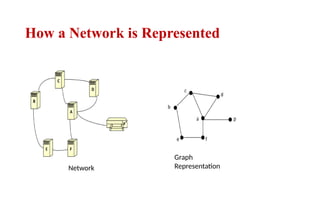
How a Network is Represented
Network
Graph
Representation
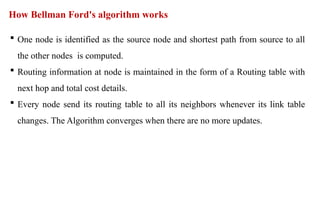
How Bellman Ford's algorithm works
 One node is identified as the source node and shortest path from source to all
the other nodes is computed.
 Routing information at node is maintained in the form of a Routing table with
next hop and total cost details.
 Every node send its routing table to all its neighbors whenever its link table
changes. The Algorithm converges when there are no more updates.
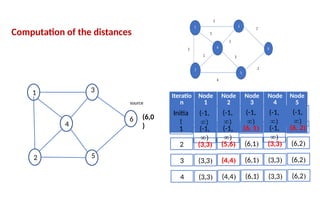
• Initially all nodes, other than the source node 6, are at infinite
cost(distance) to node 6. Node 6 informs its neighbors it is at distance 0
from itself.
• Iteration 1:- Node 3 finds that it is connected to node 6 with cost of 1. Node
5 finds it is connected to node 6 at a cost of 2. nodes 3 and 5 update their
entries and inform their neighbors.
• Iteration 2:- Node1 finds it can reach node 6, via node 3 with cost 3. Node
2 finds it can reach node 6, via node 5 with cost 6. Node 4 finds it has paths
via nodes 3and 5, with costs 3 and 7 respectively. Node 4 selects the path via
node 3. Nodes 1, 2, and 4 update their entries and inform their neighbors.
• Iteration 3:- Node 2 finds that it can reach node 6 via node 4 with distance
4. Node 2 changes its entry to (4,4) and informs its neighbors.
• Iteration 4:- Nodes 1 and 5 process the new entry from node 2 but do not
find any new shortest paths. The algorithm has converged.
1 3
5
6
2
4
Iteratio
n
Node
1
Node
2
Node
3
Node
4
Node
5
(6,0
)
(-1,
∞)
(-1,
∞)
(-1,
∞)
(-1,
∞)
(-1,
∞)
Initia
l
(-1,
∞)
(6, 1) (-1,
∞)
(6, 2)
(-1,
∞)
1
(5,6) (6,1) (3,3) (6,2)
(3,3)
2
(4,4) (6,1) (3,3) (6,2)
(3,3)
3
(4,4) (6,1) (3,3) (6,2)
(3,3)
4
Computation of the distances
source
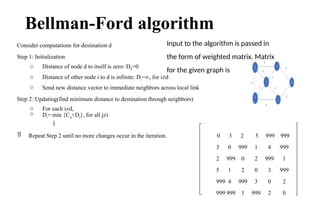
Bellman-Ford algorithm
Consider computations for destination d
Step 1: Initialization
o Distance of node d to itself is zero: Dd=0
o Distance of other node i to d is infinite: Di=∞, for i≠d
o Send new distance vector to immediate neighbors across local link
Step 2: Updating(find minimum distance to destination through neighbors)
o For each i≠d,
o Di= min {Cij+Dj}, for all j≠i
j
 Repeat Step 2 until no more changes occur in the iteration. 0 3 2 5 999 999
3 0 999 1 4 999
2 999 0 2 999 1
5 1 2 0 3 999
999 4 999 3 0 2
999 999 1 999 2 0
Input to the algorithm is passed in
the form of weighted matrix. Matrix
for the given graph is
Program 6: Write a program to find the shortest path between vertices
using bellman-ford algorithm.
import java.util.Scanner;
public class BellmanFord
{
private int D[];
private int n;
public static final int MAX_VALUE = 999;
public BellmanFord(int n) Constructor of the class
{
this.n=n;
D = new int[n+1]; Creates an array D to hold the distance information
}
public void shortest(int d, int A[][])
{
for (int i=1;i<=n;i++)
D[i]=MAX_VALUE; Initially all n values in D is set to infinity which is 999
D[d] = 0; Distance from destination to itself is set to zero
for(int k=1;k<=n-1;k++)
{
for(int i=1;i<=n;i++)
{
for(int j=1;j<=n;j++)
{
if(A[i][j]!=MAX_VALUE) for every node distance is updated in array D, if an
alternate path is available path through a neighbor
which is better than the current
if(D[j]>D[i]+A[i][j]) {
D[j] is the current distance value, D[i]+A[i][j] is the
D[j]=D[i]+A[i][j]; new path through neighbor i
}
}
}
}
for(int i=1;i<=n;i++)
{
for(int j=1;j<=n;j++)
{
if(A[i][j]!=MAX_VALUE)
{
if(D[j]>D[i]+A[i][j]) The same condition which was tested in the previous loop is
checked, if it is true here the graph contains negative edges
{
System.out.println("The Graph contains negative egde cycle");
return;
}
}
}
}
for(int i=1;i<=n;i++)
{
System.out.println("Distance from " +i+ “ to destination " +d+ "is " + D[i]); Finally array D will
have the computed distance from all
} the vertices to the destination vertex
}
public static void main(String[ ] args)
{
int n=0,d;
Scanner sc = new Scanner(System.in);
System.out.println("Enter the number of vertices");
n = sc.nextInt();
int A[][] = new int[n+1][n+1];
System.out.println("Enter the Weighted matrix");
for(int i=1;i<=n;i++)
{
for(int j=1;j<=n;j++)
A[i][j]=sc.nextInt(); read the weighted matrix A
}
System.out.println("Enter the destination vertex");
d=sc.nextInt(); select the destination node
BellmanFord b = new BellmanFord(n); create an object of the class
b.shortest(d,A); Call the shortest function
sc.close();
}
}
OUTPUT 1
run:
Enter the number of vertices
6
Enter the Weighted matrix
0 3 2 5 999 999
3 0 999 1 4 999
2 999 0 2 999 1
5 1 2 0 3 999
999 4 999 3 0 2
999 999 1 999 2 0
Enter the destination vertex
6
Distance from 1 to destination 6 is 3
Distance from 2 to destination 6 is 4
Distance from 3 to destination 6 is 1
Distance from 4 to destination 6 is 3
Distance from 5 to destination 6 is 2
Distance from 6 to destination 6 is 0
OUTPUT 2
run:
Enter the number of vertices
6
Enter the Weighted matrix
0 -3 2 5 999 999
-3 0 999 1 4 999
2 999 0 2 999 1
5 1 2 0 3 999
999 4 999 3 0 2
999 999 1 999 2 0
Enter the destination vertex
6
The Graph contains negative edge cycle
BUILD SUCCESSFUL (total time: 1 minute 11
seconds)
-

computer networks lab program Bellman Ford.pptx

  • 1.
    Computer Network Laboratory-BCS502 Departmentof CSE - Data Science Program 6: Develop a program to find the shortest path between vertices using the Bellman-Ford and path vector routing algorithm
  • 3.
    Bellman-Ford algorithm  Bellman-Fordalgorithm is used to find shortest path (minimum distance) from one node to all the other nodes in a given network.  It operates at network layer  It is also called as Distance vector algorithm/Ford Fulkerson algorithm.  It maintains a table which gives two pieces of information i.e next hop and total cost.  Bellman-Ford is capable of handling graphs that contain negative edge weights, so it is more versatile.
  • 4.
    How a Networkis Represented Network Graph Representation
  • 5.
    How Bellman Ford'salgorithm works  One node is identified as the source node and shortest path from source to all the other nodes is computed.  Routing information at node is maintained in the form of a Routing table with next hop and total cost details.  Every node send its routing table to all its neighbors whenever its link table changes. The Algorithm converges when there are no more updates.
  • 6.
    • Initially allnodes, other than the source node 6, are at infinite cost(distance) to node 6. Node 6 informs its neighbors it is at distance 0 from itself. • Iteration 1:- Node 3 finds that it is connected to node 6 with cost of 1. Node 5 finds it is connected to node 6 at a cost of 2. nodes 3 and 5 update their entries and inform their neighbors. • Iteration 2:- Node1 finds it can reach node 6, via node 3 with cost 3. Node 2 finds it can reach node 6, via node 5 with cost 6. Node 4 finds it has paths via nodes 3and 5, with costs 3 and 7 respectively. Node 4 selects the path via node 3. Nodes 1, 2, and 4 update their entries and inform their neighbors. • Iteration 3:- Node 2 finds that it can reach node 6 via node 4 with distance 4. Node 2 changes its entry to (4,4) and informs its neighbors. • Iteration 4:- Nodes 1 and 5 process the new entry from node 2 but do not find any new shortest paths. The algorithm has converged.
  • 7.
    1 3 5 6 2 4 Iteratio n Node 1 Node 2 Node 3 Node 4 Node 5 (6,0 ) (-1, ∞) (-1, ∞) (-1, ∞) (-1, ∞) (-1, ∞) Initia l (-1, ∞) (6, 1)(-1, ∞) (6, 2) (-1, ∞) 1 (5,6) (6,1) (3,3) (6,2) (3,3) 2 (4,4) (6,1) (3,3) (6,2) (3,3) 3 (4,4) (6,1) (3,3) (6,2) (3,3) 4 Computation of the distances source
  • 8.
    Bellman-Ford algorithm Consider computationsfor destination d Step 1: Initialization o Distance of node d to itself is zero: Dd=0 o Distance of other node i to d is infinite: Di=∞, for i≠d o Send new distance vector to immediate neighbors across local link Step 2: Updating(find minimum distance to destination through neighbors) o For each i≠d, o Di= min {Cij+Dj}, for all j≠i j  Repeat Step 2 until no more changes occur in the iteration. 0 3 2 5 999 999 3 0 999 1 4 999 2 999 0 2 999 1 5 1 2 0 3 999 999 4 999 3 0 2 999 999 1 999 2 0 Input to the algorithm is passed in the form of weighted matrix. Matrix for the given graph is
  • 9.
    Program 6: Writea program to find the shortest path between vertices using bellman-ford algorithm. import java.util.Scanner; public class BellmanFord { private int D[]; private int n; public static final int MAX_VALUE = 999; public BellmanFord(int n) Constructor of the class { this.n=n; D = new int[n+1]; Creates an array D to hold the distance information } public void shortest(int d, int A[][]) { for (int i=1;i<=n;i++) D[i]=MAX_VALUE; Initially all n values in D is set to infinity which is 999
  • 10.
    D[d] = 0;Distance from destination to itself is set to zero for(int k=1;k<=n-1;k++) { for(int i=1;i<=n;i++) { for(int j=1;j<=n;j++) { if(A[i][j]!=MAX_VALUE) for every node distance is updated in array D, if an alternate path is available path through a neighbor which is better than the current if(D[j]>D[i]+A[i][j]) { D[j] is the current distance value, D[i]+A[i][j] is the D[j]=D[i]+A[i][j]; new path through neighbor i } } } }
  • 11.
    for(int i=1;i<=n;i++) { for(int j=1;j<=n;j++) { if(A[i][j]!=MAX_VALUE) { if(D[j]>D[i]+A[i][j])The same condition which was tested in the previous loop is checked, if it is true here the graph contains negative edges { System.out.println("The Graph contains negative egde cycle"); return; } } } } for(int i=1;i<=n;i++) { System.out.println("Distance from " +i+ “ to destination " +d+ "is " + D[i]); Finally array D will have the computed distance from all } the vertices to the destination vertex }
  • 12.
    public static voidmain(String[ ] args) { int n=0,d; Scanner sc = new Scanner(System.in); System.out.println("Enter the number of vertices"); n = sc.nextInt(); int A[][] = new int[n+1][n+1]; System.out.println("Enter the Weighted matrix"); for(int i=1;i<=n;i++) { for(int j=1;j<=n;j++) A[i][j]=sc.nextInt(); read the weighted matrix A } System.out.println("Enter the destination vertex"); d=sc.nextInt(); select the destination node BellmanFord b = new BellmanFord(n); create an object of the class b.shortest(d,A); Call the shortest function sc.close(); } }
  • 13.
    OUTPUT 1 run: Enter thenumber of vertices 6 Enter the Weighted matrix 0 3 2 5 999 999 3 0 999 1 4 999 2 999 0 2 999 1 5 1 2 0 3 999 999 4 999 3 0 2 999 999 1 999 2 0 Enter the destination vertex 6 Distance from 1 to destination 6 is 3 Distance from 2 to destination 6 is 4 Distance from 3 to destination 6 is 1 Distance from 4 to destination 6 is 3 Distance from 5 to destination 6 is 2 Distance from 6 to destination 6 is 0
  • 14.
    OUTPUT 2 run: Enter thenumber of vertices 6 Enter the Weighted matrix 0 -3 2 5 999 999 -3 0 999 1 4 999 2 999 0 2 999 1 5 1 2 0 3 999 999 4 999 3 0 2 999 999 1 999 2 0 Enter the destination vertex 6 The Graph contains negative edge cycle BUILD SUCCESSFUL (total time: 1 minute 11 seconds) -