
Pro-Poor Climate Change Mitigation: LiniWollenberg
WHY ?Long Term: food security v. agricultural mitigation Competing demands will exceed the 445 Mhaavailable(Lambin 2011)Short Term: Identifying feasible options for smallholder mitigation    -Incentives (C mkt?), MRV, results in practice, trade-offs
Pro Poor  Mitigation3.1 Agricultural development pathwaysPolicies supporting low GHG impact & triple winPolicy impacts on  outcomes and trade-offsMethods and scenarios to conduct analysesTarget: policy makers, donors, UNFCCC, NARSImpacts and trade-offs3.2 Incentives and institutionsPolicy, market, and project design optionsFeasibility of options: cost effectiveness, benefits for farmers, farmers’ participation, governanceTarget: Project developers, donors, policy makers3.3 Technical options for smallholdersStandards and MRV appropriate to smallholdersSystems analysis at farm and landscape levelsTechnologies on farmsTarget: standards, national agencies, project developersGender lensPlace-based workBenchmark sitesAction researchCapacity buildingEmissions scenariosGHG regional working groupsPhD network on methods
Mitigation potentialsand technical options
Technical options and mitigation potentialsBenchmark site, national, and regional emissions baselines and mitigation potentials (80%+ GHGs from livestock, Ethiopia)National training on modelling mitigation potentials Centers- Technical options (most centers); trade-offs in livestock sector, tool for low C emissions decisions (ILRI); agroforestry suitability maps and sensitivity analysis (ICRAF)CGIAR SynergiesDemonstrating feasibility of improved practices and technologies in agriculture, (benchmark sites)Trade-offs analysis (win3 + adaptive)National capacities for decision-making
INSTITUTIONS AND INCENTIVESPro-poor mitigation What CCAFS outputs?Why are they useful?>> Spotlight on: State-of-the-art agricultural mitigationEarthscan book of current knowledgeLessons from REDD+ for agricultureMaximizing opportunities, avoiding pitfalls in future systems for ag mitigation3
Test the carbon marketImproving benefits from carbon market         projects  PAR with 6 E. Africa projects, w/Ecoagriculture, ICRAF):- Real benefits from yields, not payments ($2/yr)  Need to decrease costs and risks
 Pre-existing institutions, upfront finance critical
 Monitoring livelihoods not a project priorityCGIAR Synergies-Mitigation as co-benefit to agriculture   -Models for ecological service payments (PES) (ICRAF, CIFOR, and ?)
Adoption of low climate impact practicesIncentives synthesis workshop:  review papers on costs and benefits of mitigation optionsadoption barriers, incentive delivery mechanisms Investment mechanisms (Munden Project + bilateral donors? Centers:  Most, IFPRI’s IFAD project CGIAR Synergies    Comparison of benefits and trade-offs among practices    Increasing adoption of mitigation practices: win-win farming practices, learning hubs
Major Outputs in 2010Measurement and MonitoringSynthesis book on Agriculture and Climate Change Mitigation (38 chapters)Site, national, and regional mitigation potentials and GHG baselinesC-market institutional baselines and partnerships for PAR (including role of women)Lessons learned from REDDLivestock synthesisCoffee synthesisCocoa intensification study
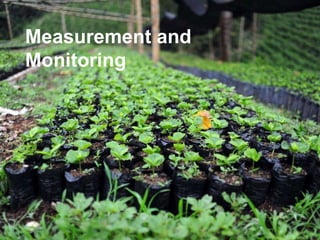
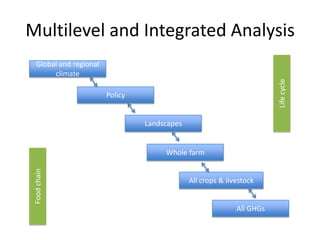
Measurement and Monitoring of GHGsField testing of process models in regionsAgricultural GHG quantification (FAO, Duke U. ++) :  (1) General review, (2) Farm-scale and landscape scale toolsRegional working groupsCenters: Landscape tools for C stock estimates (ICRAF), National training for livestock systems GHG inventories (ILRI)CGIAR Synergies MRV and standards for smallholders,  Systems methods and analysis: Farm, production system, and landscape Scientific capacity building
Major Outputs in 2010Synthesis book on Agriculture and Climate Change Mitigation (38 chapters)Site, national, and regional mitigation potentials and GHG baselinesC-market institutional baselines and partnerships for PAR (including role of women)Lessons learned from REDDLivestock synthesisCoffee synthesisCocoa intensification study
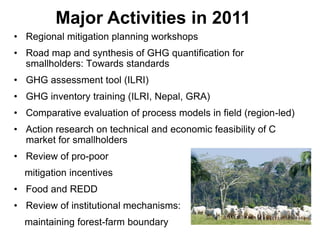
Major Activities in 2011Regional mitigation planning workshopsRoad map and synthesis of GHG quantification for smallholders: Towards standardsGHG assessment tool (ILRI)GHG inventory training (ILRI, Nepal, GRA)Comparative evaluation of process models in field (region-led)Action research on technical and economic feasibility of C market for smallholdersReview of pro-poor     mitigation incentivesFood and REDD
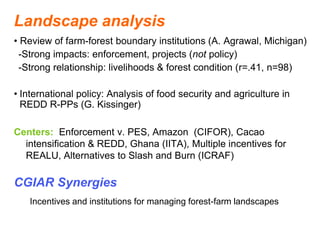
Review of institutional mechanisms:    maintaining forest-farm boundary
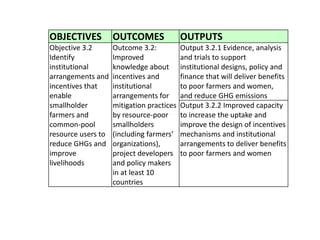
Pro-Poor Mitigation objectives3.1 Identify agricultural development pathways Evaluate C footprint for-food production and adaptation options-energy production-sustainable intensificationAssess policy impacts for “triple win”TOC: Develop visions/ evidence with policy makers, UNFCCC and donors to guide agricultural developmentCGIAR:  ILRI, IFPRI
3.2 Develop incentives and institutions for pro-poor mitigationTest feasibility of carbon market for smallholders
Other incentives and innovations: food value chains, aggregation, risk sharing, micro-finance, landscapes
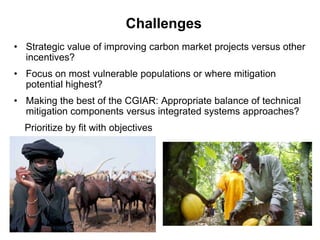
Assess impactsTOC       - Develop innovative models for projects and policy makers      - Use long-term action research; learning networks      - Focus where success likely (Latin Am, SE Asia)      - Test mitigation among vulnerable populations? CGIAR:  IFPRI, CAPRI, ICRAF, World Fish
3.3 Develop technological options for mitigation by smallholders    - Test technologies on farms for multiple sectors (all GHG, lifecycle, whole farm, landscape)    - Develop cost-effective, simple, integrated MRV    - Assess impacts Build on existing trials and work of CG Centers and NARSCGIAR:  All centersTOC  - Produce data and standards for national inventories, IPCC/UNFCCC, carbon markets -  Regional working groups and datasets
Main outcomes2012

CCAFS Theme 3 Strategy: Pro-Poor Climate Change Mitigation - Lini Wollenberg

  • 1.
    Pro-Poor Climate ChangeMitigation: LiniWollenberg
  • 2.
    WHY ?Long Term:food security v. agricultural mitigation Competing demands will exceed the 445 Mhaavailable(Lambin 2011)Short Term: Identifying feasible options for smallholder mitigation -Incentives (C mkt?), MRV, results in practice, trade-offs
  • 3.
    Pro Poor Mitigation3.1 Agricultural development pathwaysPolicies supporting low GHG impact & triple winPolicy impacts on outcomes and trade-offsMethods and scenarios to conduct analysesTarget: policy makers, donors, UNFCCC, NARSImpacts and trade-offs3.2 Incentives and institutionsPolicy, market, and project design optionsFeasibility of options: cost effectiveness, benefits for farmers, farmers’ participation, governanceTarget: Project developers, donors, policy makers3.3 Technical options for smallholdersStandards and MRV appropriate to smallholdersSystems analysis at farm and landscape levelsTechnologies on farmsTarget: standards, national agencies, project developersGender lensPlace-based workBenchmark sitesAction researchCapacity buildingEmissions scenariosGHG regional working groupsPhD network on methods
  • 4.
  • 5.
    Technical options andmitigation potentialsBenchmark site, national, and regional emissions baselines and mitigation potentials (80%+ GHGs from livestock, Ethiopia)National training on modelling mitigation potentials Centers- Technical options (most centers); trade-offs in livestock sector, tool for low C emissions decisions (ILRI); agroforestry suitability maps and sensitivity analysis (ICRAF)CGIAR SynergiesDemonstrating feasibility of improved practices and technologies in agriculture, (benchmark sites)Trade-offs analysis (win3 + adaptive)National capacities for decision-making
  • 6.
    INSTITUTIONS AND INCENTIVESPro-poormitigation What CCAFS outputs?Why are they useful?>> Spotlight on: State-of-the-art agricultural mitigationEarthscan book of current knowledgeLessons from REDD+ for agricultureMaximizing opportunities, avoiding pitfalls in future systems for ag mitigation3
  • 7.
    Test the carbonmarketImproving benefits from carbon market projects PAR with 6 E. Africa projects, w/Ecoagriculture, ICRAF):- Real benefits from yields, not payments ($2/yr) Need to decrease costs and risks
  • 8.
    Pre-existing institutions,upfront finance critical
  • 9.
    Monitoring livelihoodsnot a project priorityCGIAR Synergies-Mitigation as co-benefit to agriculture -Models for ecological service payments (PES) (ICRAF, CIFOR, and ?)
  • 10.
    Adoption of lowclimate impact practicesIncentives synthesis workshop: review papers on costs and benefits of mitigation optionsadoption barriers, incentive delivery mechanisms Investment mechanisms (Munden Project + bilateral donors? Centers: Most, IFPRI’s IFAD project CGIAR Synergies Comparison of benefits and trade-offs among practices Increasing adoption of mitigation practices: win-win farming practices, learning hubs
  • 11.
    Major Outputs in2010Measurement and MonitoringSynthesis book on Agriculture and Climate Change Mitigation (38 chapters)Site, national, and regional mitigation potentials and GHG baselinesC-market institutional baselines and partnerships for PAR (including role of women)Lessons learned from REDDLivestock synthesisCoffee synthesisCocoa intensification study
  • 12.
    Measurement and Monitoringof GHGsField testing of process models in regionsAgricultural GHG quantification (FAO, Duke U. ++) : (1) General review, (2) Farm-scale and landscape scale toolsRegional working groupsCenters: Landscape tools for C stock estimates (ICRAF), National training for livestock systems GHG inventories (ILRI)CGIAR Synergies MRV and standards for smallholders, Systems methods and analysis: Farm, production system, and landscape Scientific capacity building
  • 15.
    Major Outputs in2010Synthesis book on Agriculture and Climate Change Mitigation (38 chapters)Site, national, and regional mitigation potentials and GHG baselinesC-market institutional baselines and partnerships for PAR (including role of women)Lessons learned from REDDLivestock synthesisCoffee synthesisCocoa intensification study
  • 16.
    Major Activities in2011Regional mitigation planning workshopsRoad map and synthesis of GHG quantification for smallholders: Towards standardsGHG assessment tool (ILRI)GHG inventory training (ILRI, Nepal, GRA)Comparative evaluation of process models in field (region-led)Action research on technical and economic feasibility of C market for smallholdersReview of pro-poor mitigation incentivesFood and REDD
  • 17.
    Review of institutionalmechanisms: maintaining forest-farm boundary
  • 19.
    Pro-Poor Mitigation objectives3.1Identify agricultural development pathways Evaluate C footprint for-food production and adaptation options-energy production-sustainable intensificationAssess policy impacts for “triple win”TOC: Develop visions/ evidence with policy makers, UNFCCC and donors to guide agricultural developmentCGIAR: ILRI, IFPRI
  • 20.
    3.2 Develop incentivesand institutions for pro-poor mitigationTest feasibility of carbon market for smallholders
  • 21.
    Other incentives andinnovations: food value chains, aggregation, risk sharing, micro-finance, landscapes
  • 22.
    Assess impactsTOC - Develop innovative models for projects and policy makers - Use long-term action research; learning networks - Focus where success likely (Latin Am, SE Asia) - Test mitigation among vulnerable populations? CGIAR: IFPRI, CAPRI, ICRAF, World Fish
  • 23.
    3.3 Develop technologicaloptions for mitigation by smallholders - Test technologies on farms for multiple sectors (all GHG, lifecycle, whole farm, landscape) - Develop cost-effective, simple, integrated MRV - Assess impacts Build on existing trials and work of CG Centers and NARSCGIAR: All centersTOC - Produce data and standards for national inventories, IPCC/UNFCCC, carbon markets - Regional working groups and datasets
  • 27.

Editor's Notes

  • #3 ␣4,000 Mha is suitable for rain-fed agriculture. Demand with no deforestation , would have to clear all natural forests to make positive, or substantially deforest
  • #4 Are you sure you need this again, but OK
  • #6 Synergies: where the whole is more than the sum of the parts
  • #7 Wide set of CG and ESSP partners writing book chapters for Earthscan; covering the range of ag sectors including livestock and fisheriesSimilarly full range of lessons from REDD+: technical options, “measurement, reporting and verification” (MRV), finance, institutions, incentives
  • #17  Use scenarios, assessment methods, science-policy dialogs. Benchmark site data used to demonstrate regional and agroecosystem options
  • #20 We need to develop a three year work plan for each Theme – each theme has three objectives. This is objective #1. Each Objective has three Outputs. {Hit} Unfortunately, this text is set in stone. We need to fit the Centre activities into this text.{Hit} Now what we must do. We need Centre-proposed milestones.{Hit} For ICRAF we need 3-5 milestones over all of Theme 3, perhaps just one for Objective 3.1
  • #23 I think it would be better to structure like Jim; sanyway it is not clear that you have your “theory of change” covered.
  • #25 Innovative C footprint assessment tool,Methods field testing and regional networksAssessments of national policy and projectsTrade-off scenarios
  • #27 400 publications reviewed, cases of ProAmbiente and NRM in australiaBorner: Scope for positive REDD incentives at national level is limited– pre-existing use right restrictions– weak/poorly defined property rights at many forest frontiers• C&C policies much cheaper to implement than PES (<US$700 million versus >US$ 9 billion annually), but with contentious social welfare implications.REDD+ Readiness Proposal (R-PP) submissions to the World Bank Forest Carbon Partnership Facility, available on the FCPF website, were reviewed. Although 37 countries are participating in the FCPF, only those with enough structure to their REDD+ programmes (either at readiness proposal or readiness plan stages) were reviewed. Furthermore, only those with enough documentation in English were reviewed (thus Central African Republic (R-PP in French), Nicaragua and Peru (R-PP’s in Spanish) were omitted). Indonesia’s UN-REDD National Joint Programme Document submission (dated October 2009) contained more detail than its May 2009 FCPF submission, so the UN-REDD submission was relied upon. The following countries were included in the REDD+ readiness plan review:  Africa: DR of Congo, Ethiopia, Ghana, Kenya, Liberia, Madagascar, Republic of Congo, Tanzania, Uganda  Asia: Cambodia, Indonesia (R-Plan), Lao PDR, Nepal, Vietnam Latin America: Argentina, Costa Rica, Guyana, Mexico, Panama, Suriname Of 20 countries reviewed, 16 report agriculture as the primary driver of D&D. Mention tenure and low productivity, but don’t address in policy