ECONOMIC AND SOCIAL EVALUATION OF NATIONAL GHG MITIGATION OPTIONS FOR AGRICULTURAL LANDSCAPES IN EAST AFRICA 
Moses Masiga - ENR Africa Associates 
CCAFS/FAO Expert Workshop on NAMAs: National mitigation planning and implementation in agriculture, Rome, Italy 16-17 July 2012 
CCAFS/ENRAfricaAssociates
OUTLINE 
1.Introduction 
2.Methodology: Data sources & Analytical Approaches; 
3.National Scenarios – Agricultural Sector Model 
4.Current stage of study 
CCAFS/ENRAfricaAssociates
INTRODUCTION 
The study contributes (CCAFS) Pro-poor Climate Change Mitigation: to identify climate change mitigation strategies that reduce poverty among the rural poor in developing countries. 
Balancing the need for precise and accurate information with realistic expectations for the effort and expense that can be dedicated to monitoring, reporting and verification costs. 
Compatibility with national goals for food security, economic development and trade i.e. sustainable food production & tangible benefits to farmers 
Work taking place in Kenya, Uganda and Ethiopia 
CCAFS/ENRAfricaAssociates
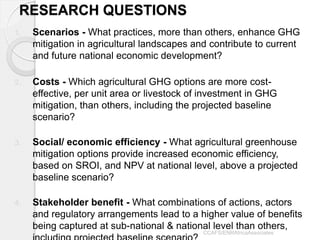
RESEARCH QUESTIONS 
1.Scenarios - What practices, more than others, enhance GHG mitigation in agricultural landscapes and contribute to current and future national economic development? 
2.Costs - Which agricultural GHG options are more cost- effective, per unit area or livestock of investment in GHG mitigation, than others, including the projected baseline scenario? 
3.Social/ economic efficiency - What agricultural greenhouse mitigation options provide increased economic efficiency, based on SROI, and NPV at national level, above a projected baseline scenario? 
4.Stakeholder benefit - What combinations of actions, actors and regulatory arrangements lead to a higher value of benefits being captured at sub-national & national level than others, including projected baseline scenario? 
CCAFS/ENRAfricaAssociates
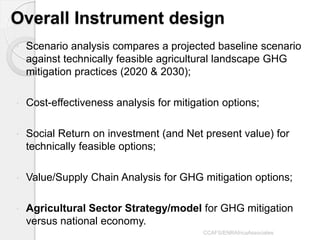
Overall Instrument design 
•Scenario analysis compares a projected baseline scenario against technically feasible agricultural landscape GHG mitigation practices (2020 & 2030); 
•Cost-effectiveness analysis for mitigation options; 
•Social Return on investment (and Net present value) for technically feasible options; 
•Value/Supply Chain Analysis for GHG mitigation options; 
•Agricultural Sector Strategy/model for GHG mitigation versus national economy. 
CCAFS/ENRAfricaAssociates
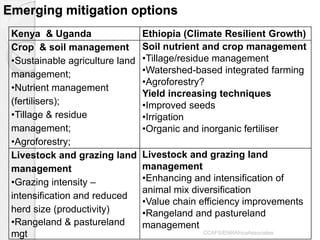
Emerging mitigation options 
Kenya & Uganda 
Ethiopia (Climate Resilient Growth) 
Crop & soil management 
•Sustainable agriculture land management; 
•Nutrient management (fertilisers); 
•Tillage & residue management; 
•Agroforestry; 
Soil nutrient and crop management 
•Tillage/residue management 
•Watershed-based integrated farming 
•Agroforestry? Yield increasing techniques 
•Improved seeds 
•Irrigation 
•Organic and inorganic fertiliser 
Livestock and grazing land management 
•Grazing intensity – intensification and reduced herd size (productivity) 
•Rangeland & pastureland mgt 
Livestock and grazing land management 
•Enhancing and intensification of animal mix diversification 
•Value chain efficiency improvements 
•Rangeland and pastureland management 
CCAFS/ENRAfricaAssociates
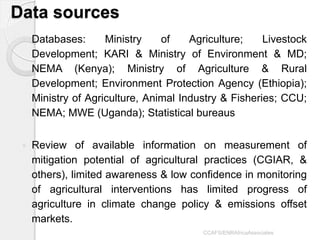
Data sources 
Databases: Ministry of Agriculture; Livestock Development; KARI & Ministry of Environment & MD; NEMA (Kenya); Ministry of Agriculture & Rural Development; Environment Protection Agency (Ethiopia); Ministry of Agriculture, Animal Industry & Fisheries; CCU; NEMA; MWE (Uganda); Statistical bureaus 
Review of available information on measurement of mitigation potential of agricultural practices (CGIAR, & others), limited awareness & low confidence in monitoring of agricultural interventions has limited progress of agriculture in climate change policy & emissions offset markets. 
CCAFS/ENRAfricaAssociates
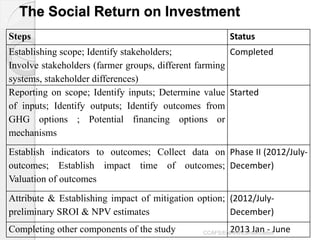
The Social Return on Investment 
Steps 
Status 
Establishing scope; Identify stakeholders; 
Involve stakeholders (farmer groups, different farming systems, stakeholder differences) 
Completed 
Reporting on scope; Identify inputs; Determine value of inputs; Identify outputs; Identify outcomes from GHG options ; Potential financing options or mechanisms 
Started 
Establish indicators to outcomes; Collect data on outcomes; Establish impact time of outcomes; Valuation of outcomes 
Phase II (2012/July- December) 
Attribute & Establishing impact of mitigation option; preliminary SROI & NPV estimates 
(2012/July- December) 
Completing other components of the study 
2013 Jan - June 
CCAFS/ENRAfricaAssociates
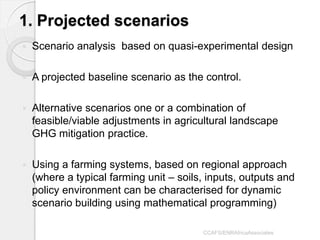
1. Projected scenarios 
Scenario analysis based on quasi-experimental design 
A projected baseline scenario as the control. 
Alternative scenarios one or a combination of feasible/viable adjustments in agricultural landscape GHG mitigation practice. 
Using a farming systems, based on regional approach (where a typical farming unit – soils, inputs, outputs and policy environment can be characterised for dynamic scenario building using mathematical programming) 
CCAFS/ENRAfricaAssociates
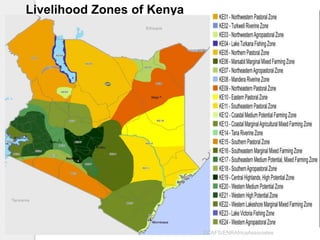
Livelihood Zones of Kenya 
CCAFS/ENRAfricaAssociates
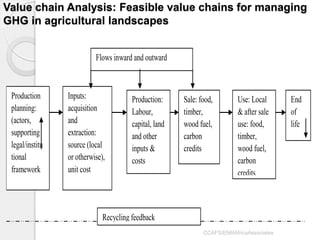
Value chain Analysis: Feasible value chains for managing GHG in agricultural landscapes 
CCAFS/ENRAfricaAssociates 
Flows inward and outward Production planning: (actors, supporting legal/institutional framework Production: Labour, capital, land and other inputs & costs Inputs: acquisition and extraction: source (local or otherwise), unit cost Sale: food, timber, wood fuel, carbon credits Use: Local & after sale use: food, timber, wood fuel, carbon credits End of life Recycling feedback
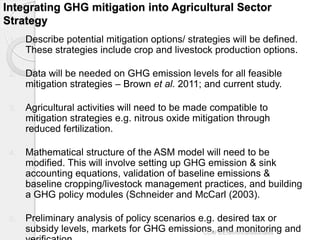
Integrating GHG mitigation into Agricultural Sector Strategy 
1.Describe potential mitigation options/ strategies will be defined. These strategies include crop and livestock production options. 
2.Data will be needed on GHG emission levels for all feasible mitigation strategies – Brown et al. 2011; and current study. 
3.Agricultural activities will need to be made compatible to mitigation strategies e.g. nitrous oxide mitigation through reduced fertilization. 
4.Mathematical structure of the ASM model will need to be modified. This will involve setting up GHG emission & sink accounting equations, validation of baseline emissions & baseline cropping/livestock management practices, and building a GHG policy modules (Schneider and McCarl (2003). 
5.Preliminary analysis of policy scenarios e.g. desired tax or subsidy levels, markets for GHG emissions, and monitoring and verification. 
CCAFS/ENRAfricaAssociates
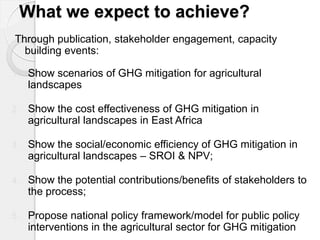
What we expect to achieve? 
Through publication, stakeholder engagement, capacity building events: 
1.Show scenarios of GHG mitigation for agricultural landscapes 
2.Show the cost effectiveness of GHG mitigation in agricultural landscapes in East Africa 
3.Show the social/economic efficiency of GHG mitigation in agricultural landscapes – SROI & NPV; 
4.Show the potential contributions/benefits of stakeholders to the process; 
5.Propose national policy framework/model for public policy interventions in the agricultural sector for GHG mitigation
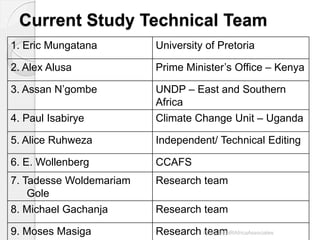
Current Study Technical Team 
1. Eric Mungatana 
University of Pretoria 
2. Alex Alusa 
Prime Minister’s Office – Kenya 
3. Assan N’gombe 
UNDP – East and Southern Africa 
4. Paul Isabirye 
Climate Change Unit – Uganda 
5. Alice Ruhweza 
Independent/ Technical Editing 
6. E. Wollenberg 
CCAFS 
7. Tadesse Woldemariam Gole 
Research team 
8. Michael Gachanja 
Research team 
9. Moses Masiga 
Research team 
CCAFS/ENRAfricaAssociates
THANKS... 
CCAFS/ENRAfricaAssociates

Masiga Economic social evaluation national GHG mitigation

  • 1.
    ECONOMIC AND SOCIALEVALUATION OF NATIONAL GHG MITIGATION OPTIONS FOR AGRICULTURAL LANDSCAPES IN EAST AFRICA Moses Masiga - ENR Africa Associates CCAFS/FAO Expert Workshop on NAMAs: National mitigation planning and implementation in agriculture, Rome, Italy 16-17 July 2012 CCAFS/ENRAfricaAssociates
  • 2.
    OUTLINE 1.Introduction 2.Methodology:Data sources & Analytical Approaches; 3.National Scenarios – Agricultural Sector Model 4.Current stage of study CCAFS/ENRAfricaAssociates
  • 3.
    INTRODUCTION The studycontributes (CCAFS) Pro-poor Climate Change Mitigation: to identify climate change mitigation strategies that reduce poverty among the rural poor in developing countries. Balancing the need for precise and accurate information with realistic expectations for the effort and expense that can be dedicated to monitoring, reporting and verification costs. Compatibility with national goals for food security, economic development and trade i.e. sustainable food production & tangible benefits to farmers Work taking place in Kenya, Uganda and Ethiopia CCAFS/ENRAfricaAssociates
  • 4.
    RESEARCH QUESTIONS 1.Scenarios- What practices, more than others, enhance GHG mitigation in agricultural landscapes and contribute to current and future national economic development? 2.Costs - Which agricultural GHG options are more cost- effective, per unit area or livestock of investment in GHG mitigation, than others, including the projected baseline scenario? 3.Social/ economic efficiency - What agricultural greenhouse mitigation options provide increased economic efficiency, based on SROI, and NPV at national level, above a projected baseline scenario? 4.Stakeholder benefit - What combinations of actions, actors and regulatory arrangements lead to a higher value of benefits being captured at sub-national & national level than others, including projected baseline scenario? CCAFS/ENRAfricaAssociates
  • 5.
    Overall Instrument design •Scenario analysis compares a projected baseline scenario against technically feasible agricultural landscape GHG mitigation practices (2020 & 2030); •Cost-effectiveness analysis for mitigation options; •Social Return on investment (and Net present value) for technically feasible options; •Value/Supply Chain Analysis for GHG mitigation options; •Agricultural Sector Strategy/model for GHG mitigation versus national economy. CCAFS/ENRAfricaAssociates
  • 6.
    Emerging mitigation options Kenya & Uganda Ethiopia (Climate Resilient Growth) Crop & soil management •Sustainable agriculture land management; •Nutrient management (fertilisers); •Tillage & residue management; •Agroforestry; Soil nutrient and crop management •Tillage/residue management •Watershed-based integrated farming •Agroforestry? Yield increasing techniques •Improved seeds •Irrigation •Organic and inorganic fertiliser Livestock and grazing land management •Grazing intensity – intensification and reduced herd size (productivity) •Rangeland & pastureland mgt Livestock and grazing land management •Enhancing and intensification of animal mix diversification •Value chain efficiency improvements •Rangeland and pastureland management CCAFS/ENRAfricaAssociates
  • 7.
    Data sources Databases:Ministry of Agriculture; Livestock Development; KARI & Ministry of Environment & MD; NEMA (Kenya); Ministry of Agriculture & Rural Development; Environment Protection Agency (Ethiopia); Ministry of Agriculture, Animal Industry & Fisheries; CCU; NEMA; MWE (Uganda); Statistical bureaus Review of available information on measurement of mitigation potential of agricultural practices (CGIAR, & others), limited awareness & low confidence in monitoring of agricultural interventions has limited progress of agriculture in climate change policy & emissions offset markets. CCAFS/ENRAfricaAssociates
  • 8.
    The Social Returnon Investment Steps Status Establishing scope; Identify stakeholders; Involve stakeholders (farmer groups, different farming systems, stakeholder differences) Completed Reporting on scope; Identify inputs; Determine value of inputs; Identify outputs; Identify outcomes from GHG options ; Potential financing options or mechanisms Started Establish indicators to outcomes; Collect data on outcomes; Establish impact time of outcomes; Valuation of outcomes Phase II (2012/July- December) Attribute & Establishing impact of mitigation option; preliminary SROI & NPV estimates (2012/July- December) Completing other components of the study 2013 Jan - June CCAFS/ENRAfricaAssociates
  • 9.
    1. Projected scenarios Scenario analysis based on quasi-experimental design A projected baseline scenario as the control. Alternative scenarios one or a combination of feasible/viable adjustments in agricultural landscape GHG mitigation practice. Using a farming systems, based on regional approach (where a typical farming unit – soils, inputs, outputs and policy environment can be characterised for dynamic scenario building using mathematical programming) CCAFS/ENRAfricaAssociates
  • 10.
    Livelihood Zones ofKenya CCAFS/ENRAfricaAssociates
  • 11.
    Value chain Analysis:Feasible value chains for managing GHG in agricultural landscapes CCAFS/ENRAfricaAssociates Flows inward and outward Production planning: (actors, supporting legal/institutional framework Production: Labour, capital, land and other inputs & costs Inputs: acquisition and extraction: source (local or otherwise), unit cost Sale: food, timber, wood fuel, carbon credits Use: Local & after sale use: food, timber, wood fuel, carbon credits End of life Recycling feedback
  • 12.
    Integrating GHG mitigationinto Agricultural Sector Strategy 1.Describe potential mitigation options/ strategies will be defined. These strategies include crop and livestock production options. 2.Data will be needed on GHG emission levels for all feasible mitigation strategies – Brown et al. 2011; and current study. 3.Agricultural activities will need to be made compatible to mitigation strategies e.g. nitrous oxide mitigation through reduced fertilization. 4.Mathematical structure of the ASM model will need to be modified. This will involve setting up GHG emission & sink accounting equations, validation of baseline emissions & baseline cropping/livestock management practices, and building a GHG policy modules (Schneider and McCarl (2003). 5.Preliminary analysis of policy scenarios e.g. desired tax or subsidy levels, markets for GHG emissions, and monitoring and verification. CCAFS/ENRAfricaAssociates
  • 13.
    What we expectto achieve? Through publication, stakeholder engagement, capacity building events: 1.Show scenarios of GHG mitigation for agricultural landscapes 2.Show the cost effectiveness of GHG mitigation in agricultural landscapes in East Africa 3.Show the social/economic efficiency of GHG mitigation in agricultural landscapes – SROI & NPV; 4.Show the potential contributions/benefits of stakeholders to the process; 5.Propose national policy framework/model for public policy interventions in the agricultural sector for GHG mitigation
  • 14.
    Current Study TechnicalTeam 1. Eric Mungatana University of Pretoria 2. Alex Alusa Prime Minister’s Office – Kenya 3. Assan N’gombe UNDP – East and Southern Africa 4. Paul Isabirye Climate Change Unit – Uganda 5. Alice Ruhweza Independent/ Technical Editing 6. E. Wollenberg CCAFS 7. Tadesse Woldemariam Gole Research team 8. Michael Gachanja Research team 9. Moses Masiga Research team CCAFS/ENRAfricaAssociates
  • 15.