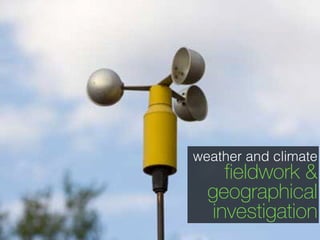
weather and climate
fieldwork &
geographical
investigation
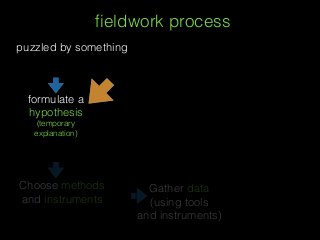
fieldwork process
fieldwork process
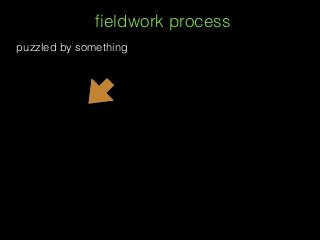
puzzled by something
fieldwork process
puzzled by something
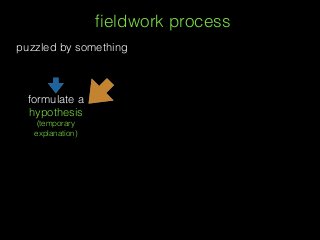
formulate a
hypothesis
(temporary
explanation)
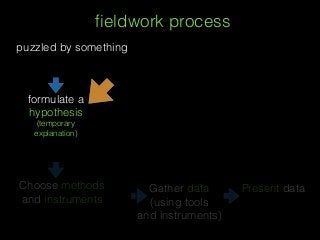
fieldwork process
puzzled by something
formulate a
hypothesis
(temporary
explanation)
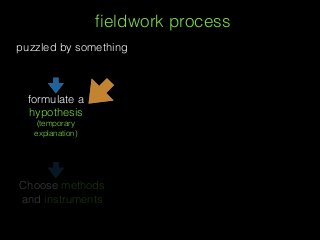
Choose methods
and instruments
fieldwork process
puzzled by something
formulate a
hypothesis
(temporary
explanation)
Choose methods
and instruments
Gather data
(using tools
and instruments)
fieldwork process
puzzled by something
formulate a
hypothesis
(temporary
explanation)
Choose methods
and instruments
Gather data
(using tools
and instruments)
Present data
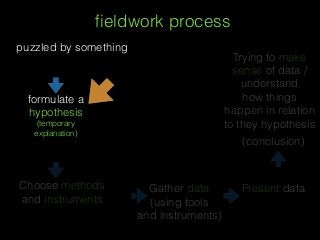
fieldwork process
puzzled by something
formulate a
hypothesis
(temporary
explanation)
Choose methods
and instruments
Gather data
(using tools
and instruments)
Present data
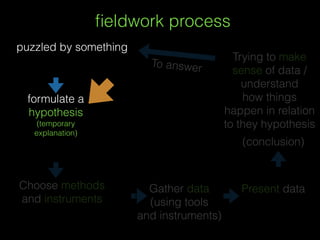
Trying to make
sense of data /
understand
how things
happen in relation
to they hypothesis
(conclusion)
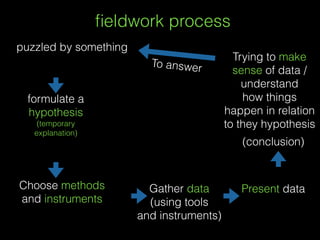
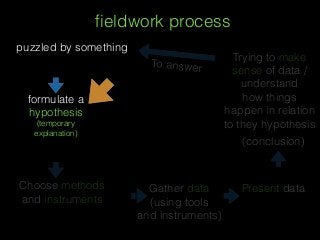
fieldwork process
puzzled by something
formulate a
hypothesis
(temporary
explanation)
Choose methods
and instruments
Gather data
(using tools
and instruments)
Present data
Trying to make
sense of data /
understand
how things
happen in relation
to they hypothesis
(conclusion)
To answer
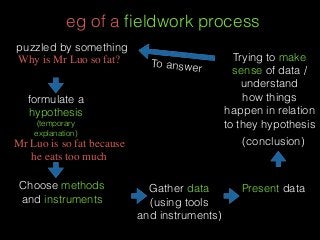
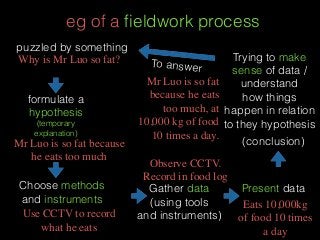
eg of a fieldwork process
puzzled by something
formulate a
hypothesis
(temporary
explanation)
Choose methods
and instruments
Gather data
(using tools
and instruments)
Present data
Trying to make
sense of data /
understand
how things
happen in relation
to they hypothesis
(conclusion)
To answer
eg of a fieldwork process
puzzled by something
formulate a
hypothesis
(temporary
explanation)
Choose methods
and instruments
Gather data
(using tools
and instruments)
Present data
Trying to make
sense of data /
understand
how things
happen in relation
to they hypothesis
(conclusion)
To answer
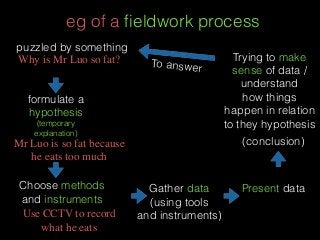
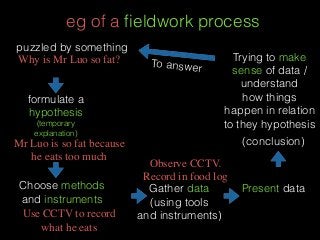
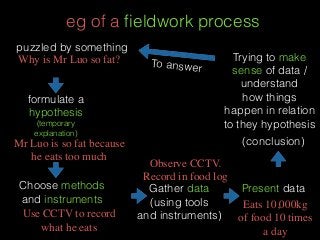
Why is Mr Luo so fat?
eg of a fieldwork process
puzzled by something
formulate a
hypothesis
(temporary
explanation)
Choose methods
and instruments
Gather data
(using tools
and instruments)
Present data
Trying to make
sense of data /
understand
how things
happen in relation
to they hypothesis
(conclusion)
To answer
Why is Mr Luo so fat?
Mr Luo is so fat because
he eats too much
eg of a fieldwork process
puzzled by something
formulate a
hypothesis
(temporary
explanation)
Choose methods
and instruments
Gather data
(using tools
and instruments)
Present data
Trying to make
sense of data /
understand
how things
happen in relation
to they hypothesis
(conclusion)
To answer
Why is Mr Luo so fat?
Mr Luo is so fat because
he eats too much
Use CCTV to record
what he eats
eg of a fieldwork process
puzzled by something
formulate a
hypothesis
(temporary
explanation)
Choose methods
and instruments
Gather data
(using tools
and instruments)
Present data
Trying to make
sense of data /
understand
how things
happen in relation
to they hypothesis
(conclusion)
To answer
Why is Mr Luo so fat?
Mr Luo is so fat because
he eats too much
Use CCTV to record
what he eats
Observe CCTV.
Record in food log
eg of a fieldwork process
puzzled by something
formulate a
hypothesis
(temporary
explanation)
Choose methods
and instruments
Gather data
(using tools
and instruments)
Present data
Trying to make
sense of data /
understand
how things
happen in relation
to they hypothesis
(conclusion)
To answer
Why is Mr Luo so fat?
Mr Luo is so fat because
he eats too much
Use CCTV to record
what he eats
Observe CCTV.
Record in food log
Eats 10,000kg
of food 10 times
a day
eg of a fieldwork process
puzzled by something
formulate a
hypothesis
(temporary
explanation)
Choose methods
and instruments
Gather data
(using tools
and instruments)
Present data
Trying to make
sense of data /
understand
how things
happen in relation
to they hypothesis
(conclusion)
To answer
Why is Mr Luo so fat?
Mr Luo is so fat because
he eats too much
Use CCTV to record
what he eats
Observe CCTV.
Record in food log
Eats 10,000kg
of food 10 times
a day
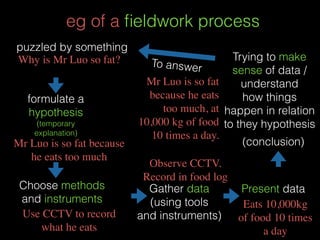
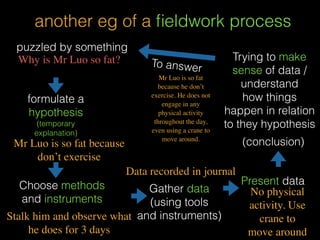
Mr Luo is so fat
because he eats
too much, at
10,000 kg of food
10 times a day.
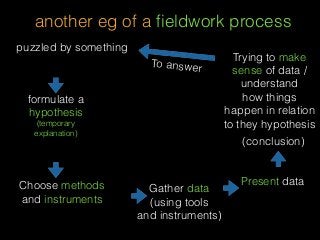
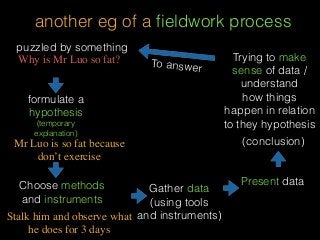
another eg of a fieldwork process
puzzled by something
formulate a
hypothesis
(temporary
explanation)
Choose methods
and instruments
Gather data
(using tools
and instruments)
Present data
Trying to make
sense of data /
understand
how things
happen in relation
to they hypothesis
(conclusion)
To answer
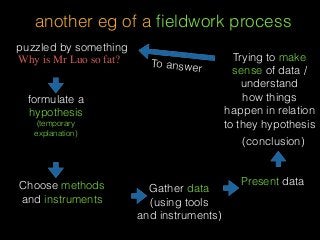
another eg of a fieldwork process
puzzled by something
formulate a
hypothesis
(temporary
explanation)
Choose methods
and instruments
Gather data
(using tools
and instruments)
Present data
Trying to make
sense of data /
understand
how things
happen in relation
to they hypothesis
(conclusion)
To answer
Why is Mr Luo so fat?
another eg of a fieldwork process
puzzled by something
formulate a
hypothesis
(temporary
explanation)
Choose methods
and instruments
Gather data
(using tools
and instruments)
Present data
Trying to make
sense of data /
understand
how things
happen in relation
to they hypothesis
(conclusion)
To answer
Why is Mr Luo so fat?
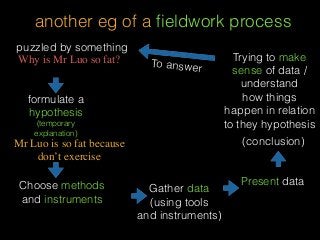
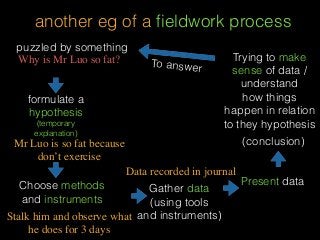
Mr Luo is so fat because
don’t exercise
another eg of a fieldwork process
puzzled by something
formulate a
hypothesis
(temporary
explanation)
Choose methods
and instruments
Gather data
(using tools
and instruments)
Present data
Trying to make
sense of data /
understand
how things
happen in relation
to they hypothesis
(conclusion)
To answer
Why is Mr Luo so fat?
Mr Luo is so fat because
don’t exercise
Stalk him and observe what
he does for 3 days
another eg of a fieldwork process
puzzled by something
formulate a
hypothesis
(temporary
explanation)
Choose methods
and instruments
Gather data
(using tools
and instruments)
Present data
Trying to make
sense of data /
understand
how things
happen in relation
to they hypothesis
(conclusion)
To answer
Why is Mr Luo so fat?
Mr Luo is so fat because
don’t exercise
Stalk him and observe what
he does for 3 days
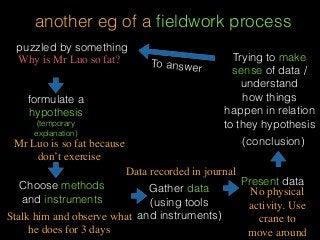
Data recorded in journal
another eg of a fieldwork process
puzzled by something
formulate a
hypothesis
(temporary
explanation)
Choose methods
and instruments
Gather data
(using tools
and instruments)
Present data
Trying to make
sense of data /
understand
how things
happen in relation
to they hypothesis
(conclusion)
To answer
Why is Mr Luo so fat?
Mr Luo is so fat because
don’t exercise
Stalk him and observe what
he does for 3 days
Data recorded in journal
No physical
activity. Use
crane to
move around
another eg of a fieldwork process
puzzled by something
formulate a
hypothesis
(temporary
explanation)
Choose methods
and instruments
Gather data
(using tools
and instruments)
Present data
Trying to make
sense of data /
understand
how things
happen in relation
to they hypothesis
(conclusion)
To answer
Why is Mr Luo so fat?
Mr Luo is so fat because
don’t exercise
Stalk him and observe what
he does for 3 days
Data recorded in journal
No physical
activity. Use
crane to
move around
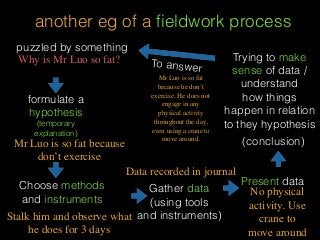
Mr Luo is so fat
because he don’t
exercise. He does not
engage in any
physical activity
throughout the day,
even using a crane to
move around.
fieldwork process
fieldwork process
puzzled by something
fieldwork process
puzzled by something
formulate a
hypothesis
(temporary
explanation)
fieldwork process
puzzled by something
formulate a
hypothesis
(temporary
explanation)
Choose methods
and instruments
fieldwork process
puzzled by something
formulate a
hypothesis
(temporary
explanation)
Choose methods
and instruments
Gather data
(using tools
and instruments)
fieldwork process
puzzled by something
formulate a
hypothesis
(temporary
explanation)
Choose methods
and instruments
Gather data
(using tools
and instruments)
Present data
fieldwork process
puzzled by something
formulate a
hypothesis
(temporary
explanation)
Choose methods
and instruments
Gather data
(using tools
and instruments)
Present data
Trying to make
sense of data /
understand
how things
happen in relation
to they hypothesis
(conclusion)
fieldwork process
puzzled by something
formulate a
hypothesis
(temporary
explanation)
Choose methods
and instruments
Gather data
(using tools
and instruments)
Present data
Trying to make
sense of data /
understand
how things
happen in relation
to they hypothesis
(conclusion)
To answer
what do you realise about the
hypothesis for both?
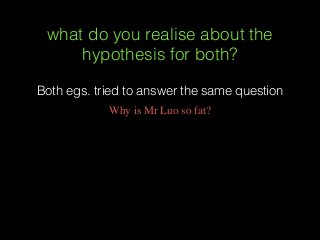
what do you realise about the
hypothesis for both?
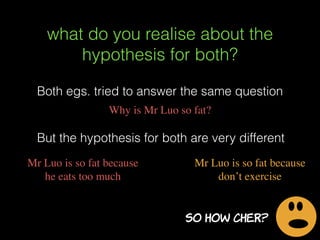
Both egs. tried to answer the same question
Why is Mr Luo so fat?
what do you realise about the
hypothesis for both?
Both egs. tried to answer the same question
Why is Mr Luo so fat?
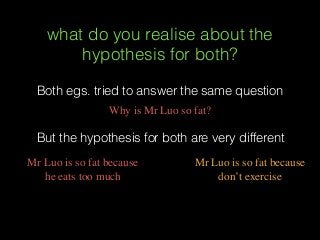
But the hypothesis for both are very different
Mr Luo is so fat because
don’t exercise
Mr Luo is so fat because
he eats too much
what do you realise about the
hypothesis for both?
Both egs. tried to answer the same question
Why is Mr Luo so fat?
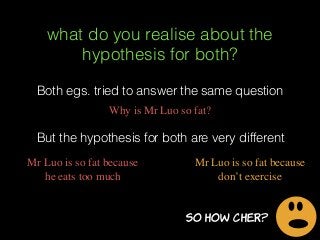
But the hypothesis for both are very different
Mr Luo is so fat because
don’t exercise
Mr Luo is so fat because
he eats too much
So how cher?
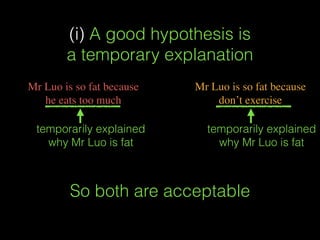
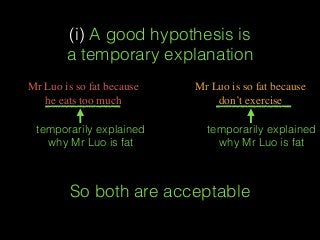
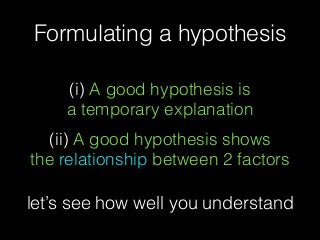
(i) A good hypothesis is 

a temporary explanation
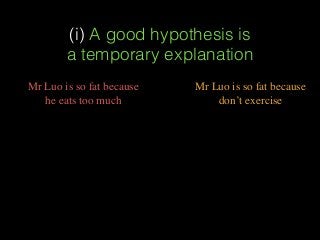
(i) A good hypothesis is 

a temporary explanation
Mr Luo is so fat because
don’t exercise
Mr Luo is so fat because
he eats too much
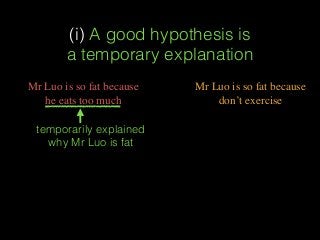
(i) A good hypothesis is 

a temporary explanation
Mr Luo is so fat because
don’t exercise
Mr Luo is so fat because
he eats too much
temporarily explained
why Mr Luo is fat
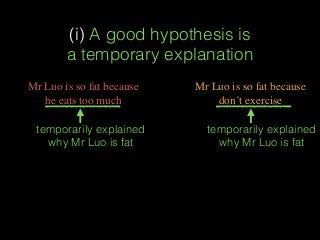
(i) A good hypothesis is 

a temporary explanation
Mr Luo is so fat because
don’t exercise
Mr Luo is so fat because
he eats too much
temporarily explained
why Mr Luo is fat
temporarily explained
why Mr Luo is fat
(i) A good hypothesis is 

a temporary explanation
Mr Luo is so fat because
don’t exercise
Mr Luo is so fat because
he eats too much
temporarily explained
why Mr Luo is fat
temporarily explained
why Mr Luo is fat
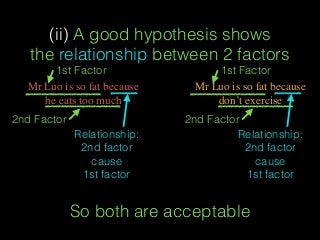
So both are acceptable
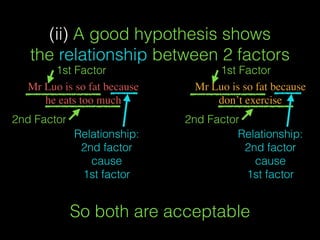
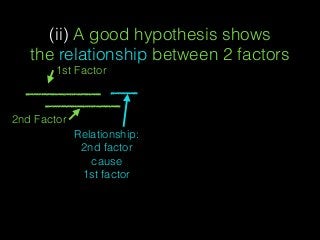
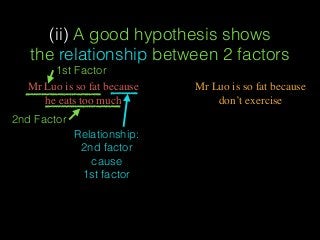
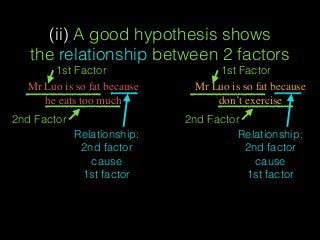
(ii) A good hypothesis shows
the relationship between 2 factors
(ii) A good hypothesis shows
the relationship between 2 factors
1st Factor
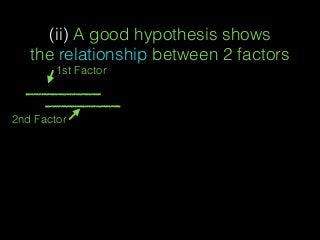
(ii) A good hypothesis shows
the relationship between 2 factors
2nd Factor
1st Factor
(ii) A good hypothesis shows
the relationship between 2 factors
2nd Factor
1st Factor
Relationship:
2nd factor
cause
1st factor
(ii) A good hypothesis shows
the relationship between 2 factors
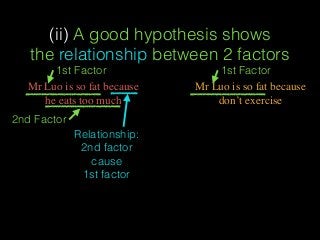
Mr Luo is so fat because
don’t exercise
Mr Luo is so fat because
he eats too much
2nd Factor
1st Factor
Relationship:
2nd factor
cause
1st factor
(ii) A good hypothesis shows
the relationship between 2 factors
Mr Luo is so fat because
don’t exercise
Mr Luo is so fat because
he eats too much
2nd Factor
1st Factor
Relationship:
2nd factor
cause
1st factor
1st Factor
(ii) A good hypothesis shows
the relationship between 2 factors
Mr Luo is so fat because
don’t exercise
Mr Luo is so fat because
he eats too much
2nd Factor
1st Factor
Relationship:
2nd factor
cause
1st factor
1st Factor
2nd Factor
(ii) A good hypothesis shows
the relationship between 2 factors
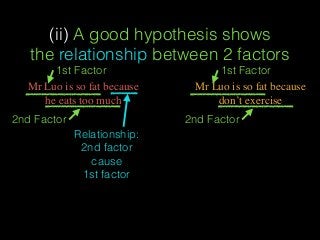
Mr Luo is so fat because
don’t exercise
Mr Luo is so fat because
he eats too much
2nd Factor
1st Factor
Relationship:
2nd factor
cause
1st factor
1st Factor
2nd Factor
Relationship:
2nd factor
cause
1st factor
(ii) A good hypothesis shows
the relationship between 2 factors
Mr Luo is so fat because
don’t exercise
Mr Luo is so fat because
he eats too much
2nd Factor
So both are acceptable
1st Factor
Relationship:
2nd factor
cause
1st factor
1st Factor
2nd Factor
Relationship:
2nd factor
cause
1st factor
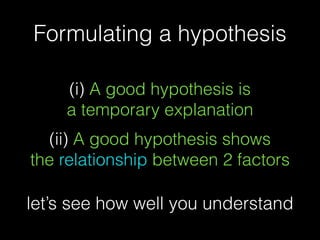
(i) A good hypothesis is 

a temporary explanation
(ii) A good hypothesis shows
the relationship between 2 factors
Formulating a hypothesis
let’s see how well you understand
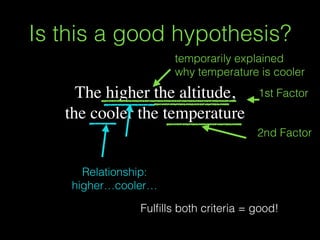
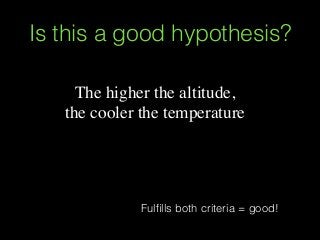
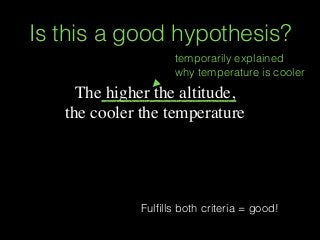
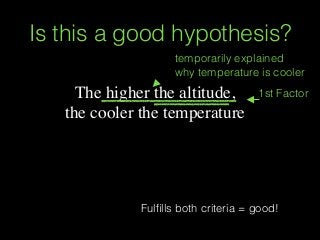
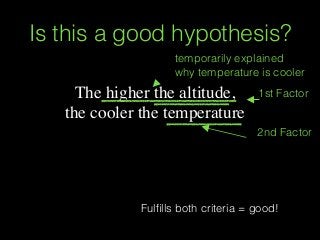
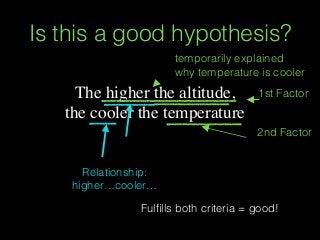
The higher the altitude,
the cooler the temperature
Is this a good hypothesis?
Fulfills both criteria = good!
The higher the altitude,
the cooler the temperature
Is this a good hypothesis?
temporarily explained
why temperature is cooler
Fulfills both criteria = good!
The higher the altitude,
the cooler the temperature
Is this a good hypothesis?
temporarily explained
why temperature is cooler
1st Factor
Fulfills both criteria = good!
The higher the altitude,
the cooler the temperature
Is this a good hypothesis?
temporarily explained
why temperature is cooler
2nd Factor
1st Factor
Fulfills both criteria = good!
The higher the altitude,
the cooler the temperature
Is this a good hypothesis?
temporarily explained
why temperature is cooler
2nd Factor
1st Factor
Relationship:
higher…cooler…
Fulfills both criteria = good!
complete mission on coursemology
Test yourself

T1w6 fieldwork

  • 1.
    weather and climate fieldwork& geographical investigation
  • 2.
  • 3.
  • 4.
    fieldwork process puzzled bysomething formulate a hypothesis (temporary explanation)
  • 5.
    fieldwork process puzzled bysomething formulate a hypothesis (temporary explanation) Choose methods and instruments
  • 6.
    fieldwork process puzzled bysomething formulate a hypothesis (temporary explanation) Choose methods and instruments Gather data (using tools and instruments)
  • 7.
    fieldwork process puzzled bysomething formulate a hypothesis (temporary explanation) Choose methods and instruments Gather data (using tools and instruments) Present data
  • 8.
    fieldwork process puzzled bysomething formulate a hypothesis (temporary explanation) Choose methods and instruments Gather data (using tools and instruments) Present data Trying to make sense of data / understand how things happen in relation to they hypothesis (conclusion)
  • 9.
    fieldwork process puzzled bysomething formulate a hypothesis (temporary explanation) Choose methods and instruments Gather data (using tools and instruments) Present data Trying to make sense of data / understand how things happen in relation to they hypothesis (conclusion) To answer
  • 10.
    eg of afieldwork process puzzled by something formulate a hypothesis (temporary explanation) Choose methods and instruments Gather data (using tools and instruments) Present data Trying to make sense of data / understand how things happen in relation to they hypothesis (conclusion) To answer
  • 11.
    eg of afieldwork process puzzled by something formulate a hypothesis (temporary explanation) Choose methods and instruments Gather data (using tools and instruments) Present data Trying to make sense of data / understand how things happen in relation to they hypothesis (conclusion) To answer Why is Mr Luo so fat?
  • 12.
    eg of afieldwork process puzzled by something formulate a hypothesis (temporary explanation) Choose methods and instruments Gather data (using tools and instruments) Present data Trying to make sense of data / understand how things happen in relation to they hypothesis (conclusion) To answer Why is Mr Luo so fat? Mr Luo is so fat because he eats too much
  • 13.
    eg of afieldwork process puzzled by something formulate a hypothesis (temporary explanation) Choose methods and instruments Gather data (using tools and instruments) Present data Trying to make sense of data / understand how things happen in relation to they hypothesis (conclusion) To answer Why is Mr Luo so fat? Mr Luo is so fat because he eats too much Use CCTV to record what he eats
  • 14.
    eg of afieldwork process puzzled by something formulate a hypothesis (temporary explanation) Choose methods and instruments Gather data (using tools and instruments) Present data Trying to make sense of data / understand how things happen in relation to they hypothesis (conclusion) To answer Why is Mr Luo so fat? Mr Luo is so fat because he eats too much Use CCTV to record what he eats Observe CCTV. Record in food log
  • 15.
    eg of afieldwork process puzzled by something formulate a hypothesis (temporary explanation) Choose methods and instruments Gather data (using tools and instruments) Present data Trying to make sense of data / understand how things happen in relation to they hypothesis (conclusion) To answer Why is Mr Luo so fat? Mr Luo is so fat because he eats too much Use CCTV to record what he eats Observe CCTV. Record in food log Eats 10,000kg of food 10 times a day
  • 16.
    eg of afieldwork process puzzled by something formulate a hypothesis (temporary explanation) Choose methods and instruments Gather data (using tools and instruments) Present data Trying to make sense of data / understand how things happen in relation to they hypothesis (conclusion) To answer Why is Mr Luo so fat? Mr Luo is so fat because he eats too much Use CCTV to record what he eats Observe CCTV. Record in food log Eats 10,000kg of food 10 times a day Mr Luo is so fat because he eats too much, at 10,000 kg of food 10 times a day.
  • 17.
    another eg ofa fieldwork process puzzled by something formulate a hypothesis (temporary explanation) Choose methods and instruments Gather data (using tools and instruments) Present data Trying to make sense of data / understand how things happen in relation to they hypothesis (conclusion) To answer
  • 18.
    another eg ofa fieldwork process puzzled by something formulate a hypothesis (temporary explanation) Choose methods and instruments Gather data (using tools and instruments) Present data Trying to make sense of data / understand how things happen in relation to they hypothesis (conclusion) To answer Why is Mr Luo so fat?
  • 19.
    another eg ofa fieldwork process puzzled by something formulate a hypothesis (temporary explanation) Choose methods and instruments Gather data (using tools and instruments) Present data Trying to make sense of data / understand how things happen in relation to they hypothesis (conclusion) To answer Why is Mr Luo so fat? Mr Luo is so fat because don’t exercise
  • 20.
    another eg ofa fieldwork process puzzled by something formulate a hypothesis (temporary explanation) Choose methods and instruments Gather data (using tools and instruments) Present data Trying to make sense of data / understand how things happen in relation to they hypothesis (conclusion) To answer Why is Mr Luo so fat? Mr Luo is so fat because don’t exercise Stalk him and observe what he does for 3 days
  • 21.
    another eg ofa fieldwork process puzzled by something formulate a hypothesis (temporary explanation) Choose methods and instruments Gather data (using tools and instruments) Present data Trying to make sense of data / understand how things happen in relation to they hypothesis (conclusion) To answer Why is Mr Luo so fat? Mr Luo is so fat because don’t exercise Stalk him and observe what he does for 3 days Data recorded in journal
  • 22.
    another eg ofa fieldwork process puzzled by something formulate a hypothesis (temporary explanation) Choose methods and instruments Gather data (using tools and instruments) Present data Trying to make sense of data / understand how things happen in relation to they hypothesis (conclusion) To answer Why is Mr Luo so fat? Mr Luo is so fat because don’t exercise Stalk him and observe what he does for 3 days Data recorded in journal No physical activity. Use crane to move around
  • 23.
    another eg ofa fieldwork process puzzled by something formulate a hypothesis (temporary explanation) Choose methods and instruments Gather data (using tools and instruments) Present data Trying to make sense of data / understand how things happen in relation to they hypothesis (conclusion) To answer Why is Mr Luo so fat? Mr Luo is so fat because don’t exercise Stalk him and observe what he does for 3 days Data recorded in journal No physical activity. Use crane to move around Mr Luo is so fat because he don’t exercise. He does not engage in any physical activity throughout the day, even using a crane to move around.
  • 24.
  • 25.
  • 26.
    fieldwork process puzzled bysomething formulate a hypothesis (temporary explanation)
  • 27.
    fieldwork process puzzled bysomething formulate a hypothesis (temporary explanation) Choose methods and instruments
  • 28.
    fieldwork process puzzled bysomething formulate a hypothesis (temporary explanation) Choose methods and instruments Gather data (using tools and instruments)
  • 29.
    fieldwork process puzzled bysomething formulate a hypothesis (temporary explanation) Choose methods and instruments Gather data (using tools and instruments) Present data
  • 30.
    fieldwork process puzzled bysomething formulate a hypothesis (temporary explanation) Choose methods and instruments Gather data (using tools and instruments) Present data Trying to make sense of data / understand how things happen in relation to they hypothesis (conclusion)
  • 31.
    fieldwork process puzzled bysomething formulate a hypothesis (temporary explanation) Choose methods and instruments Gather data (using tools and instruments) Present data Trying to make sense of data / understand how things happen in relation to they hypothesis (conclusion) To answer
  • 32.
    what do yourealise about the hypothesis for both?
  • 33.
    what do yourealise about the hypothesis for both? Both egs. tried to answer the same question Why is Mr Luo so fat?
  • 34.
    what do yourealise about the hypothesis for both? Both egs. tried to answer the same question Why is Mr Luo so fat? But the hypothesis for both are very different Mr Luo is so fat because don’t exercise Mr Luo is so fat because he eats too much
  • 35.
    what do yourealise about the hypothesis for both? Both egs. tried to answer the same question Why is Mr Luo so fat? But the hypothesis for both are very different Mr Luo is so fat because don’t exercise Mr Luo is so fat because he eats too much So how cher?
  • 36.
    (i) A goodhypothesis is 
 a temporary explanation
  • 37.
    (i) A goodhypothesis is 
 a temporary explanation Mr Luo is so fat because don’t exercise Mr Luo is so fat because he eats too much
  • 38.
    (i) A goodhypothesis is 
 a temporary explanation Mr Luo is so fat because don’t exercise Mr Luo is so fat because he eats too much temporarily explained why Mr Luo is fat
  • 39.
    (i) A goodhypothesis is 
 a temporary explanation Mr Luo is so fat because don’t exercise Mr Luo is so fat because he eats too much temporarily explained why Mr Luo is fat temporarily explained why Mr Luo is fat
  • 40.
    (i) A goodhypothesis is 
 a temporary explanation Mr Luo is so fat because don’t exercise Mr Luo is so fat because he eats too much temporarily explained why Mr Luo is fat temporarily explained why Mr Luo is fat So both are acceptable
  • 41.
    (ii) A goodhypothesis shows the relationship between 2 factors
  • 42.
    (ii) A goodhypothesis shows the relationship between 2 factors 1st Factor
  • 43.
    (ii) A goodhypothesis shows the relationship between 2 factors 2nd Factor 1st Factor
  • 44.
    (ii) A goodhypothesis shows the relationship between 2 factors 2nd Factor 1st Factor Relationship: 2nd factor cause 1st factor
  • 45.
    (ii) A goodhypothesis shows the relationship between 2 factors Mr Luo is so fat because don’t exercise Mr Luo is so fat because he eats too much 2nd Factor 1st Factor Relationship: 2nd factor cause 1st factor
  • 46.
    (ii) A goodhypothesis shows the relationship between 2 factors Mr Luo is so fat because don’t exercise Mr Luo is so fat because he eats too much 2nd Factor 1st Factor Relationship: 2nd factor cause 1st factor 1st Factor
  • 47.
    (ii) A goodhypothesis shows the relationship between 2 factors Mr Luo is so fat because don’t exercise Mr Luo is so fat because he eats too much 2nd Factor 1st Factor Relationship: 2nd factor cause 1st factor 1st Factor 2nd Factor
  • 48.
    (ii) A goodhypothesis shows the relationship between 2 factors Mr Luo is so fat because don’t exercise Mr Luo is so fat because he eats too much 2nd Factor 1st Factor Relationship: 2nd factor cause 1st factor 1st Factor 2nd Factor Relationship: 2nd factor cause 1st factor
  • 49.
    (ii) A goodhypothesis shows the relationship between 2 factors Mr Luo is so fat because don’t exercise Mr Luo is so fat because he eats too much 2nd Factor So both are acceptable 1st Factor Relationship: 2nd factor cause 1st factor 1st Factor 2nd Factor Relationship: 2nd factor cause 1st factor
  • 50.
    (i) A goodhypothesis is 
 a temporary explanation (ii) A good hypothesis shows the relationship between 2 factors Formulating a hypothesis let’s see how well you understand
  • 51.
    The higher thealtitude, the cooler the temperature Is this a good hypothesis? Fulfills both criteria = good!
  • 52.
    The higher thealtitude, the cooler the temperature Is this a good hypothesis? temporarily explained why temperature is cooler Fulfills both criteria = good!
  • 53.
    The higher thealtitude, the cooler the temperature Is this a good hypothesis? temporarily explained why temperature is cooler 1st Factor Fulfills both criteria = good!
  • 54.
    The higher thealtitude, the cooler the temperature Is this a good hypothesis? temporarily explained why temperature is cooler 2nd Factor 1st Factor Fulfills both criteria = good!
  • 55.
    The higher thealtitude, the cooler the temperature Is this a good hypothesis? temporarily explained why temperature is cooler 2nd Factor 1st Factor Relationship: higher…cooler… Fulfills both criteria = good!
  • 56.
    complete mission oncoursemology Test yourself