
Tax
Avoidance
and
Evasion

Econ
325

Tax Avoidance and Tax Evasion
•  While it’s common to think of taxes as
something that must be paid, people actually
have some latitude in deciding how much
they will actually pay
–  People can take efforts to avoid taxes (by
contributing to RRSPs, by incorporating, to avoid
high personal tax rates, etc.) Avoidance is legal.
–  People can take efforts to evade taxes (by hiding
income from Revenue Canada) Evasion is illegal.
•  The choice of how much to pay in taxes is
another margin along which behavior can be
distorted by taxes
Tax Avoidance and Tax Evasion
•  General definitions:
–  Tax evasion: not reporting all of one’s income
–  Tax avoidance: complying with tax laws, but
working hard to reduce one’s tax burden within the
constraints of the law (i.e. exploiting loopholes)
–  While avoidance is legal, we may worry that lots of
resources go into searching for and exploiting
loopholes--where those resources might be better
spent on “productive” activities rather than “rent-
seeking” activities
•  Avoidance behaviour is essentially a manifestation of the
substitution effect.
Tax Avoidance
3 Principles of Tax Avoidance
1)  Postponement of taxes ($1000 in taxes paid
tomorrow is preferred to $1000 in taxes paid
today)
2)  Tax arbitrage across individuals in different tax
brackets.
3)  Tax arbitrage across income streams facing
different tax treatments
Tax avoidance often involves a combination of
these 3 principles.
Tax Avoidance--Postponement
•  Recall previous discussion of RRSPs
–  You can put up to $22,000 away each year tax
deferred (meaning you don’t pay taxes on it now,
you pay taxes on it when you withdraw it for
retirement)
–  Such postponement of tax liability is valuable for
2 reasons
1)  Bills paid later are cheaper than bills paid today (you
can earn interest off the money you save now)
2)  If you’re in a high tax bracket now, you can wait to pay
taxes until you’re in a lower tax bracket (like when your
income falls in retirement)
–  RRSPs are a good example of a postponement
strategy for tax avoidance
Tax Avoidance--Postponement
•  Evidence that taxes affect timing of
“non-economic” decisions
– US tax system involved (until recently) a
“marriage penalty” (married couples paid
more than two single people cohabiting)
– Evidence that marriage rates tended to fall
in Nov-Dec. Couples would wait until Jan
to marry, to postpone marriage penalty for
an extra year
Tax Avoidance--Timing Activities
•  Births
–  Under US tax system, you can claim a per-child
exemption that amounts to a couple thousand
dollars reduction in tax liability
•  Child must be born by Dec31 of tax year
•  Evidence that birth rates are higher in late December
than in early January
•  Why? People have some control over birth timing
(scheduled C-sections, inducements, etc.)
•  Speeding up a deduction is like postponing a tax liability
Tax Avoidance--Timing Activities
•  Research by Slemrod and Kopczuk (2001)
suggests that people varied the timing of their
death to qualify for lower inheritance tax rates
–  Found that probability of death rose just prior to
inheritance tax increases (i.e. people hurry up
death to have estate taxed in low-tax regime)
–  Probability of death fell just prior to inheritance tax
decreases (i.e. people wait for lower-tax regime)
Tax Avoidance--Tax Arbitrage
Across Income Streams
•  RRSPs also provide a means of tax arbitrage
–  People have the choice of putting savings in a
savings account or an RRSP
–  Both accounts produce interest income, but they
are taxed at different rates
–  Interest income in savings account is taxed at
whatever your top marginal rate is
–  RRSP income is untaxed
–  Hence people have an incentive to shift money
from taxable savings accounts to RRSPs
–  In fact, if interest payments are tax deductible, one
could arbitrage further by borrowing to contribute
to RRSP (borrow at tax deductible rate; lend at
tax-free lending rate)
Tax Avoidance--Tax Arbitrage
Across Income Streams
•  Home production: Simple tax arbitrage
–  If you go to work and hire a nanny, you pay tax on
the income you earn at work
–  If you stay home and take care of your child
yourself, you get childcare (a form of in-kind
income) that is not subject to income tax
–  Same with home improvements
•  Do-it-yourself work is not subject to income tax, labour
component is not subject to GST
•  Basic theory of comparative advantage argues that
people should hire contractors to do work in their home
–  Tax system causes distortionary incentives that induce
people to do this work themselves.
–  This wouldn’t be a problem if home production were
taxable
Tax Avoidance--Tax Arbitrage
Across Income Streams
•  U-Brew beer and wine
–  High commodity taxes are charged for beer and
wine
•  Some of this may be justified on efficiency grounds if
there are externalities associated with alcohol
consumption
•  But that doesn’t mean people won’t try to avoid the tax
–  Alcoholic beverage taxes only apply to alcoholic
beverages
•  Grape juice is tax-free (no GST…because it’s food; no
excise tax, because it’s alcohol free)
•  Provides incentive for wine producers to sell juice plus
yeast packet
•  Unfermented wort (for beermaking) is treated as a food
product, so same rules apply
•  In Canada, there’s a huge U-Brew industry
–  Some of this is due to hobbyists who like “Do-it-
Yourself” for its own sake
–  Much is due to taxation of alcoholic beverages
–  It would be much more efficient, to let the
professionals make and bottle the wine and beer
(economies of scale, comparative advantage, etc.)
–  But because of the tax, many of us produce these
commodities ourselves
Tax Avoidance--Tax Arbitrage
Across Income Streams
Tax Avoidance--Tax Arbitrage
Across Individuals Facing Different
Marginal Tax Rates
•  Income-splitting is a common feature in the
Canadian income tax system
–  Suppose my wife has a small business and makes
$75,000 per year
–  Suppose I take care of the cat and cook meals, so
my annual income is zero
–  Suppose income over $60,000 is taxed at 35%
marginal rate
–  Suppose income under $20,000 is taxed at 15%
marginal rate
–  By paying me to be the cook and catsitter for her
business, my wife could transfer (say $15,000
from her to me) note: this isn’t quite legal!
Tax Avoidance--Arbitrage Across
Individuals With Different MTRs
•  My wife’s tax liability falls by $15,000*0.35, or
$5,250
•  My tax liability rises by $15,000*0.15, or
$2,250
•  Overall household liability falls by $3000!
•  While you can’t fake employ a member of
your household, it might be easy to overpay a
member of the household who truly works for
the family business
•  Or, my wife could transfer income-earning
assets into my name, thereby legally shifting
income from her to me (note: attribution rules
in Canada limit one’s ability to do this)
Tax Avoidance--Arbitrage Across
Individuals With Different MTRs
•  The US avoids the income-splitting
problem by treating the family as the
taxable unit (Canada treats the
individual as the taxable unit)
– But this may provide a strong disincentive
for secondary income earner to work
– If I took job in the US (rather than taking
care of the cat) my first dollar would be
taxed at my wife’s highest marginal rate
The Problem with Tax Avoidance
•  This attempt to find and exploit loopholes
takes time (yours, and your tax lawyer’s), so
you end up with highly educated, productive
people running around engaging in rent-
seeking
–  Rent-seeking is activity that seeks to transfer
economic surplus from others (e.g. the
government) to oneself
–  It’s unproductive. That lawyer could be designing
bridges or finding a solution to global warming
somewhere if she wasn’t tied up helping you avoid
taxes
Tax Evasion
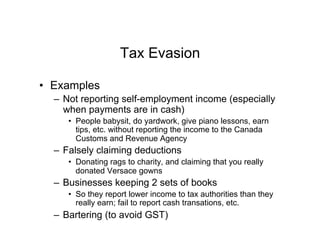
•  Examples
–  Not reporting self-employment income (especially
when payments are in cash)
•  People babysit, do yardwork, give piano lessons, earn
tips, etc. without reporting the income to the Canada
Customs and Revenue Agency
–  Falsely claiming deductions
•  Donating rags to charity, and claiming that you really
donated Versace gowns
–  Businesses keeping 2 sets of books
•  So they report lower income to tax authorities than they
really earn; fail to report cash transations, etc.
–  Bartering (to avoid GST)
Modeling Tax Evasion
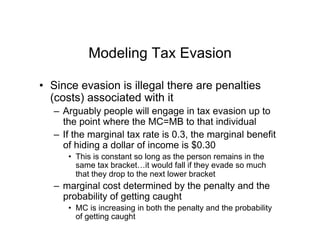
•  Since evasion is illegal there are penalties
(costs) associated with it
–  Arguably people will engage in tax evasion up to
the point where the MC=MB to that individual
–  If the marginal tax rate is 0.3, the marginal benefit
of hiding a dollar of income is $0.30
•  This is constant so long as the person remains in the
same tax bracket…it would fall if they evade so much
that they drop to the next lower bracket
–  marginal cost determined by the penalty and the
probability of getting caught
•  MC is increasing in both the penalty and the probability
of getting caught
Modeling Tax Evasion
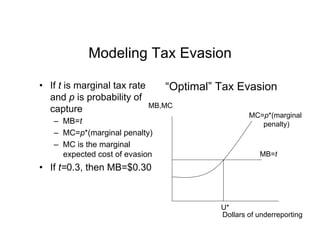
•  If t is marginal tax rate
and p is probability of
capture
–  MB=t
–  MC=p*(marginal penalty)
–  MC is the marginal
expected cost of evasion
•  If t=0.3, then MB=$0.30
“Optimal” Tax Evasion
MB=t
Dollars of underreporting
MC=p*(marginal
penalty)
MB,MC
U*
Predictions of the Model
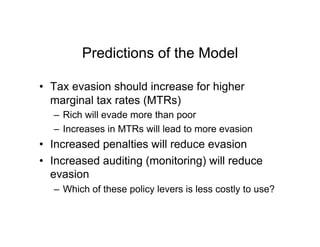
•  Tax evasion should increase for higher
marginal tax rates (MTRs)
–  Rich will evade more than poor
–  Increases in MTRs will lead to more evasion
•  Increased penalties will reduce evasion
•  Increased auditing (monitoring) will reduce
evasion
–  Which of these policy levers is less costly to use?
Evasion
•  People may not just evade more as MTRs
rise, may choose work that facilitates evasion
–  Lemieux, Fortin, and Frechette (1994) find that
people are more likely to work in underground
economy when MTRs increase
–  Essentially the ability to evade allows for higher
MTRs to change wage differentials between
different types of work
•  Take 2 jobs that pay $10 an hour and a MTR of .2; if
evasion is easy in one job then, effective after tax wages
are $10 for the job with easy evasion, and $8 for the
other job.
•  If the MTR rises to 0.4, then the wage differential rises
from $2 to $4; may cause some to switch jobs.
Evidence on Evasion
•  Degree of evasion depends on ease of
evasion (expected penalties)
–  In US, wage and salary income is generally
reported by employers to the IRS
•  Estimates suggest that people report 99.5% of wage and
salary income (because they know the IRS has a record)
•  Estimates suggest that only 41.4% of self-employment
income is reported
–  Studies of taxpayers in US earning between 50k
and 100k per year suggests 60% understated their
tax liability, 26% reported correctly, and 14%
overstated their liability (probably due to errors)
Example of Evasion in US
•  The IRS suspected many taxpayers
were claiming exemptions for
dependents (kids) that didn’t exist
– In 1987 changed tax form to require that
taxpayers list social security number of
each dependent
– Number of exemptions claimed fell by 7
million that year
Problem With Evasion
•  As with avoidance, people may engage in
“rent-seeking” activities to get out of paying
taxes
–  This creates excess burden (DWL), because rent-
seeking just transfers rents around…it is a costly
activity that doesn’t produce anything new for
society
•  Also, for both avoidance and evasion,
horizontal equity is violated
–  Similar people end up paying different taxes
•  If wealthy evade/avoid more, this undoes
some of the progressivity in the tax system
Taxing the Rich
•  Ayn Rand Atlas Shrugged (1957)
– Depicts a world in which the “prime
movers” go on strike to show how essential
their contribution to society is, and to
expose the obstacles society places in their
way
– In 1957 top MTR in US was 91% (for
incomes higher than the equivalent of $2.3
million in $1997)
Taxing the Rich
•  Are the rich really incredibly productive? Or
are they just lucky? How important are they?
–  Taxes on luck are a great idea (people can’t alter
their luck); taxes on productive activity are more
likely to have associated DWL.
–  George Gilder (1981) “a successful economy
depends on the proliferation of the rich…to help
the poor and middle classes, one must cut the
taxes of the rich”
–  Peter Drucker (1997) “If all the super-rich people
disappeared, the world economy would not even
notice. The super-rich are irrelevant to the
economy.”
Why Are the Rich Rich?
•  Possible reasons
–  Endowed with high ability, so they’re very
productive
•  This argues for lower MTRs to encourage that
productivity
–  Lucky
•  This argues for higher MTRs
•  high MTRs can serve as insurance. People can be
insured against bad luck by paying low tax rates if they
don’t become rich; govt can finance these low tax rates
by having rich pay high tax rates
•  In this case, a progressive tax system provides a form of
income insurance for everyone; if people are risk averse,
this can be social welfare enhancing
Why Are the Rich Rich?
–  May have different tastes for consumption vs.
leisure or consumption today vs. consumption
tomorrow (maybe they just work harder or save
more)
•  Taxing rich more would violate horizontal and vertical
equity, in this case
–  Maybe they inherited
•  From a one-generation perspective taxing them doesn’t
seem problematic (inheritance tax doesn’t change
relative prices)
•  But it may deter parents from accumulating wealth; could
cause them to reduce labour supply or to save less
Why Are the Rich Rich?
– Maybe they have unique skills.
•  Entrepreneurial?
•  If this is the case, these people have rare skills
that we might want to be careful about deterring
them with high MTRs
Rich and Avoidance/Evasion
•  Rich may be particularly likely to engage in
avoidance/evasion activities
–  Evidence suggests that evasion rises with income
–  They have the most to gain from finding loopholes
–  They likely know (and learn from) others who do it
•  If rich are more able to wriggle away from
taxes than poor, this may be an argument
against very high MTRs (or stiffer penalties)
•  A simpler tax code might reduce the ability of
rich to wriggle away, and make progressivity
less costly to implement.

T10 taxevasion copy

  • 1.
  • 2.
    Tax Avoidance andTax Evasion •  While it’s common to think of taxes as something that must be paid, people actually have some latitude in deciding how much they will actually pay –  People can take efforts to avoid taxes (by contributing to RRSPs, by incorporating, to avoid high personal tax rates, etc.) Avoidance is legal. –  People can take efforts to evade taxes (by hiding income from Revenue Canada) Evasion is illegal. •  The choice of how much to pay in taxes is another margin along which behavior can be distorted by taxes
  • 3.
    Tax Avoidance andTax Evasion •  General definitions: –  Tax evasion: not reporting all of one’s income –  Tax avoidance: complying with tax laws, but working hard to reduce one’s tax burden within the constraints of the law (i.e. exploiting loopholes) –  While avoidance is legal, we may worry that lots of resources go into searching for and exploiting loopholes--where those resources might be better spent on “productive” activities rather than “rent- seeking” activities •  Avoidance behaviour is essentially a manifestation of the substitution effect.
  • 4.
    Tax Avoidance 3 Principlesof Tax Avoidance 1)  Postponement of taxes ($1000 in taxes paid tomorrow is preferred to $1000 in taxes paid today) 2)  Tax arbitrage across individuals in different tax brackets. 3)  Tax arbitrage across income streams facing different tax treatments Tax avoidance often involves a combination of these 3 principles.
  • 5.
    Tax Avoidance--Postponement •  Recallprevious discussion of RRSPs –  You can put up to $22,000 away each year tax deferred (meaning you don’t pay taxes on it now, you pay taxes on it when you withdraw it for retirement) –  Such postponement of tax liability is valuable for 2 reasons 1)  Bills paid later are cheaper than bills paid today (you can earn interest off the money you save now) 2)  If you’re in a high tax bracket now, you can wait to pay taxes until you’re in a lower tax bracket (like when your income falls in retirement) –  RRSPs are a good example of a postponement strategy for tax avoidance
  • 6.
    Tax Avoidance--Postponement •  Evidencethat taxes affect timing of “non-economic” decisions – US tax system involved (until recently) a “marriage penalty” (married couples paid more than two single people cohabiting) – Evidence that marriage rates tended to fall in Nov-Dec. Couples would wait until Jan to marry, to postpone marriage penalty for an extra year
  • 7.
    Tax Avoidance--Timing Activities • Births –  Under US tax system, you can claim a per-child exemption that amounts to a couple thousand dollars reduction in tax liability •  Child must be born by Dec31 of tax year •  Evidence that birth rates are higher in late December than in early January •  Why? People have some control over birth timing (scheduled C-sections, inducements, etc.) •  Speeding up a deduction is like postponing a tax liability
  • 8.
    Tax Avoidance--Timing Activities • Research by Slemrod and Kopczuk (2001) suggests that people varied the timing of their death to qualify for lower inheritance tax rates –  Found that probability of death rose just prior to inheritance tax increases (i.e. people hurry up death to have estate taxed in low-tax regime) –  Probability of death fell just prior to inheritance tax decreases (i.e. people wait for lower-tax regime)
  • 9.
    Tax Avoidance--Tax Arbitrage AcrossIncome Streams •  RRSPs also provide a means of tax arbitrage –  People have the choice of putting savings in a savings account or an RRSP –  Both accounts produce interest income, but they are taxed at different rates –  Interest income in savings account is taxed at whatever your top marginal rate is –  RRSP income is untaxed –  Hence people have an incentive to shift money from taxable savings accounts to RRSPs –  In fact, if interest payments are tax deductible, one could arbitrage further by borrowing to contribute to RRSP (borrow at tax deductible rate; lend at tax-free lending rate)
  • 10.
    Tax Avoidance--Tax Arbitrage AcrossIncome Streams •  Home production: Simple tax arbitrage –  If you go to work and hire a nanny, you pay tax on the income you earn at work –  If you stay home and take care of your child yourself, you get childcare (a form of in-kind income) that is not subject to income tax –  Same with home improvements •  Do-it-yourself work is not subject to income tax, labour component is not subject to GST •  Basic theory of comparative advantage argues that people should hire contractors to do work in their home –  Tax system causes distortionary incentives that induce people to do this work themselves. –  This wouldn’t be a problem if home production were taxable
  • 11.
    Tax Avoidance--Tax Arbitrage AcrossIncome Streams •  U-Brew beer and wine –  High commodity taxes are charged for beer and wine •  Some of this may be justified on efficiency grounds if there are externalities associated with alcohol consumption •  But that doesn’t mean people won’t try to avoid the tax –  Alcoholic beverage taxes only apply to alcoholic beverages •  Grape juice is tax-free (no GST…because it’s food; no excise tax, because it’s alcohol free) •  Provides incentive for wine producers to sell juice plus yeast packet •  Unfermented wort (for beermaking) is treated as a food product, so same rules apply
  • 12.
    •  In Canada,there’s a huge U-Brew industry –  Some of this is due to hobbyists who like “Do-it- Yourself” for its own sake –  Much is due to taxation of alcoholic beverages –  It would be much more efficient, to let the professionals make and bottle the wine and beer (economies of scale, comparative advantage, etc.) –  But because of the tax, many of us produce these commodities ourselves Tax Avoidance--Tax Arbitrage Across Income Streams
  • 13.
    Tax Avoidance--Tax Arbitrage AcrossIndividuals Facing Different Marginal Tax Rates •  Income-splitting is a common feature in the Canadian income tax system –  Suppose my wife has a small business and makes $75,000 per year –  Suppose I take care of the cat and cook meals, so my annual income is zero –  Suppose income over $60,000 is taxed at 35% marginal rate –  Suppose income under $20,000 is taxed at 15% marginal rate –  By paying me to be the cook and catsitter for her business, my wife could transfer (say $15,000 from her to me) note: this isn’t quite legal!
  • 14.
    Tax Avoidance--Arbitrage Across IndividualsWith Different MTRs •  My wife’s tax liability falls by $15,000*0.35, or $5,250 •  My tax liability rises by $15,000*0.15, or $2,250 •  Overall household liability falls by $3000! •  While you can’t fake employ a member of your household, it might be easy to overpay a member of the household who truly works for the family business •  Or, my wife could transfer income-earning assets into my name, thereby legally shifting income from her to me (note: attribution rules in Canada limit one’s ability to do this)
  • 15.
    Tax Avoidance--Arbitrage Across IndividualsWith Different MTRs •  The US avoids the income-splitting problem by treating the family as the taxable unit (Canada treats the individual as the taxable unit) – But this may provide a strong disincentive for secondary income earner to work – If I took job in the US (rather than taking care of the cat) my first dollar would be taxed at my wife’s highest marginal rate
  • 16.
    The Problem withTax Avoidance •  This attempt to find and exploit loopholes takes time (yours, and your tax lawyer’s), so you end up with highly educated, productive people running around engaging in rent- seeking –  Rent-seeking is activity that seeks to transfer economic surplus from others (e.g. the government) to oneself –  It’s unproductive. That lawyer could be designing bridges or finding a solution to global warming somewhere if she wasn’t tied up helping you avoid taxes
  • 17.
    Tax Evasion •  Examples – Not reporting self-employment income (especially when payments are in cash) •  People babysit, do yardwork, give piano lessons, earn tips, etc. without reporting the income to the Canada Customs and Revenue Agency –  Falsely claiming deductions •  Donating rags to charity, and claiming that you really donated Versace gowns –  Businesses keeping 2 sets of books •  So they report lower income to tax authorities than they really earn; fail to report cash transations, etc. –  Bartering (to avoid GST)
  • 18.
    Modeling Tax Evasion • Since evasion is illegal there are penalties (costs) associated with it –  Arguably people will engage in tax evasion up to the point where the MC=MB to that individual –  If the marginal tax rate is 0.3, the marginal benefit of hiding a dollar of income is $0.30 •  This is constant so long as the person remains in the same tax bracket…it would fall if they evade so much that they drop to the next lower bracket –  marginal cost determined by the penalty and the probability of getting caught •  MC is increasing in both the penalty and the probability of getting caught
  • 19.
    Modeling Tax Evasion • If t is marginal tax rate and p is probability of capture –  MB=t –  MC=p*(marginal penalty) –  MC is the marginal expected cost of evasion •  If t=0.3, then MB=$0.30 “Optimal” Tax Evasion MB=t Dollars of underreporting MC=p*(marginal penalty) MB,MC U*
  • 20.
    Predictions of theModel •  Tax evasion should increase for higher marginal tax rates (MTRs) –  Rich will evade more than poor –  Increases in MTRs will lead to more evasion •  Increased penalties will reduce evasion •  Increased auditing (monitoring) will reduce evasion –  Which of these policy levers is less costly to use?
  • 21.
    Evasion •  People maynot just evade more as MTRs rise, may choose work that facilitates evasion –  Lemieux, Fortin, and Frechette (1994) find that people are more likely to work in underground economy when MTRs increase –  Essentially the ability to evade allows for higher MTRs to change wage differentials between different types of work •  Take 2 jobs that pay $10 an hour and a MTR of .2; if evasion is easy in one job then, effective after tax wages are $10 for the job with easy evasion, and $8 for the other job. •  If the MTR rises to 0.4, then the wage differential rises from $2 to $4; may cause some to switch jobs.
  • 22.
    Evidence on Evasion • Degree of evasion depends on ease of evasion (expected penalties) –  In US, wage and salary income is generally reported by employers to the IRS •  Estimates suggest that people report 99.5% of wage and salary income (because they know the IRS has a record) •  Estimates suggest that only 41.4% of self-employment income is reported –  Studies of taxpayers in US earning between 50k and 100k per year suggests 60% understated their tax liability, 26% reported correctly, and 14% overstated their liability (probably due to errors)
  • 23.
    Example of Evasionin US •  The IRS suspected many taxpayers were claiming exemptions for dependents (kids) that didn’t exist – In 1987 changed tax form to require that taxpayers list social security number of each dependent – Number of exemptions claimed fell by 7 million that year
  • 24.
    Problem With Evasion • As with avoidance, people may engage in “rent-seeking” activities to get out of paying taxes –  This creates excess burden (DWL), because rent- seeking just transfers rents around…it is a costly activity that doesn’t produce anything new for society •  Also, for both avoidance and evasion, horizontal equity is violated –  Similar people end up paying different taxes •  If wealthy evade/avoid more, this undoes some of the progressivity in the tax system
  • 25.
    Taxing the Rich • Ayn Rand Atlas Shrugged (1957) – Depicts a world in which the “prime movers” go on strike to show how essential their contribution to society is, and to expose the obstacles society places in their way – In 1957 top MTR in US was 91% (for incomes higher than the equivalent of $2.3 million in $1997)
  • 26.
    Taxing the Rich • Are the rich really incredibly productive? Or are they just lucky? How important are they? –  Taxes on luck are a great idea (people can’t alter their luck); taxes on productive activity are more likely to have associated DWL. –  George Gilder (1981) “a successful economy depends on the proliferation of the rich…to help the poor and middle classes, one must cut the taxes of the rich” –  Peter Drucker (1997) “If all the super-rich people disappeared, the world economy would not even notice. The super-rich are irrelevant to the economy.”
  • 27.
    Why Are theRich Rich? •  Possible reasons –  Endowed with high ability, so they’re very productive •  This argues for lower MTRs to encourage that productivity –  Lucky •  This argues for higher MTRs •  high MTRs can serve as insurance. People can be insured against bad luck by paying low tax rates if they don’t become rich; govt can finance these low tax rates by having rich pay high tax rates •  In this case, a progressive tax system provides a form of income insurance for everyone; if people are risk averse, this can be social welfare enhancing
  • 28.
    Why Are theRich Rich? –  May have different tastes for consumption vs. leisure or consumption today vs. consumption tomorrow (maybe they just work harder or save more) •  Taxing rich more would violate horizontal and vertical equity, in this case –  Maybe they inherited •  From a one-generation perspective taxing them doesn’t seem problematic (inheritance tax doesn’t change relative prices) •  But it may deter parents from accumulating wealth; could cause them to reduce labour supply or to save less
  • 29.
    Why Are theRich Rich? – Maybe they have unique skills. •  Entrepreneurial? •  If this is the case, these people have rare skills that we might want to be careful about deterring them with high MTRs
  • 30.
    Rich and Avoidance/Evasion • Rich may be particularly likely to engage in avoidance/evasion activities –  Evidence suggests that evasion rises with income –  They have the most to gain from finding loopholes –  They likely know (and learn from) others who do it •  If rich are more able to wriggle away from taxes than poor, this may be an argument against very high MTRs (or stiffer penalties) •  A simpler tax code might reduce the ability of rich to wriggle away, and make progressivity less costly to implement.