Income Tax Update: What
You Need to Know About the
Tax Cuts and Jobs Act
Barbara O’Neill, Ph.D., CFP®, Rutgers Cooperative Extension
boneill@njaes.rutgers.edu
Income Tax Background
Background:
Major Taxes Paid in the U.S.
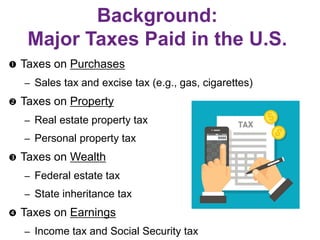
 Taxes on Purchases
– Sales tax and excise tax (e.g., gas, cigarettes)
 Taxes on Property
– Real estate property tax
– Personal property tax
 Taxes on Wealth
– Federal estate tax
– State inheritance tax
 Taxes on Earnings
– Income tax and Social Security tax
Background: The Progressive
Nature of Federal Income Tax
• Progressive tax – Takes a larger percentage
of income from high-income taxpayers than
low-income taxpayers.
– Federal income tax
• Regressive tax – Takes a decreasing
percentage of income as income increases.
– State sales tax
Background: Marginal Tax Rate Is
Applied to the Last Dollar Earned
• Marginal Tax Bracket (MTB) – Income-range
segments that are taxed at increasing rates as
income goes up
• Marginal Tax Rate – The tax rate applied to your
last dollar of earnings
• Established by Congress and change periodically
• Major overhaul of federal income tax rates in TCJA
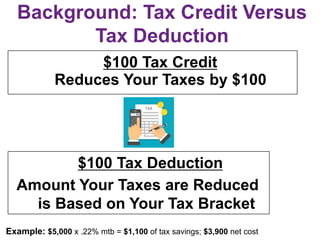
Background: Tax Credit Versus
Tax Deduction
$100 Tax Credit
Reduces Your Taxes by $100
$100 Tax Deduction
Amount Your Taxes are Reduced
is Based on Your Tax Bracket
Example: $5,000 x .22% mtb = $1,100 of tax savings; $3,900 net cost
Background:
Types of Deductions
Deduction = An amount subtracted from gross income to
reduce the amount of income subject to tax.
• Standard Deduction- Amount established each year by tax
code; no need to itemize deductions; amount is based on a
taxpayer's filing status, age, etc; no receipts needed
• Itemized Deduction- Specific amounts spent on certain
goods and services throughout the year; allowed deductions
are outlined by the IRS and include such expenditures as
mortgage interest and charitable donations
www.investopedia.com/terms/i/itemizeddeduction.asp#ixzz1zxopAxpP
www.money-zine.com/Calculators/Mortgage-Calculators/Mortgage-Tax-
Deduction-Calculator/ (Mortgage tax deduction calculator)
7
Background: Itemizing Required
for Charitable Gift Benefits
• If you claim the standard deduction on your tax
return, charitable gifts will not provide a tax benefit
– Psychic benefits of giving to charity are another issue
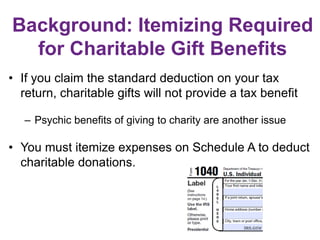
• You must itemize expenses on Schedule A to deduct
charitable donations.
Background: Refundable and
Non-Refundable Tax Credits
• Refundable: When tax credits are greater than the
amount of tax you owe, the IRS sends you a tax
refund for the difference
– Example: Earned Income Tax Credit (EITC)
• Non-Refundable: Credit can’t be used to increase
your tax refund or to create a tax refund when you
wouldn’t have already had one. In other words, your
savings cannot exceed the amount of tax you owe.
– Example: Child and Dependent Care Expenses Credit
Background: Tax-Rate
Schedules and Tax Tables
• Tax-Rate Schedules – Used by filers with a taxable
income of $100,000 or more; requires a mathematical
computation to determine tax liability
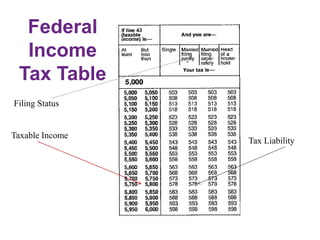
• Tax Tables – Used to look up one’s tax liability
according to tax filing status and income range
Federal
Income
Tax Table
Filing Status
Taxable Income
Tax Liability
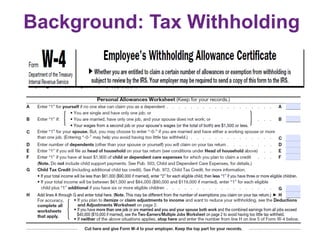
Background: Tax Withholding
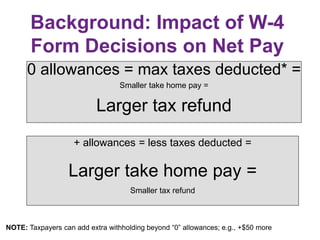
Background: Impact of W-4
Form Decisions on Net Pay
0 allowances = max taxes deducted* =
Smaller take home pay =
Larger tax refund
+ allowances = less taxes deducted =
Larger take home pay =
Smaller tax refund
NOTE: Taxpayers can add extra withholding beyond “0” allowances; e.g., +$50 more
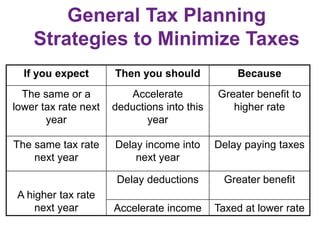
General Tax Planning
Strategies to Minimize Taxes
If you expect Then you should Because
The same or a
lower tax rate next
year
Accelerate
deductions into this
year
Greater benefit to
higher rate
The same tax rate
next year
Delay income into
next year
Delay paying taxes
A higher tax rate
next year
Delay deductions Greater benefit
Accelerate income Taxed at lower rate
Background:
Alternative Minimum Tax (AMT)
– Paid by taxpayers with high amounts of certain
deductions and various types of income
– Designed to ensure that those who receive tax
breaks also pay their fair share of taxes
– Has increasingly been affecting less affluent
taxpayers, especially in high-tax states (e.g., NJ)
– A high proportion of long-term capital gains to
ordinary income can trigger the AMT
Background: Tax Avoidance
and Tax Evasion
Tax Avoidance (Minimization)
– Legitimate methods to reduce your tax obligation
to your fair share but no more
(e.g., deductions, credits, tax-deferred/tax-free investing)
Tax Evasion
– Illegally not paying taxes you owe, such as not
reporting all income or overstating deductions
Any Questions About the
Background Information?
Tax Cuts and Jobs Act
The Tax Cuts and Jobs Act was passed by the U.S. Senate and
House of Representatives in late December 2017 and signed by
President Trump on December 22, 2017.
This law will impact individual taxpayers and businesses on a
scale that has not been seen in over 30 years.
Your Tax Return Was Supposed
to Fit on a Postcard!
Tax Cuts and Jobs Act #1
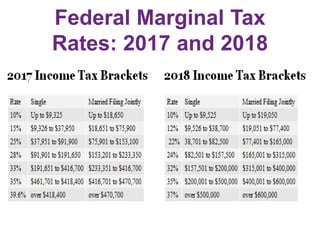
• Eight year period of lower individual tax rates from
2018 through 2025 with seven temporary tax rate
brackets ranging from 10% to 37%
• Elimination of personal exemptions (from 2018-2025)
• Nearly double the standard deduction ($12,000 for
singles and $24,000 for married couples filing jointly
in 2018)
– Fewer people will benefit from itemized deductions
Federal Marginal Tax
Rates: 2017 and 2018
Tax Cuts and Jobs Act #2
• $10,000 cap for state and local tax (SALT)
deductions (e.g., state income tax and municipal
property tax) for taxpayers who itemize; NOT
indexed for inflation
• Repeal of all miscellaneous deductions that were
previously subject to 2% of adjusted gross income
(AGI) floor (e.g., union dues, uniform expenses,
unreimbursed business expenses, tax prep fees)
• Enhanced child tax credit of $2,000 per qualifying
child; $1,400 of the credit is refundable
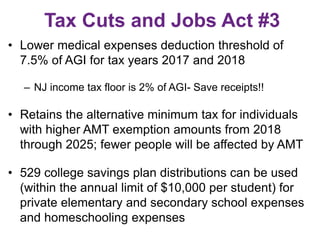
Tax Cuts and Jobs Act #3
• Lower medical expenses deduction threshold of
7.5% of AGI for tax years 2017 and 2018
– NJ income tax floor is 2% of AGI- Save receipts!!
• Retains the alternative minimum tax for individuals
with higher AMT exemption amounts from 2018
through 2025; fewer people will be affected by AMT
• 529 college savings plan distributions can be used
(within the annual limit of $10,000 per student) for
private elementary and secondary school expenses
and homeschooling expenses
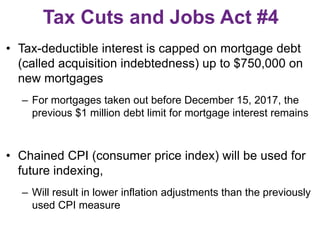
Tax Cuts and Jobs Act #4
• Tax-deductible interest is capped on mortgage debt
(called acquisition indebtedness) up to $750,000 on
new mortgages
– For mortgages taken out before December 15, 2017, the
previous $1 million debt limit for mortgage interest remains
• Chained CPI (consumer price index) will be used for
future indexing,
– Will result in lower inflation adjustments than the previously
used CPI measure
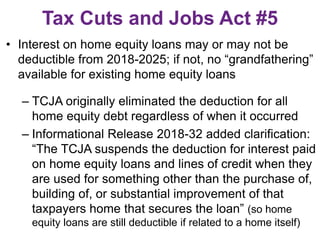
Tax Cuts and Jobs Act #5
• Interest on home equity loans may or may not be
deductible from 2018-2025; if not, no “grandfathering”
available for existing home equity loans
– TCJA originally eliminated the deduction for all
home equity debt regardless of when it occurred
– Informational Release 2018-32 added clarification:
“The TCJA suspends the deduction for interest paid
on home equity loans and lines of credit when they
are used for something other than the purchase of,
building of, or substantial improvement of that
taxpayers home that secures the loan” (so home
equity loans are still deductible if related to a home itself)
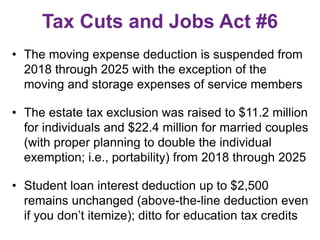
Tax Cuts and Jobs Act #6
• The moving expense deduction is suspended from
2018 through 2025 with the exception of the
moving and storage expenses of service members
• The estate tax exclusion was raised to $11.2 million
for individuals and $22.4 million for married couples
(with proper planning to double the individual
exemption; i.e., portability) from 2018 through 2025
• Student loan interest deduction up to $2,500
remains unchanged (above-the-line deduction even
if you don’t itemize); ditto for education tax credits
Tax Cuts and Jobs Act #7
• The Affordable Care Act shared responsibility
payment remains in effect for 2017 and 2018 and is
$0 beginning in 2019
• Alimony is no longer deductible by spouses who pay
or taxable to recipient spouses for divorce decrees
signed after December 31, 2018
• Uninsured casualty losses can only be deducted if
they are attributable to a federally declared disaster
and exceed 10% of AGI
• TCJA slams NJ harder than any other state:
http://www.nj.com/politics/index.ssf/2018/03/trump_tax_plan_hits_nj_hard
er_than_any_other_state.html
What to Do About Your Income
Tax Withholding?
• Check your expected tax impact as a result of the
TCJA with an online calculator:
– http://tpc-tax-calculator.urban.org/
– http://taxplancalculator.com/calc
– https://taxfoundation.org/2018-tax-reform-calculator/
• Determine the change in your tax withholding starting
with first revised paycheck of 2018; multiply this
amount by the number of remaining paychecks
• Compare the two numbers; adjust W-4 form as
needed
What to Do About the SALT Cap?
• Consider downsizing to a smaller home in your
current town to have lower property taxes
• Consider moving to another town that has lower
property taxes (Trenton, NJ to Morrisville, PA)
• Suck it up and pay more federal income tax
What to Do About the Loss of
Business Expense Deductions?
• Say “no” to actions that require unreimbursed, non-
deductible expenses (e.g., hold a teleconference
instead of driving)
• Establish a consulting business (consistent with
employer policies) to deduct expenses against (e.g.,
professional dues)
• Pay now non-deductible employee business
expenses fully out-of-pocket (i.e., pay more income
tax)
What to Do About the Loss of
Charitable Contribution Deduction?
• “Make Yourself Whole” Strategy- Give what you used
to give out-of-pocket (i.e., after taking tax deductions)-
now that you can no longer itemize
• Donate appreciated assets instead of cash (to avoid
capital gains taxes)
• If over 70 ½, donate from an IRA (so RMD does not
count as income to the donor)
• “Bunch” donation funds into target years, using a
donor-advised fund to distribute funds to charities
Income Tax Resources
Recommended Resource
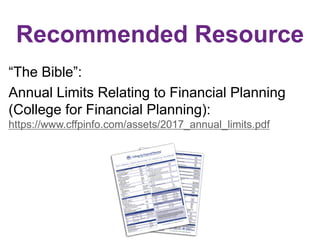
“The Bible”:
Annual Limits Relating to Financial Planning
(College for Financial Planning):
https://www.cffpinfo.com/assets/2017_annual_limits.pdf
Federal Tax Rates
Rutgers Cooperative Extension Tax Information web
page: http://njaes.rutgers.edu/money/taxinfo/
Nerd’s Eye View Blog Post
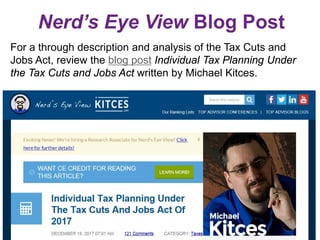
For a through description and analysis of the Tax Cuts and
Jobs Act, review the blog post Individual Tax Planning Under
the Tax Cuts and Jobs Act written by Michael Kitces.
TCJA Tax Law Calculators
• Tax Bill Calculator: Will Your Taxes Go Up or Down? (The
New York Times):
https://www.nytimes.com/interactive/2017/12/17/upshot/tax-
calculator.html?em_pos=small&emc=edit_up_20171218&nl=u
pshot&nl_art=0&nlid=77794120&ref=headline&te=1
• Tax Calculator: What Tax Reform Means For You (Fox
Business):
http://www.foxbusiness.com/politics/2017/12/19/tax-
calculator-what-tax-reform-means-for.html
• Be sure to check the underlying assumptions!
• You will get a rough estimate-not an exact number
TCJA Tax Law Resources
• Congress Passes Sweeping New Tax Legislation (Iowa State University):
https://www.calt.iastate.edu/blogpost/congress-passes-sweeping-new-tax-
legislation
• Details of the Conference Report for the Tax Cuts and Jobs Act (Tax
Foundation): https://taxfoundation.org/conference-report-tax-cuts-and-jobs-
act/
• Preliminary Details and Analysis of the Tax Cuts and Jobs Act (Tax
Foundation): https://taxfoundation.org/final-tax-cuts-and-jobs-act-details-
analysis/
• Tax Cuts and Jobs Act Summary (CCH Incorporated and Wolters Kluwer):
https://goo.gl/CtJMAq
• The Final GOP Tax Bill is Complete. Here’s What Is In It (The Washington
Post): https://www.washingtonpost.com/news/wonk/wp/2017/12/15/the-final-
gop-tax-bill-is-complete-heres-what-is-in-it/?utm_term=.b82bad4b0124
Any Questions About the
TCJA?

NJCFE Webinar-TCJA-Income Tax Update

  • 1.
    Income Tax Update:What You Need to Know About the Tax Cuts and Jobs Act Barbara O’Neill, Ph.D., CFP®, Rutgers Cooperative Extension boneill@njaes.rutgers.edu
  • 2.
  • 3.
    Background: Major Taxes Paidin the U.S.  Taxes on Purchases – Sales tax and excise tax (e.g., gas, cigarettes)  Taxes on Property – Real estate property tax – Personal property tax  Taxes on Wealth – Federal estate tax – State inheritance tax  Taxes on Earnings – Income tax and Social Security tax
  • 4.
    Background: The Progressive Natureof Federal Income Tax • Progressive tax – Takes a larger percentage of income from high-income taxpayers than low-income taxpayers. – Federal income tax • Regressive tax – Takes a decreasing percentage of income as income increases. – State sales tax
  • 5.
    Background: Marginal TaxRate Is Applied to the Last Dollar Earned • Marginal Tax Bracket (MTB) – Income-range segments that are taxed at increasing rates as income goes up • Marginal Tax Rate – The tax rate applied to your last dollar of earnings • Established by Congress and change periodically • Major overhaul of federal income tax rates in TCJA
  • 6.
    Background: Tax CreditVersus Tax Deduction $100 Tax Credit Reduces Your Taxes by $100 $100 Tax Deduction Amount Your Taxes are Reduced is Based on Your Tax Bracket Example: $5,000 x .22% mtb = $1,100 of tax savings; $3,900 net cost
  • 7.
    Background: Types of Deductions Deduction= An amount subtracted from gross income to reduce the amount of income subject to tax. • Standard Deduction- Amount established each year by tax code; no need to itemize deductions; amount is based on a taxpayer's filing status, age, etc; no receipts needed • Itemized Deduction- Specific amounts spent on certain goods and services throughout the year; allowed deductions are outlined by the IRS and include such expenditures as mortgage interest and charitable donations www.investopedia.com/terms/i/itemizeddeduction.asp#ixzz1zxopAxpP www.money-zine.com/Calculators/Mortgage-Calculators/Mortgage-Tax- Deduction-Calculator/ (Mortgage tax deduction calculator) 7
  • 8.
    Background: Itemizing Required forCharitable Gift Benefits • If you claim the standard deduction on your tax return, charitable gifts will not provide a tax benefit – Psychic benefits of giving to charity are another issue • You must itemize expenses on Schedule A to deduct charitable donations.
  • 9.
    Background: Refundable and Non-RefundableTax Credits • Refundable: When tax credits are greater than the amount of tax you owe, the IRS sends you a tax refund for the difference – Example: Earned Income Tax Credit (EITC) • Non-Refundable: Credit can’t be used to increase your tax refund or to create a tax refund when you wouldn’t have already had one. In other words, your savings cannot exceed the amount of tax you owe. – Example: Child and Dependent Care Expenses Credit
  • 10.
    Background: Tax-Rate Schedules andTax Tables • Tax-Rate Schedules – Used by filers with a taxable income of $100,000 or more; requires a mathematical computation to determine tax liability • Tax Tables – Used to look up one’s tax liability according to tax filing status and income range
  • 11.
  • 12.
  • 13.
    Background: Impact ofW-4 Form Decisions on Net Pay 0 allowances = max taxes deducted* = Smaller take home pay = Larger tax refund + allowances = less taxes deducted = Larger take home pay = Smaller tax refund NOTE: Taxpayers can add extra withholding beyond “0” allowances; e.g., +$50 more
  • 14.
    General Tax Planning Strategiesto Minimize Taxes If you expect Then you should Because The same or a lower tax rate next year Accelerate deductions into this year Greater benefit to higher rate The same tax rate next year Delay income into next year Delay paying taxes A higher tax rate next year Delay deductions Greater benefit Accelerate income Taxed at lower rate
  • 15.
    Background: Alternative Minimum Tax(AMT) – Paid by taxpayers with high amounts of certain deductions and various types of income – Designed to ensure that those who receive tax breaks also pay their fair share of taxes – Has increasingly been affecting less affluent taxpayers, especially in high-tax states (e.g., NJ) – A high proportion of long-term capital gains to ordinary income can trigger the AMT
  • 16.
    Background: Tax Avoidance andTax Evasion Tax Avoidance (Minimization) – Legitimate methods to reduce your tax obligation to your fair share but no more (e.g., deductions, credits, tax-deferred/tax-free investing) Tax Evasion – Illegally not paying taxes you owe, such as not reporting all income or overstating deductions
  • 17.
    Any Questions Aboutthe Background Information?
  • 18.
    Tax Cuts andJobs Act The Tax Cuts and Jobs Act was passed by the U.S. Senate and House of Representatives in late December 2017 and signed by President Trump on December 22, 2017. This law will impact individual taxpayers and businesses on a scale that has not been seen in over 30 years.
  • 19.
    Your Tax ReturnWas Supposed to Fit on a Postcard!
  • 20.
    Tax Cuts andJobs Act #1 • Eight year period of lower individual tax rates from 2018 through 2025 with seven temporary tax rate brackets ranging from 10% to 37% • Elimination of personal exemptions (from 2018-2025) • Nearly double the standard deduction ($12,000 for singles and $24,000 for married couples filing jointly in 2018) – Fewer people will benefit from itemized deductions
  • 21.
  • 22.
    Tax Cuts andJobs Act #2 • $10,000 cap for state and local tax (SALT) deductions (e.g., state income tax and municipal property tax) for taxpayers who itemize; NOT indexed for inflation • Repeal of all miscellaneous deductions that were previously subject to 2% of adjusted gross income (AGI) floor (e.g., union dues, uniform expenses, unreimbursed business expenses, tax prep fees) • Enhanced child tax credit of $2,000 per qualifying child; $1,400 of the credit is refundable
  • 23.
    Tax Cuts andJobs Act #3 • Lower medical expenses deduction threshold of 7.5% of AGI for tax years 2017 and 2018 – NJ income tax floor is 2% of AGI- Save receipts!! • Retains the alternative minimum tax for individuals with higher AMT exemption amounts from 2018 through 2025; fewer people will be affected by AMT • 529 college savings plan distributions can be used (within the annual limit of $10,000 per student) for private elementary and secondary school expenses and homeschooling expenses
  • 24.
    Tax Cuts andJobs Act #4 • Tax-deductible interest is capped on mortgage debt (called acquisition indebtedness) up to $750,000 on new mortgages – For mortgages taken out before December 15, 2017, the previous $1 million debt limit for mortgage interest remains • Chained CPI (consumer price index) will be used for future indexing, – Will result in lower inflation adjustments than the previously used CPI measure
  • 25.
    Tax Cuts andJobs Act #5 • Interest on home equity loans may or may not be deductible from 2018-2025; if not, no “grandfathering” available for existing home equity loans – TCJA originally eliminated the deduction for all home equity debt regardless of when it occurred – Informational Release 2018-32 added clarification: “The TCJA suspends the deduction for interest paid on home equity loans and lines of credit when they are used for something other than the purchase of, building of, or substantial improvement of that taxpayers home that secures the loan” (so home equity loans are still deductible if related to a home itself)
  • 26.
    Tax Cuts andJobs Act #6 • The moving expense deduction is suspended from 2018 through 2025 with the exception of the moving and storage expenses of service members • The estate tax exclusion was raised to $11.2 million for individuals and $22.4 million for married couples (with proper planning to double the individual exemption; i.e., portability) from 2018 through 2025 • Student loan interest deduction up to $2,500 remains unchanged (above-the-line deduction even if you don’t itemize); ditto for education tax credits
  • 27.
    Tax Cuts andJobs Act #7 • The Affordable Care Act shared responsibility payment remains in effect for 2017 and 2018 and is $0 beginning in 2019 • Alimony is no longer deductible by spouses who pay or taxable to recipient spouses for divorce decrees signed after December 31, 2018 • Uninsured casualty losses can only be deducted if they are attributable to a federally declared disaster and exceed 10% of AGI • TCJA slams NJ harder than any other state: http://www.nj.com/politics/index.ssf/2018/03/trump_tax_plan_hits_nj_hard er_than_any_other_state.html
  • 28.
    What to DoAbout Your Income Tax Withholding? • Check your expected tax impact as a result of the TCJA with an online calculator: – http://tpc-tax-calculator.urban.org/ – http://taxplancalculator.com/calc – https://taxfoundation.org/2018-tax-reform-calculator/ • Determine the change in your tax withholding starting with first revised paycheck of 2018; multiply this amount by the number of remaining paychecks • Compare the two numbers; adjust W-4 form as needed
  • 29.
    What to DoAbout the SALT Cap? • Consider downsizing to a smaller home in your current town to have lower property taxes • Consider moving to another town that has lower property taxes (Trenton, NJ to Morrisville, PA) • Suck it up and pay more federal income tax
  • 30.
    What to DoAbout the Loss of Business Expense Deductions? • Say “no” to actions that require unreimbursed, non- deductible expenses (e.g., hold a teleconference instead of driving) • Establish a consulting business (consistent with employer policies) to deduct expenses against (e.g., professional dues) • Pay now non-deductible employee business expenses fully out-of-pocket (i.e., pay more income tax)
  • 31.
    What to DoAbout the Loss of Charitable Contribution Deduction? • “Make Yourself Whole” Strategy- Give what you used to give out-of-pocket (i.e., after taking tax deductions)- now that you can no longer itemize • Donate appreciated assets instead of cash (to avoid capital gains taxes) • If over 70 ½, donate from an IRA (so RMD does not count as income to the donor) • “Bunch” donation funds into target years, using a donor-advised fund to distribute funds to charities
  • 32.
  • 33.
    Recommended Resource “The Bible”: AnnualLimits Relating to Financial Planning (College for Financial Planning): https://www.cffpinfo.com/assets/2017_annual_limits.pdf
  • 34.
    Federal Tax Rates RutgersCooperative Extension Tax Information web page: http://njaes.rutgers.edu/money/taxinfo/
  • 35.
    Nerd’s Eye ViewBlog Post For a through description and analysis of the Tax Cuts and Jobs Act, review the blog post Individual Tax Planning Under the Tax Cuts and Jobs Act written by Michael Kitces.
  • 36.
    TCJA Tax LawCalculators • Tax Bill Calculator: Will Your Taxes Go Up or Down? (The New York Times): https://www.nytimes.com/interactive/2017/12/17/upshot/tax- calculator.html?em_pos=small&emc=edit_up_20171218&nl=u pshot&nl_art=0&nlid=77794120&ref=headline&te=1 • Tax Calculator: What Tax Reform Means For You (Fox Business): http://www.foxbusiness.com/politics/2017/12/19/tax- calculator-what-tax-reform-means-for.html • Be sure to check the underlying assumptions! • You will get a rough estimate-not an exact number
  • 37.
    TCJA Tax LawResources • Congress Passes Sweeping New Tax Legislation (Iowa State University): https://www.calt.iastate.edu/blogpost/congress-passes-sweeping-new-tax- legislation • Details of the Conference Report for the Tax Cuts and Jobs Act (Tax Foundation): https://taxfoundation.org/conference-report-tax-cuts-and-jobs- act/ • Preliminary Details and Analysis of the Tax Cuts and Jobs Act (Tax Foundation): https://taxfoundation.org/final-tax-cuts-and-jobs-act-details- analysis/ • Tax Cuts and Jobs Act Summary (CCH Incorporated and Wolters Kluwer): https://goo.gl/CtJMAq • The Final GOP Tax Bill is Complete. Here’s What Is In It (The Washington Post): https://www.washingtonpost.com/news/wonk/wp/2017/12/15/the-final- gop-tax-bill-is-complete-heres-what-is-in-it/?utm_term=.b82bad4b0124
  • 38.