1
Income Taxes
Financial Planning for Women
February 2008
Garman/Forgue Personal Finance 9th ed.
Presented by Danielle Walker
2
Objectives - be able to:
• Calculate your marginal tax rate &
apply in tax planning
• Reduce your taxable income
• Differentiate between adjustments,
deductions, & credits
• Recognize taxable income < gross
• Adjust W-4 withholding
• Avoid instant refund schemes
• Know Utah has 2 tax systems
3
Introduction
• Tax Planning: Seeking legal ways to
reduce, eliminate, or defer income
taxes.
• Taxable Income: the income upon
which income taxes are levied
4
Progressive vs. Regressive
• Progressive tax- tax rate increases as
taxable income increases.
– U.S. income tax
• Regressive tax- as income rises, the
tax demands a decreasing proportion of
a person’s income.
– State sales tax
5
Marginal Tax Bracket and
Rate
• Marginal Tax Bracket (MTB)- one of the
6 income ranges that are taxed at
increasing rates as income goes up
• Marginal Tax Rate- the rate at which
one is taxed in each bracket
* Tax brackets are adjusted each year for inflation
Find MTB
• Use IRS tables or
• On tax table find:
– Taxable income & tax due
– Add $100 to taxable income and find tax
due
– The $ difference = MTB
• 10%, 15%, 25%, 28%, 33% or 35%
• Most taxpayers are in 10% or 15% MTB
6
7
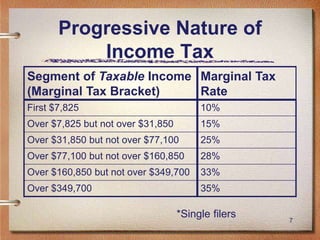
Progressive Nature of
Income Tax
Segment of Taxable Income
(Marginal Tax Bracket)
Marginal Tax
Rate
First $7,825 10%
Over $7,825 but not over $31,850 15%
Over $31,850 but not over $77,100 25%
Over $77,100 but not over $160,850 28%
Over $160,850 but not over $349,700 33%
Over $349,700 35%
*Single filers
8
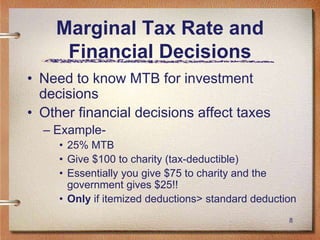
Marginal Tax Rate and
Financial Decisions
• Need to know MTB for investment
decisions
• Other financial decisions affect taxes
– Example-
• 25% MTB
• Give $100 to charity (tax-deductible)
• Essentially you give $75 to charity and the
government gives $25!!
• Only if itemized deductions> standard deduction
9
Filing Status & Tax Rates
• IRS 2007 tax rate schedules
– http://www.irs.gov/formspubs/article/0,,id=1
64272,00.html
– Single
– Married, filing jointly or qualifying widower
– Married, filing separately
– Head of household
10
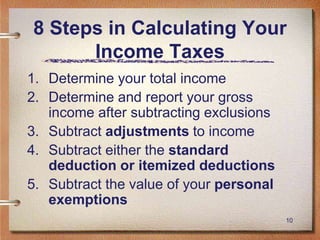
8 Steps in Calculating Your
Income Taxes
1. Determine your total income
2. Determine and report your gross
income after subtracting exclusions
3. Subtract adjustments to income
4. Subtract either the standard
deduction or itemized deductions
5. Subtract the value of your personal
exemptions
11
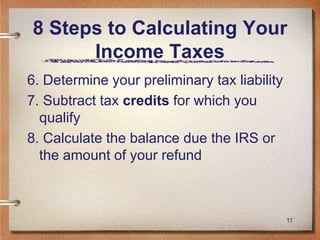
8 Steps to Calculating Your
Income Taxes
6. Determine your preliminary tax liability
7. Subtract tax credits for which you
qualify
8. Calculate the balance due the IRS or
the amount of your refund
12
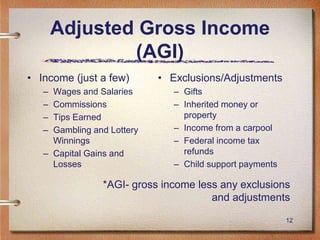
Adjusted Gross Income
(AGI)
• Income (just a few)
– Wages and Salaries
– Commissions
– Tips Earned
– Gambling and Lottery
Winnings
– Capital Gains and
Losses
• Exclusions/Adjustments
– Gifts
– Inherited money or
property
– Income from a carpool
– Federal income tax
refunds
– Child support payments
*AGI- gross income less any exclusions
and adjustments
13
Personal Exemptions and
Standard Deductions
• Personal Exemptions- $3400 x number of
people that taxpayer’s income supports
• Standard Deduction- amount that all tax
payers may subtract from their AGI
– Amount depends on filing status
– Deduct itemized deductions if > SD
• You only pay fed. taxes on income > your
personal exemption(s) + standard or
itemized deductions. (taxable income)
14
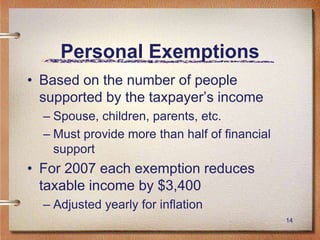
Personal Exemptions
• Based on the number of people
supported by the taxpayer’s income
– Spouse, children, parents, etc.
– Must provide more than half of financial
support
• For 2007 each exemption reduces
taxable income by $3,400
– Adjusted yearly for inflation
15
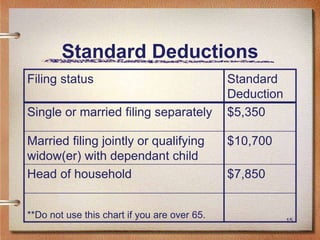
Standard Deductions
Filing status Standard
Deduction
Single or married filing separately $5,350
Married filing jointly or qualifying
widow(er) with dependant child
$10,700
Head of household $7,850
**Do not use this chart if you are over 65.
16
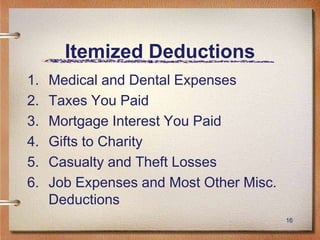
Itemized Deductions
1. Medical and Dental Expenses
2. Taxes You Paid
3. Mortgage Interest You Paid
4. Gifts to Charity
5. Casualty and Theft Losses
6. Job Expenses and Most Other Misc.
Deductions
17
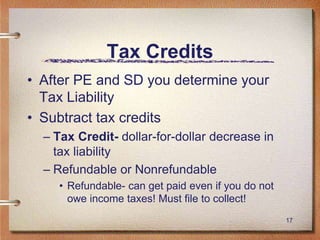
Tax Credits
• After PE and SD you determine your
Tax Liability
• Subtract tax credits
– Tax Credit- dollar-for-dollar decrease in
tax liability
– Refundable or Nonrefundable
• Refundable- can get paid even if you do not
owe income taxes! Must file to collect!
18
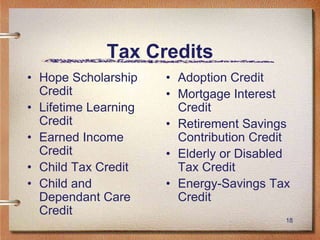
Tax Credits
• Hope Scholarship
Credit
• Lifetime Learning
Credit
• Earned Income
Credit
• Child Tax Credit
• Child and
Dependant Care
Credit
• Adoption Credit
• Mortgage Interest
Credit
• Retirement Savings
Contribution Credit
• Elderly or Disabled
Tax Credit
• Energy-Savings Tax
Credit
19
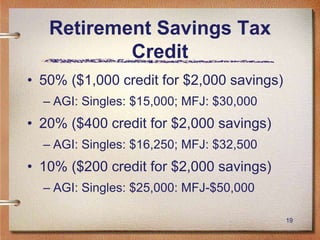
Retirement Savings Tax
Credit
• 50% ($1,000 credit for $2,000 savings)
– AGI: Singles: $15,000; MFJ: $30,000
• 20% ($400 credit for $2,000 savings)
– AGI: Singles: $16,250; MFJ: $32,500
• 10% ($200 credit for $2,000 savings)
– AGI: Singles: $25,000: MFJ-$50,000
20
Reduce Taxes Through
Proper Planning
• Practice legal tax avoidance, not tax
evasion.
• A dollar saved from taxes is really two
dollars - or more
– Opportunity cost
– Earning another dollar to replace one paid
to the IRS
– Earnings on a dollar not paid to the IRS
21
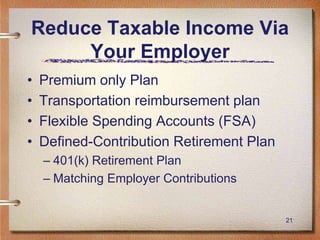
Reduce Taxable Income Via
Your Employer
• Premium only Plan
• Transportation reimbursement plan
• Flexible Spending Accounts (FSA)
• Defined-Contribution Retirement Plan
– 401(k) Retirement Plan
– Matching Employer Contributions
22
Tax Terminology
• Taxable
• Tax-deferred
• Tax-free (tax-exempt)
• Tax Sheltered
23
Tax Sheltered Investments
• Investments that yield returns that are
tax advantaged
– IRAs, Traditional and Roth
– Coverdell Education Savings Account
– 529 College Savings Plans
– Government Savings Bonds
– Municipal Bonds
– Capital Gains on Housing
24
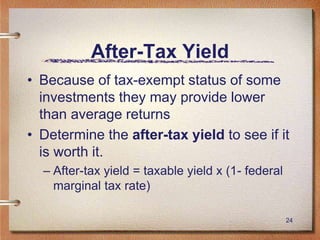
After-Tax Yield
• Because of tax-exempt status of some
investments they may provide lower
than average returns
• Determine the after-tax yield to see if it
is worth it.
– After-tax yield = taxable yield x (1- federal
marginal tax rate)
25
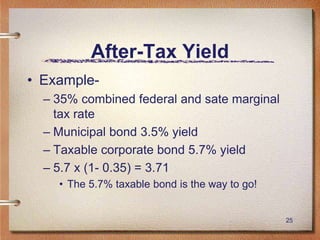
After-Tax Yield
• Example-
– 35% combined federal and sate marginal
tax rate
– Municipal bond 3.5% yield
– Taxable corporate bond 5.7% yield
– 5.7 x (1- 0.35) = 3.71
• The 5.7% taxable bond is the way to go!
26
Overwithholding
• When employees have their employers
withhold more in estimated taxes than the tax
liability ultimately due.
• A poor strategy of forced savings
• Opportunity cost- what could have been
done/earned with that money???
• File a new W4 to decrease your
withholding and automatically invest or
payoff debt
– http://www.irs.gov/individuals/article/0,,id=96196,0
0.html
27
Top 3 Financial Missteps
1. Turn all your income tax planning over
to someone else
2. Overwithhold too much income to
receive a refund next year
3. Ignore the impact of income taxes in
your personal financial planning
28
Hiring a Tax Preparer
• Anyone can be a tax preparer!!
• Make sure to do your research
– What qualifications do they have?
– How qualified do I need them to be?
– What do they charge?
– Do I want tax advise all year round?
– Make sure to check out agencies as well
as individuals
29
Hiring a Tax Preparer
• Free file - AGI needs to be $54,000 or less
– http://www.irs.gov/efile/article/0,,id=118986,00.html
• USU Accounting students provide VITA
assistance in basement of USU Business
building
– Open Wednesdays 5-9 pm & Saturdays 9 am-1
pm February 13th - April 5th.
• For more info: Joe Fail [failing21@yahoo.com]
– The VITA lab will not be open March 8th, 12th,
15th, or 29th
30
Tax Changes for 2007
• Deduction for mortgage insurance premiums
is phased out for taxpayers with adjusted
gross incomes exceeding $100,000 ($50,000,
if married filing separately).
• To deduct any charitable donation, taxpayers
must have a bank record or a written
communication from the recipient showing
the name of the organization and the date
and amount of the contribution.
31
Utah Changes for 2007
• What's New for 2007 Tax Year
– Dual Income Tax System: The Utah
individual tax law was changed for 2007 to
allow you to calculate your Utah tax liability
two ways and then pay the lower amount.
– Utah Educational Savings Plan (529)
Deduction Expanded: The deduction for
an investment in a Utah Educational
Savings Plan has been increased for 2007.
32
Utah Changes for 2007
– Utah Educational Savings Plan Credit: An
investment in a 529 may be taken as a deduction
(Part 3 of TC-40S) under the traditional tax
system. It may also be used as a credit under the
single rate tax system when calculating the tax on
line 13 of TC-40.
– Nonrefundable Residential Energy System Tax
Credit: a new credit is available for a system
installed on a residential unit that supplies all or
part of the energy required.
33
Utah Changes for 2007
– Refundable Commercial Energy System Tax
Credit: A new refundable credit is available for a
commercial energy system.
• For more information -
http://incometax.utah.gov/new.php
34
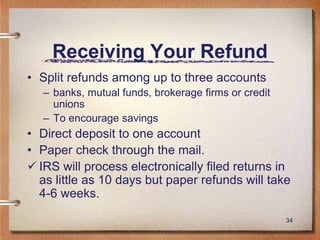
Receiving Your Refund
• Split refunds among up to three accounts
– banks, mutual funds, brokerage firms or credit
unions
– To encourage savings
• Direct deposit to one account
• Paper check through the mail.
 IRS will process electronically filed returns in
as little as 10 days but paper refunds will take
4-6 weeks.
35
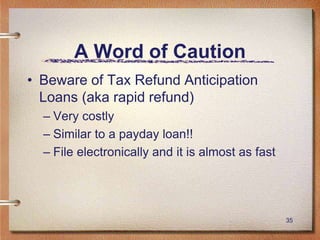
A Word of Caution
• Beware of Tax Refund Anticipation
Loans (aka rapid refund)
– Very costly
– Similar to a payday loan!!
– File electronically and it is almost as fast
36
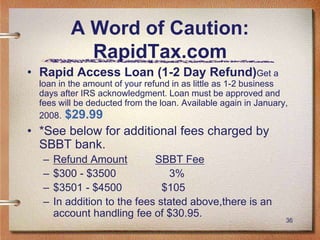
A Word of Caution:
RapidTax.com
• Rapid Access Loan (1-2 Day Refund)Get a
loan in the amount of your refund in as little as 1-2 business
days after IRS acknowledgment. Loan must be approved and
fees will be deducted from the loan. Available again in January,
2008. $29.99
• *See below for additional fees charged by
SBBT bank.
– Refund Amount SBBT Fee
– $300 - $3500 3%
– $3501 - $4500 $105
– In addition to the fees stated above,there is an
account handling fee of $30.95.
37
On a Lighter Note
• The guy who said that truth never hurts never
had to fill out a Form 1040.
• Another difference between death and taxes
is that death is frequently painless.
• Children may be deductible, but they are still
taxing.
• Tax Humor (page 1) From Tom Antion & Associates -
http://www.antion.com/humor/speakerhumor/taxes.htm
38
March 5, 2007!!
• Investment Planning
– Note that it is the FIRST Wednesday due
to Spring Break!!
– Remember to bring a friend!

Fpw income taxes

  • 1.
    1 Income Taxes Financial Planningfor Women February 2008 Garman/Forgue Personal Finance 9th ed. Presented by Danielle Walker
  • 2.
    2 Objectives - beable to: • Calculate your marginal tax rate & apply in tax planning • Reduce your taxable income • Differentiate between adjustments, deductions, & credits • Recognize taxable income < gross • Adjust W-4 withholding • Avoid instant refund schemes • Know Utah has 2 tax systems
  • 3.
    3 Introduction • Tax Planning:Seeking legal ways to reduce, eliminate, or defer income taxes. • Taxable Income: the income upon which income taxes are levied
  • 4.
    4 Progressive vs. Regressive •Progressive tax- tax rate increases as taxable income increases. – U.S. income tax • Regressive tax- as income rises, the tax demands a decreasing proportion of a person’s income. – State sales tax
  • 5.
    5 Marginal Tax Bracketand Rate • Marginal Tax Bracket (MTB)- one of the 6 income ranges that are taxed at increasing rates as income goes up • Marginal Tax Rate- the rate at which one is taxed in each bracket * Tax brackets are adjusted each year for inflation
  • 6.
    Find MTB • UseIRS tables or • On tax table find: – Taxable income & tax due – Add $100 to taxable income and find tax due – The $ difference = MTB • 10%, 15%, 25%, 28%, 33% or 35% • Most taxpayers are in 10% or 15% MTB 6
  • 7.
    7 Progressive Nature of IncomeTax Segment of Taxable Income (Marginal Tax Bracket) Marginal Tax Rate First $7,825 10% Over $7,825 but not over $31,850 15% Over $31,850 but not over $77,100 25% Over $77,100 but not over $160,850 28% Over $160,850 but not over $349,700 33% Over $349,700 35% *Single filers
  • 8.
    8 Marginal Tax Rateand Financial Decisions • Need to know MTB for investment decisions • Other financial decisions affect taxes – Example- • 25% MTB • Give $100 to charity (tax-deductible) • Essentially you give $75 to charity and the government gives $25!! • Only if itemized deductions> standard deduction
  • 9.
    9 Filing Status &Tax Rates • IRS 2007 tax rate schedules – http://www.irs.gov/formspubs/article/0,,id=1 64272,00.html – Single – Married, filing jointly or qualifying widower – Married, filing separately – Head of household
  • 10.
    10 8 Steps inCalculating Your Income Taxes 1. Determine your total income 2. Determine and report your gross income after subtracting exclusions 3. Subtract adjustments to income 4. Subtract either the standard deduction or itemized deductions 5. Subtract the value of your personal exemptions
  • 11.
    11 8 Steps toCalculating Your Income Taxes 6. Determine your preliminary tax liability 7. Subtract tax credits for which you qualify 8. Calculate the balance due the IRS or the amount of your refund
  • 12.
    12 Adjusted Gross Income (AGI) •Income (just a few) – Wages and Salaries – Commissions – Tips Earned – Gambling and Lottery Winnings – Capital Gains and Losses • Exclusions/Adjustments – Gifts – Inherited money or property – Income from a carpool – Federal income tax refunds – Child support payments *AGI- gross income less any exclusions and adjustments
  • 13.
    13 Personal Exemptions and StandardDeductions • Personal Exemptions- $3400 x number of people that taxpayer’s income supports • Standard Deduction- amount that all tax payers may subtract from their AGI – Amount depends on filing status – Deduct itemized deductions if > SD • You only pay fed. taxes on income > your personal exemption(s) + standard or itemized deductions. (taxable income)
  • 14.
    14 Personal Exemptions • Basedon the number of people supported by the taxpayer’s income – Spouse, children, parents, etc. – Must provide more than half of financial support • For 2007 each exemption reduces taxable income by $3,400 – Adjusted yearly for inflation
  • 15.
    15 Standard Deductions Filing statusStandard Deduction Single or married filing separately $5,350 Married filing jointly or qualifying widow(er) with dependant child $10,700 Head of household $7,850 **Do not use this chart if you are over 65.
  • 16.
    16 Itemized Deductions 1. Medicaland Dental Expenses 2. Taxes You Paid 3. Mortgage Interest You Paid 4. Gifts to Charity 5. Casualty and Theft Losses 6. Job Expenses and Most Other Misc. Deductions
  • 17.
    17 Tax Credits • AfterPE and SD you determine your Tax Liability • Subtract tax credits – Tax Credit- dollar-for-dollar decrease in tax liability – Refundable or Nonrefundable • Refundable- can get paid even if you do not owe income taxes! Must file to collect!
  • 18.
    18 Tax Credits • HopeScholarship Credit • Lifetime Learning Credit • Earned Income Credit • Child Tax Credit • Child and Dependant Care Credit • Adoption Credit • Mortgage Interest Credit • Retirement Savings Contribution Credit • Elderly or Disabled Tax Credit • Energy-Savings Tax Credit
  • 19.
    19 Retirement Savings Tax Credit •50% ($1,000 credit for $2,000 savings) – AGI: Singles: $15,000; MFJ: $30,000 • 20% ($400 credit for $2,000 savings) – AGI: Singles: $16,250; MFJ: $32,500 • 10% ($200 credit for $2,000 savings) – AGI: Singles: $25,000: MFJ-$50,000
  • 20.
    20 Reduce Taxes Through ProperPlanning • Practice legal tax avoidance, not tax evasion. • A dollar saved from taxes is really two dollars - or more – Opportunity cost – Earning another dollar to replace one paid to the IRS – Earnings on a dollar not paid to the IRS
  • 21.
    21 Reduce Taxable IncomeVia Your Employer • Premium only Plan • Transportation reimbursement plan • Flexible Spending Accounts (FSA) • Defined-Contribution Retirement Plan – 401(k) Retirement Plan – Matching Employer Contributions
  • 22.
    22 Tax Terminology • Taxable •Tax-deferred • Tax-free (tax-exempt) • Tax Sheltered
  • 23.
    23 Tax Sheltered Investments •Investments that yield returns that are tax advantaged – IRAs, Traditional and Roth – Coverdell Education Savings Account – 529 College Savings Plans – Government Savings Bonds – Municipal Bonds – Capital Gains on Housing
  • 24.
    24 After-Tax Yield • Becauseof tax-exempt status of some investments they may provide lower than average returns • Determine the after-tax yield to see if it is worth it. – After-tax yield = taxable yield x (1- federal marginal tax rate)
  • 25.
    25 After-Tax Yield • Example- –35% combined federal and sate marginal tax rate – Municipal bond 3.5% yield – Taxable corporate bond 5.7% yield – 5.7 x (1- 0.35) = 3.71 • The 5.7% taxable bond is the way to go!
  • 26.
    26 Overwithholding • When employeeshave their employers withhold more in estimated taxes than the tax liability ultimately due. • A poor strategy of forced savings • Opportunity cost- what could have been done/earned with that money??? • File a new W4 to decrease your withholding and automatically invest or payoff debt – http://www.irs.gov/individuals/article/0,,id=96196,0 0.html
  • 27.
    27 Top 3 FinancialMissteps 1. Turn all your income tax planning over to someone else 2. Overwithhold too much income to receive a refund next year 3. Ignore the impact of income taxes in your personal financial planning
  • 28.
    28 Hiring a TaxPreparer • Anyone can be a tax preparer!! • Make sure to do your research – What qualifications do they have? – How qualified do I need them to be? – What do they charge? – Do I want tax advise all year round? – Make sure to check out agencies as well as individuals
  • 29.
    29 Hiring a TaxPreparer • Free file - AGI needs to be $54,000 or less – http://www.irs.gov/efile/article/0,,id=118986,00.html • USU Accounting students provide VITA assistance in basement of USU Business building – Open Wednesdays 5-9 pm & Saturdays 9 am-1 pm February 13th - April 5th. • For more info: Joe Fail [failing21@yahoo.com] – The VITA lab will not be open March 8th, 12th, 15th, or 29th
  • 30.
    30 Tax Changes for2007 • Deduction for mortgage insurance premiums is phased out for taxpayers with adjusted gross incomes exceeding $100,000 ($50,000, if married filing separately). • To deduct any charitable donation, taxpayers must have a bank record or a written communication from the recipient showing the name of the organization and the date and amount of the contribution.
  • 31.
    31 Utah Changes for2007 • What's New for 2007 Tax Year – Dual Income Tax System: The Utah individual tax law was changed for 2007 to allow you to calculate your Utah tax liability two ways and then pay the lower amount. – Utah Educational Savings Plan (529) Deduction Expanded: The deduction for an investment in a Utah Educational Savings Plan has been increased for 2007.
  • 32.
    32 Utah Changes for2007 – Utah Educational Savings Plan Credit: An investment in a 529 may be taken as a deduction (Part 3 of TC-40S) under the traditional tax system. It may also be used as a credit under the single rate tax system when calculating the tax on line 13 of TC-40. – Nonrefundable Residential Energy System Tax Credit: a new credit is available for a system installed on a residential unit that supplies all or part of the energy required.
  • 33.
    33 Utah Changes for2007 – Refundable Commercial Energy System Tax Credit: A new refundable credit is available for a commercial energy system. • For more information - http://incometax.utah.gov/new.php
  • 34.
    34 Receiving Your Refund •Split refunds among up to three accounts – banks, mutual funds, brokerage firms or credit unions – To encourage savings • Direct deposit to one account • Paper check through the mail.  IRS will process electronically filed returns in as little as 10 days but paper refunds will take 4-6 weeks.
  • 35.
    35 A Word ofCaution • Beware of Tax Refund Anticipation Loans (aka rapid refund) – Very costly – Similar to a payday loan!! – File electronically and it is almost as fast
  • 36.
    36 A Word ofCaution: RapidTax.com • Rapid Access Loan (1-2 Day Refund)Get a loan in the amount of your refund in as little as 1-2 business days after IRS acknowledgment. Loan must be approved and fees will be deducted from the loan. Available again in January, 2008. $29.99 • *See below for additional fees charged by SBBT bank. – Refund Amount SBBT Fee – $300 - $3500 3% – $3501 - $4500 $105 – In addition to the fees stated above,there is an account handling fee of $30.95.
  • 37.
    37 On a LighterNote • The guy who said that truth never hurts never had to fill out a Form 1040. • Another difference between death and taxes is that death is frequently painless. • Children may be deductible, but they are still taxing. • Tax Humor (page 1) From Tom Antion & Associates - http://www.antion.com/humor/speakerhumor/taxes.htm
  • 38.
    38 March 5, 2007!! •Investment Planning – Note that it is the FIRST Wednesday due to Spring Break!! – Remember to bring a friend!