Data Collection Techniques
   Agenda
     Probe 2 (15)
     Lecture: Chapter 5 (15)

     Lecture: Target Behaviors, Measurement (60)

     Break (10)

     Activity: Target Behavior Definitions (30)

     Session Lesson (30-45)

     Lecture (If time allows): Recording Data, Reliability,
      Graphs (20)
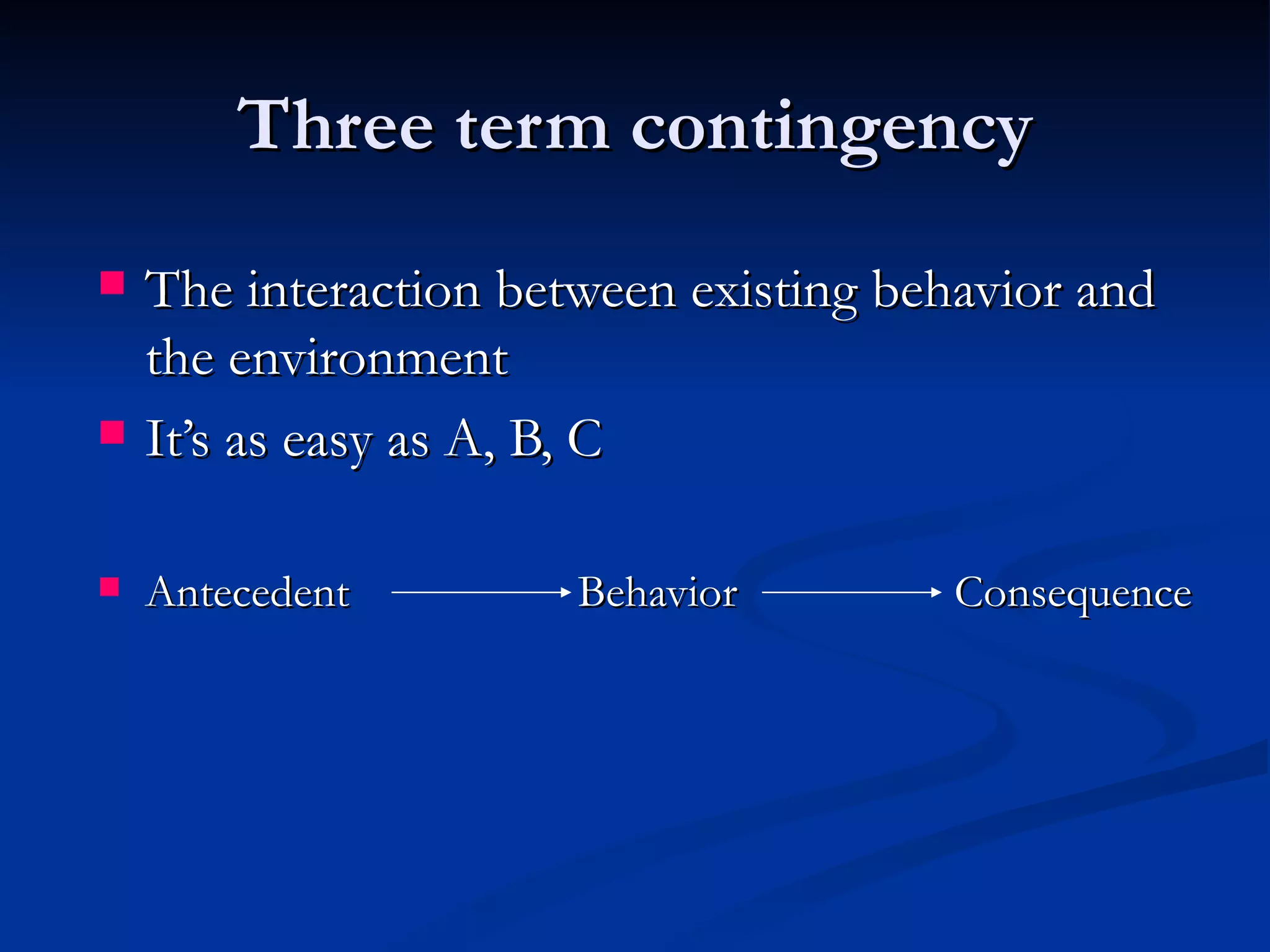
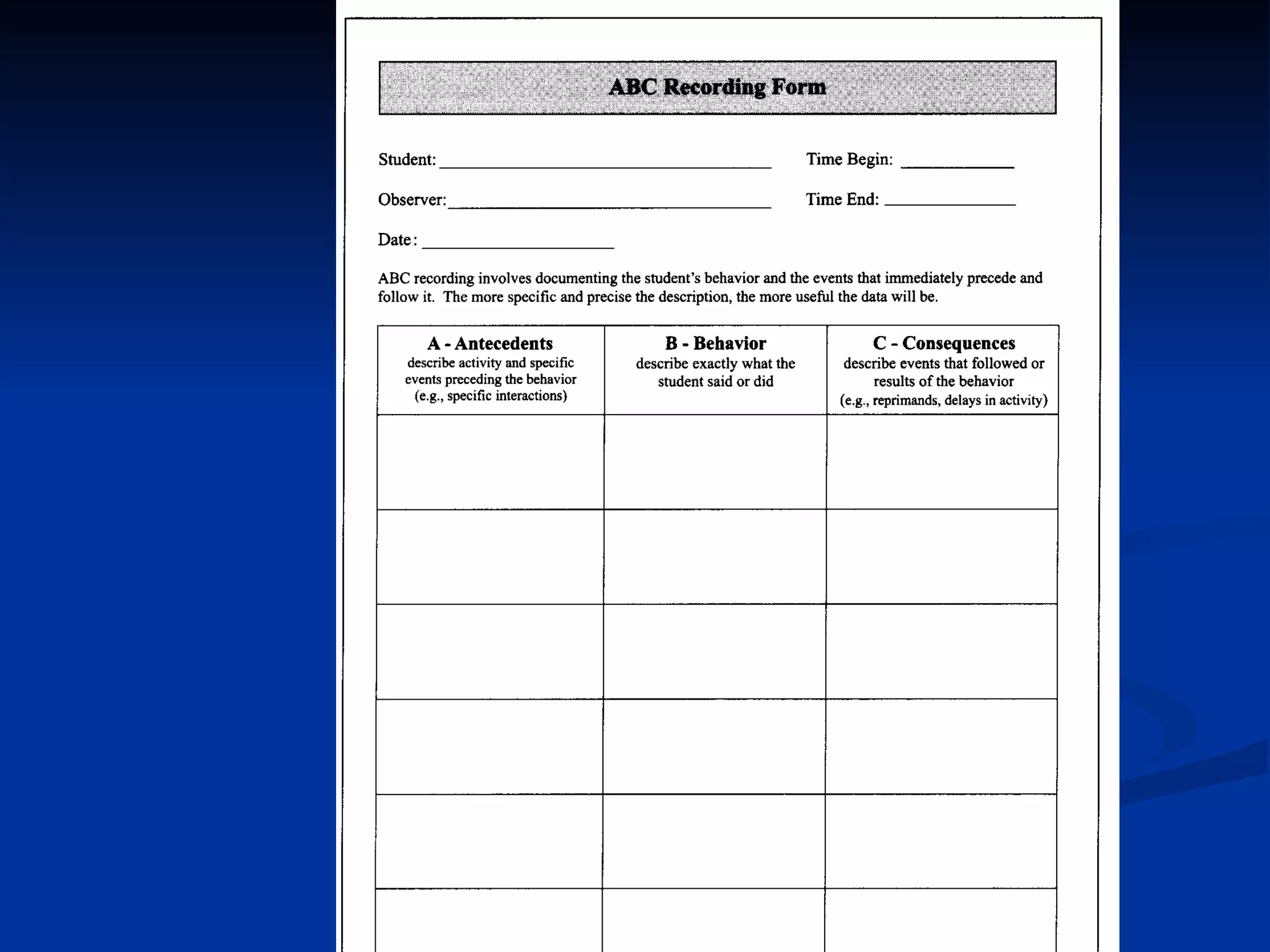
Three term contingency
   The interaction between existing behavior and
    the environment
   It’s as easy as A, B, C

   Antecedent         Behavior        Consequence
Principles of Behavior
   They describe a basic relationship between
    behavior and its controlling variables
     Positive reinforcement
     Negative reinforcement

     Punishment by presentation

     Punishment by removal

     Extinction
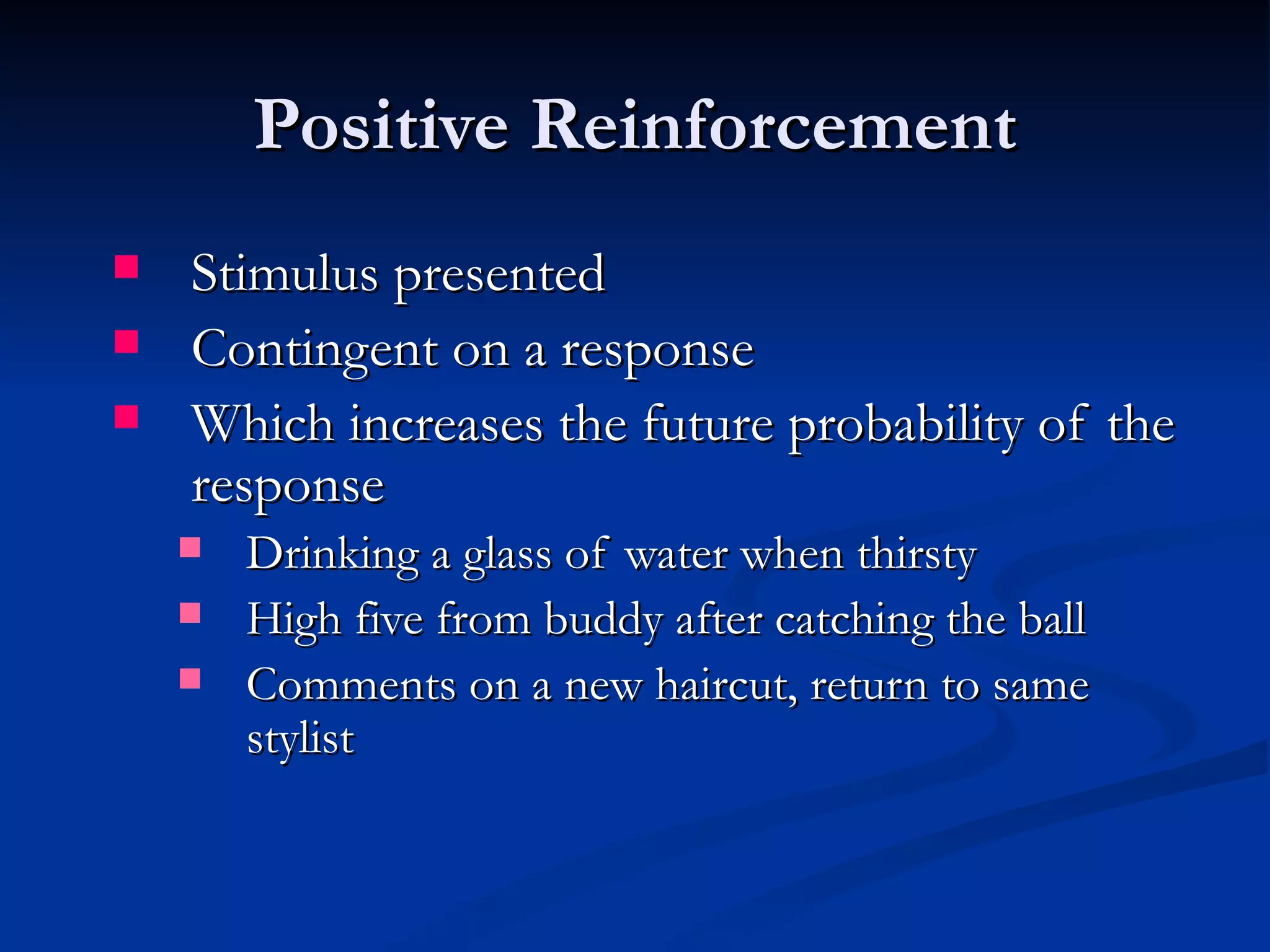
Positive Reinforcement
   Stimulus presented
   Contingent on a response
   Which increases the future probability of the
    response
       Drinking a glass of water when thirsty
       High five from buddy after catching the ball
       Comments on a new haircut, return to same
        stylist
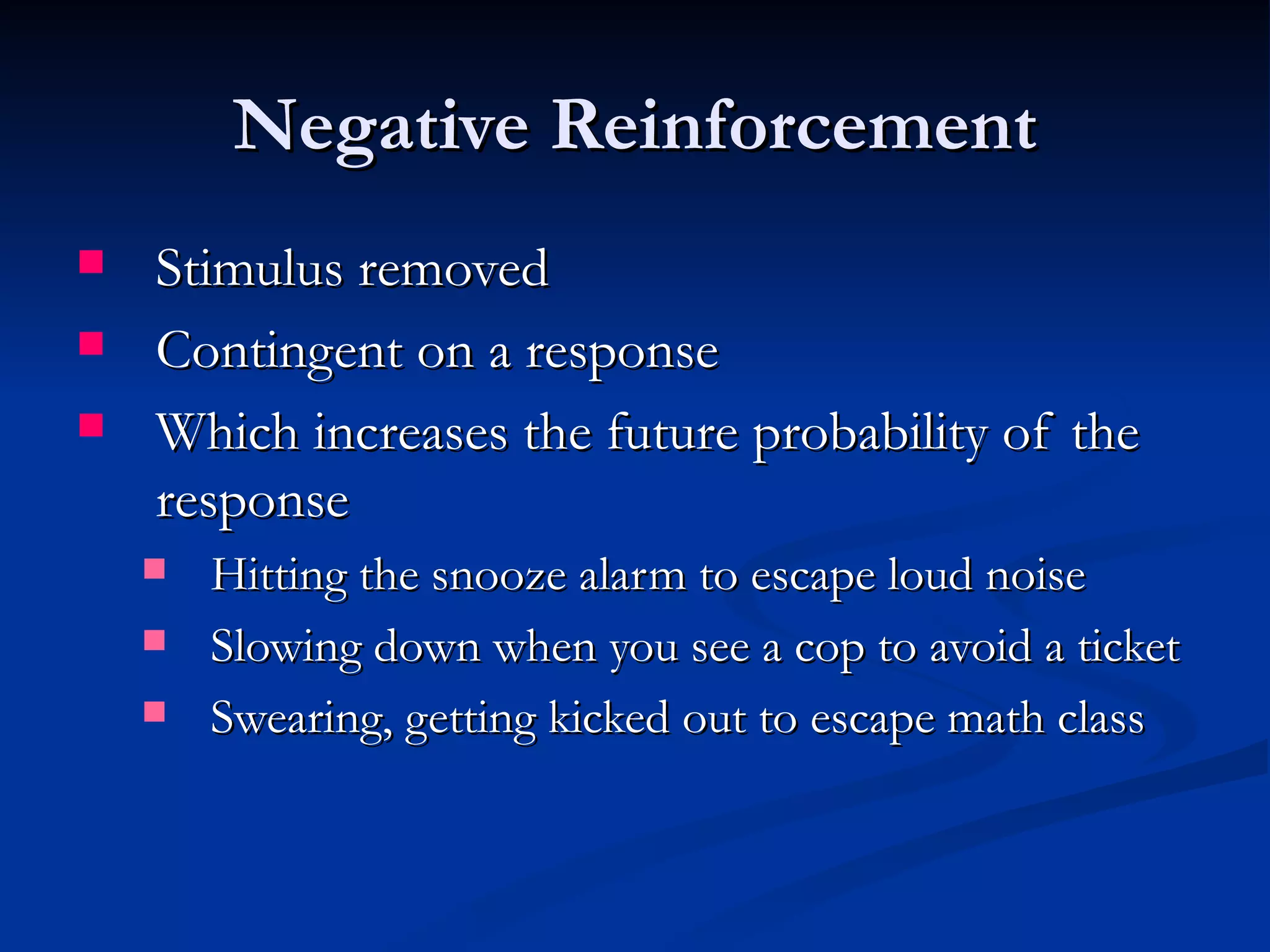
Negative Reinforcement
   Stimulus removed
   Contingent on a response
   Which increases the future probability of the
    response
       Hitting the snooze alarm to escape loud noise
       Slowing down when you see a cop to avoid a ticket
       Swearing, getting kicked out to escape math class
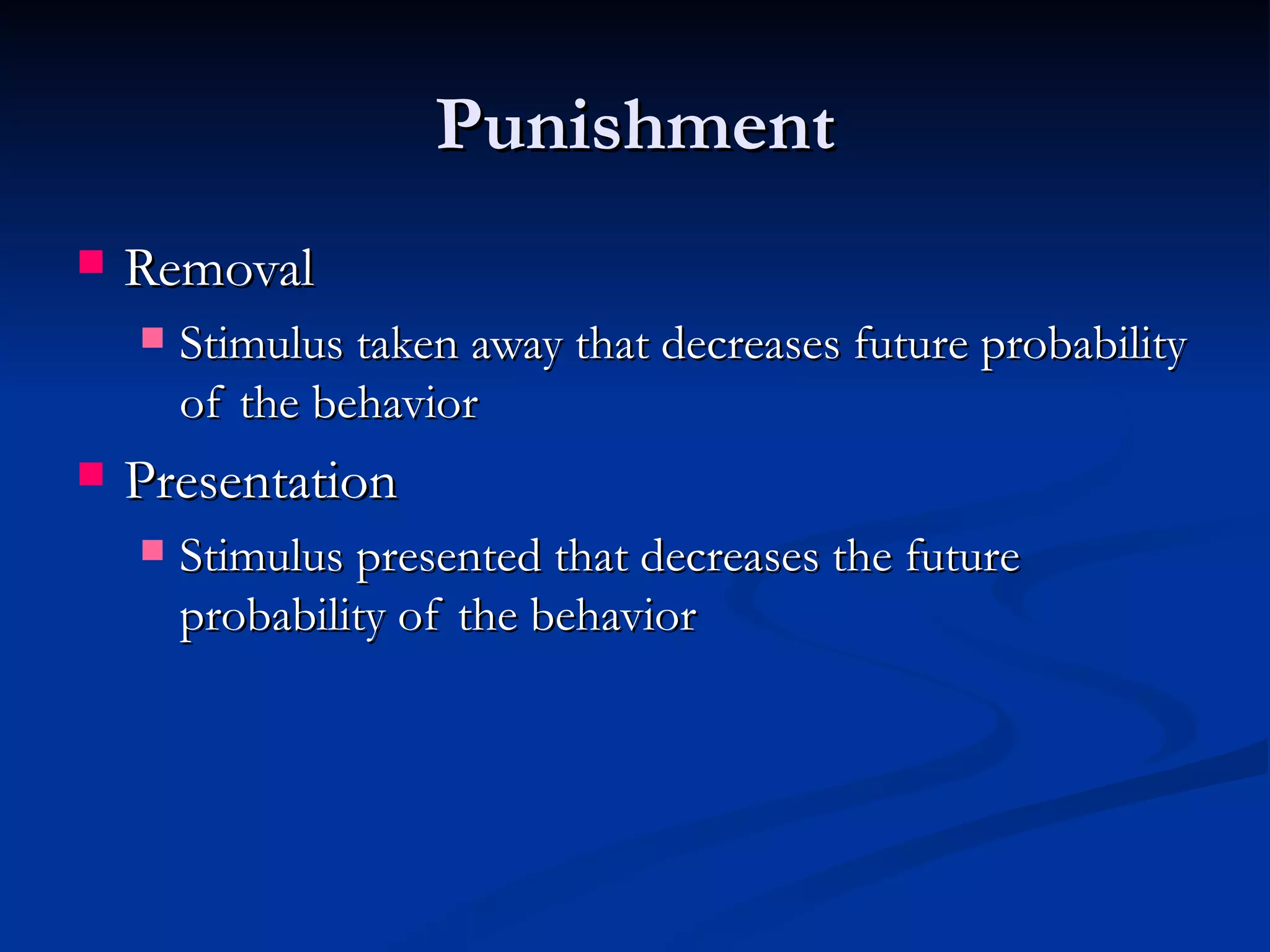
Punishment
   Removal
       Stimulus taken away that decreases future probability
        of the behavior
   Presentation
       Stimulus presented that decreases the future
        probability of the behavior
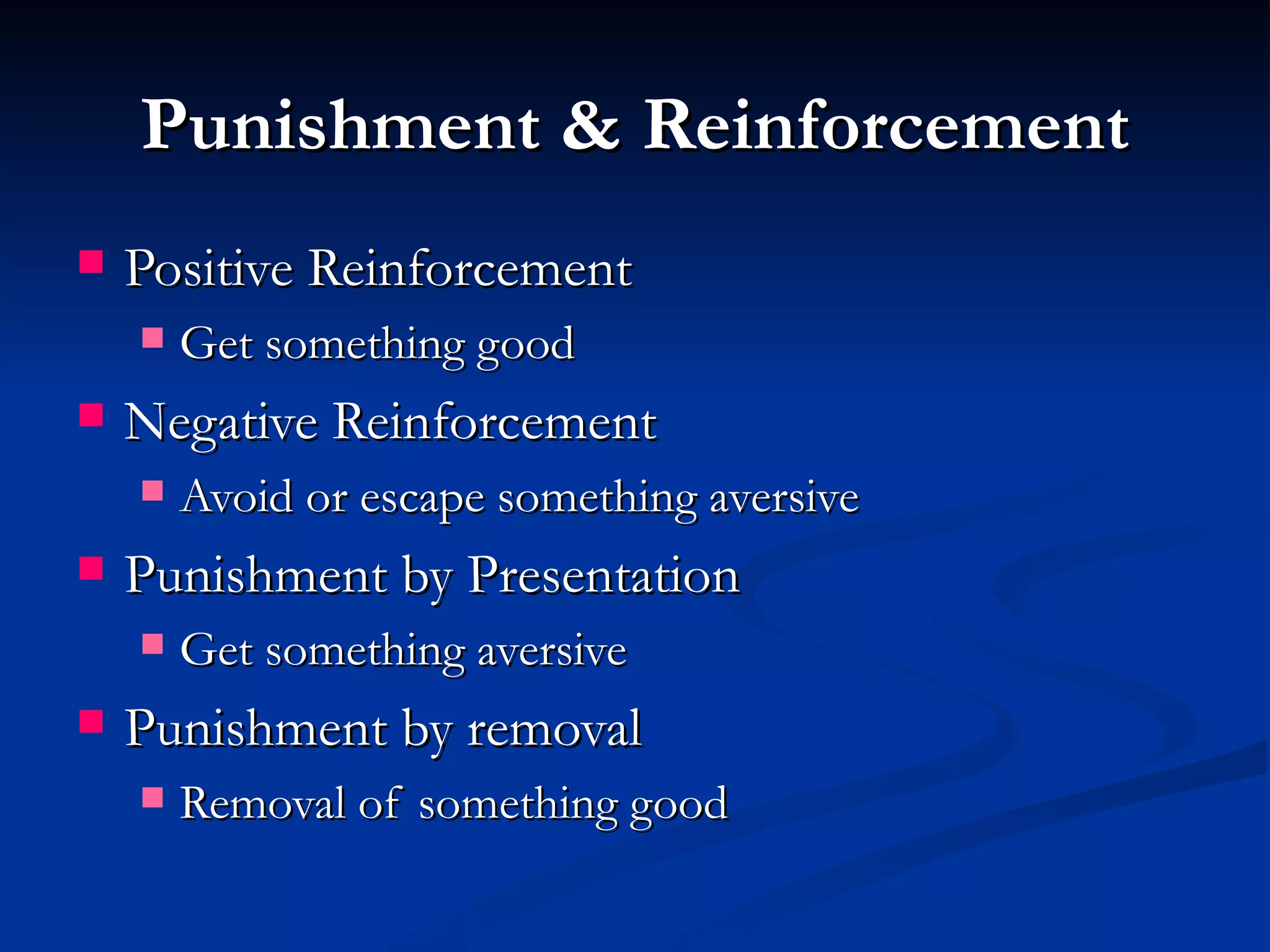
Punishment & Reinforcement
   Positive Reinforcement
       Get something good
   Negative Reinforcement
       Avoid or escape something aversive
   Punishment by Presentation
       Get something aversive
   Punishment by removal
       Removal of something good
   Negative reinforcement is when you take
    something away and the behavior
    decreases
   True or False?                  False
   Positive reinforcement involves giving
    something to someone and increases future
    behavior
   True or False?                True
   A classroom teacher walks by a
    student and says, “I like how you’re
    doing your math quietly”, after
    which the student begins talking to
    his neighbor.
   This is an example of positive
    reinforcement
   True or False?
                                      False
   A behavior that has been negatively reinforced
    will occur less often
   True or False?
                                   False
   A teacher gives a student a “good
    behavior coupon” for arriving to
    school on time
   The student continues to arrive on-
    time
   This is an example of positive
    reinforcement
                               True
   The principal sends a student home
    for fighting
   The student returns to school the
    next day and gets into another fight
   This is an example of punishment by
    removal
                                False
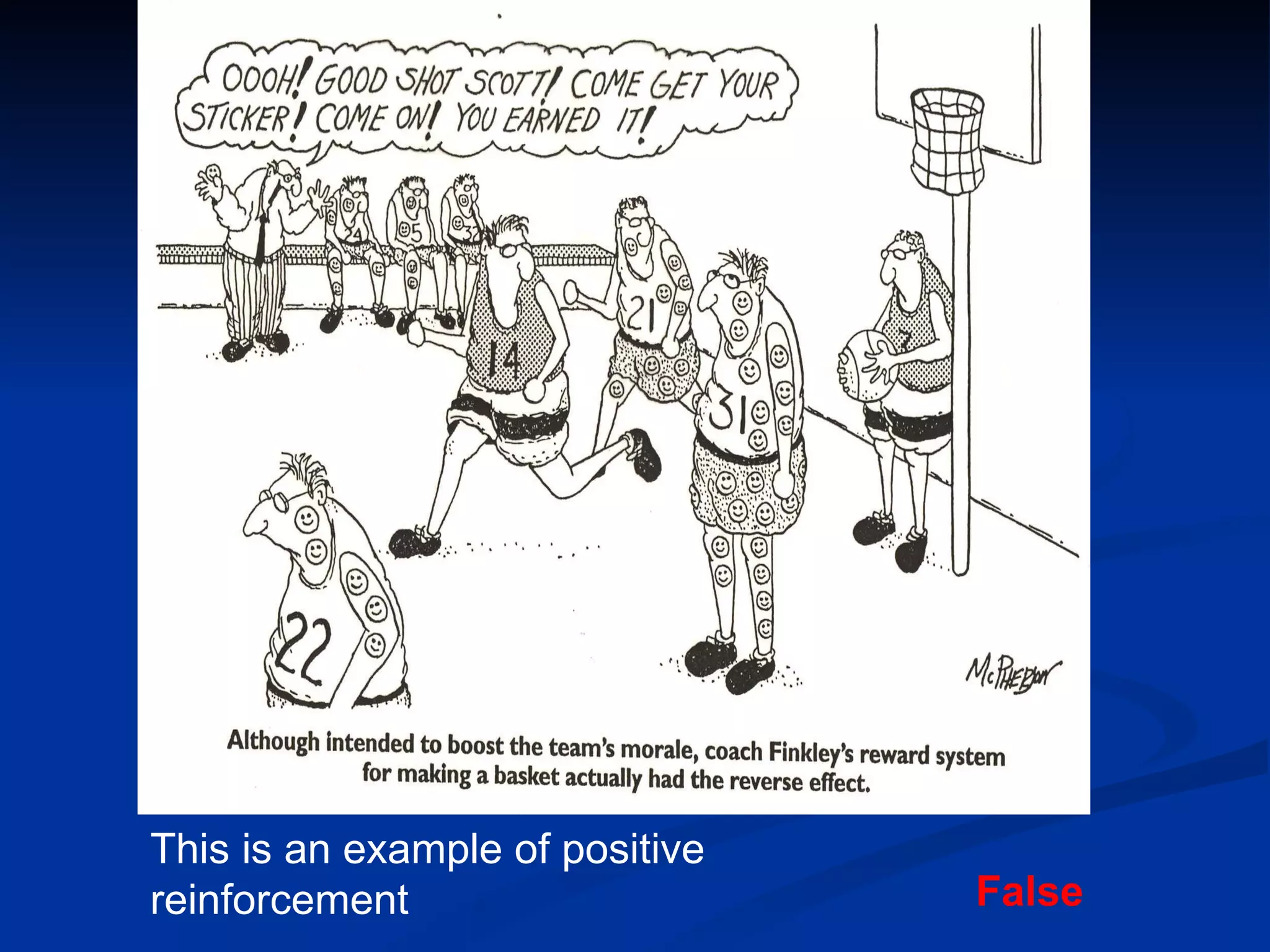
This is an example of positive
reinforcement                    False
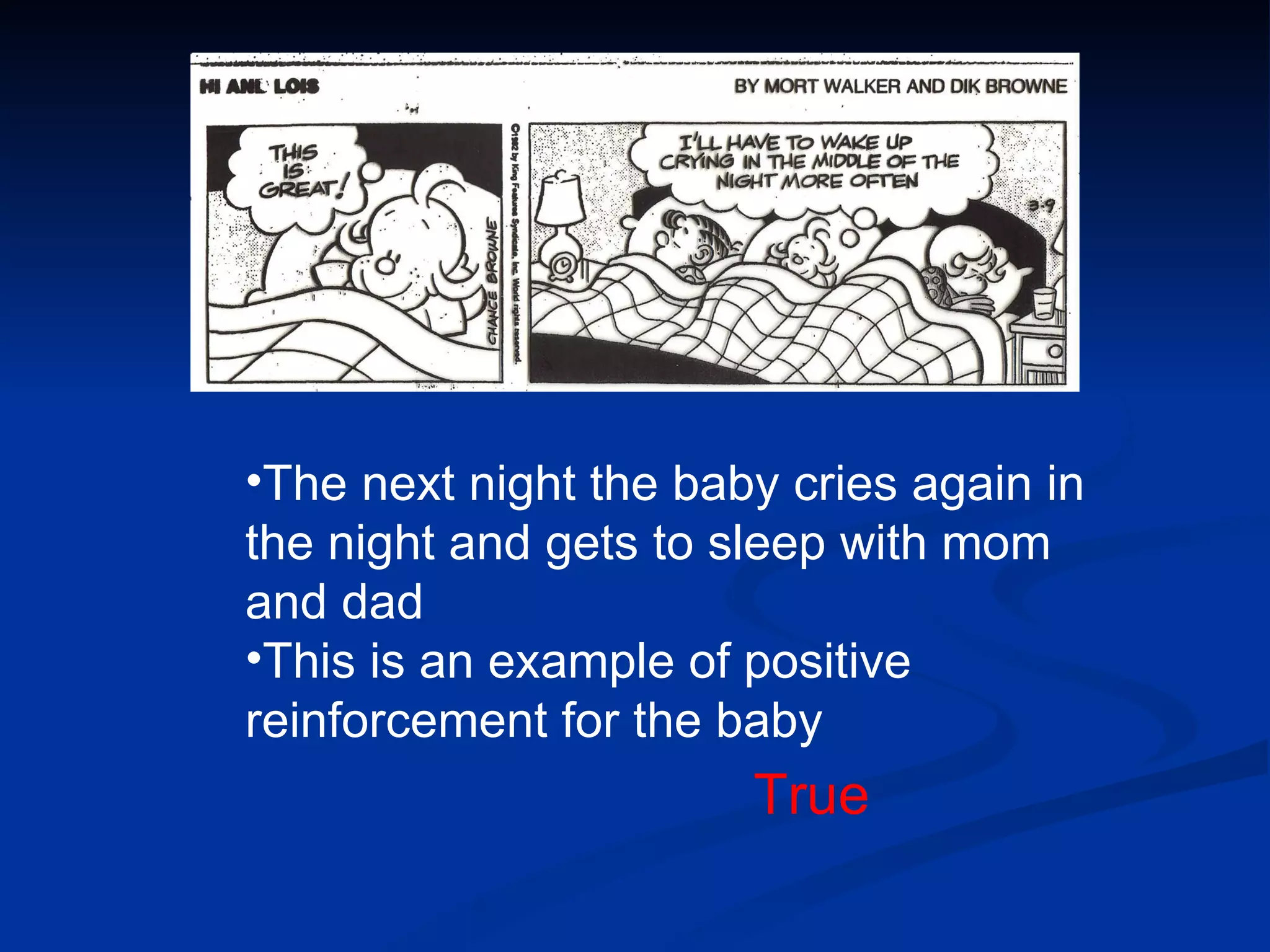
•The next night the baby cries again in
the night and gets to sleep with mom
and dad
•This is an example of positive
reinforcement for the baby
                       True
   Steve was kicked out of math class
    for disruptive behavior and sent to
    IHS for the remainder of the period
   Steve was also then kicked out of
    science for disruptive behavior and
    sent to IHS
   This is an example of punishment by
    removal                         False
Target Behaviors
   The behavior targeted for observation,
    measurement, and assessment and/or
    modification
   Defined by teachers as the behavior needing to
    be learned, increased, or decreased
   Once identified – it must be defined
       Must be observable and measurable
Target Behavior: Characteristics
          of Good Definitions
   Objective: such that the specific instances of
    the response class can be detected, observed,
    and recorded reliably
   Clear: unambiguous, such that others can use
    and replicate
   Complete: such that the definition
    discriminates the target behavior from other,
    similar but nontarget behaviors and allows for
    accurate coding
Target Behaviors
   Kim does not do what the teacher asks
   When given a direction by the teacher, Kim fails
    to initiate the behavior within 5 seconds
   Andy is hyperactive
   Andy is out of his seat more than one time in 10
    minutes
   Fred does not ride the school bus properly
   Fred is out of his assigned seat on the bus
Target Behaviors
   Betsy is aggressive
   Betsy hits, kicks, pushes and calls other children
    names during recess
   Billy is withdrawn
   Billy initiates less than one interaction with a
    peer in any given 10-minute free play period
Defining Target Behavior
   On-task
   Out-of-seat
   Makes rude comments
   Gets better grades
   Off-task
   Aggressive
   Does homework
On-Task Definition
   The target behavior to increase is on task
    behavior for independent tasks during literary
    center time.
   Looks like: the student actively working on the
    task, with his eyes not leaving his paper for more
    than five seconds at a time and his pencil in his
    hand.
   Looks like/Sounds like: the student is in his seat
    and not talking to any other students unless
    prompted to. The student will also have a quiet
    mouth, with no talking, humming, whistling, etc.
Out-of-Seat Definition
General description of behavior
 Billy leaves his seat without permission while I
  am teaching class as a whole
Target behavior definition
 Leaving seat without permission during whole
  group instruction
 No body parts touching desk or seat
Verbal Definition

Student makes vocal verbal response that is
  non-content related, out of turn, and
  directed at another person in relation to
  others’ academic ability, social skills, family,
  or personal characteristics.
Accuracy Definition

Measurement of the target behavior is the
percentage of correct responses. A correct
response includes factual and complete
responses that correspond to the in-class task or
assignment. A correct answer can take a variety
of forms including, letters, numbers, words,
mathematical symbols, punctuation marks,
circling, etc.
Off-Task
   Student’s work is out of his visual field for
    more than 3 consecutive seconds during all
    occasions except those beyond his control
    (e.g. teacher took it away, hasn’t been handed
    out yet, waiting for help from an adult).
   Student is conversing with someone other
    than an adult. The only exception to this is
    when the student is talking to someone else
    that is engaged in the same task and none of
    the other criteria for off-task behaviors have
    been met.
Physical Aggression
   Physical Aggression: Kicking, hitting,
    pushing, or head butting any staff, peer,
    property, or self.
     Kicking, Hitting, Head-Butting: Forceful contact
      made by the student’s foot, arm, hand, or head towards
      any staff, peer, property, or self.
     Pushing: Making contact with the palm of the hands
      on any staff, peer, or property resulting in the
      movement of the property or person.
Productivity Definition
   Jason will increase his math productivity by
    attempting math problems. An attempt will be
    recorded if an answer is content related and is
    given in the form of a written answer on paper,
    on dry erase board, whispered, or verbalized.
Dimensions of Behavior
   Frequency: Number of times a response
    occurs
   Duration: Length of time to complete a
    response or total amount of time that a
    response occurs
   Rate: Number of occurrences per unit of
    time
   Latency: Amount of time it takes to begin a
    behavior once an antecedent is present

Frequency Recording
   Behaviors that are well-defined are easily
    recorded with this strategy
   Behaviors that are brief and discrete
   Simple numerical count is sufficient, but
    recording the time period in which the behavior
    occurred is critical
   If observation sessions vary in length convert
    data to rate (# of behaviors/time)
Duration Recording
   If the length of the response is the major
    characteristic duration may be the best
    dimension to record
   Monitored by any watch or clock
   Record cumulative time of a target behavior
   Total duration is more convenient, duration per
    occurrence is more accurate
Rate
   Frequency of TB divided by the number of
    minutes
   Useful when observation periods are not
    constant and vary in duration
   Recommended when reporting the number of
    times behavior occurred unless the observation
    periods are constant
Latency Recording

   Start a timer when the cue (e.g., verbal
    instruction) is presented and stop the timer
    when the student complies with the request
   Often the goal is to decrease latency
   For students who are impulsive, teaching them
    to increase latency might be an effective tool
Magnitude
   Force or strength of a behavior
       Aggression, temper tantrums, verbal responses,
        noises and body movements
   Crying – frequency and duration the same, but
    magnitude may decrease from a scream to a
    whimper
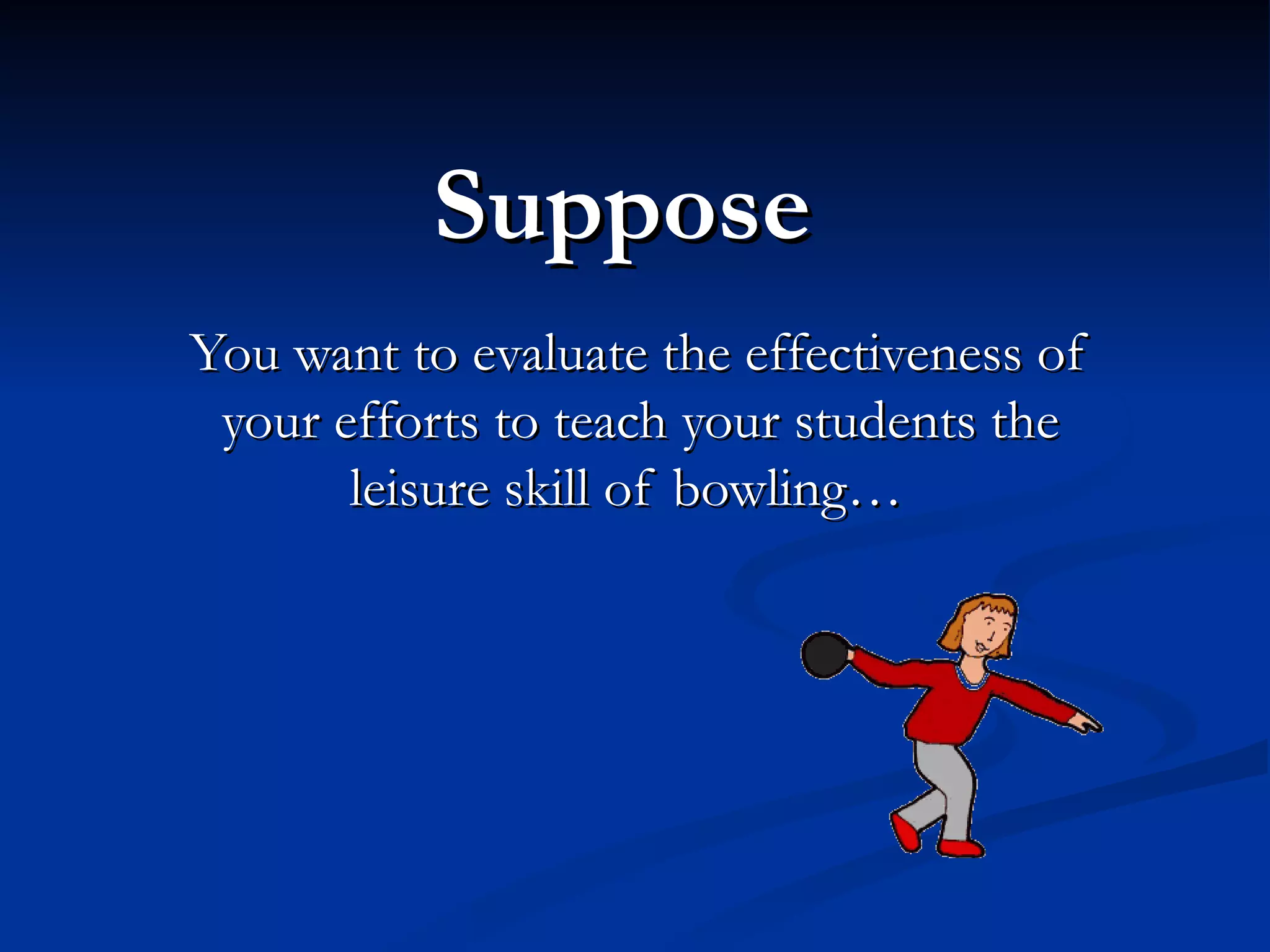
Suppose
You want to evaluate the effectiveness of
 your efforts to teach your students the
       leisure skill of bowling…
Measurement
What are some characteristics of interest you
 might want to address?
   Frequency
     Number of times a discrete response occurs in a
      standard observation period
     Repetition of one topography is usually the
      salient dimension

    Example: Number of times per game student
     selects the correct bowling ball to throw
Measurement
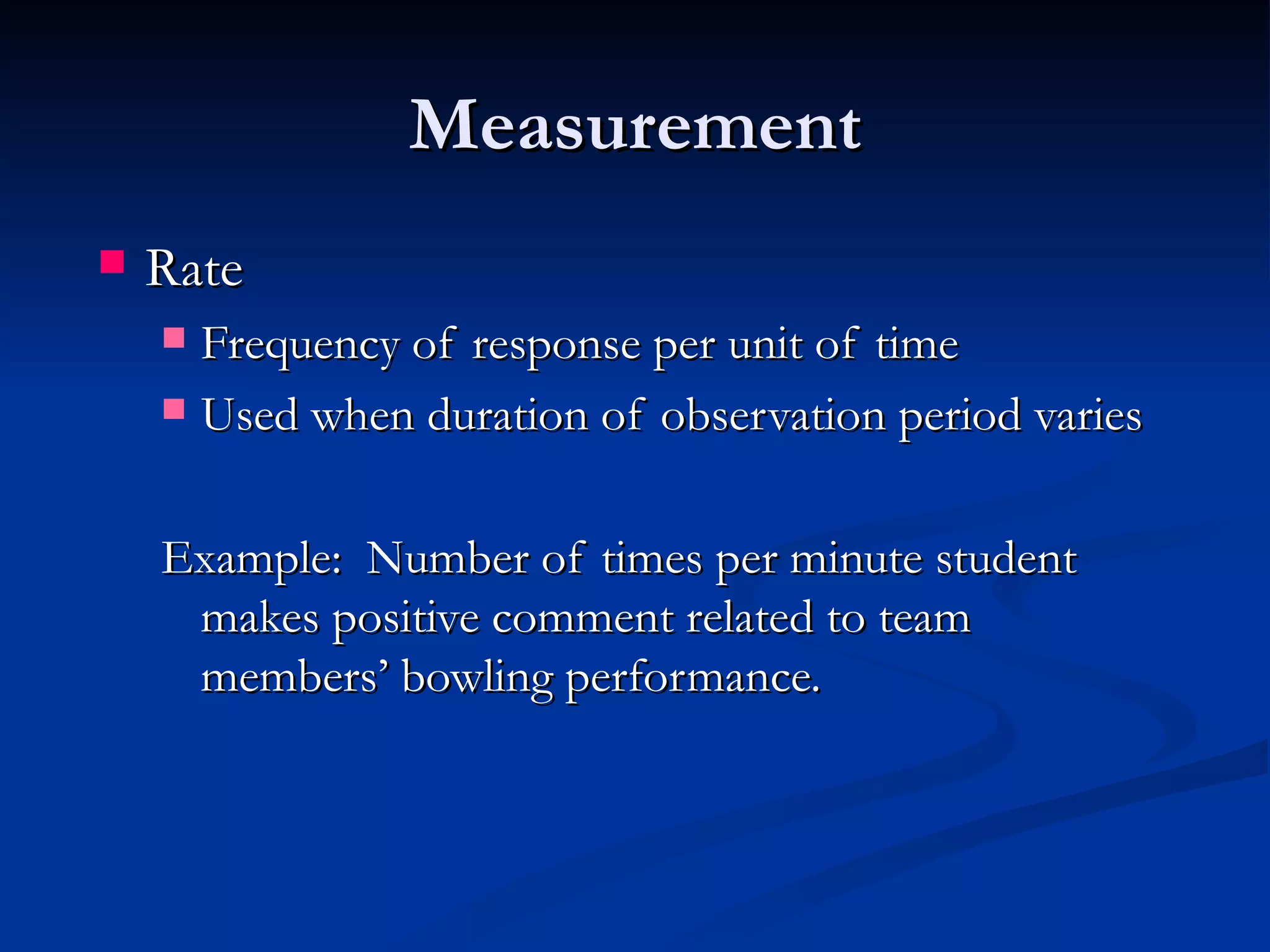
   Rate
     Frequency of response per unit of time
     Used when duration of observation period varies


    Example: Number of times per minute student
     makes positive comment related to team
     members’ bowling performance.
Measurement

   Latency
     Time to onset of response
     Every instance of behavior can be located in time
      with respect to other events.

    Example: The time that elapses from when it is
     student’s turn to bowl and when he picks up the
     bowling ball.
Measurement
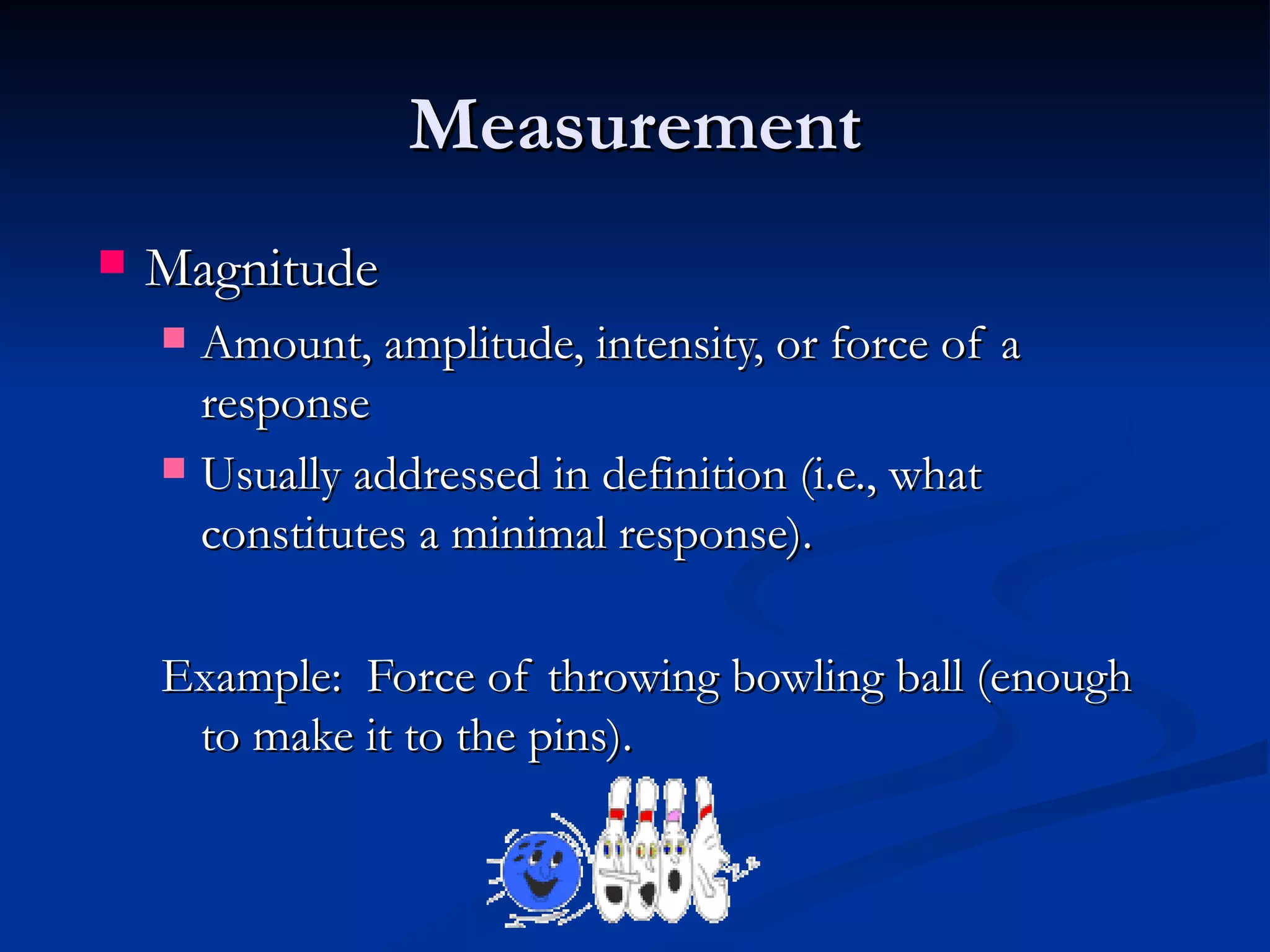
   Magnitude
     Amount, amplitude, intensity, or force of a
      response
     Usually addressed in definition (i.e., what
      constitutes a minimal response).

    Example: Force of throwing bowling ball (enough
     to make it to the pins).
Measurement
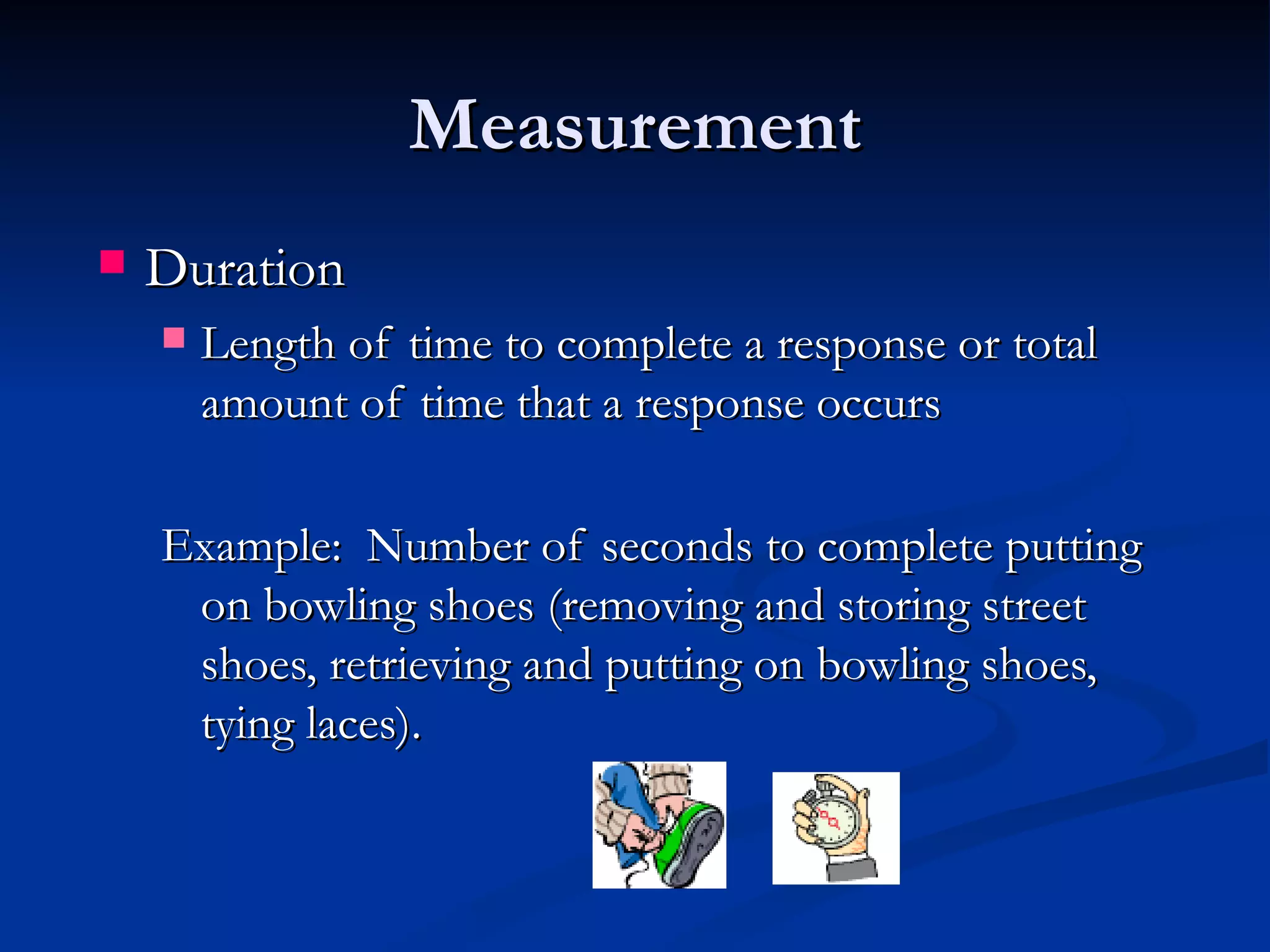
   Duration
       Length of time to complete a response or total
        amount of time that a response occurs

    Example: Number of seconds to complete putting
     on bowling shoes (removing and storing street
     shoes, retrieving and putting on bowling shoes,
     tying laces).
Measurement
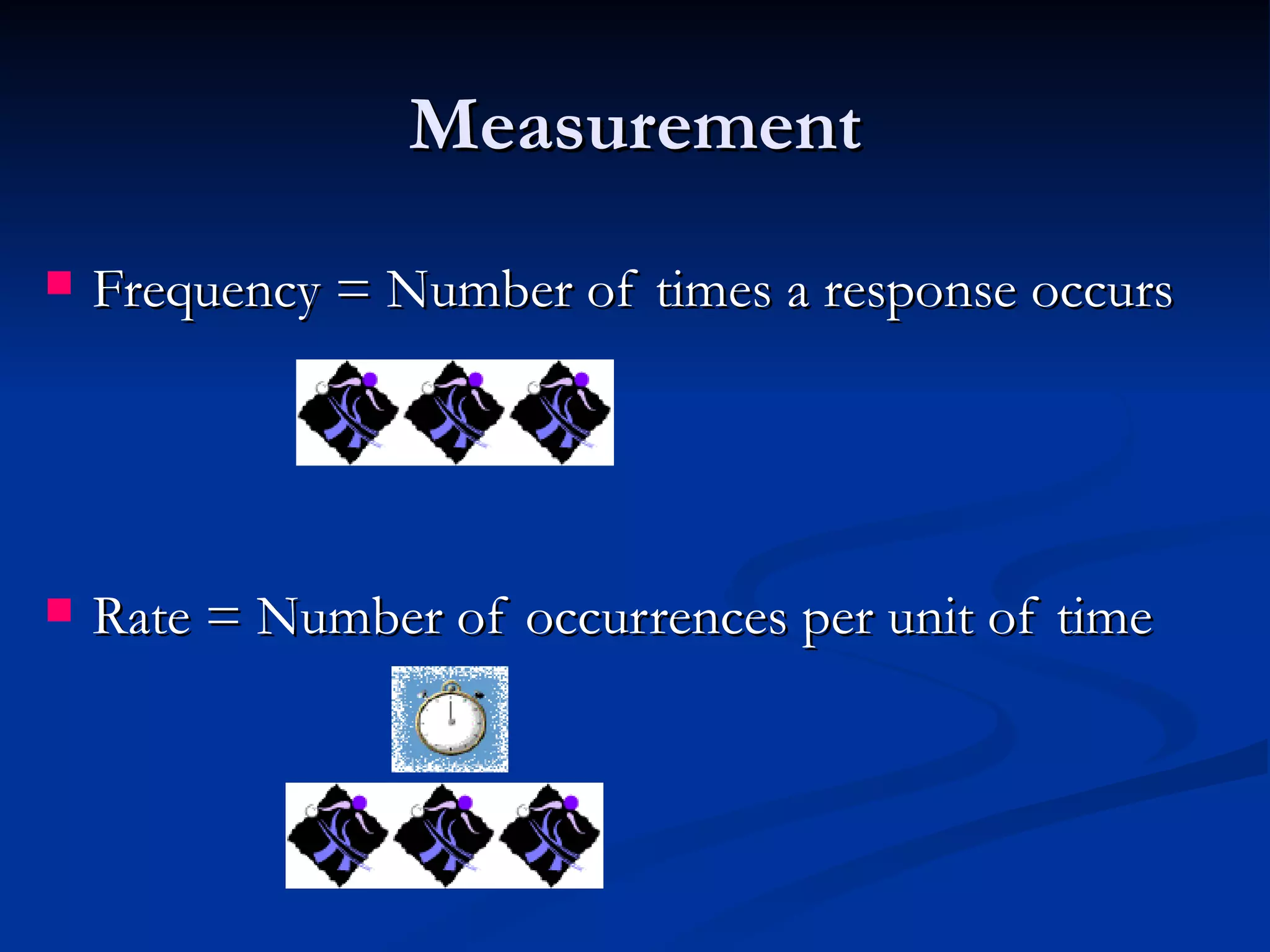
   Frequency = Number of times a response occurs


   Rate = Number of occurrences per unit of time
Measurement

   Duration = Length of time to complete a response
    or total amount of time that a response occurs
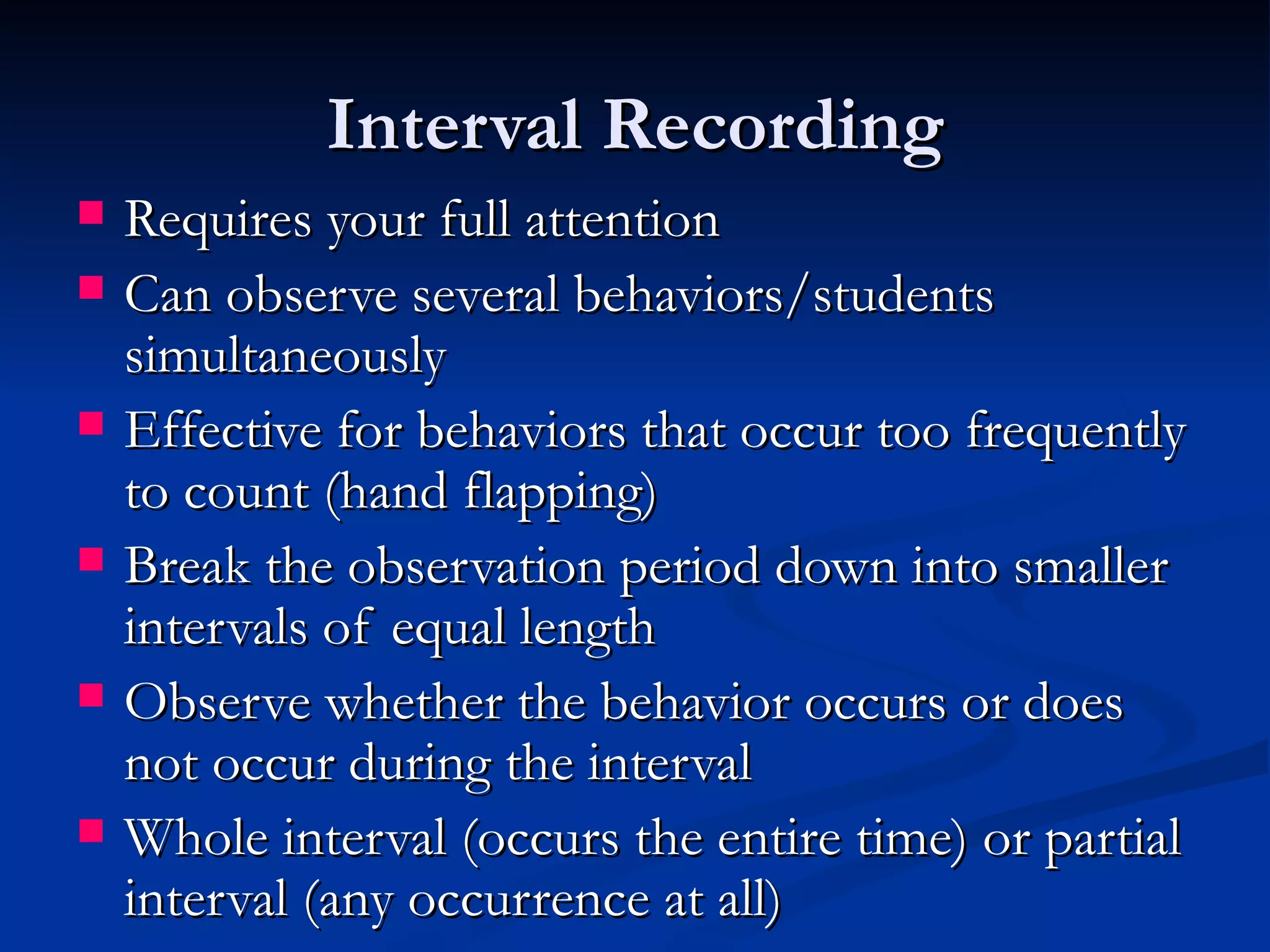
Interval Recording
   Requires your full attention
   Can observe several behaviors/students
    simultaneously
   Effective for behaviors that occur too frequently
    to count (hand flapping)
   Break the observation period down into smaller
    intervals of equal length
   Observe whether the behavior occurs or does
    not occur during the interval
   Whole interval (occurs the entire time) or partial
    interval (any occurrence at all)
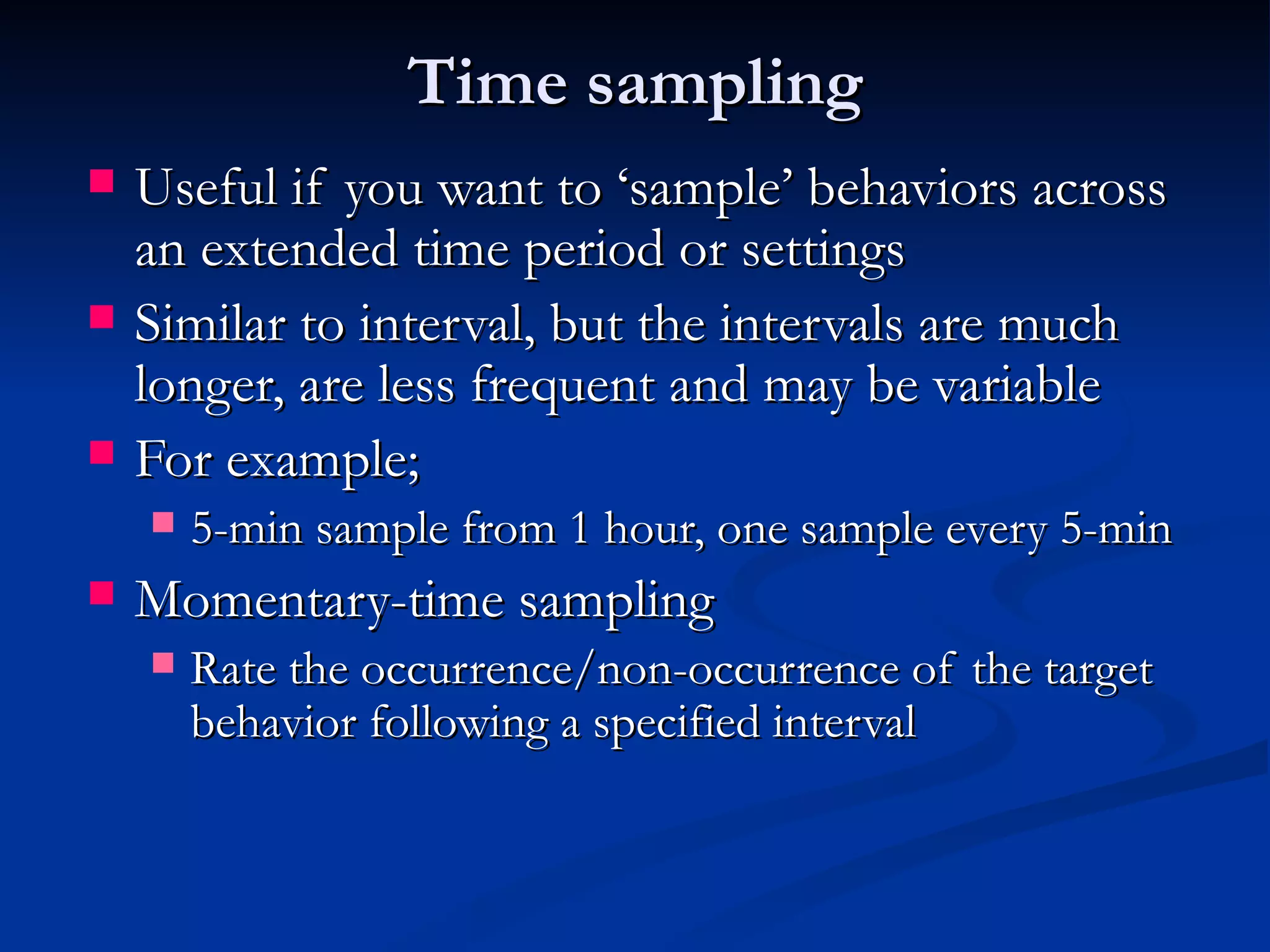
Time sampling
   Useful if you want to ‘sample’ behaviors across
    an extended time period or settings
   Similar to interval, but the intervals are much
    longer, are less frequent and may be variable
   For example;
       5-min sample from 1 hour, one sample every 5-min
   Momentary-time sampling
       Rate the occurrence/non-occurrence of the target
        behavior following a specified interval
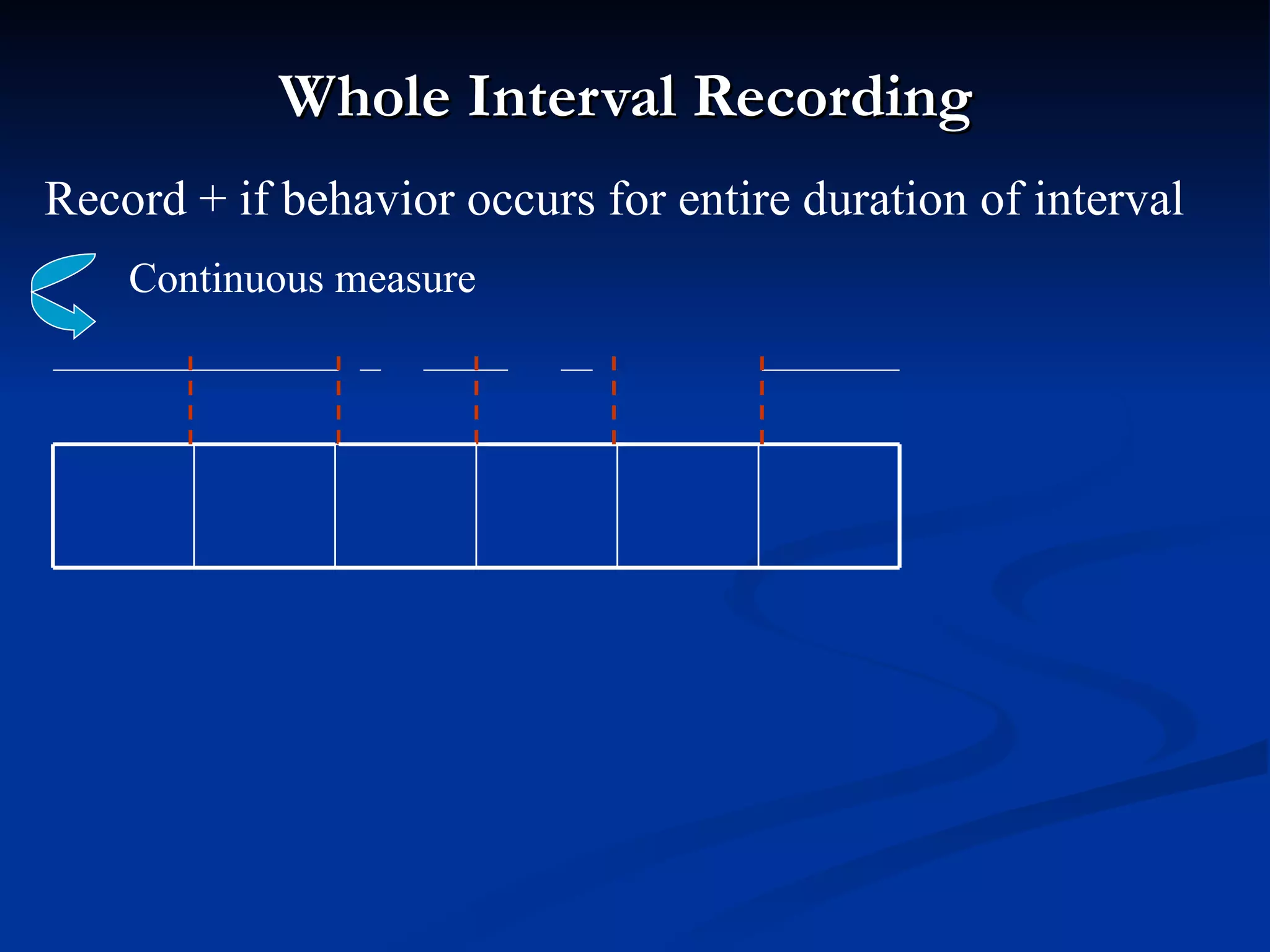
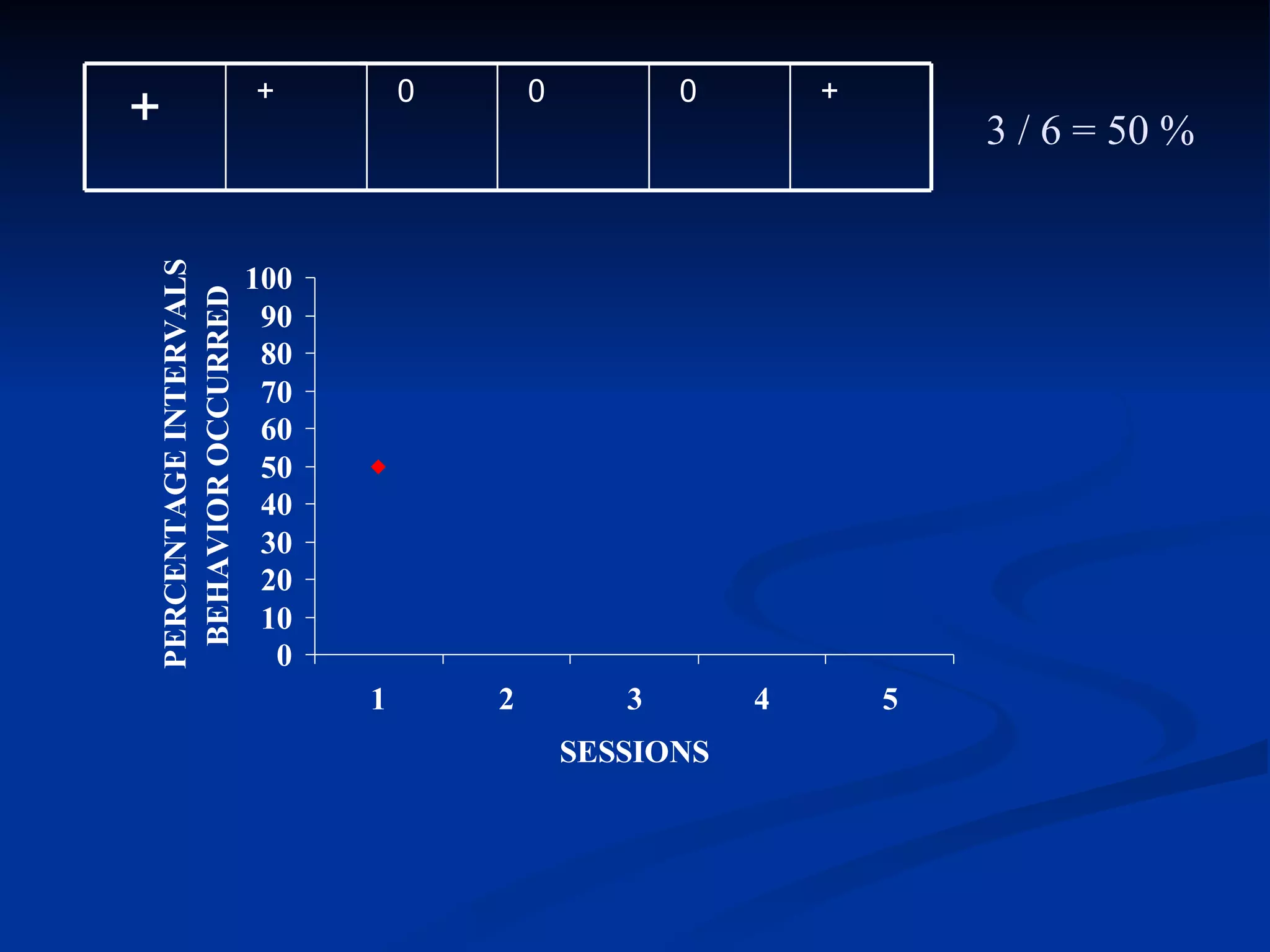
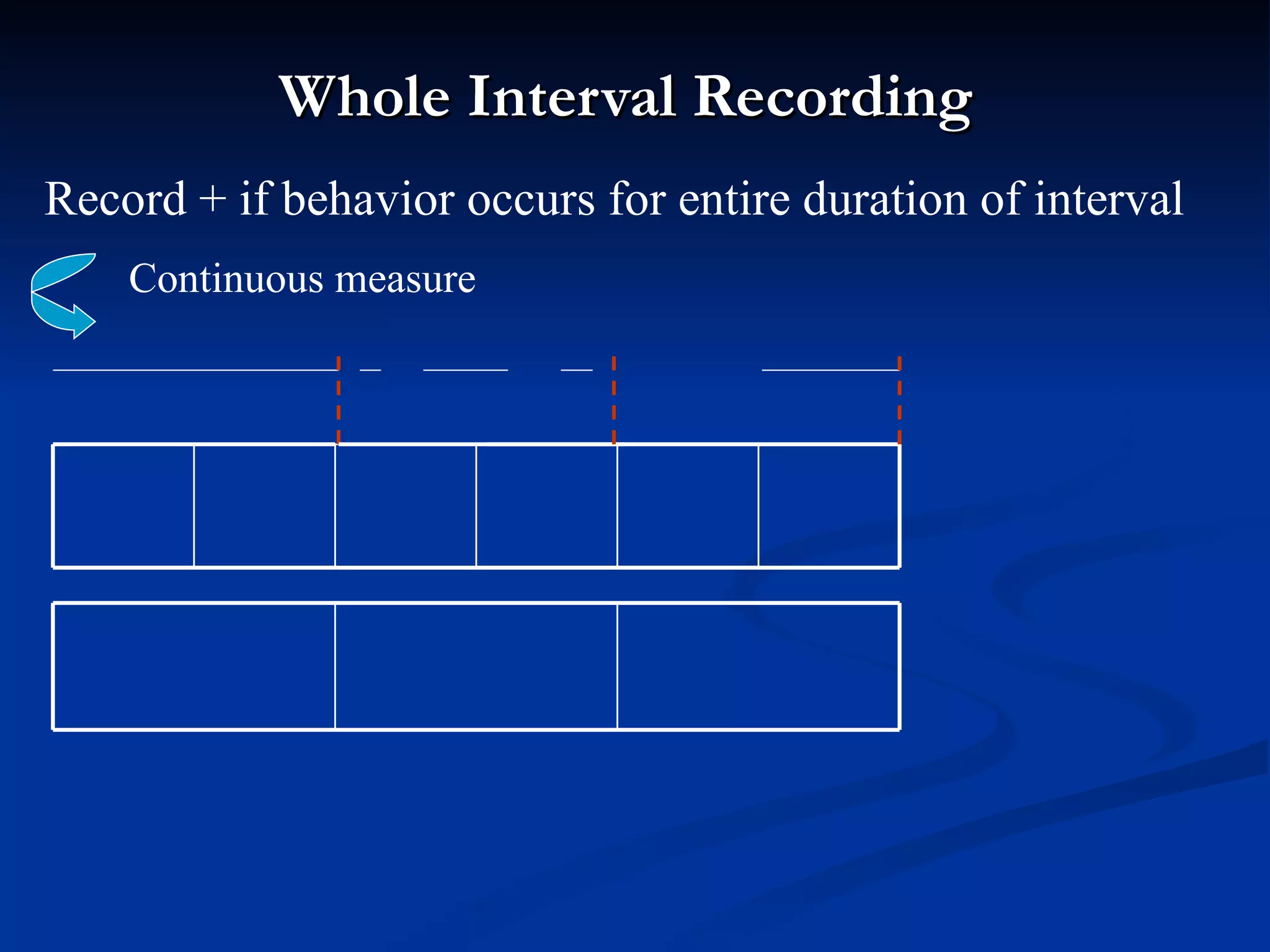
Whole Interval Recording
Record + if behavior occurs for entire duration of interval
    Continuous measure
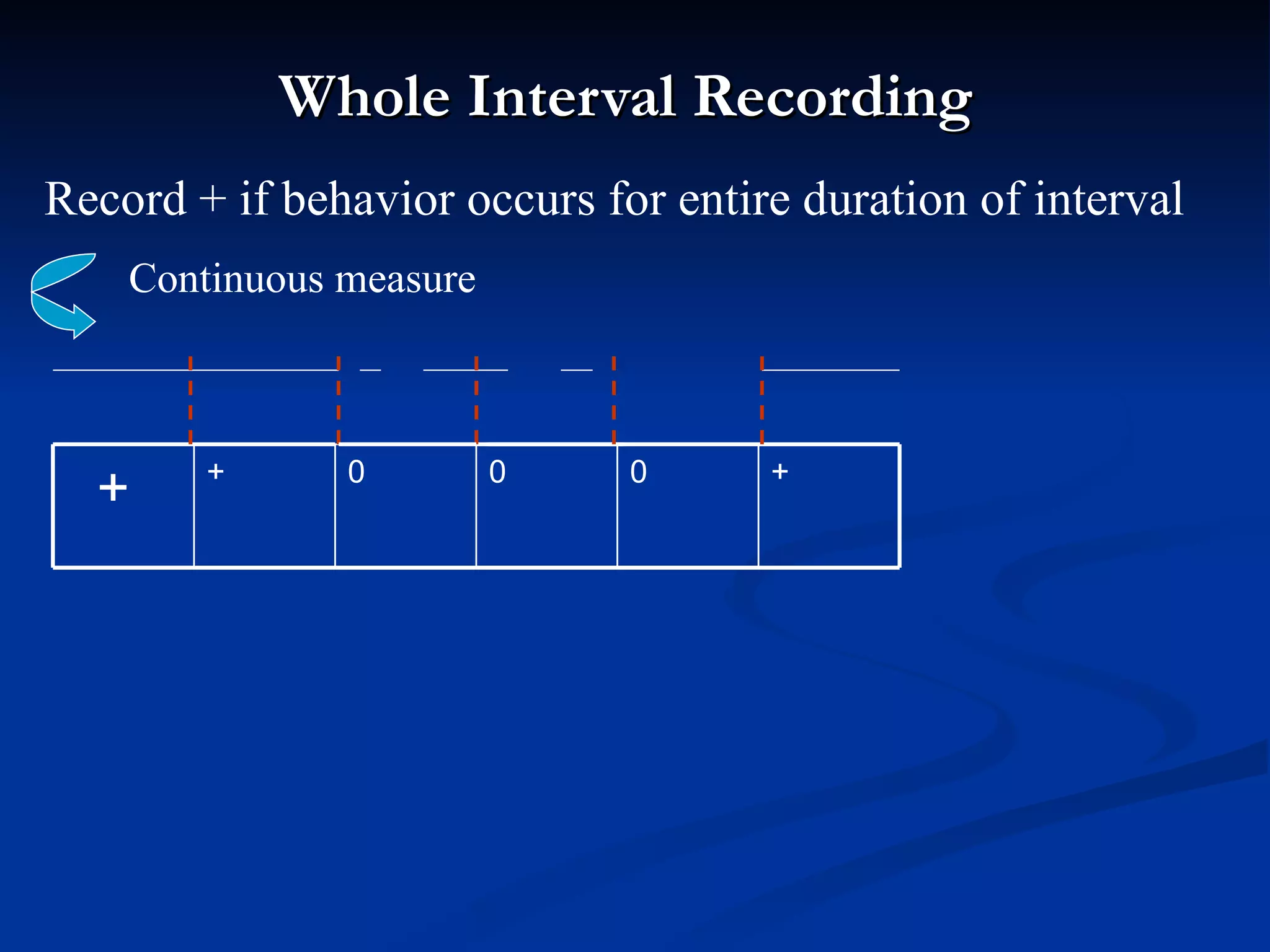
Whole Interval Recording
Record + if behavior occurs for entire duration of interval
    Continuous measure


        +      0         0    0      +
  +
+         0       0          0       +
+                                                                   3 / 6 = 50 %
PERCENTAGE INTERVALS


                       100
 BEHAVIOR OCCURRED


                        90
                        80
                        70
                        60
                        50
                        40
                        30
                        20
                        10
                         0
                             1       2          3       4       5
                                             SESSIONS
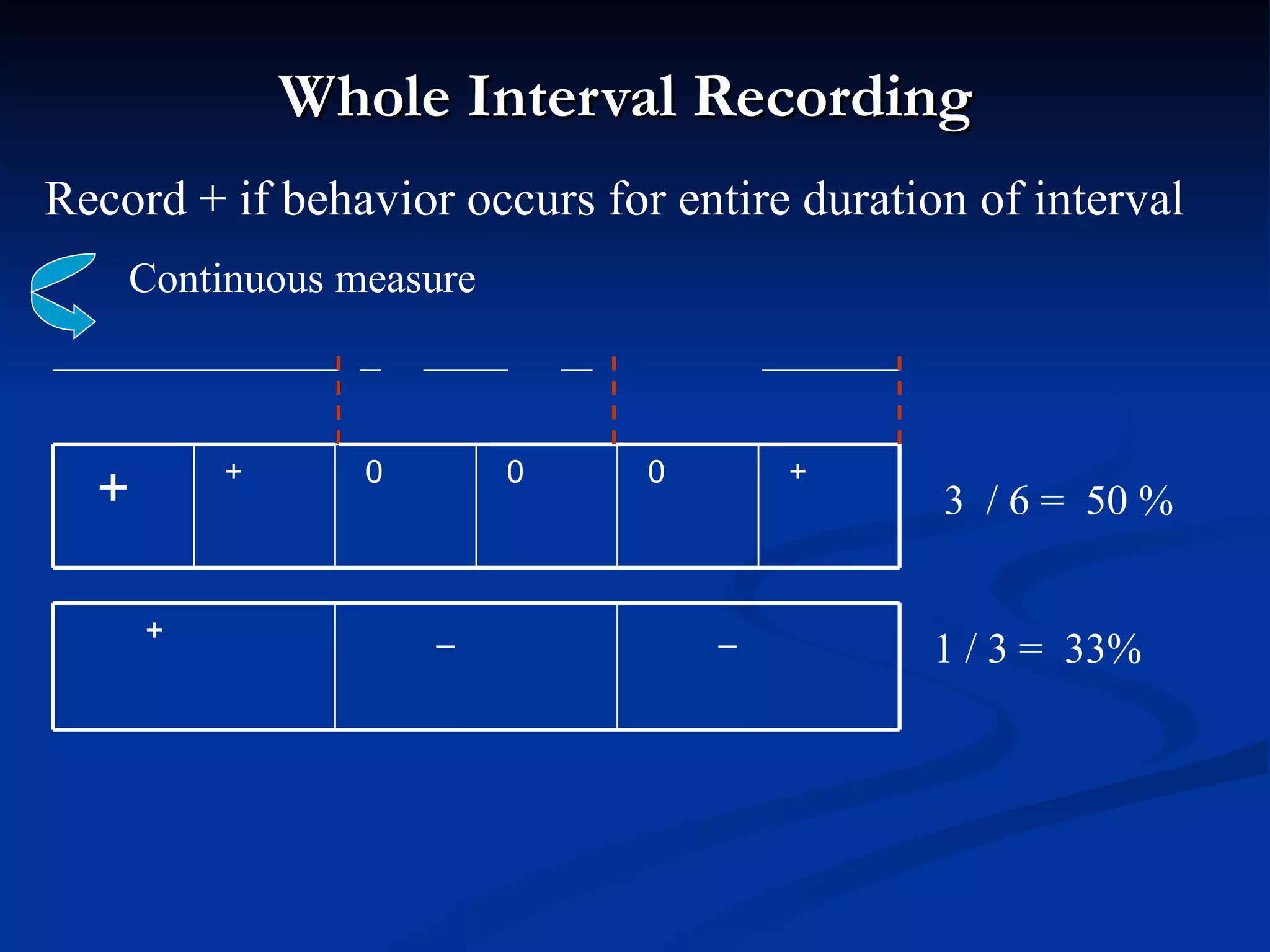
Whole Interval Recording
Record + if behavior occurs for entire duration of interval
    Continuous measure
Whole Interval Recording
Record + if behavior occurs for entire duration of interval
    Continuous measure


          +     0        0     0       +
  +                                           3 / 6 = 50 %


      +             _              _
                                              1 / 3 = 33%
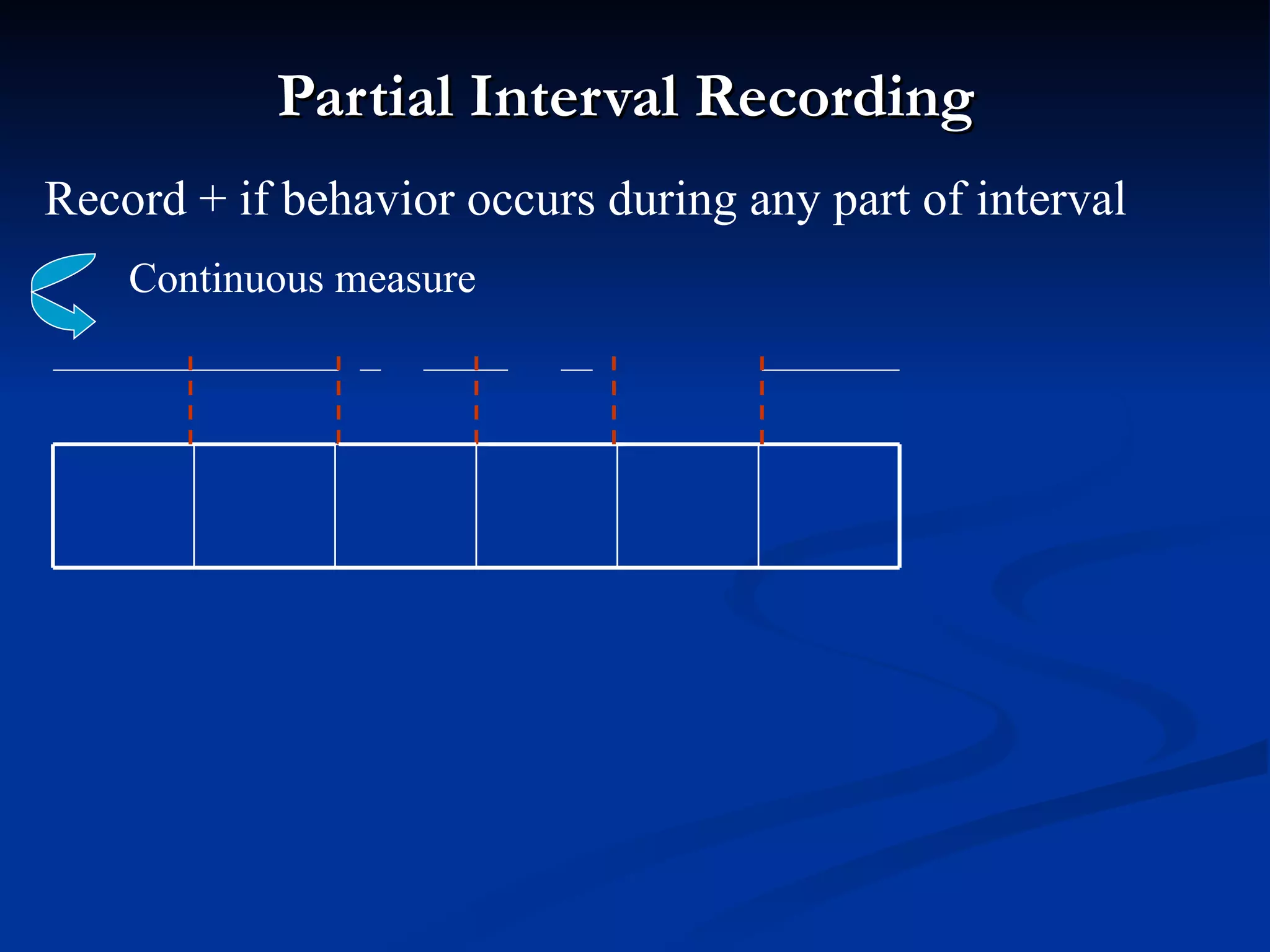
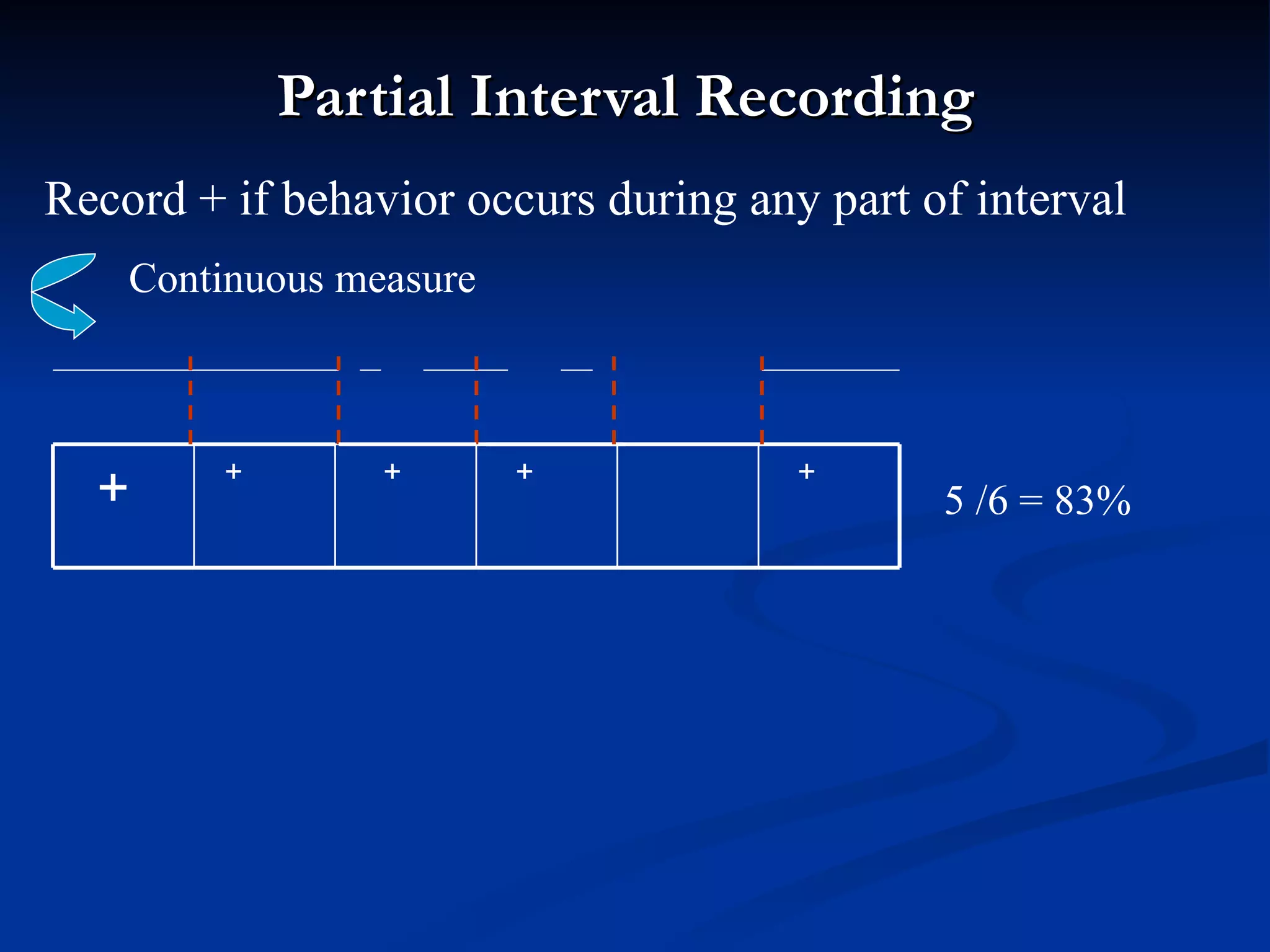
Partial Interval Recording
Record + if behavior occurs during any part of interval
    Continuous measure
Partial Interval Recording
Record + if behavior occurs during any part of interval
    Continuous measure


         +       +       +            +
  +                                          5 /6 = 83%
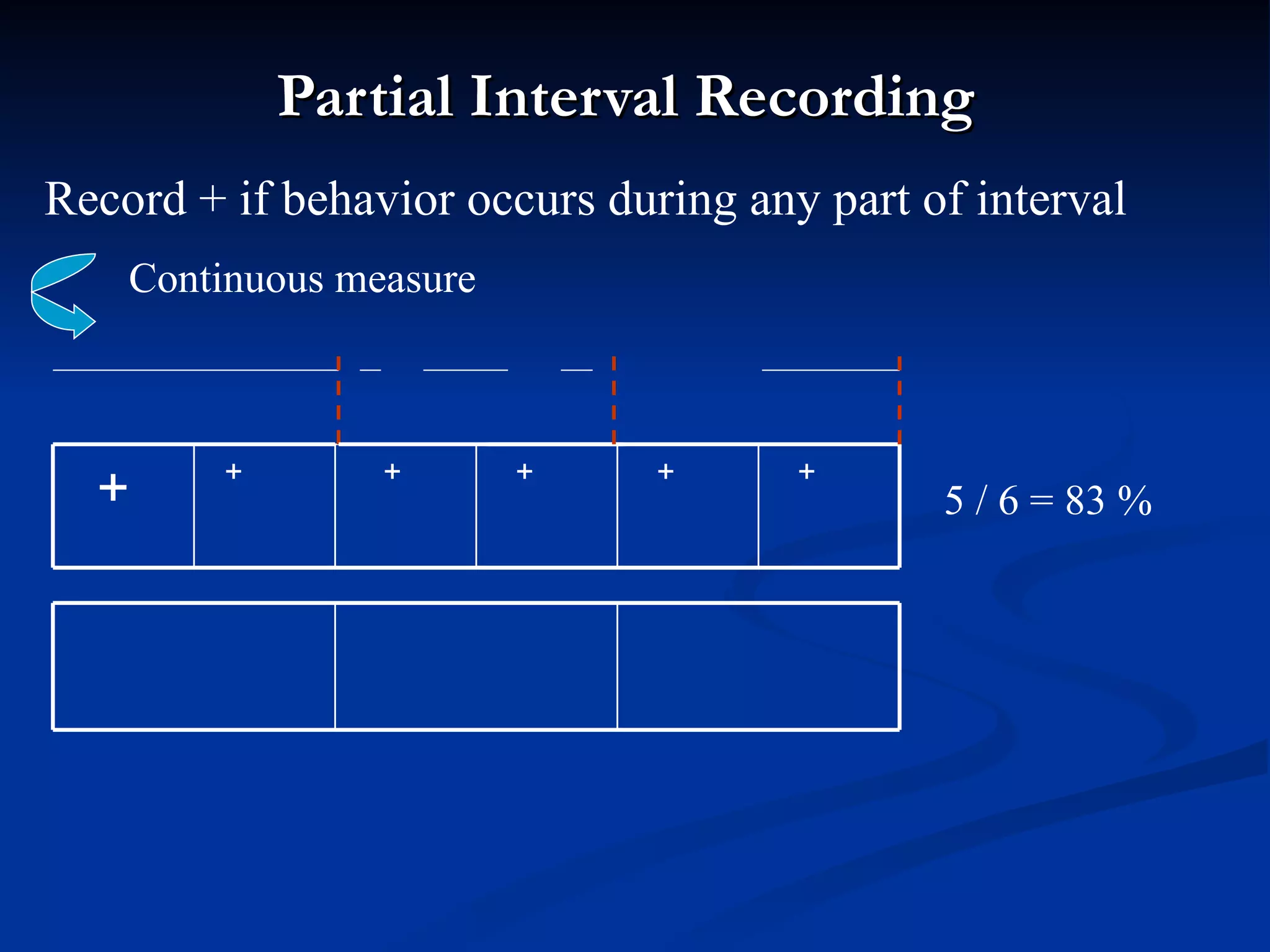
Partial Interval Recording
Record + if behavior occurs during any part of interval
    Continuous measure


         +       +       +     +      +
  +                                          5 / 6 = 83 %
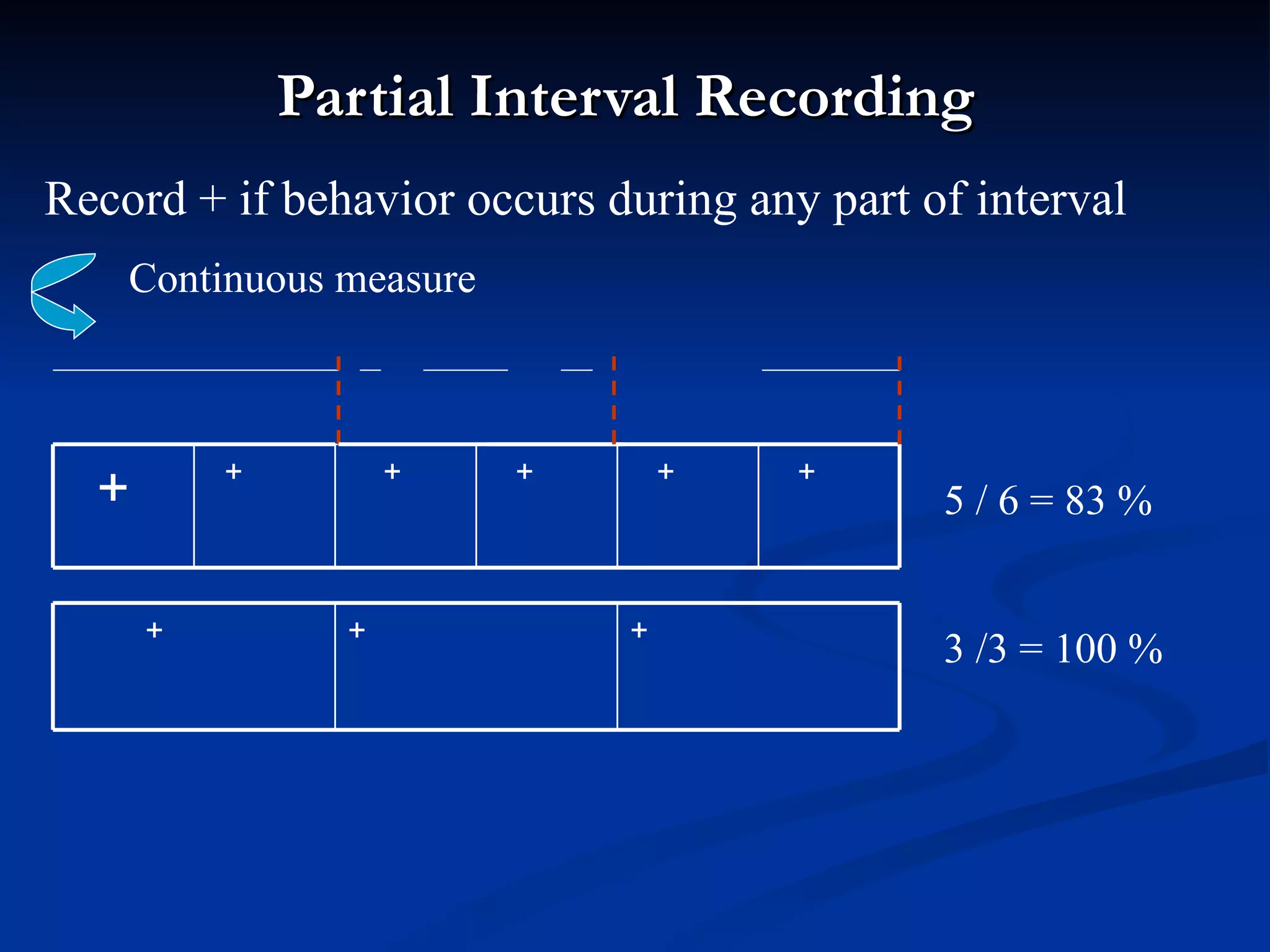
Partial Interval Recording
Record + if behavior occurs during any part of interval
    Continuous measure


          +         +    +       +    +
  +                                          5 / 6 = 83 %


      +         +            +
                                             3 /3 = 100 %
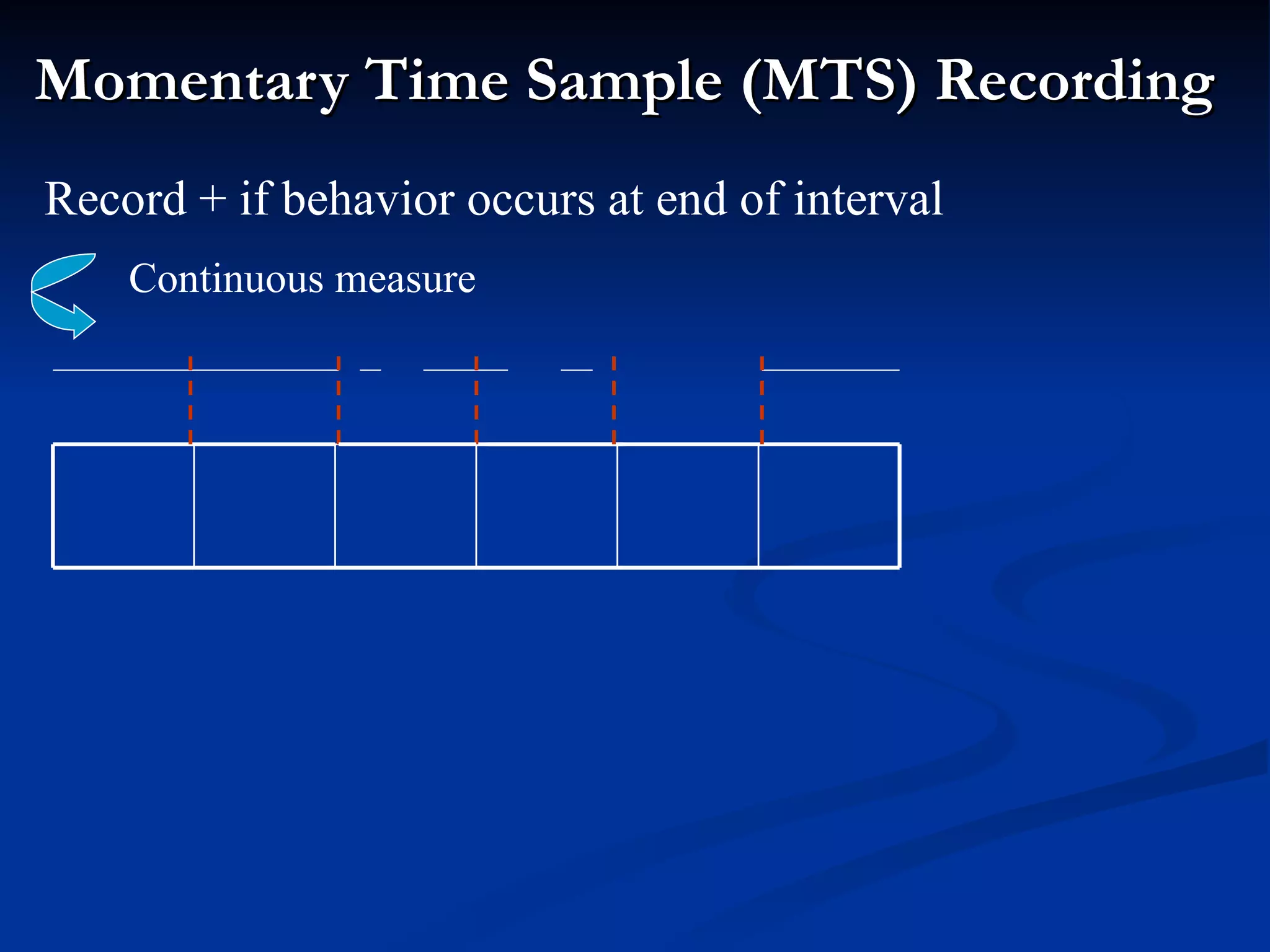
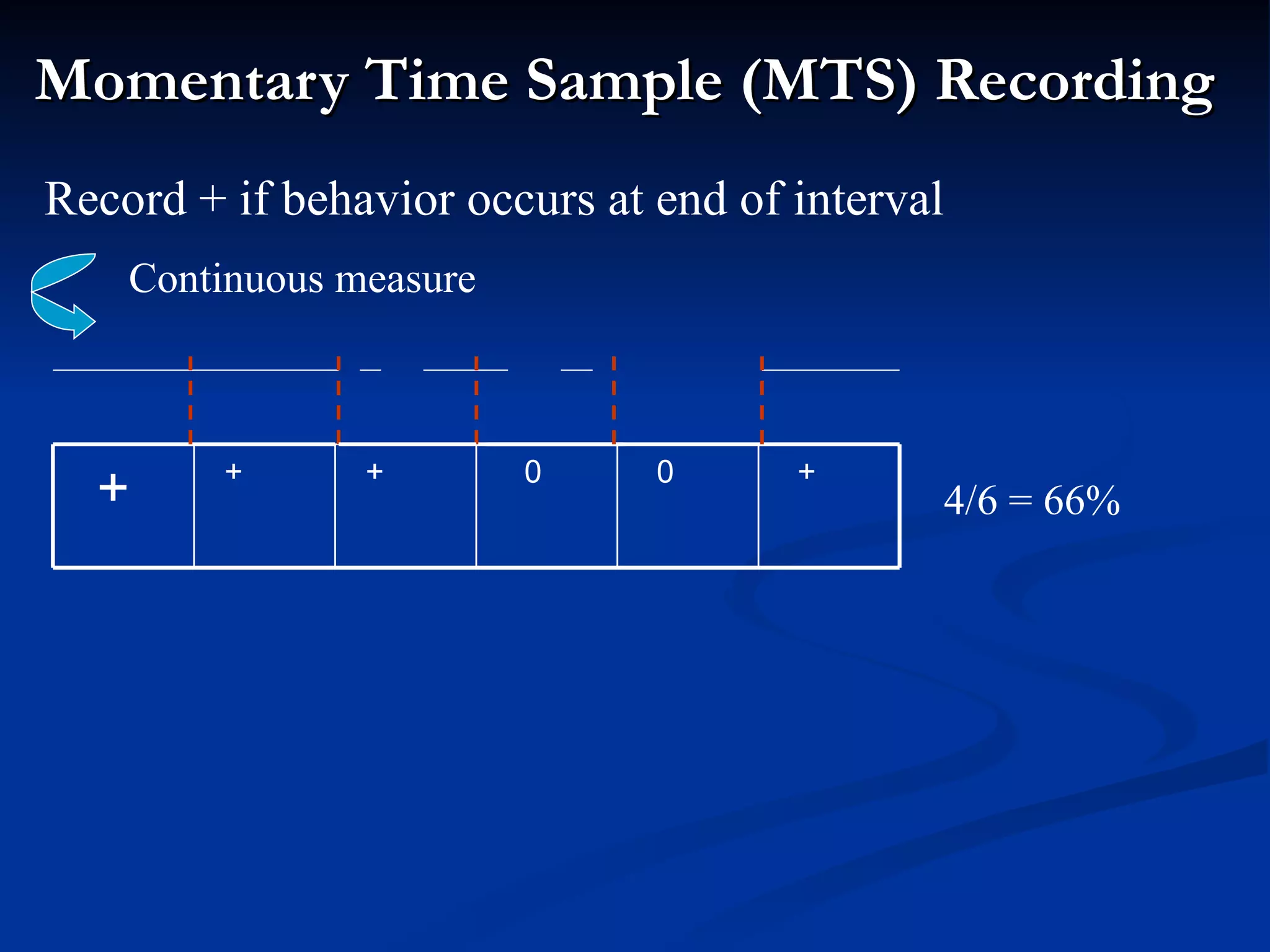
Momentary Time Sample (MTS) Recording
Record + if behavior occurs at end of interval
    Continuous measure
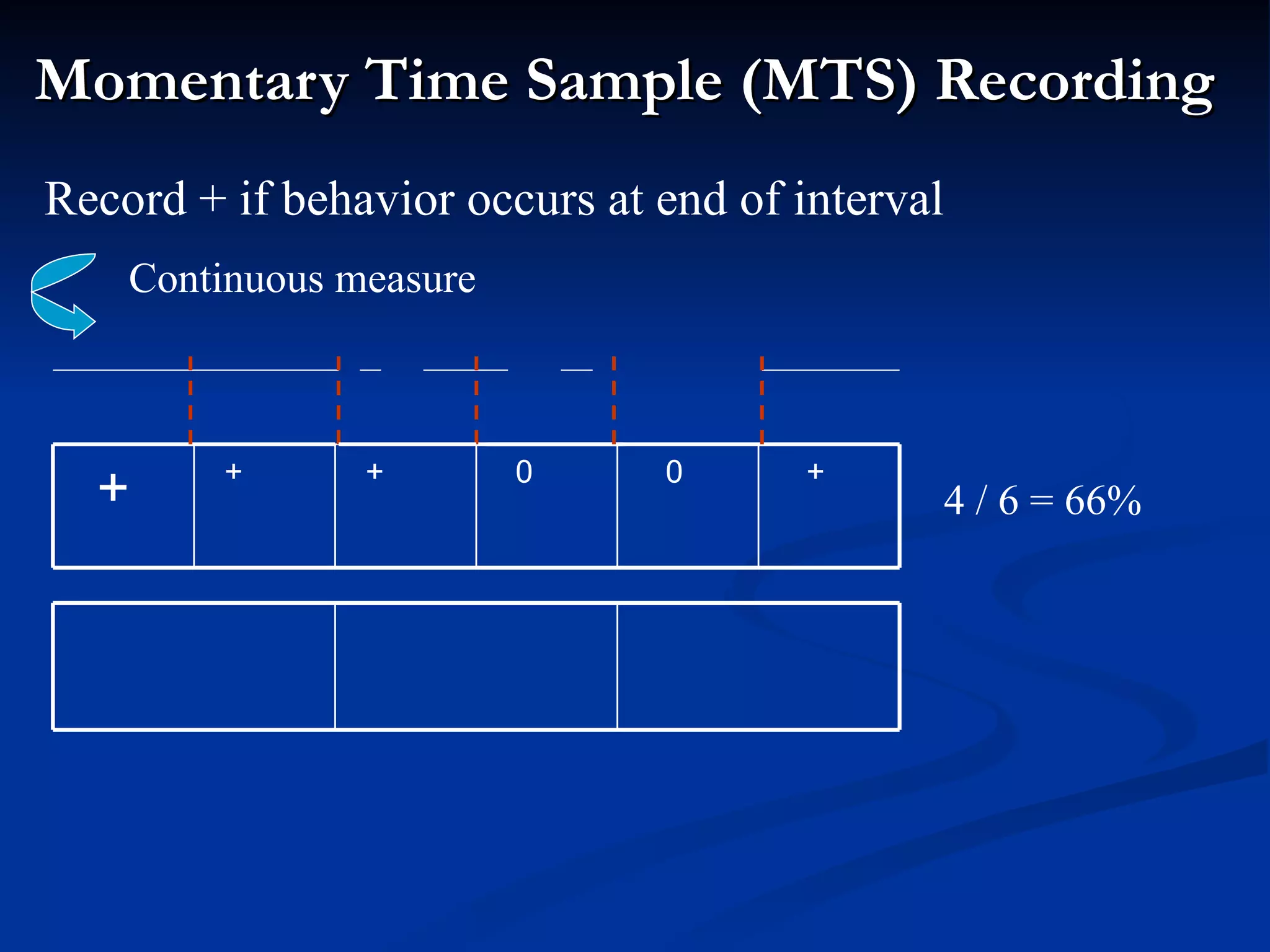
Momentary Time Sample (MTS) Recording
Record + if behavior occurs at end of interval
    Continuous measure


         +      +        0     0      +
  +                                          4/6 = 66%
Momentary Time Sample (MTS) Recording
Record + if behavior occurs at end of interval
    Continuous measure


         +      +        0     0      +
  +                                          4 / 6 = 66%
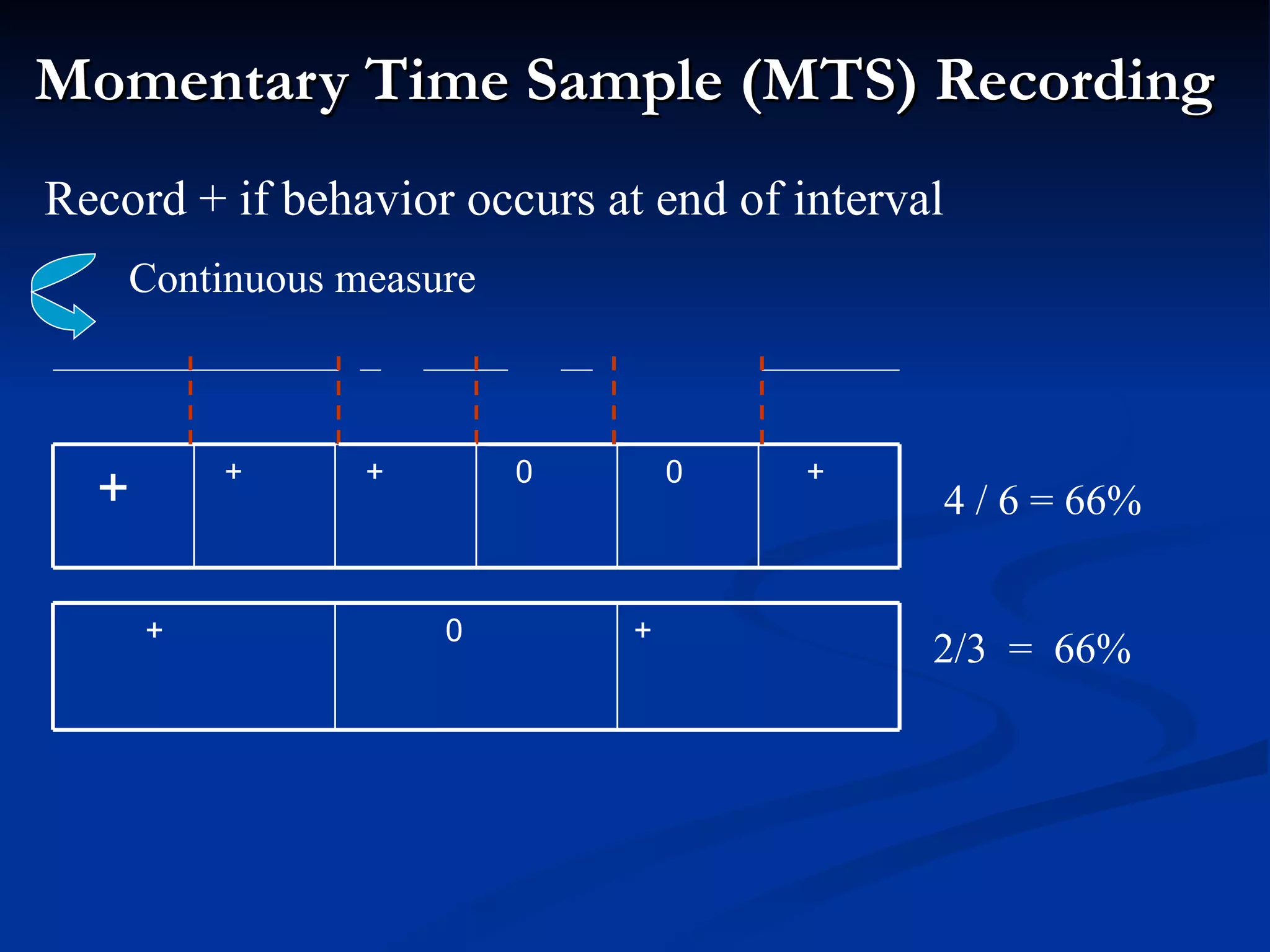
Momentary Time Sample (MTS) Recording
Record + if behavior occurs at end of interval
    Continuous measure


          +     +        0        0   +
  +                                          4 / 6 = 66%


      +             0         +
                                             2/3 = 66%
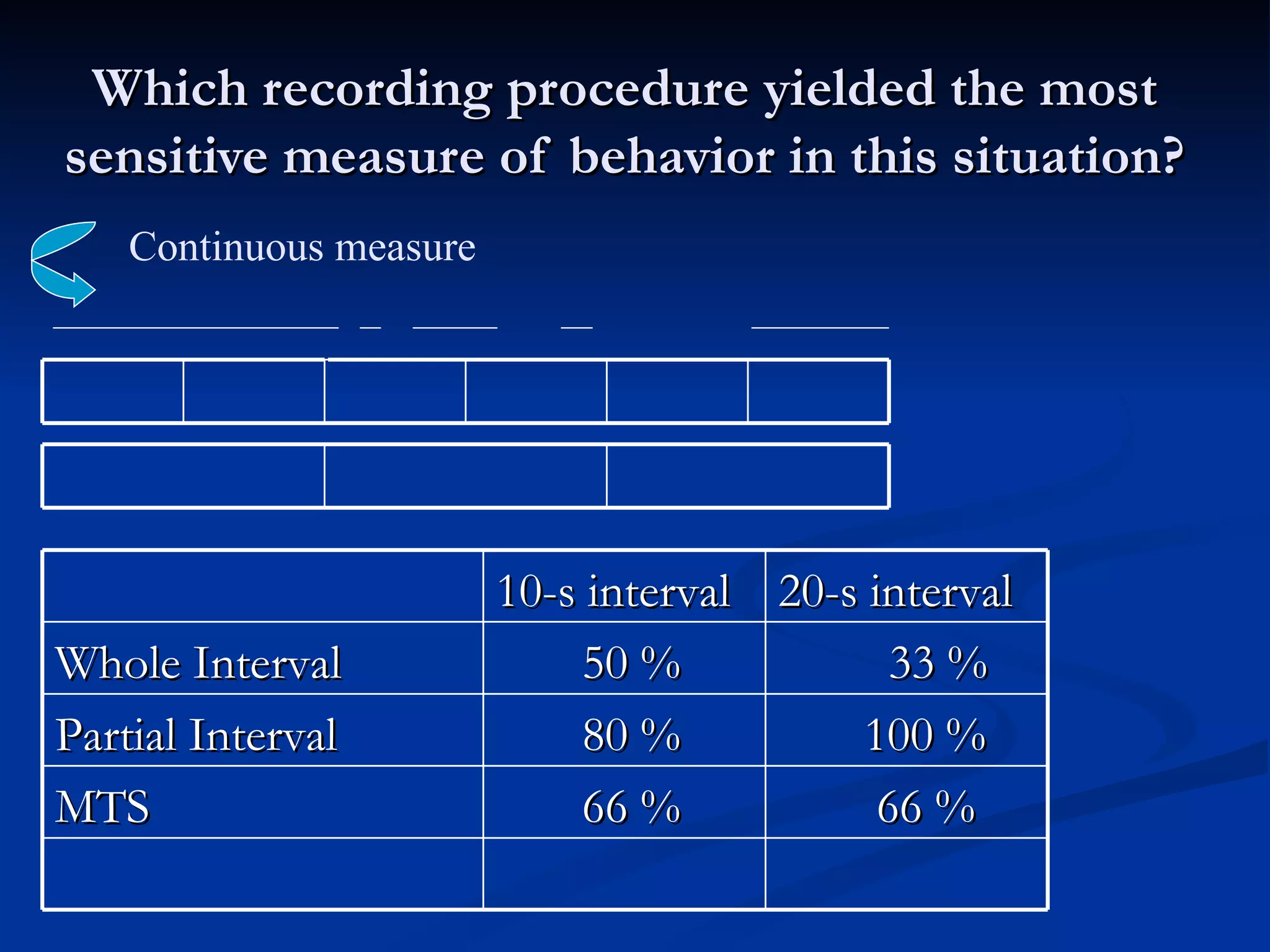
Which recording procedure yielded the most
sensitive measure of behavior in this situation?
    Continuous measure


                         10-s interval 20-s interval
Whole Interval                50 %            33 %
Partial Interval              80 %          100 %
MTS                           66 %           66 %
Accuracy of Observation and
                Measures
   Reactivity: changes in behavior of person being
    observed
   Observer drift: gradual shift by the observer of
    understanding of the target behavior
   Recording procedure: procedure selected to
    measure the dimensions of a behavior (duration)
   Observer expectancy: expectations teachers have
    about the children they observe
   Personal values/bias: social, cultural, or religious
    values that affect teacher’s perception of
    behavior
Data Collection Aids
   Pocket counting: transfer pennies from one to
    another
   Empty jar: drop pennies into jar each time TB
    occurs (take out each time TB occurs)
   Masking tape on the wrist: names on the tape
    and slash marks next to name when TB occurs
Reliability of Observations
   Reliability: refers to accuracy of data collected
    across observers (IOA)
   Reliability for:
     Frequency counts
     Duration and latency

     Interval recording and time sampling (see book for
      each formula)
Recording Observations
   Permanent product recording: materials that are
    produced as a result of behavior
   Data collection form: prepared sheet of paper
    used to record raw data during observations
   Coding system: list of codes added to the data
    sheet that assists teachers in efficiently recording
    TB
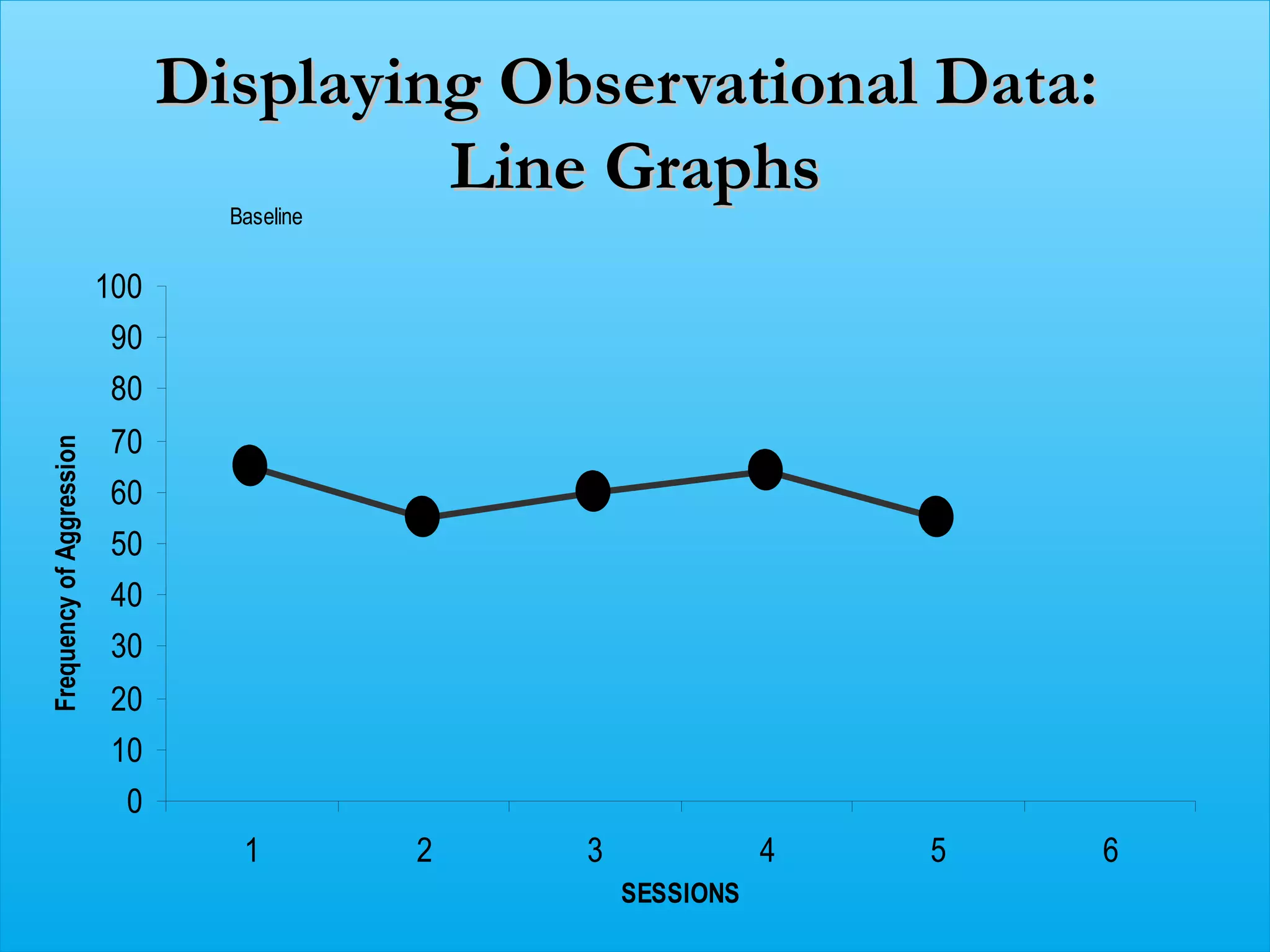
Displaying Observational Data:
                                         Line Graphs
                                  Baseline


                          100
                           90
                           80
                           70
Frequency of Aggression


                           60
                           50
                           40
                           30
                           20
                           10
                            0
                                   1         2   3              4   5   6
                                                     SESSIONS
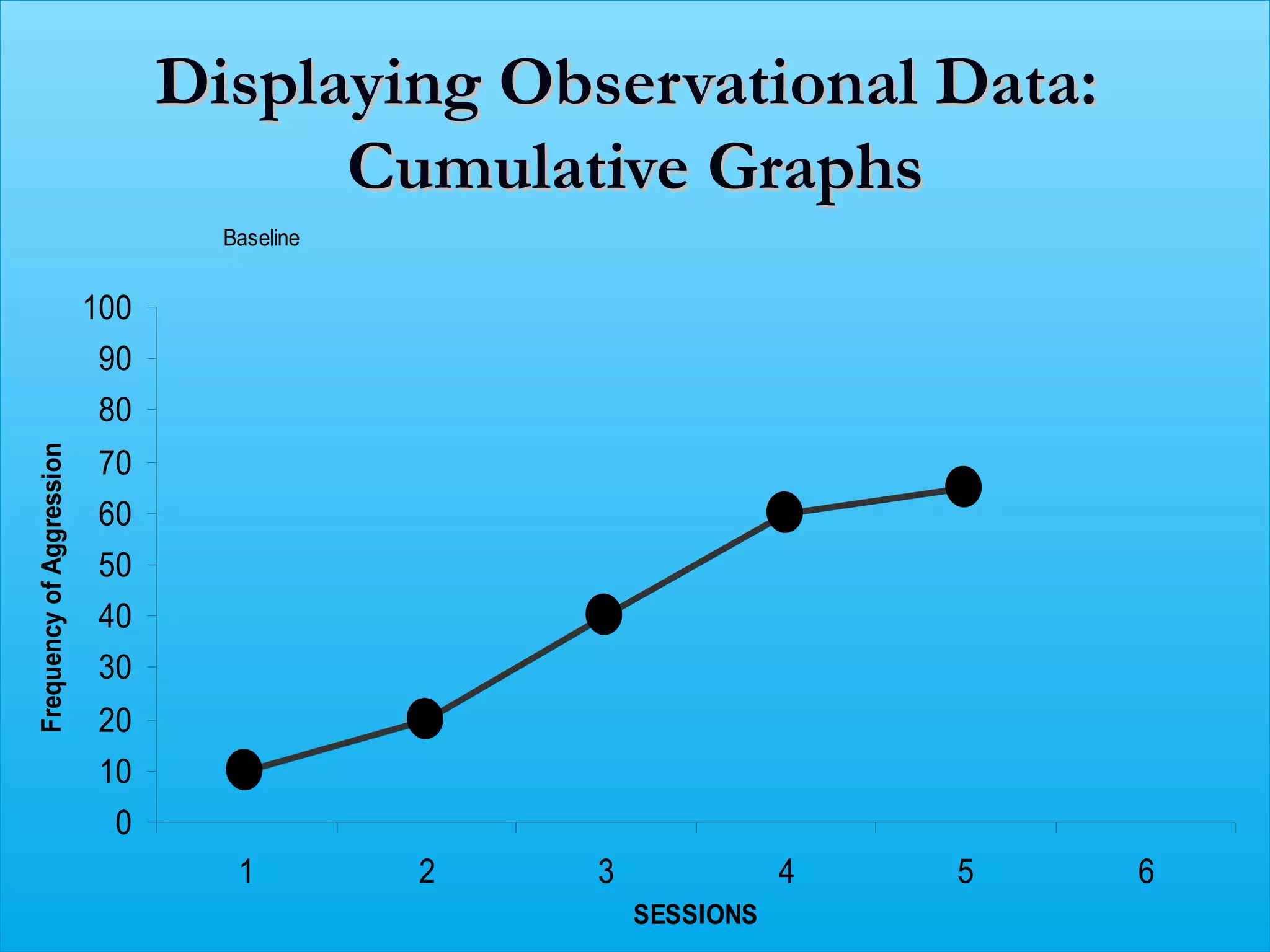
Displaying Observational Data:
                                      Cumulative Graphs
                                  Baseline


                          100
                           90
                           80
Frequency of Aggression


                           70
                           60
                           50
                           40
                           30
                           20
                           10
                            0
                                   1         2   3              4   5   6
                                                     SESSIONS
Displaying Observational Data:
                                      Bar Graphs
                                Baseline


                          100
                           90
Frequency of Aggression


                           80
                           70
                           60
                           50
                           40
                           30
                           20
                           10
                            0
                                 1         2   3              4   5   6
                                                   SESSIONS
Baseline and Intervention
   Baseline: refers to the measurement of the TB
    prior to implementation of any intervention
   Collect baseline data until data is stable
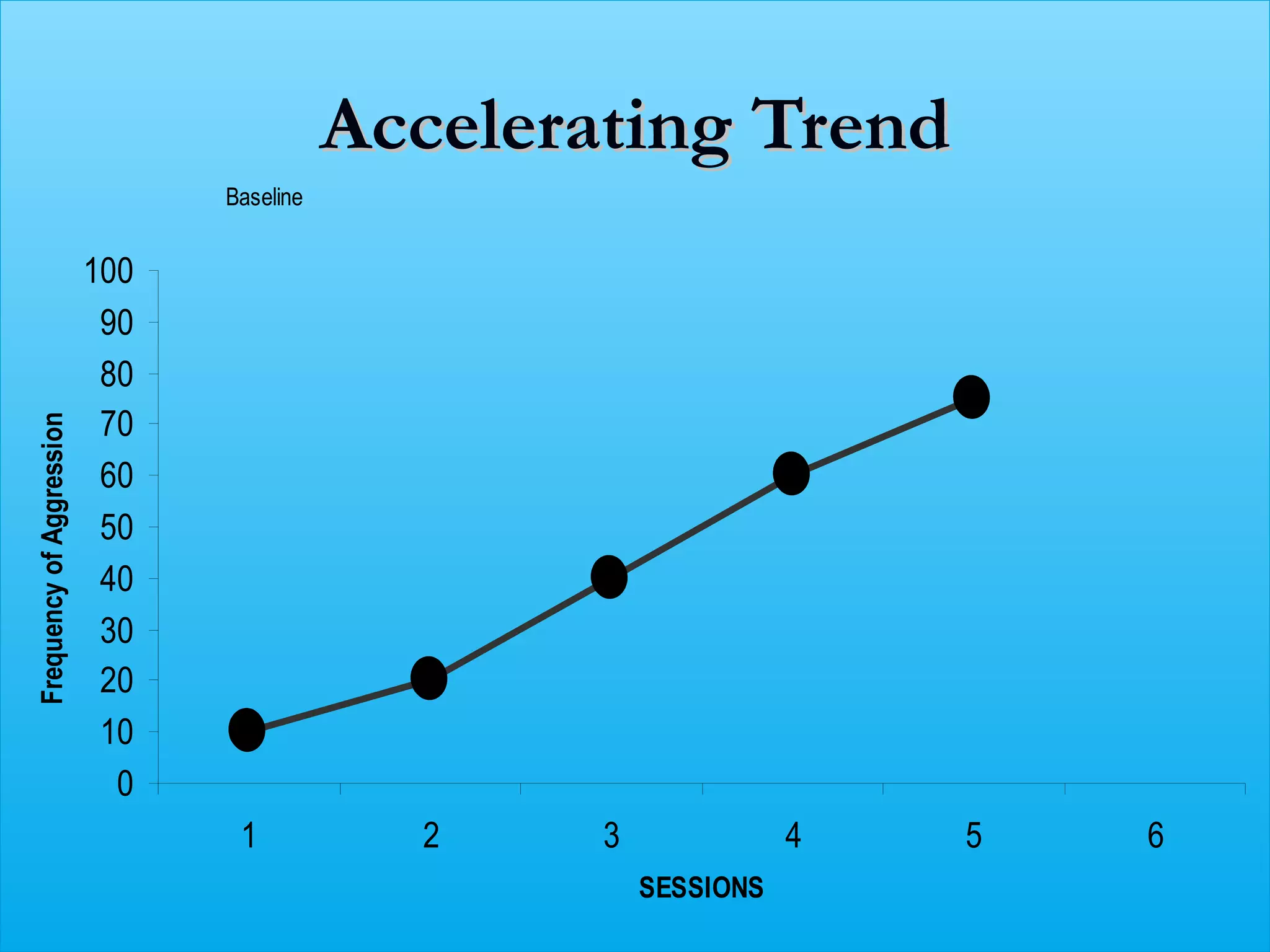
Accelerating Trend
                                Baseline


                          100
                           90
                           80
                           70
Frequency of Aggression


                           60
                           50
                           40
                           30
                           20
                           10
                            0
                                 1           2     3              4   5   6
                                                       SESSIONS
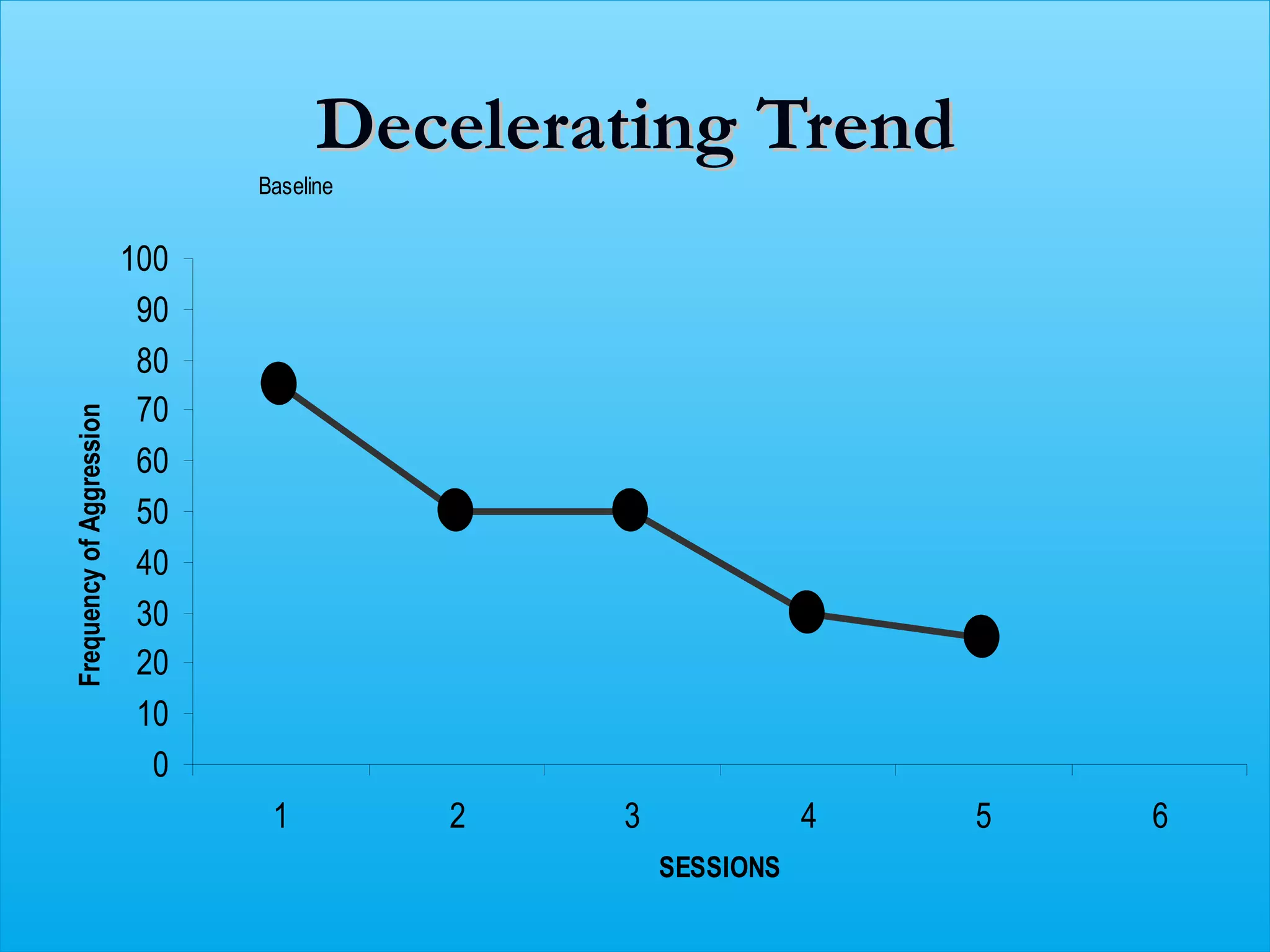
Decelerating Trend
                                Baseline


                          100
                           90
                           80
                           70
Frequency of Aggression


                           60
                           50
                           40
                           30
                           20
                           10
                            0
                                 1         2   3              4   5   6
                                                   SESSIONS
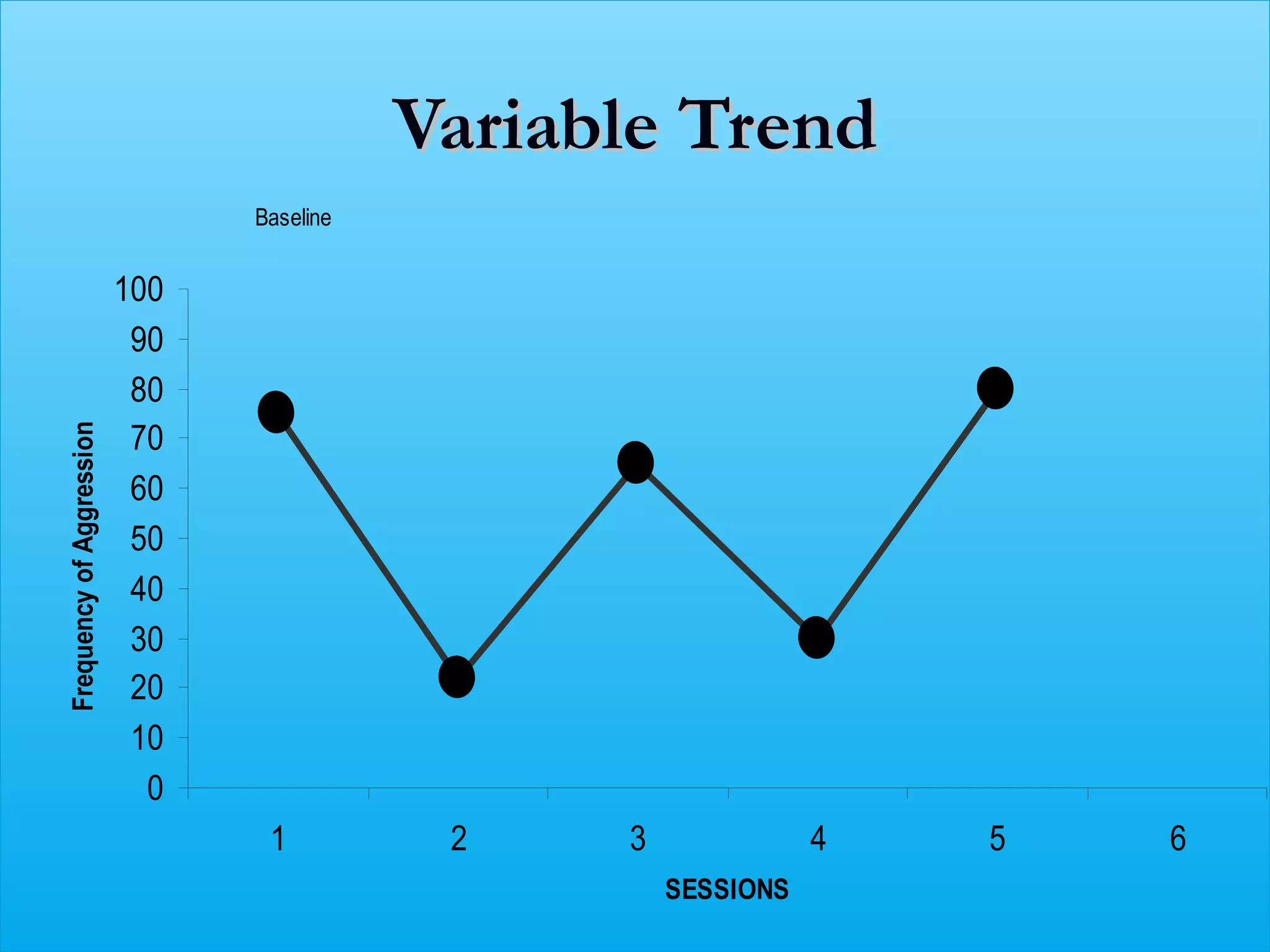
Variable Trend
                                Baseline


                          100
                           90
                           80
                           70
Frequency of Aggression


                           60
                           50
                           40
                           30
                           20
                           10
                            0
                                 1          2    3              4   5   6
                                                     SESSIONS
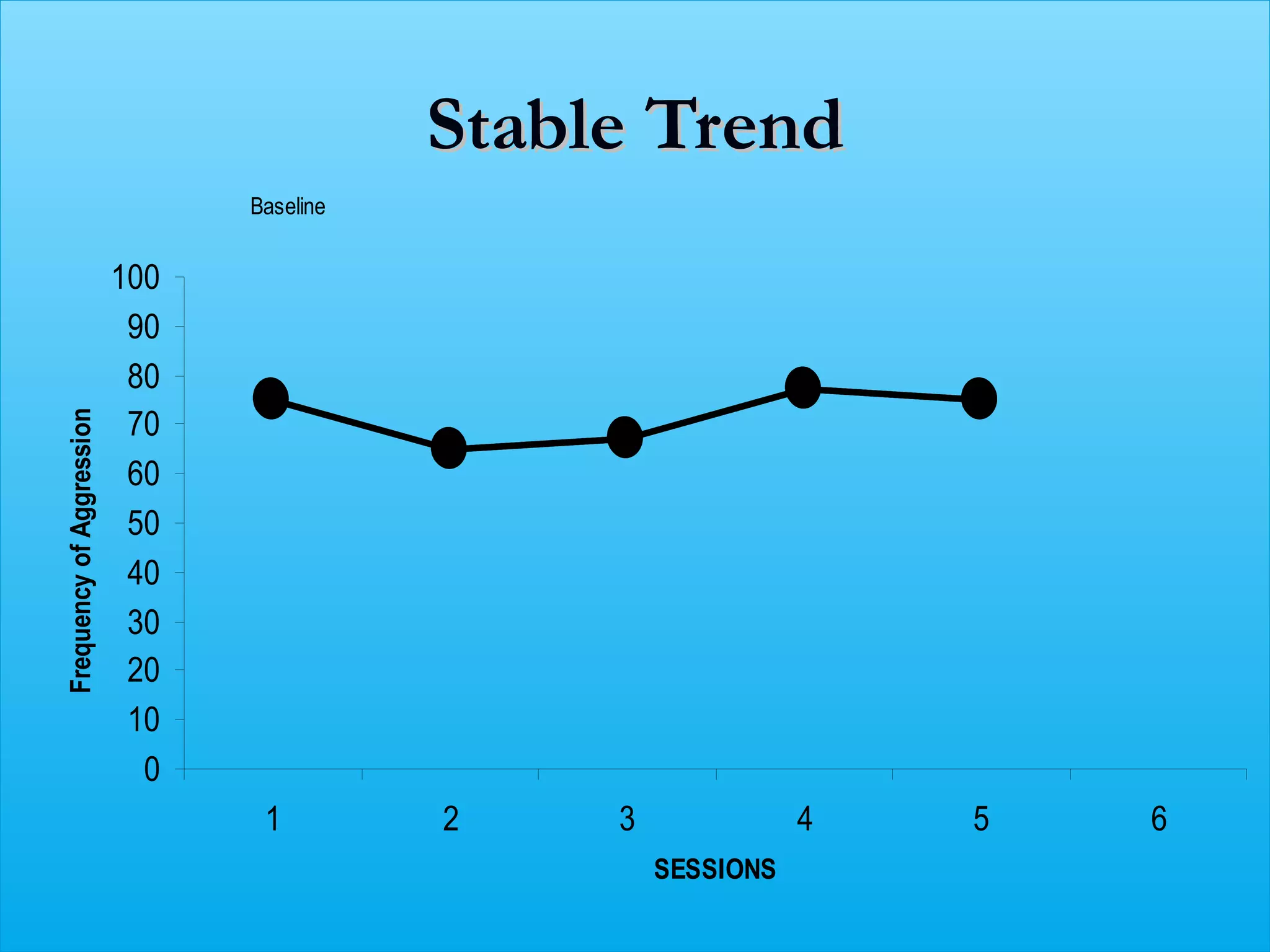
Stable Trend
                                Baseline


                          100
                           90
                           80
                           70
Frequency of Aggression


                           60
                           50
                           40
                           30
                           20
                           10
                            0
                                 1         2    3              4   5   6
                                                    SESSIONS

T bs and_dc_449

  • 1.
    Data Collection Techniques  Agenda  Probe 2 (15)  Lecture: Chapter 5 (15)  Lecture: Target Behaviors, Measurement (60)  Break (10)  Activity: Target Behavior Definitions (30)  Session Lesson (30-45)  Lecture (If time allows): Recording Data, Reliability, Graphs (20)
  • 2.
    Three term contingency  The interaction between existing behavior and the environment  It’s as easy as A, B, C  Antecedent Behavior Consequence
  • 4.
    Principles of Behavior  They describe a basic relationship between behavior and its controlling variables  Positive reinforcement  Negative reinforcement  Punishment by presentation  Punishment by removal  Extinction
  • 5.
    Positive Reinforcement  Stimulus presented  Contingent on a response  Which increases the future probability of the response  Drinking a glass of water when thirsty  High five from buddy after catching the ball  Comments on a new haircut, return to same stylist
  • 6.
    Negative Reinforcement  Stimulus removed  Contingent on a response  Which increases the future probability of the response  Hitting the snooze alarm to escape loud noise  Slowing down when you see a cop to avoid a ticket  Swearing, getting kicked out to escape math class
  • 7.
    Punishment  Removal  Stimulus taken away that decreases future probability of the behavior  Presentation  Stimulus presented that decreases the future probability of the behavior
  • 8.
    Punishment & Reinforcement  Positive Reinforcement  Get something good  Negative Reinforcement  Avoid or escape something aversive  Punishment by Presentation  Get something aversive  Punishment by removal  Removal of something good
  • 9.
    Negative reinforcement is when you take something away and the behavior decreases  True or False? False
  • 10.
    Positive reinforcement involves giving something to someone and increases future behavior  True or False? True
  • 11.
    A classroom teacher walks by a student and says, “I like how you’re doing your math quietly”, after which the student begins talking to his neighbor.  This is an example of positive reinforcement  True or False? False
  • 12.
    A behavior that has been negatively reinforced will occur less often  True or False? False
  • 13.
    A teacher gives a student a “good behavior coupon” for arriving to school on time  The student continues to arrive on- time  This is an example of positive reinforcement True
  • 14.
    The principal sends a student home for fighting  The student returns to school the next day and gets into another fight  This is an example of punishment by removal False
  • 15.
    This is anexample of positive reinforcement False
  • 16.
    •The next nightthe baby cries again in the night and gets to sleep with mom and dad •This is an example of positive reinforcement for the baby True
  • 17.
    Steve was kicked out of math class for disruptive behavior and sent to IHS for the remainder of the period  Steve was also then kicked out of science for disruptive behavior and sent to IHS  This is an example of punishment by removal False
  • 18.
    Target Behaviors  The behavior targeted for observation, measurement, and assessment and/or modification  Defined by teachers as the behavior needing to be learned, increased, or decreased  Once identified – it must be defined  Must be observable and measurable
  • 19.
    Target Behavior: Characteristics of Good Definitions  Objective: such that the specific instances of the response class can be detected, observed, and recorded reliably  Clear: unambiguous, such that others can use and replicate  Complete: such that the definition discriminates the target behavior from other, similar but nontarget behaviors and allows for accurate coding
  • 20.
    Target Behaviors  Kim does not do what the teacher asks  When given a direction by the teacher, Kim fails to initiate the behavior within 5 seconds  Andy is hyperactive  Andy is out of his seat more than one time in 10 minutes  Fred does not ride the school bus properly  Fred is out of his assigned seat on the bus
  • 21.
    Target Behaviors  Betsy is aggressive  Betsy hits, kicks, pushes and calls other children names during recess  Billy is withdrawn  Billy initiates less than one interaction with a peer in any given 10-minute free play period
  • 22.
    Defining Target Behavior  On-task  Out-of-seat  Makes rude comments  Gets better grades  Off-task  Aggressive  Does homework
  • 23.
    On-Task Definition  The target behavior to increase is on task behavior for independent tasks during literary center time.  Looks like: the student actively working on the task, with his eyes not leaving his paper for more than five seconds at a time and his pencil in his hand.  Looks like/Sounds like: the student is in his seat and not talking to any other students unless prompted to. The student will also have a quiet mouth, with no talking, humming, whistling, etc.
  • 24.
    Out-of-Seat Definition General descriptionof behavior  Billy leaves his seat without permission while I am teaching class as a whole Target behavior definition  Leaving seat without permission during whole group instruction  No body parts touching desk or seat
  • 25.
    Verbal Definition Student makesvocal verbal response that is non-content related, out of turn, and directed at another person in relation to others’ academic ability, social skills, family, or personal characteristics.
  • 26.
    Accuracy Definition Measurement ofthe target behavior is the percentage of correct responses. A correct response includes factual and complete responses that correspond to the in-class task or assignment. A correct answer can take a variety of forms including, letters, numbers, words, mathematical symbols, punctuation marks, circling, etc.
  • 27.
    Off-Task  Student’s work is out of his visual field for more than 3 consecutive seconds during all occasions except those beyond his control (e.g. teacher took it away, hasn’t been handed out yet, waiting for help from an adult).  Student is conversing with someone other than an adult. The only exception to this is when the student is talking to someone else that is engaged in the same task and none of the other criteria for off-task behaviors have been met.
  • 28.
    Physical Aggression  Physical Aggression: Kicking, hitting, pushing, or head butting any staff, peer, property, or self.  Kicking, Hitting, Head-Butting: Forceful contact made by the student’s foot, arm, hand, or head towards any staff, peer, property, or self.  Pushing: Making contact with the palm of the hands on any staff, peer, or property resulting in the movement of the property or person.
  • 29.
    Productivity Definition  Jason will increase his math productivity by attempting math problems. An attempt will be recorded if an answer is content related and is given in the form of a written answer on paper, on dry erase board, whispered, or verbalized.
  • 30.
    Dimensions of Behavior  Frequency: Number of times a response occurs  Duration: Length of time to complete a response or total amount of time that a response occurs  Rate: Number of occurrences per unit of time  Latency: Amount of time it takes to begin a behavior once an antecedent is present 
  • 31.
    Frequency Recording  Behaviors that are well-defined are easily recorded with this strategy  Behaviors that are brief and discrete  Simple numerical count is sufficient, but recording the time period in which the behavior occurred is critical  If observation sessions vary in length convert data to rate (# of behaviors/time)
  • 32.
    Duration Recording  If the length of the response is the major characteristic duration may be the best dimension to record  Monitored by any watch or clock  Record cumulative time of a target behavior  Total duration is more convenient, duration per occurrence is more accurate
  • 33.
    Rate  Frequency of TB divided by the number of minutes  Useful when observation periods are not constant and vary in duration  Recommended when reporting the number of times behavior occurred unless the observation periods are constant
  • 34.
    Latency Recording  Start a timer when the cue (e.g., verbal instruction) is presented and stop the timer when the student complies with the request  Often the goal is to decrease latency  For students who are impulsive, teaching them to increase latency might be an effective tool
  • 35.
    Magnitude  Force or strength of a behavior  Aggression, temper tantrums, verbal responses, noises and body movements  Crying – frequency and duration the same, but magnitude may decrease from a scream to a whimper
  • 36.
    Suppose You want toevaluate the effectiveness of your efforts to teach your students the leisure skill of bowling…
  • 37.
    Measurement What are somecharacteristics of interest you might want to address?  Frequency  Number of times a discrete response occurs in a standard observation period  Repetition of one topography is usually the salient dimension Example: Number of times per game student selects the correct bowling ball to throw
  • 38.
    Measurement  Rate  Frequency of response per unit of time  Used when duration of observation period varies Example: Number of times per minute student makes positive comment related to team members’ bowling performance.
  • 39.
    Measurement  Latency  Time to onset of response  Every instance of behavior can be located in time with respect to other events. Example: The time that elapses from when it is student’s turn to bowl and when he picks up the bowling ball.
  • 40.
    Measurement  Magnitude  Amount, amplitude, intensity, or force of a response  Usually addressed in definition (i.e., what constitutes a minimal response). Example: Force of throwing bowling ball (enough to make it to the pins).
  • 41.
    Measurement  Duration  Length of time to complete a response or total amount of time that a response occurs Example: Number of seconds to complete putting on bowling shoes (removing and storing street shoes, retrieving and putting on bowling shoes, tying laces).
  • 42.
    Measurement  Frequency = Number of times a response occurs  Rate = Number of occurrences per unit of time
  • 43.
    Measurement  Duration = Length of time to complete a response or total amount of time that a response occurs
  • 44.
    Interval Recording  Requires your full attention  Can observe several behaviors/students simultaneously  Effective for behaviors that occur too frequently to count (hand flapping)  Break the observation period down into smaller intervals of equal length  Observe whether the behavior occurs or does not occur during the interval  Whole interval (occurs the entire time) or partial interval (any occurrence at all)
  • 45.
    Time sampling  Useful if you want to ‘sample’ behaviors across an extended time period or settings  Similar to interval, but the intervals are much longer, are less frequent and may be variable  For example;  5-min sample from 1 hour, one sample every 5-min  Momentary-time sampling  Rate the occurrence/non-occurrence of the target behavior following a specified interval
  • 46.
    Whole Interval Recording Record+ if behavior occurs for entire duration of interval Continuous measure
  • 47.
    Whole Interval Recording Record+ if behavior occurs for entire duration of interval Continuous measure + 0 0 0 + +
  • 48.
    + 0 0 0 + + 3 / 6 = 50 % PERCENTAGE INTERVALS 100 BEHAVIOR OCCURRED 90 80 70 60 50 40 30 20 10 0 1 2 3 4 5 SESSIONS
  • 49.
    Whole Interval Recording Record+ if behavior occurs for entire duration of interval Continuous measure
  • 50.
    Whole Interval Recording Record+ if behavior occurs for entire duration of interval Continuous measure + 0 0 0 + + 3 / 6 = 50 % + _ _ 1 / 3 = 33%
  • 51.
    Partial Interval Recording Record+ if behavior occurs during any part of interval Continuous measure
  • 52.
    Partial Interval Recording Record+ if behavior occurs during any part of interval Continuous measure + + + + + 5 /6 = 83%
  • 53.
    Partial Interval Recording Record+ if behavior occurs during any part of interval Continuous measure + + + + + + 5 / 6 = 83 %
  • 54.
    Partial Interval Recording Record+ if behavior occurs during any part of interval Continuous measure + + + + + + 5 / 6 = 83 % + + + 3 /3 = 100 %
  • 55.
    Momentary Time Sample(MTS) Recording Record + if behavior occurs at end of interval Continuous measure
  • 56.
    Momentary Time Sample(MTS) Recording Record + if behavior occurs at end of interval Continuous measure + + 0 0 + + 4/6 = 66%
  • 57.
    Momentary Time Sample(MTS) Recording Record + if behavior occurs at end of interval Continuous measure + + 0 0 + + 4 / 6 = 66%
  • 58.
    Momentary Time Sample(MTS) Recording Record + if behavior occurs at end of interval Continuous measure + + 0 0 + + 4 / 6 = 66% + 0 + 2/3 = 66%
  • 59.
    Which recording procedureyielded the most sensitive measure of behavior in this situation? Continuous measure 10-s interval 20-s interval Whole Interval 50 % 33 % Partial Interval 80 % 100 % MTS 66 % 66 %
  • 60.
    Accuracy of Observationand Measures  Reactivity: changes in behavior of person being observed  Observer drift: gradual shift by the observer of understanding of the target behavior  Recording procedure: procedure selected to measure the dimensions of a behavior (duration)  Observer expectancy: expectations teachers have about the children they observe  Personal values/bias: social, cultural, or religious values that affect teacher’s perception of behavior
  • 61.
    Data Collection Aids  Pocket counting: transfer pennies from one to another  Empty jar: drop pennies into jar each time TB occurs (take out each time TB occurs)  Masking tape on the wrist: names on the tape and slash marks next to name when TB occurs
  • 62.
    Reliability of Observations  Reliability: refers to accuracy of data collected across observers (IOA)  Reliability for:  Frequency counts  Duration and latency  Interval recording and time sampling (see book for each formula)
  • 63.
    Recording Observations  Permanent product recording: materials that are produced as a result of behavior  Data collection form: prepared sheet of paper used to record raw data during observations  Coding system: list of codes added to the data sheet that assists teachers in efficiently recording TB
  • 64.
    Displaying Observational Data: Line Graphs Baseline 100 90 80 70 Frequency of Aggression 60 50 40 30 20 10 0 1 2 3 4 5 6 SESSIONS
  • 65.
    Displaying Observational Data: Cumulative Graphs Baseline 100 90 80 Frequency of Aggression 70 60 50 40 30 20 10 0 1 2 3 4 5 6 SESSIONS
  • 66.
    Displaying Observational Data: Bar Graphs Baseline 100 90 Frequency of Aggression 80 70 60 50 40 30 20 10 0 1 2 3 4 5 6 SESSIONS
  • 67.
    Baseline and Intervention  Baseline: refers to the measurement of the TB prior to implementation of any intervention  Collect baseline data until data is stable
  • 68.
    Accelerating Trend Baseline 100 90 80 70 Frequency of Aggression 60 50 40 30 20 10 0 1 2 3 4 5 6 SESSIONS
  • 69.
    Decelerating Trend Baseline 100 90 80 70 Frequency of Aggression 60 50 40 30 20 10 0 1 2 3 4 5 6 SESSIONS
  • 70.
    Variable Trend Baseline 100 90 80 70 Frequency of Aggression 60 50 40 30 20 10 0 1 2 3 4 5 6 SESSIONS
  • 71.
    Stable Trend Baseline 100 90 80 70 Frequency of Aggression 60 50 40 30 20 10 0 1 2 3 4 5 6 SESSIONS

Editor's Notes

  • #41 Sometimes magnitude will of interest and need to have a sensitive instrument to detect variations (e.g., volume of dormitory noise, force squeezing tool for rehab).