Advanced Patterns
in Asynchronous
Programming
Asy Ronen
Michael Arenzon
Asy Ronen
* Independent consultant
* asy.ronen@gmail.com
* linkedin.com/in/asyronen
Michael Arenzon
* Application Infrastructure TL @ Outbrain
* github.com/marenzo
* linkedin.com/in/arenzon
About Us
Intro
▪ When writing async code, a few models can be used, such as:
▫ Actor
▫ CSP
▫ Future / Promise
▪ We will concentrate on futures, specifically Scala Future
▪ We will introduce a set of useful patterns that will enhance the
resiliency of your system
“
Disclaimer: All patterns were
tested in production
All patterns are
used in
production
Motivation
▪ In Outbrain we started writing asynchronous services a few
years back using our own library called Ob1k.
▪ Ob1k includes a Future implementation in Java that is similar to
the Scala one (or C# Task).
▪ We learned a few patterns that were useful when working with
asynchronous code in a live production environment
▪ These patterns are now ported to a standalone library around
Scala’s future.
▪ When writing async code there is a need to relate to real clock in order to:
▫ Schedule a future computation
▫ “Sleep” between two async actions
▫ Measure time of async actions
▫ Etc…
▪ To do that we need a scheduler
Pattern #1 - schedule()
def schedule[T](duration: FiniteDuration)
(callable: => T)
(implicit scheduler: Scheduler): Future[T]
def scheduleWith[T](duration: FiniteDuration)
(callable: => Future[T])
(implicit scheduler: Scheduler): Future[T]
schedule() - Definition
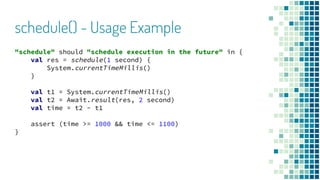
"schedule" should "schedule execution in the future" in {
val res = schedule(1 second) {
System.currentTimeMillis()
}
val t1 = System.currentTimeMillis()
val t2 = Await.result(res, 2 second)
val time = t2 - t1
assert (time >= 1000 && time <= 1100)
}
schedule() - Usage Example
▪ If not properly bounded, we can wait for a future forever.
▪ If we want to provide SLA for our service, we must limit the total
time allowed to process the request.
▪ An error returned on time is better than no answer.
Pattern #2 - withTimeout()
implicit class FutureTimeout[T](future: Future[T]) {
def withTimeout(duration: FiniteDuration)
(implicit scheduler: Scheduler,
executor: ExecutionContext):Future[T] = {
val deadline = schedule(duration) {
throw new TimeoutException("future timeout")
}
Future firstCompletedOf Seq(future, deadline)
}
}
withTimeout() - Implementation
The original future task is not interrupted!
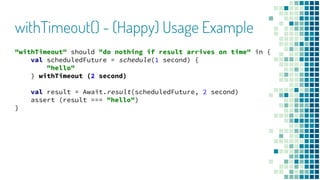
withTimeout() - (Happy) Usage Example
"withTimeout" should "do nothing if result arrives on time" in {
val scheduledFuture = schedule(1 second) {
"hello"
} withTimeout (2 second)
val result = Await.result(scheduledFuture, 2 second)
assert (result === "hello")
}
withTimeout() - Usage Example
"withTimeout" should "throw exception after timeout" in {
val scheduledFuture = schedule(2 second) {
"hello"
} withTimeout (1 second)
assertThrows[TimeoutException] {
Await.result(scheduledFuture, 2 second)
}
}
Pattern #3 - sequence()
▪ Scala’s Future class contain a sequence method that transforms
a List[Future[T]] => Future[List[T]]
▪ However, it has two main drawbacks:
a. If one future fails the whole thing fails but what if 90% of
the results are good enough for us?
b. It doesn’t fail fast i.e. we wait for the slowest result/error to
arrive
sequence() - Definition
def sequence[T]
(futures: Seq[Future[T]], stop: StopCondition = FailOnError)
(implicit executor: ExecutionContext): Future[Seq[T]]
def collect[K, T]
(futures: Map[K, Future[T]], stop: StopCondition = FailOnError)
(implicit executor: ExecutionContext): Future[Map[K, T]]
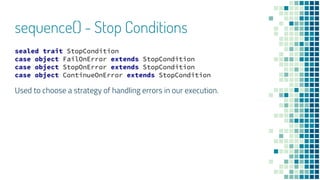
sequence() - Stop Conditions
sealed trait StopCondition
case object FailOnError extends StopCondition
case object StopOnError extends StopCondition
case object ContinueOnError extends StopCondition
Used to choose a strategy of handling errors in our execution.
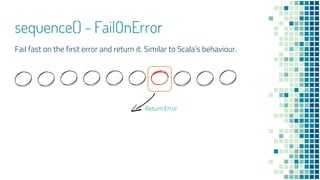
sequence() - FailOnError
Fail fast on the first error and return it. Similar to Scala’s behaviour.
Return Error
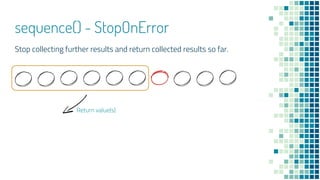
sequence() - StopOnError
Stop collecting further results and return collected results so far.
Return value(s)
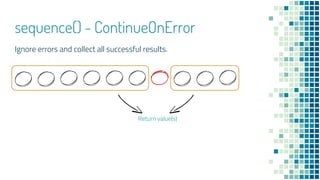
sequence() - ContinueOnError
Ignore errors and collect all successful results.
Return value(s)
sequence() - Definition (extended)
def sequenceAll[T]
(futures: Seq[Future[T]])
(implicit executor: ExecutionContext): Future[Seq[Try[T]]]
def collectAll[K, T]
(futures: Map[K, Future[T]])
(implicit executor: ExecutionContext): Future[Map[K, Try[T]]]
Return all values & errors
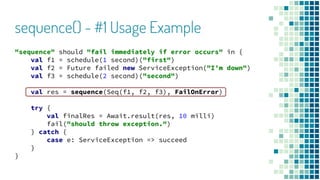
sequence() - #1 Usage Example
"sequence" should "fail immediately if error occurs" in {
val f1 = schedule(1 second)("first")
val f2 = Future failed new ServiceException("I’m down")
val f3 = schedule(2 second)("second")
val res = sequence(Seq(f1, f2, f3), FailOnError)
try {
val finalRes = Await.result(res, 10 milli)
fail("should throw exception.")
} catch {
case e: ServiceException => succeed
}
}
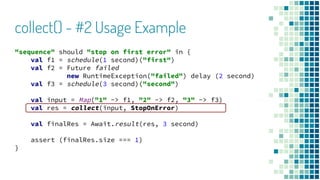
collect() - #2 Usage Example
"sequence" should "stop on first error" in {
val f1 = schedule(1 second)("first")
val f2 = Future failed
new RuntimeException("failed") delay (2 second)
val f3 = schedule(3 second)("second")
val input = Map("1" -> f1, "2" -> f2, "3" -> f3)
val res = collect(input, StopOnError)
val finalRes = Await.result(res, 3 second)
assert (finalRes.size === 1)
}
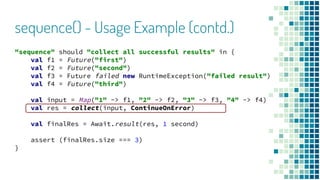
sequence() - Usage Example (contd.)
"sequence" should "collect all successful results" in {
val f1 = Future("first")
val f2 = Future("second")
val f3 = Future failed new RuntimeException("failed result")
val f4 = Future("third")
val input = Map("1" -> f1, "2" -> f2, "3" -> f3, "4" -> f4)
val res = collect(input, ContinueOnError)
val finalRes = Await.result(res, 1 second)
assert (finalRes.size === 3)
}
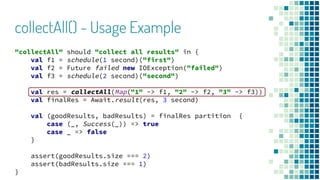
collectAll() - Usage Example
"collectAll" should "collect all results" in {
val f1 = schedule(1 second)("first")
val f2 = Future failed new IOException("failed")
val f3 = schedule(2 second)("second")
val res = collectAll(Map("1" -> f1, "2" -> f2, "3" -> f3))
val finalRes = Await.result(res, 3 second)
val (goodResults, badResults) = finalRes partition {
case (_, Success(_)) => true
case _ => false
}
assert(goodResults.size === 2)
assert(badResults.size === 1)
}
Pattern #4 - parallelCollect()
▪ Executing too many operations concurrently can be overwhelming.
▪ Some services cap concurrency of a single consumer
▪ To throttle execution we need a tool that will allow us to define maximum
concurrent operations
parallelCollect() - Definition
def parallelCollect[T, R]
(elements: Seq[T], parallelism: Int,
stop: StopCondition = FailOnError)
(producer: T => Future[R])
(implicit executor: ExecutionContext): Future[Seq[R]]
parallelCollect() - Usage Example
"Google Search" should "return all results without throttling" in {
val queries: List[String] = createQueries(amount = 10000)
val results = parallelCollect(queries, 10, ContinueOnError) {
query => GoogleSearchClient.sendQuery(query)
} withTimeout(30 second)
val finalRes = Await.result(results, 30 second)
assert (finalRes.size === 10000)
}
Pattern #5 - retry()
● Applications fail. Network connections drop. Connections
timeout. Bad things happen.
● You can give your application perseverance with retry.
retry() - (Naive) Implementation
def retry[T](retries: Int)(f: => Future[T]): Future[T] = f recoverWith {
case _ if retries > 0 => retry(retries - 1)(f)
}
retry() - (Real) Implementation
sealed trait RetryPolicy
case object Immediate extends RetryPolicy
case class Fixed(duration: FiniteDuration) extends RetryPolicy
case class Exponential(duration: FiniteDuration) extends RetryPolicy
def retry[T](retries: Int, policy: RetryPolicy)
(producer: Int => Future[T])
(implicit executor: ExecutionContext,
scheduler: Scheduler): Future[T]
retry() - (Real) Implementation
type Conditional = PartialFunction[Throwable, RetryPolicy]
def retry[T](retries: Int)
(policy: Conditional)
(producer: Int => Future[T])
(implicit scheduler: Scheduler,
executor: ExecutionContext): Future[T]
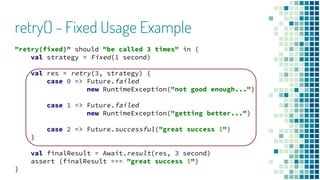
retry() - Fixed Usage Example
"retry(fixed)" should "be called 3 times" in {
val strategy = Fixed(1 second)
val res = retry(3, strategy) {
case 0 => Future.failed
new RuntimeException("not good enough...")
case 1 => Future.failed
new RuntimeException("getting better...")
case 2 => Future.successful("great success !")
}
val finalResult = Await.result(res, 3 second)
assert (finalResult === "great success !")
}
retry() - Conditional Usage Example
"retry(conditional)" should "stop on IOException" in {
val policy: PartialFunction[Throwable, RetryPolicy] = {
case _: TimeoutException => Fixed(1 second)
}
val res = retry(3)(policy) {
case 0 => Future failed new TimeoutException("really slow")
case 1 => Future failed new IOException("something bad")
case 2 => Future successful "great success"
}
try Await.result(res, 3 second) catch {
case _: IOException => succeed
}
}
▪ Slow response at a single instance level happens on a regular basis -
GC, unresponsive queries, network issues, etc.
▪ When we analyze our latencies over time, we will see a long tail of long
latencies exceeding our SLA.
▪ It is possible to trade-off between average load of a system and overall
response time.
Pattern #6 - doubleDispatch()
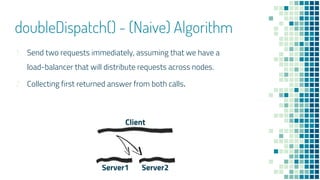
doubleDispatch() - (Naive) Algorithm
1. Send two requests immediately, assuming that we have a
load-balancer that will distribute requests across nodes.
2. Collecting first returned answer from both calls.
Client
Server1 Server2
doubleDispatch() - A better approach
1. Send the first request to the first node
2. After a predefined period of time, if no answer arrived from
the first request, we dispatch the second one.
3. Collect first returned answer from both calls.
Client
Server1 Server2
20 msec
doubleDispatch() - Definition
def doubleDispatch[T](duration: FiniteDuration)
(producer: => Future[T])
(implicit executor: ExecutionContext,
scheduler: Scheduler): Future[T]
This mechanism can only be used with idempotent operations
doubleDispatch() - Usage Example
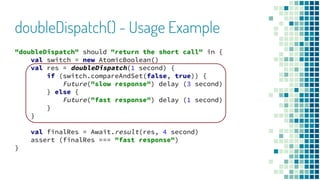
"doubleDispatch" should "return the short call" in {
val switch = new AtomicBoolean()
val res = doubleDispatch(1 second) {
if (switch.compareAndSet(false, true)) {
Future("slow response") delay (3 second)
} else {
Future("fast response") delay (1 second)
}
}
val finalRes = Await.result(res, 4 second)
assert (finalRes === "fast response")
}
doubleDispatch() - Choosing Duration
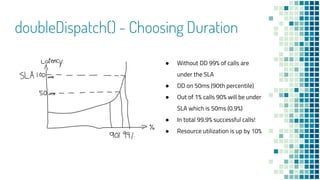
● Without DD 99% of calls are
under the SLA
● DD on 50ms (90th percentile)
● Out of 1% calls 90% will be under
SLA which is 50ms (0.9%)
● In total 99.9% successful calls!
● Resource utilization is up by 10%
Future Plans
▪ Circuit breaker
▪ Resource (Object) Pool
▪ What else ? we accept pull requests ;)
THANKS!
Code available at:
https://github.com/haski/async-patterns
Ob1k:
https://github.com/outbrain/ob1k

Advanced patterns in asynchronous programming

  • 1.
  • 2.
    Asy Ronen * Independentconsultant * asy.ronen@gmail.com * linkedin.com/in/asyronen Michael Arenzon * Application Infrastructure TL @ Outbrain * github.com/marenzo * linkedin.com/in/arenzon About Us
  • 3.
    Intro ▪ When writingasync code, a few models can be used, such as: ▫ Actor ▫ CSP ▫ Future / Promise ▪ We will concentrate on futures, specifically Scala Future ▪ We will introduce a set of useful patterns that will enhance the resiliency of your system
  • 4.
    “ Disclaimer: All patternswere tested in production All patterns are used in production
  • 5.
    Motivation ▪ In Outbrainwe started writing asynchronous services a few years back using our own library called Ob1k. ▪ Ob1k includes a Future implementation in Java that is similar to the Scala one (or C# Task). ▪ We learned a few patterns that were useful when working with asynchronous code in a live production environment ▪ These patterns are now ported to a standalone library around Scala’s future.
  • 6.
    ▪ When writingasync code there is a need to relate to real clock in order to: ▫ Schedule a future computation ▫ “Sleep” between two async actions ▫ Measure time of async actions ▫ Etc… ▪ To do that we need a scheduler Pattern #1 - schedule()
  • 7.
    def schedule[T](duration: FiniteDuration) (callable:=> T) (implicit scheduler: Scheduler): Future[T] def scheduleWith[T](duration: FiniteDuration) (callable: => Future[T]) (implicit scheduler: Scheduler): Future[T] schedule() - Definition
  • 8.
    "schedule" should "scheduleexecution in the future" in { val res = schedule(1 second) { System.currentTimeMillis() } val t1 = System.currentTimeMillis() val t2 = Await.result(res, 2 second) val time = t2 - t1 assert (time >= 1000 && time <= 1100) } schedule() - Usage Example
  • 9.
    ▪ If notproperly bounded, we can wait for a future forever. ▪ If we want to provide SLA for our service, we must limit the total time allowed to process the request. ▪ An error returned on time is better than no answer. Pattern #2 - withTimeout()
  • 10.
    implicit class FutureTimeout[T](future:Future[T]) { def withTimeout(duration: FiniteDuration) (implicit scheduler: Scheduler, executor: ExecutionContext):Future[T] = { val deadline = schedule(duration) { throw new TimeoutException("future timeout") } Future firstCompletedOf Seq(future, deadline) } } withTimeout() - Implementation The original future task is not interrupted!
  • 11.
    withTimeout() - (Happy)Usage Example "withTimeout" should "do nothing if result arrives on time" in { val scheduledFuture = schedule(1 second) { "hello" } withTimeout (2 second) val result = Await.result(scheduledFuture, 2 second) assert (result === "hello") }
  • 12.
    withTimeout() - UsageExample "withTimeout" should "throw exception after timeout" in { val scheduledFuture = schedule(2 second) { "hello" } withTimeout (1 second) assertThrows[TimeoutException] { Await.result(scheduledFuture, 2 second) } }
  • 13.
    Pattern #3 -sequence() ▪ Scala’s Future class contain a sequence method that transforms a List[Future[T]] => Future[List[T]] ▪ However, it has two main drawbacks: a. If one future fails the whole thing fails but what if 90% of the results are good enough for us? b. It doesn’t fail fast i.e. we wait for the slowest result/error to arrive
  • 14.
    sequence() - Definition defsequence[T] (futures: Seq[Future[T]], stop: StopCondition = FailOnError) (implicit executor: ExecutionContext): Future[Seq[T]] def collect[K, T] (futures: Map[K, Future[T]], stop: StopCondition = FailOnError) (implicit executor: ExecutionContext): Future[Map[K, T]]
  • 15.
    sequence() - StopConditions sealed trait StopCondition case object FailOnError extends StopCondition case object StopOnError extends StopCondition case object ContinueOnError extends StopCondition Used to choose a strategy of handling errors in our execution.
  • 16.
    sequence() - FailOnError Failfast on the first error and return it. Similar to Scala’s behaviour. Return Error
  • 17.
    sequence() - StopOnError Stopcollecting further results and return collected results so far. Return value(s)
  • 18.
    sequence() - ContinueOnError Ignoreerrors and collect all successful results. Return value(s)
  • 19.
    sequence() - Definition(extended) def sequenceAll[T] (futures: Seq[Future[T]]) (implicit executor: ExecutionContext): Future[Seq[Try[T]]] def collectAll[K, T] (futures: Map[K, Future[T]]) (implicit executor: ExecutionContext): Future[Map[K, Try[T]]] Return all values & errors
  • 20.
    sequence() - #1Usage Example "sequence" should "fail immediately if error occurs" in { val f1 = schedule(1 second)("first") val f2 = Future failed new ServiceException("I’m down") val f3 = schedule(2 second)("second") val res = sequence(Seq(f1, f2, f3), FailOnError) try { val finalRes = Await.result(res, 10 milli) fail("should throw exception.") } catch { case e: ServiceException => succeed } }
  • 21.
    collect() - #2Usage Example "sequence" should "stop on first error" in { val f1 = schedule(1 second)("first") val f2 = Future failed new RuntimeException("failed") delay (2 second) val f3 = schedule(3 second)("second") val input = Map("1" -> f1, "2" -> f2, "3" -> f3) val res = collect(input, StopOnError) val finalRes = Await.result(res, 3 second) assert (finalRes.size === 1) }
  • 22.
    sequence() - UsageExample (contd.) "sequence" should "collect all successful results" in { val f1 = Future("first") val f2 = Future("second") val f3 = Future failed new RuntimeException("failed result") val f4 = Future("third") val input = Map("1" -> f1, "2" -> f2, "3" -> f3, "4" -> f4) val res = collect(input, ContinueOnError) val finalRes = Await.result(res, 1 second) assert (finalRes.size === 3) }
  • 23.
    collectAll() - UsageExample "collectAll" should "collect all results" in { val f1 = schedule(1 second)("first") val f2 = Future failed new IOException("failed") val f3 = schedule(2 second)("second") val res = collectAll(Map("1" -> f1, "2" -> f2, "3" -> f3)) val finalRes = Await.result(res, 3 second) val (goodResults, badResults) = finalRes partition { case (_, Success(_)) => true case _ => false } assert(goodResults.size === 2) assert(badResults.size === 1) }
  • 24.
    Pattern #4 -parallelCollect() ▪ Executing too many operations concurrently can be overwhelming. ▪ Some services cap concurrency of a single consumer ▪ To throttle execution we need a tool that will allow us to define maximum concurrent operations
  • 25.
    parallelCollect() - Definition defparallelCollect[T, R] (elements: Seq[T], parallelism: Int, stop: StopCondition = FailOnError) (producer: T => Future[R]) (implicit executor: ExecutionContext): Future[Seq[R]]
  • 26.
    parallelCollect() - UsageExample "Google Search" should "return all results without throttling" in { val queries: List[String] = createQueries(amount = 10000) val results = parallelCollect(queries, 10, ContinueOnError) { query => GoogleSearchClient.sendQuery(query) } withTimeout(30 second) val finalRes = Await.result(results, 30 second) assert (finalRes.size === 10000) }
  • 27.
    Pattern #5 -retry() ● Applications fail. Network connections drop. Connections timeout. Bad things happen. ● You can give your application perseverance with retry.
  • 28.
    retry() - (Naive)Implementation def retry[T](retries: Int)(f: => Future[T]): Future[T] = f recoverWith { case _ if retries > 0 => retry(retries - 1)(f) }
  • 29.
    retry() - (Real)Implementation sealed trait RetryPolicy case object Immediate extends RetryPolicy case class Fixed(duration: FiniteDuration) extends RetryPolicy case class Exponential(duration: FiniteDuration) extends RetryPolicy def retry[T](retries: Int, policy: RetryPolicy) (producer: Int => Future[T]) (implicit executor: ExecutionContext, scheduler: Scheduler): Future[T]
  • 30.
    retry() - (Real)Implementation type Conditional = PartialFunction[Throwable, RetryPolicy] def retry[T](retries: Int) (policy: Conditional) (producer: Int => Future[T]) (implicit scheduler: Scheduler, executor: ExecutionContext): Future[T]
  • 31.
    retry() - FixedUsage Example "retry(fixed)" should "be called 3 times" in { val strategy = Fixed(1 second) val res = retry(3, strategy) { case 0 => Future.failed new RuntimeException("not good enough...") case 1 => Future.failed new RuntimeException("getting better...") case 2 => Future.successful("great success !") } val finalResult = Await.result(res, 3 second) assert (finalResult === "great success !") }
  • 32.
    retry() - ConditionalUsage Example "retry(conditional)" should "stop on IOException" in { val policy: PartialFunction[Throwable, RetryPolicy] = { case _: TimeoutException => Fixed(1 second) } val res = retry(3)(policy) { case 0 => Future failed new TimeoutException("really slow") case 1 => Future failed new IOException("something bad") case 2 => Future successful "great success" } try Await.result(res, 3 second) catch { case _: IOException => succeed } }
  • 33.
    ▪ Slow responseat a single instance level happens on a regular basis - GC, unresponsive queries, network issues, etc. ▪ When we analyze our latencies over time, we will see a long tail of long latencies exceeding our SLA. ▪ It is possible to trade-off between average load of a system and overall response time. Pattern #6 - doubleDispatch()
  • 34.
    doubleDispatch() - (Naive)Algorithm 1. Send two requests immediately, assuming that we have a load-balancer that will distribute requests across nodes. 2. Collecting first returned answer from both calls. Client Server1 Server2
  • 35.
    doubleDispatch() - Abetter approach 1. Send the first request to the first node 2. After a predefined period of time, if no answer arrived from the first request, we dispatch the second one. 3. Collect first returned answer from both calls. Client Server1 Server2 20 msec
  • 36.
    doubleDispatch() - Definition defdoubleDispatch[T](duration: FiniteDuration) (producer: => Future[T]) (implicit executor: ExecutionContext, scheduler: Scheduler): Future[T] This mechanism can only be used with idempotent operations
  • 37.
    doubleDispatch() - UsageExample "doubleDispatch" should "return the short call" in { val switch = new AtomicBoolean() val res = doubleDispatch(1 second) { if (switch.compareAndSet(false, true)) { Future("slow response") delay (3 second) } else { Future("fast response") delay (1 second) } } val finalRes = Await.result(res, 4 second) assert (finalRes === "fast response") }
  • 38.
    doubleDispatch() - ChoosingDuration ● Without DD 99% of calls are under the SLA ● DD on 50ms (90th percentile) ● Out of 1% calls 90% will be under SLA which is 50ms (0.9%) ● In total 99.9% successful calls! ● Resource utilization is up by 10%
  • 39.
    Future Plans ▪ Circuitbreaker ▪ Resource (Object) Pool ▪ What else ? we accept pull requests ;)
  • 40.