RELATIONS
PearlRoseCajenta
REPORTER
What is a 'relation'?
In math, a relation is just a set of
ordered pairs.
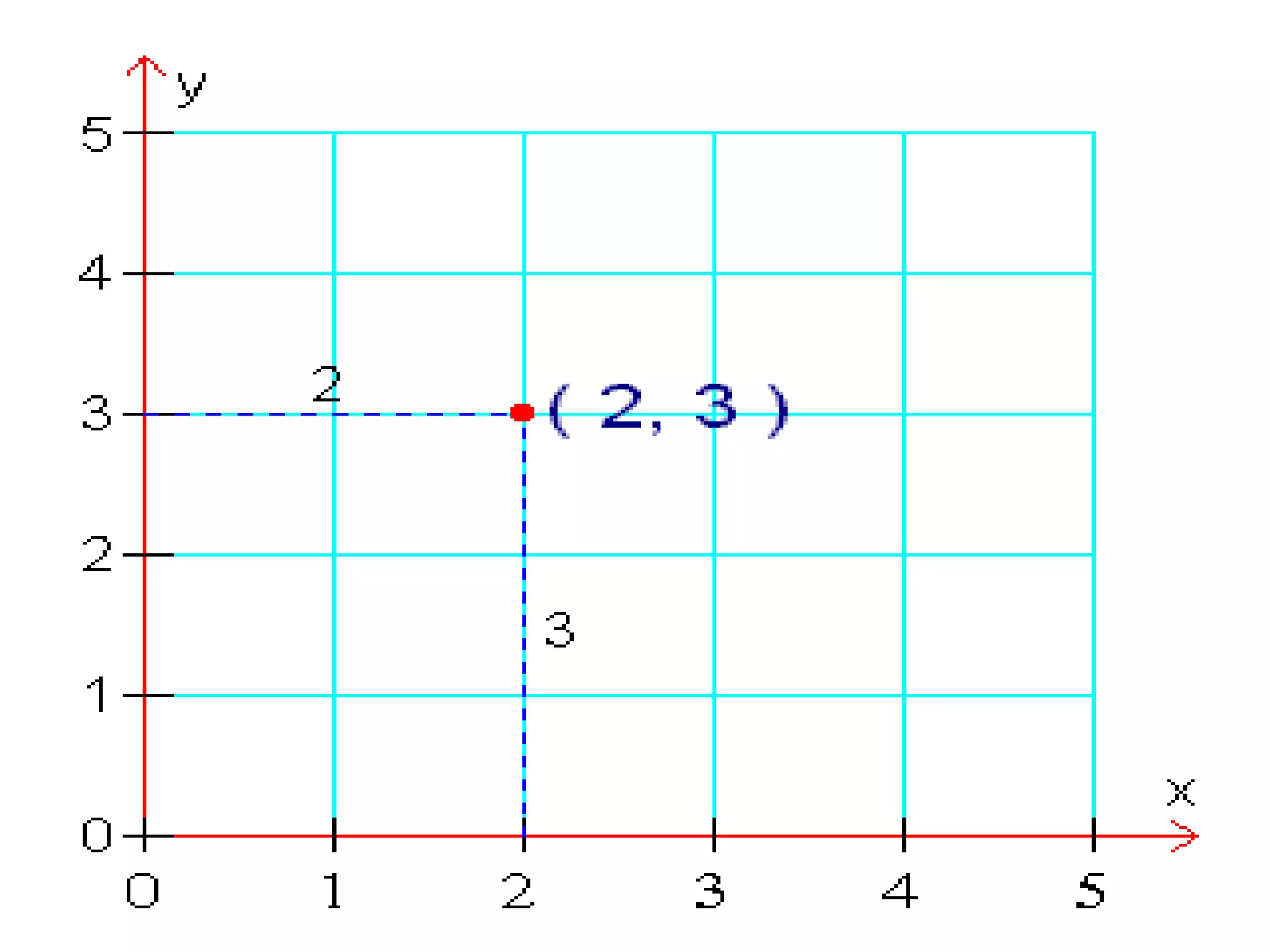
- is a pair of numbers used to
locate a point on a coordinate plane;
the first number tells how far to move
horizontally and the second number
tells how far to move vertically.
*OrderedPair
*Set
- is a collection.
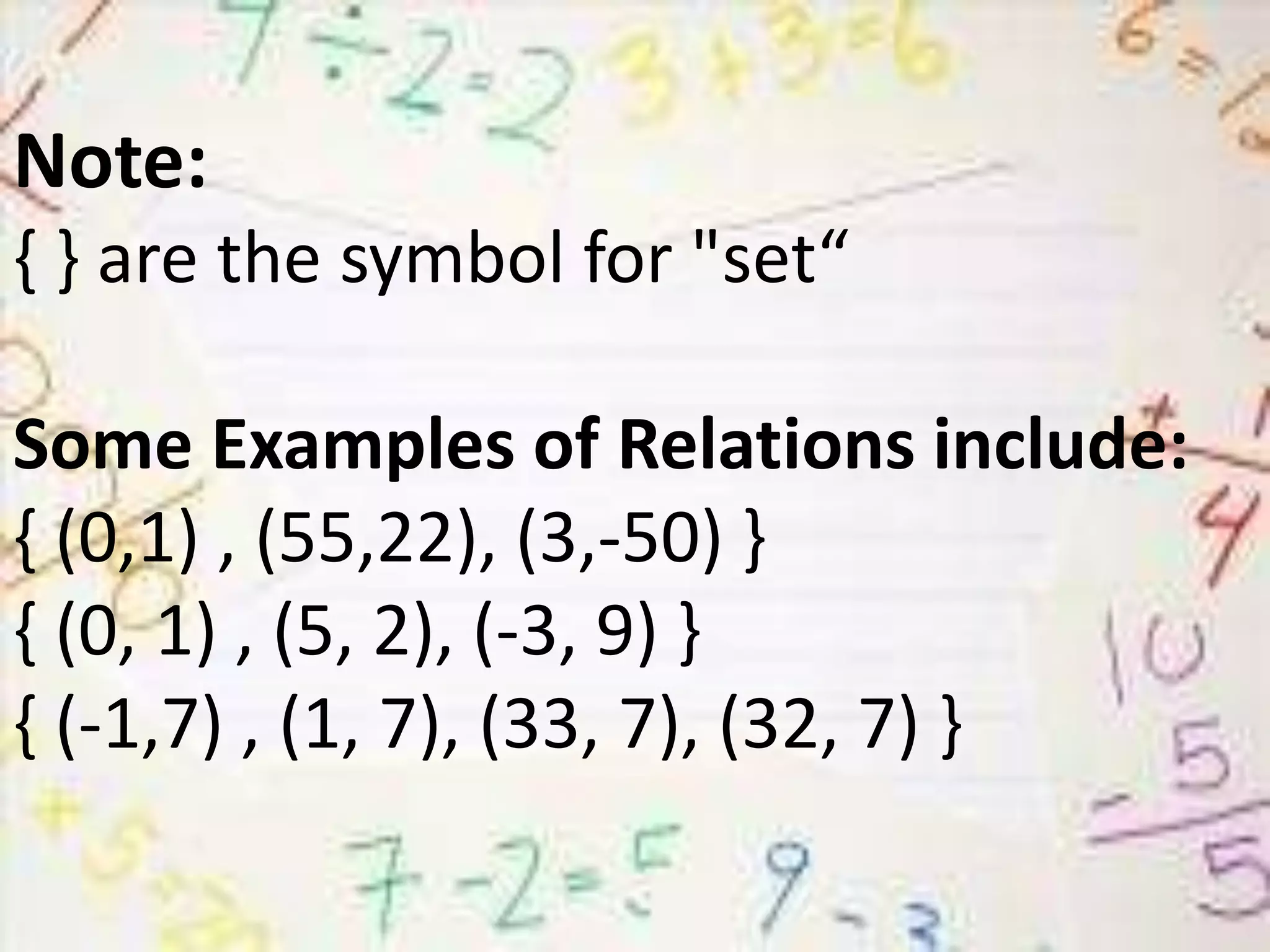
Note:
{ } are the symbol for "set“
Some Examples of Relations include:
{ (0,1) , (55,22), (3,-50) }
{ (0, 1) , (5, 2), (-3, 9) }
{ (-1,7) , (1, 7), (33, 7), (32, 7) }
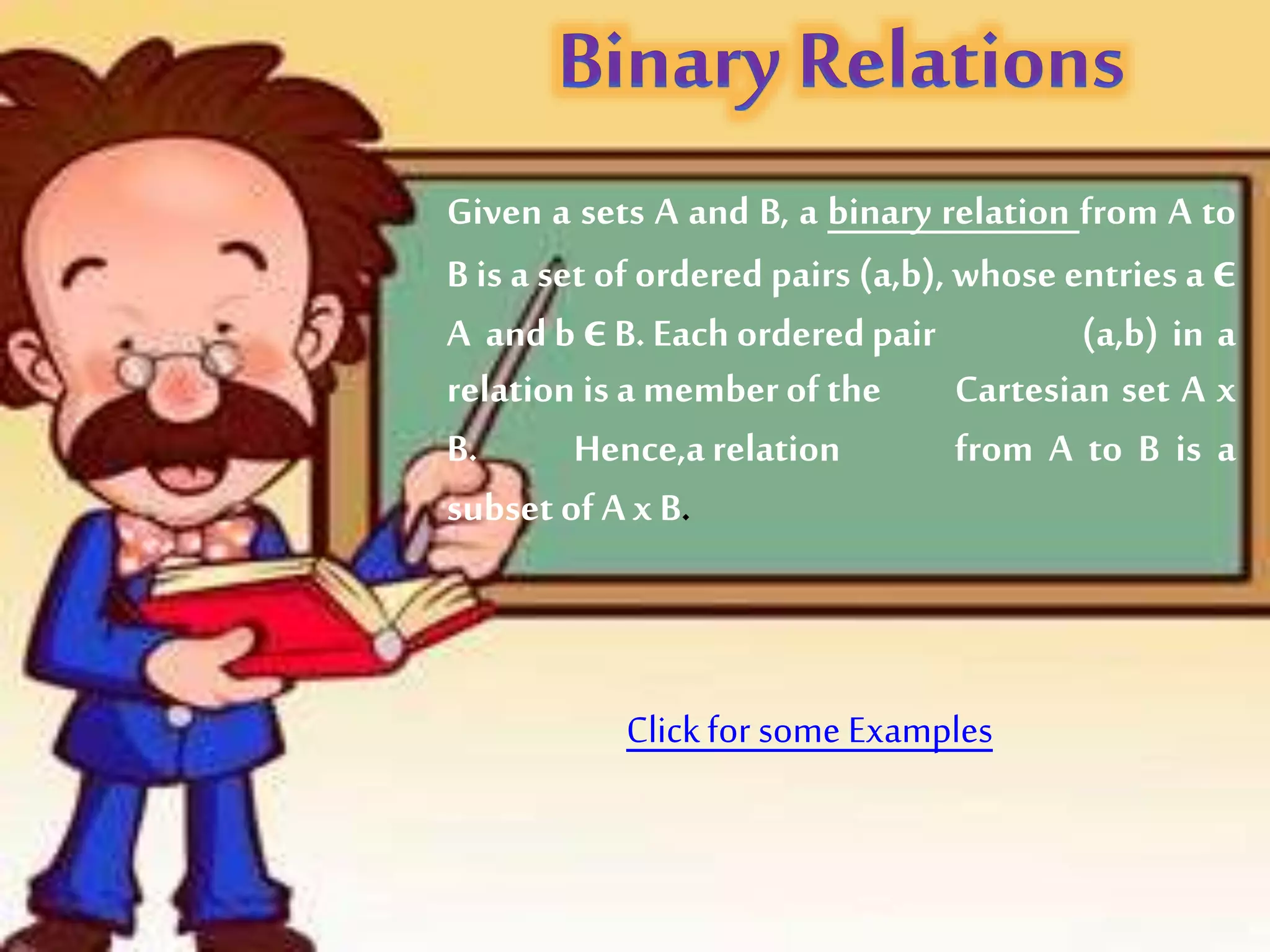
Given a sets A and B, a binary relation from A to
B is a set of ordered pairs (a,b), whose entries a ϵ
A and b ϵ B. Each orderedpair (a,b) in a
relation is a memberof the Cartesian set A x
B. Hence,arelation from A to B is a
subset of A x B.
Clickfor some Examples
Domain and Range of a
‘Relation’
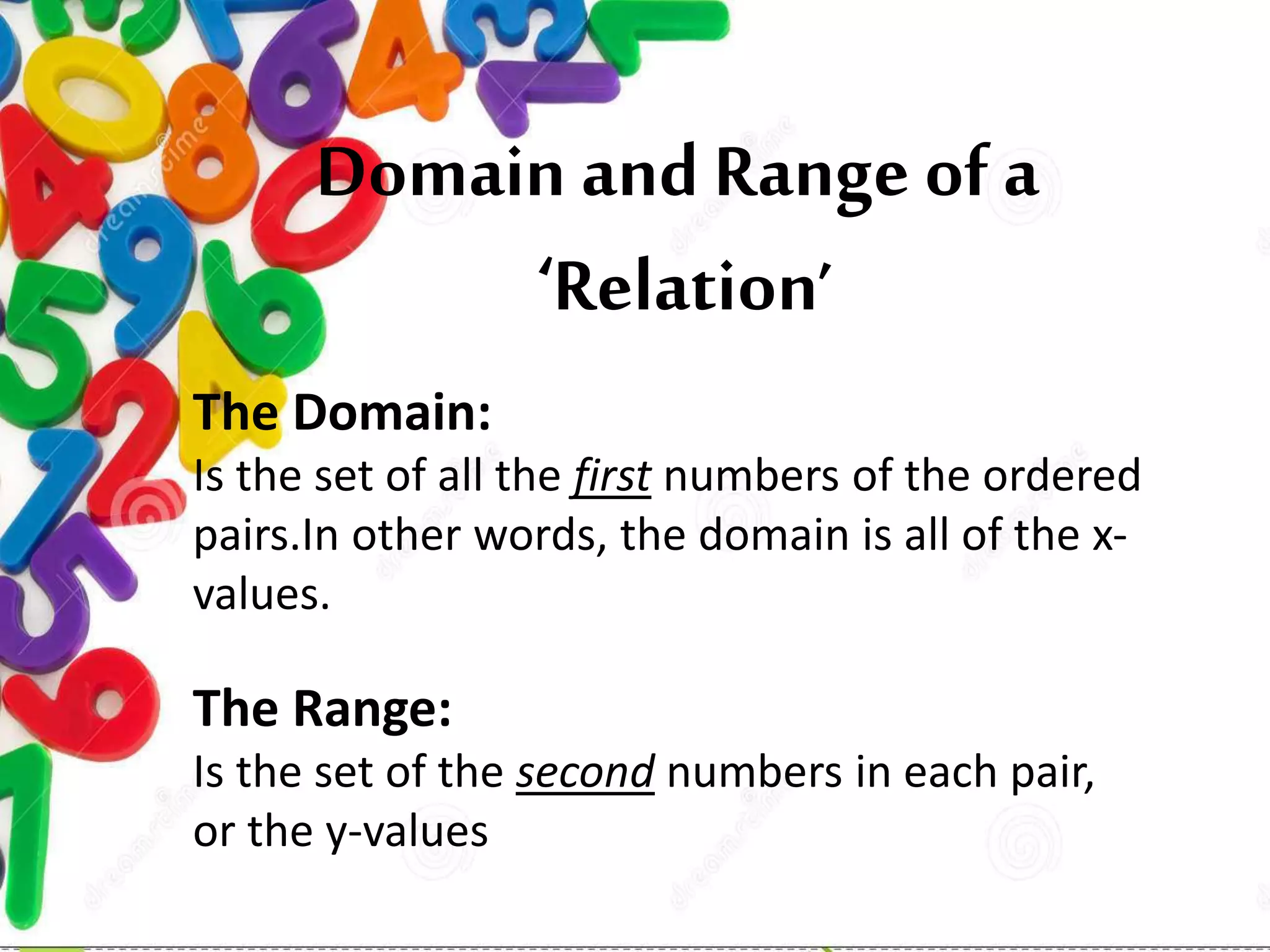
The Domain:
Is the set of all the first numbers of the ordered
pairs.In other words, the domain is all of the x-
values.
The Range:
Is the set of the second numbers in each pair,
or the y-values
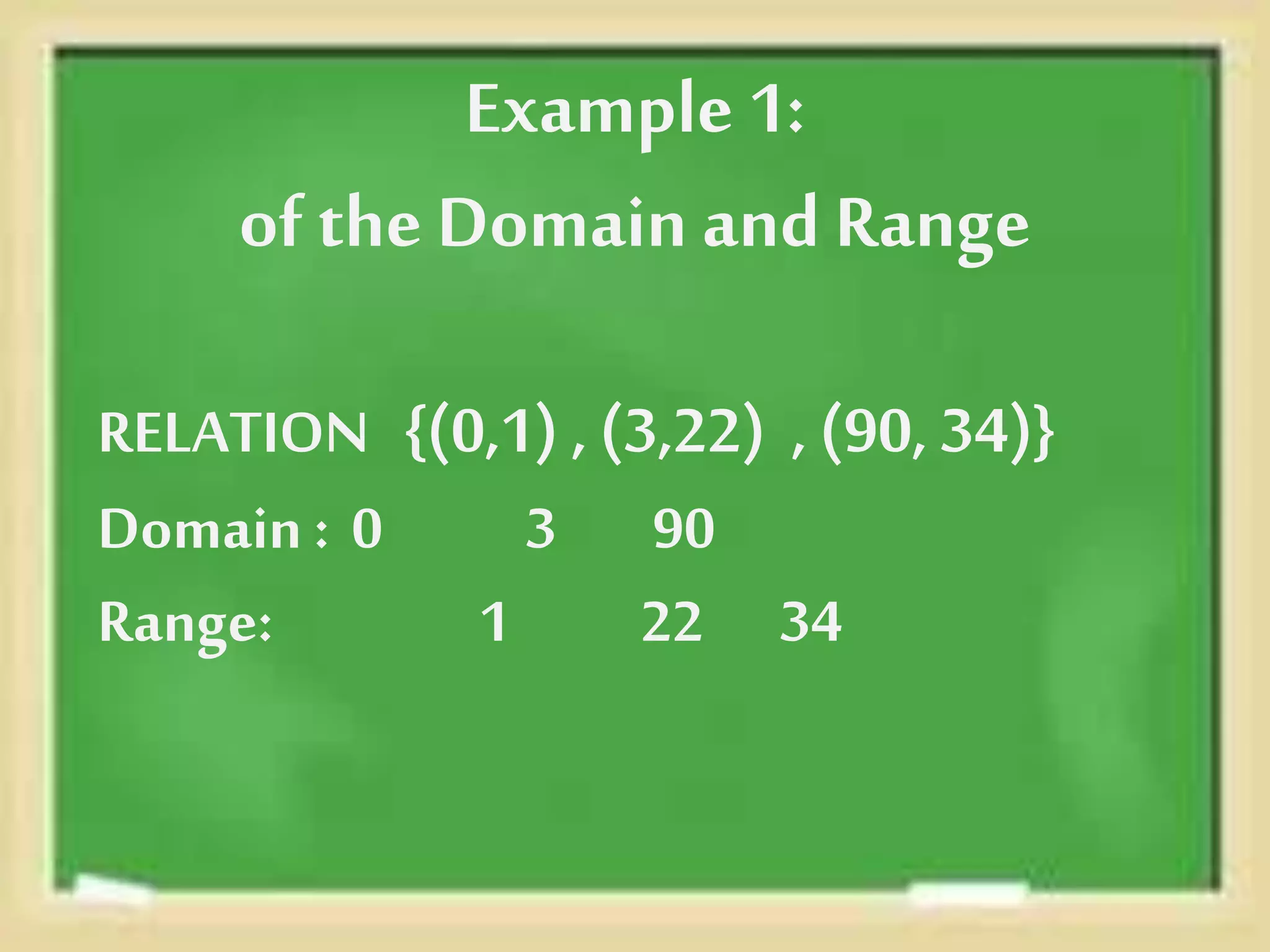
Example 1:
of the Domain and Range
RELATION {(0,1) , (3,22) , (90, 34)}
Domain : 0 3 90
Range: 1 22 34
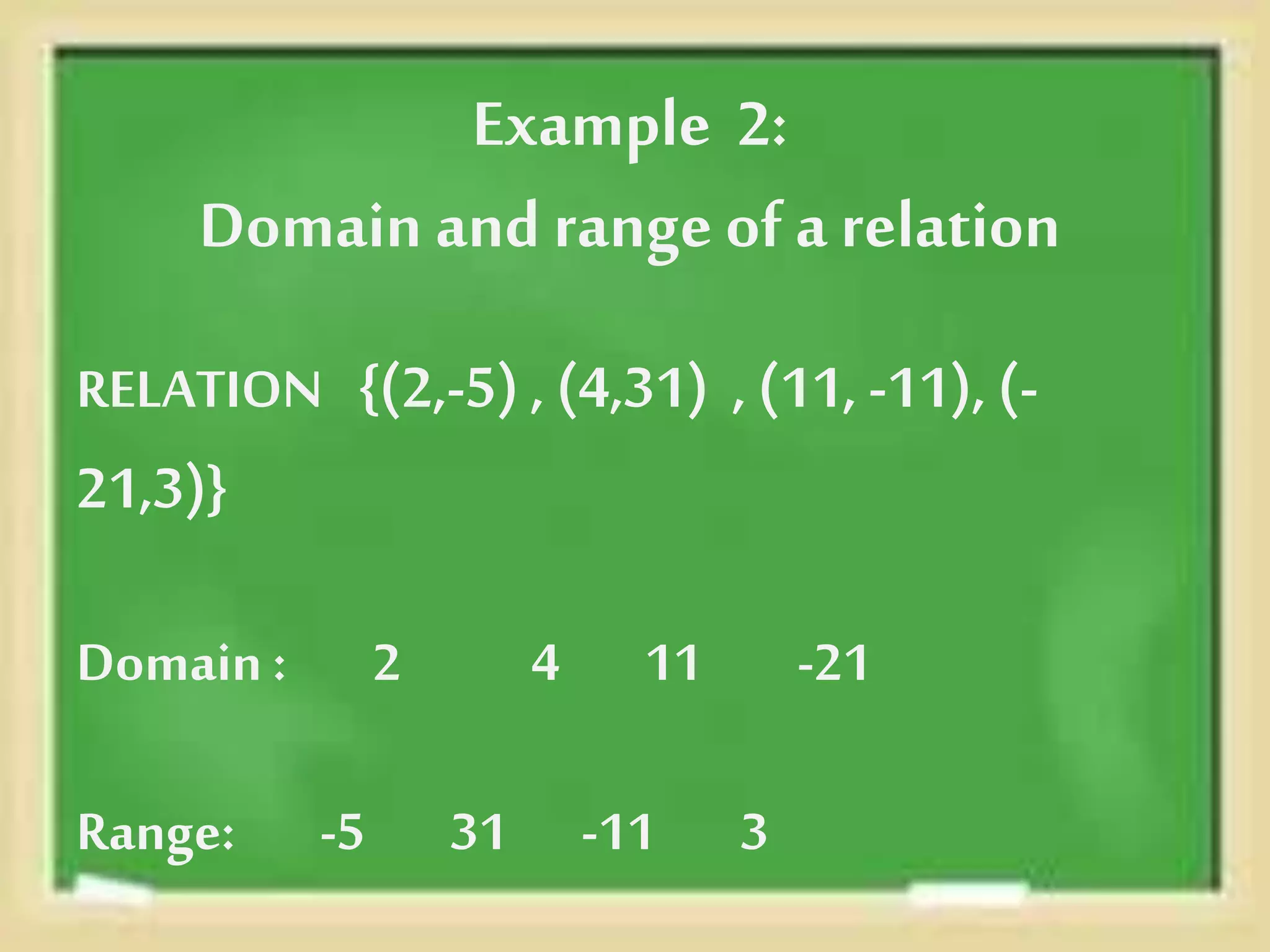
Example 2:
Domain and rangeof a relation
RELATION {(2,-5) , (4,31) , (11, -11), (-
21,3)}
Domain: 2 4 11 -21
Range: -5 31 -11 3
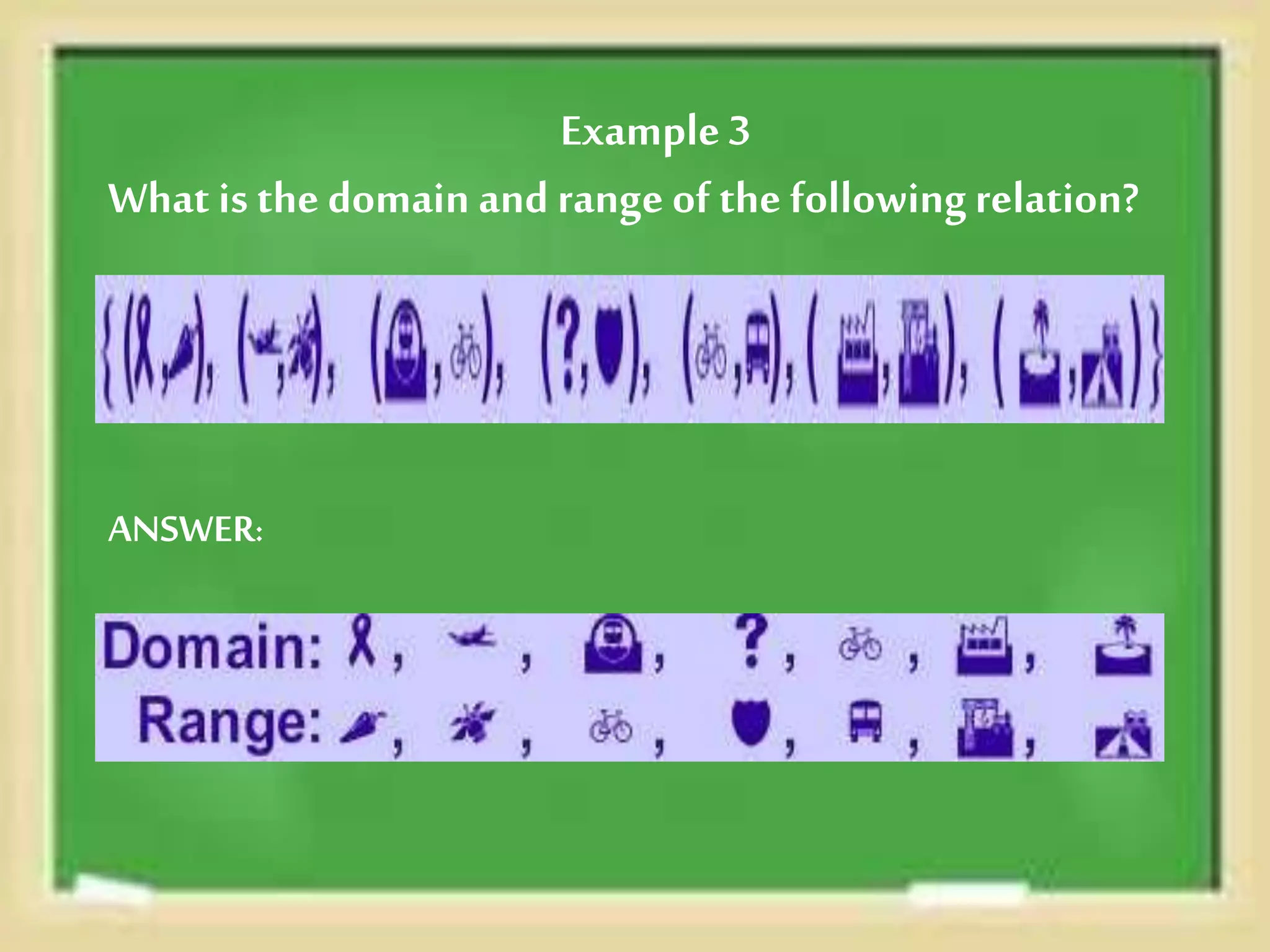
Example3
What is the domain and range of the followingrelation?
ANSWER:
Arrow Diagram
-is use by describingthe
relationfrom A into B sets.
Example:
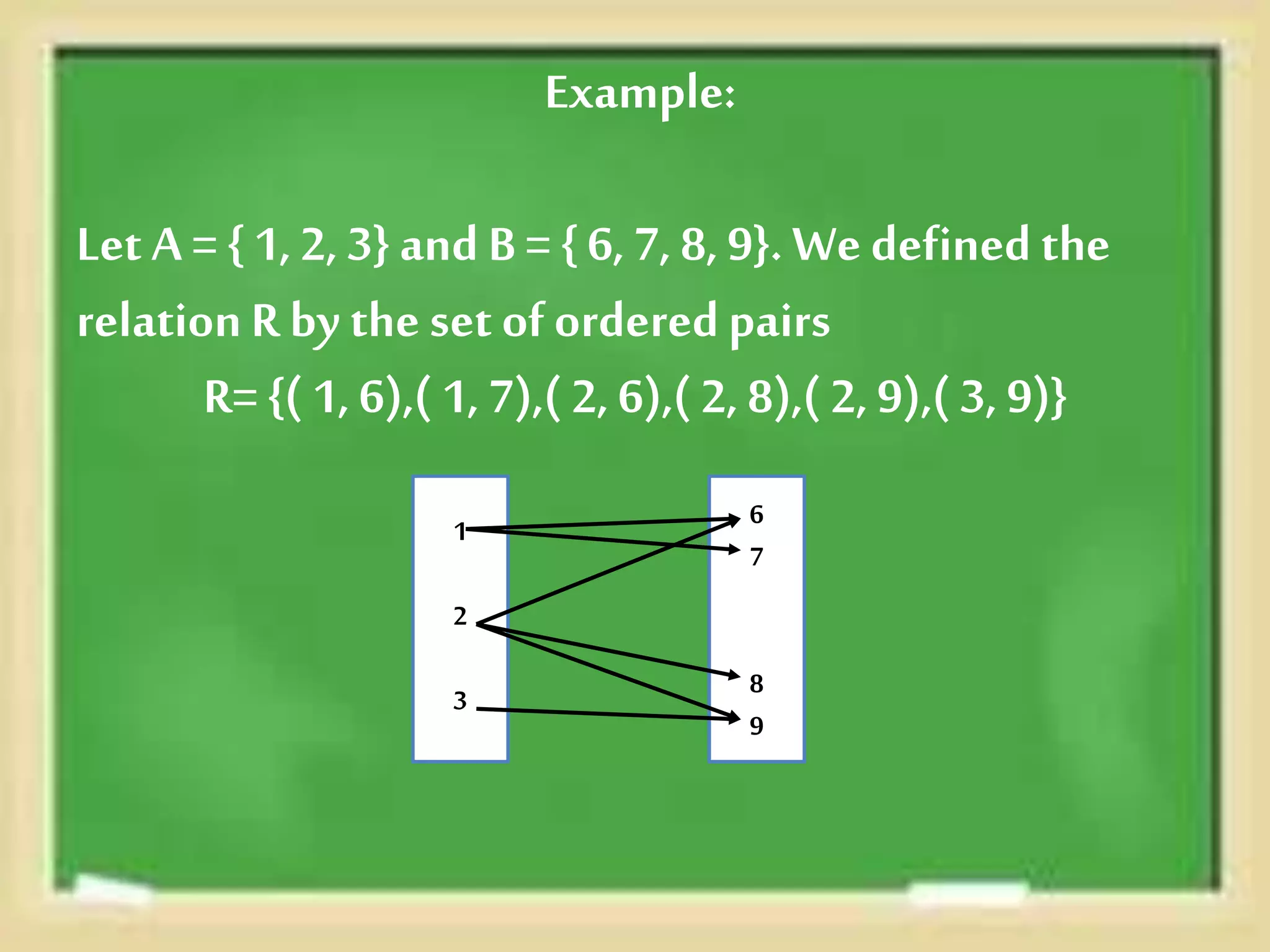
Let A = { 1, 2, 3} and B = { 6, 7, 8, 9}. We defined the
relationR by the set of orderedpairs
R= {( 1, 6),( 1, 7),( 2, 6),( 2, 8),( 2, 9),( 3, 9)}
1
2
3
6
7
8
9
DirectedGraph
Is a set of vertices and a collection
of directed edges that each
connects an ordered pair of
vertices.
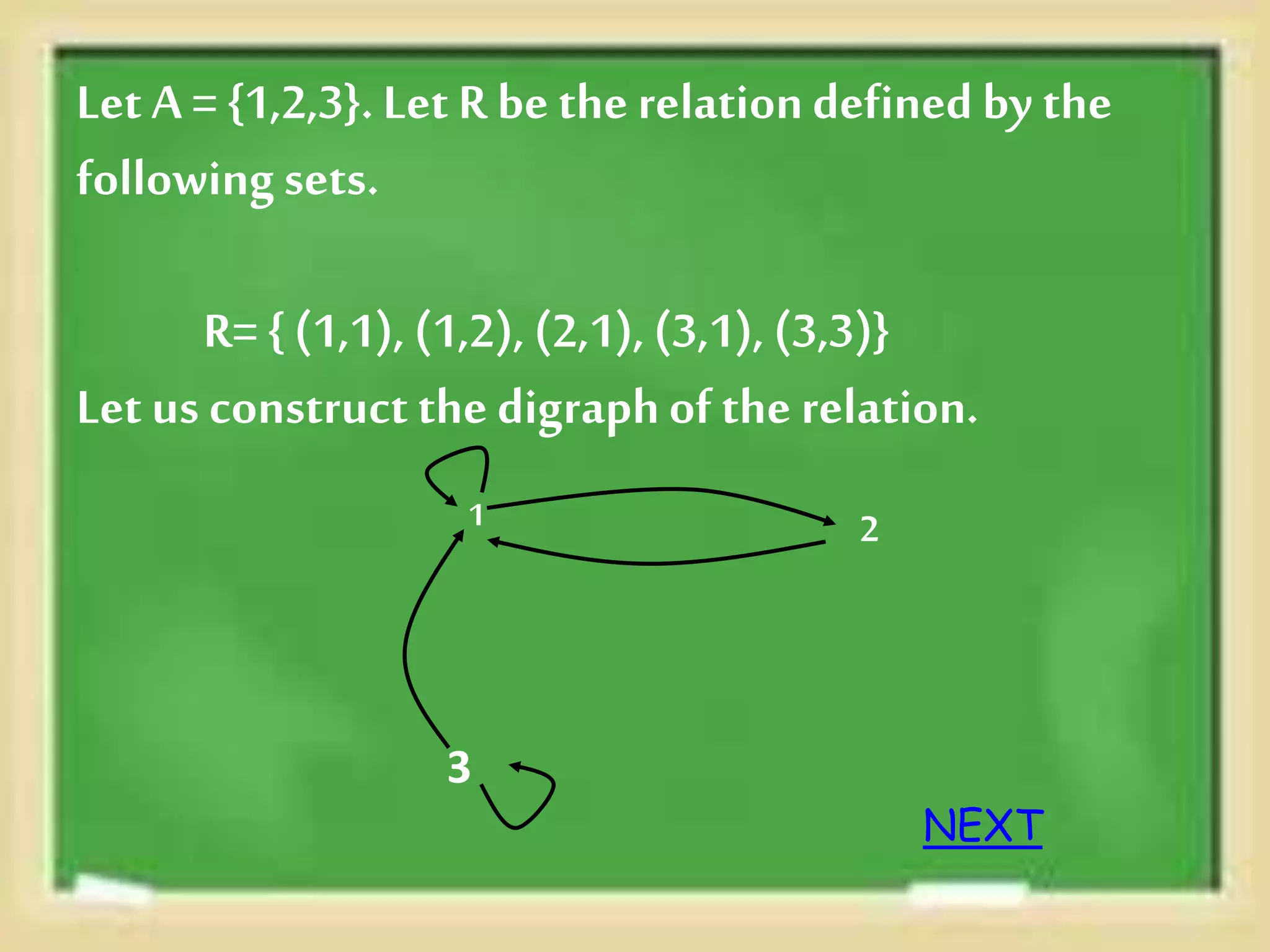
Let A = {1,2,3}. Let R be the relationdefined by the
followingsets.
R= { (1,1), (1,2), (2,1),(3,1), (3,3)}
Let us construct the digraphof the relation.
3
1 2
NEXT
Examples
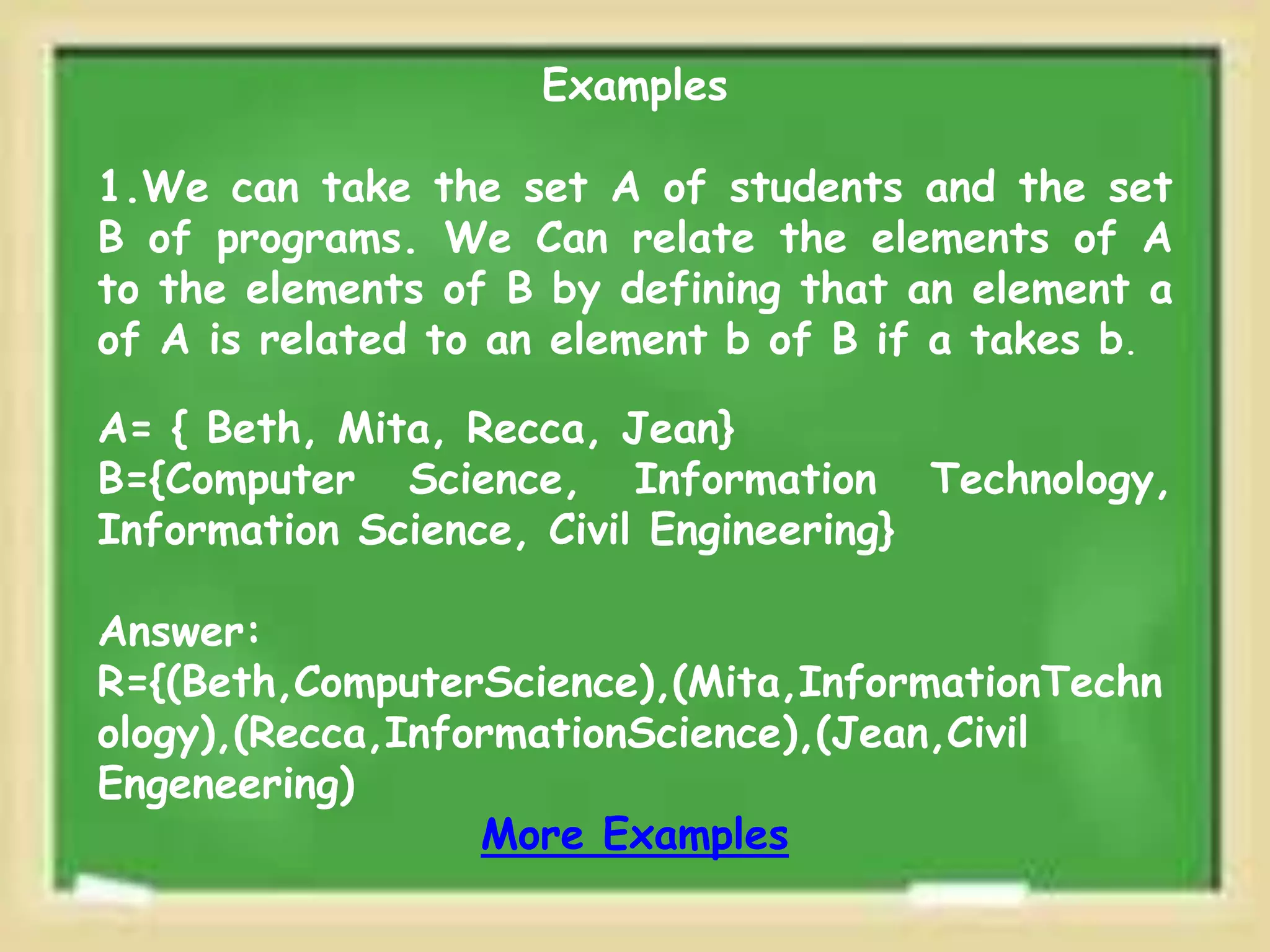
1.We can take the set A of students and the set
B of programs. We Can relate the elements of A
to the elements of B by defining that an element a
of A is related to an element b of B if a takes b.
A= { Beth, Mita, Recca, Jean}
B={Computer Science, Information Technology,
Information Science, Civil Engineering}
Answer:
R={(Beth,ComputerScience),(Mita,InformationTechn
ology),(Recca,InformationScience),(Jean,Civil
Engeneering)
More Examples
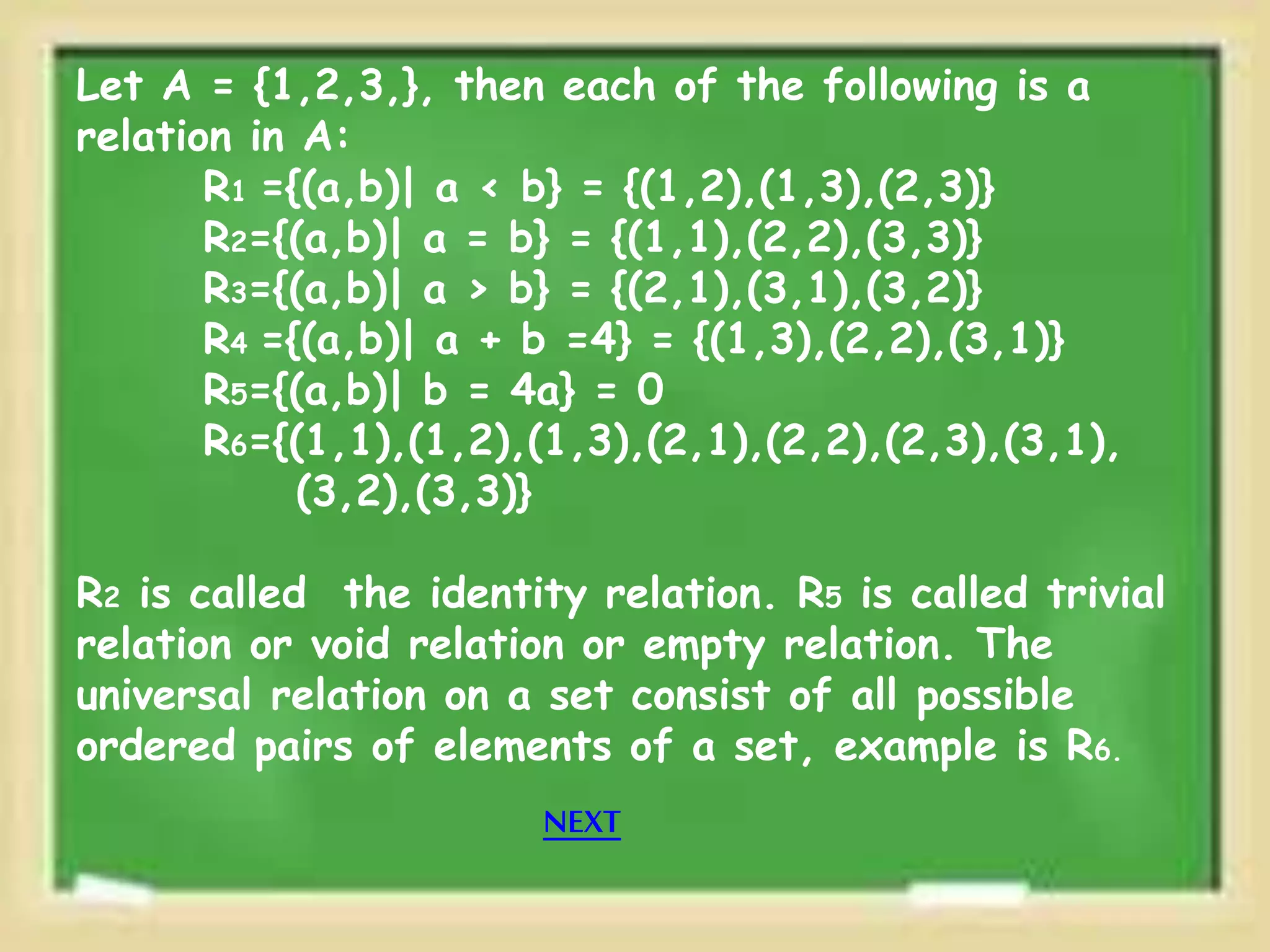
Let A = {1,2,3,}, then each of the following is a
relation in A:
R1 ={(a,b)| a < b} = {(1,2),(1,3),(2,3)}
R2={(a,b)| a = b} = {(1,1),(2,2),(3,3)}
R3={(a,b)| a > b} = {(2,1),(3,1),(3,2)}
R4 ={(a,b)| a + b =4} = {(1,3),(2,2),(3,1)}
R5={(a,b)| b = 4a} = 0
R6={(1,1),(1,2),(1,3),(2,1),(2,2),(2,3),(3,1),
(3,2),(3,3)}
R2 is called the identity relation. R5 is called trivial
relation or void relation or empty relation. The
universal relation on a set consist of all possible
ordered pairs of elements of a set, example is R6.
NEXT
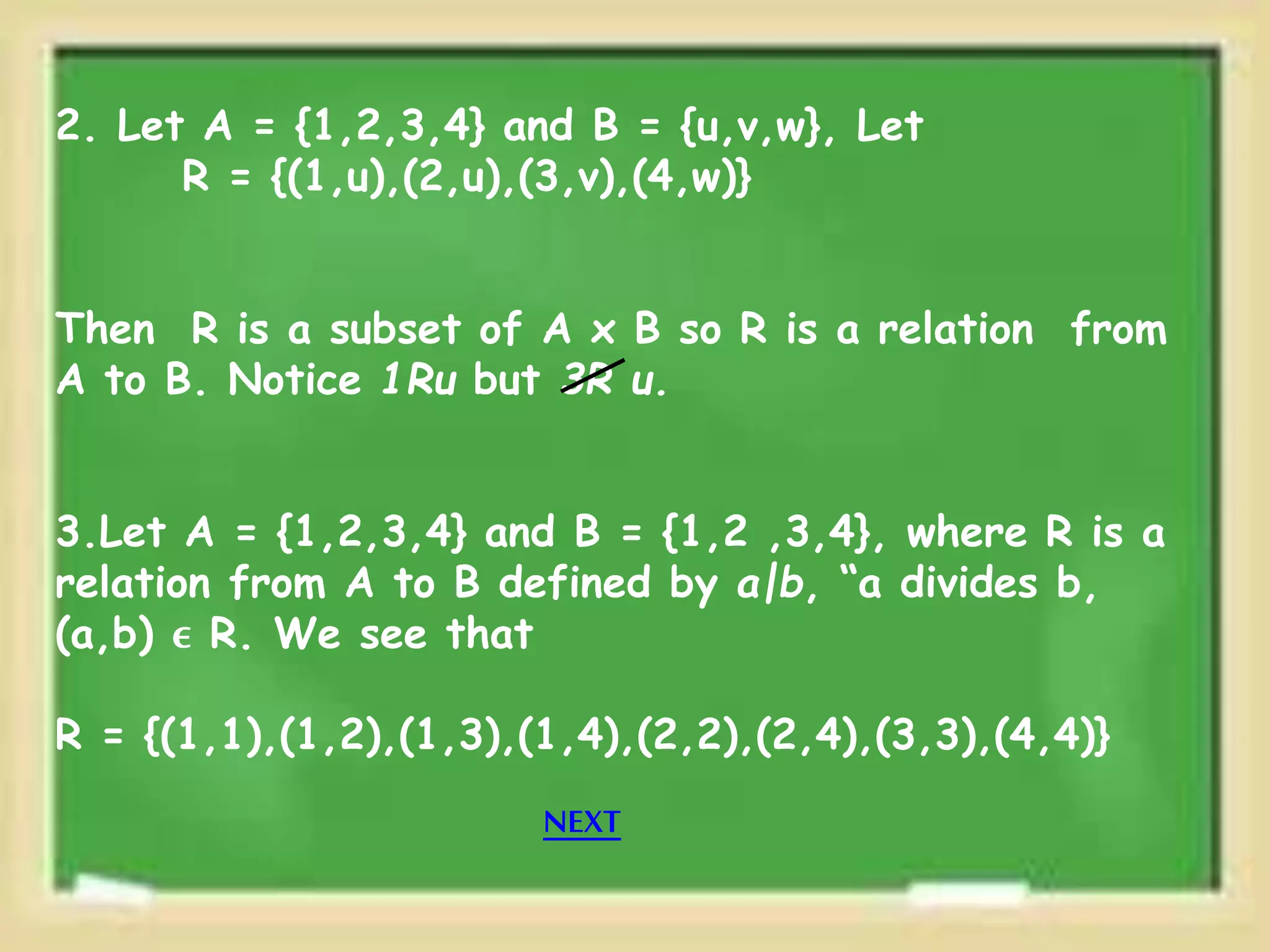
2. Let A = {1,2,3,4} and B = {u,v,w}, Let
R = {(1,u),(2,u),(3,v),(4,w)}
Then R is a subset of A x B so R is a relation from
A to B. Notice 1Ru but 3R u.
3.Let A = {1,2,3,4} and B = {1,2 ,3,4}, where R is a
relation from A to B defined by a|b, “a divides b,
(a,b) ϵ R. We see that
R = {(1,1),(1,2),(1,3),(1,4),(2,2),(2,4),(3,3),(4,4)}
NEXT
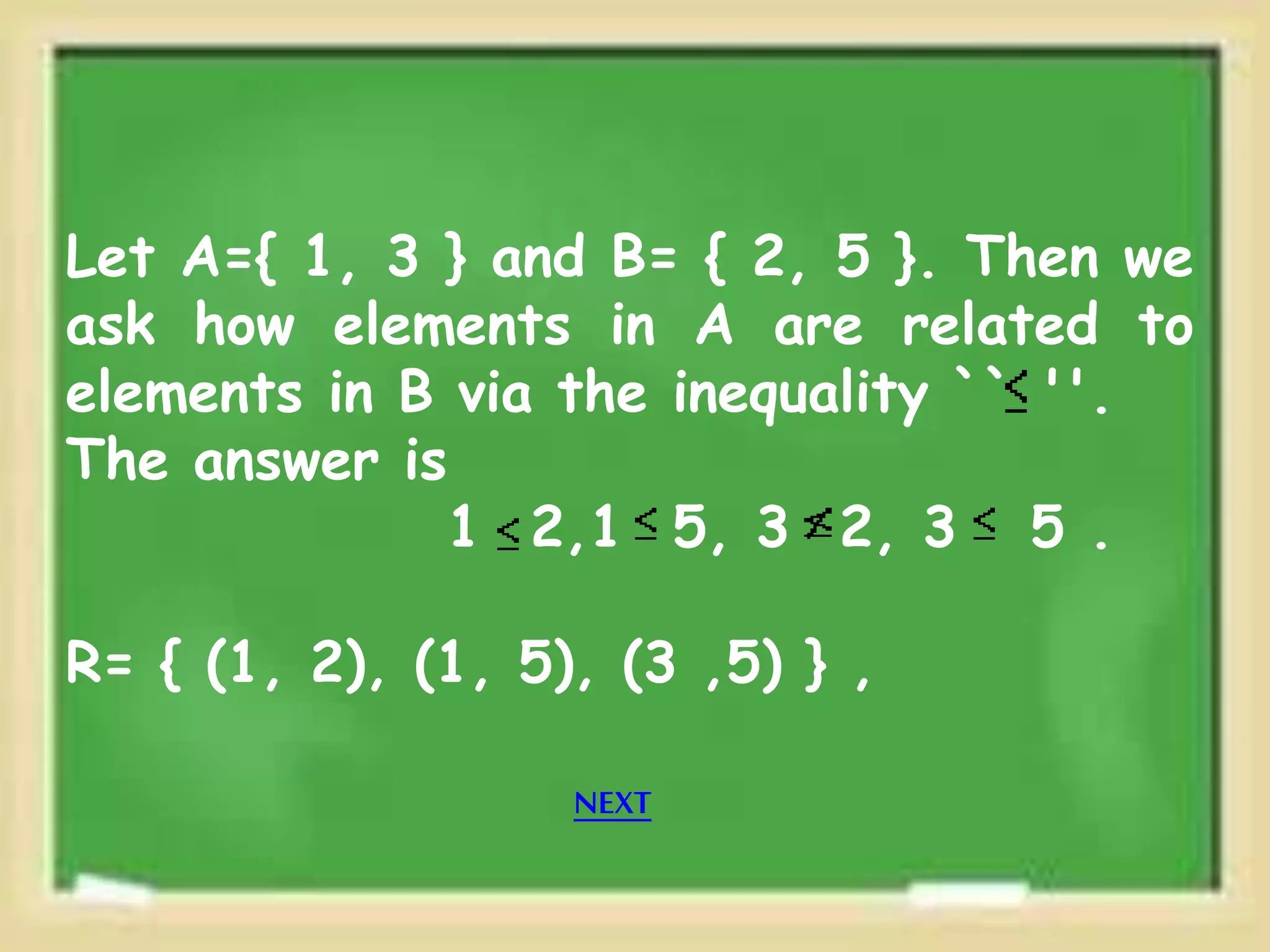
Let A={ 1, 3 } and B= { 2, 5 }. Then we
ask how elements in A are related to
elements in B via the inequality `` ''.
The answer is
1 2,1 5, 3 2, 3 5 .
R= { (1, 2), (1, 5), (3 ,5) } ,
NEXT
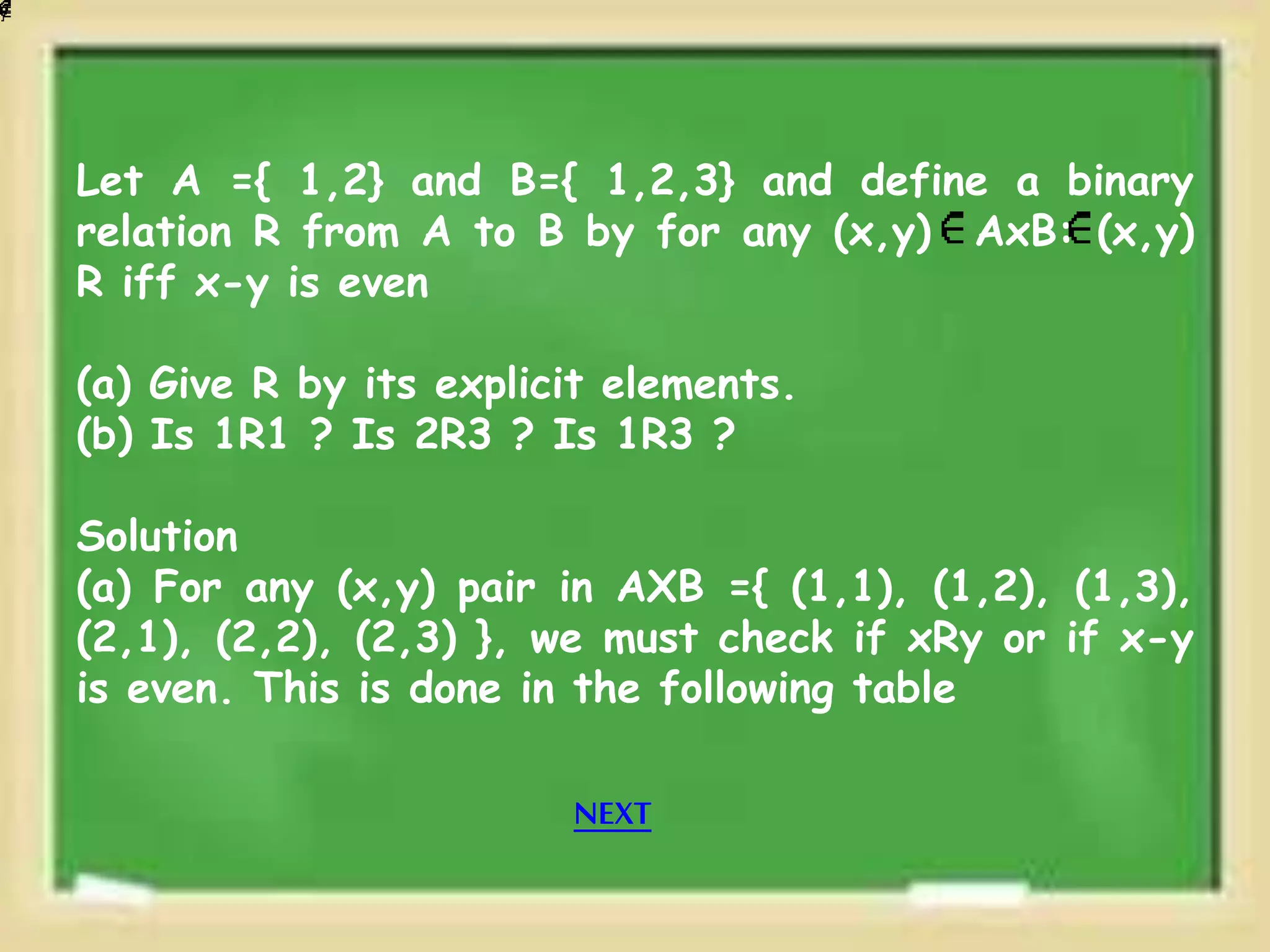
Let A ={ 1,2} and B={ 1,2,3} and define a binary
relation R from A to B by for any (x,y) AxB: (x,y)
R iff x-y is even
(a) Give R by its explicit elements.
(b) Is 1R1 ? Is 2R3 ? Is 1R3 ?
Solution
(a) For any (x,y) pair in AXB ={ (1,1), (1,2), (1,3),
(2,1), (2,2), (2,3) }, we must check if xRy or if x-y
is even. This is done in the following table
NEXT
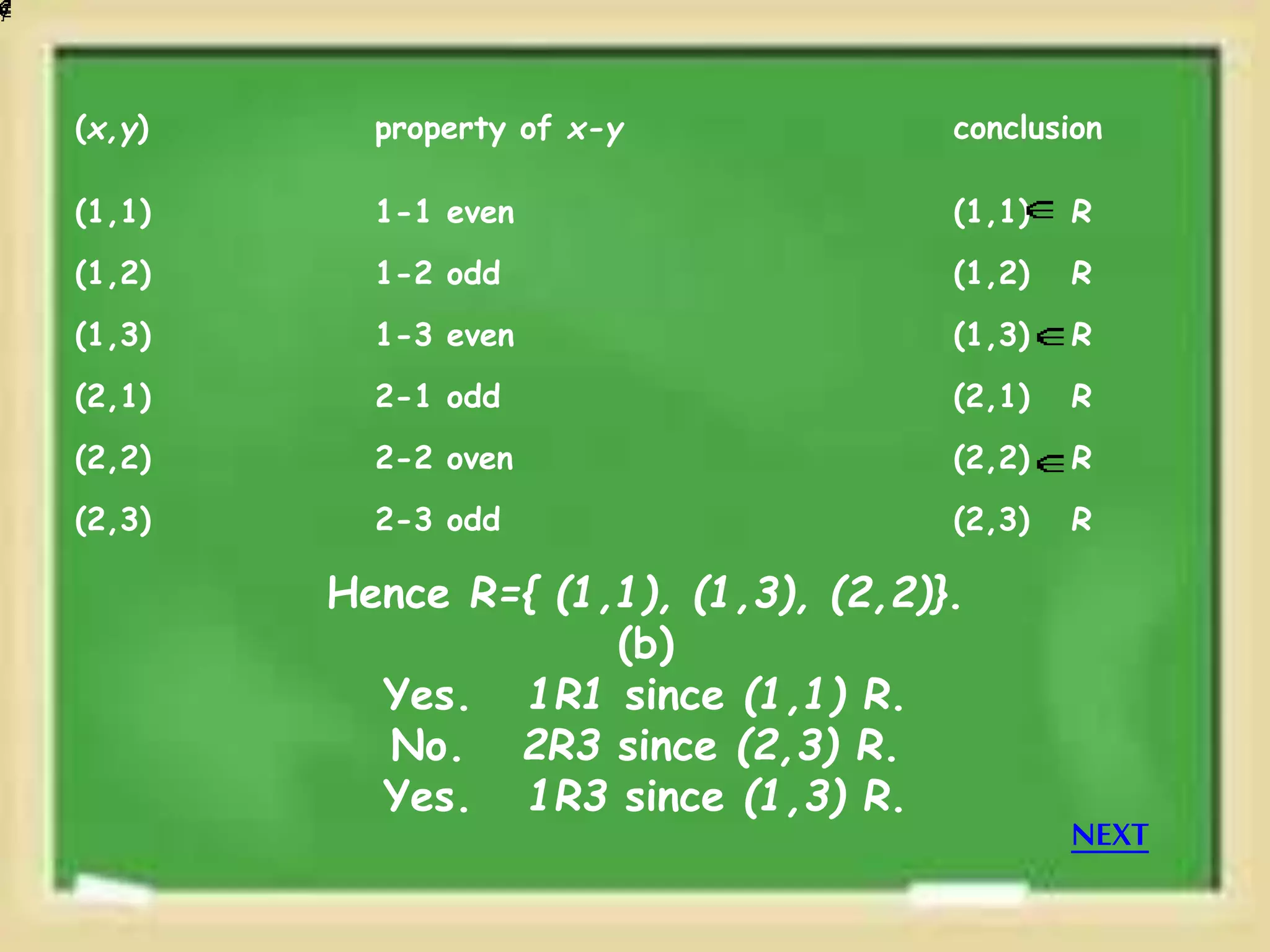
(x,y) property of x-y conclusion
(1,1) 1-1 even (1,1) R
(1,2) 1-2 odd (1,2) R
(1,3) 1-3 even (1,3) R
(2,1) 2-1 odd (2,1) R
(2,2) 2-2 oven (2,2) R
(2,3) 2-3 odd (2,3) R
Hence R={ (1,1), (1,3), (2,2)}.
(b)
Yes. 1R1 since (1,1) R.
No. 2R3 since (2,3) R.
Yes. 1R3 since (1,3) R.
NEXT
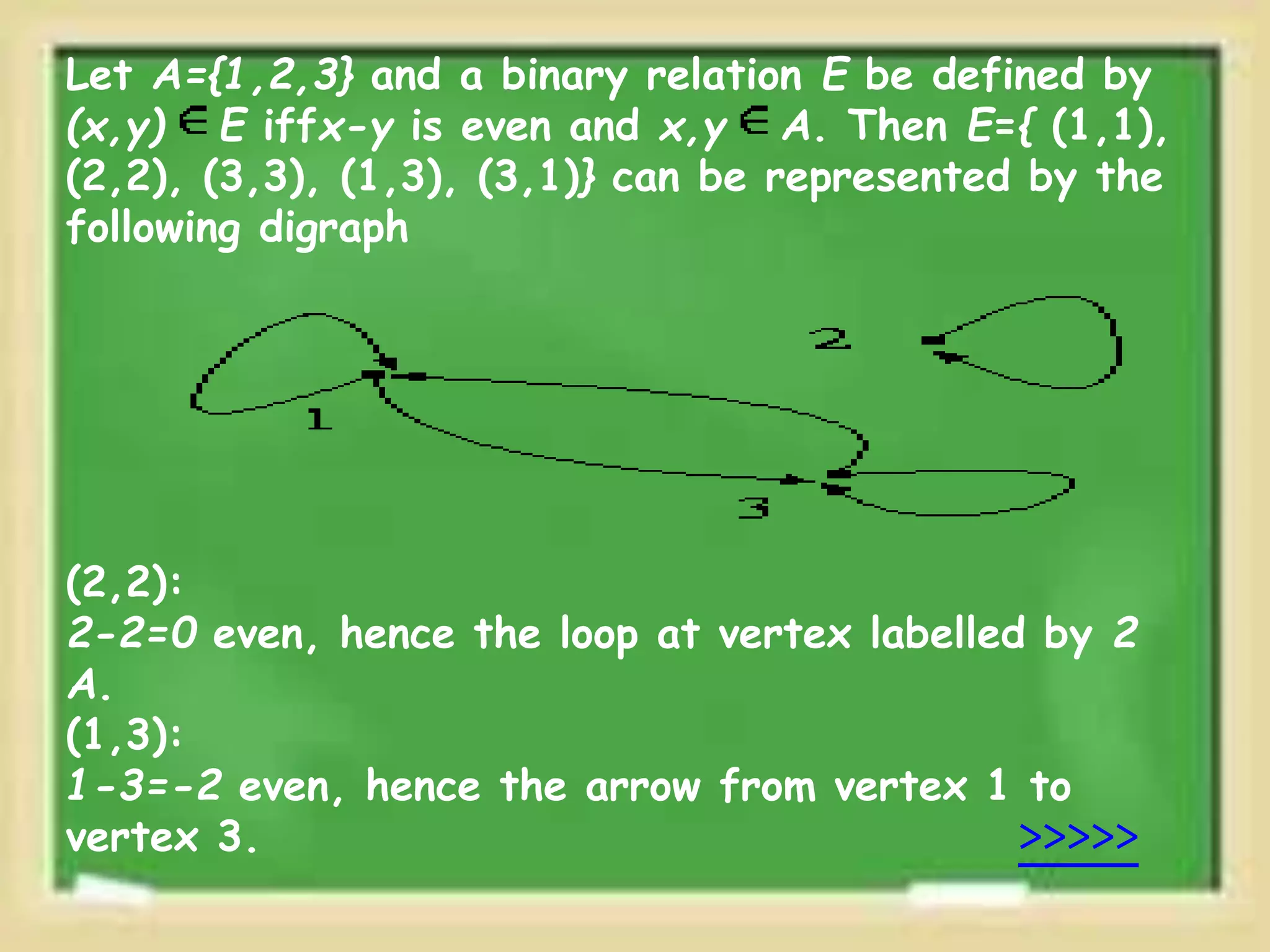
Let A={1,2,3} and a binary relation E be defined by
(x,y) E iffx-y is even and x,y A. Then E={ (1,1),
(2,2), (3,3), (1,3), (3,1)} can be represented by the
following digraph
(2,2):
2-2=0 even, hence the loop at vertex labelled by 2
A.
(1,3):
1-3=-2 even, hence the arrow from vertex 1 to
vertex 3. >>>>>

Relations in Discrete Math

  • 1.
  • 2.
    What is a'relation'? In math, a relation is just a set of ordered pairs. - is a pair of numbers used to locate a point on a coordinate plane; the first number tells how far to move horizontally and the second number tells how far to move vertically. *OrderedPair *Set - is a collection.
  • 3.
    Note: { } arethe symbol for "set“ Some Examples of Relations include: { (0,1) , (55,22), (3,-50) } { (0, 1) , (5, 2), (-3, 9) } { (-1,7) , (1, 7), (33, 7), (32, 7) }
  • 4.
    Given a setsA and B, a binary relation from A to B is a set of ordered pairs (a,b), whose entries a ϵ A and b ϵ B. Each orderedpair (a,b) in a relation is a memberof the Cartesian set A x B. Hence,arelation from A to B is a subset of A x B. Clickfor some Examples
  • 5.
    Domain and Rangeof a ‘Relation’ The Domain: Is the set of all the first numbers of the ordered pairs.In other words, the domain is all of the x- values. The Range: Is the set of the second numbers in each pair, or the y-values
  • 6.
    Example 1: of theDomain and Range RELATION {(0,1) , (3,22) , (90, 34)} Domain : 0 3 90 Range: 1 22 34
  • 7.
    Example 2: Domain andrangeof a relation RELATION {(2,-5) , (4,31) , (11, -11), (- 21,3)} Domain: 2 4 11 -21 Range: -5 31 -11 3
  • 8.
    Example3 What is thedomain and range of the followingrelation? ANSWER:
  • 9.
    Arrow Diagram -is useby describingthe relationfrom A into B sets.
  • 10.
    Example: Let A ={ 1, 2, 3} and B = { 6, 7, 8, 9}. We defined the relationR by the set of orderedpairs R= {( 1, 6),( 1, 7),( 2, 6),( 2, 8),( 2, 9),( 3, 9)} 1 2 3 6 7 8 9
  • 11.
    DirectedGraph Is a setof vertices and a collection of directed edges that each connects an ordered pair of vertices.
  • 12.
    Let A ={1,2,3}. Let R be the relationdefined by the followingsets. R= { (1,1), (1,2), (2,1),(3,1), (3,3)} Let us construct the digraphof the relation. 3 1 2 NEXT
  • 14.
    Examples 1.We can takethe set A of students and the set B of programs. We Can relate the elements of A to the elements of B by defining that an element a of A is related to an element b of B if a takes b. A= { Beth, Mita, Recca, Jean} B={Computer Science, Information Technology, Information Science, Civil Engineering} Answer: R={(Beth,ComputerScience),(Mita,InformationTechn ology),(Recca,InformationScience),(Jean,Civil Engeneering) More Examples
  • 15.
    Let A ={1,2,3,}, then each of the following is a relation in A: R1 ={(a,b)| a < b} = {(1,2),(1,3),(2,3)} R2={(a,b)| a = b} = {(1,1),(2,2),(3,3)} R3={(a,b)| a > b} = {(2,1),(3,1),(3,2)} R4 ={(a,b)| a + b =4} = {(1,3),(2,2),(3,1)} R5={(a,b)| b = 4a} = 0 R6={(1,1),(1,2),(1,3),(2,1),(2,2),(2,3),(3,1), (3,2),(3,3)} R2 is called the identity relation. R5 is called trivial relation or void relation or empty relation. The universal relation on a set consist of all possible ordered pairs of elements of a set, example is R6. NEXT
  • 17.
    2. Let A= {1,2,3,4} and B = {u,v,w}, Let R = {(1,u),(2,u),(3,v),(4,w)} Then R is a subset of A x B so R is a relation from A to B. Notice 1Ru but 3R u. 3.Let A = {1,2,3,4} and B = {1,2 ,3,4}, where R is a relation from A to B defined by a|b, “a divides b, (a,b) ϵ R. We see that R = {(1,1),(1,2),(1,3),(1,4),(2,2),(2,4),(3,3),(4,4)} NEXT
  • 18.
    Let A={ 1,3 } and B= { 2, 5 }. Then we ask how elements in A are related to elements in B via the inequality `` ''. The answer is 1 2,1 5, 3 2, 3 5 . R= { (1, 2), (1, 5), (3 ,5) } , NEXT
  • 19.
    Let A ={1,2} and B={ 1,2,3} and define a binary relation R from A to B by for any (x,y) AxB: (x,y) R iff x-y is even (a) Give R by its explicit elements. (b) Is 1R1 ? Is 2R3 ? Is 1R3 ? Solution (a) For any (x,y) pair in AXB ={ (1,1), (1,2), (1,3), (2,1), (2,2), (2,3) }, we must check if xRy or if x-y is even. This is done in the following table NEXT
  • 20.
    (x,y) property ofx-y conclusion (1,1) 1-1 even (1,1) R (1,2) 1-2 odd (1,2) R (1,3) 1-3 even (1,3) R (2,1) 2-1 odd (2,1) R (2,2) 2-2 oven (2,2) R (2,3) 2-3 odd (2,3) R Hence R={ (1,1), (1,3), (2,2)}. (b) Yes. 1R1 since (1,1) R. No. 2R3 since (2,3) R. Yes. 1R3 since (1,3) R. NEXT
  • 21.
    Let A={1,2,3} anda binary relation E be defined by (x,y) E iffx-y is even and x,y A. Then E={ (1,1), (2,2), (3,3), (1,3), (3,1)} can be represented by the following digraph (2,2): 2-2=0 even, hence the loop at vertex labelled by 2 A. (1,3): 1-3=-2 even, hence the arrow from vertex 1 to vertex 3. >>>>>