THATTARTANIAMANINAMANATIMONANANA NANATINUS 20170322687A1
(19)United States
(12)Patent Application Publication (10)Pub.No.: US 2017/0322687A1Lavian et al. (43) Pub . Date: Nov. 9, 2017
(54) SYSTEMSAND METHODSFOR
ELECTRONIC COMMUNICATIONS
(71) Applicants:TalLavian, Sunnyvale, CA (US);Zvi
Or-Bach, San Jose, CA (US)
(72) Inventors: TalLavian, Sunnyvale,CA (US);Zvi
Or-Bach, San Jose,CA (US)
(21) Appl.No.: 15/600,773
continuation-in-part of application No. 13/273,187,
filed on Oct. 13, 2011, now abandoned.
Publication Classification
(51) Int. Cl.
G06F 3/0482 (2013.01)
H04L 29/08 (2006.01)
U .S . CI.
CPC ............. G06F 3/0482 (2013.01); H04L67/12
(2013.01)
(57) ABSTRACT
Embodiments ofthe invention provide a system for enhanc
ing user interaction with objects connected to a network. The
system includes a processor, a display screen, a memory
coupled to the processor. Thememory comprises a database
including a list of two or more objects and instructions
executable by the processor to display amenu. Themenu is
associated with at least two independent objects. And the
two independent objects are produced by two independent
vendors.
(22) Filed: May 21, 2017
Related U.S.Application Data
(63) Continuation-in-part of application No. 13/310,696,
filed on Dec.2, 2011,now Pat.No.9,690,877,which
is a continuation-in -part of application No. 13/245,
804, filed on Sep. 26, 2011, now abandoned,which is
a continuation-in -part ofapplication No. 13/272,212,
filed on Oct. 12, 2011, now abandoned, which is a
104 RemoteDevice - 106a
Device102 1 1066Network Remote DeviceVMThings
108
Remote Device 106c
ro Remote Device Is 106
106a
104
RemoteDevice
Patent Application Publication
DeviceDevice
102
106b
Network
RemoteDevice
VMThings108
I
RemoteDevice
106c
Nov.9,2017 Sheet 1 of64
106n
RemoteDevice
100
FIG.1A
US 2017/0322687A1
102
114
Server
Device(110
Patent Application Publication
106a
Is
RemoteDevice
104
WebPage
-112a
106b
Network
RemoteDevice
UserID
1126
Password
106c
RemoteDevice
VMThings108
Nov.9,2017 Sheet 2 of64
Is106n
RemoteDevice
Rg200
FIG.1B
US 2017/0322687A1
1106a
RemoteDevice
Patent Application Publication
118
wan
11821
DisplayDevice
104
-1066
RemoteDevice
1161
AccessDevice
Network
VMThings108
-106c
RemoteDevice
Nov.9,2017 Sheet 3 of64
Is106n
RemoteDevice
î300
FIG.10
US 2017/0322687A1
106a
Patent Application Publication
RemoteDevice
118
y
DisplayDevice
120
·106b
RemoteDevice
116
AccessDevice
ZigBeeNetwork
VMThings108
06C
RemoteDevice
Nov.9,2017 Sheet 4 of64
106n
RemoteDevice
FIG.1D
US 2017/0322687A1
1106a
RemoteDevice
Patent Application Publication
118
DisplayDevice
122
Is106b
RemoteDevice
116
AccessDevice
WiMAXNetwork
VMThings108
Ir106c
RemoteDevice
Nov.9,2017 Sheet 5 of64
Is106n
RemoteDevice
FIG.1E
US 2017/0322687A1
1106a
RemoteDevice
Patent Application Publication
118
DisplayDevice
124
106b
RemoteDevice
AccessDevice
GSMNetwork
116
v
VMThings108
1106c
RemoteDevice
Nov.9,2017 Sheet 6 of64
106n
RemoteDevice
FIG.1F
US 2017/0322687A1
Is
1062
120
RemoteDevice
Patent Application Publication
1
1024
1065
DeviceDevice VMThings108
ZigBeeNetwork
RemoteDevice
106c
RemoteDevice
Nov.9,2017 Sheet 7 of64
106n
RemoteDevice
FIG.1G
US 2017/0322687A1
106a
122
RemoteDeviceRemoteDevice
-1062
Patent Application Publication
Device
102
102Y
WiMAXNetwork
s
1066
RemoteDevice
VMThings108annet
RemoteDevice
Ls106c
Nov.9,2017 Sheet 8 of64
106n
RemoteDevice
FIG.1H
US 2017/0322687A1
-106a
130
RemoteDevice
Patent Application Publication
1022
126
-106b
Device
Internet
LocalNetwork
RemoteDevice
VMThings108
106c
www
.
RemoteDevice
r128
Nov.9,2017 Sheet 9 of64
-106n
BridgeDevice
RemoteDevice
US 2017/0322687A1
FIG.11
12022
104
Service
Patent Application Publication
Device
102
-202b
Network
Service
VMThings108
I2020
Service
Nov. 9, 2017 Sheet 10 of64
-202n
Service
K
400
US 2017/0322687 A1
FIG.2A
102
ServerServer
114
1202a
Service
Patent Application Publication
04
Device?110
WebPage
-112a
UserID
1126
2026
mona
Network
Service
Password
Service
2020
VMThings108
Nov.9,2017 Sheet 11 of64
br202n
2n
Service
> 500
US 2017/0322687A1
FIG.2B
02a
Service
Patent Application Publication
118
DisplayDevice
104
I2020
Service
AccessDevice
www.
Network
116vo
VMThings108
I2020
020
Service
Nov. 9, 2017 Sheet 12 of64
I202n
Service
F
600
FIG.2C
US 2017/0322687 A1
1202a
Service
Patent Application Publication
118
%
DisplayDevice
120
202b
Service
AccessDevice
ZigBeeNetwork
116
2
VMThings108
I2020
Service
Nov. 9, 2017 Sheet 13 of64
202n
Service
FIG.2D
US 2017/0322687 A1
12022
Service
Patent Application Publication
118-
DisplayDevice
122
I2026
Service
AccessDevice
WiMAXNetwork
116
V
VMThings108
I2020
Service
Nov. 9, 2017 Sheet 14 of64
202n
Service
FIG.2E
US 2017/0322687 A1
1202a
Service
Patent Application Publication
118
DisplayDevice
124
I2026
Service
AccessDevice
GSMNetwork
116
2
VMThings108
I2020
Service
Nov.9,2017 Sheet 15 of64
-2020
Service
FIG.2F
US 2017/0322687A1
I202a
120
Service
Patent Application Publication
Device
102
ZigBeeNetwork
qzoz1
Service
VMThings108
Service
2020
Nov. 9, 2017 Sheet 16 of64
12026
Service
FIG.2G
US 2017/0322687 A1
Patent Application Publication
Service
122
202a
Device
1024
WiMAXNetwork
t2020
Service
VMThings108
Service
202c
Nov. 9, 2017 Sheet 17 of64
Service
-202n
US 2017/0322687 A1
FIG.2H
-202a
130
Service
102-
Patent Application Publication
126
202b
Device
===
Internet
LocalNetwork
Service
VMThings|108.
2020
Service
7128
Nov.9,2017 Sheet18 of 64
BridgeDevice
202?
Service
US2017/0322687 A1
FIG.21
-
102
102
Patent Application Publication
Device
Device
308
310
306a
Vehicle3
s306b
s302
RemoteDevices1
AC
-302
RemoteDevices
Control
4
s306c
Camera5
s304
Services
306n
Nov. 9, 2017 Sheet 19 of64
Microwaven
US 2017/0322687 A1
FIG.3A
(1)
102102
102
Device
Device5312
314a
Entertainment
Patent Application Publication
308 <302
RemoteDevices
314b
Travel
-304
4.
(Control
Services2
-304
Services
S3140Banking5
•314n
Hotels
Nov. 9, 2017 Sheet 20 of64
FIG.3B
US 2017/0322687 A1
110a
110b
102
102
Qey
Patent Application Publication
Device
WebPage
Device
WebPage 5302
RemoteDevices
5306a
Vehicle3
-306b
AC
302
RemoteDevices
-304
Services
4
Services2
306c
Camera5
306n
Microwave
Nov. 9, 2017 Sheet 21 of64
w
FIG.3C
US 2017/0322687 A1
110a
110c
102
2
102 Device
Device
WebPage
s302
RemoteDevices
Patent Application Publication
WebPage
5314a
Entertainment
s304
304
Services2
3146
Travel4
-3140
Banking
Services
5
Nov.9,2017 Sheet 22 of64
314n
:
Hotelsn
FIG.3D
US 2017/0322687A1
102
Device
Patent Application Publication
RemoteDevices
404a
404b
404d
Camera
404e
Microwave
Vehicle
4040
402
Truck
Car5
Regulate8
4044
4049
404h
4041
Nov. 9, 2017 Sheet 23 of64
404
Close
Open10
4048
4041
FIG.4
US 2017/0322687 A1
102
-
Device
Patent Application Publication
Services
5042
504b
504d
Banking2
Entertainment3
Energoman
Travel4
504e
504C
502
ABCBank
XYZBank6
Nov. 9, 2017 Sheet 24 of64
BankAccount
5049CreditCards
504h
CheckBill1504k
Account
Transfer
Details
9
10
-5041
5041
US 2017/0322687 A1
FIG.5
,602
Device
17614
DisplayDisplay
K
RadioInterface
Patent Application Publication
Is102
,604
7616/
Processor
NetworkInterface
Network
— -
5606
6221
- -
Memory
Memory1620a
Card
GraphicalUserInterface608
Nov. 9, 2017 Sheet 25 of64
76206
Input/OutputInterface
Keyboard
Database610
200
76200
Mouse
VMThings612
USB
620d
w
US 2017/0322687 A1
FIG.6
AccessDevice
Patent Application Publication
.712
702
RadioInterface
1116
Processor
104
C714
r
720
NetworkInterface
Network
704
Memory
Memory16718a
GraphicalUserInterface706
Input/OutputInterface
Card
Nov. 9, 2017 Sheet 26 of64
77186
Keyboard
Database708
Database
17180
Mouse
Ports
VMThings710
7180
USB
vmthings
722
US 2017/0322687 A1
FIG.7
Patent Application Publication Nov.9,2017 Sheet 27 of64 US 2017/0322687A1
Start
802 Access a database ofvisualaccessmenus
through a GUIat a device
804 Display a visualaccessmenu at the device
806 Display an enhanced visualaccess menu
based on a selection ofan option by a user
808 Receivea selection ofa device option from a
user
810 Connect to a remote device based on
selection of the device option
812 Controlone ormore operations of the remote
device based on selection of the device
option
Stop
FIG . 8
Patent Application Publication Nov. 9, 2017 Sheet 28 of64 US 2017/0322687 A1
StartStart
902 Access a database of visualaccessmenus
through a GUIat a device
904 -
Display a visualaccessmenu atthe device
906 Display an enhanced visualaccessmenu
based on a selection ofan option by a user
908 Receive a selection of a service option from
a user
Connect to a service based on a selection of
the service option
912 Control and display information about the
service based on selection of the service
option
Stop
FIG . 9
Patent Application Publication Nov. 9, 2017 Sheet 29 of64 US 2017/0322687 A1
Start
1002 Display aGUIforaccessing visualaccess
menus atthe device
1004
Receive an input from a user of the device
1010 1006
YesWait foran
inputat the
device
Is input is for
accessing
services?
No
1008 2
No Is inputis for
accessing
remote
devices ?
Yes
1012 2
Yes
(ckNo
Is a visual
accessmenu
for remote
devices
available ?
FIG . 10A
Patent Application Publication Nov. 9, 2017 Sheet 30 of64 US 2017/0322687 A1
10161014
A
NoIs a visual
access menu
for services
available ?
Retrieve
visual access
menu from a
server
1018 Yes
Display the visualaccessmenu including
service options at the device
1020
Receive a selection of a service option from
the user
1024
1022
NO
Is information
for the
selected
service option
available ?
Receive
information
from the
server
1026 Yes
Displaythe information based on the received
selection
* StopStop
FIG . 10B
Patent Application Publication Nov. 9, 2017 Sheet 31 of64 US 2017/0322687 A1
1028 -
Retrieve the visualaccessmenu for the
remote devices from the server. . . . . . . . . . . . . . . . . . . . . . . . . . . . . . . . . . . . . . . . . . . . . . . . . . . . . . . . . . . . . . . . . . . . . . . . . . . . . . . . . . . . . . . . . . . .
1030
Display the visual access menu including
device options at the device
1032 )
Receive a selection ofa device option from
the user
1034 Connect to a remote device based on the
received selection
1036 Control theremote device based on the one
ormore userinputs
FIG . 100
Patent Application Publication Nov. 9, 2017 Sheet 32 of64 US 2017/0322687 A1
Start
1102 Open a website through a webbrowser atthe
device
1104 yy Authenticate a user's identity atthewebsite
1106
Display a visual access menu at the device
1108
Receive an input from the user of the device
11101 Display an enhanced visual accessmenu
when the inputis for accessingremote
devices
11121Receive a selection of a device option from
theuser112 Receiveaselectionofadeviceoptionfrom
11141114 v Connect to a remote device based on a
selection ofthe device option
1116 Control one ormore operations of the remoteControl ordevice based on the selection of the device
option
Stop
FIG .11
Patent Application Publication Nov. 9, 2017 Sheet 33 of64 US 2017/0322687 A1
StartStart )
1202 Open a website through a web browser at the
device
1204 Y Authenticate user's identity at thewebsite
1206
Display a visual access menu at the device
1208
Receive an input from the user of the device
1210
|
8W
M3Display an enhanced visualaccess menu
when the inputis for accessing services
1212 Receive a selection ofa service option from
the user
1214 Connect to a service based on a selection of
the service option
1216 Controland display information about the
service based on selection of the service
option
Stop
FIG .12
Patent Application PublicationPatentApplication Publicatior Nov. 9, 2017 Sheet 34 of64 US 2017/0322687 A1
( StartStart )
1302 Open awebsite through aweb browser atthe
device
1304 Authenticate user's identity at the website
1306 4 Display a visualaccessmenu at the deviceDisplay a visualacce
1308
Receive an inputfrom the userofthe device
1314
13102Wait for an
inputatthe
device
YesIs input is for
accessing
services?
No
13127
YesIs inputis for
accessing
remote
devices ?
FIG . 13A
Patent Application Publication Nov. 9, 2017 Sheet 35 of64 US 2017/0322687 A1
(A)1316
Is a visual
accessmenu
for services
available ?
13182
No Retrieve visual
access menu
from a server
1320 Yes
Display the visualaccess menu including
service options at the device
1322
Receive a selection of a service option from
the user
1324 1326
Is information
for the
selected
service option
available ?
Receive
information
from the
server
1328 Yes
Display the information at the device based
on the received selection
(o StopStop )
FIG13B
Patent Application Publication Nov. 9, 2017 Sheet 36 of64 US 2017/0322687 A1
1330 V
No
Is a visual
accessmenu
for remote
devices
available atthe
device ?
1332
Retrieve the visual
accessmenu from
the server
Yes
1334 Display the visualaccessmenu including
device options at the device
1336
Receive a selection of a device option from
the user
1338 Connectto a remote device based on the
received selection
1340 Controltheremote device based on the one
ormore user inputs
FIG . 130
Patent Application Publication Nov.9,2017 Sheet 37 of64 US 2017/0322687A1
StartStart )
1402 Open a website through a web browser atthe
device
1404 Display a visual accessmenu atthe device
1406
Receive an input from the user ofthe device
1408 Display an enhanced visualaccess menu
when the input is foraccessing remote
devices
1410 Receive a selection of a device option from
the user
1412 Connectto a remote device based on a
selection of the device option
1414 Control one ormore operations ofthe remote
device based on the selection of the device
option
Stop
FIG .14
PatentApplicationPublicationPatent Application Publication Nov. 9, 2017 Sheet 38 of64 US 2017/0322687 A1
Start
1502 Access a database of visualaccessmenus
through a GUIat an access device
1504 Display a visual accessmenu at a display
device
1506 Display, atthe display device, an enhanced
visual accessmenu based on a selection of
an option by a user
1508 Receive a selection of a device option from a
user
1510 Connectto a remote device based on
selection of the device option
1512 Control one ormore operations ofthe remote
device based on selection of the device
option
Stop
FIG . 15
Patent Application Publication Nov. 9, 2017 Sheet 39 of64 US 2017/0322687 A1
( StartStart )
1602 Access a database ofvisual accessmenus
through aGUIatan access device
16041604 Display a visual accessmenu at a display
device
1606 | Display, at the display device, an enhanced
visualaccessmenubased on a selection of
an option by a user
1608 Receive a selection of a service option from
a user
1610 - Connect to a service based on a selection of
the service option
1612 Display information , at the display device,
about the service based on the selection of
the service option
Stop
FIG . 16
Patent Application Publication Nov. 9, 2017 Sheet 40 of64 US 2017/0322687 A1
StartStart )
1702 Display a GUIfor accessing visualaccess
menusat a display device connected to an
access device
1704 Receive an input from a user ofthe device
1710
1706
YesWait for an
inputfrom the
user
Is inputis for
accessing
services ?
No
1708
No Is inputis for
accessing
remote
devices?
Yes
1712
NoNo Yes
( B(c
Is a visual
accessmenu
forremote
devices
available ?
FIG . 17A
Patent Application Publication Nov. 9, 2017 Sheet41 of64 US 2017/0322687 A1
B
1716 1714 mm
NoIs a visual
accessmenu
for services
available ?
Retrieve
visual access
menu from a
server
1718 Yes
Displaythe visualaccessmenu including
service optionsatthe device
1720
Receive a selection ofa service option from
the user
1724
1722
No
Is information
for the
selected
service option
available ?
Receive
information
from the
server
1726 Yes
Display theinformation based on the received
selection
( D * StopStop )
FIG . 17B
Patent Application Publication Nov. 9, 2017 Sheet42 of64 US 2017/0322687 A1
1728
Retrieve the visualaccessmenu for the
remote devices from the server
1730
Display the visual accessmenu including
device options at the display device
1732 Receive a selection of a device option from
the user
1734 Connectto a remote device based on the
received selection
1736 Controltheremote device based on the one
ormore userinputs
FIG . 170
Patent Application Publication Nov. 9, 2017 Sheet 43 of 64 US 2017/0322687 A1
1802
Device FIG.18A
??102
Patent Application Publication Nov. 9, 2017 Sheet 44 of64 US 2017/0322687 A1
1802
1026 Device(Computer)
LINKDIK FIG.18B
1802
102a Device(Smartphone)
S102
CockpitCockpit
Patent Application Publication
-1904a
-1904b
1904C
IVR
RemoteDeviceControl
ServicesControl
-1904d
-1904e
1904f
1902
Outlook
Calendar
OtherE-mails
-1904g
©1904h
1904n
Nov. 9, 2017 Sheet 45 of64
Messengers
Games
OtherObjects
US 2017/0322687 A1
FIG.19
106a
104
RemoteDevice
Patent Application Publication
FirstDevice
2002v
106b
Network
RemoteDevice
VMThings2004 -
RemoteDevice
t
106C
- - -
Nov. 9, 2017 Sheet 46 of64
2010
106n
2006
v
RemoteDevice
SecondDeviceVMThings2008
ProxyServer FIG.20A
US 2017/0322687 A1
br2020
104
[202a
ServiceService
Patent Application Publication
FirstDevice
2002v
202b
Network
Service
VMThings2004
t2020
Service
SecondDevice
2006
2010
202n
W
Nov. 9, 2017 Sheet47 of64
*
Service
me
nt
ProxyServer
ytrouvent
*
VMThings2008
FIG.20B
US 2017/0322687 A1
Patent Application Publication Nov. 9, 2017 Sheet 48 of64 US 2017/0322687 A1
Start
2102 Access aGUI forconfiguring a cockpitby a
firstuser ata first device
V
2104 Configure the cockpitbased on preferences
of the firstuser
2106 Share the cockpitwith one ormore second
users ofthe second devices
2108 Translate the cockpitbased on preference of
the one ormore secondusers
2110 Display the translated cockpit atthe one or
more second devices
StopStop
FIG .21
Patent Application Publication Nov. 9, 2017 Sheet49 of64 US 2017/0322687 A1
C StartStart
2202 Access a GUI for configuring a cockpit ata
firstdevice by a first user
2204 Configure the cockpit based on preferences
ofthe first user
2206 Share the cockpitwith one ormore second
users
2208 Translate the cockpit based on preference of
the one ormore second users
2210 - Display the translated cockpit at one ormore
second devices ofthe one ormore second
users
2212
Interactwith the cockpit at the second device
FIG . 22A
Patent Application Publication Nov. 9, 2017 Sheet 50 of64 US 2017/0322687 A1
2214 v
214yse mereomderereStore interactions ofthe second users with
the cockpit at a proxy server in a networkmere
2216 Ask for a permission from the firstuser in
case of a change in the cockpit by the one or
more second user
2218 Update the cockpitbased on thepermission
from the first user
stoStop
FIG . 22B
Patent Application Publication Nov. 9, 2017 Sheet51 of64 US 2017/0322687 A1
C StartStart
2302 - Access a database ofvisualaccessmenus
through aGUIfor customizing a cockpit at a
device
2304 Search the database for a cockpit based on
an inputfrom a user
2306 71 Customize the cockpit according to theuser
preferences
23082308 y Display a customized cockpit at thedeviceDisplay a cu
Stop
FIG .23
Patent Application Publication Nov. 9, 2017 Sheet 52 of64 US 2017/0322687 A1
wwwwwwwwwwwwwwwwwwwwwwwwwwmumunun
Start
2402 Access a database ofvisual accessmenus
through a GUIfor creating a cockpit ata
device
2404 - Display one ormore configuration settings
options for creating the visualaccess menu
2406 v Receive selection ofone ormore settings
options from a usereselectionofoneormoresettings
2408 Create the cockpitbased on the selection
received from the user
2410 Display the cockpit to the user
Stop
FIG . 24
Patent Application Publication Nov. 9, 2017 Sheet 53 of64 US 2017/0322687 A1
StartStart
2502 in Access a database of visualaccessmenus
through a GUIfor creating a cockpit at a
device
2504 - Display one ormore configuration options for
customizing or creating the cockpit
2506 V Create/configure thecockpitbased on the
selection received from the user
2508 V Receive a rating forthe cockpit from other
users in a network
2510 Customize the cockpitbasedon theratings of
the other users
2512 y Display the customized cockpit at the devicemienlay the custon
StopStop
FIG . 25
Patent Application Publication Nov. 9, 2017 Sheet 54 of64 US 2017/0322687 A1
C StartStart
2602 Create a firstcockpitby accessing a GUIfor
creating a cockpit at a first device
2604 Download the firstcockpit atoneormore
second devices
2606 Customize a second cockpit atthe one or
more second devicesbased on the
downloaded firstcockpit
2608 Receive a rating on the customized second
cockpit from other users in a network
2610 Download configuration settings ofthe
second cockpitatthe first device based on
the users ratings
2612 - Customize the first cockpitbased on the
downloaded configuration settings
2614 V Display thecustomized first cockpit atthe first
device
Stop
FIG . 26
Patent Application Publication Nov. 9, 2017 Sheet 55 of64 US 2017/0322687 A1
StartStart
2702 **Select a second cockpit ofone ormore
second user from a database,wherein a
profile of the second users is similarto profile
of a firstuser
2704 - Analyze the second cockpit of the one or
more second usersWWWWWWWWWWWWWWWWWWWWWWWWWWW
2706
318
Create a firstcockpit specific to the firstuser
based on the analysis ofthe second cockpit
of the second users
2708 V Display the firstcockpitspecific to the first
userat the device
C StopStop
FIG . 27
Patent Application Publication Nov. 9, 2017 Sheet 56 of64 US 2017/0322687 A1
C StartStart
2802 2 . Access a GUI for creatinga cockpit at a first
device
2804 ?Provide information about a second user
2806 Download configuration settingsofa second
cockpit of the second user at the firstdevice
2808 v Create or customize a first cockpitbasedon
the second cockpit ofthe second user
2810
Store the first cockpit at the first device
2812
Display the firstcockpit to the user
Stop
FIG . 28
PatentApplicationPublicationPatent Application Publication Nov. 9, 2017 Sheet 57 of64 US 2017/0322687 A1
Start
2902 Access a GUI for creating a cockpit at a
device
20. Dominecontengonoangna2904 Download a cockpit having good ratings at a
device from the internet
2906 Translate/customize the downloaded cockpit
according to a language preference of a user
2908
Store the customized cockpit at the device
2910 Display the customized cockpit atthe deviceDisplaythecustom
C Stop
FIG . 29
-3002
-3006a
Object
Devicer3008
WebPage
3010a
Patent Application Publication
3004
3006b
Object
UserID
NetworkCockpitDatabase3012
-30100
1
3006c
Object
Password
VMThings3014
Nov. 9, 2017 Sheet 58 of64
3006n
ObjectObject
US 2017/0322687 A1
FIG.30
Patent Application Publication Nov. 9, 2017 Sheet 59 of64 US 2017/0322687 A1
StartStart )
3102 v Open awebsite through a web browser ata
device
3104 Authenticate a user's identity at thewebsite
3106 Display oneormore configuration options to
the user
3108 Receive selection ofthe one ormore
configuration options from theuser
wat Configure or create a cockpit for the user
based on the selection ofthe configuration
options.
1 1
Display the cockpit to theuser
Stop
FIG .31
Patent Application Publication Nov. 9, 2017 Sheet 60 of64 US 2017/0322687 A1
C StartStart )
3202 1 Open a website through aweb browser ata
device
3204 7 Authenticate a user's identity at thewebsite
3206 Display a cockpit specific to theuser at the
device
3208
User interacts with the cockpit
3210 - Display an enhanced visualaccess menu
based on the interaction ofthe userwith the
cockpit
3212 - Interact and control one ormore operationsof
theremote devices
Stop
FIG .32
Patent Application Publication Nov. 9, 2017 Sheet61 of64 US 2017/0322687 A1
wwwwwwwwwwwwwwwwww
StartStart )
3302 Access a website forcreating a cockpit at a
first device
33041 Invite one ormore second user for
configuring the cockpit
3306 > Receive one ormore inputs from the one or
more second users
3308
Receive one ormore inputs from the firstuser
3310 Configure a cockpitbased on the inputs of the
firstand second user
3312 y Store the cockpit at the firstdeviceStorethe
Stop
FIG . 33
PatentApplicationPublicationPatent Application Publication Nov. 9, 2017 Sheet62 of64 US 2017/0322687 A1
Start
3402 Access a database of visualaccessmenus
through a GUIat a device
3404 Display a visualaccessmenu alongwith one
ormore mode options to a user
3406 v Receive selection of amode option from the
user
r
3408 Switch themode based on the selection of
themode option
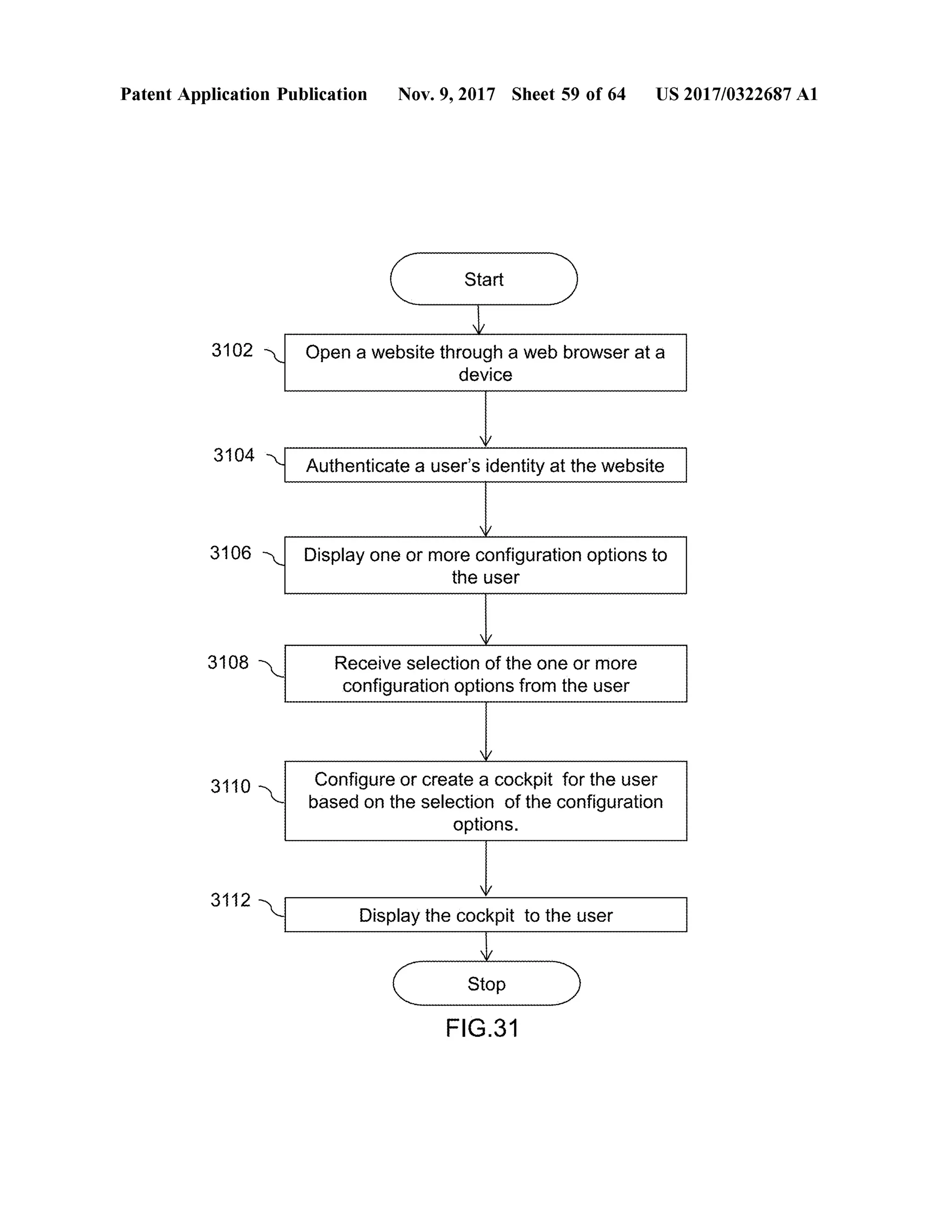
3410 Play an audiomenu to theuserwhen the
user selects an audio mode
StopStop
FIG .34
102
Cockpit
Patent Application Publication
www
-1904a
-1904b
19040
IVR
RemoteDeviceControl
-1904e
ServicesControl
1904d
1904f
Outlook
Calendar
OtherE-mails
1902
-1904g
-1904h
1904n
Nov. 9, 2017 Sheet63 of64
Messengers
Games
OtherObjects
AudioMode3502a
VideoMode35026
TextMode3502C
ListMode3502n
US 2017/0322687 A1
FIG.35A
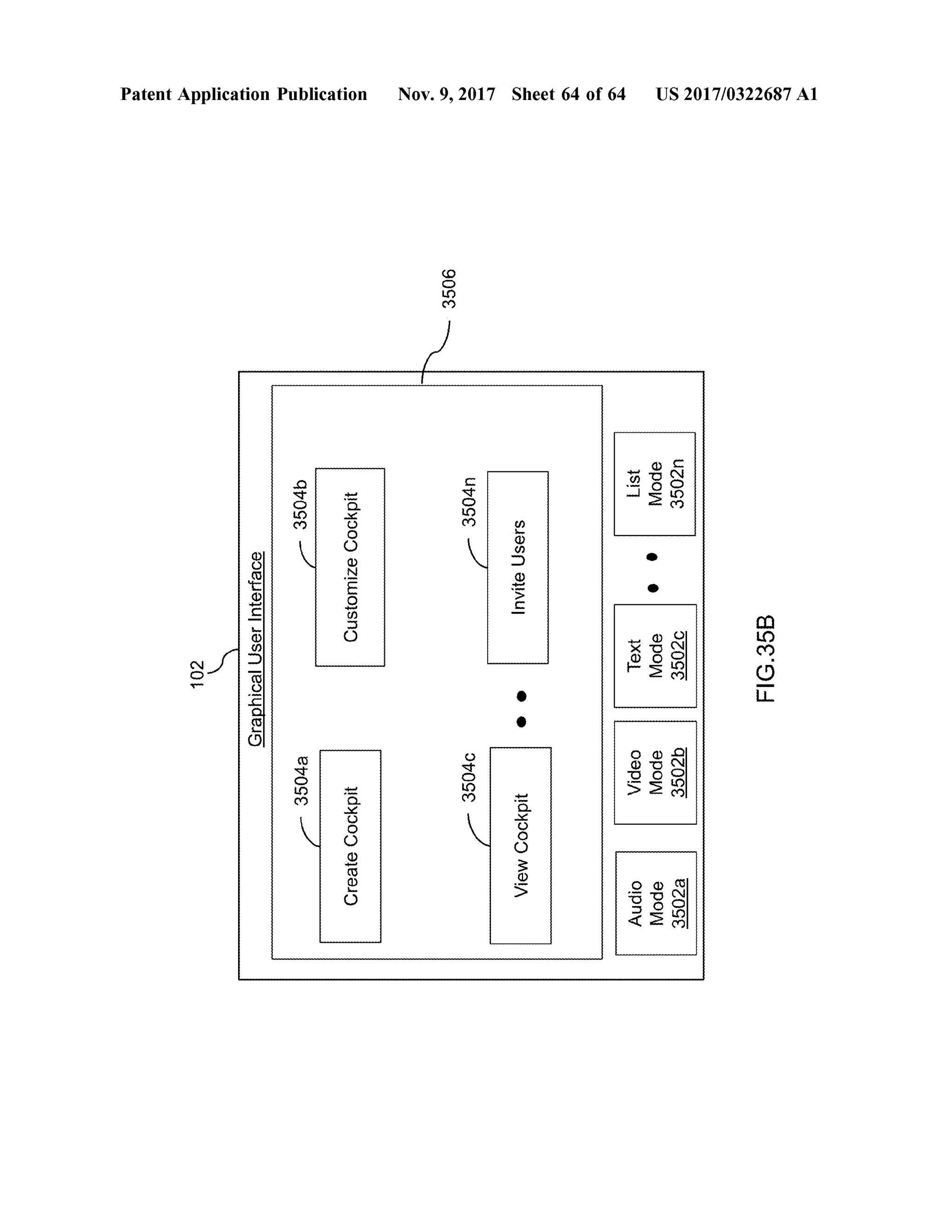
102
Patent Application Publication
GraphicalUserInterface
3504a
35046
CreateCockpit
CustomizeCockpit
3506
35040
-3504n
ViewCockpit
InviteUsers
Nov. 9, 2017 Sheet 64 of64
AudioMode3502a
VideoMode3502b
TextMode35020
ListMode3502n
US 2017/0322687 A1
FIG.35B
US 2017/0322687 A1 Nov. 9, 2017
SYSTEMS AND METHODS FOR
ELECTRONIC COMMUNICATIONS
GPS server 114. However, the user is unable to control or
update the positional coordinates of the vehicle as per
choice.
[0007] In lightof the above discussion, systemsand meth
ods are desired for providing real-time controlofthe elec
tronic devices and services from a remote location .
SUMMARY
CROSS REFERENCE TO RELATED
APPLICATIONS
10001] This application is a Continuation-In -Part(CIP )of
U .S. Non-Provisional application Ser. No. U .S . Ser. No.
13/310 ,696 entitled “Systems and Methods for Electronic
Communications' filed on Dec. 2, 2011, which is Continu
ation -In -Part (CIP ) of U .S. Non-Provisionalapplication Ser.
No. 13/245,804 entitled 'Systems and Methods for Elec
tronic Communications' filed on Sep. 26 , 2011, Ser. No.
13/272,212 entitled “Systems and Methods for Electronic
Communications' filed on Oct. 12, 2011, and Ser. No.
13/273,187 entitled “Systems and Methods for Electronic
Communications' filed on Oct. 13, 2011.
FIELD OF THE INVENTION
[0002] The presentinvention is related to electronic com
munications in a network and more specifically to systems
and method for accessing and controlling one or more
objects (physical or virtual) such as remote devices and
services from a remote location by a user.
BACKGROUND OF THE INVENTION
[0003] Electronic devicesare frequently used in day to day
life. The electronic devices may include television, refrig
erator, air conditioners, fans, tube lights, cameras or other
electronic equipments such as transmitters,antennas etc.All
the electronic devices consume power regularly or at fre
quentintervals oftime. For efficientpower consumption, the
electronic devices must be controlled or switched ON /OFF.
[0004] Appliances such as fans, tube lights or microwave
may be controlled by regulating the electrical parameters
associated with the appliances. For example, a user may
controlspeed offan,regulate operating power ofthe micro
wave as per requirement. However, it requires physical
presence of the user to regulate or switch ON /OFF the
appliances. A technique for controlling the appliances by a
remote control device is well known. The remote control
device may transmitsignals for controlling the appliances.
Forexample, theremote control devicemay simultaneously
control air conditioners, fans or cameras as perthe require
ment.However, the technique is limited by location of the
user. Moreover, the technique is incapable ofupdating the
real-time status of the appliances to the user.
[0005] Another available technique discloses a smart
device for controlling the appliances. The smart device is
configured with internet and connected with the appliances.
A user connected with the smart device via the internetmay
controlthe appliances from a remote location.Moreover, the
user may control the appliances by connecting with pro
cessing device via communication channel. The processing
device may be located nearby to the smart device and may
further receive signals from the user to control the appli
ances. However, the technique requires installation of a
smart device and/or processing device for controlling the
appliances from a remote location .
[0006] Another available technique discloses real-time
position monitoring of vehicles. The user may monitor real
time coordinates of the vehicles based on the information
received from a transmitter located in the vehicle. The user
receives the position coordinates from the transmitter via a
[0008] Embodiments ofthe invention provide a server for
enhancing interaction with Internet of Things. The server
includes a processor and amemory coupled to the processor.
Thememory includes a database comprising one or more
options corresponding to each of the things. Further, the
memory includes oneormore instructionsexecutableby the
processor for providing the one ormore options to a user for
enabling the user to select at least one option therefrom .
Further, the memory includes one or more instructions
executable by the processor to receive information corre
sponding to the selection of the at least one option by the
user. Furthermore, thememory includes oneormore instruc
tions executable by the processor to configure a visualmenu
based on the received information. Herein, the at least one
visualmenu may enable a user to control the puarlity of
Internet of Things (IoT) devices irrespective of their loca
tions.
[0009] Hereinbove, the plurality of Internet of Things
(IoT) devices consist ofa plurality of electronicsdevices, a
plurality ofkitchen appliances, a plurality ofvehicles, or a
combination thereof. Further, the configured visual menu
may be stored in the database.
[0010] Embodiments of the invention further provide a
device for enhancing interaction with Internet of Things
through a server in a communication network . The device
includes a processor and a memory coupled to the processor.
Thememory includes a database and one or more instruc
tions executable by the processor for accessing one ormore
options corresponding to each ofthe things. Theoneormore
options are accessed from the server. Further, the one or
more instructions select at least one option from the one or
more options. The at least one options is selected to con
figure a visualmenu. Further, in this embodiment, the device
may include a display screen to provide the configured
visualmenu to the user.
0011]. Further, embodiments of the invention provide a
system for enhancing interaction with Internet of Things in
a communication network . The system includes a server
including one ormore options corresponding to the things.
Further, the system includes a device communicably
coupled to the server through the communication network .
Thedevice configured for enabling a user to access the one
or more options to select at least one option therefrom . The
at least one option is selected to configure a visualmenu
corresponding to the things. Here, the user is enabled to
access the one ormore options by authenticating with the
server.
[0012]. Additionally, embodiments of the invention pro
vide a server for enhancing interaction with Internet of
Things. The server includes a processor and a memory
coupled to the processor. The memory includes a database
including one ormore visualmenus corresponding to each
of the things. Further, the memory includes one or more
instructions executable by the processor for providing a
visualmenu, from the one ormore visualmenus,to a user
for enabling the user to interact with the visual menu.
US 2017/0322687 A1 Nov. 9, 2017
Further, the one or more instructions provide an enhanced
visualmenu based on the interaction ofthe user with the
visual menu. Furthermore, the one or more instructions
enable the userto interact with the enhanced visualmenu to
controlone ormore operations corresponding to the things.
[0013] Embodimentsofthe invention provide a system for
enhancing interaction of a user with objects connected to a
network. The system includes a processor, a display screen,
and a memory coupled to the processor. The memory
comprises a database including a list of two or more objects
and instructions executable by the processor to display a
menu on the display screen. The menu is associated with at
leasttwo independentobjects. Further, the two independent
objects are produced by at least two independent vendors.
[0014] Embodiments of the invention further provide a
system for enhancing interaction of a user with objects
connected to a network . The system includes a processor, a
display screen and amemory coupled to the processor. The
memory includes a database comprising a listof oneormore
objects and instructions executable by the processor to
display the objects to the user through the display screen.
The menu includes icon which may indicate one object
madeby a vendor.Further, the icon is substantially different
than the one provided by said vendor.
[0015] Herein, the objectsmay include atleast oneofone
ormore services and one ormore remote devices thatmay
be controlled by the user. Further, a service provider (*ven
dor') may provide one ormore services thatmay be utilized
by the user bymanaging the corresponding objects.
[0016] Further, embodiments of the invention provide a
system for enhancing interactionwith the InternetofThings.
The system includes a processor and a memory coupled to
the processor. Thememory includes a database including
one ormore options corresponding to each of the Internetof
Things. Further, thememory includes instructions to share at
least oneofthe one ormore optionswith one ormore users
ofthe things. Furthermore, thememory includes instructions
to receive information corresponding to selection of the at
least one option by the one ormore users. Additionally, the
memory includes instructions to update the database based
on the selection ofthe atleast one option by the one ormore
users. The instructions are executable by the processor.
[0017] Here, the one ormore users may be referred to
users of one ormore second devices. In an embodiment, a
userofa firstdevice (hereinafter may be referred to as 'first
user')may share the one ormore options, corresponding to
the Internet of things, with the users of the second devices
(hereinafter may be referred to as the second users '). The
oneormore optionsmaybe sharedby defining rights for the
second users for enabling them to control the Internet of
Things. Further,the oneormore optionsmay be sharedwith
the second users to enable them to personalize the one or
more options according to their preferences. According to
the rights defined by the first user, the second users may
perform one ormore operations, for controlling the Internet
of Things,by selecting at least one option from the one or
more options.
[0018] Additionally, the one or more options may be
shared for a specific time and on the occurrence ofa specific
event thatmay be defined by the firstuser. The second users
may modify the shared one ormore options as per their
preferences. Further,the firstusermaybe enabled to discard
such modifications.
[0019] Furthermore, embodiments of the invention pro
vide a system for enhancing interaction with the Internet of
Things. The system includes a processor and a memory
coupled to the processor. Thememory includes a database
having a visualmenu corresponding to the things.Further,
thememory includes instructions executable by the proces
sor to share the visualmenu with oneormore second users
of the things. The one ormore second users correspond to
one or more second devices. Furthermore , the memory
includes instructions executable by the processor to translate
the visualmenu based on one ormore preferencesofthe one
or more second users. Additionally, the memory includes
Instructions executable by the processor to display the
translated visualmenu to the second users at the correspond
ing second devices.
10020] Herein , the visualmenu is shared with the one or
more second users by definingrights for enablingthe second
users to perform one or more operations corresponding to
the things. The one or more operations being performed by
selecting one ormore icons presentin the visualmenu.
[0021] Furthermore, embodiments of the invention pro
vide a device for enhancing interaction with the Internetof
Things. The device includes a processor and a memory
coupled to the processor. The memory includes a database
and instructions executable by the processor. The database
includes one ormore options corresponding to the things.
Further, the instructionsshare atleastone oftheone ormore
options with one ormore users of the things. Furthermore,
instructions receive information corresponding to selection
of the at least one option by the one or more users.
Additionally, instructions update the database based on the
selection of the at least one option by the one ormore users.
(0022] Herein , the one ormore users may be referred to
users ofone ormore second devices. In this embodiment, a
user of a first device (hereinafter may be referred to as 'first
user')may share the one or more options, corresponding to
the Internet of things, with the users of the second devices
(hereinafter may be referred to as the second users'). The
one ormore optionsmay be sharedbydefiningrights for the
second users for enabling them to control the Internet of
Things. Further, the one ormore optionsmay be shared with
the second users to enable them to personalize the one or
more options according to their preferences. Additionally,
thememory further includes instructions to receive permis
sion request from the one ormore users. The request is
received for enabling the one or more users to personalize
the at least one option.
[0023]. Embodiments of the invention provide a method
for accessing and controllingremote devices in a network.
Themethod includes accessing a database of visual access
menus through a graphicaluser interface (GUI) at a device.
Further, the method includes displaying a visual access
menu atthe device. The visualaccess menumay includeone
or more options. The device may include an Internet of
Things application such as a VMThings for displaying the
visual access menu at the device. The VMThings also
enables a user of the device to control the remote devices.
The VMThings may be configured to create an Internet of
Things menu including representations of recognizable
objects. The objects may be physical objects or virtual
objects. The Internet of Things menu may be a menu of
identifiable objects (physical or virtualobjects) connected in
an Internet like structure. The usermay control the remote
devices irrespective of the location of the remote devices
US 2017/0322687 A1 Nov. 9, 2017
through the visual access menu . The user may select an
option from the visual access menu. The method further
includes displaying an enhanced visual access menu based
on a selection of an option received from the user. The
enhanced visual access menu may include one or more
device options depending on the selection ofthe option. The
device options are representation corresponding to the
remote devices. The method further includes receiving a
selection of a device option from the user. The method
further includes connecting to a remote device based on the
selection ofthe device option. Further, themethod includes
controlling the one or more operations of the connected
remote device based on the selection of the device option.
[0024] Embodiments of the invention provide a method
for accessing and controlling services from a remote loca
tion. The method includes accessing, by a user ofa device,
a database of visual access menus through a graphicaluser
interface (GUI) at the device. Further, themethod includes
displaying a visual access menu at the device. The visual
access menu may include one ormore options. The device
may include an Internet of Things application i.e. a
VMThings for displaying the visual access menu at the
device. Further, the VMThings may create an Internet of
Things menu including one or more identifiable objects
connected to each other in an Internet like structure. The
VMThingsmay display visual accessmenu atthe device to
enable the user to controlthe remote services. The method
further includes displaying an enhanced visualaccessmenu
based on a selection of an option received from the user. The
enhanced visual access menu may include one or more
service optionsdepending on the selection ofthe option . The
service options are representation corresponding to the ser
vices. Themethod further includes receiving a selection of
a service option from the user. Themethod further includes
connecting to a service based on the selection ofthe service
option. Further, the method includes connecting the device
to the service. Furthermore, themethod includes controlling
and displaying information about the service at the device
based on the selection of the service option.
[0025] Embodiments of the invention also provide a
device for accessing and controlling remote devices in a
network. The device may include an Internet of Things
application i.e. a VMThings configured to enable a user of
the device to access a database including visual access
menus through a GUI. Further,the VMThings is configured
to create an Internet of Things menu including oneormore
identifiable objects connected in an Internet like structure.
The VMThingsmay display a visual accessmenu including
one or more options at the device. Further, the VMThings
may display an enhanced visual accessmenu at the device
based on a selection of an option received from the user. The
enhanced visual access menu may include one or more
device options depending on the selection ofthe option. The
device options are representation corresponding to the
remote devices. The VMThingsmay further receive a selec
tion of a device option from the user. The VMThings may
also connect the device to a remote device based on the
selection of the device option. The VMThings may control
one or more operations of the connected remote device
based on the selection of the device option.
[0026 ] Embodiments of the invention also provide a
device for accessing and controlling services in a network
from a remote location . The device may include an Internet
of Things application such as a VMThings configured to
enable a user of the device to access a database including
visualaccessmenus through a GUI. The VMThings is also
configured to display a visualaccessmenu including one or
more options at the device. Further, the VMThings may
display an enhanced visualaccessmenu at the devicebased
on a selection of an option received from the user. The
enhanced visual access menu may include one or more
service optionsdependingon the selection of the option. The
service options are representation corresponding to the ser
vices located remotely. The VMThingsmay further receive
a selection of a service option from theuser. The VMThings
may also connect the device to a service based on the
selection of the service option. The VMThings may control
and display information ofthe service t the device based on
the selection ofthe service option.
[0027] Embodiments ofthe invention also provide a sys
tem for accessing and controlling remote devices. The
system includes a display device configured to display one
ormore visualaccessmenus.Further,the system includesan
access device connected to the display device. The access
device may include an Internet of Things application i.e. a
VMThings configured to display the one or more visual
accessmenus including one ormore options to control the
remote devices, at the display device. The user may create
or configure an Internetof Thingsmenu through a Graphical
User Interface at the device. In an embodiment of the
invention, the VMThings may be configured to create the
Internet of Things menu. The VMThings is further config
ured to enable a user of the access device to access a
database including the visual access menus through a GUI.
The VMThings may display an enhanced visual access
menu atthe device based on a selection ofan option received
from the user. The enhanced visualaccessmenu may include
oneormore deviceoptions dependingon theselection of the
option. Thedevice options are representation corresponding
to the remote devices. The VMThingsmay further receive a
selection of a device option from the user. The VMThings
may also connect the device to a remote device based on the
selection of the device option. The VMThingsmay control
one or more operations of the connected remote device
based on the selection ofthe device option.
[0028] Embodiments ofthe invention also provide a sys
tem for accessing and controlling services in a network from
a remote location . The system may include a display device
configured to display one or more visual access menus.
Further, the system may include an access device connected
to the display device. The access device may include an
Internet of Thingsapplication i.e. a VMThings configured to
display the one or more visual access menus including one
ormore options to controlthe remote devices at the display
device. The VMThings is further configured to enable a user
oftheaccess device to access a database includingthe visual
accessmenus through aGraphicalUser Interface (GUI). The
GUImay be used for creating an Internet of Things Menu
including a plurality ofidentifiable objects in a network like
structure. The identifiable objectsmay bephysical objects or
virtual objects. Further, the VMThings may display an
enhanced visual access menu at the device based on a
selection ofthe option received from theuser. Theenhanced
visual accessmenu may include one ormore service options
depending on theselection ofthe option. The service options
are representation corresponding to the services. The
VMThings may further receive a selection of a service
option from the user. TheVMThingsmay also connectthe
US 2017/0322687 A1 Nov. 9, 2017
[0032] An aspect ofthe invention is to transfer display of
a device to another device. The other device may be con
nected to the device through wireless means.
[0033] Another aspect of the invention is to create a data
base of visual access menus or enhanced visual access
menus. The visual access menus or the enhanced visual
access menus are the visualmenus for controlling one or
more objects such as, but are not limited to ,remote devices,
services, and so forth .
device to a remote device based on the selection of the
service option. The VMThings may control and display
information about the service based on the selection of the
service option.
[0029] Embodiments of the invention further provide a
method foraccessing and controlling the remote devices in
a network through a web browser. The method includes
opening a webpage in theweb browser at a device including
a VMThings. Themethodmay further include displaying a
visualaccessmenu at thedevice. The VMThingsmay create
or display the visual accessmenu or an Internet of Things
menu at the device. The Internet of Things menu may
include a plurality ofrepresentationscorresponding to iden
tifiable objects. The identifiable objects may be physical
objects or virtual objects. The visual access menu may
include one or more options. Further, the method includes
displaying an enhanced visual access menu at the device
based on a selection ofan option received from the user. The
enhanced visual access menu may include one or more
device options depending on the selection oftheoption. The
device options are representation corresponding to the
remote devices. The method further includes receiving a
selection of a device option from the user. The method
further includes connecting to a remote device based on the
selection of the device option . Further, the method includes
connecting the device to the remote device based on the
selection of thedevice option. Further, the method includes
controlling the one or more operations of the connected
remote device based on the selection of the device option.
[0030) Embodiments of the invention further provide a
method for accessing and controlling the services in a
network through a web browser. Themethod includes open
ing a webpage in the web browser at a device including an
Internet of Things application i.e. a VMThings. The
VMThings is configured to enable a user of the device to
access a database including the visualaccess menus through
a GUI. The method further includes displaying a visual
access menu at the device. The VMThings may display the
visual accessmenu at the device. The visual accessmenu
may include one or more options. Further, the method
includes displaying an enhanced visual access menu at the
device based on a selection of an option received from the
user. The enhanced visual access menu may include one or
more service options depending on the selection of the
option. The service options are representation corresponding
to the service. The method further includes receiving a
selection of a service option from the user. The method
further includes connecting to a service based on the selec
tion of the service option . Further, the method includes
connecting the device to the remote device based on the
selection ofthe service option. Further, themethod includes
controlling and displaying the information of the service
based on the selection ofthe service option.
[0031] An aspect of the invention is to enable a user to
control one or more operations of the remote devices or
services through voicecommands or gestures orhandmove
ments. For example, the usermay switch on an air condi
tioner (AC) by showing a thumb up gesture in frontof the
device. The device may include a camera to detect the
gesture. TheVMThingsatthedevice (or access device)may
analyze the gesture and control a remote devicebased on the
analysis
BRIEF DESCRIPTION OF THE DRAWINGS
[0034] Having thus described the invention in general
terms, reference will now be made to the accompanying
drawings, which are not necessarily drawn to scale, and
wherein:
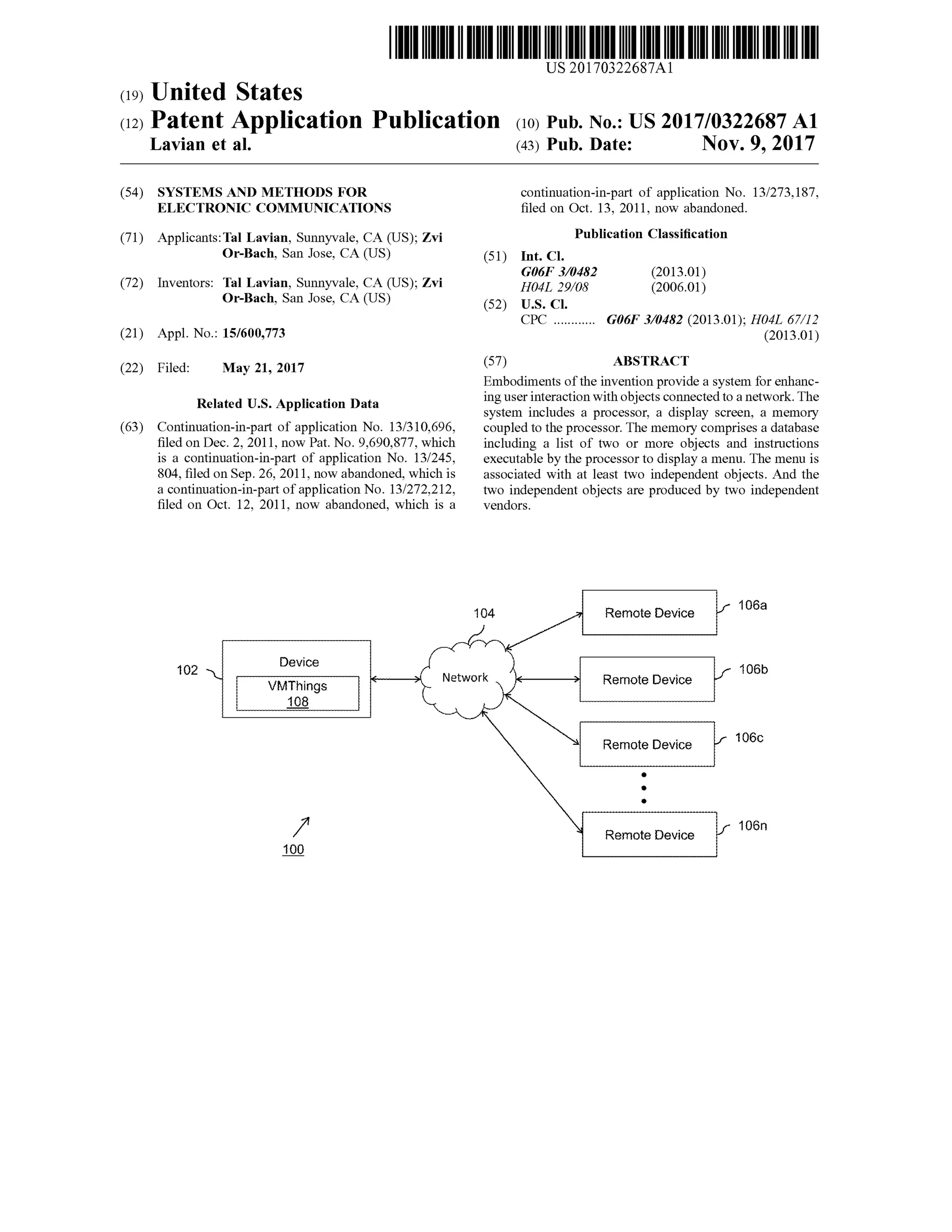
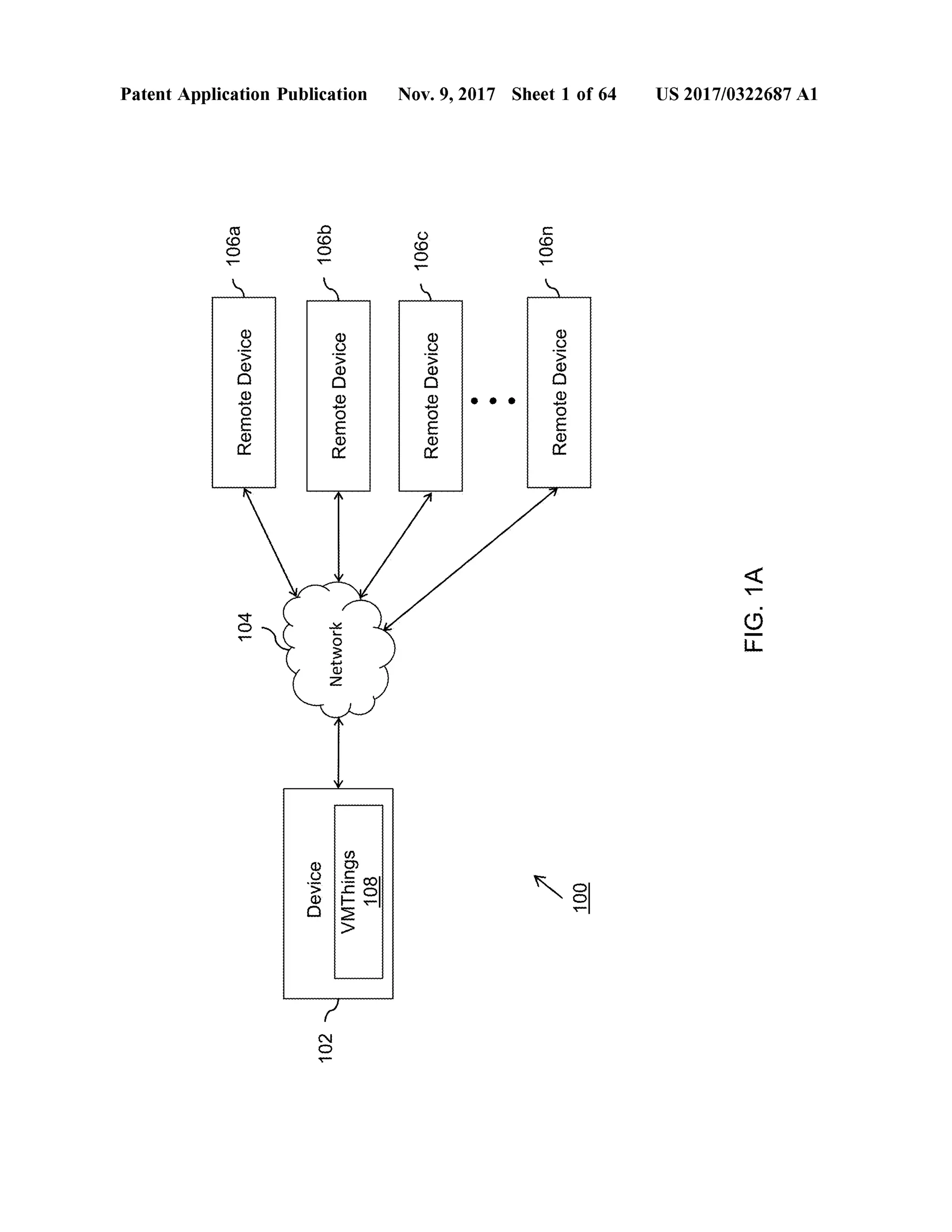
[0035] FIG . 1A illustrates an exemplary environment, in
accordance with an first embodiment of the invention;
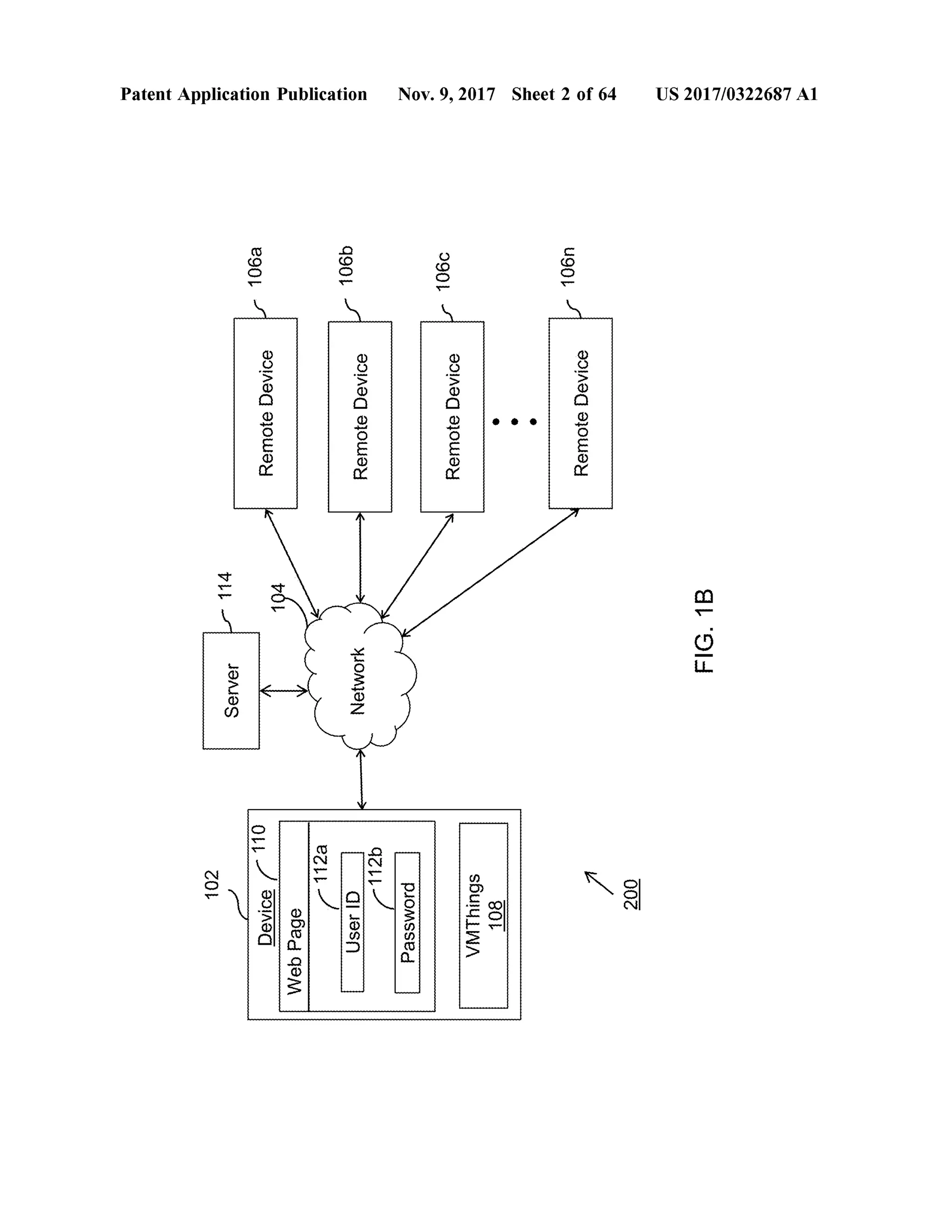
[0036] FIG . 1B illustrates another exemplary environ
ment, in accordancewith the first embodiment of the inven
tion;
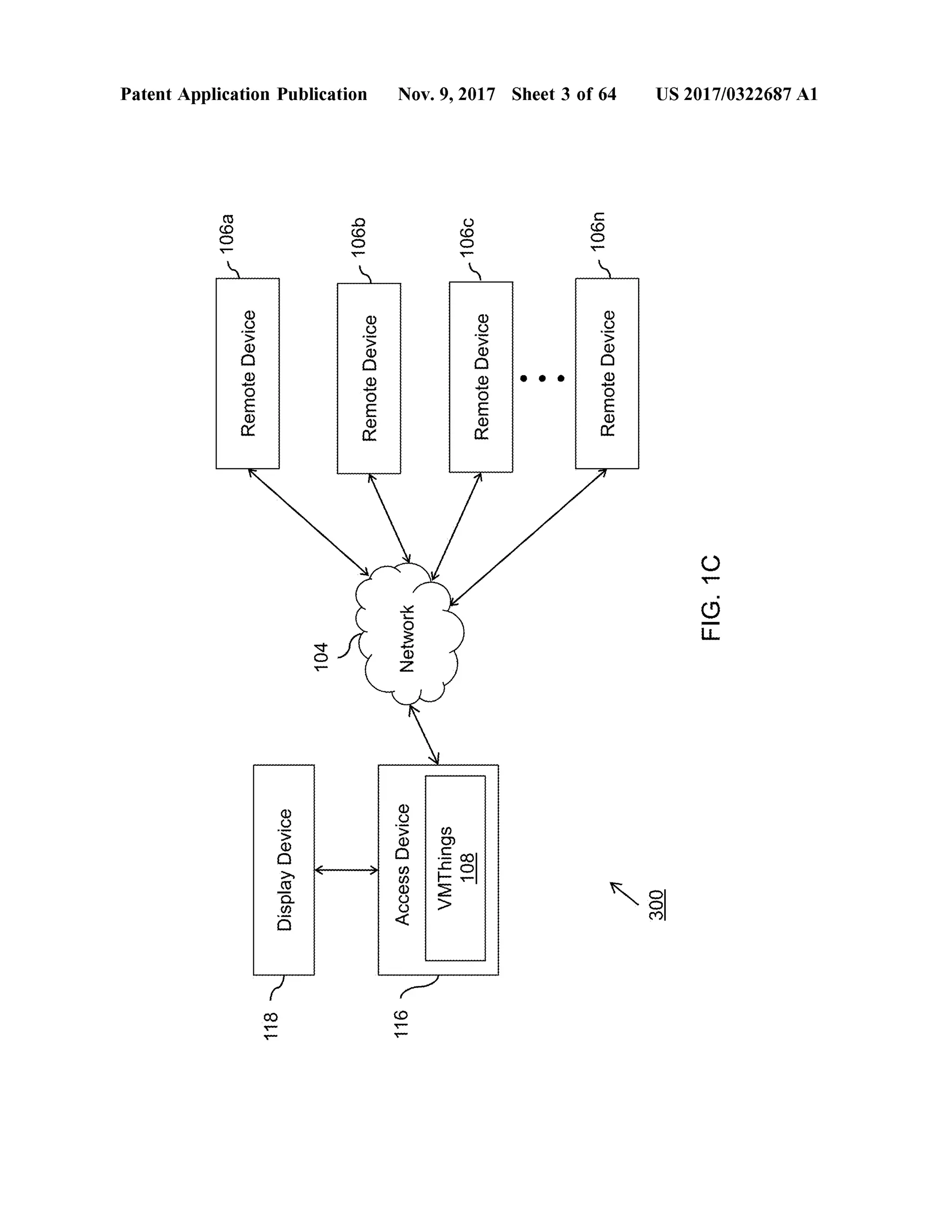
[0037] FIG . 1C illustrates yet another exemplary environ
ment, in accordance with the first embodimentofthe inven
tion;
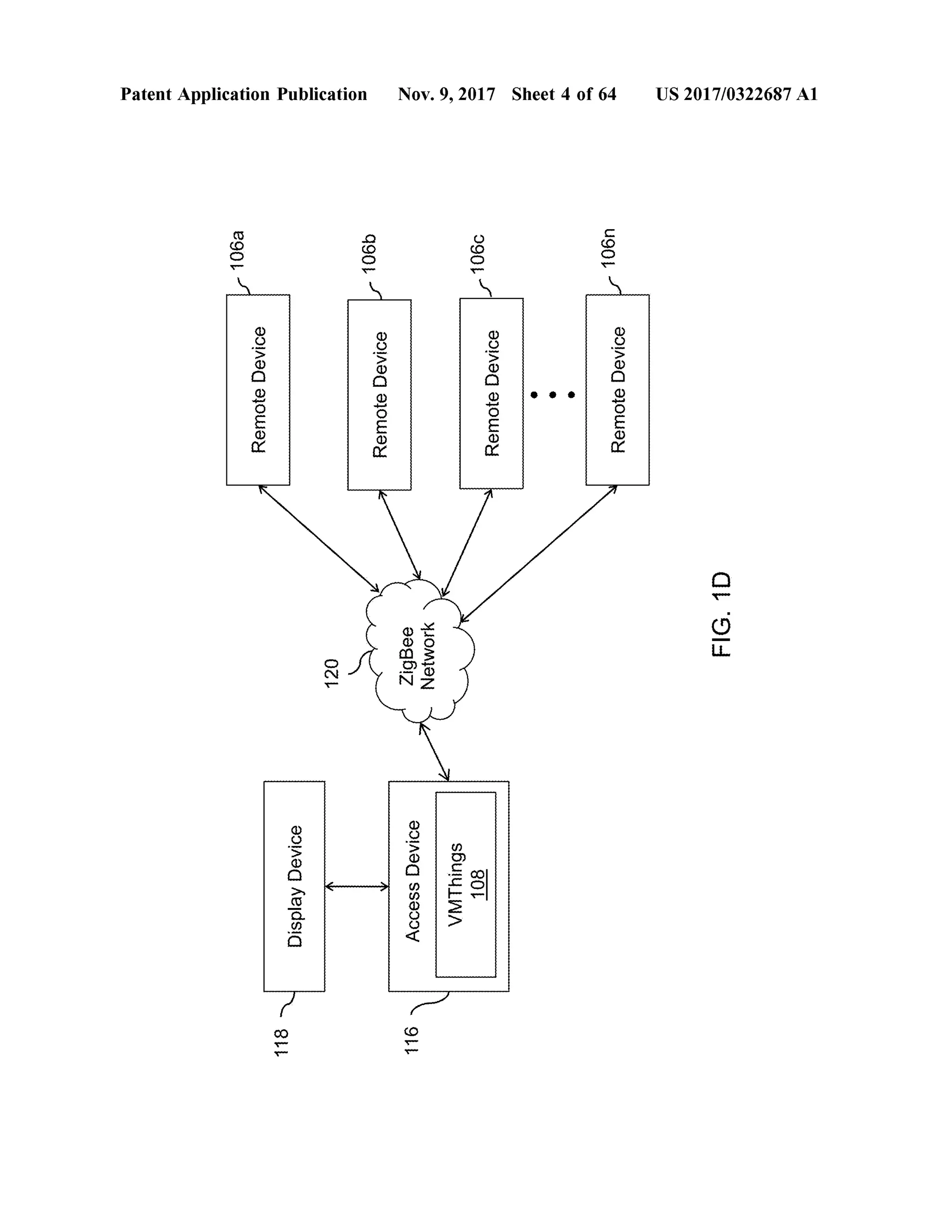
[0038] FIG . 1D illustrates an environment based on a
ZigBee network, in accordance with the first embodimentof
the invention;
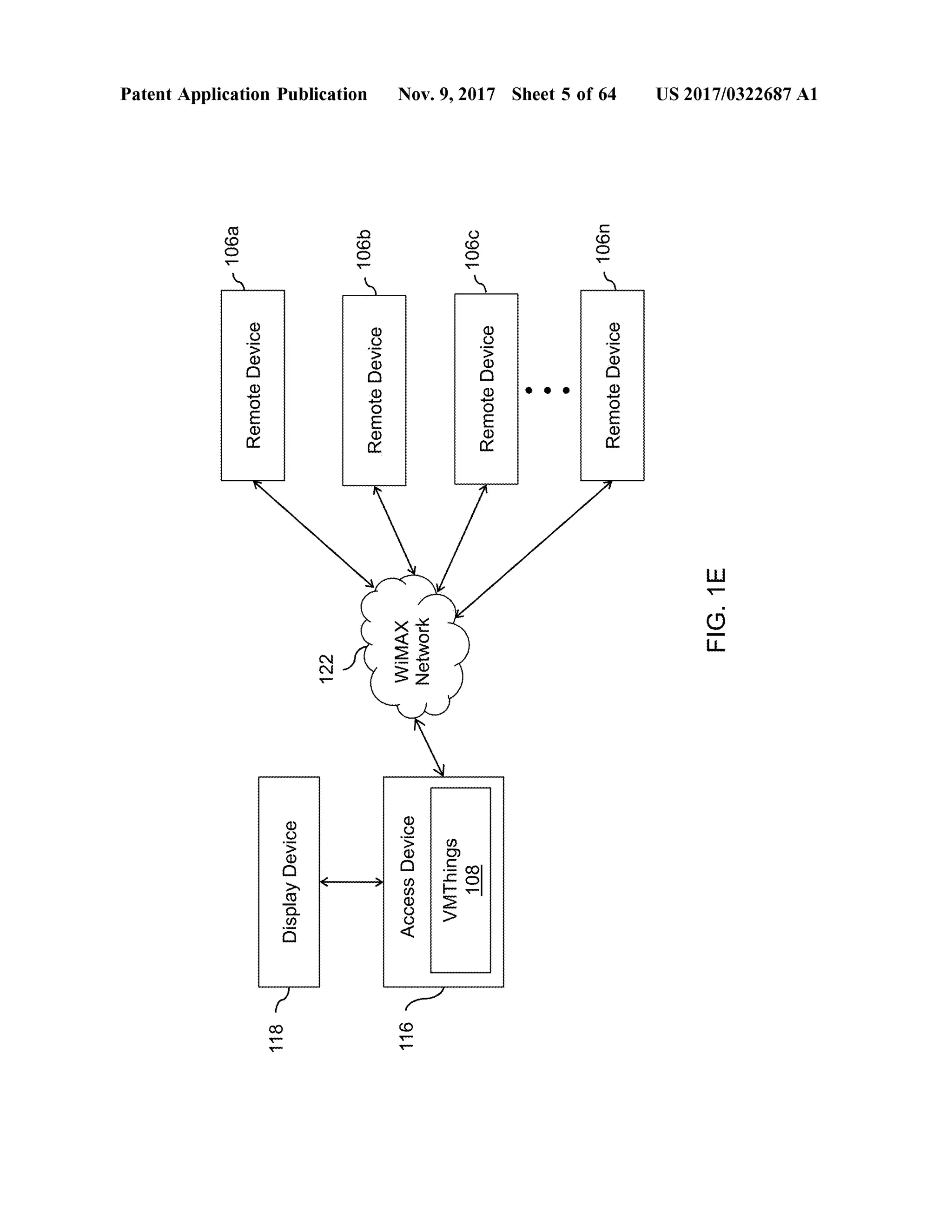
10039] FIG . 1E illustrates an environment based on a
WiMAX network, in accordance with the first embodiment
of the invention;
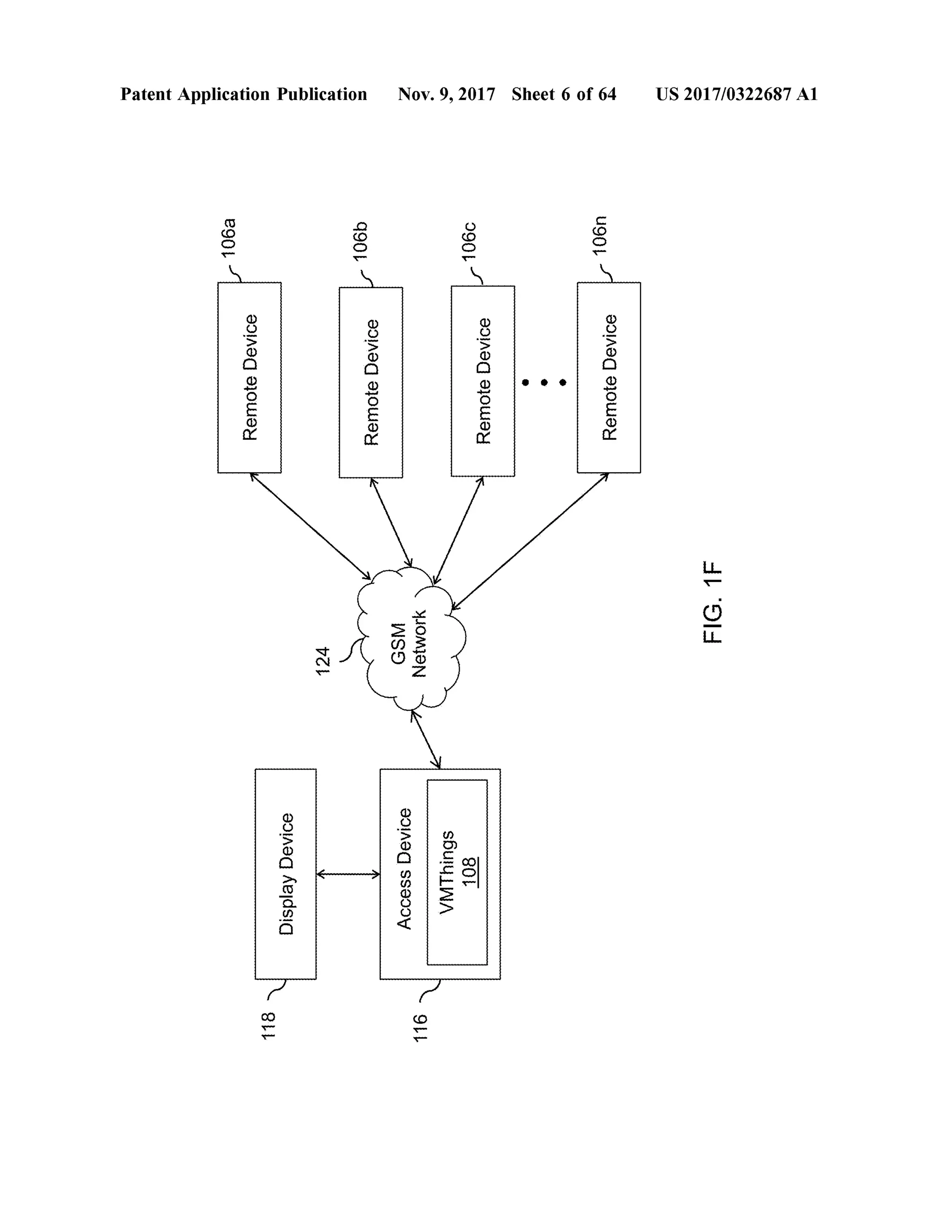
10040] FIG . 1F illustrates an environment based on a
Global System forMobile Communication (GSM ) network ,
in accordance with the first embodimentofthe invention;
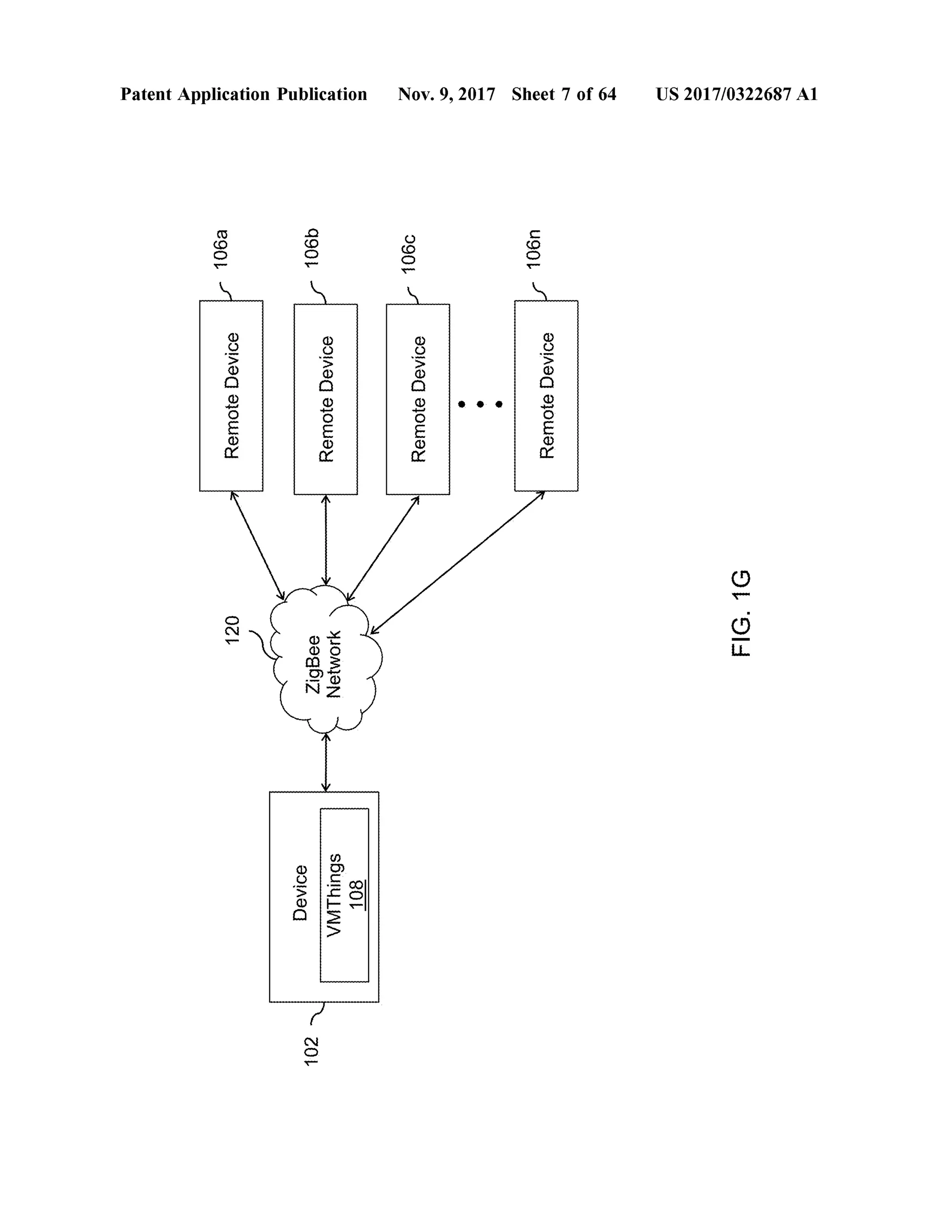
10041] FIG . 16 illustrates an environment based on a
ZigBee network, in accordance with the first embodimentof
the invention;
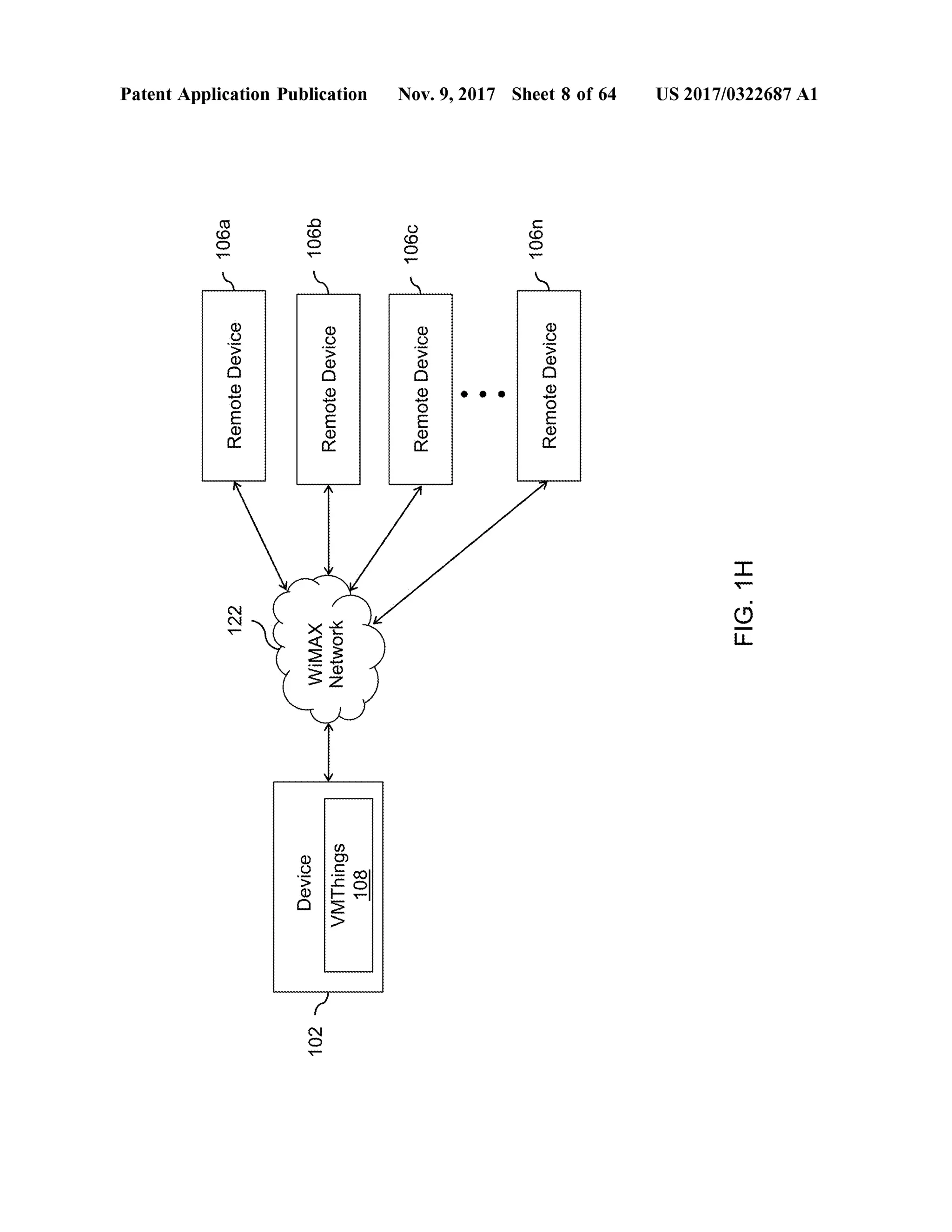
10042] FIG . 1H illustrates an environment based on a
WiMAX network, in accordance with the first embodiment
of the invention;
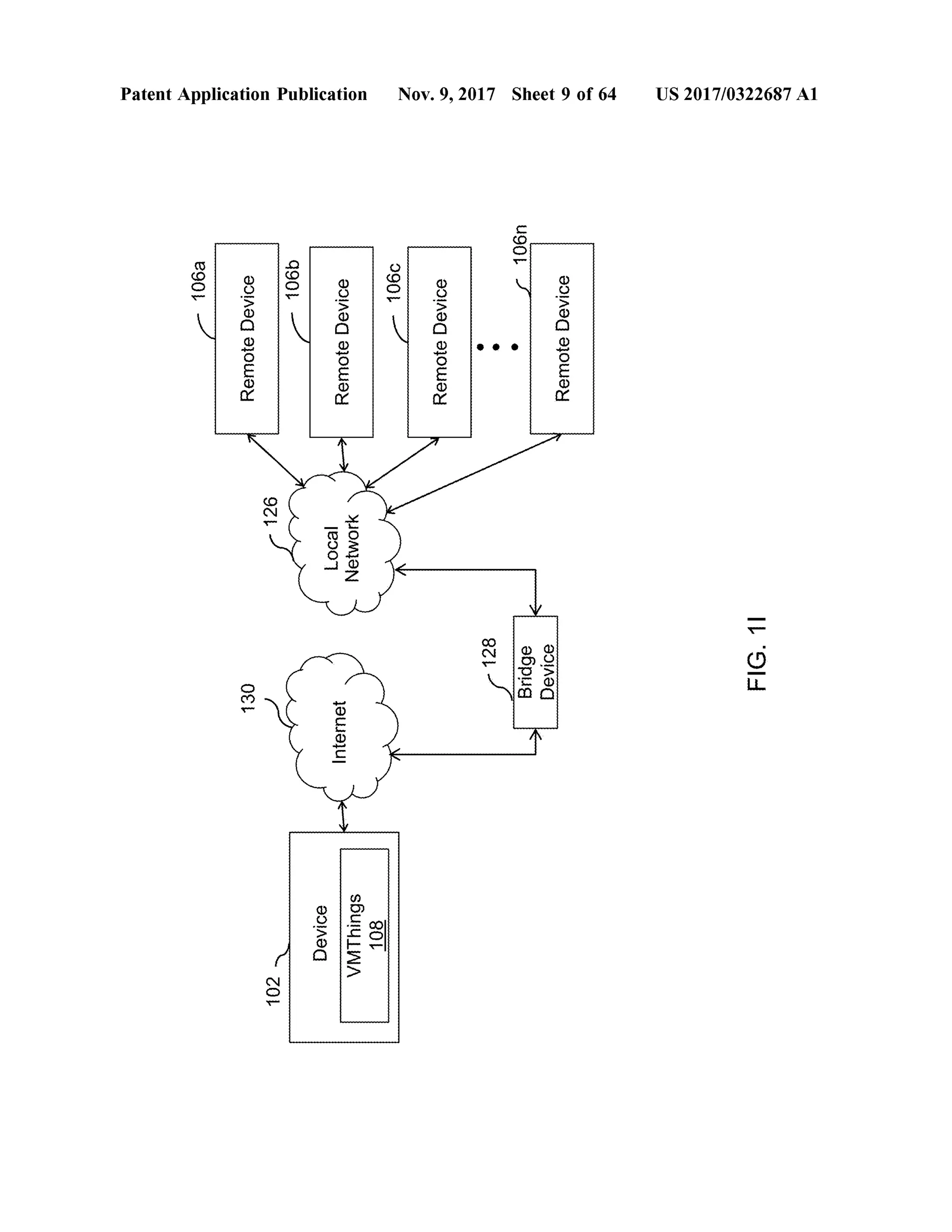
[0043] FIG . 11 illustrates an environment based on a
combination of a localnetwork and the Internet, in accor
dance with the first embodiment ofthe invention;
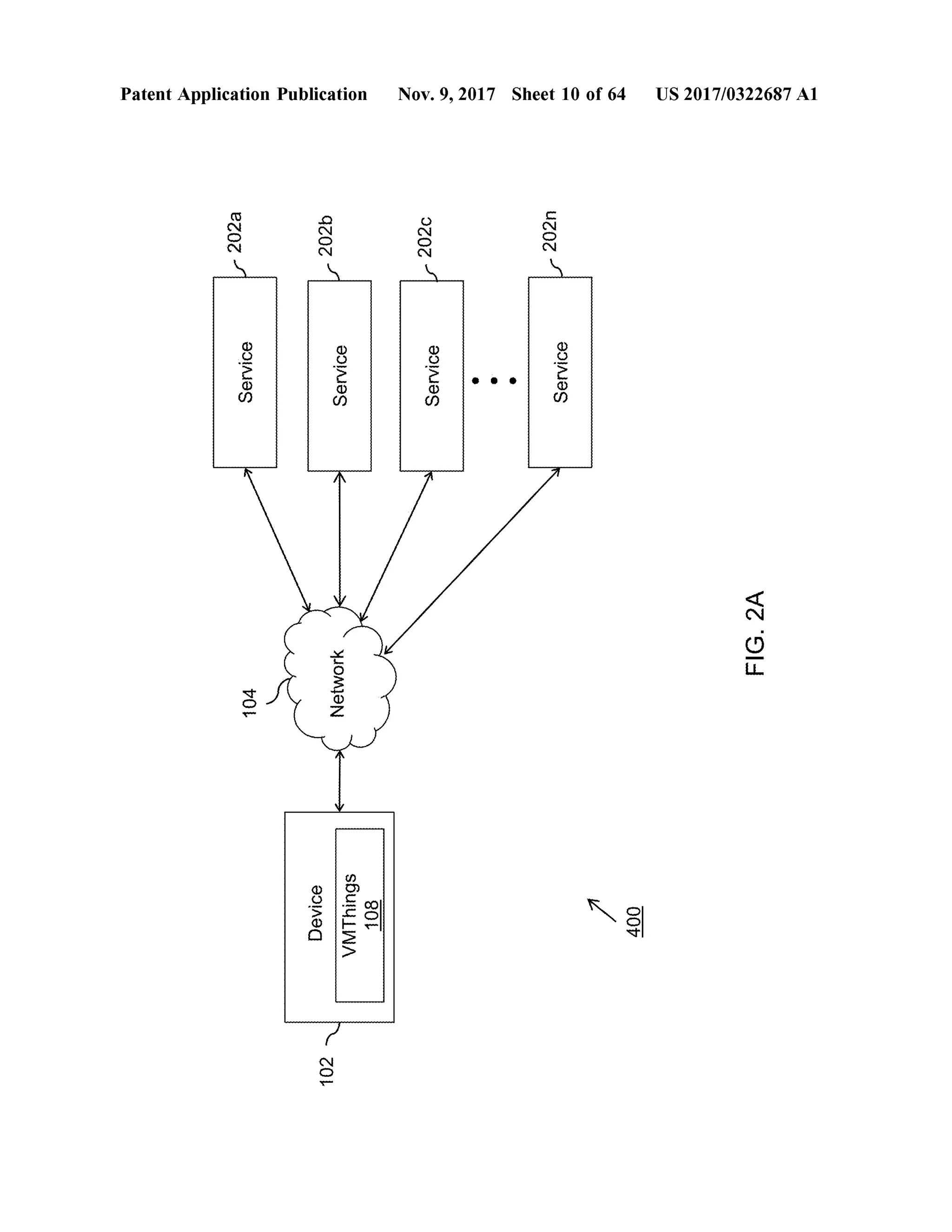
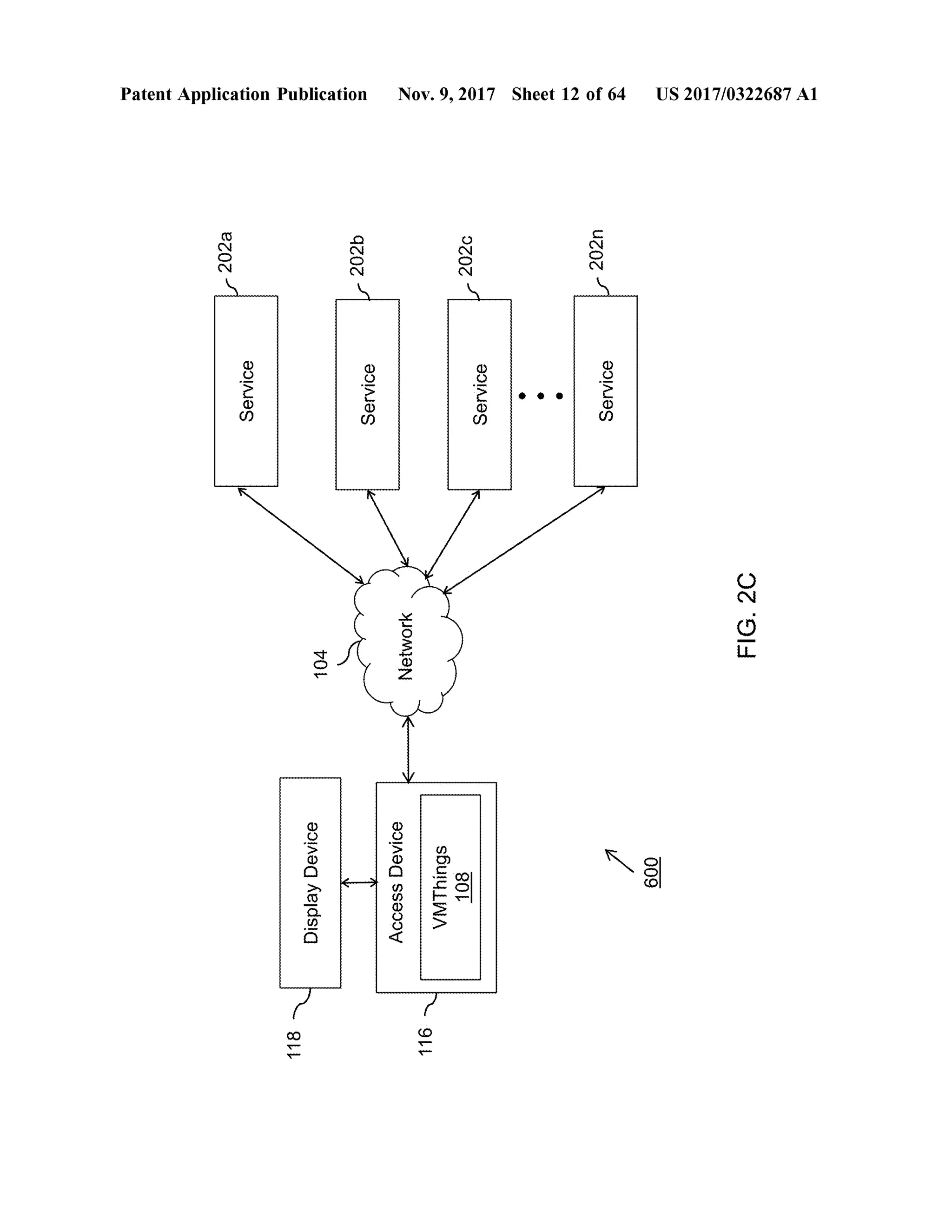
10044]. FIG . 2A illustrates an exemplary environment, in
accordance with a second embodiment of the invention ;
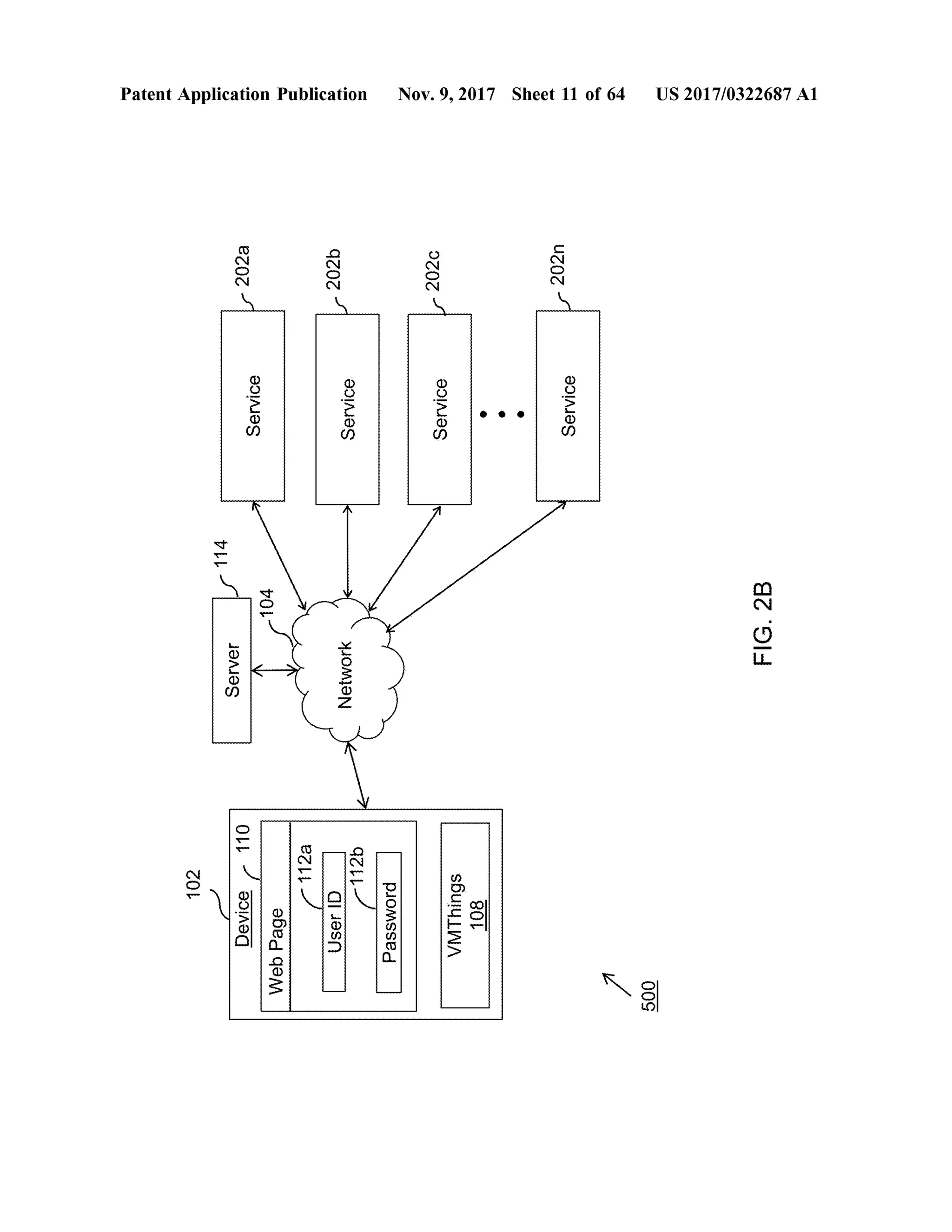
[0045] FIG . 2B illustrates another exemplary environ
ment, in accordance with the second embodiment of the
invention;
[0046] FIG . 2C illustrates yet another exemplary environ
ment, in accordance with the second embodiment of the
invention;
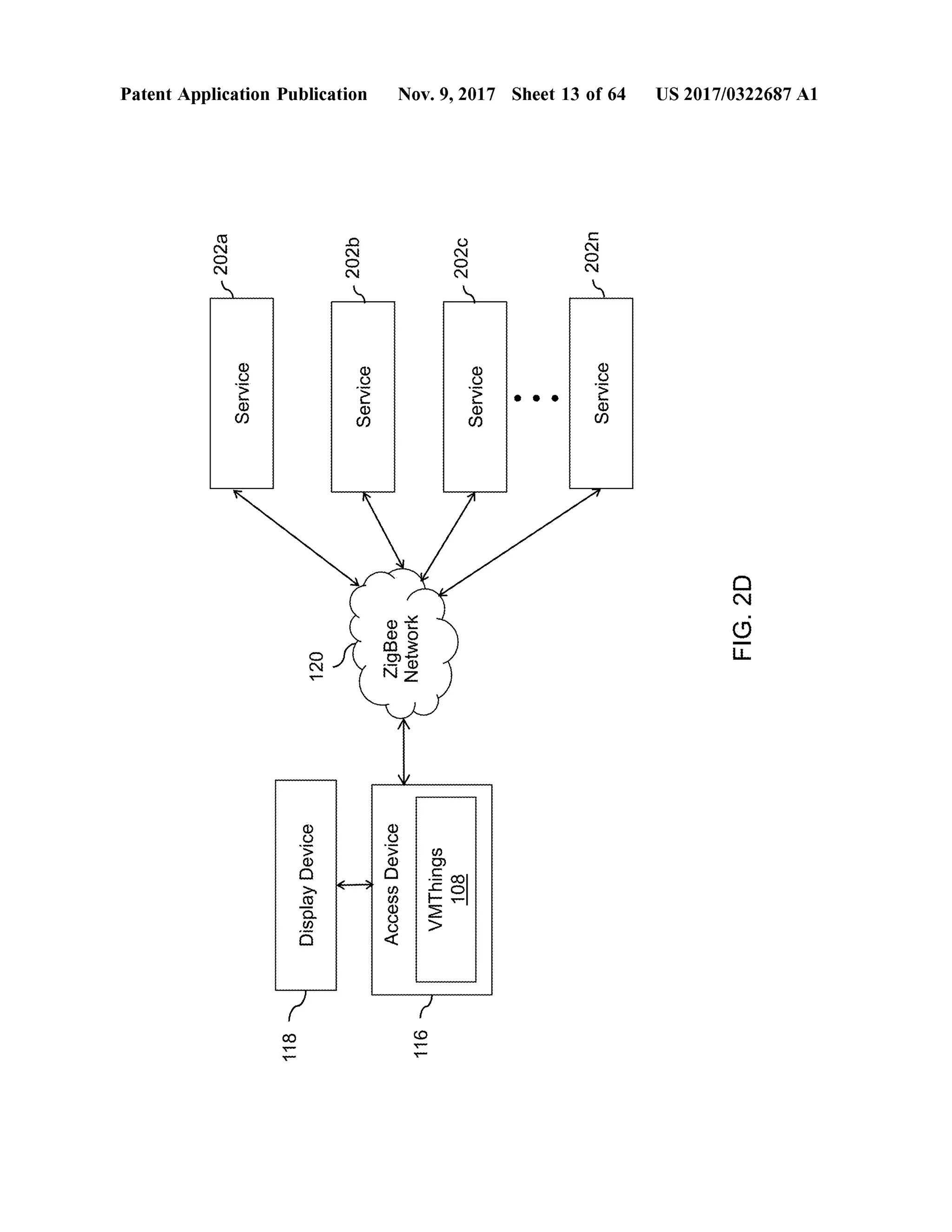
[0047] FIG . 2D illustrates an environment based on a
ZigBee network, in accordancewith the second embodiment
of the invention;
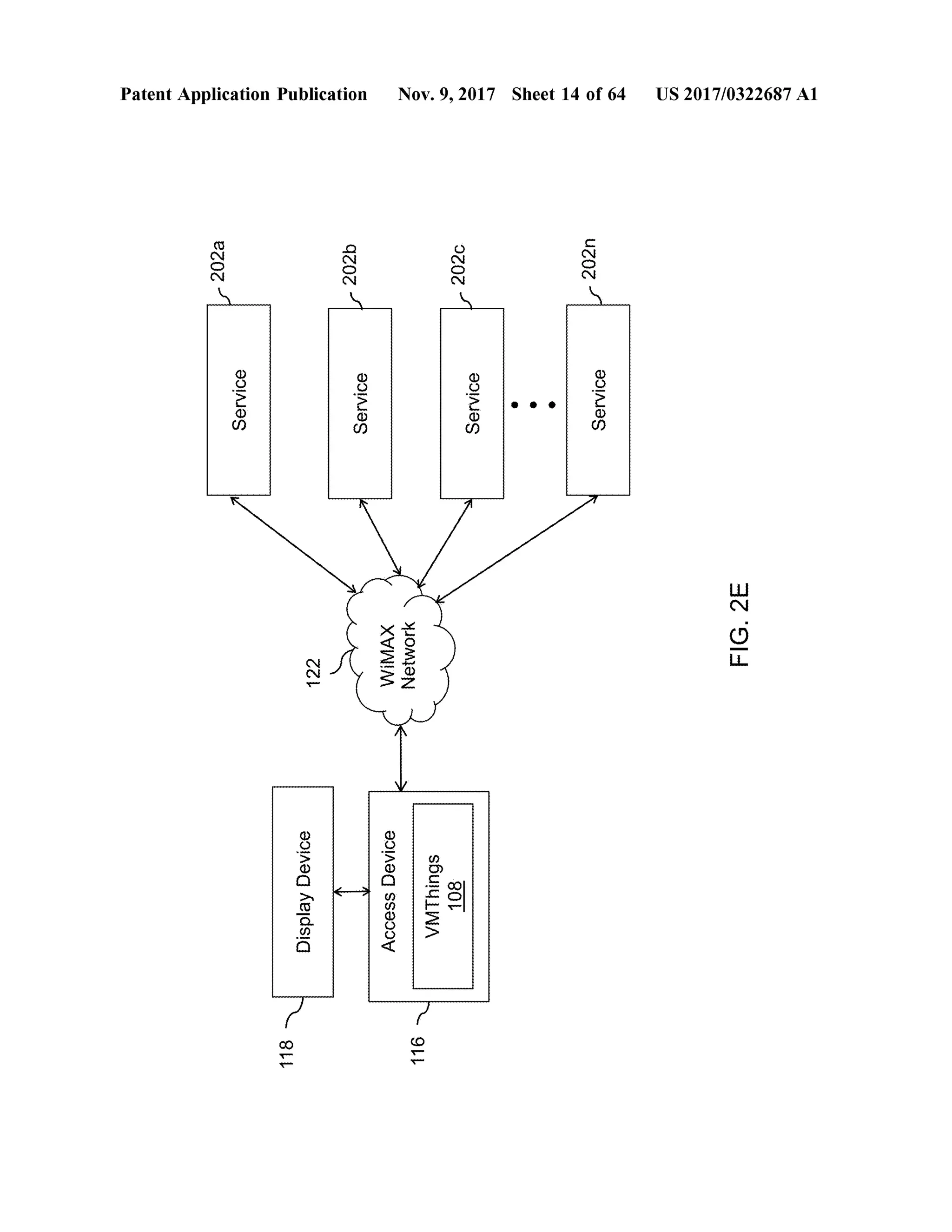
10048]. FIG . 2E illustrates an environment based on a
WiMAX network , in accordance with the second embodi
ment ofthe invention;
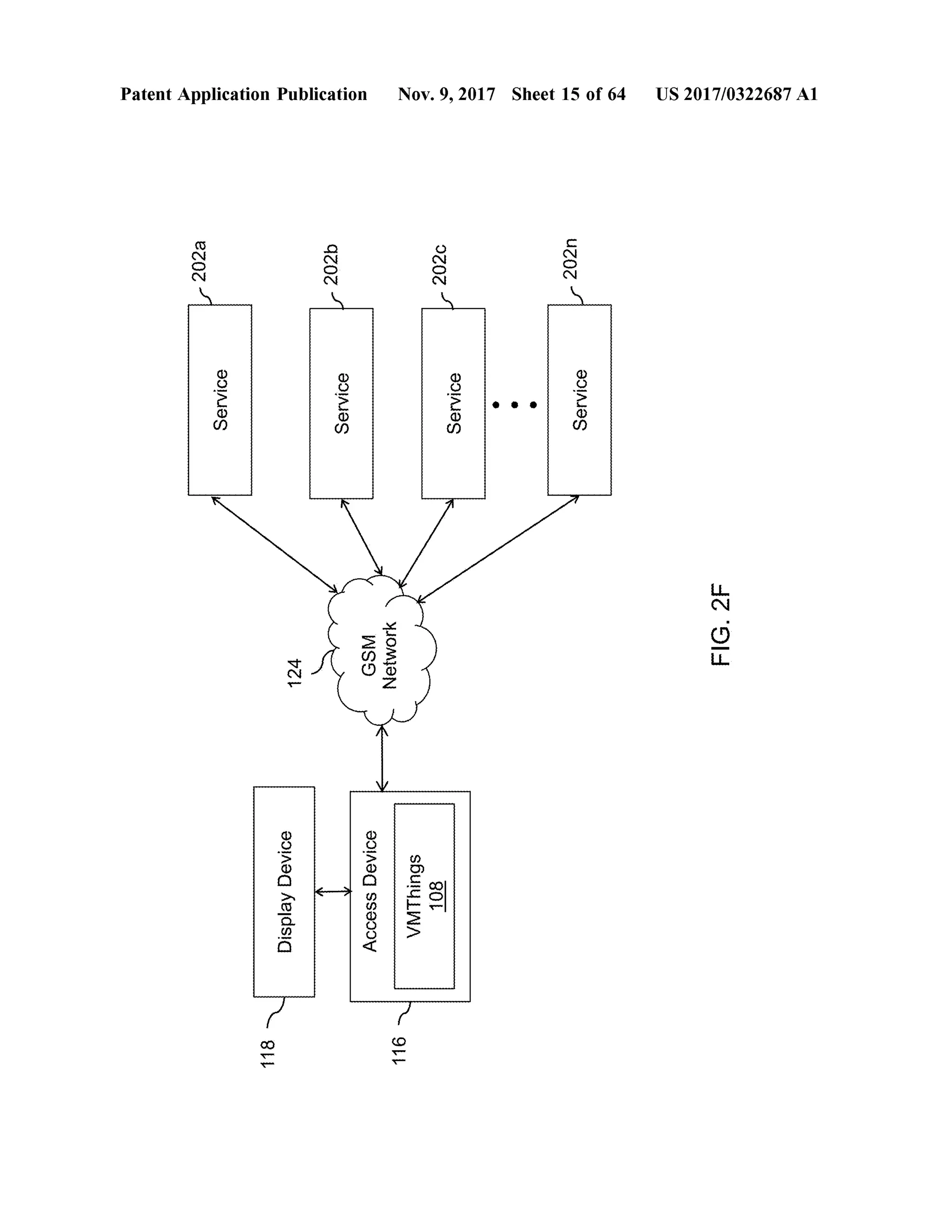
[00491. FIG . 2F illustrates an environmentbased on a GSM
network, in accordance with the second embodimentofthe
invention;
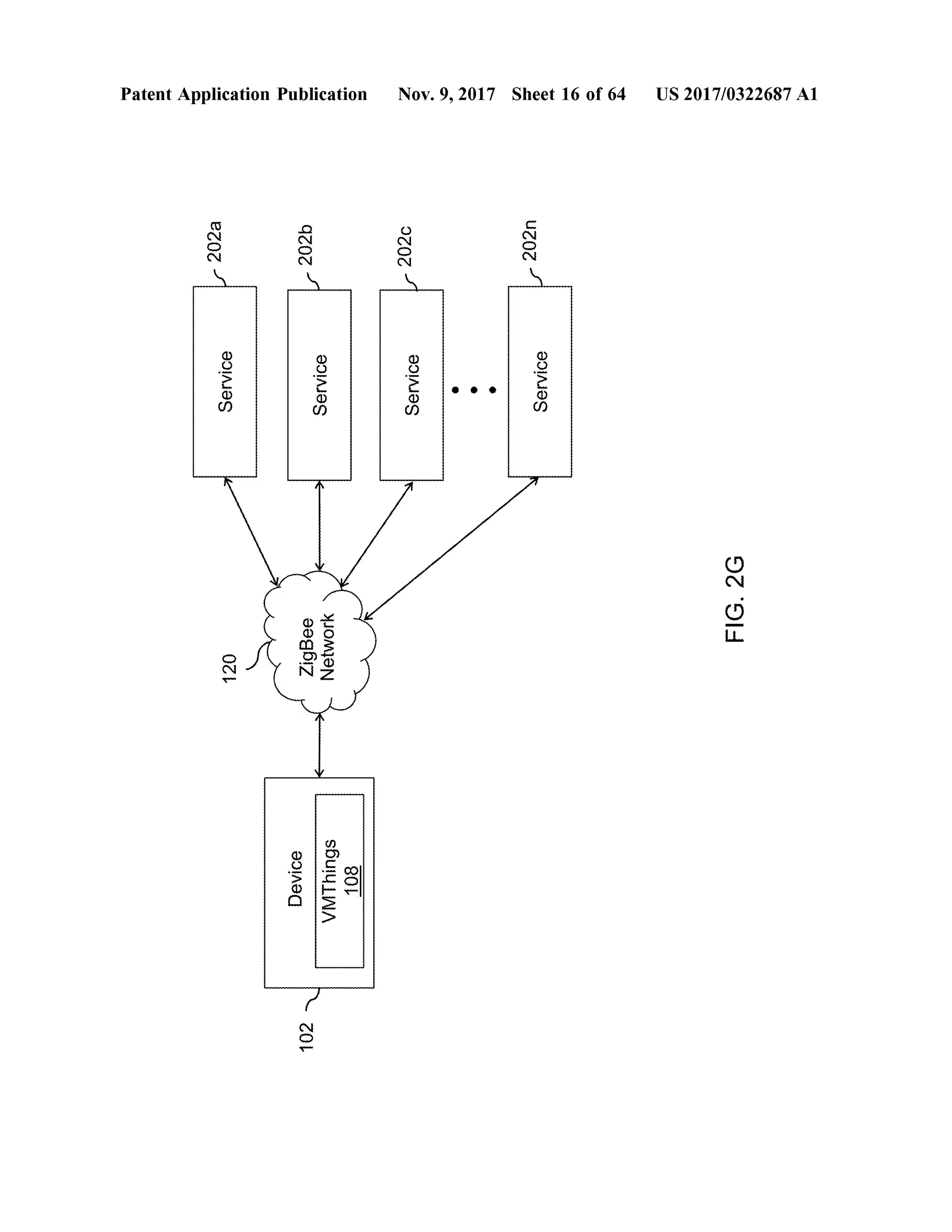
10050] FIG . 2G illustrates an environment based on a
ZigBee network, in accordancewith thesecond embodiment
of the invention ;
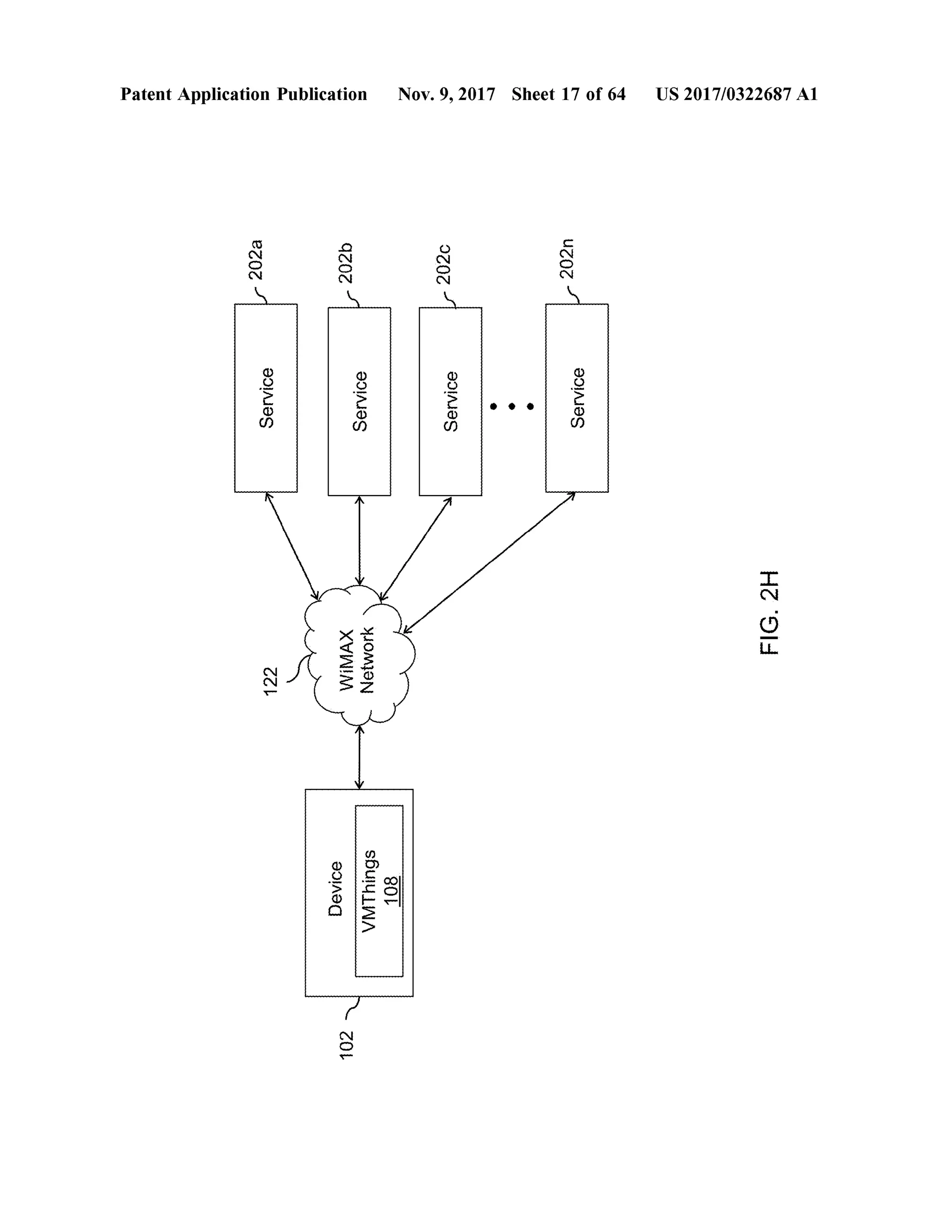
[0051] FIG . 2H illustrates an environment based on a
WiMAX network , in accordance with the second embodi
ment of the invention;
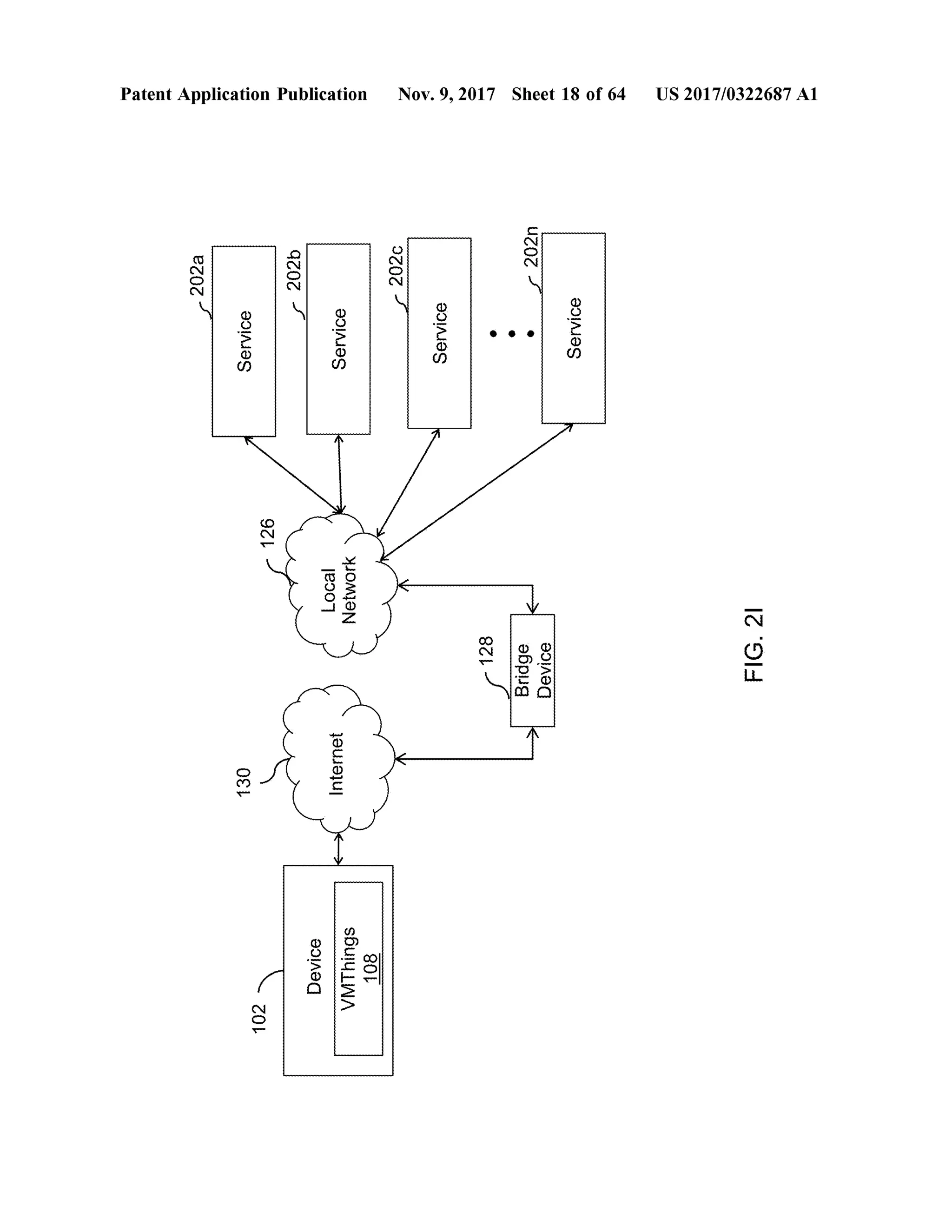
US 2017/0322687 A1 Nov. 9, 2017
[0052] FIG . 21 illustrates an environment based on a
combination of a local network and the Internet, in accor-
dance with the second embodiment of the invention ;
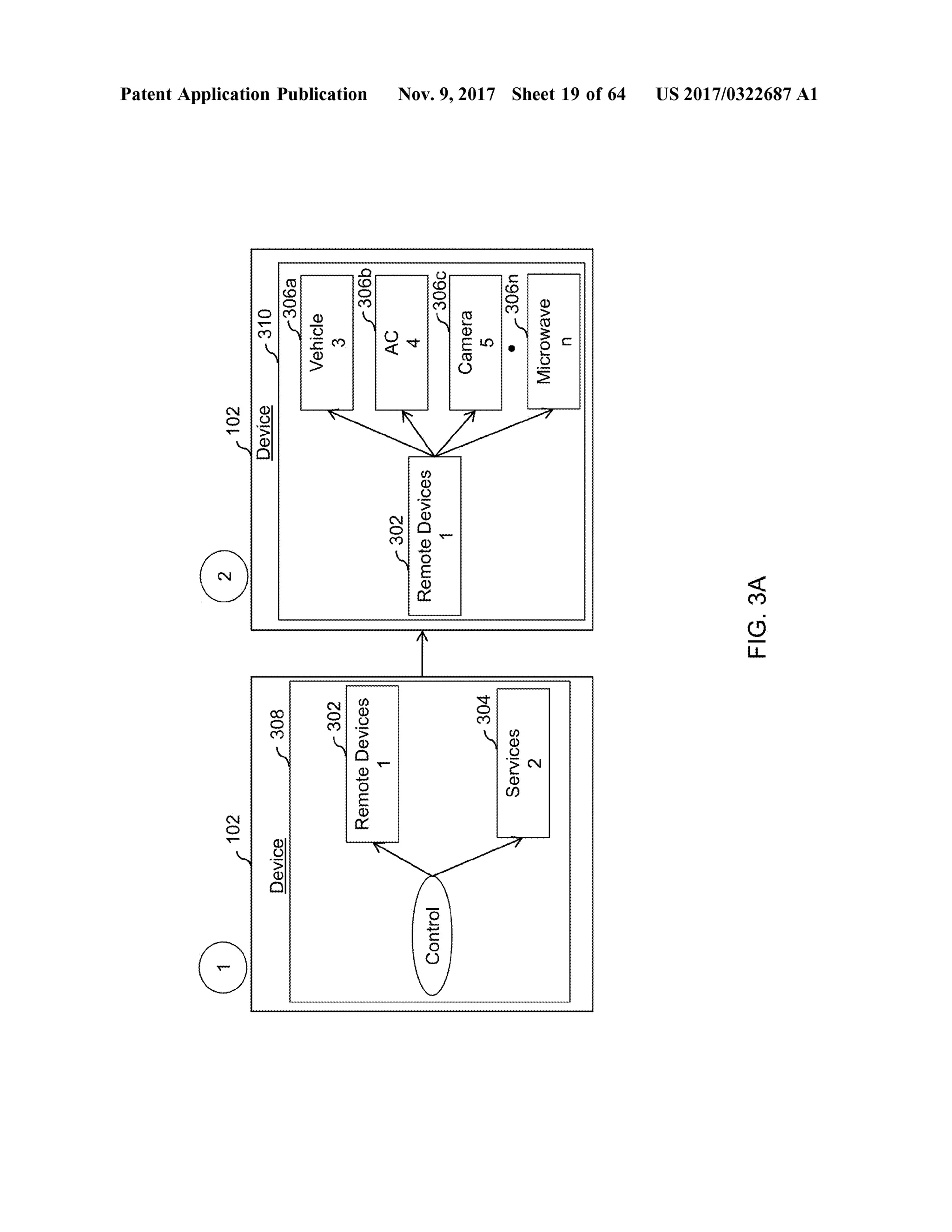
[0053] FIG . 3A illustrates an exemplary visual access
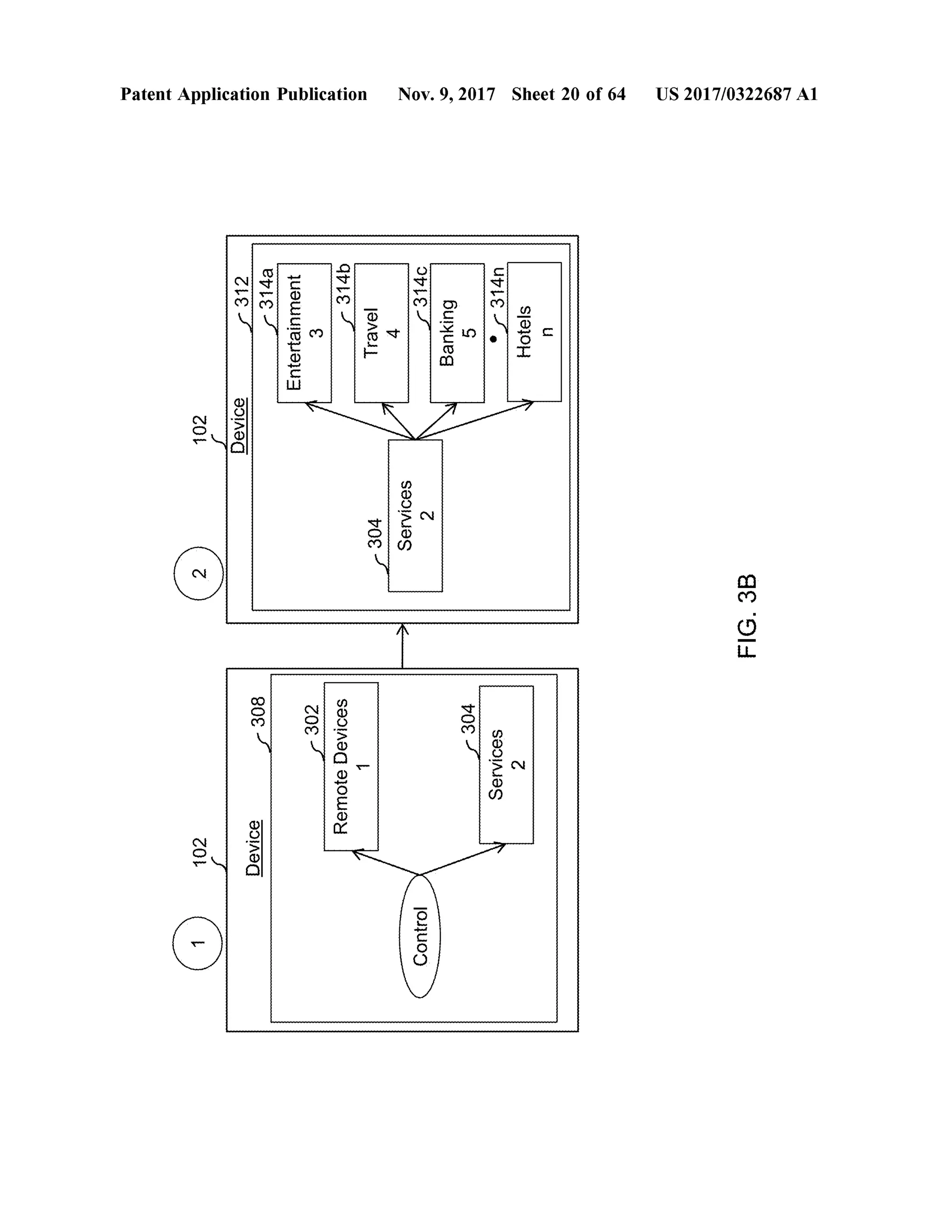
menu and enhanced visual access menu at a device, in
accordance with the first embodiment of the invention;
[0054] FIG . 3B illustrates an exemplary visual access
menu and enhanced visual access menu at the device, in
accordance with second embodiment of the invention;
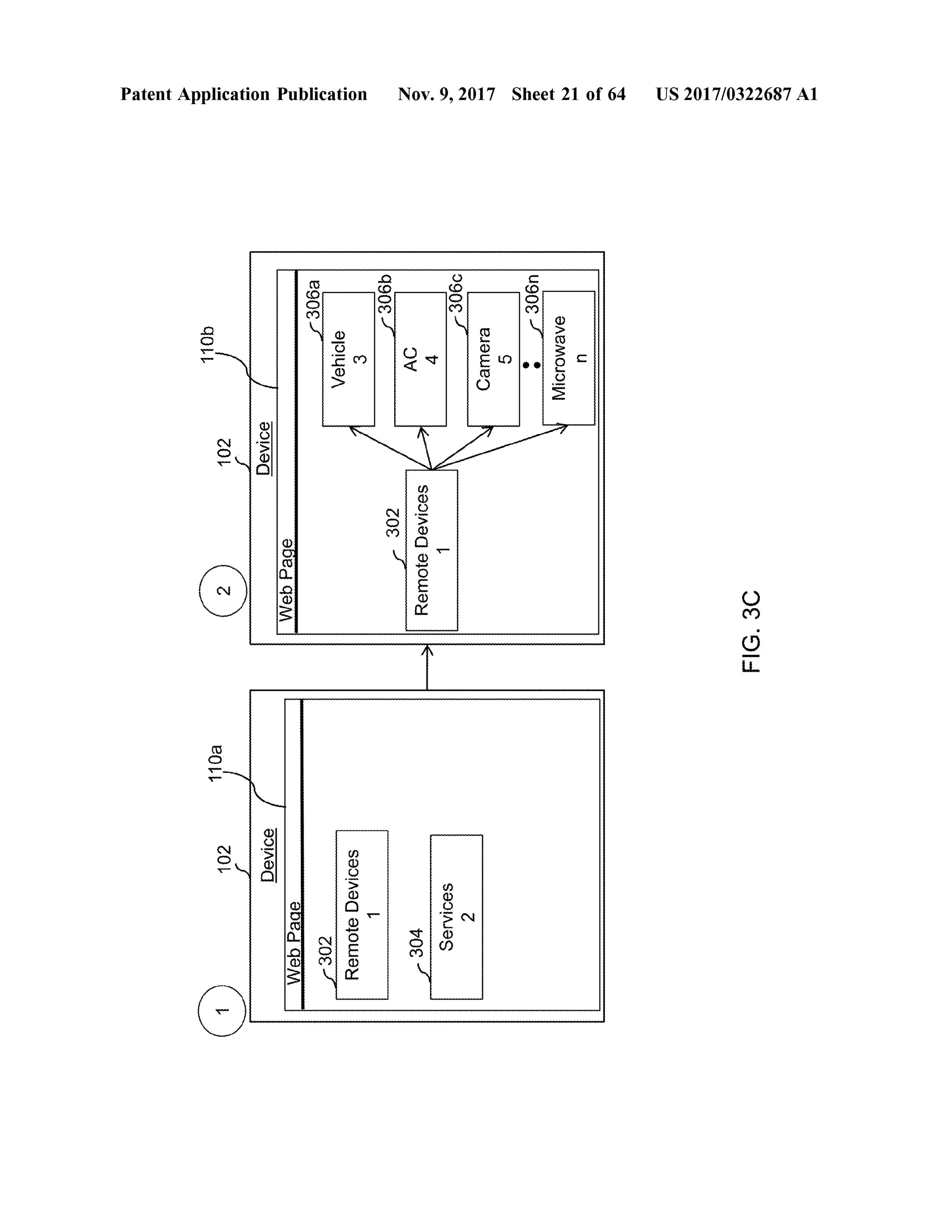
[0055] FIG . 3C illustrates anotherexemplary visualaccess
menu and enhanced visual access menu at the device, in
accordance with first embodiment ofthe invention;
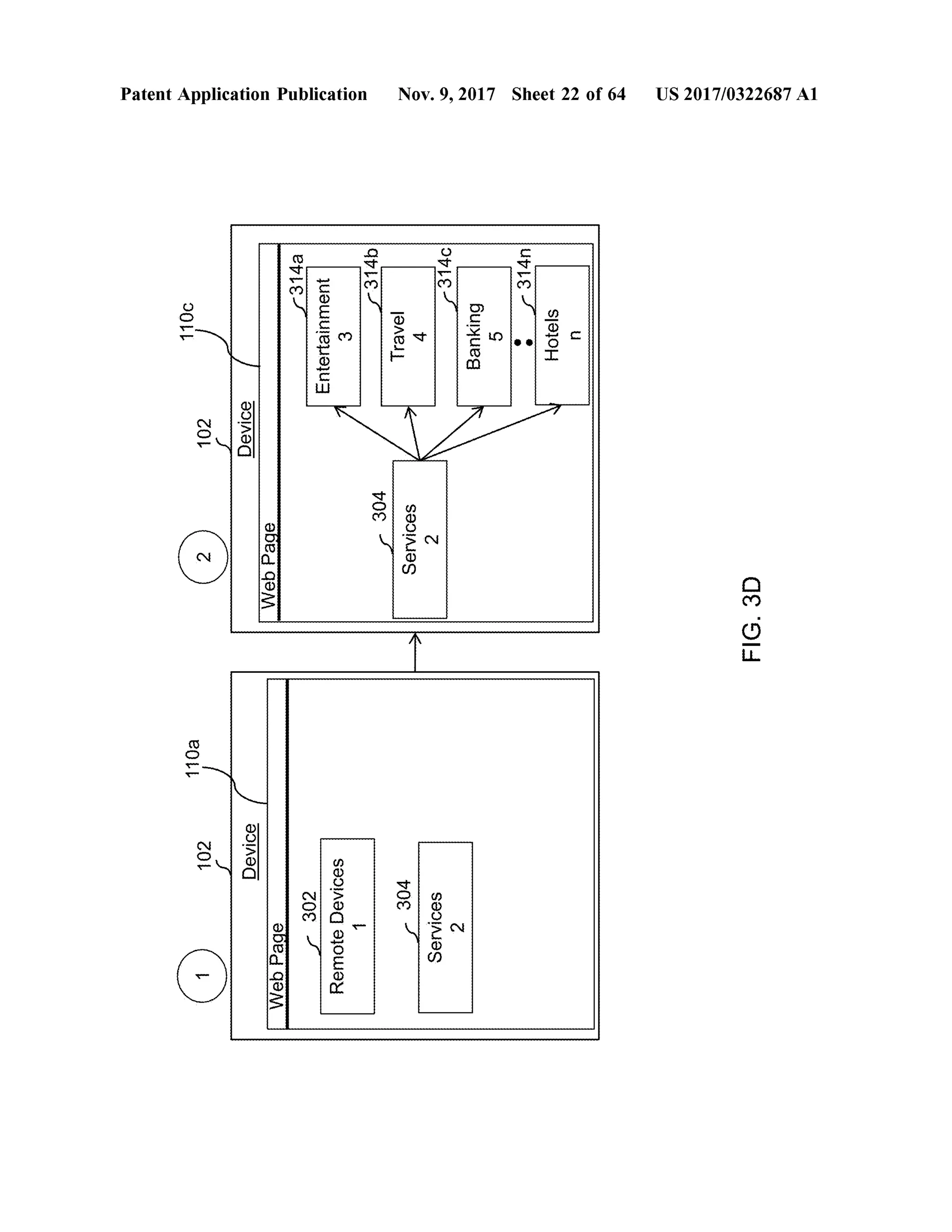
[0056 ) FIG .3D illustrates another exemplary visualaccess
menu and enhanced visual accessmenu at the device, in
accordance with second embodiment of the invention ;
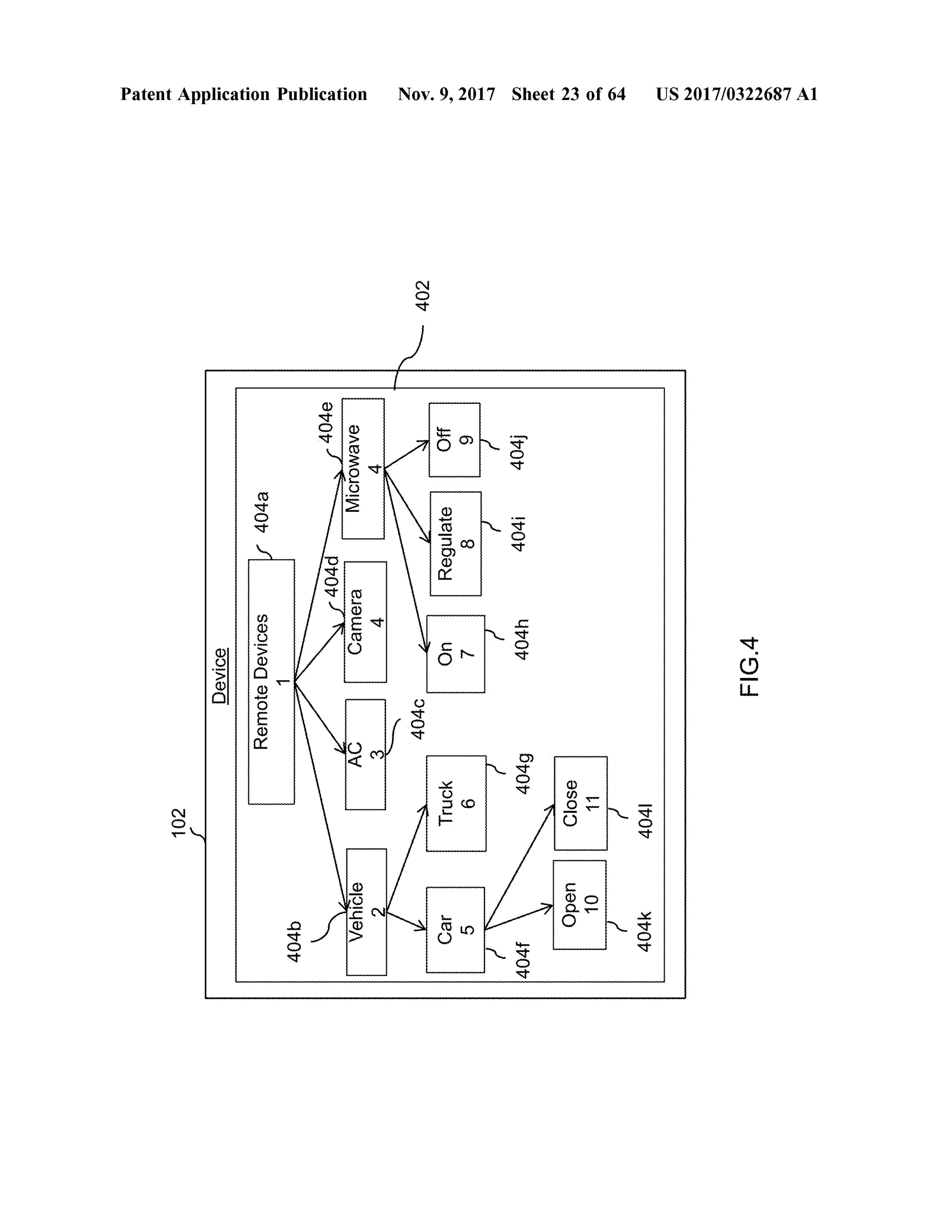
10057 ] FIG . 4 illustrates an exemplary enhanced visual
access menu including one or more device options, in
accordance with an embodiment of the invention.
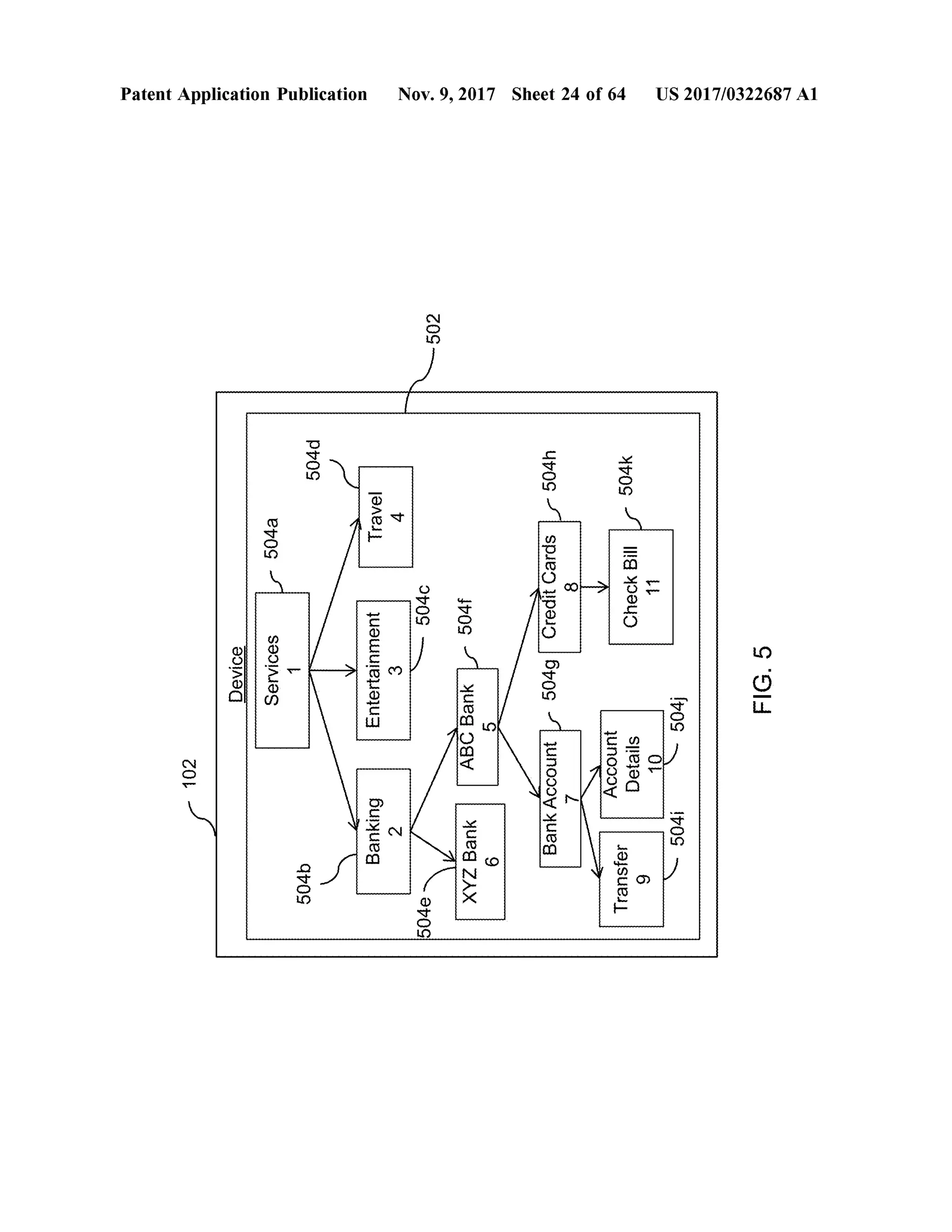
[0058] FIG . 5 illustrates an exemplary enhanced visual
access menu including one or more service options, in
accordance with an embodiment of the invention.
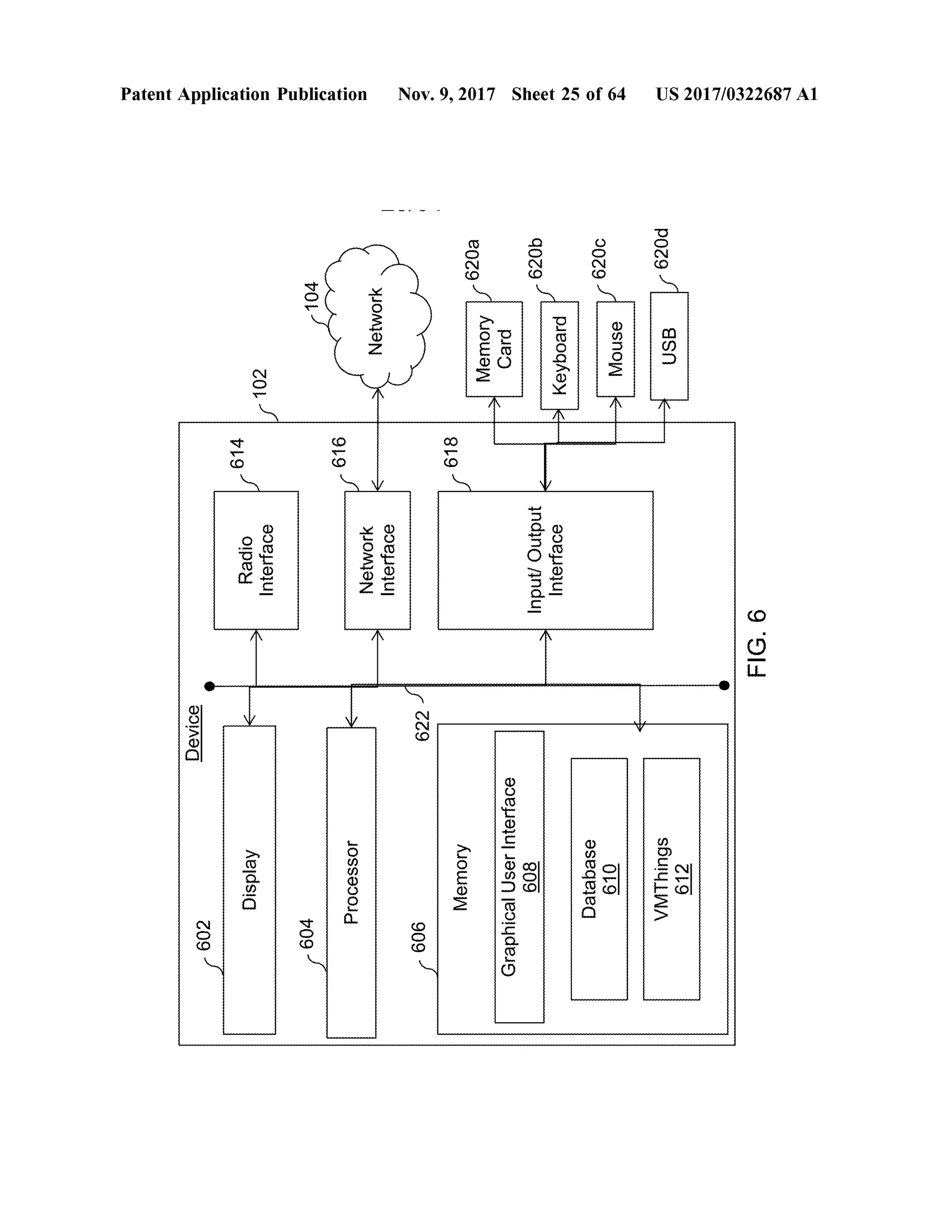
10059] FIG . 6 illustrates exemplary components of a
device, in accordance with an embodimentofthe invention;
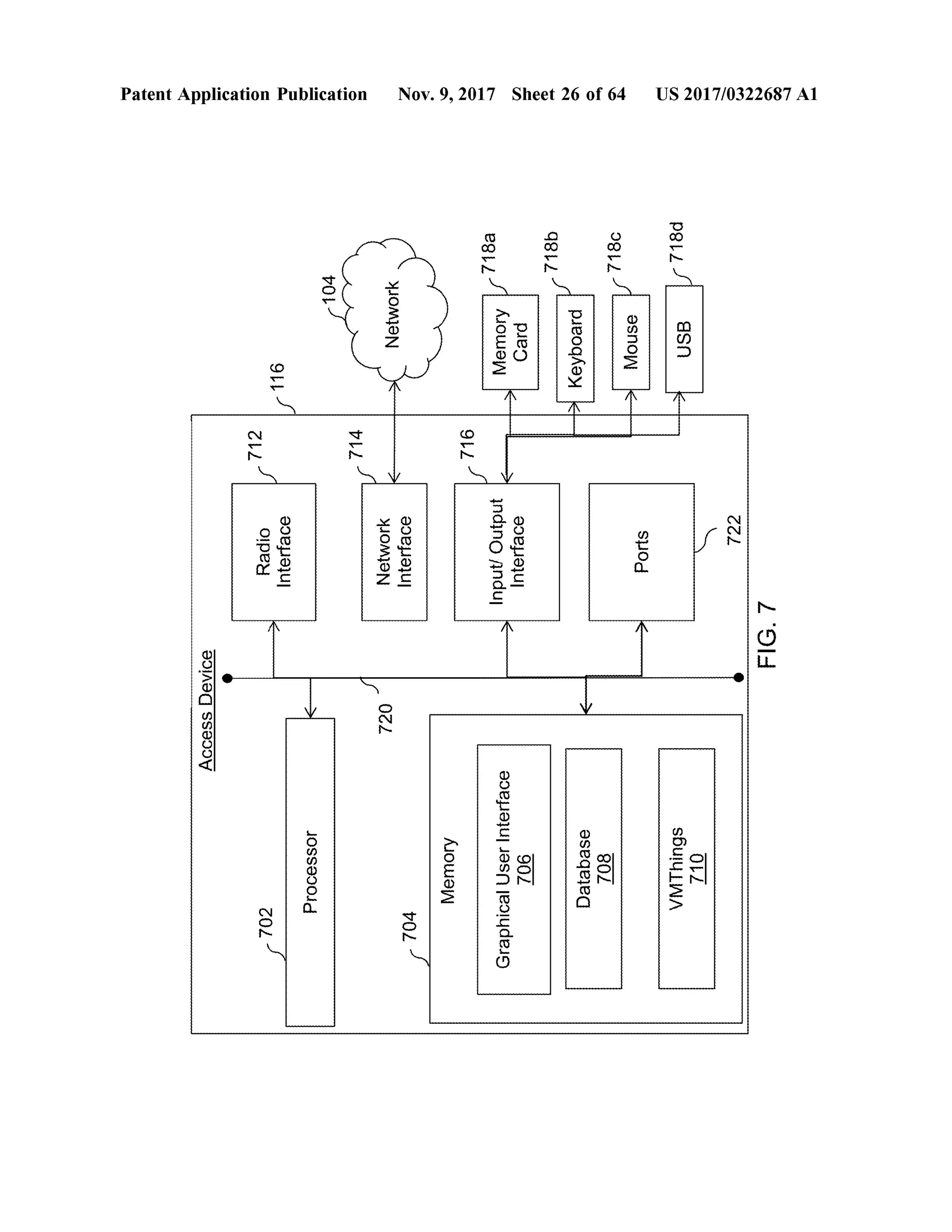
[0060] FIG . 7 illustrates exemplary components of an
access device, in accordance with an embodiment of the
invention;
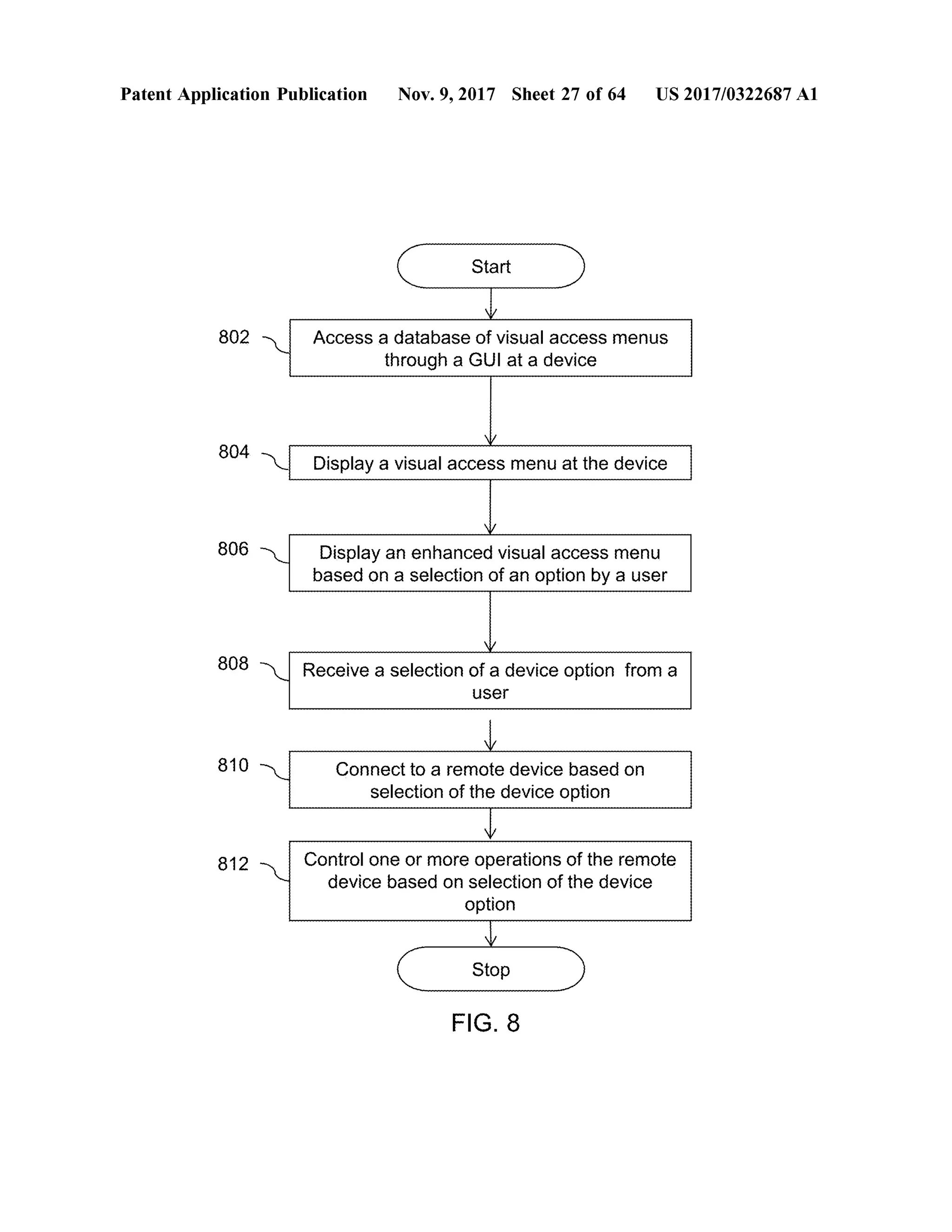
[0061] FIG . 8 illustrates a flow diagram for controlling
remote devices, in accordance with an embodiment of the
invention;
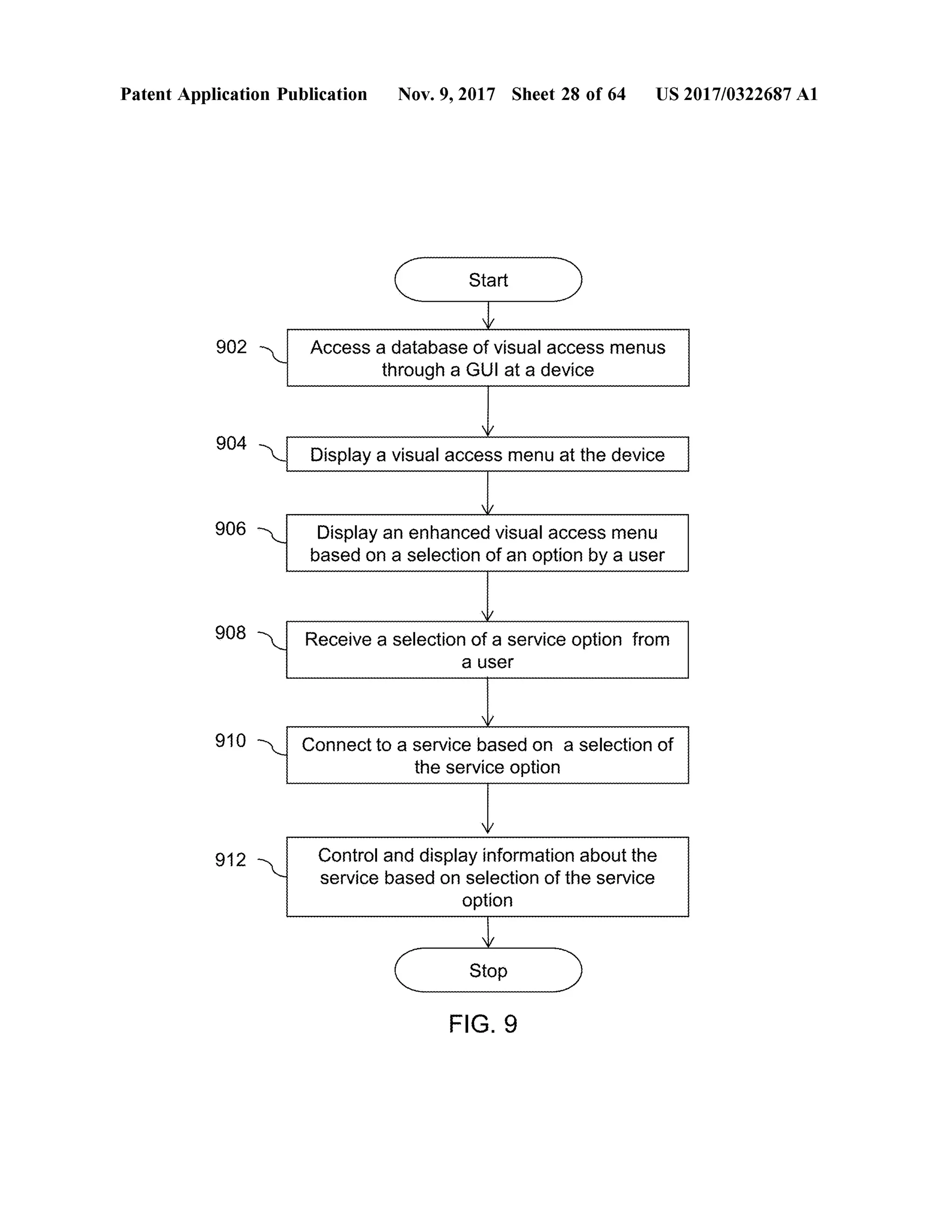
[0062] FIG . 9 illustrates a flow diagram for controlling
remote services, in accordance with an embodiment of the
invention;
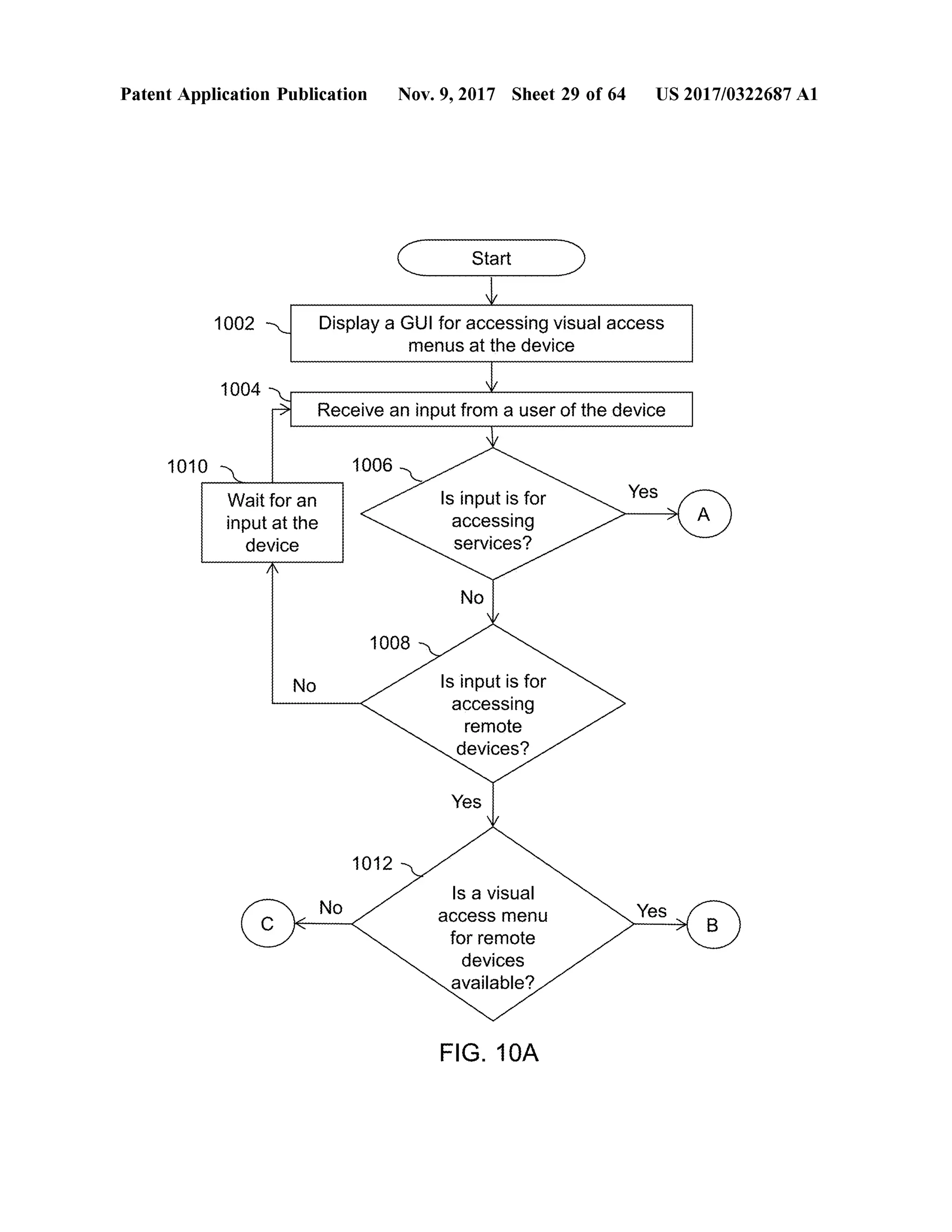
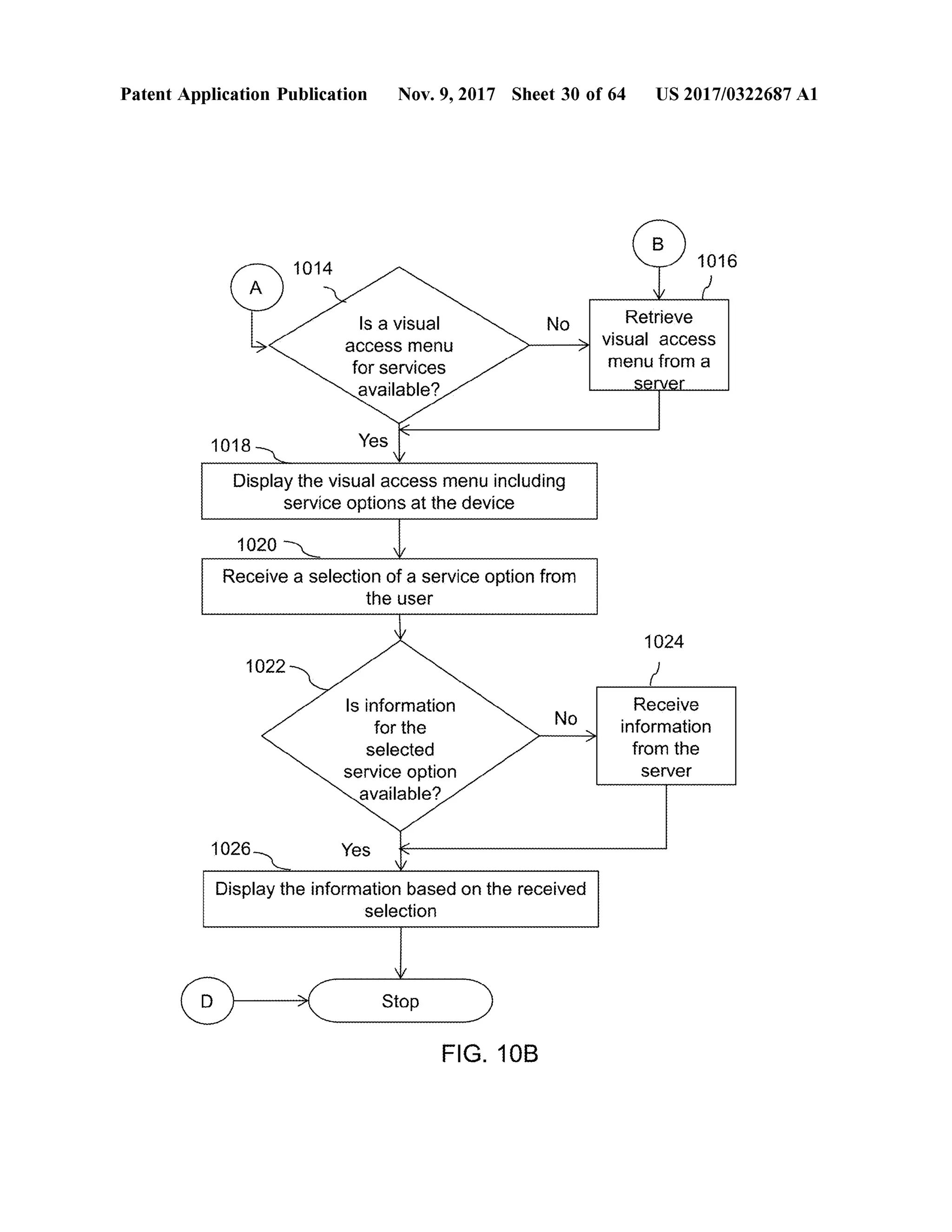
10063] FIGS. 10A , 10B , and 10C illustrate a flow diagram
for controlling objects by using a device in a network , in
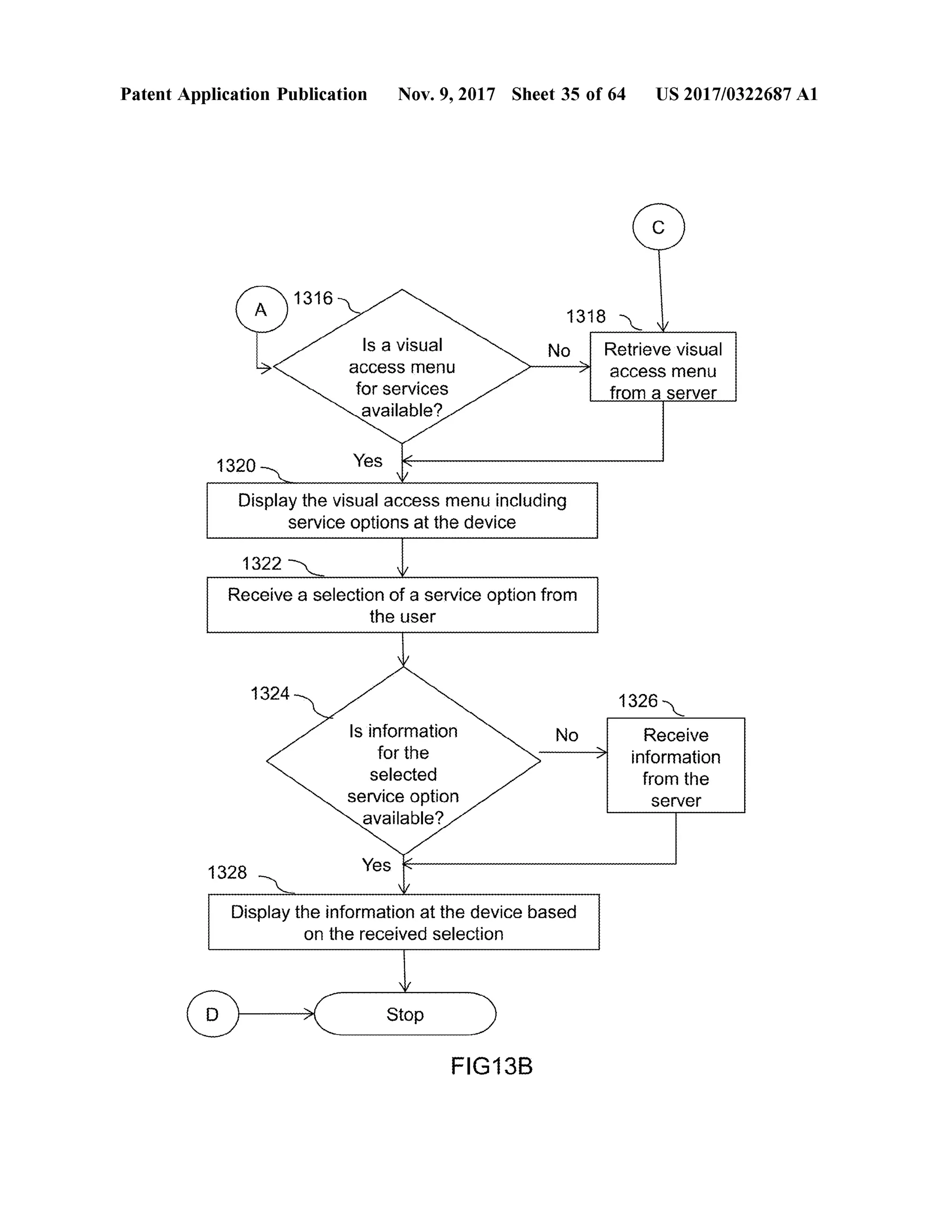
accordance with an embodiment of the invention;
[0064] FIG . 11 illustrates a flow diagram for controlling
remote devices by using a web browser at a device, in
accordance with an embodiment of the invention;
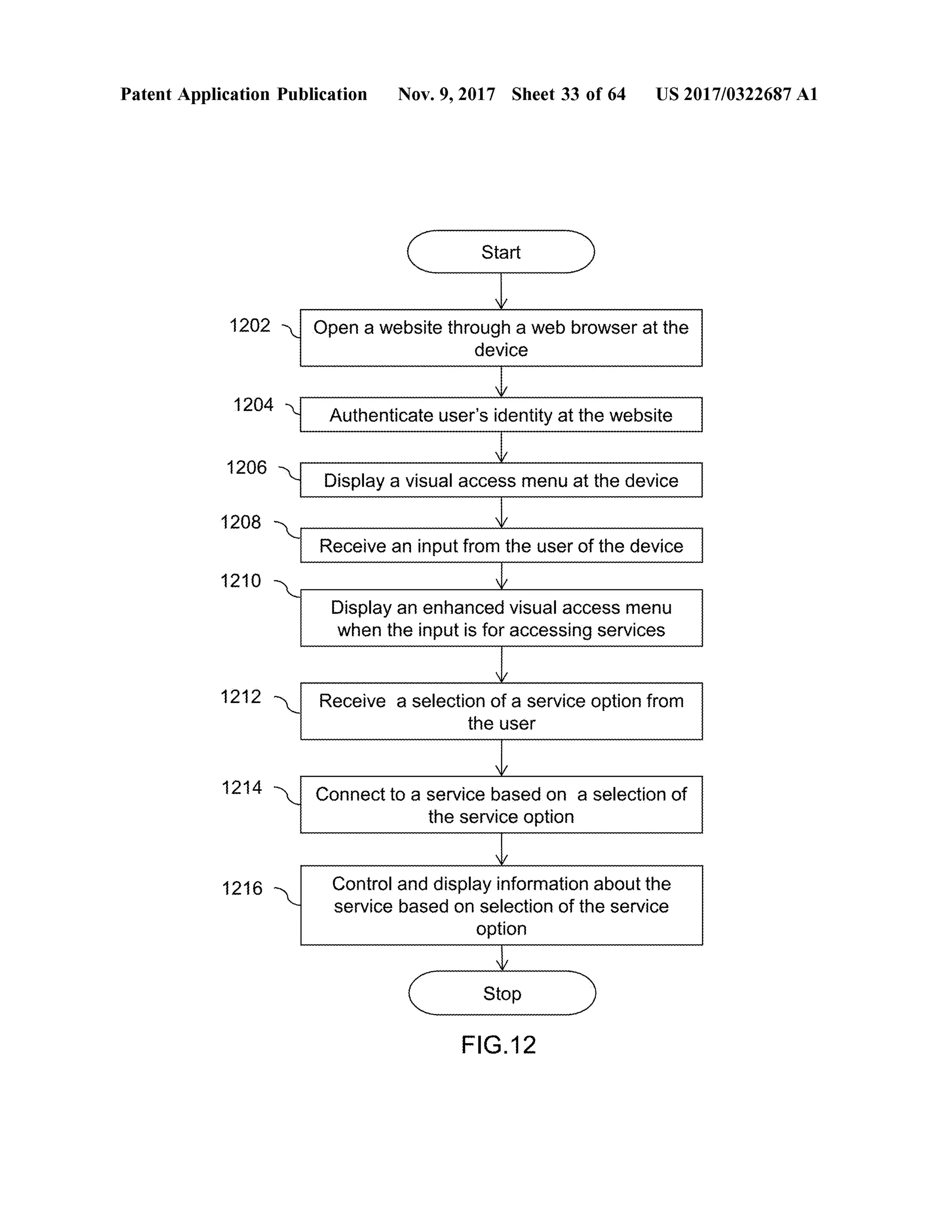
[0065) FIG . 12 illustrates a flow diagram for controlling
remote services by using a web browser at a device, in
accordance with an embodiment of the invention;
[0066] FIGS. 13A, 13B ,and 13C illustrate a flow diagram
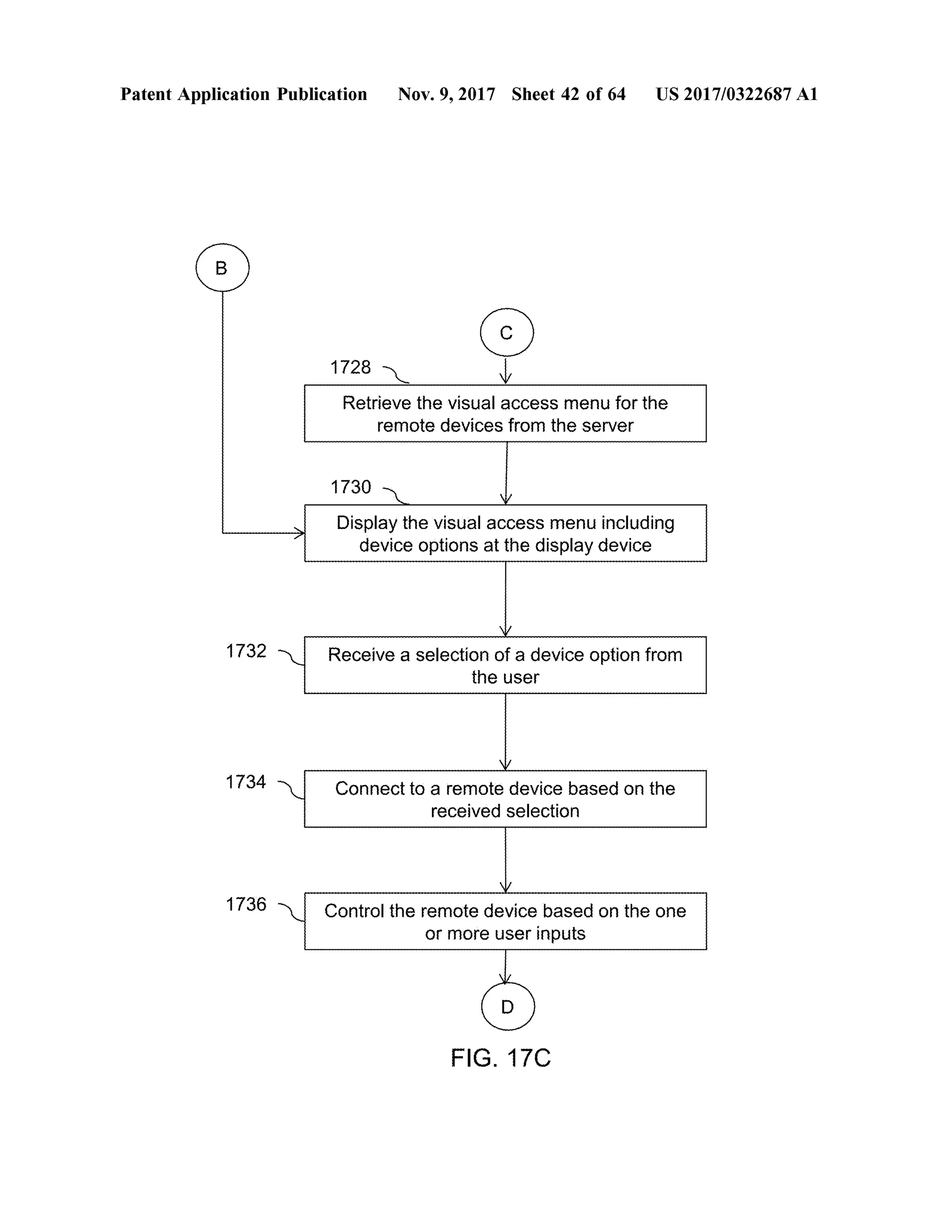
for controlling objects in a network through a web browser
at a device, in accordance with an embodiment of the
invention ; and
[0067] FIG . 14 illustrates a flow diagram for controlling
remote devices through a website, in accordance with
another embodimentof the invention;
[0068] FIG . 15 illustrates a flow diagram for controlling
remote devices by using an access device in a network, in
accordance with an embodiment ofthe invention;
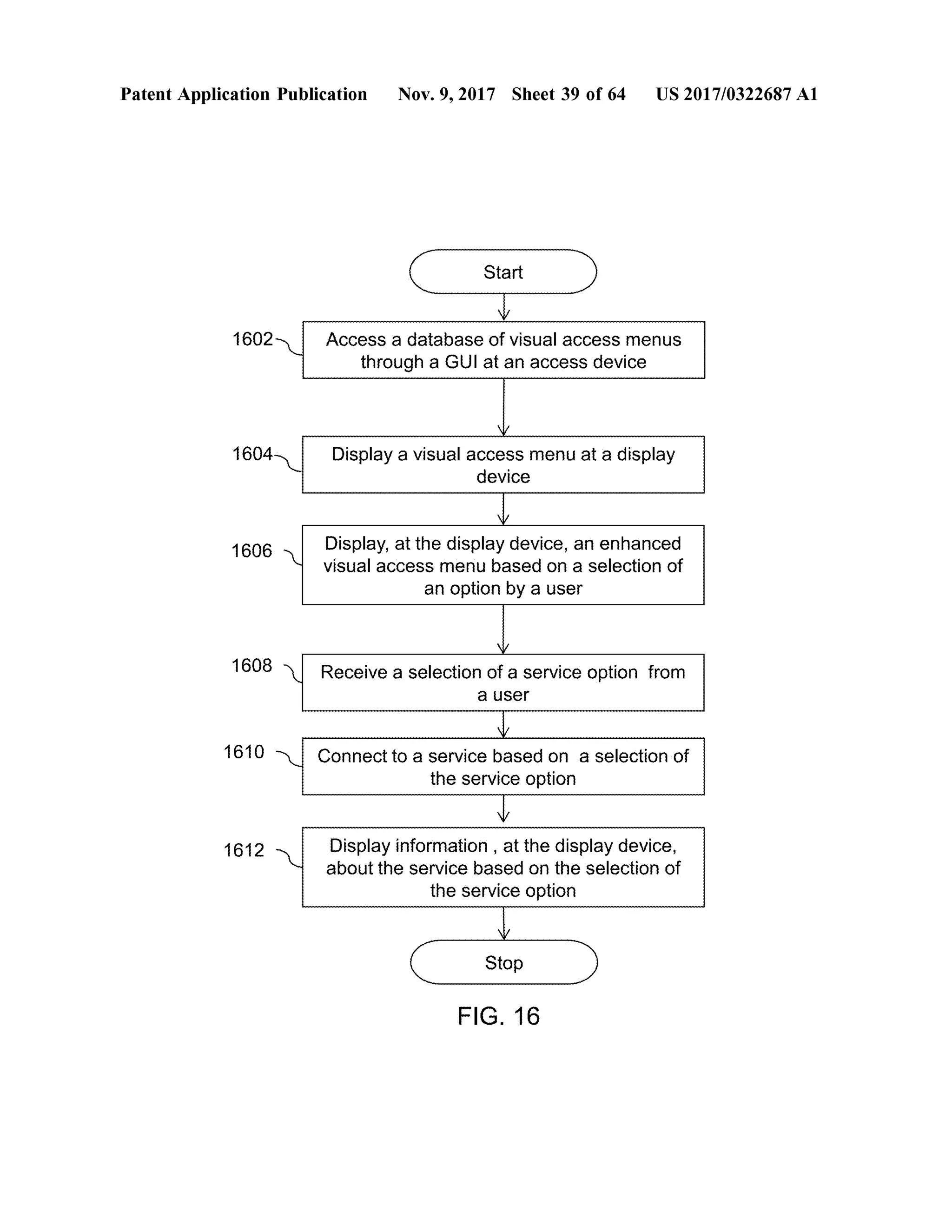
[0069] FIG . 16 illustrates a flow diagram for controlling
remote servicesby using an access device in a network , in
accordance with an embodiment of the invention;
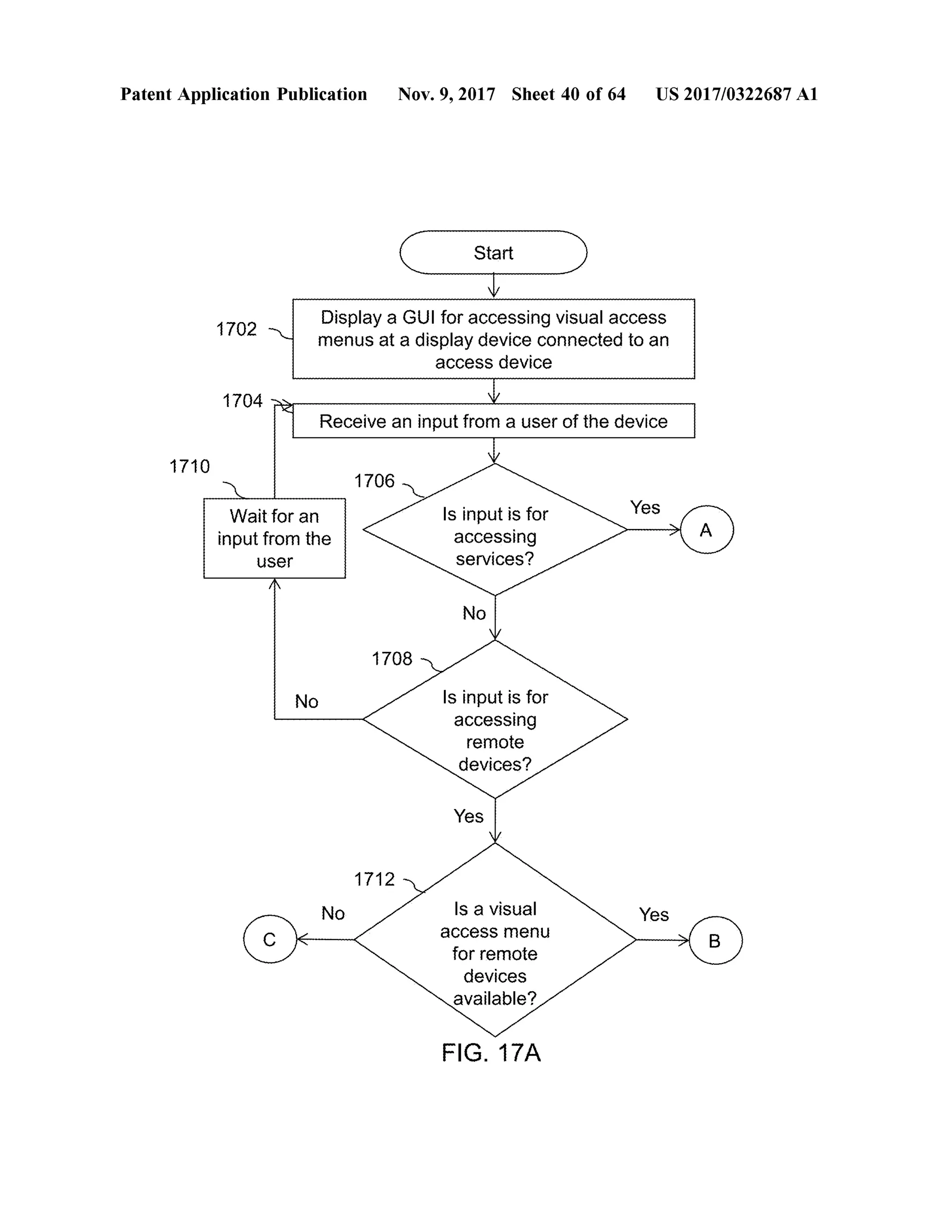
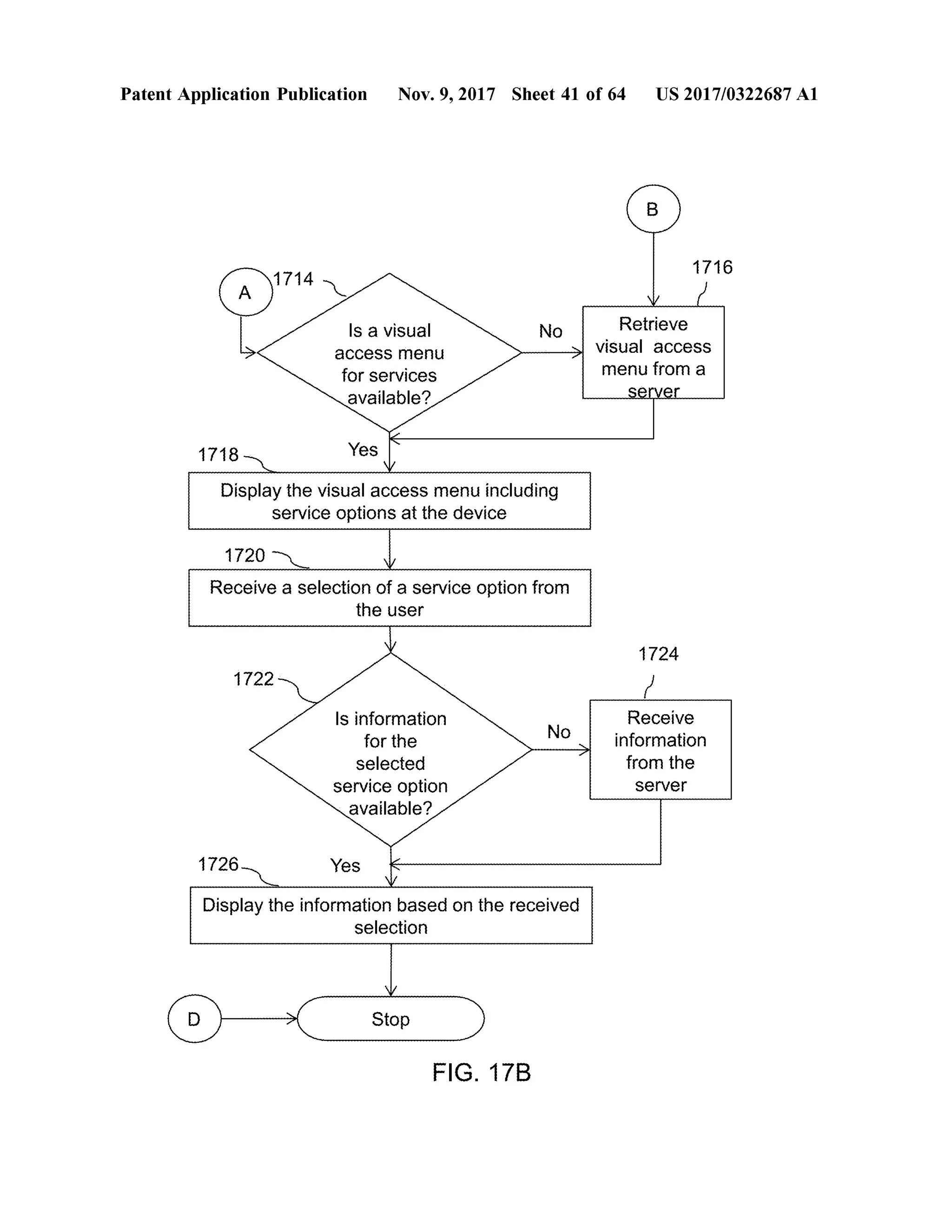
10070] FIGS. 17A , 17B , and 17C illustrate a flow diagram
for controlling objects in a network devices through an
access device, in accordance with an embodiment of the
invention;
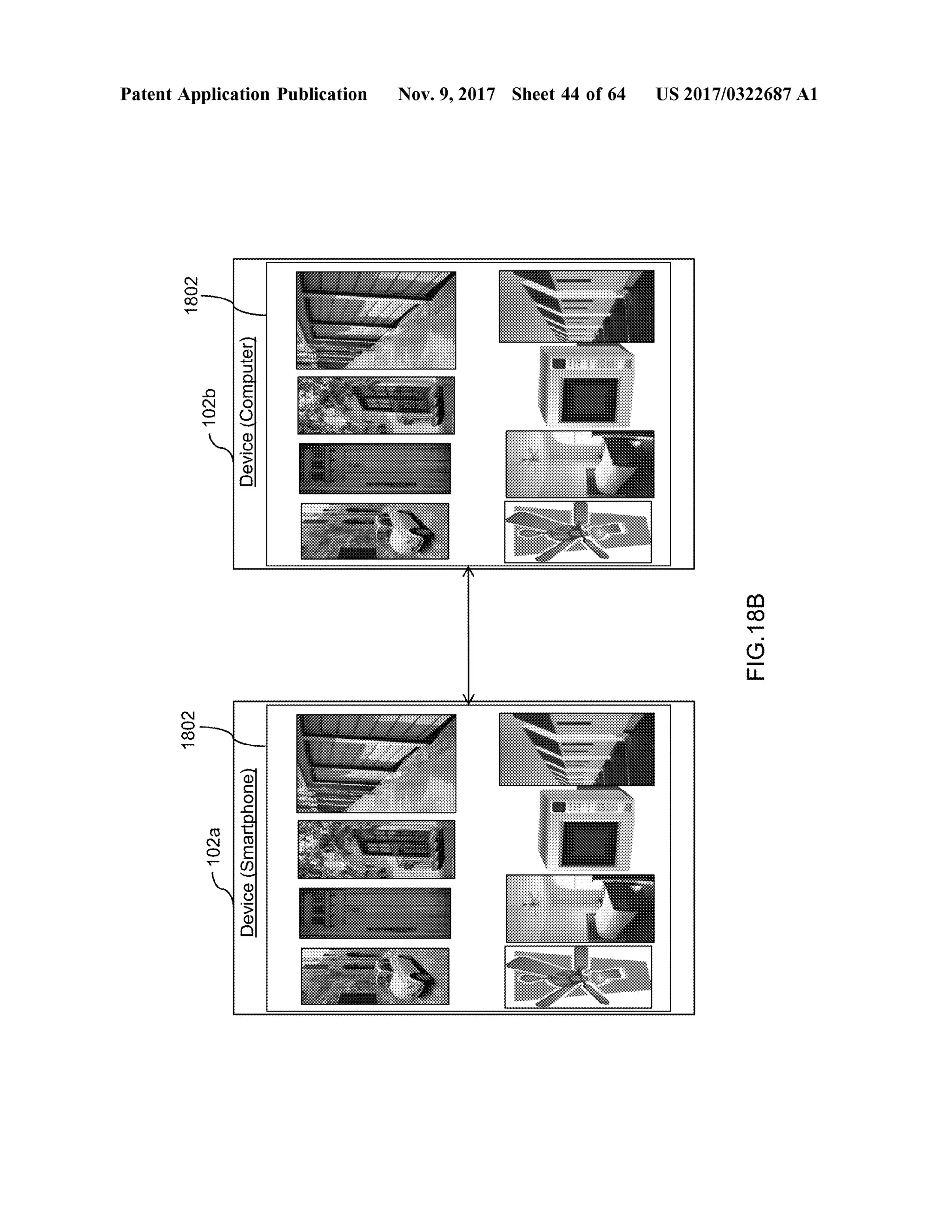
[0071] FIG . 18A illustrates an exemplary display of
images ofremote devices, in an embodiment of the inven
tion;
[0072] FIG . 18B illustrates transfer ofan exemplary dis
play of images from a device to another device, in an
embodiment of the invention ;
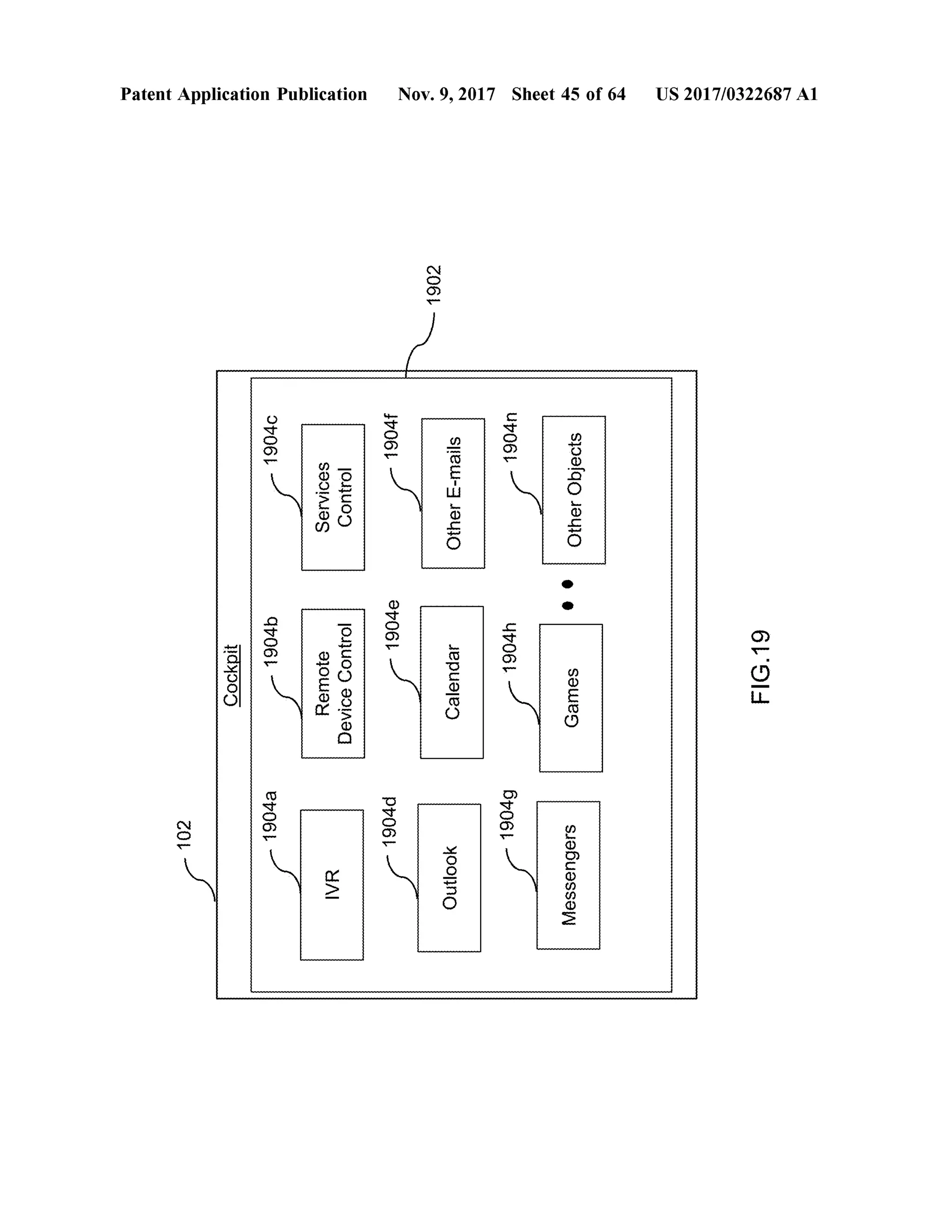
[0073] FIG . 19 illustrates an exemplary display of a cock
pit 1902 at the device 102, in accordance with an embodi
ment of the invention;
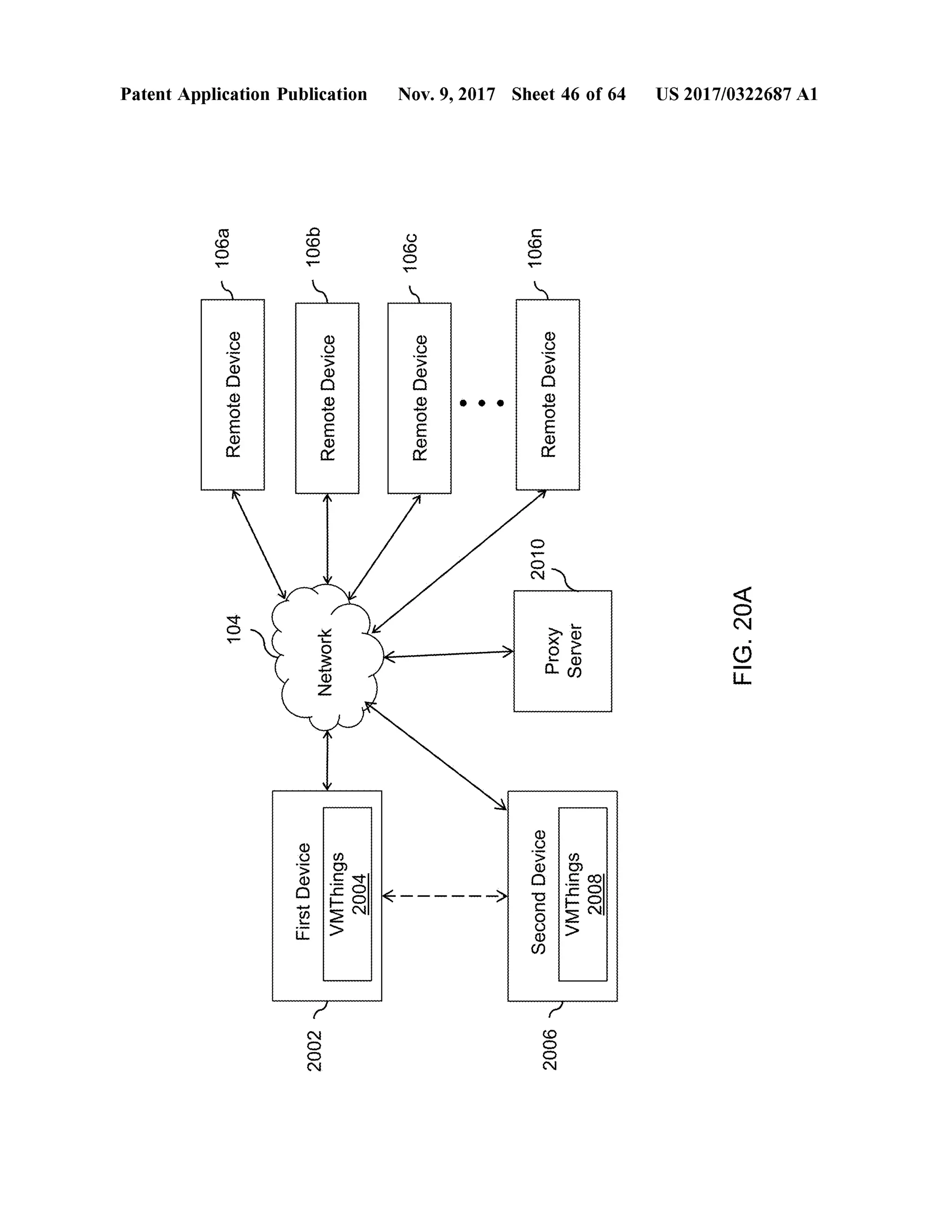
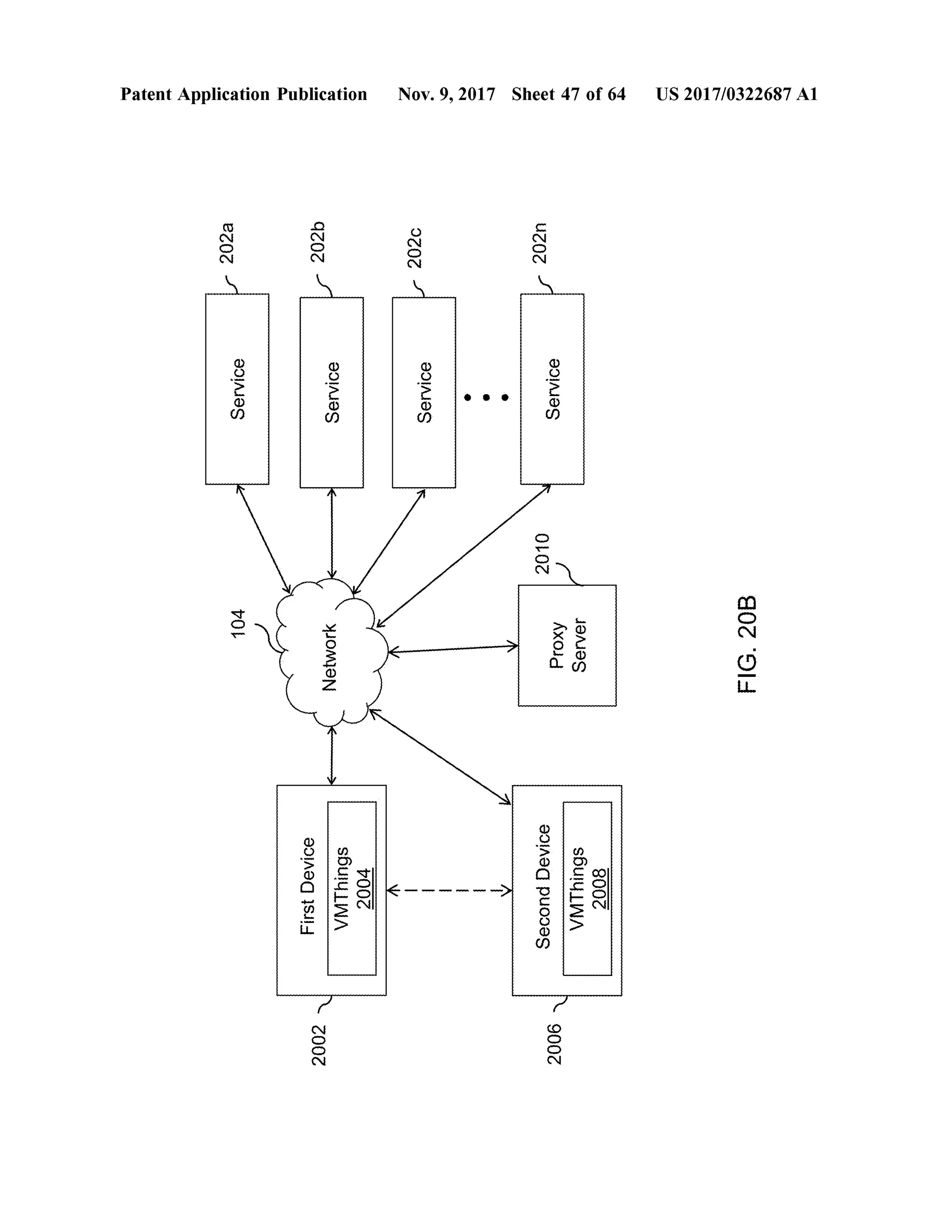
[0074] FIGS. 20A-20B illustrate exemplary environments
for providing access ofthe cockpit 1902 of a user to other
users, in accordance with an embodiment of the invention ;
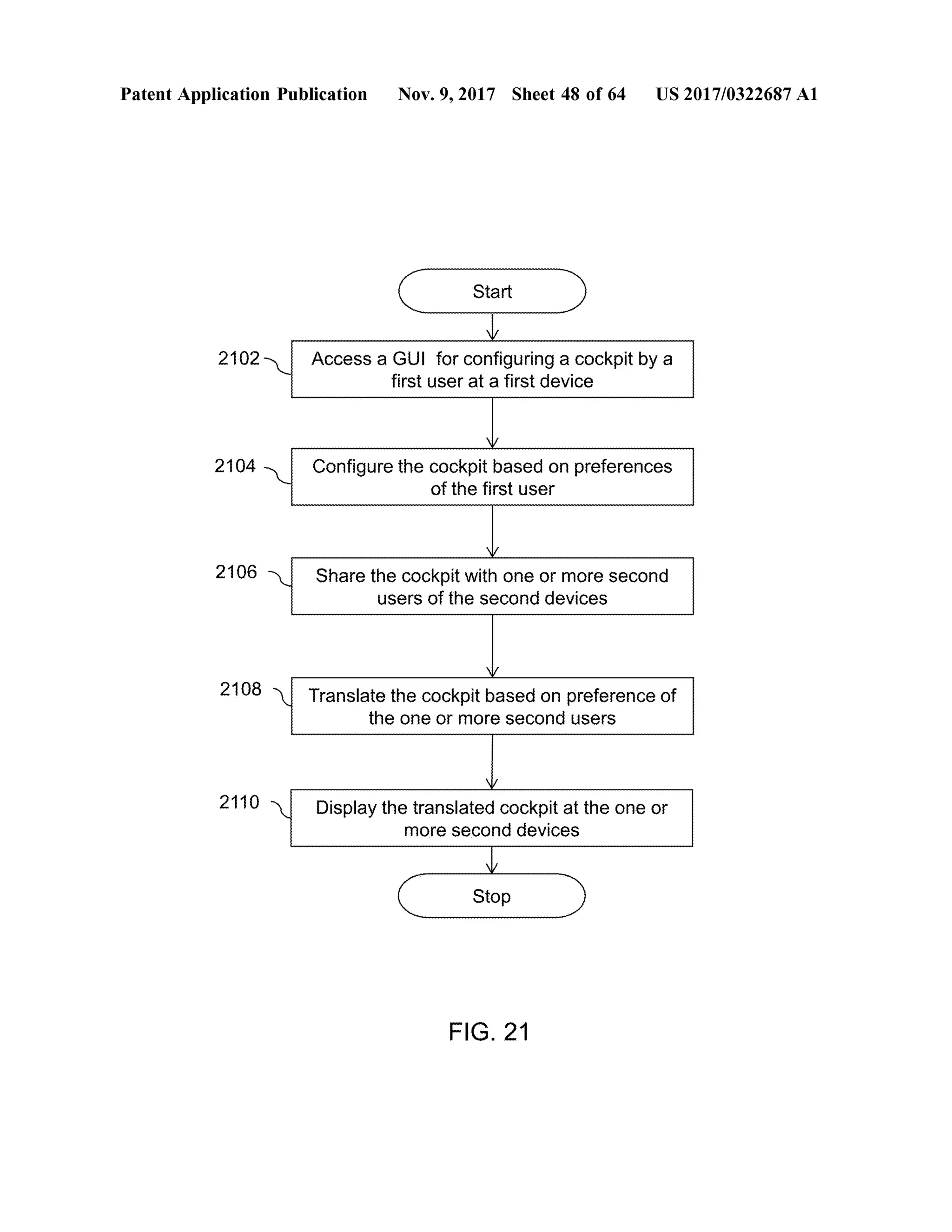
[0075] FIG . 21 illustrates a flow diagram for providing
access control of a cockpit to one ormore second users, in
accordance with an embodimentof the invention; and
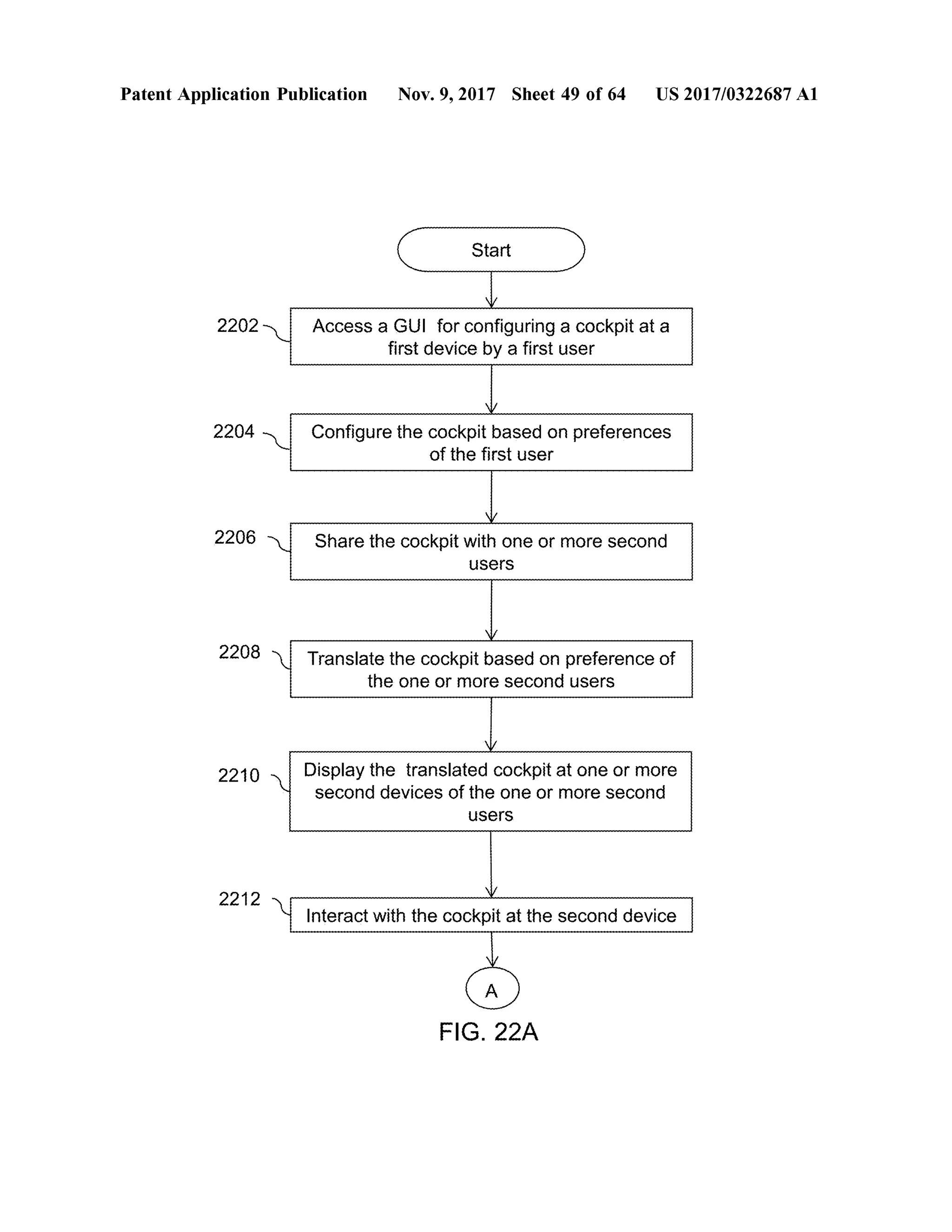
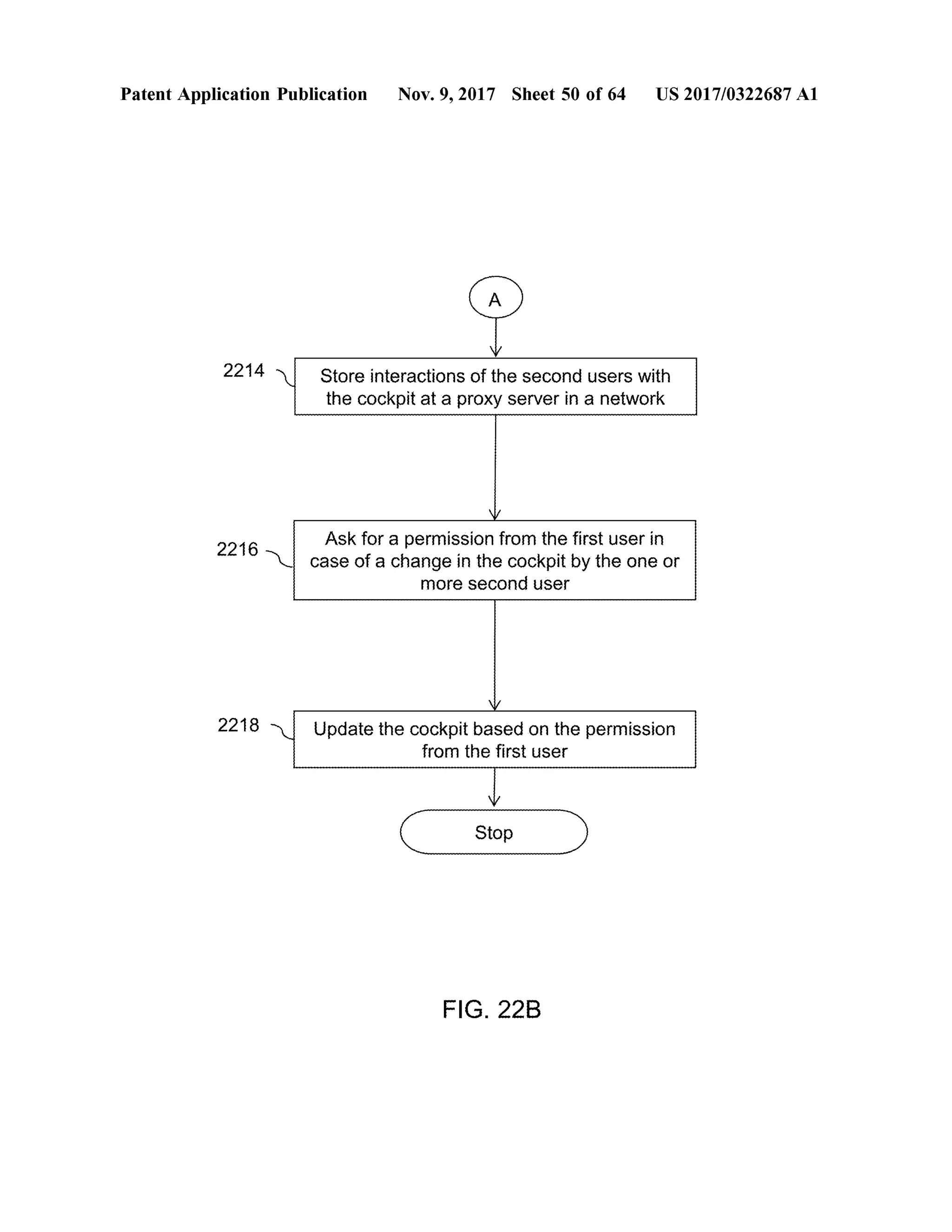
[0076 ] FIGS. 22A -22B illustrate a flow diagram for pro
viding access control of the cockpit to one ormore second
users, in accordance with another embodimentof the inven
tion ;
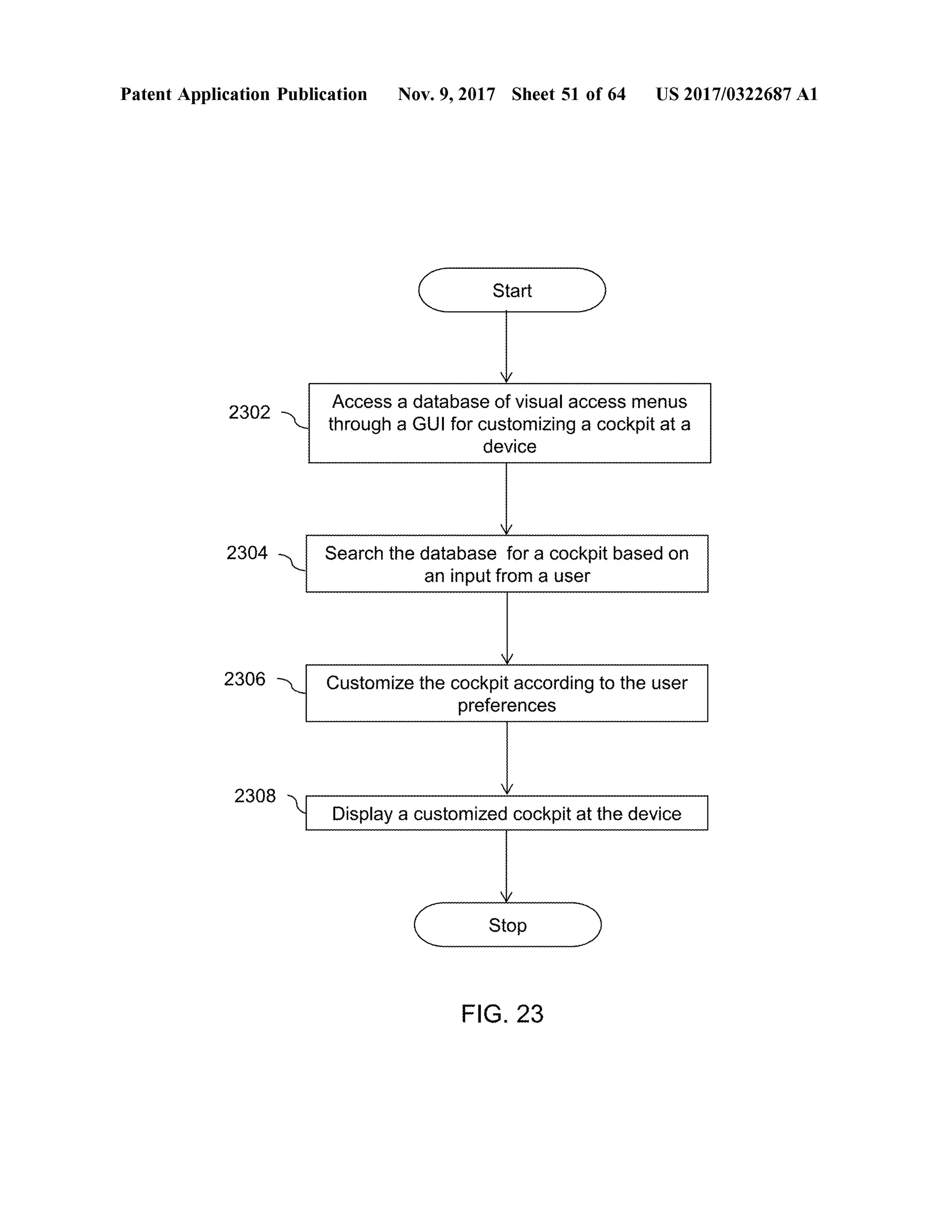
[0077] FIG . 23 illustrates a flow diagram for configuring
a cockpit based on user's preference, in accordance with an
embodiment of the invention;
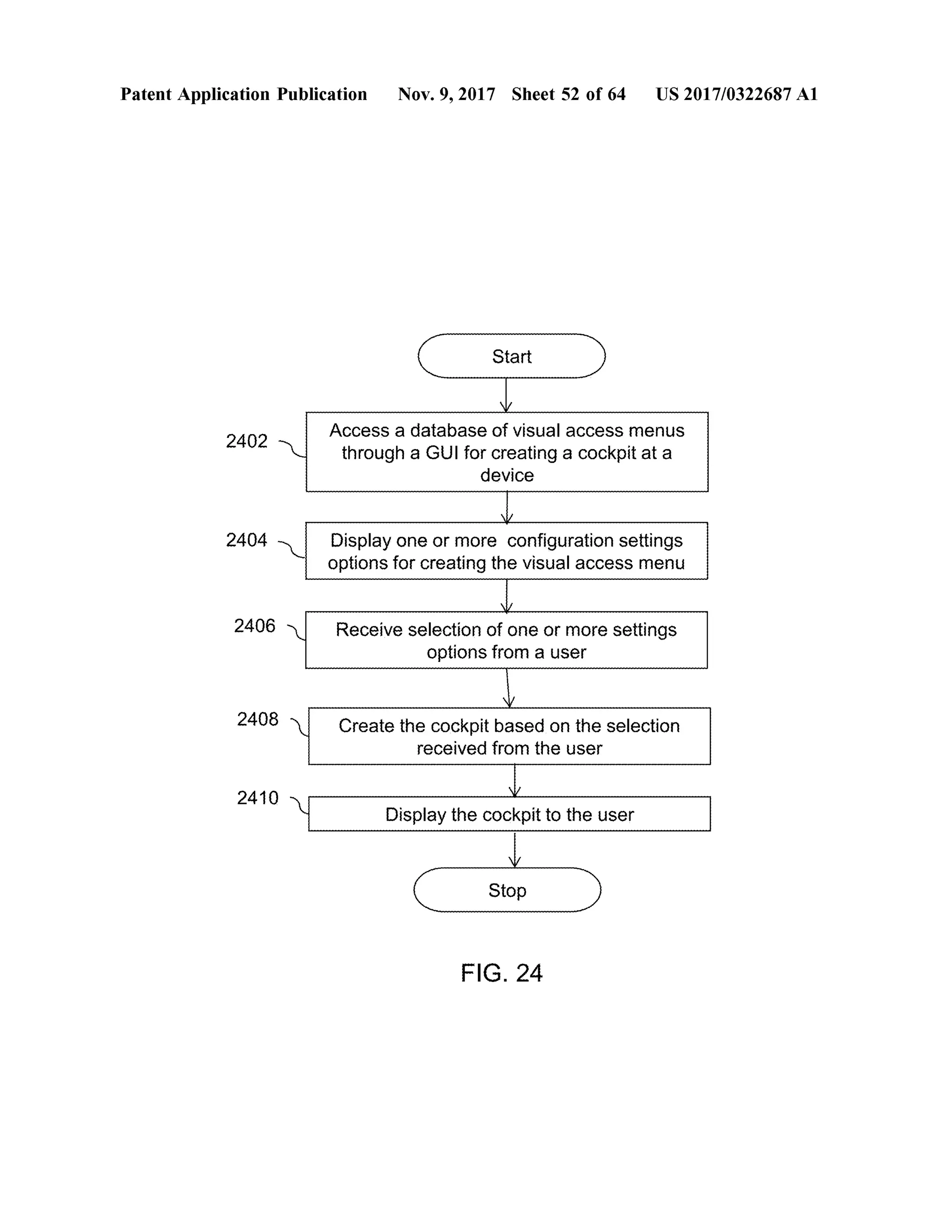
10078] FIG . 24 illustrates a flow diagram for configuring
a cockpit, in accordance with an embodiment of the inven
tion;
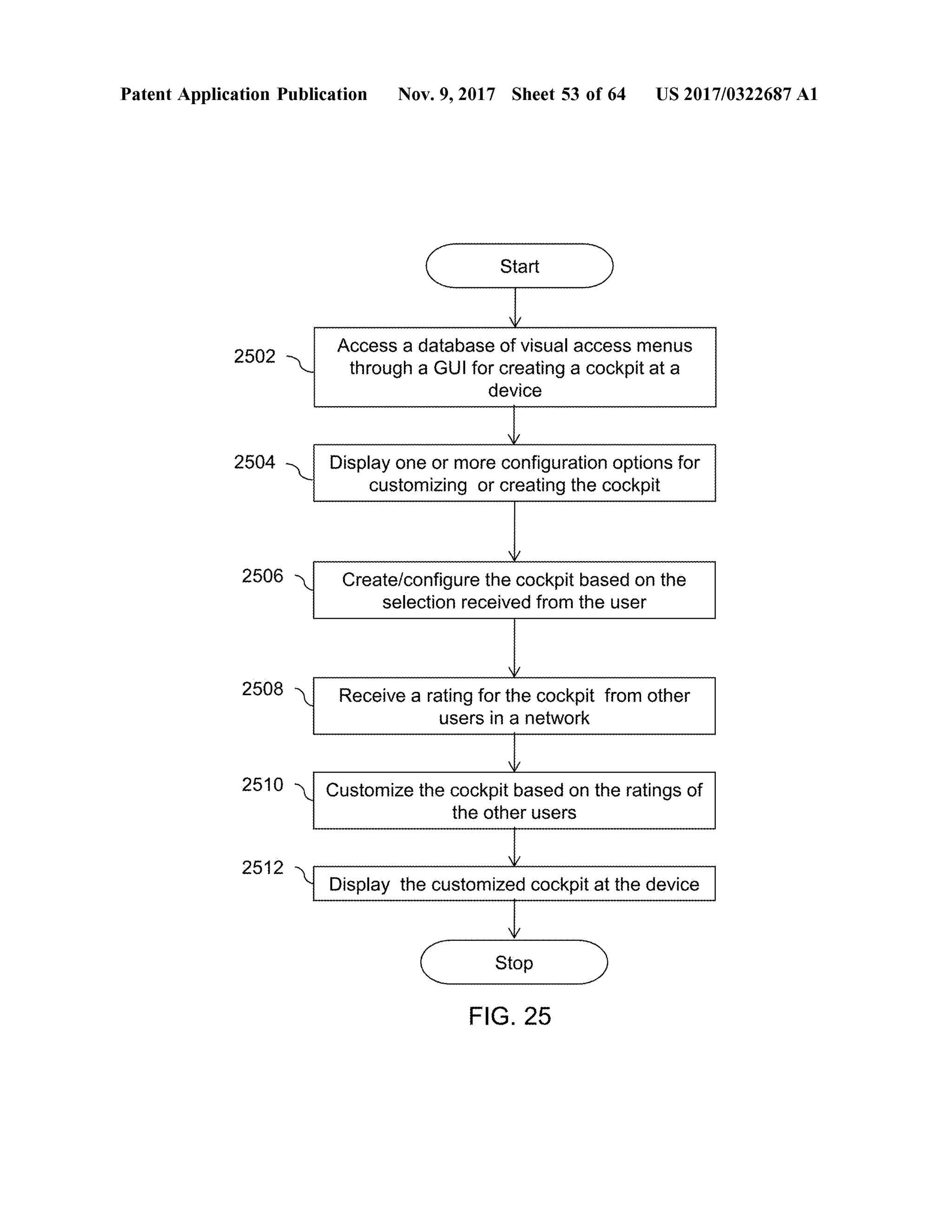
100791. FIG . 25 illustrates a flow diagram for customizing
a cockpit based on other users ' reviews, in accordance with
an embodiment of the invention;
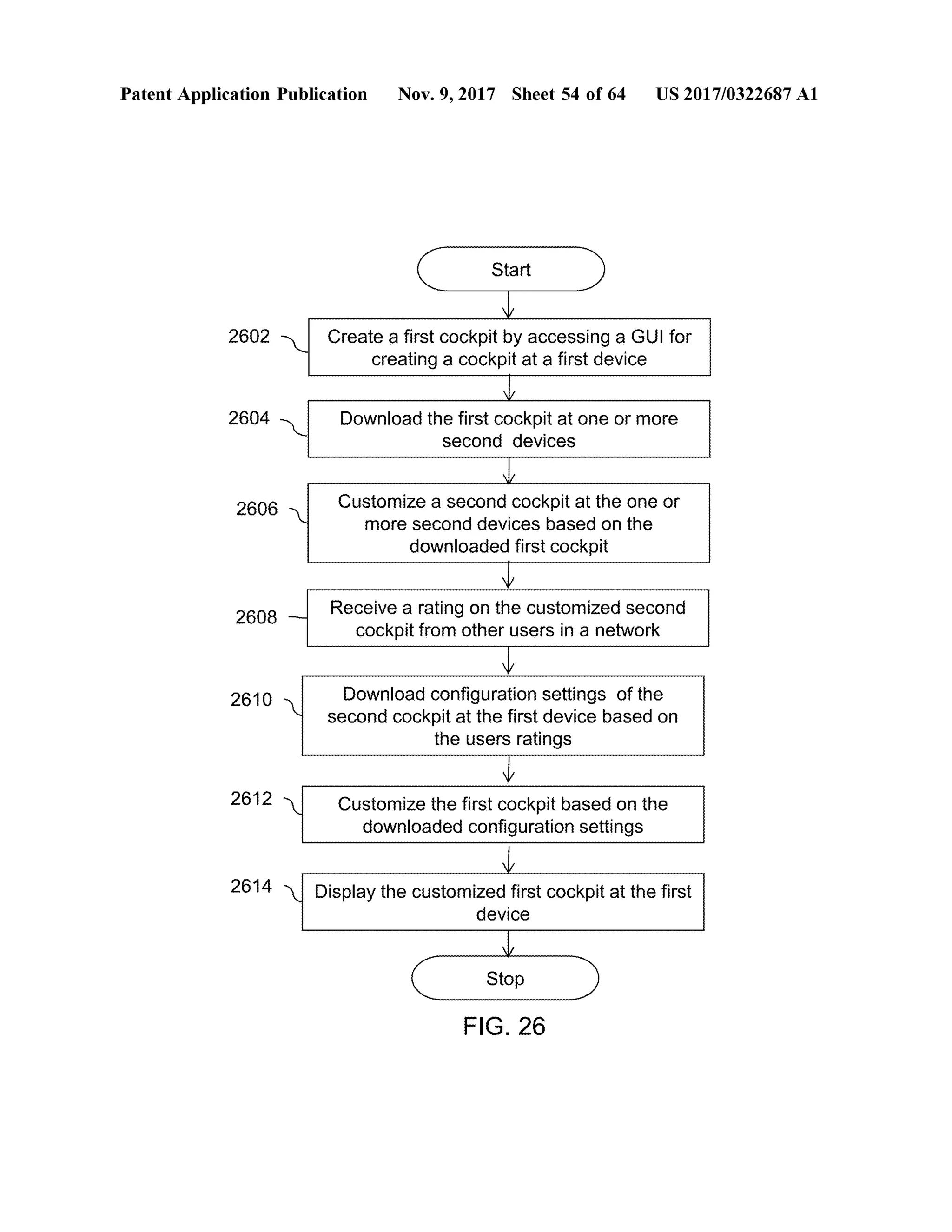
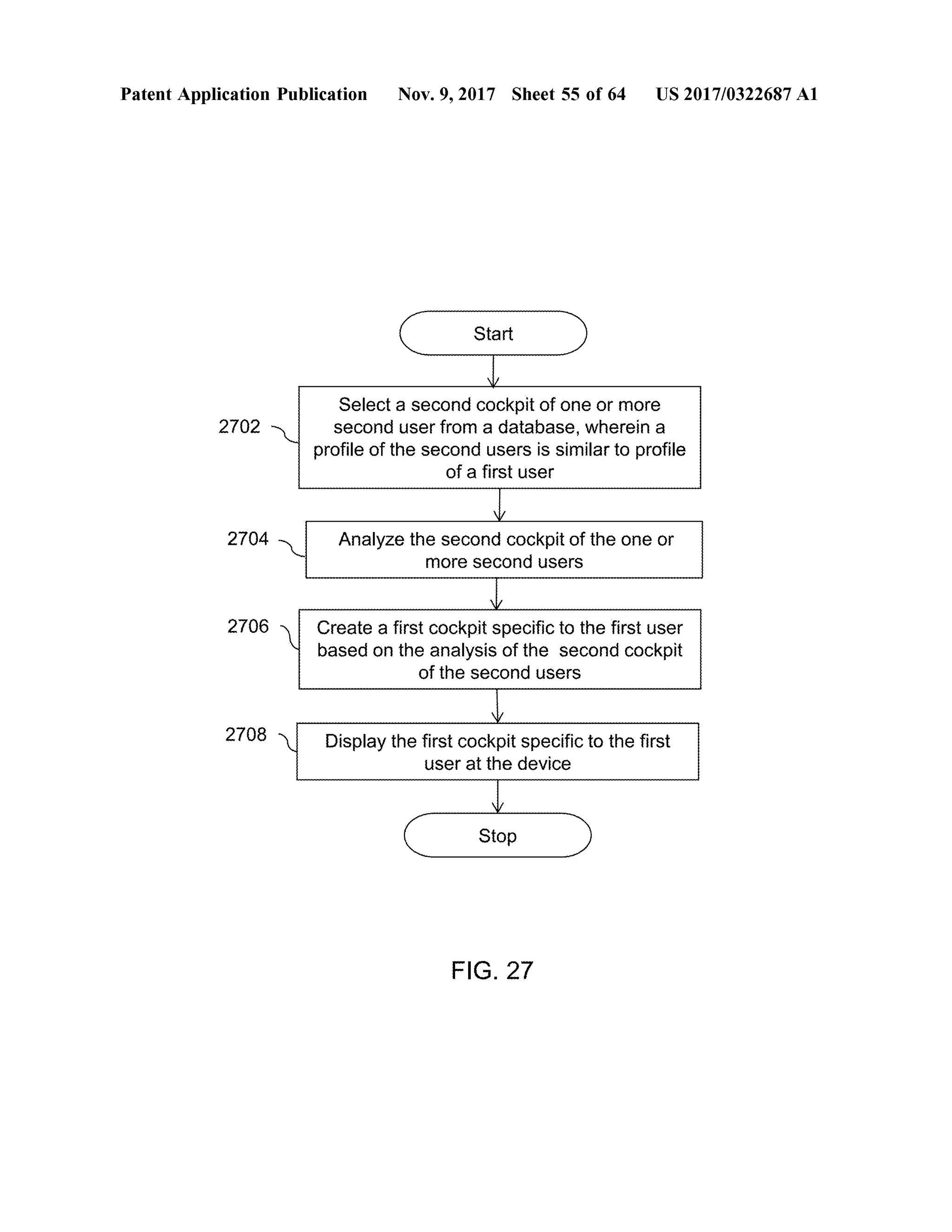
[0080] FIG . 26 illustrates a flow diagram fordownloading
and customizing a cockpitat a second device, in accordance
with an embodimentof the invention;
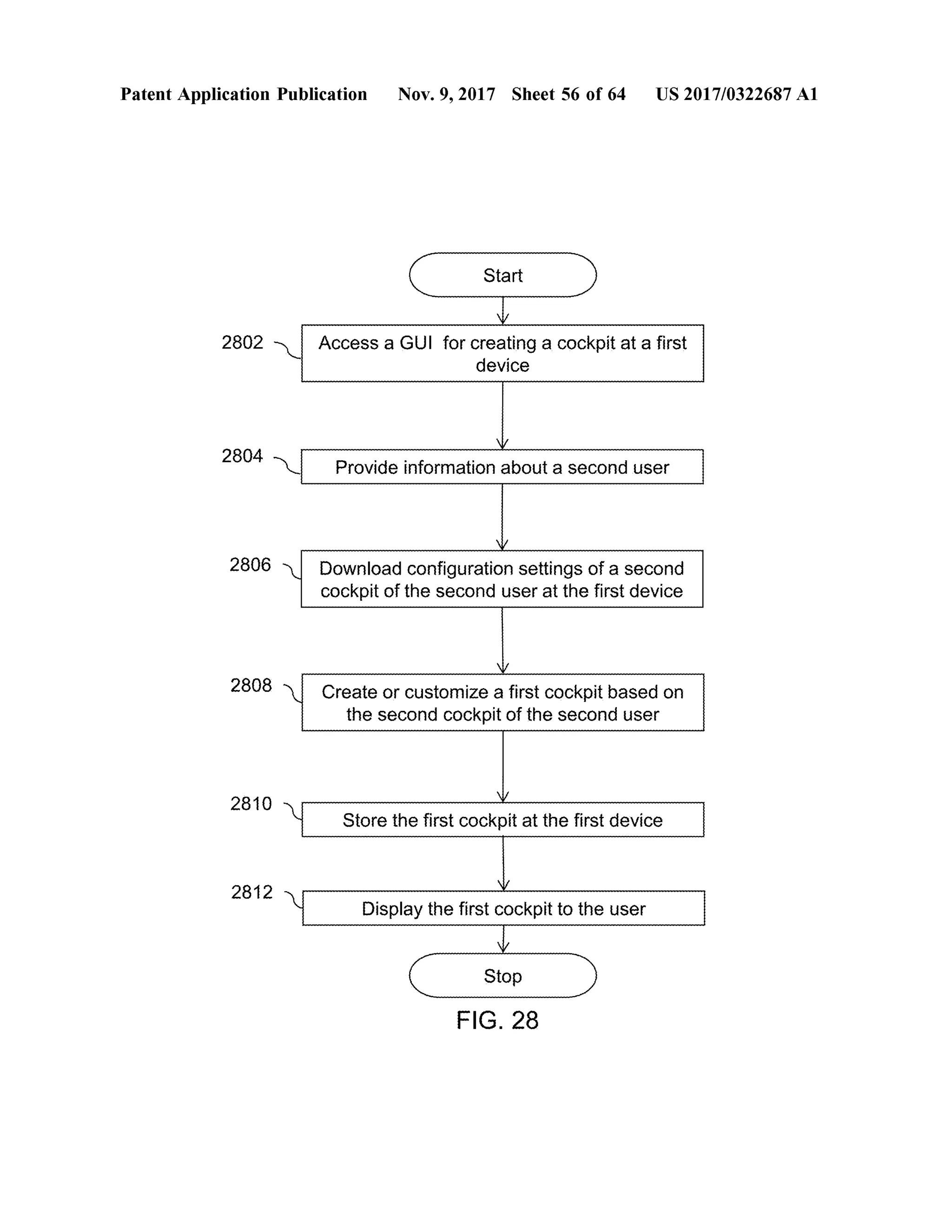
[0081] FIG . 27 illustrates a flow diagram for configuring
a cockpit based on another cockpit of other user, in accor
dance with an embodiment of the invention ;
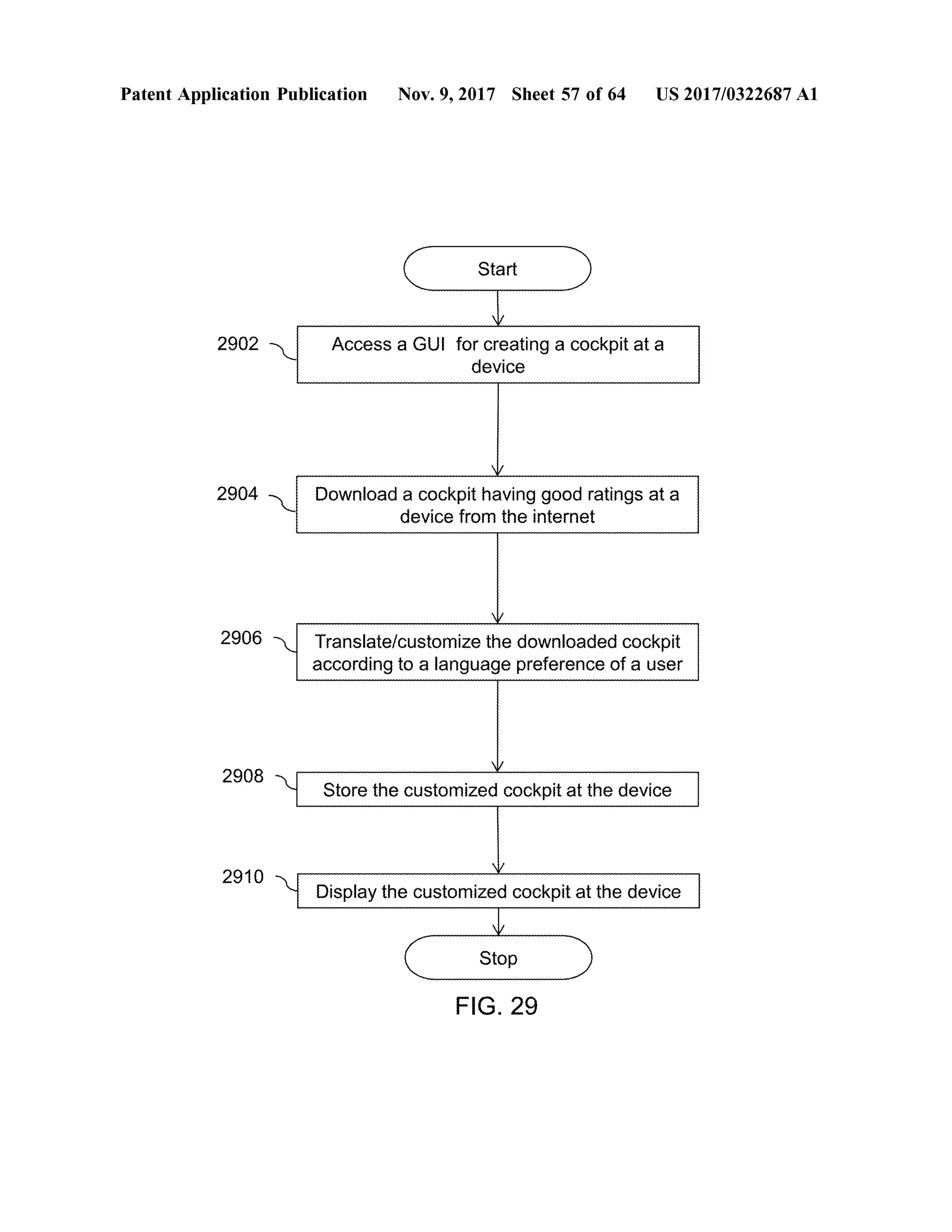
[0082] FIG . 28 illustrates a flow diagram for configuring
a cockpitbased on another cockpit of otheruser, in accor
dance with another embodiment of the invention;
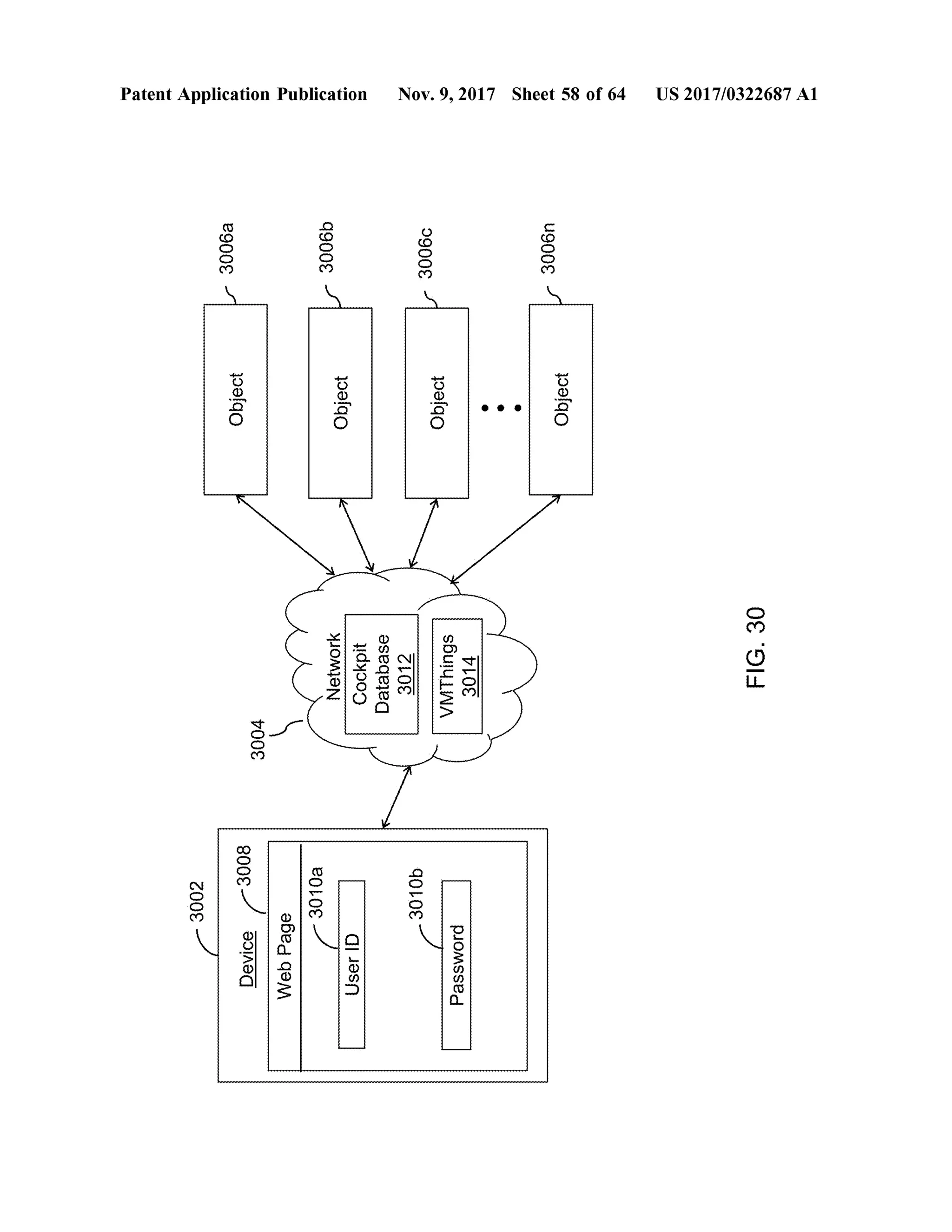
10083] FIG . 29 illustrates a flowchart for downloading a
cockpit from a network, in accordancewith an embodiment
of the invention;
10084] FIG . 30 illustrates an environment for accessing a
cockpit through a website, in accordance with an embodi
ment of the invention;
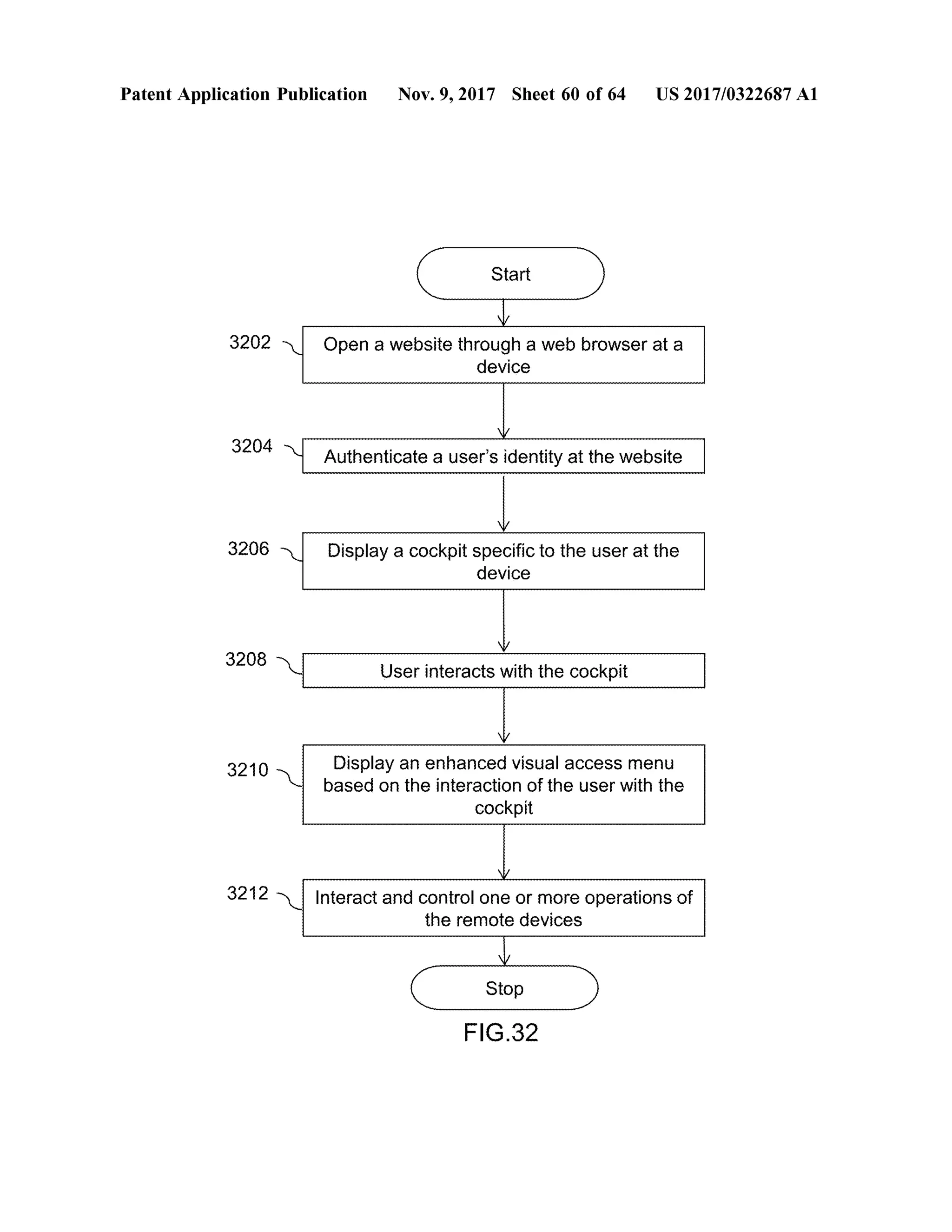
[0085] FIG . 31 illustrates a flow diagram for configuring
a cockpit through a website, in accordancewith an embodi
ment of the invention;
0086 ]. FIG . 32 illustrates a flow diagram for accessing a
cockpit through a website, in accordance with an embodi
ment of the invention;
[0087] FIG . 33 illustrates a flow diagram for configuring
a cockpitwith the help of other users, in accordance with an
embodimentof the invention ;
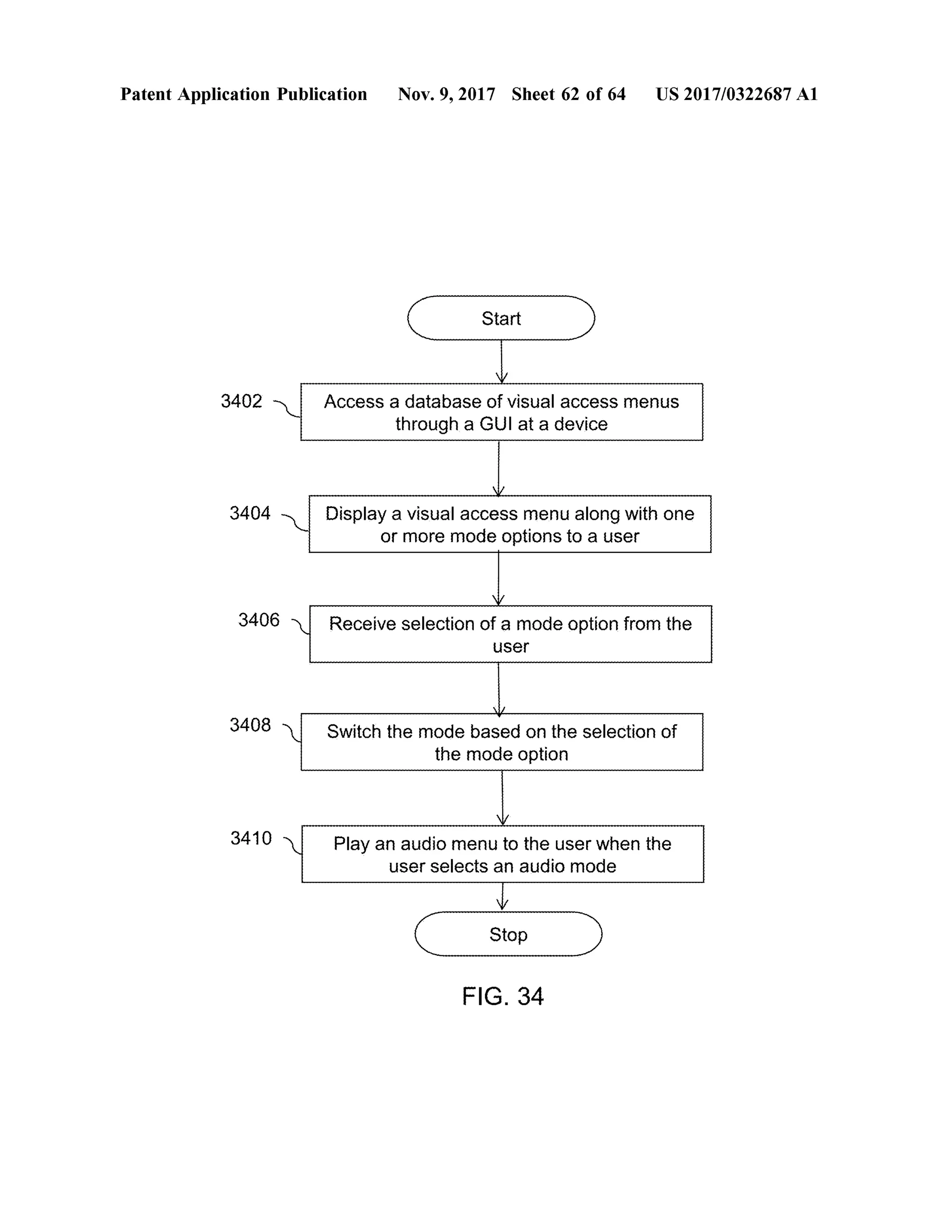
[0088] FIG . 34 illustrates a flow diagram for switching a
display mode of a cockpit, in accordance with an embodi
ment of the invention; and
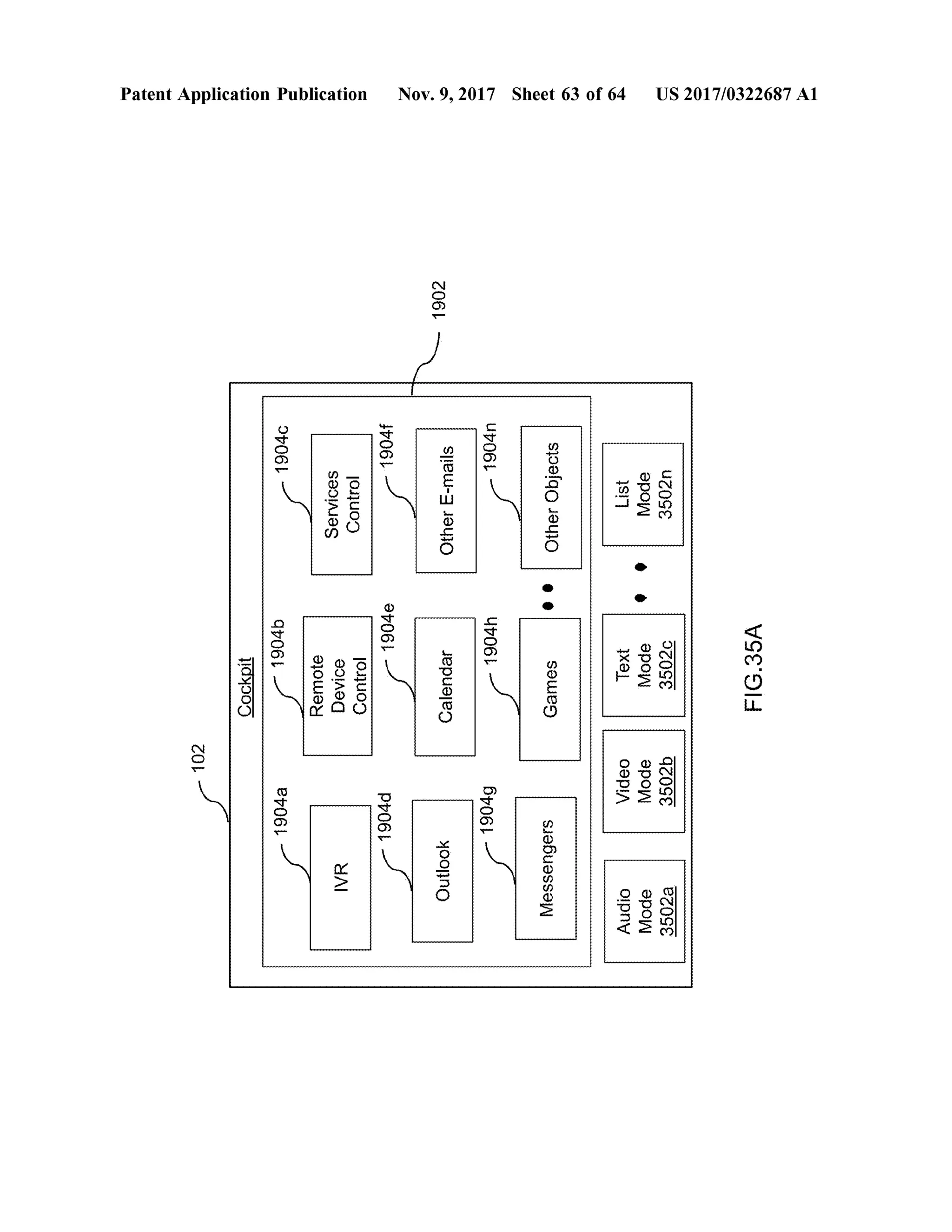
[0089] FIGS. 35A-35B illustrate an exemplary display of
a GUIalong with one ormoremode options, in accordance
with an embodiment of the invention.
DETAILED DESCRIPTION OF THE
INVENTION
[0090] Illustrative embodiments ofthe invention now will
be described more fully hereinafter with reference to the
accompanying drawings, in which some,butnot allembodi
ments of the invention are shown. Indeed, the inventionmay
be embodied in many different forms and should not be
construed as limited to the embodiments set forth herein ;
rather, these embodiments are provided so that this disclo
sure will satisfy applicable legal requirements. Like num
bers refer to like elements throughout.
US 2017/0322687 A1 Nov. 9, 2017
10091] FIG . 1A illustrates an exemplary environment 100,
in accordancewith a first embodimentofthe invention. The
first embodiment describes functionality of an Internet of
Things application i.e. a VMThings 108 for controlling a
plurality of remote devices 106a-n. A usermay create or
configure an Internet of Thingsmenu or cockpit for access
ing or controlling the plurality ofremote devices 106a-n at
a device 102 . In an embodiment of the invention , the
VMThings 108 may configure or create the Internet of
Things menu or the cockpit. The Internet of Thingsmenu
may include representations of one ormore recognizable or
identifiable objects such as, but are not limited to , remote
devices 106a-n or services in an Internet or network like
structure. The one or more identifiable objects may be
physical or virtualobjects. In an embodiment of the inven
tion, a graphical user interface (GUI) may be used by the
user for creating the Internet of Things Menu. The objects
may be the remote devices 106a -n or services. The usermay
use the device 102 for connecting to a plurality of remote
devices 106a-n through a network 104 through the Internet
of Thingsmenu. The device 102 maybeused by the user to
control a plurality of objects in the network 104. The
VMThings 108 may control one ormore operations of the
plurality ofobjects. In an embodimentof the invention, the
objects may include remote devices 106a-n . In another
embodimentof the invention , the objects maybe services as
described in FIG . 2A -I. In yet another embodiment of the
invention , the objects may be combination of the remote
devices 106a-n and services. In an embodiment of the
invention , the device 102 can be a portable device capable
of communicating and connecting to other devices such as
the remote devices 106a-n . The device 102 may have a
display screen . In an embodiment of the invention, the
device 102may have a limited display ormay nothave a
display at all. Example of the device 102 may include a
mobile phone, a smart phone, a computer, a personaldigital
assistant (PDA), a tablet computer, a laptop, and so forth.
[0092] The network 104 can be a wired network or a
wireless network or a combination of these. The wireless
network may use wireless technologies to provide connec
tivity among various devices. Examples of the wireless
technologies include,butarenot limited to,Wi-Fi,WiMAX,
fixed wireless data, ZigBee, Radio Frequency 4 for Con
sumer Electronics network (RF4CE), HomeRF, IEEE 802.
11, 4G orLong Term Evolution (LTE), Bluetooth, Infrared ,
spread-spectrum ,Near Field Communication (NFC ),Global
Systems for Mobile communication (GSM ), Digital-Ad
vanced Mobile Phone Service (D -AMPS). The device 102 is
connected to the plurality of remote devices 106a-n through
the network 104. Examples of the wired network include,
but are not limited to , Local Area Network (LAN ), Metro
politan AreaNetwork (MAN), Wide AreaNetwork (WAN ),
and so forth . In an embodiment of the invention ,the network
104 is the Internet.
[0093] The plurality of remote devices 106a-n can be
electronic equipments such as, butare not limited to , house
hold devices including electric lights, water pump, genera
tor, fans, television (TV), cameras,microwave, doors, win
dows, computer, or garage locks, security systems, air
conditioners (AC), and so forth. In an embodiment of the
invention, the plurality oftheremote devices 106a-n can be
vehicles such as cars, trucks, vans, and so forth . In an
embodiment of the invention, the VMThings 108 may
presenta standard menu (or a standard visualaccess menu)
for controlling all remote devices 106a-n to the user. The
user may be provided with different visual access menus
based on the location of the remote devices 106a-n . For
example, the usermay be displayed with different visual
access menus for remote devices present in office, home,
factory, and so forth . In another embodiment of the inven
tion, the VMThings 108 may display a customized menu at
the device 102 based on user preferences and/or access
pattern. In an embodiment of the invention , the user may
configure the VMThings 108 to control remote devices
106a-n present in more than one building. The buildings
maybepresentatdifferentlocations.Similarly,theusermay
control the one ormore remote devices 106a-n located in
his/her office from the home. For example, the user may
control doorofhis/heroffice cabin,may switch on or switch
off his/her office computer/laptop, AC , and so forth . In an
embodimentof the invention, the usermay control opera
tions of one or more remote devices 106a-n present in a
factory from the home. Further, the user may access the
plurality of remote devices 106a -n from a remote location
by using the device 102. Further, the usermay use the same
device 102 for controlling the remote devices located at
different locations such as office, factory, home, etc. The
user doesn't have to carry different ormultiple devices for
controlling different remote devices 106a-n . The device 102
may include a database including a list of one or more
objects. In an embodiment of the invention, the device 102
may include audio or visual menus of the one or more
objects i.e. of the remote devices 106a-n. The device 102
may include visual access menus and/or enhanced visual
accessmenus corresponding to various objects. The visual
accessmenu may provide an interface to the user to control
the one or more objects such as remote devices 106a-n. The
visual access menu may include one or more options such
as, but are not limited to a remote devices option, services
option, and so forth. In an embodimentof the invention, the
visual access menus at the device 102 may be updated
regularly at predefined timeinterval such asafter every two
days, or once a week. The enhanced visual access menus
may include one ormore device options. In an embodiment
of the invention, the device 102 may include a touch
sensitive display. In such a scenario ,the usermay access the
one ormore options or the device options by touching the
options directly. In an embodimentofthe invention, theuser
may connectto the one or more objects such as the remote
devices 106a-n through applications such as, but are not
limited to, Skype, Google Talk, Yahoo Messenger,Magic
Jack, and so forth .
[0094] Further,the device 102may includethe VMThings
108 which is configured to enable the user to access the
visual access menus through a Graphical User Interface
(GUI) atthedevice 102. The VMThings 108 may enable the
user to control the remote devices 106a-n irrespective of
their location through the network 104. The VMThings 108
may display the one or more visual access menus at the
device 102. Further, the device 102 may include visual
access menus associated with at least two independent
objects. In an embodiment of the invention, the two at least
two independentobjects may be produced by two indepen
dent vendors, In an embodiment of the invention, the device
may include vendor specific visual access menus or
enhanced visualaccessmenus fortheremote devices 106a
n. Further, thedevice 102may also include standard menu(s)
for accessing the objects. The VMThings 108 may display
US 2017/0322687 A1 Nov. 9, 2017
the visual access menu depending on the independent ven
dor(s)ofthe oneormore objects. In another embodimentof
the invention, the VMThings 108 may display a visual
accessmenu which is notprovided by either of the at least
two independent vendors of the at least two independent
objects. In an embodiment of the invention, the user may
access and controloneormore ofthe remotedevices 106a-n
from the remote location by using the device 102. For
example, the user may use his smart phone to access and
operate a microwave at his/her home from his/her office.
Further, the user can use the device 102 at one location to
monitor and regulate one ormore operations of the remote
devices 106a-n present at another location. The one ormore
operationsmaybe, such as, butarenot limited to, switch on,
switch off, regulate, and so forth .
[0095] Further, the visual access menus may include at
least one icon indicating one or more objects such as the
remote devices 106a-n. Further, the icon is substantially
different than the icons provided in the visual accessmenu
provided by the vendor.Further, the remote devices 106a-n
may be grouped into various categories such as,but are not
limited to, electronics appliances,homedevices, buildings,
doors, room appliances, switches, floor wise, and so forth .
Further, theremote devices 106a-n may be grouped accord
ing to location of the remote devices, such ashomedevices,
office devices, garages devices, factory devices, farm house
devices, and so forth . The VMThings 108 of the device 102
may store visual access menus and enhanced visual access
menus corresponding to theremote devices 106a-n based on
the various categories oftheremote devices 106a-n . Each of
theremote devices 106a-nmayhave a unique remote device
identity (ID ). In an embodiment of the invention, the user
may require to register the remote devices 106a-n with the
device 102 so that the remote devices 106a-n may be
controlled by using the VMThings 108.In an embodimentof
the invention, the usermay be required to authenticate or
provehis/her identity atdevice 102 or for the remote devices
106a-n before controlling one or more operations of the
remote devices 106a-n.
[0096] Further, the VMThings 108 may display an
enhanced visual access menu corresponding to the remote
devices 106a-n. The enhanced visual access menu may
include one ormoredevice options. Thedevice optionsmay
be displayed as graphicsoricons and/or textrepresentations
of the remote devices 106a-n . For example, a car may be
displayed for representing the car option. The user may
control the remote devices 106a-n by selecting a device
option from the device options atthedevice 102.Further,the
enhanced visual accessmenu may display the grouping or
categories ofthe remotedevices 106a-n. The VMThings 108
may also translate the visual access menu or the enhanced
visual access menu from a first language to a second
language. Examples of the first language and the second
language may include, but are not limited to, Spanish,
French, English, Sanskrit,Hindi,Urdu, Arabic, and so forth .
Forexample, the VMThingsmay translate an English visual
accessmenu into a French visualaccessmenu and thereafter,
itmay be displayed at the device 102. The VMThings 108
may display the visual accessmenu or the enhanced visual
accessmenu at the device 102 based on theuser's preferred
language.
[0097] The user may select an option from the visual
accessmenu oran enhanced visualaccessmenu. Further, the
user may select an option (or device options) by using a
combination ofkeys on a keypad of the device 102. In an
embodiment of the invention, the usermay select an option
by clicking the option or the device option by using a mouse
device. In an embodiment of the invention, the user may
select an option by touching the screen of the device 102.
Forexample, if theuserwantsto switch on an air conditioner
(AC) on way towardshome, the user can select or enter an
appropriate key combination on thedevice 102 ormay touch
(in case of touch sensitive display at the device 102) an
option of the visual access menu corresponding to the AC .
[0098] In one embodiment, the user can give a voice
command to the device 102.Based on the input received by
the device 102, the air conditioner may be switched on
automatically. Further,the user can also regulate the cooling
of the room by changing temperature settings of the air
conditioner. After connecting the device 102 to one or more
of the remote devices 106a-n , the user can control the one
ormore operations such as, butare not limited to, switch on ,
switch off, reduce temperature, and so forth from a distant
location withoutbeing physically presentat the location. In
one embodiment, the remote devices 106a-n can be security
camerasor alarm station installed at the homelocation ofthe
user.
[0099] In an embodiment of the invention, the user may
select an option bymaking gestures orhandmovements at
the device.For example, theusermay do a thumbup gesture
to switch on an appliance athome ormay do a thumb down
gesture to switch off the same. Similarly, the user may do
othergesturessuch as,butare notlimited to,waving a hand,
nodding head, smiling, blinking an eye, and so forth . In an
embodiment of the invention, the device may include a
camera fordetecting the gestures or handmovements. In an
embodiment of the invention, the VMThings 108 may be
configured to analyze and interpret the gestures and hand
movements. Further, the VMThings 108may include stored
gestures defined by the user atdevice 102 and may compare
ormatch the real time gestureswith the stored gestures. The
device may include a software or hardware such asmicro
phone for detecting the voice commands or audio inputs.
101001 In another embodiment of the invention, the
VMThings 108 may be configured to analyze the voice
commands and audio inputs received from the userthrough
voice recognition . Further, the usermay select the option
from an Internetof Thingsmenu through voice command (s )
for controlling the remote devices 106a-n . The device 102
may include a listof voice commands andaction tobetaken
corresponding to each command. The VMThings 108 may
compare andmatch the received voice command with the
stored list and thereafter may take an action based on the
comparison. In an exemplary scenario, the user atofficemay
switch on the AC present at home by accessing the visual
accessmenu and saying "switch off the AC” on the device
102 (or a smart phone). In an embodiment ofthe invention,
speech/voice recognition may be used to analyze the voice
instructions or commands received from the user to control
the remote devices 106a-n . In an embodiment of the inven
tion,the device 102may receive a call from theone ormore
objects such as a remote device. In such a case, the
VMThings 108 may display a visual accessmenu of the
calling object.
10101] In an embodiment of the invention, the VMThings
108 may determine location of thedevice or the plurality of
objects such as the remote devices 106a-n . In an embodi
ment of the invention, the selection ofthe option may be
US 2017/0322687 A1 Nov. 9, 2017
automatic based on one or more predefined instructions of
the user of the device 102. For example, the predefined
instruction may be like switch on theAC at 6 PM , switch off
the TV at 2 PM , andclose thedoorofthegarage. The remote
devices 106a-n may be controlled according to these pre
defined instructions irrespectiveofthe location ofthe user or
the device 102.
[0102] In an embodiment of the invention, one or more
signalsmaybe generated and transmitted by thedevice 102
based on the selection of the option or an input received
from the user. The signals may be transmitted to the remote
devices 106a-n through the network 104. The remote
devices 106a-n may be controlled based on the signals
received from the device 102. In an embodiment of the
invention, the device 102 may receive an alertmessage(s)
regarding the operational condition of the remote devices
106a-n . For example, an alertmessage like 'Car door left
opened'may bereceived by the user athis/hermobile phone
for a car standing in a parking area. In an embodimentofthe
invention, the alertmessagemaybereceived through at least
one of an SMS, an MMS, an instantmessage, an e-mail, a
phone call,turn on of display ofdevice when it's off, and so
forth . In another embodiment of the invention , the usermay
further receive alertmessage aspopmessages at the device
102, at a GPA system , at a multi function display of a car of
the user,at a TV, at a picture frame, and so forth . Thereafter,
the usermay control or operate the car door through his/her
smart phone and from the office itself. There is no need for
him to rush to the parking area for closing the door. In an
embodiment of the invention, the user may receive alert
messages at a predefined timeperiod. For example, the user
may receive the alert messages regarding the connected
remote devices 106a-n after every 1 hour, 2 hour, 30
minutes, and so forth.
[0103] Further, the displayed Internet of Things menu or
the visualaccess menu may extend or change based on the
user selection of the option from the visualaccessmenu. In
another embodiment of the invention, the device 102 may
receive images,videos,audios, related to theremote devices
106a-n at thepredefined timeperiod.Further, thedevice 102
may receivereal-timeinformation,such as,but isnotlimited
to, images, video etc.oftheplurality ofthe remote devices
106a -n . In an exemplary scenario, the user can monitor and
control real-time operation of the remote devices 106a-n
such as one or more vehicles based on the information
received through thenetwork 104. For example,theuser can
receive images orvideos ofthe oneormore vehicles on the
device 102. Further, the VMThings 108 may display these
images of remote devices 106a-n to the user. The user can
send instructions or voice response to the one or more
vehicles through the network 104. Forexample, the user can
track position ofthe one ormore vehicles in real-time from
the device 102 at another location .
[0104] In an embodiment of the invention, the enhanced
visual access menus corresponding to the remote devices
106a-n may be stored at a server 114 in thenetwork 104. As
discussed with reference to FIG . 1B , the user of the device
102 may access the visual access menus corresponding to
the remote devices 106a-n through a web browser in an
exemplary environment 200. The environment 200 may
include the device 102 such as a smart phone capable of
connecting to the network 104 (or the Internet) via the web
browser. In an embodiment of the invention, the remote
devices 106a-n may be controlled via a local wireless
communication or local network . In an embodiment of the
invention, the remote devices 106a-n may be connected to
a bridge device thatmay furtherbe connected to the Internet.
Theweb browsermay be used to connectto the Internet and
in turn to the localnetwork . Examples of the web browser
include, but are not limited to, Internet Explorer, Google
Chrome,Mozilla Firefox, Netscape Navigator,and so forth .
The user can enter a Uniform Resource Locator (URL ) such
as,'wwW.ABC.com ’ in theweb browserto access a website
including a database. The database at thewebsite may store
a plurality ofvisualaccessmenusor InternetofThingsmenu
orcockpit or enhanced visual accessmenus associated with
the remote devices 106a-n . The enhanced visual access
menus are visualaccess menus corresponding to the remote
devices 106a-n. Each ofthe enhanced visual access menus
may include one or more device options. In an embodiment
of the invention, the databasemay bepresent in the network
104.
[0105] A webpage 110 maybe displayed atthe device 102
corresponding to theURL entered by the user. The usermay
be required or asked to authenticate his/her identity before
accessing the visual access menus. The displayed webpage
110 may include one or more data request fields 112a -b
where the user may enter his/her details. In an embodiment
of the invention, the usermay access various visual access
menus by authenticating at the website by entering his/her
login details such as,but are not limited to, password, used
ID , e-mail ID , date ofbirth,and so forth, in the oneormore
data request fields 112a-b . Though not shown, but a person
skilled in the art will appreciate, that thewebpage 110 may
includemore than two data request fields 112a-b. Theone or
more of options of the visual accessmenus or the enhanced
visualaccessmenus may be displayed to the user athis/her
device 102.
f0106 ]. In an embodiment of the invention, the user may
create personalized visual access menus for controlling
his/herpersonaldevices of the remote devices 106a-n. In an
embodiment of the invention, the user may configure or
create an Internet of things menu for controlling remote
devices. The Internetof Thingsmenumay include a plurality
of representations corresponding to identifiable objects such
as the remote devices 106a-n. Further, the user may cus
tomize the Internet of Things menu based on his/her pref
erences such as, but not limited to, language preference,
theme preference, color preference, font size preference,
device preference, service preference, and so forth. The
VMThings 108 may display customized or personalized
visual access menu at the device 102. In an embodimentof
the invention, the VMThings 108 may displayvisual access
menu ata second display connected to the device 102. The
usermay select an option from the multiple options of the
visual access menu. The enhanced visual access menu (or
the Internet of Thingsmenu)may be displayed atthe device
based on the selection ofan option by the userat the device
102. In an embodimentofthe invention, a connectionmay
be established between the user device 102 and the remote
devices 106a-n based on the selection of the option by the
user. Thereafter, the user can access and control the remote
devices 106a-n irrespective of a location of the user. The
user may not have to be in front of or close to the remote
device 106a-n for controlling the operations of the remote
devices 106a-n.
[0107] FIG . 1C illustrates another exemplary environment
300 , in accordance with the first embodimentof the inven
US 2017/0322687 A1 Nov. 9, 2017
tion. An access device 116 may be connected to a display
device 118. The access device 116 may access and control
the plurality of remote devices 106a-n connected through
the network 104. The access device 116 may be any device
capable of data and/or voice communications through the
network 104 or the remote devices 106a-n . Examples ofthe
access device 116 include,but are not limited to , a router, a
telephone, a set top box, a hub, a gateway, a printer, a music
system , a mobile phone, a PDA, a smart phone, a picture
frame, and so forth . In an embodiment of the invention , the
access device 116 may not have a display or may have
limited display capability. The access device 116 may
include a plurality of ports for connecting to the network
104,and/or thedisplay device 118. Theplurality of ports can
be such as, but are not limited to, parallel ports, serialports,
DB -2 connector,IEEE 1284, IEEE 1394 ports, 8P8C ports,
PS/2 ports,RS-232 ports, Registered Jack (RJ) 45 ports,RJ
48 ports, VGA port, Small Computer System Interface
(SCSI) ports,USB ports,DB-25 ports,and so forth.
[0108] Examples of the display device 118 may include,
but are not limited to, a television , a Liquid Crystal Diode
(LCD) display, a Light Emitting Diode (LED) display, a
projector screen, a computer,a laptop, a tablet computer, a
picture frame, a tablet computer, and so forth. Theaccess
device 116 may provide a network interface to the display
device 118. The user may use the access device 116 for
connecting to the network 104 . Moreover, the user can
access the remote devices 106a-n connected to the network
104 by using the access device 116. In this embodiment of
the invention, once connected with the remote devices
106a -n the visual access menus or the Internet of Things
menus may be displayed to the user at the display device
118. In an embodimentof the invention, the usermay have
to authenticate and/or one or more login details before
viewing the visual access menus. The usermay authenticate
or enter his/herpersonal details at the access device 116. In
an embodiment ofthe invention, the usermay authenticate
or enterthepersonal details at the display screen.
[0109] In an embodiment of the invention, the access
device 116 may be a home controller device. The user may
access the VMThings 108 by logging into this home con
troller andmay view the visual access menus at his device
102 or a display device 116. After logging into the home
controller the user may control the objects i.e. remote
devices or services associated with the home controller.
Therefore, the usermay controlthe one or more objects by
using a combination ofdevices such as thehomecontroller,
smart phone, another display device, and so forth .
[0110] The access device 116 may include an Internet of
Things application i.e. VMThings 108 application for
accessing the visual accessmenus and the enhanced visual
accessmenus. The VMThings 108 may display the visual
access menus at the display device 120. The user may
connect to the remote devices 106a-n by selecting one or
more options ofthe visual accessmenus.Further, the remote
devices 106a-n may be grouped into variouscategories such
as, but are not limited to , electronics appliances, home
devices, buildings, doors, room appliances, electric
switches, cars, windows, and so forth . Further, the remote
devices 106a-nmay be grouped according to location, such
as home devices, office devices, garages devices, and so
forth. The of the access device 116 may store visual access
menus and enhanced visualaccessmenus according to the
various categoriesoftheremotedevices 106a-n attheaccess
device 116 . Further,the usermay control any remote device
from the remote devices 106a-n by selecting one ormore
options from the visual access menu or the Internet of
Things menu. In an exemplary scenario, the user can con
nect to thenetwork 104 by using a telephone and may view
the visualaccessmenu on a screen of the television . There
after, the user may access and control the remote devices
106a-n from the telephone by pressing appropriate keys/
buttonsofthe telephone.
[0111] In an embodiment ofthe invention, the user may
register the remote devices 106a- n or do some settings at the
access device 116 or the remote devices 106a-n, so that the
user may control the remote devices 106a-n from the
VMThings 108. In an embodimentofthe invention, the user
may be required to authenticate or prove his/her identity at
the access device 116 or for the remote devices 106a-n
before controlling one or more operations of the remote
devices 106a-n .
10112 ]. FIG . 1D illustrates an environment based on a
ZigBee network 120, in accordance with the first embodi
ment ofthe invention. As shown, the access device 116 may
include the VMThings 108 for displaying a visual access
menu or an enhanced visual accessmenu or an Internetof
Things menu at the display device 118. The access device
116 may connect to the remote device 106a -n through the
ZigBee network 120. In an embodimentofthe invention, the
remote devices 106a-n may be connected to the ZigBee
network 120 through a localnetwork such as a LAN , a NFC
network, a Bluetooth network, and so forth . The local
network may be connected to the ZigBee network 120
through some gateway device such asbridge, router, hub,
gateway device, switch, and so forth.
[0113] FIG . 1E illustrates an environment based on a
WiMAX network 122, in accordance with the first embodi
ment of the invention. As shown, the access device 116 may
include the VMThings 108 for displaying the Internet of
Things menu or the visual access menu or the enhanced
visual access menus at the display device 118. The access
device 116 may connect to the remote devices 106a-n
through the WiMAX network 122. In an embodimentof the
invention, the remote devices 106a-n may be connected to
the WiMAX network 122 through a localnetwork such as a
LAN ,NFC network and so forth . In an embodimentof the
invention, the user may require to register the remote
devices 106a-n or do somesettings at the access device 116
or the remote devices 106a -n , so that the user may control
the remote devices 106a-n from the VMThings 108. In an
embodiment of the invention , the user may be required to
authenticate or prove his/her identity at the access device
116 or forthe remote devices 106a-n before controlling one
ormore operationsofthe remote devices 106a-n. The user
may access the visual access menus and enhanced visual
access menus at the access device 116 through a GUI. The
VMThings 108 may enable the user to control the remote
devices 106a-n irrespective of the location of the remote
devices 106a-n . For example, the usermay control opera
tions of the air conditioner located in his/her factory by
being athome itself. The usermay nothave to bephysically
present at the factory or near the air conditioner for con
trolling the operationsofthe air conditioner. The user may
dothesamethrough the VMThings 108 ofthe access device
116 (or the device 102).
[0114] FIG . 1F illustrates an environment based on a
Global System forMobile Communication (GSM ) network
US 2017/0322687 A1 Nov. 9, 2017
124, in accordance with the first embodiment ofthe inven
tion.As shown, the access device 116 may be connected to
the remote devices 106a-n through the GSM network 124.
Though not shown, but a person skilled in the art will
appreciate that the access device 116 may be connected to
the remote devices 106a-n through other networks, such as,
but are notlimited to,an RF4CEnetwork ,an NFC network,
anHSPA network, a LAN , a WAN , a 3ra generation network ,
a 4th generation network, a CDMA network, an EV-DO
network, and so forth .
[0115] FIG . 1G illustrates an environment based on the
ZigBee network 120, in accordance with the first embodi
mentofthe invention.As shown, the device 102may include
the VMThings 108. A user may configure an Internet of
Thingsmenu by using the VMThings at the device 102. The
user of the device 102 may connect to the remote devices
106a-n by using the VMThings 108 through the GUIat the
device 102. Further, thedevice 102may be connected to the
remote devices 106a-n through the ZigBee network 120. In
an embodiment of the invention, the device 102 may be
connected to other wireless network such as the WiMAX
network 122, as shown in FIG . 1H .
[0116] FIG . 11 illustrates an environment based on a
combination of a localnetwork 126 and the Internet 130, in
accordance with the first embodimentof the invention . The
remote devices 106 a -n may be connected to a localnetwork
126. The local network 126 can be a private network , a
wirelessnetwork, andso forth . The localnetwork 126 in turn
may be connected to an external or public network such as,
but are not limited to, the Internet 130 through a bridge
device 128. The device 102 may connect to the remote
devices 106a -n through the Internet 130 . The local network
126 and the Internet 130 may be connected to each other
through other devices such as, butare not limited to , a router,
a hub, a switch , a gateway, and so forth .
[0117] In an embodiment of the invention, the VMThings
108 may display an advertisement or multiple advertise
ments along with the visual accessmenu at the device 102 .
In an embodiment of the invention, the VMThings may
display the advertisementormultiple advertisements along
with an Internet of Things menu at the device 102. In an
embodiment of the invention, the advertisement(s) are
selected and displayed based on the contentofthe displayed
visual access menu or the Internet of Things menu. For
example, if the visual access menu is for controlling the
home appliances, then the advertisements may be about
homeappliances such asAC, fans,etc. In an embodimentof
the invention, the visual accessmenu and/oradvertisements
may be displayed at a second display or a display device
such as a picture frame, LCD, television, and so forth
connected to the device 102. Further, the visual access
menus and the advertisements may be displayed at the
display device or the second display through wirelessmeans
such as Wi-Fi, Bluetooth, ZigBee, and so forth.
[0118] FIG . 2A illustrates an exemplary environment 400,
in accordance with a second embodiment of the invention.
The user 102may use thedevice 102 to connectto a plurality
of services 202a-n through the network 104. The user can
access the information about the services 202a-n at the
device 102. As discussed with reference to FIG . 1A, the
device 102 can be a portable or hand -held device capable of
communicating and connecting to the network 104 or other
devices such as the remote devices 106a-n . Example of the
device 102may include a mobile phone, a smart phone, a
computer, a personal digital assistant (PDA), a tablet com
puter, a laptop etc. Thenetwork 104 can be a wired network
such as a Local Area Network (LAN ) or a Wide Area
Network (WAN ) or a wireless network such as a WiMAX
network or a combination of these. Examples ofthe services
202a-n include, but are not limited to , banking services,
travel services, entertainment services, railways services,
movies services, restaurants, and so forth . Further, the
banking servicesmay be categorized as insurance services,
retail banking services, internet banking services, loans
service, NRI banking, and so forth . The entertainment
services may be accessed by the user to get information
aboutmusic,movies, theatre, news, cartoons, or sports. For
examples, the usermay accessmoviesservices to know the
new releases in movies. The information aboutservicesmay
be displayed in form ofan enhanced visual accessmenu. The
user may interact with the enhanced visual access menu
accordingly.
[0119 ] In an embodiment of the invention,theVMThings
108 may display an Internetof Things menu at the device
102. The Internet of thingsmenu may include representa
tions of one or more recognizable or identifiable objects
such as, but are not limited to , remote devices 106a-n or
services in an Internet or network like structure. The one or
more identifiable objects may bephysicalor virtual objects.
A graphical user interface (GUI) maybe used by the user for
creating the Internet ofThingsMenu. In an embodiment of
the invention, the objectsmay be the services 202a-n.
[0120] Further, the VMThings 108 may highlight a fre
quently accessed service option or preferred service option
in the enhanced visualaccessmenu for the services 202a-n
or the Internetof Thingsmenu based on the user'sprevious
access patterns. In an embodiment of the invention, the
VMThings 108 may highlight one or more frequently
accessed device options or preferred device options in the
enhanced visualaccessmenu fortheremote devices 106a-n.
Further,the VMThings 108 may storethe useraccesspattern
at the device 102. In an embodiment of the invention, the
VMThings 108may present a standard menu (or a standard
visualaccessmenu) forcontrollingallservices 202a-n to the
user. In anotherembodimentofthe invention,the VMThings
108 may display a customized menu of services 202a-n at
the device 102 based on user preferences and/or access
pattern.
[0121] The device 102 may include a Graphical User
Interface (GUI) to enable the user to access the services
202a-n. In an embodiment of the invention, the device 102
may include audio or visualmenusof the services 202a-n .
The device 102 may include visual access menus and/or
enhanced visual accessmenus corresponding to the services
202a-n . The enhanced visual accessmenu may include one
or more service options. The service options may be dis
played as graphics or icons ortext representing the services
202a-n . The user may control and get more information
aboutthe services 202a-n by selecting a service option from
the service options at the device 102. In an embodiment of
the invention, the user may select a service option by
touching the screen of the device 102. For example, if the
userwantsmore information aboutthe travelling service,the
user may select the travel service option. In one embodi
ment, the user can give a voice command to the device 102
for selecting a service option from the enhanced visual
accessmenu. Further, the usermay selectan option by using
a combination of keys on a keypad of the device 102.
US 2017/0322687 A1 Nov. 9, 2017
Further, the user may select a service option by using a
mouse device. In an embodiment of the invention, the
selection of the service option may be automatic based on
the one or more predefined instructions of the user of the
device 102.In an embodimentoftheinvention,the usermay
have to register him /her or the device 102 to access the
services 202a-n. In an embodiment the user may have to
authenticate his identity prior to accessing the services
202a-n. In an embodiment of the invention, the user may
receive alert messages related to the services 202a-n . For
example, the user may receive reminders aboutmaking a
payment for his/her credit card bill. In another embodiment
of the invention, the user may receive the alert messages
regardingthe connected services 202a-n ata predefined time
period such as, but are not limited to , after every 1 hour, 2
hour, 30 minutes, and so forth . In an embodiment of the
invention,the VMThings 108 may alert the user through at
least oneofby turning on the display of the device 102 from
an off state and present a menu (visual access menu or
Internet of Things menu or cockpit), presenting a menu in a
pop up window , sending Short Messaging Service (SMS)
message, sending a Multimedia Messaging Service (MMS)
message,initiatinga telephone call,and so forth.Further,the
user may receive alertmessage as a pop up message at
his/her Global Positioning System (GPS) device or amulti
function display ofhis/her car orat screen of a television or
at a mobile phone of the user,and so forth.
[0122] In another embodiment ofthe invention,the device
102 may receive images, videos, audios, related to the
services 202a-n at thepredefined timeperiod. In an embodi
ment of the invention, the usermay access or control the
services 202a -n by giving voice commands or voice inputs .
In an embodimentofthe invention , the usermay connectto
theservices 202a-n through applications such as, butare not
limited to, Skype, Google Talk, Yahoo Messenger,Magic
Jack, and so forth .
10123] Further, the device 102 may include visual access
menus associated with at least two independent objects or
services. In an embodiment of the invention, at least two
independent objects/services may be produced by at least
two independent vendors. In an embodiment of the inven
tion, thedevice 102 may include vendor specific Internetof
Things menus or visual access menus or enhanced visual
access menus for the services 202a-n . Further, the device
102 may also include standard menu(s) for accessing the
objects. The VMThings 108 may display the visual access
menu depending on the independentvendor(s) of the one or
more objects. In another embodiment of the invention, the
VMThings 108 may display a visual access menu which is
ndnot provided by either of the at least two independent
vendors of the at least two independent objects. Further, the
visualaccessmenusmay include at least one icon indicating
the one or more services 202a-n. Further, the icon is
substantially different than the icons provided in the visual
accessmenu or the Internetof Things menu provided by the
vendor. The VMThings 108 may display customized or
personalized visual accessmenu or the Internet of Things
menu at the device 102. In an embodimentofthe invention ,
the VMThings 108 may display visual access menu or the
Internetof Thingsmenu at a second display connected to the
device 102.
[0124] In an embodiment of the invention, speech/voice
recognition may be used to analyze the voice instructions or
commands received from the user to access the services
202a-n. In an embodiment ofthe invention, the device 102
may receive a call from the services 202a-n . In such a case,
the VMThings 108 may display a visual accessmenu and/or
an Internet of Things menu of the calling service. Further,
the Internet of Things menu may include one or more
options for interacting with the service from which call is
received
[0125] FIG .2B illustrates anotherexemplary environment
500, in accordance with the second embodiment of the
invention. In an embodiment of the invention , the visual
accessmenus or the Internetof Thingsmenu corresponding
to the services 202a-n maybe stored at the server 114 in the
network 104. The user at the device 102 may access an
enhanced visualaccessmenu corresponding to the services
202a -n by using a web browser. The device 102 may be
configured to connectto thenetwork 104 (orthe Internet)by
entering a URL or a website address in the web browser.
Examples oftheweb browser include, butare not limited to ,
Apple Safari, Internet Explorer, Google Chrome, Mozilla
Firefox, NetscapeNavigator,and so forth . Theuser can enter
a URL or a website address in theweb browser to access a
database including a plurality of enhanced visual access
menus corresponding to the services 202a-n . In an embodi
ment of the invention, the database may be present in the
network 104.
[0126] A webpage 110 including the one or more data
request fields 112a-b may be displayed at the device 102
based on the enteredURL . Theusermay enterhis/her details
in the data request fields 112a-b for getting access to the
database. Thereafter, at least one enhanced visual access
menus to access the services 202a-n maybe displayed to the
user at the device 102. The user may access information
about the one ormore services 202a-n by interacting with
the displayed enhanced visual access menus. In an embodi
ment of the invention, thewebpage 110 may include atleast
one of images, audio/video files, text, hyperlinks, and so
forth
[0127] In an embodiment of the invention, a new visual
access menu or a new Internet of things menu may be
displayed when the user is directed to a new web sitebased
on the user 's input or selection. The new visualaccessmenu
may be an IVR menu or an Internet of Things menu
associated with the new web site. Further, the new visual
accessmenu may include options associated with the new
web site.
[0128] FIG . 2C illustrates yetanother exemplary environ
ment600, in accordance with thesecond embodimentofthe
invention.As discussed with reference to FIG . 1C , the user
may use the access device 116 to access or control services
202a-n . The access device 116 may be any device capable of
data and/orvoice communications through the network 104.
In an embodiment of the invention, the access device 116
may nothave a display or may have limited display capa
bilities. The access device 116 can be such as, but are not
limited to, a router, a telephone, a set top box, a hub, a
gateway, a printer, a mobile phone, a smart phone, a PDA,
a tablet computer, a walkie -talkie, and so forth . Further, the
access device 116 may include a plurality of ports for
connecting to the network 104 orthedisplaydevice 118 such
as a television or an LCD display.Examplesoftheplurality
ofports include, but are not limited to , parallel ports, serial
ports,DB-2 connector,IEEE 1284, IEEE 1394 ports, 8P8C
ports, PS/2 ports, RS-232 ports, Registered Jack (RJ) 45
US 2017/0322687 A1 Nov. 9, 2017
ports, RJ 48 ports, VGA port, Small Computer System
Interface (SCSI) ports, USB ports, DB-25 ports, and so
forth .
[0129] The access device 116 may provide a network
interface to the display device 118. The user may use the
access device 116 for accessing the one or more of the
services 202a-n through the network 104. An enhanced
visual access menu or an Internet of Things menu corre
sponding to the services 202a-n may be displayed to the
user. Thereafter, the usermay access the information about
the services 202a-n accordingly. In an embodiment of the
invention , the user may have to enter one or more login
details for authenticating himself/herself to gain access to
the one or more visual access menus. In an exemplary
scenario, the user can connectto the network 104 by using
a telephone and may view the visual access menu on a
television screen. Thereafter, the user may access and con
trol the services 202a-n from the telephone by selecting or
dialing or pressing one ormore combination ofkeys at the
telephone.
[0130] In an embodiment ofthe invention, the VMThings
108 may display an advertisement or multiple advertise
ments along with the visual access menu at the display
device 118. In an embodimentof the invention, the adver
tisement(s) are selected and displayed based on the content
of the displayed visual accessmenu. For example, if the
visualaccessmenu is for controlling the banking services,
then the advertisementsmaybe about insurance and opening
accounts. In an embodiment of the invention, the visual
access menu and/or advertisements may be displayed at a
second display or the display device 118 such as a picture
frame,LCD, television,and so forth connected to the access
device 116 . Further, the visual access menus and the adver
tisements may be displayed at the display device 118 or the
second display through wireless means such as Wi-Fi,
Bluetooth, ZigBee, and so forth .
[0131] FIG . 2D illustrates an environment based on the
ZigBeenetwork 120, in accordancewith the second embodi
mentofthe invention. As shown, the access device 116 may
include the VMThings 108 for displaying a visual access
menu or an enhanced visual accessmenu including one or
more service options at the display device 118. The access
device 116 may access and/or connect to theservices 202a-n
through the ZigBee network 120. Examples of the services
202a-n include, but are not limited to, banking services,
travel services, entertainment services, railways services,
movies services, restaurants, hotels, and so forth. In an
embodiment of the invention, the services 202a-n may be
accessed through the ZigBee network 120 and the local
network 126 such as a LAN, an NFC network, a Bluetooth
network, virtual private network (VPN ), and so forth . The
localnetwork may be privately monitored network with no
or limited access to outside users. The local network 126
may be connected to the ZigBee network 120 through some
gateway device such as the bridge device 128, a router, a
hub, a gateway, a switch, and so forth .
10132] FIG . 2E illustrates an environment based on the
WiMAX network 122, in accordance with the second
embodimentof the invention. Asshown, the access device
116may include the VMThings 108 for displayinga visual
access menu or an enhanced visual access menu including
one ormore service options at the display device 118. The
access device 116 may connect to the services 202a -n
through the WiMAX network 122 Examples of the services
202a-n include, but are not limited to, banking services,
travel services, entertainment services, railways services,
movies services, restaurants, and so forth. In an embodiment
of the invention, the services 202a-n may be connected to
the WiMAX network 122 through a localnetwork such as a
LAN , an NFC network,and so forth . The local network 126
may be connected to the WiMAX network 122. In an
embodiment of the invention, the user may require to
register to the services 202a-n or do some settings at the
access device 116 or the remote devices 106a -n , so that the
user may control the services 202a -n (or remote devices
106a-n ) from the access device 116. In an embodiment of
the invention, the user may be required to authenticate or
provehis/her identity atthe access device 116 or theservices
202a-n before accessing the services 202a -n . The usermay
access visual access menus and enhanced visual access
menus at the access device 116 through a GUI. The
VMThings 108 may enable the user to access and control the
services 202a-n irrespective ofthe location of the user.
[0133] FIG . 2F illustrates an environment based on the
Global System forMobile Communication (GSM ) network
124, in accordance with the second embodiment of the
invention. As shown the access device 116 may be con
nected to the services 202a-n through theGSM network 124.
Though not shown, but a person skilled in the art will
appreciate that the access device 116 may be connected to
the services 202a-n through other networks, such as,butare
not limited to, an RF4CE network, an NFC network , an
HSPA network, a LAN , a WAN , a 3rd generation network, a
4th generation network, a Code Division Multiple Access
(CDMA) network , an EV-DO network, and so forth .
[0134] FIG . 2G illustrates an environment based on the
ZigBee network 120 , in accordance with the first embodi
mentoftheinvention.As shown,thedevice 102may include
the VMThings 108 for configuring or customizing or dis
playing an Internet of Things menu at the device 102 by a
user. The Internet of Things menu may include representa
tions of one or more recognizable or identifiable objects
such as, but are not limited to, remote devices 106a-n or
services in an Internet ornetwork like structure. The one or
more identifiable objects may be physicalor virtual objects.
A graphicaluser interface (GUI)maybeusedby theuser for
creating the Internetof ThingsMenu. The device 102 can be
a portable device capable ofcommunicating and connecting
to the network 104 or other devices such as the remote
devices 106a-n.Example ofthedevice 102may include,but
are not limited to, a mobile phone, a telephone, a smart
phone, a computer, a personal digital assistant (PDA), a
tablet computer, a laptop, and so forth .A user of the device
102 may access to the services 106a -n by using the
VMThings 108 through the GUI at the device 102. Further,
the device 102 may be connected to the services 202a-n
through the ZigBee network 120. In an embodimentof the
invention,thedevice 102maybeconnected to otherwireless
network such asthe WiMAX network 122,as shown in FIG .
2H .
[0135] FIG . 21 illustrates an environment based on a
combination of a localnetwork and the Internet, in accor
dance with the first embodiment of the invention. The
services 202a-n may be interconnected through the local
network 126 . The local network 126 can be a private
network , a wireless network, a VPN and so forth . The local
network 126 in turn may be connected to an external or
public network such as, but are not limited to , the Internet
US 2017/0322687 A1 Nov. 9, 2017
130 through a bridge device 128 or a router,or a switch or
a gateway device, and so forth. The user ofthe device 102
may connect or access the services 202a-n through the
Internet 130. Further, the VMThings 108 may display infor
mation aboutservicesin a preferred languagesetby the user.
For example , if the user wants the information in English ,
the VMThings may display the information about the ser
vices 202a-n in English language, and if the user is inter
ested in getting information in Spanish language, the
VMThings may display the information aboutthe services
202a-n in Spanish language. VMThings is configured to
display the visual accessmenu or the enhanced visualaccess
menu in different languages such as, but are not limited to ,
English, Spanish, French, German, Sanskrit, Hindi, and so
forth . Further, the user may have to register himself or the
device 102 (or the access device 116 ) at the website before
accessing the services 202a-n . In an embodiment of the
invention, the services 202a -n may be accessed through the
web browser or the web page 110 as shown in FIG . 2B
[0136] FIG . 3A illustrates an exemplary visual access
menu 308 and an enhanced visual access menu 310 at a
device 102, in accordance with the first embodimentofthe
invention. As discussed with reference to FIG . 1A , the
device 102may include a graphicaluser interface (GUI) for
accessing the visual access menus. Further, the VMThings
108 may display the visual accessmenu 308 (or the Internet
of Thingsmenu) at the device 102 so as to enable the user
to control the remote devices 106a-n . A visual access menu
308may include one or more options. The optionsmay be
a remote devices 302 option and services 304 option.
Though not shown, but a person skilled in the art will
appreciate thatthe visualaccessmenu 308 (or the Internetof
Thingsmenu)may includemore than two options. A userof
the device 102 may select an option of these options from
the displayed visual access menu 308 (or the Internet of
Thingsmenu ). Further, the usermay select an option by any
of the following ways, but are not limited to , touching an
option,through a voice command, through a gesture or hand
movement, through an audio input,by pressing one ormore
keys at the device 102, and so forth . Further, the VMThings
108may use voice recognition to enable theuser to make
selection of an option or icon from the visual access menu
308 (or the Internet of Things menu) through a voice
command. The device 102may include a voice recognition
module to process and analyze the voice command (s ).
[0137] Thereafter,an enhanced visualaccessmenu 310 (or
an enhanced Internet of Things menu ) may be displayed
based on the selection of the option from the visual access
menu 308. For example, if the userhas selected the remote
devices 302 option, then the enhanced visual access menu
310 including one ormore device options 306a-n may be
displayed to the user at the device 102. The one or more
device options may include options corresponding to the
remote devices 106a -n such as, but are not limited to , a
vehicle 306a, an air conditioner (AC) 306b, camera 306c,
microwave 306n, and so forth . The usermay select a device
option of the device options 306a-n . For example, the user
may select and control a microwave by selecting themicro
wave option 306n. For example, if the user may controlthe
operations such as switch off, switch on , regulate, and so
forth through the enhanced visualaccess menu. Further, the
remote devices 106a-n may include some predefined set
tings so that the user may access and control the remote
devices 106a-n from a remote location. In an embodimentof
the invention, the predefined settings may be done by the
user. The VMThings 108 may store these pre-defined set
tings at the access device 116 (or the device 102). In an
embodiment of the invention, the device 102 may be con
nected to the services based on the local communication
protocol based on nearby communication and proximity
such as NFC , the Bluetooth , and so forth . Further, the user
may have to authenticate his/her identity before accessing
the remote devices 106a-n . The device 102 may connect to
the remote devicesbased on the predefined settings. Further,
in an embodiment of the invention, each remote device of
theremote devices 106a-n may have a unique remote device
identity (ID ) to distinguish from other remote devices.
Further, the user may be allowed to access the remote
devices 106a-n based on registration and/orauthentication.
10138]. In an embodiment of the invention, the user may
personalize or customize the visual access menus or the
Internet of Thingsmenu displayed to him /her according to
his/her preferences. For example, theusermay select remote
devices such as car, garage,homedoors, fans, and lights of
his/her house. Now the user may be displayed with a visual
access menu corresponding to his/her preferred remote
devices of the remote devices 106a-n. Through this visual
access menu or the Internet of Things menu the usermay
access and control one ormore operations of the personal
remote devices. Similarly, the user may define his/her pref
erences for accessing the remote devices present at his/her
office or factory, and so forth. Therefore,multiple visual
access menusmay be stored at the devices based on the
preferences of the user. In an embodiment of the invention ,
more than one usermay use the device 102 for accessing
remote devices 106a -n . For example, in a home, 4 usersmay
be using same smart phone for controlling the multiple
devices ofhome. The VMThings 108 allowsdifferent users
to access remotedevices (or services)according to their own
preferencesatthe device 102 (orthe access device 116). The
VMThings 108 may also store the different preferences
corresponding to the different users. The VMThings 108
may identify different users basedon theirunique user ID or
details. Further, the VMThings 108 may highlight few
frequently selected or previously selected options of the
visual access menu. Further, the VMThings may display a
menu for communicating with the one or more objectsmade
by a vendor. In an embodiment of the invention, themenu
is not provided by the vendor. Further, the one or more
objects may comprise at least two objects produced by two
independent vendors.
[0139] Further,the usermay provide a language prefer
ence or a display preference. For example, the VMThings
108may display the visual accessmenu (or the Internet of
Things menu) in Spanish language based on the user's
Spanish language preference. In an embodiment of the
invention, the visual accessmenu (orthe Internet of Things
menu)may be displayed by the VMThings 108 on a bigger
display screen in vicinity of the device 102,such as, but are
not limited to a projector screen , an LCD display, an LED
display, a television , and so forth based on the user's display
preference. Further, theVMThings 108may store the usage
or access pattern for the users based on his/her selectionsof
options from the visualaccess menus or the enhanced visual
accessmenus (or the Internet of Thingsmenus) at the device
102. In an embodimentofthe invention, the device 102may
store usagepatterns formore than one user atthe device 102.
py
US 2017/0322687 A1 Nov. 9, 2017
14
(0140] In an embodiment of the invention, the user may
select an option from the one ormore options at the device
102 (or the access device 116 ) through voice inputs. For
example, the user may switch on a microwave present at
home by saying “Switch On the Microwave” or just by
saying “ Switch On” . In another embodiment of the inven
tion, the usermay provide inputs at the device 102by using
different gestures orhandmovements. For example the user
may switch on an air conditioner by showing a gesture of a
thumb up at the device 102. In an embodiment of the
invention, the device 102may include a camera. Further, the
user may provide inputs regarding controlling remote
devices (orservices)atthedevice 102 by clicking an image.
In an embodiment of the invention, the VMThings 108 may
store a list of voice commands or gestures or hand move
ments forselecting options from the visualaccessmenus or
the enhanced visual access menus (or the Internet of Things
menus). The VMThings 108 may store the actions to be
taken corresponding to these commands orgestures orhand
movements.
[0141] FIG . 3B illustrates an exemplary visual access
menu 308 and an enhanced visual access menu 312 of
services 202a -n at the device, in accordance with second
embodiment of the invention. The user may access infor
mation about one ormore services by selecting the services
304 option from the visual accessmenu 308 (or the Internet
of Things menu for services 202a-n). An enhanced visual
accessmenu 312 or an enhanced Internet of Things menu
corresponding to the services 202a-n may be displayed to
theuserby the VMThings 108. The enhanced visual access
menu 312 may include one ormore service options 314a-n
for different types of services such as, but are not limited to ,
entertainment 314a, travel314b,banking 314c,hotels 314n,
movies, airlines,and so forth.
[0142] In an embodiment of the invention, the user can
further expand the visualaccessmenu for any ofthe services
by selecting a service option from the service options
314a -n . For example, the user may accessmore information
aboutbanking servicesby selecting a banking option 314c.
In an embodiment of the invention, the usermay customize
the visualaccessmenudisplayed to him by providinghis/her
preferences about the services (or remote devices) he/she
would like to access or control. For example, the usermay
selectpreferred servicessuch as entertainment,banking,and
hotels. Therefore, now the user will be displayed an
extended visual access menu including options for these
three preferred services only. In an embodiment of the
invention , the device 102 may be connected to the services
based on the localcommunication protocolbased on nearby
communication and proximity such as NFC, Bluetooth , and
so forth . Further,the user may have to authenticate his/her
identity before accessing the services 202a-n. Further, in an
embodiment of the invention, each service of the services
202a-n may have a unique service identity (ID ) to distin
guish from other services. Similarly, every user may have a
unique user ID . In an embodimentofthe invention, the user
may be authenticated based on the user ID . Further, theuser
may be allowed to access the services 202a-n based on
registration and/or authentication.
[0143] In an embodiment of the invention, the usermay
access the remote devices 106a-n and services 202a-n
through a web browser as shown in FIG . 2B . FIG . 3C
illustrates another exemplary visual access menu and an
enhanced visualaccessmenu at the device 102 when a web
browser is used to access the visual access menus for
controlling the remote devices 106a- n . The visual access
menusmay be stored at the server 114 in thenetwork 104.
In an embodiment of the invention, the VMThings may
update the database at the device 102 (or the access device
116 ) at a regular interval. Further, the database may store a
category attribute for each oftheone ormore objects i.e. the
remote devices 106a-n and a standard menu according to
each category attribute. Similarly, the database may store
other attributes or properties such as, but not limited to,
location, device name, and so forth , associated with the
plurality ofobjects. In an embodiment ofthe invention,the
user can access the visualaccessmenu including the various
device options 306a-n through the web browser. The user
may enter a URL in the web browser. A web page 110a
including a visual access menu may be displayed at the
devicebased on the entered URL. The visualaccessmenu at
the web page 110 may include options such as,but are not
limited to, remote devices option 302, and services option
304 In an embodiment of the invention, the user may be
asked to enter his/her personal details for authentication
prior to getting access to the visual accessmenu(s ). The user
may selectan option from theremote devices option 302 and
the services option 304.
[0144] Thedisplay ofthedevice 102may switch from the
webpage 110a to webpage 110b when the user selects the
remote devices option 302. Thewebpage 110bmay include
an enhanced visual access menu including the device
options 306a-n. Thedevice options 306a-n maybe graphics
or icon and/or textoptions representing the remote devices
106a-n such as, but are not limited to, a vehicle, an air
conditioner (AC), a camera, a door, a microwave, a window ,
and so forth. Examples ofthe device options 306a -n include,
but are not limited to , a vehicle 306a, an AC 306b, a camera
306c, a microwave 306n, and so forth . In an embodimentof
the invention,when theuser selects the services option 304
from the webpage 110a, the display ofthe device 102 may
change from thewebpage 110a to a webpage 110c as shown
in FIG . 3D . The webpage 110cmay include an enhanced
visual access menu including the service options 314a -n .
The servicesoptions314a-nmay include options for access
ing the services such as,but are not limited to ,entertainment
314a, travel 314b,banking 314c,hotels 314n, food, and so
forth. The information maybe displayed to theuserbasedon
his/her selection accordingly. Further, the information may
be displayed to the user in a language based on the user's
language preference.
[0145] FIG . 4 illustrates an exemplary enhanced visual
accessmenu 402 (ortheInternet ofThingsmenu for remote
devices 106a-n ) including one or more device options
404a - 1, in accordance with an embodiment ofthe invention .
A visual access menu 402 may include the one or more
device options 404a -1 . The device options 404a - 1 may be
such as, but are not limited to, a vehicle 404b, an AC 404d,
a camera 404e, a microwave 404f, a car 404g, a truck 404h,
and so forth . In an embodimentofthe invention,the userof
the device 102 may select a device option such as a vehicle
option 404b from the device options 404a - 1 by touching the
vehicle option 404b. In another embodimentof the inven
tion, the usermay enter a voice command or play an audio
at the device 102 or at some other device nearby to select a
device option of the device options 404a-1 from the
enhanced visual access menu 402 (or an enhanced Internet
of Things menu for theremote devices 106a-n ). In another
US 2017/0322687 A1 Nov. 9, 2017
15
embodiment of the invention, the user may select device
options 404a- 1 through gestures or hand movements such as
a thumb up, a thumb down, a waving hand, a head nod,and
so forth . The enhanced visual access menu 402 includes
device options 404a-1. The usermay close the door of the
car by selecting the Close option 4041. Similarly, the user
may regulate the temperatureofthemicrowaveby selecting
the regulate option 404i. Though not shown, a person
ordinarily skilled in the artwill appreciate thatthe enhanced
visualaccessmenu 402may include different device options
and more than device options 404a- 1. Further, the device
options 404a-1 may differbased on the user's preferences
such as language, remote devices, and so forth .
[0146] FIG .5 illustrates an exemplary visual accessmenu
502 (or the Internet of Things menu) including one ormore
service options 504a -k , in accordance with an embodiment
of the invention. The enhanced visualaccessmenu 502 may
include a plurality of service options 504a-k. Though not
shown but a person skilled in art will appreciate that the
enhanced visual accessmenu 502 may includemore service
optionsthan shown. Theservice options 504a-k may include
services such as, but are not limited to, banking 504b,
entertainment 504c, travel 504d, and so forth. Further, the
service options 504a-k may differ based on the user's
preferences such as language, services of interest, and so
forth .
[0147] Theusermay selecta service option ofthe service
options 504a-k . In an embodiment of the invention , the user
ofthe device 102may select thebanking 504b option from
the service options 504a-k by touching the banking 504b
option . In an embodiment of the invention, the user may
select the banking 504b option by using a combination of
keys such as“12'. The user can enter thekey combination by
using an inputdevice such as a keyboard connected to the
device 102 or through keypad ofthe device 102. In another
embodiment of the invention, the user may enter a voice
command ormusic through a microphone ofthe device 102
to selecta service option from the serviceoptions504a-k of
the visual accessmenu 502. In yet another embodiment of
the invention, the user may select or control a service
through gestures or hand movements. The user may get
information about credit cardsby selecting the creditcards
504h option. Similarly, the usermay retrievemore informa
tion abouthis/her credit card bill by selecting the check bill
504k option from the visual accessmenu 502.
[0148] In an embodiment of the invention, the usermay
access the localservices available in nearby area or are in
vicinity with respect to the device 102 through the
VMThings 108. For example, if the user is nearby some
services, and have the device 102 or the access device 116 ,
then the VMThings 108may enable the user to communicate
and connect to the localservice. Further,the VMThings 108
may provide somesuggestion(s)regardingthe localservices
and offerings. For example, the device 102 or the usermay
communicate with the nearby Bank, Coffee shop, or train
station .
[0149] Further, the usermay have to authenticate his/her
identitybefore accessingorusing theservices.Forexample,
the user may be asked to enter his personal details for
authentication prior to connecting or accessing the services.
The authentication process prevents unauthorized users
from accessing the services. Further, each service may be
identified through its unique service ID .
[0150] FIG . 6 illustrates exemplary components of the
device 102, in accordance with an embodiment of the
invention. Thedevice 102may include a system bus622 to
connect the various components. Examples of the system
bus622 include several types of bus structures including a
memory bus, a peripheralbus,or a localbususing any ofa
variety ofbus architectures. As discussed with reference to
FIG . 1A , the device 102 can be a communication device
capable of connecting to other devices such as the remote
devices 106a -n through the network 104. Example of the
device 102 may include a mobile phone, a smart phone, a
computer,a personal digital assistant (PDA), a tablet com
puter, a laptop etc. The remote devices 106a-n can be
devices such as, but are not limited to, home appliances,
vehicles, doors, lights, security systems, garage locks, and
so forth . Further, the user may access the remote devices
106a-n from a remote location by using the device 102. In
an embodiment of the invention, the remote devices 106a-n
may bedevicespresent athome location. In another embodi
ment of the invention , the remote devices 106a-n may be
devices present at an office location. In yet another embodi
ment of the invention , the remote devices 106a-n may be
present at a factory location.
[0151] The device 102 can connect to the network 104
through a network interface 616. An Input/Output (IO )
interface618 ofthedevice 102may be configured to connect
to external or peripheral devices such as a memory card
620a, a keyboard 620b, a mouse 620c, and a Universal
Serial Bus (USB ) device620d.Although not shown, various
otherdevices can be connected through the IO interface 618
to the device 102. In an embodiment of the invention, the
device 102 may be connected to a hub thatprovides various
services such as voice communication, network access,
television services and so forth . For example, the hub may
be a Home Gateway device that acts as a hub between the
device 102 and the network 104.
10152] Thedevice 102may include a display602 to output
graphical information or the visual access menus or the
Internetof Thingsmenus to the userofthe device 102. In an
embodimentof the invention, the display 202may include
a touch sensitive screen. Therefore, the user can provide
inputs to the device 102 by touching the display 602 or by
point and click using themouse 620c. The user can interact
with the visualaccessmenu (orthe Internetof Thingsmenu)
by pressing a desired button from the keyboard 620b. For
example, the user can press a “3' key from the keyboard
620b to select a node 3 in the visual access menu. Further,
the user can directly select the node 3 of the visual access
menu from the display 602, in case of a touch sensitive
screen .
[0153] A memory 606 ofthedevice 102may store various
programs, data and/or instructions that can be executed by a
processor 604 ofthedevice 102.Examplesofthememory
606 include, but are not limited to, a Random Access
Memory (RAM ), a Read Only Memory (ROM ),a hard disk,
and so forth. A person skilled in the art will appreciate that
other types of computer-readablemedia which can store data
thatis accessibleby a computer,such asmagnetic cassettes,
flash memory cards, digital video disks, and the like, may
also be used by the device 102. The memory 606 may
include a graphical user interface (GUI) 608 for accessing
the enhanced visual accessmenus (or the enhanced Internet
of Things menu) for the remote devices 106a-n and/or
services 202a-n. Thememory 606 may include a database
US 2017/0322687 A1 Nov. 9, 2017
610 for storing the enhanced visual accessmenus corre-
sponding to theremote devices 106a-n and/or the plurality
of services 202a -n . Further, the database 610 may store user
preferences related to the enhanced visual accessmenus of
the remote devices 106a-n and the plurality of services
202a-n . Further, the database 610 may include a category
attribute for each ofthe objects i.e. the services 202a-n orthe
remote devices 106a-n and a standard menu according to
each category attribute. Further, the database 610may store
the alert and reminder messages. In an embodiment of the
invention, the database 610 may store information about
variousservices202a-n and remote devices 106a-n.Further,
the database 610 may be updated at a predefined time
interval. Forexample, the database610may be updated after
every 2 days, once in a week,monthly, and so forth . In an
embodiment of the invention , the updates may be received
from the server 114 as shown in FIG . 1B . In another
embodiment of the invention , the updates about the visual
accessmenusmay be received from thenetwork 104.
10154] In an embodimentof the invention, the VMThings
612may update the database 610 based on crowd sourcing.
Itmeans the database 610 may be updated based on feed
back or reviews or thoughts of other users.For example, if
10 users outof15 users visiting a website and accessing the
visualaccess menus says that there is some error in the
system of controlling a particular object,then based on the
ratings provided by these users, the record or the menu for
the particular object in the database 610 may be updated.
The VMThings 612 may also learn the problem associated
with the visual access menus or the device or the objects
from many other sources and may find a solution based on
many otherusers.Examples of theothersourcesinclude,butm :
are not limited to, other network devices, remote devices
106a-n, services 202a-n,users,server,and so forth .
[0155] In an embodiment of the invention, the database
610 may be created based on the information of a yellow
pages directory. The pluralityofobjectsmay be categorized
based on the category mentioned in the yellow pages.
Further, the visual access menus in the database may be
created based on the categories of the objects according to
the yellow pages. In an embodiment of the invention , the
database 610 may be created by a human operator or an
automatic application .
[0156] Further, thememory 606 may store an Internet of
Things application such as a VMThings 612 for displaying
visual access menus corresponding to the objects such as
remote devices 106a-n or the services 202a-n at the device
102. Further, the VMThings 612 may be configured to
connect the device 102 to the one or more of the remote
devices 106a-n . In an embodiment of the invention, the
VMThings 612 may be used to connect to the services
202a-n remotely. The VMThings612 may be configured to
display a visual representation in form of enhanced visual
accessmenusofthe remote devices 106a-n or the services
202a-n at the display 602. The device 102 may further
include a radio interface 614 configured for wireless com
munications with other devices in the network 104. The
visualaccess menusmay includemultiple device optionsor
service options. The user can select one or more options
from the visual access menu. Further, the VMThings 612
may connect the user to the remote devices 106a-n or
services based on the selection of the options. Further, the
VMThings612 may be configured to enable thedevice 102
to receive images, videos, and so forth of the connected
remote devices 106a-n and service 202a-n irrespective of
their location. In an embodiment of the invention, the
images are real-time images. In an embodiment of the
invention, the VMThings 612 may be implemented as
software or firmware orhardware or a combination of these
atthe device 102.
[0157] In an embodiment of the invention, the user
VMThings 612 may store one ormore selection of options
made by the user (s) in the database 610. Further, the
VMThings 612may bookmark the optionsbased on the past
history of the user activity with the visual access menu. The
database 610may store personalized visualaccessmenus or
enhanced visual access menu for different users. The data
base 610 may be updated based on user instructions. The
user instructions may be provided by the user through
commands such as,but are not limited to, voice commands,
gestures, selection ofkeys, and so forth. In an embodiment
of the invention, the VMThings 612 is also configured to
analyze and process the voice commands based on the
contextofthe voice command.
[0158] Further, the database610 may store visual access
menu of the one or more objects based on category of the
objects. In another embodiment of the invention, the data
basemay storethevisualaccessmenusbased on the vendors
of the one or more objects. In an embodiment of the
invention,the visual accessmenusmay be stored based on
oneormore propertiesoftheobjects such as,butnotlimited
to , location, type, distance and so forth . The database 610
may also store advertisements related to the one or more
objects. In an embodiment of the invention, the VMThings
612 may display at least one advertisement along with the
visual access menu at the device or display device. The
advertisements may be related to the content of the visual
accessmenu. In an embodiment of the invention, the adver
tisementsmay be related to the one ormore objects, remote
devices 106a-n, services 202a-n, and so forth. In another
embodiment of the invention , the advertisements may be
related to a location of the device 102 or of the one ormore
objects. In an embodimentofthe invention, the advertise
ments may be displayed to the user based on one ormore
preference of the user. For example, the usermay prefer to
view advertisements of electronic devices like computers,
etc. Further, the VMThings 108 may highlight the one or
more options in the visual accessmenu. In an embodiment
ofthe invention, theone ormore optionsmay be highlighted
based on the users' previous selection of options. Further,
the VMThings 612may keep a record ofuser activity on the
device 102. The VMThings 612 may store the user profile
and access patterns of the user for accessing the visual
accessmenu or interacting with the device 102.
[0159] In an embodiment of the invention, the database
610may beupdated based on addition or deletion of theone
or more objects. For example, if a new remote device is
added to the list ofdevices to be controlled then the visual
access menu will be updated accordingly. Further, the
VMThings 612 may detect errors which may occur during
the user interaction with the visual access menu. The
VMThings 612 may also report to the user about these
errors. In an embodiment of the invention, the errors may
occur due to some other reasons such as technicalreasons,
network failure, and so forth .
[0160] In an embodiment of the invention, the usermay
receive a call from the controlled one ormore objects.Also ,
the user may be presented with a visual access menu
US 2017/0322687 A1 Nov. 9, 2017
associated with the object from which the call is received.
The VMThings 612 may display the visual access menu
associated with the object from which call is received atthe
device 102
[0161] Depending on the complexity or numberof device
options and/orservice options in the visual accessmenu the
size of the visual accessmenu may differ.Moreover, size of
the display 602 may be limited or small. As a result, all the
options of the visual access menu may not be displayed
together on the display 602. In such a case , the VMThings
612may allow theuserto navigate byscrollinghorizontally
and/or vertically to view options on the visual access menu .
Further, the VMThings612 may detectthe capability of the
device 102 before displaying the visual access menu. For
example, in case the device 102 is a basic mobile phone with
limited functionality of the display screen. Therefore, the
applicationmay display the visualaccessmenu in form of a
simple list.Similarly,a listmay be displayed in case offixed
line orwired telephones.Moreover, in case the device 102
includes a high capability screen,such as,butarenotlimited
to asofan iPad,a television then thevisualaccessmenumay
be displayed in form of graphics.
[0162] Further, thememory 606 may include other appli
cations that enable the userto communicate/interactwith the
remote devices 106a-n through the network 104.Examples
of other applications include, but are not limited to, Skype,
Google Talk ,Magic Jack, and so forth . Other applications
may be stored as software or firmware on the device 102.
Further,thememory 606 may include an Operating System
(OS) (not shown) for the device 102 to function properly.
[0163] Though not shown, the device 102may include a
camera , a microphone, a speaker, and so forth . The usermay
provide voice commandsby using the microphone. Further,
the user may provide the input or select the option by
clicking an imageby using the camera . Theusermay control
one or more operations of the remote devices 106a-n by
making gestures orhand movements in front ofthe camera
of the device 102. The speaker may be used to outputmusic
and voice responses to the user. Further, the VMThings612
may record voice commands received from the user. These
recorded commands then may be stored at the device 102.
The usermay input one ormore key orkey combinations
using the keyboard 620b. The keyboard 620b may be a
physicalkeyboard or a virtualkeyboard displayed on a touch
screen display 602 ofthe device 102. In an embodiment, the
keyboard6206 is a keypad on the device 102. Subsequently,
after some processing by the application, the enhanced
visual access menu corresponding to the remote devices
106a-n and/orthe services 202a-n based on the user inputs
or selection is searched and displayed on the display 602.
[0164] In an embodiment of the invention, the visual
access menu or the enhanced visual access menu may be
provided in real-time to the user. In another embodiment of
the invention, the visual access menus (or the Internet of
Thingsmenus)maybe downloaded and stored atthe device
102 andmay be accessed by the user later. In an embodiment
of the invention ,the visualaccess menu may beprovided by
a messaging service such as a Short Messaging Service
(SMS). In an embodiment of the invention, customized
visual access menusmay be displayed to the userbased on
oneormore preferences oftheuser. In an embodimentofthe
invention , the visual access menu may be customized based
on the profile of the user. In an embodimentofthe invention,
theprofilemaybe generated based on accesspattern ofuser
or the data capture by a hub connected to the device 102.
Further, in an embodimentof theinvention, the VMThings
108 may convert the format of themessage including the
visual access menu into another format based on the user
preference related to the format. For example, the
VMThings 108 may convert the format of the visual access
menu received in an SMS format to an e-mail formatbased
on userpreference.
[0165] In an embodiment,thememory 606 may include a
web browser to access and display web pages from the
network 104 and/or other computer networks. The usermay
use the web browser to open a website for accessing the
visual access menu (or the Internetof Things menu). In an
embodiment, the user may store the login details for the
website(s)atthe device 102. Therefore,theuser can connect
to the remote devices 106a- n or services 202a -n from the
web browser automatically andmay nothave to enter his/her
login details every timeto login to thewebsite. Theusermay
navigate through the web site and may select a hyperlink
embedded in the webpage of the website. Based on the
selection ofthe hyperlink by theuser,he/shemaybe directed
to anotherwebpage.In such a scenario, the VMThings 612
may display a new Internetof Things menu associated with
the new web site. In an embodiment of the invention, the
VMThings 612 may display a new visual access menu
associated with the new web page.
[0166] FIG . 7 illustrates exemplary components of the
access device 116 , in accordance with an embodiment ofthe
invention. The access device 116 may include a system bus
720 to connectthe various components. Examplesof system
bus 720 include several types ofbus structures including a
memory bus, a peripheral bus, or a localbus using any of a
variety ofbus architectures.As discussed with reference to
FIGS. 1C and 2C, the access device 116may be any device
capable of data and/or voice communications through the
network 104 or the remote devices 106a-n. Examples of the
access device 116 include, but are not limited to, a router, a
printer, a music system , a telephone, a set top box , a hub, a
gateway, amobile phone,andso forth. In an embodimentof
the invention , the access device 116 may not have or may
have limited display capability. The access device 116 may
include a plurality ofports722 forconnecting to thenetwork
104, and/or the display device 118. Examples of the ports
722 may include,but are notlimited to,parallelports, serial
ports,DB-2 connector, IEEE 1284, IEEE 1394 ports, 8P8C
ports, PS/2 ports, RS-232 ports, Registered Jack (RJ) 45
ports, RJ 48 ports, VGA port, Small Computer System
Interface (SCSI) ports, USB ports, DB-25 ports, and so
forth . The access device 116 may be connected to a display
device 118.Further, the access device 116 may connect to
the remote devices 106a-n through the network 104. The
accessdevice 116 may access and controltheremote devices
106a-n and service 202a -n . In an embodiment of the inven
tion,the access device 116 mayhave a unique access device
identity (ID ). The access device 116 may be authorized
based on this unique access device ID .
[0167] The accessdevice 116 can connectto the network
104 through a network interface 714.An Input/Output(10 )
interface 716 ofthedevice 102 may be configured to connect
external or peripheraldevices such as a memory card 718a,
a keyboard 718b, a mouse 718c, and a UniversalSerialBus
(USB) device 718d. Although not shown, various other
devices can be connected through the IO interface 716 to the
access device 116 . In an embodiment of the invention, the
US 2017/0322687 A1 Nov. 9, 2017
access device 116 may be connected to a hub or gatewaym ent of the invention, the VMThings 710 may be imple
device thatprovides various services such as voice commu mented as software or firmware or hardware or a combina
nication, network access, television services and so forth . tion of these at the access device 116.
For example, the hub may be a HomeGateway device that 0171] In an embodiment of the invention , the display
actsasa hubbetween the access device and thenetwork 104. device 118may include a touch sensitive screen. Therefore,
[0168] The access device 116 may use the screen of the the user can provide inputs ormay select an option from the
display device 118 to output graphical information to the visual access menu or the Internet of Things menu by
user of theaccess device 116.Further, the access device 116 touching the screen ofthe display device 118 orby pointand
may include a memory 704 to store various programs, data click using the mouse 718c. The user can interactwith the
and/or instructions that can be executed by a processor 702. visual access menu or the Internet of Things menu by
Examples ofthememory 704 include,but are not limited to, pressing a desired key or combination or keys from the
a Random Access Memory (RAM ), a Read Only Memory keyboard 718b. For example, the user can press a “3' key
(ROM ), a hard disk , and so forth . A person skilled in the art from the keyboard 620b to select a node 3 in the visual
will appreciate that other typesofcomputer-readablemedia access menu or the Internetof Thingsmenu. Further, the
which can store data that is accessibleby a computer, such user can directly select thenode 3 ofthe visualaccessmenu
as magnetic cassettes, flash memory cards, digital video or the Internet of Thingsmenu, in case of a touch sensitive
disks, and the like, may also be used by the access device screen.
116. Thememory 704 may store a graphical user interface [0172] Further, the size ofthe visual access menu or the
(GUI) 706 for accessing the visual access menus of the Internet of Thingsmenu may differ depending on the num
remote devices 106a-n and/or services 202a-n. TheGUI ber of service options.Asa result,all the service options of
may provide an interface to the user(s) to access the visual the visual accessmenu or the Internet of Things menumay
access menus or enhanced visual access menus. In an notbe displayed togetheron the screen of the display device
embodiment of the invention, the GUI may be used to 118. In such a case , the VMThings 710 may allow the user
configure or create the Internet of Things menus. The to navigate by scrolling horizontally and/or vertically to
Internetof Thingsmenu may include representationsofone view variousservice options in thevisualaccessmenuorthe
ormore recognizable or identifiable objects such as, but are Internetof Thingsmenu. Further, the VMThings 710may
not limited to, remote devices 106a-n or services in an detect the capability of the screen of the display device 118
Internet or network like structure. The one or more identi before displaying the visual access menu or the Internetof
fiable objects may be physical or virtual objects. Things menu.Forexample, in case the display device 118 is
[0169] Thememory 704 may include a database 708 to a basic mobile phone with limited functionality of the
store the visual access menus or the Internet of Things display screen, various device optionsor the service options
menus corresponding to the remote devices 106a-n and/or ofthe enhanced visual accessmenu or the Internetof Things
theservices 202a-n.Further,the database 708may store user menu may be displayed as a list including one or more
preferences related to the remote devices 106a-n and the options.
services 202a-n . Further, the database 708 may store the [0173] In an embodiment of the invention, the database
alert and reminder messages. In an embodiment of the 708 may be updated based on the feedback of the one or
invention, the database 708 may store information aboutthe more users or based on error reportreceived from the other
services 202a-n. Further, the database 708 may be updated sources. In an embodiment of the invention,the VMThings
ata predefined time interval.For example, the database 708 710 may update the database 708 based on crowd sourcing.
may beupdated afterevery 4 days,once in a week,monthly, It means the database 708 may be updated based on feed
and so forth . In an embodimentof the invention, the updates back or reviews or thoughts ofother users. For example, if
related to the visual access menus and remote devices 80 users outof 100users visiting a websiteand accessing the
106a-n or services 202a-n may be received from the server visual access menus says that there is some error in the
114 as shown in FIG . 2B . In an embodiments of the system ofcontrolling a particularobject, then based on the
invention, the updates may be received from the network ratings provided by these users, the record or themenu for
104 the particular object in the database 708 may be updated.
[0170] Further, thememory 704 may store an application The VMThings 710 may also learn the problem associated
such as a VMThings 710 to connect to the remote devices with the visual access menus or the device or the objects
106a-n and the services 202a-n remotely. Further, the from many other sources and may find a solution based on
VMThings 710 may connect the access device 116 to the many other users. Examples ofthe other sources include,but
display device 118. The VMThings 710may display a visual are not limited to , other network devices, remote devices
representation in form of visual accessmenusor the Internet 106a-n, services 202a-n, users, server, and so forth .
of Thingsmenus of the remote devices 106a-n or services 0174 ]. Further, the memory 704 may include other appli
202a-n at the display device 118. The display device 118 cations that enable the userto communicate/interactwith the
may further include a radio interface 712 configured for services 202a-n through thenetwork 104. Examplesofother
wireless communications with other devices. The user can applications include, but are not limited to , Skype,Google
select one ormore option from the visualaccess menu orthe Talk ,Magic Jack , and so forth. Other applications may be
Internet of Thingsmenu to connect to a particular service. stored as software or firmware on the display device 118.
Further, the VMThings 710 may connect the user to the Further, thememory 704 may include an Operating System
remote devices 106a-n or the services 202a-n based on the (OS) (not shown) for the access device 116 to function.
selection ofthe options. Further,the VMThings 710 may be [0175] Though not shown, the access device 116 may
configured to enable the device 102 to receive images, include a camera, a microphone, a speaker, and so forth . In
videos, and so forth related to the remote devices 106a-n or an embodiment of the invention , the display device 118may
services 202a-n irrespective oftheir location. In an embodi include the camera orthe speakerorthemicrophone,and so
US 2017/0322687 A1 Nov. 9, 2017
19
forth. The usermay provide voice commands by using the
microphone. Further, the user may provide the input or
select the option by clicking an image through a camera . The
user may control one or more operations of the remote
devices 106a-n by making gestures or hand movements in
front of the camera of thedevice 102. The speakermay also
beused to outputmusic and voice responses to theuser. The
usermay input one ormore key orkey combinations using
the keyboard 718b. The keyboard 718b may be a physical
keyboard or a virtualkeyboard displayed on a touch screen
display of the display device 118. In an embodiment, the
keyboard 718b maybe akeypad on the access device 116 or
the displaydevice 118.Subsequently, after someprocessing
by the VMThings 710, an enhanced visual access menu
corresponding to the services 202a-n based on the user
inputs or selection is searched and displayed on the screen
of the display device 118.
[0176] In an embodimentofthe invention, the VMThings
710may be configured to recognize the context of the voice
inputs received from the users or other sources. The
VMThings 710 may take an action based on the context of
the voice inputs.
[0177] Further, the usermay forward ormove the display
of the device to another device by providing a selection or
input. In an embodiment of the invention, the VMThings
710 may forward or transfer the display from a device to
another device based on the user inputs. For example, the
usermay transfer the visualmenu displayed on his/hersmart
phoneto another smart phoneby tappingat thedisplayofthe
smart phone. The input for doing so may be a voice
command, a selection of one or more keys, touching the
display, gesture, and so forth. In an embodiment of the
invention, the usermay transfer thedisplay from a device to
a wall.
[0178] In an embodiment, thememory 704 may include a
web browser to display web pages from the network 104
and/or other computernetworks. The usermay use the web
browser to open a website for accessing the visual access
menu(s). In an embodiment, the usermay store the login
details for the website(s ) at the device. Therefore, the user
can connect to the services 202a-n from the web browser
automatically and may notbe required to enter his/her login
details every time to login to the website .
[0179] In an embodiment of the invention, the database
708maybe updated based on addition ordeletion of the one
or more objects. For example, if a new remote device or
service is added to the list of devices or services to be
controlled then the visual access menu in the database may
be updated accordingly. Further, the VMThings 710 may
detect errors which may occur during the user interaction
with the visual access menu. The VMThings 710 may also
reportto the user aboutthese errors.In an embodimentofthe
invention, the errors may occur due to some other reasons
such as technical reasons, network failure, and so forth. In
an embodimentof the invention , the errors may be reported
in form of such as, butnotlimited to,text report, images, an
MMS, a SMS, an E -mail, voicemessages, and so forth . In
another embodiment of the invention, the VMThings 710
may maintain and store a log of errors reported and actions
taken to correctthem in the database 708.
[0180] In an embodiment of the invention, the database
708 may be created by a human operator or an automatic
application. The human operator may listen to various
options ofthe audio menus of the one ormore objects and
may create a visualaccessmenu or visual Internet of Things
menus accordingly. In an embodiment of the invention,the
database 708 may be created based on one ormore instruc
tionsofthe users by the human operator.
10181] In an embodiment of the invention, the database
708 may be created based on the information of a yellow
pages directory. The plurality ofobjects may be categorized
based on the category mentioned in the yellow pages.
Further, the visual access menus or the Internet of Things
menus in the database may be created based on the catego
ries of the objects according to the yellow pages.
[0182] FIG .8 illustrates a flowchart for controllingremote
devices when the visual access menus or the Internet of
Things menus are accessed through an access device, in
accordance with an embodiment of the invention.As dis
cussed with reference to FIGS. 1A and 2A , the user of the
device such as a smart phonemay connectto a plurality of
objects in the network such as remote devices and services.
In an embodiment of the invention, the objects may be a
combination of the remote devices and services. Further,the
device may control one or more operations of the remote
devices. The device may include an Internet of Things
application such as a VMThings configured to display
graphical information to the user. The VMThings may
display visual access menus (or enhanced visual access
menus) or the Internet of Thingsmenus at the device for
controlling remote devices or services irrespective of the
location of the remote devices or services. In an embodiment
ofthe invention, the Internet of Things menu may include
representations of one or more recognizable or identifiable
objects such as, but are not limited to, remote devices or
services in an Internet or network like structure. The one or
more identifiable objects may be physical or virtual objects.
In an embodiment ofthe invention, a graphicaluser interface
(GUI) may be used by the user for creating the Internet of
Things menu . The objects may be the remote devices or
services. In an embodiment ofthe invention, the devicemay
be connected to a display device such as an LCD screen , a
TV, an LED screen, a projector screen and so forth . In an
embodiment of the invention, the device orremote devices
maybe connected to each otherthrough a localnetwork such
as a wireless network like Bluetooth, RF4CE network, and
so forth or through a wired network like LocalArea Network
(LAN ).
10183] At step 802, a database including visual access
menus may be accessed through a graphical user interface
(GUI) at the device. In an embodimentof the invention , the
GUImay be accessed at the device by the user. At step 804,
a visual accessmenu or the Internetof Thingsmenu may be
displayed at the device. In an embodiment of the invention ,
the VMThingsmay display the visual accessmenus and the
Internet of Things menu at the device. The visual access
menu may include one ormore options such as,but arenot
limited to, a remote devices option,a services option, and so
forth . The usermay select an option from these options. The
VMThings may receive an input from the user. The input
may be a selection ofoption by the user. In an embodiment
of the invention, the device may include a touch sensitive
screen . In an embodiment of the invention, the user may
select an option by touching the screen of the device. In
another embodimentofthe invention,the usermay select an
option by making a gesture or hand movement or through a
voice command. The gestures,hand movements or the voice
commandsmay be detected by the display device. In an
US 2017/0322687 A1 Nov. 9, 2017
20
embodimentofthe invention, the VMThingsmay detect the
gestures or hand movements or the voice commands. Fur-
ther, the VMThings ofthe devicemay understand and accept
voice inputs from the user in different languages irrespective
ofthe device language. Therefore, the usermay control the
remote devices by giving voice commands in different
languages such as,butare not limited to,English, Spanish ,
French, Hindi, Chinese language, Japanese language,
Hawaiian,German language, and so forth.
[0184) Atstep 806, an enhanced visual access menu or an
enhanced Internet of Thingsmenu for remote devices based
on a selection ofan option by a usermay be displayed atthe
display device when the user selects the remote devices
option from the visual accessmenu. The enhanced visual
access menu for devices may include one ormore device
options. In an embodimentofthe invention, the VMThings
of the device may display a visual access menu or an
enhanced visualaccessmenu or an Internetof Thingsmenu
in different languages. Further, the device or the remote
devices may have one language and the user may want to
control and communicate in a different language, the user
may do this via the VMThings application . The user may
select a service option from these service options. Atstep
808, a selection of a device option may be received from the
user. The user may provide the selection by touching the
screen ofthe display device orbymaking some gestures or
through handmovements in frontofthe display deviceorthe
access device. In an embodiment ofthe invention, the user
may select a service option through a voice command or
instruction.
[0185] Atstep 810, the usermay be connected to a remote
device based on the selection of a device option. In an
embodimentoftheinvention, the VMThingsmay also check
whether the remote device corresponding to the device
selected by the user is registered to bemonitored by the user
ornot.In another embodimentofthe invention,theusermay
be required to authenticate his/her identity before accessing
or connecting to the remote devices 106a-n . Thereafter, at
step 812,the usermay controloneormore operationsofthe
remote device based on the selection of the device option .
For example, the user may view real time pictures of the
remote device, the usermay switch on the remote device,
and so forth.
[0186] FIG . 9 illustrates a flowchart for controlling ser
vices when the visualaccess menus, in accordance with an
embodimentof the invention . Asdiscussed with reference to
FIGS. 1C and 2C , the services may be accessed and/or
controlled by using an access device.Atstep 902, a graphi
caluser interface (GUI) for accessing or creating an Internet
of Thingsmenu or a visual accessmenu may be displayed
at the device. In an embodiment of the invention , the
VMThingsmay display theGUIatthe device. In an embodi-
mentofthe invention, theGUImaybe accessed or opened
by the user of the device. The visual access menu or the
Internet of Thingsmenu may include one ormore options
such as, but are not limited to , a remote devices option and
a services option. The usermay select any oftheseoptions.
[0187] Atstep 904,an input including an option selected
by the user is received atthe device. In an embodimentof
the invention, the device may include a touch sensitive
screen. In another embodiment of the invention, the user
mayselectan option bymaking a gesture orhand movement
or through a voice command. The gesturesmaybe such as,
but are not limited to, a thumb up, a head nod, a smile, a
laughter, a thumb down, showing two fingers, and so forth .
In an embodiment of the invention, the VMThings of the
device may detect the gestures or hand movements or the
voice commands and may receive a selection of the option.
Further, the VMThings of the device may understand and
accept voice inputs from the user in different languages
irrespectiveofthe device language.
101881. At step 906 , an enhanced visualaccess menu or an
enhanced Internet of Things menu for services based on a
selection of an option by a user may be displayed at the
device when the user selects the services option from the
visual access menu. The enhanced visualaccess menu for
services may include one or more service options. In an
embodimentof the invention , the VMThings of the device
may display the enhanced visual accessmenu in different
languages as per the user's instruction or convenience.
Further, the device or the remote devices may have one
language and the user may control and communicate in a
different language via the VMThings. In such a scenario, the
VMThingsmay display the visual accessmenu atthe device
in a language(s) preferred by the user. The VMThings will
do the required translation of language. In an embodiment of
the invention, the VMThings may display more than one
visualaccessmenus at the screen of the device. Themultiple
visual access menus may be displayed in different lan
guages . The user may select a service option from these
service options. At step 908, a selection of a service option
may be received from the user. In an embodiment of the
invention, the user may select a service option through a
voice command orinstruction.
[0189] Atstep 910,the usermay be connected to a service
based on the selection ofthe service option . The VMThings
may also check whether the information for the selected
service option is available at the device. If the information
is not available, then the information may be requested
and/or received from a server. Thereafter, at step 912,
information about the service may be displayed at the
display device based on the selection of the service option.
The usermay interactwith the information accordingly. In
an embodiment of the invention , the information may
include text, graphics,audio, video , orhyperlinks.
[0190] FIGS. 10A , 10B ,and 10C illustrate a flow diagram
for controlling objects by using a device in a network, in
accordance with an embodiment of the invention . As dis
cussed with reference to FIGS. 1A and 2A, the user of the
device such as a smart phone may connect and control
various objects in the network. In an embodiment of the
invention, the objectsmay includeremote devices such as a
car, a washingmachine, door,truck , and so forth . In another
embodiment of the invention, the objects may be services
such as entertainment, banking, hotels, and so forth as
described in FIG . 2A -I. In yet another embodiment of the
invention, the objects may be combination of the remote
devices and services. Further, the devicemay control one or
more operations of the remote devices. The user at the
device may also view information about various services.
Thedevicemay includean Internetof Things application i.e.
VMThings configured to display graphical information at
the device. In an embodiment of the invention, the
VMThings may display the visual access menus at the
device for controlling remote devices or services irrespec
tive of location of the remote devices or services.
(0191] Atstep 1002, a graphicaluser interface (GUI) for
accessing or configuring an Internet of Things menu or a
US 2017/0322687 A1 Nov. 9, 2017
21
visual accessmenu may be displayed at the device. In an
embodiment of the invention, the VMThings may display
the GUI at the device. In an embodiment of the invention,
theGUImay beopened by the userof the device. The visual
access menu may include one ormore options such as, but
are not limited to , a remote devices option and a services
option. The usermay select any of these options.
[0192] Atstep 1004,an inputincluding an option selected
by the user is received at the device. At step 1006, it is
checked whether the input is for accessing services. The
input is for accessing services when the user selects the
servicesoption. If the inputis for accessing services then the
process control goes to step 1014, else the process control
goes to step 1008.
[0193] At step 1008, it is checked whether the input is for
accessing the remote devices. In an embodiment of the
invention, the input is foraccessing remote devices such as
car,microwave, garage, doors, and so forth, when the user
selects the remote devices option from the visual access
menu. If the input is for accessing the remote devices then
the control goes to step 1012, else the process waits for an
input from the user at the device at step 1010.
[0194] Atstep 1014, it is checked whethera visualaccess
menu or an Internet of Thingsmenu for services is available
at the device. If not available then at step 1016, the visual
access menu of the servicesmay be retrieved from a server
in the network else the process continues to step 1018. At
step 1018, the visualaccess of the servicesmenu including
one ormore service optionsmaybe displayed at thedevice.
The service options may be graphics icons and/or text
representing services. The usermay select an option(s) from
the service options. At step 1020, a selection of a service
option may be received from the user at the device. There
after, at step 1022, it is checked whether, information
corresponding to the selected service option is available at
the device. If not available the informationmaybe requested
and received from the server at step 1024. Then, at step
1026, the information may be displayed at the device based
on the received selection of the service option. For example,
the usermay check his/her credit card bill through banking
service option andmay also know differentways ofmaking
the payment and information about nearby payment office.
101951. When at step 1008 the input is for accessing the
remote devices then at step 1012, it is checked whether a
visual access menu for remote devices is available at the
device. If notavailable then the visual access menu of the
remote devices is retrieved from the server at step 1028.
Then at 1030, thevisualaccessmenu includingone ormore
device optionsmay be displayed at the device. The device
options may be graphics icons and/or text representing
remote devices. The usermay selecta device option (s) from
thevisualaccessmenu ofthe remote devices.Further,atstep
1032, information corresponding to the user's selection may
be received. At step 1034, a connection between the device
and a remote device is established based on the received
selection. Thereafter, at step 1036 , the user may controlthe
remote device(s) irrespective of location of the remote
devices.
[0196] FIG . 11 illustrates a flowchart for controlling
remote devices while accessing the visual access menu or
the Internet of Things menu through a web browser, in
accordance with an embodiment of the invention . As dis
cussed with reference to FIGS. 1B and 2B , the user of the
device 102mayaccess theremote devices and/orservicesby
using a web browser such as Google Chrome, Internet
Explorer at the device. In an embodimentofthe invention,
the user may access the web browser at the access device
connected to the display device.
[0197] Atstep 1102,theusermay open awebsite through
a web browser atthe device. The usermay open the website
by entering a Uniform Resource Locator (URL ) of a website
attheweb browser. Thewebsite may allow the user to access
visualaccess menus. In an embodimentof the invention ,the
website is displayed at the display device. At step 1104, the
usermay authenticate his/her identity by entering one or
more details in one ormore fields on the web page. The
VMThingsmay check whether theuser isan authorized user
ornot based on a unique user ID ofthe user. The VMThings
may store the user IDs at the device. In an embodiment of
the invention,thewebsite maymaintain the databaseofuser
IDsauthorized to access the remote devices or the services.
Atstep 1106, a visual access menu including one ormore
options is displayed at the device. In an embodimentofthe
invention , an Internetof Thingsmenu may be displayed. The
Internet of Things menu may include representations or
icons of one or more recognizable or identifiable objects
such as, but are not limited to, remote devices 106a-n or
services in an Internet or network like structure. In an
embodimentofthe invention the VMThingsmay display the
visual access menu or the Internet of Things menu at the
device. In another embodiment of the invention the
VMThings may display the visual access menu at the
display device connected to the access device. The one or
more options can be such as a remote devices option, a
services option, and so forth . The usermay select an option
from these options. At step 1108, an input regarding the
selection of the option may be received from the user at the
device.
[0198] At step 1110, an enhanced visualaccessmenu for
the remote devices may be displayed at a screen of the
device or the web browser when the user selects the remote
devices option from the visual accessmenu. In an embodi
ment of the invention, an enhanced Internet of Thingsmenu
for the remote devices may be displayed at a screen of the
device orthe web browser when the user selects the remote
devices option from the visual access menu . As shown in
FIG . 3C , the display of the device may switch based on the
selection oftheoption. In an embodiment of the invention
the enhanced visual access menu or the Internet of Things
menu for the remote devices may be retrieved from the
server. The enhanced visual access menu for the remote
devices may include one or more device options. In an
embodiment of the invention, the enhanced Internet of
Things menu for the remote devices may include one or
more representations corresponding to the remote devices.
The user may select a device option from the displayed
enhanced visual accessmenu of the remote devices. Each
device optionmay representa remote device which theuser
can control. Further, the options, service options, and device
options may be represented as graphics or/and text on the
visual access menus. At step 1112, a selection of a device
option may be received from the user at the device. In an
embodimentofthe invention, theVMThingsmay detect the
selection received from the user. In an embodiment of the
invention,the usermay selectthe device option by touching
thedevice option at display of the device. In an embodiment
of the invention, the user may provide the selection of the
device option through voice inputs or commands and/or
re
US 2017/0322687 A1 Nov. 9, 2017
gestures or handmovements such as, but are not limited to,
a thumb up, a head nod, and so forth . Further, the voice
inputs or commands may be in different languages such as
English, Spanish, and so forth . The VMThings may detect,
understand and translate the voice commands into a lan
guage which can be understood by the device.
[0199) Atstep 1114, a connection between the device and
the remote device(s ) is established by the VMThings. There
after, at step 1116 , the user may control one or more
operations ofthe connected remote devices irrespective of
their location . For example, the user may switch on an AC
located at his/her home while driving back to home. In an
embodimentof the invention, the VMThings at the device
may change the voice commands into text and may respond
or controlthe remote devices accordingly.
[0200] FIG . 12 illustrates a flowchart for controlling ser
vices while accessing the visual access menu through a web
browser, in accordance with an embodiment of the inven
tion. As discussed with reference to FIGS. 1B and 2B , the
user of the device 102may access the services by using a
web browser such asGoogle Chrome, Internet Explorer at
thedevice. In an embodimentofthe invention, theusermay
access the web browser at the access device connected to the
display device.
[0201] Atstep 1202, the usermay open a website through
a web browseratthe device. The usermay open the website
by entering a Uniform Resource Locator (URL) of a website
at the web browser such as Google Chrome. Theweb site
may allow the user to access visual access menus. In an
embodimentofthe invention, the website is displayed at the
display device. At step 1204, the user may authenticate
his/her identity by entering one or more details in one or
more fields on the web page. At step 1206 , a visual access
menu including one or more options is displayed at the
device. In an embodiment of the invention, an Internet of
Thingsmenu may be displayed at the device. In an embodi
mentof the invention the VMThingsmay display the visual
access menu at the device. In another embodiment of the
invention the VMThingsmay display the visual accessmenu
at the display device connected to the access device. The
usermay select an option from the optionssuch as a remote
devices option or the services option ofthe visual access
menu.At step 1208,an inputfrom theusermay be received
at thedevice.
[0202] Atstep 1210, an enhanced visual accessmenu for
the servicesmay be displayed at a screen ofthedevice orthe
web browser when the user selects the services option from
the visualaccessmenu. In an embodiment of the invention,
an enhanced Internetof Thingsmenu forthe servicesmaybe
displayed at a screen ofthe device or theweb browser when
the user selects the services option from the Internet of
Thingsmenu.Asshown in FIG .3D, thedisplay ofthe device
may switch based on the selection of the option. In an
embodiment of the invention, the enhanced visual access
menu or the enhanced Internet of Things menu for the
services including the one or more service optionsmay be
retrieved from the server. The user may select a device
option from the displayed enhanced visual access menu of
the services. Each service option may represent a service.At
step 1212, a selection of a service option may be received
from the user at the device. In an embodiment of the
invention, the VMThings may detect the selection received
from the user. In an embodiment of the invention, the user
may selectthe service option by touching theservice option
atdisplay of thedevice. In an embodimentofthe invention,
the user may provide the selection of the service option
through voice inputs or commands and/or gestures or hand
movements such as,but are not limited to , a thumb up, a
head nod, and so forth. Further, the voice inputs or com
mands may be in different languages such as English,
Spanish, and so forth. The VMThingsmay detect, under
stand and translate the voice commands into a language
which can be understood by the device or the services
[0203] Atstep 1214, a connection between the device and
the remote device(s)may be established by the VMThings.
Thereafter, at step 1216 , the user may control one ormore
operations of the connected remote devices irrespective of
their location . For example , the user may switch on an AC
located at his/her homewhile driving back to home. In an
embodiment of the invention, the VMThings at the device
may change the voice commands into text and may respond
or access the services accordingly. Further, the VMThings
may store the voice commands in different languages at the
device (orthe access device). The VMThings also stores the
listofactions corresponding to the various voice commands,
gestures, hand movements, and so forth .
[0204] FIGS. 13A, 13B, and 13C illustrate a flowchart for
controlling objects in a network while accessing the visual
accessmenu through a web browser, in accordance with an
embodimentof the invention. As discussed with reference to
FIGS. 1B and 2B, the user of the device 102 may access
various objects such as, but are not limited to, remote
devices and/or services by using a web browser such as
Google Chrome, Internet Explorer at the device. In an
embodiment of the invention, the usermay access the web
browseratthe access device connected to the display device.
[0205] At step 1302,theusermay open a website through
a web browser atthedevice. The usermay open the website
by entering a Uniform Resource Locator (URL ) ofa website
at the web browser. The web site may allow the user to
access visual access menus. In an embodimentofthe inven
tion, thewebsite is displayed atthe display device. Atstep
1304, the usermay authenticate his/her identity by entering
one ormore details in one ormore fields on the web page.
At step 1306 , a visualaccessmenu comprising one ormore
options is displayed at the device. In an embodiment of the
invention the VMThingsmay display the visualaccessmenu
at the device. In another embodiment of the invention the
VMThings may display the visual access menu at the
display device connected to the access device. The one or
more options can be such as a remote devices option, a
services option, and so forth . The usermay select an option
from these options. Atstep 1308, an input from the usermay
be received at the device. Then at step 1310, it is checked
whether the input is for accessing services. If outcomeof the
step 1310 istruethen the controlgoes to step 1316, else step
1312 is followed.
[0206] At step 1312, it is checked whether the input
received atstep 1308 is for accessing remote devices . If true
then the control goes to step 1330 else the process waits for
an inputat theuser at step 1314 .At step 1316 , it is checked
whether, an enhanced visual access menu for services is
available at the device. If the enhanced visual access menu
is notavailable then atstep 1318, the enhanced visualaccess
menu may be retrieved from the server else step 1320 is
executed. Then at step 1320, the enhanced visual access
menu including one or more service options such as for
banking, entertainment etc. is displayed atthe device. The
US 2017/0322687 A1 Nov. 9, 2017
23
usermay selecta service option from the service options. At
step 1322,a selection ofa service option from the usermay
be received. Then at step 1324, it is checked whether
information for selected service option is available at the
device. If not available then the information may be
requested and received from the server at step 1326 . Then at
step 1328, the information may be displayed at the device
based on the received selection.
[0207] Ifat step 1312, the input is foraccessing theremote
device,then at step 1330, it is checked whether an enhanced
visualaccessmenu for the remote services is available at the
device. If not available, then at step 1332, the enhanced
visualaccessmenu for the remote devices including the one
ormore device optionsmay be retrieved from the server else
step 1334 may be executed. At step 1334, the enhanced
visual access menu including the device options may be
displayed at the device or the web browser. In an embodi
mentofthe invention,the enhanced visualaccessmenu may
be displayed at the display device connected to the display
device or the access device.
[0208] The user may select a device option from the
displayed enhanced visual access menu of the remote
devices. Each device option may represent a remote device.
Further,the options,service options,and device optionsmay
be represented as graphics or/and text on the visual access
menus. At step 1336 , a selection of a device option may be
received from the user. In an embodimentofthe invention,
theusermay select thedeviceoptionby touching thedevice
option at display of the device. In an embodiment of the
invention, the user may provide the selection of the device
option through voice inputs or commandsand/or gestures or
handmovements such as,but arenotlimited to,a thumb up,
a head nod, and so forth. The VMThings may detect,
understand and translate the voice commands into a lan
guage which can be understoodby thedevice.In an embodi
ment of the invention, the VMThings at the device may
change the voice commands into text and may respond or
control the remote devices accordingly.
[0209] Atstep 1338, a connection between the device and
the remote device(s ) is established by the VMThings. There
after, at step 1340, the user may control one or more
operations of the connected remote devices irrespective of
their location. For example, the usermay switch on an AC
located athis/her homewhile drivingback to home.
[0210] FIG . 14 illustrates a flow diagram for controlling
the remote devices through a website , in accordance with
another embodimentofthe invention. At step 1402, the user
may open a website through a web browser at the device.
The website is for accessing the remote devices or visual
accessmenuscorresponding to theremotedevices. Theuser
may open the website by entering a Uniform Resource
Locator (URL) of the website in the web browser. Theweb
site may allow the user to access visualaccessmenus ofthe
remote devices (or services as explained in FIG . 12). In an
embodimentofthe invention, thewebsite is displayed atthe
display device. Each of the remote devices may have an
associated unique ID . Similarly, thedevicemay also have a
unique device ID . Theremote devices are registered with the
device. Further, the usermay haveto register him /her so as
to be able to access theremote devices.
[0211] Atstep 1404,a visualaccessmenu including oneor
more optionsmaybe displayed at thedevice. In an embodim
mentof the invention the VMThingsmay display the visual
access menu at the device. In another embodiment of the
invention the VMThingsmay display the visualaccessmenu
display device connected to the access device. The one or
more options can be such as a remote devices option, a
services option, and so forth . The user may select an option
from these options. At step 1406, an input including a
selection of the option may be received at the device from
the user.
[0212] At step 1408, an enhanced visual access menu for
the remote devices may be displayed at a screen of the
device or as the web page when the user selects the remote
devices option from the visual accessmenu. As shown in
FIG . 3C , the display ofthe devicemay switch based on the
selection of the option. In an embodiment of the invention
the enhanced visual access menu for the remote devices
including the one ormore device optionsmay be retrieved
from the server. Theusermay selecta deviceoption from the
displayed enhanced visual access menu of the remote
devices. Each device option may represent a remote device
which can be controlled. Further, the options, service
options, and device optionsmay be represented as graphics
orland text on the visual access menus.
[0213] Atstep 1410, a selection ofa device optionmaybe
received from the user at the device. In an embodiment of
the invention, the VMThings may detect the selection
received from the user. In an embodimentof the invention,
the usermay select the device option by touching the device
option atdisplay screen ofthe device. In an embodiment of
the invention , the user may provide the selection of the
device option through voice inputs or commands and/or
gestures orhandmovements such as,but are notlimited to ,
a thumb up, a head nod, and so forth . Further, the voice
inputs or commandsmay be in different languages such as
English, Spanish, and so forth. The VMThingsmay detect,
understand and translate the voice commands into a lan
guagewhich can be understood by the device. Atstep 1412,
a connection between the device and the remote device(s) is
established by the VMThings. Thereafter, at step 1414, the
user may control one or more operations of the connected
remote devices irrespective of their location . For example,
the usermay switch on an AC located athis/her homewhile
driving back to home. In an embodiment of the invention,
the VMThings at the device may change the voice com
mands into text and may respond or control the remote
devices accordingly.
[0214] FIG . 15 illustrates a flowchart for controlling
remote devices when the visual access menus are accessed
through an access device, in accordance with an embodi
mentof the invention. As discussed with reference to FIGS.
1C and 2C, the remote devicesmay be controlled by using
an access device. The access devicemay be any communi
cation device capable of connecting to a network or a local
network . In an embodiment of the invention , the access
devicemay have limited display capabilities or no display
capabilities. Examples of the access device include, but are
not limited to, a settop box, a home gateway, a hub, a router,
a bridge, amobilephone, a smart phone,a printer, a scanner,
a computer, a PDA , a pager, a watch , a tablet computer, a
music player, an IPod, a telephone, and so forth . The access
device may include an Internetof Things application such as
a VMThings application for displaying visual accessmenus
for controlling the remote devices or services at the display
device. The access device may be connected to a display
device such as an LCD screen, a projector screen, a televi
sion, and so forth. The display device may be a device
US 2017/0322687 A1 Nov. 9, 2017
24
including a display (or a large display screen). The access
device may further include an application VMThings con
figured to display visual access menus and information to
the user. In an embodiment of the invention the access
device may act as the device itself. In another embodiment
of the invention , the device may also be connected to the
display device.
[0215] At step 1502, a database including visual access
menus may be accessed through a graphical user interface
(GUI) at the access device. In an embodiment of the
invention, theGUImay be accessed via the access device by
the user. At step 1504, a visual access menu may be
displayed at the display device. In an embodiment of the
invention, the VMThings may display the visual access
menus at the display device. The visual access menu may
includeoneormore options such as, but are notlimited to ,
a remote devicesoption, a services option, and so forth . The
user may select an option from these options. The
VMThings may receive an input from the user. The input
maybe a selection of option by the user. In an embodiment
of the invention , the display device may include a touch
sensitivescreen. In an embodimentofthe invention, the user
may select an option by touching the screen ofthe display
device. In another embodiment of the invention, the user
may select an option bymaking a gesture orhandmovement
orthrough a voice command. The gestures,handmovements
or the voice commands may be detected by the display
device.In an embodimentofthe invention,the VMThingsof
the access device may detect the gestures or hand move
ments or thevoice commands.Further,the VMThings ofthe
access devicemay understand and accept voice inputs from
the user in different languages irrespective of the device
language. Therefore, the user may control the remote
devices by giving voice commands in different languages
such as, but are not limited to, English, Spanish, French ,
Hindi, Chinese language, Japanese language, Hawaiian ,
German language, and so forth .
[0216] At step 1506,an enhanced visual access menu for
remote devicesbased on a selection of an option by a user
may be displayed at the display devicewhen theuser selects
the remote devices option from the visual access menu. The
enhanced visualaccessmenu for devicesmay include oneor
more device options. In an embodimentoftheinvention, the
VMThings of the access device may display visual access
menu or enhanced visualaccess menu in differentlanguages.
Further, the access device or the remote devicesmay have
one language and the user may want to control and com
municate in a different language, the user may do this via
VMThingsapplication. The usermay select a service option
from these service options. At step 1508, a selection of a
device option may be received from the user. The user may
provide the selection by touching the screen of the display
device orby making somegestures or through handmove
ments in frontofthe display device or the access device. The
gesturesmay be such as,but are not limited to , a thumbs up,
a headnod, a smile, a laughter, a thumbsdown,showing two
fingers,and so forth . In an embodiment ofthe invention, the
usermay select a service option through a voice command
or instruction .
[0217] At step 1510, the user may be connected to a
remote device based on the selection of a device option. In
an embodiment of the invention, the VMThings may also
check whether the remote device corresponding to the
device selected by the user is registered to bemonitoredby
the user ornot. Thereafter,at step 1512, theusermay control
one or more operations of the remote device based on the
selection of the device option . For example, the user may
view realtime pictures ofthe remote device,theuser may
switch on the remote device, and so forth.
[0218] FIG . 16 illustrates a flowchart for controlling ser
vices when the visual accessmenus are accessed through an
access device, in accordance with an embodiment of the
invention.Asdiscussed with referenceto FIGS. 1C and 2C ,
the servicesmay be accessed and/or controlled by using an
access device. At step 1602, a database including visual
access menus may be accessed through a graphical user
interface (GUI) at the access device. In an embodiment of
the invention, the GUImay be accessed via the access
device by theuser.
[0219] At step 1604, a visual accessmenu may be dis
played at the display device. In an embodiment of the
invention, the VMThings of the access device may display
the visual access menus at the display device. The visual
access menu may include one ormore options such as, but
are notlimited to , a remote devices option, a services option,
and so forth . The user may select an option from these
options. The VMThings may receive an input from the user.
The inputmay be a selection of option by the user. In an
embodiment of the invention, the display device may
include a touch sensitive screen. In an embodiment of the
invention, the user may select an option by touching the
screen of the display device. In another embodimentof the
invention,the usermay selectan option bymaking a gesture
or hand movement or through a voice command . The
gestures,hand movements or the voice commands may be
detected by the display device. In an embodiment of the
invention ,the VMThings of the access devicemay detect the
gestures or hand movements or the voice commands. Fur
ther, the VMThings of theaccess devicemay understand and
accept voice inputs from the user in different languages
irrespective ofthe device language. Therefore, theusermay
control the remote devices by giving voice commands in
differentlanguages such as,but are not limited to, English ,
Spanish , French, Hindi, Chinese language, Japanese lan
guage, Hawaiian,German language, and so forth .
[0220] At step 1606, an enhanced visual accessmenu for
services based on a selection of an option by a user may be
displayed at the display device when the user selects the
services option from the visual accessmenu . The enhanced
visual access menu for services may include one ormore
service options. In an embodiment of the invention, the
VMThings of the access device may display visual access
menu or enhanced visualaccessmenu in different languages.
Further, the access device or the remote devices may have
one language and the user may want to control and com
municate in a different language. The user may select a
service option from these service options. At step 1608, a
selection of a service option may be received from the user.
In an embodiment of the invention, the user may select a
service option through a voice command or instruction.
[0221 At step 1610, the user may be connected to a
service based on the selection of a service option . The
VMThingsmay also check whether the information for the
selected service option is available at the device. If the
information is not available, then the information may be
requested and/or received from a server. Thereafter, at step
1612, information about the service may be displayed at the
display device based on the selection ofthe service option.
US 2017/0322687 A1 Nov. 9, 2017
25
The usermay interactwith the information accordingly. In
an embodiment of the invention, the information may
include text, graphics, audio, video, or hyperlinks.
[0222] FIGS. 17A, 17B and 17C illustrate a flow diagram
for controlling various objects in a network through an
access device, in accordance with an embodiment of the
invention. At step 1702, a GUI for accessing the visual
access menus may be displayed at the display device. The
VMThings may display the visual access menus at the
display device. The visual access menu may include one or
more options such as,butare not limited to, a remote devices
option, a services option, and so forth . The usermay select
from these options. Atstep 1704, an input from the usermay
be received. The inputmay be a selection ofoption by the
user. In an embodimentofthe invention, thedisplay device
may include a touch sensitive screen. In an embodiment of
the invention, the usermay select an option by touching the
screen of the display device. In another embodiment ofthe
invention, the usermay select an option bymakinga gesture
or hand movement or through a voice command. At step
1706, it is checked whether, the input is for accessing the
services. If the input is for accessing services then process
controlgoes to step 1714 else step 1708 is executed.Atstep
1708, it is checked whether,the input received at step 1704
is foraccessingremote device(s). Iftheinput is for accessing
remote devices then step 1712 is executed , else the process
waits for input from user at the access device at step 1710 .
[0223] Atstep 1714,it is checked whether,a visual access
menu of the services is available at the access device. Ifthe
visual accessmenu for accessing services is available then
process control goes to step 1718, else step 1716 is executed.
At step 1716, the visual access menu for accessing the
services is received from a server in the network. Examples
of the servicesmay include, but are not limited to, banking
services, entertainment service, tours and travel services,
and so forth .
[0224] Atstep 1718,thevisualaccessmenu includingone
ormore service options for accessing the services may be
displayed at the screen ofthe display device. The usermay
select a service option from these service options. At step
1720, a selection of a service option may be received from
theuser. Theusermay provide the selection by touching the
screen of the display device orby making some gestures in
front of the display device or the access device. In an
embodimentof the invention, the usermay select a service
option through a voice command or instruction.
[0225] Atstep 1722,it is checked whether the information
for the selected service option is available at the device. If
theinformation isnotavailable,then the informationmaybe
requested and/or received from the server at step 1724, else
step 1726 is executed .Atstep 1726 , the information of the
selected services may be displayed at the display device.
Thereafter, the usermay interactwith the visualaccess menu
for accessing services accordingly.
[0226] If atstep 1708, the input is foraccessing theremote
devices, then step 1712 is executed. At step 1712, it is
checked whether, a visualaccessmenu of theremote devices
is available at the access device. If the visualaccess menu
for the remotedeviceisavailable then step 1730 is executed,
else the visualaccessmenu oftheremote devices is retrieved
from the serveratstep 1728.Atstep 1730,the visualaccess
menu including one or more device options is displayed at
the display device. The device options may be graphics
icons and/ortextrepresenting remote devices. The usermay
beenabled to selecta device option(s) from thevisualaccess
menu of the remote devices, at step 1732. At step 1734, a
connection between the device and a remote device is
established based on the received selection. Thereafter, at
step 1736, the user may control the remote device(s) irre
spective of a location of the remote devices. For example,
theuser sitting in his/her officemay regulate the temperature
of themicrowave located athomewithoutbeing physically
present at home.
[0227] FIG . 18A illustrates an exemplary display of
images, in accordance with an embodimentof the invention.
As discussed before, the device 102may receive images of
the remote devices 106a-n (or services 202a- n ) in real-time.
In an embodiment of the invention , the access device 116
may receive the images of the remote devices 106a-n in
real-time. In an embodiment of the invention, the images
may be received at pre-defined time interval. In another
embodiment of the invention , the VMThings 108 may
retrieve the images in real-time or based on user's instruc
tions. The images of more than one remote devicemay be
displayed at the device as shown in FIG . 18A . The image
display 1802 includes images ofmultiple remote devices
106a-n . Therefore, the user may not have to connect to
different remote devices individually to see their images. In
an embodimentofthe invention, the device 102may receive
video or audio of the remote devices 106a -n . Therefore, the
remote devices106a-n areregistered with the device 102 (or
the access device 116 ). The images may be received and
stored at the device 102 which can be accessed by the user
as per his/her convenience. Further, the remote devices
106a-n may be grouped into various categories such as,but
are not limited to , electronics appliances, home devices,
buildings, doors, room appliances, switches, and so forth .
Further, the VMThings 108 may display the images of
multiple objects such as remote devices 106a-n , services
202a-n at a single interface or display. Further, the remote
devices 106a -n may be grouped based on the information
aboutthe remote devices 106a-n in a yellow pagesdirectory.
[0228) Further,the remote devices 106a-nmay be grouped
according to location, such ashomedevices, office devices,
garages devices, and so forth. In an embodiment of the
invention, the remote devices may be grouped based on
other criteria such as, but are not limited to , functions of the
remote device, utility of the remote device, type of the
remote device, and so forth . The VMThings 108 of the
device 102 may store visual access menus and enhanced
visual access menus corresponding to the remote devices
based on the various categories of the remote devices
106a-n. In an embodiment of the invention, the user may
require to register at the remote devices 106a-n so as to be
able to control the remote devices 106a-n from the
VMThings 108. In an embodimentofthe invention,the user
may be required to authenticate or prove his/her identity at
device 102 or for the remote devices 106a-n before control
ling one or more operations of the remote devices 106a-n .
The VMThings 108 may also display the images of the
multiple devices based on these groupings of the remote
devices 106a-n. In an embodiment of the invention, the
image display 1802 may include images of the remote
devices located in kitchen ofthe home. In an embodimentof
the invention, the VMThings 108 may display one or more
advertisements related to the content of the display 1802.
Further, the advertisements may be displayed based on user
preferences such as user interest, etc.
US 2017/0322687 A1 Nov. 9, 2017
26
[0229] FIG . 18B illustrates transferofan exemplary dis
play of images from a device to another device, in an
embodiment of the invention. In an embodiment of the
invention, the VMThings 108 may connect a device 102a to
oneormoredevices such as a device 102b and transfer the
displayed contentsuch as display 1802 from the device 102a
to the device 102b. As shown in FIG . 18B , the device 102b
can be a smart phone, a mobile phone, a picture frame, an
LCD display, an LED display, a GPS screen, a PDA , a TV,
a tablet computer, a projector screen, a computer, a laptop,
and so forth . The VMThings 108 of the device 102a may
transfer display 1802 to the display of the device 102b.
Therefore, thedisplay 1802 includingone ormore imagesof
the remote devices 106a-n or objectsmay be displayed atthe
device 102b. Further, the VMThings 108may transfer any
display such as a visual accessmenu displayed at the device
102a or device 102 to the device 102b . In an embodimentof
the invention , the device 102b may also include an Internet
of Thingsapplication such as VMThings. In an embodiment
ofthe invention , thedisplay 1802 is transferred to the device
102b based on at least one input from the user. Examples of
the at least one inputmay include, but are not limited to, a
touch , a voice command , a gesture, a hand movement, a
selection ofone ormorekeysatthe device 102,and so forth .
Forexample, in caseofa touch sensitive screen at thedevice
102a, a usermay transfer the displayed content at thedisplay
of the device 102b by touching the screen of the device
102a. In an embodiment of the invention, the user may
provide the selection through dual tone multi frequency
(DTMF) tones. In an embodiment of the invention, the
display 1802 may be transferred based on the user input to
a projection screen or a wall.
[0230] FIG .19illustratesan exemplary display ofa cock
pit 1902 at the device 102, in accordance with an embodi
ment of the invention. The cockpit 1902 is an interface
which enables a user to accessvarious services, devices or
objects. The cockpit 1902may include a plurality of icons
1904a-n representing various objects which a user or users
can access or control. The tabs 1904a-n may be icons or text
or combination ofthese. The cockpit 1902 may include a tab
1904a which is an icon representing Interactive Voice
Response System (IVR ). The user may select the IVR tab
1904a to access various application and interfaces for inter
acting with IVR systems of various destinations. The des
tinations may be organizations or companies or individual
services implementing IVR systems. In an embodiment of
the invention, the user ofthe device 102may connectto any
of these destinations by dialing a telephone number of a
destination. A tab 1904b is an icon corresponding to inter
face for controlling remote devices 106a-n . The user may
select the Remote devices tab 1904b for viewing an
enhanced visualaccess menu for controllingremote devices
106a-n . The remote devicemay be home equipments, cars,
doors, electronic appliances, windows, and so forth . A tab
1904c is an icon corresponding to interface for controlling
services 202a-n . Theusermay select the Servicestab 1904c
for viewing visual accessmenu for accessing or controlling
services 202a-n .
[0231] Further, the cockpit 1902 include tabs 1904d-n
representing other objects such as, but are not limited to , an
Outlook 1904d,a Calendar 1904e, Personal E -mails 1904 ,
Messengers 1904g,Games 1904h, and so forth. The user
may use the Outlook tab 1904d to check his/her professional
or outlook mails. The usermay select calendar tab 1904e to
view calendar, and to plan his/herday. Theusermay use the
calendar tab to do many other routine tasks such as, setting
timings for meetings and appointment etc. In an embodi
ment of the invention, the user may be connected to an
online calendar when he/she selects the calendar tab 1904e.
In another embodiment of the invention, the user may be
displayed with an offline calendar. The user may also set
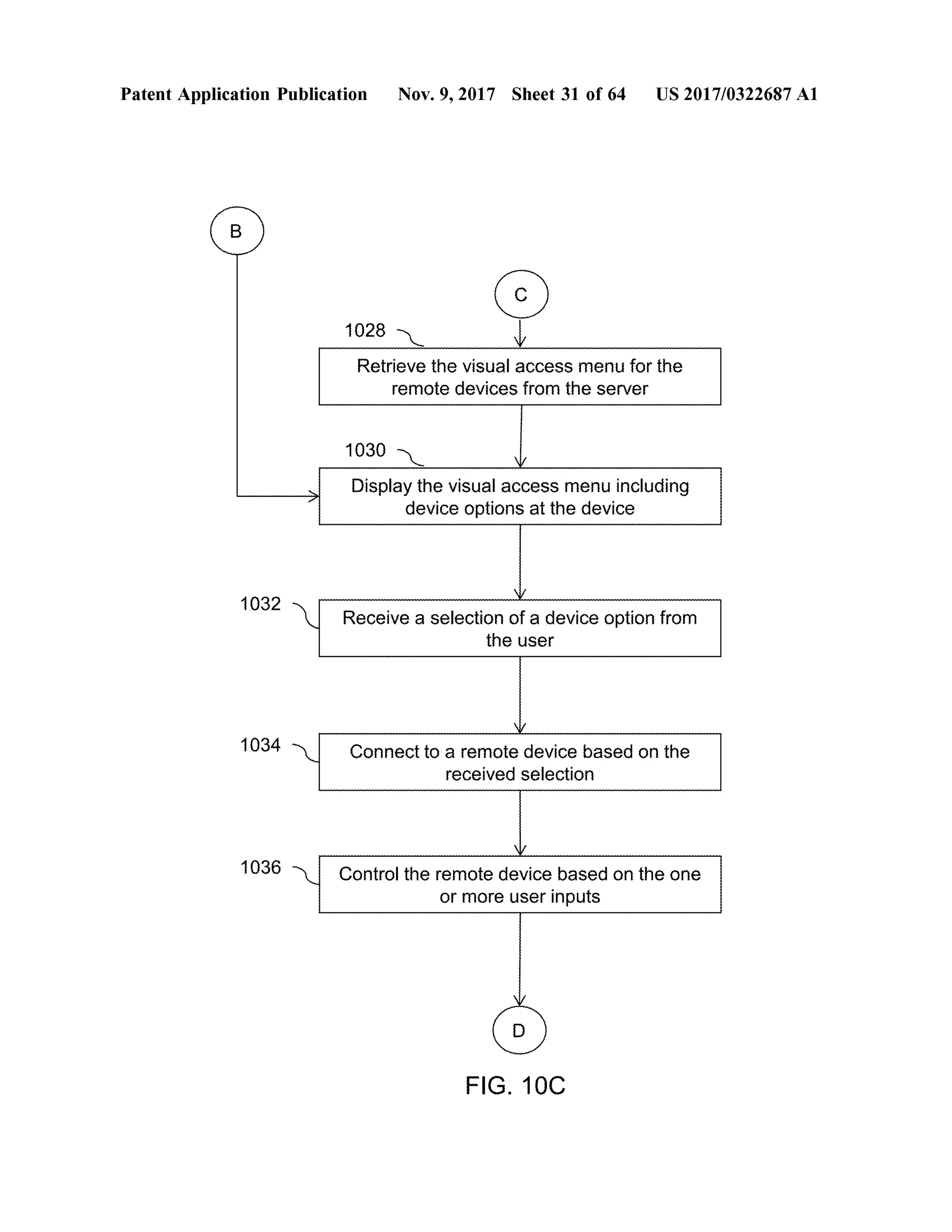
reminders about meetings, occasions such as anniversary,
birthdays etc. using the calendar tab 1904e.
[0232] FIG .20A-B illustratesexemplary environments for
providing accessofthecockpit 1902 ofa user to otherusers,
in accordance with an embodiment of the invention . As
shown in FIG . 19 ,a usermay bedisplayed with the cockpit
1902 for accessing various objects. Further, in an embodi
mentof the invention, the usermay create or configure the
cockpit 1902 by using various predefined controls or set
tings. The cockpit 1902 may include the plurality of tabs
1904a-n for enabling the user to access the various objects
such as remote devices 106a-n, services 202a-n, and so
forth . In an embodiment of the invention, the user may set
up the cockpit 1902 according to his/herpreferences such as
language preferences, themepreferences, and so forth . The
user may customize the cockpit 1902 according to his/her
convenience or preferences.
[0233] In an embodiment of the invention, a first user of
a first device 2002 may set up a cockpit such as the cockpit
1902 for accessing various objects at the firstdevice 2002.
The first device 2002 may include an IVR application
VMThings 2004. The usermay create the cockpit 1902 by
using the VMThings 2004. Further, the first user may
provide the access ofthe cockpit 1902 to oneormore second
users. The one ormore second users are associated with one
ormore second devices such as a second device 2006. The
second device 2006 may include an IVR application
VMThings 2008. The VMThings 2008 may display the
cockpit 1902 ofthe first user at the second device 2006 . In
an embodiment of the invention, the firstdevice 2002 and
the second device 2006 can be a portable device capable of
communicating and connecting to other devices such as the
remote devices 106a-n . Examples of the first device 2002
and the second device 2006 may include,butare notlimited
to , a mobile phone, a smart phone, a computer, a personal
digital assistant (PDA), a tablet computer, a laptop, and so
forth.
[0234] Further,the first device 2002 and the second device
2006 are connected to each other through a network 104.
The network 104 can be a wired network or a wireless
network or a combination of these. The wireless network
may use wireless technologies to provide connectivity
among various devices. Examples of the wireless technolo
gies include, but are not limited to, Wi-Fi, WiMAX, fixed
wireless data, ZigBee, Radio Frequency 4 for Consumer
Electronicsnetwork (RF4CE), Home RF, IEEE 802.11, 4G
orLong Term Evolution (LTE), Bluetooth, Infrared,spread
spectrum , Near Field Communication (NFC ),Global Sys
tems forMobile communication (GSM ), Digital-Advanced
Mobile Phone Service (D -AMPS). The device 102 may
connect to the plurality of remote devices 106a-n through
the network 104. Examples of the wired network include,
but are not limited to , Local Area Network (LAN ),Metro
politan Area Network (MAN ),Wide Area Network (WAN ),
and so forth . In an embodimentof the invention ,the network
104 is the Internet.
US 2017/0322687 A1 Nov. 9, 2017
27
[0235] Further,thecockpit 1902may includevisualaccess
menu for controlling the plurality ofremote devices 106a-n
or services 202a-n .As shown in FIG . 20A , the firstusermay
connect and control the plurality ofremote devices 106a-n
through the network 104. Examples of the remote devices
include,but are not limited to, household devices including
electric lights,water pump, generator, fans,television (TV),
cameras, microwave, doors, windows, computer, or garage
locks, security systems,air-conditioners (AC), lights, and so
forth . In an embodimentofthe invention, the plurality ofthe
remote devices 106a-n can be vehicles such as cars, trucks,
vans,and so forth .Once set up, the firstusermay access the
cockpit 1902 at the first device 2002. In an embodimentof
the invention, the usermay access the cockpit 1902 through
a website or web browser. The user(s )may have to authen
ticate before accessing the cockpit.In an embodimentofthe
invention, the cockpit 1902 may be stored at a proxy server
2010. Further, the proxy server 2010 may also store cockpits
ofotherusers. In an embodiment ofthe invention, the proxy
server 2010 may maintain a record of the interaction ofthe
users with the cockpits. Further,the proxy server 2010may
include a list ofusers and information aboutaccess control
over various cockpits. In an embodiment of the invention ,
the access controlpermissions of the cockpit 1902 may be
provided to theoneormore second users by the proxy server
2010. In an embodiment of the invention, the proxy server
2010 may send a message to the first user to ask for a
permission regarding some changes in his/her cockpit 1902
by the one or more second users. Thereafter, the cockpit
1902may be changed or updated based on the permission
from the first user. Further, the proxy server 2010 may
monitor the cockpit 1902 of the first user and see if there are
unauthorized requests to control the cockpit 1902 or the
remote devices 106a-n . In case there are unauthorized
request, theproxy server 2010may reportto theownerofthe
cockpit 1902 such as the firstuser. In an embodimentofthe
invention, the proxy server 2010 may report about unau
thorized access to a security designated entity. Thereafter,
eitherthe security designated entity or the firstusermay take
an action to handle the unauthorized access. For example,
the firstusermay block the users from which unauthorized
access requests are received.
[0236 ] In an embodiment of the invention, the usermay
create or configure an Internet of Things menu including
representations of one or more identifiable objects. The
identifiable objects may be virtual or physicalobjects. The
user may share the Internet of Thingsmenu with other user
such as friends or relatives.
10237] In an embodiment of the invention, differentusers
may request access to cockpit 1902 of other users. In an
embodimentof the invention, the one or more second users
may request to getcontrol over first user's cockpit 1902.For
example,a wifemay requestherhusbandto getaccess on his
cockpit. The one ormore secondusersmay get access ofthe
cockpit 1902 of the first user based on the permission
granted by the first user. In an exemplary scenario, the
reverse controlmay allow the service provider to getmore
information and control of the cockpit of the users. The
service provider can be a telecom service provider,a grocery
provider, a movie rental service provider, an internet pro
vider, and so forth.
[0238] FIG . 21 illustrates a flow diagram for providing
access controlofthe cockpit to one ormore second users, in
accordance with an embodiment of the invention. As illus-
trated in FIG . 20A-B , the first user may configure or
customize the cockpit 1902 at the first device 2002. The first
usermay communicate with the one ormore second users
over the network 104 such as the Internet. The first device
2002may connect to the second device 2006 through the
network 104.
[0239] Atstep 2102,the firstusermay access a graphical
user interface (GUI) for configuring the cockpit 1902 at the
firstdevice 2002. Atstep 2104, the user may configure the
cockpit 1902 based on his/her one or more preferences.
Examples ofthepreferencesmay include,butare notlimited
to, language selection, font size, and selection of remote
devices, favorite services, pictures, icons, themes, and so
forth . For example,theusermayselecta color and theme for
his/her cockpit 1902.
[0240] At step 2106, the firstuser may share the cockpit
1902 with the one ormore second users. For example, the
first user such as John may share the cockpit 1902 of
managing and controlling his home devices with his wife
Marie or son Paul so that they may also control the home
devices. Further, the user may provide limited or full control
ofthe cockpit 1902 to the second users. Further, the control
to the cockpit 1902 including different tabs representing
objects such asremote devices may be provided to different
secondusers.In an embodimentofthe invention,the access
to the cockpit 1902may be provided on an eventbasis. For
example, the first usermay provideaccess to the second user
for two days, or till Christmas. In an embodiment of the
invention,the first usermay provide an access to the cockpit
1902 based on time for example, such as for 4 hours, 3
hours, and so forth.
[0241] In an embodiment of the invention, the first user
may receive one ormore alertmessages about the remote
devices, services or other objects of the cockpit 1902. In an
embodiment of the invention, the VMThings 2004may send
these alert messages or control of the cockpit 1902 to the
first userwhen he/she is available. In another embodimentof
the invention, the VMThings 2004 may send the alert
messages or controlofthe cockpit 1902 to the other second
users when the first user is not available . Further, the user
may setup a list of second users to whom the control ofthe
cockpit 1902 may be passed in absence of the first user.
[0242]. Further, the VMThings 2008 at the second device
2006 may translate language of the cockpit 1902 based on
language preference of the second user, at step 2108. In an
embodiment of the invention , the VMThings 2008 may
translate the cockpit 1902 of the first user based on the
configuration of the second device 2006. For example, the
VMThings2008may translate thecockpit 1902 into Russian
language if the second user understands Russian. Then at
step 2110, the cockpit 1902 or a menu ofthe cockpit 1902
may be displayed at the second device 2006 . In an embodi
ment of the invention, the cockpit 1902may be downloaded
at the second device 2006 . Thereafter, the second user may
interactwith the cockpit 1902.Further, the VMThings 2008
may change the display of the second device 2006 to a menu
of the shared cockpit 1902. Further, the displayed visual
access menu or the cockpit 1902 will be according to the
second user's preference(s).
[0243] FIGS. 22A and 22B illustrate a flow diagram for
providing access control of the cockpit to one or more
second users, in accordancewith another embodimentofthe
invention. As illustrated in FIG . 20A - B , the first user may
configure or customize the cockpit 1902 at the first device
US 2017/0322687 A1 Nov. 9, 2017
2002. The first usermay communicate with the one ormore
second users overthenetwork 104 such as the Internet. The
first device 2002 may connect to the second device 2006
through the network 104.
[0244] Atstep 2202, the firstusermay access a graphical
user interface (GUI) for configuring the cockpit 1902 at the
first device 2002. The first device 2002 may be a mobile
phone, a smart phone, a computer, a personal digitalassis
tant (PDA), a tablet computer, a laptop, and so forth . At step
2204, the user may configure the cockpit 1902 based on
his/her one or more preferences. Examples of the one or
more preferences may include, but are not limited to,
language preference, font size, and preferred remote
devices, favorite services, pictures, icons, themes, and so
forth .For example, theusermay selecta fontsize for his/her
cockpit 1902.
[0245] At step 2206, the first usermay share the cockpit
1902 with the one ormore second users. For example, the
first user such as John may share the cockpit 1902 for
managing and controlling his home devices with his wife
Marie or son Paul so that they may also control the home
devices. In an embodimentofthe invention, thesecond users
may also provide controlof the cockpit 1902 to one ormore
third users after getting controlofthe cockpit 1902. The one
or more second users are the users associated with one or
more second devices such as the second device 2006.
Further, the user may provide partial or full control of the
cockpit 1902 to the second users.Further, thecontrolto the
cockpit 1902 including different objects or remote devices
may be provided to the second users. Further, the access
control of the objects may differ for different users. For
example, first user may provide complete control i.e . view
ing,controlling and modifying permission to his/her cockpit
1902 to a User A , and may give partial/limited controlsuch
as just viewing and controlling permission to a User B .
[0246]. In an embodiment of the invention, the access to
the cockpit 1902 may be provided on an eventbasis. For
example,the firstusermay provide access to the second user
for two days, or till Christmas. In an embodiment of the
invention, the first usermay provide an access to the cockpit
1902 based on time. For example, such as for 4 hours, 3
hours, till 5:30 PM , and so forth .
[0247] In an embodimentof the invention, the first user
may receive one or more alertmessages about the remote
devices, services or other objects of the cockpit 1902. In an
embodimentof the invention, the VMThings 2004 may send
these alertmessages or control of the cockpit 1902 to the
firstuserwhen he/she is available.In another embodimentof
the invention, the VMThings 2004 may send the alert
messages or control ofthe cockpit 1902 to the other second
users when the first user is not available. Further, the user
may setup a listofsecondusersto whom the controlofthe
cockpit 1902 may be passed in absence ofthe firstuser.
[0248] Further, at step 2208, the VMThings 2008 at the
second device 2006may translate the cockpit 1902based on
language preference of the second user. For example, the
VMThings2008may translate the cockpit 1902 into Russian
language if the second user understandsRussian or wants to
view the cockpit 1902 in Russian. In an embodiment of the
invention, the VMThings 2008may translate languageofthe
cockpit 1902 of the first user based on the configuration of
the second device 2006. For example, the VMThings 2008
may translate the cockpit 1902which is in English language
into a Russian language cockpit if the second user under
stands or wants to view the cockpit in Russian language.
Then at step 2210,thecockpit 1902 or amenu ofthe cockpit
1902 may be displayed at the second device 2006 . Further,
the VMThings 2008 may change the display of the second
device 2006 to a visualmenu of the shared cockpit 1902.
Further, the displayedmenu willbe according to the second
user's preference.
[0249] Thereafter, at step 2212 the one ormore second
users may interact with the cockpit 1902 at their respective
one ormore second devices. The second user(s )may view
and controlthe one ormore objects in the cockpit 1902 from
the second device 2006 itself. For example, the second user
may use his/her smart phone to switch off the microwave
associated with a homeof the firstuser. Further, the firstuser
may receive notificationsregarding events atthe firstdevice
2002. The events may be such as, butnot limited to , switch
on, switch off, theft, and so forth. In an embodiment of the
invention, the first user may receive notifications about
changes done by the one or more second user to his/her
cockpit 1902. Further, messages asking to approve these
changesby thesecond usersmaybereceived by the first user
at the first device 2002.
f0250]. Further, the proxy server 2010 may maintain a
record of interactions with the cockpit 1902 by different
users. Further, the proxy server 2010 may have some level
of controlrelated to the sharing of the cockpit 1902 with
otherusers. In an embodimentofthe invention, the firstuser
may provide some instructions to the proxy server 2010
regarding sharingofthecockpit. The proxy server 2010 may
know to whom to send the request and when to send the
request if it does notwork for any reason. Further, theproxy
server 2010 may maintain records related to managing
ownership of the control of the cockpit 1902. The proxy
server 2010 may also decide to whom to give control and
how much controlofthe cockpit 1902 ofthe first user. In an
embodimentof the invention, the proxy server 2010 may
decide about giving control to other users based on pre
defined settings received from the first user (or the users).
Further, the proxy server 2010may save the access pattern
ofthe firstuser or the one ormore second users. Further, the
proxy server2010may also store profileinformation such as
name,age,and profession etc.oftheusers.Furthermore, the
proxy server 2010 may provide control to the second users
based on one ormoreparameters such as,butarenotlimited
to , time, event, availability of a user at the device and so
forth . Further, the proxy server 2010 may maintain a record
of all the changes done to the cockpit 1902 by the one or
more second users. In an embodimentof the invention, the
first user may roll back all the changes done by the other
second users based on the record of the changes maintained
at the proxy server 2010.
[0251] In an embodimentoftheinvention, differentusers
may request access to cockpit of other users. In an exem
plary scenario, the one ormore second users may request to
get control over first user's cockpit 1902. For example, a
daughtermay request hermom to get accesson her cockpit
1902. Therefore, the one or more second users may get
access of the cockpit 1902 of the first user based on the
permission granted by the first user. The request for sharing
the cockpitmay be received by the users in form ofSMS,
MMS, instantmessage, e-mails, and so forth attheir respec
tivedevices. The firstusermay provide complete access or
limited access to the one or more users. In an exemplary
scenario, thereverse controlmay allow the service provider
US 2017/0322687 A1 Nov. 9, 2017
29
to getmoreinformation and controlofthe cockpit 1902 of
users. Further, the proxy server 2010 may monitor the
cockpit 1902 of the first user and see if there are unauthor
ized requests to controlthe cockpit 1902. In case there are
unauthorized request, the proxy server 2010 may report to
the owner of the cockpit 1902 such as the first user. In an
embodiment of the invention, the proxy server 2010 may
report about unauthorized access to a security designated
entity. In an embodimentof the invention ,the proxy server
2010 may itself handle the unauthorized access requests.
10252] Atstep 2214,the interactions with the cockpit 1902
ofthe first usermay be stored atthe proxy server 2010. The
proxy server 2010 may store the interactionsin form of list,
records, text, audio , video and so forth. At 2216 , the proxy
server 2010 may send amessage to the first user to ask for
a permission regarding some changes in his/her cockpit
1902 by the one or more second users. Thereafter, at step
2218, the cockpit 1902 may be changed or modified or
updated based on thepermission received from the firstuser.
[0253] FIG . 23 illustrates a flow diagram for customizing
a cockpit based on user's preference, in accordance with an
embodimentofthe invention. A usermay create or configure
a cockpit such as thecockpit 1902 asshown in FIG . 19. The
cockpit 1902 may include a plurality of tabs or icons
1904a-n representingdifferent types ofobjects. The cockpit
1902maybe device specific or user specific. The VMThings
108may present a GUIfor configuring the cockpit 1902 to
a user at the device 102.
[0254) Atstep 2302, the usermay access a database of
visual access menus through a GUI for customizing a
cockpit includingmultiple visualaccessmenus correspond
ing to multiple objects at the device 102. The visual access
menus may be visual menus for accessing one or more
objects such as, but are not limited to , services 202a-n ,
remote devices 106a-n , and so forth . The user may provide
one or more inputs at the device 102 . At step 2304, the
VMThings 108 may search the database for a cockpit or one
ormore visualaccessmenus based on the one ormore inputs
received from the user. The user may provide inputs at the
device by at least one of pressing one ormorekeys atthe
device 102, giving a voice command ,through gestures,hand
movement, touching the screen of the device 102, and so
forth . In an embodimentof the invention, the VMThings 108
may retrieve a cockpit or visual access menu matching the
inputs from a server. In another embodimentof the inven
tion, the VMThings 108 may display a message telling that
cockpit or the visual access menu is not available at the
device 102.
[0255] At step 2306, the VMThings 108 may customize
the cockpit visual accessmenu according to user's prefer
ence. In an embodimentofthe invention, the VMThings 108
may customize one or more visual accessmenus or objects
of the cockpit according to user's preference. For example,
the usermaybe interested in controlling remote devices such
as car, garage, home doors, fans, and lights ofhis/her house
only. So, the user may be displayed with a visual access
menu corresponding to his/her preferred remote devices of
the remote devices 106a-n . Through this visual accessmenu
the user may access and control one ormore operations of
the personal remote devices. Similarly, the user may define
his/her preferences foraccessing the remote devices present
athis/her office or factory, and so forth. Therefore,multiple
visualaccess menusmay be stored at the devices based on
the preferencesoftheuser. Examples ofthepreferencesmay
include, but are not limited to, language preference, font
size, and selection of remote devices, favorite services,
pictures, icons, themes,and so forth . For example , the user
may select a color and theme for his/her cockpit to be
displayed at the device 102 . In an embodiment of the
invention, the usermay be displayed with a different visual
accessmenu when theuser accessesthe visual access menu
from different devices. For example, when the user is
accessing a visual access menu to control services from
his/her laptop, he may see a first visual access menu and
when the same user accesses the visual access menu from
his/her smart phone he may be presented with a second
visualaccessmenu. The purpose or functionality of the first
visual access menu may be same as of the second visual
access menu. For example, the first and the second visual
accessmenumay be thevisualmenus for controlling one or
more cars of the user.
[0256). Thereafter, at step 2308, a customized cockpit or
theone ormore visualaccessmenus may be displayed at the
device 102. In an embodiment of the invention, the visual
access menu may be customized based on the user prefer
ences received in real time. In another embodiment of the
invention,the visual access menumay becustomized based
on predefined user preferences. In an embodiment of the
invention,the customized visualaccessmenu maybe stored
atthe device 102 or at a server in a cloud network.
10257]. In an embodiment of the invention, a standard
cockpit orvisual access menu may be displayed to the user.
The standard cockpit may be an interface which is not
customized according to the user preferences. The standard
visual accessmenu may be a standard menu which may be
displayed without any customization specific to the user.
[0258] FIG . 24 illustrates a flow diagram for configuring
a cockpit, in accordance with an embodiment of the inven
tion . As discussed with reference to FIG . 1A , a user may
access or control the remote devices 106a-n or services
202a-n by using the device 102. The device 102may include
the VMThings 108 for displaying graphical information at
the device 102. The user may create a cockpit by using a
GUI at the device 102. At step 2402, the user may access a
database of visual access menus through a GUIfor creating
a cockpit such as the cockpit 1902 as shown in FIG . 19.For
example, the user may access a database of visual access
menu at his/her smart phone. In an embodiment of the
invention,the database may be present at the device 102. In
another embodimentof the invention, the database may be
presenton a server in a cloud network.
[0259] At step 2404, the VMThings 108 may display one
or more configuration settings options for creating the
cockpit to the user at the device 102. The user may choose
or select one or more configuration setting options. In an
embodiment of the invention, the user may provide inputs
regarding the configuration settings. At step 2406 , a selec
tion of theoneormore configuration settingoptionsmaybe
received at the device 102. In an embodiment of the inven
tion, the VMThings 108may detect and receive the selection
of the configuration options from the user atthe device 102.
At step 2408, a cockpit may be created based on the
selection received from the user. In an embodiment of the
invention, the VMThings 108 may create the cockpitbased
on the selection of the configuration options. The cockpit
created may be a customized cockpit specific to theuser. The
customized cockpitmay be stored at the device 102. There
after, at step 2410, the cockpitmay be displayed at the
US 2017/0322687 A1 Nov. 9, 2017
30
device 102. In an embodimentofthe invention, the cockpit
may be displayed at a display device such as the display
device 118 connected to the device 102.
[0260] FIG . 25 illustrates a flow diagram for customizing
a cockpitbased on other users' reviews,in accordance with
an embodiment of the invention. As discussed with refer
ence to FIG . 19, the user may access different objects
through the cockpit 1902. Further, the user may create or
configure or set up or customize a cockpit specific to the
user.
[0261] Atstep 2502, a usermay access a database includ
ing a plurality ofvisual access menus through a GUIfor
creating a cockpit at a device such as the device 102. The
visual accessmenus are the visualmenus for accessing or
controlling multiple objects such as remote devices 106a-n
or services 202a-n . In an embodiment of the invention, the
database may be present at a server in the network 104. In
another embodimentofthe invention, the database ofvisual
access menusmay presentat the device 102.
[0262] Atstep 2504,one ormore configuration optionsfor
configuring/creating or customizing the cockpit may be
displayed to theuser.In an embodimentofthe invention,the
VMThings 108may display the one ormore configurations
options to the user. Theuser may select or choose these one
or more configuration options to change or modify a stan
dard cockpit.Atstep 2506, theusermay create or configure
the cockpit based on a selection of the one or more con
figuration options received from the user.
[0263] The usermay allow otherusers to view orcheck or
access the cockpit and rate it and provide reviews or
feedback about the cockpit. At step 2508, the user may
receive ratings/reviews/feedback for the cockpit from the
other users in the network 104. The other users may also
suggestsomechanges likeaddition ordeletion in the cockpit
to the user. At step 2510, the cockpitmay be customized at
the device 102 based on the ratings or reviews or feedback
received from the other users. In an embodiment of the
invention, the VMThings 108maymodify the cockpitbased
on the reviews or ratings or feedback automatically at the
device 102. In another embodimentofthe invention, theuser
may accept or reject reviews or feedback and then he/she
may modify the cockpit manually or with the help of the
VMThings 108 application at the device 102.
[0264] Further,themodified cockpitmay be stored in the
database. Thereafter, at step 2512, the customized ormodi
fied cockpit may be displayed at the device 102. In an
embodimentof the invention, themodified cockpit may be
displayed at the display device 118 such as a projector
screen,a TV, a large screen and so forth. In an embodiment
of the invention, the user may not customize the cockpit
based on the other users' reviews or feedback .
[0265] FIG . 26 illustratesa flow diagram for downloading
and customizing a cockpit at a second device, in accordance
with an embodiment of the invention . The user may share
the cockpitwith other users. The cockpitmay bemodified by
theotherusers based on the access controlpermissions from
the user. Further, the user may configure or customize
his /her cockpit with the help of other users in his/her social
network. The socialnetwork may be created by the user by
using a social networkingwebsite. Examples of the social
networking websites include, but are not limited to , Face
book, Google + , Orkut, Twitter, Academia.edu, Athlinks,
Bebo, Badoo, BIGADDA, BlackPlanet, Buzznet, Cloob,
Faceparty, Flixter, Fubar, Google Buzz, Hi5, ibibo,MyS
pace, LinkedIn, MyLife, Ning, WAYN , and so forth. For
example,the usermay share orinvite otherusers to help him
in creatinghis/her cockpit in real time.
[0266] At step 2602, a first cockpitmay be configured or
created by accessing a GUIfor creating thecockpit ata first
device. A first user may create the first cockpit at the first
device. Then at step 2604, the first cockpit may be shared
with one or more second users and downloaded at their
respecting one ormore second devices. Examples ofthe first
device and the second devices may include, but are not
limited to, a mobile phone, a smart phone, a computer, a
laptop, an I-pod, an I-pad, a tablet computer, a home
controller, a set top box, an android device, an android set
top box, and so forth . The cockpitmay be downloaded atthe
system through at least one of an SMS, an MMS, File
transfer protocol (FTP), an E -mail, through wireless tech
nologies like Bluetooth, ZigBee,RF4CE, Wi-Fi, WiMAX,
and so forth.
[0267] At step 2606, the one or more second users may
modify or customize a second cockpit at the one ormore
second devices based on the downloaded first cockpit. The
second cockpit is associated with at least one of the one or
more second users. At step 2608, ratings or reviews or
feedback may be received on the customized second cockpit
of the second user from the other users (orone ormore third
users) in his/her socialnetwork . For example, a second user
may receive ratings on the second cockpit from his/her
friends or relatives in the social network such as on Face
book, Twitter, Orkut, Ning,MySpace, ibibo, and so forth .
[0268] Atstep 2610,oneormore configuration settings of
the second cockpit are downloaded at the first device based
on the reviews or ratings of the other user i.e. the one or
more third users. At step 2612, the first cockpit may be
customized based on the downloaded configuration settings
and reviews. Thereafter, at step 2614, the customized first
cockpitmay be displayed at the first device. In an embodi
ment of the invention, the customized first cockpit may be
stored in the database.
[0269] FIG . 27 illustrates a flow diagram for configuring
a cockpit based on another cockpit of other user, in accor
dance with an embodiment of the invention . As discussed
with reference to FIG . 1A , every user in the network 104
may access visual accessmenus at their respective devices.
Subsequently through these visual access menus, the user
may controlthe one ormore functions or operations of the
one ormore objects such as the remote devices 106a -n . As
discussed with reference to FIGS. 19 and 20, the usermay
configure a cockpit such as the cockpit 19 according to
his/her preferences. Asdiscussed with reference to FIG .26,
theusermay configure or customizehis/her cockpitwith the
help of other users in his/her social network . The social
network may be created by the user by using a social
networking website. Examples of the social networking
websites include,butare notlimited to, Facebook,Google+,
Orkut, Twitter,Academia.edu,Athlinks, Bebo, Badoo,BIG
ADDA , BlackPlanet, Buzznet, Cloob , Faceparty, Flixter,
Fubar, Google Buzz, Hi5, ibibo, MySpace, LinkedIn ,
MyLife, Ning, WAYN, and so forth . For example, the user
may share or invite other users to help him in creating
his/her cockpit in realtime.
[0270] Atstep 2702,atleastonesecond cockpitassociated
with one ormore second users is selected from a database.
The databasemay be at a first device or at a second device
or at a server in the network 104. Each user in the network
US 2017/0322687 A1 Nov. 9, 2017
31
104 may have an associated profile stored at the database.
Theprofile ofa usermay include information such asbutnot
limited to ,name,age, Identity (ID ), interests, favorite books,
and so forth about the user. Further, the at leastone second
cockpit is associated with a second user whose profile is
similar to a profile of a first user. In an embodiment of the
invention, the VMThings 108 may search and select the at
leastone cockpit from the database. In an embodimentofthe
invention, theusermay select the second cockpit of theone
ormore second users.
[0271] Atstep 2704, the second cockpitmaybe analyzed
by the VMThings 108.In an embodimentofthe invention,
the analysis may happen at the first device. In another
embodimentofthe invention, the analysismayhappen at the
server in the network 104 or a network device in a cloud
network.Atstep 2706, a first cockpitspecific to the firstuser
may be created or configured based on the analysis ofthe
second cockpit of the one or more second users. In an
embodimentofthe invention, the VMThings 108may create
the first cockpit based on the second cockpit. In another
embodiment of the invention, the user may provide inputs
for configuring the cockpit based on the analysis of the
second cockpit. Further,theusermay invite other usersmay
behis friends, relatives,colleagues,and so forth to configure
the cockpit fortheuser. The firstcockpitmay be stored atthe
first device. In an embodiment of the invention , the first
cockpit may be stored at the server or the network device.
Thereafter, at step 2708, the first cockpitmay be displayed
at the first device to the user. In an embodiment of the
invention, the first cockpitmay be displayed at a display
device connected to the first device. The display device may
be connected to the first device through wireless or wired
means.
[0272] FIG . 28 illustrates a flow diagram for configuring
a cockpit based on another cockpit of other user, in accor
dance with another embodiment of the invention. At step
2802, the usermay access a graphical user interface (GUI)
for configuringor creating a cockpit at a first device. Atstep
2804, the first usermay provide information or profile of at
least one second user. The profilemay include information
such as a name, age, devices, services, and so forth. Then at
step 2806, the VMThings 108 may search for a second
cockpit of the second user and download at the first device.
At2808, the VMThings 108may customize or configure a
firstcockpit for the first user based on the second cockpitof
the at least one second user. In an embodiment of the
invention, the Further at step 2810, the VMThings 108may
store the first cockpit at the first device. In an embodiment
of the invention, the first cockpitmay be stored ata server
in the network 104. Further, the user may translate the first
cockpit from one language to another. The usermay change
or select a new font size, theme, color etc. for the first
cockpit. Thereafter, at step 2812, the first cockpit may be
displayed to theuser atthe first device. In an embodimentof
the invention,the first cockpit may be displayed ata display
device attached or connected to the first device. Thereafter,
theusermay interactand accessthe oneormore objectsof
the first cockpit accordingly.
[0273] FIG . 29 illustrates a flowchart for downloading a
cockpit from a network, in accordancewith an embodiment
ofthe invention. In an embodimentof the invention, the user
may download the cockpit or one or more configuration
settings forsettinghis/her cockpit at a device. At step 2902,
a graphical user interface (GUI) for creating or configuring
or copying a cockpit at a devicemay be accessed by a user.
In an embodimentof the invention, the user may configure
his/her cockpit based on the cockpit of other users in the
network 104. At step 2904, the usermay select and down
load a cockpit having good reviewsand ratings from the
other users from the network 104 such as the Internet. The
cockpit maybe present in a cloud network. In an embodi
ment of the invention, the user may customize the down
loaded cockpit according to his/her preference and device
compatibility. Atstep 2906, the cockpit may becustomized
or translated according to a language preference of the user.
In an embodiment of the invention, the cockpit may be
translated or customized by the VMThings 108 based on
predefined preferences oftheuser. For example, the cockpit
language may be changed from English to Spanish . In an
embodiment of the invention , the user may not customize
the downloaded cockpit. At step 2908, the customized
cockpitmaybestored at thedevice.In an embodimentofthe
invention, customized cockpit may be stored at a server or
in cloud network. Atstep 2910, the customized cockpitmay
be displayed at the device or at a display device attached to
the device.
[0274] FIG . 30 illustrates an environment for accessing a
cockpit through a website, in accordance with an embodi
ment of the invention.As discussed with reference to FIG .
19, the cockpit 1902 may include multiple tabs or icons
1902a-n for connecting to and controlling multiple objects
3006a-n. The objects may be such as but not limited to ,
remote devices, services, applications, and so forth . A user
may use a device 3002 to access a cockpit or visual access
menusthrough a website in a network 3004. Examples ofthe
device 3002 may include, but are not limited to, smart
phone, PDA, amobile phone, a computer, a laptop,a tablet
computer,an I-POD, and so forth.
[0275] The network 3004 can be a wired network or a
wireless network or a combination of these. The wireless
network may use wireless technologies to provideconnec
tivity among various devices. Examples of the wireless
technologiesinclude,butare notlimited to,Wi-Fi,WiMAX,
fixed wireless data, ZigBee, Radio Frequency 4 for Con
sumer Electronics network (RF4CE), HomeRF, IEEE 802.
11, 4G orLong Term Evolution (LTE),Bluetooth, Infrared,
spread-spectrum , Near Field Communication (NFC),Global
Systems for Mobile communication (GSM ), Digital-Ad
vancedMobilePhone Service (D -AMPS). Thedevice 102 is
connected to the plurality ofremotedevices 106a-n through
the network 104. Examples of the wired network include,
but are not limited to, Local Area Network (LAN ), Metro
politan Area Network (MAN ),Wide Area Network (WAN),
and so forth . In an embodiment of the invention, thenetwork
104 is the Internet. In an embodimentof the invention, the
one or more objects may connect to the network 3004
through a network device such as, but not limited to , a
router,a bridge,a switch, a gateway,a homecommunication
device, and so forth . In an embodiment of the invention , the
objects 3006a-nmay connectto the network 3004 indirectly
through a local network.
[0276] The device 3002may include a web browser for
opening a web site. Examples of the web browser include,
but are not limited to, Internet Explorer, Google Chrome,
Mozilla Firefox,Netscape Navigator, and so forth. The user
can enter a Uniform Resource Locator (URL ) such as,
"www.XYZ.com ' in the web browser to access the website.
Further,when the user enters a URL in the web browser, a
US 2017/0322687 A1 Nov. 9, 2017
32
web page 3008 maybe displayed atthe device 3002based
on the URL. The web page 3008 may include one ormore
data request fields 3010a-n. In an embodimentof the inven
tion, the user may have to authenticate his identity to the
website before accessing the cockpits. The usermay enter
his/her details in theoneormore data request fields 3010a-n
for authentication. In an exemplary scenario , the web page
3008 may include a username data request field 3010a, and
a password data request field 3010b.
[0277] The network 3004may include a cockpit database
3012 or server for storing a plurality of cockpits associated
with a plurality of users or devices. Further, the cockpit
database 3012 may include a plurality of visual access
menus for controlling one ormore objects. The cockpit
database 3012 may also maintain a list of users, devices,
remote devices, services and so forth . In an embodiment of
the invention, thenetwork 3004may include an IVR appli
cation such as VMThings 3014. The VMThings 3014 may
display graphical information to the user atthedevice 3002.
In an embodiment ofthe invention, the graphical informa
tion or visual access menu may be displayed at a display
device such as, but not limited to, a television, an LCD
screen, an LED screen, a computer, a projector screen, a
picture frame, and so forth . In an embodiment of the
invention, the user may configure a cockpit at the device
3002 by accessing a graphical user interface (GUI) for
configuring the cockpit through thewebsite. The user may
log in to the website by providing one or more details.
Thereafter, the user may access or configure or customize
the cockpit. The usermay customize the cockpitby provid
ing one ormore user preferences such as font size, theme,
color, and so forth .
[0278] FIG . 31 illustrates a flow diagram for configuring
a cockpit through a website, in accordance with an embodi
mentof the invention. As discussed with reference to FIG .
30, the user may open a website by entering its network
address orURL in a web browsersuch as Internet Explorer,
Google Chrome, etc. At step 3102, the user may open a
website through a web browser at a device. The usermay
entera URL associated with the website to open a webpage.
In an embodimentof the invention,thewebsitemay include
a plurality ofwebpage. In an embodimentof the invention,
a third party maymaintain thewebsite for configuring the
cockpit. In an embodimentofthe invention, thewebsite may
be a website for configuring or creating or setting up a
cockpit.Based on theURL a web page such as theweb page
3008 may be displayed at the device 3002. The web page
3008 may include one ormore data request fields 3010a-n.
[0279] In an embodiment of the invention, the website
may ask the user to enter his/her personaldetails for autho
rization. At step 3104, the user may enter one or more
personaldetails in the data request fields 3010a-n to authen
ticate atthewebsite. The user may be allowed to accessweb
site based on the authorization. The user can access a GUI
for configuring the cockpit after authorization.Atstep 3106,
VMthings 3014 may display one or more configuration
options to the user. The user may select or choose the one or
more configuration options to configure the cockpit. At step
3108, the VMthings 3014 may receive selection of the one
ormore configuration options from the user. The usermay
select the optionsby touching the screen of thedevice. In an
embodimentoftheinvention, the usermay select the options
through at least one of entering a combination of keys,
giving a voice command, gestures, handmovements, and so
forth .
[0280] At step 3110, the VMthings 3014may configure or
create the cockpit for the user based on the selection of the
configuration options. In an embodiment of the invention ,
the cockpit may be customized based on the one ormore
configuration options. In an embodimentof the invention,
the usermay create a plurality of cockpits based on his/her
preferences. For example, the user may create a cockpit for
handling homeappliances, a second cockpit for handling or
controlling office objects and so forth. Thereafter, at step
3112, the cockpit may be displayed to the user. The
VMThings 3014may display the cockpit at the device 3002.
In an embodimentofthe invention,the VMThings3014 may
display the cockpit at a display device attached to the device
3002. The cockpit is then stored at the cockpit database
3012. The usermay interact or control one or more objects
through the cockpit.
[0281] FIG . 32 illustrates a flow diagram for accessing a
cockpit through a website, in accordance with an embodi
ment of the invention. As discussed with reference to FIG .
30, the usermay access the cockpit through a website. At
step 3202, the user may open a website through a web
browser at the device 3002 . A web page 3008 based on the
URL of the website may be displayed at the device 3002.
Thewebpage 3008 may include one ormore data request
fields 3010 a -n. The usermay enter his/her details in the data
request fields 3010 a-n. A website servermay check whether
the user is an authorized user or not based on the entered
details, at step 3204. Thereafter, the VMThings 3014 may
search the cockpit database 3012 for a cockpit associated
with the user. In an embodimentofthe invention, the cockpit
may be present in a cloud network.
[0282] Then at step 3206, the VMThings 3014 may dis
play the cockpit specific to theuser at the device 3002. In an
embodimentof the invention, the cockpitmay be displayed
at a display device. Further, different cockpits may be
displayed to different users based on their details. In another
embodiment of the invention, a standard cockpit may be
displayed to the user. The standard cockpitmaybe a cockpit
includingone ormore objects without any specific changes
according to different users. In an embodiment of the
invention, the VMThings 3014 may display the cockpit at
the device 3002 based on current location of the user orthe
device 3002. The icons in the cockpitmay differ depending
on the location of the device 3002 or the user. For example,
the user may be displayed with a first cockpitwhen the user
isathomeandmay be displayedwith a second cockpitwhen
theuser is travelling.In an embodimentofthe invention,the
location of the user may be determined by using a GPS
system at the device 3001 or in the network 3004. In an
embodiment of the invention, the location of the objects
being controlled may change. For example, car, pet, wife,
kidsmay change their location. Therefore, VMThings 3014
may display different cockpit or visualmenus to the user
based on the location of the controlled objects.
[0283] Subsequently,theusercan interactwith the cockpit
at step 3208. The usermay select a tab from a plurality of
tabs or icons of the cockpit for interacting with the objects.
Atstep 3210, the usermay be displayed with an enhanced
visualaccess menu based on the selection or interaction of
the user with the cockpit. As discussed with reference to
FIG . 1A to FIG . 21, the enhanced visual accessmenu may
US 2017/0322687 A1 Nov. 9, 2017
33
include one ormore device options or the service options.
The device options may be the icons representing one or
more remote devices 106a-n . Similarly, the service options
may be the icons or graphics representing one or more
services 202a- n . In an embodiment of the invention , the
cockpit maybe displayed based on one ormore preferences
of the user such as color preference, font size, theme,
language preference, and so forth . In an embodimentof the
invention, the usermay provide the preferences in realtime.
In an embodiment ofthe invention , the user preferences are
pre-defined and may be stored atthe cockpit database 3012
or the device 3002. Atstep 3212, the usermay interactand
controlone ormore operations of the objects such as remote
devices.
[0284] FIG . 33 illustrates a flow diagram for configuring
a cockpitwith thehelp ofotherusers, in accordancewith an
embodimentofthe invention.Asdiscussed with reference to
FIG . 30, a user may access a website for creating or
configuring orcustomizing a cockpit through a web browser
such as InternetExplorer,Google Chrome,and so forth. The
website may include a plurality of web pages. Each of the
web pagemay display text, images, data request fields, and
so forth. In an embodimentofthe invention, the web page
may include audio files or video files.
[0285] In an embodiment of the invention, the usermay
configure an Internet of Things menu by accessing a web
site . The user may login to the website and then may get
access to various setting controls for configuring the Internet
of Thingsmenu based on the authorization. In an embodi
mentof the invention, the Internet of Things application i.e .
the VMThings may create the Internet of Things menu for
differentusers at the device. Further, the usermay share the
Internet of Things menu with otherusers. In an embodiment
of the invention , the Internet of Thingsmenu may include
one or more options for identifiable objects. Further, the
Internet of Things menu may be created by inviting other
users.
[0286 ] Atstep 3302, a first usermay access a website for
creating or configuring or setting up a cockpit at a first
device such as a first device 2002 of FIG . 20A -B . The first
device may be a smart phone. At step 3304, the usermay
invite one ormore second users for configuring the cockpit
for the first user. The first usermay invite the one ormore
second users through at least one of an SMS, an MMS, an
instant message, an e -mail, through face to face conversa
tion, or phone, and so forth .
[0287] At step 3306, one ormore inputsmay bereceived
from the one ormore second users. Further, the one ormore
second users may provide the one or more inputs at their
respective second devices. In an embodimentof the inven
tion the VMThings 3014 in the network 3004 may receive
the one ormore inputs from the one ormore second users.
Atstep 3308, one ormore inputsmay be received from the
first user. Further, the firstusermay provide the one ormore
inputs atthe firstdevice. In an embodimentofthe invention,
the VMThings 3014 may receive the inputs from the first
user. Further, the firstuser and the second user may provide
the inputs by at leastone of,touching screen of their devices,
pressing one or more keys at the devices, giving voice
commands, gestures,hand movements, and so forth.
[0288] Atstep 3310,the VMThings 3014 may configure a
cockpit for the first user based on the one or more inputs
from the first user and the one ormore second users. In an
embodiment of the invention, the VMThings 3014 may
customize an already configured cockpit of the first user
based on the one or more inputs from the firstuser and the
one ormore second users. Finally, atstep 3312, the cockpit
may be stored at the firstdevice. In an embodiment of the
invention, the cockpit may be stored at a server of the
website or at the cockpit database 3012 in thenetwork 3004.
In an embodiment of the invention, the first user may
provide access to the cockpit to the one or more second
users.
[0289] FIG . 34 illustrates a flow diagram for switching a
display mode of a cockpit, in accordance with an embodi
ment of the invention. In an embodiment of the invention,
the cockpit or the visualaccess menusmay be displayed to
the user based on the user's one or more preferences.
Further, the cockpit (or visual access menus) may be dis
played to the userbased on the display capabilities of the
device. For example, the cockpitmay be displayed as a list
when the device is a simple mobile phone and has a small
display. In an embodimentofthe invention, thecockpit may
be played to the user depending on the user's preference.
[0290] At step 3402, a usermay access a database of
visual access menus or cockpit through a graphical user
interface (GUI) at a device. The GUI may provide an
interface for creating or configuring or customizing or
accessing a cockpit. As discussed with reference to FIG . 30,
the cockpit database 3012 may include a plurality of cock
pits or visual access menus for differentusers and devices.
Examples ofthe device may include, but are not limited to ,
a mobile phone, a smart phone, a laptop, an I-pod, a tablet
computer, a PDA, an electronics device, and so forth . The
user may receive alerts ormessages from the one ormore
objects connected through the cockpit or the visual access
menus.Atstep 3404,a cockpit alongwith oneormoremode
optionsmay be displayed to the user.Examples of themode
options may include, but are not limited to , video, audio ,
visual, text, list, and so forth . In an embodiment of the
invention, the oneormoremode optionsmaybe displayed
at the GUI for creating/accessing cockpit.
[0291] The usermay select at least onemode option from
theone ormoremodeoptions.A selectionofthe video mode
option may play the cockpit as a video. A selection of the
audio mode option may play the cockpit options asaudio or
music. A selection ofthe textmode option may display the
cockpitoptionsastext. Similarly, a selection ofthe listmode
option may display the cockpit options as a list. At step
3406 , a selection of the at least one mode optionsmay be
received from the user at the device. In an embodiment of
the invention, the VMThings atthe devicemay receive the
selection of themode option.
[0292] Based on the selection of themode option , the
modeofthe display of the devicemay be switched at step
3408. For example , the user may select the audio option, so
the displaymay switch to audio mode and various options of
the cockpit or the visual access menus may be played to the
user. Subsequently, at step 3410, an audio menu may be
played at the device when the user selects the audio mode.
Thereafter, the user may listen to the options and may
interact by providing one ormore inputs . The one or more
inputs may be provided through at least one of gestures,
hand movements, voice commands, pressing one ormore
keys at the device, touching the display, and so forth. For
example, when a user is driving, and wants to access the
US 2017/0322687 A1 Nov. 9, 2017
34
cockpit,hemay choose the audio mode option. Therefore,
the optionsmay be played to theuser andhe/she can interact
with the cockpit accordingly.
[0293] FIG . 35A illustrates an exemplary display ofcock
pit along with oneormoremodeoptions,in accordance with
an embodiment of the invention. As discussed with refer
ence to FIG . 19, a usermay create or configure a cockpit
such as the cockpit 1902 atthe device 102. The cockpit 1902
is an interface which enables a user to access various
services, devices or objects. The cockpit 1902may include
icons 1904a -n representing various objects which a user or
users can access or control. The tabs 1904a-n may be icons
or text or combination ofthese.
[0294] As discussed with reference to FIG . 34, the
VMThings 108 may display the cockpit along with one or
moremode optionsat the device 102.Examples of themode
optionsmay include, butare not limited to, video , audio,
visual, text, list, and so forth . In an embodiment of the
invention,the one or more mode options may be displayed
at a GUI 3506 for creating/accessing cockpit as shown in
FIG . 35B. The usermay select at leastonemodeoption from
theone ormoremodeoptions. A selection ofthe video mode
option may play the cockpit as a video. A selection of the
audio mode option may play thecockpit options as audio or
music. A selection ofthe textmode option may display the
cockpitoptions astext.Similarly,a selection ofthe listmode
option may display the cockpitoptionsasa list. A display of
the device 102 may change based on the selection of the
mode optionsby theuser.For example, if theuserselects an
audio mode option, an audio menu may be played at the
device 102. Thereafter, the usermay listen to the optionsand
may interactby providing one ormore inputs.
[0295] As shown in FIG . 35 , the exemplary GUI 3506
may includeone ormore icons/tabs/options 3504a-n . A GUI
option 3504a may be a Create Cockpit option. A user may
select this option for creating or configuring or setting up a
cockpit. A GUIoption 3504b may be a Customize Cockpit
option. The usermay use this option to customize an already
created or stored cockpit. In an embodiment of the inven
tion, the cockpit may be stored at the device 102. In an
embodimentof the invention , the cockpits are maintained by
the cockpit database 3012 as shown in FIG . 30. A GUI
option 3504c may be a View Cockpit option. The usermay
select this option to view the cockpits at the device 102.
[0296] In another embodiment ofthe invention, a server
may provide functionality of the VMThings. Further, the
server may maintain all the information which is otherwise
was provided by the VMThings. The server may maintain
the information regarding the one or more visual access
menus, users, devices, remote devices, services, display
device, access device,and so forth . A user atthe device such
as a telephone may request information from the server.
Further,the servermay send the information to the request
ing device over a network. The network may be a wired or
a wireless network. The connection between the device and
the servermay be a wired or a wireless connection . Further,
the server may send the information to the requesting
device(s) by using technologies such as, but are notlimited
to, SMS,MMS,e-mail,and so forth .Based on the received
information,thecontentmay bedisplayed atthedevice.For
example, if the userhas requested the information regarding
controlling remote devices, then information of visual
access menu related to remotedevices maybe received from
theserver. Further, the servermay display the visual access
menu atthe device.In an embodimentofthe invention,the
server may also provide other functions or features of the
VMThings 108 as explained in the FIGS. 1A -2G . The user
may respond or select an option from the displayed visual
access menus through DTMF tones. The device may be a
telephone or a simplemobile phone.
10297] In an embodiment ofthe invention, the usermay
access the functionalities as described above by logging into
a second device such as a home controller. Theusermay see
and control devices associated with the home controller.
[0298] Further, the VMThings may store the user activity
such as selection of options from the visual accessmenus at
thedevice. This user activity informationmay beused bythe
VMThings for displaying the visual accessmenu to thesame
user next time.
[0299] An aspectof the invention allowsthe user to share
his/her cockpit of controlling one ormore objects with other
users.
103001 Another aspectof the invention allowsthe users to
request permission to access or control the one or more
objects ofthe cockpit from the other users.
[0301] Another aspect of the invention provides a cockpit
includingmultiple interfaces forcontrollingmultiple objects
by a user.
[0302] An aspect of the invention enables a user to con
figure or set up a cockpit with the help of other users in
his/hersocialnetwork. Therefore,theusermay invite his/her
friends or other users to set up his cockpit.
[0303] Further aspect of the invention allows a user to
copy other user's cockpit. Thereafter, the usermay configure
his/her cockpitbased on the copied cockpit.
[0304] Another aspect of the invention allows a user to
download a cockpit from a cloud network or the Internet.
[0305 ] Yet another aspect of the invention is to enable a
user to controlone ormore operationsofthe remote devices
or services through voice commands or gestures or hand
movements. For example , the user may switch on an air
conditioner (AC) by showing a thumb up gesture in frontof
the device. The device may include a camera to detect the
gesture. The VMThingsatthe device (oraccess device)may
analyze the gesture and controlaremote device based on the
analysis.
[0306] An advantage of the invention relates to visual
accessmenus thatmay ask for voice commands. This GUI
is for some user harder to use due to accent or other
problems. Thedatabase could beprovided with theoption as
been described before for the system to output voice com
mandaccording to userselectionof the optionsorthe device
options or the service options. The device may include a
microphone for detecting the voice commands. VMThings
may analyze thevoice commandsand may take the actions
accordingly. Further, the disclosed system and methods
allow the user to give voice commands in different lan
guages. For example, theusermay selectan option by giving
a voice command in French language. Furthermore, the user
may select an option (or device options or service options)
from the visual access menu through one ormore gestures
orhandmovements. In an embodimentofthe invention, the
usermay store one ormore gestures for one ormore actions.
For example, theusermay use a thumb up gesture to switch
on the AC . Similarly the user may store a thumb down
gesture to switch off an electronic appliance such asmicro
wave .
US 2017/0322687 A1 Nov. 9, 2017
35
[0307] Another advantage ofthe invention relates to pro
viding visual access menus and enhanced visual access
menus in different language(s). In an embodiment of the
invention, the VMThings ofdeviceor theaccessdevicemay
display visual accessmenu or enhanced visualaccessmenu
in different languages. Further, the device may have one
language and theusermaywantto controland communicate
in a differentlanguage.Similarly,the VMThings may under
stand and accept voice inputs from the user in different
languages irrespective ofthedevicelanguage.Therefore,the
usermay control the remote devicesby giving voice com
mands in different languages such as,but arenot limited to,
English, Spanish, French, Hindi, Chinese language, Japa
nese language, Hawaiian,German language,and so forth. In
an embodimentofthe invention, the devicemay notsupport
or understand a particular language such as Spanish ,butstill
the VMThings can display the visual access menus in
Spanish language.
[0308] Anotheraspectofthe invention is to provide infor
mation aboutvariousservices to theuser using a device such
as a smartphone anytime anywhere.
10309) Further aspect of the invention is to enable a user
to control operations of the remote devices through a device
including VMThingsapplication. The usermay nothave to
be physically present near the remote devices to control
them .
[0310] Yetanother aspectofthe invention is to allow users
to see the images ofremote devices in real-time irrespective
ofthe location oftheremote devices. For example, the user
may see theremote devices such ashomeappliances present
at his/her home by being present at the office.
[0311] Embodimentsofthe invention are described above
with reference to block diagramsand schematic illustrations
ofmethods and systems according to embodiments of the
invention . It will be understood that each block of the
diagramsand combinationsofblocks in the diagramscan be
implemented by computerprogram instructions. Thesecom
puter program instructionsmay be loaded onto one ormore
generalpurpose computers, special purpose computers, or
other programmable data processing translator to produce
machines, such that the instructions which execute on the
computers or other programmable data processing translator
createmeansfor implementing the functionsspecified in the
block or blocks. Such computer program instructions may
also be stored in a computer-readablememory thatcan direct
a computer or other programmable dataprocessing appara
tus to function in a particularmanner, such that the instruc
tions stored in the computer-readable memory produce an
article of manufacture including instruction means that
implement the function specified in the block orblocks.
[0312] While the invention hasbeen described in connec
tion with what is presently considered to be the most
practical and various embodiments, it is to be understood
that the invention is not to be limited to the disclosed
embodiments, but on the contrary, is intended to cover
variousmodifications and equivalent arrangements included
within the spirit and scope of the appended claims. The
invention has been described in the general context of
computing devices,phone and computer-executable instruc
tions, such asprogram modules, being executed by a com
puter. Generally, program modules include routines, pro
grams, characters, components, data structures, etc., that
perform particular tasks or implement particular abstract
data types. A person skilled in the artwill appreciate that the
invention may be practiced with other computer system
configurations, includinghand-held devices,multiprocessor
systems,microprocessor-based or programmable consumer
electronics, network PCs, minicomputers, mainframe com
puters, and the like. Further, the invention may also be
practiced in distributed computing worlds where tasks are
performed by remote processing devices that are linked
through a communications network . In a distributed com
putingworld,program modulesmay be located in both local
and remote memory storage devices.
[0313] This written description uses examples to disclose
the invention , including the best mode, and also to enable
any person skilled in the art to practice the invention,
including making and using any devices or systems and
performing any incorporatedmethods. The patentable scope
the invention is defined in the claims,andmay include other
examples that occur to those skilled in the art. Such other
examples are intended to be within the scope of the claims
if they have structural elements that do not differ from the
literal language of the claims, or if they include equivalent
structural elements with insubstantial differences from the
literal languages of the claims.
1. A server for enhancing interaction with a plurality of
Internet of Things (IoT) devices, the server comprising:
a processor; and
a memory coupled to the processor, the memory com
prising:
a database comprising oneormoreoptions correspond
ing to each ofthe IoT devices; and
one or more instructions executable by the processor
for providing the one or more options to a user for
enabling the user to select at least one option;
one ormore instructions executableby the processor to
receive information corresponding to the selection of
the at least one option by the user; and
2 .one or more instructions executableby the processor to
configure at least one visual menu based on the received
information , wherein the at least one visualmenu enables
controlling the plurality of Internetof Things (IoT) devices
irrespectiveoftheir locations.The serverofclaim 1,wherein
the plurality ofInternetof Things (IoT) devices consist of a
plurality of electronics devices, a plurality ofkitchen appli
ances, a plurality ofvehicles,or a combination thereof.
3. The server of claim 1, wherein the user can select at
least one option by at least a voice command, a gesture, a
hand movement, a combination of keys or a combination
thereof.
4. The server of claim 1, wherein thememory further
comprising one or more instructions for authenticating the
user prior to providing the one ormore options to the user.
5. The server of claim 1, wherein thememory further
comprising one ormore instructions for storing the config
ured visualmenu in the database.
6. The server of claim 1, wherein the memory further
comprising one or more instructions executable by the
processor for providing one or more mode options to the
user for enabling the user to select amode option there from ,
themode option beingselected forreceiving the visualmenu
in the selected mode option.
7. The server ofclaim 1,wherein the one ormore options
correspond to at least one of a service or a remote device.
Systems and methods for electronic communications

Systems and methods for electronic communications

  • 1.
    THATTARTANIAMANINAMANATIMONANANA NANATINUS 20170322687A1 (19)UnitedStates (12)Patent Application Publication (10)Pub.No.: US 2017/0322687A1Lavian et al. (43) Pub . Date: Nov. 9, 2017 (54) SYSTEMSAND METHODSFOR ELECTRONIC COMMUNICATIONS (71) Applicants:TalLavian, Sunnyvale, CA (US);Zvi Or-Bach, San Jose, CA (US) (72) Inventors: TalLavian, Sunnyvale,CA (US);Zvi Or-Bach, San Jose,CA (US) (21) Appl.No.: 15/600,773 continuation-in-part of application No. 13/273,187, filed on Oct. 13, 2011, now abandoned. Publication Classification (51) Int. Cl. G06F 3/0482 (2013.01) H04L 29/08 (2006.01) U .S . CI. CPC ............. G06F 3/0482 (2013.01); H04L67/12 (2013.01) (57) ABSTRACT Embodiments ofthe invention provide a system for enhanc ing user interaction with objects connected to a network. The system includes a processor, a display screen, a memory coupled to the processor. Thememory comprises a database including a list of two or more objects and instructions executable by the processor to display amenu. Themenu is associated with at least two independent objects. And the two independent objects are produced by two independent vendors. (22) Filed: May 21, 2017 Related U.S.Application Data (63) Continuation-in-part of application No. 13/310,696, filed on Dec.2, 2011,now Pat.No.9,690,877,which is a continuation-in -part of application No. 13/245, 804, filed on Sep. 26, 2011, now abandoned,which is a continuation-in -part ofapplication No. 13/272,212, filed on Oct. 12, 2011, now abandoned, which is a 104 RemoteDevice - 106a Device102 1 1066Network Remote DeviceVMThings 108 Remote Device 106c ro Remote Device Is 106
  • 2.
  • 3.
  • 4.
  • 5.
  • 6.
  • 7.
  • 8.
    Is 1062 120 RemoteDevice Patent Application Publication 1 1024 1065 DeviceDeviceVMThings108 ZigBeeNetwork RemoteDevice 106c RemoteDevice Nov.9,2017 Sheet 7 of64 106n RemoteDevice FIG.1G US 2017/0322687A1
  • 9.
  • 10.
  • 11.
  • 12.
  • 13.
  • 14.
  • 15.
  • 16.
  • 17.
  • 18.
  • 19.
  • 20.
  • 21.
    (1) 102102 102 Device Device5312 314a Entertainment Patent Application Publication 308<302 RemoteDevices 314b Travel -304 4. (Control Services2 -304 Services S3140Banking5 •314n Hotels Nov. 9, 2017 Sheet 20 of64 FIG.3B US 2017/0322687 A1
  • 22.
    110a 110b 102 102 Qey Patent Application Publication Device WebPage Device WebPage5302 RemoteDevices 5306a Vehicle3 -306b AC 302 RemoteDevices -304 Services 4 Services2 306c Camera5 306n Microwave Nov. 9, 2017 Sheet 21 of64 w FIG.3C US 2017/0322687 A1
  • 23.
    110a 110c 102 2 102 Device Device WebPage s302 RemoteDevices Patent ApplicationPublication WebPage 5314a Entertainment s304 304 Services2 3146 Travel4 -3140 Banking Services 5 Nov.9,2017 Sheet 22 of64 314n : Hotelsn FIG.3D US 2017/0322687A1
  • 24.
  • 25.
    102 - Device Patent Application Publication Services 5042 504b 504d Banking2 Entertainment3 Energoman Travel4 504e 504C 502 ABCBank XYZBank6 Nov.9, 2017 Sheet 24 of64 BankAccount 5049CreditCards 504h CheckBill1504k Account Transfer Details 9 10 -5041 5041 US 2017/0322687 A1 FIG.5
  • 26.
    ,602 Device 17614 DisplayDisplay K RadioInterface Patent Application Publication Is102 ,604 7616/ Processor NetworkInterface Network —- 5606 6221 - - Memory Memory1620a Card GraphicalUserInterface608 Nov. 9, 2017 Sheet 25 of64 76206 Input/OutputInterface Keyboard Database610 200 76200 Mouse VMThings612 USB 620d w US 2017/0322687 A1 FIG.6
  • 27.
  • 28.
    Patent Application PublicationNov.9,2017 Sheet 27 of64 US 2017/0322687A1 Start 802 Access a database ofvisualaccessmenus through a GUIat a device 804 Display a visualaccessmenu at the device 806 Display an enhanced visualaccess menu based on a selection ofan option by a user 808 Receivea selection ofa device option from a user 810 Connect to a remote device based on selection of the device option 812 Controlone ormore operations of the remote device based on selection of the device option Stop FIG . 8
  • 29.
    Patent Application PublicationNov. 9, 2017 Sheet 28 of64 US 2017/0322687 A1 StartStart 902 Access a database of visualaccessmenus through a GUIat a device 904 - Display a visualaccessmenu atthe device 906 Display an enhanced visualaccessmenu based on a selection ofan option by a user 908 Receive a selection of a service option from a user Connect to a service based on a selection of the service option 912 Control and display information about the service based on selection of the service option Stop FIG . 9
  • 30.
    Patent Application PublicationNov. 9, 2017 Sheet 29 of64 US 2017/0322687 A1 Start 1002 Display aGUIforaccessing visualaccess menus atthe device 1004 Receive an input from a user of the device 1010 1006 YesWait foran inputat the device Is input is for accessing services? No 1008 2 No Is inputis for accessing remote devices ? Yes 1012 2 Yes (ckNo Is a visual accessmenu for remote devices available ? FIG . 10A
  • 31.
    Patent Application PublicationNov. 9, 2017 Sheet 30 of64 US 2017/0322687 A1 10161014 A NoIs a visual access menu for services available ? Retrieve visual access menu from a server 1018 Yes Display the visualaccessmenu including service options at the device 1020 Receive a selection of a service option from the user 1024 1022 NO Is information for the selected service option available ? Receive information from the server 1026 Yes Displaythe information based on the received selection * StopStop FIG . 10B
  • 32.
    Patent Application PublicationNov. 9, 2017 Sheet 31 of64 US 2017/0322687 A1 1028 - Retrieve the visualaccessmenu for the remote devices from the server. . . . . . . . . . . . . . . . . . . . . . . . . . . . . . . . . . . . . . . . . . . . . . . . . . . . . . . . . . . . . . . . . . . . . . . . . . . . . . . . . . . . . . . . . . . . 1030 Display the visual access menu including device options at the device 1032 ) Receive a selection ofa device option from the user 1034 Connect to a remote device based on the received selection 1036 Control theremote device based on the one ormore userinputs FIG . 100
  • 33.
    Patent Application PublicationNov. 9, 2017 Sheet 32 of64 US 2017/0322687 A1 Start 1102 Open a website through a webbrowser atthe device 1104 yy Authenticate a user's identity atthewebsite 1106 Display a visual access menu at the device 1108 Receive an input from the user of the device 11101 Display an enhanced visual accessmenu when the inputis for accessingremote devices 11121Receive a selection of a device option from theuser112 Receiveaselectionofadeviceoptionfrom 11141114 v Connect to a remote device based on a selection ofthe device option 1116 Control one ormore operations of the remoteControl ordevice based on the selection of the device option Stop FIG .11
  • 34.
    Patent Application PublicationNov. 9, 2017 Sheet 33 of64 US 2017/0322687 A1 StartStart ) 1202 Open a website through a web browser at the device 1204 Y Authenticate user's identity at thewebsite 1206 Display a visual access menu at the device 1208 Receive an input from the user of the device 1210 | 8W M3Display an enhanced visualaccess menu when the inputis for accessing services 1212 Receive a selection ofa service option from the user 1214 Connect to a service based on a selection of the service option 1216 Controland display information about the service based on selection of the service option Stop FIG .12
  • 35.
    Patent Application PublicationPatentApplicationPublicatior Nov. 9, 2017 Sheet 34 of64 US 2017/0322687 A1 ( StartStart ) 1302 Open awebsite through aweb browser atthe device 1304 Authenticate user's identity at the website 1306 4 Display a visualaccessmenu at the deviceDisplay a visualacce 1308 Receive an inputfrom the userofthe device 1314 13102Wait for an inputatthe device YesIs input is for accessing services? No 13127 YesIs inputis for accessing remote devices ? FIG . 13A
  • 36.
    Patent Application PublicationNov. 9, 2017 Sheet 35 of64 US 2017/0322687 A1 (A)1316 Is a visual accessmenu for services available ? 13182 No Retrieve visual access menu from a server 1320 Yes Display the visualaccess menu including service options at the device 1322 Receive a selection of a service option from the user 1324 1326 Is information for the selected service option available ? Receive information from the server 1328 Yes Display the information at the device based on the received selection (o StopStop ) FIG13B
  • 37.
    Patent Application PublicationNov. 9, 2017 Sheet 36 of64 US 2017/0322687 A1 1330 V No Is a visual accessmenu for remote devices available atthe device ? 1332 Retrieve the visual accessmenu from the server Yes 1334 Display the visualaccessmenu including device options at the device 1336 Receive a selection of a device option from the user 1338 Connectto a remote device based on the received selection 1340 Controltheremote device based on the one ormore user inputs FIG . 130
  • 38.
    Patent Application PublicationNov.9,2017 Sheet 37 of64 US 2017/0322687A1 StartStart ) 1402 Open a website through a web browser atthe device 1404 Display a visual accessmenu atthe device 1406 Receive an input from the user ofthe device 1408 Display an enhanced visualaccess menu when the input is foraccessing remote devices 1410 Receive a selection of a device option from the user 1412 Connectto a remote device based on a selection of the device option 1414 Control one ormore operations ofthe remote device based on the selection of the device option Stop FIG .14
  • 39.
    PatentApplicationPublicationPatent Application PublicationNov. 9, 2017 Sheet 38 of64 US 2017/0322687 A1 Start 1502 Access a database of visualaccessmenus through a GUIat an access device 1504 Display a visual accessmenu at a display device 1506 Display, atthe display device, an enhanced visual accessmenu based on a selection of an option by a user 1508 Receive a selection of a device option from a user 1510 Connectto a remote device based on selection of the device option 1512 Control one ormore operations ofthe remote device based on selection of the device option Stop FIG . 15
  • 40.
    Patent Application PublicationNov. 9, 2017 Sheet 39 of64 US 2017/0322687 A1 ( StartStart ) 1602 Access a database ofvisual accessmenus through aGUIatan access device 16041604 Display a visual accessmenu at a display device 1606 | Display, at the display device, an enhanced visualaccessmenubased on a selection of an option by a user 1608 Receive a selection of a service option from a user 1610 - Connect to a service based on a selection of the service option 1612 Display information , at the display device, about the service based on the selection of the service option Stop FIG . 16
  • 41.
    Patent Application PublicationNov. 9, 2017 Sheet 40 of64 US 2017/0322687 A1 StartStart ) 1702 Display a GUIfor accessing visualaccess menusat a display device connected to an access device 1704 Receive an input from a user ofthe device 1710 1706 YesWait for an inputfrom the user Is inputis for accessing services ? No 1708 No Is inputis for accessing remote devices? Yes 1712 NoNo Yes ( B(c Is a visual accessmenu forremote devices available ? FIG . 17A
  • 42.
    Patent Application PublicationNov. 9, 2017 Sheet41 of64 US 2017/0322687 A1 B 1716 1714 mm NoIs a visual accessmenu for services available ? Retrieve visual access menu from a server 1718 Yes Displaythe visualaccessmenu including service optionsatthe device 1720 Receive a selection ofa service option from the user 1724 1722 No Is information for the selected service option available ? Receive information from the server 1726 Yes Display theinformation based on the received selection ( D * StopStop ) FIG . 17B
  • 43.
    Patent Application PublicationNov. 9, 2017 Sheet42 of64 US 2017/0322687 A1 1728 Retrieve the visualaccessmenu for the remote devices from the server 1730 Display the visual accessmenu including device options at the display device 1732 Receive a selection of a device option from the user 1734 Connectto a remote device based on the received selection 1736 Controltheremote device based on the one ormore userinputs FIG . 170
  • 44.
    Patent Application PublicationNov. 9, 2017 Sheet 43 of 64 US 2017/0322687 A1 1802 Device FIG.18A ??102
  • 45.
    Patent Application PublicationNov. 9, 2017 Sheet 44 of64 US 2017/0322687 A1 1802 1026 Device(Computer) LINKDIK FIG.18B 1802 102a Device(Smartphone)
  • 46.
  • 47.
    106a 104 RemoteDevice Patent Application Publication FirstDevice 2002v 106b Network RemoteDevice VMThings2004- RemoteDevice t 106C - - - Nov. 9, 2017 Sheet 46 of64 2010 106n 2006 v RemoteDevice SecondDeviceVMThings2008 ProxyServer FIG.20A US 2017/0322687 A1
  • 48.
  • 49.
    Patent Application PublicationNov. 9, 2017 Sheet 48 of64 US 2017/0322687 A1 Start 2102 Access aGUI forconfiguring a cockpitby a firstuser ata first device V 2104 Configure the cockpitbased on preferences of the firstuser 2106 Share the cockpitwith one ormore second users ofthe second devices 2108 Translate the cockpitbased on preference of the one ormore secondusers 2110 Display the translated cockpit atthe one or more second devices StopStop FIG .21
  • 50.
    Patent Application PublicationNov. 9, 2017 Sheet49 of64 US 2017/0322687 A1 C StartStart 2202 Access a GUI for configuring a cockpit ata firstdevice by a first user 2204 Configure the cockpit based on preferences ofthe first user 2206 Share the cockpitwith one ormore second users 2208 Translate the cockpit based on preference of the one ormore second users 2210 - Display the translated cockpit at one ormore second devices ofthe one ormore second users 2212 Interactwith the cockpit at the second device FIG . 22A
  • 51.
    Patent Application PublicationNov. 9, 2017 Sheet 50 of64 US 2017/0322687 A1 2214 v 214yse mereomderereStore interactions ofthe second users with the cockpit at a proxy server in a networkmere 2216 Ask for a permission from the firstuser in case of a change in the cockpit by the one or more second user 2218 Update the cockpitbased on thepermission from the first user stoStop FIG . 22B
  • 52.
    Patent Application PublicationNov. 9, 2017 Sheet51 of64 US 2017/0322687 A1 C StartStart 2302 - Access a database ofvisualaccessmenus through aGUIfor customizing a cockpit at a device 2304 Search the database for a cockpit based on an inputfrom a user 2306 71 Customize the cockpit according to theuser preferences 23082308 y Display a customized cockpit at thedeviceDisplay a cu Stop FIG .23
  • 53.
    Patent Application PublicationNov. 9, 2017 Sheet 52 of64 US 2017/0322687 A1 wwwwwwwwwwwwwwwwwwwwwwwwwwmumunun Start 2402 Access a database ofvisual accessmenus through a GUIfor creating a cockpit ata device 2404 - Display one ormore configuration settings options for creating the visualaccess menu 2406 v Receive selection ofone ormore settings options from a usereselectionofoneormoresettings 2408 Create the cockpitbased on the selection received from the user 2410 Display the cockpit to the user Stop FIG . 24
  • 54.
    Patent Application PublicationNov. 9, 2017 Sheet 53 of64 US 2017/0322687 A1 StartStart 2502 in Access a database of visualaccessmenus through a GUIfor creating a cockpit at a device 2504 - Display one ormore configuration options for customizing or creating the cockpit 2506 V Create/configure thecockpitbased on the selection received from the user 2508 V Receive a rating forthe cockpit from other users in a network 2510 Customize the cockpitbasedon theratings of the other users 2512 y Display the customized cockpit at the devicemienlay the custon StopStop FIG . 25
  • 55.
    Patent Application PublicationNov. 9, 2017 Sheet 54 of64 US 2017/0322687 A1 C StartStart 2602 Create a firstcockpitby accessing a GUIfor creating a cockpit at a first device 2604 Download the firstcockpit atoneormore second devices 2606 Customize a second cockpit atthe one or more second devicesbased on the downloaded firstcockpit 2608 Receive a rating on the customized second cockpit from other users in a network 2610 Download configuration settings ofthe second cockpitatthe first device based on the users ratings 2612 - Customize the first cockpitbased on the downloaded configuration settings 2614 V Display thecustomized first cockpit atthe first device Stop FIG . 26
  • 56.
    Patent Application PublicationNov. 9, 2017 Sheet 55 of64 US 2017/0322687 A1 StartStart 2702 **Select a second cockpit ofone ormore second user from a database,wherein a profile of the second users is similarto profile of a firstuser 2704 - Analyze the second cockpit of the one or more second usersWWWWWWWWWWWWWWWWWWWWWWWWWWW 2706 318 Create a firstcockpit specific to the firstuser based on the analysis ofthe second cockpit of the second users 2708 V Display the firstcockpitspecific to the first userat the device C StopStop FIG . 27
  • 57.
    Patent Application PublicationNov. 9, 2017 Sheet 56 of64 US 2017/0322687 A1 C StartStart 2802 2 . Access a GUI for creatinga cockpit at a first device 2804 ?Provide information about a second user 2806 Download configuration settingsofa second cockpit of the second user at the firstdevice 2808 v Create or customize a first cockpitbasedon the second cockpit ofthe second user 2810 Store the first cockpit at the first device 2812 Display the firstcockpit to the user Stop FIG . 28
  • 58.
    PatentApplicationPublicationPatent Application PublicationNov. 9, 2017 Sheet 57 of64 US 2017/0322687 A1 Start 2902 Access a GUI for creating a cockpit at a device 20. Dominecontengonoangna2904 Download a cockpit having good ratings at a device from the internet 2906 Translate/customize the downloaded cockpit according to a language preference of a user 2908 Store the customized cockpit at the device 2910 Display the customized cockpit atthe deviceDisplaythecustom C Stop FIG . 29
  • 59.
  • 60.
    Patent Application PublicationNov. 9, 2017 Sheet 59 of64 US 2017/0322687 A1 StartStart ) 3102 v Open awebsite through a web browser ata device 3104 Authenticate a user's identity at thewebsite 3106 Display oneormore configuration options to the user 3108 Receive selection ofthe one ormore configuration options from theuser wat Configure or create a cockpit for the user based on the selection ofthe configuration options. 1 1 Display the cockpit to theuser Stop FIG .31
  • 61.
    Patent Application PublicationNov. 9, 2017 Sheet 60 of64 US 2017/0322687 A1 C StartStart ) 3202 1 Open a website through aweb browser ata device 3204 7 Authenticate a user's identity at thewebsite 3206 Display a cockpit specific to theuser at the device 3208 User interacts with the cockpit 3210 - Display an enhanced visualaccess menu based on the interaction ofthe userwith the cockpit 3212 - Interact and control one ormore operationsof theremote devices Stop FIG .32
  • 62.
    Patent Application PublicationNov. 9, 2017 Sheet61 of64 US 2017/0322687 A1 wwwwwwwwwwwwwwwwww StartStart ) 3302 Access a website forcreating a cockpit at a first device 33041 Invite one ormore second user for configuring the cockpit 3306 > Receive one ormore inputs from the one or more second users 3308 Receive one ormore inputs from the firstuser 3310 Configure a cockpitbased on the inputs of the firstand second user 3312 y Store the cockpit at the firstdeviceStorethe Stop FIG . 33
  • 63.
    PatentApplicationPublicationPatent Application PublicationNov. 9, 2017 Sheet62 of64 US 2017/0322687 A1 Start 3402 Access a database of visualaccessmenus through a GUIat a device 3404 Display a visualaccessmenu alongwith one ormore mode options to a user 3406 v Receive selection of amode option from the user r 3408 Switch themode based on the selection of themode option 3410 Play an audiomenu to theuserwhen the user selects an audio mode StopStop FIG .34
  • 64.
    102 Cockpit Patent Application Publication www -1904a -1904b 19040 IVR RemoteDeviceControl -1904e ServicesControl 1904d 1904f Outlook Calendar OtherE-mails 1902 -1904g -1904h 1904n Nov.9, 2017 Sheet63 of64 Messengers Games OtherObjects AudioMode3502a VideoMode35026 TextMode3502C ListMode3502n US 2017/0322687 A1 FIG.35A
  • 65.
    102 Patent Application Publication GraphicalUserInterface 3504a 35046 CreateCockpit CustomizeCockpit 3506 35040 -3504n ViewCockpit InviteUsers Nov.9, 2017 Sheet 64 of64 AudioMode3502a VideoMode3502b TextMode35020 ListMode3502n US 2017/0322687 A1 FIG.35B
  • 66.
    US 2017/0322687 A1Nov. 9, 2017 SYSTEMS AND METHODS FOR ELECTRONIC COMMUNICATIONS GPS server 114. However, the user is unable to control or update the positional coordinates of the vehicle as per choice. [0007] In lightof the above discussion, systemsand meth ods are desired for providing real-time controlofthe elec tronic devices and services from a remote location . SUMMARY CROSS REFERENCE TO RELATED APPLICATIONS 10001] This application is a Continuation-In -Part(CIP )of U .S. Non-Provisional application Ser. No. U .S . Ser. No. 13/310 ,696 entitled “Systems and Methods for Electronic Communications' filed on Dec. 2, 2011, which is Continu ation -In -Part (CIP ) of U .S. Non-Provisionalapplication Ser. No. 13/245,804 entitled 'Systems and Methods for Elec tronic Communications' filed on Sep. 26 , 2011, Ser. No. 13/272,212 entitled “Systems and Methods for Electronic Communications' filed on Oct. 12, 2011, and Ser. No. 13/273,187 entitled “Systems and Methods for Electronic Communications' filed on Oct. 13, 2011. FIELD OF THE INVENTION [0002] The presentinvention is related to electronic com munications in a network and more specifically to systems and method for accessing and controlling one or more objects (physical or virtual) such as remote devices and services from a remote location by a user. BACKGROUND OF THE INVENTION [0003] Electronic devicesare frequently used in day to day life. The electronic devices may include television, refrig erator, air conditioners, fans, tube lights, cameras or other electronic equipments such as transmitters,antennas etc.All the electronic devices consume power regularly or at fre quentintervals oftime. For efficientpower consumption, the electronic devices must be controlled or switched ON /OFF. [0004] Appliances such as fans, tube lights or microwave may be controlled by regulating the electrical parameters associated with the appliances. For example, a user may controlspeed offan,regulate operating power ofthe micro wave as per requirement. However, it requires physical presence of the user to regulate or switch ON /OFF the appliances. A technique for controlling the appliances by a remote control device is well known. The remote control device may transmitsignals for controlling the appliances. Forexample, theremote control devicemay simultaneously control air conditioners, fans or cameras as perthe require ment.However, the technique is limited by location of the user. Moreover, the technique is incapable ofupdating the real-time status of the appliances to the user. [0005] Another available technique discloses a smart device for controlling the appliances. The smart device is configured with internet and connected with the appliances. A user connected with the smart device via the internetmay controlthe appliances from a remote location.Moreover, the user may control the appliances by connecting with pro cessing device via communication channel. The processing device may be located nearby to the smart device and may further receive signals from the user to control the appli ances. However, the technique requires installation of a smart device and/or processing device for controlling the appliances from a remote location . [0006] Another available technique discloses real-time position monitoring of vehicles. The user may monitor real time coordinates of the vehicles based on the information received from a transmitter located in the vehicle. The user receives the position coordinates from the transmitter via a [0008] Embodiments ofthe invention provide a server for enhancing interaction with Internet of Things. The server includes a processor and amemory coupled to the processor. Thememory includes a database comprising one or more options corresponding to each of the things. Further, the memory includes oneormore instructionsexecutableby the processor for providing the one ormore options to a user for enabling the user to select at least one option therefrom . Further, the memory includes one or more instructions executable by the processor to receive information corre sponding to the selection of the at least one option by the user. Furthermore, thememory includes oneormore instruc tions executable by the processor to configure a visualmenu based on the received information. Herein, the at least one visualmenu may enable a user to control the puarlity of Internet of Things (IoT) devices irrespective of their loca tions. [0009] Hereinbove, the plurality of Internet of Things (IoT) devices consist ofa plurality of electronicsdevices, a plurality ofkitchen appliances, a plurality ofvehicles, or a combination thereof. Further, the configured visual menu may be stored in the database. [0010] Embodiments of the invention further provide a device for enhancing interaction with Internet of Things through a server in a communication network . The device includes a processor and a memory coupled to the processor. Thememory includes a database and one or more instruc tions executable by the processor for accessing one ormore options corresponding to each ofthe things. Theoneormore options are accessed from the server. Further, the one or more instructions select at least one option from the one or more options. The at least one options is selected to con figure a visualmenu. Further, in this embodiment, the device may include a display screen to provide the configured visualmenu to the user. 0011]. Further, embodiments of the invention provide a system for enhancing interaction with Internet of Things in a communication network . The system includes a server including one ormore options corresponding to the things. Further, the system includes a device communicably coupled to the server through the communication network . Thedevice configured for enabling a user to access the one or more options to select at least one option therefrom . The at least one option is selected to configure a visualmenu corresponding to the things. Here, the user is enabled to access the one ormore options by authenticating with the server. [0012]. Additionally, embodiments of the invention pro vide a server for enhancing interaction with Internet of Things. The server includes a processor and a memory coupled to the processor. The memory includes a database including one ormore visualmenus corresponding to each of the things. Further, the memory includes one or more instructions executable by the processor for providing a visualmenu, from the one ormore visualmenus,to a user for enabling the user to interact with the visual menu.
  • 67.
    US 2017/0322687 A1Nov. 9, 2017 Further, the one or more instructions provide an enhanced visualmenu based on the interaction ofthe user with the visual menu. Furthermore, the one or more instructions enable the userto interact with the enhanced visualmenu to controlone ormore operations corresponding to the things. [0013] Embodimentsofthe invention provide a system for enhancing interaction of a user with objects connected to a network. The system includes a processor, a display screen, and a memory coupled to the processor. The memory comprises a database including a list of two or more objects and instructions executable by the processor to display a menu on the display screen. The menu is associated with at leasttwo independentobjects. Further, the two independent objects are produced by at least two independent vendors. [0014] Embodiments of the invention further provide a system for enhancing interaction of a user with objects connected to a network . The system includes a processor, a display screen and amemory coupled to the processor. The memory includes a database comprising a listof oneormore objects and instructions executable by the processor to display the objects to the user through the display screen. The menu includes icon which may indicate one object madeby a vendor.Further, the icon is substantially different than the one provided by said vendor. [0015] Herein, the objectsmay include atleast oneofone ormore services and one ormore remote devices thatmay be controlled by the user. Further, a service provider (*ven dor') may provide one ormore services thatmay be utilized by the user bymanaging the corresponding objects. [0016] Further, embodiments of the invention provide a system for enhancing interactionwith the InternetofThings. The system includes a processor and a memory coupled to the processor. Thememory includes a database including one ormore options corresponding to each of the Internetof Things. Further, thememory includes instructions to share at least oneofthe one ormore optionswith one ormore users ofthe things. Furthermore, thememory includes instructions to receive information corresponding to selection of the at least one option by the one ormore users. Additionally, the memory includes instructions to update the database based on the selection ofthe atleast one option by the one ormore users. The instructions are executable by the processor. [0017] Here, the one ormore users may be referred to users of one ormore second devices. In an embodiment, a userofa firstdevice (hereinafter may be referred to as 'first user')may share the one ormore options, corresponding to the Internet of things, with the users of the second devices (hereinafter may be referred to as the second users '). The oneormore optionsmaybe sharedby defining rights for the second users for enabling them to control the Internet of Things. Further,the oneormore optionsmay be sharedwith the second users to enable them to personalize the one or more options according to their preferences. According to the rights defined by the first user, the second users may perform one ormore operations, for controlling the Internet of Things,by selecting at least one option from the one or more options. [0018] Additionally, the one or more options may be shared for a specific time and on the occurrence ofa specific event thatmay be defined by the firstuser. The second users may modify the shared one ormore options as per their preferences. Further,the firstusermaybe enabled to discard such modifications. [0019] Furthermore, embodiments of the invention pro vide a system for enhancing interaction with the Internet of Things. The system includes a processor and a memory coupled to the processor. Thememory includes a database having a visualmenu corresponding to the things.Further, thememory includes instructions executable by the proces sor to share the visualmenu with oneormore second users of the things. The one ormore second users correspond to one or more second devices. Furthermore , the memory includes instructions executable by the processor to translate the visualmenu based on one ormore preferencesofthe one or more second users. Additionally, the memory includes Instructions executable by the processor to display the translated visualmenu to the second users at the correspond ing second devices. 10020] Herein , the visualmenu is shared with the one or more second users by definingrights for enablingthe second users to perform one or more operations corresponding to the things. The one or more operations being performed by selecting one ormore icons presentin the visualmenu. [0021] Furthermore, embodiments of the invention pro vide a device for enhancing interaction with the Internetof Things. The device includes a processor and a memory coupled to the processor. The memory includes a database and instructions executable by the processor. The database includes one ormore options corresponding to the things. Further, the instructionsshare atleastone oftheone ormore options with one ormore users of the things. Furthermore, instructions receive information corresponding to selection of the at least one option by the one or more users. Additionally, instructions update the database based on the selection of the at least one option by the one ormore users. (0022] Herein , the one ormore users may be referred to users ofone ormore second devices. In this embodiment, a user of a first device (hereinafter may be referred to as 'first user')may share the one or more options, corresponding to the Internet of things, with the users of the second devices (hereinafter may be referred to as the second users'). The one ormore optionsmay be sharedbydefiningrights for the second users for enabling them to control the Internet of Things. Further, the one ormore optionsmay be shared with the second users to enable them to personalize the one or more options according to their preferences. Additionally, thememory further includes instructions to receive permis sion request from the one ormore users. The request is received for enabling the one or more users to personalize the at least one option. [0023]. Embodiments of the invention provide a method for accessing and controllingremote devices in a network. Themethod includes accessing a database of visual access menus through a graphicaluser interface (GUI) at a device. Further, the method includes displaying a visual access menu atthe device. The visualaccess menumay includeone or more options. The device may include an Internet of Things application such as a VMThings for displaying the visual access menu at the device. The VMThings also enables a user of the device to control the remote devices. The VMThings may be configured to create an Internet of Things menu including representations of recognizable objects. The objects may be physical objects or virtual objects. The Internet of Things menu may be a menu of identifiable objects (physical or virtualobjects) connected in an Internet like structure. The usermay control the remote devices irrespective of the location of the remote devices
  • 68.
    US 2017/0322687 A1Nov. 9, 2017 through the visual access menu . The user may select an option from the visual access menu. The method further includes displaying an enhanced visual access menu based on a selection of an option received from the user. The enhanced visual access menu may include one or more device options depending on the selection ofthe option. The device options are representation corresponding to the remote devices. The method further includes receiving a selection of a device option from the user. The method further includes connecting to a remote device based on the selection ofthe device option. Further, themethod includes controlling the one or more operations of the connected remote device based on the selection of the device option. [0024] Embodiments of the invention provide a method for accessing and controlling services from a remote loca tion. The method includes accessing, by a user ofa device, a database of visual access menus through a graphicaluser interface (GUI) at the device. Further, themethod includes displaying a visual access menu at the device. The visual access menu may include one ormore options. The device may include an Internet of Things application i.e. a VMThings for displaying the visual access menu at the device. Further, the VMThings may create an Internet of Things menu including one or more identifiable objects connected to each other in an Internet like structure. The VMThingsmay display visual accessmenu atthe device to enable the user to controlthe remote services. The method further includes displaying an enhanced visualaccessmenu based on a selection of an option received from the user. The enhanced visual access menu may include one or more service optionsdepending on the selection ofthe option . The service options are representation corresponding to the ser vices. Themethod further includes receiving a selection of a service option from the user. Themethod further includes connecting to a service based on the selection ofthe service option. Further, the method includes connecting the device to the service. Furthermore, themethod includes controlling and displaying information about the service at the device based on the selection of the service option. [0025] Embodiments of the invention also provide a device for accessing and controlling remote devices in a network. The device may include an Internet of Things application i.e. a VMThings configured to enable a user of the device to access a database including visual access menus through a GUI. Further,the VMThings is configured to create an Internet of Things menu including oneormore identifiable objects connected in an Internet like structure. The VMThingsmay display a visual accessmenu including one or more options at the device. Further, the VMThings may display an enhanced visual accessmenu at the device based on a selection of an option received from the user. The enhanced visual access menu may include one or more device options depending on the selection ofthe option. The device options are representation corresponding to the remote devices. The VMThingsmay further receive a selec tion of a device option from the user. The VMThings may also connect the device to a remote device based on the selection of the device option. The VMThings may control one or more operations of the connected remote device based on the selection of the device option. [0026 ] Embodiments of the invention also provide a device for accessing and controlling services in a network from a remote location . The device may include an Internet of Things application such as a VMThings configured to enable a user of the device to access a database including visualaccessmenus through a GUI. The VMThings is also configured to display a visualaccessmenu including one or more options at the device. Further, the VMThings may display an enhanced visualaccessmenu at the devicebased on a selection of an option received from the user. The enhanced visual access menu may include one or more service optionsdependingon the selection of the option. The service options are representation corresponding to the ser vices located remotely. The VMThingsmay further receive a selection of a service option from theuser. The VMThings may also connect the device to a service based on the selection of the service option. The VMThings may control and display information ofthe service t the device based on the selection ofthe service option. [0027] Embodiments ofthe invention also provide a sys tem for accessing and controlling remote devices. The system includes a display device configured to display one ormore visualaccessmenus.Further,the system includesan access device connected to the display device. The access device may include an Internet of Things application i.e. a VMThings configured to display the one or more visual accessmenus including one ormore options to control the remote devices, at the display device. The user may create or configure an Internetof Thingsmenu through a Graphical User Interface at the device. In an embodiment of the invention, the VMThings may be configured to create the Internet of Things menu. The VMThings is further config ured to enable a user of the access device to access a database including the visual access menus through a GUI. The VMThings may display an enhanced visual access menu atthe device based on a selection ofan option received from the user. The enhanced visualaccessmenu may include oneormore deviceoptions dependingon theselection of the option. Thedevice options are representation corresponding to the remote devices. The VMThingsmay further receive a selection of a device option from the user. The VMThings may also connect the device to a remote device based on the selection of the device option. The VMThingsmay control one or more operations of the connected remote device based on the selection ofthe device option. [0028] Embodiments ofthe invention also provide a sys tem for accessing and controlling services in a network from a remote location . The system may include a display device configured to display one or more visual access menus. Further, the system may include an access device connected to the display device. The access device may include an Internet of Thingsapplication i.e. a VMThings configured to display the one or more visual access menus including one ormore options to controlthe remote devices at the display device. The VMThings is further configured to enable a user oftheaccess device to access a database includingthe visual accessmenus through aGraphicalUser Interface (GUI). The GUImay be used for creating an Internet of Things Menu including a plurality ofidentifiable objects in a network like structure. The identifiable objectsmay bephysical objects or virtual objects. Further, the VMThings may display an enhanced visual access menu at the device based on a selection ofthe option received from theuser. Theenhanced visual accessmenu may include one ormore service options depending on theselection ofthe option. The service options are representation corresponding to the services. The VMThings may further receive a selection of a service option from the user. TheVMThingsmay also connectthe
  • 69.
    US 2017/0322687 A1Nov. 9, 2017 [0032] An aspect ofthe invention is to transfer display of a device to another device. The other device may be con nected to the device through wireless means. [0033] Another aspect of the invention is to create a data base of visual access menus or enhanced visual access menus. The visual access menus or the enhanced visual access menus are the visualmenus for controlling one or more objects such as, but are not limited to ,remote devices, services, and so forth . device to a remote device based on the selection of the service option. The VMThings may control and display information about the service based on the selection of the service option. [0029] Embodiments of the invention further provide a method foraccessing and controlling the remote devices in a network through a web browser. The method includes opening a webpage in theweb browser at a device including a VMThings. Themethodmay further include displaying a visualaccessmenu at thedevice. The VMThingsmay create or display the visual accessmenu or an Internet of Things menu at the device. The Internet of Things menu may include a plurality ofrepresentationscorresponding to iden tifiable objects. The identifiable objects may be physical objects or virtual objects. The visual access menu may include one or more options. Further, the method includes displaying an enhanced visual access menu at the device based on a selection ofan option received from the user. The enhanced visual access menu may include one or more device options depending on the selection oftheoption. The device options are representation corresponding to the remote devices. The method further includes receiving a selection of a device option from the user. The method further includes connecting to a remote device based on the selection of the device option . Further, the method includes connecting the device to the remote device based on the selection of thedevice option. Further, the method includes controlling the one or more operations of the connected remote device based on the selection of the device option. [0030) Embodiments of the invention further provide a method for accessing and controlling the services in a network through a web browser. Themethod includes open ing a webpage in the web browser at a device including an Internet of Things application i.e. a VMThings. The VMThings is configured to enable a user of the device to access a database including the visualaccess menus through a GUI. The method further includes displaying a visual access menu at the device. The VMThings may display the visual accessmenu at the device. The visual accessmenu may include one or more options. Further, the method includes displaying an enhanced visual access menu at the device based on a selection of an option received from the user. The enhanced visual access menu may include one or more service options depending on the selection of the option. The service options are representation corresponding to the service. The method further includes receiving a selection of a service option from the user. The method further includes connecting to a service based on the selec tion of the service option . Further, the method includes connecting the device to the remote device based on the selection ofthe service option. Further, themethod includes controlling and displaying the information of the service based on the selection ofthe service option. [0031] An aspect of the invention is to enable a user to control one or more operations of the remote devices or services through voicecommands or gestures orhandmove ments. For example, the usermay switch on an air condi tioner (AC) by showing a thumb up gesture in frontof the device. The device may include a camera to detect the gesture. TheVMThingsatthedevice (or access device)may analyze the gesture and control a remote devicebased on the analysis BRIEF DESCRIPTION OF THE DRAWINGS [0034] Having thus described the invention in general terms, reference will now be made to the accompanying drawings, which are not necessarily drawn to scale, and wherein: [0035] FIG . 1A illustrates an exemplary environment, in accordance with an first embodiment of the invention; [0036] FIG . 1B illustrates another exemplary environ ment, in accordancewith the first embodiment of the inven tion; [0037] FIG . 1C illustrates yet another exemplary environ ment, in accordance with the first embodimentofthe inven tion; [0038] FIG . 1D illustrates an environment based on a ZigBee network, in accordance with the first embodimentof the invention; 10039] FIG . 1E illustrates an environment based on a WiMAX network, in accordance with the first embodiment of the invention; 10040] FIG . 1F illustrates an environment based on a Global System forMobile Communication (GSM ) network , in accordance with the first embodimentofthe invention; 10041] FIG . 16 illustrates an environment based on a ZigBee network, in accordance with the first embodimentof the invention; 10042] FIG . 1H illustrates an environment based on a WiMAX network, in accordance with the first embodiment of the invention; [0043] FIG . 11 illustrates an environment based on a combination of a localnetwork and the Internet, in accor dance with the first embodiment ofthe invention; 10044]. FIG . 2A illustrates an exemplary environment, in accordance with a second embodiment of the invention ; [0045] FIG . 2B illustrates another exemplary environ ment, in accordance with the second embodiment of the invention; [0046] FIG . 2C illustrates yet another exemplary environ ment, in accordance with the second embodiment of the invention; [0047] FIG . 2D illustrates an environment based on a ZigBee network, in accordancewith the second embodiment of the invention; 10048]. FIG . 2E illustrates an environment based on a WiMAX network , in accordance with the second embodi ment ofthe invention; [00491. FIG . 2F illustrates an environmentbased on a GSM network, in accordance with the second embodimentofthe invention; 10050] FIG . 2G illustrates an environment based on a ZigBee network, in accordancewith thesecond embodiment of the invention ; [0051] FIG . 2H illustrates an environment based on a WiMAX network , in accordance with the second embodi ment of the invention;
  • 70.
    US 2017/0322687 A1Nov. 9, 2017 [0052] FIG . 21 illustrates an environment based on a combination of a local network and the Internet, in accor- dance with the second embodiment of the invention ; [0053] FIG . 3A illustrates an exemplary visual access menu and enhanced visual access menu at a device, in accordance with the first embodiment of the invention; [0054] FIG . 3B illustrates an exemplary visual access menu and enhanced visual access menu at the device, in accordance with second embodiment of the invention; [0055] FIG . 3C illustrates anotherexemplary visualaccess menu and enhanced visual access menu at the device, in accordance with first embodiment ofthe invention; [0056 ) FIG .3D illustrates another exemplary visualaccess menu and enhanced visual accessmenu at the device, in accordance with second embodiment of the invention ; 10057 ] FIG . 4 illustrates an exemplary enhanced visual access menu including one or more device options, in accordance with an embodiment of the invention. [0058] FIG . 5 illustrates an exemplary enhanced visual access menu including one or more service options, in accordance with an embodiment of the invention. 10059] FIG . 6 illustrates exemplary components of a device, in accordance with an embodimentofthe invention; [0060] FIG . 7 illustrates exemplary components of an access device, in accordance with an embodiment of the invention; [0061] FIG . 8 illustrates a flow diagram for controlling remote devices, in accordance with an embodiment of the invention; [0062] FIG . 9 illustrates a flow diagram for controlling remote services, in accordance with an embodiment of the invention; 10063] FIGS. 10A , 10B , and 10C illustrate a flow diagram for controlling objects by using a device in a network , in accordance with an embodiment of the invention; [0064] FIG . 11 illustrates a flow diagram for controlling remote devices by using a web browser at a device, in accordance with an embodiment of the invention; [0065) FIG . 12 illustrates a flow diagram for controlling remote services by using a web browser at a device, in accordance with an embodiment of the invention; [0066] FIGS. 13A, 13B ,and 13C illustrate a flow diagram for controlling objects in a network through a web browser at a device, in accordance with an embodiment of the invention ; and [0067] FIG . 14 illustrates a flow diagram for controlling remote devices through a website, in accordance with another embodimentof the invention; [0068] FIG . 15 illustrates a flow diagram for controlling remote devices by using an access device in a network, in accordance with an embodiment ofthe invention; [0069] FIG . 16 illustrates a flow diagram for controlling remote servicesby using an access device in a network , in accordance with an embodiment of the invention; 10070] FIGS. 17A , 17B , and 17C illustrate a flow diagram for controlling objects in a network devices through an access device, in accordance with an embodiment of the invention; [0071] FIG . 18A illustrates an exemplary display of images ofremote devices, in an embodiment of the inven tion; [0072] FIG . 18B illustrates transfer ofan exemplary dis play of images from a device to another device, in an embodiment of the invention ; [0073] FIG . 19 illustrates an exemplary display of a cock pit 1902 at the device 102, in accordance with an embodi ment of the invention; [0074] FIGS. 20A-20B illustrate exemplary environments for providing access ofthe cockpit 1902 of a user to other users, in accordance with an embodiment of the invention ; [0075] FIG . 21 illustrates a flow diagram for providing access control of a cockpit to one ormore second users, in accordance with an embodimentof the invention; and [0076 ] FIGS. 22A -22B illustrate a flow diagram for pro viding access control of the cockpit to one ormore second users, in accordance with another embodimentof the inven tion ; [0077] FIG . 23 illustrates a flow diagram for configuring a cockpit based on user's preference, in accordance with an embodiment of the invention; 10078] FIG . 24 illustrates a flow diagram for configuring a cockpit, in accordance with an embodiment of the inven tion; 100791. FIG . 25 illustrates a flow diagram for customizing a cockpit based on other users ' reviews, in accordance with an embodiment of the invention; [0080] FIG . 26 illustrates a flow diagram fordownloading and customizing a cockpitat a second device, in accordance with an embodimentof the invention; [0081] FIG . 27 illustrates a flow diagram for configuring a cockpit based on another cockpit of other user, in accor dance with an embodiment of the invention ; [0082] FIG . 28 illustrates a flow diagram for configuring a cockpitbased on another cockpit of otheruser, in accor dance with another embodiment of the invention; 10083] FIG . 29 illustrates a flowchart for downloading a cockpit from a network, in accordancewith an embodiment of the invention; 10084] FIG . 30 illustrates an environment for accessing a cockpit through a website, in accordance with an embodi ment of the invention; [0085] FIG . 31 illustrates a flow diagram for configuring a cockpit through a website, in accordancewith an embodi ment of the invention; 0086 ]. FIG . 32 illustrates a flow diagram for accessing a cockpit through a website, in accordance with an embodi ment of the invention; [0087] FIG . 33 illustrates a flow diagram for configuring a cockpitwith the help of other users, in accordance with an embodimentof the invention ; [0088] FIG . 34 illustrates a flow diagram for switching a display mode of a cockpit, in accordance with an embodi ment of the invention; and [0089] FIGS. 35A-35B illustrate an exemplary display of a GUIalong with one ormoremode options, in accordance with an embodiment of the invention. DETAILED DESCRIPTION OF THE INVENTION [0090] Illustrative embodiments ofthe invention now will be described more fully hereinafter with reference to the accompanying drawings, in which some,butnot allembodi ments of the invention are shown. Indeed, the inventionmay be embodied in many different forms and should not be construed as limited to the embodiments set forth herein ; rather, these embodiments are provided so that this disclo sure will satisfy applicable legal requirements. Like num bers refer to like elements throughout.
  • 71.
    US 2017/0322687 A1Nov. 9, 2017 10091] FIG . 1A illustrates an exemplary environment 100, in accordancewith a first embodimentofthe invention. The first embodiment describes functionality of an Internet of Things application i.e. a VMThings 108 for controlling a plurality of remote devices 106a-n. A usermay create or configure an Internet of Thingsmenu or cockpit for access ing or controlling the plurality ofremote devices 106a-n at a device 102 . In an embodiment of the invention , the VMThings 108 may configure or create the Internet of Things menu or the cockpit. The Internet of Thingsmenu may include representations of one ormore recognizable or identifiable objects such as, but are not limited to , remote devices 106a-n or services in an Internet or network like structure. The one or more identifiable objects may be physical or virtualobjects. In an embodiment of the inven tion, a graphical user interface (GUI) may be used by the user for creating the Internet of Things Menu. The objects may be the remote devices 106a -n or services. The usermay use the device 102 for connecting to a plurality of remote devices 106a-n through a network 104 through the Internet of Thingsmenu. The device 102 maybeused by the user to control a plurality of objects in the network 104. The VMThings 108 may control one ormore operations of the plurality ofobjects. In an embodimentof the invention, the objects may include remote devices 106a-n . In another embodimentof the invention , the objects maybe services as described in FIG . 2A -I. In yet another embodiment of the invention , the objects may be combination of the remote devices 106a-n and services. In an embodiment of the invention , the device 102 can be a portable device capable of communicating and connecting to other devices such as the remote devices 106a-n . The device 102 may have a display screen . In an embodiment of the invention, the device 102may have a limited display ormay nothave a display at all. Example of the device 102 may include a mobile phone, a smart phone, a computer, a personaldigital assistant (PDA), a tablet computer, a laptop, and so forth. [0092] The network 104 can be a wired network or a wireless network or a combination of these. The wireless network may use wireless technologies to provide connec tivity among various devices. Examples of the wireless technologies include,butarenot limited to,Wi-Fi,WiMAX, fixed wireless data, ZigBee, Radio Frequency 4 for Con sumer Electronics network (RF4CE), HomeRF, IEEE 802. 11, 4G orLong Term Evolution (LTE), Bluetooth, Infrared , spread-spectrum ,Near Field Communication (NFC ),Global Systems for Mobile communication (GSM ), Digital-Ad vanced Mobile Phone Service (D -AMPS). The device 102 is connected to the plurality of remote devices 106a-n through the network 104. Examples of the wired network include, but are not limited to , Local Area Network (LAN ), Metro politan AreaNetwork (MAN), Wide AreaNetwork (WAN ), and so forth . In an embodiment of the invention ,the network 104 is the Internet. [0093] The plurality of remote devices 106a-n can be electronic equipments such as, butare not limited to , house hold devices including electric lights, water pump, genera tor, fans, television (TV), cameras,microwave, doors, win dows, computer, or garage locks, security systems, air conditioners (AC), and so forth. In an embodiment of the invention, the plurality oftheremote devices 106a-n can be vehicles such as cars, trucks, vans, and so forth . In an embodiment of the invention, the VMThings 108 may presenta standard menu (or a standard visualaccess menu) for controlling all remote devices 106a-n to the user. The user may be provided with different visual access menus based on the location of the remote devices 106a-n . For example, the usermay be displayed with different visual access menus for remote devices present in office, home, factory, and so forth . In another embodiment of the inven tion, the VMThings 108 may display a customized menu at the device 102 based on user preferences and/or access pattern. In an embodiment of the invention , the user may configure the VMThings 108 to control remote devices 106a-n present in more than one building. The buildings maybepresentatdifferentlocations.Similarly,theusermay control the one ormore remote devices 106a-n located in his/her office from the home. For example, the user may control doorofhis/heroffice cabin,may switch on or switch off his/her office computer/laptop, AC , and so forth . In an embodimentof the invention, the usermay control opera tions of one or more remote devices 106a-n present in a factory from the home. Further, the user may access the plurality of remote devices 106a -n from a remote location by using the device 102. Further, the usermay use the same device 102 for controlling the remote devices located at different locations such as office, factory, home, etc. The user doesn't have to carry different ormultiple devices for controlling different remote devices 106a-n . The device 102 may include a database including a list of one or more objects. In an embodiment of the invention, the device 102 may include audio or visual menus of the one or more objects i.e. of the remote devices 106a-n. The device 102 may include visual access menus and/or enhanced visual accessmenus corresponding to various objects. The visual accessmenu may provide an interface to the user to control the one or more objects such as remote devices 106a-n. The visual access menu may include one or more options such as, but are not limited to a remote devices option, services option, and so forth. In an embodimentof the invention, the visual access menus at the device 102 may be updated regularly at predefined timeinterval such asafter every two days, or once a week. The enhanced visual access menus may include one ormore device options. In an embodiment of the invention, the device 102 may include a touch sensitive display. In such a scenario ,the usermay access the one ormore options or the device options by touching the options directly. In an embodimentofthe invention, theuser may connectto the one or more objects such as the remote devices 106a-n through applications such as, but are not limited to, Skype, Google Talk, Yahoo Messenger,Magic Jack, and so forth . [0094] Further,the device 102may includethe VMThings 108 which is configured to enable the user to access the visual access menus through a Graphical User Interface (GUI) atthedevice 102. The VMThings 108 may enable the user to control the remote devices 106a-n irrespective of their location through the network 104. The VMThings 108 may display the one or more visual access menus at the device 102. Further, the device 102 may include visual access menus associated with at least two independent objects. In an embodiment of the invention, the two at least two independentobjects may be produced by two indepen dent vendors, In an embodiment of the invention, the device may include vendor specific visual access menus or enhanced visualaccessmenus fortheremote devices 106a n. Further, thedevice 102may also include standard menu(s) for accessing the objects. The VMThings 108 may display
  • 72.
    US 2017/0322687 A1Nov. 9, 2017 the visual access menu depending on the independent ven dor(s)ofthe oneormore objects. In another embodimentof the invention, the VMThings 108 may display a visual accessmenu which is notprovided by either of the at least two independent vendors of the at least two independent objects. In an embodiment of the invention, the user may access and controloneormore ofthe remotedevices 106a-n from the remote location by using the device 102. For example, the user may use his smart phone to access and operate a microwave at his/her home from his/her office. Further, the user can use the device 102 at one location to monitor and regulate one ormore operations of the remote devices 106a-n present at another location. The one ormore operationsmaybe, such as, butarenot limited to, switch on, switch off, regulate, and so forth . [0095] Further, the visual access menus may include at least one icon indicating one or more objects such as the remote devices 106a-n. Further, the icon is substantially different than the icons provided in the visual accessmenu provided by the vendor.Further, the remote devices 106a-n may be grouped into various categories such as,but are not limited to, electronics appliances,homedevices, buildings, doors, room appliances, switches, floor wise, and so forth . Further, theremote devices 106a-n may be grouped accord ing to location of the remote devices, such ashomedevices, office devices, garages devices, factory devices, farm house devices, and so forth . The VMThings 108 of the device 102 may store visual access menus and enhanced visual access menus corresponding to theremote devices 106a-n based on the various categories oftheremote devices 106a-n . Each of theremote devices 106a-nmayhave a unique remote device identity (ID ). In an embodiment of the invention, the user may require to register the remote devices 106a-n with the device 102 so that the remote devices 106a-n may be controlled by using the VMThings 108.In an embodimentof the invention, the usermay be required to authenticate or provehis/her identity atdevice 102 or for the remote devices 106a-n before controlling one or more operations of the remote devices 106a-n. [0096] Further, the VMThings 108 may display an enhanced visual access menu corresponding to the remote devices 106a-n. The enhanced visual access menu may include one ormoredevice options. Thedevice optionsmay be displayed as graphicsoricons and/or textrepresentations of the remote devices 106a-n . For example, a car may be displayed for representing the car option. The user may control the remote devices 106a-n by selecting a device option from the device options atthedevice 102.Further,the enhanced visual accessmenu may display the grouping or categories ofthe remotedevices 106a-n. The VMThings 108 may also translate the visual access menu or the enhanced visual access menu from a first language to a second language. Examples of the first language and the second language may include, but are not limited to, Spanish, French, English, Sanskrit,Hindi,Urdu, Arabic, and so forth . Forexample, the VMThingsmay translate an English visual accessmenu into a French visualaccessmenu and thereafter, itmay be displayed at the device 102. The VMThings 108 may display the visual accessmenu or the enhanced visual accessmenu at the device 102 based on theuser's preferred language. [0097] The user may select an option from the visual accessmenu oran enhanced visualaccessmenu. Further, the user may select an option (or device options) by using a combination ofkeys on a keypad of the device 102. In an embodiment of the invention, the usermay select an option by clicking the option or the device option by using a mouse device. In an embodiment of the invention, the user may select an option by touching the screen of the device 102. Forexample, if theuserwantsto switch on an air conditioner (AC) on way towardshome, the user can select or enter an appropriate key combination on thedevice 102 ormay touch (in case of touch sensitive display at the device 102) an option of the visual access menu corresponding to the AC . [0098] In one embodiment, the user can give a voice command to the device 102.Based on the input received by the device 102, the air conditioner may be switched on automatically. Further,the user can also regulate the cooling of the room by changing temperature settings of the air conditioner. After connecting the device 102 to one or more of the remote devices 106a-n , the user can control the one ormore operations such as, butare not limited to, switch on , switch off, reduce temperature, and so forth from a distant location withoutbeing physically presentat the location. In one embodiment, the remote devices 106a-n can be security camerasor alarm station installed at the homelocation ofthe user. [0099] In an embodiment of the invention, the user may select an option bymaking gestures orhandmovements at the device.For example, theusermay do a thumbup gesture to switch on an appliance athome ormay do a thumb down gesture to switch off the same. Similarly, the user may do othergesturessuch as,butare notlimited to,waving a hand, nodding head, smiling, blinking an eye, and so forth . In an embodiment of the invention, the device may include a camera fordetecting the gestures or handmovements. In an embodiment of the invention, the VMThings 108 may be configured to analyze and interpret the gestures and hand movements. Further, the VMThings 108may include stored gestures defined by the user atdevice 102 and may compare ormatch the real time gestureswith the stored gestures. The device may include a software or hardware such asmicro phone for detecting the voice commands or audio inputs. 101001 In another embodiment of the invention, the VMThings 108 may be configured to analyze the voice commands and audio inputs received from the userthrough voice recognition . Further, the usermay select the option from an Internetof Thingsmenu through voice command (s ) for controlling the remote devices 106a-n . The device 102 may include a listof voice commands andaction tobetaken corresponding to each command. The VMThings 108 may compare andmatch the received voice command with the stored list and thereafter may take an action based on the comparison. In an exemplary scenario, the user atofficemay switch on the AC present at home by accessing the visual accessmenu and saying "switch off the AC” on the device 102 (or a smart phone). In an embodiment ofthe invention, speech/voice recognition may be used to analyze the voice instructions or commands received from the user to control the remote devices 106a-n . In an embodiment of the inven tion,the device 102may receive a call from theone ormore objects such as a remote device. In such a case, the VMThings 108 may display a visual accessmenu of the calling object. 10101] In an embodiment of the invention, the VMThings 108 may determine location of thedevice or the plurality of objects such as the remote devices 106a-n . In an embodi ment of the invention, the selection ofthe option may be
  • 73.
    US 2017/0322687 A1Nov. 9, 2017 automatic based on one or more predefined instructions of the user of the device 102. For example, the predefined instruction may be like switch on theAC at 6 PM , switch off the TV at 2 PM , andclose thedoorofthegarage. The remote devices 106a-n may be controlled according to these pre defined instructions irrespectiveofthe location ofthe user or the device 102. [0102] In an embodiment of the invention, one or more signalsmaybe generated and transmitted by thedevice 102 based on the selection of the option or an input received from the user. The signals may be transmitted to the remote devices 106a-n through the network 104. The remote devices 106a-n may be controlled based on the signals received from the device 102. In an embodiment of the invention, the device 102 may receive an alertmessage(s) regarding the operational condition of the remote devices 106a-n . For example, an alertmessage like 'Car door left opened'may bereceived by the user athis/hermobile phone for a car standing in a parking area. In an embodimentofthe invention, the alertmessagemaybereceived through at least one of an SMS, an MMS, an instantmessage, an e-mail, a phone call,turn on of display ofdevice when it's off, and so forth . In another embodiment of the invention , the usermay further receive alertmessage aspopmessages at the device 102, at a GPA system , at a multi function display of a car of the user,at a TV, at a picture frame, and so forth . Thereafter, the usermay control or operate the car door through his/her smart phone and from the office itself. There is no need for him to rush to the parking area for closing the door. In an embodiment of the invention, the user may receive alert messages at a predefined timeperiod. For example, the user may receive the alert messages regarding the connected remote devices 106a-n after every 1 hour, 2 hour, 30 minutes, and so forth. [0103] Further, the displayed Internet of Things menu or the visualaccess menu may extend or change based on the user selection of the option from the visualaccessmenu. In another embodiment of the invention, the device 102 may receive images,videos,audios, related to theremote devices 106a-n at thepredefined timeperiod.Further, thedevice 102 may receivereal-timeinformation,such as,but isnotlimited to, images, video etc.oftheplurality ofthe remote devices 106a -n . In an exemplary scenario, the user can monitor and control real-time operation of the remote devices 106a-n such as one or more vehicles based on the information received through thenetwork 104. For example,theuser can receive images orvideos ofthe oneormore vehicles on the device 102. Further, the VMThings 108 may display these images of remote devices 106a-n to the user. The user can send instructions or voice response to the one or more vehicles through the network 104. Forexample, the user can track position ofthe one ormore vehicles in real-time from the device 102 at another location . [0104] In an embodiment of the invention, the enhanced visual access menus corresponding to the remote devices 106a-n may be stored at a server 114 in thenetwork 104. As discussed with reference to FIG . 1B , the user of the device 102 may access the visual access menus corresponding to the remote devices 106a-n through a web browser in an exemplary environment 200. The environment 200 may include the device 102 such as a smart phone capable of connecting to the network 104 (or the Internet) via the web browser. In an embodiment of the invention, the remote devices 106a-n may be controlled via a local wireless communication or local network . In an embodiment of the invention, the remote devices 106a-n may be connected to a bridge device thatmay furtherbe connected to the Internet. Theweb browsermay be used to connectto the Internet and in turn to the localnetwork . Examples of the web browser include, but are not limited to, Internet Explorer, Google Chrome,Mozilla Firefox, Netscape Navigator,and so forth . The user can enter a Uniform Resource Locator (URL ) such as,'wwW.ABC.com ’ in theweb browserto access a website including a database. The database at thewebsite may store a plurality ofvisualaccessmenusor InternetofThingsmenu orcockpit or enhanced visual accessmenus associated with the remote devices 106a-n . The enhanced visual access menus are visualaccess menus corresponding to the remote devices 106a-n. Each ofthe enhanced visual access menus may include one or more device options. In an embodiment of the invention, the databasemay bepresent in the network 104. [0105] A webpage 110 maybe displayed atthe device 102 corresponding to theURL entered by the user. The usermay be required or asked to authenticate his/her identity before accessing the visual access menus. The displayed webpage 110 may include one or more data request fields 112a -b where the user may enter his/her details. In an embodiment of the invention, the usermay access various visual access menus by authenticating at the website by entering his/her login details such as,but are not limited to, password, used ID , e-mail ID , date ofbirth,and so forth, in the oneormore data request fields 112a-b . Though not shown, but a person skilled in the art will appreciate, that thewebpage 110 may includemore than two data request fields 112a-b. Theone or more of options of the visual accessmenus or the enhanced visualaccessmenus may be displayed to the user athis/her device 102. f0106 ]. In an embodiment of the invention, the user may create personalized visual access menus for controlling his/herpersonaldevices of the remote devices 106a-n. In an embodiment of the invention, the user may configure or create an Internet of things menu for controlling remote devices. The Internetof Thingsmenumay include a plurality of representations corresponding to identifiable objects such as the remote devices 106a-n. Further, the user may cus tomize the Internet of Things menu based on his/her pref erences such as, but not limited to, language preference, theme preference, color preference, font size preference, device preference, service preference, and so forth. The VMThings 108 may display customized or personalized visual access menu at the device 102. In an embodimentof the invention, the VMThings 108 may displayvisual access menu ata second display connected to the device 102. The usermay select an option from the multiple options of the visual access menu. The enhanced visual access menu (or the Internet of Thingsmenu)may be displayed atthe device based on the selection ofan option by the userat the device 102. In an embodimentofthe invention, a connectionmay be established between the user device 102 and the remote devices 106a-n based on the selection of the option by the user. Thereafter, the user can access and control the remote devices 106a-n irrespective of a location of the user. The user may not have to be in front of or close to the remote device 106a-n for controlling the operations of the remote devices 106a-n. [0107] FIG . 1C illustrates another exemplary environment 300 , in accordance with the first embodimentof the inven
  • 74.
    US 2017/0322687 A1Nov. 9, 2017 tion. An access device 116 may be connected to a display device 118. The access device 116 may access and control the plurality of remote devices 106a-n connected through the network 104. The access device 116 may be any device capable of data and/or voice communications through the network 104 or the remote devices 106a-n . Examples ofthe access device 116 include,but are not limited to , a router, a telephone, a set top box, a hub, a gateway, a printer, a music system , a mobile phone, a PDA, a smart phone, a picture frame, and so forth . In an embodiment of the invention , the access device 116 may not have a display or may have limited display capability. The access device 116 may include a plurality of ports for connecting to the network 104,and/or thedisplay device 118. Theplurality of ports can be such as, but are not limited to, parallel ports, serialports, DB -2 connector,IEEE 1284, IEEE 1394 ports, 8P8C ports, PS/2 ports,RS-232 ports, Registered Jack (RJ) 45 ports,RJ 48 ports, VGA port, Small Computer System Interface (SCSI) ports,USB ports,DB-25 ports,and so forth. [0108] Examples of the display device 118 may include, but are not limited to, a television , a Liquid Crystal Diode (LCD) display, a Light Emitting Diode (LED) display, a projector screen, a computer,a laptop, a tablet computer, a picture frame, a tablet computer, and so forth. Theaccess device 116 may provide a network interface to the display device 118. The user may use the access device 116 for connecting to the network 104 . Moreover, the user can access the remote devices 106a-n connected to the network 104 by using the access device 116. In this embodiment of the invention, once connected with the remote devices 106a -n the visual access menus or the Internet of Things menus may be displayed to the user at the display device 118. In an embodimentof the invention, the usermay have to authenticate and/or one or more login details before viewing the visual access menus. The usermay authenticate or enter his/herpersonal details at the access device 116. In an embodiment ofthe invention, the usermay authenticate or enterthepersonal details at the display screen. [0109] In an embodiment of the invention, the access device 116 may be a home controller device. The user may access the VMThings 108 by logging into this home con troller andmay view the visual access menus at his device 102 or a display device 116. After logging into the home controller the user may control the objects i.e. remote devices or services associated with the home controller. Therefore, the usermay controlthe one or more objects by using a combination ofdevices such as thehomecontroller, smart phone, another display device, and so forth . [0110] The access device 116 may include an Internet of Things application i.e. VMThings 108 application for accessing the visual accessmenus and the enhanced visual accessmenus. The VMThings 108 may display the visual access menus at the display device 120. The user may connect to the remote devices 106a-n by selecting one or more options ofthe visual accessmenus.Further, the remote devices 106a-n may be grouped into variouscategories such as, but are not limited to , electronics appliances, home devices, buildings, doors, room appliances, electric switches, cars, windows, and so forth . Further, the remote devices 106a-nmay be grouped according to location, such as home devices, office devices, garages devices, and so forth. The of the access device 116 may store visual access menus and enhanced visualaccessmenus according to the various categoriesoftheremotedevices 106a-n attheaccess device 116 . Further,the usermay control any remote device from the remote devices 106a-n by selecting one ormore options from the visual access menu or the Internet of Things menu. In an exemplary scenario, the user can con nect to thenetwork 104 by using a telephone and may view the visualaccessmenu on a screen of the television . There after, the user may access and control the remote devices 106a-n from the telephone by pressing appropriate keys/ buttonsofthe telephone. [0111] In an embodiment ofthe invention, the user may register the remote devices 106a- n or do some settings at the access device 116 or the remote devices 106a-n, so that the user may control the remote devices 106a-n from the VMThings 108. In an embodimentofthe invention, the user may be required to authenticate or prove his/her identity at the access device 116 or for the remote devices 106a-n before controlling one or more operations of the remote devices 106a-n . 10112 ]. FIG . 1D illustrates an environment based on a ZigBee network 120, in accordance with the first embodi ment ofthe invention. As shown, the access device 116 may include the VMThings 108 for displaying a visual access menu or an enhanced visual accessmenu or an Internetof Things menu at the display device 118. The access device 116 may connect to the remote device 106a -n through the ZigBee network 120. In an embodimentofthe invention, the remote devices 106a-n may be connected to the ZigBee network 120 through a localnetwork such as a LAN , a NFC network, a Bluetooth network, and so forth . The local network may be connected to the ZigBee network 120 through some gateway device such asbridge, router, hub, gateway device, switch, and so forth. [0113] FIG . 1E illustrates an environment based on a WiMAX network 122, in accordance with the first embodi ment of the invention. As shown, the access device 116 may include the VMThings 108 for displaying the Internet of Things menu or the visual access menu or the enhanced visual access menus at the display device 118. The access device 116 may connect to the remote devices 106a-n through the WiMAX network 122. In an embodimentof the invention, the remote devices 106a-n may be connected to the WiMAX network 122 through a localnetwork such as a LAN ,NFC network and so forth . In an embodimentof the invention, the user may require to register the remote devices 106a-n or do somesettings at the access device 116 or the remote devices 106a -n , so that the user may control the remote devices 106a-n from the VMThings 108. In an embodiment of the invention , the user may be required to authenticate or prove his/her identity at the access device 116 or forthe remote devices 106a-n before controlling one ormore operationsofthe remote devices 106a-n. The user may access the visual access menus and enhanced visual access menus at the access device 116 through a GUI. The VMThings 108 may enable the user to control the remote devices 106a-n irrespective of the location of the remote devices 106a-n . For example, the usermay control opera tions of the air conditioner located in his/her factory by being athome itself. The usermay nothave to bephysically present at the factory or near the air conditioner for con trolling the operationsofthe air conditioner. The user may dothesamethrough the VMThings 108 ofthe access device 116 (or the device 102). [0114] FIG . 1F illustrates an environment based on a Global System forMobile Communication (GSM ) network
  • 75.
    US 2017/0322687 A1Nov. 9, 2017 124, in accordance with the first embodiment ofthe inven tion.As shown, the access device 116 may be connected to the remote devices 106a-n through the GSM network 124. Though not shown, but a person skilled in the art will appreciate that the access device 116 may be connected to the remote devices 106a-n through other networks, such as, but are notlimited to,an RF4CEnetwork ,an NFC network, anHSPA network, a LAN , a WAN , a 3ra generation network , a 4th generation network, a CDMA network, an EV-DO network, and so forth . [0115] FIG . 1G illustrates an environment based on the ZigBee network 120, in accordance with the first embodi mentofthe invention.As shown, the device 102may include the VMThings 108. A user may configure an Internet of Thingsmenu by using the VMThings at the device 102. The user of the device 102 may connect to the remote devices 106a-n by using the VMThings 108 through the GUIat the device 102. Further, thedevice 102may be connected to the remote devices 106a-n through the ZigBee network 120. In an embodiment of the invention, the device 102 may be connected to other wireless network such as the WiMAX network 122, as shown in FIG . 1H . [0116] FIG . 11 illustrates an environment based on a combination of a localnetwork 126 and the Internet 130, in accordance with the first embodimentof the invention . The remote devices 106 a -n may be connected to a localnetwork 126. The local network 126 can be a private network , a wirelessnetwork, andso forth . The localnetwork 126 in turn may be connected to an external or public network such as, but are not limited to, the Internet 130 through a bridge device 128. The device 102 may connect to the remote devices 106a -n through the Internet 130 . The local network 126 and the Internet 130 may be connected to each other through other devices such as, butare not limited to , a router, a hub, a switch , a gateway, and so forth . [0117] In an embodiment of the invention, the VMThings 108 may display an advertisement or multiple advertise ments along with the visual accessmenu at the device 102 . In an embodiment of the invention, the VMThings may display the advertisementormultiple advertisements along with an Internet of Things menu at the device 102. In an embodiment of the invention, the advertisement(s) are selected and displayed based on the contentofthe displayed visual access menu or the Internet of Things menu. For example, if the visual access menu is for controlling the home appliances, then the advertisements may be about homeappliances such asAC, fans,etc. In an embodimentof the invention, the visual accessmenu and/oradvertisements may be displayed at a second display or a display device such as a picture frame, LCD, television, and so forth connected to the device 102. Further, the visual access menus and the advertisements may be displayed at the display device or the second display through wirelessmeans such as Wi-Fi, Bluetooth, ZigBee, and so forth. [0118] FIG . 2A illustrates an exemplary environment 400, in accordance with a second embodiment of the invention. The user 102may use thedevice 102 to connectto a plurality of services 202a-n through the network 104. The user can access the information about the services 202a-n at the device 102. As discussed with reference to FIG . 1A, the device 102 can be a portable or hand -held device capable of communicating and connecting to the network 104 or other devices such as the remote devices 106a-n . Example of the device 102may include a mobile phone, a smart phone, a computer, a personal digital assistant (PDA), a tablet com puter, a laptop etc. Thenetwork 104 can be a wired network such as a Local Area Network (LAN ) or a Wide Area Network (WAN ) or a wireless network such as a WiMAX network or a combination of these. Examples ofthe services 202a-n include, but are not limited to , banking services, travel services, entertainment services, railways services, movies services, restaurants, and so forth . Further, the banking servicesmay be categorized as insurance services, retail banking services, internet banking services, loans service, NRI banking, and so forth . The entertainment services may be accessed by the user to get information aboutmusic,movies, theatre, news, cartoons, or sports. For examples, the usermay accessmoviesservices to know the new releases in movies. The information aboutservicesmay be displayed in form ofan enhanced visual accessmenu. The user may interact with the enhanced visual access menu accordingly. [0119 ] In an embodiment of the invention,theVMThings 108 may display an Internetof Things menu at the device 102. The Internet of thingsmenu may include representa tions of one or more recognizable or identifiable objects such as, but are not limited to , remote devices 106a-n or services in an Internet or network like structure. The one or more identifiable objects may bephysicalor virtual objects. A graphical user interface (GUI) maybe used by the user for creating the Internet ofThingsMenu. In an embodiment of the invention, the objectsmay be the services 202a-n. [0120] Further, the VMThings 108 may highlight a fre quently accessed service option or preferred service option in the enhanced visualaccessmenu for the services 202a-n or the Internetof Thingsmenu based on the user'sprevious access patterns. In an embodiment of the invention, the VMThings 108 may highlight one or more frequently accessed device options or preferred device options in the enhanced visualaccessmenu fortheremote devices 106a-n. Further,the VMThings 108 may storethe useraccesspattern at the device 102. In an embodiment of the invention, the VMThings 108may present a standard menu (or a standard visualaccessmenu) forcontrollingallservices 202a-n to the user. In anotherembodimentofthe invention,the VMThings 108 may display a customized menu of services 202a-n at the device 102 based on user preferences and/or access pattern. [0121] The device 102 may include a Graphical User Interface (GUI) to enable the user to access the services 202a-n. In an embodiment of the invention, the device 102 may include audio or visualmenusof the services 202a-n . The device 102 may include visual access menus and/or enhanced visual accessmenus corresponding to the services 202a-n . The enhanced visual accessmenu may include one or more service options. The service options may be dis played as graphics or icons ortext representing the services 202a-n . The user may control and get more information aboutthe services 202a-n by selecting a service option from the service options at the device 102. In an embodiment of the invention, the user may select a service option by touching the screen of the device 102. For example, if the userwantsmore information aboutthe travelling service,the user may select the travel service option. In one embodi ment, the user can give a voice command to the device 102 for selecting a service option from the enhanced visual accessmenu. Further, the usermay selectan option by using a combination of keys on a keypad of the device 102.
  • 76.
    US 2017/0322687 A1Nov. 9, 2017 Further, the user may select a service option by using a mouse device. In an embodiment of the invention, the selection of the service option may be automatic based on the one or more predefined instructions of the user of the device 102.In an embodimentoftheinvention,the usermay have to register him /her or the device 102 to access the services 202a-n. In an embodiment the user may have to authenticate his identity prior to accessing the services 202a-n. In an embodiment of the invention, the user may receive alert messages related to the services 202a-n . For example, the user may receive reminders aboutmaking a payment for his/her credit card bill. In another embodiment of the invention, the user may receive the alert messages regardingthe connected services 202a-n ata predefined time period such as, but are not limited to , after every 1 hour, 2 hour, 30 minutes, and so forth . In an embodiment of the invention,the VMThings 108 may alert the user through at least oneofby turning on the display of the device 102 from an off state and present a menu (visual access menu or Internet of Things menu or cockpit), presenting a menu in a pop up window , sending Short Messaging Service (SMS) message, sending a Multimedia Messaging Service (MMS) message,initiatinga telephone call,and so forth.Further,the user may receive alertmessage as a pop up message at his/her Global Positioning System (GPS) device or amulti function display ofhis/her car orat screen of a television or at a mobile phone of the user,and so forth. [0122] In another embodiment ofthe invention,the device 102 may receive images, videos, audios, related to the services 202a-n at thepredefined timeperiod. In an embodi ment of the invention, the usermay access or control the services 202a -n by giving voice commands or voice inputs . In an embodimentofthe invention , the usermay connectto theservices 202a-n through applications such as, butare not limited to, Skype, Google Talk, Yahoo Messenger,Magic Jack, and so forth . 10123] Further, the device 102 may include visual access menus associated with at least two independent objects or services. In an embodiment of the invention, at least two independent objects/services may be produced by at least two independent vendors. In an embodiment of the inven tion, thedevice 102 may include vendor specific Internetof Things menus or visual access menus or enhanced visual access menus for the services 202a-n . Further, the device 102 may also include standard menu(s) for accessing the objects. The VMThings 108 may display the visual access menu depending on the independentvendor(s) of the one or more objects. In another embodiment of the invention, the VMThings 108 may display a visual access menu which is ndnot provided by either of the at least two independent vendors of the at least two independent objects. Further, the visualaccessmenusmay include at least one icon indicating the one or more services 202a-n. Further, the icon is substantially different than the icons provided in the visual accessmenu or the Internetof Things menu provided by the vendor. The VMThings 108 may display customized or personalized visual accessmenu or the Internet of Things menu at the device 102. In an embodimentofthe invention , the VMThings 108 may display visual access menu or the Internetof Thingsmenu at a second display connected to the device 102. [0124] In an embodiment of the invention, speech/voice recognition may be used to analyze the voice instructions or commands received from the user to access the services 202a-n. In an embodiment ofthe invention, the device 102 may receive a call from the services 202a-n . In such a case, the VMThings 108 may display a visual accessmenu and/or an Internet of Things menu of the calling service. Further, the Internet of Things menu may include one or more options for interacting with the service from which call is received [0125] FIG .2B illustrates anotherexemplary environment 500, in accordance with the second embodiment of the invention. In an embodiment of the invention , the visual accessmenus or the Internetof Thingsmenu corresponding to the services 202a-n maybe stored at the server 114 in the network 104. The user at the device 102 may access an enhanced visualaccessmenu corresponding to the services 202a -n by using a web browser. The device 102 may be configured to connectto thenetwork 104 (orthe Internet)by entering a URL or a website address in the web browser. Examples oftheweb browser include, butare not limited to , Apple Safari, Internet Explorer, Google Chrome, Mozilla Firefox, NetscapeNavigator,and so forth . Theuser can enter a URL or a website address in theweb browser to access a database including a plurality of enhanced visual access menus corresponding to the services 202a-n . In an embodi ment of the invention, the database may be present in the network 104. [0126] A webpage 110 including the one or more data request fields 112a-b may be displayed at the device 102 based on the enteredURL . Theusermay enterhis/her details in the data request fields 112a-b for getting access to the database. Thereafter, at least one enhanced visual access menus to access the services 202a-n maybe displayed to the user at the device 102. The user may access information about the one ormore services 202a-n by interacting with the displayed enhanced visual access menus. In an embodi ment of the invention, thewebpage 110 may include atleast one of images, audio/video files, text, hyperlinks, and so forth [0127] In an embodiment of the invention, a new visual access menu or a new Internet of things menu may be displayed when the user is directed to a new web sitebased on the user 's input or selection. The new visualaccessmenu may be an IVR menu or an Internet of Things menu associated with the new web site. Further, the new visual accessmenu may include options associated with the new web site. [0128] FIG . 2C illustrates yetanother exemplary environ ment600, in accordance with thesecond embodimentofthe invention.As discussed with reference to FIG . 1C , the user may use the access device 116 to access or control services 202a-n . The access device 116 may be any device capable of data and/orvoice communications through the network 104. In an embodiment of the invention, the access device 116 may nothave a display or may have limited display capa bilities. The access device 116 can be such as, but are not limited to, a router, a telephone, a set top box, a hub, a gateway, a printer, a mobile phone, a smart phone, a PDA, a tablet computer, a walkie -talkie, and so forth . Further, the access device 116 may include a plurality of ports for connecting to the network 104 orthedisplaydevice 118 such as a television or an LCD display.Examplesoftheplurality ofports include, but are not limited to , parallel ports, serial ports,DB-2 connector,IEEE 1284, IEEE 1394 ports, 8P8C ports, PS/2 ports, RS-232 ports, Registered Jack (RJ) 45
  • 77.
    US 2017/0322687 A1Nov. 9, 2017 ports, RJ 48 ports, VGA port, Small Computer System Interface (SCSI) ports, USB ports, DB-25 ports, and so forth . [0129] The access device 116 may provide a network interface to the display device 118. The user may use the access device 116 for accessing the one or more of the services 202a-n through the network 104. An enhanced visual access menu or an Internet of Things menu corre sponding to the services 202a-n may be displayed to the user. Thereafter, the usermay access the information about the services 202a-n accordingly. In an embodiment of the invention , the user may have to enter one or more login details for authenticating himself/herself to gain access to the one or more visual access menus. In an exemplary scenario, the user can connectto the network 104 by using a telephone and may view the visual access menu on a television screen. Thereafter, the user may access and con trol the services 202a-n from the telephone by selecting or dialing or pressing one ormore combination ofkeys at the telephone. [0130] In an embodiment ofthe invention, the VMThings 108 may display an advertisement or multiple advertise ments along with the visual access menu at the display device 118. In an embodimentof the invention, the adver tisement(s) are selected and displayed based on the content of the displayed visual accessmenu. For example, if the visualaccessmenu is for controlling the banking services, then the advertisementsmaybe about insurance and opening accounts. In an embodiment of the invention, the visual access menu and/or advertisements may be displayed at a second display or the display device 118 such as a picture frame,LCD, television,and so forth connected to the access device 116 . Further, the visual access menus and the adver tisements may be displayed at the display device 118 or the second display through wireless means such as Wi-Fi, Bluetooth, ZigBee, and so forth . [0131] FIG . 2D illustrates an environment based on the ZigBeenetwork 120, in accordancewith the second embodi mentofthe invention. As shown, the access device 116 may include the VMThings 108 for displaying a visual access menu or an enhanced visual accessmenu including one or more service options at the display device 118. The access device 116 may access and/or connect to theservices 202a-n through the ZigBee network 120. Examples of the services 202a-n include, but are not limited to, banking services, travel services, entertainment services, railways services, movies services, restaurants, hotels, and so forth. In an embodiment of the invention, the services 202a-n may be accessed through the ZigBee network 120 and the local network 126 such as a LAN, an NFC network, a Bluetooth network, virtual private network (VPN ), and so forth . The localnetwork may be privately monitored network with no or limited access to outside users. The local network 126 may be connected to the ZigBee network 120 through some gateway device such as the bridge device 128, a router, a hub, a gateway, a switch, and so forth . 10132] FIG . 2E illustrates an environment based on the WiMAX network 122, in accordance with the second embodimentof the invention. Asshown, the access device 116may include the VMThings 108 for displayinga visual access menu or an enhanced visual access menu including one ormore service options at the display device 118. The access device 116 may connect to the services 202a -n through the WiMAX network 122 Examples of the services 202a-n include, but are not limited to, banking services, travel services, entertainment services, railways services, movies services, restaurants, and so forth. In an embodiment of the invention, the services 202a-n may be connected to the WiMAX network 122 through a localnetwork such as a LAN , an NFC network,and so forth . The local network 126 may be connected to the WiMAX network 122. In an embodiment of the invention, the user may require to register to the services 202a-n or do some settings at the access device 116 or the remote devices 106a -n , so that the user may control the services 202a -n (or remote devices 106a-n ) from the access device 116. In an embodiment of the invention, the user may be required to authenticate or provehis/her identity atthe access device 116 or theservices 202a-n before accessing the services 202a -n . The usermay access visual access menus and enhanced visual access menus at the access device 116 through a GUI. The VMThings 108 may enable the user to access and control the services 202a-n irrespective ofthe location of the user. [0133] FIG . 2F illustrates an environment based on the Global System forMobile Communication (GSM ) network 124, in accordance with the second embodiment of the invention. As shown the access device 116 may be con nected to the services 202a-n through theGSM network 124. Though not shown, but a person skilled in the art will appreciate that the access device 116 may be connected to the services 202a-n through other networks, such as,butare not limited to, an RF4CE network, an NFC network , an HSPA network, a LAN , a WAN , a 3rd generation network, a 4th generation network, a Code Division Multiple Access (CDMA) network , an EV-DO network, and so forth . [0134] FIG . 2G illustrates an environment based on the ZigBee network 120 , in accordance with the first embodi mentoftheinvention.As shown,thedevice 102may include the VMThings 108 for configuring or customizing or dis playing an Internet of Things menu at the device 102 by a user. The Internet of Things menu may include representa tions of one or more recognizable or identifiable objects such as, but are not limited to, remote devices 106a-n or services in an Internet ornetwork like structure. The one or more identifiable objects may be physicalor virtual objects. A graphicaluser interface (GUI)maybeusedby theuser for creating the Internetof ThingsMenu. The device 102 can be a portable device capable ofcommunicating and connecting to the network 104 or other devices such as the remote devices 106a-n.Example ofthedevice 102may include,but are not limited to, a mobile phone, a telephone, a smart phone, a computer, a personal digital assistant (PDA), a tablet computer, a laptop, and so forth .A user of the device 102 may access to the services 106a -n by using the VMThings 108 through the GUI at the device 102. Further, the device 102 may be connected to the services 202a-n through the ZigBee network 120. In an embodimentof the invention,thedevice 102maybeconnected to otherwireless network such asthe WiMAX network 122,as shown in FIG . 2H . [0135] FIG . 21 illustrates an environment based on a combination of a localnetwork and the Internet, in accor dance with the first embodiment of the invention. The services 202a-n may be interconnected through the local network 126 . The local network 126 can be a private network , a wireless network, a VPN and so forth . The local network 126 in turn may be connected to an external or public network such as, but are not limited to , the Internet
  • 78.
    US 2017/0322687 A1Nov. 9, 2017 130 through a bridge device 128 or a router,or a switch or a gateway device, and so forth. The user ofthe device 102 may connect or access the services 202a-n through the Internet 130. Further, the VMThings 108 may display infor mation aboutservicesin a preferred languagesetby the user. For example , if the user wants the information in English , the VMThings may display the information about the ser vices 202a-n in English language, and if the user is inter ested in getting information in Spanish language, the VMThings may display the information aboutthe services 202a-n in Spanish language. VMThings is configured to display the visual accessmenu or the enhanced visualaccess menu in different languages such as, but are not limited to , English, Spanish, French, German, Sanskrit, Hindi, and so forth . Further, the user may have to register himself or the device 102 (or the access device 116 ) at the website before accessing the services 202a-n . In an embodiment of the invention, the services 202a -n may be accessed through the web browser or the web page 110 as shown in FIG . 2B [0136] FIG . 3A illustrates an exemplary visual access menu 308 and an enhanced visual access menu 310 at a device 102, in accordance with the first embodimentofthe invention. As discussed with reference to FIG . 1A , the device 102may include a graphicaluser interface (GUI) for accessing the visual access menus. Further, the VMThings 108 may display the visual accessmenu 308 (or the Internet of Thingsmenu) at the device 102 so as to enable the user to control the remote devices 106a-n . A visual access menu 308may include one or more options. The optionsmay be a remote devices 302 option and services 304 option. Though not shown, but a person skilled in the art will appreciate thatthe visualaccessmenu 308 (or the Internetof Thingsmenu)may includemore than two options. A userof the device 102 may select an option of these options from the displayed visual access menu 308 (or the Internet of Thingsmenu ). Further, the usermay select an option by any of the following ways, but are not limited to , touching an option,through a voice command, through a gesture or hand movement, through an audio input,by pressing one ormore keys at the device 102, and so forth . Further, the VMThings 108may use voice recognition to enable theuser to make selection of an option or icon from the visual access menu 308 (or the Internet of Things menu) through a voice command. The device 102may include a voice recognition module to process and analyze the voice command (s ). [0137] Thereafter,an enhanced visualaccessmenu 310 (or an enhanced Internet of Things menu ) may be displayed based on the selection of the option from the visual access menu 308. For example, if the userhas selected the remote devices 302 option, then the enhanced visual access menu 310 including one ormore device options 306a-n may be displayed to the user at the device 102. The one or more device options may include options corresponding to the remote devices 106a -n such as, but are not limited to , a vehicle 306a, an air conditioner (AC) 306b, camera 306c, microwave 306n, and so forth . The usermay select a device option of the device options 306a-n . For example, the user may select and control a microwave by selecting themicro wave option 306n. For example, if the user may controlthe operations such as switch off, switch on , regulate, and so forth through the enhanced visualaccess menu. Further, the remote devices 106a-n may include some predefined set tings so that the user may access and control the remote devices 106a-n from a remote location. In an embodimentof the invention, the predefined settings may be done by the user. The VMThings 108 may store these pre-defined set tings at the access device 116 (or the device 102). In an embodiment of the invention, the device 102 may be con nected to the services based on the local communication protocol based on nearby communication and proximity such as NFC , the Bluetooth , and so forth . Further, the user may have to authenticate his/her identity before accessing the remote devices 106a-n . The device 102 may connect to the remote devicesbased on the predefined settings. Further, in an embodiment of the invention, each remote device of theremote devices 106a-n may have a unique remote device identity (ID ) to distinguish from other remote devices. Further, the user may be allowed to access the remote devices 106a-n based on registration and/orauthentication. 10138]. In an embodiment of the invention, the user may personalize or customize the visual access menus or the Internet of Thingsmenu displayed to him /her according to his/her preferences. For example, theusermay select remote devices such as car, garage,homedoors, fans, and lights of his/her house. Now the user may be displayed with a visual access menu corresponding to his/her preferred remote devices of the remote devices 106a-n. Through this visual access menu or the Internet of Things menu the usermay access and control one ormore operations of the personal remote devices. Similarly, the user may define his/her pref erences for accessing the remote devices present at his/her office or factory, and so forth. Therefore,multiple visual access menusmay be stored at the devices based on the preferences of the user. In an embodiment of the invention , more than one usermay use the device 102 for accessing remote devices 106a -n . For example, in a home, 4 usersmay be using same smart phone for controlling the multiple devices ofhome. The VMThings 108 allowsdifferent users to access remotedevices (or services)according to their own preferencesatthe device 102 (orthe access device 116). The VMThings 108 may also store the different preferences corresponding to the different users. The VMThings 108 may identify different users basedon theirunique user ID or details. Further, the VMThings 108 may highlight few frequently selected or previously selected options of the visual access menu. Further, the VMThings may display a menu for communicating with the one or more objectsmade by a vendor. In an embodiment of the invention, themenu is not provided by the vendor. Further, the one or more objects may comprise at least two objects produced by two independent vendors. [0139] Further,the usermay provide a language prefer ence or a display preference. For example, the VMThings 108may display the visual accessmenu (or the Internet of Things menu) in Spanish language based on the user's Spanish language preference. In an embodiment of the invention, the visual accessmenu (orthe Internet of Things menu)may be displayed by the VMThings 108 on a bigger display screen in vicinity of the device 102,such as, but are not limited to a projector screen , an LCD display, an LED display, a television , and so forth based on the user's display preference. Further, theVMThings 108may store the usage or access pattern for the users based on his/her selectionsof options from the visualaccess menus or the enhanced visual accessmenus (or the Internet of Thingsmenus) at the device 102. In an embodimentofthe invention, the device 102may store usagepatterns formore than one user atthe device 102. py
  • 79.
    US 2017/0322687 A1Nov. 9, 2017 14 (0140] In an embodiment of the invention, the user may select an option from the one ormore options at the device 102 (or the access device 116 ) through voice inputs. For example, the user may switch on a microwave present at home by saying “Switch On the Microwave” or just by saying “ Switch On” . In another embodiment of the inven tion, the usermay provide inputs at the device 102by using different gestures orhandmovements. For example the user may switch on an air conditioner by showing a gesture of a thumb up at the device 102. In an embodiment of the invention, the device 102may include a camera. Further, the user may provide inputs regarding controlling remote devices (orservices)atthedevice 102 by clicking an image. In an embodiment of the invention, the VMThings 108 may store a list of voice commands or gestures or hand move ments forselecting options from the visualaccessmenus or the enhanced visual access menus (or the Internet of Things menus). The VMThings 108 may store the actions to be taken corresponding to these commands orgestures orhand movements. [0141] FIG . 3B illustrates an exemplary visual access menu 308 and an enhanced visual access menu 312 of services 202a -n at the device, in accordance with second embodiment of the invention. The user may access infor mation about one ormore services by selecting the services 304 option from the visual accessmenu 308 (or the Internet of Things menu for services 202a-n). An enhanced visual accessmenu 312 or an enhanced Internet of Things menu corresponding to the services 202a-n may be displayed to theuserby the VMThings 108. The enhanced visual access menu 312 may include one ormore service options 314a-n for different types of services such as, but are not limited to , entertainment 314a, travel314b,banking 314c,hotels 314n, movies, airlines,and so forth. [0142] In an embodiment of the invention, the user can further expand the visualaccessmenu for any ofthe services by selecting a service option from the service options 314a -n . For example, the user may accessmore information aboutbanking servicesby selecting a banking option 314c. In an embodiment of the invention, the usermay customize the visualaccessmenudisplayed to him by providinghis/her preferences about the services (or remote devices) he/she would like to access or control. For example, the usermay selectpreferred servicessuch as entertainment,banking,and hotels. Therefore, now the user will be displayed an extended visual access menu including options for these three preferred services only. In an embodiment of the invention , the device 102 may be connected to the services based on the localcommunication protocolbased on nearby communication and proximity such as NFC, Bluetooth , and so forth . Further,the user may have to authenticate his/her identity before accessing the services 202a-n. Further, in an embodiment of the invention, each service of the services 202a-n may have a unique service identity (ID ) to distin guish from other services. Similarly, every user may have a unique user ID . In an embodimentofthe invention, the user may be authenticated based on the user ID . Further, theuser may be allowed to access the services 202a-n based on registration and/or authentication. [0143] In an embodiment of the invention, the usermay access the remote devices 106a-n and services 202a-n through a web browser as shown in FIG . 2B . FIG . 3C illustrates another exemplary visual access menu and an enhanced visualaccessmenu at the device 102 when a web browser is used to access the visual access menus for controlling the remote devices 106a- n . The visual access menusmay be stored at the server 114 in thenetwork 104. In an embodiment of the invention, the VMThings may update the database at the device 102 (or the access device 116 ) at a regular interval. Further, the database may store a category attribute for each oftheone ormore objects i.e. the remote devices 106a-n and a standard menu according to each category attribute. Similarly, the database may store other attributes or properties such as, but not limited to, location, device name, and so forth , associated with the plurality ofobjects. In an embodiment ofthe invention,the user can access the visualaccessmenu including the various device options 306a-n through the web browser. The user may enter a URL in the web browser. A web page 110a including a visual access menu may be displayed at the devicebased on the entered URL. The visualaccessmenu at the web page 110 may include options such as,but are not limited to, remote devices option 302, and services option 304 In an embodiment of the invention, the user may be asked to enter his/her personal details for authentication prior to getting access to the visual accessmenu(s ). The user may selectan option from theremote devices option 302 and the services option 304. [0144] Thedisplay ofthedevice 102may switch from the webpage 110a to webpage 110b when the user selects the remote devices option 302. Thewebpage 110bmay include an enhanced visual access menu including the device options 306a-n. Thedevice options 306a-n maybe graphics or icon and/or textoptions representing the remote devices 106a-n such as, but are not limited to, a vehicle, an air conditioner (AC), a camera, a door, a microwave, a window , and so forth. Examples ofthe device options 306a -n include, but are not limited to , a vehicle 306a, an AC 306b, a camera 306c, a microwave 306n, and so forth . In an embodimentof the invention,when theuser selects the services option 304 from the webpage 110a, the display ofthe device 102 may change from thewebpage 110a to a webpage 110c as shown in FIG . 3D . The webpage 110cmay include an enhanced visual access menu including the service options 314a -n . The servicesoptions314a-nmay include options for access ing the services such as,but are not limited to ,entertainment 314a, travel 314b,banking 314c,hotels 314n, food, and so forth. The information maybe displayed to theuserbasedon his/her selection accordingly. Further, the information may be displayed to the user in a language based on the user's language preference. [0145] FIG . 4 illustrates an exemplary enhanced visual accessmenu 402 (ortheInternet ofThingsmenu for remote devices 106a-n ) including one or more device options 404a - 1, in accordance with an embodiment ofthe invention . A visual access menu 402 may include the one or more device options 404a -1 . The device options 404a - 1 may be such as, but are not limited to, a vehicle 404b, an AC 404d, a camera 404e, a microwave 404f, a car 404g, a truck 404h, and so forth . In an embodimentofthe invention,the userof the device 102 may select a device option such as a vehicle option 404b from the device options 404a - 1 by touching the vehicle option 404b. In another embodimentof the inven tion, the usermay enter a voice command or play an audio at the device 102 or at some other device nearby to select a device option of the device options 404a-1 from the enhanced visual access menu 402 (or an enhanced Internet of Things menu for theremote devices 106a-n ). In another
  • 80.
    US 2017/0322687 A1Nov. 9, 2017 15 embodiment of the invention, the user may select device options 404a- 1 through gestures or hand movements such as a thumb up, a thumb down, a waving hand, a head nod,and so forth . The enhanced visual access menu 402 includes device options 404a-1. The usermay close the door of the car by selecting the Close option 4041. Similarly, the user may regulate the temperatureofthemicrowaveby selecting the regulate option 404i. Though not shown, a person ordinarily skilled in the artwill appreciate thatthe enhanced visualaccessmenu 402may include different device options and more than device options 404a- 1. Further, the device options 404a-1 may differbased on the user's preferences such as language, remote devices, and so forth . [0146] FIG .5 illustrates an exemplary visual accessmenu 502 (or the Internet of Things menu) including one ormore service options 504a -k , in accordance with an embodiment of the invention. The enhanced visualaccessmenu 502 may include a plurality of service options 504a-k. Though not shown but a person skilled in art will appreciate that the enhanced visual accessmenu 502 may includemore service optionsthan shown. Theservice options 504a-k may include services such as, but are not limited to, banking 504b, entertainment 504c, travel 504d, and so forth. Further, the service options 504a-k may differ based on the user's preferences such as language, services of interest, and so forth . [0147] Theusermay selecta service option ofthe service options 504a-k . In an embodiment of the invention , the user ofthe device 102may select thebanking 504b option from the service options 504a-k by touching the banking 504b option . In an embodiment of the invention, the user may select the banking 504b option by using a combination of keys such as“12'. The user can enter thekey combination by using an inputdevice such as a keyboard connected to the device 102 or through keypad ofthe device 102. In another embodiment of the invention, the user may enter a voice command ormusic through a microphone ofthe device 102 to selecta service option from the serviceoptions504a-k of the visual accessmenu 502. In yet another embodiment of the invention, the user may select or control a service through gestures or hand movements. The user may get information about credit cardsby selecting the creditcards 504h option. Similarly, the usermay retrievemore informa tion abouthis/her credit card bill by selecting the check bill 504k option from the visual accessmenu 502. [0148] In an embodiment of the invention, the usermay access the localservices available in nearby area or are in vicinity with respect to the device 102 through the VMThings 108. For example, if the user is nearby some services, and have the device 102 or the access device 116 , then the VMThings 108may enable the user to communicate and connect to the localservice. Further,the VMThings 108 may provide somesuggestion(s)regardingthe localservices and offerings. For example, the device 102 or the usermay communicate with the nearby Bank, Coffee shop, or train station . [0149] Further, the usermay have to authenticate his/her identitybefore accessingorusing theservices.Forexample, the user may be asked to enter his personal details for authentication prior to connecting or accessing the services. The authentication process prevents unauthorized users from accessing the services. Further, each service may be identified through its unique service ID . [0150] FIG . 6 illustrates exemplary components of the device 102, in accordance with an embodiment of the invention. Thedevice 102may include a system bus622 to connect the various components. Examples of the system bus622 include several types of bus structures including a memory bus, a peripheralbus,or a localbususing any ofa variety ofbus architectures. As discussed with reference to FIG . 1A , the device 102 can be a communication device capable of connecting to other devices such as the remote devices 106a -n through the network 104. Example of the device 102 may include a mobile phone, a smart phone, a computer,a personal digital assistant (PDA), a tablet com puter, a laptop etc. The remote devices 106a-n can be devices such as, but are not limited to, home appliances, vehicles, doors, lights, security systems, garage locks, and so forth . Further, the user may access the remote devices 106a-n from a remote location by using the device 102. In an embodiment of the invention, the remote devices 106a-n may bedevicespresent athome location. In another embodi ment of the invention , the remote devices 106a-n may be devices present at an office location. In yet another embodi ment of the invention , the remote devices 106a-n may be present at a factory location. [0151] The device 102 can connect to the network 104 through a network interface 616. An Input/Output (IO ) interface618 ofthedevice 102may be configured to connect to external or peripheral devices such as a memory card 620a, a keyboard 620b, a mouse 620c, and a Universal Serial Bus (USB ) device620d.Although not shown, various otherdevices can be connected through the IO interface 618 to the device 102. In an embodiment of the invention, the device 102 may be connected to a hub thatprovides various services such as voice communication, network access, television services and so forth . For example, the hub may be a Home Gateway device that acts as a hub between the device 102 and the network 104. 10152] Thedevice 102may include a display602 to output graphical information or the visual access menus or the Internetof Thingsmenus to the userofthe device 102. In an embodimentof the invention, the display 202may include a touch sensitive screen. Therefore, the user can provide inputs to the device 102 by touching the display 602 or by point and click using themouse 620c. The user can interact with the visualaccessmenu (orthe Internetof Thingsmenu) by pressing a desired button from the keyboard 620b. For example, the user can press a “3' key from the keyboard 620b to select a node 3 in the visual access menu. Further, the user can directly select the node 3 of the visual access menu from the display 602, in case of a touch sensitive screen . [0153] A memory 606 ofthedevice 102may store various programs, data and/or instructions that can be executed by a processor 604 ofthedevice 102.Examplesofthememory 606 include, but are not limited to, a Random Access Memory (RAM ), a Read Only Memory (ROM ),a hard disk, and so forth. A person skilled in the art will appreciate that other types of computer-readablemedia which can store data thatis accessibleby a computer,such asmagnetic cassettes, flash memory cards, digital video disks, and the like, may also be used by the device 102. The memory 606 may include a graphical user interface (GUI) 608 for accessing the enhanced visual accessmenus (or the enhanced Internet of Things menu) for the remote devices 106a-n and/or services 202a-n. Thememory 606 may include a database
  • 81.
    US 2017/0322687 A1Nov. 9, 2017 610 for storing the enhanced visual accessmenus corre- sponding to theremote devices 106a-n and/or the plurality of services 202a -n . Further, the database 610 may store user preferences related to the enhanced visual accessmenus of the remote devices 106a-n and the plurality of services 202a-n . Further, the database 610 may include a category attribute for each ofthe objects i.e. the services 202a-n orthe remote devices 106a-n and a standard menu according to each category attribute. Further, the database 610may store the alert and reminder messages. In an embodiment of the invention, the database 610 may store information about variousservices202a-n and remote devices 106a-n.Further, the database 610 may be updated at a predefined time interval. Forexample, the database610may be updated after every 2 days, once in a week,monthly, and so forth . In an embodiment of the invention , the updates may be received from the server 114 as shown in FIG . 1B . In another embodiment of the invention , the updates about the visual accessmenusmay be received from thenetwork 104. 10154] In an embodimentof the invention, the VMThings 612may update the database 610 based on crowd sourcing. Itmeans the database 610 may be updated based on feed back or reviews or thoughts of other users.For example, if 10 users outof15 users visiting a website and accessing the visualaccess menus says that there is some error in the system of controlling a particular object,then based on the ratings provided by these users, the record or the menu for the particular object in the database 610 may be updated. The VMThings 612 may also learn the problem associated with the visual access menus or the device or the objects from many other sources and may find a solution based on many otherusers.Examples of theothersourcesinclude,butm : are not limited to, other network devices, remote devices 106a-n, services 202a-n,users,server,and so forth . [0155] In an embodiment of the invention, the database 610 may be created based on the information of a yellow pages directory. The pluralityofobjectsmay be categorized based on the category mentioned in the yellow pages. Further, the visual access menus in the database may be created based on the categories of the objects according to the yellow pages. In an embodiment of the invention , the database 610 may be created by a human operator or an automatic application . [0156] Further, thememory 606 may store an Internet of Things application such as a VMThings 612 for displaying visual access menus corresponding to the objects such as remote devices 106a-n or the services 202a-n at the device 102. Further, the VMThings 612 may be configured to connect the device 102 to the one or more of the remote devices 106a-n . In an embodiment of the invention, the VMThings 612 may be used to connect to the services 202a-n remotely. The VMThings612 may be configured to display a visual representation in form of enhanced visual accessmenusofthe remote devices 106a-n or the services 202a-n at the display 602. The device 102 may further include a radio interface 614 configured for wireless com munications with other devices in the network 104. The visualaccess menusmay includemultiple device optionsor service options. The user can select one or more options from the visual access menu. Further, the VMThings 612 may connect the user to the remote devices 106a-n or services based on the selection of the options. Further, the VMThings612 may be configured to enable thedevice 102 to receive images, videos, and so forth of the connected remote devices 106a-n and service 202a-n irrespective of their location. In an embodiment of the invention, the images are real-time images. In an embodiment of the invention, the VMThings 612 may be implemented as software or firmware orhardware or a combination of these atthe device 102. [0157] In an embodiment of the invention, the user VMThings 612 may store one ormore selection of options made by the user (s) in the database 610. Further, the VMThings 612may bookmark the optionsbased on the past history of the user activity with the visual access menu. The database 610may store personalized visualaccessmenus or enhanced visual access menu for different users. The data base 610 may be updated based on user instructions. The user instructions may be provided by the user through commands such as,but are not limited to, voice commands, gestures, selection ofkeys, and so forth. In an embodiment of the invention, the VMThings 612 is also configured to analyze and process the voice commands based on the contextofthe voice command. [0158] Further, the database610 may store visual access menu of the one or more objects based on category of the objects. In another embodiment of the invention, the data basemay storethevisualaccessmenusbased on the vendors of the one or more objects. In an embodiment of the invention,the visual accessmenusmay be stored based on oneormore propertiesoftheobjects such as,butnotlimited to , location, type, distance and so forth . The database 610 may also store advertisements related to the one or more objects. In an embodiment of the invention, the VMThings 612 may display at least one advertisement along with the visual access menu at the device or display device. The advertisements may be related to the content of the visual accessmenu. In an embodiment of the invention, the adver tisementsmay be related to the one ormore objects, remote devices 106a-n, services 202a-n, and so forth. In another embodiment of the invention , the advertisements may be related to a location of the device 102 or of the one ormore objects. In an embodimentofthe invention, the advertise ments may be displayed to the user based on one ormore preference of the user. For example, the usermay prefer to view advertisements of electronic devices like computers, etc. Further, the VMThings 108 may highlight the one or more options in the visual accessmenu. In an embodiment ofthe invention, theone ormore optionsmay be highlighted based on the users' previous selection of options. Further, the VMThings 612may keep a record ofuser activity on the device 102. The VMThings 612 may store the user profile and access patterns of the user for accessing the visual accessmenu or interacting with the device 102. [0159] In an embodiment of the invention, the database 610may beupdated based on addition or deletion of theone or more objects. For example, if a new remote device is added to the list ofdevices to be controlled then the visual access menu will be updated accordingly. Further, the VMThings 612 may detect errors which may occur during the user interaction with the visual access menu. The VMThings 612 may also report to the user about these errors. In an embodiment of the invention, the errors may occur due to some other reasons such as technicalreasons, network failure, and so forth . [0160] In an embodiment of the invention, the usermay receive a call from the controlled one ormore objects.Also , the user may be presented with a visual access menu
  • 82.
    US 2017/0322687 A1Nov. 9, 2017 associated with the object from which the call is received. The VMThings 612 may display the visual access menu associated with the object from which call is received atthe device 102 [0161] Depending on the complexity or numberof device options and/orservice options in the visual accessmenu the size of the visual accessmenu may differ.Moreover, size of the display 602 may be limited or small. As a result, all the options of the visual access menu may not be displayed together on the display 602. In such a case , the VMThings 612may allow theuserto navigate byscrollinghorizontally and/or vertically to view options on the visual access menu . Further, the VMThings612 may detectthe capability of the device 102 before displaying the visual access menu. For example, in case the device 102 is a basic mobile phone with limited functionality of the display screen. Therefore, the applicationmay display the visualaccessmenu in form of a simple list.Similarly,a listmay be displayed in case offixed line orwired telephones.Moreover, in case the device 102 includes a high capability screen,such as,butarenotlimited to asofan iPad,a television then thevisualaccessmenumay be displayed in form of graphics. [0162] Further, thememory 606 may include other appli cations that enable the userto communicate/interactwith the remote devices 106a-n through the network 104.Examples of other applications include, but are not limited to, Skype, Google Talk ,Magic Jack, and so forth . Other applications may be stored as software or firmware on the device 102. Further,thememory 606 may include an Operating System (OS) (not shown) for the device 102 to function properly. [0163] Though not shown, the device 102may include a camera , a microphone, a speaker, and so forth . The usermay provide voice commandsby using the microphone. Further, the user may provide the input or select the option by clicking an imageby using the camera . Theusermay control one or more operations of the remote devices 106a-n by making gestures orhand movements in front ofthe camera of the device 102. The speaker may be used to outputmusic and voice responses to the user. Further, the VMThings612 may record voice commands received from the user. These recorded commands then may be stored at the device 102. The usermay input one ormore key orkey combinations using the keyboard 620b. The keyboard 620b may be a physicalkeyboard or a virtualkeyboard displayed on a touch screen display 602 ofthe device 102. In an embodiment, the keyboard6206 is a keypad on the device 102. Subsequently, after some processing by the application, the enhanced visual access menu corresponding to the remote devices 106a-n and/orthe services 202a-n based on the user inputs or selection is searched and displayed on the display 602. [0164] In an embodiment of the invention, the visual access menu or the enhanced visual access menu may be provided in real-time to the user. In another embodiment of the invention, the visual access menus (or the Internet of Thingsmenus)maybe downloaded and stored atthe device 102 andmay be accessed by the user later. In an embodiment of the invention ,the visualaccess menu may beprovided by a messaging service such as a Short Messaging Service (SMS). In an embodiment of the invention, customized visual access menusmay be displayed to the userbased on oneormore preferences oftheuser. In an embodimentofthe invention , the visual access menu may be customized based on the profile of the user. In an embodimentofthe invention, theprofilemaybe generated based on accesspattern ofuser or the data capture by a hub connected to the device 102. Further, in an embodimentof theinvention, the VMThings 108 may convert the format of themessage including the visual access menu into another format based on the user preference related to the format. For example, the VMThings 108 may convert the format of the visual access menu received in an SMS format to an e-mail formatbased on userpreference. [0165] In an embodiment,thememory 606 may include a web browser to access and display web pages from the network 104 and/or other computer networks. The usermay use the web browser to open a website for accessing the visual access menu (or the Internetof Things menu). In an embodiment, the user may store the login details for the website(s)atthe device 102. Therefore,theuser can connect to the remote devices 106a- n or services 202a -n from the web browser automatically andmay nothave to enter his/her login details every timeto login to thewebsite. Theusermay navigate through the web site and may select a hyperlink embedded in the webpage of the website. Based on the selection ofthe hyperlink by theuser,he/shemaybe directed to anotherwebpage.In such a scenario, the VMThings 612 may display a new Internetof Things menu associated with the new web site. In an embodiment of the invention, the VMThings 612 may display a new visual access menu associated with the new web page. [0166] FIG . 7 illustrates exemplary components of the access device 116 , in accordance with an embodiment ofthe invention. The access device 116 may include a system bus 720 to connectthe various components. Examplesof system bus 720 include several types ofbus structures including a memory bus, a peripheral bus, or a localbus using any of a variety ofbus architectures.As discussed with reference to FIGS. 1C and 2C, the access device 116may be any device capable of data and/or voice communications through the network 104 or the remote devices 106a-n. Examples of the access device 116 include, but are not limited to, a router, a printer, a music system , a telephone, a set top box , a hub, a gateway, amobile phone,andso forth. In an embodimentof the invention , the access device 116 may not have or may have limited display capability. The access device 116 may include a plurality ofports722 forconnecting to thenetwork 104, and/or the display device 118. Examples of the ports 722 may include,but are notlimited to,parallelports, serial ports,DB-2 connector, IEEE 1284, IEEE 1394 ports, 8P8C ports, PS/2 ports, RS-232 ports, Registered Jack (RJ) 45 ports, RJ 48 ports, VGA port, Small Computer System Interface (SCSI) ports, USB ports, DB-25 ports, and so forth . The access device 116 may be connected to a display device 118.Further, the access device 116 may connect to the remote devices 106a-n through the network 104. The accessdevice 116 may access and controltheremote devices 106a-n and service 202a -n . In an embodiment of the inven tion,the access device 116 mayhave a unique access device identity (ID ). The access device 116 may be authorized based on this unique access device ID . [0167] The accessdevice 116 can connectto the network 104 through a network interface 714.An Input/Output(10 ) interface 716 ofthedevice 102 may be configured to connect external or peripheraldevices such as a memory card 718a, a keyboard 718b, a mouse 718c, and a UniversalSerialBus (USB) device 718d. Although not shown, various other devices can be connected through the IO interface 716 to the access device 116 . In an embodiment of the invention, the
  • 83.
    US 2017/0322687 A1Nov. 9, 2017 access device 116 may be connected to a hub or gatewaym ent of the invention, the VMThings 710 may be imple device thatprovides various services such as voice commu mented as software or firmware or hardware or a combina nication, network access, television services and so forth . tion of these at the access device 116. For example, the hub may be a HomeGateway device that 0171] In an embodiment of the invention , the display actsasa hubbetween the access device and thenetwork 104. device 118may include a touch sensitive screen. Therefore, [0168] The access device 116 may use the screen of the the user can provide inputs ormay select an option from the display device 118 to output graphical information to the visual access menu or the Internet of Things menu by user of theaccess device 116.Further, the access device 116 touching the screen ofthe display device 118 orby pointand may include a memory 704 to store various programs, data click using the mouse 718c. The user can interactwith the and/or instructions that can be executed by a processor 702. visual access menu or the Internet of Things menu by Examples ofthememory 704 include,but are not limited to, pressing a desired key or combination or keys from the a Random Access Memory (RAM ), a Read Only Memory keyboard 718b. For example, the user can press a “3' key (ROM ), a hard disk , and so forth . A person skilled in the art from the keyboard 620b to select a node 3 in the visual will appreciate that other typesofcomputer-readablemedia access menu or the Internetof Thingsmenu. Further, the which can store data that is accessibleby a computer, such user can directly select thenode 3 ofthe visualaccessmenu as magnetic cassettes, flash memory cards, digital video or the Internet of Thingsmenu, in case of a touch sensitive disks, and the like, may also be used by the access device screen. 116. Thememory 704 may store a graphical user interface [0172] Further, the size ofthe visual access menu or the (GUI) 706 for accessing the visual access menus of the Internet of Thingsmenu may differ depending on the num remote devices 106a-n and/or services 202a-n. TheGUI ber of service options.Asa result,all the service options of may provide an interface to the user(s) to access the visual the visual accessmenu or the Internet of Things menumay access menus or enhanced visual access menus. In an notbe displayed togetheron the screen of the display device embodiment of the invention, the GUI may be used to 118. In such a case , the VMThings 710 may allow the user configure or create the Internet of Things menus. The to navigate by scrolling horizontally and/or vertically to Internetof Thingsmenu may include representationsofone view variousservice options in thevisualaccessmenuorthe ormore recognizable or identifiable objects such as, but are Internetof Thingsmenu. Further, the VMThings 710may not limited to, remote devices 106a-n or services in an detect the capability of the screen of the display device 118 Internet or network like structure. The one or more identi before displaying the visual access menu or the Internetof fiable objects may be physical or virtual objects. Things menu.Forexample, in case the display device 118 is [0169] Thememory 704 may include a database 708 to a basic mobile phone with limited functionality of the store the visual access menus or the Internet of Things display screen, various device optionsor the service options menus corresponding to the remote devices 106a-n and/or ofthe enhanced visual accessmenu or the Internetof Things theservices 202a-n.Further,the database 708may store user menu may be displayed as a list including one or more preferences related to the remote devices 106a-n and the options. services 202a-n . Further, the database 708 may store the [0173] In an embodiment of the invention, the database alert and reminder messages. In an embodiment of the 708 may be updated based on the feedback of the one or invention, the database 708 may store information aboutthe more users or based on error reportreceived from the other services 202a-n. Further, the database 708 may be updated sources. In an embodiment of the invention,the VMThings ata predefined time interval.For example, the database 708 710 may update the database 708 based on crowd sourcing. may beupdated afterevery 4 days,once in a week,monthly, It means the database 708 may be updated based on feed and so forth . In an embodimentof the invention, the updates back or reviews or thoughts ofother users. For example, if related to the visual access menus and remote devices 80 users outof 100users visiting a websiteand accessing the 106a-n or services 202a-n may be received from the server visual access menus says that there is some error in the 114 as shown in FIG . 2B . In an embodiments of the system ofcontrolling a particularobject, then based on the invention, the updates may be received from the network ratings provided by these users, the record or themenu for 104 the particular object in the database 708 may be updated. [0170] Further, thememory 704 may store an application The VMThings 710 may also learn the problem associated such as a VMThings 710 to connect to the remote devices with the visual access menus or the device or the objects 106a-n and the services 202a-n remotely. Further, the from many other sources and may find a solution based on VMThings 710 may connect the access device 116 to the many other users. Examples ofthe other sources include,but display device 118. The VMThings 710may display a visual are not limited to , other network devices, remote devices representation in form of visual accessmenusor the Internet 106a-n, services 202a-n, users, server, and so forth . of Thingsmenus of the remote devices 106a-n or services 0174 ]. Further, the memory 704 may include other appli 202a-n at the display device 118. The display device 118 cations that enable the userto communicate/interactwith the may further include a radio interface 712 configured for services 202a-n through thenetwork 104. Examplesofother wireless communications with other devices. The user can applications include, but are not limited to , Skype,Google select one ormore option from the visualaccess menu orthe Talk ,Magic Jack , and so forth. Other applications may be Internet of Thingsmenu to connect to a particular service. stored as software or firmware on the display device 118. Further, the VMThings 710 may connect the user to the Further, thememory 704 may include an Operating System remote devices 106a-n or the services 202a-n based on the (OS) (not shown) for the access device 116 to function. selection ofthe options. Further,the VMThings 710 may be [0175] Though not shown, the access device 116 may configured to enable the device 102 to receive images, include a camera, a microphone, a speaker, and so forth . In videos, and so forth related to the remote devices 106a-n or an embodiment of the invention , the display device 118may services 202a-n irrespective oftheir location. In an embodi include the camera orthe speakerorthemicrophone,and so
  • 84.
    US 2017/0322687 A1Nov. 9, 2017 19 forth. The usermay provide voice commands by using the microphone. Further, the user may provide the input or select the option by clicking an image through a camera . The user may control one or more operations of the remote devices 106a-n by making gestures or hand movements in front of the camera of thedevice 102. The speakermay also beused to outputmusic and voice responses to theuser. The usermay input one ormore key orkey combinations using the keyboard 718b. The keyboard 718b may be a physical keyboard or a virtualkeyboard displayed on a touch screen display of the display device 118. In an embodiment, the keyboard 718b maybe akeypad on the access device 116 or the displaydevice 118.Subsequently, after someprocessing by the VMThings 710, an enhanced visual access menu corresponding to the services 202a-n based on the user inputs or selection is searched and displayed on the screen of the display device 118. [0176] In an embodimentofthe invention, the VMThings 710may be configured to recognize the context of the voice inputs received from the users or other sources. The VMThings 710 may take an action based on the context of the voice inputs. [0177] Further, the usermay forward ormove the display of the device to another device by providing a selection or input. In an embodiment of the invention, the VMThings 710 may forward or transfer the display from a device to another device based on the user inputs. For example, the usermay transfer the visualmenu displayed on his/hersmart phoneto another smart phoneby tappingat thedisplayofthe smart phone. The input for doing so may be a voice command, a selection of one or more keys, touching the display, gesture, and so forth. In an embodiment of the invention, the usermay transfer thedisplay from a device to a wall. [0178] In an embodiment, thememory 704 may include a web browser to display web pages from the network 104 and/or other computernetworks. The usermay use the web browser to open a website for accessing the visual access menu(s). In an embodiment, the usermay store the login details for the website(s ) at the device. Therefore, the user can connect to the services 202a-n from the web browser automatically and may notbe required to enter his/her login details every time to login to the website . [0179] In an embodiment of the invention, the database 708maybe updated based on addition ordeletion of the one or more objects. For example, if a new remote device or service is added to the list of devices or services to be controlled then the visual access menu in the database may be updated accordingly. Further, the VMThings 710 may detect errors which may occur during the user interaction with the visual access menu. The VMThings 710 may also reportto the user aboutthese errors.In an embodimentofthe invention, the errors may occur due to some other reasons such as technical reasons, network failure, and so forth. In an embodimentof the invention , the errors may be reported in form of such as, butnotlimited to,text report, images, an MMS, a SMS, an E -mail, voicemessages, and so forth . In another embodiment of the invention, the VMThings 710 may maintain and store a log of errors reported and actions taken to correctthem in the database 708. [0180] In an embodiment of the invention, the database 708 may be created by a human operator or an automatic application. The human operator may listen to various options ofthe audio menus of the one ormore objects and may create a visualaccessmenu or visual Internet of Things menus accordingly. In an embodiment of the invention,the database 708 may be created based on one ormore instruc tionsofthe users by the human operator. 10181] In an embodiment of the invention, the database 708 may be created based on the information of a yellow pages directory. The plurality ofobjects may be categorized based on the category mentioned in the yellow pages. Further, the visual access menus or the Internet of Things menus in the database may be created based on the catego ries of the objects according to the yellow pages. [0182] FIG .8 illustrates a flowchart for controllingremote devices when the visual access menus or the Internet of Things menus are accessed through an access device, in accordance with an embodiment of the invention.As dis cussed with reference to FIGS. 1A and 2A , the user of the device such as a smart phonemay connectto a plurality of objects in the network such as remote devices and services. In an embodiment of the invention, the objects may be a combination of the remote devices and services. Further,the device may control one or more operations of the remote devices. The device may include an Internet of Things application such as a VMThings configured to display graphical information to the user. The VMThings may display visual access menus (or enhanced visual access menus) or the Internet of Thingsmenus at the device for controlling remote devices or services irrespective of the location of the remote devices or services. In an embodiment ofthe invention, the Internet of Things menu may include representations of one or more recognizable or identifiable objects such as, but are not limited to, remote devices or services in an Internet or network like structure. The one or more identifiable objects may be physical or virtual objects. In an embodiment ofthe invention, a graphicaluser interface (GUI) may be used by the user for creating the Internet of Things menu . The objects may be the remote devices or services. In an embodiment ofthe invention, the devicemay be connected to a display device such as an LCD screen , a TV, an LED screen, a projector screen and so forth . In an embodiment of the invention, the device orremote devices maybe connected to each otherthrough a localnetwork such as a wireless network like Bluetooth, RF4CE network, and so forth or through a wired network like LocalArea Network (LAN ). 10183] At step 802, a database including visual access menus may be accessed through a graphical user interface (GUI) at the device. In an embodimentof the invention , the GUImay be accessed at the device by the user. At step 804, a visual accessmenu or the Internetof Thingsmenu may be displayed at the device. In an embodiment of the invention , the VMThingsmay display the visual accessmenus and the Internet of Things menu at the device. The visual access menu may include one ormore options such as,but arenot limited to, a remote devices option,a services option, and so forth . The usermay select an option from these options. The VMThings may receive an input from the user. The input may be a selection ofoption by the user. In an embodiment of the invention, the device may include a touch sensitive screen . In an embodiment of the invention, the user may select an option by touching the screen of the device. In another embodimentofthe invention,the usermay select an option by making a gesture or hand movement or through a voice command. The gestures,hand movements or the voice commandsmay be detected by the display device. In an
  • 85.
    US 2017/0322687 A1Nov. 9, 2017 20 embodimentofthe invention, the VMThingsmay detect the gestures or hand movements or the voice commands. Fur- ther, the VMThings ofthe devicemay understand and accept voice inputs from the user in different languages irrespective ofthe device language. Therefore, the usermay control the remote devices by giving voice commands in different languages such as,butare not limited to,English, Spanish , French, Hindi, Chinese language, Japanese language, Hawaiian,German language, and so forth. [0184) Atstep 806, an enhanced visual access menu or an enhanced Internet of Thingsmenu for remote devices based on a selection ofan option by a usermay be displayed atthe display device when the user selects the remote devices option from the visual accessmenu. The enhanced visual access menu for devices may include one ormore device options. In an embodimentofthe invention, the VMThings of the device may display a visual access menu or an enhanced visualaccessmenu or an Internetof Thingsmenu in different languages. Further, the device or the remote devices may have one language and the user may want to control and communicate in a different language, the user may do this via the VMThings application . The user may select a service option from these service options. Atstep 808, a selection of a device option may be received from the user. The user may provide the selection by touching the screen ofthe display device orbymaking some gestures or through handmovements in frontofthe display deviceorthe access device. In an embodiment ofthe invention, the user may select a service option through a voice command or instruction. [0185] Atstep 810, the usermay be connected to a remote device based on the selection of a device option. In an embodimentoftheinvention, the VMThingsmay also check whether the remote device corresponding to the device selected by the user is registered to bemonitored by the user ornot.In another embodimentofthe invention,theusermay be required to authenticate his/her identity before accessing or connecting to the remote devices 106a-n . Thereafter, at step 812,the usermay controloneormore operationsofthe remote device based on the selection of the device option . For example, the user may view real time pictures of the remote device, the usermay switch on the remote device, and so forth. [0186] FIG . 9 illustrates a flowchart for controlling ser vices when the visualaccess menus, in accordance with an embodimentof the invention . Asdiscussed with reference to FIGS. 1C and 2C , the services may be accessed and/or controlled by using an access device.Atstep 902, a graphi caluser interface (GUI) for accessing or creating an Internet of Thingsmenu or a visual accessmenu may be displayed at the device. In an embodiment of the invention , the VMThingsmay display theGUIatthe device. In an embodi- mentofthe invention, theGUImaybe accessed or opened by the user of the device. The visual access menu or the Internet of Thingsmenu may include one ormore options such as, but are not limited to , a remote devices option and a services option. The usermay select any oftheseoptions. [0187] Atstep 904,an input including an option selected by the user is received atthe device. In an embodimentof the invention, the device may include a touch sensitive screen. In another embodiment of the invention, the user mayselectan option bymaking a gesture orhand movement or through a voice command. The gesturesmaybe such as, but are not limited to, a thumb up, a head nod, a smile, a laughter, a thumb down, showing two fingers, and so forth . In an embodiment of the invention, the VMThings of the device may detect the gestures or hand movements or the voice commands and may receive a selection of the option. Further, the VMThings of the device may understand and accept voice inputs from the user in different languages irrespectiveofthe device language. 101881. At step 906 , an enhanced visualaccess menu or an enhanced Internet of Things menu for services based on a selection of an option by a user may be displayed at the device when the user selects the services option from the visual access menu. The enhanced visualaccess menu for services may include one or more service options. In an embodimentof the invention , the VMThings of the device may display the enhanced visual accessmenu in different languages as per the user's instruction or convenience. Further, the device or the remote devices may have one language and the user may control and communicate in a different language via the VMThings. In such a scenario, the VMThingsmay display the visual accessmenu atthe device in a language(s) preferred by the user. The VMThings will do the required translation of language. In an embodiment of the invention, the VMThings may display more than one visualaccessmenus at the screen of the device. Themultiple visual access menus may be displayed in different lan guages . The user may select a service option from these service options. At step 908, a selection of a service option may be received from the user. In an embodiment of the invention, the user may select a service option through a voice command orinstruction. [0189] Atstep 910,the usermay be connected to a service based on the selection ofthe service option . The VMThings may also check whether the information for the selected service option is available at the device. If the information is not available, then the information may be requested and/or received from a server. Thereafter, at step 912, information about the service may be displayed at the display device based on the selection of the service option. The usermay interactwith the information accordingly. In an embodiment of the invention , the information may include text, graphics,audio, video , orhyperlinks. [0190] FIGS. 10A , 10B ,and 10C illustrate a flow diagram for controlling objects by using a device in a network, in accordance with an embodiment of the invention . As dis cussed with reference to FIGS. 1A and 2A, the user of the device such as a smart phone may connect and control various objects in the network. In an embodiment of the invention, the objectsmay includeremote devices such as a car, a washingmachine, door,truck , and so forth . In another embodiment of the invention, the objects may be services such as entertainment, banking, hotels, and so forth as described in FIG . 2A -I. In yet another embodiment of the invention, the objects may be combination of the remote devices and services. Further, the devicemay control one or more operations of the remote devices. The user at the device may also view information about various services. Thedevicemay includean Internetof Things application i.e. VMThings configured to display graphical information at the device. In an embodiment of the invention, the VMThings may display the visual access menus at the device for controlling remote devices or services irrespec tive of location of the remote devices or services. (0191] Atstep 1002, a graphicaluser interface (GUI) for accessing or configuring an Internet of Things menu or a
  • 86.
    US 2017/0322687 A1Nov. 9, 2017 21 visual accessmenu may be displayed at the device. In an embodiment of the invention, the VMThings may display the GUI at the device. In an embodiment of the invention, theGUImay beopened by the userof the device. The visual access menu may include one ormore options such as, but are not limited to , a remote devices option and a services option. The usermay select any of these options. [0192] Atstep 1004,an inputincluding an option selected by the user is received at the device. At step 1006, it is checked whether the input is for accessing services. The input is for accessing services when the user selects the servicesoption. If the inputis for accessing services then the process control goes to step 1014, else the process control goes to step 1008. [0193] At step 1008, it is checked whether the input is for accessing the remote devices. In an embodiment of the invention, the input is foraccessing remote devices such as car,microwave, garage, doors, and so forth, when the user selects the remote devices option from the visual access menu. If the input is for accessing the remote devices then the control goes to step 1012, else the process waits for an input from the user at the device at step 1010. [0194] Atstep 1014, it is checked whethera visualaccess menu or an Internet of Thingsmenu for services is available at the device. If not available then at step 1016, the visual access menu of the servicesmay be retrieved from a server in the network else the process continues to step 1018. At step 1018, the visualaccess of the servicesmenu including one ormore service optionsmaybe displayed at thedevice. The service options may be graphics icons and/or text representing services. The usermay select an option(s) from the service options. At step 1020, a selection of a service option may be received from the user at the device. There after, at step 1022, it is checked whether, information corresponding to the selected service option is available at the device. If not available the informationmaybe requested and received from the server at step 1024. Then, at step 1026, the information may be displayed at the device based on the received selection of the service option. For example, the usermay check his/her credit card bill through banking service option andmay also know differentways ofmaking the payment and information about nearby payment office. 101951. When at step 1008 the input is for accessing the remote devices then at step 1012, it is checked whether a visual access menu for remote devices is available at the device. If notavailable then the visual access menu of the remote devices is retrieved from the server at step 1028. Then at 1030, thevisualaccessmenu includingone ormore device optionsmay be displayed at the device. The device options may be graphics icons and/or text representing remote devices. The usermay selecta device option (s) from thevisualaccessmenu ofthe remote devices.Further,atstep 1032, information corresponding to the user's selection may be received. At step 1034, a connection between the device and a remote device is established based on the received selection. Thereafter, at step 1036 , the user may controlthe remote device(s) irrespective of location of the remote devices. [0196] FIG . 11 illustrates a flowchart for controlling remote devices while accessing the visual access menu or the Internet of Things menu through a web browser, in accordance with an embodiment of the invention . As dis cussed with reference to FIGS. 1B and 2B , the user of the device 102mayaccess theremote devices and/orservicesby using a web browser such as Google Chrome, Internet Explorer at the device. In an embodimentofthe invention, the user may access the web browser at the access device connected to the display device. [0197] Atstep 1102,theusermay open awebsite through a web browser atthe device. The usermay open the website by entering a Uniform Resource Locator (URL ) of a website attheweb browser. Thewebsite may allow the user to access visualaccess menus. In an embodimentof the invention ,the website is displayed at the display device. At step 1104, the usermay authenticate his/her identity by entering one or more details in one ormore fields on the web page. The VMThingsmay check whether theuser isan authorized user ornot based on a unique user ID ofthe user. The VMThings may store the user IDs at the device. In an embodiment of the invention,thewebsite maymaintain the databaseofuser IDsauthorized to access the remote devices or the services. Atstep 1106, a visual access menu including one ormore options is displayed at the device. In an embodimentofthe invention , an Internetof Thingsmenu may be displayed. The Internet of Things menu may include representations or icons of one or more recognizable or identifiable objects such as, but are not limited to, remote devices 106a-n or services in an Internet or network like structure. In an embodimentofthe invention the VMThingsmay display the visual access menu or the Internet of Things menu at the device. In another embodiment of the invention the VMThings may display the visual access menu at the display device connected to the access device. The one or more options can be such as a remote devices option, a services option, and so forth . The usermay select an option from these options. At step 1108, an input regarding the selection of the option may be received from the user at the device. [0198] At step 1110, an enhanced visualaccessmenu for the remote devices may be displayed at a screen of the device or the web browser when the user selects the remote devices option from the visual accessmenu. In an embodi ment of the invention, an enhanced Internet of Thingsmenu for the remote devices may be displayed at a screen of the device orthe web browser when the user selects the remote devices option from the visual access menu . As shown in FIG . 3C , the display of the device may switch based on the selection oftheoption. In an embodiment of the invention the enhanced visual access menu or the Internet of Things menu for the remote devices may be retrieved from the server. The enhanced visual access menu for the remote devices may include one or more device options. In an embodiment of the invention, the enhanced Internet of Things menu for the remote devices may include one or more representations corresponding to the remote devices. The user may select a device option from the displayed enhanced visual accessmenu of the remote devices. Each device optionmay representa remote device which theuser can control. Further, the options, service options, and device options may be represented as graphics or/and text on the visual access menus. At step 1112, a selection of a device option may be received from the user at the device. In an embodimentofthe invention, theVMThingsmay detect the selection received from the user. In an embodiment of the invention,the usermay selectthe device option by touching thedevice option at display of the device. In an embodiment of the invention, the user may provide the selection of the device option through voice inputs or commands and/or re
  • 87.
    US 2017/0322687 A1Nov. 9, 2017 gestures or handmovements such as, but are not limited to, a thumb up, a head nod, and so forth . Further, the voice inputs or commands may be in different languages such as English, Spanish, and so forth . The VMThings may detect, understand and translate the voice commands into a lan guage which can be understood by the device. [0199) Atstep 1114, a connection between the device and the remote device(s ) is established by the VMThings. There after, at step 1116 , the user may control one or more operations ofthe connected remote devices irrespective of their location . For example, the user may switch on an AC located at his/her home while driving back to home. In an embodimentof the invention, the VMThings at the device may change the voice commands into text and may respond or controlthe remote devices accordingly. [0200] FIG . 12 illustrates a flowchart for controlling ser vices while accessing the visual access menu through a web browser, in accordance with an embodiment of the inven tion. As discussed with reference to FIGS. 1B and 2B , the user of the device 102may access the services by using a web browser such asGoogle Chrome, Internet Explorer at thedevice. In an embodimentofthe invention, theusermay access the web browser at the access device connected to the display device. [0201] Atstep 1202, the usermay open a website through a web browseratthe device. The usermay open the website by entering a Uniform Resource Locator (URL) of a website at the web browser such as Google Chrome. Theweb site may allow the user to access visual access menus. In an embodimentofthe invention, the website is displayed at the display device. At step 1204, the user may authenticate his/her identity by entering one or more details in one or more fields on the web page. At step 1206 , a visual access menu including one or more options is displayed at the device. In an embodiment of the invention, an Internet of Thingsmenu may be displayed at the device. In an embodi mentof the invention the VMThingsmay display the visual access menu at the device. In another embodiment of the invention the VMThingsmay display the visual accessmenu at the display device connected to the access device. The usermay select an option from the optionssuch as a remote devices option or the services option ofthe visual access menu.At step 1208,an inputfrom theusermay be received at thedevice. [0202] Atstep 1210, an enhanced visual accessmenu for the servicesmay be displayed at a screen ofthedevice orthe web browser when the user selects the services option from the visualaccessmenu. In an embodiment of the invention, an enhanced Internetof Thingsmenu forthe servicesmaybe displayed at a screen ofthe device or theweb browser when the user selects the services option from the Internet of Thingsmenu.Asshown in FIG .3D, thedisplay ofthe device may switch based on the selection of the option. In an embodiment of the invention, the enhanced visual access menu or the enhanced Internet of Things menu for the services including the one or more service optionsmay be retrieved from the server. The user may select a device option from the displayed enhanced visual access menu of the services. Each service option may represent a service.At step 1212, a selection of a service option may be received from the user at the device. In an embodiment of the invention, the VMThings may detect the selection received from the user. In an embodiment of the invention, the user may selectthe service option by touching theservice option atdisplay of thedevice. In an embodimentofthe invention, the user may provide the selection of the service option through voice inputs or commands and/or gestures or hand movements such as,but are not limited to , a thumb up, a head nod, and so forth. Further, the voice inputs or com mands may be in different languages such as English, Spanish, and so forth. The VMThingsmay detect, under stand and translate the voice commands into a language which can be understood by the device or the services [0203] Atstep 1214, a connection between the device and the remote device(s)may be established by the VMThings. Thereafter, at step 1216 , the user may control one ormore operations of the connected remote devices irrespective of their location . For example , the user may switch on an AC located at his/her homewhile driving back to home. In an embodiment of the invention, the VMThings at the device may change the voice commands into text and may respond or access the services accordingly. Further, the VMThings may store the voice commands in different languages at the device (orthe access device). The VMThings also stores the listofactions corresponding to the various voice commands, gestures, hand movements, and so forth . [0204] FIGS. 13A, 13B, and 13C illustrate a flowchart for controlling objects in a network while accessing the visual accessmenu through a web browser, in accordance with an embodimentof the invention. As discussed with reference to FIGS. 1B and 2B, the user of the device 102 may access various objects such as, but are not limited to, remote devices and/or services by using a web browser such as Google Chrome, Internet Explorer at the device. In an embodiment of the invention, the usermay access the web browseratthe access device connected to the display device. [0205] At step 1302,theusermay open a website through a web browser atthedevice. The usermay open the website by entering a Uniform Resource Locator (URL ) ofa website at the web browser. The web site may allow the user to access visual access menus. In an embodimentofthe inven tion, thewebsite is displayed atthe display device. Atstep 1304, the usermay authenticate his/her identity by entering one ormore details in one ormore fields on the web page. At step 1306 , a visualaccessmenu comprising one ormore options is displayed at the device. In an embodiment of the invention the VMThingsmay display the visualaccessmenu at the device. In another embodiment of the invention the VMThings may display the visual access menu at the display device connected to the access device. The one or more options can be such as a remote devices option, a services option, and so forth . The usermay select an option from these options. Atstep 1308, an input from the usermay be received at the device. Then at step 1310, it is checked whether the input is for accessing services. If outcomeof the step 1310 istruethen the controlgoes to step 1316, else step 1312 is followed. [0206] At step 1312, it is checked whether the input received atstep 1308 is for accessing remote devices . If true then the control goes to step 1330 else the process waits for an inputat theuser at step 1314 .At step 1316 , it is checked whether, an enhanced visual access menu for services is available at the device. If the enhanced visual access menu is notavailable then atstep 1318, the enhanced visualaccess menu may be retrieved from the server else step 1320 is executed. Then at step 1320, the enhanced visual access menu including one or more service options such as for banking, entertainment etc. is displayed atthe device. The
  • 88.
    US 2017/0322687 A1Nov. 9, 2017 23 usermay selecta service option from the service options. At step 1322,a selection ofa service option from the usermay be received. Then at step 1324, it is checked whether information for selected service option is available at the device. If not available then the information may be requested and received from the server at step 1326 . Then at step 1328, the information may be displayed at the device based on the received selection. [0207] Ifat step 1312, the input is foraccessing theremote device,then at step 1330, it is checked whether an enhanced visualaccessmenu for the remote services is available at the device. If not available, then at step 1332, the enhanced visualaccessmenu for the remote devices including the one ormore device optionsmay be retrieved from the server else step 1334 may be executed. At step 1334, the enhanced visual access menu including the device options may be displayed at the device or the web browser. In an embodi mentofthe invention,the enhanced visualaccessmenu may be displayed at the display device connected to the display device or the access device. [0208] The user may select a device option from the displayed enhanced visual access menu of the remote devices. Each device option may represent a remote device. Further,the options,service options,and device optionsmay be represented as graphics or/and text on the visual access menus. At step 1336 , a selection of a device option may be received from the user. In an embodimentofthe invention, theusermay select thedeviceoptionby touching thedevice option at display of the device. In an embodiment of the invention, the user may provide the selection of the device option through voice inputs or commandsand/or gestures or handmovements such as,but arenotlimited to,a thumb up, a head nod, and so forth. The VMThings may detect, understand and translate the voice commands into a lan guage which can be understoodby thedevice.In an embodi ment of the invention, the VMThings at the device may change the voice commands into text and may respond or control the remote devices accordingly. [0209] Atstep 1338, a connection between the device and the remote device(s ) is established by the VMThings. There after, at step 1340, the user may control one or more operations of the connected remote devices irrespective of their location. For example, the usermay switch on an AC located athis/her homewhile drivingback to home. [0210] FIG . 14 illustrates a flow diagram for controlling the remote devices through a website , in accordance with another embodimentofthe invention. At step 1402, the user may open a website through a web browser at the device. The website is for accessing the remote devices or visual accessmenuscorresponding to theremotedevices. Theuser may open the website by entering a Uniform Resource Locator (URL) of the website in the web browser. Theweb site may allow the user to access visualaccessmenus ofthe remote devices (or services as explained in FIG . 12). In an embodimentofthe invention, thewebsite is displayed atthe display device. Each of the remote devices may have an associated unique ID . Similarly, thedevicemay also have a unique device ID . Theremote devices are registered with the device. Further, the usermay haveto register him /her so as to be able to access theremote devices. [0211] Atstep 1404,a visualaccessmenu including oneor more optionsmaybe displayed at thedevice. In an embodim mentof the invention the VMThingsmay display the visual access menu at the device. In another embodiment of the invention the VMThingsmay display the visualaccessmenu display device connected to the access device. The one or more options can be such as a remote devices option, a services option, and so forth . The user may select an option from these options. At step 1406, an input including a selection of the option may be received at the device from the user. [0212] At step 1408, an enhanced visual access menu for the remote devices may be displayed at a screen of the device or as the web page when the user selects the remote devices option from the visual accessmenu. As shown in FIG . 3C , the display ofthe devicemay switch based on the selection of the option. In an embodiment of the invention the enhanced visual access menu for the remote devices including the one ormore device optionsmay be retrieved from the server. Theusermay selecta deviceoption from the displayed enhanced visual access menu of the remote devices. Each device option may represent a remote device which can be controlled. Further, the options, service options, and device optionsmay be represented as graphics orland text on the visual access menus. [0213] Atstep 1410, a selection ofa device optionmaybe received from the user at the device. In an embodiment of the invention, the VMThings may detect the selection received from the user. In an embodimentof the invention, the usermay select the device option by touching the device option atdisplay screen ofthe device. In an embodiment of the invention , the user may provide the selection of the device option through voice inputs or commands and/or gestures orhandmovements such as,but are notlimited to , a thumb up, a head nod, and so forth . Further, the voice inputs or commandsmay be in different languages such as English, Spanish, and so forth. The VMThingsmay detect, understand and translate the voice commands into a lan guagewhich can be understood by the device. Atstep 1412, a connection between the device and the remote device(s) is established by the VMThings. Thereafter, at step 1414, the user may control one or more operations of the connected remote devices irrespective of their location . For example, the usermay switch on an AC located athis/her homewhile driving back to home. In an embodiment of the invention, the VMThings at the device may change the voice com mands into text and may respond or control the remote devices accordingly. [0214] FIG . 15 illustrates a flowchart for controlling remote devices when the visual access menus are accessed through an access device, in accordance with an embodi mentof the invention. As discussed with reference to FIGS. 1C and 2C, the remote devicesmay be controlled by using an access device. The access devicemay be any communi cation device capable of connecting to a network or a local network . In an embodiment of the invention , the access devicemay have limited display capabilities or no display capabilities. Examples of the access device include, but are not limited to, a settop box, a home gateway, a hub, a router, a bridge, amobilephone, a smart phone,a printer, a scanner, a computer, a PDA , a pager, a watch , a tablet computer, a music player, an IPod, a telephone, and so forth . The access device may include an Internetof Things application such as a VMThings application for displaying visual accessmenus for controlling the remote devices or services at the display device. The access device may be connected to a display device such as an LCD screen, a projector screen, a televi sion, and so forth. The display device may be a device
  • 89.
    US 2017/0322687 A1Nov. 9, 2017 24 including a display (or a large display screen). The access device may further include an application VMThings con figured to display visual access menus and information to the user. In an embodiment of the invention the access device may act as the device itself. In another embodiment of the invention , the device may also be connected to the display device. [0215] At step 1502, a database including visual access menus may be accessed through a graphical user interface (GUI) at the access device. In an embodiment of the invention, theGUImay be accessed via the access device by the user. At step 1504, a visual access menu may be displayed at the display device. In an embodiment of the invention, the VMThings may display the visual access menus at the display device. The visual access menu may includeoneormore options such as, but are notlimited to , a remote devicesoption, a services option, and so forth . The user may select an option from these options. The VMThings may receive an input from the user. The input maybe a selection of option by the user. In an embodiment of the invention , the display device may include a touch sensitivescreen. In an embodimentofthe invention, the user may select an option by touching the screen ofthe display device. In another embodiment of the invention, the user may select an option bymaking a gesture orhandmovement orthrough a voice command. The gestures,handmovements or the voice commands may be detected by the display device.In an embodimentofthe invention,the VMThingsof the access device may detect the gestures or hand move ments or thevoice commands.Further,the VMThings ofthe access devicemay understand and accept voice inputs from the user in different languages irrespective of the device language. Therefore, the user may control the remote devices by giving voice commands in different languages such as, but are not limited to, English, Spanish, French , Hindi, Chinese language, Japanese language, Hawaiian , German language, and so forth . [0216] At step 1506,an enhanced visual access menu for remote devicesbased on a selection of an option by a user may be displayed at the display devicewhen theuser selects the remote devices option from the visual access menu. The enhanced visualaccessmenu for devicesmay include oneor more device options. In an embodimentoftheinvention, the VMThings of the access device may display visual access menu or enhanced visualaccess menu in differentlanguages. Further, the access device or the remote devicesmay have one language and the user may want to control and com municate in a different language, the user may do this via VMThingsapplication. The usermay select a service option from these service options. At step 1508, a selection of a device option may be received from the user. The user may provide the selection by touching the screen of the display device orby making somegestures or through handmove ments in frontofthe display device or the access device. The gesturesmay be such as,but are not limited to , a thumbs up, a headnod, a smile, a laughter, a thumbsdown,showing two fingers,and so forth . In an embodiment ofthe invention, the usermay select a service option through a voice command or instruction . [0217] At step 1510, the user may be connected to a remote device based on the selection of a device option. In an embodiment of the invention, the VMThings may also check whether the remote device corresponding to the device selected by the user is registered to bemonitoredby the user ornot. Thereafter,at step 1512, theusermay control one or more operations of the remote device based on the selection of the device option . For example, the user may view realtime pictures ofthe remote device,theuser may switch on the remote device, and so forth. [0218] FIG . 16 illustrates a flowchart for controlling ser vices when the visual accessmenus are accessed through an access device, in accordance with an embodiment of the invention.Asdiscussed with referenceto FIGS. 1C and 2C , the servicesmay be accessed and/or controlled by using an access device. At step 1602, a database including visual access menus may be accessed through a graphical user interface (GUI) at the access device. In an embodiment of the invention, the GUImay be accessed via the access device by theuser. [0219] At step 1604, a visual accessmenu may be dis played at the display device. In an embodiment of the invention, the VMThings of the access device may display the visual access menus at the display device. The visual access menu may include one ormore options such as, but are notlimited to , a remote devices option, a services option, and so forth . The user may select an option from these options. The VMThings may receive an input from the user. The inputmay be a selection of option by the user. In an embodiment of the invention, the display device may include a touch sensitive screen. In an embodiment of the invention, the user may select an option by touching the screen of the display device. In another embodimentof the invention,the usermay selectan option bymaking a gesture or hand movement or through a voice command . The gestures,hand movements or the voice commands may be detected by the display device. In an embodiment of the invention ,the VMThings of the access devicemay detect the gestures or hand movements or the voice commands. Fur ther, the VMThings of theaccess devicemay understand and accept voice inputs from the user in different languages irrespective ofthe device language. Therefore, theusermay control the remote devices by giving voice commands in differentlanguages such as,but are not limited to, English , Spanish , French, Hindi, Chinese language, Japanese lan guage, Hawaiian,German language, and so forth . [0220] At step 1606, an enhanced visual accessmenu for services based on a selection of an option by a user may be displayed at the display device when the user selects the services option from the visual accessmenu . The enhanced visual access menu for services may include one ormore service options. In an embodiment of the invention, the VMThings of the access device may display visual access menu or enhanced visualaccessmenu in different languages. Further, the access device or the remote devices may have one language and the user may want to control and com municate in a different language. The user may select a service option from these service options. At step 1608, a selection of a service option may be received from the user. In an embodiment of the invention, the user may select a service option through a voice command or instruction. [0221 At step 1610, the user may be connected to a service based on the selection of a service option . The VMThingsmay also check whether the information for the selected service option is available at the device. If the information is not available, then the information may be requested and/or received from a server. Thereafter, at step 1612, information about the service may be displayed at the display device based on the selection ofthe service option.
  • 90.
    US 2017/0322687 A1Nov. 9, 2017 25 The usermay interactwith the information accordingly. In an embodiment of the invention, the information may include text, graphics, audio, video, or hyperlinks. [0222] FIGS. 17A, 17B and 17C illustrate a flow diagram for controlling various objects in a network through an access device, in accordance with an embodiment of the invention. At step 1702, a GUI for accessing the visual access menus may be displayed at the display device. The VMThings may display the visual access menus at the display device. The visual access menu may include one or more options such as,butare not limited to, a remote devices option, a services option, and so forth . The usermay select from these options. Atstep 1704, an input from the usermay be received. The inputmay be a selection ofoption by the user. In an embodimentofthe invention, thedisplay device may include a touch sensitive screen. In an embodiment of the invention, the usermay select an option by touching the screen of the display device. In another embodiment ofthe invention, the usermay select an option bymakinga gesture or hand movement or through a voice command. At step 1706, it is checked whether, the input is for accessing the services. If the input is for accessing services then process controlgoes to step 1714 else step 1708 is executed.Atstep 1708, it is checked whether,the input received at step 1704 is foraccessingremote device(s). Iftheinput is for accessing remote devices then step 1712 is executed , else the process waits for input from user at the access device at step 1710 . [0223] Atstep 1714,it is checked whether,a visual access menu of the services is available at the access device. Ifthe visual accessmenu for accessing services is available then process control goes to step 1718, else step 1716 is executed. At step 1716, the visual access menu for accessing the services is received from a server in the network. Examples of the servicesmay include, but are not limited to, banking services, entertainment service, tours and travel services, and so forth . [0224] Atstep 1718,thevisualaccessmenu includingone ormore service options for accessing the services may be displayed at the screen ofthe display device. The usermay select a service option from these service options. At step 1720, a selection of a service option may be received from theuser. Theusermay provide the selection by touching the screen of the display device orby making some gestures in front of the display device or the access device. In an embodimentof the invention, the usermay select a service option through a voice command or instruction. [0225] Atstep 1722,it is checked whether the information for the selected service option is available at the device. If theinformation isnotavailable,then the informationmaybe requested and/or received from the server at step 1724, else step 1726 is executed .Atstep 1726 , the information of the selected services may be displayed at the display device. Thereafter, the usermay interactwith the visualaccess menu for accessing services accordingly. [0226] If atstep 1708, the input is foraccessing theremote devices, then step 1712 is executed. At step 1712, it is checked whether, a visualaccessmenu of theremote devices is available at the access device. If the visualaccess menu for the remotedeviceisavailable then step 1730 is executed, else the visualaccessmenu oftheremote devices is retrieved from the serveratstep 1728.Atstep 1730,the visualaccess menu including one or more device options is displayed at the display device. The device options may be graphics icons and/ortextrepresenting remote devices. The usermay beenabled to selecta device option(s) from thevisualaccess menu of the remote devices, at step 1732. At step 1734, a connection between the device and a remote device is established based on the received selection. Thereafter, at step 1736, the user may control the remote device(s) irre spective of a location of the remote devices. For example, theuser sitting in his/her officemay regulate the temperature of themicrowave located athomewithoutbeing physically present at home. [0227] FIG . 18A illustrates an exemplary display of images, in accordance with an embodimentof the invention. As discussed before, the device 102may receive images of the remote devices 106a-n (or services 202a- n ) in real-time. In an embodiment of the invention , the access device 116 may receive the images of the remote devices 106a-n in real-time. In an embodiment of the invention, the images may be received at pre-defined time interval. In another embodiment of the invention , the VMThings 108 may retrieve the images in real-time or based on user's instruc tions. The images of more than one remote devicemay be displayed at the device as shown in FIG . 18A . The image display 1802 includes images ofmultiple remote devices 106a-n . Therefore, the user may not have to connect to different remote devices individually to see their images. In an embodimentofthe invention, the device 102may receive video or audio of the remote devices 106a -n . Therefore, the remote devices106a-n areregistered with the device 102 (or the access device 116 ). The images may be received and stored at the device 102 which can be accessed by the user as per his/her convenience. Further, the remote devices 106a-n may be grouped into various categories such as,but are not limited to , electronics appliances, home devices, buildings, doors, room appliances, switches, and so forth . Further, the VMThings 108 may display the images of multiple objects such as remote devices 106a-n , services 202a-n at a single interface or display. Further, the remote devices 106a -n may be grouped based on the information aboutthe remote devices 106a-n in a yellow pagesdirectory. [0228) Further,the remote devices 106a-nmay be grouped according to location, such ashomedevices, office devices, garages devices, and so forth. In an embodiment of the invention, the remote devices may be grouped based on other criteria such as, but are not limited to , functions of the remote device, utility of the remote device, type of the remote device, and so forth . The VMThings 108 of the device 102 may store visual access menus and enhanced visual access menus corresponding to the remote devices based on the various categories of the remote devices 106a-n. In an embodiment of the invention, the user may require to register at the remote devices 106a-n so as to be able to control the remote devices 106a-n from the VMThings 108. In an embodimentofthe invention,the user may be required to authenticate or prove his/her identity at device 102 or for the remote devices 106a-n before control ling one or more operations of the remote devices 106a-n . The VMThings 108 may also display the images of the multiple devices based on these groupings of the remote devices 106a-n. In an embodiment of the invention, the image display 1802 may include images of the remote devices located in kitchen ofthe home. In an embodimentof the invention, the VMThings 108 may display one or more advertisements related to the content of the display 1802. Further, the advertisements may be displayed based on user preferences such as user interest, etc.
  • 91.
    US 2017/0322687 A1Nov. 9, 2017 26 [0229] FIG . 18B illustrates transferofan exemplary dis play of images from a device to another device, in an embodiment of the invention. In an embodiment of the invention, the VMThings 108 may connect a device 102a to oneormoredevices such as a device 102b and transfer the displayed contentsuch as display 1802 from the device 102a to the device 102b. As shown in FIG . 18B , the device 102b can be a smart phone, a mobile phone, a picture frame, an LCD display, an LED display, a GPS screen, a PDA , a TV, a tablet computer, a projector screen, a computer, a laptop, and so forth . The VMThings 108 of the device 102a may transfer display 1802 to the display of the device 102b. Therefore, thedisplay 1802 includingone ormore imagesof the remote devices 106a-n or objectsmay be displayed atthe device 102b. Further, the VMThings 108may transfer any display such as a visual accessmenu displayed at the device 102a or device 102 to the device 102b . In an embodimentof the invention , the device 102b may also include an Internet of Thingsapplication such as VMThings. In an embodiment ofthe invention , thedisplay 1802 is transferred to the device 102b based on at least one input from the user. Examples of the at least one inputmay include, but are not limited to, a touch , a voice command , a gesture, a hand movement, a selection ofone ormorekeysatthe device 102,and so forth . Forexample, in caseofa touch sensitive screen at thedevice 102a, a usermay transfer the displayed content at thedisplay of the device 102b by touching the screen of the device 102a. In an embodiment of the invention, the user may provide the selection through dual tone multi frequency (DTMF) tones. In an embodiment of the invention, the display 1802 may be transferred based on the user input to a projection screen or a wall. [0230] FIG .19illustratesan exemplary display ofa cock pit 1902 at the device 102, in accordance with an embodi ment of the invention. The cockpit 1902 is an interface which enables a user to accessvarious services, devices or objects. The cockpit 1902may include a plurality of icons 1904a-n representing various objects which a user or users can access or control. The tabs 1904a-n may be icons or text or combination ofthese. The cockpit 1902 may include a tab 1904a which is an icon representing Interactive Voice Response System (IVR ). The user may select the IVR tab 1904a to access various application and interfaces for inter acting with IVR systems of various destinations. The des tinations may be organizations or companies or individual services implementing IVR systems. In an embodiment of the invention, the user ofthe device 102may connectto any of these destinations by dialing a telephone number of a destination. A tab 1904b is an icon corresponding to inter face for controlling remote devices 106a-n . The user may select the Remote devices tab 1904b for viewing an enhanced visualaccess menu for controllingremote devices 106a-n . The remote devicemay be home equipments, cars, doors, electronic appliances, windows, and so forth . A tab 1904c is an icon corresponding to interface for controlling services 202a-n . Theusermay select the Servicestab 1904c for viewing visual accessmenu for accessing or controlling services 202a-n . [0231] Further, the cockpit 1902 include tabs 1904d-n representing other objects such as, but are not limited to , an Outlook 1904d,a Calendar 1904e, Personal E -mails 1904 , Messengers 1904g,Games 1904h, and so forth. The user may use the Outlook tab 1904d to check his/her professional or outlook mails. The usermay select calendar tab 1904e to view calendar, and to plan his/herday. Theusermay use the calendar tab to do many other routine tasks such as, setting timings for meetings and appointment etc. In an embodi ment of the invention, the user may be connected to an online calendar when he/she selects the calendar tab 1904e. In another embodiment of the invention, the user may be displayed with an offline calendar. The user may also set reminders about meetings, occasions such as anniversary, birthdays etc. using the calendar tab 1904e. [0232] FIG .20A-B illustratesexemplary environments for providing accessofthecockpit 1902 ofa user to otherusers, in accordance with an embodiment of the invention . As shown in FIG . 19 ,a usermay bedisplayed with the cockpit 1902 for accessing various objects. Further, in an embodi mentof the invention, the usermay create or configure the cockpit 1902 by using various predefined controls or set tings. The cockpit 1902 may include the plurality of tabs 1904a-n for enabling the user to access the various objects such as remote devices 106a-n, services 202a-n, and so forth . In an embodiment of the invention, the user may set up the cockpit 1902 according to his/herpreferences such as language preferences, themepreferences, and so forth . The user may customize the cockpit 1902 according to his/her convenience or preferences. [0233] In an embodiment of the invention, a first user of a first device 2002 may set up a cockpit such as the cockpit 1902 for accessing various objects at the firstdevice 2002. The first device 2002 may include an IVR application VMThings 2004. The usermay create the cockpit 1902 by using the VMThings 2004. Further, the first user may provide the access ofthe cockpit 1902 to oneormore second users. The one ormore second users are associated with one ormore second devices such as a second device 2006. The second device 2006 may include an IVR application VMThings 2008. The VMThings 2008 may display the cockpit 1902 ofthe first user at the second device 2006 . In an embodiment of the invention, the firstdevice 2002 and the second device 2006 can be a portable device capable of communicating and connecting to other devices such as the remote devices 106a-n . Examples of the first device 2002 and the second device 2006 may include,butare notlimited to , a mobile phone, a smart phone, a computer, a personal digital assistant (PDA), a tablet computer, a laptop, and so forth. [0234] Further,the first device 2002 and the second device 2006 are connected to each other through a network 104. The network 104 can be a wired network or a wireless network or a combination of these. The wireless network may use wireless technologies to provide connectivity among various devices. Examples of the wireless technolo gies include, but are not limited to, Wi-Fi, WiMAX, fixed wireless data, ZigBee, Radio Frequency 4 for Consumer Electronicsnetwork (RF4CE), Home RF, IEEE 802.11, 4G orLong Term Evolution (LTE), Bluetooth, Infrared,spread spectrum , Near Field Communication (NFC ),Global Sys tems forMobile communication (GSM ), Digital-Advanced Mobile Phone Service (D -AMPS). The device 102 may connect to the plurality of remote devices 106a-n through the network 104. Examples of the wired network include, but are not limited to , Local Area Network (LAN ),Metro politan Area Network (MAN ),Wide Area Network (WAN ), and so forth . In an embodimentof the invention ,the network 104 is the Internet.
  • 92.
    US 2017/0322687 A1Nov. 9, 2017 27 [0235] Further,thecockpit 1902may includevisualaccess menu for controlling the plurality ofremote devices 106a-n or services 202a-n .As shown in FIG . 20A , the firstusermay connect and control the plurality ofremote devices 106a-n through the network 104. Examples of the remote devices include,but are not limited to, household devices including electric lights,water pump, generator, fans,television (TV), cameras, microwave, doors, windows, computer, or garage locks, security systems,air-conditioners (AC), lights, and so forth . In an embodimentofthe invention, the plurality ofthe remote devices 106a-n can be vehicles such as cars, trucks, vans,and so forth .Once set up, the firstusermay access the cockpit 1902 at the first device 2002. In an embodimentof the invention, the usermay access the cockpit 1902 through a website or web browser. The user(s )may have to authen ticate before accessing the cockpit.In an embodimentofthe invention, the cockpit 1902 may be stored at a proxy server 2010. Further, the proxy server 2010 may also store cockpits ofotherusers. In an embodiment ofthe invention, the proxy server 2010 may maintain a record of the interaction ofthe users with the cockpits. Further,the proxy server 2010may include a list ofusers and information aboutaccess control over various cockpits. In an embodiment of the invention , the access controlpermissions of the cockpit 1902 may be provided to theoneormore second users by the proxy server 2010. In an embodiment of the invention, the proxy server 2010 may send a message to the first user to ask for a permission regarding some changes in his/her cockpit 1902 by the one or more second users. Thereafter, the cockpit 1902may be changed or updated based on the permission from the first user. Further, the proxy server 2010 may monitor the cockpit 1902 of the first user and see if there are unauthorized requests to control the cockpit 1902 or the remote devices 106a-n . In case there are unauthorized request, theproxy server 2010may reportto theownerofthe cockpit 1902 such as the firstuser. In an embodimentofthe invention, the proxy server 2010 may report about unau thorized access to a security designated entity. Thereafter, eitherthe security designated entity or the firstusermay take an action to handle the unauthorized access. For example, the firstusermay block the users from which unauthorized access requests are received. [0236 ] In an embodiment of the invention, the usermay create or configure an Internet of Things menu including representations of one or more identifiable objects. The identifiable objects may be virtual or physicalobjects. The user may share the Internet of Thingsmenu with other user such as friends or relatives. 10237] In an embodiment of the invention, differentusers may request access to cockpit 1902 of other users. In an embodimentof the invention, the one or more second users may request to getcontrol over first user's cockpit 1902.For example,a wifemay requestherhusbandto getaccess on his cockpit. The one ormore secondusersmay get access ofthe cockpit 1902 of the first user based on the permission granted by the first user. In an exemplary scenario, the reverse controlmay allow the service provider to getmore information and control of the cockpit of the users. The service provider can be a telecom service provider,a grocery provider, a movie rental service provider, an internet pro vider, and so forth. [0238] FIG . 21 illustrates a flow diagram for providing access controlofthe cockpit to one ormore second users, in accordance with an embodiment of the invention. As illus- trated in FIG . 20A-B , the first user may configure or customize the cockpit 1902 at the first device 2002. The first usermay communicate with the one ormore second users over the network 104 such as the Internet. The first device 2002may connect to the second device 2006 through the network 104. [0239] Atstep 2102,the firstusermay access a graphical user interface (GUI) for configuring the cockpit 1902 at the firstdevice 2002. Atstep 2104, the user may configure the cockpit 1902 based on his/her one or more preferences. Examples ofthepreferencesmay include,butare notlimited to, language selection, font size, and selection of remote devices, favorite services, pictures, icons, themes, and so forth . For example,theusermayselecta color and theme for his/her cockpit 1902. [0240] At step 2106, the firstuser may share the cockpit 1902 with the one ormore second users. For example, the first user such as John may share the cockpit 1902 of managing and controlling his home devices with his wife Marie or son Paul so that they may also control the home devices. Further, the user may provide limited or full control ofthe cockpit 1902 to the second users. Further, the control to the cockpit 1902 including different tabs representing objects such asremote devices may be provided to different secondusers.In an embodimentofthe invention,the access to the cockpit 1902may be provided on an eventbasis. For example, the first usermay provideaccess to the second user for two days, or till Christmas. In an embodiment of the invention,the first usermay provide an access to the cockpit 1902 based on time for example, such as for 4 hours, 3 hours, and so forth. [0241] In an embodiment of the invention, the first user may receive one ormore alertmessages about the remote devices, services or other objects of the cockpit 1902. In an embodiment of the invention, the VMThings 2004may send these alert messages or control of the cockpit 1902 to the first userwhen he/she is available. In another embodimentof the invention, the VMThings 2004 may send the alert messages or controlofthe cockpit 1902 to the other second users when the first user is not available . Further, the user may setup a list of second users to whom the control ofthe cockpit 1902 may be passed in absence of the first user. [0242]. Further, the VMThings 2008 at the second device 2006 may translate language of the cockpit 1902 based on language preference of the second user, at step 2108. In an embodiment of the invention , the VMThings 2008 may translate the cockpit 1902 of the first user based on the configuration of the second device 2006. For example, the VMThings2008may translate thecockpit 1902 into Russian language if the second user understands Russian. Then at step 2110, the cockpit 1902 or a menu ofthe cockpit 1902 may be displayed at the second device 2006 . In an embodi ment of the invention, the cockpit 1902may be downloaded at the second device 2006 . Thereafter, the second user may interactwith the cockpit 1902.Further, the VMThings 2008 may change the display of the second device 2006 to a menu of the shared cockpit 1902. Further, the displayed visual access menu or the cockpit 1902 will be according to the second user's preference(s). [0243] FIGS. 22A and 22B illustrate a flow diagram for providing access control of the cockpit to one or more second users, in accordancewith another embodimentofthe invention. As illustrated in FIG . 20A - B , the first user may configure or customize the cockpit 1902 at the first device
  • 93.
    US 2017/0322687 A1Nov. 9, 2017 2002. The first usermay communicate with the one ormore second users overthenetwork 104 such as the Internet. The first device 2002 may connect to the second device 2006 through the network 104. [0244] Atstep 2202, the firstusermay access a graphical user interface (GUI) for configuring the cockpit 1902 at the first device 2002. The first device 2002 may be a mobile phone, a smart phone, a computer, a personal digitalassis tant (PDA), a tablet computer, a laptop, and so forth . At step 2204, the user may configure the cockpit 1902 based on his/her one or more preferences. Examples of the one or more preferences may include, but are not limited to, language preference, font size, and preferred remote devices, favorite services, pictures, icons, themes, and so forth .For example, theusermay selecta fontsize for his/her cockpit 1902. [0245] At step 2206, the first usermay share the cockpit 1902 with the one ormore second users. For example, the first user such as John may share the cockpit 1902 for managing and controlling his home devices with his wife Marie or son Paul so that they may also control the home devices. In an embodimentofthe invention, thesecond users may also provide controlof the cockpit 1902 to one ormore third users after getting controlofthe cockpit 1902. The one or more second users are the users associated with one or more second devices such as the second device 2006. Further, the user may provide partial or full control of the cockpit 1902 to the second users.Further, thecontrolto the cockpit 1902 including different objects or remote devices may be provided to the second users. Further, the access control of the objects may differ for different users. For example, first user may provide complete control i.e . view ing,controlling and modifying permission to his/her cockpit 1902 to a User A , and may give partial/limited controlsuch as just viewing and controlling permission to a User B . [0246]. In an embodiment of the invention, the access to the cockpit 1902 may be provided on an eventbasis. For example,the firstusermay provide access to the second user for two days, or till Christmas. In an embodiment of the invention, the first usermay provide an access to the cockpit 1902 based on time. For example, such as for 4 hours, 3 hours, till 5:30 PM , and so forth . [0247] In an embodimentof the invention, the first user may receive one or more alertmessages about the remote devices, services or other objects of the cockpit 1902. In an embodimentof the invention, the VMThings 2004 may send these alertmessages or control of the cockpit 1902 to the firstuserwhen he/she is available.In another embodimentof the invention, the VMThings 2004 may send the alert messages or control ofthe cockpit 1902 to the other second users when the first user is not available. Further, the user may setup a listofsecondusersto whom the controlofthe cockpit 1902 may be passed in absence ofthe firstuser. [0248] Further, at step 2208, the VMThings 2008 at the second device 2006may translate the cockpit 1902based on language preference of the second user. For example, the VMThings2008may translate the cockpit 1902 into Russian language if the second user understandsRussian or wants to view the cockpit 1902 in Russian. In an embodiment of the invention, the VMThings 2008may translate languageofthe cockpit 1902 of the first user based on the configuration of the second device 2006. For example, the VMThings 2008 may translate the cockpit 1902which is in English language into a Russian language cockpit if the second user under stands or wants to view the cockpit in Russian language. Then at step 2210,thecockpit 1902 or amenu ofthe cockpit 1902 may be displayed at the second device 2006 . Further, the VMThings 2008 may change the display of the second device 2006 to a visualmenu of the shared cockpit 1902. Further, the displayedmenu willbe according to the second user's preference. [0249] Thereafter, at step 2212 the one ormore second users may interact with the cockpit 1902 at their respective one ormore second devices. The second user(s )may view and controlthe one ormore objects in the cockpit 1902 from the second device 2006 itself. For example, the second user may use his/her smart phone to switch off the microwave associated with a homeof the firstuser. Further, the firstuser may receive notificationsregarding events atthe firstdevice 2002. The events may be such as, butnot limited to , switch on, switch off, theft, and so forth. In an embodiment of the invention, the first user may receive notifications about changes done by the one or more second user to his/her cockpit 1902. Further, messages asking to approve these changesby thesecond usersmaybereceived by the first user at the first device 2002. f0250]. Further, the proxy server 2010 may maintain a record of interactions with the cockpit 1902 by different users. Further, the proxy server 2010 may have some level of controlrelated to the sharing of the cockpit 1902 with otherusers. In an embodimentofthe invention, the firstuser may provide some instructions to the proxy server 2010 regarding sharingofthecockpit. The proxy server 2010 may know to whom to send the request and when to send the request if it does notwork for any reason. Further, theproxy server 2010 may maintain records related to managing ownership of the control of the cockpit 1902. The proxy server 2010 may also decide to whom to give control and how much controlofthe cockpit 1902 ofthe first user. In an embodimentof the invention, the proxy server 2010 may decide about giving control to other users based on pre defined settings received from the first user (or the users). Further, the proxy server 2010may save the access pattern ofthe firstuser or the one ormore second users. Further, the proxy server2010may also store profileinformation such as name,age,and profession etc.oftheusers.Furthermore, the proxy server 2010 may provide control to the second users based on one ormoreparameters such as,butarenotlimited to , time, event, availability of a user at the device and so forth . Further, the proxy server 2010 may maintain a record of all the changes done to the cockpit 1902 by the one or more second users. In an embodimentof the invention, the first user may roll back all the changes done by the other second users based on the record of the changes maintained at the proxy server 2010. [0251] In an embodimentoftheinvention, differentusers may request access to cockpit of other users. In an exem plary scenario, the one ormore second users may request to get control over first user's cockpit 1902. For example, a daughtermay request hermom to get accesson her cockpit 1902. Therefore, the one or more second users may get access of the cockpit 1902 of the first user based on the permission granted by the first user. The request for sharing the cockpitmay be received by the users in form ofSMS, MMS, instantmessage, e-mails, and so forth attheir respec tivedevices. The firstusermay provide complete access or limited access to the one or more users. In an exemplary scenario, thereverse controlmay allow the service provider
  • 94.
    US 2017/0322687 A1Nov. 9, 2017 29 to getmoreinformation and controlofthe cockpit 1902 of users. Further, the proxy server 2010 may monitor the cockpit 1902 of the first user and see if there are unauthor ized requests to controlthe cockpit 1902. In case there are unauthorized request, the proxy server 2010 may report to the owner of the cockpit 1902 such as the first user. In an embodiment of the invention, the proxy server 2010 may report about unauthorized access to a security designated entity. In an embodimentof the invention ,the proxy server 2010 may itself handle the unauthorized access requests. 10252] Atstep 2214,the interactions with the cockpit 1902 ofthe first usermay be stored atthe proxy server 2010. The proxy server 2010 may store the interactionsin form of list, records, text, audio , video and so forth. At 2216 , the proxy server 2010 may send amessage to the first user to ask for a permission regarding some changes in his/her cockpit 1902 by the one or more second users. Thereafter, at step 2218, the cockpit 1902 may be changed or modified or updated based on thepermission received from the firstuser. [0253] FIG . 23 illustrates a flow diagram for customizing a cockpit based on user's preference, in accordance with an embodimentofthe invention. A usermay create or configure a cockpit such as thecockpit 1902 asshown in FIG . 19. The cockpit 1902 may include a plurality of tabs or icons 1904a-n representingdifferent types ofobjects. The cockpit 1902maybe device specific or user specific. The VMThings 108may present a GUIfor configuring the cockpit 1902 to a user at the device 102. [0254) Atstep 2302, the usermay access a database of visual access menus through a GUI for customizing a cockpit includingmultiple visualaccessmenus correspond ing to multiple objects at the device 102. The visual access menus may be visual menus for accessing one or more objects such as, but are not limited to , services 202a-n , remote devices 106a-n , and so forth . The user may provide one or more inputs at the device 102 . At step 2304, the VMThings 108 may search the database for a cockpit or one ormore visualaccessmenus based on the one ormore inputs received from the user. The user may provide inputs at the device by at least one of pressing one ormorekeys atthe device 102, giving a voice command ,through gestures,hand movement, touching the screen of the device 102, and so forth . In an embodimentof the invention, the VMThings 108 may retrieve a cockpit or visual access menu matching the inputs from a server. In another embodimentof the inven tion, the VMThings 108 may display a message telling that cockpit or the visual access menu is not available at the device 102. [0255] At step 2306, the VMThings 108 may customize the cockpit visual accessmenu according to user's prefer ence. In an embodimentofthe invention, the VMThings 108 may customize one or more visual accessmenus or objects of the cockpit according to user's preference. For example, the usermaybe interested in controlling remote devices such as car, garage, home doors, fans, and lights ofhis/her house only. So, the user may be displayed with a visual access menu corresponding to his/her preferred remote devices of the remote devices 106a-n . Through this visual accessmenu the user may access and control one ormore operations of the personal remote devices. Similarly, the user may define his/her preferences foraccessing the remote devices present athis/her office or factory, and so forth. Therefore,multiple visualaccess menusmay be stored at the devices based on the preferencesoftheuser. Examples ofthepreferencesmay include, but are not limited to, language preference, font size, and selection of remote devices, favorite services, pictures, icons, themes,and so forth . For example , the user may select a color and theme for his/her cockpit to be displayed at the device 102 . In an embodiment of the invention, the usermay be displayed with a different visual accessmenu when theuser accessesthe visual access menu from different devices. For example, when the user is accessing a visual access menu to control services from his/her laptop, he may see a first visual access menu and when the same user accesses the visual access menu from his/her smart phone he may be presented with a second visualaccessmenu. The purpose or functionality of the first visual access menu may be same as of the second visual access menu. For example, the first and the second visual accessmenumay be thevisualmenus for controlling one or more cars of the user. [0256). Thereafter, at step 2308, a customized cockpit or theone ormore visualaccessmenus may be displayed at the device 102. In an embodiment of the invention, the visual access menu may be customized based on the user prefer ences received in real time. In another embodiment of the invention,the visual access menumay becustomized based on predefined user preferences. In an embodiment of the invention,the customized visualaccessmenu maybe stored atthe device 102 or at a server in a cloud network. 10257]. In an embodiment of the invention, a standard cockpit orvisual access menu may be displayed to the user. The standard cockpit may be an interface which is not customized according to the user preferences. The standard visual accessmenu may be a standard menu which may be displayed without any customization specific to the user. [0258] FIG . 24 illustrates a flow diagram for configuring a cockpit, in accordance with an embodiment of the inven tion . As discussed with reference to FIG . 1A , a user may access or control the remote devices 106a-n or services 202a-n by using the device 102. The device 102may include the VMThings 108 for displaying graphical information at the device 102. The user may create a cockpit by using a GUI at the device 102. At step 2402, the user may access a database of visual access menus through a GUIfor creating a cockpit such as the cockpit 1902 as shown in FIG . 19.For example, the user may access a database of visual access menu at his/her smart phone. In an embodiment of the invention,the database may be present at the device 102. In another embodimentof the invention, the database may be presenton a server in a cloud network. [0259] At step 2404, the VMThings 108 may display one or more configuration settings options for creating the cockpit to the user at the device 102. The user may choose or select one or more configuration setting options. In an embodiment of the invention, the user may provide inputs regarding the configuration settings. At step 2406 , a selec tion of theoneormore configuration settingoptionsmaybe received at the device 102. In an embodiment of the inven tion, the VMThings 108may detect and receive the selection of the configuration options from the user atthe device 102. At step 2408, a cockpit may be created based on the selection received from the user. In an embodiment of the invention, the VMThings 108 may create the cockpitbased on the selection of the configuration options. The cockpit created may be a customized cockpit specific to theuser. The customized cockpitmay be stored at the device 102. There after, at step 2410, the cockpitmay be displayed at the
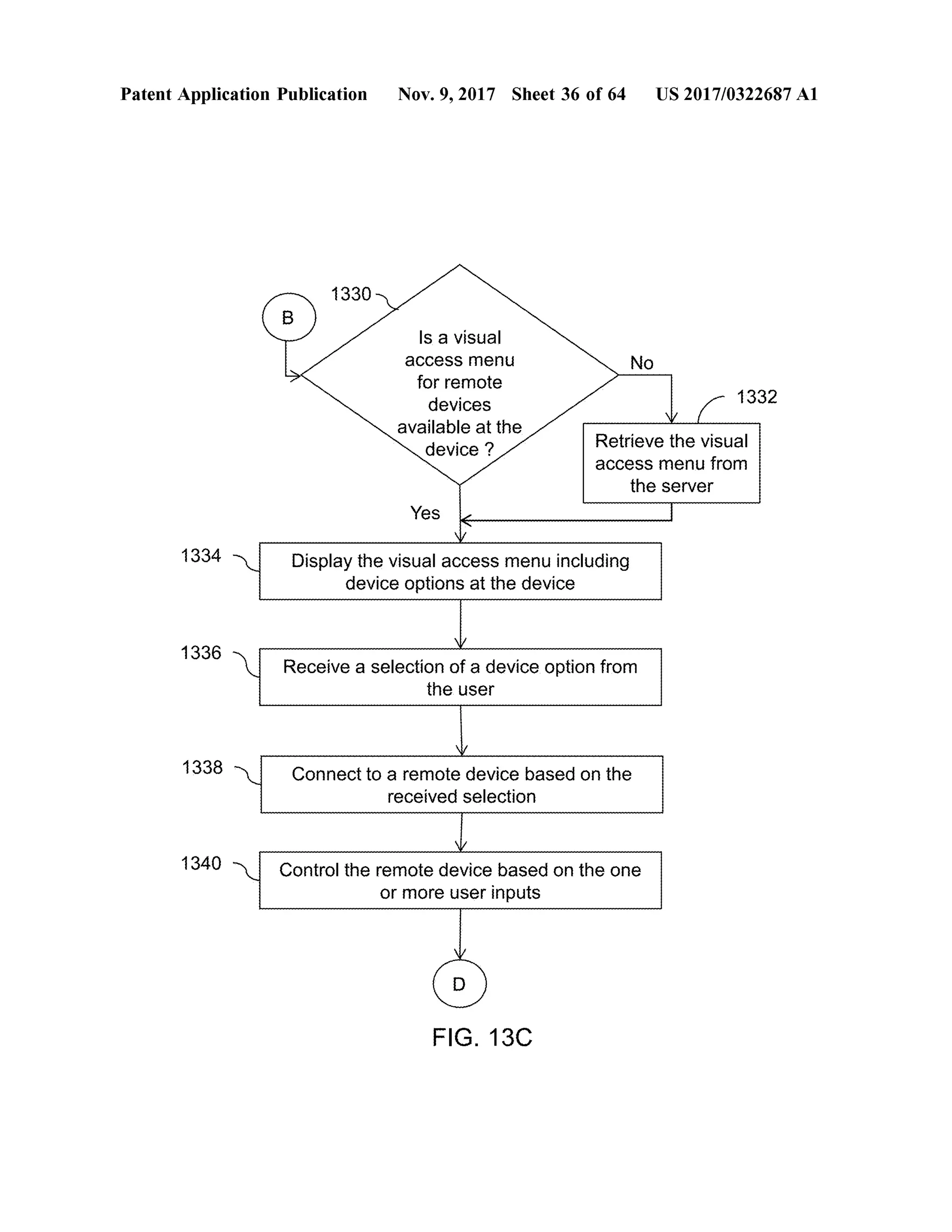
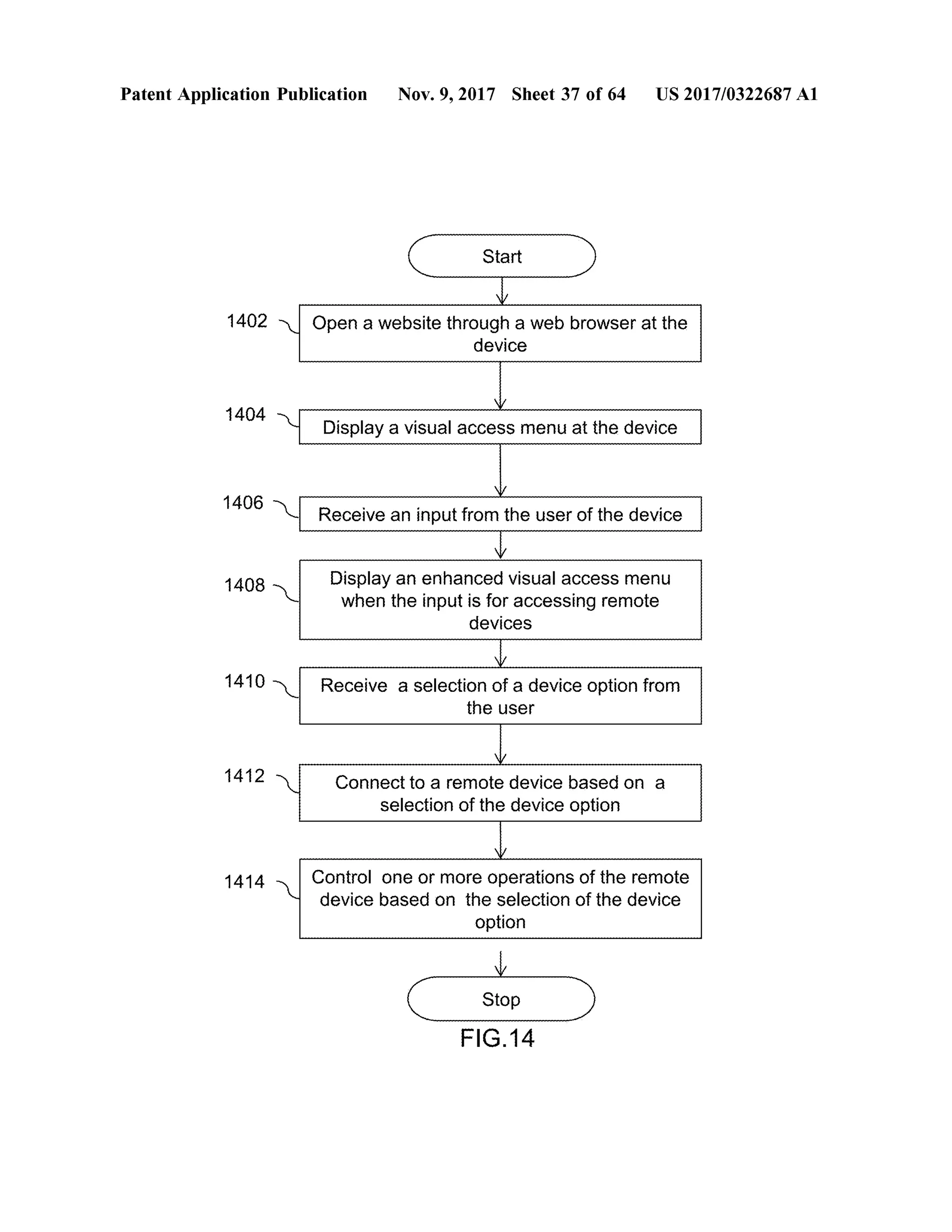
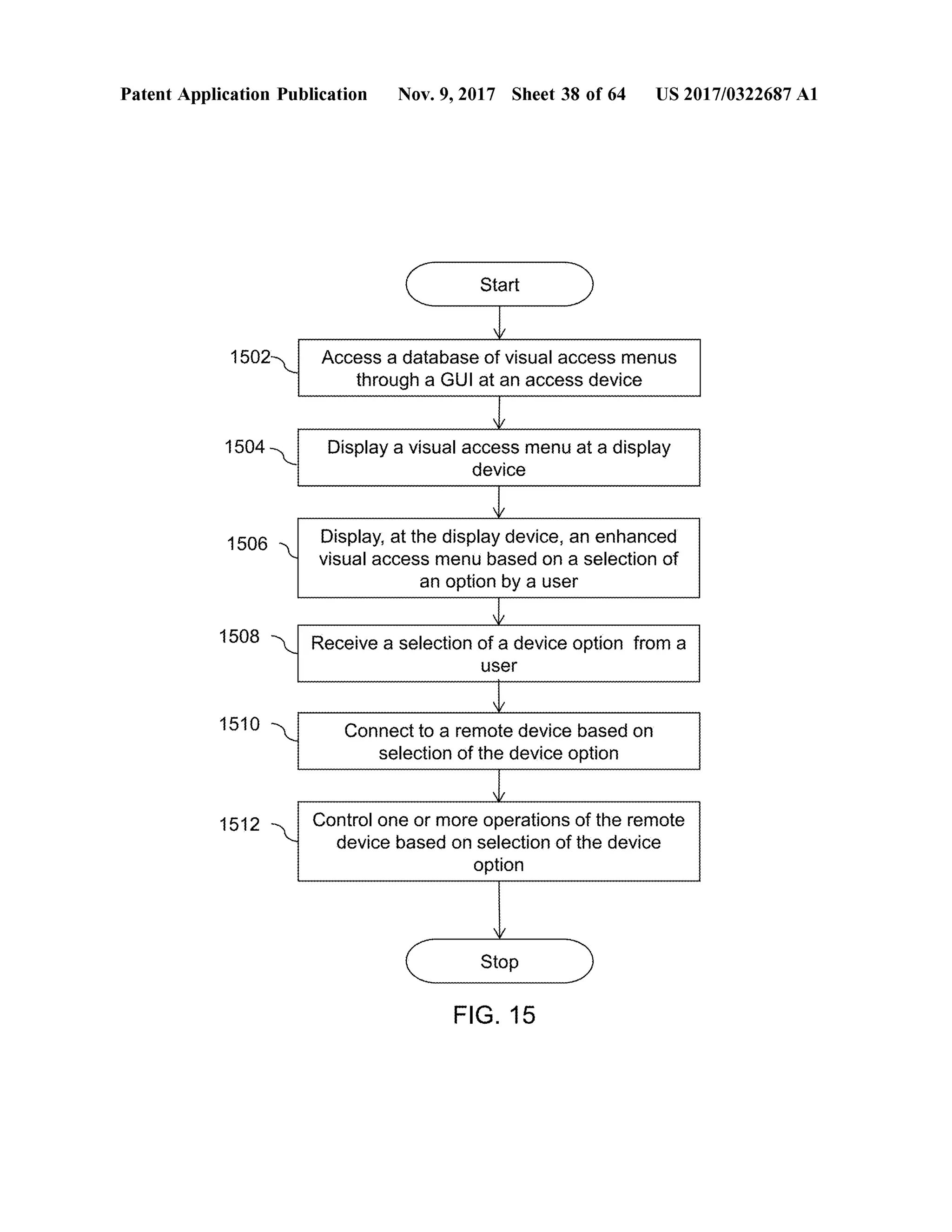
  • 95.
    US 2017/0322687 A1Nov. 9, 2017 30 device 102. In an embodimentofthe invention, the cockpit may be displayed at a display device such as the display device 118 connected to the device 102. [0260] FIG . 25 illustrates a flow diagram for customizing a cockpitbased on other users' reviews,in accordance with an embodiment of the invention. As discussed with refer ence to FIG . 19, the user may access different objects through the cockpit 1902. Further, the user may create or configure or set up or customize a cockpit specific to the user. [0261] Atstep 2502, a usermay access a database includ ing a plurality ofvisual access menus through a GUIfor creating a cockpit at a device such as the device 102. The visual accessmenus are the visualmenus for accessing or controlling multiple objects such as remote devices 106a-n or services 202a-n . In an embodiment of the invention, the database may be present at a server in the network 104. In another embodimentofthe invention, the database ofvisual access menusmay presentat the device 102. [0262] Atstep 2504,one ormore configuration optionsfor configuring/creating or customizing the cockpit may be displayed to theuser.In an embodimentofthe invention,the VMThings 108may display the one ormore configurations options to the user. Theuser may select or choose these one or more configuration options to change or modify a stan dard cockpit.Atstep 2506, theusermay create or configure the cockpit based on a selection of the one or more con figuration options received from the user. [0263] The usermay allow otherusers to view orcheck or access the cockpit and rate it and provide reviews or feedback about the cockpit. At step 2508, the user may receive ratings/reviews/feedback for the cockpit from the other users in the network 104. The other users may also suggestsomechanges likeaddition ordeletion in the cockpit to the user. At step 2510, the cockpitmay be customized at the device 102 based on the ratings or reviews or feedback received from the other users. In an embodiment of the invention, the VMThings 108maymodify the cockpitbased on the reviews or ratings or feedback automatically at the device 102. In another embodimentofthe invention, theuser may accept or reject reviews or feedback and then he/she may modify the cockpit manually or with the help of the VMThings 108 application at the device 102. [0264] Further,themodified cockpitmay be stored in the database. Thereafter, at step 2512, the customized ormodi fied cockpit may be displayed at the device 102. In an embodimentof the invention, themodified cockpit may be displayed at the display device 118 such as a projector screen,a TV, a large screen and so forth. In an embodiment of the invention, the user may not customize the cockpit based on the other users' reviews or feedback . [0265] FIG . 26 illustratesa flow diagram for downloading and customizing a cockpit at a second device, in accordance with an embodiment of the invention . The user may share the cockpitwith other users. The cockpitmay bemodified by theotherusers based on the access controlpermissions from the user. Further, the user may configure or customize his /her cockpit with the help of other users in his/her social network. The socialnetwork may be created by the user by using a social networkingwebsite. Examples of the social networking websites include, but are not limited to , Face book, Google + , Orkut, Twitter, Academia.edu, Athlinks, Bebo, Badoo, BIGADDA, BlackPlanet, Buzznet, Cloob, Faceparty, Flixter, Fubar, Google Buzz, Hi5, ibibo,MyS pace, LinkedIn, MyLife, Ning, WAYN , and so forth. For example,the usermay share orinvite otherusers to help him in creatinghis/her cockpit in real time. [0266] At step 2602, a first cockpitmay be configured or created by accessing a GUIfor creating thecockpit ata first device. A first user may create the first cockpit at the first device. Then at step 2604, the first cockpit may be shared with one or more second users and downloaded at their respecting one ormore second devices. Examples ofthe first device and the second devices may include, but are not limited to, a mobile phone, a smart phone, a computer, a laptop, an I-pod, an I-pad, a tablet computer, a home controller, a set top box, an android device, an android set top box, and so forth . The cockpitmay be downloaded atthe system through at least one of an SMS, an MMS, File transfer protocol (FTP), an E -mail, through wireless tech nologies like Bluetooth, ZigBee,RF4CE, Wi-Fi, WiMAX, and so forth. [0267] At step 2606, the one or more second users may modify or customize a second cockpit at the one ormore second devices based on the downloaded first cockpit. The second cockpit is associated with at least one of the one or more second users. At step 2608, ratings or reviews or feedback may be received on the customized second cockpit of the second user from the other users (orone ormore third users) in his/her socialnetwork . For example, a second user may receive ratings on the second cockpit from his/her friends or relatives in the social network such as on Face book, Twitter, Orkut, Ning,MySpace, ibibo, and so forth . [0268] Atstep 2610,oneormore configuration settings of the second cockpit are downloaded at the first device based on the reviews or ratings of the other user i.e. the one or more third users. At step 2612, the first cockpit may be customized based on the downloaded configuration settings and reviews. Thereafter, at step 2614, the customized first cockpitmay be displayed at the first device. In an embodi ment of the invention, the customized first cockpit may be stored in the database. [0269] FIG . 27 illustrates a flow diagram for configuring a cockpit based on another cockpit of other user, in accor dance with an embodiment of the invention . As discussed with reference to FIG . 1A , every user in the network 104 may access visual accessmenus at their respective devices. Subsequently through these visual access menus, the user may controlthe one ormore functions or operations of the one ormore objects such as the remote devices 106a -n . As discussed with reference to FIGS. 19 and 20, the usermay configure a cockpit such as the cockpit 19 according to his/her preferences. Asdiscussed with reference to FIG .26, theusermay configure or customizehis/her cockpitwith the help of other users in his/her social network . The social network may be created by the user by using a social networking website. Examples of the social networking websites include,butare notlimited to, Facebook,Google+, Orkut, Twitter,Academia.edu,Athlinks, Bebo, Badoo,BIG ADDA , BlackPlanet, Buzznet, Cloob , Faceparty, Flixter, Fubar, Google Buzz, Hi5, ibibo, MySpace, LinkedIn , MyLife, Ning, WAYN, and so forth . For example, the user may share or invite other users to help him in creating his/her cockpit in realtime. [0270] Atstep 2702,atleastonesecond cockpitassociated with one ormore second users is selected from a database. The databasemay be at a first device or at a second device or at a server in the network 104. Each user in the network
  • 96.
    US 2017/0322687 A1Nov. 9, 2017 31 104 may have an associated profile stored at the database. Theprofile ofa usermay include information such asbutnot limited to ,name,age, Identity (ID ), interests, favorite books, and so forth about the user. Further, the at leastone second cockpit is associated with a second user whose profile is similar to a profile of a first user. In an embodiment of the invention, the VMThings 108 may search and select the at leastone cockpit from the database. In an embodimentofthe invention, theusermay select the second cockpit of theone ormore second users. [0271] Atstep 2704, the second cockpitmaybe analyzed by the VMThings 108.In an embodimentofthe invention, the analysis may happen at the first device. In another embodimentofthe invention, the analysismayhappen at the server in the network 104 or a network device in a cloud network.Atstep 2706, a first cockpitspecific to the firstuser may be created or configured based on the analysis ofthe second cockpit of the one or more second users. In an embodimentofthe invention, the VMThings 108may create the first cockpit based on the second cockpit. In another embodiment of the invention, the user may provide inputs for configuring the cockpit based on the analysis of the second cockpit. Further,theusermay invite other usersmay behis friends, relatives,colleagues,and so forth to configure the cockpit fortheuser. The firstcockpitmay be stored atthe first device. In an embodiment of the invention , the first cockpit may be stored at the server or the network device. Thereafter, at step 2708, the first cockpitmay be displayed at the first device to the user. In an embodiment of the invention, the first cockpitmay be displayed at a display device connected to the first device. The display device may be connected to the first device through wireless or wired means. [0272] FIG . 28 illustrates a flow diagram for configuring a cockpit based on another cockpit of other user, in accor dance with another embodiment of the invention. At step 2802, the usermay access a graphical user interface (GUI) for configuringor creating a cockpit at a first device. Atstep 2804, the first usermay provide information or profile of at least one second user. The profilemay include information such as a name, age, devices, services, and so forth. Then at step 2806, the VMThings 108 may search for a second cockpit of the second user and download at the first device. At2808, the VMThings 108may customize or configure a firstcockpit for the first user based on the second cockpitof the at least one second user. In an embodiment of the invention, the Further at step 2810, the VMThings 108may store the first cockpit at the first device. In an embodiment of the invention, the first cockpitmay be stored ata server in the network 104. Further, the user may translate the first cockpit from one language to another. The usermay change or select a new font size, theme, color etc. for the first cockpit. Thereafter, at step 2812, the first cockpit may be displayed to theuser atthe first device. In an embodimentof the invention,the first cockpit may be displayed ata display device attached or connected to the first device. Thereafter, theusermay interactand accessthe oneormore objectsof the first cockpit accordingly. [0273] FIG . 29 illustrates a flowchart for downloading a cockpit from a network, in accordancewith an embodiment ofthe invention. In an embodimentof the invention, the user may download the cockpit or one or more configuration settings forsettinghis/her cockpit at a device. At step 2902, a graphical user interface (GUI) for creating or configuring or copying a cockpit at a devicemay be accessed by a user. In an embodimentof the invention, the user may configure his/her cockpit based on the cockpit of other users in the network 104. At step 2904, the usermay select and down load a cockpit having good reviewsand ratings from the other users from the network 104 such as the Internet. The cockpit maybe present in a cloud network. In an embodi ment of the invention, the user may customize the down loaded cockpit according to his/her preference and device compatibility. Atstep 2906, the cockpit may becustomized or translated according to a language preference of the user. In an embodiment of the invention, the cockpit may be translated or customized by the VMThings 108 based on predefined preferences oftheuser. For example, the cockpit language may be changed from English to Spanish . In an embodiment of the invention , the user may not customize the downloaded cockpit. At step 2908, the customized cockpitmaybestored at thedevice.In an embodimentofthe invention, customized cockpit may be stored at a server or in cloud network. Atstep 2910, the customized cockpitmay be displayed at the device or at a display device attached to the device. [0274] FIG . 30 illustrates an environment for accessing a cockpit through a website, in accordance with an embodi ment of the invention.As discussed with reference to FIG . 19, the cockpit 1902 may include multiple tabs or icons 1902a-n for connecting to and controlling multiple objects 3006a-n. The objects may be such as but not limited to , remote devices, services, applications, and so forth . A user may use a device 3002 to access a cockpit or visual access menusthrough a website in a network 3004. Examples ofthe device 3002 may include, but are not limited to, smart phone, PDA, amobile phone, a computer, a laptop,a tablet computer,an I-POD, and so forth. [0275] The network 3004 can be a wired network or a wireless network or a combination of these. The wireless network may use wireless technologies to provideconnec tivity among various devices. Examples of the wireless technologiesinclude,butare notlimited to,Wi-Fi,WiMAX, fixed wireless data, ZigBee, Radio Frequency 4 for Con sumer Electronics network (RF4CE), HomeRF, IEEE 802. 11, 4G orLong Term Evolution (LTE),Bluetooth, Infrared, spread-spectrum , Near Field Communication (NFC),Global Systems for Mobile communication (GSM ), Digital-Ad vancedMobilePhone Service (D -AMPS). Thedevice 102 is connected to the plurality ofremotedevices 106a-n through the network 104. Examples of the wired network include, but are not limited to, Local Area Network (LAN ), Metro politan Area Network (MAN ),Wide Area Network (WAN), and so forth . In an embodiment of the invention, thenetwork 104 is the Internet. In an embodimentof the invention, the one or more objects may connect to the network 3004 through a network device such as, but not limited to , a router,a bridge,a switch, a gateway,a homecommunication device, and so forth . In an embodiment of the invention , the objects 3006a-nmay connectto the network 3004 indirectly through a local network. [0276] The device 3002may include a web browser for opening a web site. Examples of the web browser include, but are not limited to, Internet Explorer, Google Chrome, Mozilla Firefox,Netscape Navigator, and so forth. The user can enter a Uniform Resource Locator (URL ) such as, "www.XYZ.com ' in the web browser to access the website. Further,when the user enters a URL in the web browser, a
  • 97.
    US 2017/0322687 A1Nov. 9, 2017 32 web page 3008 maybe displayed atthe device 3002based on the URL. The web page 3008 may include one ormore data request fields 3010a-n. In an embodimentof the inven tion, the user may have to authenticate his identity to the website before accessing the cockpits. The usermay enter his/her details in theoneormore data request fields 3010a-n for authentication. In an exemplary scenario , the web page 3008 may include a username data request field 3010a, and a password data request field 3010b. [0277] The network 3004may include a cockpit database 3012 or server for storing a plurality of cockpits associated with a plurality of users or devices. Further, the cockpit database 3012 may include a plurality of visual access menus for controlling one ormore objects. The cockpit database 3012 may also maintain a list of users, devices, remote devices, services and so forth . In an embodiment of the invention, thenetwork 3004may include an IVR appli cation such as VMThings 3014. The VMThings 3014 may display graphical information to the user atthedevice 3002. In an embodiment ofthe invention, the graphical informa tion or visual access menu may be displayed at a display device such as, but not limited to, a television, an LCD screen, an LED screen, a computer, a projector screen, a picture frame, and so forth . In an embodiment of the invention, the user may configure a cockpit at the device 3002 by accessing a graphical user interface (GUI) for configuring the cockpit through thewebsite. The user may log in to the website by providing one or more details. Thereafter, the user may access or configure or customize the cockpit. The usermay customize the cockpitby provid ing one ormore user preferences such as font size, theme, color, and so forth . [0278] FIG . 31 illustrates a flow diagram for configuring a cockpit through a website, in accordance with an embodi mentof the invention. As discussed with reference to FIG . 30, the user may open a website by entering its network address orURL in a web browsersuch as Internet Explorer, Google Chrome, etc. At step 3102, the user may open a website through a web browser at a device. The usermay entera URL associated with the website to open a webpage. In an embodimentof the invention,thewebsitemay include a plurality ofwebpage. In an embodimentof the invention, a third party maymaintain thewebsite for configuring the cockpit. In an embodimentofthe invention, thewebsite may be a website for configuring or creating or setting up a cockpit.Based on theURL a web page such as theweb page 3008 may be displayed at the device 3002. The web page 3008 may include one ormore data request fields 3010a-n. [0279] In an embodiment of the invention, the website may ask the user to enter his/her personaldetails for autho rization. At step 3104, the user may enter one or more personaldetails in the data request fields 3010a-n to authen ticate atthewebsite. The user may be allowed to accessweb site based on the authorization. The user can access a GUI for configuring the cockpit after authorization.Atstep 3106, VMthings 3014 may display one or more configuration options to the user. The user may select or choose the one or more configuration options to configure the cockpit. At step 3108, the VMthings 3014 may receive selection of the one ormore configuration options from the user. The usermay select the optionsby touching the screen of thedevice. In an embodimentoftheinvention, the usermay select the options through at least one of entering a combination of keys, giving a voice command, gestures, handmovements, and so forth . [0280] At step 3110, the VMthings 3014may configure or create the cockpit for the user based on the selection of the configuration options. In an embodiment of the invention , the cockpit may be customized based on the one ormore configuration options. In an embodimentof the invention, the usermay create a plurality of cockpits based on his/her preferences. For example, the user may create a cockpit for handling homeappliances, a second cockpit for handling or controlling office objects and so forth. Thereafter, at step 3112, the cockpit may be displayed to the user. The VMThings 3014may display the cockpit at the device 3002. In an embodimentofthe invention,the VMThings3014 may display the cockpit at a display device attached to the device 3002. The cockpit is then stored at the cockpit database 3012. The usermay interact or control one or more objects through the cockpit. [0281] FIG . 32 illustrates a flow diagram for accessing a cockpit through a website, in accordance with an embodi ment of the invention. As discussed with reference to FIG . 30, the usermay access the cockpit through a website. At step 3202, the user may open a website through a web browser at the device 3002 . A web page 3008 based on the URL of the website may be displayed at the device 3002. Thewebpage 3008 may include one ormore data request fields 3010 a -n. The usermay enter his/her details in the data request fields 3010 a-n. A website servermay check whether the user is an authorized user or not based on the entered details, at step 3204. Thereafter, the VMThings 3014 may search the cockpit database 3012 for a cockpit associated with the user. In an embodimentofthe invention, the cockpit may be present in a cloud network. [0282] Then at step 3206, the VMThings 3014 may dis play the cockpit specific to theuser at the device 3002. In an embodimentof the invention, the cockpitmay be displayed at a display device. Further, different cockpits may be displayed to different users based on their details. In another embodiment of the invention, a standard cockpit may be displayed to the user. The standard cockpitmaybe a cockpit includingone ormore objects without any specific changes according to different users. In an embodiment of the invention, the VMThings 3014 may display the cockpit at the device 3002 based on current location of the user orthe device 3002. The icons in the cockpitmay differ depending on the location of the device 3002 or the user. For example, the user may be displayed with a first cockpitwhen the user isathomeandmay be displayedwith a second cockpitwhen theuser is travelling.In an embodimentofthe invention,the location of the user may be determined by using a GPS system at the device 3001 or in the network 3004. In an embodiment of the invention, the location of the objects being controlled may change. For example, car, pet, wife, kidsmay change their location. Therefore, VMThings 3014 may display different cockpit or visualmenus to the user based on the location of the controlled objects. [0283] Subsequently,theusercan interactwith the cockpit at step 3208. The usermay select a tab from a plurality of tabs or icons of the cockpit for interacting with the objects. Atstep 3210, the usermay be displayed with an enhanced visualaccess menu based on the selection or interaction of the user with the cockpit. As discussed with reference to FIG . 1A to FIG . 21, the enhanced visual accessmenu may
  • 98.
    US 2017/0322687 A1Nov. 9, 2017 33 include one ormore device options or the service options. The device options may be the icons representing one or more remote devices 106a-n . Similarly, the service options may be the icons or graphics representing one or more services 202a- n . In an embodiment of the invention , the cockpit maybe displayed based on one ormore preferences of the user such as color preference, font size, theme, language preference, and so forth . In an embodimentof the invention, the usermay provide the preferences in realtime. In an embodiment ofthe invention , the user preferences are pre-defined and may be stored atthe cockpit database 3012 or the device 3002. Atstep 3212, the usermay interactand controlone ormore operations of the objects such as remote devices. [0284] FIG . 33 illustrates a flow diagram for configuring a cockpitwith thehelp ofotherusers, in accordancewith an embodimentofthe invention.Asdiscussed with reference to FIG . 30, a user may access a website for creating or configuring orcustomizing a cockpit through a web browser such as InternetExplorer,Google Chrome,and so forth. The website may include a plurality of web pages. Each of the web pagemay display text, images, data request fields, and so forth. In an embodimentofthe invention, the web page may include audio files or video files. [0285] In an embodiment of the invention, the usermay configure an Internet of Things menu by accessing a web site . The user may login to the website and then may get access to various setting controls for configuring the Internet of Thingsmenu based on the authorization. In an embodi mentof the invention, the Internet of Things application i.e . the VMThings may create the Internet of Things menu for differentusers at the device. Further, the usermay share the Internet of Things menu with otherusers. In an embodiment of the invention , the Internet of Thingsmenu may include one or more options for identifiable objects. Further, the Internet of Things menu may be created by inviting other users. [0286 ] Atstep 3302, a first usermay access a website for creating or configuring or setting up a cockpit at a first device such as a first device 2002 of FIG . 20A -B . The first device may be a smart phone. At step 3304, the usermay invite one ormore second users for configuring the cockpit for the first user. The first usermay invite the one ormore second users through at least one of an SMS, an MMS, an instant message, an e -mail, through face to face conversa tion, or phone, and so forth . [0287] At step 3306, one ormore inputsmay bereceived from the one ormore second users. Further, the one ormore second users may provide the one or more inputs at their respective second devices. In an embodimentof the inven tion the VMThings 3014 in the network 3004 may receive the one ormore inputs from the one ormore second users. Atstep 3308, one ormore inputsmay be received from the first user. Further, the firstusermay provide the one ormore inputs atthe firstdevice. In an embodimentofthe invention, the VMThings 3014 may receive the inputs from the first user. Further, the firstuser and the second user may provide the inputs by at leastone of,touching screen of their devices, pressing one or more keys at the devices, giving voice commands, gestures,hand movements, and so forth. [0288] Atstep 3310,the VMThings 3014 may configure a cockpit for the first user based on the one or more inputs from the first user and the one ormore second users. In an embodiment of the invention, the VMThings 3014 may customize an already configured cockpit of the first user based on the one or more inputs from the firstuser and the one ormore second users. Finally, atstep 3312, the cockpit may be stored at the firstdevice. In an embodiment of the invention, the cockpit may be stored at a server of the website or at the cockpit database 3012 in thenetwork 3004. In an embodiment of the invention, the first user may provide access to the cockpit to the one or more second users. [0289] FIG . 34 illustrates a flow diagram for switching a display mode of a cockpit, in accordance with an embodi ment of the invention. In an embodiment of the invention, the cockpit or the visualaccess menusmay be displayed to the user based on the user's one or more preferences. Further, the cockpit (or visual access menus) may be dis played to the userbased on the display capabilities of the device. For example, the cockpitmay be displayed as a list when the device is a simple mobile phone and has a small display. In an embodimentofthe invention, thecockpit may be played to the user depending on the user's preference. [0290] At step 3402, a usermay access a database of visual access menus or cockpit through a graphical user interface (GUI) at a device. The GUI may provide an interface for creating or configuring or customizing or accessing a cockpit. As discussed with reference to FIG . 30, the cockpit database 3012 may include a plurality of cock pits or visual access menus for differentusers and devices. Examples ofthe device may include, but are not limited to , a mobile phone, a smart phone, a laptop, an I-pod, a tablet computer, a PDA, an electronics device, and so forth . The user may receive alerts ormessages from the one ormore objects connected through the cockpit or the visual access menus.Atstep 3404,a cockpit alongwith oneormoremode optionsmay be displayed to the user.Examples of themode options may include, but are not limited to , video, audio , visual, text, list, and so forth . In an embodiment of the invention, the oneormoremode optionsmaybe displayed at the GUI for creating/accessing cockpit. [0291] The usermay select at least onemode option from theone ormoremodeoptions.A selectionofthe video mode option may play the cockpit as a video. A selection of the audio mode option may play the cockpit options asaudio or music. A selection ofthe textmode option may display the cockpitoptionsastext. Similarly, a selection ofthe listmode option may display the cockpit options as a list. At step 3406 , a selection of the at least one mode optionsmay be received from the user at the device. In an embodiment of the invention, the VMThings atthe devicemay receive the selection of themode option. [0292] Based on the selection of themode option , the modeofthe display of the devicemay be switched at step 3408. For example , the user may select the audio option, so the displaymay switch to audio mode and various options of the cockpit or the visual access menus may be played to the user. Subsequently, at step 3410, an audio menu may be played at the device when the user selects the audio mode. Thereafter, the user may listen to the options and may interact by providing one ormore inputs . The one or more inputs may be provided through at least one of gestures, hand movements, voice commands, pressing one ormore keys at the device, touching the display, and so forth. For example, when a user is driving, and wants to access the
  • 99.
    US 2017/0322687 A1Nov. 9, 2017 34 cockpit,hemay choose the audio mode option. Therefore, the optionsmay be played to theuser andhe/she can interact with the cockpit accordingly. [0293] FIG . 35A illustrates an exemplary display ofcock pit along with oneormoremodeoptions,in accordance with an embodiment of the invention. As discussed with refer ence to FIG . 19, a usermay create or configure a cockpit such as the cockpit 1902 atthe device 102. The cockpit 1902 is an interface which enables a user to access various services, devices or objects. The cockpit 1902may include icons 1904a -n representing various objects which a user or users can access or control. The tabs 1904a-n may be icons or text or combination ofthese. [0294] As discussed with reference to FIG . 34, the VMThings 108 may display the cockpit along with one or moremode optionsat the device 102.Examples of themode optionsmay include, butare not limited to, video , audio, visual, text, list, and so forth . In an embodiment of the invention,the one or more mode options may be displayed at a GUI 3506 for creating/accessing cockpit as shown in FIG . 35B. The usermay select at leastonemodeoption from theone ormoremodeoptions. A selection ofthe video mode option may play the cockpit as a video. A selection of the audio mode option may play thecockpit options as audio or music. A selection ofthe textmode option may display the cockpitoptions astext.Similarly,a selection ofthe listmode option may display the cockpitoptionsasa list. A display of the device 102 may change based on the selection of the mode optionsby theuser.For example, if theuserselects an audio mode option, an audio menu may be played at the device 102. Thereafter, the usermay listen to the optionsand may interactby providing one ormore inputs. [0295] As shown in FIG . 35 , the exemplary GUI 3506 may includeone ormore icons/tabs/options 3504a-n . A GUI option 3504a may be a Create Cockpit option. A user may select this option for creating or configuring or setting up a cockpit. A GUIoption 3504b may be a Customize Cockpit option. The usermay use this option to customize an already created or stored cockpit. In an embodiment of the inven tion, the cockpit may be stored at the device 102. In an embodimentof the invention , the cockpits are maintained by the cockpit database 3012 as shown in FIG . 30. A GUI option 3504c may be a View Cockpit option. The usermay select this option to view the cockpits at the device 102. [0296] In another embodiment ofthe invention, a server may provide functionality of the VMThings. Further, the server may maintain all the information which is otherwise was provided by the VMThings. The server may maintain the information regarding the one or more visual access menus, users, devices, remote devices, services, display device, access device,and so forth . A user atthe device such as a telephone may request information from the server. Further,the servermay send the information to the request ing device over a network. The network may be a wired or a wireless network. The connection between the device and the servermay be a wired or a wireless connection . Further, the server may send the information to the requesting device(s) by using technologies such as, but are notlimited to, SMS,MMS,e-mail,and so forth .Based on the received information,thecontentmay bedisplayed atthedevice.For example, if the userhas requested the information regarding controlling remote devices, then information of visual access menu related to remotedevices maybe received from theserver. Further, the servermay display the visual access menu atthe device.In an embodimentofthe invention,the server may also provide other functions or features of the VMThings 108 as explained in the FIGS. 1A -2G . The user may respond or select an option from the displayed visual access menus through DTMF tones. The device may be a telephone or a simplemobile phone. 10297] In an embodiment ofthe invention, the usermay access the functionalities as described above by logging into a second device such as a home controller. Theusermay see and control devices associated with the home controller. [0298] Further, the VMThings may store the user activity such as selection of options from the visual accessmenus at thedevice. This user activity informationmay beused bythe VMThings for displaying the visual accessmenu to thesame user next time. [0299] An aspectof the invention allowsthe user to share his/her cockpit of controlling one ormore objects with other users. 103001 Another aspectof the invention allowsthe users to request permission to access or control the one or more objects ofthe cockpit from the other users. [0301] Another aspect of the invention provides a cockpit includingmultiple interfaces forcontrollingmultiple objects by a user. [0302] An aspect of the invention enables a user to con figure or set up a cockpit with the help of other users in his/hersocialnetwork. Therefore,theusermay invite his/her friends or other users to set up his cockpit. [0303] Further aspect of the invention allows a user to copy other user's cockpit. Thereafter, the usermay configure his/her cockpitbased on the copied cockpit. [0304] Another aspect of the invention allows a user to download a cockpit from a cloud network or the Internet. [0305 ] Yet another aspect of the invention is to enable a user to controlone ormore operationsofthe remote devices or services through voice commands or gestures or hand movements. For example , the user may switch on an air conditioner (AC) by showing a thumb up gesture in frontof the device. The device may include a camera to detect the gesture. The VMThingsatthe device (oraccess device)may analyze the gesture and controlaremote device based on the analysis. [0306] An advantage of the invention relates to visual accessmenus thatmay ask for voice commands. This GUI is for some user harder to use due to accent or other problems. Thedatabase could beprovided with theoption as been described before for the system to output voice com mandaccording to userselectionof the optionsorthe device options or the service options. The device may include a microphone for detecting the voice commands. VMThings may analyze thevoice commandsand may take the actions accordingly. Further, the disclosed system and methods allow the user to give voice commands in different lan guages. For example, theusermay selectan option by giving a voice command in French language. Furthermore, the user may select an option (or device options or service options) from the visual access menu through one ormore gestures orhandmovements. In an embodimentofthe invention, the usermay store one ormore gestures for one ormore actions. For example, theusermay use a thumb up gesture to switch on the AC . Similarly the user may store a thumb down gesture to switch off an electronic appliance such asmicro wave .
  • 100.
    US 2017/0322687 A1Nov. 9, 2017 35 [0307] Another advantage ofthe invention relates to pro viding visual access menus and enhanced visual access menus in different language(s). In an embodiment of the invention, the VMThings ofdeviceor theaccessdevicemay display visual accessmenu or enhanced visualaccessmenu in different languages. Further, the device may have one language and theusermaywantto controland communicate in a differentlanguage.Similarly,the VMThings may under stand and accept voice inputs from the user in different languages irrespective ofthedevicelanguage.Therefore,the usermay control the remote devicesby giving voice com mands in different languages such as,but arenot limited to, English, Spanish, French, Hindi, Chinese language, Japa nese language, Hawaiian,German language,and so forth. In an embodimentofthe invention, the devicemay notsupport or understand a particular language such as Spanish ,butstill the VMThings can display the visual access menus in Spanish language. [0308] Anotheraspectofthe invention is to provide infor mation aboutvariousservices to theuser using a device such as a smartphone anytime anywhere. 10309) Further aspect of the invention is to enable a user to control operations of the remote devices through a device including VMThingsapplication. The usermay nothave to be physically present near the remote devices to control them . [0310] Yetanother aspectofthe invention is to allow users to see the images ofremote devices in real-time irrespective ofthe location oftheremote devices. For example, the user may see theremote devices such ashomeappliances present at his/her home by being present at the office. [0311] Embodimentsofthe invention are described above with reference to block diagramsand schematic illustrations ofmethods and systems according to embodiments of the invention . It will be understood that each block of the diagramsand combinationsofblocks in the diagramscan be implemented by computerprogram instructions. Thesecom puter program instructionsmay be loaded onto one ormore generalpurpose computers, special purpose computers, or other programmable data processing translator to produce machines, such that the instructions which execute on the computers or other programmable data processing translator createmeansfor implementing the functionsspecified in the block or blocks. Such computer program instructions may also be stored in a computer-readablememory thatcan direct a computer or other programmable dataprocessing appara tus to function in a particularmanner, such that the instruc tions stored in the computer-readable memory produce an article of manufacture including instruction means that implement the function specified in the block orblocks. [0312] While the invention hasbeen described in connec tion with what is presently considered to be the most practical and various embodiments, it is to be understood that the invention is not to be limited to the disclosed embodiments, but on the contrary, is intended to cover variousmodifications and equivalent arrangements included within the spirit and scope of the appended claims. The invention has been described in the general context of computing devices,phone and computer-executable instruc tions, such asprogram modules, being executed by a com puter. Generally, program modules include routines, pro grams, characters, components, data structures, etc., that perform particular tasks or implement particular abstract data types. A person skilled in the artwill appreciate that the invention may be practiced with other computer system configurations, includinghand-held devices,multiprocessor systems,microprocessor-based or programmable consumer electronics, network PCs, minicomputers, mainframe com puters, and the like. Further, the invention may also be practiced in distributed computing worlds where tasks are performed by remote processing devices that are linked through a communications network . In a distributed com putingworld,program modulesmay be located in both local and remote memory storage devices. [0313] This written description uses examples to disclose the invention , including the best mode, and also to enable any person skilled in the art to practice the invention, including making and using any devices or systems and performing any incorporatedmethods. The patentable scope the invention is defined in the claims,andmay include other examples that occur to those skilled in the art. Such other examples are intended to be within the scope of the claims if they have structural elements that do not differ from the literal language of the claims, or if they include equivalent structural elements with insubstantial differences from the literal languages of the claims. 1. A server for enhancing interaction with a plurality of Internet of Things (IoT) devices, the server comprising: a processor; and a memory coupled to the processor, the memory com prising: a database comprising oneormoreoptions correspond ing to each ofthe IoT devices; and one or more instructions executable by the processor for providing the one or more options to a user for enabling the user to select at least one option; one ormore instructions executableby the processor to receive information corresponding to the selection of the at least one option by the user; and 2 .one or more instructions executableby the processor to configure at least one visual menu based on the received information , wherein the at least one visualmenu enables controlling the plurality of Internetof Things (IoT) devices irrespectiveoftheir locations.The serverofclaim 1,wherein the plurality ofInternetof Things (IoT) devices consist of a plurality of electronics devices, a plurality ofkitchen appli ances, a plurality ofvehicles,or a combination thereof. 3. The server of claim 1, wherein the user can select at least one option by at least a voice command, a gesture, a hand movement, a combination of keys or a combination thereof. 4. The server of claim 1, wherein thememory further comprising one or more instructions for authenticating the user prior to providing the one ormore options to the user. 5. The server of claim 1, wherein thememory further comprising one ormore instructions for storing the config ured visualmenu in the database. 6. The server of claim 1, wherein the memory further comprising one or more instructions executable by the processor for providing one or more mode options to the user for enabling the user to select amode option there from , themode option beingselected forreceiving the visualmenu in the selected mode option. 7. The server ofclaim 1,wherein the one ormore options correspond to at least one of a service or a remote device.