SYSTEMIC FLOURIDES
SUBMITTED TO :-
PROF. &HEAD – DR. VIRINDER GOYAL
PROFESSOR – DR. KANIKA GUPTA
VERMA
READER – DR. SURUCHI JUNEJA SUKHIJA
SR. LECTURER - DR. SAKSHI BAMBA
SUBMITTED BY
AKSHDEEP SINGH
B.D.S. 3RD YEAR
ROLL NO. 07
• INTRODUCTION
• MECHANISM OF FLOURIDE INCORPORATION
• TYPES OF SYSTEMIC FLOURIDE
• WATER FLOURIDATION
• SCHOOL WATER FLOURIDATION
• SALT FLOURIDATION
• MILK FLOURIDATION
• FLOURIDE SUPPLEMENTS
• CONCLUSION
FLOURIDE
• Fluoride is a mineral that is found in all natural water sources and is the ionic
form of the trace element fluorine, which is commonly found in the
environment; fluorine reaches water sources by leaching from soil and rocks
into groundwater.
• When used as directed or within the context of community water fluoridation
programs, fluoride is a safe and effective agent that can be used to prevent and
control dental caries.
INTRODUCTION
• Systemic fluorides provides a low concentration of fluoride to the teeth over a
long period of time.
• It circulates through the blood stream and is incorporated into developing teeth.
• After teeth erupt, fluoride contacts teeth directly through salivary secretions.
• Most systemic fluorides have a topical effect but their primary effect is systemic.
MECHANISM OF SYSTEMIC FLOURIDE
INCORPORATION
• Systemic fluorides are ingested into the body.
• Fluorine with Hydroxy-apettite forms Fluor-apettite.
• Deposited on tooth during tooth development.
• However, the actual mechanism of action of systemic fluorides is from the
topical protection as the fluoride present in saliva, which continually bathes the
teeth, provides a constant source that is also incorporated into plaque and
facilitates remineralization.
TYPES OF SYSTEMIC FLOURIDES
• WATER FLUORIDATION
• COMMUNITY WATER FLUORIDATION
• SCHOOL WATER FLUORIDATION
• SALT FLUORIDATION
• MILK FLUORIDATION
• FLUORIDES SUPPLEMENTS
WATER FLOURIDATION
• Water fluoridation is defined as “ controlled adjustment of the concentration of
fluoride in A communal water supply so as to achieve maximum caries reduction
and clinically insignificant level of fluorosis”.
• It can also be defined as “the upward adjustment of the concentration of fluoride in
public water supply in such a way that the concentration of fluoride ion in the water
may be consistently maintained at 1 parts per million(ppm) by weight to prevent
dental caries with minimal possibility of causing dental fluorosis”.
• Community water fluoridation is the process of adjusting the fluoride content of
fluoride-deficient water to the recommended level for optimal dental health, which
is currently recommended at 0.7 parts fluoride per million parts water(ADA, April
2018).
• Water fluoridation is an effective and inexpensive means of obtaining the
fluoride necessary to prevent tooth decay.
• Studies show that water fluoridation continues to be effective in reducing tooth
decay by 20% to 40% in children and adults.
• While water fluoridation is an extremely effective and inexpensive means of
obtaining the fluoride necessary for optimal tooth decay prevention, not
everyone lives in a community with a centralized, public or private water source
that can be fluoridated. For those individuals, fluoride is available in other
forms.
• The recommended concentration-0.7 and 1.2 ppm, depending on the average
regional temperature.
• The lower levels of fluoride are recommended for warmer regions. In these
locations the intake of water tends to be higher.
• The optimal level of fluoride is approximately 1 part per million(ppm)
HISTORY
The first water fluoridation programme was started in the year 1945 in the four
cities in USA.
1. GRANDS RAPIDS- MUSKEGON STUDY
2. NEWBURGH-KINGSTON STUDY
3. EVANSTON OAK PARK STUDY
4. BRANTFORD- SARNIA- STARTFORD STUDY
5. TIEL – CULEMBORG STUDY
GRANDS RAPIDS- MUSKEGON STUDY
NEWBURGH
• On January 25th ,1945 ,sodium fluoride was added to GRAND RAPIDS water
supply. Muskegon town was kept as a control.
• After 6 ½ years in July ,1951 the caries experience of 6 and 15 years old
children residents of grand rapids was half that of Muskegon . ( reported by -
Arnold et al,1953).
• So impressive was the efficacy of fluoridation that the city officials of Muskegon
also decided to fluoridate their own water supply also.
NEWBURGH –KINGSTON STUDY
• On may 2nd 1945 , sodium fluoride was added to drinking water of Newburgh
on the Hudson river.
• Kingston town was kept as a control.
• After 10 years of fluoridation et al (1956) reported that the DMF rate had fallen
from 23.5 % to 13.9 %, confirming the caries inhibitory property of 1 ppm
fluoride in drinking water.
EVANSTON- OAK PARK STUDY
• In January 1946, a fluoridation experiment began in Evanston ,Illinois and the
nearby community of oak park acted as the control town.
• After 14 years of fluoridation in Evanston, there was a reduction of 49 % in DMF
values.
• The Evanston-oak park study presented the most detailed data of all the
fluoridation studies.
THE BRANTFORD- SARNIA-STARTFORD
STUDY
• In Canada, a project was undertaken in Brantford, Ontario, where fluoride was
added to water supply in June 1945.
• The community of Sarnia was established as the control town.
• In addition ,the community of Stratford, where fluoride was naturally present in
drinking water at level of 1.3 ppm was used as an auxiliary control.
• After 17 years of fluoridation in Brantford, caries experience was similar to that
occurring in the natural fluoride area of Stratford and was 55 % lower than in the
control town of sarnia; BROWN AND POPLOVE,1965)
TIEL – CULEMBORG STUDY
• In march 1953 the drinking water in Tiel was fluoridated to a level of 1.1 ppm.
• Culemborg with water fluoride level of 0.1 ppm was the control.
• After 13 years of fluoridation, the number of anatomical sites of teeth affected
by dental caries was 58 % lower in Tiel than in culemborg.
OPTIMUM FLOURIDE LEVELS
• The optimum recommended fluoride levels varies with climate because the
average consumption of water increases in warmer climates
• In cold climates the recommended fluoride level-1.2 ppm
• In extremely hot climate-0.7 ppm.
• In moderate climates-1 ppm.
• The optimum fluoride concentration can be calculated by following equation:
• ppm fluoride (concentration) = 0.34/e
• Where e = -0.038+0.0062 x temperature of the area in degree farenhite.
PRE REQUIREMENTS
• Presence of caries in the community/public.
• Level of fluoride concentrations in their drinking water.
• Centralized water supply to the community.
• Community acceptance/approval.
• Installation and maintenance cost.
ADVANTAGES
• Large number of people are benefited.
• Consumption is regular
• Fluoridated drinking water not only acts systemically
• During tooth formation to make dental enamel more resistant to dental
decay,but also has topical effect through the release in saliva after ingestion.
• Fluoridation of community water is the least expensive way to provide fluoride
to a large group of people.
DISADVANTAGES
• Interfere with human rights.
• Other modes are not considered.
• Common source of water supply may not be present.
FEASEBILITY IN INDIA
• Based on the current knowledge dentist population ratio of 1:80,000 and lack of
preventive awareness of oral diseases , communal water fluoridation appears to
be the most effective, practical and economical public health measure for
prevention of dental caries as this method extends its benefits to all the
residents of the community without necessitating any conscious effort on the
part of the residents.
• But the only short coming in that it can be implemented only in the areas which
have central pipe water supply system.
• Currently, most of the cities and towns in india covering 30% of the population
have piped water supply.
• An effort should be made with the concerned authorities to institute water
fluoridation at least in these areas.
SCHOOL WATER FLOURIDATION
• School water fluoridation is one of the possible areas to be explored. This
programme helps in limiting caries in school children who are the prime
concern.
• It is the suitable alternative where water fluoridation is not feasible.
• The amount of fluoride added in school drinking water should be greater than
normal because children have to stay in the school for a short period of time
and to compensate for holidays and vacations.
• The current recommended regimen for school water fluoridation is adding 4.5
times more fluoride.
• There has been around 25 to 40 % decrease in dental caries with this program.
• Simple fluoridators particularly that employ the venturi system are most suitable
,because they require almost no maintenance and can be utilized effectively in
small instalments of small or medium sized schools.
ADVANTAGES
• Good results in reducing caries.
• Minimal equipment requirement.
• Not expensive.
DISADVANTAGES
• Children do not receive the benefit until they go to school.
• Not all children go to the school go the school in poor countries and towns and
villages.
• Amount of water drunk can’t be regulated.
SALT FLUORIDATION
• Salt fluoridation is a controlled addition of fluoride, usually sodium or
potassium fluoride, during the manufacture of salt for human consumption.
• First fluoridated salt was introduced by Wespi in Switzerland 1948.It has been
on sale in Switzerland since 1955.
• Experiments have been conducted with concentration of fluoride in salt ranging
from 90 mg of fluoride per kg. Salt to 200 -350 mg/kg .
• Initial clinical trial of 90 mg/kg fluoride salt showed 20- 25 % of reduction of
dental caries.
• In 1967 Muhleman showed the safe dose of fluoridated salt, that 300 mg/kg
yields 1.5 mg fluoride/5 gm of salt. Tooth from Hungary, after 8 years of salt
fluoridates at the level of 250 mg fluoride /kg reported 35-58% of caries
reduction
PRODUCTION OF FLOURIDATED SALT
• For effective caries prevention, fluoride must be present in ionic form when salt(
sodium chloride) is dissolved in water. There are essentially two different salt
production processes:
• 1. Batch processing
• 2. Continuous processing
• Fluoride is added to salt by spraying concentrated solutions of sodium fluoride
or potassium fluoride.
• Premixed granules of NaF and CaF2 with Po4 are added to common salt.
ADVANTAGES
• Fluoridated salt is safe.
• Theoretically fluoridated salt prevents dental caries by both systemic as well
topical action.
• It does not require community water supply as in case of water fluoridation.
• It permits individual to accept it or reject it.
• Low cost
• Fluoridated salt and iodized salt can be made available to the population.
DISADVANTAGES
• No precise control over indicated consumption, since salt intake varies greatly
among people.
• International efforts to reduce sodium uptake.
• Less sodium (Na+) intake to help control hypertension
FEASIBILITY IN INDIA
• Salt fluoridation appears to be a viable and feasible method of fluoride ingestion
systemically because its distribution can be easily monitored as the supply can
be effectively controlled especially for those areas which do not need
supplemental fluorides I.E., Endemic fluoride belts.
• Moreover, individual monitoring is not required as the levels are so adjusted so
as to provide optimum levels of fluoride keeping in view the fact that on an
average an individual consumes 5-8 gms of salt per day.
LIMITATIONS
• There may be large variations in salt intake in different groups of
people.Fluoridated salt consumption is lowest when the need for fluorides is
greatest – in early years of life.
• The amount of fluoridated salt ingested may decrease with increasing
consumption of processed food. If the processors do not use fluoridated salt.
• Difficulties arise when there are multiple drinking water sources which have a
naturally optimal or excessive fluoride concentration.
• It requires refined salt produced with modern technology and a high level of
technical expertise.
• The current view data high salt intake may contribute to hypertension.
MILK FLOURIDATION
• Milk fluoridation is the addition of a measured quantity of fluoride to bottled or
packaged milk to be drunk by children.
• It was introduced by Zeigler ,a Pediatrician, who started the first project with
fluoridated milk in swiss city of Winterthur in 1953.
• In 1971, Dr. Edgar borrow established the borrow foundation (formally the borrow
dental milk foundation) in England, with the aim of promoting the use of milk as a
vehicle for fluoride for the benefit of children’s oral health.
• The first community based milk fluoridation scheme was introduced in 1988, in
Bulgaria, under the international milk fluoridation program.
MILK DISTRIBUTION
• Fluoridated milk distribution to children is best done through an established or
existing system, like school milk or milk for kindergartens and nursery schools.
• Fluoridating the milk-fluoridated milk can be produced in number of forms:-
1. Liquid (pasteurized and sterilized)
2. Powder-each containing a variety of fluoridating agents so as to provide them
with the optimum amount in line with recommendations of WHO expert
committee (1994), i.e. Ranging from 0 to 1.0 mg fluoride per day according to
the age of the child and the fluoride concentration in the local water supply.
COMPOUNDS USED FOR FLUORIDATION
• Calcium fluoride
• Sodium fluoride
• Disodium Monofluorophosphate
• Disodium Silicofluoride
FEASEBILITY IN INDIA
• In addition being the staple food for children and its consumption can be
confined to groups who need it most, that practically speaking that this scheme
/method does not seem to be viable and feasible because of :
1. In INDIA, majority of children population living in rural and urban areas cannot
afford milk daily.
2. Central milk supply system does not exist in India.
3. Variation of intake and quantity of milk is another which cannot be controlled
since it depends upon the socio-economic religious and ethnic factors.
FLUORIDE SUPPLEMENTS
• Fluoride supplements are available in different forms such as fluoride tablets
,drops , lozenges.
• Fluoride tablets, drops and lozenges are not available over the counter but
prescribed by the dentist or Paediatrician to individual patients or as a part of
school or home based preventive dentistry program.
FLUORIDE COMPOUNDS USED
• Most commonly used is sodium fluoride.
• Other compounds used are acidulated phosphate fluoride, potassium fluoride or
calcium fluoride.
• Supplements contain measured amount of fluorides, 0.25 mg , 0.5 mg, 1.0 mg.
• They should be taken on daily basis according to the prescribed dosage
schedule.
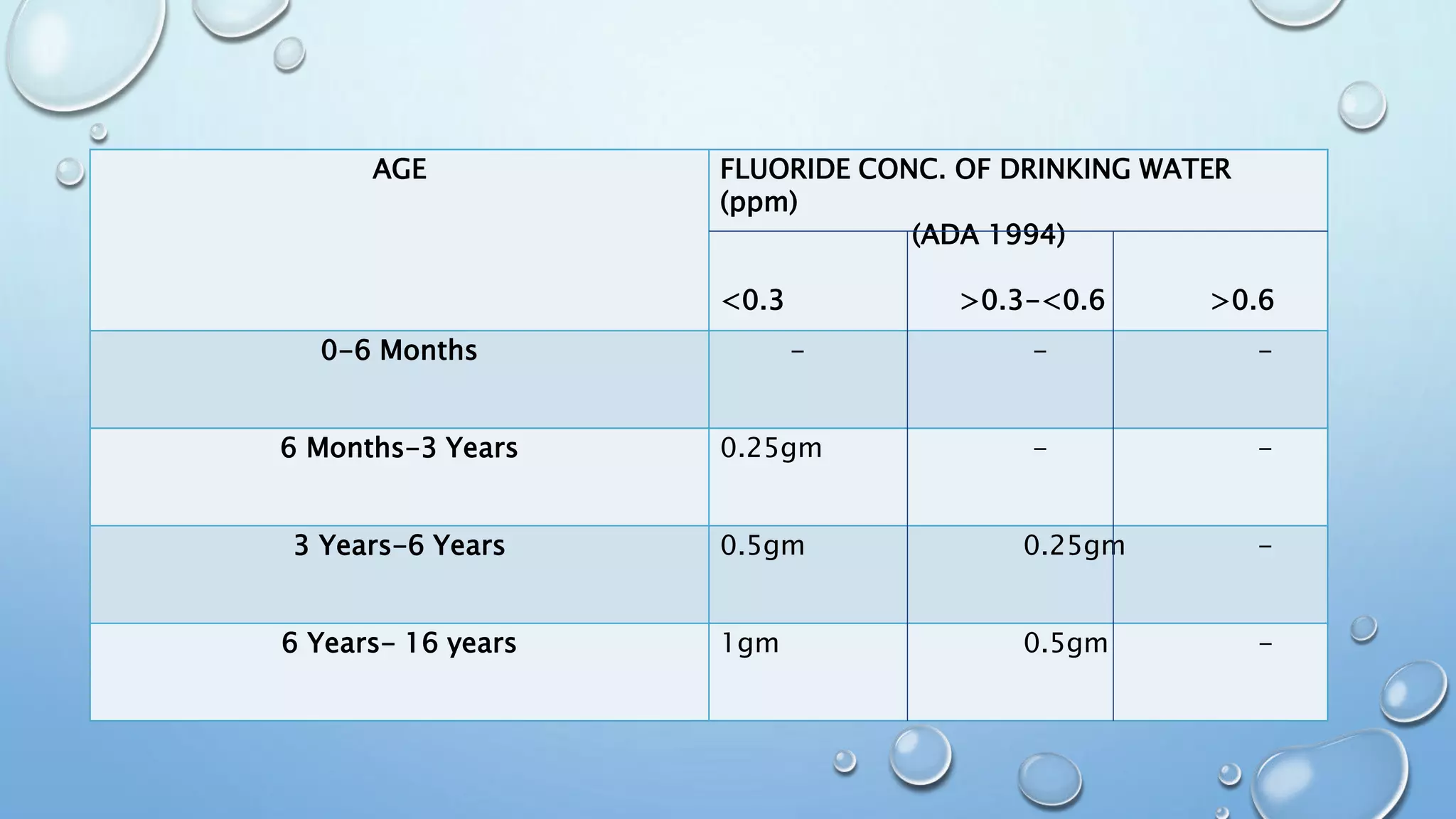
AGE FLUORIDE CONC. OF DRINKING WATER
(ppm)
(ADA 1994)
<0.3 >0.3-<0.6 >0.6
0-6 Months - - -
6 Months-3 Years 0.25gm - -
3 Years-6 Years 0.5gm 0.25gm -
6 Years- 16 years 1gm 0.5gm -
BENEFITS
• The use of dietary fluoride supplements from birth to age 13 or 16 years
provides caries reduction from 16-65%.
• Supplements provide systemic and topical benefits for primary and permanent
teeth.
PRECAUTIONS
• Accidental ingestion of fluoride supplements can cause stomach upset.
• No more than 120, 2.2 mg sodium fluoride tablet should be dispensed at one
time.
• There is no risk of dental fluorosis if the proper regime is followed.
• However, fluoride supplements when ingested prior to tooth eruption are a risk
factor for dental fluorosis.
CONCLUSION
• When used appropriately, fluoride is a safe and effective agent that can be used to
prevent dental caries. Fluorides has contributed profoundly to the improved dental
health of persons all over the world. Fluoride is needed throughout the life to
protect teeth against tooth decay. To ensure additional gains in oral health systemic
fluorides has been introduced. They provide a low concentration of fluoride to the
teeth over a long period of time. It is easy to administer through various mediums
like water, milk, salt. Systemic fluorides help in circulating fluorides in the blood
stream and is incorporated into developing teeth. But still systemic fluorides are yet
not widespread in India, therefore to ensure additional gains in oral health practices
water fluoridation should be extended to additional communities and fluoride
toothpastes should be used widely.
REFERENCES
1. Essentials of public health dentistry, 4th edition; Soben Peter;
2. Textbook of pedodontics, 3rd edition, Nikhil Marwah;
3. Textbook of pedodontics, Dr. Shobha Tandon;
4. FINN clinical Pedodontics, Sideny B. FINN;
5. https://www.Ada.Org/en/member-center/oral-health-topics/fluoride-
topical-and-systemic-supplements
Systemic flouride in Dentistry

Systemic flouride in Dentistry

  • 1.
    SYSTEMIC FLOURIDES SUBMITTED TO:- PROF. &HEAD – DR. VIRINDER GOYAL PROFESSOR – DR. KANIKA GUPTA VERMA READER – DR. SURUCHI JUNEJA SUKHIJA SR. LECTURER - DR. SAKSHI BAMBA SUBMITTED BY AKSHDEEP SINGH B.D.S. 3RD YEAR ROLL NO. 07
  • 2.
    • INTRODUCTION • MECHANISMOF FLOURIDE INCORPORATION • TYPES OF SYSTEMIC FLOURIDE • WATER FLOURIDATION • SCHOOL WATER FLOURIDATION • SALT FLOURIDATION • MILK FLOURIDATION • FLOURIDE SUPPLEMENTS • CONCLUSION
  • 3.
    FLOURIDE • Fluoride isa mineral that is found in all natural water sources and is the ionic form of the trace element fluorine, which is commonly found in the environment; fluorine reaches water sources by leaching from soil and rocks into groundwater. • When used as directed or within the context of community water fluoridation programs, fluoride is a safe and effective agent that can be used to prevent and control dental caries.
  • 4.
    INTRODUCTION • Systemic fluoridesprovides a low concentration of fluoride to the teeth over a long period of time. • It circulates through the blood stream and is incorporated into developing teeth. • After teeth erupt, fluoride contacts teeth directly through salivary secretions. • Most systemic fluorides have a topical effect but their primary effect is systemic.
  • 5.
    MECHANISM OF SYSTEMICFLOURIDE INCORPORATION • Systemic fluorides are ingested into the body. • Fluorine with Hydroxy-apettite forms Fluor-apettite. • Deposited on tooth during tooth development. • However, the actual mechanism of action of systemic fluorides is from the topical protection as the fluoride present in saliva, which continually bathes the teeth, provides a constant source that is also incorporated into plaque and facilitates remineralization.
  • 6.
    TYPES OF SYSTEMICFLOURIDES • WATER FLUORIDATION • COMMUNITY WATER FLUORIDATION • SCHOOL WATER FLUORIDATION • SALT FLUORIDATION • MILK FLUORIDATION • FLUORIDES SUPPLEMENTS
  • 7.
    WATER FLOURIDATION • Waterfluoridation is defined as “ controlled adjustment of the concentration of fluoride in A communal water supply so as to achieve maximum caries reduction and clinically insignificant level of fluorosis”. • It can also be defined as “the upward adjustment of the concentration of fluoride in public water supply in such a way that the concentration of fluoride ion in the water may be consistently maintained at 1 parts per million(ppm) by weight to prevent dental caries with minimal possibility of causing dental fluorosis”. • Community water fluoridation is the process of adjusting the fluoride content of fluoride-deficient water to the recommended level for optimal dental health, which is currently recommended at 0.7 parts fluoride per million parts water(ADA, April 2018).
  • 8.
    • Water fluoridationis an effective and inexpensive means of obtaining the fluoride necessary to prevent tooth decay. • Studies show that water fluoridation continues to be effective in reducing tooth decay by 20% to 40% in children and adults. • While water fluoridation is an extremely effective and inexpensive means of obtaining the fluoride necessary for optimal tooth decay prevention, not everyone lives in a community with a centralized, public or private water source that can be fluoridated. For those individuals, fluoride is available in other forms.
  • 9.
    • The recommendedconcentration-0.7 and 1.2 ppm, depending on the average regional temperature. • The lower levels of fluoride are recommended for warmer regions. In these locations the intake of water tends to be higher. • The optimal level of fluoride is approximately 1 part per million(ppm)
  • 10.
    HISTORY The first waterfluoridation programme was started in the year 1945 in the four cities in USA. 1. GRANDS RAPIDS- MUSKEGON STUDY 2. NEWBURGH-KINGSTON STUDY 3. EVANSTON OAK PARK STUDY 4. BRANTFORD- SARNIA- STARTFORD STUDY 5. TIEL – CULEMBORG STUDY
  • 11.
    GRANDS RAPIDS- MUSKEGONSTUDY NEWBURGH • On January 25th ,1945 ,sodium fluoride was added to GRAND RAPIDS water supply. Muskegon town was kept as a control. • After 6 ½ years in July ,1951 the caries experience of 6 and 15 years old children residents of grand rapids was half that of Muskegon . ( reported by - Arnold et al,1953). • So impressive was the efficacy of fluoridation that the city officials of Muskegon also decided to fluoridate their own water supply also.
  • 12.
    NEWBURGH –KINGSTON STUDY •On may 2nd 1945 , sodium fluoride was added to drinking water of Newburgh on the Hudson river. • Kingston town was kept as a control. • After 10 years of fluoridation et al (1956) reported that the DMF rate had fallen from 23.5 % to 13.9 %, confirming the caries inhibitory property of 1 ppm fluoride in drinking water.
  • 13.
    EVANSTON- OAK PARKSTUDY • In January 1946, a fluoridation experiment began in Evanston ,Illinois and the nearby community of oak park acted as the control town. • After 14 years of fluoridation in Evanston, there was a reduction of 49 % in DMF values. • The Evanston-oak park study presented the most detailed data of all the fluoridation studies.
  • 14.
    THE BRANTFORD- SARNIA-STARTFORD STUDY •In Canada, a project was undertaken in Brantford, Ontario, where fluoride was added to water supply in June 1945. • The community of Sarnia was established as the control town. • In addition ,the community of Stratford, where fluoride was naturally present in drinking water at level of 1.3 ppm was used as an auxiliary control. • After 17 years of fluoridation in Brantford, caries experience was similar to that occurring in the natural fluoride area of Stratford and was 55 % lower than in the control town of sarnia; BROWN AND POPLOVE,1965)
  • 15.
    TIEL – CULEMBORGSTUDY • In march 1953 the drinking water in Tiel was fluoridated to a level of 1.1 ppm. • Culemborg with water fluoride level of 0.1 ppm was the control. • After 13 years of fluoridation, the number of anatomical sites of teeth affected by dental caries was 58 % lower in Tiel than in culemborg.
  • 16.
    OPTIMUM FLOURIDE LEVELS •The optimum recommended fluoride levels varies with climate because the average consumption of water increases in warmer climates • In cold climates the recommended fluoride level-1.2 ppm • In extremely hot climate-0.7 ppm. • In moderate climates-1 ppm. • The optimum fluoride concentration can be calculated by following equation: • ppm fluoride (concentration) = 0.34/e • Where e = -0.038+0.0062 x temperature of the area in degree farenhite.
  • 17.
    PRE REQUIREMENTS • Presenceof caries in the community/public. • Level of fluoride concentrations in their drinking water. • Centralized water supply to the community. • Community acceptance/approval. • Installation and maintenance cost.
  • 18.
    ADVANTAGES • Large numberof people are benefited. • Consumption is regular • Fluoridated drinking water not only acts systemically • During tooth formation to make dental enamel more resistant to dental decay,but also has topical effect through the release in saliva after ingestion. • Fluoridation of community water is the least expensive way to provide fluoride to a large group of people.
  • 19.
    DISADVANTAGES • Interfere withhuman rights. • Other modes are not considered. • Common source of water supply may not be present.
  • 20.
    FEASEBILITY IN INDIA •Based on the current knowledge dentist population ratio of 1:80,000 and lack of preventive awareness of oral diseases , communal water fluoridation appears to be the most effective, practical and economical public health measure for prevention of dental caries as this method extends its benefits to all the residents of the community without necessitating any conscious effort on the part of the residents. • But the only short coming in that it can be implemented only in the areas which have central pipe water supply system. • Currently, most of the cities and towns in india covering 30% of the population have piped water supply. • An effort should be made with the concerned authorities to institute water fluoridation at least in these areas.
  • 21.
    SCHOOL WATER FLOURIDATION •School water fluoridation is one of the possible areas to be explored. This programme helps in limiting caries in school children who are the prime concern. • It is the suitable alternative where water fluoridation is not feasible. • The amount of fluoride added in school drinking water should be greater than normal because children have to stay in the school for a short period of time and to compensate for holidays and vacations.
  • 22.
    • The currentrecommended regimen for school water fluoridation is adding 4.5 times more fluoride. • There has been around 25 to 40 % decrease in dental caries with this program. • Simple fluoridators particularly that employ the venturi system are most suitable ,because they require almost no maintenance and can be utilized effectively in small instalments of small or medium sized schools.
  • 23.
    ADVANTAGES • Good resultsin reducing caries. • Minimal equipment requirement. • Not expensive.
  • 24.
    DISADVANTAGES • Children donot receive the benefit until they go to school. • Not all children go to the school go the school in poor countries and towns and villages. • Amount of water drunk can’t be regulated.
  • 25.
    SALT FLUORIDATION • Saltfluoridation is a controlled addition of fluoride, usually sodium or potassium fluoride, during the manufacture of salt for human consumption. • First fluoridated salt was introduced by Wespi in Switzerland 1948.It has been on sale in Switzerland since 1955. • Experiments have been conducted with concentration of fluoride in salt ranging from 90 mg of fluoride per kg. Salt to 200 -350 mg/kg .
  • 26.
    • Initial clinicaltrial of 90 mg/kg fluoride salt showed 20- 25 % of reduction of dental caries. • In 1967 Muhleman showed the safe dose of fluoridated salt, that 300 mg/kg yields 1.5 mg fluoride/5 gm of salt. Tooth from Hungary, after 8 years of salt fluoridates at the level of 250 mg fluoride /kg reported 35-58% of caries reduction
  • 27.
    PRODUCTION OF FLOURIDATEDSALT • For effective caries prevention, fluoride must be present in ionic form when salt( sodium chloride) is dissolved in water. There are essentially two different salt production processes: • 1. Batch processing • 2. Continuous processing • Fluoride is added to salt by spraying concentrated solutions of sodium fluoride or potassium fluoride. • Premixed granules of NaF and CaF2 with Po4 are added to common salt.
  • 28.
    ADVANTAGES • Fluoridated saltis safe. • Theoretically fluoridated salt prevents dental caries by both systemic as well topical action. • It does not require community water supply as in case of water fluoridation. • It permits individual to accept it or reject it. • Low cost • Fluoridated salt and iodized salt can be made available to the population.
  • 29.
    DISADVANTAGES • No precisecontrol over indicated consumption, since salt intake varies greatly among people. • International efforts to reduce sodium uptake. • Less sodium (Na+) intake to help control hypertension
  • 30.
    FEASIBILITY IN INDIA •Salt fluoridation appears to be a viable and feasible method of fluoride ingestion systemically because its distribution can be easily monitored as the supply can be effectively controlled especially for those areas which do not need supplemental fluorides I.E., Endemic fluoride belts. • Moreover, individual monitoring is not required as the levels are so adjusted so as to provide optimum levels of fluoride keeping in view the fact that on an average an individual consumes 5-8 gms of salt per day.
  • 31.
    LIMITATIONS • There maybe large variations in salt intake in different groups of people.Fluoridated salt consumption is lowest when the need for fluorides is greatest – in early years of life. • The amount of fluoridated salt ingested may decrease with increasing consumption of processed food. If the processors do not use fluoridated salt. • Difficulties arise when there are multiple drinking water sources which have a naturally optimal or excessive fluoride concentration. • It requires refined salt produced with modern technology and a high level of technical expertise. • The current view data high salt intake may contribute to hypertension.
  • 32.
    MILK FLOURIDATION • Milkfluoridation is the addition of a measured quantity of fluoride to bottled or packaged milk to be drunk by children. • It was introduced by Zeigler ,a Pediatrician, who started the first project with fluoridated milk in swiss city of Winterthur in 1953. • In 1971, Dr. Edgar borrow established the borrow foundation (formally the borrow dental milk foundation) in England, with the aim of promoting the use of milk as a vehicle for fluoride for the benefit of children’s oral health. • The first community based milk fluoridation scheme was introduced in 1988, in Bulgaria, under the international milk fluoridation program.
  • 33.
    MILK DISTRIBUTION • Fluoridatedmilk distribution to children is best done through an established or existing system, like school milk or milk for kindergartens and nursery schools. • Fluoridating the milk-fluoridated milk can be produced in number of forms:- 1. Liquid (pasteurized and sterilized) 2. Powder-each containing a variety of fluoridating agents so as to provide them with the optimum amount in line with recommendations of WHO expert committee (1994), i.e. Ranging from 0 to 1.0 mg fluoride per day according to the age of the child and the fluoride concentration in the local water supply.
  • 34.
    COMPOUNDS USED FORFLUORIDATION • Calcium fluoride • Sodium fluoride • Disodium Monofluorophosphate • Disodium Silicofluoride
  • 35.
    FEASEBILITY IN INDIA •In addition being the staple food for children and its consumption can be confined to groups who need it most, that practically speaking that this scheme /method does not seem to be viable and feasible because of : 1. In INDIA, majority of children population living in rural and urban areas cannot afford milk daily. 2. Central milk supply system does not exist in India. 3. Variation of intake and quantity of milk is another which cannot be controlled since it depends upon the socio-economic religious and ethnic factors.
  • 36.
    FLUORIDE SUPPLEMENTS • Fluoridesupplements are available in different forms such as fluoride tablets ,drops , lozenges. • Fluoride tablets, drops and lozenges are not available over the counter but prescribed by the dentist or Paediatrician to individual patients or as a part of school or home based preventive dentistry program.
  • 37.
    FLUORIDE COMPOUNDS USED •Most commonly used is sodium fluoride. • Other compounds used are acidulated phosphate fluoride, potassium fluoride or calcium fluoride. • Supplements contain measured amount of fluorides, 0.25 mg , 0.5 mg, 1.0 mg. • They should be taken on daily basis according to the prescribed dosage schedule.
  • 38.
    AGE FLUORIDE CONC.OF DRINKING WATER (ppm) (ADA 1994) <0.3 >0.3-<0.6 >0.6 0-6 Months - - - 6 Months-3 Years 0.25gm - - 3 Years-6 Years 0.5gm 0.25gm - 6 Years- 16 years 1gm 0.5gm -
  • 39.
    BENEFITS • The useof dietary fluoride supplements from birth to age 13 or 16 years provides caries reduction from 16-65%. • Supplements provide systemic and topical benefits for primary and permanent teeth.
  • 40.
    PRECAUTIONS • Accidental ingestionof fluoride supplements can cause stomach upset. • No more than 120, 2.2 mg sodium fluoride tablet should be dispensed at one time. • There is no risk of dental fluorosis if the proper regime is followed. • However, fluoride supplements when ingested prior to tooth eruption are a risk factor for dental fluorosis.
  • 41.
    CONCLUSION • When usedappropriately, fluoride is a safe and effective agent that can be used to prevent dental caries. Fluorides has contributed profoundly to the improved dental health of persons all over the world. Fluoride is needed throughout the life to protect teeth against tooth decay. To ensure additional gains in oral health systemic fluorides has been introduced. They provide a low concentration of fluoride to the teeth over a long period of time. It is easy to administer through various mediums like water, milk, salt. Systemic fluorides help in circulating fluorides in the blood stream and is incorporated into developing teeth. But still systemic fluorides are yet not widespread in India, therefore to ensure additional gains in oral health practices water fluoridation should be extended to additional communities and fluoride toothpastes should be used widely.
  • 42.
    REFERENCES 1. Essentials ofpublic health dentistry, 4th edition; Soben Peter; 2. Textbook of pedodontics, 3rd edition, Nikhil Marwah; 3. Textbook of pedodontics, Dr. Shobha Tandon; 4. FINN clinical Pedodontics, Sideny B. FINN; 5. https://www.Ada.Org/en/member-center/oral-health-topics/fluoride- topical-and-systemic-supplements