
Integrating Work Force Management
  (WFM) with complementary systems
  Unleashing the collective potential


April 2012
“Enhancing the
performance of field
staff, reducing
customer fulfillment
costs …...”


…..and multiplying efficiencies by
creating a system that can handle the
complex workflows of workforce
management using real-time data
while simultaneously being user-
friendly and easy to use
“The Carriers, have
found opportunities in
multiple applications
across education,
health, finance,
enterprises, gaming,
entertainment to boost
the revenues.”


“…. There is a proliferation of devices and
customer premises equipment (CPE). And
as we move to triple and quad play, the
data pipes will become huge and the
present-day value added services will
become the core services.
”
“The challenges for the
service providers are
and will continue to
multiply with every new
offering, services and
user applications;
sometimes
exponentially. ……..”


........ Spoilt for choices, the customers are
placing more and more emphasis on
providing high quality uninterrupted service
sometimes across multiple screens and
locations.
“As operating budgets
shrink, carriers are
relying on operational
efficiencies to boost
the bottom lines.……..”


........ WFM is one system of carriers’
ecosystem that is capable of meeting
the dual objective of bringing
operational efficiencies by optimizing
workforce and improving customer
satisfaction by reducing fault detection
and service delivery time.
Today, most of the system; that form a part
of the critical workflows of field staff; work
in isolation with other systems


  Integration for Delivering business value         Business Benefits


  •Completing the automation loop and filling       •A reduction in the response-time by
  the lacunas.                                      approximately 25%
  •Unleashes the untapped potential of              •Repeat service drop by 38%
  applications to meet the dynamic planning
                                                    E.g, allowing for timely feedback or quicker
  needs of demand-oriented multi-skilled
                                                    rescheduling for repeat jobs; the decision
  environments
                                                    makers can take better decisions on field force;
                                                    effectively.

                                                Proprietary & Confidential. ©Aricent Group 2011
                                                                                                       6
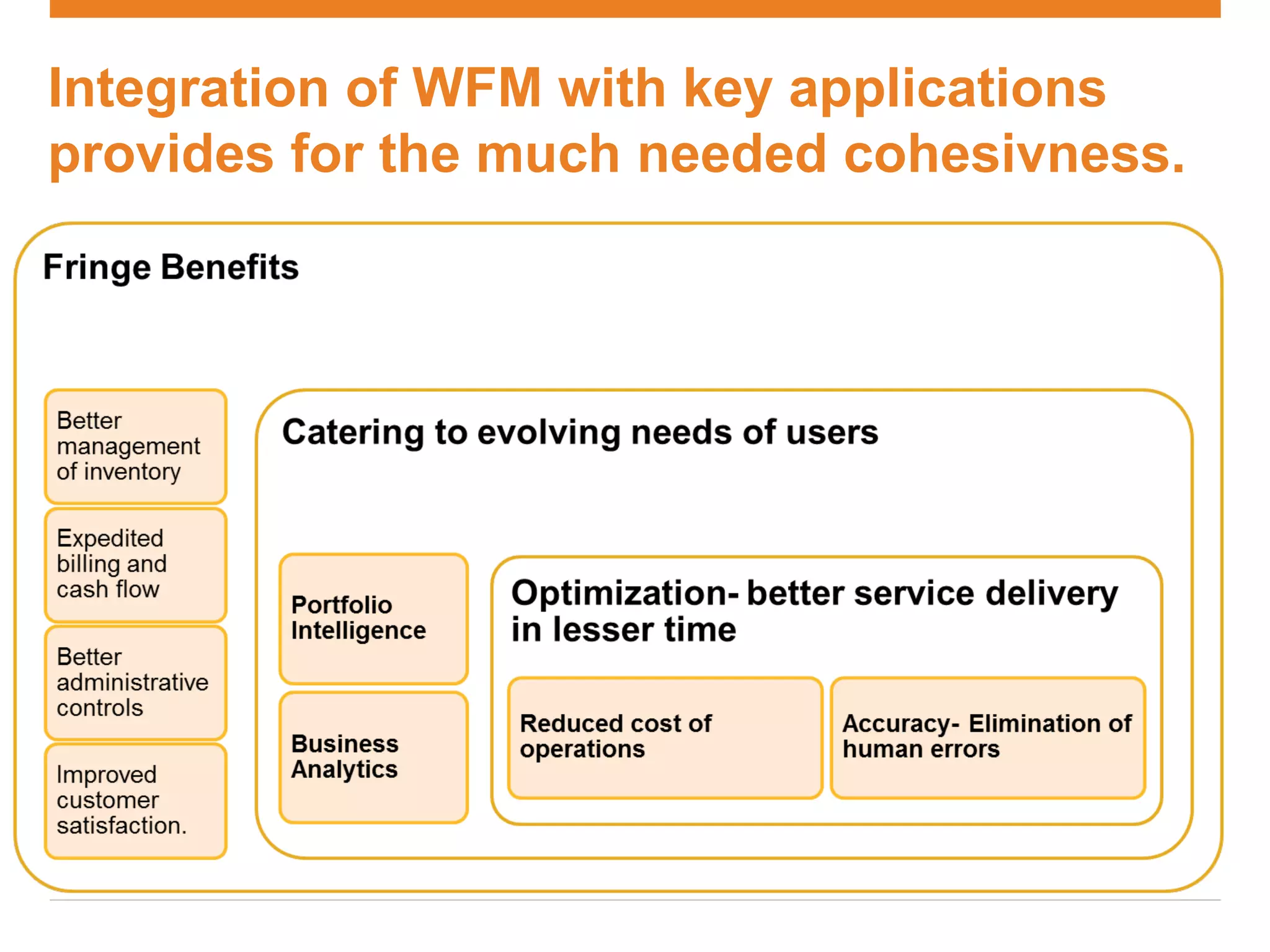
Integration of WFM with key applications
provides for the much needed cohesivness.
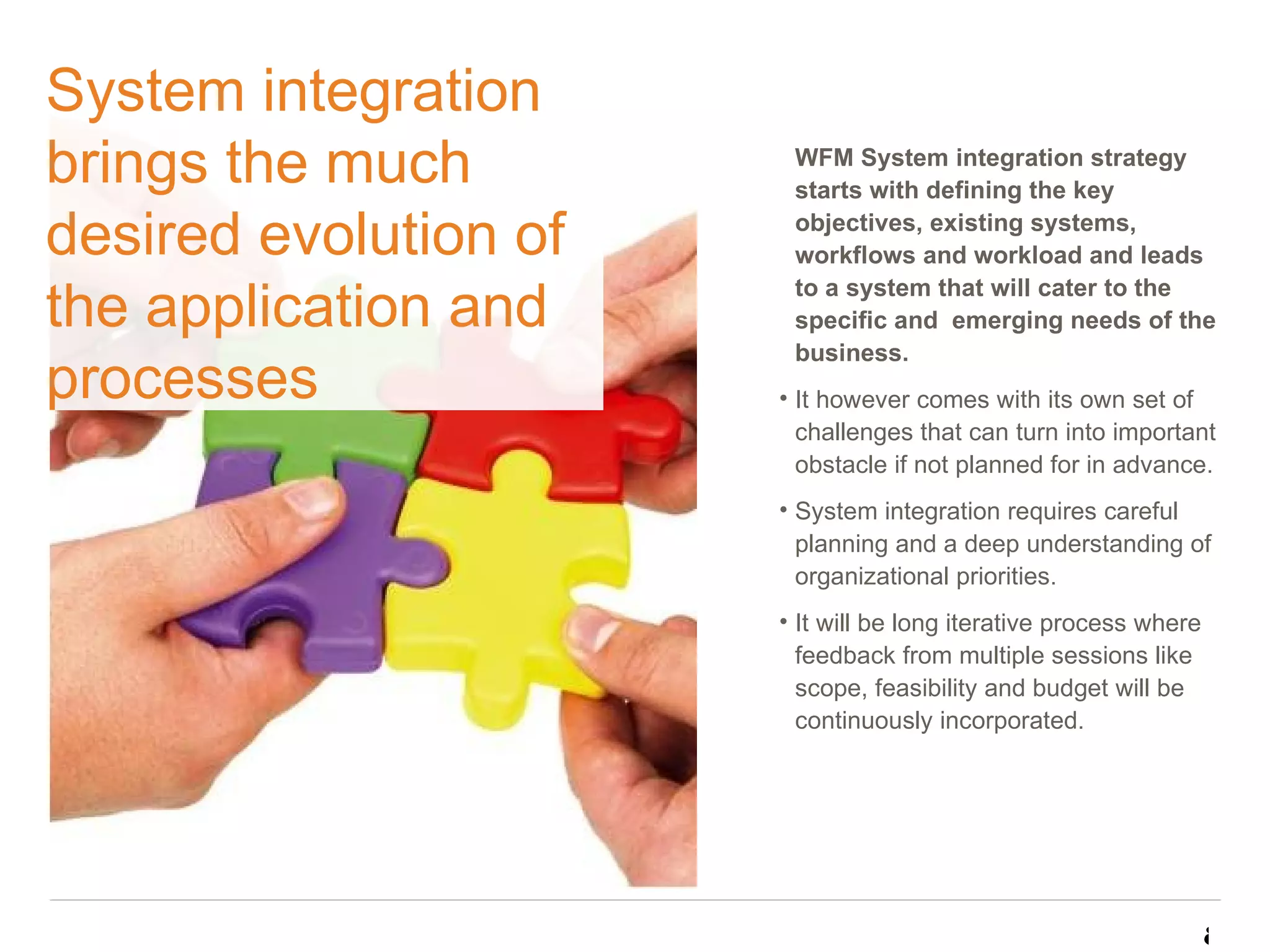
System integration
brings the much         WFM System integration strategy
                        starts with defining the key

desired evolution of    objectives, existing systems,
                        workflows and workload and leads

the application and
                        to a system that will cater to the
                        specific and emerging needs of the
                        business.
processes              • It however comes with its own set of
                         challenges that can turn into important
                         obstacle if not planned for in advance.
                       • System integration requires careful
                         planning and a deep understanding of
                         organizational priorities.
                       • It will be long iterative process where
                         feedback from multiple sessions like
                         scope, feasibility and budget will be
                         continuously incorporated.


                                                                   8
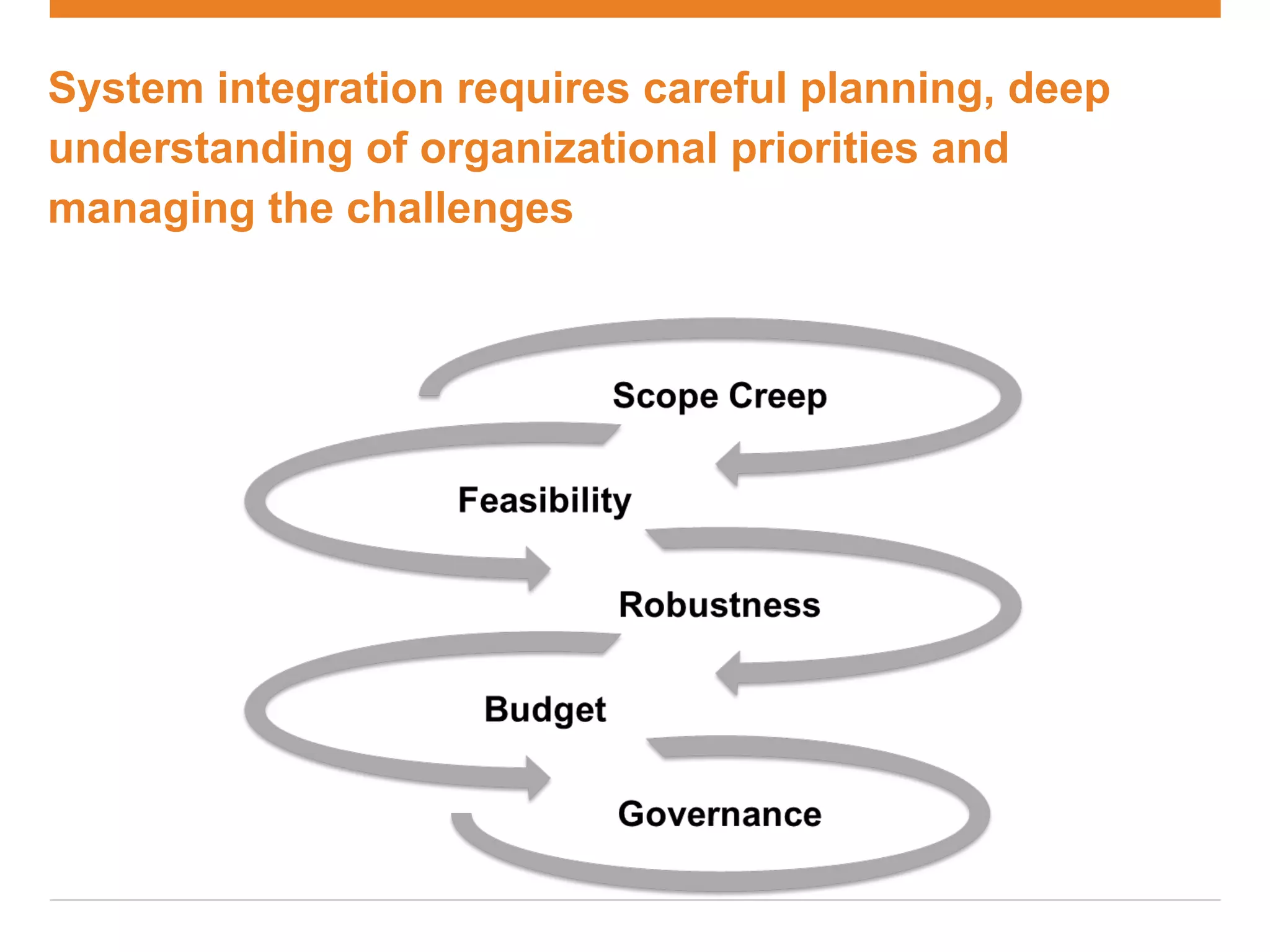
System integration requires careful planning, deep
understanding of organizational priorities and
managing the challenges
It is important to
define the scope.     Multiple business units are
                      always vying for the same IT
                      budget
                     • Invest time to build an
                       understanding of user
                       requirements, challenges,
                       immediate priorities and long term
                       goals.
                     • It is important to understand what
                       needs to be done and minimize
                       the clamor.
                     • The most pragmatic approach
                       under these circumstances is to
                       plan for with system integration in
                       phases and addressing various
                       sets of challenges as you go.
Conduct a thorough       System integration uses not only
technical feasibility    WFM components but also a
                         large number of existing
                         components designed under
                         different set of requirements,
                         objectives, assumptions, fault
                         tolerance, reliability and security
                         protocols.
                        • A good design can help you get
                          through the challenges of system
                          incompatibilities - inadequate APIs,
                          non-coherent data structures,
                          partial interoperability-where it is
                          almost impossible to trigger a
                          command into one system from
                          another; different reliability and
                          uptimes, anarchy issues where
                          subsystems have different methods
                          of authorization authentication and
                          user rights management.
                        • It helps to include the existing
                          vendors at the feasibility and
                          planning stage itself. .
Design for
robustness    The key design
              challenges will be to
              avoid introducing the
              system instabilities
              when faults and failures
              in one component
              cascade along, leading
              to system wide failures.
             • Thus SI design must be
               capable of isolating and
               shunting out the problem
               system from other as
               needed.
Budget is the most
common pitfall.      It is necessary to budget
                     not just for SI but also
                     for ongoing maintenance
                     and testing for new links
                     that can make the
                     structure more complex.
Good governance
is a critical enabler    ….and fundamental
                         component of any SI
                         initiatives.
                        • To overcome this challenge,
                          emphasis should be laid on
                          collaborative decision-making
                          given the evolving user needs
                          and typically large number
                          and diversity of stakeholders
                          and applications with multi-
                          dimensional linkages.
Thank You


            Please feel free to
            contact me by leaving
            message for me on slide
            share…

                                      15

System integration challanges in Workforce Management

  • 1.
    Integrating Work ForceManagement (WFM) with complementary systems Unleashing the collective potential April 2012
  • 2.
    “Enhancing the performance offield staff, reducing customer fulfillment costs …...” …..and multiplying efficiencies by creating a system that can handle the complex workflows of workforce management using real-time data while simultaneously being user- friendly and easy to use
  • 3.
    “The Carriers, have foundopportunities in multiple applications across education, health, finance, enterprises, gaming, entertainment to boost the revenues.” “…. There is a proliferation of devices and customer premises equipment (CPE). And as we move to triple and quad play, the data pipes will become huge and the present-day value added services will become the core services. ”
  • 4.
    “The challenges forthe service providers are and will continue to multiply with every new offering, services and user applications; sometimes exponentially. ……..” ........ Spoilt for choices, the customers are placing more and more emphasis on providing high quality uninterrupted service sometimes across multiple screens and locations.
  • 5.
    “As operating budgets shrink,carriers are relying on operational efficiencies to boost the bottom lines.……..” ........ WFM is one system of carriers’ ecosystem that is capable of meeting the dual objective of bringing operational efficiencies by optimizing workforce and improving customer satisfaction by reducing fault detection and service delivery time.
  • 6.
    Today, most ofthe system; that form a part of the critical workflows of field staff; work in isolation with other systems Integration for Delivering business value Business Benefits •Completing the automation loop and filling •A reduction in the response-time by the lacunas. approximately 25% •Unleashes the untapped potential of •Repeat service drop by 38% applications to meet the dynamic planning E.g, allowing for timely feedback or quicker needs of demand-oriented multi-skilled rescheduling for repeat jobs; the decision environments makers can take better decisions on field force; effectively. Proprietary & Confidential. ©Aricent Group 2011 6
  • 7.
    Integration of WFMwith key applications provides for the much needed cohesivness.
  • 8.
    System integration brings themuch WFM System integration strategy starts with defining the key desired evolution of objectives, existing systems, workflows and workload and leads the application and to a system that will cater to the specific and emerging needs of the business. processes • It however comes with its own set of challenges that can turn into important obstacle if not planned for in advance. • System integration requires careful planning and a deep understanding of organizational priorities. • It will be long iterative process where feedback from multiple sessions like scope, feasibility and budget will be continuously incorporated. 8
  • 9.
    System integration requirescareful planning, deep understanding of organizational priorities and managing the challenges
  • 10.
    It is importantto define the scope. Multiple business units are always vying for the same IT budget • Invest time to build an understanding of user requirements, challenges, immediate priorities and long term goals. • It is important to understand what needs to be done and minimize the clamor. • The most pragmatic approach under these circumstances is to plan for with system integration in phases and addressing various sets of challenges as you go.
  • 11.
    Conduct a thorough System integration uses not only technical feasibility WFM components but also a large number of existing components designed under different set of requirements, objectives, assumptions, fault tolerance, reliability and security protocols. • A good design can help you get through the challenges of system incompatibilities - inadequate APIs, non-coherent data structures, partial interoperability-where it is almost impossible to trigger a command into one system from another; different reliability and uptimes, anarchy issues where subsystems have different methods of authorization authentication and user rights management. • It helps to include the existing vendors at the feasibility and planning stage itself. .
  • 12.
    Design for robustness The key design challenges will be to avoid introducing the system instabilities when faults and failures in one component cascade along, leading to system wide failures. • Thus SI design must be capable of isolating and shunting out the problem system from other as needed.
  • 13.
    Budget is themost common pitfall. It is necessary to budget not just for SI but also for ongoing maintenance and testing for new links that can make the structure more complex.
  • 14.
    Good governance is acritical enabler ….and fundamental component of any SI initiatives. • To overcome this challenge, emphasis should be laid on collaborative decision-making given the evolving user needs and typically large number and diversity of stakeholders and applications with multi- dimensional linkages.
  • 15.
    Thank You Please feel free to contact me by leaving message for me on slide share… 15