PRACTICUM HERBS AND 
BEVERAGE 
MAKING JAMS AND SYRUPS 
HERBAL 
By 
Lidya Mandari 10.70.0110 
Yemima Rosa P B 10.70.0139 
Michella M.J 11.70.0087 
Jan Foreign Student
INTRODUCTION 
• Jam is a type of processed foods derived from 
fruit juice or fruit that has been destroyed, 
added sugar and cooked until thickened. 
• According to ISO (1994), the syrup is defined 
as a concentrated sugar solution (sucrose: High 
Fructose Syrup and sugar inversion or other) 
with or without the addition of food additives 
are permitted.
MATERIAL AND METHOD 1 
• Materials 
The tools used in this lab is the analytical balance, 
stove, mixer, bottle empty containers UC 1000, 
empty bottles round hexagon containers, blenders, 
pans, knives, telanan,etc. 
The materials used in this lab to make cinnamon 
syrup (groups 1-2), lemongrass (groups 3-4) and 
Tamarind (groups 5-6). To make rosella jam 
which (groups 1-3) and ginger (group 4-6), sugar, 
citric acid, pectin.
MATERIAL AND METHOD 2 
• Method 
Making Syrup 
Materials,water, sugar 
cooked until boiling 
Added citric acid 
chill 
move into the bottle sensory test
MATERIAL AND METHOD 3 
• Making Jam 
Materials + sugar 
stirring until 
smooth 
be cooked 
Added pectin 
stirring 
constantly, until 
almost boiling 
Let 
stand 
move into 
the bottle 
sensory 
test
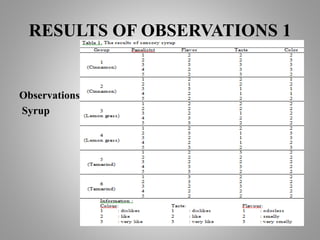
RESULTS OF OBSERVATIONS 1 
Observations 
Syrup
RESULTS OF OBSERVATIONS 2 
Observations 
jam
DISCUSSION 1 
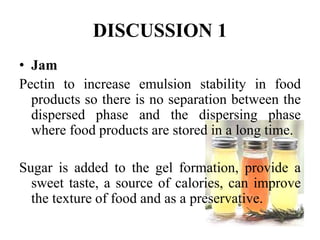
• Jam 
Pectin to increase emulsion stability in food 
products so there is no separation between the 
dispersed phase and the dispersing phase 
where food products are stored in a long time. 
Sugar is added to the gel formation, provide a 
sweet taste, a source of calories, can improve 
the texture of food and as a preservative.
DISCUSSION 2 
• Sensory analysis was performed testing to provide 
an assessment of a product, by relying on the 
senses. 
• 5 results panelists have a different preference 
level on color, flavor, viscosity and flavor of jam. 
Rosella jam (groups 1-3) average panelists liked 
the color, aroma and flavor rosella jam. Panelists 
liked the viscosity of groups 1 and 2. that most 
panelists favored jam in group 2
DISCUSSION 3 
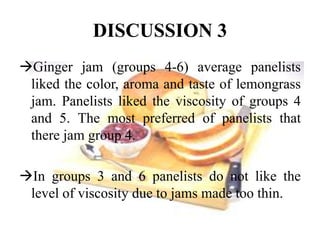
Ginger jam (groups 4-6) average panelists 
liked the color, aroma and taste of lemongrass 
jam. Panelists liked the viscosity of groups 4 
and 5. The most preferred of panelists that 
there jam group 4. 
In groups 3 and 6 panelists do not like the 
level of viscosity due to jams made too thin.
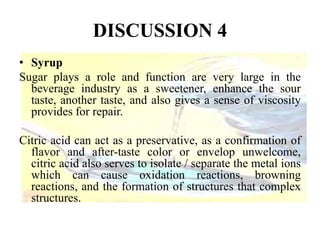
DISCUSSION 4 
• Syrup 
Sugar plays a role and function are very large in the 
beverage industry as a sweetener, enhance the sour 
taste, another taste, and also gives a sense of viscosity 
provides for repair. 
Citric acid can act as a preservative, as a confirmation of 
flavor and after-taste color or envelop unwelcome, 
citric acid also serves to isolate / separate the metal ions 
which can cause oxidation reactions, browning 
reactions, and the formation of structures that complex 
structures.
DISCUSSION 5 
• The results of the 5 panelists each have different 
preferences on the color, taste and flavor syrups. 
At cinnamon syrup (groups 1 and 2) average panelists 
like taste, flavor and color of cinnamon syrup. The most 
preferred group of panelists that syrup 1. 
At lemongrass syrup (groups 3 and 4) also average 
panelists like taste, flavor and color lemongrass syrup. 
The most preferred group of panelists that syrup 3. 
In Tamarind syrup (groups 5 and 6) also average 
panelists like taste, flavor and color of Tamarind syrup. 
The most preferred group of panelists that syrup 5.
REFERENCE 
• Cruess, W.V. 1958. Commercial Fruit and Vegetable Products. Mc.Graw-Hill Co. 
New York. 
• Desrosier, NW. 1988. Teknologi Pengawetan Pangan. (M Muljohardjo, 
penerjemah). Jakarta: UI Press. 
• Lutony, Tony. L. 1993. Tanaman Sumber Pemanis. PT Penebar Swadaya. Jakarta. 
• Muryanti. 2011. Proses Pembuatan Selai Herbal Rosella (Hibiscus sabdariffa L) 
Kaya Antioksidan dan Vitamin C. Tugas akhir sebagai persyaratan sarjana Fakultas 
Pertanian Universitas Sebelas Maret. Surakarta. 
• Satuhu, S. 1994. Penanganan dan Pengolahan Buah. PT Penebar Swadaya. Jakarta. 
• Syahrumsyah.,H, Murdianto.,W, Pramanti ,.N. 2010. Pengaruh Penambahan 
Karboksi Metil Selulosa (CMC) Dan Tingkat Kematangan Buah Nanas (Ananas 
Comosus (L) Merr.) Terhadap Mutu Selai Nanas . Jurnal Teknologi Pertanian 
Jurusan Teknologi Hasil Pertanian, Fakultas Pertanian Universitas Mulawarman. 
Samarinda. 
• Tressler, D.K. and J.G. Woodroof, 1976. Fruit Products Formulary Volume 3: Fruit, 
Vegetable, and Nut Products. The AVI Publishing Company Inc. Westport, 
Connecticut. 
• Wong, Dominic, W.S., 1989. Mechanism And Theory In Food Chemistry. Van 
Nostrand Reinhold. New York. 
• Winarno, FG. 1997. Kimia Pangan dan Gizi. Jakarta : Gramedia Pustaka Utama.
APPENDIX 1 
lemongrass extract 
lemongrass extract added 
sugar 
Lemongrass Syrup 
Syrup
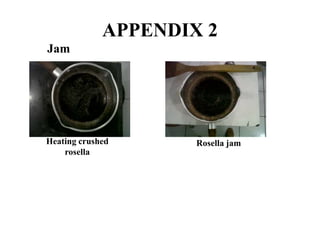
APPENDIX 2 
Jam 
Heating crushed 
rosella 
Rosella jam
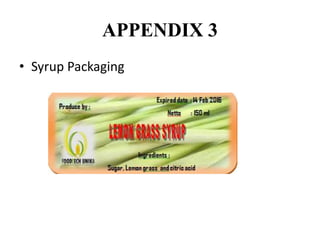
APPENDIX 3 
• Syrup Packaging
• Jam Packaging with glass 
Produced by: 
Food 
Tecnology 
Department 
Netto: 236 g 
Expired date : 14 
Februari 2014 
The benefit : 
to address a variety of diseases and health 
problems. Benefits of red rosella among 
others, can lower uric acid, lower 
cholesterol levels in the body, destroying 
fat, body slimming, reducing smoking 
addiction, prevent stroke and 
hypertension, improve digestion, eliminate 
hemorrhoids, blood sugar levels, prevent 
cancer, tumors, cysts and the like. 
Serving suggestion: 
Spread the bread with jam 
and ready to eat 
Ingredients: Rosella, 
pectin, sugar, water
TEA BAG DRINK 
of MOSA 
By 
Lidya Mandari 10.70.0110 
Yemima Rosa P B 10.70.0139 
Michella M.J 11.70.0087 
Jan Foreign Student
THE GOAL 
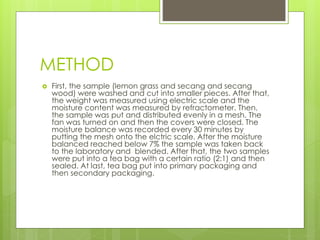
 The goal of this lab is to determine a 
method of making student steeping 
products from the drying process with 
solar tunnel dryer, the tea bag 
packaging, and manufacturing of both 
primary and secondary packaging.
METHOD
METHOD 
 First, the sample (lemon grass and secang and secang 
wood) were washed and cut into smaller pieces. After that, 
the weight was measured using electric scale and the 
moisture content was measured by refractometer. Then, 
the sample was put and distributed evenly in a mesh. The 
fan was turned on and then the covers were closed. The 
moisture balance was recorded every 30 minutes by 
putting the mesh onto the elctric scale. After the moisture 
balanced reached below 7% the sample was taken back 
to the laboratory and blended. After that, the two samples 
were put into a tea bag with a certain ratio (2:1) and then 
sealed. At last, tea bag put into primary packaging and 
then secondary packaging.
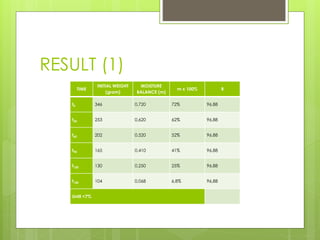
RESULT (1) 
TIME 
INITIAL WEIGHT 
(gram) 
MOISTURE 
BALANCE (m) 
m x 100% R 
t0 346 0,720 72% 96,88 
t30 253 0,620 62% 96,88 
t60 202 0,520 52% 96,88 
t90 165 0,410 41% 96,88 
t120 130 0,250 25% 96,88 
t150 104 0,068 6,8% 96,88 
Until <7%
RESULT (1) 
Panelist Color Taste Flavor Overall 
TIME 
INITIAL WEIGHT 
(gram) 
MOISTURE 
BALANCE (m) 
m x 100% R 
1 1 1 2 1 
t0 346 0,720 72% 96,88 
2 2 2 3 2 
t30 253 0,620 62% 96,88 
3 2 2 3 2 
4 1 2 2 2 
t60 202 0,520 52% 96,88 
5 2 2 1 2 
t90 165 0,410 41% 96,88 
6 2 2 3 2 
7 2 2 2 2 
t120 130 0,250 25% 96,88 
8 2 2 2 2 
t150 104 0,068 6,8% 96,88 
9 2 2 2 2 
Until <7% 
10 1 2 1 2
PACKAGING
DISCUSSION 
 The amount of each sample provided in 
each group differs from each other. It 
affects the rate of drying because the 
greater the amount the longer it takes to 
dry. Moreover, the sample of each group 
varies in size. Size affects the rate of drying 
because of the contact area to the sun. 
The smaller the size the faster the drying 
rate, because the area exposed to the 
sun is increased.
DISCUSSION 
 Solar tunnel dryer (STD) are commonly used for 
drying agricutural products. It consist of fans, 
transparent covering, and tunnel to put the 
samples. The working principle is to push hot air 
through the tunnel using the fan to enhance the 
drying rate. This following figure is a simplified 
arrangement of simplified STD.
Syrup and jam
Syrup and jam

Syrup and jam

  • 1.
    PRACTICUM HERBS AND BEVERAGE MAKING JAMS AND SYRUPS HERBAL By Lidya Mandari 10.70.0110 Yemima Rosa P B 10.70.0139 Michella M.J 11.70.0087 Jan Foreign Student
  • 2.
    INTRODUCTION • Jamis a type of processed foods derived from fruit juice or fruit that has been destroyed, added sugar and cooked until thickened. • According to ISO (1994), the syrup is defined as a concentrated sugar solution (sucrose: High Fructose Syrup and sugar inversion or other) with or without the addition of food additives are permitted.
  • 3.
    MATERIAL AND METHOD1 • Materials The tools used in this lab is the analytical balance, stove, mixer, bottle empty containers UC 1000, empty bottles round hexagon containers, blenders, pans, knives, telanan,etc. The materials used in this lab to make cinnamon syrup (groups 1-2), lemongrass (groups 3-4) and Tamarind (groups 5-6). To make rosella jam which (groups 1-3) and ginger (group 4-6), sugar, citric acid, pectin.
  • 4.
    MATERIAL AND METHOD2 • Method Making Syrup Materials,water, sugar cooked until boiling Added citric acid chill move into the bottle sensory test
  • 5.
    MATERIAL AND METHOD3 • Making Jam Materials + sugar stirring until smooth be cooked Added pectin stirring constantly, until almost boiling Let stand move into the bottle sensory test
  • 6.
    RESULTS OF OBSERVATIONS1 Observations Syrup
  • 7.
    RESULTS OF OBSERVATIONS2 Observations jam
  • 8.
    DISCUSSION 1 •Jam Pectin to increase emulsion stability in food products so there is no separation between the dispersed phase and the dispersing phase where food products are stored in a long time. Sugar is added to the gel formation, provide a sweet taste, a source of calories, can improve the texture of food and as a preservative.
  • 9.
    DISCUSSION 2 •Sensory analysis was performed testing to provide an assessment of a product, by relying on the senses. • 5 results panelists have a different preference level on color, flavor, viscosity and flavor of jam. Rosella jam (groups 1-3) average panelists liked the color, aroma and flavor rosella jam. Panelists liked the viscosity of groups 1 and 2. that most panelists favored jam in group 2
  • 10.
    DISCUSSION 3 Gingerjam (groups 4-6) average panelists liked the color, aroma and taste of lemongrass jam. Panelists liked the viscosity of groups 4 and 5. The most preferred of panelists that there jam group 4. In groups 3 and 6 panelists do not like the level of viscosity due to jams made too thin.
  • 11.
    DISCUSSION 4 •Syrup Sugar plays a role and function are very large in the beverage industry as a sweetener, enhance the sour taste, another taste, and also gives a sense of viscosity provides for repair. Citric acid can act as a preservative, as a confirmation of flavor and after-taste color or envelop unwelcome, citric acid also serves to isolate / separate the metal ions which can cause oxidation reactions, browning reactions, and the formation of structures that complex structures.
  • 12.
    DISCUSSION 5 •The results of the 5 panelists each have different preferences on the color, taste and flavor syrups. At cinnamon syrup (groups 1 and 2) average panelists like taste, flavor and color of cinnamon syrup. The most preferred group of panelists that syrup 1. At lemongrass syrup (groups 3 and 4) also average panelists like taste, flavor and color lemongrass syrup. The most preferred group of panelists that syrup 3. In Tamarind syrup (groups 5 and 6) also average panelists like taste, flavor and color of Tamarind syrup. The most preferred group of panelists that syrup 5.
  • 13.
    REFERENCE • Cruess,W.V. 1958. Commercial Fruit and Vegetable Products. Mc.Graw-Hill Co. New York. • Desrosier, NW. 1988. Teknologi Pengawetan Pangan. (M Muljohardjo, penerjemah). Jakarta: UI Press. • Lutony, Tony. L. 1993. Tanaman Sumber Pemanis. PT Penebar Swadaya. Jakarta. • Muryanti. 2011. Proses Pembuatan Selai Herbal Rosella (Hibiscus sabdariffa L) Kaya Antioksidan dan Vitamin C. Tugas akhir sebagai persyaratan sarjana Fakultas Pertanian Universitas Sebelas Maret. Surakarta. • Satuhu, S. 1994. Penanganan dan Pengolahan Buah. PT Penebar Swadaya. Jakarta. • Syahrumsyah.,H, Murdianto.,W, Pramanti ,.N. 2010. Pengaruh Penambahan Karboksi Metil Selulosa (CMC) Dan Tingkat Kematangan Buah Nanas (Ananas Comosus (L) Merr.) Terhadap Mutu Selai Nanas . Jurnal Teknologi Pertanian Jurusan Teknologi Hasil Pertanian, Fakultas Pertanian Universitas Mulawarman. Samarinda. • Tressler, D.K. and J.G. Woodroof, 1976. Fruit Products Formulary Volume 3: Fruit, Vegetable, and Nut Products. The AVI Publishing Company Inc. Westport, Connecticut. • Wong, Dominic, W.S., 1989. Mechanism And Theory In Food Chemistry. Van Nostrand Reinhold. New York. • Winarno, FG. 1997. Kimia Pangan dan Gizi. Jakarta : Gramedia Pustaka Utama.
  • 14.
    APPENDIX 1 lemongrassextract lemongrass extract added sugar Lemongrass Syrup Syrup
  • 15.
    APPENDIX 2 Jam Heating crushed rosella Rosella jam
  • 16.
    APPENDIX 3 •Syrup Packaging
  • 17.
    • Jam Packagingwith glass Produced by: Food Tecnology Department Netto: 236 g Expired date : 14 Februari 2014 The benefit : to address a variety of diseases and health problems. Benefits of red rosella among others, can lower uric acid, lower cholesterol levels in the body, destroying fat, body slimming, reducing smoking addiction, prevent stroke and hypertension, improve digestion, eliminate hemorrhoids, blood sugar levels, prevent cancer, tumors, cysts and the like. Serving suggestion: Spread the bread with jam and ready to eat Ingredients: Rosella, pectin, sugar, water
  • 18.
    TEA BAG DRINK of MOSA By Lidya Mandari 10.70.0110 Yemima Rosa P B 10.70.0139 Michella M.J 11.70.0087 Jan Foreign Student
  • 19.
    THE GOAL The goal of this lab is to determine a method of making student steeping products from the drying process with solar tunnel dryer, the tea bag packaging, and manufacturing of both primary and secondary packaging.
  • 20.
  • 21.
    METHOD  First,the sample (lemon grass and secang and secang wood) were washed and cut into smaller pieces. After that, the weight was measured using electric scale and the moisture content was measured by refractometer. Then, the sample was put and distributed evenly in a mesh. The fan was turned on and then the covers were closed. The moisture balance was recorded every 30 minutes by putting the mesh onto the elctric scale. After the moisture balanced reached below 7% the sample was taken back to the laboratory and blended. After that, the two samples were put into a tea bag with a certain ratio (2:1) and then sealed. At last, tea bag put into primary packaging and then secondary packaging.
  • 22.
    RESULT (1) TIME INITIAL WEIGHT (gram) MOISTURE BALANCE (m) m x 100% R t0 346 0,720 72% 96,88 t30 253 0,620 62% 96,88 t60 202 0,520 52% 96,88 t90 165 0,410 41% 96,88 t120 130 0,250 25% 96,88 t150 104 0,068 6,8% 96,88 Until <7%
  • 23.
    RESULT (1) PanelistColor Taste Flavor Overall TIME INITIAL WEIGHT (gram) MOISTURE BALANCE (m) m x 100% R 1 1 1 2 1 t0 346 0,720 72% 96,88 2 2 2 3 2 t30 253 0,620 62% 96,88 3 2 2 3 2 4 1 2 2 2 t60 202 0,520 52% 96,88 5 2 2 1 2 t90 165 0,410 41% 96,88 6 2 2 3 2 7 2 2 2 2 t120 130 0,250 25% 96,88 8 2 2 2 2 t150 104 0,068 6,8% 96,88 9 2 2 2 2 Until <7% 10 1 2 1 2
  • 24.
  • 25.
    DISCUSSION  Theamount of each sample provided in each group differs from each other. It affects the rate of drying because the greater the amount the longer it takes to dry. Moreover, the sample of each group varies in size. Size affects the rate of drying because of the contact area to the sun. The smaller the size the faster the drying rate, because the area exposed to the sun is increased.
  • 26.
    DISCUSSION  Solartunnel dryer (STD) are commonly used for drying agricutural products. It consist of fans, transparent covering, and tunnel to put the samples. The working principle is to push hot air through the tunnel using the fan to enhance the drying rate. This following figure is a simplified arrangement of simplified STD.