Nanoencapsulating of Kaffir Lime Oil with Coacervation Method using Arabic Gum and Maltodextrin as Encapsulant
IJFNS
Nanoencapsulating of Kaffir Lime Oil with Coacervation
Method using Arabic Gum and Maltodextrin as Encapsulant
*K. Triyono1, N. Suhartatik2, Y.W. Wulandari3
1
Departement of Agrotechnology, Faculty of Agricultural, University of Slamet Riyadi, Jl. Sumpah Pemuda no.18,
Surakarta, Central Java 57136, Indonesia
2,3
Agriculture Product Technology, Faculty of Industrial and Food Technology, University of Slamet Riyadi, Jl.
Sumpah Pemuda no.18, Surakarta, Central Java 57136, Indonesia
Kaffir lime oil is an essensial oil from cirtus hystrix leaves. that product is generally volatile when
exposed by air, kaffir lime oil covering is used, made with the nanocapsule. The technique used
is coacervation method. This experiment aims to identity the ratio of arabic gum and kaffir lime
oil, and also by maintaining the optimal crosslinking time. Nanoencapsule making process starts
with mixing arabic gum into the kaffir lime oil on various mixing ratio. The coacervation process
is done by dropping encapsulant mix and kaffir lime oil with various concentration into
glutaraldehyde. After the coacervation, next is the process of adding maltodextrin into the mix
with homogenization process and latsly is spray drying emulsion. Analysis is done by observing
the result of encapsulation efficiency, particle distribution, and morphology profil using Scanning
Electron Microscope. The result shows that the best nanoencapsulation efficiency is between
70.71% - 80.75%. The optimum condition for the highest value of total essential oils content in on
1:3 ratio (b/v) and the optimal time of crosslinking is 13 minutes. The nanocapsulees had sperichal
shape with dips in the surface with average size of nanopsulees of 457.87 nm.
Keywords: kaffir lime oil, coacervation, arabic gum, maltodedextrin, nanoencapsulation
INTRODUCTION
Kaffir lime oil is essential oil from kaffir lime leaves (Citrus
hystrix. DC). That essential oil possesses some important
bioactivities such as antioxidant, antileukemic, antitussive,
antihemorrhage, antioxidative stress properties, and
antibacterial properties. Nowadays, essential oil of kaffir
lime is in demand as a fragrance in the food, perfumery
and cosmetic industries. Citrus hystric leaf is rich in vitamin
E. Among 62 edible tropical plants analysed for α-
tocopherol content citrus hystrix leaves (398.3 mg/kg
edible portion) ranked second behind sauropus
androgynus (426.8 mg/kg edible portion) (Ching and
Mohamed, 2001). Thirty-eight constituents were identified
in the leaf essential oil of kaffir lime representing 89% of
the total oil (Waikedre et al., 2010).
The oil was rich in monoterpenes (87%) with ß-pinene as
major component (10%) and low limonene (4.7%). The
essential oil of citrus hystric was characterized by high
content of terpinen-4-ol (13.0%), α-terpineol (7.6%), 1,8-
cineole (6.4%), and citronellol (6.0%). Twenty nine
compounds were found in the essential oil of kaffir lime
leaves (Loh et al., 2011) ß-citronellal was the major
compound amounting to 66.85% of total oil. Kaffir lime is
identified as volatile compound and that product is
generally volatile when exposed by air. therefore,
protection in the way of encapsulation is needed.
*Corresponding author: Kharis Triyono, Departement of
Agrotechnology, Faculty of Agricultural, University of
Slamet Riyadi, Jl. Sumpah Pemuda no.18, Surakarta,
Central Java 57136, Indonesia. E-mail:
kharistriyono464@gmail.com Tel: +62271853839
International Journal of Food and Nutrition Sciences
Vol. 3(1), pp. 043-048, March, 2018. © www.premierpublishers.org. ISSN: XXXX-XXXX
Research Article
Nanoencapsulating of Kaffir Lime Oil with Coacervation Method using Arabic Gum and Maltodextrin as Encapsulant
Triyono et al. 044
Encapsulation is the process of coating liquid core material
using certain encapsulant which makes the core particles
have desired fisikokimia characteristic (Zuidam and
Nedovic, 2010). Encapsulation can produce particle with
micrometer down to nanometer diameter (Carvajal et al.,
2010). And nowadays, encapsulation is done in nanometer
size to make better carrying system (Ali et al., 2013). Low
efficiency in encapsulation has become one main problem
in the encapsulation process. The efficiency of the
encapsulation is determined by the method and the
materials used during the encapsulation process. Various
kinds of natural polymer has been known for their ability to
be used in producing nanoparticle (Bertolini et al., 2001) In
this study, gum arabic and maltodextrine are used as the
encapsulant of the combination coacervation and spray
drying in the encapsulation process.
Gum Arabic is chosen because of its ability to form
protecting coat with the coacervation method because of
its good emulating ability. Besides, during the process of
spray drying, gum arabic can form a coat protecting the
core material from oxidation, absorption, and evaporation
(Pandya and Patel, 2013). Fajriani (2015) was able to
make nanocapsule using gum arabic and gelatin with
coacervationand freeze drying method resulting 64,81%
efficiency. Maltodextrin was chosen for its ability to protect
the core material from oxidation and its low viscosity on
high solid concentration. Therefore, it is good to be used
as the encapsulant material using spray drying method.
Coacervation is done because of its simplicity. Moreover,
it doesn’t need heat treatment, so it will prevent damage to
the core material. Coacervation makes use of the
macromolecule characteristic, containing kation and anion
substances, to react electrostatically, forming the capsule
(Tono et al., 2010). The use of hydrophilic materials in the
encapsulation process has been known for producing the
material will be separated easily from the coating material
because of the same hydrophilic characteristic (Ahmed et
al., 2009). The coating process in this study using gum
arabic as the first coating and crosslinked with
glutaraldehyde, maltodextrine as the coating will be used
so that it will protect the surface essential oil. That is
expected that encapsulation with high efficiency will be
obtained. Furtheremore the aim of this study is to identify
the best ratio between essential oil and encapsulant, and
the best cross linking time to produce the high efficiency of
nanoparticles.
MATERIALS AND METHODS
Sample kaffir lime (Citrus hystrix DC) leaves were colected
from local orchid in Klaten, Central Java. Upon arrival at
the laboratory, mature leaves were sorted out manually
based on the size and color, dark green color with a glossy
sheen and bright green. The leaves were washed under
running tap water and used as experiments without
crushing. The species was colected during March-April
2017.
The materials used in this research are kaffir lime oil,
obtained from extraction in laboratory from this research.
Maltodextrine (MD), and gum Arabic (GA). The chemicals
used are glutaraldehyde 25% (Merck, Germany) as the
cross linking agent. And the chemicals used to analyze are
alcohol, ethanol, Galatic Acid (Merck, Germany), FeCl3
(J.T Baker, USA), and Folinciocalteau (Merck, Germany).
Kaffir lime oils staining is observed using microscope
(olympus CX21LED biological microscope) and obtilab
application (Advance, Indonesia), Spectrophotometer UV-
Vis (Spectronic 200, Thermo Scientific) is used to test the
total essential oil and the surface essential oil to calculate
the encapsulation efficiency. Particle size is analyzed
using Distribution Size Particle (Horiba SZ-100), and the
nanocapsule morphology is observed using SEM
(Scanning Electron Microscope JEOL JSM-5310 LV,
Japan).
Procedure
Kaffir lime oils staining
Kaffir lime oil staining is conducted based on Ali (Bertolini
et al., 2001) with modification. Yellow FeCl3 5% solution is
added to the nanoparticle solution with 5% ratio of FeCl3
solution: nanoparticle solution (3 drops: 1 ml). The mixture
is then stirred slowly for 30 minutes. The colored
nanoparticles solution is then observed with the light
microscope (Advanced, Indonesia) using OPTILAB
application.
Total essential oil
Total essential oils analysis method is conducted based on
Ali (Bertolini et al., 2001) with modification. 0,1 gr of kaffir
lime oil nanocapsule is weighed and diluted to 100 ml
using aquadest, taken as much as 1 ml (100x dilution) to
put in the reaction tube then 1ml of saturated NaCO3
solution is added to the test tube and incubated for 10 min
at room temperature. Then 0.5 ml of the folinciocalteu
(Chemix CV, Yogyakarta) reagent and 7.5 ml aquadest
were added, the mixture homogenized using vortex and
then incubated for 30 min at room temperature under dark
environmental conditions. Absorbance of the sample was
then measured using a UV-vis spectrophotometer at a
wavelength of 770 nm. The total phenol content of the
sample was interpreted to be equivalent to gallic acid
based on the standard curve of obtained gallic acid.
Surface kaffir lime oils
Surface essensial oil content analysis is based on the
study of Cilek (Young et al., 1993) with modification. A
total of 100 mg of nanocapsule kaffir lime powder sample
is weighed and dissolved into 1 ml of ethanol solution:
methanol (50:50), then the mixture was homogenized
using vortex (Maxi Mix II) for 1 minute. After that, the mixed
solution is filtered using filter paper. The solution that
Nanoencapsulating of Kaffir Lime Oil with Coacervation Method using Arabic Gum and Maltodextrin as Encapsulant
Int. J. Food Nutr. Sci. 045
passed from filtration was then taken and weighed as
much as 100 mg then diluted to 100 ml (100x dilution). One
ml of solution from dilution was taken and inserted into the
test tube, then added 1 ml saturated Na2CO3 solution and
incubated in room temperature for 10 min. After that, the
folinciocalteu reagent (Chemix CV, Yogyakarta) was
added as much as 0.5 ml and the sample was incubated
for 30 min at room temperature with dark environmental
condition. The sample absorbance was observed at a
wavelength of 770 nm using a UV-Vis spectrophotometer
and the results of the data were interpreted in the level of
gallic acid equivalent based on the obtained standard error
curve of the gallic acid.
Encapsulation efficiency
The efficiency of encapsulation is calculated by comparing
the essential oil concentration trapped in encapsulation
with the total essential oil concentration and interpreted in
percentage form.The encapsulation efficiency is
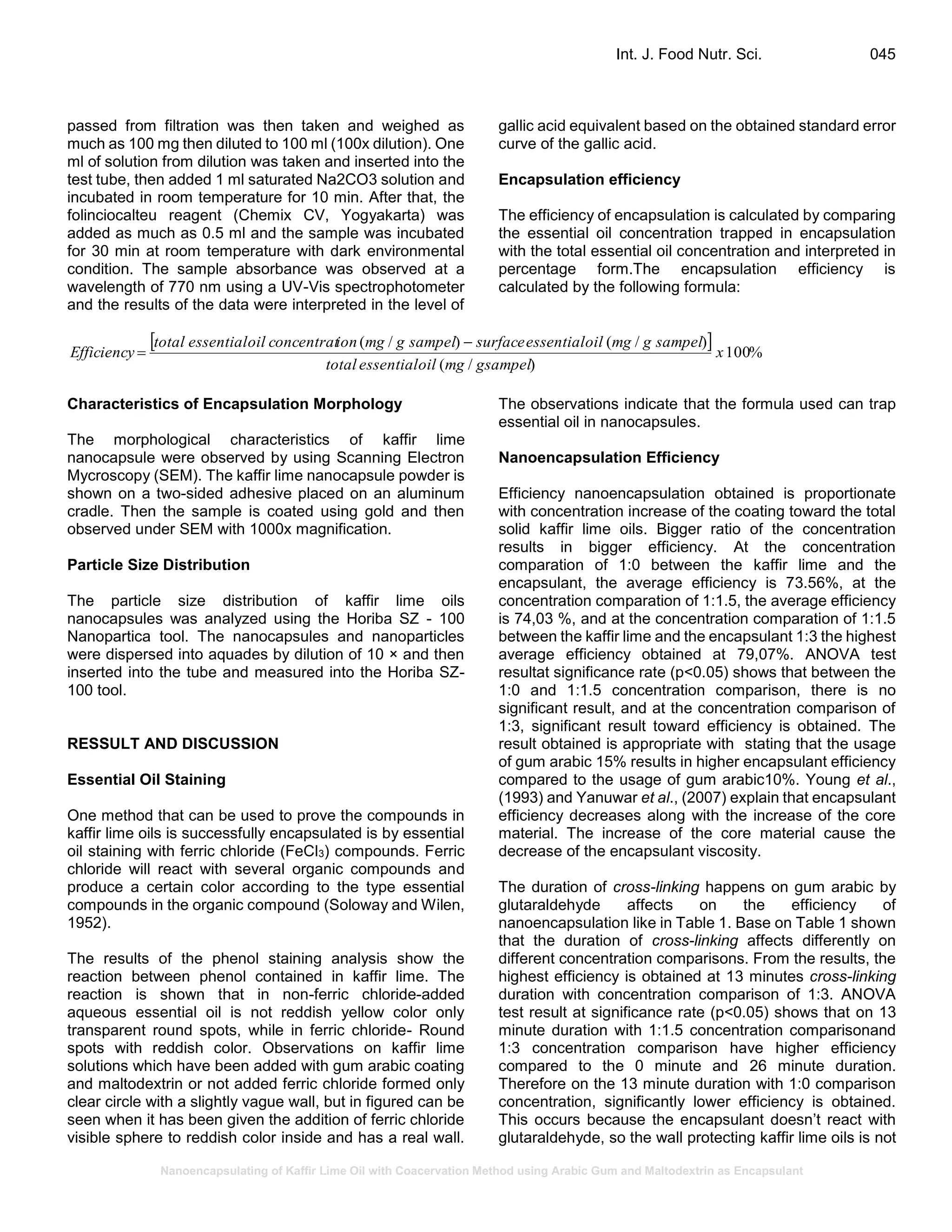
calculated by the following formula:
  %100
)/(
)/()/(
x
gsampelmgoilessentialtotal
sampelgmgoilessentialsurfacesampelgmgionconcentratoilessentialtotal
Efficiency


Characteristics of Encapsulation Morphology
The morphological characteristics of kaffir lime
nanocapsule were observed by using Scanning Electron
Mycroscopy (SEM). The kaffir lime nanocapsule powder is
shown on a two-sided adhesive placed on an aluminum
cradle. Then the sample is coated using gold and then
observed under SEM with 1000x magnification.
Particle Size Distribution
The particle size distribution of kaffir lime oils
nanocapsules was analyzed using the Horiba SZ - 100
Nanopartica tool. The nanocapsules and nanoparticles
were dispersed into aquades by dilution of 10 × and then
inserted into the tube and measured into the Horiba SZ-
100 tool.
RESSULT AND DISCUSSION
Essential Oil Staining
One method that can be used to prove the compounds in
kaffir lime oils is successfully encapsulated is by essential
oil staining with ferric chloride (FeCl3) compounds. Ferric
chloride will react with several organic compounds and
produce a certain color according to the type essential
compounds in the organic compound (Soloway and Wilen,
1952).
The results of the phenol staining analysis show the
reaction between phenol contained in kaffir lime. The
reaction is shown that in non-ferric chloride-added
aqueous essential oil is not reddish yellow color only
transparent round spots, while in ferric chloride- Round
spots with reddish color. Observations on kaffir lime
solutions which have been added with gum arabic coating
and maltodextrin or not added ferric chloride formed only
clear circle with a slightly vague wall, but in figured can be
seen when it has been given the addition of ferric chloride
visible sphere to reddish color inside and has a real wall.
The observations indicate that the formula used can trap
essential oil in nanocapsules.
Nanoencapsulation Efficiency
Efficiency nanoencapsulation obtained is proportionate
with concentration increase of the coating toward the total
solid kaffir lime oils. Bigger ratio of the concentration
results in bigger efficiency. At the concentration
comparation of 1:0 between the kaffir lime and the
encapsulant, the average efficiency is 73.56%, at the
concentration comparation of 1:1.5, the average efficiency
is 74,03 %, and at the concentration comparation of 1:1.5
between the kaffir lime and the encapsulant 1:3 the highest
average efficiency obtained at 79,07%. ANOVA test
resultat significance rate (p<0.05) shows that between the
1:0 and 1:1.5 concentration comparison, there is no
significant result, and at the concentration comparison of
1:3, significant result toward efficiency is obtained. The
result obtained is appropriate with stating that the usage
of gum arabic 15% results in higher encapsulant efficiency
compared to the usage of gum arabic10%. Young et al.,
(1993) and Yanuwar et al., (2007) explain that encapsulant
efficiency decreases along with the increase of the core
material. The increase of the core material cause the
decrease of the encapsulant viscosity.
The duration of cross-linking happens on gum arabic by
glutaraldehyde affects on the efficiency of
nanoencapsulation like in Table 1. Base on Table 1 shown
that the duration of cross-linking affects differently on
different concentration comparisons. From the results, the
highest efficiency is obtained at 13 minutes cross-linking
duration with concentration comparison of 1:3. ANOVA
test result at significance rate (p<0.05) shows that on 13
minute duration with 1:1.5 concentration comparisonand
1:3 concentration comparison have higher efficiency
compared to the 0 minute and 26 minute duration.
Therefore on the 13 minute duration with 1:0 comparison
concentration, significantly lower efficiency is obtained.
This occurs because the encapsulant doesn’t react with
glutaraldehyde, so the wall protecting kaffir lime oils is not
Nanoencapsulating of Kaffir Lime Oil with Coacervation Method using Arabic Gum and Maltodextrin as Encapsulant
Triyono et al. 046
formed. While, on 13 minute duration with 1:1.5
concentration comparison and 1:3 concentration
comparison, the highest efficiency is obtained because the
cross-linking process on the proper condition to produce
the desired level of hardness in which during the
homogenitation process.
The longer the cross-linking duration between gum arabic
and glutaraldehyde, the harder the encapsulant wall would
be, this would result in longer core material release
duration Chang et al., (2006) and (Pandya and Patel,
2013). Furthermore, on 0 minute cross-linking duration, it
can be concluded the thecross-linking process doesn’t
happen which makes small efficiency because of high
amount of uncapsulated essential oils. Besides, on 26
minute cross-linking duration, the process has been going
for too long which also makes small efficiency because the
encapsulant wall will be too hard to be broken down. When
the polymer cannot be broken down during the
homogenitation process, it would result in bigger size and
the core release duration would be longer. It will also make
the maltodekstrine, as the second wall, unable to react with
the gum arabic. Smaller efficiency is also caused by
improper coating. At 1:1.5 and 1:3 concentration
comparison, efficiency obtained is bigger compared with
1:3 concentration comparison in 0 and 26 minute
durations. Hence, in this study, the amount of cross-linking
agent is not varied. Still, the amount of gum arabic being
cross-linked is varied, this indirectly result in varying
amount of cross-linking agent reacting with gum arabic.
Alvim and Grosso (2009) explained, with higher amount of
cross-linking agent, the harder the cross-linking would be
made.
Table 1: The effect of time on efficiency at various
concentrations
efficiency (%) Kaffir lime concentration: gum arabic (b/v)
1 : 0 1: 1.5 1 : 3
Time
(minute)
0 71,21ab 70,71a 78,41d
13 73,69b 79,94d 80,75e
26 75,79c 71,65ab 78,05d
a-e values with different superscript within a coloum are
significantly different (P<0.05)
Particle Distribution
The size of overall nanoencapsulated before spray drying
has a size of 457.87 nm. The results of the particle
distribution measurements prove that the
nanoencapsulation formula using coacervation of gum
arabic coated with maltodextrin succeeds in producing
nanometer-sized particles. This study looks at the
comparison of particle size distribution after and before
spray drying.
The particle distribution graph of the kaffir lime
nanoencapsulation formula after spray drying.
Nanoparticles as a whole has a size of 318.45 nm. The
size of the nanoparticles smaller than that of nanocapsule
is due to the fact that at the time of the manufacture of kaffir
lime nanoparticles, homogenization is done so that the
resulting average particle size is smaller. After spray
drying the nanocapsule has an average larger size spread
due to the formation of aggregation between the powders.
Agglomeration occurs due to maltodextrin. Used of
maltodextrin as an ingredient will result in poor wall
structures, since maltodextrins can form agglomeration
and caking on flour products.
Nanocapsule Morphology
The nanocapsule morphology affects the properties of the
nanocapsules formed, One example of an affected trait is
the rate at which the active compound is released. The
observation of nanocapsule morphology was done using
Scanning Electron Microscopy (SEM) to find out the form
of nanocapsule. This morphological analysis was
performed only on samples with the highest efficiency in
the ratio of kaffir lime oils and gum arabic concentration in
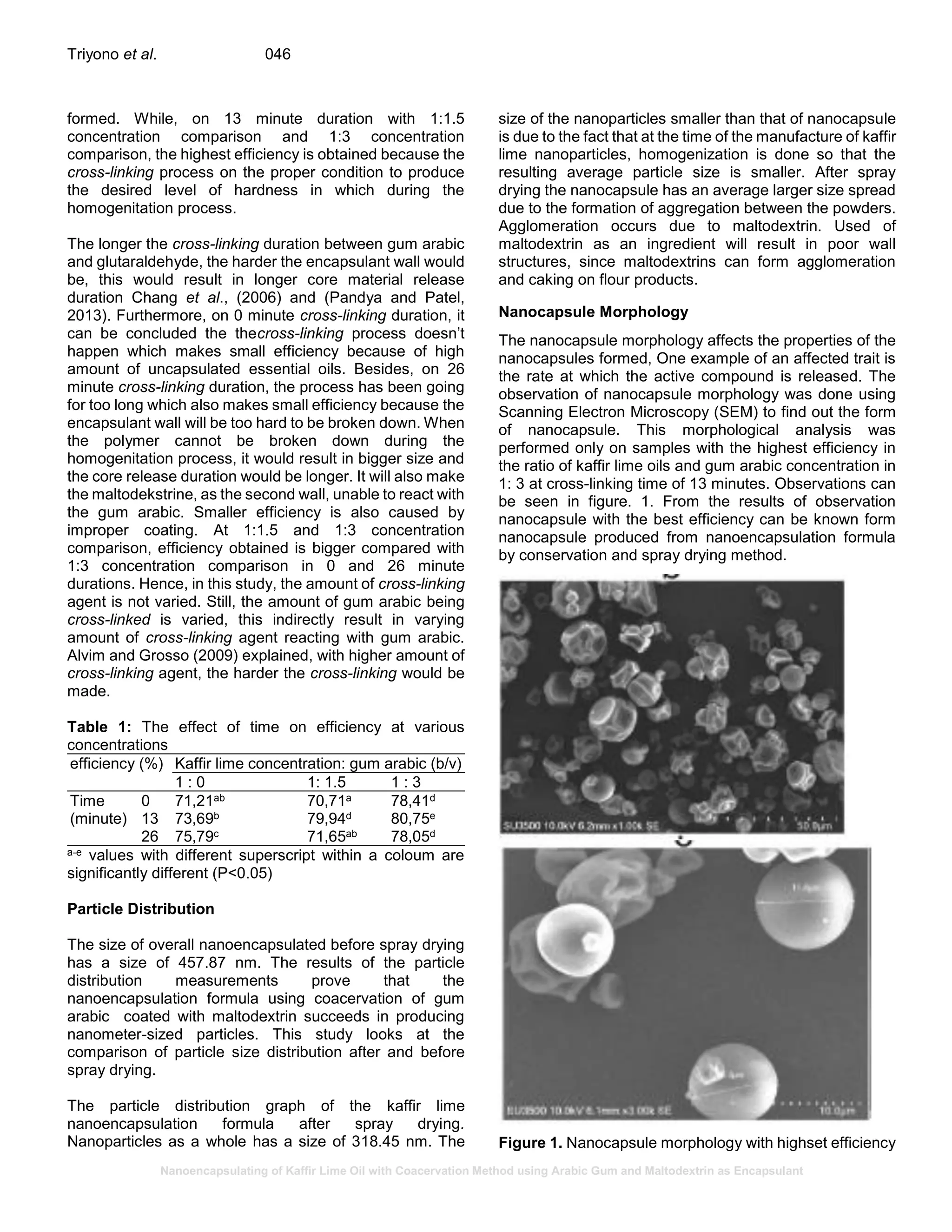
1: 3 at cross-linking time of 13 minutes. Observations can
be seen in figure. 1. From the results of observation
nanocapsule with the best efficiency can be known form
nanocapsule produced from nanoencapsulation formula
by conservation and spray drying method.
Figure 1. Nanocapsule morphology with highset efficiency
Nanoencapsulating of Kaffir Lime Oil with Coacervation Method using Arabic Gum and Maltodextrin as Encapsulant
Int. J. Food Nutr. Sci. 047
From figure. 1 shown that the nanocapsule of the optimum
treatment has a round or shrink shape. The shrinking form
can occur because the encapsulation can’t sustain the
form when there is rapid evaporation during the spray
drying process. In chamber spray drying the air
temperature used reaches 140oC and the evaporation of
water is very fast. Similar results can be found in the
research of (Ali et al., 2013) where the capsule formed is
also round and waved due to very rapid solvent
evaporation. In nanocapsule morphological observations,
a broken capsule is not found, this proves by preceding the
process of encapsulation with coacervation make the
capsule wall becomes strong.
An uneven form of the surface of the nanocapsule
indicates that the second coating or maltodextrin does not
react well with gum arabic as the main coating. Not
reacting maltodextrin with gum arabic makes maltodextrin
stand alone to maintain evaporation of water when drying
with spray drying. No reaction between maltodextrin and
gum arabic could well be caused by long cross-linking, so
that within 13 minutes of cross-linking resulting in the
highest efficiency, excessive cross-linking is still occurring.
CONCLUSION
Nanocapsule with uneven surface morphology, a mean
size of 457.87 nm with an efficiency of 79,07%. was
obtained through the incorporation of coacervation and
spray drying methods, by comparison of concentration and
cross-linking time between gum arabic and glutaraldehyde
for 13 minutes and the ratio of kaffir lime and gum arabic
1: 3.
ACKNOWLEDGEMENTS
This research was supported by Terapan Reseach
research grant funded by Ministry of Research,
Technology, and Higher Education of Indonesia (No.
218/S9/AK/2017).
REFERENCE
Ahmed m, Aktea MS, Chin KB, Eun JB. (2009). Effect of
maltodextrin concentration and drying temperature on
quality properties of purple sweet potato flour. Food
SciBiotechnol 18: 1487-1494.
Ali Degoyusa, DarmadjiPurnama, Pranoto Yudi. (2013).
Optimasi Nanoenkapsulasi Asap Cair Tempurung
Kelapa Dengan Response Surface Methodology Dan
Karakterisasi nanocapsule. Jurnal Teknologi dan
Industri Pangan. Vol. 25 No 1 Th 2014.
Alvim Izbela Dutra and Grosso Carlos Raimundo Ferreira.
(2009). Microparticles obtained by complex
coacervation: influence of the type of reticulation and
the drying process on the release of the core material.
Ciência e Tecnologia de Alimentos journal. Vol 30 (4) :
1069 – 1076.
Bertolini A.C., A.C. Sianidan C.R.F. Grosso (2001).
Stability of Monoterpenes Encapsulated in Gum Arabic
by Spray Drying. J.Agr.Food.Chem, 49: 780-785.
Carvajal, M.X.Q., B.H.C. Diaz, L.S.M. Torres, J.J.C. Perez,
L.A. Beltran, A.J. Aparicio, dan G.F.G. Lopez. 2010.
Nanoencapsulation: A New Trend in Food Engineering
Processing. Food Engineering Review, 2: 39-50.
Chang, C. P. et al.,Release properties on gelatin-gum
arabicic microcapsules containing camphor oil with
added polystyrene. Colloid and Surface B:
Biointerfaces, v. 50, p. 136-140, 2006.
Ching L.S, Mohamed S. (2001). Alpha-tocopherol content
in 62 edible tropical plants. J Agric food Chem 49(6):
3101-3105.
Fajriani Nur S. (2015). Nanoenkapsulasi Asap Cair
Tempurung Kelapa Dengan Metode coacervation
Kompleks. Thesis Universitas Gadjah Mada. (not
published).
Loh F.S., Awang R.M., Omar D, and rahmani M.,
Insecticidal properties of Citrus hystrix DC leaves
essential oil againts Spodoptera litura fabricius, J. Med.
Plant. Res., 2011. 5:3739-3744.
Pandya SS, Patel Parul K. (2013). Preparation and
Characterization of Crosslinked Gum Acacia
Microspheres by Single Step Emulsion In-Situ Polymer
Crosslinking Method: A Potential Vehicle for Controlled
Drug Delivery. Journal of Pharmacy and
Pharmaceutical Sciences. Volume 1.
Soloway S, Wilen SH. (1952). Improved Ferric Cloride
Test For Phenols. Anal Chem 24: 979-983. DOI:
10.1021/ac60066a017.
Tono RV, Brabet C, Hubinger MD. (2010). Anthocyanin
stabiolity and antioxidant activity of spray dried acai
(euterpeoleraceaMart.) Juice produced with different
carrier agents. Food Res Int 43: 907-914. DOI:
10.1016/j.Foodres.2009.12.013.
Waikedre J, Dugay A, Barrachina I, Herrenknecht C,
Cabalion P, Fournet A. (2010). Chemical composition
and antimicrobial activity of the essential oils from New
caledonian Citrus macroptera and Citrus hystric. Chem
Biodivers 7(4): 871-877.
Yanuar W, Widjanarko S.B., Wahono T. (2007).
Karakteristik dan stabilitas antioksidan mikrokapsul
minyak buah merah (Pandanus conoideus Lam)
dengan bahan penyalut berbasis protein. J. Teknologi
Pertanian 8(2): 127-135.
Young, S.L., Sarda. X., Rosenberg. M. (1993).
Microencapsulating properties of whey protein with
carbohidrat. J. Dairy Sci. 76: 2678-2885
Zuidam, N.J and V.A. Nedovic. (2010). Encapsulation
technologies for active ingredients and food
processing. Springer. New York. USA.
Nanoencapsulating of Kaffir Lime Oil with Coacervation Method using Arabic Gum and Maltodextrin as Encapsulant
Triyono et al. 048
Accepted 19 March, 2018
Citation: Triyono K, Suhartatik N, Wulandari YW (2018).
Nanoencapsulating of Kaffir Lime Oil with coacervation
method using arabic gum and maltodextrin as
encapsulant. International Journal of Food and Nutrition
Sciences, 3(1): 043-048.
Copyright: © 2018 Triyono et al. This is an open-access
article distributed under the terms of the Creative
Commons Attribution License, which permits unrestricted
use, distribution, and reproduction in any medium,
provided the original author and source are cited.

Nanoencapsulating of Kaffir Lime Oil with Coacervation Method using Arabic Gum and Maltodextrin as Encapsulant

  • 1.
    Nanoencapsulating of KaffirLime Oil with Coacervation Method using Arabic Gum and Maltodextrin as Encapsulant IJFNS Nanoencapsulating of Kaffir Lime Oil with Coacervation Method using Arabic Gum and Maltodextrin as Encapsulant *K. Triyono1, N. Suhartatik2, Y.W. Wulandari3 1 Departement of Agrotechnology, Faculty of Agricultural, University of Slamet Riyadi, Jl. Sumpah Pemuda no.18, Surakarta, Central Java 57136, Indonesia 2,3 Agriculture Product Technology, Faculty of Industrial and Food Technology, University of Slamet Riyadi, Jl. Sumpah Pemuda no.18, Surakarta, Central Java 57136, Indonesia Kaffir lime oil is an essensial oil from cirtus hystrix leaves. that product is generally volatile when exposed by air, kaffir lime oil covering is used, made with the nanocapsule. The technique used is coacervation method. This experiment aims to identity the ratio of arabic gum and kaffir lime oil, and also by maintaining the optimal crosslinking time. Nanoencapsule making process starts with mixing arabic gum into the kaffir lime oil on various mixing ratio. The coacervation process is done by dropping encapsulant mix and kaffir lime oil with various concentration into glutaraldehyde. After the coacervation, next is the process of adding maltodextrin into the mix with homogenization process and latsly is spray drying emulsion. Analysis is done by observing the result of encapsulation efficiency, particle distribution, and morphology profil using Scanning Electron Microscope. The result shows that the best nanoencapsulation efficiency is between 70.71% - 80.75%. The optimum condition for the highest value of total essential oils content in on 1:3 ratio (b/v) and the optimal time of crosslinking is 13 minutes. The nanocapsulees had sperichal shape with dips in the surface with average size of nanopsulees of 457.87 nm. Keywords: kaffir lime oil, coacervation, arabic gum, maltodedextrin, nanoencapsulation INTRODUCTION Kaffir lime oil is essential oil from kaffir lime leaves (Citrus hystrix. DC). That essential oil possesses some important bioactivities such as antioxidant, antileukemic, antitussive, antihemorrhage, antioxidative stress properties, and antibacterial properties. Nowadays, essential oil of kaffir lime is in demand as a fragrance in the food, perfumery and cosmetic industries. Citrus hystric leaf is rich in vitamin E. Among 62 edible tropical plants analysed for α- tocopherol content citrus hystrix leaves (398.3 mg/kg edible portion) ranked second behind sauropus androgynus (426.8 mg/kg edible portion) (Ching and Mohamed, 2001). Thirty-eight constituents were identified in the leaf essential oil of kaffir lime representing 89% of the total oil (Waikedre et al., 2010). The oil was rich in monoterpenes (87%) with ß-pinene as major component (10%) and low limonene (4.7%). The essential oil of citrus hystric was characterized by high content of terpinen-4-ol (13.0%), α-terpineol (7.6%), 1,8- cineole (6.4%), and citronellol (6.0%). Twenty nine compounds were found in the essential oil of kaffir lime leaves (Loh et al., 2011) ß-citronellal was the major compound amounting to 66.85% of total oil. Kaffir lime is identified as volatile compound and that product is generally volatile when exposed by air. therefore, protection in the way of encapsulation is needed. *Corresponding author: Kharis Triyono, Departement of Agrotechnology, Faculty of Agricultural, University of Slamet Riyadi, Jl. Sumpah Pemuda no.18, Surakarta, Central Java 57136, Indonesia. E-mail: kharistriyono464@gmail.com Tel: +62271853839 International Journal of Food and Nutrition Sciences Vol. 3(1), pp. 043-048, March, 2018. © www.premierpublishers.org. ISSN: XXXX-XXXX Research Article
  • 2.
    Nanoencapsulating of KaffirLime Oil with Coacervation Method using Arabic Gum and Maltodextrin as Encapsulant Triyono et al. 044 Encapsulation is the process of coating liquid core material using certain encapsulant which makes the core particles have desired fisikokimia characteristic (Zuidam and Nedovic, 2010). Encapsulation can produce particle with micrometer down to nanometer diameter (Carvajal et al., 2010). And nowadays, encapsulation is done in nanometer size to make better carrying system (Ali et al., 2013). Low efficiency in encapsulation has become one main problem in the encapsulation process. The efficiency of the encapsulation is determined by the method and the materials used during the encapsulation process. Various kinds of natural polymer has been known for their ability to be used in producing nanoparticle (Bertolini et al., 2001) In this study, gum arabic and maltodextrine are used as the encapsulant of the combination coacervation and spray drying in the encapsulation process. Gum Arabic is chosen because of its ability to form protecting coat with the coacervation method because of its good emulating ability. Besides, during the process of spray drying, gum arabic can form a coat protecting the core material from oxidation, absorption, and evaporation (Pandya and Patel, 2013). Fajriani (2015) was able to make nanocapsule using gum arabic and gelatin with coacervationand freeze drying method resulting 64,81% efficiency. Maltodextrin was chosen for its ability to protect the core material from oxidation and its low viscosity on high solid concentration. Therefore, it is good to be used as the encapsulant material using spray drying method. Coacervation is done because of its simplicity. Moreover, it doesn’t need heat treatment, so it will prevent damage to the core material. Coacervation makes use of the macromolecule characteristic, containing kation and anion substances, to react electrostatically, forming the capsule (Tono et al., 2010). The use of hydrophilic materials in the encapsulation process has been known for producing the material will be separated easily from the coating material because of the same hydrophilic characteristic (Ahmed et al., 2009). The coating process in this study using gum arabic as the first coating and crosslinked with glutaraldehyde, maltodextrine as the coating will be used so that it will protect the surface essential oil. That is expected that encapsulation with high efficiency will be obtained. Furtheremore the aim of this study is to identify the best ratio between essential oil and encapsulant, and the best cross linking time to produce the high efficiency of nanoparticles. MATERIALS AND METHODS Sample kaffir lime (Citrus hystrix DC) leaves were colected from local orchid in Klaten, Central Java. Upon arrival at the laboratory, mature leaves were sorted out manually based on the size and color, dark green color with a glossy sheen and bright green. The leaves were washed under running tap water and used as experiments without crushing. The species was colected during March-April 2017. The materials used in this research are kaffir lime oil, obtained from extraction in laboratory from this research. Maltodextrine (MD), and gum Arabic (GA). The chemicals used are glutaraldehyde 25% (Merck, Germany) as the cross linking agent. And the chemicals used to analyze are alcohol, ethanol, Galatic Acid (Merck, Germany), FeCl3 (J.T Baker, USA), and Folinciocalteau (Merck, Germany). Kaffir lime oils staining is observed using microscope (olympus CX21LED biological microscope) and obtilab application (Advance, Indonesia), Spectrophotometer UV- Vis (Spectronic 200, Thermo Scientific) is used to test the total essential oil and the surface essential oil to calculate the encapsulation efficiency. Particle size is analyzed using Distribution Size Particle (Horiba SZ-100), and the nanocapsule morphology is observed using SEM (Scanning Electron Microscope JEOL JSM-5310 LV, Japan). Procedure Kaffir lime oils staining Kaffir lime oil staining is conducted based on Ali (Bertolini et al., 2001) with modification. Yellow FeCl3 5% solution is added to the nanoparticle solution with 5% ratio of FeCl3 solution: nanoparticle solution (3 drops: 1 ml). The mixture is then stirred slowly for 30 minutes. The colored nanoparticles solution is then observed with the light microscope (Advanced, Indonesia) using OPTILAB application. Total essential oil Total essential oils analysis method is conducted based on Ali (Bertolini et al., 2001) with modification. 0,1 gr of kaffir lime oil nanocapsule is weighed and diluted to 100 ml using aquadest, taken as much as 1 ml (100x dilution) to put in the reaction tube then 1ml of saturated NaCO3 solution is added to the test tube and incubated for 10 min at room temperature. Then 0.5 ml of the folinciocalteu (Chemix CV, Yogyakarta) reagent and 7.5 ml aquadest were added, the mixture homogenized using vortex and then incubated for 30 min at room temperature under dark environmental conditions. Absorbance of the sample was then measured using a UV-vis spectrophotometer at a wavelength of 770 nm. The total phenol content of the sample was interpreted to be equivalent to gallic acid based on the standard curve of obtained gallic acid. Surface kaffir lime oils Surface essensial oil content analysis is based on the study of Cilek (Young et al., 1993) with modification. A total of 100 mg of nanocapsule kaffir lime powder sample is weighed and dissolved into 1 ml of ethanol solution: methanol (50:50), then the mixture was homogenized using vortex (Maxi Mix II) for 1 minute. After that, the mixed solution is filtered using filter paper. The solution that
  • 3.
    Nanoencapsulating of KaffirLime Oil with Coacervation Method using Arabic Gum and Maltodextrin as Encapsulant Int. J. Food Nutr. Sci. 045 passed from filtration was then taken and weighed as much as 100 mg then diluted to 100 ml (100x dilution). One ml of solution from dilution was taken and inserted into the test tube, then added 1 ml saturated Na2CO3 solution and incubated in room temperature for 10 min. After that, the folinciocalteu reagent (Chemix CV, Yogyakarta) was added as much as 0.5 ml and the sample was incubated for 30 min at room temperature with dark environmental condition. The sample absorbance was observed at a wavelength of 770 nm using a UV-Vis spectrophotometer and the results of the data were interpreted in the level of gallic acid equivalent based on the obtained standard error curve of the gallic acid. Encapsulation efficiency The efficiency of encapsulation is calculated by comparing the essential oil concentration trapped in encapsulation with the total essential oil concentration and interpreted in percentage form.The encapsulation efficiency is calculated by the following formula:   %100 )/( )/()/( x gsampelmgoilessentialtotal sampelgmgoilessentialsurfacesampelgmgionconcentratoilessentialtotal Efficiency   Characteristics of Encapsulation Morphology The morphological characteristics of kaffir lime nanocapsule were observed by using Scanning Electron Mycroscopy (SEM). The kaffir lime nanocapsule powder is shown on a two-sided adhesive placed on an aluminum cradle. Then the sample is coated using gold and then observed under SEM with 1000x magnification. Particle Size Distribution The particle size distribution of kaffir lime oils nanocapsules was analyzed using the Horiba SZ - 100 Nanopartica tool. The nanocapsules and nanoparticles were dispersed into aquades by dilution of 10 × and then inserted into the tube and measured into the Horiba SZ- 100 tool. RESSULT AND DISCUSSION Essential Oil Staining One method that can be used to prove the compounds in kaffir lime oils is successfully encapsulated is by essential oil staining with ferric chloride (FeCl3) compounds. Ferric chloride will react with several organic compounds and produce a certain color according to the type essential compounds in the organic compound (Soloway and Wilen, 1952). The results of the phenol staining analysis show the reaction between phenol contained in kaffir lime. The reaction is shown that in non-ferric chloride-added aqueous essential oil is not reddish yellow color only transparent round spots, while in ferric chloride- Round spots with reddish color. Observations on kaffir lime solutions which have been added with gum arabic coating and maltodextrin or not added ferric chloride formed only clear circle with a slightly vague wall, but in figured can be seen when it has been given the addition of ferric chloride visible sphere to reddish color inside and has a real wall. The observations indicate that the formula used can trap essential oil in nanocapsules. Nanoencapsulation Efficiency Efficiency nanoencapsulation obtained is proportionate with concentration increase of the coating toward the total solid kaffir lime oils. Bigger ratio of the concentration results in bigger efficiency. At the concentration comparation of 1:0 between the kaffir lime and the encapsulant, the average efficiency is 73.56%, at the concentration comparation of 1:1.5, the average efficiency is 74,03 %, and at the concentration comparation of 1:1.5 between the kaffir lime and the encapsulant 1:3 the highest average efficiency obtained at 79,07%. ANOVA test resultat significance rate (p<0.05) shows that between the 1:0 and 1:1.5 concentration comparison, there is no significant result, and at the concentration comparison of 1:3, significant result toward efficiency is obtained. The result obtained is appropriate with stating that the usage of gum arabic 15% results in higher encapsulant efficiency compared to the usage of gum arabic10%. Young et al., (1993) and Yanuwar et al., (2007) explain that encapsulant efficiency decreases along with the increase of the core material. The increase of the core material cause the decrease of the encapsulant viscosity. The duration of cross-linking happens on gum arabic by glutaraldehyde affects on the efficiency of nanoencapsulation like in Table 1. Base on Table 1 shown that the duration of cross-linking affects differently on different concentration comparisons. From the results, the highest efficiency is obtained at 13 minutes cross-linking duration with concentration comparison of 1:3. ANOVA test result at significance rate (p<0.05) shows that on 13 minute duration with 1:1.5 concentration comparisonand 1:3 concentration comparison have higher efficiency compared to the 0 minute and 26 minute duration. Therefore on the 13 minute duration with 1:0 comparison concentration, significantly lower efficiency is obtained. This occurs because the encapsulant doesn’t react with glutaraldehyde, so the wall protecting kaffir lime oils is not
  • 4.
    Nanoencapsulating of KaffirLime Oil with Coacervation Method using Arabic Gum and Maltodextrin as Encapsulant Triyono et al. 046 formed. While, on 13 minute duration with 1:1.5 concentration comparison and 1:3 concentration comparison, the highest efficiency is obtained because the cross-linking process on the proper condition to produce the desired level of hardness in which during the homogenitation process. The longer the cross-linking duration between gum arabic and glutaraldehyde, the harder the encapsulant wall would be, this would result in longer core material release duration Chang et al., (2006) and (Pandya and Patel, 2013). Furthermore, on 0 minute cross-linking duration, it can be concluded the thecross-linking process doesn’t happen which makes small efficiency because of high amount of uncapsulated essential oils. Besides, on 26 minute cross-linking duration, the process has been going for too long which also makes small efficiency because the encapsulant wall will be too hard to be broken down. When the polymer cannot be broken down during the homogenitation process, it would result in bigger size and the core release duration would be longer. It will also make the maltodekstrine, as the second wall, unable to react with the gum arabic. Smaller efficiency is also caused by improper coating. At 1:1.5 and 1:3 concentration comparison, efficiency obtained is bigger compared with 1:3 concentration comparison in 0 and 26 minute durations. Hence, in this study, the amount of cross-linking agent is not varied. Still, the amount of gum arabic being cross-linked is varied, this indirectly result in varying amount of cross-linking agent reacting with gum arabic. Alvim and Grosso (2009) explained, with higher amount of cross-linking agent, the harder the cross-linking would be made. Table 1: The effect of time on efficiency at various concentrations efficiency (%) Kaffir lime concentration: gum arabic (b/v) 1 : 0 1: 1.5 1 : 3 Time (minute) 0 71,21ab 70,71a 78,41d 13 73,69b 79,94d 80,75e 26 75,79c 71,65ab 78,05d a-e values with different superscript within a coloum are significantly different (P<0.05) Particle Distribution The size of overall nanoencapsulated before spray drying has a size of 457.87 nm. The results of the particle distribution measurements prove that the nanoencapsulation formula using coacervation of gum arabic coated with maltodextrin succeeds in producing nanometer-sized particles. This study looks at the comparison of particle size distribution after and before spray drying. The particle distribution graph of the kaffir lime nanoencapsulation formula after spray drying. Nanoparticles as a whole has a size of 318.45 nm. The size of the nanoparticles smaller than that of nanocapsule is due to the fact that at the time of the manufacture of kaffir lime nanoparticles, homogenization is done so that the resulting average particle size is smaller. After spray drying the nanocapsule has an average larger size spread due to the formation of aggregation between the powders. Agglomeration occurs due to maltodextrin. Used of maltodextrin as an ingredient will result in poor wall structures, since maltodextrins can form agglomeration and caking on flour products. Nanocapsule Morphology The nanocapsule morphology affects the properties of the nanocapsules formed, One example of an affected trait is the rate at which the active compound is released. The observation of nanocapsule morphology was done using Scanning Electron Microscopy (SEM) to find out the form of nanocapsule. This morphological analysis was performed only on samples with the highest efficiency in the ratio of kaffir lime oils and gum arabic concentration in 1: 3 at cross-linking time of 13 minutes. Observations can be seen in figure. 1. From the results of observation nanocapsule with the best efficiency can be known form nanocapsule produced from nanoencapsulation formula by conservation and spray drying method. Figure 1. Nanocapsule morphology with highset efficiency
  • 5.
    Nanoencapsulating of KaffirLime Oil with Coacervation Method using Arabic Gum and Maltodextrin as Encapsulant Int. J. Food Nutr. Sci. 047 From figure. 1 shown that the nanocapsule of the optimum treatment has a round or shrink shape. The shrinking form can occur because the encapsulation can’t sustain the form when there is rapid evaporation during the spray drying process. In chamber spray drying the air temperature used reaches 140oC and the evaporation of water is very fast. Similar results can be found in the research of (Ali et al., 2013) where the capsule formed is also round and waved due to very rapid solvent evaporation. In nanocapsule morphological observations, a broken capsule is not found, this proves by preceding the process of encapsulation with coacervation make the capsule wall becomes strong. An uneven form of the surface of the nanocapsule indicates that the second coating or maltodextrin does not react well with gum arabic as the main coating. Not reacting maltodextrin with gum arabic makes maltodextrin stand alone to maintain evaporation of water when drying with spray drying. No reaction between maltodextrin and gum arabic could well be caused by long cross-linking, so that within 13 minutes of cross-linking resulting in the highest efficiency, excessive cross-linking is still occurring. CONCLUSION Nanocapsule with uneven surface morphology, a mean size of 457.87 nm with an efficiency of 79,07%. was obtained through the incorporation of coacervation and spray drying methods, by comparison of concentration and cross-linking time between gum arabic and glutaraldehyde for 13 minutes and the ratio of kaffir lime and gum arabic 1: 3. ACKNOWLEDGEMENTS This research was supported by Terapan Reseach research grant funded by Ministry of Research, Technology, and Higher Education of Indonesia (No. 218/S9/AK/2017). REFERENCE Ahmed m, Aktea MS, Chin KB, Eun JB. (2009). Effect of maltodextrin concentration and drying temperature on quality properties of purple sweet potato flour. Food SciBiotechnol 18: 1487-1494. Ali Degoyusa, DarmadjiPurnama, Pranoto Yudi. (2013). Optimasi Nanoenkapsulasi Asap Cair Tempurung Kelapa Dengan Response Surface Methodology Dan Karakterisasi nanocapsule. Jurnal Teknologi dan Industri Pangan. Vol. 25 No 1 Th 2014. Alvim Izbela Dutra and Grosso Carlos Raimundo Ferreira. (2009). Microparticles obtained by complex coacervation: influence of the type of reticulation and the drying process on the release of the core material. Ciência e Tecnologia de Alimentos journal. Vol 30 (4) : 1069 – 1076. Bertolini A.C., A.C. Sianidan C.R.F. Grosso (2001). Stability of Monoterpenes Encapsulated in Gum Arabic by Spray Drying. J.Agr.Food.Chem, 49: 780-785. Carvajal, M.X.Q., B.H.C. Diaz, L.S.M. Torres, J.J.C. Perez, L.A. Beltran, A.J. Aparicio, dan G.F.G. Lopez. 2010. Nanoencapsulation: A New Trend in Food Engineering Processing. Food Engineering Review, 2: 39-50. Chang, C. P. et al.,Release properties on gelatin-gum arabicic microcapsules containing camphor oil with added polystyrene. Colloid and Surface B: Biointerfaces, v. 50, p. 136-140, 2006. Ching L.S, Mohamed S. (2001). Alpha-tocopherol content in 62 edible tropical plants. J Agric food Chem 49(6): 3101-3105. Fajriani Nur S. (2015). Nanoenkapsulasi Asap Cair Tempurung Kelapa Dengan Metode coacervation Kompleks. Thesis Universitas Gadjah Mada. (not published). Loh F.S., Awang R.M., Omar D, and rahmani M., Insecticidal properties of Citrus hystrix DC leaves essential oil againts Spodoptera litura fabricius, J. Med. Plant. Res., 2011. 5:3739-3744. Pandya SS, Patel Parul K. (2013). Preparation and Characterization of Crosslinked Gum Acacia Microspheres by Single Step Emulsion In-Situ Polymer Crosslinking Method: A Potential Vehicle for Controlled Drug Delivery. Journal of Pharmacy and Pharmaceutical Sciences. Volume 1. Soloway S, Wilen SH. (1952). Improved Ferric Cloride Test For Phenols. Anal Chem 24: 979-983. DOI: 10.1021/ac60066a017. Tono RV, Brabet C, Hubinger MD. (2010). Anthocyanin stabiolity and antioxidant activity of spray dried acai (euterpeoleraceaMart.) Juice produced with different carrier agents. Food Res Int 43: 907-914. DOI: 10.1016/j.Foodres.2009.12.013. Waikedre J, Dugay A, Barrachina I, Herrenknecht C, Cabalion P, Fournet A. (2010). Chemical composition and antimicrobial activity of the essential oils from New caledonian Citrus macroptera and Citrus hystric. Chem Biodivers 7(4): 871-877. Yanuar W, Widjanarko S.B., Wahono T. (2007). Karakteristik dan stabilitas antioksidan mikrokapsul minyak buah merah (Pandanus conoideus Lam) dengan bahan penyalut berbasis protein. J. Teknologi Pertanian 8(2): 127-135. Young, S.L., Sarda. X., Rosenberg. M. (1993). Microencapsulating properties of whey protein with carbohidrat. J. Dairy Sci. 76: 2678-2885 Zuidam, N.J and V.A. Nedovic. (2010). Encapsulation technologies for active ingredients and food processing. Springer. New York. USA.
  • 6.
    Nanoencapsulating of KaffirLime Oil with Coacervation Method using Arabic Gum and Maltodextrin as Encapsulant Triyono et al. 048 Accepted 19 March, 2018 Citation: Triyono K, Suhartatik N, Wulandari YW (2018). Nanoencapsulating of Kaffir Lime Oil with coacervation method using arabic gum and maltodextrin as encapsulant. International Journal of Food and Nutrition Sciences, 3(1): 043-048. Copyright: © 2018 Triyono et al. This is an open-access article distributed under the terms of the Creative Commons Attribution License, which permits unrestricted use, distribution, and reproduction in any medium, provided the original author and source are cited.