Principles of
Acute Care
Dr. Mohammad Taqi Ehsani
PGY1 of Orthopedics, FMIC
Contents
• General Principles
• Tendon Injury
• Nerve Injury
• Skin Injury
• Bone Injury
• Vascular Injury
General Principles
• It has been said that the first surgeon who sees the injured hand most affects the
final result
• Accurate early diagnosis is more difficult in a child than in an adult because patient
cooperation may be minimal or absent
• It is perfectly acceptable and in fact often crucial to insist that a follow-up
examination be done a day or so later in the clinic or physician’s office, when less
blood, less hysteria, and less distraction make a more complete and reliable
examination possible
• A second examination is particularly useful in cases of possible nerve injury, for a
sensory examination can be done more reliably in the quiet of the physician’s office
than in a hectic emergency department
• Occasionally, even this is not sufficient, and when the surgeon cannot rule out a nerve
or tendon injury, the wound may need to be explored under general anesthesia
• It is important to realize that almost no hand injury is a life-threatening emergency
and that treatment should always be delayed until the anesthetic risk is minimized by
a period of fasting and until a well-rested operating team with appropriate light,
instruments, and training is available.
General Principles
• Simple closure of the skin with delay is the treatment of choice until all these
elements are in place
• As in other areas, the diagnosis is based on the history of the injury, observation,
findings on physical examination, and radiographs
• Careful and thoughtful observation of the injured hand by the surgeon is by far
the most important factor in evaluating an uncooperative child. This observation
must be made in the context of what has been called “topographic anticipation.”
• The surgeon’s knowledge of the topographic anatomy of the injured site is used to
anticipate the physical findings associated with probable injuries
• assessment is best done by critically observing the rest position and use of the
hand by the child
Tendon Injury
• Alteration of the hand’s resting position in a child with a tendon
laceration may be obvious or subtle
• when wound exploration reveals laceration of a tendon
sheath, it is very likely that the tendon itself has sustained
injury.
• During the first 5 to 7 days after injury, a partially injured
tendon is especially vulnerable to failure. If a partial injury is
suspected, the hand is splinted in a posture to protect the
tendon from rupture (Some hand surgeons prefer to explore)
• Surgical exploration and the technique of tendon repair in
children are identical to exploration and repair in adults, except
for the size of the structures involved
• extension lag and loss of flexion are common after extensor
tendon repair in this population
Tendon Injury
• The more critical challenges in children are immediate postoperative care to prevent
rupture and, later, rehabilitation to develop gliding of the repaired tendon.
• Postoperative immobilization should be complete and uninterrupted in a small child
• successful results have been reported with age-adapted early mobilization
• Excessive immobilization of more than 4 weeks for flexor tendons or 6 weeks for
extensor tendons is not warranted and in small children can lead to stiffness
• changing the casts early just to “have a look” may reward the surgeon with rupture
and should not be done unless infection or swelling leading to compromise is
strongly suspected.
• The type of rehabilitation possible in very young children is limited but becomes more
like that in adults as the child’s cooperation level improves with age.
• When a primary repair fails, we rarely repeat the attempt in a young,
uncooperative child.
• If tendon repair is unsuccessful in a preschool child, surgery should wait to be
repeated until the child’s hand is larger and the child is better able to understand and
cooperate with the treatment program
Nerve Injury
• The diagnosis of a nerve injury is usually subtle and depends heavily on topographic
anticipation.
• The surgeon is well served by expecting the worst instead of just hoping for the best
• being very superficial in the hand, wrist, and elbow, the peripheral nerves virtually
always run beside an artery. With a good history of arterial bleeding after a wound,
one should carefully examine the patient for a nerve injury.
• Children with suspected nerve injuries, more than almost any patient, deserve a
follow-up assessment in the relative quiet of the clinic or office setting because the
diagnosis is easily missed the day of injury
• Absence of a sweat pattern of the anesthetic finger is a useful finding, and
recognition of this finding is more often possible during a second examination, best
identified by the dry or slick quality of the affected finger when the surgeon gently
strokes the injured digit and uses a normal digit for comparison
• Finally, it is completely appropriate for a competent hand surgeon to explore the
wound under anesthesia when the diagnosis is sufficiently suspected.
Skin Injury
• Fingertip injuries in children are very common. As a general rule, the less done for
these injuries, the better. Even wounds with some exposed bone can heal with
dressing changes alone if no tendon has been exposed. More extensive wounds may
require full- or split-thickness grafts or local rotation flaps.
• Pedicle grafting in children is rarely indicated in the acute treatment of all but the
most catastrophic hand wounds
• Burns are treated as in adults, with the surgeon remembering that the initial
assessment frequently underestimates the severity of children’s burns
• Child abuse may be manifested as burns; especially suspect are cigarette burns and
bilateral hand and foot burns in a stocking-glove distribution
• Treadmill burn injuries usually occur on the palmar surface of a young child’s hand
and are treated by early Silvadene dressing changes, splinting, and antibiotics, with
later aggressive scar management and mobilization
• Characteristically, children tend to burn their hands more often on the palms because
they lack understanding of what is too hot to hold
• Severe flexion contractures are frequent after these injuries. Fortunately, the palmar skin is
thicker, and the deeper and important structures such as the nerves, tendons, and tendon
sheath are usually unharmed
Bone Injury
• The great advantage of radiographs in
diagnosing adult fractures is limited in
children by the cartilaginous nature of
much of a young child’s bone
• The value of simultaneous comparison
views of the injured side and the normal
side cannot be overestimated
• A true lateral radiograph of the injured
digit is important and may reveal a subtle
but often significant injury. The technician
should use the fingernail as a topographic
landmark to obtain a true lateral view
Bone Injury
• In general, most fractures in a child’s hand are treated nonoperatively
because children’s hands have a remarkable ability to recover useful
movement by remodeling fractures that would clearly need open reduction in
an adult.
• Minimal displacements and malalignments heal better with closed treatment.
• Simply protecting the hand from use for 3 or 4 weeks is usually adequate.
However, reduction of rotational malalignment is critical before
immobilization.
• Serious rotational malalignment, markedly displaced intraarticular fractures,
and some displaced epiphyseal fractures may require early open reduction
and internal fixation
Vascular Injury
• Vascular trauma in the upper limb can result from direct vascular injury and lead to a
nonviable distal extremity or can result from a compartment syndrome caused by
pressure in an unyielding fascial compartment
• Complete loss of distal circulation should be addressed by a vascular surgeon
• Forearm compartment syndrome has been the dread of pediatric orthopaedic surgeons
since Volkmann first described the condition in 1881
• The clinical setting for compartment syndrome rarely involves massive open trauma
because in these cases the fascial covering is disrupted enough to prevent secondary
ischemic muscle death. Instead, the condition is all too often unexpected and, despite
aggressive early fasciotomy, may not be preventable
• The classic clinical signs of pain, pallor, paralysis, pulselessness, and paresthesia are
not reliable in young children. Increasing need for pain medication is the most sensitive
indicator of compartment syndrome
• Although a supracondylar fracture of the humerus is the classic association, both-bone
forearm fractures, blunt trauma, and even extravasation of blood or fluids may be the
inciting cause.
• Pain on passive digital extension that is referred to the proximal part of the forearm may
be especially suggestive.
Vascular Injury
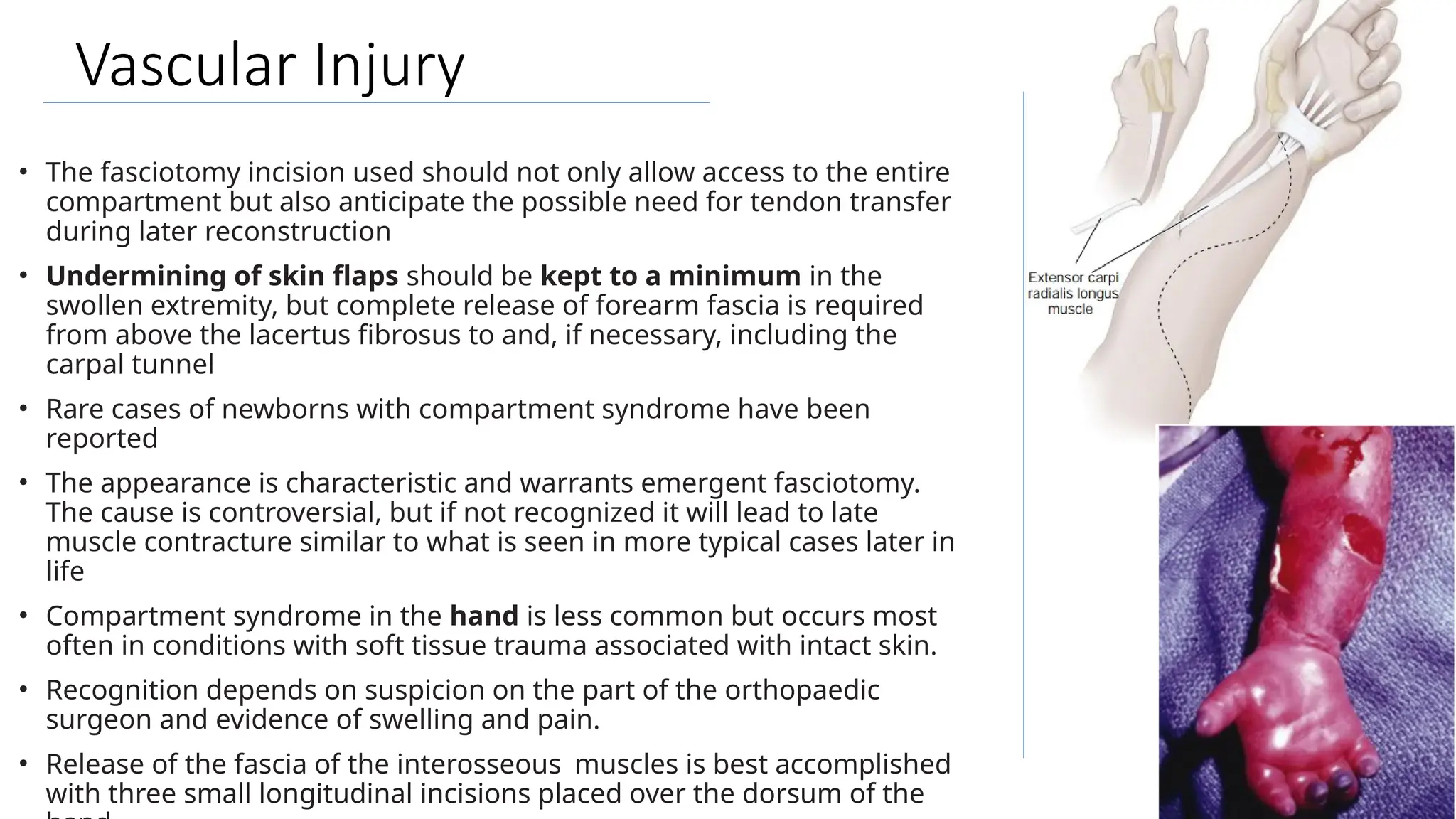
• The fasciotomy incision used should not only allow access to the entire
compartment but also anticipate the possible need for tendon transfer
during later reconstruction
• Undermining of skin flaps should be kept to a minimum in the
swollen extremity, but complete release of forearm fascia is required
from above the lacertus fibrosus to and, if necessary, including the
carpal tunnel
• Rare cases of newborns with compartment syndrome have been
reported
• The appearance is characteristic and warrants emergent fasciotomy.
The cause is controversial, but if not recognized it will lead to late
muscle contracture similar to what is seen in more typical cases later in
life
• Compartment syndrome in the hand is less common but occurs most
often in conditions with soft tissue trauma associated with intact skin.
• Recognition depends on suspicion on the part of the orthopaedic
surgeon and evidence of swelling and pain.
• Release of the fascia of the interosseous muscles is best accomplished
with three small longitudinal incisions placed over the dorsum of the
Thank you

Principles of Acute Care of Hand injuries.pptx

  • 1.
    Principles of Acute Care Dr.Mohammad Taqi Ehsani PGY1 of Orthopedics, FMIC
  • 2.
    Contents • General Principles •Tendon Injury • Nerve Injury • Skin Injury • Bone Injury • Vascular Injury
  • 3.
    General Principles • Ithas been said that the first surgeon who sees the injured hand most affects the final result • Accurate early diagnosis is more difficult in a child than in an adult because patient cooperation may be minimal or absent • It is perfectly acceptable and in fact often crucial to insist that a follow-up examination be done a day or so later in the clinic or physician’s office, when less blood, less hysteria, and less distraction make a more complete and reliable examination possible • A second examination is particularly useful in cases of possible nerve injury, for a sensory examination can be done more reliably in the quiet of the physician’s office than in a hectic emergency department • Occasionally, even this is not sufficient, and when the surgeon cannot rule out a nerve or tendon injury, the wound may need to be explored under general anesthesia • It is important to realize that almost no hand injury is a life-threatening emergency and that treatment should always be delayed until the anesthetic risk is minimized by a period of fasting and until a well-rested operating team with appropriate light, instruments, and training is available.
  • 4.
    General Principles • Simpleclosure of the skin with delay is the treatment of choice until all these elements are in place • As in other areas, the diagnosis is based on the history of the injury, observation, findings on physical examination, and radiographs • Careful and thoughtful observation of the injured hand by the surgeon is by far the most important factor in evaluating an uncooperative child. This observation must be made in the context of what has been called “topographic anticipation.” • The surgeon’s knowledge of the topographic anatomy of the injured site is used to anticipate the physical findings associated with probable injuries • assessment is best done by critically observing the rest position and use of the hand by the child
  • 5.
    Tendon Injury • Alterationof the hand’s resting position in a child with a tendon laceration may be obvious or subtle • when wound exploration reveals laceration of a tendon sheath, it is very likely that the tendon itself has sustained injury. • During the first 5 to 7 days after injury, a partially injured tendon is especially vulnerable to failure. If a partial injury is suspected, the hand is splinted in a posture to protect the tendon from rupture (Some hand surgeons prefer to explore) • Surgical exploration and the technique of tendon repair in children are identical to exploration and repair in adults, except for the size of the structures involved • extension lag and loss of flexion are common after extensor tendon repair in this population
  • 6.
    Tendon Injury • Themore critical challenges in children are immediate postoperative care to prevent rupture and, later, rehabilitation to develop gliding of the repaired tendon. • Postoperative immobilization should be complete and uninterrupted in a small child • successful results have been reported with age-adapted early mobilization • Excessive immobilization of more than 4 weeks for flexor tendons or 6 weeks for extensor tendons is not warranted and in small children can lead to stiffness • changing the casts early just to “have a look” may reward the surgeon with rupture and should not be done unless infection or swelling leading to compromise is strongly suspected. • The type of rehabilitation possible in very young children is limited but becomes more like that in adults as the child’s cooperation level improves with age. • When a primary repair fails, we rarely repeat the attempt in a young, uncooperative child. • If tendon repair is unsuccessful in a preschool child, surgery should wait to be repeated until the child’s hand is larger and the child is better able to understand and cooperate with the treatment program
  • 7.
    Nerve Injury • Thediagnosis of a nerve injury is usually subtle and depends heavily on topographic anticipation. • The surgeon is well served by expecting the worst instead of just hoping for the best • being very superficial in the hand, wrist, and elbow, the peripheral nerves virtually always run beside an artery. With a good history of arterial bleeding after a wound, one should carefully examine the patient for a nerve injury. • Children with suspected nerve injuries, more than almost any patient, deserve a follow-up assessment in the relative quiet of the clinic or office setting because the diagnosis is easily missed the day of injury • Absence of a sweat pattern of the anesthetic finger is a useful finding, and recognition of this finding is more often possible during a second examination, best identified by the dry or slick quality of the affected finger when the surgeon gently strokes the injured digit and uses a normal digit for comparison • Finally, it is completely appropriate for a competent hand surgeon to explore the wound under anesthesia when the diagnosis is sufficiently suspected.
  • 8.
    Skin Injury • Fingertipinjuries in children are very common. As a general rule, the less done for these injuries, the better. Even wounds with some exposed bone can heal with dressing changes alone if no tendon has been exposed. More extensive wounds may require full- or split-thickness grafts or local rotation flaps. • Pedicle grafting in children is rarely indicated in the acute treatment of all but the most catastrophic hand wounds • Burns are treated as in adults, with the surgeon remembering that the initial assessment frequently underestimates the severity of children’s burns • Child abuse may be manifested as burns; especially suspect are cigarette burns and bilateral hand and foot burns in a stocking-glove distribution • Treadmill burn injuries usually occur on the palmar surface of a young child’s hand and are treated by early Silvadene dressing changes, splinting, and antibiotics, with later aggressive scar management and mobilization • Characteristically, children tend to burn their hands more often on the palms because they lack understanding of what is too hot to hold
  • 9.
    • Severe flexioncontractures are frequent after these injuries. Fortunately, the palmar skin is thicker, and the deeper and important structures such as the nerves, tendons, and tendon sheath are usually unharmed
  • 10.
    Bone Injury • Thegreat advantage of radiographs in diagnosing adult fractures is limited in children by the cartilaginous nature of much of a young child’s bone • The value of simultaneous comparison views of the injured side and the normal side cannot be overestimated • A true lateral radiograph of the injured digit is important and may reveal a subtle but often significant injury. The technician should use the fingernail as a topographic landmark to obtain a true lateral view
  • 11.
    Bone Injury • Ingeneral, most fractures in a child’s hand are treated nonoperatively because children’s hands have a remarkable ability to recover useful movement by remodeling fractures that would clearly need open reduction in an adult. • Minimal displacements and malalignments heal better with closed treatment. • Simply protecting the hand from use for 3 or 4 weeks is usually adequate. However, reduction of rotational malalignment is critical before immobilization. • Serious rotational malalignment, markedly displaced intraarticular fractures, and some displaced epiphyseal fractures may require early open reduction and internal fixation
  • 12.
    Vascular Injury • Vasculartrauma in the upper limb can result from direct vascular injury and lead to a nonviable distal extremity or can result from a compartment syndrome caused by pressure in an unyielding fascial compartment • Complete loss of distal circulation should be addressed by a vascular surgeon • Forearm compartment syndrome has been the dread of pediatric orthopaedic surgeons since Volkmann first described the condition in 1881 • The clinical setting for compartment syndrome rarely involves massive open trauma because in these cases the fascial covering is disrupted enough to prevent secondary ischemic muscle death. Instead, the condition is all too often unexpected and, despite aggressive early fasciotomy, may not be preventable • The classic clinical signs of pain, pallor, paralysis, pulselessness, and paresthesia are not reliable in young children. Increasing need for pain medication is the most sensitive indicator of compartment syndrome • Although a supracondylar fracture of the humerus is the classic association, both-bone forearm fractures, blunt trauma, and even extravasation of blood or fluids may be the inciting cause. • Pain on passive digital extension that is referred to the proximal part of the forearm may be especially suggestive.
  • 13.
    Vascular Injury • Thefasciotomy incision used should not only allow access to the entire compartment but also anticipate the possible need for tendon transfer during later reconstruction • Undermining of skin flaps should be kept to a minimum in the swollen extremity, but complete release of forearm fascia is required from above the lacertus fibrosus to and, if necessary, including the carpal tunnel • Rare cases of newborns with compartment syndrome have been reported • The appearance is characteristic and warrants emergent fasciotomy. The cause is controversial, but if not recognized it will lead to late muscle contracture similar to what is seen in more typical cases later in life • Compartment syndrome in the hand is less common but occurs most often in conditions with soft tissue trauma associated with intact skin. • Recognition depends on suspicion on the part of the orthopaedic surgeon and evidence of swelling and pain. • Release of the fascia of the interosseous muscles is best accomplished with three small longitudinal incisions placed over the dorsum of the
  • 14.