Outline Introduction Sync and Cell search Sync. Seq. REFERENCES
Synchronization in LTE
Saeed Sadeghi
Faculty of Electrical and Computer Engineering
Tarbiat Modares University
November 2015
1 / 24 saeed sadeghi velni Synchronization in LTE
Outline Introduction Sync and Cell search Sync. Seq. REFERENCES
Outline
Introduction
Synchronization and Cell Search in LTE
Synchronization Sequences
References
2 / 24 saeed sadeghi velni Synchronization in LTE
Outline Introduction Sync and Cell search Sync. Seq. REFERENCES
Cell Search procedure
A UE wishing to access an LTE cell must first undertake a cell search pro-
cedure. This consists of a series of synchronization stages by which the UE
determines time and frequency parameters that are necessary to demodulate
the downlink and to transmit uplink signals with the correct timing.
Major Synchronization Requairements
Symbol timing acquisition: FFT window
Carrier frequency: mismatch of the local oscillators, Doppler shift
caused by any UE motion
Sampling clock
3 / 24 saeed sadeghi velni Synchronization in LTE
Outline Introduction Sync and Cell search Sync. Seq. REFERENCES
Cell Search
Initial synchronization
Detects an LTE cell and decodes all the information required to
register to it.
UE is switched on, UE has lost the connection to the serving
cell
New cell identification,
when a UE is already connected to an LTE cell and is in the
process of detecting a new neighbour cell
the UE reports to the serving cell measurements related to the
new cell: handover
repeated periodically until: serving cell quality becomes
satisfactory again, UE moves to another serving cell
4 / 24 saeed sadeghi velni Synchronization in LTE
Outline Introduction Sync and Cell search Sync. Seq. REFERENCES
Two specially physical signals for synchronization which are
broadcasted in each cell
Primary Synchronization Signal (PSS)
Secondary Synchronization Signal (SSS)
5 / 24 saeed sadeghi velni Synchronization in LTE
Outline Introduction Sync and Cell search Sync. Seq. REFERENCES
The PSS and SSS structure in time for the FDD
6 / 24 saeed sadeghi velni Synchronization in LTE
Outline Introduction Sync and Cell search Sync. Seq. REFERENCES
The PSS and SSS structure in time for the TDD
7 / 24 saeed sadeghi velni Synchronization in LTE
Outline Introduction Sync and Cell search Sync. Seq. REFERENCES
The PSS and SSS structure in frequency for the TDD
8 / 24 saeed sadeghi velni Synchronization in LTE
Outline Introduction Sync and Cell search Sync. Seq. REFERENCES
Two points
Multiple transmit antenna: the PSS and SSS are always
transmitted from the same antenna port in any given subframe,
while between different subframes they may be transmitted from
different antenna ports in order to benefit from time-switched
antenna diversity.
PSS and SSS in a given cell are used to indicate the physical
layer cell identity to the UE
N
(cell)
ID = 3N
(1)
ID + N
(2)
ID ∀
0 ≤ N
(1)
ID ≥ 167
0 ≤ N
(2)
ID ≥ 2
[ t + 1]
9 / 24 saeed sadeghi velni Synchronization in LTE
Outline Introduction Sync and Cell search Sync. Seq. REFERENCES
synchronization sequences
PSS
Zadoff-Chu sequences
SSS
M-sequences
10 / 24 saeed sadeghi velni Synchronization in LTE
Outline Introduction Sync and Cell search Sync. Seq. REFERENCES
Zadoff-Chu sequences
Non-binary unit-amplitude sequences
Satisfy Constant Amplitude Zero Autocorrelation (CAZAC)
property
aq = exp −j2πq
n(n + 1)/2 + ln
NZC
Important properties of ZC sequences
Property 1
Constant amplitude in ZC sequence and its Nzc-point DFT: lim-
its the Peak-to-Average Power Ratio (PAPR), generates bounded
and time-flat interference to other users, only phases need to be
computed and stored, not amplitudes.
11 / 24 saeed sadeghi velni Synchronization in LTE
Outline Introduction Sync and Cell search Sync. Seq. REFERENCES
Property 2
1-ZC sequences of any length have ‘ideal’ cyclic autocorrelation:
This property is of major interest when the received signal is cor-
related with a reference sequence and the received reference se-
quences are misaligned
rkk(σ) =
1
NZC
NZC−1
n=0
ak(n)a∗
k(n + σ) = δ(σ)
12 / 24 saeed sadeghi velni Synchronization in LTE
Outline Introduction Sync and Cell search Sync. Seq. REFERENCES
2-The main benefit of the CAZAC property is that it allows multiple or-
thogonal sequences to be generated from the same ZC sequence: Zero-
Correlation Zone (ZCZ)
Property 3
The absolute value of the cyclic cross-correlation function be-
tween any two ZC sequences is constant and equal to 1/sqrt(Nzc),
if |q1-q2| is relatively prime with respect to Nzc
theoretical minimum cross-correlation value for any two sequences
that have ideal autocorrelation
DFT of a ZC sequence
ZC sequence can be generated directly in the frequency domain
without the need for a DFT operation
13 / 24 saeed sadeghi velni Synchronization in LTE
Outline Introduction Sync and Cell search Sync. Seq. REFERENCES
Primary Synchronization Signal (PSS) Sequences
The PSS is constructed from a frequency-domain ZC sequence of
length 63, the middle element punctured to avoid transmitting on the
d.c. subcarrier.
14 / 24 saeed sadeghi velni Synchronization in LTE
Outline Introduction Sync and Cell search Sync. Seq. REFERENCES
Three PSS sequences are used in LTE, corresponding to the three
physical layer identities within each group of cells. The selected roots
for the three ZC PSS sequences are M = 29, 34, 25,
ZC63
M (n) = exp −j
πMn(n + 1)
63
∀ M =



25
29
34
This set of roots for the ZC sequences was chosen for its good periodic
autocorrelation and cross-correlation properties. In particular, these
sequences have a low-frequency offset sensitivity, defined as the ratio
of the maximum undesired autocorrelation peak in the time domain to
the desired correlation peak computed at a certain frequency offset.
15 / 24 saeed sadeghi velni Synchronization in LTE
Outline Introduction Sync and Cell search Sync. Seq. REFERENCES
Autocorrelation profile at 7.5 kHz frequency offset for roots = 25, 29,
34:
16 / 24 saeed sadeghi velni Synchronization in LTE
Outline Introduction Sync and Cell search Sync. Seq. REFERENCES
It can be seen that the average and peak values of the
cross-correlation are low relative to the autocorrelation
The residual cross-correlation signal can then be considered as
white noise with low variance
(a) Cross-correlation of the PSS se-
quence pair 25 and 29
(b) Autocorrelation of the PSS se-
quence 29 as a function of time offset
17 / 24 saeed sadeghi velni Synchronization in LTE
Outline Introduction Sync and Cell search Sync. Seq. REFERENCES
Thanks to the flat frequency-domain autocorrelation
The PSS can be easily detected during the initial synchronization
with a frequency offset up to 7.5 kHz
18 / 24 saeed sadeghi velni Synchronization in LTE
Outline Introduction Sync and Cell search Sync. Seq. REFERENCES
Detect PSS
The UE must detect the PSS without any a priori knowledge of
the channel
Maximum likelihood detector
m∗
M = argmaxm |
N−1
i=0
Y[i + m]S∗
M[i] |2
the performance of a non-coherent detector degrades if the
coherence bandwidth of the channel is less than the six resource
blocks
19 / 24 saeed sadeghi velni Synchronization in LTE
Outline Introduction Sync and Cell search Sync. Seq. REFERENCES
Secondary Synchronization Signal (SSS)
Sequences
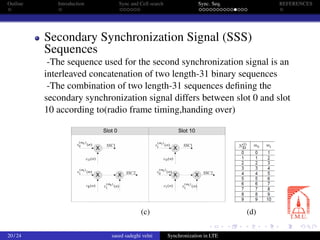
-The sequence used for the second synchronization signal is an
interleaved concatenation of two length-31 binary sequences
-The combination of two length-31 sequences defining the
secondary synchronization signal differs between slot 0 and slot
10 according to(radio frame timing,handing over)
(c) (d)
20 / 24 saeed sadeghi velni Synchronization in LTE
Outline Introduction Sync and Cell search Sync. Seq. REFERENCES
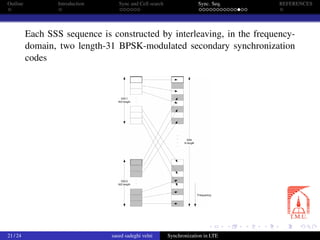
Each SSS sequence is constructed by interleaving, in the frequency-
domain, two length-31 BPSK-modulated secondary synchronization
codes
21 / 24 saeed sadeghi velni Synchronization in LTE
Outline Introduction Sync and Cell search Sync. Seq. REFERENCES
The SSS sequences have good frequency-domain properties, being
spectrally flat
22 / 24 saeed sadeghi velni Synchronization in LTE
Outline Introduction Sync and Cell search Sync. Seq. REFERENCES
Detect SSS
The channel can therefore be assumed to be known based on the
PSS sequence
Coherent detection method
ˆSm = arg min
s
N
n=1
|y[n] − S[n, n]ˆhn|
Interfering eNodeB employs the same PSS as the one used by
the target cell
23 / 24 saeed sadeghi velni Synchronization in LTE
Outline Introduction Sync and Cell search Sync. Seq. REFERENCES
[1] A. Golnari, M. Shabany, A. Nezamalhosseini, and G. Gulak,
"design and implementation of time and frequency synchronization
in LTE",
IEEE Transaction on Very Large Scale Integration System, vol.23,
no.12, pp.2970–2982, June 2015.
[2] Stefania Sesia, Issam Toufik, and Matthew Baker,
LTE – The UMTS Long Term Evolution,
Wiley.
24 / 24 saeed sadeghi velni Synchronization in LTE

synchronization

  • 1.
    Outline Introduction Syncand Cell search Sync. Seq. REFERENCES Synchronization in LTE Saeed Sadeghi Faculty of Electrical and Computer Engineering Tarbiat Modares University November 2015 1 / 24 saeed sadeghi velni Synchronization in LTE
  • 2.
    Outline Introduction Syncand Cell search Sync. Seq. REFERENCES Outline Introduction Synchronization and Cell Search in LTE Synchronization Sequences References 2 / 24 saeed sadeghi velni Synchronization in LTE
  • 3.
    Outline Introduction Syncand Cell search Sync. Seq. REFERENCES Cell Search procedure A UE wishing to access an LTE cell must first undertake a cell search pro- cedure. This consists of a series of synchronization stages by which the UE determines time and frequency parameters that are necessary to demodulate the downlink and to transmit uplink signals with the correct timing. Major Synchronization Requairements Symbol timing acquisition: FFT window Carrier frequency: mismatch of the local oscillators, Doppler shift caused by any UE motion Sampling clock 3 / 24 saeed sadeghi velni Synchronization in LTE
  • 4.
    Outline Introduction Syncand Cell search Sync. Seq. REFERENCES Cell Search Initial synchronization Detects an LTE cell and decodes all the information required to register to it. UE is switched on, UE has lost the connection to the serving cell New cell identification, when a UE is already connected to an LTE cell and is in the process of detecting a new neighbour cell the UE reports to the serving cell measurements related to the new cell: handover repeated periodically until: serving cell quality becomes satisfactory again, UE moves to another serving cell 4 / 24 saeed sadeghi velni Synchronization in LTE
  • 5.
    Outline Introduction Syncand Cell search Sync. Seq. REFERENCES Two specially physical signals for synchronization which are broadcasted in each cell Primary Synchronization Signal (PSS) Secondary Synchronization Signal (SSS) 5 / 24 saeed sadeghi velni Synchronization in LTE
  • 6.
    Outline Introduction Syncand Cell search Sync. Seq. REFERENCES The PSS and SSS structure in time for the FDD 6 / 24 saeed sadeghi velni Synchronization in LTE
  • 7.
    Outline Introduction Syncand Cell search Sync. Seq. REFERENCES The PSS and SSS structure in time for the TDD 7 / 24 saeed sadeghi velni Synchronization in LTE
  • 8.
    Outline Introduction Syncand Cell search Sync. Seq. REFERENCES The PSS and SSS structure in frequency for the TDD 8 / 24 saeed sadeghi velni Synchronization in LTE
  • 9.
    Outline Introduction Syncand Cell search Sync. Seq. REFERENCES Two points Multiple transmit antenna: the PSS and SSS are always transmitted from the same antenna port in any given subframe, while between different subframes they may be transmitted from different antenna ports in order to benefit from time-switched antenna diversity. PSS and SSS in a given cell are used to indicate the physical layer cell identity to the UE N (cell) ID = 3N (1) ID + N (2) ID ∀ 0 ≤ N (1) ID ≥ 167 0 ≤ N (2) ID ≥ 2 [ t + 1] 9 / 24 saeed sadeghi velni Synchronization in LTE
  • 10.
    Outline Introduction Syncand Cell search Sync. Seq. REFERENCES synchronization sequences PSS Zadoff-Chu sequences SSS M-sequences 10 / 24 saeed sadeghi velni Synchronization in LTE
  • 11.
    Outline Introduction Syncand Cell search Sync. Seq. REFERENCES Zadoff-Chu sequences Non-binary unit-amplitude sequences Satisfy Constant Amplitude Zero Autocorrelation (CAZAC) property aq = exp −j2πq n(n + 1)/2 + ln NZC Important properties of ZC sequences Property 1 Constant amplitude in ZC sequence and its Nzc-point DFT: lim- its the Peak-to-Average Power Ratio (PAPR), generates bounded and time-flat interference to other users, only phases need to be computed and stored, not amplitudes. 11 / 24 saeed sadeghi velni Synchronization in LTE
  • 12.
    Outline Introduction Syncand Cell search Sync. Seq. REFERENCES Property 2 1-ZC sequences of any length have ‘ideal’ cyclic autocorrelation: This property is of major interest when the received signal is cor- related with a reference sequence and the received reference se- quences are misaligned rkk(σ) = 1 NZC NZC−1 n=0 ak(n)a∗ k(n + σ) = δ(σ) 12 / 24 saeed sadeghi velni Synchronization in LTE
  • 13.
    Outline Introduction Syncand Cell search Sync. Seq. REFERENCES 2-The main benefit of the CAZAC property is that it allows multiple or- thogonal sequences to be generated from the same ZC sequence: Zero- Correlation Zone (ZCZ) Property 3 The absolute value of the cyclic cross-correlation function be- tween any two ZC sequences is constant and equal to 1/sqrt(Nzc), if |q1-q2| is relatively prime with respect to Nzc theoretical minimum cross-correlation value for any two sequences that have ideal autocorrelation DFT of a ZC sequence ZC sequence can be generated directly in the frequency domain without the need for a DFT operation 13 / 24 saeed sadeghi velni Synchronization in LTE
  • 14.
    Outline Introduction Syncand Cell search Sync. Seq. REFERENCES Primary Synchronization Signal (PSS) Sequences The PSS is constructed from a frequency-domain ZC sequence of length 63, the middle element punctured to avoid transmitting on the d.c. subcarrier. 14 / 24 saeed sadeghi velni Synchronization in LTE
  • 15.
    Outline Introduction Syncand Cell search Sync. Seq. REFERENCES Three PSS sequences are used in LTE, corresponding to the three physical layer identities within each group of cells. The selected roots for the three ZC PSS sequences are M = 29, 34, 25, ZC63 M (n) = exp −j πMn(n + 1) 63 ∀ M =    25 29 34 This set of roots for the ZC sequences was chosen for its good periodic autocorrelation and cross-correlation properties. In particular, these sequences have a low-frequency offset sensitivity, defined as the ratio of the maximum undesired autocorrelation peak in the time domain to the desired correlation peak computed at a certain frequency offset. 15 / 24 saeed sadeghi velni Synchronization in LTE
  • 16.
    Outline Introduction Syncand Cell search Sync. Seq. REFERENCES Autocorrelation profile at 7.5 kHz frequency offset for roots = 25, 29, 34: 16 / 24 saeed sadeghi velni Synchronization in LTE
  • 17.
    Outline Introduction Syncand Cell search Sync. Seq. REFERENCES It can be seen that the average and peak values of the cross-correlation are low relative to the autocorrelation The residual cross-correlation signal can then be considered as white noise with low variance (a) Cross-correlation of the PSS se- quence pair 25 and 29 (b) Autocorrelation of the PSS se- quence 29 as a function of time offset 17 / 24 saeed sadeghi velni Synchronization in LTE
  • 18.
    Outline Introduction Syncand Cell search Sync. Seq. REFERENCES Thanks to the flat frequency-domain autocorrelation The PSS can be easily detected during the initial synchronization with a frequency offset up to 7.5 kHz 18 / 24 saeed sadeghi velni Synchronization in LTE
  • 19.
    Outline Introduction Syncand Cell search Sync. Seq. REFERENCES Detect PSS The UE must detect the PSS without any a priori knowledge of the channel Maximum likelihood detector m∗ M = argmaxm | N−1 i=0 Y[i + m]S∗ M[i] |2 the performance of a non-coherent detector degrades if the coherence bandwidth of the channel is less than the six resource blocks 19 / 24 saeed sadeghi velni Synchronization in LTE
  • 20.
    Outline Introduction Syncand Cell search Sync. Seq. REFERENCES Secondary Synchronization Signal (SSS) Sequences -The sequence used for the second synchronization signal is an interleaved concatenation of two length-31 binary sequences -The combination of two length-31 sequences defining the secondary synchronization signal differs between slot 0 and slot 10 according to(radio frame timing,handing over) (c) (d) 20 / 24 saeed sadeghi velni Synchronization in LTE
  • 21.
    Outline Introduction Syncand Cell search Sync. Seq. REFERENCES Each SSS sequence is constructed by interleaving, in the frequency- domain, two length-31 BPSK-modulated secondary synchronization codes 21 / 24 saeed sadeghi velni Synchronization in LTE
  • 22.
    Outline Introduction Syncand Cell search Sync. Seq. REFERENCES The SSS sequences have good frequency-domain properties, being spectrally flat 22 / 24 saeed sadeghi velni Synchronization in LTE
  • 23.
    Outline Introduction Syncand Cell search Sync. Seq. REFERENCES Detect SSS The channel can therefore be assumed to be known based on the PSS sequence Coherent detection method ˆSm = arg min s N n=1 |y[n] − S[n, n]ˆhn| Interfering eNodeB employs the same PSS as the one used by the target cell 23 / 24 saeed sadeghi velni Synchronization in LTE
  • 24.
    Outline Introduction Syncand Cell search Sync. Seq. REFERENCES [1] A. Golnari, M. Shabany, A. Nezamalhosseini, and G. Gulak, "design and implementation of time and frequency synchronization in LTE", IEEE Transaction on Very Large Scale Integration System, vol.23, no.12, pp.2970–2982, June 2015. [2] Stefania Sesia, Issam Toufik, and Matthew Baker, LTE – The UMTS Long Term Evolution, Wiley. 24 / 24 saeed sadeghi velni Synchronization in LTE