SYMPATHOMIMETICS
BY
RAAJITA.I
★ Introduction
★ Nervous system
★ Adrenergic receptors
★ Adrenergic neurotransmitters
★ Classification of drugs
★ SAR of adrenergic agonists
★ Synthesis of phenylephrine
★ Synthesis of salbutamol
About
INTRODUCTION
● Sympathomimetics are also known as adrenomimetics or adrenergic
agonists.
● Drugs that mimic the action of sympathetic system are called
sympathomimetics.
● Sympathomimetics can be grouped by their mode of action and by the
spectrum of receptors.
● Some of the drugs act by direct mode, that is they interact and activate the
adrenoreceptors.
● Others act indirectly i.e, their actions are dependent on the release of
endogenous catecholamines.
● These indirectly acting agents have 2 different mode of actions:
1. Displacement of stored catecholamines from adrenergic
nerve endings
2. By inhibition of reuptake of catecholamines already released
NERVOUS SYSTEM
Nervous system
Peripheral NS
Central NS
Brain Spinal cord Somatic NS Autonomic NS
● Autonomic nervous system involves Sympathetic & Parasympathetic
systems.
● Sympathetic NS is responsible for Fight / Flight responses while
Parasympathetic NS shows Maintenance of response.
● Sympathetic system involves neurotransmitters which are chemically
Catecholamines and named as follows:
Dopamine Shows pleasure & addiction
Epinephrine Increases heart rate
Norepinephrine Causes vasoconstriction
ADRENERGIC RECEPTORS: (GPCR TYPE)
𝛼 - receptors
● 𝛼1- receptors: present at
postsynaptic receptor sites to
show increased excitatory action
● 𝛼2 - receptors: present at pre &
postsynaptic receptor sites and
shows inhibitory action
Ꞵ - receptors
● 𝛃1- receptors: present at cardiac
tissue and shows excitatory
action (↑ blood pressure)
● 𝛃2- receptors: present at smooth
muscles & gland cells to show
inhibitory action (relaxation)
● 𝛃3- receptors: present in adipose
tissue and urinary bladder that
leads to lipolysis & relaxation
respectively
ADRENERGIC NEUROTRANSMITTERS
DOPAMINE ADRENALINE NORADRENALINE
Synthesis, release & fate of neurotransmitters
● The dopamine is synthesised from phenylamine in the presence of DOPA
decarboxylase which gives noradrenaline and adrenaline in the presence of
β- hydroxylase and N- methyl transference respectively.
● It is stored in chromaffin granules along with ATP & chromogranin-A that
diffuses into cytosol.
● Entry of calcium into presynaptic nerve terminal that undergoes
depolarisation and causes exocytosis of noradrenaline and adrenaline into
synaptic cleft.
● When the neurotransmitter binds to ∝1 receptor increase in activity is
observed and vice versa in case of ∝2 receptor (known as feedback
mechanism)
● The adrenergic neurotransmitters are metabolised in the presence of
Monoamine Oxidase (MAO)
Catechol O-Methyltransferase (COMT)
● MAO gives end product named as ‘3,4- dihydroxy phenyl glycolaldehyde’.
● COMT gives end product named as ‘4- hydroxy-3- methyl phenyl
glycolaldehyde’.
CLASSIFICATION OF SYMPATHOMIMETIC
DRUGS:
Directly acting drugs:
Norepinephrine Epinephrine Phenylephrine Dopamine
Methyldopa Clonidine Dobutamine
Isoproterenol Terbutaline Salbutamol
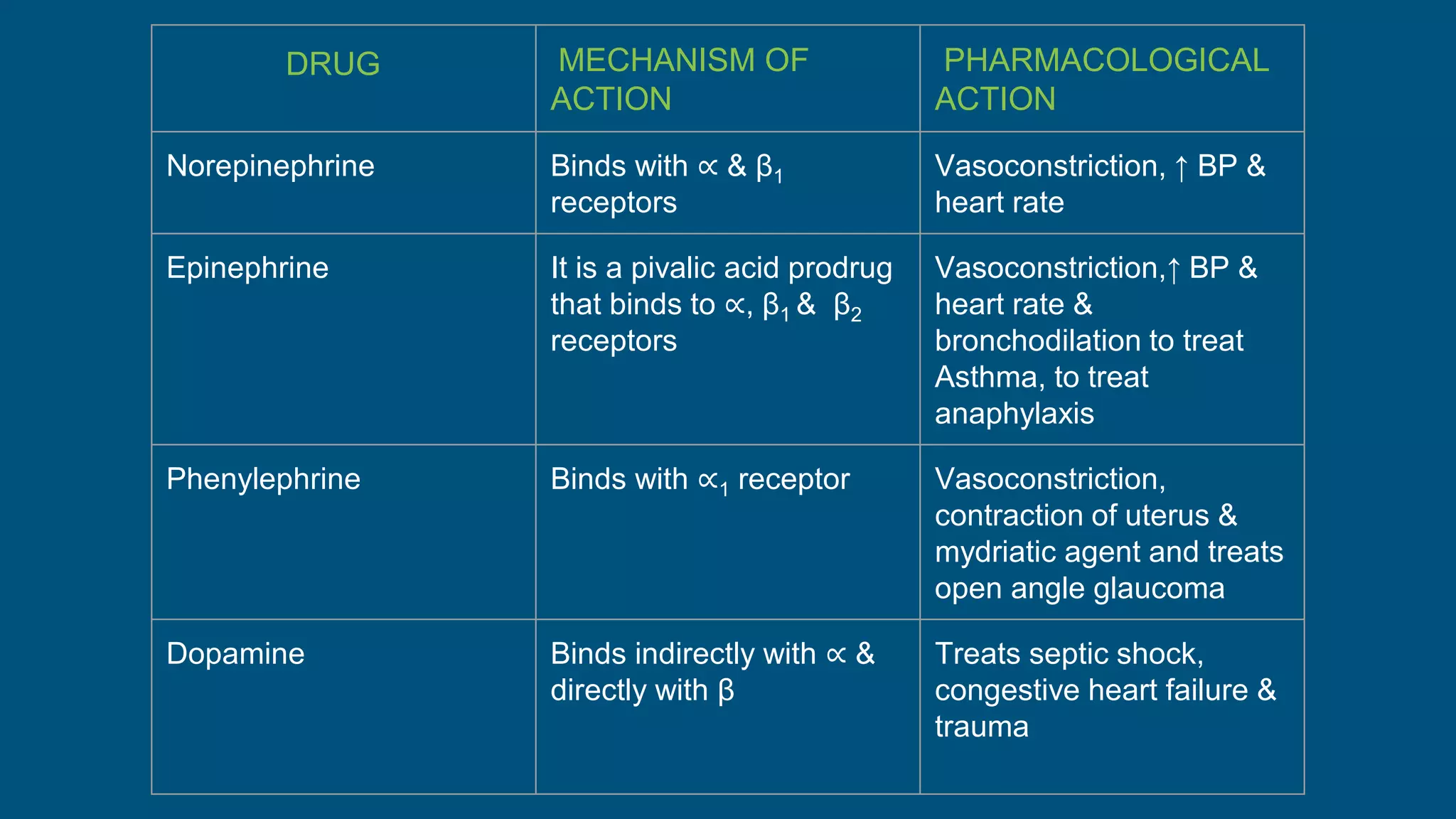
DRUG MECHANISM OF
ACTION
PHARMACOLOGICAL
ACTION
Norepinephrine Binds with ∝ & β1
receptors
Vasoconstriction, ↑ BP &
heart rate
Epinephrine It is a pivalic acid prodrug
that binds to ∝, β1 & β2
receptors
Vasoconstriction,↑ BP &
heart rate &
bronchodilation to treat
Asthma, to treat
anaphylaxis
Phenylephrine Binds with ∝1 receptor Vasoconstriction,
contraction of uterus &
mydriatic agent and treats
open angle glaucoma
Dopamine Binds indirectly with ∝ &
directly with β
Treats septic shock,
congestive heart failure &
trauma
Methyldopa Converted to ∝-methyl
norepinephrine and binds
to ∝1 receptors
Antihypertensive
Clonidine Binds to ∝2 receptors Antihypertensive, mild
sedative, also used to
treat glaucoma,
migraine,prophylaxis &
opiate withdrawal
syndrome
Dobutamine Binds to ∝1 & β1 receptors Treats congestive heart
failure
Isoproterenol Binds to β1 & β2 receptors Increases cardiac output
& treats asthma
respectively
Terbutaline Binds to β2 receptors Treats asthma
Salbutamol Binds to β2 receptors Treats asthma & causes
uterus relaxation
Bitolterol It is a colterol prodrug that
binds to β2 receptors
Causes bronchodilation to
treat asthma
❏ Bitolterol is a prodrug of salbutamol, which has more affinity
towards β2 receptors than ∝ receptors due to increased
bulkiness on amine group(contains 30-butyl group).
Bitolterol
Indirectly acting drugs
Drugs Mechanism of action Pharmacological
action
Hydroxy amphetamine Causes release of
noradrenaline
Dilation of pupil,
diagnostic agent in
testing HORNER’s
SYNDROME
Pseudoephedrine Binds to ∝ & β receptors Vasoconstriction &
↑cardiac output
Propylhexane Binds to ∝ receptors in
respiratory tract
Nasal decongestant
Mixed action drugs
Drugs Mechanism of action Pharmacological
action
Ephedrine Binds to ∝ & β receptors Treats hay fever &
urticaria and used as
nasal decongestant
Metaraminol Binds to ∝ & β receptors Causes hypotension
SAR of adrenergic agonists
General structure:
● It contains a catechol ring, β- carbon with hydroxyl group(-OH) and a ∝-
carbon containing an amine group(-NH2).
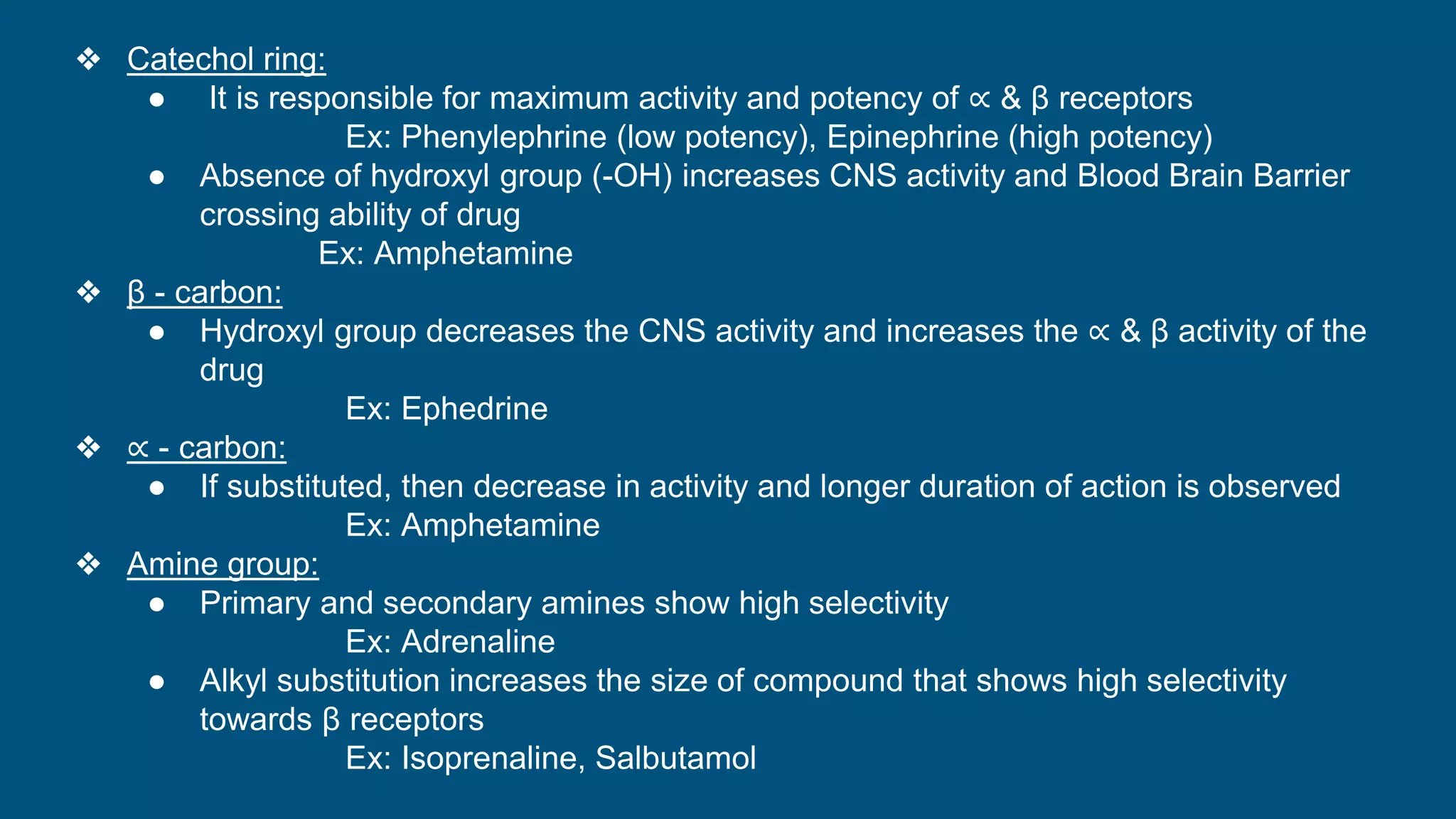
❖ Catechol ring:
● It is responsible for maximum activity and potency of ∝ & β receptors
Ex: Phenylephrine (low potency), Epinephrine (high potency)
● Absence of hydroxyl group (-OH) increases CNS activity and Blood Brain Barrier
crossing ability of drug
Ex: Amphetamine
❖ β - carbon:
● Hydroxyl group decreases the CNS activity and increases the ∝ & β activity of the
drug
Ex: Ephedrine
❖ ∝ - carbon:
● If substituted, then decrease in activity and longer duration of action is observed
Ex: Amphetamine
❖ Amine group:
● Primary and secondary amines show high selectivity
Ex: Adrenaline
● Alkyl substitution increases the size of compound that shows high selectivity
towards β receptors
Ex: Isoprenaline, Salbutamol
SYNTHESIS OF PHENYLEPHRINE:
NH2-CH3
--HCl
Chloroacetyl phenol H2/Ni
Phenylephrine
SYNTHESIS OF SALBUTAMOL:
∝- hydroxy
benzyl
alcohol
Chloroacetyl
chloride
– HCl
NH2–
C(CH3)3
–HCl
MPV
Reduction
Salbutamol
THANK
YOU

SYMPATHOMIMETIC DRUGS (MC-I).pptx

  • 1.
  • 2.
    ★ Introduction ★ Nervoussystem ★ Adrenergic receptors ★ Adrenergic neurotransmitters ★ Classification of drugs ★ SAR of adrenergic agonists ★ Synthesis of phenylephrine ★ Synthesis of salbutamol About
  • 3.
    INTRODUCTION ● Sympathomimetics arealso known as adrenomimetics or adrenergic agonists. ● Drugs that mimic the action of sympathetic system are called sympathomimetics. ● Sympathomimetics can be grouped by their mode of action and by the spectrum of receptors. ● Some of the drugs act by direct mode, that is they interact and activate the adrenoreceptors. ● Others act indirectly i.e, their actions are dependent on the release of endogenous catecholamines.
  • 4.
    ● These indirectlyacting agents have 2 different mode of actions: 1. Displacement of stored catecholamines from adrenergic nerve endings 2. By inhibition of reuptake of catecholamines already released
  • 5.
    NERVOUS SYSTEM Nervous system PeripheralNS Central NS Brain Spinal cord Somatic NS Autonomic NS
  • 6.
    ● Autonomic nervoussystem involves Sympathetic & Parasympathetic systems. ● Sympathetic NS is responsible for Fight / Flight responses while Parasympathetic NS shows Maintenance of response. ● Sympathetic system involves neurotransmitters which are chemically Catecholamines and named as follows: Dopamine Shows pleasure & addiction Epinephrine Increases heart rate Norepinephrine Causes vasoconstriction
  • 7.
    ADRENERGIC RECEPTORS: (GPCRTYPE) 𝛼 - receptors ● 𝛼1- receptors: present at postsynaptic receptor sites to show increased excitatory action ● 𝛼2 - receptors: present at pre & postsynaptic receptor sites and shows inhibitory action Ꞵ - receptors ● 𝛃1- receptors: present at cardiac tissue and shows excitatory action (↑ blood pressure) ● 𝛃2- receptors: present at smooth muscles & gland cells to show inhibitory action (relaxation) ● 𝛃3- receptors: present in adipose tissue and urinary bladder that leads to lipolysis & relaxation respectively
  • 8.
  • 9.
    Synthesis, release &fate of neurotransmitters ● The dopamine is synthesised from phenylamine in the presence of DOPA decarboxylase which gives noradrenaline and adrenaline in the presence of β- hydroxylase and N- methyl transference respectively. ● It is stored in chromaffin granules along with ATP & chromogranin-A that diffuses into cytosol. ● Entry of calcium into presynaptic nerve terminal that undergoes depolarisation and causes exocytosis of noradrenaline and adrenaline into synaptic cleft. ● When the neurotransmitter binds to ∝1 receptor increase in activity is observed and vice versa in case of ∝2 receptor (known as feedback mechanism)
  • 10.
    ● The adrenergicneurotransmitters are metabolised in the presence of Monoamine Oxidase (MAO) Catechol O-Methyltransferase (COMT) ● MAO gives end product named as ‘3,4- dihydroxy phenyl glycolaldehyde’. ● COMT gives end product named as ‘4- hydroxy-3- methyl phenyl glycolaldehyde’.
  • 11.
  • 12.
    Directly acting drugs: NorepinephrineEpinephrine Phenylephrine Dopamine
  • 13.
  • 14.
    DRUG MECHANISM OF ACTION PHARMACOLOGICAL ACTION NorepinephrineBinds with ∝ & β1 receptors Vasoconstriction, ↑ BP & heart rate Epinephrine It is a pivalic acid prodrug that binds to ∝, β1 & β2 receptors Vasoconstriction,↑ BP & heart rate & bronchodilation to treat Asthma, to treat anaphylaxis Phenylephrine Binds with ∝1 receptor Vasoconstriction, contraction of uterus & mydriatic agent and treats open angle glaucoma Dopamine Binds indirectly with ∝ & directly with β Treats septic shock, congestive heart failure & trauma
  • 15.
    Methyldopa Converted to∝-methyl norepinephrine and binds to ∝1 receptors Antihypertensive Clonidine Binds to ∝2 receptors Antihypertensive, mild sedative, also used to treat glaucoma, migraine,prophylaxis & opiate withdrawal syndrome Dobutamine Binds to ∝1 & β1 receptors Treats congestive heart failure Isoproterenol Binds to β1 & β2 receptors Increases cardiac output & treats asthma respectively Terbutaline Binds to β2 receptors Treats asthma
  • 16.
    Salbutamol Binds toβ2 receptors Treats asthma & causes uterus relaxation Bitolterol It is a colterol prodrug that binds to β2 receptors Causes bronchodilation to treat asthma ❏ Bitolterol is a prodrug of salbutamol, which has more affinity towards β2 receptors than ∝ receptors due to increased bulkiness on amine group(contains 30-butyl group). Bitolterol
  • 17.
    Indirectly acting drugs DrugsMechanism of action Pharmacological action Hydroxy amphetamine Causes release of noradrenaline Dilation of pupil, diagnostic agent in testing HORNER’s SYNDROME Pseudoephedrine Binds to ∝ & β receptors Vasoconstriction & ↑cardiac output Propylhexane Binds to ∝ receptors in respiratory tract Nasal decongestant
  • 18.
    Mixed action drugs DrugsMechanism of action Pharmacological action Ephedrine Binds to ∝ & β receptors Treats hay fever & urticaria and used as nasal decongestant Metaraminol Binds to ∝ & β receptors Causes hypotension
  • 19.
    SAR of adrenergicagonists General structure: ● It contains a catechol ring, β- carbon with hydroxyl group(-OH) and a ∝- carbon containing an amine group(-NH2).
  • 20.
    ❖ Catechol ring: ●It is responsible for maximum activity and potency of ∝ & β receptors Ex: Phenylephrine (low potency), Epinephrine (high potency) ● Absence of hydroxyl group (-OH) increases CNS activity and Blood Brain Barrier crossing ability of drug Ex: Amphetamine ❖ β - carbon: ● Hydroxyl group decreases the CNS activity and increases the ∝ & β activity of the drug Ex: Ephedrine ❖ ∝ - carbon: ● If substituted, then decrease in activity and longer duration of action is observed Ex: Amphetamine ❖ Amine group: ● Primary and secondary amines show high selectivity Ex: Adrenaline ● Alkyl substitution increases the size of compound that shows high selectivity towards β receptors Ex: Isoprenaline, Salbutamol
  • 21.
  • 22.
    SYNTHESIS OF SALBUTAMOL: ∝-hydroxy benzyl alcohol Chloroacetyl chloride – HCl NH2– C(CH3)3 –HCl MPV Reduction Salbutamol
  • 23.

Editor's Notes