Syllabus Shapes
and
Syllabus Evaluation
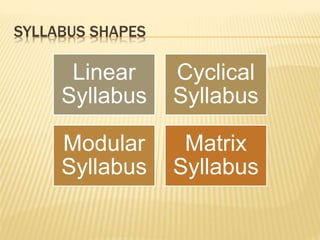
SYLLABUS SHAPES
Linear
Syllabus
Cyclical
Syllabus
Modular
Syllabus
Matrix
Syllabus
LINEAR SYLLABUS
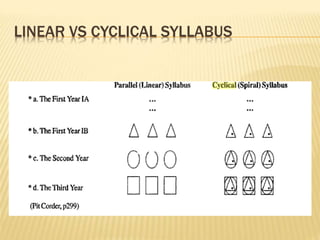
 Teaching on a line versus spiral natural
learning process
 Language learning viewed as a process of
evolution.
 Learners should be given opportunities to
experience the same features turning up in
many different combinations, so that they
may gradually «grow into» the language.
LINEAR SYLLABUS
 Learning points are isolated and presented
one after another.
 Issues of sequencing and grading are of
paramount importance.
 Linguistic and pedagogical principles
determine the order in which items will be
presented.
 A strict linear shape does not work well when
the categories of language content are
notional or functional.
LINEAR VS CYCLICAL SYLLABUS
CYLICAL SYLLABUS
 Language learning as «integrative» rather
than cumulative
 Language as a network of interrelated
categories
 Enables teachers and learners to work with
the same topic more than once
CYCLICAL SYLLABUS
 Example: Prepare 3 sets of exercises to
teach the use of articles, according to a spiral
syllabus, to be used at 3 different levels.
CYCLICAL SYLLABUS
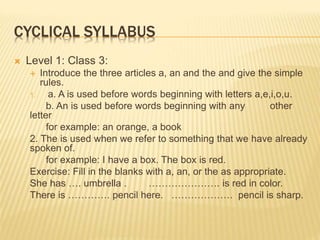
 Level 1: Class 3:
 Introduce the three articles a, an and the and give the simple
rules.
1. a. A is used before words beginning with letters a,e,i,o,u.
b. An is used before words beginning with any other
letter
for example: an orange, a book
2. The is used when we refer to something that we have already
spoken of.
for example: I have a box. The box is red.
Exercise: Fill in the blanks with a, an, or the as appropriate.
She has …. umbrella . …………………. is red in color.
There is …………. pencil here. ………………. pencil is sharp.
CYCLICAL SYLLABUS
 Level 2: Class 8
1. The different uses of the
for ex: The names of rivers and mountains
2. The absence of articles for certain words like God
3. Use of the along with objects of which there is only one of its kind
like the Bible; the sky
Exercise: Supply articles where necessary.
Ganga is one of holly rivers of India. It starts from Himalayas and
joins of Bay and Bengal….
 Level 3: Class 12
Execise: Correct sentences if necessary
Sky is blue.
The Ram came.
MODULAR FORMAT
 Composed of modules basically similar to
units in a syllabus
 Each module integrates the language in a
thematic or situational context processsed
through skills-building tasks
 Modules are independent from each other
 Gives flexibility to the tacher
 The language could be dividied into modules
in several ways.
MATRIX FORMAT
 The most complex and burdensome for the
designer
 Relies on the design of free sets of topics,
situations and tasks or activities later to be
matched by the teacher
 The format does not impose a certain
method and could be used for content based
courses as well as task based and
communicative courses.
GUIDELINES FOR SYLLABUS EVALUATION
 Does the syllabus have clearly stated objectives?
What are they?
 How far does the syllabus incorporate current
thinking in linguistics, sociology, psychology and
pedagogy?
 Is the target behaviour clearly spelt out or at least
implied?
 What is the syllabus type?
 Does the syllabus spell out the methodology?
 Is the syllabus consistent with the other aspects of
the curriculum?
 Does the syllabus have flexibility? Is it negotiable?
SYLLABUS EVALUATION ACCORDING TO THE COMMON
EUROPEAN FRAMEWORK
 The educational reform of 1999 presents new requirements vis-à-vis authoring
syllabuses based on the core curriculum. According to ministerial recommendations
issued at the outset of the 1999 reform, the authoring syllabus should include:
 an introduction including the presentation of the syllabus, its origin, information about
the educational experience of the authors, characteristics of the students for whom the
syllabus is suitable and minimum requirements related to school equipment
indispensable for the implementation of the syllabus
 a set of objectives
 a list of teaching contents
 recommendations for educational procedures, methods and techniques
 exit competencies
 a list of testing techniques to be used in formative and summative evaluation
 samples of tests
 samples of lesson scenarios
PUTTING IT ALL TOGETHER….
 Remain flexible and leave options open.
 Eclecticism: the practice of (or belief in)
making informed choices among the
available approaches, syllabuses, techniques
and exercises in order to adapt to a particular
group of students in a particular situation for
the purposes of most effectively and
efficiently helping them to learn a language.
PUTTING IT ALL TOGETHER…
 «True eclecticism involves informed and
rational choices based on knowledge and
experience» (James Dean Brown)
 «It is wise to take an eclectic approach,
taking what is useful from each theory and
trusting also in the evidence of your own
experience as a teacher.» (Hutchinson &
Waters)
REFERENCES
 Brown, J.D. (1995).The Elements of Language Curriculum,
Boston: Thomson Publishing.
 Corder, S.P. (1973). Introducing Applied Linguistics,
Penguin, Harmonswordth.
 Dubin, F. & Olshtain, E. (1986). Course Design: Developing
Programs and materials for language learning. USA:
Cambridge University Press.
 Hutchinson, T. & Waters, A. (1987). English for Specific
Purposes, Cambridge: Cambridge University Press.
 Macalister, P. (2010). Language Curriculum Design, NY:
Routledge.
 Sarawati, V. (2005). English Language Teaching: Principles
& Practice, India: Orient Longman.

Syllabus Shapes Presentation and its affect

  • 1.
  • 2.
  • 3.
    LINEAR SYLLABUS  Teachingon a line versus spiral natural learning process  Language learning viewed as a process of evolution.  Learners should be given opportunities to experience the same features turning up in many different combinations, so that they may gradually «grow into» the language.
  • 4.
    LINEAR SYLLABUS  Learningpoints are isolated and presented one after another.  Issues of sequencing and grading are of paramount importance.  Linguistic and pedagogical principles determine the order in which items will be presented.  A strict linear shape does not work well when the categories of language content are notional or functional.
  • 5.
  • 6.
    CYLICAL SYLLABUS  Languagelearning as «integrative» rather than cumulative  Language as a network of interrelated categories  Enables teachers and learners to work with the same topic more than once
  • 7.
    CYCLICAL SYLLABUS  Example:Prepare 3 sets of exercises to teach the use of articles, according to a spiral syllabus, to be used at 3 different levels.
  • 8.
    CYCLICAL SYLLABUS  Level1: Class 3:  Introduce the three articles a, an and the and give the simple rules. 1. a. A is used before words beginning with letters a,e,i,o,u. b. An is used before words beginning with any other letter for example: an orange, a book 2. The is used when we refer to something that we have already spoken of. for example: I have a box. The box is red. Exercise: Fill in the blanks with a, an, or the as appropriate. She has …. umbrella . …………………. is red in color. There is …………. pencil here. ………………. pencil is sharp.
  • 9.
    CYCLICAL SYLLABUS  Level2: Class 8 1. The different uses of the for ex: The names of rivers and mountains 2. The absence of articles for certain words like God 3. Use of the along with objects of which there is only one of its kind like the Bible; the sky Exercise: Supply articles where necessary. Ganga is one of holly rivers of India. It starts from Himalayas and joins of Bay and Bengal….  Level 3: Class 12 Execise: Correct sentences if necessary Sky is blue. The Ram came.
  • 10.
    MODULAR FORMAT  Composedof modules basically similar to units in a syllabus  Each module integrates the language in a thematic or situational context processsed through skills-building tasks  Modules are independent from each other  Gives flexibility to the tacher  The language could be dividied into modules in several ways.
  • 11.
    MATRIX FORMAT  Themost complex and burdensome for the designer  Relies on the design of free sets of topics, situations and tasks or activities later to be matched by the teacher  The format does not impose a certain method and could be used for content based courses as well as task based and communicative courses.
  • 12.
    GUIDELINES FOR SYLLABUSEVALUATION  Does the syllabus have clearly stated objectives? What are they?  How far does the syllabus incorporate current thinking in linguistics, sociology, psychology and pedagogy?  Is the target behaviour clearly spelt out or at least implied?  What is the syllabus type?  Does the syllabus spell out the methodology?  Is the syllabus consistent with the other aspects of the curriculum?  Does the syllabus have flexibility? Is it negotiable?
  • 13.
    SYLLABUS EVALUATION ACCORDINGTO THE COMMON EUROPEAN FRAMEWORK  The educational reform of 1999 presents new requirements vis-à-vis authoring syllabuses based on the core curriculum. According to ministerial recommendations issued at the outset of the 1999 reform, the authoring syllabus should include:  an introduction including the presentation of the syllabus, its origin, information about the educational experience of the authors, characteristics of the students for whom the syllabus is suitable and minimum requirements related to school equipment indispensable for the implementation of the syllabus  a set of objectives  a list of teaching contents  recommendations for educational procedures, methods and techniques  exit competencies  a list of testing techniques to be used in formative and summative evaluation  samples of tests  samples of lesson scenarios
  • 14.
    PUTTING IT ALLTOGETHER….  Remain flexible and leave options open.  Eclecticism: the practice of (or belief in) making informed choices among the available approaches, syllabuses, techniques and exercises in order to adapt to a particular group of students in a particular situation for the purposes of most effectively and efficiently helping them to learn a language.
  • 15.
    PUTTING IT ALLTOGETHER…  «True eclecticism involves informed and rational choices based on knowledge and experience» (James Dean Brown)  «It is wise to take an eclectic approach, taking what is useful from each theory and trusting also in the evidence of your own experience as a teacher.» (Hutchinson & Waters)
  • 16.
    REFERENCES  Brown, J.D.(1995).The Elements of Language Curriculum, Boston: Thomson Publishing.  Corder, S.P. (1973). Introducing Applied Linguistics, Penguin, Harmonswordth.  Dubin, F. & Olshtain, E. (1986). Course Design: Developing Programs and materials for language learning. USA: Cambridge University Press.  Hutchinson, T. & Waters, A. (1987). English for Specific Purposes, Cambridge: Cambridge University Press.  Macalister, P. (2010). Language Curriculum Design, NY: Routledge.  Sarawati, V. (2005). English Language Teaching: Principles & Practice, India: Orient Longman.