UNIT IV
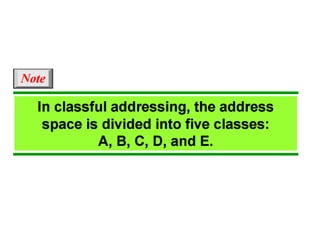
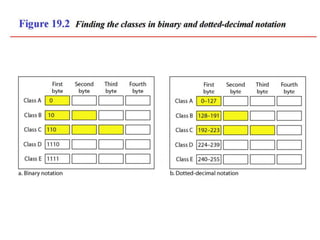
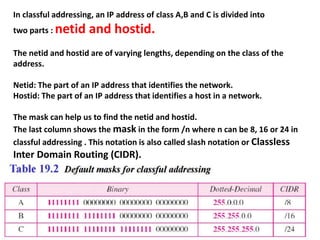
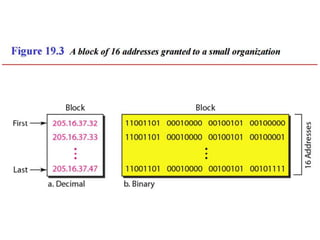
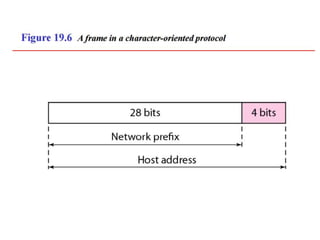
In classful addressing, an IP address of class A,B and C is divided into
two parts : netid and hostid.
The netid and hostid are of varying lengths, depending on the class of the
address.
Netid: The part of an IP address that identifies the network.
Hostid: The part of an IP address that identifies a host in a network.
The mask can help us to find the netid and hostid.
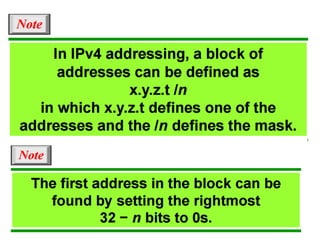
The last column shows the mask in the form /n where n can be 8, 16 or 24 in
classful addressing . This notation is also called slash notation or Classless
Inter Domain Routing (CIDR).
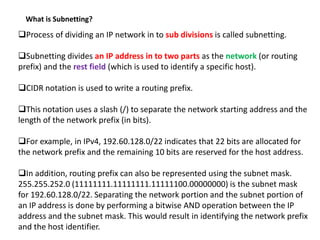
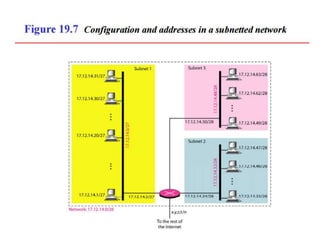
What is Subnetting?
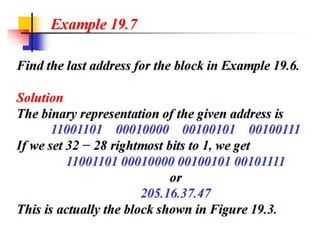
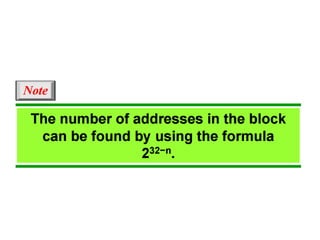
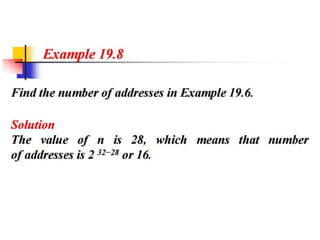
Process of dividing an IP network in to sub divisions is called subnetting.
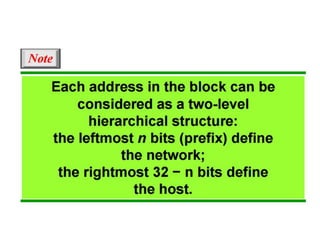
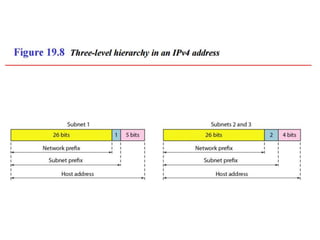
Subnetting divides an IP address in to two parts as the network (or routing
prefix) and the rest field (which is used to identify a specific host).
CIDR notation is used to write a routing prefix.
This notation uses a slash (/) to separate the network starting address and the
length of the network prefix (in bits).
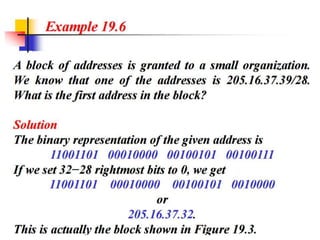
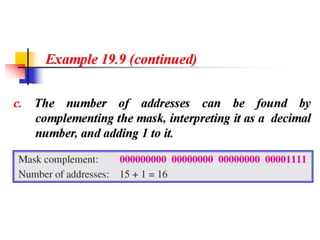
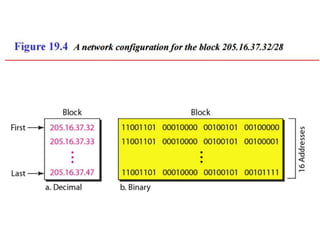
For example, in IPv4, 192.60.128.0/22 indicates that 22 bits are allocated for
the network prefix and the remaining 10 bits are reserved for the host address.
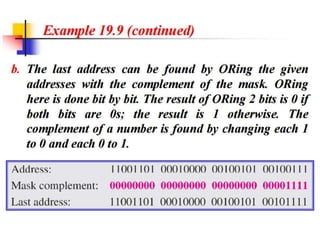
In addition, routing prefix can also be represented using the subnet mask.
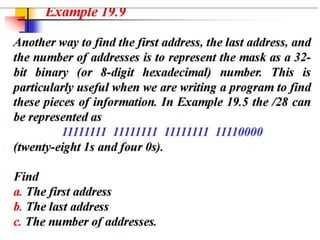
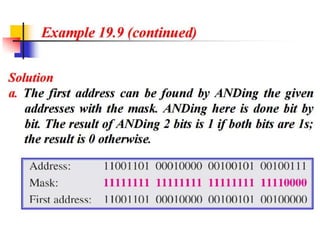
255.255.252.0 (11111111.11111111.11111100.00000000) is the subnet mask
for 192.60.128.0/22. Separating the network portion and the subnet portion of
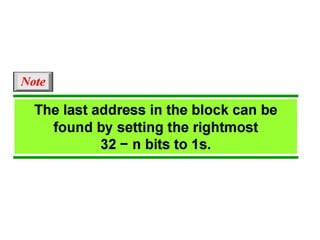
an IP address is done by performing a bitwise AND operation between the IP
address and the subnet mask. This would result in identifying the network prefix
and the host identifier.
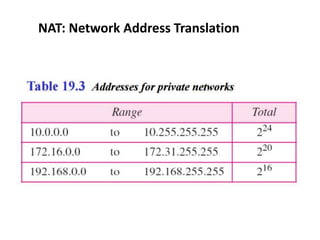
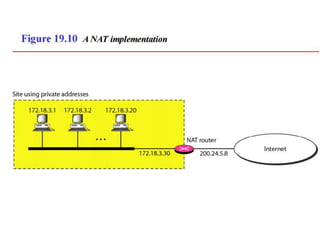
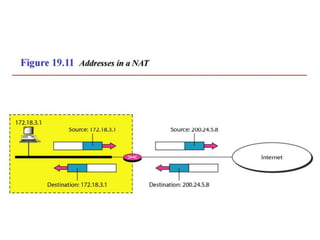
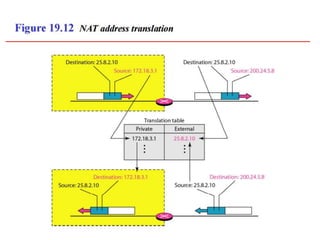
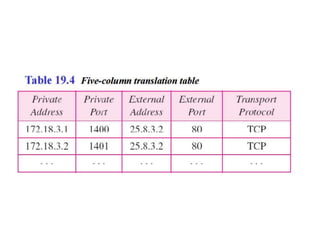
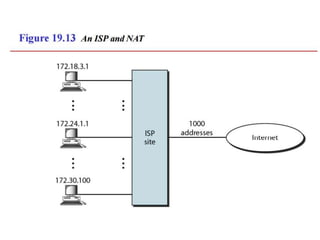
NAT: Network Address Translation
SYBSC IT COMPUTER NETWORKS UNIT IV Network Layer : Logical Addressing

SYBSC IT COMPUTER NETWORKS UNIT IV Network Layer : Logical Addressing

  • 1.
  • 12.
    In classful addressing,an IP address of class A,B and C is divided into two parts : netid and hostid. The netid and hostid are of varying lengths, depending on the class of the address. Netid: The part of an IP address that identifies the network. Hostid: The part of an IP address that identifies a host in a network. The mask can help us to find the netid and hostid. The last column shows the mask in the form /n where n can be 8, 16 or 24 in classful addressing . This notation is also called slash notation or Classless Inter Domain Routing (CIDR).
  • 14.
    What is Subnetting? Processof dividing an IP network in to sub divisions is called subnetting. Subnetting divides an IP address in to two parts as the network (or routing prefix) and the rest field (which is used to identify a specific host). CIDR notation is used to write a routing prefix. This notation uses a slash (/) to separate the network starting address and the length of the network prefix (in bits). For example, in IPv4, 192.60.128.0/22 indicates that 22 bits are allocated for the network prefix and the remaining 10 bits are reserved for the host address. In addition, routing prefix can also be represented using the subnet mask. 255.255.252.0 (11111111.11111111.11111100.00000000) is the subnet mask for 192.60.128.0/22. Separating the network portion and the subnet portion of an IP address is done by performing a bitwise AND operation between the IP address and the subnet mask. This would result in identifying the network prefix and the host identifier.
  • 39.