SWOT Analysis:
SWOT Analysis:
Strengths, Weaknesses,
Opportunities, and Threats
Patrick Weasel Head
Patrick Weasel Head
The University of Montana
Missoula, MT
Missoula, MT
What is a SWOT analysis and
why should you use one?
• A SWOT analysis guides you to identify the positives
A SWOT analysis guides you to identify the positives
and negatives inside your institution (S-W) and outside
of it, in the external environment (O-T).
• Developing a full awareness of your situation can help
Developing a full awareness of your situation can help
with both strategic planning and decision-making.
• The SWOT method was originally developed for
The SWOT method was originally developed for
business and industry, but it is equally useful in other
arenas, and even personal growth.
• SWOT is not the only assessment technique you can
SWOT is not the only assessment technique you can
use, but is one with a long track record of effectiveness.
The strengths of this method are its simplicity and
application to a variety of levels of operation.
When do you use SWOT?
• A SWOT analysis can offer helpful perspectives at any stage of
A SWOT analysis can offer helpful perspectives at any stage of
an effort. You might use it to:
– Explore possibilities for new efforts or solutions to problems.
Explore possibilities for new efforts or solutions to problems.
– Make decisions about the best path for your initiative. Identifying your
Make decisions about the best path for your initiative. Identifying your
opportunities for success in context of threats to success can clarify
directions and choices.
– Determine where change is possible. If you are at a point of making a
Determine where change is possible. If you are at a point of making a
decision, an inventory of your strengths and weaknesses can reveal
priorities as well as possibilities.
– Adjust and refine plans mid-course. A new opportunity might open wider
Adjust and refine plans mid-course. A new opportunity might open wider
avenues, while a new threat could close a path that once existed.
– SWOT also offers a simple way of communicating and is an excellent way
SWOT also offers a simple way of communicating and is an excellent way
to organize information you have gathered from studies or surveys.
What are the elements of a SWOT
analysis?
analysis?
• A SWOT analysis focuses on the four elements of the
A SWOT analysis focuses on the four elements of the
acronym, but the graphic format you use varies
depending on the depth and complexity of your effort.
• Remember that the purpose of performing a SWOT is
Remember that the purpose of performing a SWOT is
to reveal positive forces that work together and
potential problems that need to be addressed or at least
recognized. Before you conduct a SWOT session,
decide what format or layout you will use.
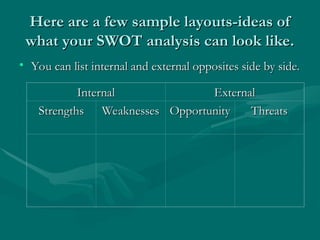
Here are a few sample layouts-ideas of
what your SWOT analysis can look like.
• You can list internal and external opposites side by side.
You can list internal and external opposites side by side.
Internal
Internal External
External
Strengths
Strengths Weaknesses
Weaknesses Opportunity
Opportunity Threats
Threats
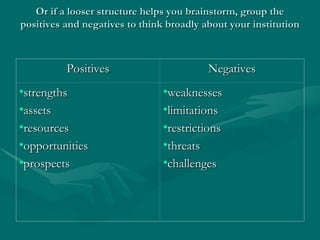
Or if a looser structure helps you brainstorm, group the
positives and negatives to think broadly about your institution
Positives
Positives Negatives
Negatives
•strengths
strengths
•assets
assets
•resources
resources
•opportunities
opportunities
•prospects
prospects
•weaknesses
weaknesses
•limitations
limitations
•restrictions
restrictions
•threats
threats
•challenges
challenges
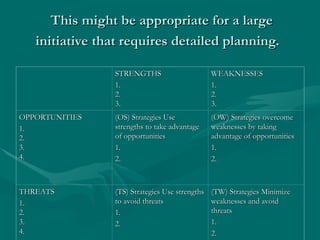
This might be appropriate for a large
initiative that requires detailed planning.
STRENGTHS
STRENGTHS
1.
1.
2.
2.
3.
3.
WEAKNESSES
WEAKNESSES
1.
1.
2.
2.
3.
3.
OPPORTUNITIES
OPPORTUNITIES
1.
1.
2.
2.
3.
3.
4.
4.
(OS) Strategies Use
(OS) Strategies Use
strengths to take advantage
of opportunities
of opportunities
1.
1.
2.
2.
(OW) Strategies overcome
weaknesses by taking
advantage of opportunities
1.
1.
2.
2.
THREATS
THREATS
1.
1.
2.
2.
3.
3.
4.
4.
(TS) Strategies Use strengths
to avoid threats
to avoid threats
1.
1.
2.
2.
(TW) Strategies Minimize
weaknesses and avoid
threats
threats
1.
1.
2.
2.
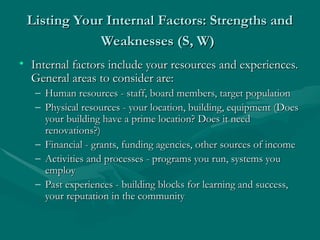
Listing Your Internal Factors: Strengths and
Weaknesses (S, W)
Weaknesses (S, W)
• Internal factors include your resources and experiences.
Internal factors include your resources and experiences.
General areas to consider are:
– Human resources - staff, board members, target population
Human resources - staff, board members, target population
– Physical resources - your location, building, equipment (Does
Physical resources - your location, building, equipment (Does
your building have a prime location? Does it need
renovations?)
renovations?)
– Financial - grants, funding agencies, other sources of income
Financial - grants, funding agencies, other sources of income
– Activities and processes - programs you run, systems you
Activities and processes - programs you run, systems you
employ
employ
– Past experiences - building blocks for learning and success,
Past experiences - building blocks for learning and success,
your reputation in the community
Listing External Factors:
Opportunities and Threats (O, T)
• Forces and facts that your group does not control include:
Forces and facts that your group does not control include:
– Future trends - in your field (On line courses?)
Future trends - in your field (On line courses?)
– The economy – tribal, local, national, or international
The economy – tribal, local, national, or international
– Funding sources - foundations, federal, tribal, donors,
Funding sources - foundations, federal, tribal, donors,
legislatures
legislatures
– Demographics - changes in the age, race, gender, culture of
Demographics - changes in the age, race, gender, culture of
those you serve or in your area
– The physical environment (Are you outgrowing your
The physical environment (Are you outgrowing your
buildings, older buildings, increased utilities?)
– Legislation (Do new tribal, state, federal, accreditation
Legislation (Do new tribal, state, federal, accreditation
requirements make your job harder-or easier?)
– Tribal, local, national or international events
Tribal, local, national or international events
Who develops the SWOT?
• The most common users are institutional members who are
The most common users are institutional members who are
responsible for decision-making and strategic planning.
• An individual or small group can develop a SWOT analysis, but
An individual or small group can develop a SWOT analysis, but
it will be more effective if you take advantage of many
stakeholders.
stakeholders.
• Each person or group offers a different perspective on the
Each person or group offers a different perspective on the
strengths and weaknesses and has different experiences of both.
• Likewise, one staff member, or stakeholder may have
Likewise, one staff member, or stakeholder may have
information about an opportunity or threat that is essential to
understanding your position and determining your future.
When and where do you develop a SWOT analysis?
• Is often created during a retreat or planning session that allows several hours for both brainstorming and more structured analysis.
Is often created during a retreat or planning session that allows several hours for both brainstorming and more structured analysis.
• The best results come when participants are encouraged to have an open attitude about possibilities.
The best results come when participants are encouraged to have an open attitude about possibilities.
• The tone when creating a SWOT analysis is usually collaborative and inclusive.
The tone when creating a SWOT analysis is usually collaborative and inclusive.
Designate a facilitator who has good listening and group process skills, and who can keep things moving and on track.
Designate a recorder to back up the leader if your group is large. Use newsprint on a flip chart or a large board to record the analysis and discussion points.
Introduce the SWOT method and its purpose in your institution. This can be as simple as asking,
Introduce the SWOT method and its purpose in your institution. This can be as simple as asking, Where are we, where can we go?
Where are we, where can we go?
Divide your stakeholders into smaller groups.
The size of these depends on the size of your entire group-breakout groups can range from three to ten.
Have each group designate a recorder, and provide each with newsprint or dry -erase board. Direct them to create a SWOT analysis in the format you choose-a chart, columns, a
matrix, or even a page for each quality.
How do you develop a SWOT
analysis?
analysis?
1.
1. Designate a facilitator who has good listening and group process
Designate a facilitator who has good listening and group process
skills, and who can keep things moving and on track.
2.
2. Designate a recorder to back up the leader if your group is large.
Designate a recorder to back up the leader if your group is large.
Use newsprint on a flip chart or a large board to record the
analysis and discussion points.
3.
3. Introduce the SWOT method and its purpose in your institution.
Introduce the SWOT method and its purpose in your institution.
This can be as simple as asking,
This can be as simple as asking, Where are we, where can we go?
Where are we, where can we go?
4.
4. Divide your stakeholders into smaller groups.
Divide your stakeholders into smaller groups.
5.
5. The size of these depends on the size of your entire group-
The size of these depends on the size of your entire group-
breakout groups can range from three to ten.
6.
6. Have each group designate a recorder, and provide each with
Have each group designate a recorder, and provide each with
newsprint or dry -erase board. Direct them to create a SWOT
analysis in the format you choose-a chart, columns, a matrix, or
even a page for each quality.
How do you use your SWOT
analysis?
analysis?
• Knowledge is indeed power, and knowing what
Knowledge is indeed power, and knowing what
the positives and negatives of your program are
puts you in a more powerful position for action.
While a SWOT analysis is not in itself action, it
can be a "support team" to help you:
– Identify the issues or problems you intend to change
Identify the issues or problems you intend to change
– Set or reaffirm goals
Set or reaffirm goals
– Create an action plan
Create an action plan
To Sum Up
To Sum Up
• A SWOT analysis identifies your S, W, O and T to
A SWOT analysis identifies your S, W, O and T to
assist you in making strategic plans and decisions.
• SWOT is a simple yet comprehensive way of assessing
SWOT is a simple yet comprehensive way of assessing
the positive and negative forces within and without
your organization, so you can be better prepared to act
effectively
effectively
• The SWOT analysis prompts you to move in a balanced
The SWOT analysis prompts you to move in a balanced
way throughout your program.
• A SWOT analysis will be most helpful if you use it to
A SWOT analysis will be most helpful if you use it to
support the vision and mission of your institution.

Marketing-SWOT-Analysis-PowerPoint-presentation.ppt

  • 1.
    SWOT Analysis: SWOT Analysis: Strengths,Weaknesses, Strengths, Weaknesses, Opportunities, and Threats Opportunities, and Threats Patrick Weasel Head Patrick Weasel Head The University of Montana The University of Montana Missoula, MT Missoula, MT
  • 2.
    What is aSWOT analysis and What is a SWOT analysis and why should you use one? why should you use one? • A SWOT analysis guides you to identify the positives A SWOT analysis guides you to identify the positives and negatives inside your institution (S-W) and outside and negatives inside your institution (S-W) and outside of it, in the external environment (O-T). of it, in the external environment (O-T). • Developing a full awareness of your situation can help Developing a full awareness of your situation can help with both strategic planning and decision-making. with both strategic planning and decision-making. • The SWOT method was originally developed for The SWOT method was originally developed for business and industry, but it is equally useful in other business and industry, but it is equally useful in other arenas, and even personal growth. arenas, and even personal growth. • SWOT is not the only assessment technique you can SWOT is not the only assessment technique you can use, but is one with a long track record of effectiveness. use, but is one with a long track record of effectiveness. The strengths of this method are its simplicity and The strengths of this method are its simplicity and application to a variety of levels of operation. application to a variety of levels of operation.
  • 3.
    When do youuse SWOT? When do you use SWOT? • A SWOT analysis can offer helpful perspectives at any stage of A SWOT analysis can offer helpful perspectives at any stage of an effort. You might use it to: an effort. You might use it to: – Explore possibilities for new efforts or solutions to problems. Explore possibilities for new efforts or solutions to problems. – Make decisions about the best path for your initiative. Identifying your Make decisions about the best path for your initiative. Identifying your opportunities for success in context of threats to success can clarify opportunities for success in context of threats to success can clarify directions and choices. directions and choices. – Determine where change is possible. If you are at a point of making a Determine where change is possible. If you are at a point of making a decision, an inventory of your strengths and weaknesses can reveal decision, an inventory of your strengths and weaknesses can reveal priorities as well as possibilities. priorities as well as possibilities. – Adjust and refine plans mid-course. A new opportunity might open wider Adjust and refine plans mid-course. A new opportunity might open wider avenues, while a new threat could close a path that once existed. avenues, while a new threat could close a path that once existed. – SWOT also offers a simple way of communicating and is an excellent way SWOT also offers a simple way of communicating and is an excellent way to organize information you have gathered from studies or surveys. to organize information you have gathered from studies or surveys.
  • 4.
    What are theelements of a SWOT What are the elements of a SWOT analysis? analysis? • A SWOT analysis focuses on the four elements of the A SWOT analysis focuses on the four elements of the acronym, but the graphic format you use varies acronym, but the graphic format you use varies depending on the depth and complexity of your effort. depending on the depth and complexity of your effort. • Remember that the purpose of performing a SWOT is Remember that the purpose of performing a SWOT is to reveal positive forces that work together and to reveal positive forces that work together and potential problems that need to be addressed or at least potential problems that need to be addressed or at least recognized. Before you conduct a SWOT session, recognized. Before you conduct a SWOT session, decide what format or layout you will use. decide what format or layout you will use.
  • 5.
    Here are afew sample layouts-ideas of Here are a few sample layouts-ideas of what your SWOT analysis can look like. what your SWOT analysis can look like. • You can list internal and external opposites side by side. You can list internal and external opposites side by side. Internal Internal External External Strengths Strengths Weaknesses Weaknesses Opportunity Opportunity Threats Threats
  • 6.
    Or if alooser structure helps you brainstorm, group the Or if a looser structure helps you brainstorm, group the positives and negatives to think broadly about your institution positives and negatives to think broadly about your institution Positives Positives Negatives Negatives •strengths strengths •assets assets •resources resources •opportunities opportunities •prospects prospects •weaknesses weaknesses •limitations limitations •restrictions restrictions •threats threats •challenges challenges
  • 7.
    This might beappropriate for a large This might be appropriate for a large initiative that requires detailed planning. initiative that requires detailed planning. STRENGTHS STRENGTHS 1. 1. 2. 2. 3. 3. WEAKNESSES WEAKNESSES 1. 1. 2. 2. 3. 3. OPPORTUNITIES OPPORTUNITIES 1. 1. 2. 2. 3. 3. 4. 4. (OS) Strategies Use (OS) Strategies Use strengths to take advantage strengths to take advantage of opportunities of opportunities 1. 1. 2. 2. (OW) Strategies overcome (OW) Strategies overcome weaknesses by taking weaknesses by taking advantage of opportunities advantage of opportunities 1. 1. 2. 2. THREATS THREATS 1. 1. 2. 2. 3. 3. 4. 4. (TS) Strategies Use strengths (TS) Strategies Use strengths to avoid threats to avoid threats 1. 1. 2. 2. (TW) Strategies Minimize (TW) Strategies Minimize weaknesses and avoid weaknesses and avoid threats threats 1. 1. 2. 2.
  • 8.
    Listing Your InternalFactors: Strengths and Listing Your Internal Factors: Strengths and Weaknesses (S, W) Weaknesses (S, W) • Internal factors include your resources and experiences. Internal factors include your resources and experiences. General areas to consider are: General areas to consider are: – Human resources - staff, board members, target population Human resources - staff, board members, target population – Physical resources - your location, building, equipment (Does Physical resources - your location, building, equipment (Does your building have a prime location? Does it need your building have a prime location? Does it need renovations?) renovations?) – Financial - grants, funding agencies, other sources of income Financial - grants, funding agencies, other sources of income – Activities and processes - programs you run, systems you Activities and processes - programs you run, systems you employ employ – Past experiences - building blocks for learning and success, Past experiences - building blocks for learning and success, your reputation in the community your reputation in the community
  • 9.
    Listing External Factors: ListingExternal Factors: Opportunities and Threats (O, T) Opportunities and Threats (O, T) • Forces and facts that your group does not control include: Forces and facts that your group does not control include: – Future trends - in your field (On line courses?) Future trends - in your field (On line courses?) – The economy – tribal, local, national, or international The economy – tribal, local, national, or international – Funding sources - foundations, federal, tribal, donors, Funding sources - foundations, federal, tribal, donors, legislatures legislatures – Demographics - changes in the age, race, gender, culture of Demographics - changes in the age, race, gender, culture of those you serve or in your area those you serve or in your area – The physical environment (Are you outgrowing your The physical environment (Are you outgrowing your buildings, older buildings, increased utilities?) buildings, older buildings, increased utilities?) – Legislation (Do new tribal, state, federal, accreditation Legislation (Do new tribal, state, federal, accreditation requirements make your job harder-or easier?) requirements make your job harder-or easier?) – Tribal, local, national or international events Tribal, local, national or international events
  • 10.
    Who develops theSWOT? Who develops the SWOT? • The most common users are institutional members who are The most common users are institutional members who are responsible for decision-making and strategic planning. responsible for decision-making and strategic planning. • An individual or small group can develop a SWOT analysis, but An individual or small group can develop a SWOT analysis, but it will be more effective if you take advantage of many it will be more effective if you take advantage of many stakeholders. stakeholders. • Each person or group offers a different perspective on the Each person or group offers a different perspective on the strengths and weaknesses and has different experiences of both. strengths and weaknesses and has different experiences of both. • Likewise, one staff member, or stakeholder may have Likewise, one staff member, or stakeholder may have information about an opportunity or threat that is essential to information about an opportunity or threat that is essential to understanding your position and determining your future. understanding your position and determining your future.
  • 11.
    When and wheredo you develop a SWOT analysis? When and where do you develop a SWOT analysis? • Is often created during a retreat or planning session that allows several hours for both brainstorming and more structured analysis. Is often created during a retreat or planning session that allows several hours for both brainstorming and more structured analysis. • The best results come when participants are encouraged to have an open attitude about possibilities. The best results come when participants are encouraged to have an open attitude about possibilities. • The tone when creating a SWOT analysis is usually collaborative and inclusive. The tone when creating a SWOT analysis is usually collaborative and inclusive. Designate a facilitator who has good listening and group process skills, and who can keep things moving and on track. Designate a facilitator who has good listening and group process skills, and who can keep things moving and on track. Designate a recorder to back up the leader if your group is large. Use newsprint on a flip chart or a large board to record the analysis and discussion points. Designate a recorder to back up the leader if your group is large. Use newsprint on a flip chart or a large board to record the analysis and discussion points. Introduce the SWOT method and its purpose in your institution. This can be as simple as asking, Introduce the SWOT method and its purpose in your institution. This can be as simple as asking, Where are we, where can we go? Where are we, where can we go? Divide your stakeholders into smaller groups. Divide your stakeholders into smaller groups. The size of these depends on the size of your entire group-breakout groups can range from three to ten. The size of these depends on the size of your entire group-breakout groups can range from three to ten. Have each group designate a recorder, and provide each with newsprint or dry -erase board. Direct them to create a SWOT analysis in the format you choose-a chart, columns, a Have each group designate a recorder, and provide each with newsprint or dry -erase board. Direct them to create a SWOT analysis in the format you choose-a chart, columns, a matrix, or even a page for each quality. matrix, or even a page for each quality.
  • 12.
    How do youdevelop a SWOT How do you develop a SWOT analysis? analysis? 1. 1. Designate a facilitator who has good listening and group process Designate a facilitator who has good listening and group process skills, and who can keep things moving and on track. skills, and who can keep things moving and on track. 2. 2. Designate a recorder to back up the leader if your group is large. Designate a recorder to back up the leader if your group is large. Use newsprint on a flip chart or a large board to record the Use newsprint on a flip chart or a large board to record the analysis and discussion points. analysis and discussion points. 3. 3. Introduce the SWOT method and its purpose in your institution. Introduce the SWOT method and its purpose in your institution. This can be as simple as asking, This can be as simple as asking, Where are we, where can we go? Where are we, where can we go? 4. 4. Divide your stakeholders into smaller groups. Divide your stakeholders into smaller groups. 5. 5. The size of these depends on the size of your entire group- The size of these depends on the size of your entire group- breakout groups can range from three to ten. breakout groups can range from three to ten. 6. 6. Have each group designate a recorder, and provide each with Have each group designate a recorder, and provide each with newsprint or dry -erase board. Direct them to create a SWOT newsprint or dry -erase board. Direct them to create a SWOT analysis in the format you choose-a chart, columns, a matrix, or analysis in the format you choose-a chart, columns, a matrix, or even a page for each quality. even a page for each quality.
  • 13.
    How do youuse your SWOT How do you use your SWOT analysis? analysis? • Knowledge is indeed power, and knowing what Knowledge is indeed power, and knowing what the positives and negatives of your program are the positives and negatives of your program are puts you in a more powerful position for action. puts you in a more powerful position for action. While a SWOT analysis is not in itself action, it While a SWOT analysis is not in itself action, it can be a "support team" to help you: can be a "support team" to help you: – Identify the issues or problems you intend to change Identify the issues or problems you intend to change – Set or reaffirm goals Set or reaffirm goals – Create an action plan Create an action plan
  • 14.
    To Sum Up ToSum Up • A SWOT analysis identifies your S, W, O and T to A SWOT analysis identifies your S, W, O and T to assist you in making strategic plans and decisions. assist you in making strategic plans and decisions. • SWOT is a simple yet comprehensive way of assessing SWOT is a simple yet comprehensive way of assessing the positive and negative forces within and without the positive and negative forces within and without your organization, so you can be better prepared to act your organization, so you can be better prepared to act effectively effectively • The SWOT analysis prompts you to move in a balanced The SWOT analysis prompts you to move in a balanced way throughout your program. way throughout your program. • A SWOT analysis will be most helpful if you use it to A SWOT analysis will be most helpful if you use it to support the vision and mission of your institution. support the vision and mission of your institution.