SWOT Analysis
SWOT = Strengths, Weaknesses,
Opportunities, Threats
•	 Strengths: attributes that are helpful to achieving 	
your objectives.
•	 Weaknesses: attributes that are harmful to achieving
your objectives.
•	 Opportunities: external conditions that are helpful 	
to achieving your objectives.
•	 Threats: external conditions that are harmful to
achieving your objectives.
SWOT Examples:
Strengths and Weaknesses Examples
(INTERNAL):
•	 Opportunity—financial, intellectual, location
•	 Perceptions of Capacity/Self Confidence
•	 Attributes
•	 Relationships with others
•	 Ethics
•	 Principles
•	 Reputation
•	 Subject areas (identify these)
•	 Activities and processes—systems you employ
•	 Past experiences—building blocks for learning and
success (educational, work, volunteer, civic 	
engagement, family dynamics, etc.)
•	 Poor habits
•	 Lack of motivation
•	 Inability to prioritize
Don’t be modest when listing your strengths and
weaknesses. Also, consider how others perceive you.
Opportunities and Threats Examples
(EXTERNAL):
•	 People—friends, family, professors, staff, others in 	
your network
•	 Resources—financial, academic, location
•	 Events
•	 Political/legal
•	 Economic condition
•	 Expectations of others
•	 Technology
•	 Criticism
•	 Competitors and competitive actions
•	 Collaboration
Assessing SWOTs
Look for a “stretch,” not just a “fit.”  You can use SWOT
to justify a course that has already been decided upon,
but if your goal is to grow or improve, you will want to use
it differently.
•	 Come to a conclusion about the most important items
in each category
•	 Relate the analysis to your vision, mission, and goals
•	 What have you already done to move towards
your goal? Talked? Researched? What’s holding
you back from going further?
•	 Translate the analysis to action plans and strategies.
•	 Identify the issues or problems you intend to change
(and the ones you can change)
•	 Set or reaffirm goals
•	 Create an action plan
The Strengths, Weaknesses, Opportunities
and Threats analysis (SWOT) is a simple yet
comprehensive way of assessing the positive and
negative forces that are internal and external.
Whatever courses of action you decide on, the four-
cornered SWOT analysis prompts you to set and take
on goals in a balanced way.
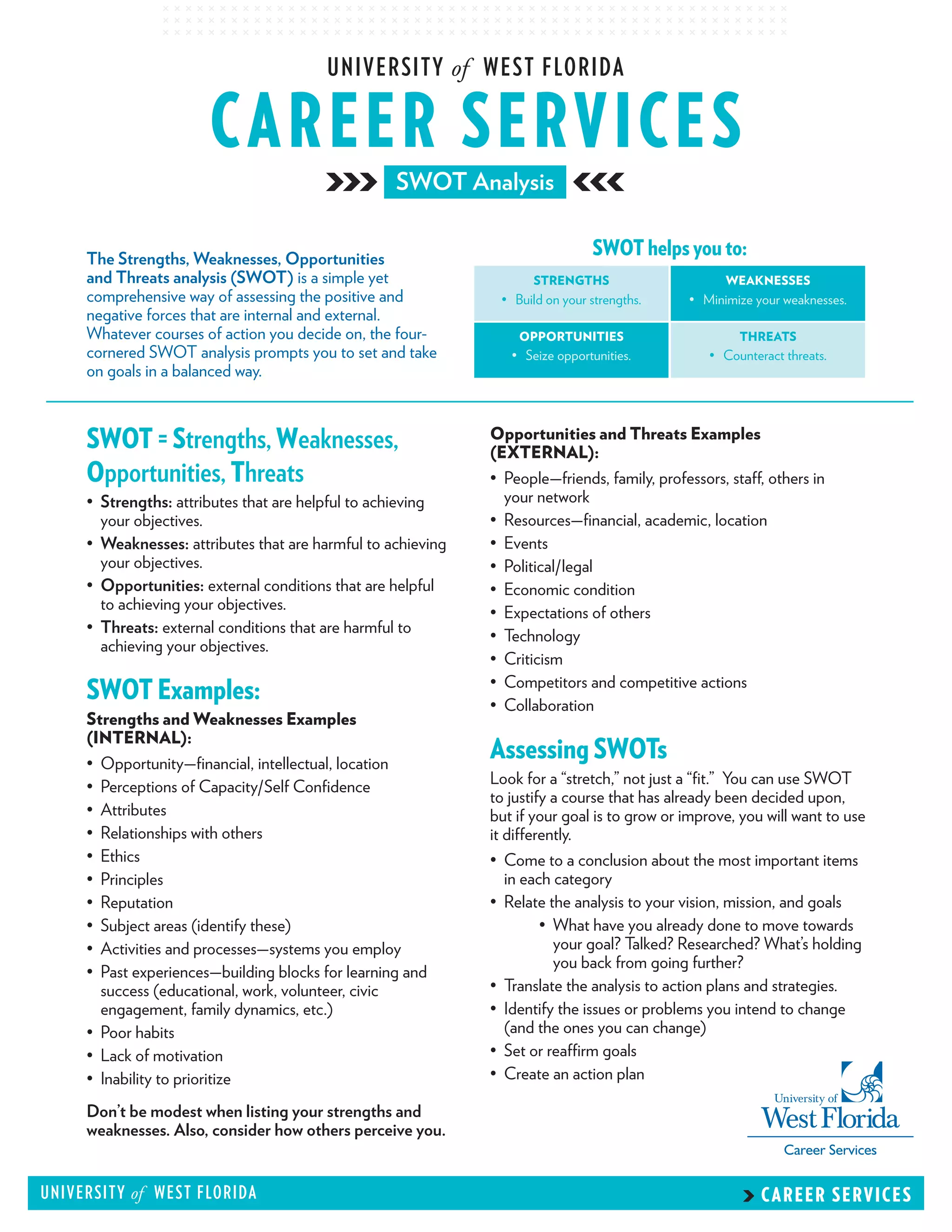
SWOT helps you to:
STRENGTHS
OPPORTUNITIES
WEAKNESSES
THREATS
•	 Build on your strengths. •	 Minimize your weaknesses.
•	 Seize opportunities. •	 Counteract threats.

SWOTAnalysis

  • 1.
    SWOT Analysis SWOT =Strengths, Weaknesses, Opportunities, Threats • Strengths: attributes that are helpful to achieving your objectives. • Weaknesses: attributes that are harmful to achieving your objectives. • Opportunities: external conditions that are helpful to achieving your objectives. • Threats: external conditions that are harmful to achieving your objectives. SWOT Examples: Strengths and Weaknesses Examples (INTERNAL): • Opportunity—financial, intellectual, location • Perceptions of Capacity/Self Confidence • Attributes • Relationships with others • Ethics • Principles • Reputation • Subject areas (identify these) • Activities and processes—systems you employ • Past experiences—building blocks for learning and success (educational, work, volunteer, civic engagement, family dynamics, etc.) • Poor habits • Lack of motivation • Inability to prioritize Don’t be modest when listing your strengths and weaknesses. Also, consider how others perceive you. Opportunities and Threats Examples (EXTERNAL): • People—friends, family, professors, staff, others in your network • Resources—financial, academic, location • Events • Political/legal • Economic condition • Expectations of others • Technology • Criticism • Competitors and competitive actions • Collaboration Assessing SWOTs Look for a “stretch,” not just a “fit.” You can use SWOT to justify a course that has already been decided upon, but if your goal is to grow or improve, you will want to use it differently. • Come to a conclusion about the most important items in each category • Relate the analysis to your vision, mission, and goals • What have you already done to move towards your goal? Talked? Researched? What’s holding you back from going further? • Translate the analysis to action plans and strategies. • Identify the issues or problems you intend to change (and the ones you can change) • Set or reaffirm goals • Create an action plan The Strengths, Weaknesses, Opportunities and Threats analysis (SWOT) is a simple yet comprehensive way of assessing the positive and negative forces that are internal and external. Whatever courses of action you decide on, the four- cornered SWOT analysis prompts you to set and take on goals in a balanced way. SWOT helps you to: STRENGTHS OPPORTUNITIES WEAKNESSES THREATS • Build on your strengths. • Minimize your weaknesses. • Seize opportunities. • Counteract threats.