SWOT Analysis
Outline
What is SWOT Analysis
Aim of SWOT Analysis
Who needs SWOT Analysis
How to conduct SWOT Analysis
Benefits & Drawbacks of SWOT Analysis
Brainstorming & Prioritization in SWOT Analysis
Tips & Exercise for SWOT Analysis
Strengths
SWOT
Analysis
Strengths
Oppurtunity Weakness
Threats
Acronym for Strengths,
Weaknesses, Opportunities and
Threats.
Technique is credited to Albert S
Humphrey who led a research
project at Stanford University in the
1960s and 1970s.
Planning tool used to understand
Strengths, Weaknesses,
Opportunities, & Threats involved in
an organisation.
What is SWOT Analysis
Used as framework.
Technique that enables a Team or
Individual to move from everyday
problems to a fresh perspective.
What is SWOT Analysis
Strengths - Internal factors that are favorable for achieving organisation’s
success.
Weaknesses - Internal factors that are unfavorable for achieving organisation’s
success.
Opportunities - External factors that are favorable for achieving organisation’s
success.
Threats - External factors that are unfavorable for achieving organisation’s
success.
STRENGTHS
Characteristics of a team or the business that
give it an advantage over others in the industry.
Positive tangible and intangible attributes, internal
to an organization.
Beneficial aspects of the organization or the capabilities
of an organization which includes human competencies,
process capabilities, financial resources, products and
services, customer goodwill and brand loyalty.
What is SWOT Analysis
WEAKNESSES
Characteristics that place the firm at a disadvantage
relative to others
Impatience
Fear
Stubbornness
Greed
What is SWOT Analysis
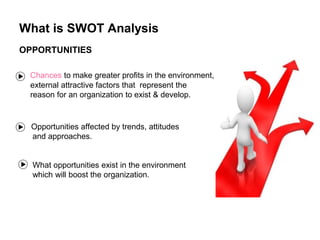
OPPORTUNITIES
Chances to make greater profits in the environment,
external attractive factors that represent the
reason for an organization to exist & develop.
Opportunities affected by trends, attitudes
and approaches.
What opportunities exist in the environment
which will boost the organization.
What is SWOT Analysis
THREATS
External elements in the environment that could cause trouble
for the business.
An external condition which could damage the
scope for attaining objectives.
Entry of foreign competitors
S
W
TO
To help decision makers
share and compare ideas.
To bring a clearer common
purpose and understanding
of factors for success.
To organize the important
factors linked to success and
failure in the business world.
To analyze issues that have
led to failure in the past.
Aim of SWOT Analysis
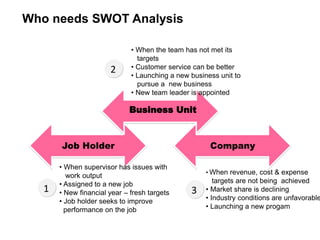
Job Holder
• When supervisor has issues with
work output
• Assigned to a new job
• New financial year – fresh targets
• Job holder seeks to improve
performance on the job
1
Business Unit
2
• When the team has not met its
targets
• Customer service can be better
• Launching a new business unit to
pursue a new business
• New team leader is appointed
Company
• When revenue, cost & expense
targets are not being achieved
• Market share is declining
• Industry conditions are unfavorable
• Launching a new progam
3
Who needs SWOT Analysis
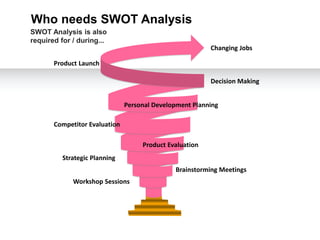
Workshop Sessions
Brainstorming Meetings
Strategic Planning
Product Evaluation
Competitor Evaluation
Personal Development Planning
Decision Making
Product Launch
Changing Jobs
Who needs SWOT Analysis
SWOT Analysis is also
required for / during...
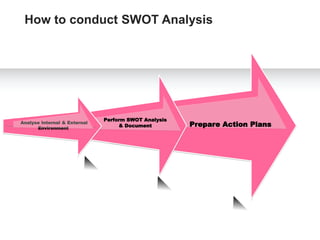
Prepare Action Plans
Perform SWOT Analysis
& Document
Analyse Internal & External
Environment
How to conduct SWOT Analysis
Analyse Internal & External Environment
Carry your findings forward - Make sure that the
SWOT analysis is used in subsequent planning.
Revisit your findings at suitable time intervals.
Create a workshop
environment - Encourage an
atmosphere conducive to the free
flow of information.
Allocate research & information gathering
tasks - Background preparation can be
carried out in two stages – Exploratory and
Detailed. Information on Strengths &
Weaknesses should focus on the internal
factors & information on Opportunities &
Threats should focus on the external factors.
Select contributors -
Expert opinion may be
required for SWOT
Evaluate listed ideas against
Objectives - With the lists compiled,
sort and group facts and ideas in
relation to the objectives.
List Strengths, Weaknesses,
Opportunities & Threats
How to conduct SWOT Analysis
Establish the objectives - Purpose of conducting a SWOT may be wide
/ narrow, general / specific.
How to conduct SWOT Analysis?
Prepare Action Plan
Things that MUST be addressed immediately
Once the SWOT analysis has been completed, mark each point with:
Things that can be handled now
Things that should be researched further
Things that should be planned for the future
Benefits & Pitfalls of SWOT Analysis
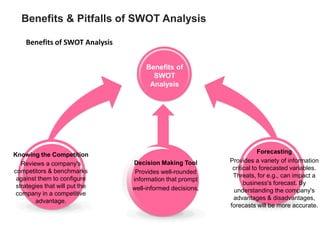
Benefits of SWOT Analysis
Forecasting
Provides a variety of information
critical to forecasted variables.
Threats, for e.g., can impact a
business's forecast. By
understanding the company's
advantages & disadvantages,
forecasts will be more accurate.
Decision Making Tool
Provides well-rounded
information that prompt
well-informed decisions.
Knowing the Competition
Reviews a company's
competitors & benchmarks
against them to configure
strategies that will put the
company in a competitive
advantage.
Benefits of
SWOT
Analysis
Benefits & Pitfalls of SWOT Analysis
Benefits of SWOT Analysis
Helps in setting of objectives for strategic planning
Besides the broad benefits, here are few more benefits of conducting SWOT
Analysis:
Provides a framework for identifying & analyzing strengths, weaknesses,
opportunities & threats
Provides an impetus to analyze a situation & develop suitable strategies
and tactics
Brainstorming
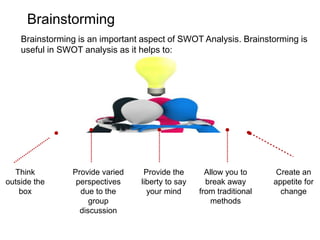
Brainstorming is an important aspect of SWOT Analysis. Brainstorming is
useful in SWOT analysis as it helps to:
Think
outside the
box
Provide varied
perspectives
due to the
group
discussion
••
Provide the
liberty to say
your mind
••
Allow you to
break away
from traditional
methods
••
Create an
appetite for
change
Tips & Exercise
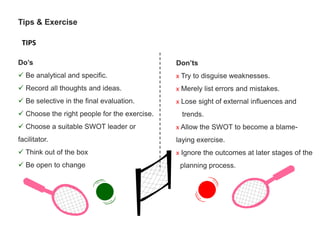
Do’s
 Be analytical and specific.
 Record all thoughts and ideas.
 Be selective in the final evaluation.
 Choose the right people for the exercise.
 Choose a suitable SWOT leader or
facilitator.
 Think out of the box
 Be open to change
Don’ts
х Try to disguise weaknesses.
х Merely list errors and mistakes.
х Lose sight of external influences and
trends.
х Allow the SWOT to become a blame-
laying exercise.
х Ignore the outcomes at later stages of the
planning process.
TIPS
swot analysis

swot analysis

  • 1.
  • 2.
    Outline What is SWOTAnalysis Aim of SWOT Analysis Who needs SWOT Analysis How to conduct SWOT Analysis Benefits & Drawbacks of SWOT Analysis Brainstorming & Prioritization in SWOT Analysis Tips & Exercise for SWOT Analysis
  • 3.
    Strengths SWOT Analysis Strengths Oppurtunity Weakness Threats Acronym forStrengths, Weaknesses, Opportunities and Threats. Technique is credited to Albert S Humphrey who led a research project at Stanford University in the 1960s and 1970s. Planning tool used to understand Strengths, Weaknesses, Opportunities, & Threats involved in an organisation. What is SWOT Analysis Used as framework. Technique that enables a Team or Individual to move from everyday problems to a fresh perspective.
  • 4.
    What is SWOTAnalysis Strengths - Internal factors that are favorable for achieving organisation’s success. Weaknesses - Internal factors that are unfavorable for achieving organisation’s success. Opportunities - External factors that are favorable for achieving organisation’s success. Threats - External factors that are unfavorable for achieving organisation’s success.
  • 5.
    STRENGTHS Characteristics of ateam or the business that give it an advantage over others in the industry. Positive tangible and intangible attributes, internal to an organization. Beneficial aspects of the organization or the capabilities of an organization which includes human competencies, process capabilities, financial resources, products and services, customer goodwill and brand loyalty. What is SWOT Analysis
  • 6.
    What is SWOTAnalysis WEAKNESSES Characteristics that place the firm at a disadvantage relative to others Impatience Fear Stubbornness Greed
  • 7.
    What is SWOTAnalysis OPPORTUNITIES Chances to make greater profits in the environment, external attractive factors that represent the reason for an organization to exist & develop. Opportunities affected by trends, attitudes and approaches. What opportunities exist in the environment which will boost the organization.
  • 8.
    What is SWOTAnalysis THREATS External elements in the environment that could cause trouble for the business. An external condition which could damage the scope for attaining objectives. Entry of foreign competitors
  • 9.
    S W TO To help decisionmakers share and compare ideas. To bring a clearer common purpose and understanding of factors for success. To organize the important factors linked to success and failure in the business world. To analyze issues that have led to failure in the past. Aim of SWOT Analysis
  • 10.
    Job Holder • Whensupervisor has issues with work output • Assigned to a new job • New financial year – fresh targets • Job holder seeks to improve performance on the job 1 Business Unit 2 • When the team has not met its targets • Customer service can be better • Launching a new business unit to pursue a new business • New team leader is appointed Company • When revenue, cost & expense targets are not being achieved • Market share is declining • Industry conditions are unfavorable • Launching a new progam 3 Who needs SWOT Analysis
  • 11.
    Workshop Sessions Brainstorming Meetings StrategicPlanning Product Evaluation Competitor Evaluation Personal Development Planning Decision Making Product Launch Changing Jobs Who needs SWOT Analysis SWOT Analysis is also required for / during...
  • 12.
    Prepare Action Plans PerformSWOT Analysis & Document Analyse Internal & External Environment How to conduct SWOT Analysis
  • 13.
    How to conductSWOT Analysis Analyse Internal & External Environment
  • 14.
    Carry your findingsforward - Make sure that the SWOT analysis is used in subsequent planning. Revisit your findings at suitable time intervals. Create a workshop environment - Encourage an atmosphere conducive to the free flow of information. Allocate research & information gathering tasks - Background preparation can be carried out in two stages – Exploratory and Detailed. Information on Strengths & Weaknesses should focus on the internal factors & information on Opportunities & Threats should focus on the external factors. Select contributors - Expert opinion may be required for SWOT Evaluate listed ideas against Objectives - With the lists compiled, sort and group facts and ideas in relation to the objectives. List Strengths, Weaknesses, Opportunities & Threats How to conduct SWOT Analysis Establish the objectives - Purpose of conducting a SWOT may be wide / narrow, general / specific.
  • 15.
    How to conductSWOT Analysis? Prepare Action Plan Things that MUST be addressed immediately Once the SWOT analysis has been completed, mark each point with: Things that can be handled now Things that should be researched further Things that should be planned for the future
  • 16.
    Benefits & Pitfallsof SWOT Analysis Benefits of SWOT Analysis Forecasting Provides a variety of information critical to forecasted variables. Threats, for e.g., can impact a business's forecast. By understanding the company's advantages & disadvantages, forecasts will be more accurate. Decision Making Tool Provides well-rounded information that prompt well-informed decisions. Knowing the Competition Reviews a company's competitors & benchmarks against them to configure strategies that will put the company in a competitive advantage. Benefits of SWOT Analysis
  • 17.
    Benefits & Pitfallsof SWOT Analysis Benefits of SWOT Analysis Helps in setting of objectives for strategic planning Besides the broad benefits, here are few more benefits of conducting SWOT Analysis: Provides a framework for identifying & analyzing strengths, weaknesses, opportunities & threats Provides an impetus to analyze a situation & develop suitable strategies and tactics
  • 18.
    Brainstorming Brainstorming is animportant aspect of SWOT Analysis. Brainstorming is useful in SWOT analysis as it helps to: Think outside the box Provide varied perspectives due to the group discussion •• Provide the liberty to say your mind •• Allow you to break away from traditional methods •• Create an appetite for change
  • 19.
    Tips & Exercise Do’s Be analytical and specific.  Record all thoughts and ideas.  Be selective in the final evaluation.  Choose the right people for the exercise.  Choose a suitable SWOT leader or facilitator.  Think out of the box  Be open to change Don’ts х Try to disguise weaknesses. х Merely list errors and mistakes. х Lose sight of external influences and trends. х Allow the SWOT to become a blame- laying exercise. х Ignore the outcomes at later stages of the planning process. TIPS