SWOC DAMA 2008 Showcase at  American Modern Insurance February 21, 2008
Showcase Agenda Background/Business Case  20 minutes Sandy Wagner Data Warehouse – AIIM  20 minutes Latha Subramanian Data Model – AIIM  20 minutes Duke Ganote Information Management – AIIM 20 minutes Dan Daly Q& A – Duke/Sandy/Latha/Dan  20 minutes
American Modern Insurance Company Background   Founded in 1938 as a consumer finance company Provider of highly focused, specialty insurance products Positioned to grow into a multi-billion dollar organization Entrepreneurial spirit & deep commitment of employees Approximately 1200 employees country-wide, with 1000  employees in eastern Cincinnati area (Amelia)
American Modern Insurance Company Background The organization believes that the strategic deployment of technology can help it achieve, and sustain, a competitive advantage.  As stated in its Operating Principles, “Our investment in information technology is part of a carefully planned strategy to ensure that American Modern's company-wide infrastructure is among the most advanced in the specialty insurance industry.”
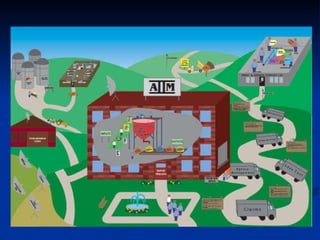
American Modern Insurance Initiative Background In 2000, American Modern embarked upon long-range initiative, coined “modernLINK,” Business and IT collaboration Business case and funding Three prongs: Web-enable insurance transaction processing Replace aging legacy processing systems  Develop a Knowledge Management architecture
American Modern Insurance Business Case The anticipated returns of this business case were: 20% annual increases in directly-attributed new business 37% of Policy and Partner Administration moved from existing internal units directly to point of service  25% improvement in current Product Review and Management cycle time 21% improvement in Product Filings cycle time 2% reduction in total loss ratio directly attributed to modernLINK initiative
American Modern Insurance Business Case These returns would yield a significant recurring annual benefit through additional premium, increased profit, and decreased expenses Almost 50% of these benefits would be attained through better knowledge/data management, richer data segmentation, and improved data and risk selection John Hayden, President and CEO, American Modern states: We must have accurate data about the risks we insure today if we are to ever be successful in establishing The Right Rate for Every Risk we choose to insure in the future.
American Modern Insurance Knowledge Management Roadmap Enterprise Data Model Operational Data Store Enterprise Data Warehouse Themed analytic data marts Enterprise reporting portal Metadata management  Data Stewardship
 
American Modern Insurance Knowledge Management Results Business users can: Make informed decisions Respond quickly to new business initiatives Create new opportunities Business users are: Moving from data collectors to data consumers Asking “why” instead of “what”
American Modern Insurance Knowledge Management Results Retention – Joe David.   In the last four years, we have leveraged the corporate reporting tools to develop a series of targeted strategies that have allowed us to improve retention by nearly eight points, which equates to annualized premium of nearly $60 million   Claims. Integration of 3 rd  party Claim data - Heather Bolyard.  This one-month sample of data for one material has identified a potential indemnity reduction of $70,000.   Reserving – Gene Stetler.  The new Loss Reserving data store from the Enterprise Data Warehouse has enabled process efficiencies, thus allowing us to predict our reserving needs with accuracy. Product – Kevin Randall.  The implementation of American Modern's data warehouse has been a significant part of the successful launch of the company's right rate for every risk initiative
American Modern Insurance 2007 Awards and Recognition In 2007, American Modern received two awards from Computerworld: Laureate  - The laureate status for the Enterprise Data Warehouse presented at the Carnegie Mellon Auditorium in Washington D.C – June 2007 BI Award  - Best Practices in Business Intelligence in the category “Creating an Agile BI Infrastructure” presented in Las Vegas, NV – September 2007
Showcase Agenda Background/Business Case  20 minutes Sandy Wagner Data Warehouse – AIIM  20 minutes Latha Subramanian Data Model – AIIM  20 minutes Duke Ganote Information Management – AIIM 20 minutes Dan Daly Q& A – Duke/Sandy/Latha/Dan  20 minutes
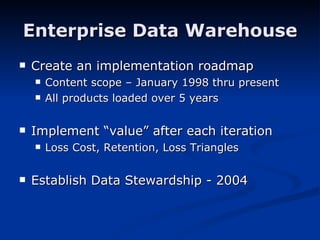
Enterprise Data Warehouse Create an implementation roadmap Content scope – January 1998 thru present All products loaded over 5 years Implement “value” after each iteration Loss Cost, Retention, Loss Triangles Establish Data Stewardship - 2004
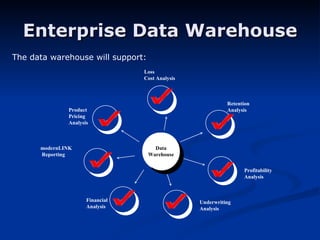
Enterprise Data Warehouse The data warehouse will support: Loss  Cost Analysis Retention Analysis modernLINK Reporting Profitability Analysis Data Warehouse Underwriting Analysis Product Pricing Analysis Financial Analysis
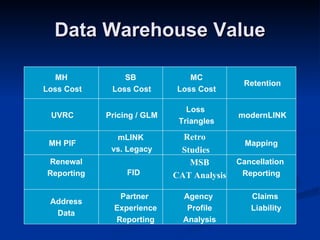
Data Warehouse Value MH Loss Cost SB  Loss Cost MC Loss Cost Retention UVRC Pricing / GLM Loss  Triangles modernLINK MH PIF mLINK vs. Legacy Retro Studies Mapping Renewal Reporting FID  MSB CAT Analysis Cancellation  Reporting Address Data Agency  Profile Analysis Claims  Liability Partner  Experience Reporting
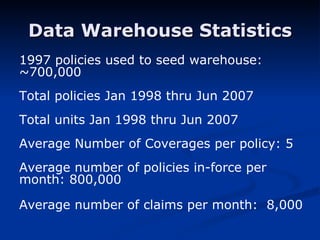
Data Warehouse Statistics 1997 policies used to seed warehouse:  ~700,000 Total policies Jan 1998 thru Jun 2007  Total units Jan 1998 thru Jun 2007 Average Number of Coverages per policy: 5 Average number of policies in-force per month: 800,000 Average number of claims per month:  8,000
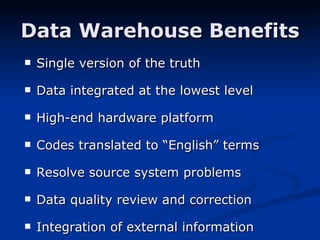
Data Warehouse Benefits Single version of the truth Data integrated at the lowest level High-end hardware platform Codes translated to “English” terms Resolve source system problems Data quality review and correction Integration of external information
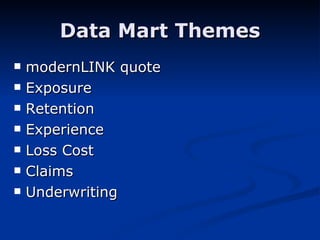
Data Mart Themes modernLINK quote  Exposure Retention Experience Loss Cost Claims Underwriting
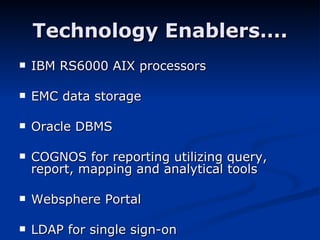
Technology Enablers…. IBM RS6000 AIX processors EMC data storage Oracle DBMS COGNOS for reporting utilizing query, report, mapping and analytical tools  Websphere Portal LDAP for single sign-on
Showcase Agenda Background/Business Case  20 minutes Sandy Wagner Data Warehouse – AIIM  20 minutes Latha Subramanian Data Model – AIIM  20 minutes Duke Ganote Information Management – AIIM 20 minutes Dan Daly Q& A – Duke/Sandy/Latha/Dan  20 minutes
Data Model  Provides a common, integrated way for the corporation to view and to communicate about its business Allows the business to drive the system Creates standard definitions/documentation Provides structure to new development projects
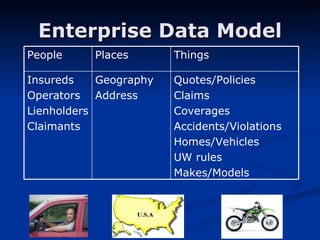
Enterprise Data Model Quotes/Policies Claims Coverages  Accidents/Violations Homes/Vehicles UW rules Makes/Models Geography Address Insureds Operators Lienholders Claimants Things Places People
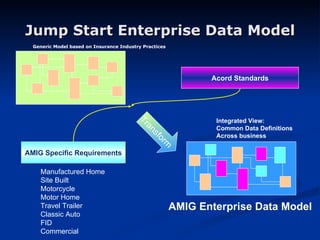
Jump Start Enterprise Data Model Acord Standards Generic Model based on Insurance Industry Practices Transform AMIG Specific Requirements Integrated View:  Common Data Definitions Across business Manufactured Home Site Built Motorcycle Motor Home Travel Trailer Classic Auto FID Commercial AMIG Enterprise Data Model
Data Model Benefits Foundation for: modernLINK rate & quote applications Data warehouse/data mart/analytic design mLP3 Operational Data Store (ODS) design New projects simply add to the model Insurance score Claims liability Development of data standards and a common “language”
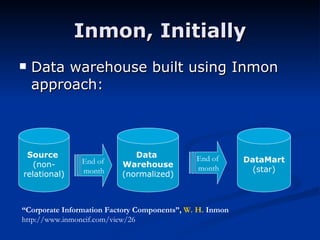
Inmon, Initially Data warehouse built using Inmon approach: Source  (non- relational) Data  Warehouse (normalized) DataMart (star) End of  month End of  month “ Corporate Information Factory Components”,  W. H.  Inmon  http://www.inmoncif.com/view/26
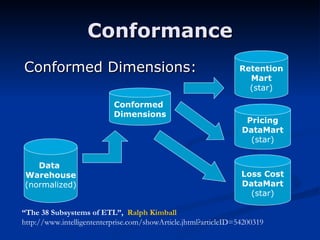
Conformance Conformed Dimensions: Data  Warehouse (normalized) Loss Cost DataMart (star) Conformed  Dimensions Pricing DataMart (star) Retention Mart (star) “ The 38 Subsystems of ETL”,  Ralph Kimball  http://www.intelligententerprise.com/showArticle.jhtml?articleID=54200319
Challenges Multiple sources Latency Stewardship
Multiple Sources OPPORTUNITIES : Daily claims/catastrophe feeds 3rd party Claim data (claims cost standards) Huon (an new Insurance ERP) Munich RE (pending merger with reinsurer)
Multiple Sources RESPONSES : Pull data : generally from relational DBMS, e.g. DB2, Informix, SQL Server Push data :  generally from non-relational DBMS: DMS II (Unisys)
Latency Changes OPPORTUNITY : Daily information Catastrophe reporting; e.g. Hurricane Katrina 2005, “Fab Four” of 2004 Financial Institutions requesting daily account information on insureds.
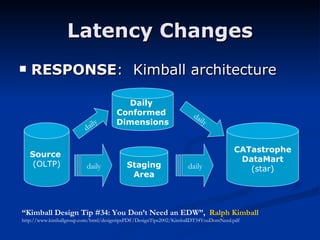
Latency Changes RESPONSE :  Kimball architecture Source  (OLTP) CATastrophe DataMart (star) Staging Area daily daily Daily  Conformed  Dimensions daily daily “ Kimball Design Tip #34: You Don’t Need an EDW”,  Ralph Kimball   http://www.kimballgroup.com/html/designtipsPDF/DesignTips2002/KimballDT34YouDontNeed.pdf
Latency Changes Kimball Architecture “ The staging area is exactly like the kitchen in a restaurant. The kitchen is a busy, even dangerous, place filled with sharp knives and hot liquids. The cooks are busy, focused on the task of preparing the food. It just isn't appropriate to allow diners into a professional kitchen or allow the cooks to be distracted with the very separate issues of the fine dining experience. ” Two Powerful Ideas: foundations for modern data warehousing,  Ralph Kimball  Sept 17, 2002:  http://www.intelligententerprise.com/020917/515warehouse1_1.jhtml
Data Stewardship OPPORTUNITY :  Daily instead of monthly reference data needed.  However, for example, no  daily   system of record  automated for: Claims Adjusters Catastrophe name/details
Data Stewardship RESPONSE : Data stewards maintain master data / system of record. Over night ETL uses master data for building dimension. Referential integrity always enforced with fact table, so data stewards cannot “delete” required for integrity.
Showcase Agenda Background/Business Case  20 minutes Sandy Wagner Data Warehouse – AIIM  20 minutes Latha Subramanian Data Model – AIIM  20 minutes Duke Ganote Information Management – AIIM 20 minutes Dan Daly Q& A – Duke/Sandy/Latha/Dan  20 minutes
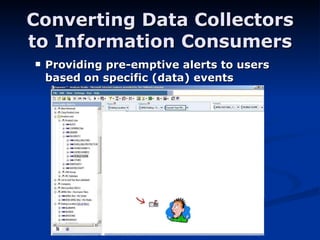
Information Management Benefits Single BI Architecture Provides a consistent view of our Corporate Data Allows for common product training & support Volume license pricing provides flexibility and cost savings Converting Data Collectors to Information Consumers Corporate Portal Integration Delivering specific information to specific business users Providing pre-emptive alerts to users based on specific (data) events
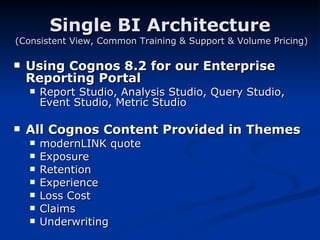
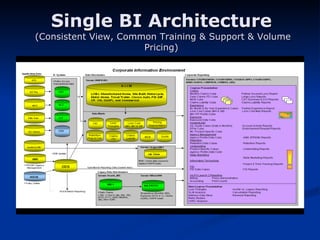
Single BI Architecture   (Consistent View, Common Training & Support & Volume Pricing) Using Cognos 8.2 for our Enterprise Reporting Portal Report Studio, Analysis Studio, Query Studio, Event Studio, Metric Studio All Cognos Content Provided in Themes modernLINK quote  Exposure Retention Experience Loss Cost Claims Underwriting
Single BI Architecture   (Consistent View, Common Training & Support & Volume Pricing)
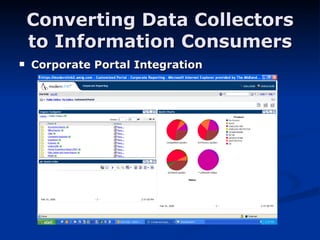
Converting Data Collectors to Information Consumers Corporate Portal Integration
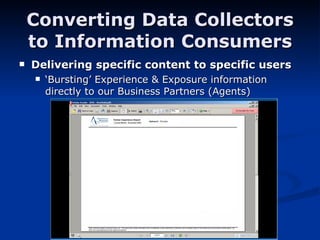
Converting Data Collectors to Information Consumers Delivering specific content to specific users ‘ Bursting’ Experience & Exposure information directly to our Business Partners (Agents)
Converting Data Collectors to Information Consumers Providing pre-emptive alerts to users based on specific (data) events
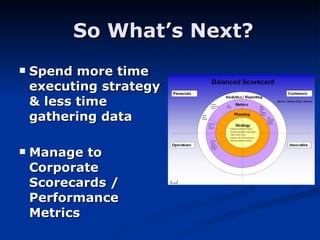
So What’s Next? Spend more time executing strategy & less time gathering data Manage to Corporate Scorecards / Performance Metrics
Showcase Agenda Background/Business Case  20 minutes Sandy Wagner Data Warehouse – AIIM  20 minutes Latha Subramanian Data Model – AIIM  20 minutes Duke Ganote Information Management – AIIM 20 minutes Dan Daly Q& A – Duke/Sandy/Latha/Dan  20 minutes
Q & A session
Wrap Up Enterprise Data Warehouse now in its 7 th  year Business units embrace the DW Holistic view of information in one place Next phase: deliver similar functionality to our external business partners Our case study has been placed in National Archives The copy of the case study can be found on the following web page:  http://www.cwhonors.org/viewCaseStudy.asp?NominationID=54
SWOC DAMA 2008 Showcase at  American Modern Insurance February 21, 2008

Swoc21 Feb08 Amig

  • 1.
    SWOC DAMA 2008Showcase at American Modern Insurance February 21, 2008
  • 2.
    Showcase Agenda Background/BusinessCase 20 minutes Sandy Wagner Data Warehouse – AIIM 20 minutes Latha Subramanian Data Model – AIIM 20 minutes Duke Ganote Information Management – AIIM 20 minutes Dan Daly Q& A – Duke/Sandy/Latha/Dan 20 minutes
  • 3.
    American Modern InsuranceCompany Background Founded in 1938 as a consumer finance company Provider of highly focused, specialty insurance products Positioned to grow into a multi-billion dollar organization Entrepreneurial spirit & deep commitment of employees Approximately 1200 employees country-wide, with 1000 employees in eastern Cincinnati area (Amelia)
  • 4.
    American Modern InsuranceCompany Background The organization believes that the strategic deployment of technology can help it achieve, and sustain, a competitive advantage. As stated in its Operating Principles, “Our investment in information technology is part of a carefully planned strategy to ensure that American Modern's company-wide infrastructure is among the most advanced in the specialty insurance industry.”
  • 5.
    American Modern InsuranceInitiative Background In 2000, American Modern embarked upon long-range initiative, coined “modernLINK,” Business and IT collaboration Business case and funding Three prongs: Web-enable insurance transaction processing Replace aging legacy processing systems Develop a Knowledge Management architecture
  • 6.
    American Modern InsuranceBusiness Case The anticipated returns of this business case were: 20% annual increases in directly-attributed new business 37% of Policy and Partner Administration moved from existing internal units directly to point of service 25% improvement in current Product Review and Management cycle time 21% improvement in Product Filings cycle time 2% reduction in total loss ratio directly attributed to modernLINK initiative
  • 7.
    American Modern InsuranceBusiness Case These returns would yield a significant recurring annual benefit through additional premium, increased profit, and decreased expenses Almost 50% of these benefits would be attained through better knowledge/data management, richer data segmentation, and improved data and risk selection John Hayden, President and CEO, American Modern states: We must have accurate data about the risks we insure today if we are to ever be successful in establishing The Right Rate for Every Risk we choose to insure in the future.
  • 8.
    American Modern InsuranceKnowledge Management Roadmap Enterprise Data Model Operational Data Store Enterprise Data Warehouse Themed analytic data marts Enterprise reporting portal Metadata management Data Stewardship
  • 9.
  • 10.
    American Modern InsuranceKnowledge Management Results Business users can: Make informed decisions Respond quickly to new business initiatives Create new opportunities Business users are: Moving from data collectors to data consumers Asking “why” instead of “what”
  • 11.
    American Modern InsuranceKnowledge Management Results Retention – Joe David. In the last four years, we have leveraged the corporate reporting tools to develop a series of targeted strategies that have allowed us to improve retention by nearly eight points, which equates to annualized premium of nearly $60 million Claims. Integration of 3 rd party Claim data - Heather Bolyard. This one-month sample of data for one material has identified a potential indemnity reduction of $70,000. Reserving – Gene Stetler. The new Loss Reserving data store from the Enterprise Data Warehouse has enabled process efficiencies, thus allowing us to predict our reserving needs with accuracy. Product – Kevin Randall. The implementation of American Modern's data warehouse has been a significant part of the successful launch of the company's right rate for every risk initiative
  • 12.
    American Modern Insurance2007 Awards and Recognition In 2007, American Modern received two awards from Computerworld: Laureate - The laureate status for the Enterprise Data Warehouse presented at the Carnegie Mellon Auditorium in Washington D.C – June 2007 BI Award - Best Practices in Business Intelligence in the category “Creating an Agile BI Infrastructure” presented in Las Vegas, NV – September 2007
  • 13.
    Showcase Agenda Background/BusinessCase 20 minutes Sandy Wagner Data Warehouse – AIIM 20 minutes Latha Subramanian Data Model – AIIM 20 minutes Duke Ganote Information Management – AIIM 20 minutes Dan Daly Q& A – Duke/Sandy/Latha/Dan 20 minutes
  • 14.
    Enterprise Data WarehouseCreate an implementation roadmap Content scope – January 1998 thru present All products loaded over 5 years Implement “value” after each iteration Loss Cost, Retention, Loss Triangles Establish Data Stewardship - 2004
  • 15.
    Enterprise Data WarehouseThe data warehouse will support: Loss Cost Analysis Retention Analysis modernLINK Reporting Profitability Analysis Data Warehouse Underwriting Analysis Product Pricing Analysis Financial Analysis
  • 16.
    Data Warehouse ValueMH Loss Cost SB Loss Cost MC Loss Cost Retention UVRC Pricing / GLM Loss Triangles modernLINK MH PIF mLINK vs. Legacy Retro Studies Mapping Renewal Reporting FID MSB CAT Analysis Cancellation Reporting Address Data Agency Profile Analysis Claims Liability Partner Experience Reporting
  • 17.
    Data Warehouse Statistics1997 policies used to seed warehouse: ~700,000 Total policies Jan 1998 thru Jun 2007 Total units Jan 1998 thru Jun 2007 Average Number of Coverages per policy: 5 Average number of policies in-force per month: 800,000 Average number of claims per month: 8,000
  • 18.
    Data Warehouse BenefitsSingle version of the truth Data integrated at the lowest level High-end hardware platform Codes translated to “English” terms Resolve source system problems Data quality review and correction Integration of external information
  • 19.
    Data Mart ThemesmodernLINK quote Exposure Retention Experience Loss Cost Claims Underwriting
  • 20.
    Technology Enablers…. IBMRS6000 AIX processors EMC data storage Oracle DBMS COGNOS for reporting utilizing query, report, mapping and analytical tools Websphere Portal LDAP for single sign-on
  • 21.
    Showcase Agenda Background/BusinessCase 20 minutes Sandy Wagner Data Warehouse – AIIM 20 minutes Latha Subramanian Data Model – AIIM 20 minutes Duke Ganote Information Management – AIIM 20 minutes Dan Daly Q& A – Duke/Sandy/Latha/Dan 20 minutes
  • 22.
    Data Model Provides a common, integrated way for the corporation to view and to communicate about its business Allows the business to drive the system Creates standard definitions/documentation Provides structure to new development projects
  • 23.
    Enterprise Data ModelQuotes/Policies Claims Coverages Accidents/Violations Homes/Vehicles UW rules Makes/Models Geography Address Insureds Operators Lienholders Claimants Things Places People
  • 24.
    Jump Start EnterpriseData Model Acord Standards Generic Model based on Insurance Industry Practices Transform AMIG Specific Requirements Integrated View: Common Data Definitions Across business Manufactured Home Site Built Motorcycle Motor Home Travel Trailer Classic Auto FID Commercial AMIG Enterprise Data Model
  • 25.
    Data Model BenefitsFoundation for: modernLINK rate & quote applications Data warehouse/data mart/analytic design mLP3 Operational Data Store (ODS) design New projects simply add to the model Insurance score Claims liability Development of data standards and a common “language”
  • 26.
    Inmon, Initially Datawarehouse built using Inmon approach: Source (non- relational) Data Warehouse (normalized) DataMart (star) End of month End of month “ Corporate Information Factory Components”, W. H. Inmon http://www.inmoncif.com/view/26
  • 27.
    Conformance Conformed Dimensions:Data Warehouse (normalized) Loss Cost DataMart (star) Conformed Dimensions Pricing DataMart (star) Retention Mart (star) “ The 38 Subsystems of ETL”, Ralph Kimball http://www.intelligententerprise.com/showArticle.jhtml?articleID=54200319
  • 28.
    Challenges Multiple sourcesLatency Stewardship
  • 29.
    Multiple Sources OPPORTUNITIES: Daily claims/catastrophe feeds 3rd party Claim data (claims cost standards) Huon (an new Insurance ERP) Munich RE (pending merger with reinsurer)
  • 30.
    Multiple Sources RESPONSES: Pull data : generally from relational DBMS, e.g. DB2, Informix, SQL Server Push data : generally from non-relational DBMS: DMS II (Unisys)
  • 31.
    Latency Changes OPPORTUNITY: Daily information Catastrophe reporting; e.g. Hurricane Katrina 2005, “Fab Four” of 2004 Financial Institutions requesting daily account information on insureds.
  • 32.
    Latency Changes RESPONSE: Kimball architecture Source (OLTP) CATastrophe DataMart (star) Staging Area daily daily Daily Conformed Dimensions daily daily “ Kimball Design Tip #34: You Don’t Need an EDW”, Ralph Kimball http://www.kimballgroup.com/html/designtipsPDF/DesignTips2002/KimballDT34YouDontNeed.pdf
  • 33.
    Latency Changes KimballArchitecture “ The staging area is exactly like the kitchen in a restaurant. The kitchen is a busy, even dangerous, place filled with sharp knives and hot liquids. The cooks are busy, focused on the task of preparing the food. It just isn't appropriate to allow diners into a professional kitchen or allow the cooks to be distracted with the very separate issues of the fine dining experience. ” Two Powerful Ideas: foundations for modern data warehousing, Ralph Kimball Sept 17, 2002: http://www.intelligententerprise.com/020917/515warehouse1_1.jhtml
  • 34.
    Data Stewardship OPPORTUNITY: Daily instead of monthly reference data needed. However, for example, no daily system of record automated for: Claims Adjusters Catastrophe name/details
  • 35.
    Data Stewardship RESPONSE: Data stewards maintain master data / system of record. Over night ETL uses master data for building dimension. Referential integrity always enforced with fact table, so data stewards cannot “delete” required for integrity.
  • 36.
    Showcase Agenda Background/BusinessCase 20 minutes Sandy Wagner Data Warehouse – AIIM 20 minutes Latha Subramanian Data Model – AIIM 20 minutes Duke Ganote Information Management – AIIM 20 minutes Dan Daly Q& A – Duke/Sandy/Latha/Dan 20 minutes
  • 37.
    Information Management BenefitsSingle BI Architecture Provides a consistent view of our Corporate Data Allows for common product training & support Volume license pricing provides flexibility and cost savings Converting Data Collectors to Information Consumers Corporate Portal Integration Delivering specific information to specific business users Providing pre-emptive alerts to users based on specific (data) events
  • 38.
    Single BI Architecture (Consistent View, Common Training & Support & Volume Pricing) Using Cognos 8.2 for our Enterprise Reporting Portal Report Studio, Analysis Studio, Query Studio, Event Studio, Metric Studio All Cognos Content Provided in Themes modernLINK quote Exposure Retention Experience Loss Cost Claims Underwriting
  • 39.
    Single BI Architecture (Consistent View, Common Training & Support & Volume Pricing)
  • 40.
    Converting Data Collectorsto Information Consumers Corporate Portal Integration
  • 41.
    Converting Data Collectorsto Information Consumers Delivering specific content to specific users ‘ Bursting’ Experience & Exposure information directly to our Business Partners (Agents)
  • 42.
    Converting Data Collectorsto Information Consumers Providing pre-emptive alerts to users based on specific (data) events
  • 43.
    So What’s Next?Spend more time executing strategy & less time gathering data Manage to Corporate Scorecards / Performance Metrics
  • 44.
    Showcase Agenda Background/BusinessCase 20 minutes Sandy Wagner Data Warehouse – AIIM 20 minutes Latha Subramanian Data Model – AIIM 20 minutes Duke Ganote Information Management – AIIM 20 minutes Dan Daly Q& A – Duke/Sandy/Latha/Dan 20 minutes
  • 45.
    Q & Asession
  • 46.
    Wrap Up EnterpriseData Warehouse now in its 7 th year Business units embrace the DW Holistic view of information in one place Next phase: deliver similar functionality to our external business partners Our case study has been placed in National Archives The copy of the case study can be found on the following web page: http://www.cwhonors.org/viewCaseStudy.asp?NominationID=54
  • 47.
    SWOC DAMA 2008Showcase at American Modern Insurance February 21, 2008

Editor's Notes

  • #4 Sandy to provide slides on KMA..
  • #5 Sandy to provide slides on KMA..
  • #6 Web-enable American Modern’s Insurance offerings; promote them through a ubiquitous, user-friendly, easy to use business offering and processing model. Enable new capabilities and processes through “Legacy” replacement for: Product Development Rating, Pricing and Underwriting Policy Administration Processing Partner Relationship Management Customer Management Develop a Knowledge Management Architecture to support the initiatives named above
  • #7 The anticipated returns of this business case are as follows: 20% annual increases in directly-attributed new business 37% of Policy and Partner Administration moved from existing customer care functions directly to point of service functions 25% improvement in current Product Review and Management cycle time 21% improvement in Product Filings cycle time 2% reduction in total loss ratio directly attributed to modernLINK initiative These returns would yield a significant recurring annual benefit through additional premium, increased profit, and decreased expenses. Almost 50% of these benefits would be attained through better knowledge/data management, richer data segmentation, and improved data and risk selection. John Hayden, President and CEO, American Modern states: We must have accurate data about the risks we insure today if we are to ever be successful in establishing The Right Rate for Every Risk we choose to insure in the future. These returns would yield significant recurring annual benefits through additional premium, increased profit, and decreased expenses. Almost 50% of these benefits would be attained through better knowledge/data management, richer data segmentation, and improved data and risk selection.
  • #8 These returns would yield a significant recurring annual benefit through additional premium, increased profit, and decreased expenses. Almost 50% of these benefits would be attained through better knowledge/data management, richer data segmentation, and improved data and risk selection. John Hayden, President and CEO, American Modern states: We must have accurate data about the risks we insure today if we are to ever be successful in establishing The Right Rate for Every Risk we choose to insure in the future. These returns would yield significant recurring annual benefits through additional premium, increased profit, and decreased expenses. Almost 50% of these benefits would be attained through better knowledge/data management, richer data segmentation, and improved data and risk selection.
  • #9 As part of the Enterprise Architecture Transformation initiative, American Modern created a roadmap to develop: This Knowledge Management architecture would provide the company with the ability to monitor, measure, and analyze existing business, refine and improve current practices, and identify new opportunities.
  • #11 Now in its seventh year, the Knowledge Management architecture has delivered significant results. Today, our business units can make informed business decisions, respond quickly to new business initiatives, and create new opportunities because of the tools and information provided. They are moving from data collectors to data consumers. Business users have information delivered to their desktops in the form of reports, analytic cubes, and maps. This new ability to ask “why ,” instead of “ wha t,” will enable American Modern to transform itself into a learning organization.
  • #12 Here is what they say:
  • #13 Not only have we received internal recognition, but external as well
  • #21 • IBM RS6000 AIX processors • EMC data storage • Oracle DBMS • COGNOS for reporting utilizing query, report, mapping and analytical tools • Websphere Portal • LDAP for single sign-on
  • #47 The business units within American Modern have wholeheartedly embraced the Enterprise Data Warehouse. It has even taken on a life of its own – it appears to be able to do almost anything For the first time, they have been able to get a holistic view of information in one place. In addition, American Modern is ready to embark on its next phase of delivering information to its external business partners using the same architecture.