

Beyond FDA Compliance: 5 Hidden
Benefits of Your Trace Matrix
Slide 1
Copyright © 2013 Software Quality Consulting Inc.
sponsored by
Speaker Bios
Steven R. Rakitin
President, Software Quality Consulting
Slide 2
Copyright © 2013 Software Quality Consulting Inc.
Michael C. Sieve
Life Sciences Solution Engineer, Seapine
Software
• 10 years experience in compliance industries, including life
sciences, government, utilities, and aviation.
• Certified Master Black Belt in Lean Six Sigma, Software
Validation, Risk Management, and Negotiation. Well versed in
the General Principles of Software Validation and Part 11
Compliance.
• 35 years experience as a software engineer and software
quality manager.
• Senior member of the IEEE Computer Society, ASQ Software
Division, ASQ Biomedical Division, and the Association for the
Advancement of Medical Instrumentation (AAMI).
• Helped write the first IEEE Software Engineering Standard
(IEEE-STD-730 Standard for Software Quality Assurance
Plans) and is currently a committee member working on
revisions to both IEEE Standard 1012 (Software Verification &
Validation) and 730 (Software Quality Assurance).
Topics
• Regulatory Requirements for Traceability
• Traceability Basics
• Requirements Trace Matrix (RTM) Benefits
• RTM Tool Validation
• References
Slide 3
Copyright © 2013 Software Quality Consulting Inc.
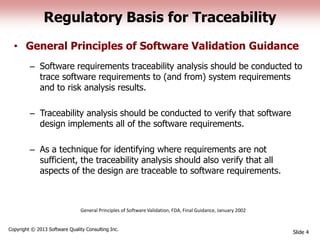
Regulatory Basis for Traceability
• General Principles of Software Validation Guidance
– Software requirements traceability analysis should be conducted to
trace software requirements to (and from) system requirements
and to risk analysis results.
– Traceability analysis should be conducted to verify that software
design implements all of the software requirements.
– As a technique for identifying where requirements are not
sufficient, the traceability analysis should also verify that all
aspects of the design are traceable to software requirements.
Slide 4
Copyright © 2013 Software Quality Consulting Inc.
General Principles of Software Validation, FDA, Final Guidance, January 2002
Regulatory Requirements for Traceability
• General Principles of Software Validation Guidance
Source code traceability analysis is an important tool to verify that all
code is linked to established specifications and established test
procedures.
Source code traceability analysis should be conducted to verify that:
– Every element of software design descriptions (SDD) has been
implemented
– Source code traces back to elements in SDD and to risk analysis
– Tests trace to elements in SDD and to risk analysis
– Tests trace to source code
Slide 5
Copyright © 2013 Software Quality Consulting Inc.
General Principles of Software Validation, FDA, Final Guidance, January 2002
Regulatory Requirements for Traceability
• Guidance for Pre-market Submissions Containing Software
– Traceability Analysis links together product design
requirements, design specifications, and testing requirements.
– Also provides a means of tying together identified hazards with
implementation and testing of mitigations.
– Traceability Analysis commonly consists of a matrix with line columns
for requirements, specifications and tests, and pointers to hazard
mitigations.
– Submit for review explicit traceability among these activities and
associated documentation as they are essential to effective product
development and to reviewer’s understanding of product
design, development and testing, and hazard mitigations.
Slide 6
Copyright © 2013 Software Quality Consulting Inc.
Guidance for the Content of Premarket Submissions for Software Contained in Medical Devices, May 11, 2005
Traceability Basics
Slide 7
Copyright © 2013 Software Quality Consulting Inc.
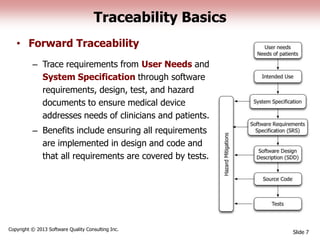
• Forward Traceability
– Trace requirements from User Needs and
System Specification through software
requirements, design, test, and hazard
documents to ensure medical device
addresses needs of clinicians and patients.
– Benefits include ensuring all requirements
are implemented in design and code and
that all requirements are covered by tests.
Traceability Basics
Slide 8
Copyright © 2013 Software Quality Consulting Inc.
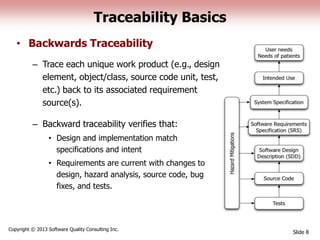
• Backwards Traceability
– Trace each unique work product (e.g., design
element, object/class, source code unit, test,
etc.) back to its associated requirement
source(s).
– Backward traceability verifies that:
• Design and implementation match
specifications and intent
• Requirements are current with changes to
design, hazard analysis, source code, bug
fixes, and tests.
Traceability Basics
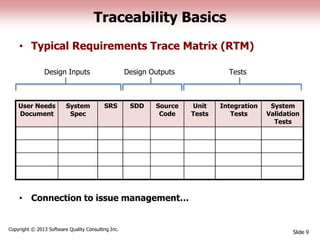
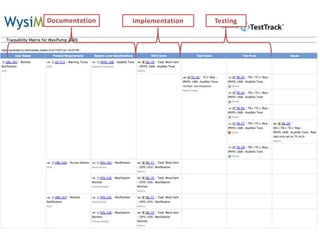
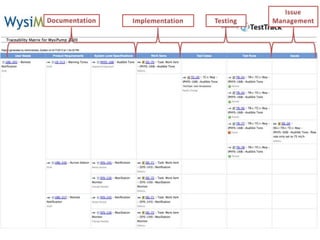
• Typical Requirements Trace Matrix (RTM)
• Connection to issue management…
Slide 9
Copyright © 2013 Software Quality Consulting Inc.
User Needs
Document
System
Spec
SRS SDD Source
Code
Unit
Tests
Integration
Tests
System
Validation
Tests
Design OutputsDesign Inputs Tests
RTM Benefits
• Provides a tool for estimating tests…
• Provides evidence all requirements are implemented…
• Provides evidence all requirements have been tested…
• Provides visibility for managing changes throughout
product development…
• Provides evidence hazard mitigations are implemented
and validated for effectiveness…
Slide 10
Copyright © 2013 Software Quality Consulting Inc.
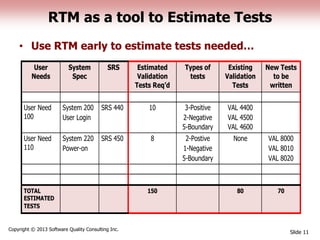
RTM as a tool to Estimate Tests
• Use RTM early to estimate tests needed…
Slide 11
Copyright © 2013 Software Quality Consulting Inc.
User
Needs
System
Spec
SRS Estimated
Validation
Tests Req’d
Types of
tests
Existing
Validation
Tests
New Tests
to be
written
User Need
100
System 200
User Login
SRS 440 10 3-Positive
2-Negative
5-Boundary
VAL 4400
VAL 4500
VAL 4600
User Need
110
System 220
Power-on
SRS 450 8 2-Postive
1-Negative
5-Boundary
None VAL 8000
VAL 8010
VAL 8020
TOTAL
ESTIMATED
TESTS
150 80 70
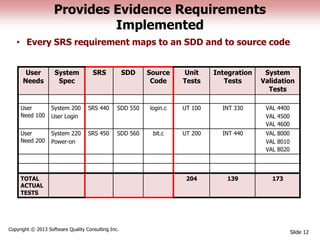
Provides Evidence Requirements
Implemented
Slide 12
Copyright © 2013 Software Quality Consulting Inc.
• Every SRS requirement maps to an SDD and to source code
User
Needs
System
Spec
SRS SDD Source
Code
Unit
Tests
Integration
Tests
System
Validation
Tests
User
Need 100
System 200
User Login
SRS 440 SDD 550 login.c UT 100 INT 330 VAL 4400
VAL 4500
VAL 4600
User
Need 200
System 220
Power-on
SRS 450 SDD 560 bit.c UT 200 INT 440 VAL 8000
VAL 8010
VAL 8020
TOTAL
ACTUAL
TESTS
204 139 173
Provides Evidence Requirements Tested
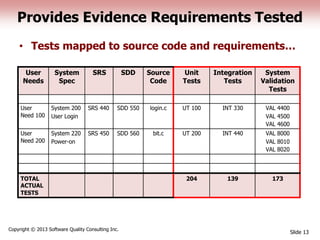
• Tests mapped to source code and requirements…
Slide 13
Copyright © 2013 Software Quality Consulting Inc.
User
Needs
System
Spec
SRS SDD Source
Code
Unit
Tests
Integration
Tests
System
Validation
Tests
User
Need 100
System 200
User Login
SRS 440 SDD 550 login.c UT 100 INT 330 VAL 4400
VAL 4500
VAL 4600
User
Need 200
System 220
Power-on
SRS 450 SDD 560 bit.c UT 200 INT 440 VAL 8000
VAL 8010
VAL 8020
TOTAL
ACTUAL
TESTS
204 139 173
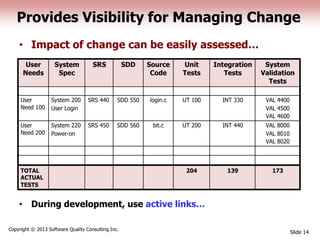
Provides Visibility for Managing Change
• Impact of change can be easily assessed…
• During development, use active links…
Slide 14
Copyright © 2013 Software Quality Consulting Inc.
User
Needs
System
Spec
SRS SDD Source
Code
Unit
Tests
Integration
Tests
System
Validation
Tests
User
Need 100
System 200
User Login
SRS 440 SDD 550 login.c UT 100 INT 330 VAL 4400
VAL 4500
VAL 4600
User
Need 200
System 220
Power-on
SRS 450 SDD 560 bit.c UT 200 INT 440 VAL 8000
VAL 8010
VAL 8020
TOTAL
ACTUAL
TESTS
204 139 173
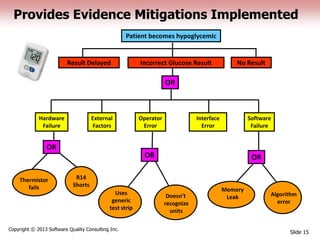
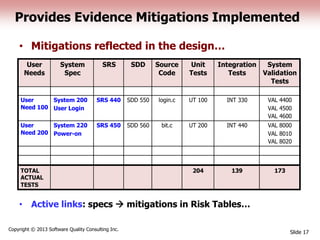
Provides Evidence Mitigations Implemented
Slide 15
Copyright © 2013 Software Quality Consulting Inc.
Hardware
Failure
Operator
Error
Interface
Error
Memory
Leak Algorithm
error
Uses
generic
test strip
Doesn’t
recognize
units
External
Factors
Thermistor
fails
R14
Shorts
Software
Failure
OROR
OR
Patient becomes hypoglycemic
OR
Incorrect Glucose ResultResult Delayed No Result
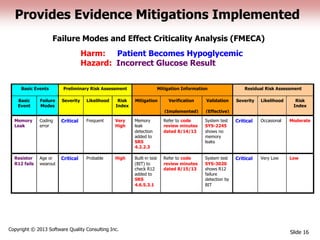
Provides Evidence Mitigations Implemented
Slide 16
Copyright © 2013 Software Quality Consulting Inc.
Basic Events Preliminary Risk Assessment Mitigation Information Residual Risk Assessment
Basic
Event
Failure
Modes
Severity Likelihood Risk
Index
Mitigation Verification
(Implemented)
Validation
(Effective)
Severity Likelihood Risk
Index
Memory
Leak
Coding
error
Critical Frequent Very
High
Memory
leak
detection
added to
SRS
4.2.2.3
Refer to code
review minutes
dated 8/14/13
System test
SYS-2245
shows no
memory
leaks
Critical Occasional Moderate
Resistor
R12 fails
Age or
wearout
Critical Probable High Built-in test
(BIT) to
check R12
added to
SRS
4.6.5.3.1
Refer to code
review minutes
dated 8/15/13
System test
SYS-3020
shows R12
failure
detection by
BIT
Critical Very Low Low
Failure Modes and Effect Criticality Analysis (FMECA)
Harm: Patient Becomes Hypoglycemic
Hazard: Incorrect Glucose Result
Provides Evidence Mitigations Implemented
• Mitigations reflected in the design…
• Active links: specs  mitigations in Risk Tables…
Slide 17
Copyright © 2013 Software Quality Consulting Inc.
User
Needs
System
Spec
SRS SDD Source
Code
Unit
Tests
Integration
Tests
System
Validation
Tests
User
Need 100
System 200
User Login
SRS 440 SDD 550 login.c UT 100 INT 330 VAL 4400
VAL 4500
VAL 4600
User
Need 200
System 220
Power-on
SRS 450 SDD 560 bit.c UT 200 INT 440 VAL 8000
VAL 8010
VAL 8020
TOTAL
ACTUAL
TESTS
204 139 173
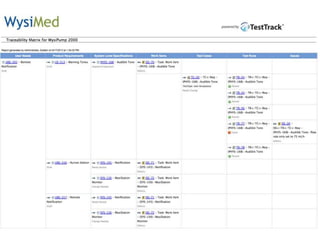
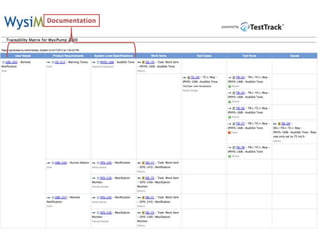
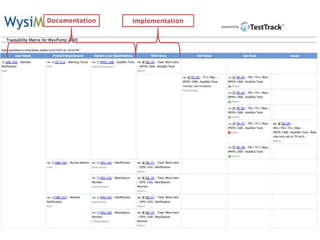
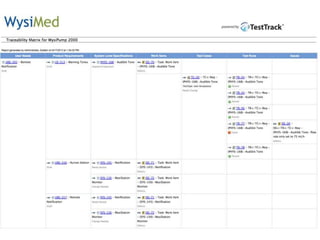
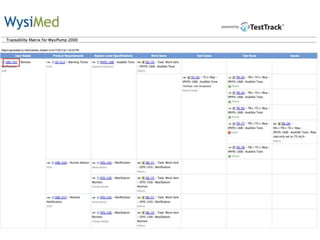
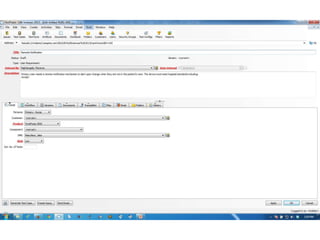
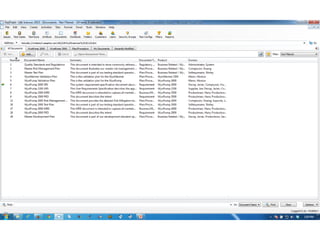
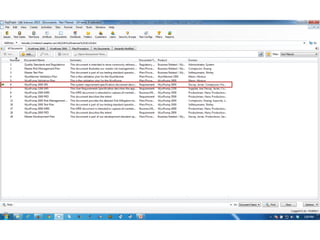
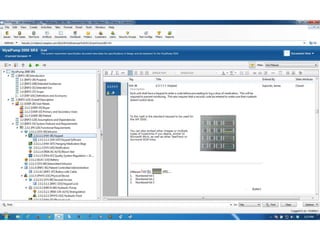
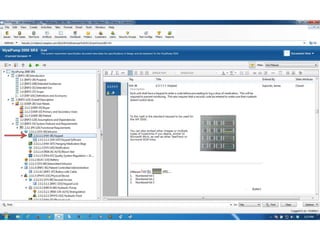
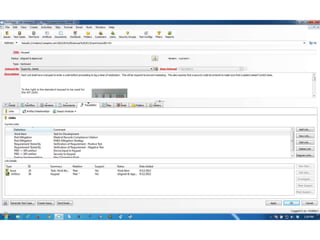
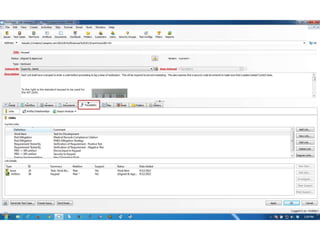
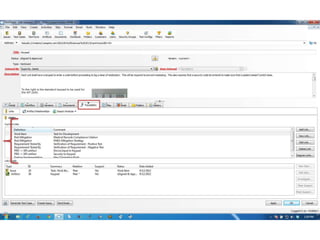
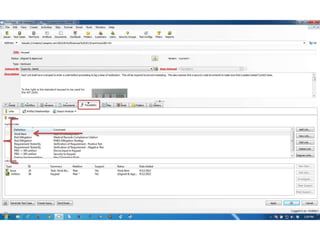
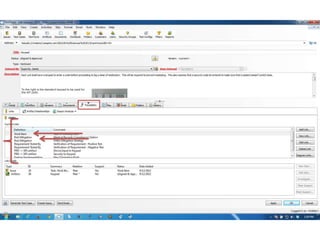
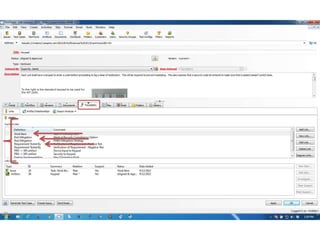
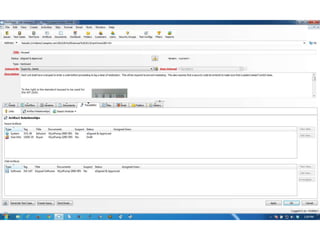
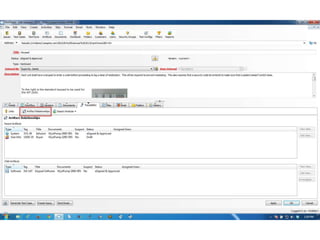
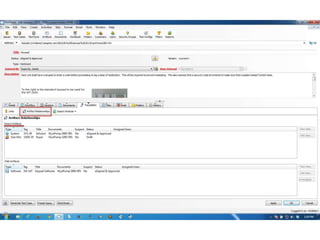
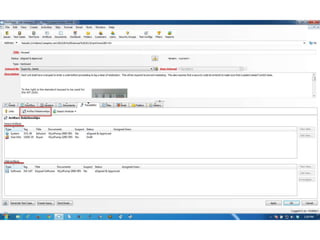
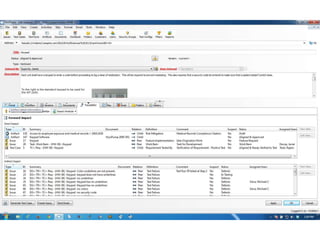
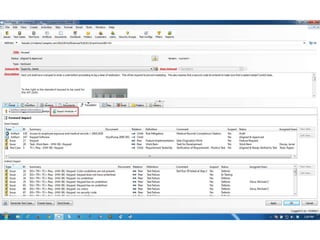
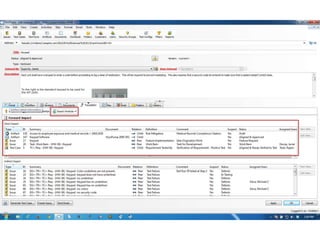
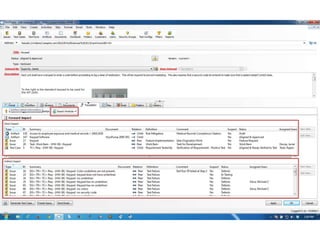
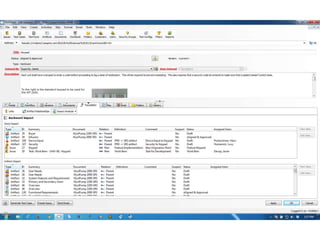
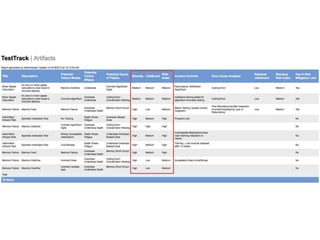
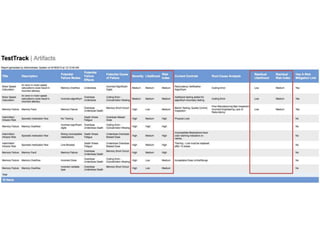
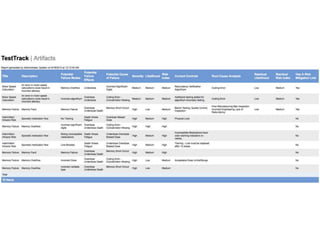
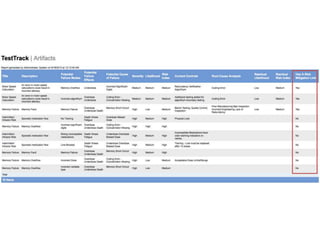
Seapine TestTrack Demonstration
Slide 18
Copyright © 2013 Software Quality Consulting Inc.
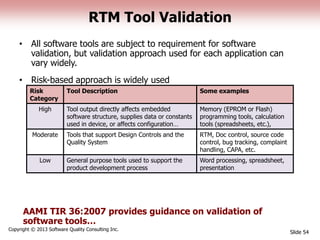
RTM Tool Validation
• All software tools are subject to requirement for software
validation, but validation approach used for each application can
vary widely.
• Risk-based approach is widely used
AAMI TIR 36:2007 provides guidance on validation of
software tools…
Slide 54
Copyright © 2013 Software Quality Consulting Inc.
Risk
Category
Tool Description Some examples
High Tool output directly affects embedded
software structure, supplies data or constants
used in device, or affects configuration…
Memory (EPROM or Flash)
programming tools, calculation
tools (spreadsheets, etc.),
Moderate Tools that support Design Controls and the
Quality System
RTM, Doc control, source code
control, bug tracking, complaint
handling, CAPA, etc.
Low General purpose tools used to support the
product development process
Word processing, spreadsheet,
presentation
Training Available from SQC
• Software Development for Medical Device Manufacturers
• Medical Device Risk Management
• Software Verification & Validation
• Computer System Validation
• For more information, please visit www.swqual.com
Slide 55
Copyright © 2013 Software Quality Consulting Inc.
Thank you!
Slide 56
If you have questions, please call or e-mail...
Copyright © 2013 Software Quality Consulting Inc.

Beyond FDA Compliance Webinar: 5 Hidden Benefits of Your Traceability Matrix

  • 1.
    Beyond FDA Compliance:5 Hidden Benefits of Your Trace Matrix Slide 1 Copyright © 2013 Software Quality Consulting Inc. sponsored by
  • 2.
    Speaker Bios Steven R.Rakitin President, Software Quality Consulting Slide 2 Copyright © 2013 Software Quality Consulting Inc. Michael C. Sieve Life Sciences Solution Engineer, Seapine Software • 10 years experience in compliance industries, including life sciences, government, utilities, and aviation. • Certified Master Black Belt in Lean Six Sigma, Software Validation, Risk Management, and Negotiation. Well versed in the General Principles of Software Validation and Part 11 Compliance. • 35 years experience as a software engineer and software quality manager. • Senior member of the IEEE Computer Society, ASQ Software Division, ASQ Biomedical Division, and the Association for the Advancement of Medical Instrumentation (AAMI). • Helped write the first IEEE Software Engineering Standard (IEEE-STD-730 Standard for Software Quality Assurance Plans) and is currently a committee member working on revisions to both IEEE Standard 1012 (Software Verification & Validation) and 730 (Software Quality Assurance).
  • 3.
    Topics • Regulatory Requirementsfor Traceability • Traceability Basics • Requirements Trace Matrix (RTM) Benefits • RTM Tool Validation • References Slide 3 Copyright © 2013 Software Quality Consulting Inc.
  • 4.
    Regulatory Basis forTraceability • General Principles of Software Validation Guidance – Software requirements traceability analysis should be conducted to trace software requirements to (and from) system requirements and to risk analysis results. – Traceability analysis should be conducted to verify that software design implements all of the software requirements. – As a technique for identifying where requirements are not sufficient, the traceability analysis should also verify that all aspects of the design are traceable to software requirements. Slide 4 Copyright © 2013 Software Quality Consulting Inc. General Principles of Software Validation, FDA, Final Guidance, January 2002
  • 5.
    Regulatory Requirements forTraceability • General Principles of Software Validation Guidance Source code traceability analysis is an important tool to verify that all code is linked to established specifications and established test procedures. Source code traceability analysis should be conducted to verify that: – Every element of software design descriptions (SDD) has been implemented – Source code traces back to elements in SDD and to risk analysis – Tests trace to elements in SDD and to risk analysis – Tests trace to source code Slide 5 Copyright © 2013 Software Quality Consulting Inc. General Principles of Software Validation, FDA, Final Guidance, January 2002
  • 6.
    Regulatory Requirements forTraceability • Guidance for Pre-market Submissions Containing Software – Traceability Analysis links together product design requirements, design specifications, and testing requirements. – Also provides a means of tying together identified hazards with implementation and testing of mitigations. – Traceability Analysis commonly consists of a matrix with line columns for requirements, specifications and tests, and pointers to hazard mitigations. – Submit for review explicit traceability among these activities and associated documentation as they are essential to effective product development and to reviewer’s understanding of product design, development and testing, and hazard mitigations. Slide 6 Copyright © 2013 Software Quality Consulting Inc. Guidance for the Content of Premarket Submissions for Software Contained in Medical Devices, May 11, 2005
  • 7.
    Traceability Basics Slide 7 Copyright© 2013 Software Quality Consulting Inc. • Forward Traceability – Trace requirements from User Needs and System Specification through software requirements, design, test, and hazard documents to ensure medical device addresses needs of clinicians and patients. – Benefits include ensuring all requirements are implemented in design and code and that all requirements are covered by tests.
  • 8.
    Traceability Basics Slide 8 Copyright© 2013 Software Quality Consulting Inc. • Backwards Traceability – Trace each unique work product (e.g., design element, object/class, source code unit, test, etc.) back to its associated requirement source(s). – Backward traceability verifies that: • Design and implementation match specifications and intent • Requirements are current with changes to design, hazard analysis, source code, bug fixes, and tests.
  • 9.
    Traceability Basics • TypicalRequirements Trace Matrix (RTM) • Connection to issue management… Slide 9 Copyright © 2013 Software Quality Consulting Inc. User Needs Document System Spec SRS SDD Source Code Unit Tests Integration Tests System Validation Tests Design OutputsDesign Inputs Tests
  • 10.
    RTM Benefits • Providesa tool for estimating tests… • Provides evidence all requirements are implemented… • Provides evidence all requirements have been tested… • Provides visibility for managing changes throughout product development… • Provides evidence hazard mitigations are implemented and validated for effectiveness… Slide 10 Copyright © 2013 Software Quality Consulting Inc.
  • 11.
    RTM as atool to Estimate Tests • Use RTM early to estimate tests needed… Slide 11 Copyright © 2013 Software Quality Consulting Inc. User Needs System Spec SRS Estimated Validation Tests Req’d Types of tests Existing Validation Tests New Tests to be written User Need 100 System 200 User Login SRS 440 10 3-Positive 2-Negative 5-Boundary VAL 4400 VAL 4500 VAL 4600 User Need 110 System 220 Power-on SRS 450 8 2-Postive 1-Negative 5-Boundary None VAL 8000 VAL 8010 VAL 8020 TOTAL ESTIMATED TESTS 150 80 70
  • 12.
    Provides Evidence Requirements Implemented Slide12 Copyright © 2013 Software Quality Consulting Inc. • Every SRS requirement maps to an SDD and to source code User Needs System Spec SRS SDD Source Code Unit Tests Integration Tests System Validation Tests User Need 100 System 200 User Login SRS 440 SDD 550 login.c UT 100 INT 330 VAL 4400 VAL 4500 VAL 4600 User Need 200 System 220 Power-on SRS 450 SDD 560 bit.c UT 200 INT 440 VAL 8000 VAL 8010 VAL 8020 TOTAL ACTUAL TESTS 204 139 173
  • 13.
    Provides Evidence RequirementsTested • Tests mapped to source code and requirements… Slide 13 Copyright © 2013 Software Quality Consulting Inc. User Needs System Spec SRS SDD Source Code Unit Tests Integration Tests System Validation Tests User Need 100 System 200 User Login SRS 440 SDD 550 login.c UT 100 INT 330 VAL 4400 VAL 4500 VAL 4600 User Need 200 System 220 Power-on SRS 450 SDD 560 bit.c UT 200 INT 440 VAL 8000 VAL 8010 VAL 8020 TOTAL ACTUAL TESTS 204 139 173
  • 14.
    Provides Visibility forManaging Change • Impact of change can be easily assessed… • During development, use active links… Slide 14 Copyright © 2013 Software Quality Consulting Inc. User Needs System Spec SRS SDD Source Code Unit Tests Integration Tests System Validation Tests User Need 100 System 200 User Login SRS 440 SDD 550 login.c UT 100 INT 330 VAL 4400 VAL 4500 VAL 4600 User Need 200 System 220 Power-on SRS 450 SDD 560 bit.c UT 200 INT 440 VAL 8000 VAL 8010 VAL 8020 TOTAL ACTUAL TESTS 204 139 173
  • 15.
    Provides Evidence MitigationsImplemented Slide 15 Copyright © 2013 Software Quality Consulting Inc. Hardware Failure Operator Error Interface Error Memory Leak Algorithm error Uses generic test strip Doesn’t recognize units External Factors Thermistor fails R14 Shorts Software Failure OROR OR Patient becomes hypoglycemic OR Incorrect Glucose ResultResult Delayed No Result
  • 16.
    Provides Evidence MitigationsImplemented Slide 16 Copyright © 2013 Software Quality Consulting Inc. Basic Events Preliminary Risk Assessment Mitigation Information Residual Risk Assessment Basic Event Failure Modes Severity Likelihood Risk Index Mitigation Verification (Implemented) Validation (Effective) Severity Likelihood Risk Index Memory Leak Coding error Critical Frequent Very High Memory leak detection added to SRS 4.2.2.3 Refer to code review minutes dated 8/14/13 System test SYS-2245 shows no memory leaks Critical Occasional Moderate Resistor R12 fails Age or wearout Critical Probable High Built-in test (BIT) to check R12 added to SRS 4.6.5.3.1 Refer to code review minutes dated 8/15/13 System test SYS-3020 shows R12 failure detection by BIT Critical Very Low Low Failure Modes and Effect Criticality Analysis (FMECA) Harm: Patient Becomes Hypoglycemic Hazard: Incorrect Glucose Result
  • 17.
    Provides Evidence MitigationsImplemented • Mitigations reflected in the design… • Active links: specs  mitigations in Risk Tables… Slide 17 Copyright © 2013 Software Quality Consulting Inc. User Needs System Spec SRS SDD Source Code Unit Tests Integration Tests System Validation Tests User Need 100 System 200 User Login SRS 440 SDD 550 login.c UT 100 INT 330 VAL 4400 VAL 4500 VAL 4600 User Need 200 System 220 Power-on SRS 450 SDD 560 bit.c UT 200 INT 440 VAL 8000 VAL 8010 VAL 8020 TOTAL ACTUAL TESTS 204 139 173
  • 18.
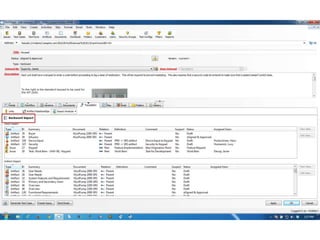
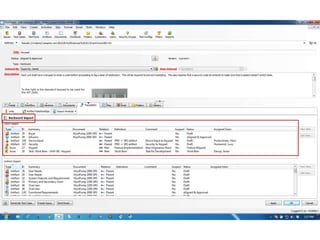
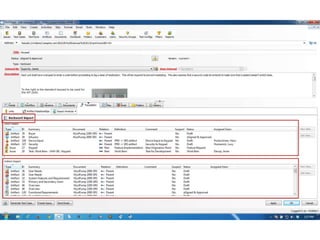
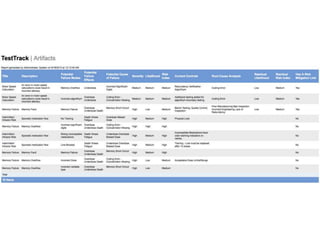
    Seapine TestTrack Demonstration Slide18 Copyright © 2013 Software Quality Consulting Inc.
  • 54.
    RTM Tool Validation •All software tools are subject to requirement for software validation, but validation approach used for each application can vary widely. • Risk-based approach is widely used AAMI TIR 36:2007 provides guidance on validation of software tools… Slide 54 Copyright © 2013 Software Quality Consulting Inc. Risk Category Tool Description Some examples High Tool output directly affects embedded software structure, supplies data or constants used in device, or affects configuration… Memory (EPROM or Flash) programming tools, calculation tools (spreadsheets, etc.), Moderate Tools that support Design Controls and the Quality System RTM, Doc control, source code control, bug tracking, complaint handling, CAPA, etc. Low General purpose tools used to support the product development process Word processing, spreadsheet, presentation
  • 55.
    Training Available fromSQC • Software Development for Medical Device Manufacturers • Medical Device Risk Management • Software Verification & Validation • Computer System Validation • For more information, please visit www.swqual.com Slide 55 Copyright © 2013 Software Quality Consulting Inc.
  • 56.
    Thank you! Slide 56 Ifyou have questions, please call or e-mail... Copyright © 2013 Software Quality Consulting Inc.