Risk Management and IEC 62304
Applying IEC 62304 Risk Management in Aligned Elements
February 2015
Elements
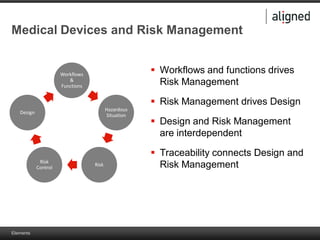
Medical Devices and Risk Management
 Workflows and functions drives
Risk Management
 Risk Management drives Design
 Design and Risk Management
are interdependent
 Traceability connects Design and
Risk Management
Workflows
&
Functions
Hazardous
Situation
Risk
Risk
Control
Design
Elements
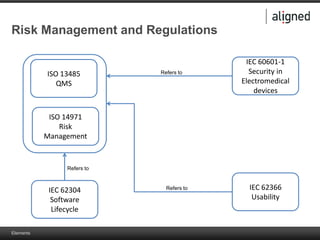
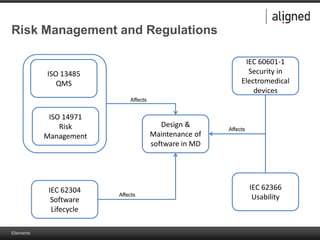
Risk Management and Regulations
ISO 13485
QMS
ISO 14971
Risk
Management
IEC 62304
Software
Lifecycle
IEC 60601-1
Security in
Electromedical
devices
IEC 62366
Usability
Refers to
Refers to
Refers to
Elements
Risk Management and Regulations
ISO 13485
QMS
ISO 14971
Risk
Management
IEC 62304
Software
Lifecycle
Design &
Maintenance of
software in MD
IEC 60601-1
Security in
Electromedical
devices
IEC 62366
Usability
Affects
Affects
Affects
Elements
General Concepts of Risk Assessments
 Identify Hazards
 Evaluate Risks (likelihood &
consequences)
 Perform Risk Reduction
 Evaluate residual Risks
Elements
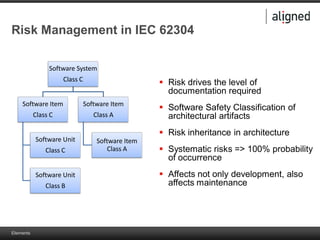
Risk Management in IEC 62304
 Risk drives the level of
documentation required
 Software Safety Classification of
architectural artifacts
 Risk inheritance in architecture
 Systematic risks => 100% probability
of occurrence
 Affects not only development, also
affects maintenance
Software System
Class C
Software Item
Class C
Software Unit
Class C
Software Unit
Class B
Software Item
Class A
Software Item
Class A
Elements
Documenting Medical Device Development
 Increasing number of regulations
 Development documentation is difficult,
complex and resource intensive to manage
 Aligned Elements helps you “build” a
consistent and complete documentation
 Free up valuable resources from
cumbersome administrative tasks
Elements
Aligned Elements – a medical device ALM
 Manages the DHF Design Control Items
 Version Control + Traceability + Documents
 Integrated Risk Management
 Real-time quality checks on content
 Ensures completeness and consistency
Elements
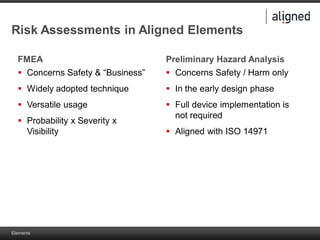
FMEA
 Concerns Safety & “Business”
 Widely adopted technique
 Versatile usage
 Probability x Severity x
Visibility
Preliminary Hazard Analysis
 Concerns Safety / Harm only
 In the early design phase
 Full device implementation is
not required
 Aligned with ISO 14971
Risk Assessments in Aligned Elements
Elements
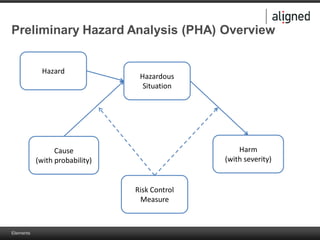
Preliminary Hazard Analysis (PHA) Overview
Cause
(with probability)
Harm
(with severity)
Hazardous
Situation
Risk Control
Measure
Hazard
Elements
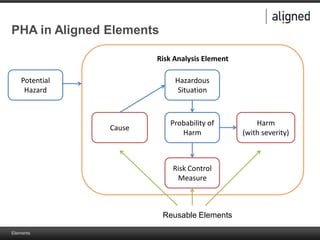
Risk Analysis Element
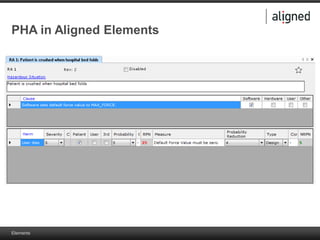
PHA in Aligned Elements
Cause
Harm
(with severity)
Hazardous
Situation
Risk Control
Measure
Reusable Elements
Probability of
Harm
Potential
Hazard
Elements
PHA in Aligned Elements
Elements
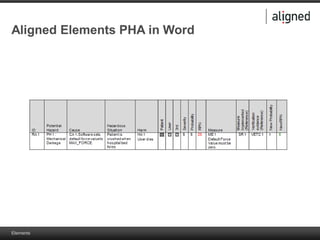
Aligned Elements PHA in Word
Elements
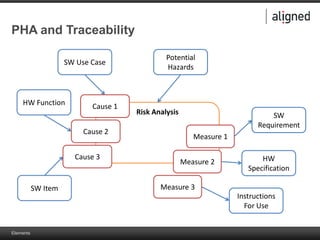
Risk Analysis
PHA and Traceability
Cause 1
Measure 1
Cause 2
Cause 3
Measure 2
Measure 3
SW Use Case
HW Function
SW Item
SW
Requirement
Instructions
For Use
HW
Specification
Potential
Hazards
Elements
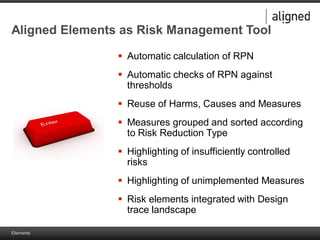
Aligned Elements as Risk Management Tool
 Automatic calculation of RPN
 Automatic checks of RPN against
thresholds
 Reuse of Harms, Causes and Measures
 Measures grouped and sorted according
to Risk Reduction Type
 Highlighting of insufficiently controlled
risks
 Highlighting of unimplemented Measures
 Risk elements integrated with Design
trace landscape
Elements
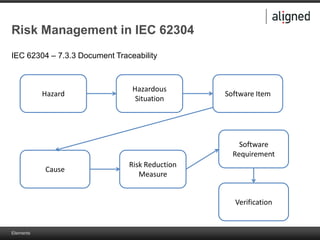
Risk Management in IEC 62304
Cause
Hazardous
Situation
Risk Reduction
Measure
Hazard Software Item
Software
Requirement
Verification
IEC 62304 – 7.3.3 Document Traceability
Elements
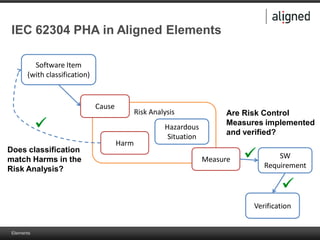
Risk Analysis
IEC 62304 PHA in Aligned Elements
Cause
Measure
Software Item
(with classification)
SW
Requirement
Verification
Harm
Does classification
match Harms in the
Risk Analysis?
Hazardous
Situation
Are Risk Control
Measures implemented
and verified?
Elements
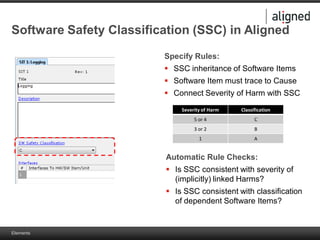
Software Safety Classification (SSC) in Aligned
Automatic Rule Checks:
 Is SSC consistent with severity of
(implicitly) linked Harms?
 Is SSC consistent with classification
of dependent Software Items?
Specify Rules:
 SSC inheritance of Software Items
 Software Item must trace to Cause
 Connect Severity of Harm with SSC
Severity of Harm Classification
5 or 4 C
3 or 2 B
1 A
Elements
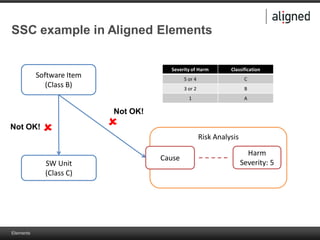
Risk Analysis
SSC example in Aligned Elements
Cause
Software Item
(Class B)
SW Unit
(Class C)
Harm
Severity: 5
Not OK!
Not OK!
Severity of Harm Classification
5 or 4 C
3 or 2 B
1 A
Elements
IEC 62304 and Probability in Risk Management
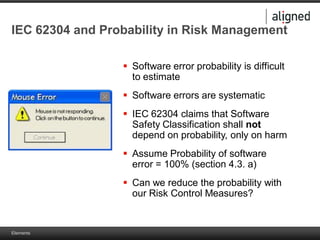
 Software error probability is difficult
to estimate
 Software errors are systematic
 IEC 62304 claims that Software
Safety Classification shall not
depend on probability, only on harm
 Assume Probability of software
error = 100% (section 4.3. a)
 Can we reduce the probability with
our Risk Control Measures?
Elements
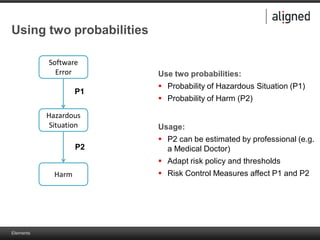
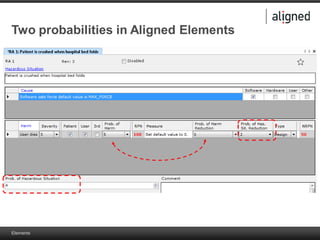
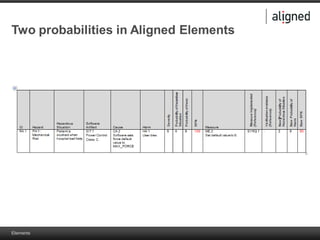
Use two probabilities:
 Probability of Hazardous Situation (P1)
 Probability of Harm (P2)
Usage:
 P2 can be estimated by professional (e.g.
a Medical Doctor)
 Adapt risk policy and thresholds
 Risk Control Measures affect P1 and P2
Using two probabilities
Software
Error
Hazardous
Situation
Harm
P1
P2
Elements
Two probabilities in Aligned Elements
Elements
Two probabilities in Aligned Elements
Elements
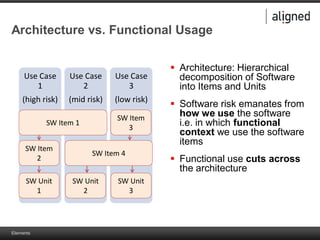
Architecture vs. Functional Usage
 Architecture: Hierarchical
decomposition of Software
into Items and Units
 Software risk emanates from
how we use the software
i.e. in which functional
context we use the software
items
 Functional use cuts across
the architecture
Use Case
1
(high risk)
Use Case
2
(mid risk)
Use Case
3
(low risk)
SW Item 1
SW Item
2
SW Item 4
SW Item
3
SW Unit
1
SW Unit
2
SW Unit
3
Elements
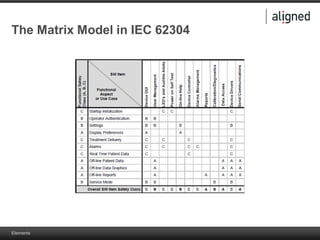
The Matrix Model in IEC 62304
Elements
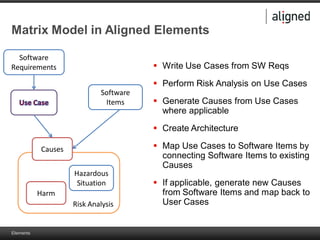
Matrix Model in Aligned Elements
 Write Use Cases from SW Reqs
 Perform Risk Analysis on Use Cases
 Generate Causes from Use Cases
where applicable
 Create Architecture
 Map Use Cases to Software Items by
connecting Software Items to existing
Causes
 If applicable, generate new Causes
from Software Items and map back to
User CasesRisk Analysis
Causes
Software
Requirements
Harm
Hazardous
Situation
Software
Items
Elements
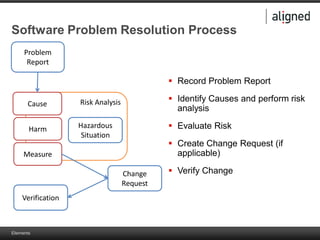
Software Problem Resolution Process
 Record Problem Report
 Identify Causes and perform risk
analysis
 Evaluate Risk
 Create Change Request (if
applicable)
 Verify Change
Risk AnalysisCause
Measure
Problem
Report
Change
Request
Verification
Harm Hazardous
Situation
Elements
Aligned Elements IEC 62304 Package
 Full template set for all IEC 62304 Artifacts
 Includes clear references to applicable sections in IEC 62304
 Full usage of Aligned Elements automatic consistency checks
 Integrated Checklists and Review Generators
 Preconfigured Word reports
 Preconfigured Trace Tables
 Preconfigured Queries
Elements
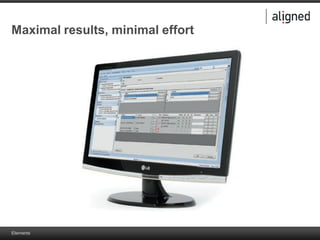
Maximal results, minimal effort
Thank You!Aligned AG
Binzmühlstrasse 210
CH-8050 Zürich
Switzerland
t +41 (0)44 312 50 20
f +41 (0)44 312 50 20
m info@aligned.ch
w www.aligned.ch

Applying IEC 62304 Risk Management in Aligned Elements - the medical device ALM

  • 1.
    Risk Management andIEC 62304 Applying IEC 62304 Risk Management in Aligned Elements February 2015
  • 2.
    Elements Medical Devices andRisk Management  Workflows and functions drives Risk Management  Risk Management drives Design  Design and Risk Management are interdependent  Traceability connects Design and Risk Management Workflows & Functions Hazardous Situation Risk Risk Control Design
  • 3.
    Elements Risk Management andRegulations ISO 13485 QMS ISO 14971 Risk Management IEC 62304 Software Lifecycle IEC 60601-1 Security in Electromedical devices IEC 62366 Usability Refers to Refers to Refers to
  • 4.
    Elements Risk Management andRegulations ISO 13485 QMS ISO 14971 Risk Management IEC 62304 Software Lifecycle Design & Maintenance of software in MD IEC 60601-1 Security in Electromedical devices IEC 62366 Usability Affects Affects Affects
  • 5.
    Elements General Concepts ofRisk Assessments  Identify Hazards  Evaluate Risks (likelihood & consequences)  Perform Risk Reduction  Evaluate residual Risks
  • 6.
    Elements Risk Management inIEC 62304  Risk drives the level of documentation required  Software Safety Classification of architectural artifacts  Risk inheritance in architecture  Systematic risks => 100% probability of occurrence  Affects not only development, also affects maintenance Software System Class C Software Item Class C Software Unit Class C Software Unit Class B Software Item Class A Software Item Class A
  • 7.
    Elements Documenting Medical DeviceDevelopment  Increasing number of regulations  Development documentation is difficult, complex and resource intensive to manage  Aligned Elements helps you “build” a consistent and complete documentation  Free up valuable resources from cumbersome administrative tasks
  • 8.
    Elements Aligned Elements –a medical device ALM  Manages the DHF Design Control Items  Version Control + Traceability + Documents  Integrated Risk Management  Real-time quality checks on content  Ensures completeness and consistency
  • 9.
    Elements FMEA  Concerns Safety& “Business”  Widely adopted technique  Versatile usage  Probability x Severity x Visibility Preliminary Hazard Analysis  Concerns Safety / Harm only  In the early design phase  Full device implementation is not required  Aligned with ISO 14971 Risk Assessments in Aligned Elements
  • 10.
    Elements Preliminary Hazard Analysis(PHA) Overview Cause (with probability) Harm (with severity) Hazardous Situation Risk Control Measure Hazard
  • 11.
    Elements Risk Analysis Element PHAin Aligned Elements Cause Harm (with severity) Hazardous Situation Risk Control Measure Reusable Elements Probability of Harm Potential Hazard
  • 12.
  • 13.
  • 14.
    Elements Risk Analysis PHA andTraceability Cause 1 Measure 1 Cause 2 Cause 3 Measure 2 Measure 3 SW Use Case HW Function SW Item SW Requirement Instructions For Use HW Specification Potential Hazards
  • 15.
    Elements Aligned Elements asRisk Management Tool  Automatic calculation of RPN  Automatic checks of RPN against thresholds  Reuse of Harms, Causes and Measures  Measures grouped and sorted according to Risk Reduction Type  Highlighting of insufficiently controlled risks  Highlighting of unimplemented Measures  Risk elements integrated with Design trace landscape
  • 16.
    Elements Risk Management inIEC 62304 Cause Hazardous Situation Risk Reduction Measure Hazard Software Item Software Requirement Verification IEC 62304 – 7.3.3 Document Traceability
  • 17.
    Elements Risk Analysis IEC 62304PHA in Aligned Elements Cause Measure Software Item (with classification) SW Requirement Verification Harm Does classification match Harms in the Risk Analysis? Hazardous Situation Are Risk Control Measures implemented and verified?
  • 18.
    Elements Software Safety Classification(SSC) in Aligned Automatic Rule Checks:  Is SSC consistent with severity of (implicitly) linked Harms?  Is SSC consistent with classification of dependent Software Items? Specify Rules:  SSC inheritance of Software Items  Software Item must trace to Cause  Connect Severity of Harm with SSC Severity of Harm Classification 5 or 4 C 3 or 2 B 1 A
  • 19.
    Elements Risk Analysis SSC examplein Aligned Elements Cause Software Item (Class B) SW Unit (Class C) Harm Severity: 5 Not OK! Not OK! Severity of Harm Classification 5 or 4 C 3 or 2 B 1 A
  • 20.
    Elements IEC 62304 andProbability in Risk Management  Software error probability is difficult to estimate  Software errors are systematic  IEC 62304 claims that Software Safety Classification shall not depend on probability, only on harm  Assume Probability of software error = 100% (section 4.3. a)  Can we reduce the probability with our Risk Control Measures?
  • 21.
    Elements Use two probabilities: Probability of Hazardous Situation (P1)  Probability of Harm (P2) Usage:  P2 can be estimated by professional (e.g. a Medical Doctor)  Adapt risk policy and thresholds  Risk Control Measures affect P1 and P2 Using two probabilities Software Error Hazardous Situation Harm P1 P2
  • 22.
  • 23.
  • 24.
    Elements Architecture vs. FunctionalUsage  Architecture: Hierarchical decomposition of Software into Items and Units  Software risk emanates from how we use the software i.e. in which functional context we use the software items  Functional use cuts across the architecture Use Case 1 (high risk) Use Case 2 (mid risk) Use Case 3 (low risk) SW Item 1 SW Item 2 SW Item 4 SW Item 3 SW Unit 1 SW Unit 2 SW Unit 3
  • 25.
  • 26.
    Elements Matrix Model inAligned Elements  Write Use Cases from SW Reqs  Perform Risk Analysis on Use Cases  Generate Causes from Use Cases where applicable  Create Architecture  Map Use Cases to Software Items by connecting Software Items to existing Causes  If applicable, generate new Causes from Software Items and map back to User CasesRisk Analysis Causes Software Requirements Harm Hazardous Situation Software Items
  • 27.
    Elements Software Problem ResolutionProcess  Record Problem Report  Identify Causes and perform risk analysis  Evaluate Risk  Create Change Request (if applicable)  Verify Change Risk AnalysisCause Measure Problem Report Change Request Verification Harm Hazardous Situation
  • 28.
    Elements Aligned Elements IEC62304 Package  Full template set for all IEC 62304 Artifacts  Includes clear references to applicable sections in IEC 62304  Full usage of Aligned Elements automatic consistency checks  Integrated Checklists and Review Generators  Preconfigured Word reports  Preconfigured Trace Tables  Preconfigured Queries
  • 29.
  • 30.
    Thank You!Aligned AG Binzmühlstrasse210 CH-8050 Zürich Switzerland t +41 (0)44 312 50 20 f +41 (0)44 312 50 20 m info@aligned.ch w www.aligned.ch