DR HAMID RAHMAN SABAWOON 1
Prepared and presented by: Dr Hamid Rahman
Sabawoon, MD, LMIH,MN
Supervised by: Dr Qadir Omar, MD, Trainer of G.Surgery
‫افغانســــــــتان‬ ‫اســـــــالمی‬ ‫جمــــــــــهوری‬
‫عـــــــــــــــامه‬ ‫صحـــــت‬ ‫وزارت‬
‫تخــــصـــــص‬ ‫اکمــــــــــال‬ ‫ریاســــت‬
‫بلــــــخی‬ ‫رابعـــــــه‬ ‫کمپــــلکس‬ ‫شفـــــاخانه‬
‫عمــــــومی‬ ‫جــــــراحی‬ ‫دیپــــــارتمنـــت‬
What is Suture?
Suture is a strand used to ligate the blood vessels and
approximate the tissues.
A suture is a thread used for uniting wound edges
Materials that had been tried included: gold, silver and
steel wire, silk, linen, hemp, flax, tree bark, animal and
human hair, bowstrings,and gut strings from sheep
and goats.
DR HAMID RAHMAN SABAWOON 3
‫بخیه‬ ‫تاریخچه‬
‫استف‬ ‫شدن‬ ‫منتن‬ ‫غیر‬ ‫و‬ ‫شفایابی‬ ‫بخشیدن‬ ‫سرعت‬ ‫بمنظور‬ ‫وسیع‬ ‫بصورت‬ ‫امروز‬ ‫بخیه‬‫اده‬
‫میشود‬.‫داکترها‬ ‫توسط‬ ‫بخیه‬,‫ها‬ ‫نرس‬,‫دندان‬ ‫داکتران‬,‫عاجل‬ ‫پرسونل‬,‫دوکتوران‬‫نظامی‬
. ‫گردشگران‬ ‫و‬ ‫سیاحان‬ ‫و‬‫میگردد‬ ‫استفاده‬ ‫حرفوی‬.
‫حیوانات‬ ‫استخوان‬ ‫و‬ ‫ازچوب‬ ‫عبارت‬ ‫میگردیده‬ ‫استفاده‬ ‫زدن‬ ‫بخیه‬ ‫برای‬ ‫موادیکه‬ ‫اولین‬
‫میگردید‬ ‫استفاده‬ ‫امروز‬ ‫از‬ ‫قبل‬ ‫سال‬ ‫هزاران‬ ‫که‬ ‫بوده‬.
‫از‬ ‫عبارت‬ ‫بود‬ ‫مروج‬ ‫ان‬ ‫در‬ ‫زدن‬ ‫بخیه‬ ‫که‬ ‫تمدن‬ ‫اولین‬‫مصری‬‫ها‬ ‫مصری‬ ‫که‬ ‫بود‬
‫آنها‬ ‫بدن‬ ‫کردن‬ ‫باز‬ ‫از‬ ‫بعد‬ ‫ها‬ ‫مرده‬ ‫دیگر‬ ‫و‬ ‫شاهان‬ ‫کردن‬ ‫بسته‬ ‫برای‬ ‫تخنیگ‬ ‫ازین‬
‫میکردند‬ ‫استفاده‬ ‫کردن‬ ‫مومیایی‬ ‫برای‬.‫نیز‬ ‫ها‬ ‫زنده‬ ‫برای‬ ‫بلکه‬ ‫مردگان‬ ‫برای‬ ‫تنها‬ ‫نه‬
‫میگردید‬ ‫استفاده‬ ‫جروحات‬ ‫کردن‬ ‫بسته‬ ‫جهت‬.
‫یونان‬ ‫فیلسوف‬‫هیپوکرات‬‫است‬ ‫نمود‬ ‫استفاده‬ ‫ان‬ ‫از‬ ‫زدن‬ ‫بخیه‬ ‫بمنظور‬ ‫موادیکه‬ ‫اولین‬
‫است‬ ‫کرده‬ ‫یاد‬ ‫خود‬ ‫تحقیقات‬ ‫در‬ ‫و‬ ‫نباتی‬ ‫محصوالت‬ ‫از‬ ‫را‬.‫منتن‬ ‫از‬ ‫عالم‬ ‫این‬ ‫و‬‫شدن‬
‫جرحه‬‫و‬‫اسکار‬ ‫تشکل‬‫است‬ ‫نموده‬ ‫یاد‬ ‫نیز‬ ‫زدن‬ ‫بخیه‬ ‫از‬ ‫بعد‬.
DR HAMID RAHMAN SABAWOON 4
‫بخیه‬ ‫تاریخچه‬
‫ولی‬ ‫نیست‬ ‫معلوم‬ ‫زدن‬ ‫بخیه‬ ‫جهت‬ ‫حیوانی‬ ‫به‬ ‫نباتی‬ ‫مواد‬ ‫تبدیل‬ ‫دقیق‬ ‫تاریخ‬ ‫هم‬ ‫هنوز‬ ‫گرچی‬
‫بنام‬ ‫موادی‬ ‫از‬ ‫عبارت‬ ‫است‬ ‫شده‬ ‫ثبت‬ ‫تاریخ‬ ‫در‬ ‫که‬ ‫معلومات‬ ‫اولین‬‫گوت‬ ‫کت‬‫توسط‬ ‫که‬ ‫بوده‬
‫بنام‬ ‫عالم‬‫گالن‬‫در‬ ‫که‬‫پرنگ‬‫ا‬‫م‬‫و‬‫ن‬‫میال‬ ‫از‬ ‫بعد‬ ‫دوسال‬ ‫میکرد‬ ‫زندگی‬‫د‬‫است‬ ‫شده‬ ‫داده‬ ‫نسبت‬.‫کت‬
‫مثل‬ ‫حیوانات‬ ‫روده‬ ‫از‬ ‫دارد‬ ‫وسیع‬ ‫استفاده‬ ‫هم‬ ‫هنوز‬ ‫که‬ ‫گود‬‫بز‬‫و‬‫گوسفند‬‫که‬ ‫میشد‬ ‫ساخته‬
‫میگردد‬ ‫استفاده‬ ‫آن‬ ‫از‬ ‫و‬ ‫شده‬ ‫ساخته‬ ‫صنعتی‬ ‫بصورت‬ ‫امروز‬.‫برداشتن‬ ‫برای‬ ‫ضرورت‬ ‫که‬
‫میگردد‬ ‫جذب‬ ‫بدن‬ ‫در‬ ‫خودبخود‬ ‫و‬ ‫نداشته‬.
‫داشتن‬ ‫زدن‬ ‫بخیه‬ ‫مواد‬ ‫با‬ ‫صحی‬ ‫کارمندان‬ ‫و‬ ‫داکتران‬ ‫که‬ ‫مشکالت‬ ‫بزرگترین‬ ‫از‬ ‫یکی‬‫د‬,‫پاک‬
‫میگردید‬ ‫انتانات‬ ‫و‬ ‫تخریش‬ ‫سبب‬ ‫معمول‬ ‫که‬ ‫بود‬ ‫جرحه‬ ‫شدن‬ ‫منتن‬ ‫و‬ ‫مواد‬ ‫این‬ ‫نبودن‬.
‫سال‬ ‫در‬1860‫بنام‬ ‫عالمی‬‫لیستر‬ ‫جوسف‬‫و‬ ‫مواد‬ ‫عالم‬ ‫این‬ ‫نمود‬ ‫حل‬ ‫حدی‬ ‫تا‬ ‫را‬ ‫مشکل‬ ‫این‬
‫بنام‬ ‫موادی‬ ‫بین‬ ‫در‬ ‫را‬ ‫خود‬ ‫دوخت‬ ‫محصوالت‬‫اسید‬ ‫کاربولیک‬‫حل‬ ‫راه‬ ‫یک‬ ‫که‬ ‫مینمود‬ ‫تعقیم‬
‫بود‬ ‫انتان‬ ‫رفتن‬ ‫ار‬ ‫برای‬ ‫مفید‬ ‫بسیار‬.‫اسید‬ ‫کرومیک‬‫ظاهر‬ ‫مواد‬ ‫تعقیم‬ ‫جهت‬ ‫صحنه‬ ‫در‬ ‫بعدا‬
‫شد‬.‫باالخره‬‫ایودین‬‫سال‬ ‫در‬ ‫نیز‬1902‫گردید‬ ‫معرفی‬.‫دراز‬ ‫سالیان‬ ‫از‬ ‫شده‬ ‫تعقیم‬ ‫گوت‬ ‫کت‬
‫دوکتورا‬ ‫هم‬ ‫هنوز‬ ‫اما‬ ‫میشود‬ ‫استفاده‬ ‫هم‬ ‫هنوز‬ ‫و‬ ‫شده‬ ‫استفاده‬ ‫جروحات‬ ‫بخیه‬ ‫در‬‫ن‬‫یافتن‬ ‫جهت‬
‫هستند‬ ‫بهتر‬ ‫و‬ ‫برتر‬ ‫دیگر‬ ‫مواد‬‫چ‬‫راکه‬‫مشکالت‬‫از‬ ‫عبارتند‬ ‫دارند‬ ‫مواد‬ ‫این‬ ‫که‬‫نبودن‬ ‫معلوم‬
‫جذب‬ ‫دقیق‬‫همچنان‬ ‫و‬ ‫بدن‬ ‫در‬ ‫مواد‬ ‫این‬‫زود‬ ‫شدن‬ ‫باز‬‫میباشد‬ ‫دوختن‬ ‫از‬ ‫بعد‬ ‫جرحه‬.‫بوجود‬
‫امدن‬‫اسکار‬ ‫نسج‬‫میباشد‬ ‫مواد‬ ‫این‬ ‫مشکالت‬ ‫از‬ ‫یکی‬ ‫نیز‬.
DR HAMID RAHMAN SABAWOON 5
‫بخیه‬ ‫تاریخچه‬
DR HAMID RAHMAN SABAWOON 6
‫بخیه‬ ‫تاریخچه‬
DR HAMID RAHMAN SABAWOON 7
Qualities of an ideal suture: It should
◦ Remain intact until union occurs.
◦ Cause minimum tissue reaction.
◦ Be non-capillary in action.
◦ Be of uniform thickness.
◦ Be knotable.
◦ Have smooth surface.
◦ Have sufficient tensile and functional strength.
◦ Easily sterilizable.
◦ Cheap and readily available
◦ Easy to handle.
‫مطلوب‬ ٔ‫ه‬‫بخی‬ ‫نخ‬
‫نباشد‬ ‫زا‬‫سرطان‬
‫باشد‬ ‫نفوذپذیر‬
‫نکند‬ ‫بافتی‬ ِ‫ت‬‫حساسی‬ ‫ایجاد‬
‫باشد‬ ‫داشته‬ ‫اعتماد‬‫قابل‬ ‫های‬‫گره‬
‫شود‬ ‫جذب‬ ،‫مطلوب‬ ٔ‫ه‬‫نتیج‬ ‫دادن‬ ‫از‬ ‫پس‬
‫نباشد‬ ‫مناسب‬ ‫باکتری‬ ‫رشد‬ ‫جهت‬
‫باشد‬ ‫کردن‬‫استریل‬ ‫قابل‬ ‫راحتی‬‫به‬.
(‫گاز‬ ‫با‬‫اکساید‬ ‫اتیلن‬
DR HAMID RAHMAN SABAWOON 8
Supplies
Materials Needed for
Suturing
DR HAMID RAHMAN SABAWOON 9
Suture Material category
Generally categorized by three
characteristics:
◦ Absorbable vs. non-absorbable
◦ Natural vs. synthetic
◦ Monofilament vs. Multifilament
‫دسته‬ ‫دو‬ ‫به‬ ‫بدن‬ ‫جذب‬ ‫نظر‬ ‫از‬:‫جذب‬‫غیرقابل‬ ‫و‬ ‫جذب‬‫قابل‬
‫دسته‬ ‫دو‬ ‫به‬ ‫ساخت‬ ‫منبع‬ ‫نظر‬ ‫از‬:‫مصنوعی؛‬ ‫و‬ ‫طبیعی‬
‫دسته‬ ‫دو‬ ‫به‬ ‫فیزیکی‬ ‫شکل‬ ‫نظر‬ ‫از‬:‫ی‬‫و‬ ‫ای‬‫رشته‬‫ک‬
‫ای؛‬‫چندرشته‬
DR HAMID RAHMAN SABAWOON 10
CLASSIFICATION OF SUTURES
ABSORBABLE NONABSORBABLE
MONOFILAMENT MULTIFILAMENT (BRAIDED)
SYNTHETIC NATURAL
DR HAMID RAHMAN SABAWOON 11
Characteristics of Sutures Materials
Suture materials can be divided into two categories: absorbable and non-
absorbable.
Absorbable materials have the advantage in that they are less likely to cause an
immune response by the body
Non-absorbable materials can be left in the body permanently if needed.
DR HAMID RAHMAN SABAWOON 12
Absorbable Suture Materials
Absorbablesuturematerials are
broken down by the patient’s body.
The original absorbable material was
chromic catgut (still used today).
This is made from animal intestines and
breaks down after 7 days.
Because it breaks down, there is less of a
likelihood of an immune reaction.
DR HAMID RAHMAN SABAWOON 13
Non-absorbable Suture Materials
Non-absorbablesutures are made of
materials that are not readily broken down by
the body’s enzymes or by hydrolysis.
Non-absorbable materials can be removed or
left in place permanently
 Source: Boston University Medical Campus
DR HAMID RAHMAN SABAWOON 14
Absorbable Suture-description
Kangaroo tendon: It is obtained from the tendon of tail of
kangaroo and is used for suturing joint capsule
Fascia lata: It is obtained from the bovine Fascia lata
‫قاب‬‫ــ‬‫ج‬‫ل‬‫ــ‬‫ذب‬
DR HAMID RAHMAN SABAWOON 15
Absorbable Suture-description
Cargile membrane: it is obtained from bovine caecum
Amniotic membrane: It is prepared from amniotic membrane of fetuses
DR HAMID RAHMAN SABAWOON 16
Collagen: It is prepared from bovine flexor tendon
filament .
Polyglactin 910 (vicryl): It is a synthetic absorbable
suture material, prepared from glycolic lactic acid polymer.
Polyglycolic acid (Dexon): It is synthetic suture material
prepared from glycolic acid
DR HAMID RAHMAN SABAWOON 17
Catgut
Absorption in tissues can be delayed by treating with
chromic acid.
Catgut therefore available as plain and chromic catgut.
chromic catgut
DR HAMID RAHMAN SABAWOON 18
Type Degree of
Chromicity
Approx No.Of
days taken for
absorption
Type A Plain 10 Days
Type B Mild chromic 15 Days
Type C Medium
chromic
20 Days
Type D Extra chromic 40 Days
DR HAMID RAHMAN SABAWOON 19
Catgut cont.
Depending on preservative used catgut is available eitheras
boilable or non boilable catgut.
1. Boilable catgut is preserved in xylol,toulene-99.75%,phenyl
merecuric acetate.025%.
2. Non boilable catgut is supplied in tubes containing90-
95%alcohol.
DR HAMID RAHMAN SABAWOON 20
Sizes of
catgut
Diameter in
mm(average)
Use
2/0 0.30 Peretoneum,bowel wall(small
animals)and ligaturing vessels
0 or
1/0
0.40 -do-
1 0.48 Muscle
fascia(SA)ligature
larger vessels
2 0.50 -do-
3 0.60 Fascia,muscles(LA)
4 0.70
5 0.80 Rumen uterus
abdomen
DR HAMID RAHMAN SABAWOON 21
Catgut size selection
Bowel: 2/0 - 3/0
Fascia: 1 - 0
Ligatures: 0 - 3/0
Pedicles: 2 - 0
Skin: 2/0 - 5/0
Arteries: 2/0 - 8/0
Micro surgery 9/0 - 10/0
Corneal closure: 9/0 - 10/0
DR HAMID RAHMAN SABAWOON 22
Non-absorbable Suture
Not degraded, permanent
may be organic; inorganic or synthetic in
nature and are used as both the internal
and external suture materials.
‫جذب‬‫غیرقابل‬
Non absorbable sutures
DR HAMID RAHMAN SABAWOON 23
Non absorbable sutures
Ethicon
Braided silk black
Trulon
Monofilament polyamide
Trulene
Monofilament polypropylene
DR HAMID RAHMAN SABAWOON 24
Non-absorbable Suture
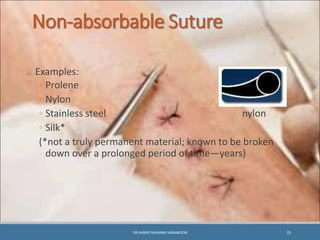
Examples:
◦ Prolene
◦ Nylon
◦ Stainless steel nylon
◦ Silk*
(*not a truly permanent material; known to be broken
down over a prolonged period of time—years)
DR HAMID RAHMAN SABAWOON 25
Non-absorbable Organic suture materials
‫عضوی‬
Cotton:capillary in nature it clings to
surgeon’s gloves and they spread infection
in wound when applied to skin and luminal
surfaces.
Silk: it may be plain or braided and
capillary in nature
Silk worm gut: non-capillary and useful
for cutaneous sutures
DR HAMID RAHMAN SABAWOON 26
cont.
Horse hair: It is cheap, non-capillary, flexible and is
easily sterilized. It causes little tissue reaction.
Linen: It is capillary in nature and produces more tissue
reaction than cotton and silk.
Umbilical tape: used to tie the umbilical cord of the
new born or as vulvar suture in cases of prolapse of
vagina of uterus.
DR HAMID RAHMAN SABAWOON 27
Polyester:is a non absorbable, sterile, surgical
suture composed of Poly (ethylene terephthalate).
It suture elicits a minimal acute inflammatory
reaction in tissues.
Polyamide: Being monofilament, Linex is
remarkably smooth and gives excellent knotsecurity.
Posses good tensile strength.
Easy removal with no tissueadherence.
DR HAMID RAHMAN SABAWOON 28
Non-absorbable Inorganic suture
material
‫عضوی‬ ‫غیر‬
Metallic suture: Wire of different
metals like tantalum, silver,
copper, stainless steel and vitallium
Tantalum: It is inert to tissues like
stainless steel
DR HAMID RAHMAN SABAWOON 29
Natural Suture ‫طبیعی‬
Biological origin
Cause intense inflammatory reaction
Examples:
◦ “Catgut” – purified collagen fibers derived from intestine of healthy sheep or
cows
◦ Silk(non absorbable)
‫دسته‬ ‫دو‬ ‫به‬ ‫ساخت‬ ‫منبع‬ ‫نظر‬ ‫از‬:‫مصنوعی‬ ‫و‬ ‫طبیعی‬
DR HAMID RAHMAN SABAWOON 30
Synthetic Suture ‫مصنوعی‬
Synthetic polymers
Do not cause intense inflammatory reaction
Examples:
◦ Vicryl(absorbable)
◦ Monocryl
◦ Prolene
◦ Nylon
DR HAMID RAHMAN SABAWOON 31
Stainless steel suture
DR HAMID RAHMAN SABAWOON 32
cont..
Silver: It becomes ionized in tissues and cause inflammation.
Copper: It is more suitable to repair fractures due to its
flexibility.
Aluminium wire: It is more flexible than stainless steel.
DR HAMID RAHMAN SABAWOON 33
Multifilament (braided)
Suture Classification ‫شکل‬ ‫نظر‬ ‫از‬ ‫تصنیف‬
‫فزیکی‬:‫ای‬ ‫رشته‬ ‫چند‬ ‫و‬ ‫ای‬ ‫رشته‬ ‫یک‬
Monofilament
DR HAMID RAHMAN SABAWOON 34
Monofilament Suture
Grossly appears as single strand of suture material; all fibers run
parallel
Minimal tissue trauma
Resists harboring microorganisms
Ties smoothly
Requires more knots than multifilament suture
Examples:
Monocryl, PDS, Prolene, Nylon
DR HAMID RAHMAN SABAWOON 35
Multifilament Suture
Fibers are twisted or braided together
Greater resistance in tissue
Provides good handling and ease of tying
Fewer knots required
Examples:
Vicryl (braided)
Chromic (twisted)
Silk (braided)
DR HAMID RAHMAN SABAWOON 36
Braided v/s Monofilament
Has capillary action
Increased infection risk
Less smooth passage
Less tensile strength
Better handling
Better knot security
No capillary action
Less infection risk
Smooth tissue passage
Higher tensile strength
Has memory
More throws required
DR HAMID RAHMAN SABAWOON 37
Silk Catgut
Natural
◦ Silk, linen, catgut
Synthetic polymer
◦ Polypropylene, polyester,
polyamide
Polypropylene Polyester
DR HAMID RAHMAN SABAWOON 38
nylon
Monofilament
◦ Polypropylene
◦ Polydioxanone
◦ Nylon
Multifilament
◦ Catgut (twisted)
◦ Polyester
◦ Silk (braided)
Polyester Silk
DR HAMID RAHMAN SABAWOON 39
DR HAMID RAHMAN SABAWOON 40
Suture Degradation
Suture Material
Method of
Degradation
Time to
Degradation
“Catgut”
Proteolytic
enzymes
Days
Vicryl, Monocryl Hydrolysis
Weeks to
months
DR HAMID RAHMAN SABAWOON 41
Suture Size
Sized according to diameter with “0” as reference size
Numbers alone indicate progressively larger sutures
(“1”, “2”, etc)
Numbers followed by a “0” indicate progressively
smaller sutures (“2-0”, “4-0”, etc)
Smaller --------------------------- Larger
.....”3-0”...”2-0”...”1-0”.....”1”...”2”...”3”.....
DR HAMID RAHMAN SABAWOON 42
The Suture Packaging
STRAND
SIZE
MATERIA
L
STRAND
LENGTH
PRODUC
T CODE
NEEDLE
CODE
WITH
LIFE SIZE
PICTURE
OF
NEEDLE
NEEDLE
LENGTHCOLOU
R
POINT
TYPE
NEEDLE
CIRCLE
DR HAMID RAHMAN SABAWOON 43
DR HAMID RAHMAN SABAWOON 44
DR HAMID RAHMAN SABAWOON 45
Needle Qualities
 Surgical needles are produced from stainless steel alloys,
resistance to corrosion.
 contain a minimum of 12% chromium, which allows a thin,
protective surface layer of chromium oxide to form when the steel
is exposed to oxygen.
 Surgical needles made of a high nickel managing stainless steel
have a greater resistance to bending and breakage than stainless
steels without nickel.
Needles
DR HAMID RAHMAN SABAWOON 46
  High-quality stainless steel
  Smallest diameter possible
  Stable in the grasp of the needle holder
  Capable of implanting suture material through tissue with
minimal trauma
  Sharp enough to penetrate tissue with minimal resistance
  Sterile and corrosion -resistant to prevent introduction of
microorganisms or foreign materials into the wound
Ideal surgical needle characteristics
DR HAMID RAHMAN SABAWOON 47
Point
This portion of the needle extends from the tip to the
maximum cross-section of the body.
Body
This part of the needle incorporates most of the needle
length. The body of the needle is important for interaction
with the needle holder and the ability to transmit the
penetrating force to the point. The needle factors that affect
this interaction include needle diameter and radius, body
geometry, and stainless steel alloy.
Anatomy of a Needle
DR HAMID RAHMAN SABAWOON 48
Swage:
The suture attachment end creates a single, continuous unit
of suture and needle. The swage may be designed to permit
easy release of the needle and suture material.
Needle coating:
The needle may be coated with silicone to permit easier
tissue passage. The coating helps reduce the force needed
to make initial tissue penetration and the frictional forces as
the body of the needle passes through the tissue.
Needle Cont…
DR HAMID RAHMAN SABAWOON 49
Anatomy of a Needle
DR HAMID RAHMAN SABAWOON 50
◦ Atraumatic needles- to suture delicate tissues like
intestine, stomach, bladder, uterus etc.
◦ Double curved and loopuyt needles -for skin
closure of cattle or buffalo and for deeper structures.
Needle Cont…
DR HAMID RAHMAN SABAWOON 51
Needles
Straight
◦ Often hand held
◦ Used to secure
percutaneously placed
devices (e.g. central and
arterial lines)
Compound curved:
This needle curvature
was originally
designed for anterior
segment ophthalmic
surgery. The body has
a tight 80° curvature
at the tip, which
becomes a 45°
curvature throughout
the remainder of the
body. A microvascular
compound curved
needle also may
facilitate vessel
approximation in
microvascular
surgery.
Curved
◦ Designed to be held with a
needle holder
◦ Used for most suturing
DR HAMID RAHMAN SABAWOON 52
Needles
•
• Eyed needles
– More Traumatic
– Only thread through
once
– Suture on a reel
– Tends to unthread itself
easily
DR HAMID RAHMAN SABAWOON 53
Needle Curvature
DR HAMID RAHMAN SABAWOON 54
Taper-Point
Suited to soft tissue
Dilates rather than cuts
Reverse
cutting
Very sharp
Ideal for skin
Cuts rather than dilates
Conventional
Cutting
Very sharp
Cuts rather than dilates
Creates weakness allowing suture
tearout
Taper-cutting
Ideal in tough or calcified tissues
Mainly used in Cardiac & Vascular
procedures.
Needle point Geometry
DR HAMID RAHMAN SABAWOON 55
Needle point Geometry
Blunt
Also known as “Protect Point”
Mainly used to prevent needle stick
injuries i.e. for abdominal wall closure.
Premium point
spatula
Ophthalmic Surgery
Spatula
Ophthalmic Surgery
DermaX*
NEW: ½ The Penetration force
½ The Penetration force
Superior Cosmetic Effect
DR HAMID RAHMAN SABAWOON 56
Needle point Geometry
DR HAMID RAHMAN SABAWOON 57
DR HAMID RAHMAN SABAWOON 58
DR HAMID RAHMAN SABAWOON 59
DR HAMID RAHMAN SABAWOON 60
The appropriate needle choice for any situation is
.......................The needle that will cause least
possible trauma to the tissue being sutured.
The Right Needle Choice
DR HAMID RAHMAN SABAWOON 61
Using needle holder, grasp needle about
2/3rds of the way back from point.
DR HAMID RAHMAN SABAWOON 62
Index finger stabilizes the instrument by resting on the shaft.
DR HAMID RAHMAN SABAWOON 63
Surgical Scissors
DR HAMID RAHMAN SABAWOON 64
FORCEPS
Grasp forceps between thumb & middle finger, while index
finger is used for stabilization.
If possible, use forceps to grasp dermis, rather than epidermis
or skin surface itself.
This helps prevent marking & injuring of skin at wound edge.
DR HAMID RAHMAN SABAWOON 65
Steri-strips
Sterile adhesive tapes
Available in different
widths
Frequently used with
subcuticular sutures
Used following staple
or suture removal
Can be used for
delayed closure
DR HAMID RAHMAN SABAWOON 66
Staples
Rapid closure of wound
Easy to apply
Evert tissue when placed
properly
DR HAMID RAHMAN SABAWOON 67
Dermabond®
A sterile, liquid topical skin
adhesive
Reacts with moisture on skin
surface to form a strong, flexible
bond
Only for easily approximated skin
edges of wounds
punctures from minimally
invasive surgery
simple, thoroughly cleansed,
lacerations
DR HAMID RAHMAN SABAWOON 68
AMCRYLATE® Gel
Iso-amyl-2-cyanoacylate
Method of application
Control hemorrhage on cutaneous incision on skin
and keep dry using swabs.
Apply few drops of Iso-amyl-2-cyanoacylate over the
wound edges.
Hold skin edges in proper opposition for about 20
seconds to achieve union of skin wound
DR HAMID RAHMAN SABAWOON 69
1. Scalp: 6-8 days
2. Face, Eyelid, Eyebrow, Nose, Lip: 3-5 days
3. Ear: 10-14 days
4. Chest and abdomen: 8-10 days
5. Back: 12-14 days
6. Extremities: 12-14 days
7. Hand: 10-14 days
8. Foot and sole: 12-14 days
9. Penis: 8-10 days
10. Condition delaying Wound Healing: 14 to 21 days
1. Chronic Corticosteroid use
2. Diabetes Mellitus
Suture Removal Timing
DR HAMID RAHMAN SABAWOON 70
Knots
A suture knot has three components
1- The loop created by the knot
2- The knot itself, which is composed of a number of tight
“throws”, each throw represents a weave of the two
stands
3- The ears, which are the cut ends of the suture
DR HAMID RAHMAN SABAWOON 71
DR HAMID RAHMAN SABAWOON 72
Suture Packaging
DR HAMID RAHMAN SABAWOON 73
Non absorbable sutures
Ethicon
Braided silk black
Trulon
Monofilament polyamide
Trulene
Monofilament
polypropylene
DR HAMID RAHMAN SABAWOON 74
DR HAMID RAHMAN SABAWOON 75
Absorbable sutures
DR HAMID RAHMAN SABAWOON 76
DR HAMID RAHMAN SABAWOON 77
DR HAMID RAHMAN SABAWOON 78
DR HAMID RAHMAN SABAWOON 79
DR HAMID RAHMAN SABAWOON 80
DR HAMID RAHMAN SABAWOON 81
Bibliography
Postlethwait, R.W.: Wound healing and surgery. Somerville, New Jersey,
Ethicon, Inc., 1971
Varma, S., et al.: Comparison of seven suture materials in infected wound.
An experimental study. J. Surg. Res., 17:165, 1974
Chaiken, R.W.: Elements of surgical treatment in the delivery of
periodontal therapy. Chicago, Quintessence, 1977
Ethicon, Wound closure manual. Somerville, New Jersey, Ethicon, Inc,
1985, p.9
www.suturs.com
www.myoclinic.com
http://cal.vet.upenn.edu/surgery/index.html
Dr. Sameer A. Mokeem faculty.ksu.edu.sa/sameer/411 PDS
DR HAMID RAHMAN SABAWOON 82

Suture materials

  • 1.
    DR HAMID RAHMANSABAWOON 1
  • 2.
    Prepared and presentedby: Dr Hamid Rahman Sabawoon, MD, LMIH,MN Supervised by: Dr Qadir Omar, MD, Trainer of G.Surgery ‫افغانســــــــتان‬ ‫اســـــــالمی‬ ‫جمــــــــــهوری‬ ‫عـــــــــــــــامه‬ ‫صحـــــت‬ ‫وزارت‬ ‫تخــــصـــــص‬ ‫اکمــــــــــال‬ ‫ریاســــت‬ ‫بلــــــخی‬ ‫رابعـــــــه‬ ‫کمپــــلکس‬ ‫شفـــــاخانه‬ ‫عمــــــومی‬ ‫جــــــراحی‬ ‫دیپــــــارتمنـــت‬
  • 3.
    What is Suture? Sutureis a strand used to ligate the blood vessels and approximate the tissues. A suture is a thread used for uniting wound edges Materials that had been tried included: gold, silver and steel wire, silk, linen, hemp, flax, tree bark, animal and human hair, bowstrings,and gut strings from sheep and goats. DR HAMID RAHMAN SABAWOON 3
  • 4.
    ‫بخیه‬ ‫تاریخچه‬ ‫استف‬ ‫شدن‬‫منتن‬ ‫غیر‬ ‫و‬ ‫شفایابی‬ ‫بخشیدن‬ ‫سرعت‬ ‫بمنظور‬ ‫وسیع‬ ‫بصورت‬ ‫امروز‬ ‫بخیه‬‫اده‬ ‫میشود‬.‫داکترها‬ ‫توسط‬ ‫بخیه‬,‫ها‬ ‫نرس‬,‫دندان‬ ‫داکتران‬,‫عاجل‬ ‫پرسونل‬,‫دوکتوران‬‫نظامی‬ . ‫گردشگران‬ ‫و‬ ‫سیاحان‬ ‫و‬‫میگردد‬ ‫استفاده‬ ‫حرفوی‬. ‫حیوانات‬ ‫استخوان‬ ‫و‬ ‫ازچوب‬ ‫عبارت‬ ‫میگردیده‬ ‫استفاده‬ ‫زدن‬ ‫بخیه‬ ‫برای‬ ‫موادیکه‬ ‫اولین‬ ‫میگردید‬ ‫استفاده‬ ‫امروز‬ ‫از‬ ‫قبل‬ ‫سال‬ ‫هزاران‬ ‫که‬ ‫بوده‬. ‫از‬ ‫عبارت‬ ‫بود‬ ‫مروج‬ ‫ان‬ ‫در‬ ‫زدن‬ ‫بخیه‬ ‫که‬ ‫تمدن‬ ‫اولین‬‫مصری‬‫ها‬ ‫مصری‬ ‫که‬ ‫بود‬ ‫آنها‬ ‫بدن‬ ‫کردن‬ ‫باز‬ ‫از‬ ‫بعد‬ ‫ها‬ ‫مرده‬ ‫دیگر‬ ‫و‬ ‫شاهان‬ ‫کردن‬ ‫بسته‬ ‫برای‬ ‫تخنیگ‬ ‫ازین‬ ‫میکردند‬ ‫استفاده‬ ‫کردن‬ ‫مومیایی‬ ‫برای‬.‫نیز‬ ‫ها‬ ‫زنده‬ ‫برای‬ ‫بلکه‬ ‫مردگان‬ ‫برای‬ ‫تنها‬ ‫نه‬ ‫میگردید‬ ‫استفاده‬ ‫جروحات‬ ‫کردن‬ ‫بسته‬ ‫جهت‬. ‫یونان‬ ‫فیلسوف‬‫هیپوکرات‬‫است‬ ‫نمود‬ ‫استفاده‬ ‫ان‬ ‫از‬ ‫زدن‬ ‫بخیه‬ ‫بمنظور‬ ‫موادیکه‬ ‫اولین‬ ‫است‬ ‫کرده‬ ‫یاد‬ ‫خود‬ ‫تحقیقات‬ ‫در‬ ‫و‬ ‫نباتی‬ ‫محصوالت‬ ‫از‬ ‫را‬.‫منتن‬ ‫از‬ ‫عالم‬ ‫این‬ ‫و‬‫شدن‬ ‫جرحه‬‫و‬‫اسکار‬ ‫تشکل‬‫است‬ ‫نموده‬ ‫یاد‬ ‫نیز‬ ‫زدن‬ ‫بخیه‬ ‫از‬ ‫بعد‬. DR HAMID RAHMAN SABAWOON 4
  • 5.
    ‫بخیه‬ ‫تاریخچه‬ ‫ولی‬ ‫نیست‬‫معلوم‬ ‫زدن‬ ‫بخیه‬ ‫جهت‬ ‫حیوانی‬ ‫به‬ ‫نباتی‬ ‫مواد‬ ‫تبدیل‬ ‫دقیق‬ ‫تاریخ‬ ‫هم‬ ‫هنوز‬ ‫گرچی‬ ‫بنام‬ ‫موادی‬ ‫از‬ ‫عبارت‬ ‫است‬ ‫شده‬ ‫ثبت‬ ‫تاریخ‬ ‫در‬ ‫که‬ ‫معلومات‬ ‫اولین‬‫گوت‬ ‫کت‬‫توسط‬ ‫که‬ ‫بوده‬ ‫بنام‬ ‫عالم‬‫گالن‬‫در‬ ‫که‬‫پرنگ‬‫ا‬‫م‬‫و‬‫ن‬‫میال‬ ‫از‬ ‫بعد‬ ‫دوسال‬ ‫میکرد‬ ‫زندگی‬‫د‬‫است‬ ‫شده‬ ‫داده‬ ‫نسبت‬.‫کت‬ ‫مثل‬ ‫حیوانات‬ ‫روده‬ ‫از‬ ‫دارد‬ ‫وسیع‬ ‫استفاده‬ ‫هم‬ ‫هنوز‬ ‫که‬ ‫گود‬‫بز‬‫و‬‫گوسفند‬‫که‬ ‫میشد‬ ‫ساخته‬ ‫میگردد‬ ‫استفاده‬ ‫آن‬ ‫از‬ ‫و‬ ‫شده‬ ‫ساخته‬ ‫صنعتی‬ ‫بصورت‬ ‫امروز‬.‫برداشتن‬ ‫برای‬ ‫ضرورت‬ ‫که‬ ‫میگردد‬ ‫جذب‬ ‫بدن‬ ‫در‬ ‫خودبخود‬ ‫و‬ ‫نداشته‬. ‫داشتن‬ ‫زدن‬ ‫بخیه‬ ‫مواد‬ ‫با‬ ‫صحی‬ ‫کارمندان‬ ‫و‬ ‫داکتران‬ ‫که‬ ‫مشکالت‬ ‫بزرگترین‬ ‫از‬ ‫یکی‬‫د‬,‫پاک‬ ‫میگردید‬ ‫انتانات‬ ‫و‬ ‫تخریش‬ ‫سبب‬ ‫معمول‬ ‫که‬ ‫بود‬ ‫جرحه‬ ‫شدن‬ ‫منتن‬ ‫و‬ ‫مواد‬ ‫این‬ ‫نبودن‬. ‫سال‬ ‫در‬1860‫بنام‬ ‫عالمی‬‫لیستر‬ ‫جوسف‬‫و‬ ‫مواد‬ ‫عالم‬ ‫این‬ ‫نمود‬ ‫حل‬ ‫حدی‬ ‫تا‬ ‫را‬ ‫مشکل‬ ‫این‬ ‫بنام‬ ‫موادی‬ ‫بین‬ ‫در‬ ‫را‬ ‫خود‬ ‫دوخت‬ ‫محصوالت‬‫اسید‬ ‫کاربولیک‬‫حل‬ ‫راه‬ ‫یک‬ ‫که‬ ‫مینمود‬ ‫تعقیم‬ ‫بود‬ ‫انتان‬ ‫رفتن‬ ‫ار‬ ‫برای‬ ‫مفید‬ ‫بسیار‬.‫اسید‬ ‫کرومیک‬‫ظاهر‬ ‫مواد‬ ‫تعقیم‬ ‫جهت‬ ‫صحنه‬ ‫در‬ ‫بعدا‬ ‫شد‬.‫باالخره‬‫ایودین‬‫سال‬ ‫در‬ ‫نیز‬1902‫گردید‬ ‫معرفی‬.‫دراز‬ ‫سالیان‬ ‫از‬ ‫شده‬ ‫تعقیم‬ ‫گوت‬ ‫کت‬ ‫دوکتورا‬ ‫هم‬ ‫هنوز‬ ‫اما‬ ‫میشود‬ ‫استفاده‬ ‫هم‬ ‫هنوز‬ ‫و‬ ‫شده‬ ‫استفاده‬ ‫جروحات‬ ‫بخیه‬ ‫در‬‫ن‬‫یافتن‬ ‫جهت‬ ‫هستند‬ ‫بهتر‬ ‫و‬ ‫برتر‬ ‫دیگر‬ ‫مواد‬‫چ‬‫راکه‬‫مشکالت‬‫از‬ ‫عبارتند‬ ‫دارند‬ ‫مواد‬ ‫این‬ ‫که‬‫نبودن‬ ‫معلوم‬ ‫جذب‬ ‫دقیق‬‫همچنان‬ ‫و‬ ‫بدن‬ ‫در‬ ‫مواد‬ ‫این‬‫زود‬ ‫شدن‬ ‫باز‬‫میباشد‬ ‫دوختن‬ ‫از‬ ‫بعد‬ ‫جرحه‬.‫بوجود‬ ‫امدن‬‫اسکار‬ ‫نسج‬‫میباشد‬ ‫مواد‬ ‫این‬ ‫مشکالت‬ ‫از‬ ‫یکی‬ ‫نیز‬. DR HAMID RAHMAN SABAWOON 5
  • 6.
  • 7.
  • 8.
    Qualities of anideal suture: It should ◦ Remain intact until union occurs. ◦ Cause minimum tissue reaction. ◦ Be non-capillary in action. ◦ Be of uniform thickness. ◦ Be knotable. ◦ Have smooth surface. ◦ Have sufficient tensile and functional strength. ◦ Easily sterilizable. ◦ Cheap and readily available ◦ Easy to handle. ‫مطلوب‬ ٔ‫ه‬‫بخی‬ ‫نخ‬ ‫نباشد‬ ‫زا‬‫سرطان‬ ‫باشد‬ ‫نفوذپذیر‬ ‫نکند‬ ‫بافتی‬ ِ‫ت‬‫حساسی‬ ‫ایجاد‬ ‫باشد‬ ‫داشته‬ ‫اعتماد‬‫قابل‬ ‫های‬‫گره‬ ‫شود‬ ‫جذب‬ ،‫مطلوب‬ ٔ‫ه‬‫نتیج‬ ‫دادن‬ ‫از‬ ‫پس‬ ‫نباشد‬ ‫مناسب‬ ‫باکتری‬ ‫رشد‬ ‫جهت‬ ‫باشد‬ ‫کردن‬‫استریل‬ ‫قابل‬ ‫راحتی‬‫به‬. (‫گاز‬ ‫با‬‫اکساید‬ ‫اتیلن‬ DR HAMID RAHMAN SABAWOON 8
  • 9.
  • 10.
    Suture Material category Generallycategorized by three characteristics: ◦ Absorbable vs. non-absorbable ◦ Natural vs. synthetic ◦ Monofilament vs. Multifilament ‫دسته‬ ‫دو‬ ‫به‬ ‫بدن‬ ‫جذب‬ ‫نظر‬ ‫از‬:‫جذب‬‫غیرقابل‬ ‫و‬ ‫جذب‬‫قابل‬ ‫دسته‬ ‫دو‬ ‫به‬ ‫ساخت‬ ‫منبع‬ ‫نظر‬ ‫از‬:‫مصنوعی؛‬ ‫و‬ ‫طبیعی‬ ‫دسته‬ ‫دو‬ ‫به‬ ‫فیزیکی‬ ‫شکل‬ ‫نظر‬ ‫از‬:‫ی‬‫و‬ ‫ای‬‫رشته‬‫ک‬ ‫ای؛‬‫چندرشته‬ DR HAMID RAHMAN SABAWOON 10
  • 11.
    CLASSIFICATION OF SUTURES ABSORBABLENONABSORBABLE MONOFILAMENT MULTIFILAMENT (BRAIDED) SYNTHETIC NATURAL DR HAMID RAHMAN SABAWOON 11
  • 12.
    Characteristics of SuturesMaterials Suture materials can be divided into two categories: absorbable and non- absorbable. Absorbable materials have the advantage in that they are less likely to cause an immune response by the body Non-absorbable materials can be left in the body permanently if needed. DR HAMID RAHMAN SABAWOON 12
  • 13.
    Absorbable Suture Materials Absorbablesuturematerialsare broken down by the patient’s body. The original absorbable material was chromic catgut (still used today). This is made from animal intestines and breaks down after 7 days. Because it breaks down, there is less of a likelihood of an immune reaction. DR HAMID RAHMAN SABAWOON 13
  • 14.
    Non-absorbable Suture Materials Non-absorbablesuturesare made of materials that are not readily broken down by the body’s enzymes or by hydrolysis. Non-absorbable materials can be removed or left in place permanently  Source: Boston University Medical Campus DR HAMID RAHMAN SABAWOON 14
  • 15.
    Absorbable Suture-description Kangaroo tendon:It is obtained from the tendon of tail of kangaroo and is used for suturing joint capsule Fascia lata: It is obtained from the bovine Fascia lata ‫قاب‬‫ــ‬‫ج‬‫ل‬‫ــ‬‫ذب‬ DR HAMID RAHMAN SABAWOON 15
  • 16.
    Absorbable Suture-description Cargile membrane:it is obtained from bovine caecum Amniotic membrane: It is prepared from amniotic membrane of fetuses DR HAMID RAHMAN SABAWOON 16
  • 17.
    Collagen: It isprepared from bovine flexor tendon filament . Polyglactin 910 (vicryl): It is a synthetic absorbable suture material, prepared from glycolic lactic acid polymer. Polyglycolic acid (Dexon): It is synthetic suture material prepared from glycolic acid DR HAMID RAHMAN SABAWOON 17
  • 18.
    Catgut Absorption in tissuescan be delayed by treating with chromic acid. Catgut therefore available as plain and chromic catgut. chromic catgut DR HAMID RAHMAN SABAWOON 18
  • 19.
    Type Degree of Chromicity ApproxNo.Of days taken for absorption Type A Plain 10 Days Type B Mild chromic 15 Days Type C Medium chromic 20 Days Type D Extra chromic 40 Days DR HAMID RAHMAN SABAWOON 19
  • 20.
    Catgut cont. Depending onpreservative used catgut is available eitheras boilable or non boilable catgut. 1. Boilable catgut is preserved in xylol,toulene-99.75%,phenyl merecuric acetate.025%. 2. Non boilable catgut is supplied in tubes containing90- 95%alcohol. DR HAMID RAHMAN SABAWOON 20
  • 21.
    Sizes of catgut Diameter in mm(average) Use 2/00.30 Peretoneum,bowel wall(small animals)and ligaturing vessels 0 or 1/0 0.40 -do- 1 0.48 Muscle fascia(SA)ligature larger vessels 2 0.50 -do- 3 0.60 Fascia,muscles(LA) 4 0.70 5 0.80 Rumen uterus abdomen DR HAMID RAHMAN SABAWOON 21
  • 22.
    Catgut size selection Bowel:2/0 - 3/0 Fascia: 1 - 0 Ligatures: 0 - 3/0 Pedicles: 2 - 0 Skin: 2/0 - 5/0 Arteries: 2/0 - 8/0 Micro surgery 9/0 - 10/0 Corneal closure: 9/0 - 10/0 DR HAMID RAHMAN SABAWOON 22
  • 23.
    Non-absorbable Suture Not degraded,permanent may be organic; inorganic or synthetic in nature and are used as both the internal and external suture materials. ‫جذب‬‫غیرقابل‬ Non absorbable sutures DR HAMID RAHMAN SABAWOON 23
  • 24.
    Non absorbable sutures Ethicon Braidedsilk black Trulon Monofilament polyamide Trulene Monofilament polypropylene DR HAMID RAHMAN SABAWOON 24
  • 25.
    Non-absorbable Suture Examples: ◦ Prolene ◦Nylon ◦ Stainless steel nylon ◦ Silk* (*not a truly permanent material; known to be broken down over a prolonged period of time—years) DR HAMID RAHMAN SABAWOON 25
  • 26.
    Non-absorbable Organic suturematerials ‫عضوی‬ Cotton:capillary in nature it clings to surgeon’s gloves and they spread infection in wound when applied to skin and luminal surfaces. Silk: it may be plain or braided and capillary in nature Silk worm gut: non-capillary and useful for cutaneous sutures DR HAMID RAHMAN SABAWOON 26
  • 27.
    cont. Horse hair: Itis cheap, non-capillary, flexible and is easily sterilized. It causes little tissue reaction. Linen: It is capillary in nature and produces more tissue reaction than cotton and silk. Umbilical tape: used to tie the umbilical cord of the new born or as vulvar suture in cases of prolapse of vagina of uterus. DR HAMID RAHMAN SABAWOON 27
  • 28.
    Polyester:is a nonabsorbable, sterile, surgical suture composed of Poly (ethylene terephthalate). It suture elicits a minimal acute inflammatory reaction in tissues. Polyamide: Being monofilament, Linex is remarkably smooth and gives excellent knotsecurity. Posses good tensile strength. Easy removal with no tissueadherence. DR HAMID RAHMAN SABAWOON 28
  • 29.
    Non-absorbable Inorganic suture material ‫عضوی‬‫غیر‬ Metallic suture: Wire of different metals like tantalum, silver, copper, stainless steel and vitallium Tantalum: It is inert to tissues like stainless steel DR HAMID RAHMAN SABAWOON 29
  • 30.
    Natural Suture ‫طبیعی‬ Biologicalorigin Cause intense inflammatory reaction Examples: ◦ “Catgut” – purified collagen fibers derived from intestine of healthy sheep or cows ◦ Silk(non absorbable) ‫دسته‬ ‫دو‬ ‫به‬ ‫ساخت‬ ‫منبع‬ ‫نظر‬ ‫از‬:‫مصنوعی‬ ‫و‬ ‫طبیعی‬ DR HAMID RAHMAN SABAWOON 30
  • 31.
    Synthetic Suture ‫مصنوعی‬ Syntheticpolymers Do not cause intense inflammatory reaction Examples: ◦ Vicryl(absorbable) ◦ Monocryl ◦ Prolene ◦ Nylon DR HAMID RAHMAN SABAWOON 31
  • 32.
    Stainless steel suture DRHAMID RAHMAN SABAWOON 32
  • 33.
    cont.. Silver: It becomesionized in tissues and cause inflammation. Copper: It is more suitable to repair fractures due to its flexibility. Aluminium wire: It is more flexible than stainless steel. DR HAMID RAHMAN SABAWOON 33
  • 34.
    Multifilament (braided) Suture Classification‫شکل‬ ‫نظر‬ ‫از‬ ‫تصنیف‬ ‫فزیکی‬:‫ای‬ ‫رشته‬ ‫چند‬ ‫و‬ ‫ای‬ ‫رشته‬ ‫یک‬ Monofilament DR HAMID RAHMAN SABAWOON 34
  • 35.
    Monofilament Suture Grossly appearsas single strand of suture material; all fibers run parallel Minimal tissue trauma Resists harboring microorganisms Ties smoothly Requires more knots than multifilament suture Examples: Monocryl, PDS, Prolene, Nylon DR HAMID RAHMAN SABAWOON 35
  • 36.
    Multifilament Suture Fibers aretwisted or braided together Greater resistance in tissue Provides good handling and ease of tying Fewer knots required Examples: Vicryl (braided) Chromic (twisted) Silk (braided) DR HAMID RAHMAN SABAWOON 36
  • 37.
    Braided v/s Monofilament Hascapillary action Increased infection risk Less smooth passage Less tensile strength Better handling Better knot security No capillary action Less infection risk Smooth tissue passage Higher tensile strength Has memory More throws required DR HAMID RAHMAN SABAWOON 37
  • 38.
    Silk Catgut Natural ◦ Silk,linen, catgut Synthetic polymer ◦ Polypropylene, polyester, polyamide Polypropylene Polyester DR HAMID RAHMAN SABAWOON 38
  • 39.
    nylon Monofilament ◦ Polypropylene ◦ Polydioxanone ◦Nylon Multifilament ◦ Catgut (twisted) ◦ Polyester ◦ Silk (braided) Polyester Silk DR HAMID RAHMAN SABAWOON 39
  • 40.
    DR HAMID RAHMANSABAWOON 40
  • 41.
    Suture Degradation Suture Material Methodof Degradation Time to Degradation “Catgut” Proteolytic enzymes Days Vicryl, Monocryl Hydrolysis Weeks to months DR HAMID RAHMAN SABAWOON 41
  • 42.
    Suture Size Sized accordingto diameter with “0” as reference size Numbers alone indicate progressively larger sutures (“1”, “2”, etc) Numbers followed by a “0” indicate progressively smaller sutures (“2-0”, “4-0”, etc) Smaller --------------------------- Larger .....”3-0”...”2-0”...”1-0”.....”1”...”2”...”3”..... DR HAMID RAHMAN SABAWOON 42
  • 43.
    The Suture Packaging STRAND SIZE MATERIA L STRAND LENGTH PRODUC TCODE NEEDLE CODE WITH LIFE SIZE PICTURE OF NEEDLE NEEDLE LENGTHCOLOU R POINT TYPE NEEDLE CIRCLE DR HAMID RAHMAN SABAWOON 43
  • 44.
    DR HAMID RAHMANSABAWOON 44
  • 45.
    DR HAMID RAHMANSABAWOON 45
  • 46.
    Needle Qualities  Surgicalneedles are produced from stainless steel alloys, resistance to corrosion.  contain a minimum of 12% chromium, which allows a thin, protective surface layer of chromium oxide to form when the steel is exposed to oxygen.  Surgical needles made of a high nickel managing stainless steel have a greater resistance to bending and breakage than stainless steels without nickel. Needles DR HAMID RAHMAN SABAWOON 46
  • 47.
      High-qualitystainless steel   Smallest diameter possible   Stable in the grasp of the needle holder   Capable of implanting suture material through tissue with minimal trauma   Sharp enough to penetrate tissue with minimal resistance   Sterile and corrosion -resistant to prevent introduction of microorganisms or foreign materials into the wound Ideal surgical needle characteristics DR HAMID RAHMAN SABAWOON 47
  • 48.
    Point This portion ofthe needle extends from the tip to the maximum cross-section of the body. Body This part of the needle incorporates most of the needle length. The body of the needle is important for interaction with the needle holder and the ability to transmit the penetrating force to the point. The needle factors that affect this interaction include needle diameter and radius, body geometry, and stainless steel alloy. Anatomy of a Needle DR HAMID RAHMAN SABAWOON 48
  • 49.
    Swage: The suture attachmentend creates a single, continuous unit of suture and needle. The swage may be designed to permit easy release of the needle and suture material. Needle coating: The needle may be coated with silicone to permit easier tissue passage. The coating helps reduce the force needed to make initial tissue penetration and the frictional forces as the body of the needle passes through the tissue. Needle Cont… DR HAMID RAHMAN SABAWOON 49
  • 50.
    Anatomy of aNeedle DR HAMID RAHMAN SABAWOON 50
  • 51.
    ◦ Atraumatic needles-to suture delicate tissues like intestine, stomach, bladder, uterus etc. ◦ Double curved and loopuyt needles -for skin closure of cattle or buffalo and for deeper structures. Needle Cont… DR HAMID RAHMAN SABAWOON 51
  • 52.
    Needles Straight ◦ Often handheld ◦ Used to secure percutaneously placed devices (e.g. central and arterial lines) Compound curved: This needle curvature was originally designed for anterior segment ophthalmic surgery. The body has a tight 80° curvature at the tip, which becomes a 45° curvature throughout the remainder of the body. A microvascular compound curved needle also may facilitate vessel approximation in microvascular surgery. Curved ◦ Designed to be held with a needle holder ◦ Used for most suturing DR HAMID RAHMAN SABAWOON 52
  • 53.
    Needles • • Eyed needles –More Traumatic – Only thread through once – Suture on a reel – Tends to unthread itself easily DR HAMID RAHMAN SABAWOON 53
  • 54.
    Needle Curvature DR HAMIDRAHMAN SABAWOON 54
  • 55.
    Taper-Point Suited to softtissue Dilates rather than cuts Reverse cutting Very sharp Ideal for skin Cuts rather than dilates Conventional Cutting Very sharp Cuts rather than dilates Creates weakness allowing suture tearout Taper-cutting Ideal in tough or calcified tissues Mainly used in Cardiac & Vascular procedures. Needle point Geometry DR HAMID RAHMAN SABAWOON 55
  • 56.
    Needle point Geometry Blunt Alsoknown as “Protect Point” Mainly used to prevent needle stick injuries i.e. for abdominal wall closure. Premium point spatula Ophthalmic Surgery Spatula Ophthalmic Surgery DermaX* NEW: ½ The Penetration force ½ The Penetration force Superior Cosmetic Effect DR HAMID RAHMAN SABAWOON 56
  • 57.
    Needle point Geometry DRHAMID RAHMAN SABAWOON 57
  • 58.
    DR HAMID RAHMANSABAWOON 58
  • 59.
    DR HAMID RAHMANSABAWOON 59
  • 60.
    DR HAMID RAHMANSABAWOON 60
  • 61.
    The appropriate needlechoice for any situation is .......................The needle that will cause least possible trauma to the tissue being sutured. The Right Needle Choice DR HAMID RAHMAN SABAWOON 61
  • 62.
    Using needle holder,grasp needle about 2/3rds of the way back from point. DR HAMID RAHMAN SABAWOON 62
  • 63.
    Index finger stabilizesthe instrument by resting on the shaft. DR HAMID RAHMAN SABAWOON 63
  • 64.
    Surgical Scissors DR HAMIDRAHMAN SABAWOON 64
  • 65.
    FORCEPS Grasp forceps betweenthumb & middle finger, while index finger is used for stabilization. If possible, use forceps to grasp dermis, rather than epidermis or skin surface itself. This helps prevent marking & injuring of skin at wound edge. DR HAMID RAHMAN SABAWOON 65
  • 66.
    Steri-strips Sterile adhesive tapes Availablein different widths Frequently used with subcuticular sutures Used following staple or suture removal Can be used for delayed closure DR HAMID RAHMAN SABAWOON 66
  • 67.
    Staples Rapid closure ofwound Easy to apply Evert tissue when placed properly DR HAMID RAHMAN SABAWOON 67
  • 68.
    Dermabond® A sterile, liquidtopical skin adhesive Reacts with moisture on skin surface to form a strong, flexible bond Only for easily approximated skin edges of wounds punctures from minimally invasive surgery simple, thoroughly cleansed, lacerations DR HAMID RAHMAN SABAWOON 68
  • 69.
    AMCRYLATE® Gel Iso-amyl-2-cyanoacylate Method ofapplication Control hemorrhage on cutaneous incision on skin and keep dry using swabs. Apply few drops of Iso-amyl-2-cyanoacylate over the wound edges. Hold skin edges in proper opposition for about 20 seconds to achieve union of skin wound DR HAMID RAHMAN SABAWOON 69
  • 70.
    1. Scalp: 6-8days 2. Face, Eyelid, Eyebrow, Nose, Lip: 3-5 days 3. Ear: 10-14 days 4. Chest and abdomen: 8-10 days 5. Back: 12-14 days 6. Extremities: 12-14 days 7. Hand: 10-14 days 8. Foot and sole: 12-14 days 9. Penis: 8-10 days 10. Condition delaying Wound Healing: 14 to 21 days 1. Chronic Corticosteroid use 2. Diabetes Mellitus Suture Removal Timing DR HAMID RAHMAN SABAWOON 70
  • 71.
    Knots A suture knothas three components 1- The loop created by the knot 2- The knot itself, which is composed of a number of tight “throws”, each throw represents a weave of the two stands 3- The ears, which are the cut ends of the suture DR HAMID RAHMAN SABAWOON 71
  • 72.
    DR HAMID RAHMANSABAWOON 72
  • 73.
    Suture Packaging DR HAMIDRAHMAN SABAWOON 73
  • 74.
    Non absorbable sutures Ethicon Braidedsilk black Trulon Monofilament polyamide Trulene Monofilament polypropylene DR HAMID RAHMAN SABAWOON 74
  • 75.
    DR HAMID RAHMANSABAWOON 75
  • 76.
    Absorbable sutures DR HAMIDRAHMAN SABAWOON 76
  • 77.
    DR HAMID RAHMANSABAWOON 77
  • 78.
    DR HAMID RAHMANSABAWOON 78
  • 79.
    DR HAMID RAHMANSABAWOON 79
  • 80.
    DR HAMID RAHMANSABAWOON 80
  • 81.
    DR HAMID RAHMANSABAWOON 81
  • 82.
    Bibliography Postlethwait, R.W.: Woundhealing and surgery. Somerville, New Jersey, Ethicon, Inc., 1971 Varma, S., et al.: Comparison of seven suture materials in infected wound. An experimental study. J. Surg. Res., 17:165, 1974 Chaiken, R.W.: Elements of surgical treatment in the delivery of periodontal therapy. Chicago, Quintessence, 1977 Ethicon, Wound closure manual. Somerville, New Jersey, Ethicon, Inc, 1985, p.9 www.suturs.com www.myoclinic.com http://cal.vet.upenn.edu/surgery/index.html Dr. Sameer A. Mokeem faculty.ksu.edu.sa/sameer/411 PDS DR HAMID RAHMAN SABAWOON 82