‫عامه‬ ‫صحت‬ ‫وزارت‬
‫تخصص‬ ‫اکمال‬ ‫ریاست‬
‫بلخی‬ ‫رابعه‬ ‫کمپلکس‬ ‫شفاخانه‬ ‫ریاست‬
‫عمومی‬ ‫جراحی‬ ‫دیپارتمنت‬
Wound Healing
‫جروحات‬ ‫التیام‬
‫نظر‬ ‫تحت‬:‫استاد‬‫هللا‬ ‫دکتورنجیب‬ ‫رنخوروال‬(‫نجیب‬)
‫عمومی‬ ‫پروفیسورجراحی‬
‫کننده‬ ‫ترتیب‬:‫ترینی‬ ‫سباوون‬ ‫داکترحمیدالرحمن‬‫اول‬ ‫سال‬
‫سال‬:27/1/1396
‫تعریف‬:
‫به‬ ‫منتج‬ ‫که‬ ‫بوده‬ ‫نسجی‬ ‫نارمل‬ ‫تمادی‬ ‫رفتن‬ ‫ازبین‬ ‫جرحه‬
‫انواع‬
‫شود‬ ‫می‬ ‫ومالیکولی‬ ‫حجروی‬ ‫تشوشات‬.
Wound Healing
 Three basic types of healing
◦ Primary
◦ Delayed Primary
◦ Secondary
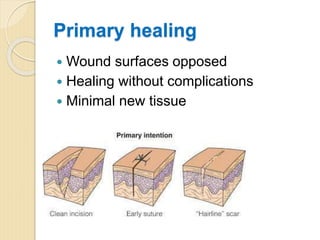
Primary healing
 Wound surfaces opposed
 Healing without complications
 Minimal new tissue
Delayed Primary
 Left open initially
 Edges approximated 4-6 days later
Secondary
 Surfaces not approximated
 Defect filled by granulation
 Covered with epithelium
 Less functional
Secondary Wound Healing
Phases of Wound Healing
 Inflammatory Phase
 Proliferative Phase
 Remodeling Phase
Inflammatory Phase
 Hemostasis and Inflammation
 Days 4 - 6
 Exposed collagen activates clotting
cascade and inflammatory phase
 Fibrin clot = scaffolding and
concentrate cytokines and growth
factors
Inflammatory: PMN
 Are the first inflammatory cells
 Reached maximum 24-48 hr.
 Source for cytokine
 Cytokine stimulate neutrophils
Inflammatory: Macrophages
 Monocytes
◦ attracted to area by complement
◦ Activated by:
 fibrin
 foreign body material
 exposure to hypoxic and acidotic
environment
 Reached maximum after 24 hours
 Remain for weeks
Inflammatory Phase
Proliferative Phase
 Epithelization, Angiogenesis and
Matrix Formation
◦ Begins when wound is covered by
epithelium
 Day 4 through 14
 Production of collagen
Inflammatory Phase
Epithelialization
 Basal epithelial cells at the wound
margin flatten (mobilize) and migrate
into the open wound
 Basal cells at margin multiply
(mitosis) in horizontal direction
 Basal cells behind margin undergo
vertical growth (differentiation)
Proliferative: Fibroblast
 Work wound repair
 Produce Granulation Tissue:
◦ Main signals are PDGF and EGF
◦ Collagen type III
◦ Glycosaminoglycans
◦ Fibronectin
◦ Elastin fibers
Proliferative Phase
Wound Contraction
 Actual contraction with pulling of
edges toward center making wounds
smaller
 Myofibroblast: contractile properties
 Surrounding skin stretched, thinned
 Original dermal thickness maintained
Maturation Phase
 Day 8 through
years
 Type III replaced
by type I
 Wound may
increase in
strength for up to
2 years after
injury
Maturation Phase
Normal healing in specific
tissue:
Bone
 The phases are as skin
 Periosteal and endosteal proliferation
lead to callus
 In the remodelling phase cortical and
medullary cavity are restored.
 If fructure ends are fixed (primary
healing)
 If gap exist secandary healing
Normal healing in specific
tissue:
Bone
 The phases are as skin
 Periosteal and endosteal proliferation
lead to callus
 In the remodelling phase cortical and
medullary cavity are restored.
 If fructure ends are fixed (primary
healing)
 If gap exist secandary healing
Nerve
 Distal to the wound wallerian
degeneration.
 Proximal of the nerve suffer
regeneration
 1-2 mm per day
Tendon
vascular blood flow and synovial
diffusion.
Tendon lacks tensile strenght for 3-6
weeks.
Active mobilisation prevent from
adhesion.
Tendon protect by splint .
Scar
 The immature scar becomes mature
a year or more.
 It is at the first pink ,hard , raised and
often itchy.
 The mature scar become paler ,
softer , flatten , most of change first 3
month.
 Mature scar during 1-2 year .
 Scar can be atrophic , hypertrophic
and keloid.
Wound Healing
 To treat the wound, you have to treat
the patient
 Optimize the patient
◦ Circulatory
◦ Pulmonary
◦ Nutrition
◦ Associated diseases or conditions
Wound Healing
‫جروحات‬ ‫درالتیام‬ ‫موثر‬ ‫فکتورهای‬
Oxygen
◦ Fibroblasts are oxygen-sensitive
◦ PO2 < 40 mmHg collagen synthesis
cannot take place
◦ Decreased PO2: most common cause of
wound infection
 Hypoxia:
◦ Endothelium responds with vasodilation
◦ Capillary leak
◦ Fibrin deposition
◦ TNF-a induction and
apoptosis)Programmed cell death)
 Edema
◦ Increased tissue pressure
◦ Compromise perfusion
◦ Cell death and tissue ulceration
 Infection
◦ Decreased tissue PO2 and prolongs the
inflammatory phase
◦ Impaired angiogenesis and epithelialization
◦ Increased collagenase activity
 Nutrition
 Low protein levels prolonged inflammatory
phase
 impaired fibroplasia
 Of the essential amino
 Methionine is critical
 Hydration
 A well hydrated wound will epithelialize faster
than a dry one
 Occlusive wound dressings hasten epithelial
repair and control the proliferation of
granulation tissue
 Temperature
◦ Wound healing is accelerated at
environmental temperatures of 30°C
◦ Tensile strength decreases by 20% in a
cold (12°C) wound environment
 Denervation
◦ Denervation has no effect on either
wound contraction or epithelialization
 Diabetes Mellitus
◦ Larger arteries, rather than the arterioles,
are typically affected
 Sorbitol accumulation
 Increased dermal vascular permeability
and pericapillary albumin deposition
 Impaired oxygen and nutrient delivery
◦ Stiffened red blood cells and increased
blood viscosity
◦ impaired phagocytosis and bacterial killing
◦ neuropathy
 Radiation Therapy
 stasis and occlusion of small vessels
 fibrosis and necrosis of capillaries
 decrease in wound tensile strength
 direct, permanent, adverse effect on
fibroblast
 Medications
◦ Steroids
 Stabilize lysosomes and arrest of inflammation
response
 inhibit both macrophages and neutrophils
 interferes with fibrogenesis, angiogenesis, and
wound contraction
 Also direct effect on Fibroblasts
 vitamin A
 oral ingestion of 25,000 IU per day pre op
 Restores inflammatory response and
promotes epithelializaton.
 Nutritional Supplements
◦ Vitamin C ( Ascorbic Acid)
 is an essential cofactor in the
synthesis of collagen
 excessive concentrations of ascorbic
acid do not promote supernormal
healing
◦ Vitamin E
 large doses of vitamin E inhibit healing
 increase the breaking strength of
wounds
 Nutritional Supplements
 Glutamine
 Enhance actions of lymphocytes,
macrophages and neutrophils
 Glycine
 Inhibitory effect on leukocytes, might
reduce inflammation related tissue injury
 Zinc
 common constituent of dozens of enzymes
 Influences B and T cell activity
 epithelial and fibroblastic proliferation is
impaired in patients with low serum zinc
levels
Factors in Wound Healing
 Smoking
 Nicotine acts via the sympathetic system
 vasoconstriction and limit distal perfusion
 1 cigarette = vasoconstriction > 90 min
 Decrease proliferation of erythrocytes,
macrophages and fibroblasts
 Smoke contains high levels of carbon
monoxide
 decreased tissue oxygen delivery
Syndromes Associated with
Abnormal Wound Healing
 Cutis Laxa
◦ Think defective elastin fibers
◦ Congenital
 AD, recessive or X-linked recessive
◦ Acquired
 Drug, neoplasms or inflammatory skin conditions
 Ehlers-Danlos Syndrome
◦ Think defective collagen metabolism
◦ AD and recessive patters
Syndromes Associated with
Abnormal Wound Healing
 Ehlers-Danlos Syndrome
◦ Four major clinical features
 Skin hyper-extensibility
 Joint hyper-mobility
 Tissue fragility
 Poor wound healing
Thanks

Wound healing

  • 1.
    ‫عامه‬ ‫صحت‬ ‫وزارت‬ ‫تخصص‬‫اکمال‬ ‫ریاست‬ ‫بلخی‬ ‫رابعه‬ ‫کمپلکس‬ ‫شفاخانه‬ ‫ریاست‬ ‫عمومی‬ ‫جراحی‬ ‫دیپارتمنت‬ Wound Healing ‫جروحات‬ ‫التیام‬ ‫نظر‬ ‫تحت‬:‫استاد‬‫هللا‬ ‫دکتورنجیب‬ ‫رنخوروال‬(‫نجیب‬) ‫عمومی‬ ‫پروفیسورجراحی‬ ‫کننده‬ ‫ترتیب‬:‫ترینی‬ ‫سباوون‬ ‫داکترحمیدالرحمن‬‫اول‬ ‫سال‬ ‫سال‬:27/1/1396
  • 3.
    ‫تعریف‬: ‫به‬ ‫منتج‬ ‫که‬‫بوده‬ ‫نسجی‬ ‫نارمل‬ ‫تمادی‬ ‫رفتن‬ ‫ازبین‬ ‫جرحه‬ ‫انواع‬ ‫شود‬ ‫می‬ ‫ومالیکولی‬ ‫حجروی‬ ‫تشوشات‬.
  • 5.
    Wound Healing  Threebasic types of healing ◦ Primary ◦ Delayed Primary ◦ Secondary
  • 6.
    Primary healing  Woundsurfaces opposed  Healing without complications  Minimal new tissue
  • 7.
    Delayed Primary  Leftopen initially  Edges approximated 4-6 days later
  • 8.
    Secondary  Surfaces notapproximated  Defect filled by granulation  Covered with epithelium  Less functional
  • 9.
  • 10.
  • 11.
    Phases of WoundHealing  Inflammatory Phase  Proliferative Phase  Remodeling Phase
  • 13.
    Inflammatory Phase  Hemostasisand Inflammation  Days 4 - 6  Exposed collagen activates clotting cascade and inflammatory phase  Fibrin clot = scaffolding and concentrate cytokines and growth factors
  • 14.
    Inflammatory: PMN  Arethe first inflammatory cells  Reached maximum 24-48 hr.  Source for cytokine  Cytokine stimulate neutrophils
  • 15.
    Inflammatory: Macrophages  Monocytes ◦attracted to area by complement ◦ Activated by:  fibrin  foreign body material  exposure to hypoxic and acidotic environment  Reached maximum after 24 hours  Remain for weeks
  • 16.
  • 17.
    Proliferative Phase  Epithelization,Angiogenesis and Matrix Formation ◦ Begins when wound is covered by epithelium  Day 4 through 14  Production of collagen
  • 18.
  • 19.
    Epithelialization  Basal epithelialcells at the wound margin flatten (mobilize) and migrate into the open wound  Basal cells at margin multiply (mitosis) in horizontal direction  Basal cells behind margin undergo vertical growth (differentiation)
  • 21.
    Proliferative: Fibroblast  Workwound repair  Produce Granulation Tissue: ◦ Main signals are PDGF and EGF ◦ Collagen type III ◦ Glycosaminoglycans ◦ Fibronectin ◦ Elastin fibers
  • 22.
  • 23.
    Wound Contraction  Actualcontraction with pulling of edges toward center making wounds smaller  Myofibroblast: contractile properties  Surrounding skin stretched, thinned  Original dermal thickness maintained
  • 24.
    Maturation Phase  Day8 through years  Type III replaced by type I  Wound may increase in strength for up to 2 years after injury
  • 25.
  • 27.
    Normal healing inspecific tissue: Bone  The phases are as skin  Periosteal and endosteal proliferation lead to callus  In the remodelling phase cortical and medullary cavity are restored.  If fructure ends are fixed (primary healing)  If gap exist secandary healing
  • 28.
    Normal healing inspecific tissue: Bone  The phases are as skin  Periosteal and endosteal proliferation lead to callus  In the remodelling phase cortical and medullary cavity are restored.  If fructure ends are fixed (primary healing)  If gap exist secandary healing
  • 29.
    Nerve  Distal tothe wound wallerian degeneration.  Proximal of the nerve suffer regeneration  1-2 mm per day
  • 30.
    Tendon vascular blood flowand synovial diffusion. Tendon lacks tensile strenght for 3-6 weeks. Active mobilisation prevent from adhesion. Tendon protect by splint .
  • 31.
    Scar  The immaturescar becomes mature a year or more.  It is at the first pink ,hard , raised and often itchy.  The mature scar become paler , softer , flatten , most of change first 3 month.  Mature scar during 1-2 year .  Scar can be atrophic , hypertrophic and keloid.
  • 32.
    Wound Healing  Totreat the wound, you have to treat the patient  Optimize the patient ◦ Circulatory ◦ Pulmonary ◦ Nutrition ◦ Associated diseases or conditions
  • 33.
  • 35.
    ‫جروحات‬ ‫درالتیام‬ ‫موثر‬‫فکتورهای‬ Oxygen ◦ Fibroblasts are oxygen-sensitive ◦ PO2 < 40 mmHg collagen synthesis cannot take place ◦ Decreased PO2: most common cause of wound infection
  • 36.
     Hypoxia: ◦ Endotheliumresponds with vasodilation ◦ Capillary leak ◦ Fibrin deposition ◦ TNF-a induction and apoptosis)Programmed cell death)
  • 37.
     Edema ◦ Increasedtissue pressure ◦ Compromise perfusion ◦ Cell death and tissue ulceration
  • 38.
     Infection ◦ Decreasedtissue PO2 and prolongs the inflammatory phase ◦ Impaired angiogenesis and epithelialization ◦ Increased collagenase activity
  • 39.
     Nutrition  Lowprotein levels prolonged inflammatory phase  impaired fibroplasia  Of the essential amino  Methionine is critical  Hydration  A well hydrated wound will epithelialize faster than a dry one  Occlusive wound dressings hasten epithelial repair and control the proliferation of granulation tissue
  • 40.
     Temperature ◦ Woundhealing is accelerated at environmental temperatures of 30°C ◦ Tensile strength decreases by 20% in a cold (12°C) wound environment  Denervation ◦ Denervation has no effect on either wound contraction or epithelialization
  • 41.
     Diabetes Mellitus ◦Larger arteries, rather than the arterioles, are typically affected  Sorbitol accumulation  Increased dermal vascular permeability and pericapillary albumin deposition  Impaired oxygen and nutrient delivery ◦ Stiffened red blood cells and increased blood viscosity ◦ impaired phagocytosis and bacterial killing ◦ neuropathy
  • 42.
     Radiation Therapy stasis and occlusion of small vessels  fibrosis and necrosis of capillaries  decrease in wound tensile strength  direct, permanent, adverse effect on fibroblast
  • 43.
     Medications ◦ Steroids Stabilize lysosomes and arrest of inflammation response  inhibit both macrophages and neutrophils  interferes with fibrogenesis, angiogenesis, and wound contraction  Also direct effect on Fibroblasts  vitamin A  oral ingestion of 25,000 IU per day pre op  Restores inflammatory response and promotes epithelializaton.
  • 44.
     Nutritional Supplements ◦Vitamin C ( Ascorbic Acid)  is an essential cofactor in the synthesis of collagen  excessive concentrations of ascorbic acid do not promote supernormal healing ◦ Vitamin E  large doses of vitamin E inhibit healing  increase the breaking strength of wounds
  • 45.
     Nutritional Supplements Glutamine  Enhance actions of lymphocytes, macrophages and neutrophils  Glycine  Inhibitory effect on leukocytes, might reduce inflammation related tissue injury  Zinc  common constituent of dozens of enzymes  Influences B and T cell activity  epithelial and fibroblastic proliferation is impaired in patients with low serum zinc levels
  • 46.
    Factors in WoundHealing  Smoking  Nicotine acts via the sympathetic system  vasoconstriction and limit distal perfusion  1 cigarette = vasoconstriction > 90 min  Decrease proliferation of erythrocytes, macrophages and fibroblasts  Smoke contains high levels of carbon monoxide  decreased tissue oxygen delivery
  • 47.
    Syndromes Associated with AbnormalWound Healing  Cutis Laxa ◦ Think defective elastin fibers ◦ Congenital  AD, recessive or X-linked recessive ◦ Acquired  Drug, neoplasms or inflammatory skin conditions  Ehlers-Danlos Syndrome ◦ Think defective collagen metabolism ◦ AD and recessive patters
  • 48.
    Syndromes Associated with AbnormalWound Healing  Ehlers-Danlos Syndrome ◦ Four major clinical features  Skin hyper-extensibility  Joint hyper-mobility  Tissue fragility  Poor wound healing
  • 49.