The Pupil Premium
Strategies to Improve Achievement that Work?
Lee Elliot Major and Robbie Coleman
8th July 2013
lee.elliotmajor@suttontrust.com
robbie.coleman@eefoundation.org.uk
Two charities, one aim
• The Sutton Trust was founded in 1997 by Sir Peter
Lampl. It is dedicated to improving social mobility
through education.
• In 2011 the Sutton Trust as lead charity in partnership
with Impetus launched the Education Endowment
Foundation, funded by a Department for Education
grant of £125m. The EEF is an independent charity
dedicated to breaking the link between family income
and educational achievement.
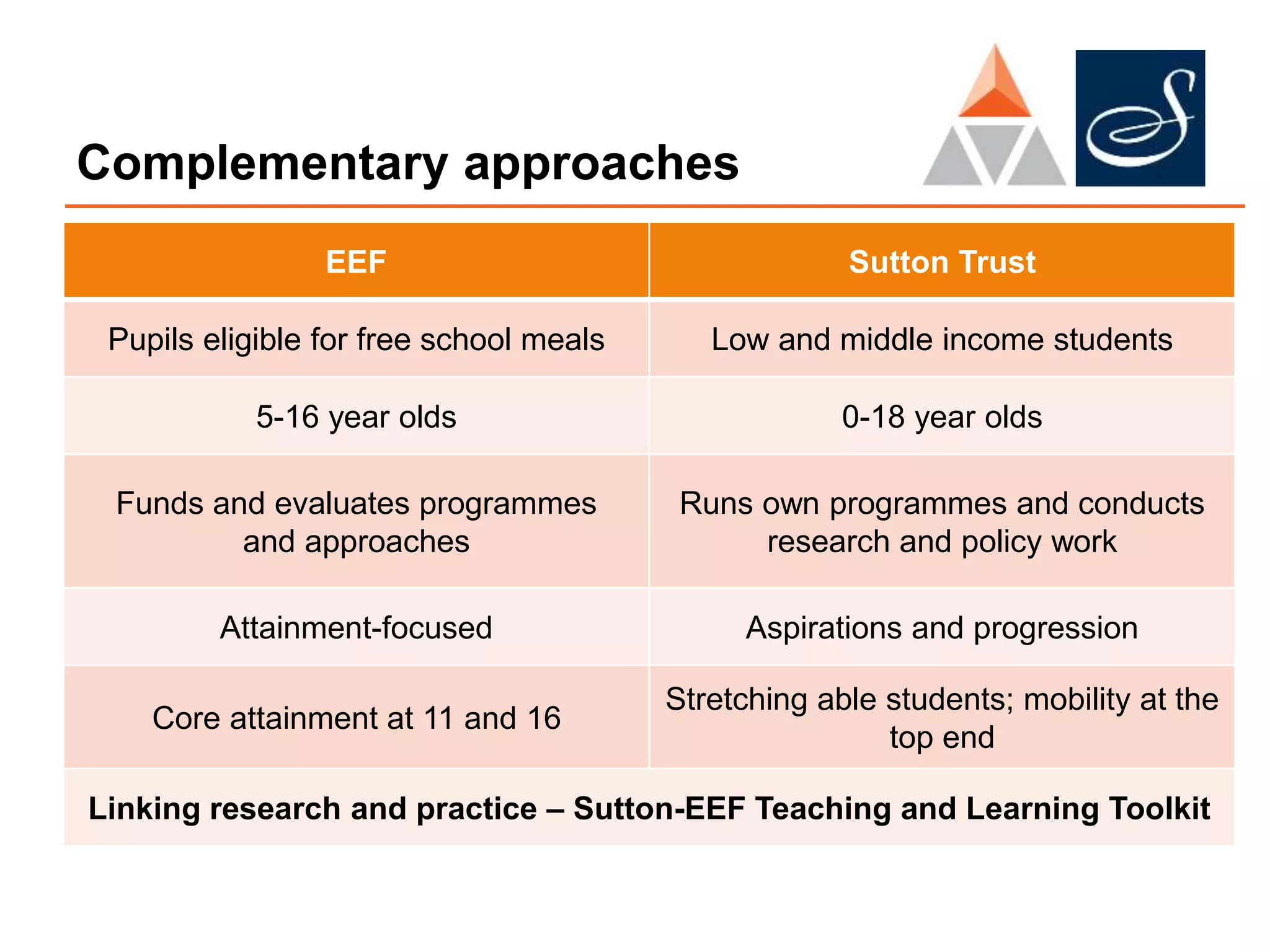
Complementary approaches
EEF Sutton Trust
Pupils eligible for free school meals Low and middle income students
5-16 year olds 0-18 year olds
Funds and evaluates programmes
and approaches
Runs own programmes and conducts
research and policy work
Attainment-focused Aspirations and progression
Core attainment at 11 and 16
Stretching able students; mobility at the
top end
Linking research and practice – Sutton-EEF Teaching and Learning Toolkit
Supporting schools to close the
gap in three ways
• Ensuring that schools have access to high-
quality, independent evidence, as a starting point
for decision-making and innovation.
• Helping schools evaluate the impact of
strategies to close the gap with guidance, advice
and case studies.
• Building the evidence of what works to raise the
attainment of disadvantaged pupils in schools
through rigorously evaluated large scale projects.
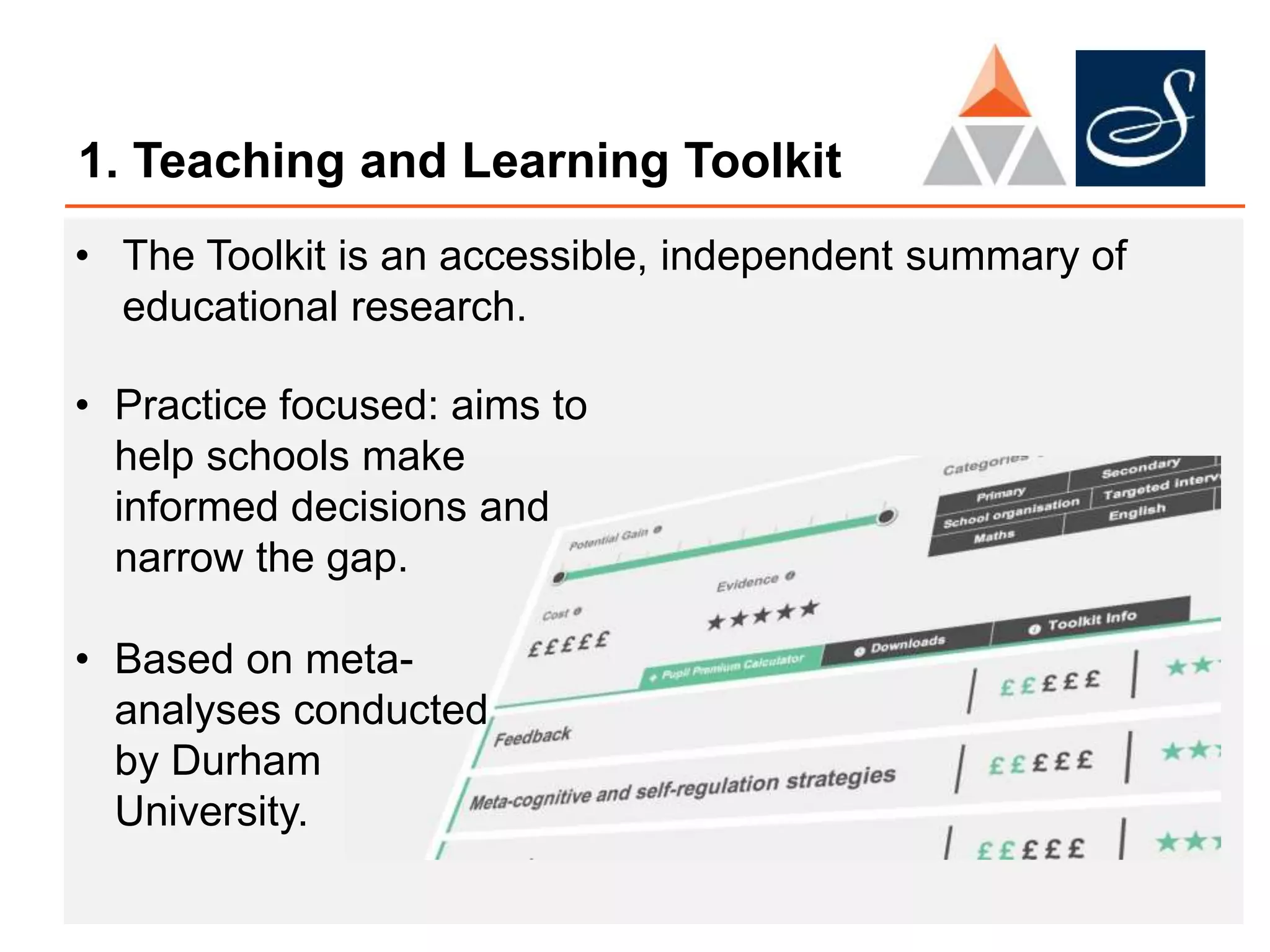
1. Teaching and Learning Toolkit
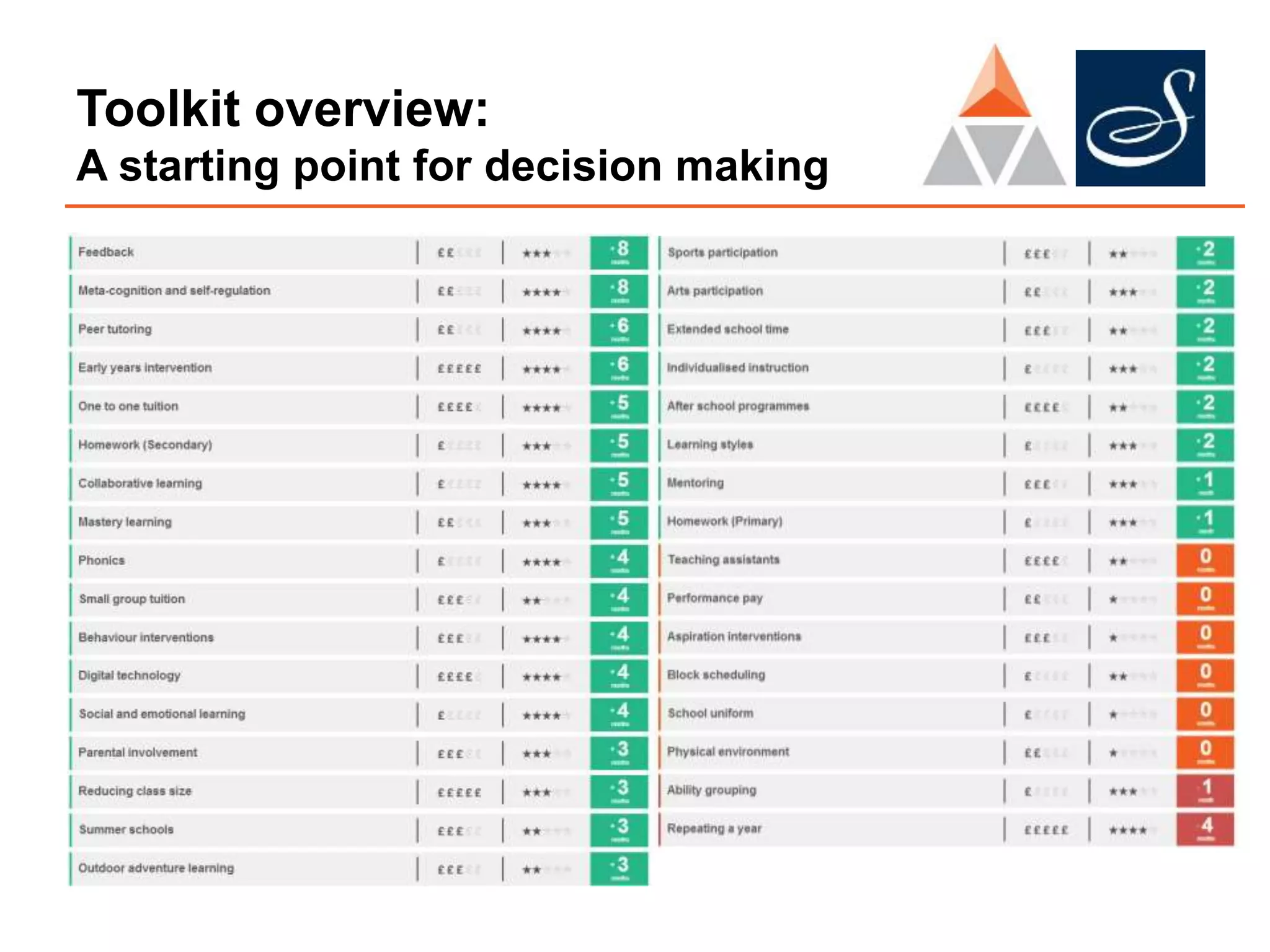
• The Toolkit is an accessible, independent summary of
educational research.
• Practice focused: aims to
help schools make
informed decisions and
narrow the gap.
• Based on meta-
analyses conducted
by Durham
University.
Toolkit overview:
A starting point for decision making
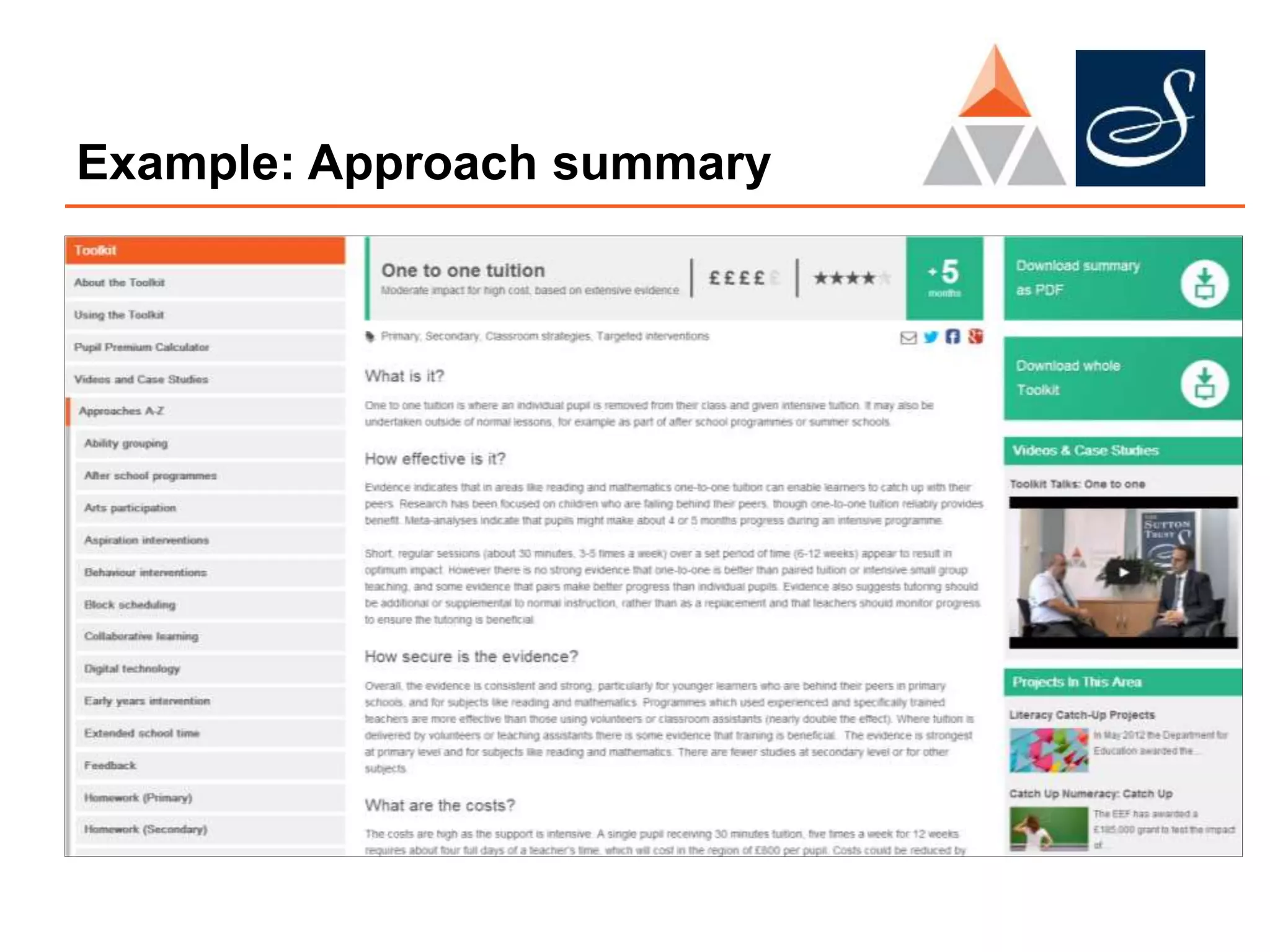
Example: Approach summary
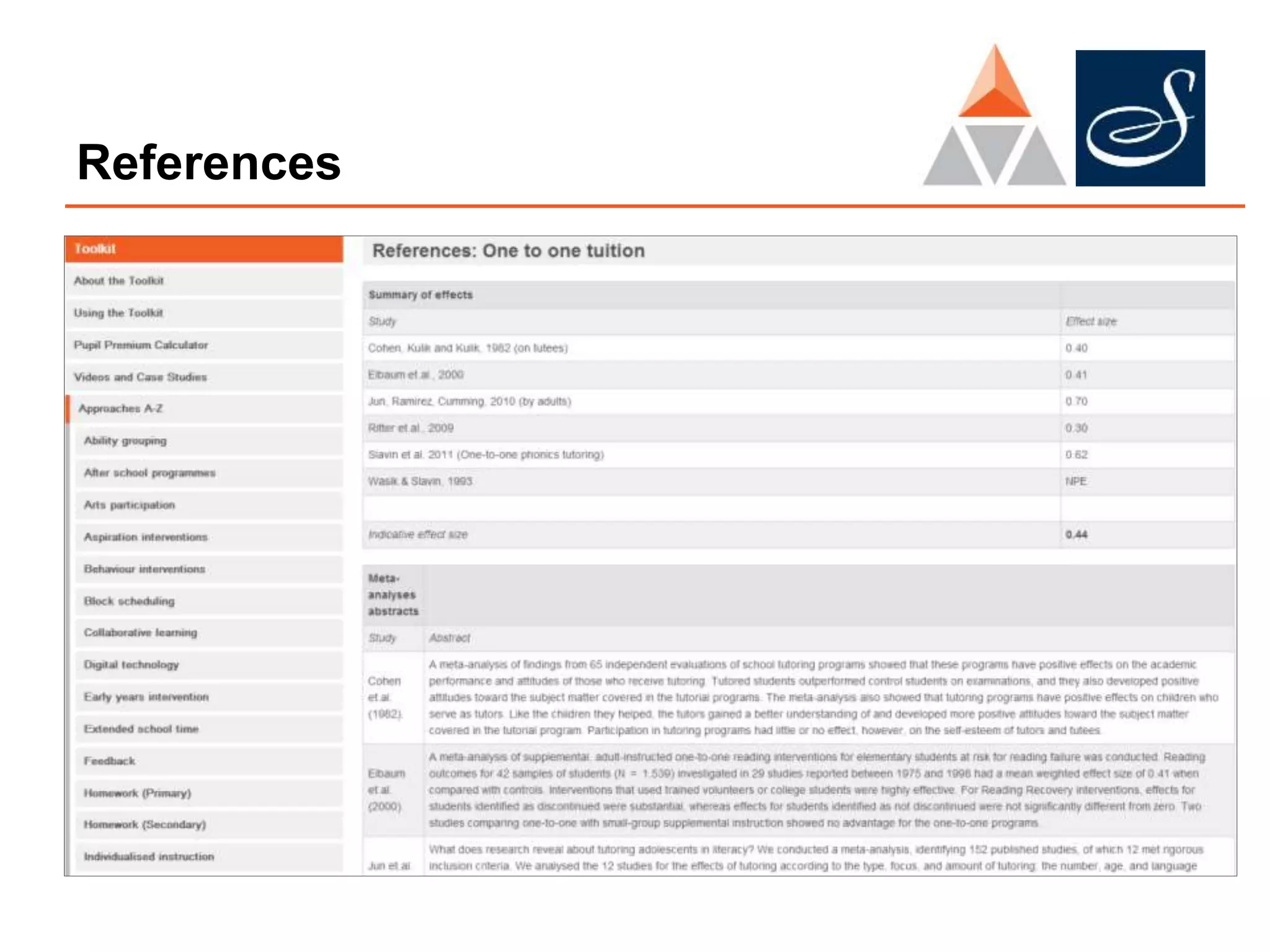
References
Scenario: Spending the Pupil
Premium
• A large secondary school receives £250,000 from the
Pupil Premium in 2012-13.
• How should the school decide to use this money?
• Should the school spend the money on professional
development to improve the quality of feedback pupils
receive, or small group tuition, or class size reduction?
The Toolkit doesn’t tell you what to do, but we hope that it will
help teachers and schools make more informed decisions.
Caution!
Myth 1: Research
provides a simple list of
dos and don’ts.
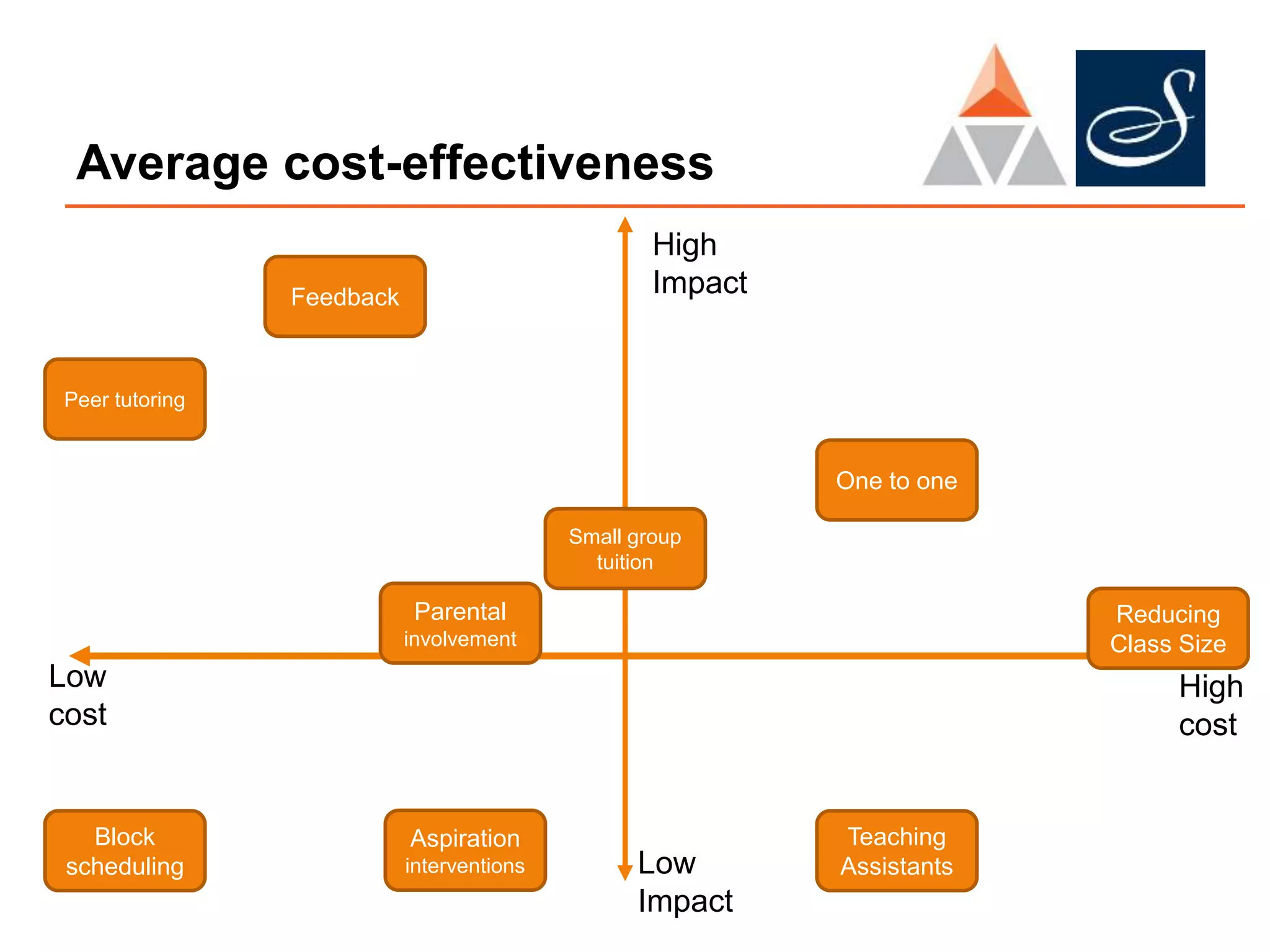
Reducing
Class Size
Average cost-effectiveness
High
Impact
Teaching
AssistantsLow
Impact
Low
cost
High
cost
Peer tutoring
One to one
Small group
tuition
Feedback
Aspiration
interventions
Parental
involvement
Block
scheduling
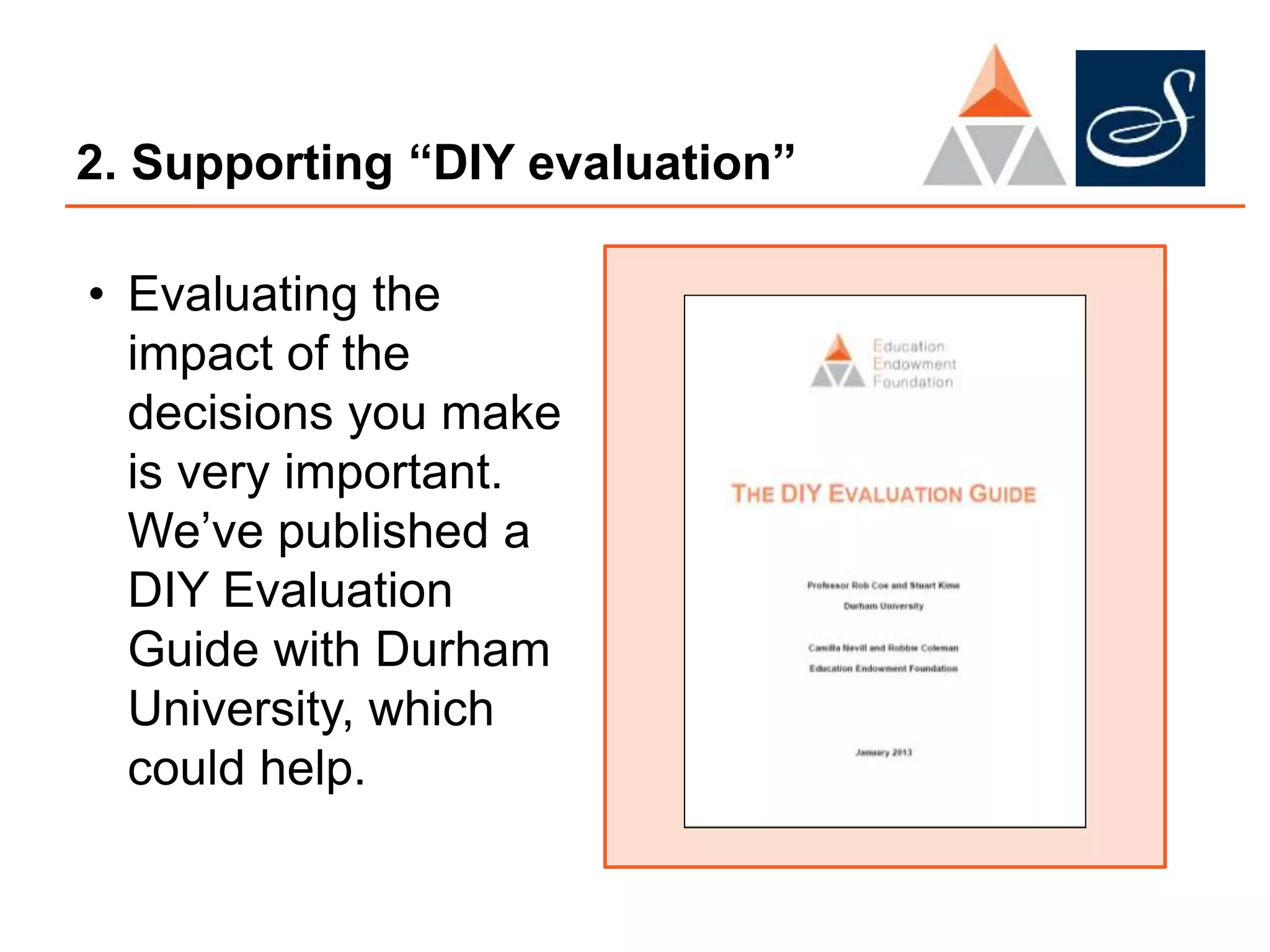
2. Supporting “DIY evaluation”
• Evaluating the
impact of the
decisions you make
is very important.
We’ve published a
DIY Evaluation
Guide with Durham
University, which
could help.
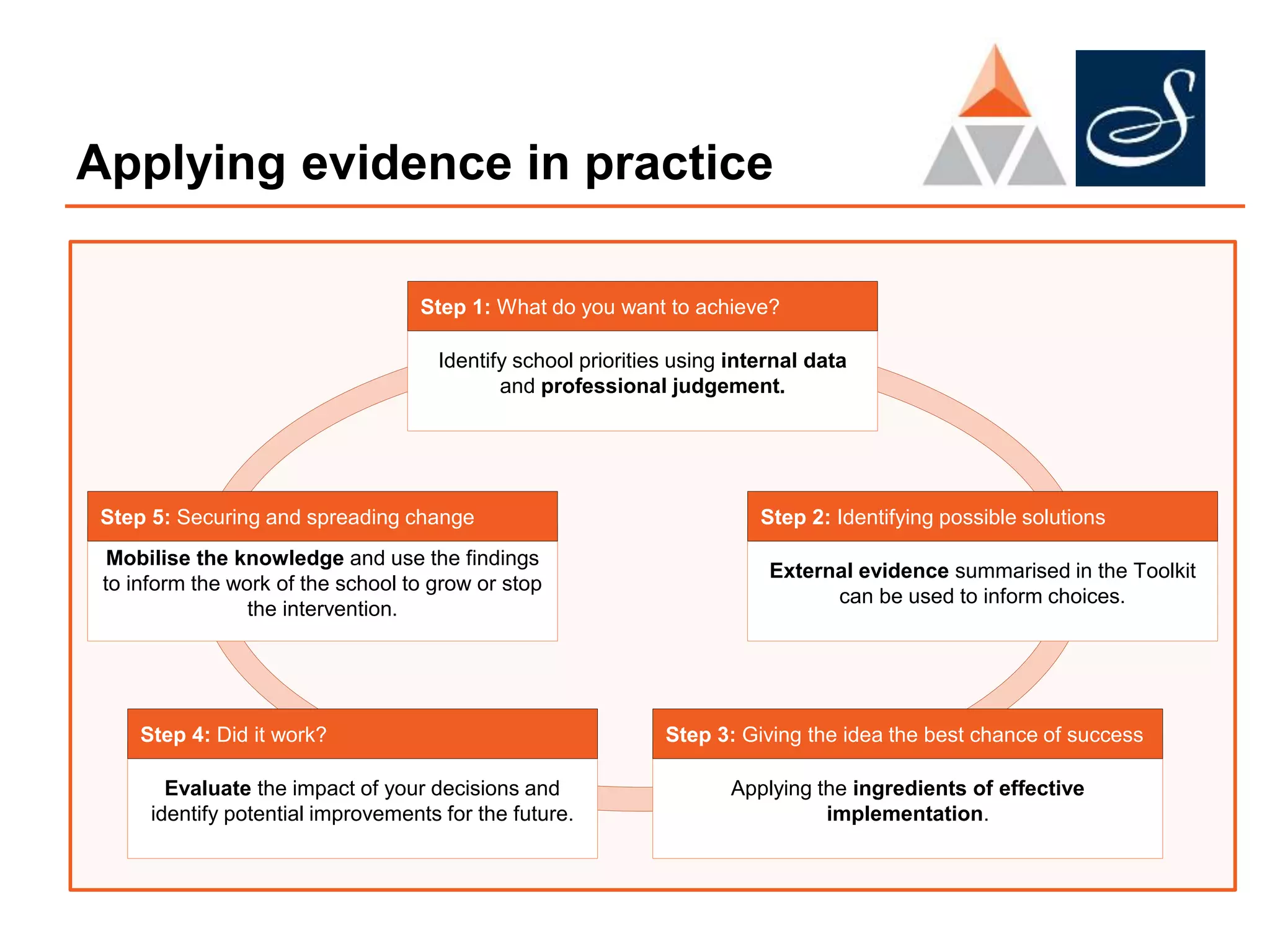
Applying evidence in practice
External evidence summarised in the Toolkit
can be used to inform choices.
Step 2: Identifying possible solutions
Evaluate the impact of your decisions and
identify potential improvements for the future.
Step 4: Did it work?
Mobilise the knowledge and use the findings
to inform the work of the school to grow or stop
the intervention.
Step 5: Securing and spreading change
Applying the ingredients of effective
implementation.
Step 3: Giving the idea the best chance of success
Identify school priorities using internal data
and professional judgement.
Step 1: What do you want to achieve?
Caution!
Myth 2: There are proven
methods which work every
time, in every context.
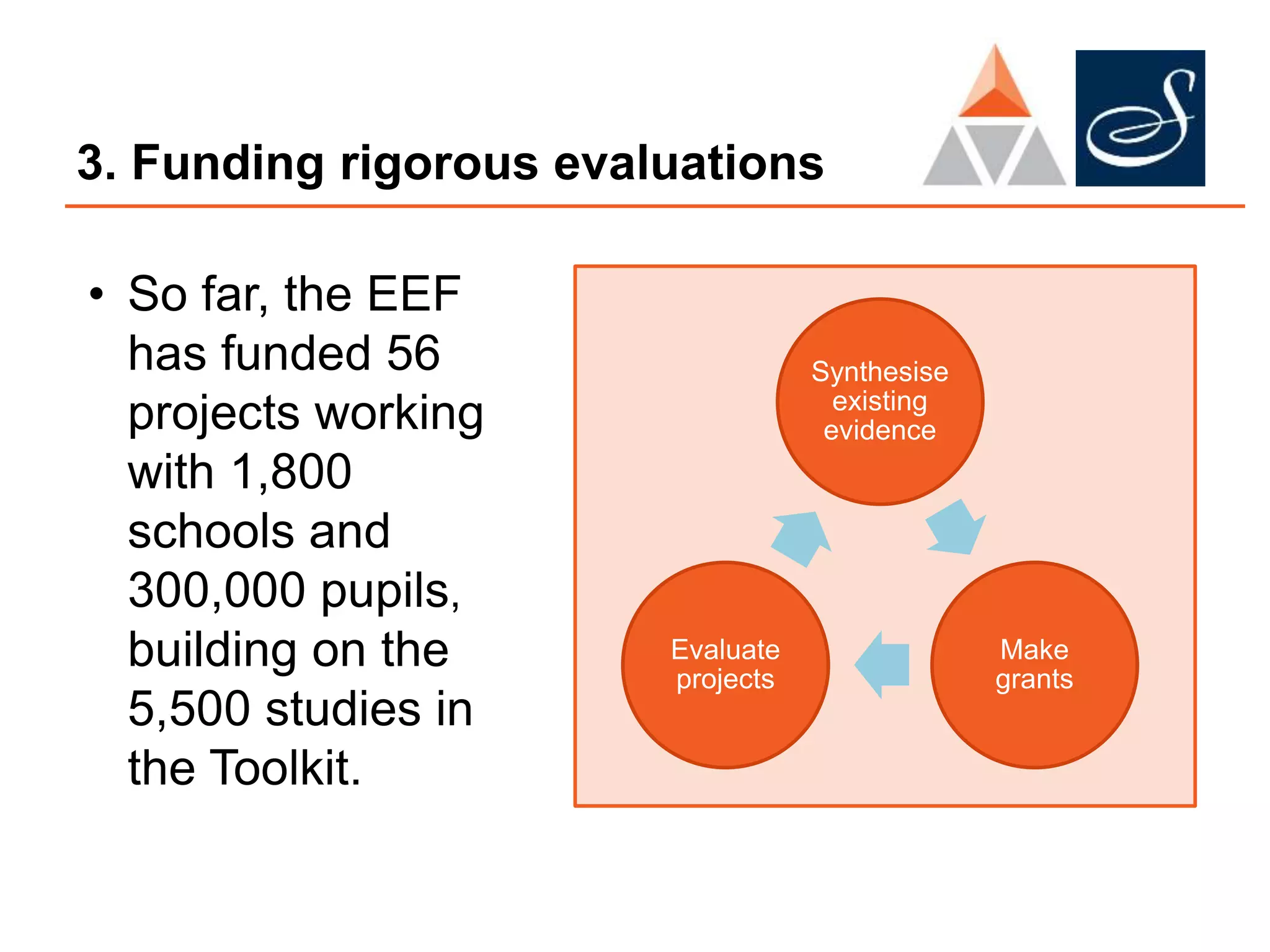
3. Funding rigorous evaluations
• So far, the EEF
has funded 56
projects working
with 1,800
schools and
300,000 pupils,
building on the
5,500 studies in
the Toolkit.
Synthesise
existing
evidence
Make
grants
Evaluate
projects
Caution!
Myth 3: We already
know enough about what
works, we just have to go
and do it.
Reflections
• Evidence can help you capturing the benefits of
current and new spending.
• But, there are no off the shelf solutions; context,
implementation and evaluation matters.
• Research can support teachers to make better
decisions, but only in tandem with professional
judgment and consideration.

The Pupil Premium: Strategies to Improve Achievement that Work? - Lee Elliot Major and Robbie Coleman

  • 1.
    The Pupil Premium Strategiesto Improve Achievement that Work? Lee Elliot Major and Robbie Coleman 8th July 2013 lee.elliotmajor@suttontrust.com robbie.coleman@eefoundation.org.uk
  • 2.
    Two charities, oneaim • The Sutton Trust was founded in 1997 by Sir Peter Lampl. It is dedicated to improving social mobility through education. • In 2011 the Sutton Trust as lead charity in partnership with Impetus launched the Education Endowment Foundation, funded by a Department for Education grant of £125m. The EEF is an independent charity dedicated to breaking the link between family income and educational achievement.
  • 3.
    Complementary approaches EEF SuttonTrust Pupils eligible for free school meals Low and middle income students 5-16 year olds 0-18 year olds Funds and evaluates programmes and approaches Runs own programmes and conducts research and policy work Attainment-focused Aspirations and progression Core attainment at 11 and 16 Stretching able students; mobility at the top end Linking research and practice – Sutton-EEF Teaching and Learning Toolkit
  • 4.
    Supporting schools toclose the gap in three ways • Ensuring that schools have access to high- quality, independent evidence, as a starting point for decision-making and innovation. • Helping schools evaluate the impact of strategies to close the gap with guidance, advice and case studies. • Building the evidence of what works to raise the attainment of disadvantaged pupils in schools through rigorously evaluated large scale projects.
  • 5.
    1. Teaching andLearning Toolkit • The Toolkit is an accessible, independent summary of educational research. • Practice focused: aims to help schools make informed decisions and narrow the gap. • Based on meta- analyses conducted by Durham University.
  • 6.
    Toolkit overview: A startingpoint for decision making
  • 7.
  • 8.
  • 9.
    Scenario: Spending thePupil Premium • A large secondary school receives £250,000 from the Pupil Premium in 2012-13. • How should the school decide to use this money? • Should the school spend the money on professional development to improve the quality of feedback pupils receive, or small group tuition, or class size reduction? The Toolkit doesn’t tell you what to do, but we hope that it will help teachers and schools make more informed decisions.
  • 10.
    Caution! Myth 1: Research providesa simple list of dos and don’ts.
  • 11.
    Reducing Class Size Average cost-effectiveness High Impact Teaching AssistantsLow Impact Low cost High cost Peertutoring One to one Small group tuition Feedback Aspiration interventions Parental involvement Block scheduling
  • 12.
    2. Supporting “DIYevaluation” • Evaluating the impact of the decisions you make is very important. We’ve published a DIY Evaluation Guide with Durham University, which could help.
  • 13.
    Applying evidence inpractice External evidence summarised in the Toolkit can be used to inform choices. Step 2: Identifying possible solutions Evaluate the impact of your decisions and identify potential improvements for the future. Step 4: Did it work? Mobilise the knowledge and use the findings to inform the work of the school to grow or stop the intervention. Step 5: Securing and spreading change Applying the ingredients of effective implementation. Step 3: Giving the idea the best chance of success Identify school priorities using internal data and professional judgement. Step 1: What do you want to achieve?
  • 14.
    Caution! Myth 2: Thereare proven methods which work every time, in every context.
  • 15.
    3. Funding rigorousevaluations • So far, the EEF has funded 56 projects working with 1,800 schools and 300,000 pupils, building on the 5,500 studies in the Toolkit. Synthesise existing evidence Make grants Evaluate projects
  • 16.
    Caution! Myth 3: Wealready know enough about what works, we just have to go and do it.
  • 17.
    Reflections • Evidence canhelp you capturing the benefits of current and new spending. • But, there are no off the shelf solutions; context, implementation and evaluation matters. • Research can support teachers to make better decisions, but only in tandem with professional judgment and consideration.