JohnW.Robertson|PortfolioofWork
Publications
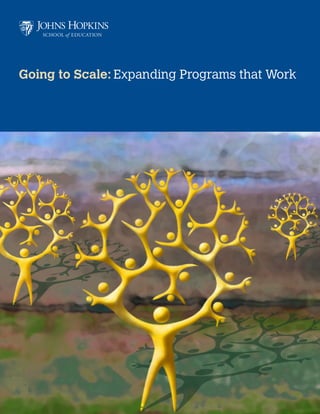
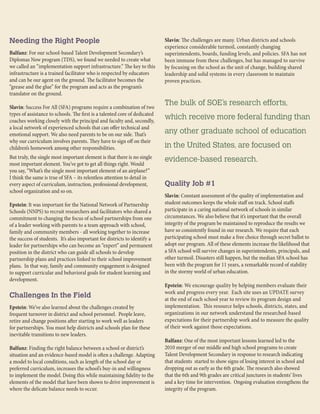
Going to Scale: Expanding Programs that Work
Dear Colleagues,
While few would argue against the importance of K-12 schools
implementing practices that “work,” assuring that the most
evidence-based practices are being implemented at scale has
proven very difficult. Despite direct guidance from federal
legislation and supportive repositories like the Best Evidence
Encyclopedia (BEE, Center for Research and Reform in
Education, Johns Hopkins School of Education) and the What
Works Clearinghouse, K-12 schools and their leaders continue to
be swayed by multiple factors other than evidence in their choices
of educational practice.
Schools, school districts and states become comfortable with
existing approaches and are often resistant to change. This
resistance is sometimes quite rational whether the new approach
is evidence-based or not. It takes time and money to fully
implement any educational practice. Once fully implemented,
educational institutions naturally protect their investment by
resisting efforts to implement new, more effective practices.
When change is palatable, these educational institutions are
bombarded with a plethora of well marketed approaches
designed with impressive face validity. These approaches are
logical, presented within the larger context of “doing good,”
and are attractively packaged with suggestive images of their
effectiveness. Too often, old fashioned sales often trump evidence
of effectiveness.
The dual challenge of finding evidence-based programs that
can be brought to scale has been a significant impediment
to education reform in the United States. What’s needed is a
tenacious commitment by colleges and universities, as well as
the education community, to support faculty research efforts
to develop, implement, and bring to scale the most effective
evidence-based programs available. We cannot be frightened
away by the required work involved to improve student
performance. Together we can make evidence-based programs
the rule rather than the exception.
David W. Andrews, PhD
Dean
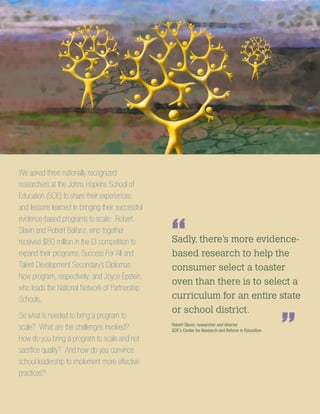
We asked three nationally recognized
researchers at the Johns Hopkins School of
Education (SOE) to share their experiences
and lessons learned in bringing their successful
evidence-based programs to scale: Robert
Slavin and Robert Balfanz, who together
received $80 million in the I3 competition to
expand their programs, Success For All and
Talent Development Secondary’s Diplomas
Now program, respectively; and Joyce Epstein,
who leads the National Network of Partnership
Schools.
So what is needed to bring a program to
scale? What are the challenges involved?
How do you bring a program to scale and not
sacrifice quality? And how do you convince
school leadership to implement more effective
practices?
Sadly, there’s more evidence-
based research to help the
consumer select a toaster
oven than there is to select a
curriculum for an entire state
or school district.
“
”Robert Slavin, researcher and director
SOE’s Center for Research and Reform in Education
Needing the Right People
Balfanz: For our school-based Talent Development Secondary’s
Diplomas Now program (TDS), we found we needed to create what
we called an “implementation support infrastructure.” The key to this
infrastructure is a trained facilitator who is respected by educators
and can be our agent on the ground. The facilitator becomes the
“grease and the glue” for the program and acts as the program’s
translator on the ground.
Slavin: Success For All (SFA) programs require a combination of two
types of assistance to schools. The first is a talented core of dedicated
coaches working closely with the principal and faculty and, secondly,
a local network of experienced schools that can offer technical and
emotional support. We also need parents to be on our side. That’s
why our curriculum involves parents. They have to sign off on their
children’s homework among other responsibilities.
But truly, the single most important element is that there is no single
most important element. You’ve got to get all things right. Would
you say, “What’s the single most important element of an airplane?”
I think the same is true of SFA – its relentless attention to detail in
every aspect of curriculum, instruction, professional development,
school organization and so on.
Epstein: It was important for the National Network of Partnership
Schools (NNPS) to recruit researchers and facilitators who shared a
commitment to changing the focus of school partnerships from one
of a leader working with parents to a team approach with school,
family and community members - all working together to increase
the success of students. It’s also important for districts to identify a
leader for partnerships who can become an “expert” and permanent
position in the district who can guide all schools to develop
partnership plans and practices linked to their school improvement
plans. In that way, family and community engagement is designed
to support curricular and behavioral goals for student learning and
development.
Challenges In the Field
Epstein: We’ve also learned about the challenges created by
frequent turnover in district and school personnel. People leave,
retire and change positions after starting to work well as leaders
for partnerships. You must help districts and schools plan for these
inevitable transitions to new leaders.
Balfanz: Finding the right balance between a school or district’s
situation and an evidence-based model is often a challenge. Adapting
a model to local conditions, such as length of the school day or
preferred curriculum, increases the school’s buy-in and willingness
to implement the model. Doing this while maintaining fidelity to the
elements of the model that have been shown to drive improvement is
where the delicate balance needs to occur.
Slavin: The challenges are many. Urban districts and schools
experience considerable turmoil, constantly changing
superintendents, boards, funding levels, and policies. SFA has not
been immune from these challenges, but has managed to survive
by focusing on the school as the unit of change, building shared
leadership and solid systems in every classroom to maintain
proven practices.
Quality Job #1
Slavin: Constant assessment of the quality of implementation and
student outcomes keeps the whole staff on track. School staffs
participate in a caring national network of schools in similar
circumstances. We also believe that it’s important that the overall
integrity of the program be maintained to reproduce the results we
have so consistently found in our research. We require that each
participating school must make a free choice through secret ballot to
adopt our program. All of these elements increase the likelihood that
a SFA school will survive changes in superintendents, principals, and
other turmoil. Disasters still happen, but the median SFA school has
been with the program for 11 years, a remarkable record of stability
in the stormy world of urban education.
Epstein: We encourage quality by helping members evaluate their
work and progress every year. Each site uses an UPDATE survey
at the end of each school year to review its program design and
implementation. This resource helps schools, districts, states, and
organizations in our network understand the researched-based
expectations for their partnership work and to measure the quality
of their work against those expectations.
Balfanz: One of the most important lessons learned led to the
2010 merger of our middle and high school programs to create
Talent Development Secondary in response to research indicating
that students started to show signs of losing interest in school and
dropping out as early as the 6th grade. The research also showed
that the 6th and 9th grades are critical junctures in students’ lives
and a key time for intervention. Ongoing evaluation strengthens the
integrity of the program.
The bulk of SOE’s research efforts,
which receive more federal funding than
any other graduate school of education
in the United States, are focused on
evidence-based research.
Communicating the Data
Balfanz: You have to work on persuasion skills. You are going
to have to convince people (in schools, districts and states) that
you have good answers AND that what you are proposing is
compatible with what they are doing that works – even though
you are changing fundamental behavior. Some audiences want
the “hard’ evidence of third-party studies. School principals aren’t
impressed with them. That’s where the soft skills are necessary –
showing that the program makes sense from a “practice” point of
view.
Slavin: Part of the “sell” is communicating the value of research-
based programs to school leaders and families. A research-based
program is one that has been evaluated in real schools over at
least a year, hopefully many times in comparison to control
groups. That’s an absolutely essential part of what we consider
to be something that is research-based and that often is left out
when people talk about what’s research-based and what’s not. In
education for some reason, we’ve done very little experimentation
where we compare experimental and control groups to see which
of them produces better outcomes for children.
Epstein: Many kinds of rigorous research—quantitative and
qualitative—form a strong research base on school, family, and
community partnerships. Evidence from applications in highly
diverse communities also contributes to district and school
leaders’ confidence that a new approach is likely to work for them.
We have learned that research on partnerships informs and
improves policy and practice and that practitioner’s challenges
inform needed research.
Last Word
Never in the history of American education has the potential for
fundamental reform been as great. In education and other human
services, evidence of effectiveness in rigorous evaluations is taking
on increasing importance in policy and practice. At SOE, our
research and experience has led us to conclude that successful
development, dissemination, and scaling up of proven approaches
requires university support of faculty work, program fidelity,
talented and dedicated staff, and a local and national network of
schools willing to be an active and engaged partner.
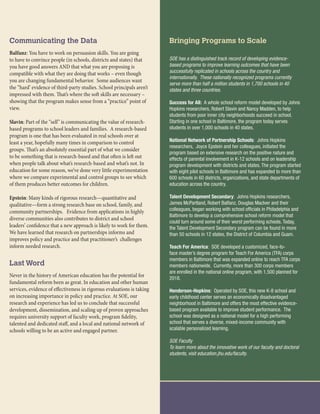
Bringing Programs to Scale
SOE has a distinguished track record of developing evidence-
based programs to improve learning outcomes that have been
successfully replicated in schools across the country and
internationally. These nationally recognized programs currently
serve more than half a million students in 1,700 schools in 40
states and three countries.
Success for All: A whole school reform model developed by Johns
Hopkins researchers, Robert Slavin and Nancy Madden, to help
students from poor inner city neighborhoods succeed in school.
Starting in one school in Baltimore, the program today serves
students in over 1,000 schools in 40 states.
National Network of Partnership Schools: Johns Hopkins
researchers, Joyce Epstein and her colleagues, initiated the
program based on extensive research on the positive nature and
effects of parental involvement in K-12 schools and on leadership
program development with districts and states. The program started
with eight pilot schools in Baltimore and has expanded to more than
600 schools in 60 districts, organizations, and state departments of
education across the country.
Talent Development Secondary: Johns Hopkins researchers,
James McPartland, Robert Balfanz, Douglas Maclver and their
colleagues, began working with school officials in Philadelphia and
Baltimore to develop a comprehensive school reform model that
could turn around some of their worst performing schools. Today,
the Talent Development Secondary program can be found in more
than 50 schools in 12 states, the District of Columbia and Guam.
Teach For America: SOE developed a customized, face-to-
face master’s degree program for Teach For America (TFA) corps
members in Baltimore that was expanded online to reach TFA corps
members nationwide. Currently, more than 300 corps members
are enrolled in the national online program, with 1,500 planned for
2018.
Henderson-Hopkins: Operated by SOE, this new K-8 school and
early childhood center serves an economically disadvantaged
neighborhood in Baltimore and offers the most effective evidence-
based program available to improve student performance. The
school was designed as a national model for a high performing
school that serves a diverse, mixed-income community with
scalable personalized learning.
SOE Faculty
To learn more about the innovative work of our faculty and doctoral
students, visit education.jhu.edu/faculty.
education.jhu.edu | 887-JHU-SOE1 | soe.info@jhu.edu
The Johns Hopkins University is an EO/AA employer committed to recruiting, supporting and fostering a diverse community.
Education Building
2800 North Charles Street
Baltimore MD 21218
Ranked #2 by U.S. News and World Report’s Best Graduate Schools of Education
The Johns Hopkins
University
BEYOND THE
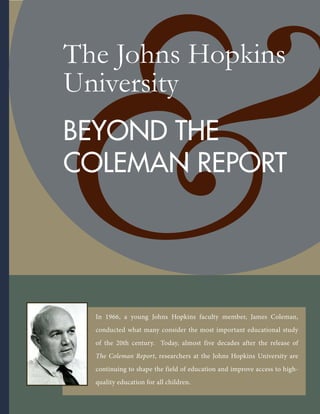
COLEMAN REPORT
In 1966, a young Johns Hopkins faculty member, James Coleman,
conducted what many consider the most important educational study
of the 20th century. Today, almost five decades after the release of
The Coleman Report, researchers at the Johns Hopkins University are
continuing to shape the field of education and improve access to high-
quality education for all children.
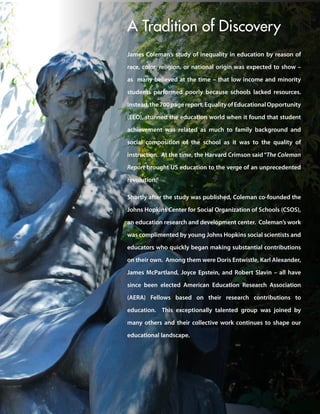
James Coleman’s study of inequality in education by reason of
race, color, religion, or national origin was expected to show –
as many believed at the time – that low income and minority
students performed poorly because schools lacked resources.
Instead,the700pagereport,EqualityofEducationalOpportunity
(EEO), stunned the education world when it found that student
achievement was related as much to family background and
social composition of the school as it was to the quality of
instruction. At the time, the Harvard Crimson said“The Coleman
Report brought US education to the verge of an unprecedented
revolution.”
Shortly after the study was published, Coleman co-founded the
Johns Hopkins Center for Social Organization of Schools (CSOS),
an education research and development center. Coleman’s work
was complimented by young Johns Hopkins social scientists and
educators who quickly began making substantial contributions
on their own. Among them were Doris Entwistle, Karl Alexander,
James McPartland, Joyce Epstein, and Robert Slavin – all have
since been elected American Education Research Association
(AERA) Fellows based on their research contributions to
education. This exceptionally talented group was joined by
many others and their collective work continues to shape our
educational landscape.
A Tradition of Discovery
The Legacy Lives On
Today, researchers at the Johns Hopkins School of Education (SOE) continue
the tradition of excellence and innovation of The Coleman Report by seeking to
discover better ways to improve learning outcomes and access to high-quality
education for all children. Their work, which takes an applied, interdisciplinary
approach to instruction and research, is supported by doctoral and post-
doctoral students and two nationally recognized SOE research centers:
Center for Research and Reform in Education (CRRE)
Works to improve the quality of education for children in grades pre-K to 12 by
focusing on the rigorous evaluation of educational programs, reviews of research
on educational programs, and policy analysis and dissemination to bring
meaningful reform to America’s underperforming public schools.
Center for Social Organization of Schools (CSOS)
Conducts research on critical education issues, including chronic absenteeism,
effective instruction and college and career readiness – with emphasis on low-
performing schools – and turns research into practice by providing technical
assistance to schools nationwide and making policy recommendations.
SOE faculty include some of the most recognized scholars in educational
research and reform, and our researchers are among the nation’s top recipients
of U.S. Department of Education’s Investing in Innovation (i3) grants for
programs aimed at improving achievement for students at-risk of academic
failure. In addition, SOE has 20 joint faculty appointments with Johns Hopkins
University schools, including arts and sciences, medicine, and public health.
Research at Work
Robert Balfanz – developed an Early Warning System
(EWS), using indicators of attendance, behavior, and performance, to
signal when students between the sixth and ninth grades are at-risk
ofnotcompletingthe12thgrade. Hisworkinidentifyingschoolswith
large numbers of dropouts, and more recently in chronic absenteeism,
make him a leading expert in one of the more critical issues
confronting urban school districts. He is also co-director of CSOS’s
Talent Development Secondary program which employs evidenced-
based intervention strategies, including EWS, to keep students in
low-performing middle and high schools from dropping out and on
the path to graduation.
Joyce L. Epstein– established the National Network of
Partnership Schools (NNPS) which guides schools, districts, and state
leaders to develop research-based programs of family and community
involvement to improve student achievement. She is also director of
theCenterforSchool,FamilyandCommunityPartnershipsthathouses
NNPS and studies the nature of that involvement.
James McPartland – conducts extensive research on
helping teachers improve literacy instruction for adolescents and has
led a team that developed a comprehensive reform model for high
schools facing problems with attendance, test scores, and dropout
rates. McPartlandisanoriginalco-authorofColeman’sEEOreportand
the executive director of CSOS.
Robert Slavin – developed a nationally acclaimed
research-driven whole school reform model, Success for All (SFA),
based on the belief that all children can succeed. This model program,
a recipient of an i3 grant, is built around a daily 90-minute reading
period for all students with a focus on phonics and tutoring for
students who need extra help. SFA employs a cooperative learning
approach where children work in pairs or in small groups to ensure
their participation and teachers continually monitor student progress.
At the School of Education, we are committed to recruiting and supporting
innovative researchers whose work will continue to lead educational thought
and stand as the national model for research and excellence.
“
Improved Access
SOE related programs are now serving 400,000children in some of the nation’s most challenging school districts.
Dr. Robert Slavin’s Success for All works with 23,000teachers in more than 1,000 Title I schools in 47states.
CSOS’sTalent Development Secondary program is in 55high-poverty middle and high schools in 19states, Guam
and the District of Columbia.
Dr. Joyce Epstein’s effort to enhance family and community participation can be found in 700schools in more
than 10states.
More than 700K-8 and early childhood students will benefit from the Henderson-Hopkins School in East
Baltimore, a model school operated by SOE that will permanently alter contemporary educational practices
and shape the next generation of schools in the United States.The school will provide research-based models
of instruction and personalized learning based on technology combined with sophisticated data systems and
evidence about what works with students at different ability levels and learning styles on a daily basis.
CRRE’sThe Best Evidence Encyclopedia (BEE) web site provides easy-to-read, unbiased reviews of research-proven
educational programs for those educators and school districts looking for the most efficient and evidenced-based
approaches to tackling their immediate concerns. The site averages over 100,000unique inquiries each year.
CSOS’s Everyone Graduates Center offers a free, online repository of research, tools and analyses of current
educational issues, including graduation rates, absenteeism, content literacy, parental involvement, and
information on dropout prevention to more than 15,000educators yearly.
A $7.4 million grant from the National Science Foundation to promote STEM student achievement
brings together researchers from the Johns Hopkins’schools of education, engineering and arts and sciences
to engage 40 STEM teachers in grades 3-5 in nine targeted low-income, high minority schools and offer
professional development to all Baltimore City elementary school teachers, reaching 132 schools and over
1,100 teachers total.
At A Glance
Number of faculty: 74, 17 joint JHU appointments
Number of doctoral students: 48
Sponsored Funding: $26.7 Million
American Education Research Association Fellows: 5
Reform Initiatives: Faculty received $100 million in the first two rounds
of the federal Investing in Innovation Fund (I3) Grants 2800 North Charles Street ■ Baltimore MD 21218
877 JHU SOE1 ■ education.jhu.edu
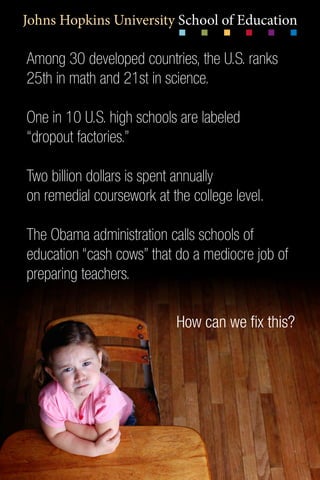
Among 30 developed countries, the U.S. ranks
25th in math and 21st in science.
One in 10 U.S. high schools are labeled
“dropout factories.”
Two billion dollars is spent annually
on remedial coursework at the college level.
The Obama administration calls schools of
education “cash cows” that do a mediocre job of
preparing teachers.
Johns Hopkins University School of Education
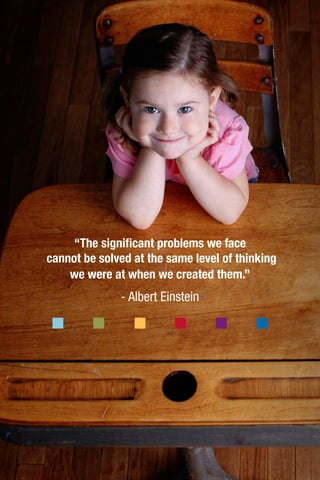
How can we fix this?
“The significant problems we face
cannot be solved at the same level of thinking
we were at when we created them.”
- Albert Einstein
If schools of education are to become part of the solution to the educational crisis in
this country and national reform is truly to take place from PK to higher education,
then we must make substantial new investments in our people and the high impact
programs they create.
The Johns Hopkins University School of Education (SOE) recently began making these
investments. Only such ardent commitments will lead to change and define schools
of education as part of the solution rather than the problem.
At the SOE, we’ve made exciting new investments in people and infrastructure with
the arrival of a new dean, David Andrews, who previously was the dean of the College
of Education and Human Ecology at The Ohio State University. With unprecedented
support from JHU President Ronald Daniels, Andrews will lead a new vision that will
strengthen the school’s local, national, and international impact through the discovery
and dissemination of new knowledge affecting education.
Taking advantage of our investment opportunities and new leadership, we’re
launching a large scale initiative to hire up to half a dozen of the most influential
senior scholars to join our team. We will aggressively target the most innovative and
progressive thinkers and bring them together without disciplinary boundaries to solve
complex educational problems.
We’re committed to building on our strength in identifying, evaluating, and supporting
evidence-based practices – and our strength is formidable. As examples, Robert
Slavin and the Success for All Foundation received the highest score in the federal
I3 competition and are on schedule to receive a $50 million grant to expand
dissemination of evidence-based reforms through the implementation of Success
for All in 1,000 additional school districts. Similarly, Robert Balfanz received a $30
million award through the same competition to expand, disseminate, and solidify the
evidence supporting Talent Development High Schools. Together, these Johns Hopkins
professors will receive $80 million (22%) of the $650 million pool that drew over
1,700 applicants for federal funds to implement evidence-based reform initiatives.
And this is only the beginning.
We invite you to follow us as we become part of the solution.
education.jhu.edu/solutions
For more information, visit:
Bloomberg School of Public Health
jhsph.edu
Center for Social Organization of Schools
jhucsos.org
Center forTalentedYouth
cty.jhu.edu
East Baltimore Community School
education.jhu.edu/ebcs
School of Education
education.jhu.edu
Success for All Foundation
successforall.org
Impact – A Global Footprint in Education
The Johns Hopkins University, through its global reach and
commitment to excellence, is working to improve the quality
of education for students in our communities, our nation, and
our world.
Asthenation’sleadingresearchinstitution,JohnsHopkinsbringstoeducationthesamededication
it brings to other disciplines by leading the way in developing the best educational practices to
benefit all learners.
The accompanying chart demonstrates sustainable educational programs, developed by Johns
Hopkins faculty and researchers, that have successfully impacted student achievement. Crossing
interdisciplinary boundaries, this work includes the School of Education (SOE), and its Center for
SocialOrganizationofSchools(CSOS),theSuccessforAllFoundation(SFAF),theCenterforTalented
Youth (CTY), and the Bloomberg School of Public Health.
As shown by the scope of these programs, the university is committed to improving student
learning whether it’s around the corner or across the globe. For example, the SOE trains and
places highly qualified teachers in more than 150 of Maryland’s most challenging schools each
year. In addition, SFAF and CSOS – among the top recipients of the U.S. Department of Education’s
Investing in Innovation grants – are bringing cutting-edge ideas to school reform efforts. SFAF
programs, representing a proven whole-school approach to school improvement that helps every
child succeed, have been adopted by more than 1,000 schools in 47 states, the United Kingdom,
Canada, and Guam. CSOS has developed a comprehensive reform model to turn around troubled
low-performing middle and high schools nationwide.
The university’s Center for Talented Youth supports the educational opportunities of
underrepresented gifted youths and serves more than 60,000 students each year at 233 locations
across the United States and in ten countries. Additionally, a Bloomberg School of Public Health
(BSPH)Initiative,PositiveBehavioralInterventionandSupports,workswithschoolsthroughoutthe
state of Maryland to implement a classroom discipline system that is creating safer, more effective
schools.The program operates in more than 90 schools in Baltimore City alone.
Closer to home, Johns Hopkins will be working to further the redevelopment of an east Baltimore
neighborhood by designing and operating a new K-8 school and early childhood center through
the East Baltimore Community Schools (EBCS) project. EBCS will serve a diverse, mixed-income
community and emphasize academic excellence.
Through research, development, and the dissemination of best practices, Johns Hopkins is helping
school systems worldwide find solutions and build high quality education systems that give every
child the greatest opportunity to learn and succeed.
A Global Impact
DC
4
MA
16
NJ
158
PA
164
OH
43
nnnn
nnnnnn
nnnnnn
nnnnnn
nnnnnn
nn
nnnnnnnn
nnnnnnnn
nnnnnnnn
nnnnnnnn
nn nnnn
nnnn
nnnnnnnnnnnnnn
nnnnnnnnnnnnnn
nnnnnnnnnnnnnn
nnnnnnnn
nnnnnn
nnnn
nnnnnnnnnnnnnn
nnnnnnnnnnnnnn
nn
nnnnnnnnnn
nnnnnnnnnn
nnnnnnnnnn
nnnnnnnnnn
nnnnnnnnnn
nn
nnnn
nnnnnn
nnnn
nnnnnnnn
nnnnnn
nnnn
nnnn
nnnn
nnnnnnnn
nnnnnnnn
nnnnnnnn
nnnnnn
nnnn
nnnnnn
nnnnnn
nnnn
nnnnnn
nnnnnn
nnnnnn
nnnnnn
nnnnnn
nnnn
nnnnnnnn
nnnnnnnnnnnn
nnnnnnnnnn
nnnn
nnnn
HI
15
nnnnnnnn
nnnn
nn
nnnnnnnn
nnnnnnnn
nnnnnnnn
nnnn
nnnn
nnnn
nn
GUAM
10
nnnn
tt tt
tt
tt
tt
êê
êê
êê
êê
êê
êê
êê
êê
êê
êê
êê
êê
êê
êê
êê
êêêê
êê
êê
êê
êê
êê
êê
êê
êê
êê
êê
êê êê
êê
ÌÌ
Baltimore City
*includes District of Columbia and Guam Information current as of 8/2011.
êê
êê
êê
nn
FL
47
GA
35
KS
55
NY
25
MI
23
LA
25
AZ
43
öö1 Baltimore County
öö4 Anne Arundel County
öö6 Montgomery County
öö7 Howard County
öö96
EBCS
CSOS
CTY
PBIS
SFAF
SOE
êê
tt
ll
nn
ÌÌ
öö
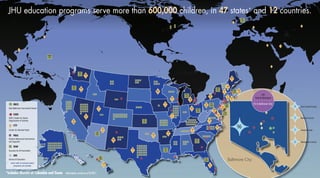
JHU education programs serve more than 600,000 children, in 47 states* and 12 countries.
School of Education
East Baltimore Community School
Success for All Foundation
SOE’s Center for Social
Organization of Schools
Center for Talented Youth
Positive Behavioral Intervention
and Supports
Icons refer to schools where
programs are located.
UK
10
tt
ttDC
2
ttIA
1
ttFL
1ttHI
1
ttAZ
2
ttCA
18
ttCT
16
ttME
1
ttMD
23
ttMA
20
ttIL
3
ttAR
3
ttNH
3
ttNC
1
ttMN
1
ttMI
3
ttNY
19
ttNV
1
ttNM
1
ttNJ
39
ttPA
39
ttOR
2
ttOK
1
ttOH
1ttUT
1
ttTX
1
ttTN
2
ttRI
3ttWI
1
ttWA
1
ttVT
9
ttVA
7
tt2
tt2
tt
WA
23
OR
23
(92 in Baltimore City)
790
Total in Maryland
nn
nn
êêêê
tt
tt
tt
As the nation’s leading research institution, Johns Hopkins brings to education the same dedication
it brings to other disciplines by preparing the best and the brightest in education to lead in teaching,
special education, counseling, administration, research, and policy. Ranked second by U.S. News &
World Report’s Best Graduate Schools of Education, the School of Eduction (SOE) offers doctoral and
other graduate programs, as well as a variety of specialized graduate certificates.
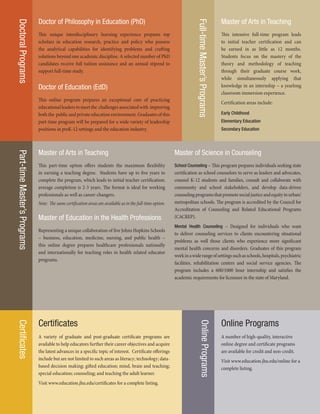
DEGREEOFFERINGSJohns Hopkins University School of Education
DEGREE OFFERINGS
Doctor of Philosophy in Education (PhD)
This unique interdisciplinary learning experience prepares top
scholars in education research, practice and policy who possess
the analytical capabilities for identifying problems and crafting
solutions beyond one academic discipline. A selected number of PhD
candidates receive full tuition assistance and an annual stipend to
support full-time study.
Doctor of Education (EdD)
This online program prepares an exceptional core of practicing
educationalleaderstomeetthe challengesassociatedwith improving
both the public and private education environment. Graduates of this
part-time program will be prepared for a wide variety of leadership
positions in preK-12 settings and the education industry.
Master of Arts in Teaching
This intensive full-time program leads
to initial teacher certification and can
be earned in as little as 12 months.
Students focus on the mastery of the
theory and methodology of teaching
through their graduate course work,
while simultaneously applying that
knowledge in an internship – a yearlong
classroom immersion experience.
Certification areas include:
Early Childhood
Elementary Education
Secondary Education
DoctoralPrograms
Full-timeMaster’sPrograms
Part-timeMaster’sProgramsCertificates
Certificates
A variety of graduate and post-graduate certificate programs are
available to help educators further their career objectives and acquire
the latest advances in a specific topic of interest. Certificate offerings
include but are not limited to such areas as literacy; technology; data-
based decision making; gifted education; mind, brain and teaching;
special education; counseling; and teaching the adult learner.
Visit www.education.jhu.edu/certificates for a complete listing.
Master of Arts in Teaching
This part-time option offers students the maximum flexibility
in earning a teaching degree. Students have up to five years to
complete the program, which leads to initial teacher certification;
average completion is 2-3 years. The format is ideal for working
professionals as well as career-changers.
Note: The same certification areas are available as in the full-time option.
Master of Education in the Health Professions
Representing a unique collaboration of five Johns Hopkins Schools
– business, education, medicine, nursing, and public health –
this online degree prepares healthcare professionals nationally
and internationally for teaching roles in health related educator
programs.
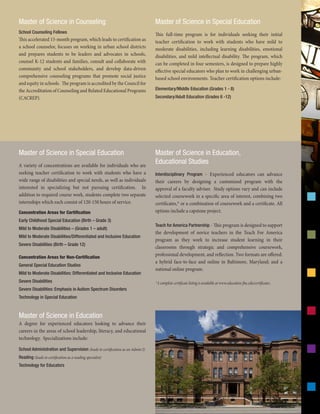
Master of Science in Counseling
School Counseling – This program prepares individuals seeking state
certification as school counselors to serve as leaders and advocates,
counsel K-12 students and families, consult and collaborate with
community and school stakeholders, and develop data-driven
counselingprogramsthatpromotesocialjusticeandequityinurban/
metropolitan schools. The program is accredited by the Council for
Accreditation of Counseling and Related Educational Programs
(CACREP).
Mental Health Counseling – Designed for individuals who want
to deliver counseling services to clients encountering situational
problems as well those clients who experience more significant
mental health concerns and disorders. Graduates of this program
workinawiderangeofsettingssuchasschools,hospitals,psychiatric
facilities, rehabilitation centers and social service agencies. The
program includes a 600/1000 hour internship and satisfies the
academic requirements for licensure in the state of Maryland.
OnlinePrograms
Online Programs
A number of high-quality, interactive
online degree and certificate programs
are available for credit and non-credit.
Visit www.education.jhu.edu/online for a
complete listing.
*A complete certificate listing is available at www.education.jhu.edu/certificates.
Master of Science in Counseling
School Counseling Fellows
This accelerated 15-month program, which leads to certification as
a school counselor, focuses on working in urban school districts
and prepares students to be leaders and advocates in schools,
counsel K-12 students and families, consult and collaborate with
community and school stakeholders, and develop data-driven
comprehensive counseling programs that promote social justice
and equity in schools. The program is accredited by the Council for
the Accreditation of Counseling and Related Educational Programs
(CACREP).
Master of Science in Special Education
This full-time program is for individuals seeking their initial
teacher certification to work with students who have mild to
moderate disabilities, including learning disabilities, emotional
disabilities, and mild intellectual disability. The program, which
can be completed in four semesters, is designed to prepare highly
effective special educators who plan to work in challenging urban-
based school environments. Teacher certification options include:
Elementary/Middle Education (Grades 1 - 8)
Secondary/Adult Education (Grades 6 -12)
Master of Science in Special Education
A variety of concentrations are available for individuals who are
seeking teacher certification to work with students who have a
wide range of disabilities and special needs, as well as individuals
interested in specializing but not pursuing certification. In
addition to required course work, students complete two separate
internships which each consist of 120-150 hours of service.
Concentration Areas for Certification
Early Childhood Special Education (Birth – Grade 3)
Mild to Moderate Disabilities – (Grades 1 – adult)
Mild to Moderate Disabilities/Differentiated and Inclusive Education
Severe Disabilities (Birth – Grade 12)
Concentration Areas for Non-Certification
General Special Education Studies
Mild to Moderate Disabilities: Differentiated and Inclusive Education
Severe Disabilities
Severe Disabilities: Emphasis in Autism Spectrum Disorders
Technology in Special Education
Master of Science in Education
A degree for experienced educators looking to advance their
careers in the areas of school leadership, literacy, and educational
technology. Specializations include:
School Administration and Supervision (leads to certification as an Admin I)
Reading (leads to certification as a reading specialist)
Technology for Educators
Master of Science in Education,
Educational Studies
Interdisciplinary Program - Experienced educators can advance
their careers by designing a customized program with the
approval of a faculty adviser. Study options vary and can include
selected coursework in a specific area of interest, combining two
certificates,* or a combination of coursework and a certificate. All
options include a capstone project.
Teach for America Partnership - This program is designed to support
the development of novice teachers in the Teach For America
program as they work to increase student learning in their
classrooms through strategic and comprehensive coursework,
professional development, and reflection. Two formats are offered:
a hybrid face-to-face and online in Baltimore, Maryland; and a
national online program.
General Admissions Requirements
Applicants to the School of Education must hold a bachelor’s degree from a regionally or nationally
accreditedcollegeoruniversityandhaveearnedaminimumcumulativegradepointaverageofatleast
3.0 (on a 4.0 scale) at both the undergraduate and graduate level (including programs in progress).
To apply, applicants should follow the specific admissions requirements for their desired program of
study, including submission of an application and relevant supporting documents. Details can be
found on our Website at: www.education.jhu.edu/admission.
Financial Assistance
Our financial aid office can assist you with applying for aid and understanding financial options such
as federal grants, low-interest loans, and scholarships. For more information about financial aid, visit
www.education.jhu.edu/financialaid.
Certification
Programs that lead to certification are noted, when applicable. Maryland state certification is
recognized in most other states.
Campus Locations
A variety of full- and part-time formats are offered at three campus locations in Baltimore, Columbia,
and Rockville, Maryland.
education.jhu.edu ■ 877-JHU-SOE1 ■ soe.info@jhu.edu
2800 North Charles Street ■ Baltimore, Maryland, 21218
The Johns Hopkins School of Education has developed an innovative online program for teacher
preparation that is fully aligned with Teach For America’s Teaching as Leadership model and will help
shape the next generation of educational leaders in our nation’s public schools.
TEACHFORAMERICASchool of Education
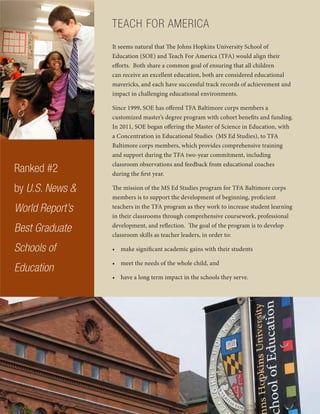
TEACH FOR AMERICA
TEACH FOR AMERICA
It seems natural that The Johns Hopkins University School of
Education (SOE) and Teach For America (TFA) would align their
efforts. Both share a common goal of ensuring that all children
can receive an excellent education, both are considered educational
mavericks, and each have successful track records of achievement and
impact in challenging educational environments.
Since 1999, SOE has offered TFA Baltimore corps members a
customized master’s degree program with cohort benefits and funding.
In 2011, SOE began offering the Master of Science in Education, with
a Concentration in Educational Studies (MS Ed Studies), to TFA
Baltimore corps members, which provides comprehensive training
and support during the TFA two-year commitment, including
classroom observations and feedback from educational coaches
during the first year.
The mission of the MS Ed Studies program for TFA Baltimore corps
members is to support the development of beginning, proficient
teachers in the TFA program as they work to increase student learning
in their classrooms through comprehensive coursework, professional
development, and reflection. The goal of the program is to develop
classroom skills as teacher leaders, in order to:
• make significant academic gains with their students
• meet the needs of the whole child, and
• have a long term impact in the schools they serve.
Ranked #2
by U.S. News &
World Report’s
Best Graduate
Schools of
Education
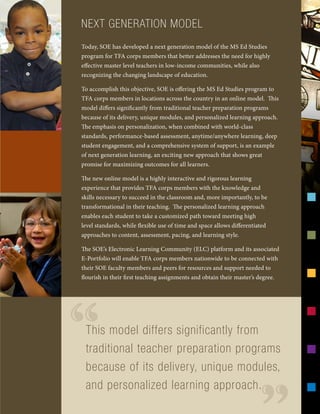
NEXT GENERATION MODEL
Today, SOE has developed a next generation model of the MS Ed Studies
program for TFA corps members that better addresses the need for highly
effective master level teachers in low-income communities, while also
recognizing the changing landscape of education.
To accomplish this objective, SOE is offering the MS Ed Studies program to
TFA corps members in locations across the country in an online model. This
model differs significantly from traditional teacher preparation programs
because of its delivery, unique modules, and personalized learning approach.
The emphasis on personalization, when combined with world-class
standards, performance-based assessment, anytime/anywhere learning, deep
student engagement, and a comprehensive system of support, is an example
of next generation learning, an exciting new approach that shows great
promise for maximizing outcomes for all learners.
The new online model is a highly interactive and rigorous learning
experience that provides TFA corps members with the knowledge and
skills necessary to succeed in the classroom and, more importantly, to be
transformational in their teaching. The personalized learning approach
enables each student to take a customized path toward meeting high
level standards, while flexible use of time and space allows differentiated
approaches to content, assessment, pacing, and learning style.
The SOE’s Electronic Learning Community (ELC) platform and its associated
E-Portfolio will enable TFA corps members nationwide to be connected with
their SOE faculty members and peers for resources and support needed to
flourish in their first teaching assignments and obtain their master’s degree.
This model differs significantly from
traditional teacher preparation programs
because of its delivery, unique modules,
and personalized learning approach.
“
The Education Building ■ 2800 North Charles Street ■ Baltimore MD 21218 ■ 877 JHU SOE1 ■ education.jhu.edu
The Johns Hopkins University is an EO/AA employer committed to recruiting, supporting, and fostering a diverse community.
PROGRAM BENEFITS
Earn a master’s degree from a world-renowned research university in a unique
online model that includes the best of personalized coursework and mentoring and
supervision.
■■ Learn in a comprehensive program format that not only complies with
INTASC (Interstate Teacher Assessment and Support Consortium) standards
but also aligns to TFA’s Teaching as Leadership rubric and includes outcomes
demonstrating transformational teaching and leadership.
■■ Waive the first 9 credits of the degree in recognition of successful completion
of recognized TFA Summer Institutes, including content focused on classroom
management and culture, instructional planning and delivery, and literacy
development. To be eligible to waive these nine credits, corps members must
have completed the TFA Summer Institute within the past five years and provide
documentation of satisfactory completion from their TFA regional office.
■■ Take advantage of additional instructional support (mentoring, supervision).
Mentors will use an online video observation coaching model to assist corps
members in scheduling the most appropriate modules to meet their needs.
■■ Build a global professional network with expert faculty and highly qualified
colleagues.
Apply by accessing a streamlined, web-based admissions process specifically
designed for TFA corps members (http://education.jhu.edu/TFA).
To become part of this exciting new online approach to personalized teacher
preparation, contact us at The Johns Hopkins University School of Education,
at (877) JHU-SOE1, soe.tfa@jhu.edu, or visit www.education.jhu.edu/tfa.
JohnsHopkinsUniversitySchoolofEducation
e are an incubator for new ideas.
We will utilize the interdisciplinary expertise
from across the university and partner with
educational entrepreneurs and organizations
who are equally committed to solving the
educational challenges of our nation.
Annual Report
Academic Year
2010-2011
W
School of Education Annual Report
2010 -2011
The Johns Hopkins School of
Education (SOE) is a vibrant
community of researchers and
educators dedicated to addressing
the most challenging problems
facing education today. As we near
the completion of our fourth year of
operation as a stand-alone school, we
would like to share our progress and
some of our accomplishments that
reflect a focus on creating a school
that is recognized nationally and
internationally as a leading voice in
educational reform.
David Andrews, Dean
US News and World Report
Rankings
The SOE entered 2011 with a #6 ranking by US News and
World Reports’ Best Graduate Schools of Education.
Unfortunately, that ranking fell to #17 with the release of
rankings this spring. Such a dramatic fall can occur in
schools with a small faculty and very few doctoral students.
Fortunately, dramatic rises in the rankings are just as
common for these small programs. The SOE experienced a
decrease in external funding per faculty largely as the result
of two large grants that expired. More importantly, SOE did
not recruit any new doctoral students. The good news is that
external funding per faculty and doctoral GRE scores are
expected to be highly competitive with peer institutions next
year, and we fully anticipate a corresponding rise back into a
top ten ranking.
Development
Dean Andrews and the SOE development staff focused
considerable effort on restructuring the work of its National
Advisory Council (NAC) and establishing new relationships
with educational reform “thought leaders” who may not
typically be associated with schools of education. The
cultivation of these new relationships is leading to new
opportunities for both philanthropy and partnership
agreements. The Windsong Trust, a new philanthropic
partner to the SOE and JHU, committed to a gift of $1.5
million in support of start-up programming for our efforts
in East Baltimore. The development staff has increased
its solicitation rate and will continue to explore ways to
substantially advance development activity in future years.
In addition, development staff, in partnership with the dean,
faculty, and NAC, has also begun planning for a $50 million
campaign to raise funds in support of faculty, SOE research,
and student scholarships.
■■ The SOE has strengthened its relationship with the university’s Center for the Social Organization of Schools
(CSOS).  While many CSOS staff have had faculty appointments in the SOE, they have not been actively involved in
our work as an independent school. We are pleased to report that Dr. Jim McPartland (CSOS co-director) and Dr. Bob
Balfanz (Talent Development High Schools) have become very active in our programs, and that Dr. Balfanz and CSOS
received a $30 million award through the federal I3 competition to expand, disseminate and solidify the evidence
supported by Talent Development High Schools.
In addition, SOE and CSOS initiated a plan to develop a new master’s degree designed to produce principals to feed
the pipeline needed by CSOS’s Talent Development High Schools. Finally, we have had discussions with CSOS staff
about the inclusion of their family and community engagement programs in the East Baltimore Community Schools
and we are discussing ways to cooperate on CSOS’s distribution of the Stocks in the Future financial literacy program.
■■ The Success for All Foundation was created decades ago as a non-profit dissemination arm for the work of
SOE researchers Dr. Robert Slavin and Dr. Nancy Madden. Dr. Slavin directs the Success for All Foundation and is
currently the director of the Center for Research and Reform in Education (CRRE) in the SOE.  Success for All has
become one of the most recognized national brand names in educational reform. A number of efforts have been
initiated to assure that the work of the Success for All Foundation is better integrated into the efforts of the School of
Education. 
As examples, Dr. Slavin has been an active leader in SOE’s senior faculty search; SOE engaged Dr. Bette Chambers
of the Success For All Foundation in a partnership with JHU, Ohio State University, and the Department of Defense
to help create a virtual learning laboratory in early childhood which provides ongoing professional development for
early childhood professionals employed by the military; SOE will send a delegation to York, England to explore new
partnerships; and SOE has tapped the expertise of Dr. Alan Cheung to provide additional research methods support
to SOE faculty and staff.
■■ As a result of a collaborative effort between SOE’s Department of Counseling and Human Services and the JHU
Urban Leadership Institute, the Paul Robeson Academic International School of Excellence (PRAISE) will now
be housed at the Education building. PRAISE will offer academic enrichment, personal empowerment skills and
parenting support for 40 African-American boys in middle and high school and their families over a three-year
period. SOE teacher preparation, school counseling, and clinical mental health students will have the opportunity
to work directly with PRAISE students. The goal of this program is to create a national model for nurturing and
supporting young African-American males. PRAISE programs at the SOE are held on Saturdays throughout the year.
Enhanced University Partnerships
Fast Facts:
Grant Funds Awarded: Faculty from the SOE and its affiliated enterprises received 24 awards
totaling $84.4 million.
■■ A new Ph.D. program is being created to complement
the existing Ed.D. program. The Ed.D. program has a
long history and has produced some influential alumni.
However, the new Ph.D. program will focus on research in
preparation for academic careers and will free the Ed.D. to
address research application and practice. This program is
pending university approval.
■■ A new Master of Education in the Health Professions
(MEHP), in partnership with five participating JHU
schools (Education, Medicine, Public Health, Nursing, and
Business), will provide health sciences professionals with
an opportunity to obtain certificates and master’s degrees in
education. These credentials will build stronger instructional
programs and assist in retention through strengthening the
career ladder in the health sciences. The initial class of 20
students has been recruited to begin the program in the fall
of 2011; the second cohort of students will begin next year
and will have the additional options for full-time and online
course delivery.
■■ Our partnership with Teach for America (TFA) continues
to grow and is generally recognized as the strongest
university partnership in the country. This year 135
first-year TFA corps members joined the 110 second-year
members as teachers-of-record in Baltimore City Public
Schools. The TFA cohort that began teaching last August is
the first to enroll in the Department of Teacher Preparation’s
newly established Master of Science in Education:
Educational Studies degree.
■■ The Department of Teacher Preparation expanded
its offerings including: launching new full-time Master
of Arts in Teaching (MAT) cohorts in Baltimore City and
Montgomery County; re-establishing an Early Childhood
Education concentration within the MAT program; and
restructuring the Accelerated Master of Arts in Teaching
(AMAT) program for Johns Hopkins undergraduates.
■■ The Department of Teacher Development and
Leadership is recruiting the first cohort for its new Graduate
Certificate in Coaching Skills for Educational Leaders, which
is due to launch in fall 2011 and is the first program of its type
in Maryland that specifically targets educational leaders and
aspiring leaders.
■■ The Department of Interdisciplinary Studies’ Neuro-
Education Initiative (NEI) expanded its work to connect
research in the neurosciences to teaching-learning processes.
Dr. Mariale Hardiman received $50K from the Provost’s
Framework for the Future Funds and an additional $400K
(over four years) from the School of Medicine’s Brain Science
Institute to support this work. Activities in 2010-11 included
sponsoring multiple conferences for teachers on applying brain
research to teaching and learning, while NEI’s third national
summit on Stress and the Brain brought together leading experts
from across the country to share research and lead discussions
on translation to educational practice.
■■ The Department of Counseling and Human Service’s
accelerated, full-time Master of Science in School Counseling
program (the School Counseling Fellows program), launched
last year, continues to grow. The second Fellows cohort,
beginning this summer, attracted a national pool of applicants,
and 24 admission offers were made, up from 16 last year.
In addition, the department submitted an application for
national accreditation by the Council for the Accreditation
of Counseling and Related Educational Programs (CACREP)
and is preparing for a site visit in 2011-12. As part of the
preparations, the department has streamlined its course
offerings to ensure its programs align with CACREP
accreditation standards and licensure requirements.
■■ The Department of Special Education’s Graduate
Certificate in the Education of Students with Autism
and Other Pervasive Developmental Disorders is being
offered in a hybrid online format to allow access by teachers
in remote areas of Maryland. Next year the autism hybrid
certificate will be offered to a select group of early childhood
professionals. The hybrid certificate program is supported
through a partnership with MSDE and local school districts.
Significant Programmatic Accomplishments
■■ The Center for Technology in Education (CTE), in partnership with the Maryland State Department of
Education’s Division of Early Childhood Development, released Healthy Beginnings, a set of newly updated
developmental guidelines for families and those who live or work with children from birth through three years of age.
The guidelines describe what infants and young children are learning at specified ages, and how adults can support
their development. The Healthy Beginnings website provides practical and fun activity ideas for parents and teachers,
along with downloadable tips and tools. www.marylandhealthybeginnings.org
In addition, CTE and Pearson Education, Inc. entered into a technology transfer agreement wherein JHU granted
Pearson Education, Inc. the worldwide exclusive rights to market Teacher Compass software. Teacher Compass is
a customizable online teacher evaluation and coaching tool that is easy to use, more efficient for administrators, and
more effective at helping teachers improve their performance.
■■ Center for Research and Reform in Education (CRRE) leaders participated in a successful proposal that
brought $50 million to the Success for All Foundation to scale up its proven elementary reform model to an
additional 1,100 schools.
In addition, CRRE completed an evaluation of a reading program for high school students and published
comprehensive reviews of research on beginning reading, programs for struggling readers, financial incentives, early
childhood programs, technology programs, and elementary and secondary mathematics programs, as well as two
articles on methods for reviewing research on outcomes of educational programs.
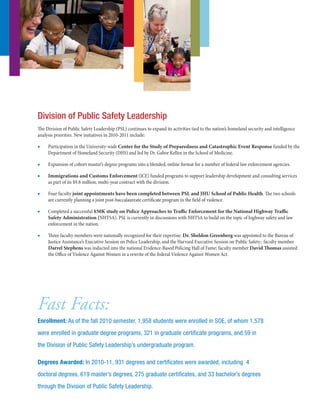
CRRE has seen the number of subscribers for its magazine, Better: Evidence-Based Education, which is published
in collaboration with the University of York and which targets educators and policy makers, grow from 7,000 to more
than 10,000 in the past year. Recent themed issues have covered mathematics, reading, social-emotional learning,
English/writing, and technology. www.bestevidence.org
CRRE, in collaboration with the Department of Interdisciplinary Studies in Education, is launching a new Graduate
Certificate in Cooperative Learning in Instructional Practices in fall 2011. This new certificate, which
addresses teachers’ continued professional development by examining research-proven instructional practices and
their role in transitioning a traditional classroom into a student centered environment, represents the first occasion
that CRRE has developed a credit-bearing, academic program offering for SOE.
Research and Development Center Highlights
Fast Facts:
Robert Slavin, director of the SOE’s Center for Research and Reform in Education, was selected
by the American Education Research Association (AERA) as one of its new fellows. AERA fellows
are recognized nationally and internationally for their outstanding contributions to education
research.
Division of Public Safety Leadership
The Division of Public Safety Leadership (PSL) continues to expand its activities tied to the nation’s homeland security and intelligence
analysis priorities. New initiatives in 2010-2011 include:
■■ Participation in the University-wide Center for the Study of Preparedness and Catastrophic Event Response funded by the
Department of Homeland Security (DHS) and led by Dr. Gabor Kellen in the School of Medicine. 
■■ Expansion of cohort master’s degree programs into a blended, online format for a number of federal law enforcement agencies.
■■ Immigrations and Customs Enforcement (ICE) funded programs to support leadership development and consulting services
as part of its $9.8 million, multi-year contract with the division.
■■ Four faculty joint appointments have been completed between PSL and JHU School of Public Health. The two schools
are currently planning a joint post-baccalaureate certificate program in the field of violence.
■■ Completed a successful $50K study on Police Approaches to Traffic Enforcement for the National Highway Traffic
Safety Administration (NHTSA). PSL is currently in discussions with NHTSA to build on the topic of highway safety and law
enforcement in the nation.
■■ Three faculty members were nationally recognized for their expertise: Dr. Sheldon Greenberg was appointed to the Bureau of
Justice Assistance’s Executive Session on Police Leadership, and the Harvard Executive Session on Public Safety; faculty member
Darrel Stephens was inducted into the national Evidence-Based Policing Hall of Fame; faculty member David Thomas assisted
the Office of Violence Against Women in a rewrite of the federal Violence Against Women Act.
Fast Facts:
Enrollment: As of the fall 2010 semester, 1,958 students were enrolled in SOE, of whom 1,578
were enrolled in graduate degree programs, 321 in graduate certificate programs, and 59 in
the Division of Public Safety Leadership’s undergraduate program.
Degrees Awarded: In 2010-11, 931 degrees and certificates were awarded, including 4
doctoral degrees, 619 master’s degrees, 275 graduate certificates, and 33 bachelor’s degrees
through the Division of Public Safety Leadership.
■■ East Baltimore Community School: The SOE
assumed a more substantial leadership role in
the East Baltimore Community School through
a stronger commitment to the efforts of the East
Baltimore Development Initiative (EBDI) and other
partners in the JHU community. The East Baltimore
Community School project involves the design
and construction of a state-of-the-art facility on
seven acres in the EBDI catchment area that will
serve children from infancy through eighth grade.
Dean Andrews chairs the design and construction
committee for this facility and SOE will assume
an operating position of both the school and
early childhood center on July 1, 2011. The SOE
is committed to assuring that the school serves a
mixed income community and is recognized as one
of the highest performing schools in Baltimore.
The East Baltimore Community School will serve
as a demonstration of university/community
collaboration and the impact of high quality schools
on redeveloping communities.
■■ The SOE’s Shaping the Future discussion series,
which addresses the most challenging issues in
public education, continues to attract outstanding
panels of nationally recognized experts. The April
2010 event discussed ways to close the nation’s
achievement gap, while the April 2011 event
examined the changes occurring in the teaching
profession and how the classroom teacher will be
impacted. Each event typically attracts more than
300 attendees.
■■ In partnership with the Baltimore City Public
Schools Office of Early Childhood, the SOE
participated in a citywide PreK at Play Day in
May 2011. The program exposed four year olds
to a variety of experiences that most wouldn’t get
a chance to see in their young lives. More than 40
four year olds visited the Education Building and
participated in hands-on learning activities. The
SOE also recruited the university’s Whiting School
of Engineering and Peabody School to participate in
this effort.
■■ For the 2010-2011 academic year, the SOE partnered
with the Margaret Brent Elementary/Middle
School in Baltimore City as part of its community
outreach program. The school is located at 2600
St. Paul Street, just two blocks from the Education
Building. Ninety-five percent of the students qualify
for the subsidized lunch program.
■■ The SOE actively supports the Baltimore Youth
Works program. During the summer of 2010 the
SOE mentored nine students from the Youth Works
program.
■■ For the second year in a row, the school hosted
the EPA’s Science Educational Development
Program’s summer camp, which brings roughly
30 Baltimore City middle school youth to campus for
an environmental science program.
■■ The school will re-launch its partnership with
Northrop Grumman to offer a seminar series to
employees nearing retirement who are interested in
teaching or serving as content resource specialists to
schools in STEM areas.
■■ The School of Education is a participant in the
Urban Health Institute, which works to connect
JHU and the surrounding community through
programs, seminars, and other events.  A series
of seminars targeted to reach across the JHU and
Baltimore communities is offered at the schools of
Education and Public Health.
■■ The SOE’s Division of Public Safety Leadership
(PSL) is involved in a variety of outreach programs
to colleges and universities, communities, and
state agencies including non-credit presentations
on dating violence; Building Boys into Men
(providing insight on how to work with and mentor
male youth); workplace violence; and advanced
sexual assault training.
Community Engagement Activities
We invite you to learn more about us by visiting www.education.jhu.edu/. To find out the latest news in education and to join
in the discussion, visit our blog at www.soetalk.com. If you have any questions regarding this document, contact Chris Atkins
Godack, assistant dean, SOE Office of Communications and Public Affairs, at cgodack@jhu.edu or (410) 516-8590.
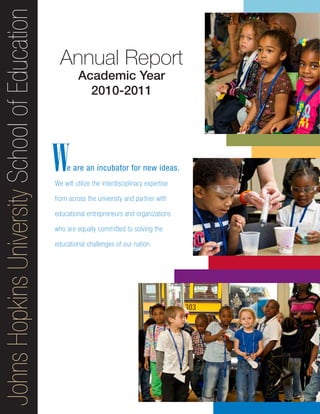
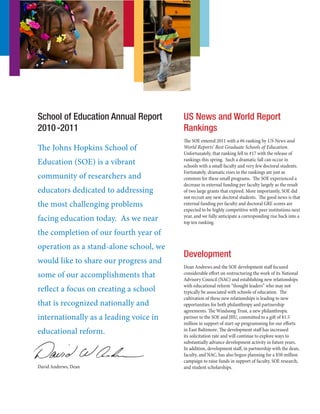
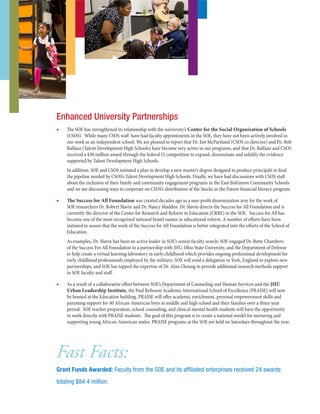
The photos in this annual report were taken on May 19, 2011 when more than 40 students from Samuel Morris Elementary school
in East Baltimore visited the SOE and participated in hands-on learning activities as part of Baltimore City’s PreK at Play Day.
We’re still not sure who enjoyed the day more – the students or SOE faculty and staff.
■■ Continue faculty recruitment
■■ Approve and implement new Ph.D. program
■■ Increase research activity and grant funding
■■ Restructure academic and administrative units to better reflect SOE’s mission and obtain greater efficiencies
■■ Implement educational policies and partnership initiatives
■■ Successfully impact the East Baltimore Community School project
■■ Commence $50 million fund-raising campaign for faculty, SOE research and scholarships
AY 2012 Major Goals
Fast Facts:
SOE’s Center for Research and Reform in Education (CRRE) developed the Best Evidence
Encyclopedia (BEE) which provides educators with summary reviews of research on effective
programs, and has more than 100,000 visitors a year. www.bestevidence.org
JohnW.Robertson|PortfolioofWork
Posters
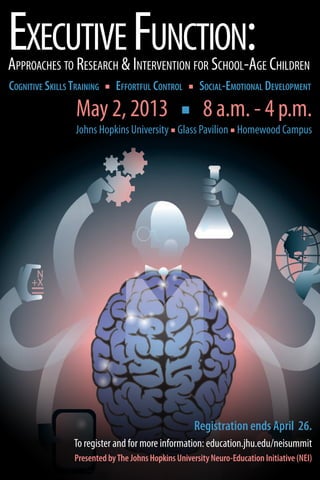
ExecutiveFunction:Approaches to Research & Intervention for School-Age Children
May 2, 2013  ■  8 a.m. - 4 p.m.
Johns Hopkins University ■ Glass Pavilion ■ Homewood Campus
Cognitive Skills Training ■ Effortful Control ■ Social-Emotional Development
Registration ends April 26.
To register and for more information: education.jhu.edu/neisummit
Presented byThe Johns Hopkins University Neuro-Education Initiative (NEI)
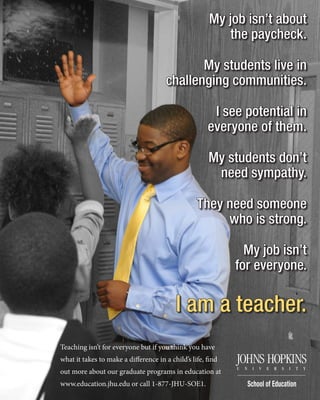
My job isn’t about
the paycheck.
My students live in
challenging communities.
I see potential in
everyone of them.
My students don’t
need sympathy.
They need someone
who is strong.
My job isn’t
for everyone.
I am a teacher.
Teaching isn’t for everyone but if you think you have
what it takes to make a difference in a child’s life, find
out more about our graduate programs in education at
www.education.jhu.edu or call 1-877-JHU-SOE1.
Monday, December 7, 2009
Shriver Hall Auditorium Homewood Campus
Reception 6:30 p.m.
Program 7 - 9:30 p.m.
What is the future
of No Child Left Behind?
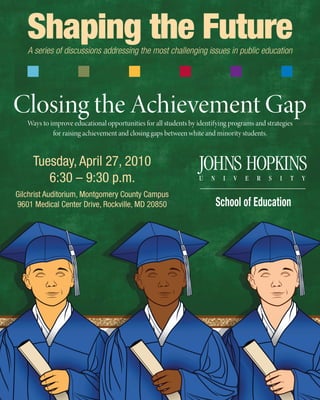
Shaping
the Future
A series of discussions addressing the
most challenging issues in public education
Closing the Achievement GapWays to improve educational opportunities for all students by identifying programs and strategies
for raising achievement and closing gaps between white and minority students.
Shaping the FutureA series of discussions addressing the most challenging issues in public education
Tuesday, April 27, 2010
6:30 – 9:30 p.m.
Gilchrist Auditorium, Montgomery County Campus
9601 Medical Center Drive, Rockville, MD 20850
Learn how by visiting
education.jhu.edu/civility
Learn how by visiting
education.jhu.edu/civility
JohnW.Robertson|PortfolioofWork
Commencement
Johns Hopkins University
School of Education
Commencement 2009
Johns Hopkins University
School of Education
Commencement
May 27, 2010
Johns Hopkins University
School of Education
Commencement
May 26, 2011
2015JohnRobertson

2015JohnRobertson

  • 1.
  • 2.
    Going to Scale:Expanding Programs that Work
  • 3.
    Dear Colleagues, While fewwould argue against the importance of K-12 schools implementing practices that “work,” assuring that the most evidence-based practices are being implemented at scale has proven very difficult. Despite direct guidance from federal legislation and supportive repositories like the Best Evidence Encyclopedia (BEE, Center for Research and Reform in Education, Johns Hopkins School of Education) and the What Works Clearinghouse, K-12 schools and their leaders continue to be swayed by multiple factors other than evidence in their choices of educational practice. Schools, school districts and states become comfortable with existing approaches and are often resistant to change. This resistance is sometimes quite rational whether the new approach is evidence-based or not. It takes time and money to fully implement any educational practice. Once fully implemented, educational institutions naturally protect their investment by resisting efforts to implement new, more effective practices. When change is palatable, these educational institutions are bombarded with a plethora of well marketed approaches designed with impressive face validity. These approaches are logical, presented within the larger context of “doing good,” and are attractively packaged with suggestive images of their effectiveness. Too often, old fashioned sales often trump evidence of effectiveness. The dual challenge of finding evidence-based programs that can be brought to scale has been a significant impediment to education reform in the United States. What’s needed is a tenacious commitment by colleges and universities, as well as the education community, to support faculty research efforts to develop, implement, and bring to scale the most effective evidence-based programs available. We cannot be frightened away by the required work involved to improve student performance. Together we can make evidence-based programs the rule rather than the exception. David W. Andrews, PhD Dean
  • 4.
    We asked threenationally recognized researchers at the Johns Hopkins School of Education (SOE) to share their experiences and lessons learned in bringing their successful evidence-based programs to scale: Robert Slavin and Robert Balfanz, who together received $80 million in the I3 competition to expand their programs, Success For All and Talent Development Secondary’s Diplomas Now program, respectively; and Joyce Epstein, who leads the National Network of Partnership Schools. So what is needed to bring a program to scale? What are the challenges involved? How do you bring a program to scale and not sacrifice quality? And how do you convince school leadership to implement more effective practices? Sadly, there’s more evidence- based research to help the consumer select a toaster oven than there is to select a curriculum for an entire state or school district. “ ”Robert Slavin, researcher and director SOE’s Center for Research and Reform in Education
  • 5.
    Needing the RightPeople Balfanz: For our school-based Talent Development Secondary’s Diplomas Now program (TDS), we found we needed to create what we called an “implementation support infrastructure.” The key to this infrastructure is a trained facilitator who is respected by educators and can be our agent on the ground. The facilitator becomes the “grease and the glue” for the program and acts as the program’s translator on the ground. Slavin: Success For All (SFA) programs require a combination of two types of assistance to schools. The first is a talented core of dedicated coaches working closely with the principal and faculty and, secondly, a local network of experienced schools that can offer technical and emotional support. We also need parents to be on our side. That’s why our curriculum involves parents. They have to sign off on their children’s homework among other responsibilities. But truly, the single most important element is that there is no single most important element. You’ve got to get all things right. Would you say, “What’s the single most important element of an airplane?” I think the same is true of SFA – its relentless attention to detail in every aspect of curriculum, instruction, professional development, school organization and so on. Epstein: It was important for the National Network of Partnership Schools (NNPS) to recruit researchers and facilitators who shared a commitment to changing the focus of school partnerships from one of a leader working with parents to a team approach with school, family and community members - all working together to increase the success of students. It’s also important for districts to identify a leader for partnerships who can become an “expert” and permanent position in the district who can guide all schools to develop partnership plans and practices linked to their school improvement plans. In that way, family and community engagement is designed to support curricular and behavioral goals for student learning and development. Challenges In the Field Epstein: We’ve also learned about the challenges created by frequent turnover in district and school personnel. People leave, retire and change positions after starting to work well as leaders for partnerships. You must help districts and schools plan for these inevitable transitions to new leaders. Balfanz: Finding the right balance between a school or district’s situation and an evidence-based model is often a challenge. Adapting a model to local conditions, such as length of the school day or preferred curriculum, increases the school’s buy-in and willingness to implement the model. Doing this while maintaining fidelity to the elements of the model that have been shown to drive improvement is where the delicate balance needs to occur. Slavin: The challenges are many. Urban districts and schools experience considerable turmoil, constantly changing superintendents, boards, funding levels, and policies. SFA has not been immune from these challenges, but has managed to survive by focusing on the school as the unit of change, building shared leadership and solid systems in every classroom to maintain proven practices. Quality Job #1 Slavin: Constant assessment of the quality of implementation and student outcomes keeps the whole staff on track. School staffs participate in a caring national network of schools in similar circumstances. We also believe that it’s important that the overall integrity of the program be maintained to reproduce the results we have so consistently found in our research. We require that each participating school must make a free choice through secret ballot to adopt our program. All of these elements increase the likelihood that a SFA school will survive changes in superintendents, principals, and other turmoil. Disasters still happen, but the median SFA school has been with the program for 11 years, a remarkable record of stability in the stormy world of urban education. Epstein: We encourage quality by helping members evaluate their work and progress every year. Each site uses an UPDATE survey at the end of each school year to review its program design and implementation. This resource helps schools, districts, states, and organizations in our network understand the researched-based expectations for their partnership work and to measure the quality of their work against those expectations. Balfanz: One of the most important lessons learned led to the 2010 merger of our middle and high school programs to create Talent Development Secondary in response to research indicating that students started to show signs of losing interest in school and dropping out as early as the 6th grade. The research also showed that the 6th and 9th grades are critical junctures in students’ lives and a key time for intervention. Ongoing evaluation strengthens the integrity of the program. The bulk of SOE’s research efforts, which receive more federal funding than any other graduate school of education in the United States, are focused on evidence-based research.
  • 6.
    Communicating the Data Balfanz:You have to work on persuasion skills. You are going to have to convince people (in schools, districts and states) that you have good answers AND that what you are proposing is compatible with what they are doing that works – even though you are changing fundamental behavior. Some audiences want the “hard’ evidence of third-party studies. School principals aren’t impressed with them. That’s where the soft skills are necessary – showing that the program makes sense from a “practice” point of view. Slavin: Part of the “sell” is communicating the value of research- based programs to school leaders and families. A research-based program is one that has been evaluated in real schools over at least a year, hopefully many times in comparison to control groups. That’s an absolutely essential part of what we consider to be something that is research-based and that often is left out when people talk about what’s research-based and what’s not. In education for some reason, we’ve done very little experimentation where we compare experimental and control groups to see which of them produces better outcomes for children. Epstein: Many kinds of rigorous research—quantitative and qualitative—form a strong research base on school, family, and community partnerships. Evidence from applications in highly diverse communities also contributes to district and school leaders’ confidence that a new approach is likely to work for them. We have learned that research on partnerships informs and improves policy and practice and that practitioner’s challenges inform needed research. Last Word Never in the history of American education has the potential for fundamental reform been as great. In education and other human services, evidence of effectiveness in rigorous evaluations is taking on increasing importance in policy and practice. At SOE, our research and experience has led us to conclude that successful development, dissemination, and scaling up of proven approaches requires university support of faculty work, program fidelity, talented and dedicated staff, and a local and national network of schools willing to be an active and engaged partner. Bringing Programs to Scale SOE has a distinguished track record of developing evidence- based programs to improve learning outcomes that have been successfully replicated in schools across the country and internationally. These nationally recognized programs currently serve more than half a million students in 1,700 schools in 40 states and three countries. Success for All: A whole school reform model developed by Johns Hopkins researchers, Robert Slavin and Nancy Madden, to help students from poor inner city neighborhoods succeed in school. Starting in one school in Baltimore, the program today serves students in over 1,000 schools in 40 states. National Network of Partnership Schools: Johns Hopkins researchers, Joyce Epstein and her colleagues, initiated the program based on extensive research on the positive nature and effects of parental involvement in K-12 schools and on leadership program development with districts and states. The program started with eight pilot schools in Baltimore and has expanded to more than 600 schools in 60 districts, organizations, and state departments of education across the country. Talent Development Secondary: Johns Hopkins researchers, James McPartland, Robert Balfanz, Douglas Maclver and their colleagues, began working with school officials in Philadelphia and Baltimore to develop a comprehensive school reform model that could turn around some of their worst performing schools. Today, the Talent Development Secondary program can be found in more than 50 schools in 12 states, the District of Columbia and Guam. Teach For America: SOE developed a customized, face-to- face master’s degree program for Teach For America (TFA) corps members in Baltimore that was expanded online to reach TFA corps members nationwide. Currently, more than 300 corps members are enrolled in the national online program, with 1,500 planned for 2018. Henderson-Hopkins: Operated by SOE, this new K-8 school and early childhood center serves an economically disadvantaged neighborhood in Baltimore and offers the most effective evidence- based program available to improve student performance. The school was designed as a national model for a high performing school that serves a diverse, mixed-income community with scalable personalized learning. SOE Faculty To learn more about the innovative work of our faculty and doctoral students, visit education.jhu.edu/faculty.
  • 7.
    education.jhu.edu | 887-JHU-SOE1 | soe.info@jhu.edu The Johns HopkinsUniversity is an EO/AA employer committed to recruiting, supporting and fostering a diverse community. Education Building 2800 North Charles Street Baltimore MD 21218 Ranked #2 by U.S. News and World Report’s Best Graduate Schools of Education
  • 8.
    The Johns Hopkins University BEYONDTHE COLEMAN REPORT In 1966, a young Johns Hopkins faculty member, James Coleman, conducted what many consider the most important educational study of the 20th century. Today, almost five decades after the release of The Coleman Report, researchers at the Johns Hopkins University are continuing to shape the field of education and improve access to high- quality education for all children.
  • 9.
    James Coleman’s studyof inequality in education by reason of race, color, religion, or national origin was expected to show – as many believed at the time – that low income and minority students performed poorly because schools lacked resources. Instead,the700pagereport,EqualityofEducationalOpportunity (EEO), stunned the education world when it found that student achievement was related as much to family background and social composition of the school as it was to the quality of instruction. At the time, the Harvard Crimson said“The Coleman Report brought US education to the verge of an unprecedented revolution.” Shortly after the study was published, Coleman co-founded the Johns Hopkins Center for Social Organization of Schools (CSOS), an education research and development center. Coleman’s work was complimented by young Johns Hopkins social scientists and educators who quickly began making substantial contributions on their own. Among them were Doris Entwistle, Karl Alexander, James McPartland, Joyce Epstein, and Robert Slavin – all have since been elected American Education Research Association (AERA) Fellows based on their research contributions to education. This exceptionally talented group was joined by many others and their collective work continues to shape our educational landscape. A Tradition of Discovery
  • 10.
    The Legacy LivesOn Today, researchers at the Johns Hopkins School of Education (SOE) continue the tradition of excellence and innovation of The Coleman Report by seeking to discover better ways to improve learning outcomes and access to high-quality education for all children. Their work, which takes an applied, interdisciplinary approach to instruction and research, is supported by doctoral and post- doctoral students and two nationally recognized SOE research centers: Center for Research and Reform in Education (CRRE) Works to improve the quality of education for children in grades pre-K to 12 by focusing on the rigorous evaluation of educational programs, reviews of research on educational programs, and policy analysis and dissemination to bring meaningful reform to America’s underperforming public schools. Center for Social Organization of Schools (CSOS) Conducts research on critical education issues, including chronic absenteeism, effective instruction and college and career readiness – with emphasis on low- performing schools – and turns research into practice by providing technical assistance to schools nationwide and making policy recommendations. SOE faculty include some of the most recognized scholars in educational research and reform, and our researchers are among the nation’s top recipients of U.S. Department of Education’s Investing in Innovation (i3) grants for programs aimed at improving achievement for students at-risk of academic failure. In addition, SOE has 20 joint faculty appointments with Johns Hopkins University schools, including arts and sciences, medicine, and public health. Research at Work Robert Balfanz – developed an Early Warning System (EWS), using indicators of attendance, behavior, and performance, to signal when students between the sixth and ninth grades are at-risk ofnotcompletingthe12thgrade. Hisworkinidentifyingschoolswith large numbers of dropouts, and more recently in chronic absenteeism, make him a leading expert in one of the more critical issues confronting urban school districts. He is also co-director of CSOS’s Talent Development Secondary program which employs evidenced- based intervention strategies, including EWS, to keep students in low-performing middle and high schools from dropping out and on the path to graduation. Joyce L. Epstein– established the National Network of Partnership Schools (NNPS) which guides schools, districts, and state leaders to develop research-based programs of family and community involvement to improve student achievement. She is also director of theCenterforSchool,FamilyandCommunityPartnershipsthathouses NNPS and studies the nature of that involvement. James McPartland – conducts extensive research on helping teachers improve literacy instruction for adolescents and has led a team that developed a comprehensive reform model for high schools facing problems with attendance, test scores, and dropout rates. McPartlandisanoriginalco-authorofColeman’sEEOreportand the executive director of CSOS. Robert Slavin – developed a nationally acclaimed research-driven whole school reform model, Success for All (SFA), based on the belief that all children can succeed. This model program, a recipient of an i3 grant, is built around a daily 90-minute reading period for all students with a focus on phonics and tutoring for students who need extra help. SFA employs a cooperative learning approach where children work in pairs or in small groups to ensure their participation and teachers continually monitor student progress. At the School of Education, we are committed to recruiting and supporting innovative researchers whose work will continue to lead educational thought and stand as the national model for research and excellence. “
  • 11.
    Improved Access SOE relatedprograms are now serving 400,000children in some of the nation’s most challenging school districts. Dr. Robert Slavin’s Success for All works with 23,000teachers in more than 1,000 Title I schools in 47states. CSOS’sTalent Development Secondary program is in 55high-poverty middle and high schools in 19states, Guam and the District of Columbia. Dr. Joyce Epstein’s effort to enhance family and community participation can be found in 700schools in more than 10states. More than 700K-8 and early childhood students will benefit from the Henderson-Hopkins School in East Baltimore, a model school operated by SOE that will permanently alter contemporary educational practices and shape the next generation of schools in the United States.The school will provide research-based models of instruction and personalized learning based on technology combined with sophisticated data systems and evidence about what works with students at different ability levels and learning styles on a daily basis. CRRE’sThe Best Evidence Encyclopedia (BEE) web site provides easy-to-read, unbiased reviews of research-proven educational programs for those educators and school districts looking for the most efficient and evidenced-based approaches to tackling their immediate concerns. The site averages over 100,000unique inquiries each year. CSOS’s Everyone Graduates Center offers a free, online repository of research, tools and analyses of current educational issues, including graduation rates, absenteeism, content literacy, parental involvement, and information on dropout prevention to more than 15,000educators yearly. A $7.4 million grant from the National Science Foundation to promote STEM student achievement brings together researchers from the Johns Hopkins’schools of education, engineering and arts and sciences to engage 40 STEM teachers in grades 3-5 in nine targeted low-income, high minority schools and offer professional development to all Baltimore City elementary school teachers, reaching 132 schools and over 1,100 teachers total. At A Glance Number of faculty: 74, 17 joint JHU appointments Number of doctoral students: 48 Sponsored Funding: $26.7 Million American Education Research Association Fellows: 5 Reform Initiatives: Faculty received $100 million in the first two rounds of the federal Investing in Innovation Fund (I3) Grants 2800 North Charles Street ■ Baltimore MD 21218 877 JHU SOE1 ■ education.jhu.edu
  • 12.
    Among 30 developedcountries, the U.S. ranks 25th in math and 21st in science. One in 10 U.S. high schools are labeled “dropout factories.” Two billion dollars is spent annually on remedial coursework at the college level. The Obama administration calls schools of education “cash cows” that do a mediocre job of preparing teachers. Johns Hopkins University School of Education How can we fix this?
  • 13.
    “The significant problemswe face cannot be solved at the same level of thinking we were at when we created them.” - Albert Einstein
  • 14.
    If schools ofeducation are to become part of the solution to the educational crisis in this country and national reform is truly to take place from PK to higher education, then we must make substantial new investments in our people and the high impact programs they create. The Johns Hopkins University School of Education (SOE) recently began making these investments. Only such ardent commitments will lead to change and define schools of education as part of the solution rather than the problem. At the SOE, we’ve made exciting new investments in people and infrastructure with the arrival of a new dean, David Andrews, who previously was the dean of the College of Education and Human Ecology at The Ohio State University. With unprecedented support from JHU President Ronald Daniels, Andrews will lead a new vision that will strengthen the school’s local, national, and international impact through the discovery and dissemination of new knowledge affecting education. Taking advantage of our investment opportunities and new leadership, we’re launching a large scale initiative to hire up to half a dozen of the most influential senior scholars to join our team. We will aggressively target the most innovative and progressive thinkers and bring them together without disciplinary boundaries to solve complex educational problems. We’re committed to building on our strength in identifying, evaluating, and supporting evidence-based practices – and our strength is formidable. As examples, Robert Slavin and the Success for All Foundation received the highest score in the federal I3 competition and are on schedule to receive a $50 million grant to expand dissemination of evidence-based reforms through the implementation of Success for All in 1,000 additional school districts. Similarly, Robert Balfanz received a $30 million award through the same competition to expand, disseminate, and solidify the evidence supporting Talent Development High Schools. Together, these Johns Hopkins professors will receive $80 million (22%) of the $650 million pool that drew over 1,700 applicants for federal funds to implement evidence-based reform initiatives. And this is only the beginning. We invite you to follow us as we become part of the solution. education.jhu.edu/solutions
  • 16.
    For more information,visit: Bloomberg School of Public Health jhsph.edu Center for Social Organization of Schools jhucsos.org Center forTalentedYouth cty.jhu.edu East Baltimore Community School education.jhu.edu/ebcs School of Education education.jhu.edu Success for All Foundation successforall.org Impact – A Global Footprint in Education The Johns Hopkins University, through its global reach and commitment to excellence, is working to improve the quality of education for students in our communities, our nation, and our world. Asthenation’sleadingresearchinstitution,JohnsHopkinsbringstoeducationthesamededication it brings to other disciplines by leading the way in developing the best educational practices to benefit all learners. The accompanying chart demonstrates sustainable educational programs, developed by Johns Hopkins faculty and researchers, that have successfully impacted student achievement. Crossing interdisciplinary boundaries, this work includes the School of Education (SOE), and its Center for SocialOrganizationofSchools(CSOS),theSuccessforAllFoundation(SFAF),theCenterforTalented Youth (CTY), and the Bloomberg School of Public Health. As shown by the scope of these programs, the university is committed to improving student learning whether it’s around the corner or across the globe. For example, the SOE trains and places highly qualified teachers in more than 150 of Maryland’s most challenging schools each year. In addition, SFAF and CSOS – among the top recipients of the U.S. Department of Education’s Investing in Innovation grants – are bringing cutting-edge ideas to school reform efforts. SFAF programs, representing a proven whole-school approach to school improvement that helps every child succeed, have been adopted by more than 1,000 schools in 47 states, the United Kingdom, Canada, and Guam. CSOS has developed a comprehensive reform model to turn around troubled low-performing middle and high schools nationwide. The university’s Center for Talented Youth supports the educational opportunities of underrepresented gifted youths and serves more than 60,000 students each year at 233 locations across the United States and in ten countries. Additionally, a Bloomberg School of Public Health (BSPH)Initiative,PositiveBehavioralInterventionandSupports,workswithschoolsthroughoutthe state of Maryland to implement a classroom discipline system that is creating safer, more effective schools.The program operates in more than 90 schools in Baltimore City alone. Closer to home, Johns Hopkins will be working to further the redevelopment of an east Baltimore neighborhood by designing and operating a new K-8 school and early childhood center through the East Baltimore Community Schools (EBCS) project. EBCS will serve a diverse, mixed-income community and emphasize academic excellence. Through research, development, and the dissemination of best practices, Johns Hopkins is helping school systems worldwide find solutions and build high quality education systems that give every child the greatest opportunity to learn and succeed. A Global Impact
  • 17.
    DC 4 MA 16 NJ 158 PA 164 OH 43 nnnn nnnnnn nnnnnn nnnnnn nnnnnn nn nnnnnnnn nnnnnnnn nnnnnnnn nnnnnnnn nn nnnn nnnn nnnnnnnnnnnnnn nnnnnnnnnnnnnn nnnnnnnnnnnnnn nnnnnnnn nnnnnn nnnn nnnnnnnnnnnnnn nnnnnnnnnnnnnn nn nnnnnnnnnn nnnnnnnnnn nnnnnnnnnn nnnnnnnnnn nnnnnnnnnn nn nnnn nnnnnn nnnn nnnnnnnn nnnnnn nnnn nnnn nnnn nnnnnnnn nnnnnnnn nnnnnnnn nnnnnn nnnn nnnnnn nnnnnn nnnn nnnnnn nnnnnn nnnnnn nnnnnn nnnnnn nnnn nnnnnnnn nnnnnnnnnnnn nnnnnnnnnn nnnn nnnn HI 15 nnnnnnnn nnnn nn nnnnnnnn nnnnnnnn nnnnnnnn nnnn nnnn nnnn nn GUAM 10 nnnn tt tt tt tt tt êê êê êê êê êê êê êê êê êê êê êê êê êê êê êê êêêê êê êê êê êê êê êê êê êê êê êê êêêê êê ÌÌ Baltimore City *includes District of Columbia and Guam Information current as of 8/2011. êê êê êê nn FL 47 GA 35 KS 55 NY 25 MI 23 LA 25 AZ 43 öö1 Baltimore County öö4 Anne Arundel County öö6 Montgomery County öö7 Howard County öö96 EBCS CSOS CTY PBIS SFAF SOE êê tt ll nn ÌÌ öö JHU education programs serve more than 600,000 children, in 47 states* and 12 countries. School of Education East Baltimore Community School Success for All Foundation SOE’s Center for Social Organization of Schools Center for Talented Youth Positive Behavioral Intervention and Supports Icons refer to schools where programs are located. UK 10 tt ttDC 2 ttIA 1 ttFL 1ttHI 1 ttAZ 2 ttCA 18 ttCT 16 ttME 1 ttMD 23 ttMA 20 ttIL 3 ttAR 3 ttNH 3 ttNC 1 ttMN 1 ttMI 3 ttNY 19 ttNV 1 ttNM 1 ttNJ 39 ttPA 39 ttOR 2 ttOK 1 ttOH 1ttUT 1 ttTX 1 ttTN 2 ttRI 3ttWI 1 ttWA 1 ttVT 9 ttVA 7 tt2 tt2 tt WA 23 OR 23 (92 in Baltimore City) 790 Total in Maryland nn nn êêêê tt tt tt
  • 18.
    As the nation’sleading research institution, Johns Hopkins brings to education the same dedication it brings to other disciplines by preparing the best and the brightest in education to lead in teaching, special education, counseling, administration, research, and policy. Ranked second by U.S. News & World Report’s Best Graduate Schools of Education, the School of Eduction (SOE) offers doctoral and other graduate programs, as well as a variety of specialized graduate certificates. DEGREEOFFERINGSJohns Hopkins University School of Education DEGREE OFFERINGS
  • 19.
    Doctor of Philosophyin Education (PhD) This unique interdisciplinary learning experience prepares top scholars in education research, practice and policy who possess the analytical capabilities for identifying problems and crafting solutions beyond one academic discipline. A selected number of PhD candidates receive full tuition assistance and an annual stipend to support full-time study. Doctor of Education (EdD) This online program prepares an exceptional core of practicing educationalleaderstomeetthe challengesassociatedwith improving both the public and private education environment. Graduates of this part-time program will be prepared for a wide variety of leadership positions in preK-12 settings and the education industry. Master of Arts in Teaching This intensive full-time program leads to initial teacher certification and can be earned in as little as 12 months. Students focus on the mastery of the theory and methodology of teaching through their graduate course work, while simultaneously applying that knowledge in an internship – a yearlong classroom immersion experience. Certification areas include: Early Childhood Elementary Education Secondary Education DoctoralPrograms Full-timeMaster’sPrograms Part-timeMaster’sProgramsCertificates Certificates A variety of graduate and post-graduate certificate programs are available to help educators further their career objectives and acquire the latest advances in a specific topic of interest. Certificate offerings include but are not limited to such areas as literacy; technology; data- based decision making; gifted education; mind, brain and teaching; special education; counseling; and teaching the adult learner. Visit www.education.jhu.edu/certificates for a complete listing. Master of Arts in Teaching This part-time option offers students the maximum flexibility in earning a teaching degree. Students have up to five years to complete the program, which leads to initial teacher certification; average completion is 2-3 years. The format is ideal for working professionals as well as career-changers. Note: The same certification areas are available as in the full-time option. Master of Education in the Health Professions Representing a unique collaboration of five Johns Hopkins Schools – business, education, medicine, nursing, and public health – this online degree prepares healthcare professionals nationally and internationally for teaching roles in health related educator programs. Master of Science in Counseling School Counseling – This program prepares individuals seeking state certification as school counselors to serve as leaders and advocates, counsel K-12 students and families, consult and collaborate with community and school stakeholders, and develop data-driven counselingprogramsthatpromotesocialjusticeandequityinurban/ metropolitan schools. The program is accredited by the Council for Accreditation of Counseling and Related Educational Programs (CACREP). Mental Health Counseling – Designed for individuals who want to deliver counseling services to clients encountering situational problems as well those clients who experience more significant mental health concerns and disorders. Graduates of this program workinawiderangeofsettingssuchasschools,hospitals,psychiatric facilities, rehabilitation centers and social service agencies. The program includes a 600/1000 hour internship and satisfies the academic requirements for licensure in the state of Maryland. OnlinePrograms Online Programs A number of high-quality, interactive online degree and certificate programs are available for credit and non-credit. Visit www.education.jhu.edu/online for a complete listing.
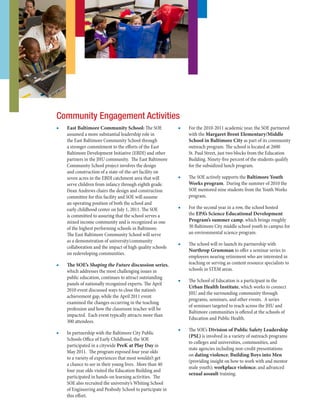
  • 20.
    *A complete certificatelisting is available at www.education.jhu.edu/certificates. Master of Science in Counseling School Counseling Fellows This accelerated 15-month program, which leads to certification as a school counselor, focuses on working in urban school districts and prepares students to be leaders and advocates in schools, counsel K-12 students and families, consult and collaborate with community and school stakeholders, and develop data-driven comprehensive counseling programs that promote social justice and equity in schools. The program is accredited by the Council for the Accreditation of Counseling and Related Educational Programs (CACREP). Master of Science in Special Education This full-time program is for individuals seeking their initial teacher certification to work with students who have mild to moderate disabilities, including learning disabilities, emotional disabilities, and mild intellectual disability. The program, which can be completed in four semesters, is designed to prepare highly effective special educators who plan to work in challenging urban- based school environments. Teacher certification options include: Elementary/Middle Education (Grades 1 - 8) Secondary/Adult Education (Grades 6 -12) Master of Science in Special Education A variety of concentrations are available for individuals who are seeking teacher certification to work with students who have a wide range of disabilities and special needs, as well as individuals interested in specializing but not pursuing certification. In addition to required course work, students complete two separate internships which each consist of 120-150 hours of service. Concentration Areas for Certification Early Childhood Special Education (Birth – Grade 3) Mild to Moderate Disabilities – (Grades 1 – adult) Mild to Moderate Disabilities/Differentiated and Inclusive Education Severe Disabilities (Birth – Grade 12) Concentration Areas for Non-Certification General Special Education Studies Mild to Moderate Disabilities: Differentiated and Inclusive Education Severe Disabilities Severe Disabilities: Emphasis in Autism Spectrum Disorders Technology in Special Education Master of Science in Education A degree for experienced educators looking to advance their careers in the areas of school leadership, literacy, and educational technology. Specializations include: School Administration and Supervision (leads to certification as an Admin I) Reading (leads to certification as a reading specialist) Technology for Educators Master of Science in Education, Educational Studies Interdisciplinary Program - Experienced educators can advance their careers by designing a customized program with the approval of a faculty adviser. Study options vary and can include selected coursework in a specific area of interest, combining two certificates,* or a combination of coursework and a certificate. All options include a capstone project. Teach for America Partnership - This program is designed to support the development of novice teachers in the Teach For America program as they work to increase student learning in their classrooms through strategic and comprehensive coursework, professional development, and reflection. Two formats are offered: a hybrid face-to-face and online in Baltimore, Maryland; and a national online program.
  • 21.
    General Admissions Requirements Applicantsto the School of Education must hold a bachelor’s degree from a regionally or nationally accreditedcollegeoruniversityandhaveearnedaminimumcumulativegradepointaverageofatleast 3.0 (on a 4.0 scale) at both the undergraduate and graduate level (including programs in progress). To apply, applicants should follow the specific admissions requirements for their desired program of study, including submission of an application and relevant supporting documents. Details can be found on our Website at: www.education.jhu.edu/admission. Financial Assistance Our financial aid office can assist you with applying for aid and understanding financial options such as federal grants, low-interest loans, and scholarships. For more information about financial aid, visit www.education.jhu.edu/financialaid. Certification Programs that lead to certification are noted, when applicable. Maryland state certification is recognized in most other states. Campus Locations A variety of full- and part-time formats are offered at three campus locations in Baltimore, Columbia, and Rockville, Maryland. education.jhu.edu ■ 877-JHU-SOE1 ■ soe.info@jhu.edu 2800 North Charles Street ■ Baltimore, Maryland, 21218
  • 22.
    The Johns HopkinsSchool of Education has developed an innovative online program for teacher preparation that is fully aligned with Teach For America’s Teaching as Leadership model and will help shape the next generation of educational leaders in our nation’s public schools. TEACHFORAMERICASchool of Education TEACH FOR AMERICA
  • 23.
    TEACH FOR AMERICA Itseems natural that The Johns Hopkins University School of Education (SOE) and Teach For America (TFA) would align their efforts. Both share a common goal of ensuring that all children can receive an excellent education, both are considered educational mavericks, and each have successful track records of achievement and impact in challenging educational environments. Since 1999, SOE has offered TFA Baltimore corps members a customized master’s degree program with cohort benefits and funding. In 2011, SOE began offering the Master of Science in Education, with a Concentration in Educational Studies (MS Ed Studies), to TFA Baltimore corps members, which provides comprehensive training and support during the TFA two-year commitment, including classroom observations and feedback from educational coaches during the first year. The mission of the MS Ed Studies program for TFA Baltimore corps members is to support the development of beginning, proficient teachers in the TFA program as they work to increase student learning in their classrooms through comprehensive coursework, professional development, and reflection. The goal of the program is to develop classroom skills as teacher leaders, in order to: • make significant academic gains with their students • meet the needs of the whole child, and • have a long term impact in the schools they serve. Ranked #2 by U.S. News & World Report’s Best Graduate Schools of Education
  • 24.
    NEXT GENERATION MODEL Today,SOE has developed a next generation model of the MS Ed Studies program for TFA corps members that better addresses the need for highly effective master level teachers in low-income communities, while also recognizing the changing landscape of education. To accomplish this objective, SOE is offering the MS Ed Studies program to TFA corps members in locations across the country in an online model. This model differs significantly from traditional teacher preparation programs because of its delivery, unique modules, and personalized learning approach. The emphasis on personalization, when combined with world-class standards, performance-based assessment, anytime/anywhere learning, deep student engagement, and a comprehensive system of support, is an example of next generation learning, an exciting new approach that shows great promise for maximizing outcomes for all learners. The new online model is a highly interactive and rigorous learning experience that provides TFA corps members with the knowledge and skills necessary to succeed in the classroom and, more importantly, to be transformational in their teaching. The personalized learning approach enables each student to take a customized path toward meeting high level standards, while flexible use of time and space allows differentiated approaches to content, assessment, pacing, and learning style. The SOE’s Electronic Learning Community (ELC) platform and its associated E-Portfolio will enable TFA corps members nationwide to be connected with their SOE faculty members and peers for resources and support needed to flourish in their first teaching assignments and obtain their master’s degree. This model differs significantly from traditional teacher preparation programs because of its delivery, unique modules, and personalized learning approach. “
  • 25.
    The Education Building■ 2800 North Charles Street ■ Baltimore MD 21218 ■ 877 JHU SOE1 ■ education.jhu.edu The Johns Hopkins University is an EO/AA employer committed to recruiting, supporting, and fostering a diverse community. PROGRAM BENEFITS Earn a master’s degree from a world-renowned research university in a unique online model that includes the best of personalized coursework and mentoring and supervision. ■■ Learn in a comprehensive program format that not only complies with INTASC (Interstate Teacher Assessment and Support Consortium) standards but also aligns to TFA’s Teaching as Leadership rubric and includes outcomes demonstrating transformational teaching and leadership. ■■ Waive the first 9 credits of the degree in recognition of successful completion of recognized TFA Summer Institutes, including content focused on classroom management and culture, instructional planning and delivery, and literacy development. To be eligible to waive these nine credits, corps members must have completed the TFA Summer Institute within the past five years and provide documentation of satisfactory completion from their TFA regional office. ■■ Take advantage of additional instructional support (mentoring, supervision). Mentors will use an online video observation coaching model to assist corps members in scheduling the most appropriate modules to meet their needs. ■■ Build a global professional network with expert faculty and highly qualified colleagues. Apply by accessing a streamlined, web-based admissions process specifically designed for TFA corps members (http://education.jhu.edu/TFA). To become part of this exciting new online approach to personalized teacher preparation, contact us at The Johns Hopkins University School of Education, at (877) JHU-SOE1, soe.tfa@jhu.edu, or visit www.education.jhu.edu/tfa.
  • 26.
    JohnsHopkinsUniversitySchoolofEducation e are anincubator for new ideas. We will utilize the interdisciplinary expertise from across the university and partner with educational entrepreneurs and organizations who are equally committed to solving the educational challenges of our nation. Annual Report Academic Year 2010-2011 W
  • 27.
    School of EducationAnnual Report 2010 -2011 The Johns Hopkins School of Education (SOE) is a vibrant community of researchers and educators dedicated to addressing the most challenging problems facing education today. As we near the completion of our fourth year of operation as a stand-alone school, we would like to share our progress and some of our accomplishments that reflect a focus on creating a school that is recognized nationally and internationally as a leading voice in educational reform. David Andrews, Dean US News and World Report Rankings The SOE entered 2011 with a #6 ranking by US News and World Reports’ Best Graduate Schools of Education. Unfortunately, that ranking fell to #17 with the release of rankings this spring. Such a dramatic fall can occur in schools with a small faculty and very few doctoral students. Fortunately, dramatic rises in the rankings are just as common for these small programs. The SOE experienced a decrease in external funding per faculty largely as the result of two large grants that expired. More importantly, SOE did not recruit any new doctoral students. The good news is that external funding per faculty and doctoral GRE scores are expected to be highly competitive with peer institutions next year, and we fully anticipate a corresponding rise back into a top ten ranking. Development Dean Andrews and the SOE development staff focused considerable effort on restructuring the work of its National Advisory Council (NAC) and establishing new relationships with educational reform “thought leaders” who may not typically be associated with schools of education. The cultivation of these new relationships is leading to new opportunities for both philanthropy and partnership agreements. The Windsong Trust, a new philanthropic partner to the SOE and JHU, committed to a gift of $1.5 million in support of start-up programming for our efforts in East Baltimore. The development staff has increased its solicitation rate and will continue to explore ways to substantially advance development activity in future years. In addition, development staff, in partnership with the dean, faculty, and NAC, has also begun planning for a $50 million campaign to raise funds in support of faculty, SOE research, and student scholarships.
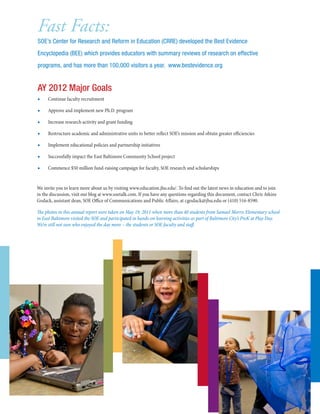
  • 28.
    ■■ The SOEhas strengthened its relationship with the university’s Center for the Social Organization of Schools (CSOS).  While many CSOS staff have had faculty appointments in the SOE, they have not been actively involved in our work as an independent school. We are pleased to report that Dr. Jim McPartland (CSOS co-director) and Dr. Bob Balfanz (Talent Development High Schools) have become very active in our programs, and that Dr. Balfanz and CSOS received a $30 million award through the federal I3 competition to expand, disseminate and solidify the evidence supported by Talent Development High Schools. In addition, SOE and CSOS initiated a plan to develop a new master’s degree designed to produce principals to feed the pipeline needed by CSOS’s Talent Development High Schools. Finally, we have had discussions with CSOS staff about the inclusion of their family and community engagement programs in the East Baltimore Community Schools and we are discussing ways to cooperate on CSOS’s distribution of the Stocks in the Future financial literacy program. ■■ The Success for All Foundation was created decades ago as a non-profit dissemination arm for the work of SOE researchers Dr. Robert Slavin and Dr. Nancy Madden. Dr. Slavin directs the Success for All Foundation and is currently the director of the Center for Research and Reform in Education (CRRE) in the SOE.  Success for All has become one of the most recognized national brand names in educational reform. A number of efforts have been initiated to assure that the work of the Success for All Foundation is better integrated into the efforts of the School of Education.  As examples, Dr. Slavin has been an active leader in SOE’s senior faculty search; SOE engaged Dr. Bette Chambers of the Success For All Foundation in a partnership with JHU, Ohio State University, and the Department of Defense to help create a virtual learning laboratory in early childhood which provides ongoing professional development for early childhood professionals employed by the military; SOE will send a delegation to York, England to explore new partnerships; and SOE has tapped the expertise of Dr. Alan Cheung to provide additional research methods support to SOE faculty and staff. ■■ As a result of a collaborative effort between SOE’s Department of Counseling and Human Services and the JHU Urban Leadership Institute, the Paul Robeson Academic International School of Excellence (PRAISE) will now be housed at the Education building. PRAISE will offer academic enrichment, personal empowerment skills and parenting support for 40 African-American boys in middle and high school and their families over a three-year period. SOE teacher preparation, school counseling, and clinical mental health students will have the opportunity to work directly with PRAISE students. The goal of this program is to create a national model for nurturing and supporting young African-American males. PRAISE programs at the SOE are held on Saturdays throughout the year. Enhanced University Partnerships Fast Facts: Grant Funds Awarded: Faculty from the SOE and its affiliated enterprises received 24 awards totaling $84.4 million.
  • 29.
    ■■ A newPh.D. program is being created to complement the existing Ed.D. program. The Ed.D. program has a long history and has produced some influential alumni. However, the new Ph.D. program will focus on research in preparation for academic careers and will free the Ed.D. to address research application and practice. This program is pending university approval. ■■ A new Master of Education in the Health Professions (MEHP), in partnership with five participating JHU schools (Education, Medicine, Public Health, Nursing, and Business), will provide health sciences professionals with an opportunity to obtain certificates and master’s degrees in education. These credentials will build stronger instructional programs and assist in retention through strengthening the career ladder in the health sciences. The initial class of 20 students has been recruited to begin the program in the fall of 2011; the second cohort of students will begin next year and will have the additional options for full-time and online course delivery. ■■ Our partnership with Teach for America (TFA) continues to grow and is generally recognized as the strongest university partnership in the country. This year 135 first-year TFA corps members joined the 110 second-year members as teachers-of-record in Baltimore City Public Schools. The TFA cohort that began teaching last August is the first to enroll in the Department of Teacher Preparation’s newly established Master of Science in Education: Educational Studies degree. ■■ The Department of Teacher Preparation expanded its offerings including: launching new full-time Master of Arts in Teaching (MAT) cohorts in Baltimore City and Montgomery County; re-establishing an Early Childhood Education concentration within the MAT program; and restructuring the Accelerated Master of Arts in Teaching (AMAT) program for Johns Hopkins undergraduates. ■■ The Department of Teacher Development and Leadership is recruiting the first cohort for its new Graduate Certificate in Coaching Skills for Educational Leaders, which is due to launch in fall 2011 and is the first program of its type in Maryland that specifically targets educational leaders and aspiring leaders. ■■ The Department of Interdisciplinary Studies’ Neuro- Education Initiative (NEI) expanded its work to connect research in the neurosciences to teaching-learning processes. Dr. Mariale Hardiman received $50K from the Provost’s Framework for the Future Funds and an additional $400K (over four years) from the School of Medicine’s Brain Science Institute to support this work. Activities in 2010-11 included sponsoring multiple conferences for teachers on applying brain research to teaching and learning, while NEI’s third national summit on Stress and the Brain brought together leading experts from across the country to share research and lead discussions on translation to educational practice. ■■ The Department of Counseling and Human Service’s accelerated, full-time Master of Science in School Counseling program (the School Counseling Fellows program), launched last year, continues to grow. The second Fellows cohort, beginning this summer, attracted a national pool of applicants, and 24 admission offers were made, up from 16 last year. In addition, the department submitted an application for national accreditation by the Council for the Accreditation of Counseling and Related Educational Programs (CACREP) and is preparing for a site visit in 2011-12. As part of the preparations, the department has streamlined its course offerings to ensure its programs align with CACREP accreditation standards and licensure requirements. ■■ The Department of Special Education’s Graduate Certificate in the Education of Students with Autism and Other Pervasive Developmental Disorders is being offered in a hybrid online format to allow access by teachers in remote areas of Maryland. Next year the autism hybrid certificate will be offered to a select group of early childhood professionals. The hybrid certificate program is supported through a partnership with MSDE and local school districts. Significant Programmatic Accomplishments
  • 30.
    ■■ The Centerfor Technology in Education (CTE), in partnership with the Maryland State Department of Education’s Division of Early Childhood Development, released Healthy Beginnings, a set of newly updated developmental guidelines for families and those who live or work with children from birth through three years of age. The guidelines describe what infants and young children are learning at specified ages, and how adults can support their development. The Healthy Beginnings website provides practical and fun activity ideas for parents and teachers, along with downloadable tips and tools. www.marylandhealthybeginnings.org In addition, CTE and Pearson Education, Inc. entered into a technology transfer agreement wherein JHU granted Pearson Education, Inc. the worldwide exclusive rights to market Teacher Compass software. Teacher Compass is a customizable online teacher evaluation and coaching tool that is easy to use, more efficient for administrators, and more effective at helping teachers improve their performance. ■■ Center for Research and Reform in Education (CRRE) leaders participated in a successful proposal that brought $50 million to the Success for All Foundation to scale up its proven elementary reform model to an additional 1,100 schools. In addition, CRRE completed an evaluation of a reading program for high school students and published comprehensive reviews of research on beginning reading, programs for struggling readers, financial incentives, early childhood programs, technology programs, and elementary and secondary mathematics programs, as well as two articles on methods for reviewing research on outcomes of educational programs. CRRE has seen the number of subscribers for its magazine, Better: Evidence-Based Education, which is published in collaboration with the University of York and which targets educators and policy makers, grow from 7,000 to more than 10,000 in the past year. Recent themed issues have covered mathematics, reading, social-emotional learning, English/writing, and technology. www.bestevidence.org CRRE, in collaboration with the Department of Interdisciplinary Studies in Education, is launching a new Graduate Certificate in Cooperative Learning in Instructional Practices in fall 2011. This new certificate, which addresses teachers’ continued professional development by examining research-proven instructional practices and their role in transitioning a traditional classroom into a student centered environment, represents the first occasion that CRRE has developed a credit-bearing, academic program offering for SOE. Research and Development Center Highlights Fast Facts: Robert Slavin, director of the SOE’s Center for Research and Reform in Education, was selected by the American Education Research Association (AERA) as one of its new fellows. AERA fellows are recognized nationally and internationally for their outstanding contributions to education research.
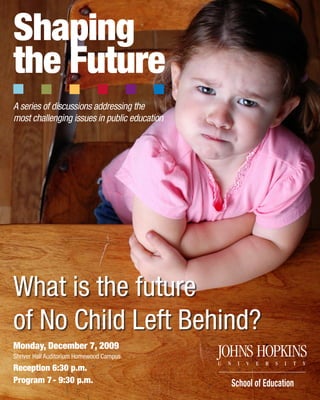

  • 31.
    Division of PublicSafety Leadership The Division of Public Safety Leadership (PSL) continues to expand its activities tied to the nation’s homeland security and intelligence analysis priorities. New initiatives in 2010-2011 include: ■■ Participation in the University-wide Center for the Study of Preparedness and Catastrophic Event Response funded by the Department of Homeland Security (DHS) and led by Dr. Gabor Kellen in the School of Medicine.  ■■ Expansion of cohort master’s degree programs into a blended, online format for a number of federal law enforcement agencies. ■■ Immigrations and Customs Enforcement (ICE) funded programs to support leadership development and consulting services as part of its $9.8 million, multi-year contract with the division. ■■ Four faculty joint appointments have been completed between PSL and JHU School of Public Health. The two schools are currently planning a joint post-baccalaureate certificate program in the field of violence. ■■ Completed a successful $50K study on Police Approaches to Traffic Enforcement for the National Highway Traffic Safety Administration (NHTSA). PSL is currently in discussions with NHTSA to build on the topic of highway safety and law enforcement in the nation. ■■ Three faculty members were nationally recognized for their expertise: Dr. Sheldon Greenberg was appointed to the Bureau of Justice Assistance’s Executive Session on Police Leadership, and the Harvard Executive Session on Public Safety; faculty member Darrel Stephens was inducted into the national Evidence-Based Policing Hall of Fame; faculty member David Thomas assisted the Office of Violence Against Women in a rewrite of the federal Violence Against Women Act. Fast Facts: Enrollment: As of the fall 2010 semester, 1,958 students were enrolled in SOE, of whom 1,578 were enrolled in graduate degree programs, 321 in graduate certificate programs, and 59 in the Division of Public Safety Leadership’s undergraduate program. Degrees Awarded: In 2010-11, 931 degrees and certificates were awarded, including 4 doctoral degrees, 619 master’s degrees, 275 graduate certificates, and 33 bachelor’s degrees through the Division of Public Safety Leadership.
  • 32.
    ■■ East BaltimoreCommunity School: The SOE assumed a more substantial leadership role in the East Baltimore Community School through a stronger commitment to the efforts of the East Baltimore Development Initiative (EBDI) and other partners in the JHU community. The East Baltimore Community School project involves the design and construction of a state-of-the-art facility on seven acres in the EBDI catchment area that will serve children from infancy through eighth grade. Dean Andrews chairs the design and construction committee for this facility and SOE will assume an operating position of both the school and early childhood center on July 1, 2011. The SOE is committed to assuring that the school serves a mixed income community and is recognized as one of the highest performing schools in Baltimore. The East Baltimore Community School will serve as a demonstration of university/community collaboration and the impact of high quality schools on redeveloping communities. ■■ The SOE’s Shaping the Future discussion series, which addresses the most challenging issues in public education, continues to attract outstanding panels of nationally recognized experts. The April 2010 event discussed ways to close the nation’s achievement gap, while the April 2011 event examined the changes occurring in the teaching profession and how the classroom teacher will be impacted. Each event typically attracts more than 300 attendees. ■■ In partnership with the Baltimore City Public Schools Office of Early Childhood, the SOE participated in a citywide PreK at Play Day in May 2011. The program exposed four year olds to a variety of experiences that most wouldn’t get a chance to see in their young lives. More than 40 four year olds visited the Education Building and participated in hands-on learning activities. The SOE also recruited the university’s Whiting School of Engineering and Peabody School to participate in this effort. ■■ For the 2010-2011 academic year, the SOE partnered with the Margaret Brent Elementary/Middle School in Baltimore City as part of its community outreach program. The school is located at 2600 St. Paul Street, just two blocks from the Education Building. Ninety-five percent of the students qualify for the subsidized lunch program. ■■ The SOE actively supports the Baltimore Youth Works program. During the summer of 2010 the SOE mentored nine students from the Youth Works program. ■■ For the second year in a row, the school hosted the EPA’s Science Educational Development Program’s summer camp, which brings roughly 30 Baltimore City middle school youth to campus for an environmental science program. ■■ The school will re-launch its partnership with Northrop Grumman to offer a seminar series to employees nearing retirement who are interested in teaching or serving as content resource specialists to schools in STEM areas. ■■ The School of Education is a participant in the Urban Health Institute, which works to connect JHU and the surrounding community through programs, seminars, and other events.  A series of seminars targeted to reach across the JHU and Baltimore communities is offered at the schools of Education and Public Health. ■■ The SOE’s Division of Public Safety Leadership (PSL) is involved in a variety of outreach programs to colleges and universities, communities, and state agencies including non-credit presentations on dating violence; Building Boys into Men (providing insight on how to work with and mentor male youth); workplace violence; and advanced sexual assault training. Community Engagement Activities
  • 33.
    We invite youto learn more about us by visiting www.education.jhu.edu/. To find out the latest news in education and to join in the discussion, visit our blog at www.soetalk.com. If you have any questions regarding this document, contact Chris Atkins Godack, assistant dean, SOE Office of Communications and Public Affairs, at cgodack@jhu.edu or (410) 516-8590. The photos in this annual report were taken on May 19, 2011 when more than 40 students from Samuel Morris Elementary school in East Baltimore visited the SOE and participated in hands-on learning activities as part of Baltimore City’s PreK at Play Day. We’re still not sure who enjoyed the day more – the students or SOE faculty and staff. ■■ Continue faculty recruitment ■■ Approve and implement new Ph.D. program ■■ Increase research activity and grant funding ■■ Restructure academic and administrative units to better reflect SOE’s mission and obtain greater efficiencies ■■ Implement educational policies and partnership initiatives ■■ Successfully impact the East Baltimore Community School project ■■ Commence $50 million fund-raising campaign for faculty, SOE research and scholarships AY 2012 Major Goals Fast Facts: SOE’s Center for Research and Reform in Education (CRRE) developed the Best Evidence Encyclopedia (BEE) which provides educators with summary reviews of research on effective programs, and has more than 100,000 visitors a year. www.bestevidence.org
  • 34.
  • 35.
    ExecutiveFunction:Approaches to Research& Intervention for School-Age Children May 2, 2013  ■  8 a.m. - 4 p.m. Johns Hopkins University ■ Glass Pavilion ■ Homewood Campus Cognitive Skills Training ■ Effortful Control ■ Social-Emotional Development Registration ends April 26. To register and for more information: education.jhu.edu/neisummit Presented byThe Johns Hopkins University Neuro-Education Initiative (NEI)
  • 36.
    My job isn’tabout the paycheck. My students live in challenging communities. I see potential in everyone of them. My students don’t need sympathy. They need someone who is strong. My job isn’t for everyone. I am a teacher. Teaching isn’t for everyone but if you think you have what it takes to make a difference in a child’s life, find out more about our graduate programs in education at www.education.jhu.edu or call 1-877-JHU-SOE1.
  • 37.
    Monday, December 7,2009 Shriver Hall Auditorium Homewood Campus Reception 6:30 p.m. Program 7 - 9:30 p.m. What is the future of No Child Left Behind? Shaping the Future A series of discussions addressing the most challenging issues in public education
  • 39.
    Closing the AchievementGapWays to improve educational opportunities for all students by identifying programs and strategies for raising achievement and closing gaps between white and minority students. Shaping the FutureA series of discussions addressing the most challenging issues in public education Tuesday, April 27, 2010 6:30 – 9:30 p.m. Gilchrist Auditorium, Montgomery County Campus 9601 Medical Center Drive, Rockville, MD 20850
  • 40.
    Learn how byvisiting education.jhu.edu/civility
  • 41.
    Learn how byvisiting education.jhu.edu/civility
  • 43.
  • 44.
    Johns Hopkins University Schoolof Education Commencement 2009
  • 46.
    Johns Hopkins University Schoolof Education Commencement May 27, 2010
  • 48.
    Johns Hopkins University Schoolof Education Commencement May 26, 2011