System Improvement Nord Trondelag, Norway Ben Levin OISE/University of Toronto
Questions to Ask What are the positives and constraints in your setting? Which of these ideas are most promising or important?  Which seem most difficult? What is confusing or missing or seems incorrect?
The Importance of Improvement Education matters more than ever Schools have improved over many years We can do better still We don’t know the limits of improvement
 
Ontario 2003–2009 From high conflict, stagnant results, public dissatisfaction, and poor morale To improving student results, low conflict, improved educator morale,  and increased public satisfaction
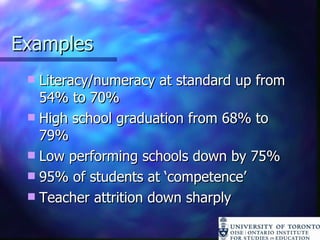
Examples Literacy/numeracy at standard up from 54% to 70% High school graduation from 68% to 79% Low performing schools down by 75% 95% of students at ‘competence’ Teacher attrition down sharply
How to Do This The right changes The right implementation A positive approach Managing the politics and distractions
Main Elements – 1 Public goals and targets Simple, clear, with high consensus
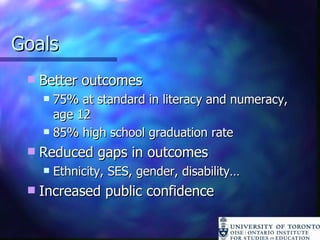
Goals Better outcomes 75% at standard in literacy and numeracy, age 12 85% high school graduation rate Reduced gaps in outcomes Ethnicity, SES, gender, disability… Increased public confidence
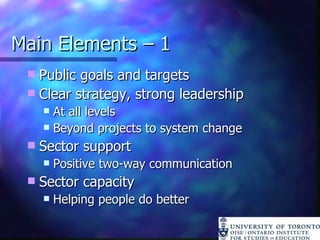
Main Elements – 1 Public goals and targets Clear strategy, strong leadership At all levels Beyond projects to system change Sector support Positive two-way communication Sector capacity Helping people do better
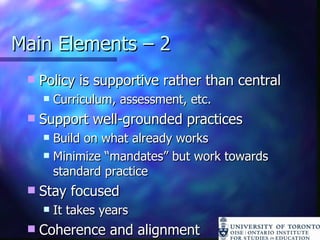
Main Elements – 2 Policy is supportive rather than central Curriculum, assessment, etc. Support well-grounded practices Build on what already works Minimize “mandates” but work towards standard practice Stay focused It takes years Coherence and alignment
Things Not to Do Focus on structures – i.e. size, organization Attack teachers or students Use a single test as the only measure
The Right Changes Change teaching and learning practices in all schools Best evidence Student engagement Reach out to parents and community Build sector capacity and commitment Improve leadership skills Approach curriculum and assessment  as servants, not masters
Secondary Schools Subject specializations Preparation for post-secondary Double standard Teacher and public beliefs about what students can do ‘ A good outcome for every student’
Strategy for Secondary Schools Knowing students and tracking progress Thinking about delivery Curriculum, course offerings, timetable Engaging the community Changing daily teaching practice
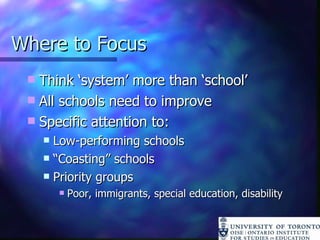
Where to Focus Think ‘system’ more than ‘school’ All schools need to improve Specific attention to: Low-performing schools “ Coasting” schools Priority groups Poor, immigrants, special education, disability
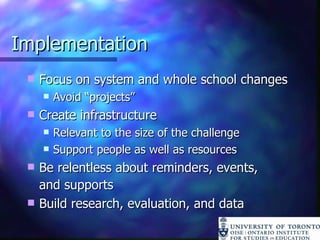
Implementation Focus on system and whole school changes Avoid “projects” Create infrastructure Relevant to the size of the challenge Support people as well as resources Be relentless about reminders, events,  and supports Build research, evaluation, and data
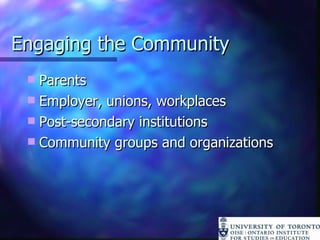
Engaging the Community Parents Employer, unions, workplaces Post-secondary institutions Community groups and organizations
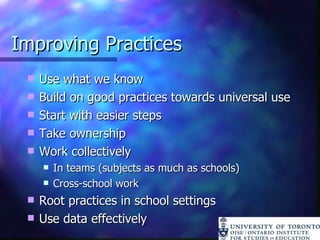
Improving Practices Use what we know Build on good practices towards universal use Start with easier steps Take ownership Work collectively In teams (subjects as much as schools) Cross-school work Root practices in school settings Use data effectively
Importance of Systems  Regular events to review data  and progress Processes to ensure every student  is considered Prevention rather than remediation Building a system across schools
Building Sector Support Build strong political leadership “ Guiding coalition” Align with local leaders Respect all partners Appeal to educators’ ideals Build staff support Stay focused and aligned Develop public confidence and support Engage students
Public Confidence People must believe that the schools deliver value This takes sustained effort Day to day work matters more than PR efforts Must be simple, clear messages backed by action
Communication and Support Endless communication to sector Enlisting support from leaders and teachers Constant positive reinforcement Respectful but with expectations Regular public communication Successes and challenges
Questions for Consideration What are the positives and constraints in your setting? Which of these ideas are most promising or important?  Which seem most difficult? What is confusing or missing or seems incorrect?
 
How to Move Ahead Balance vision with realism What is important/what can actually be done Longer-term ideas and short-term actions Think about implementation How can this be brought about? Create ongoing discussion
Some Specific Ideas The High Skills Major Provides a way to combine work with school, connected to real qualifications and to post-secondary education Leadership teams in each school With designated responsibility to track all students’ progress and intervene when problems are occurring

More Specifics Student Success teachers An additional teacher in each secondary school with responsibility to track, support and advocate for students who are struggling Credit recover Allows students to complete course requirements without having to repeat in their entirety
More Specifics Student Success Commission Joint with teacher unions to make sure implementation of initiatives could proceed smoothly Speak Out Initiative for students to suggest changes and ideas that would improve their school experience
Last Specifics Dual credits Allows students to take post-secondary courses while still in secondary school and count them for credit in both places Independent learning Gives students more opportunities (or the requirement) to demonstrate independent learning skills
How to Deal with Resistance How to deal with resistance Expect and accept it Listen to reasons, try to deal with them Invite participation Marginalize
Inspired teachers Teaching, not teachers Aim for always good, occasionally inspired Student feedback Peer support/pressure Research on good practice
Ontario – Non-Successes Some schools have not improved Too many initiatives Classroom practices are hard to change Some leaders too authoritarian Links with community not strong enough Ongoing modifications, do not paint yourselves into a corner
Teacher Training Low priority area Hard to change Small impact Instead, work mostly with teachers already in schools But do build partnerships with universities
‘ Room to move’ Imagination as to what is possible Appeal to idealism Specific examples – historical and current – of what has been achieved
Avoiding this work as a ‘reform’ Use a different word – ‘improvement’? Acknowledge and build on past success This is a next step Appeal to  Focus on students and what happens to them
Thank You!

Trondelag sept10

  • 1.
    System Improvement NordTrondelag, Norway Ben Levin OISE/University of Toronto
  • 2.
    Questions to AskWhat are the positives and constraints in your setting? Which of these ideas are most promising or important? Which seem most difficult? What is confusing or missing or seems incorrect?
  • 3.
    The Importance ofImprovement Education matters more than ever Schools have improved over many years We can do better still We don’t know the limits of improvement
  • 4.
  • 5.
    Ontario 2003–2009 Fromhigh conflict, stagnant results, public dissatisfaction, and poor morale To improving student results, low conflict, improved educator morale, and increased public satisfaction
  • 6.
    Examples Literacy/numeracy atstandard up from 54% to 70% High school graduation from 68% to 79% Low performing schools down by 75% 95% of students at ‘competence’ Teacher attrition down sharply
  • 7.
    How to DoThis The right changes The right implementation A positive approach Managing the politics and distractions
  • 8.
    Main Elements –1 Public goals and targets Simple, clear, with high consensus
  • 9.
    Goals Better outcomes75% at standard in literacy and numeracy, age 12 85% high school graduation rate Reduced gaps in outcomes Ethnicity, SES, gender, disability… Increased public confidence
  • 10.
    Main Elements –1 Public goals and targets Clear strategy, strong leadership At all levels Beyond projects to system change Sector support Positive two-way communication Sector capacity Helping people do better
  • 11.
    Main Elements –2 Policy is supportive rather than central Curriculum, assessment, etc. Support well-grounded practices Build on what already works Minimize “mandates” but work towards standard practice Stay focused It takes years Coherence and alignment
  • 12.
    Things Not toDo Focus on structures – i.e. size, organization Attack teachers or students Use a single test as the only measure
  • 13.
    The Right ChangesChange teaching and learning practices in all schools Best evidence Student engagement Reach out to parents and community Build sector capacity and commitment Improve leadership skills Approach curriculum and assessment as servants, not masters
  • 14.
    Secondary Schools Subjectspecializations Preparation for post-secondary Double standard Teacher and public beliefs about what students can do ‘ A good outcome for every student’
  • 15.
    Strategy for SecondarySchools Knowing students and tracking progress Thinking about delivery Curriculum, course offerings, timetable Engaging the community Changing daily teaching practice
  • 16.
    Where to FocusThink ‘system’ more than ‘school’ All schools need to improve Specific attention to: Low-performing schools “ Coasting” schools Priority groups Poor, immigrants, special education, disability
  • 17.
    Implementation Focus onsystem and whole school changes Avoid “projects” Create infrastructure Relevant to the size of the challenge Support people as well as resources Be relentless about reminders, events, and supports Build research, evaluation, and data
  • 18.
    Engaging the CommunityParents Employer, unions, workplaces Post-secondary institutions Community groups and organizations
  • 19.
    Improving Practices Usewhat we know Build on good practices towards universal use Start with easier steps Take ownership Work collectively In teams (subjects as much as schools) Cross-school work Root practices in school settings Use data effectively
  • 20.
    Importance of Systems Regular events to review data and progress Processes to ensure every student is considered Prevention rather than remediation Building a system across schools
  • 21.
    Building Sector SupportBuild strong political leadership “ Guiding coalition” Align with local leaders Respect all partners Appeal to educators’ ideals Build staff support Stay focused and aligned Develop public confidence and support Engage students
  • 22.
    Public Confidence Peoplemust believe that the schools deliver value This takes sustained effort Day to day work matters more than PR efforts Must be simple, clear messages backed by action
  • 23.
    Communication and SupportEndless communication to sector Enlisting support from leaders and teachers Constant positive reinforcement Respectful but with expectations Regular public communication Successes and challenges
  • 24.
    Questions for ConsiderationWhat are the positives and constraints in your setting? Which of these ideas are most promising or important? Which seem most difficult? What is confusing or missing or seems incorrect?
  • 25.
  • 26.
    How to MoveAhead Balance vision with realism What is important/what can actually be done Longer-term ideas and short-term actions Think about implementation How can this be brought about? Create ongoing discussion
  • 27.
    Some Specific IdeasThe High Skills Major Provides a way to combine work with school, connected to real qualifications and to post-secondary education Leadership teams in each school With designated responsibility to track all students’ progress and intervene when problems are occurring
  • 28.
    More Specifics StudentSuccess teachers An additional teacher in each secondary school with responsibility to track, support and advocate for students who are struggling Credit recover Allows students to complete course requirements without having to repeat in their entirety
  • 29.
    More Specifics StudentSuccess Commission Joint with teacher unions to make sure implementation of initiatives could proceed smoothly Speak Out Initiative for students to suggest changes and ideas that would improve their school experience
  • 30.
    Last Specifics Dualcredits Allows students to take post-secondary courses while still in secondary school and count them for credit in both places Independent learning Gives students more opportunities (or the requirement) to demonstrate independent learning skills
  • 31.
    How to Dealwith Resistance How to deal with resistance Expect and accept it Listen to reasons, try to deal with them Invite participation Marginalize
  • 32.
    Inspired teachers Teaching,not teachers Aim for always good, occasionally inspired Student feedback Peer support/pressure Research on good practice
  • 33.
    Ontario – Non-SuccessesSome schools have not improved Too many initiatives Classroom practices are hard to change Some leaders too authoritarian Links with community not strong enough Ongoing modifications, do not paint yourselves into a corner
  • 34.
    Teacher Training Lowpriority area Hard to change Small impact Instead, work mostly with teachers already in schools But do build partnerships with universities
  • 35.
    ‘ Room tomove’ Imagination as to what is possible Appeal to idealism Specific examples – historical and current – of what has been achieved
  • 36.
    Avoiding this workas a ‘reform’ Use a different word – ‘improvement’? Acknowledge and build on past success This is a next step Appeal to Focus on students and what happens to them
  • 37.