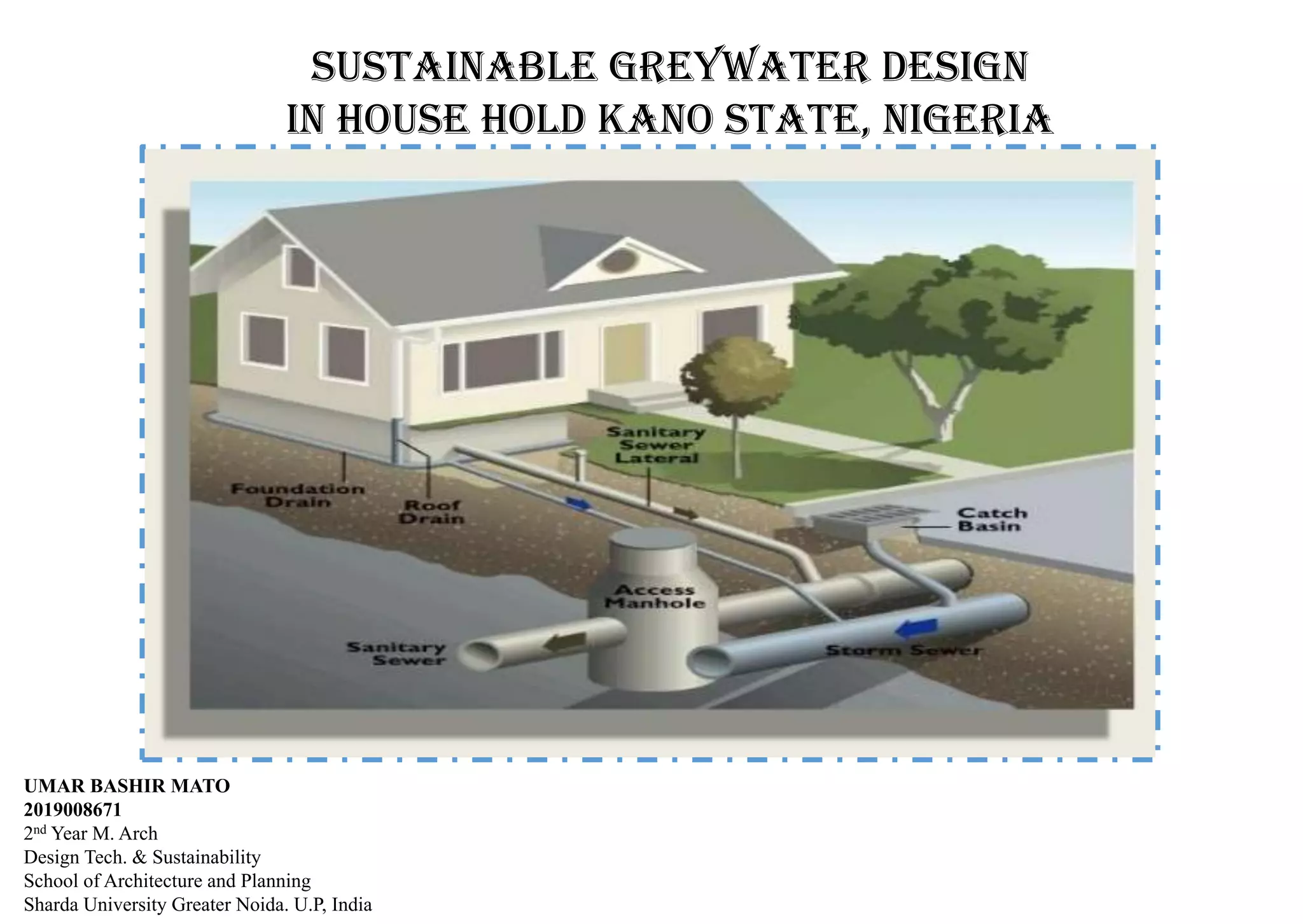
SUSTAINABLE GREYWATER DESIGN
IN house hold KANO STATE, NIGERIA
UMAR BASHIR MATO
2019008671
2nd Year M. Arch
Design Tech. & Sustainability
School of Architecture and Planning
Sharda University Greater Noida. U.P, India
Grey water is all the wastewater generated in households or office buildings from streams without
fecal contamination, i.e. all streams except for the wastewater from toilets. Sources of grey water
include sinks, showers, baths, washing machines or dishwashers. As grey water contains
fewer pathogens than domestic wastewater, it is generally safer to handle and easier to treat
and reuse onsite for toilet flushing, landscape or crop irrigation, and other non-potable uses. (Brain G.
R. ‘et al’ 2020)
FACTORS TO CONSIDER WHEN DESIGNING A SUSTAINABLE GREY WATER
Consider the:
•personal habits of the users i.e. what they put in the system
•quantity of wastewater output
•size of the site
•soil conditions of the site
•type of recycling usage required i.e. whether it is for irrigation only, or for re-use within the home.
(Murthy B. S 2018)
GREY WATER DEFINITION
Sustainable Greywater Design
LOCATION OF THE STUDY AREA
Sustainable Greywater Design
Source: Department of Geography Bayero Univ. Kano, Nigeria 2020.
DESIGN PROBLEM
Kano state is one of the populous states in Nigeria, because of its reputation in commercial
activities it receives an influx of people from different part of the country. This leads to the
increase in population thereby increasing the pressure of land use and some major resources such
as water.
City Fabric
Sustainable Greywater Design
SCOPE OF THE STUDY
This design looks forward to work based on the listed scope below.
● The empirical (Actual) content of chlorine to be use in the treatment of greywater per litre.
● How this sustainable idea could be positioned in the proposed design with respect to the borehole
and septic tank
(Source: Tasiu Y. R. ‘et al’
2016)
(Source: Tasiu Y. R. 2017)
Sustainable Greywater Design
SOURCES & WATER CONDITION IN KANO STATE
CHEMICAL CONSTITUENTS FOUND IN GREYWATER
1)Surfactants (originate from laundry tub) they can be either cation or anion in nature, though anion
is reportedly higher in laundry greywater
2)Nitrates, Sulphates and their derivatives, cation surfactants (salt based constituents) from
ammonium
3)Nitrogen and Phosphate originate from Kitchen waste water like detergent, vegetables water etc.
(Najem S. A. & Scholz M. 2015).
PHYSICAL CONSTITUENTS OF GREYWATER
1)Temperature – ranges from 18 – 35oC (high temp. favour microbiological growth, CaCO3)
2)Turbidity – solid concentration ranges from 190 – 537 mg/L (Edwin A. G. ‘et al’ 2014).
BIOLOGICAL CHARACTERISTICS
Greywater contains microorganisms such as bacteria, protozoa and helminths
-Salmonella & Campelobacteria
-Pseudomonas
-Cryptosporidium
(Takahashi Y. & Sall O. 2007)
Sustainable Greywater Design
DOMESTIC WATER USAGE
From the figure below (Nizam Ismail ‘et al’ 2020), deliberated that about 74% of household waste
water is greywater and its release to the surrounding contributes to the pollution of freshwater.
However, greywater recycling is an important aspect of saving the freshwater as well as saving the
society.
Findings from (Wright M. 1996) explained 65% of waste water as greywater. Taking the average of
the two data, the approximate percentage of greywater discharge from household is 70%.
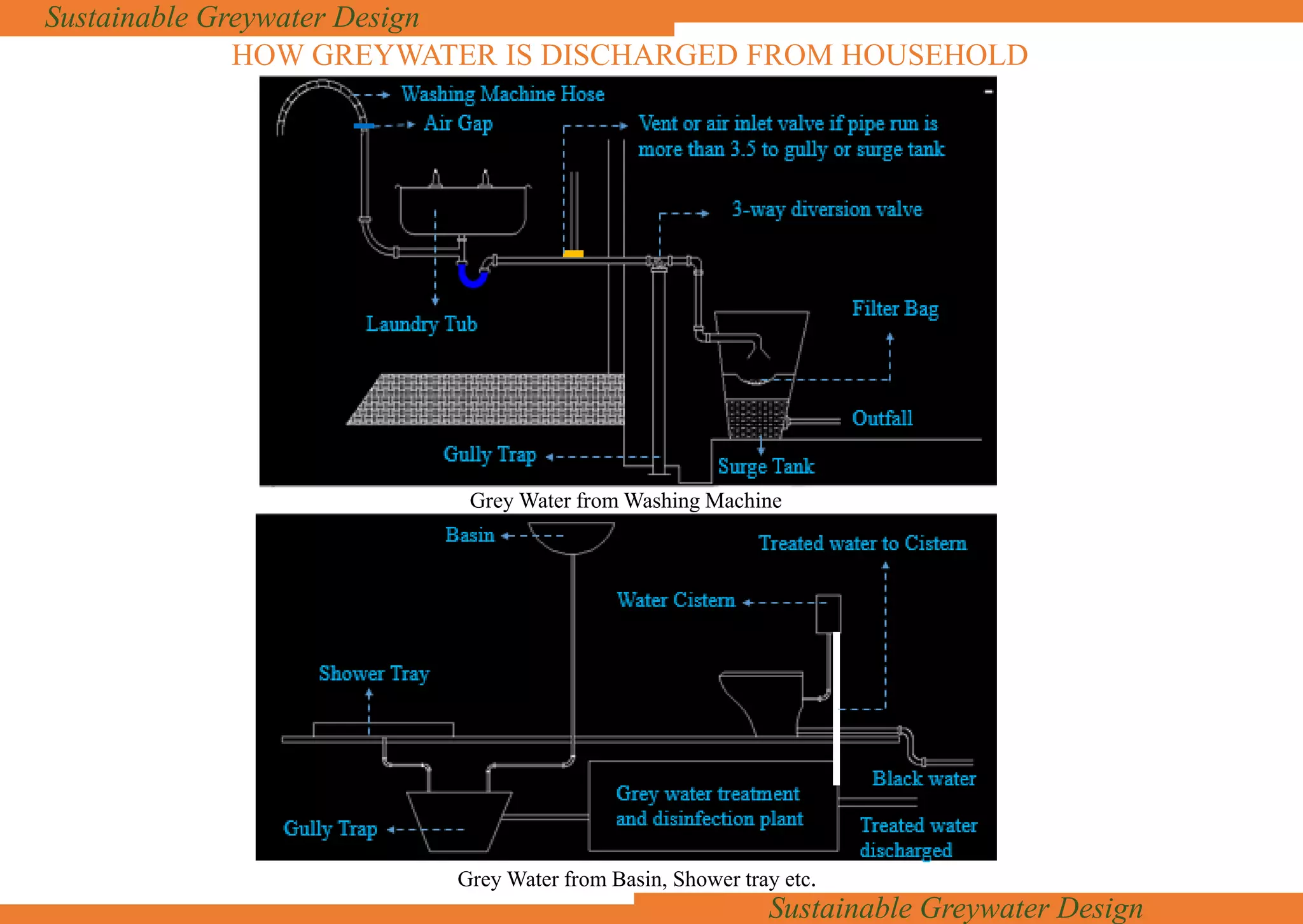
HOW GREYWATER IS DISCHARGED FROM HOUSEHOLD
Grey Water from Washing Machine
Grey Water from Basin, Shower tray etc.
Sustainable Greywater Design
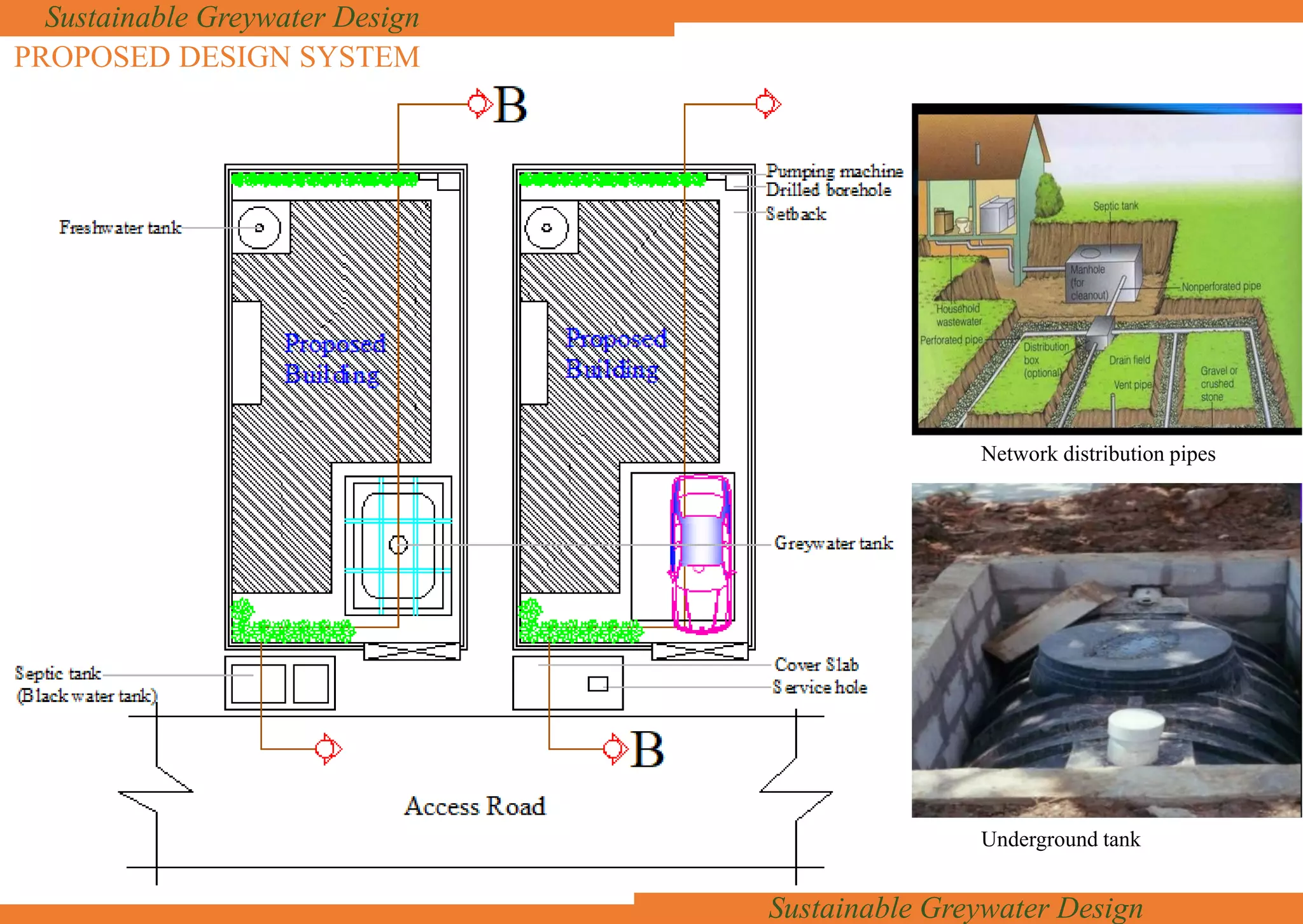
PROPOSED DESIGN SYSTEM
Sustainable Greywater Design
Network distribution pipes
Underground tank
Sustainable Greywater Design
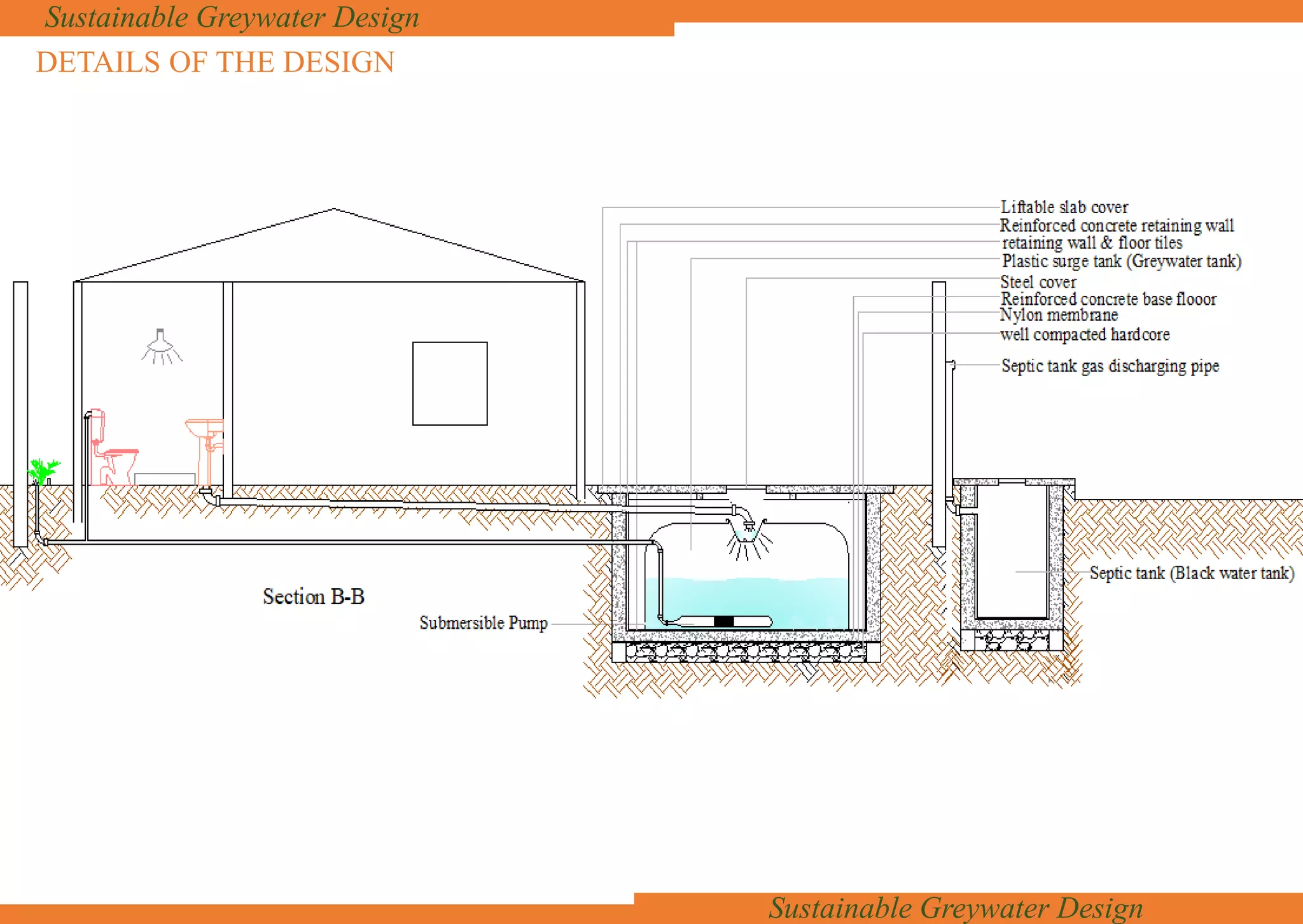
DETAILS OF THE DESIGN
Sustainable Greywater Design
SUBMERSIBLE PUMP
Submersible pump is a pump which performs with the aid of centrifugal force when completely
submerged in water. It is attached to an electric motor powered by the impellers that perform the
duty of forcing the water through the diffuser into the face of one above it. On a normal 4-inch
submersible pump, each impeller produces 9psi pressure depending on the diameter of the
impeller. (Mattem A 2007)
Submersible Pump Impeller
Sustainable Greywater Design
WORKING PRINCIPLE OF SUBMERSIBLE PUMP
Electric motor
Water entrance halls
The Impellers
The Diffuser
Check valve
Water pumps out through the pipe
Source: Learn Engineering. 2018
Sustainable Greywater Design
TREATMENT OF GREYWATER
This exercise looks forward to treat the greywater through two different method i.e. Filtration and
Chlorination for reuse in toilet flushing and plant watering in the proposed design.
Filtration
Filtration is the process of removing the solid granules of particle in the water through physical method
with the aid of filter medium to allow the pure water to pass through. (Abdel-Shafy ‘et al’ 2013)
Chlorination
Chlorination is one of the easiest processes of disinfecting wastewater, it has an effective oxidants
capable of killing pathogenic organism that are detrimental to human health as well as aquatic life. This
process of disinfection is easy to obtain, apply and most importantly economical.
Typical forms of chlorine used in wastewater treatment are:
➢ Elemental chlorine
➢ Hypochlorite
➢ Chlorine Dioxide
(Source: Pennsylvania Department of Environmental Protection 2016)
Sustainable Greywater Design
In a household or any greywater recycling system, it is considered that the empirical content of chlorine
disinfectant added for greywater treatment is:
● 2-tablespoon of chlorine bleach 5-litre of greywater
● 30-tablespoon or ½ litre of chlorine bleach 75-litre of greywater
(Source: Renewable energy UK 2020)
Considering 500-litre greywater tank for this design. Therefore, the calculation of the actual amount of
chlorine disinfectant to treat 500-litre greywater is shown below:
0.5 litre of chlorine disinfectant 75-litre of greywater
X litre of chlorine disinfectant 500-litre of greywater
Where X = Unknown amount of chlorine
By cross multiplication of the above equation,
X = 500 x 0.5 ÷ 75 = 3.33
Hence, X (amount of chlorine) to treat 500-litre of greywater = 3.33-litre
IMPORTANCE OF REUSING GREYWATER
Reuse of greywater can help in substituting precious drinking water in applications which do not need
drinking water quality, it is generally used for non-portable usage for different functions, this will in
turn reduce freshwater consumption apart from wastewater generation. Such as
● Toilet flushing
● Irrigation purpose
● Industrial Application
● Ground recharging
● Vehicle washing
● Fire fighting
● Dust control
● street washing
And many more.
(Olanrewaju O. O. & Ilemobade A. A. 2015)
Sustainable Greywater Design
References
Abdel-Shafy H.I., El-Khateeb M.A., Shehata M. “Greywater Treatment Using Different Designs Of Sand Filters” Water Pollution Control
Department , Division of Environmental Research, National Research Center , Dokki, Cairo , Egypt 2013.
Brain G. R., Lynch J., Klopp K. “Graywater Systems” Departments of Environment & Society, and Plants, Soils & Climate: Utah State
University 2020.
Edwin A. G., Gopalsamy P., Muthu N. “Characterization of domestic gray water from point source to determine the potential for urban residential
reuse: a short review” Springerlink.com 2014
Learn Engineering. 2018. https://www.youtube.com/watch?v=L0Q6cboXyLY [Accessed Sept., 2020].
Murthy B. S “Design and development of grey water reuse system” Sri Jayachamarajendra College of Engineering, JSS TI Campus,
Manasagangothri, Mysuru, Karnataka, India. 2018
Mattem A “Submersible Pump” Alberto agriculture for rural development, 2007
Manna S. S. “Treatment Of Gray Water For Reusing In Non-potable Purpose To Conserve Water In India” Department of Civil Engineering,
Priyadarshini Institute of Technology, Nellore – 524004, Andhra Pradesh, India. 2018.
Nizam Ismail M. S., Awang S., Khan E. N., Yahaya E. M., Darimie R. M. “Greywater Treatment System Design for Laundry Services in
Malaysia: A Case Study” River Basin Research Centre, National Hydraulic Research Institute of Malaysia (NAHRIM), Lot 5377, Jalan Putra
Permai,43300, Seri Kembangan, Selangor. 2020.
Najem S. A. & Scholz M. “Chemical simulation of greywater” Civil Engineering Research Group, School of Computing, Science and
Engineering, The University of Salford, Salford, UK 2015
Olanrewaju O. O., Ilemobade A. A. “Greywater Reuse Review and Framework for Assessing Greywater Treatment Technologies for Toilet
Flushing” Department of Agricultural and Environmental Engineering, Federal University of Technology, Ak ure, Nigeria. 2015.
Pennsylvania Department of Environmental Protection. “Disinfection and Chlorination” This course includes content developed by the
Pennsylvania Department of Environmental Protection (Pa. DEP) in cooperation with the following contractors, subcontractors, or grantees.
2016.
Renewable energy UK 2020. http://www.reuk.co.uk/wordpress/water/disinfecting-greywater/ [Accessed Oct., 2020].
Tasiu Y. R., Iguisi E.O., Mallam I “Assessment of Water Supply Situation in the Rural Areas of Kano State, Northern Nigeria” Department of
Geography, Sa’adatu Rimi College of Education Kano, Nigeria. 2016.
Tasiu Y. R. “Impacts Of Surface Topography On Groundwater Potential In Parts of Kano State, Nigeria” Department of Geography Bayero
University, Kano. 2017.
Takahashi Y. & Sall O. “Physical, chemical and biological characteristics of stored greywater from unsewered suburban Dakar in Senegal” 2007.
Wright M. “Safe Use of Household Greywater” Cooperative Extension Service College of Agriculture and Home Economics.1996
Yi-Kai Juan, Yi Chen., Jing-Ming Lin. “Greywater Reuse System Design and Economic Analysis for Residential Buildings in Taiwan”
Department of Architecture, National Taiwan University of Science and Technology, Taipei City 10607, Taiwan.
THANK
YOU
FOR
LISTENING
I WELCOME YOUR QUESTIONS…

Sustainable greywater Design

  • 1.
    SUSTAINABLE GREYWATER DESIGN INhouse hold KANO STATE, NIGERIA UMAR BASHIR MATO 2019008671 2nd Year M. Arch Design Tech. & Sustainability School of Architecture and Planning Sharda University Greater Noida. U.P, India
  • 2.
    Grey water isall the wastewater generated in households or office buildings from streams without fecal contamination, i.e. all streams except for the wastewater from toilets. Sources of grey water include sinks, showers, baths, washing machines or dishwashers. As grey water contains fewer pathogens than domestic wastewater, it is generally safer to handle and easier to treat and reuse onsite for toilet flushing, landscape or crop irrigation, and other non-potable uses. (Brain G. R. ‘et al’ 2020) FACTORS TO CONSIDER WHEN DESIGNING A SUSTAINABLE GREY WATER Consider the: •personal habits of the users i.e. what they put in the system •quantity of wastewater output •size of the site •soil conditions of the site •type of recycling usage required i.e. whether it is for irrigation only, or for re-use within the home. (Murthy B. S 2018) GREY WATER DEFINITION Sustainable Greywater Design Sustainable Greywater Design
  • 3.
    LOCATION OF THESTUDY AREA Sustainable Greywater Design Sustainable Greywater Design Source: Department of Geography Bayero Univ. Kano, Nigeria 2020.
  • 4.
    DESIGN PROBLEM Kano stateis one of the populous states in Nigeria, because of its reputation in commercial activities it receives an influx of people from different part of the country. This leads to the increase in population thereby increasing the pressure of land use and some major resources such as water. City Fabric Sustainable Greywater Design Sustainable Greywater Design
  • 5.
    Sustainable Greywater Design SustainableGreywater Design SCOPE OF THE STUDY This design looks forward to work based on the listed scope below. ● The empirical (Actual) content of chlorine to be use in the treatment of greywater per litre. ● How this sustainable idea could be positioned in the proposed design with respect to the borehole and septic tank
  • 6.
    (Source: Tasiu Y.R. ‘et al’ 2016) (Source: Tasiu Y. R. 2017) Sustainable Greywater Design Sustainable Greywater Design SOURCES & WATER CONDITION IN KANO STATE
  • 7.
    CHEMICAL CONSTITUENTS FOUNDIN GREYWATER 1)Surfactants (originate from laundry tub) they can be either cation or anion in nature, though anion is reportedly higher in laundry greywater 2)Nitrates, Sulphates and their derivatives, cation surfactants (salt based constituents) from ammonium 3)Nitrogen and Phosphate originate from Kitchen waste water like detergent, vegetables water etc. (Najem S. A. & Scholz M. 2015). PHYSICAL CONSTITUENTS OF GREYWATER 1)Temperature – ranges from 18 – 35oC (high temp. favour microbiological growth, CaCO3) 2)Turbidity – solid concentration ranges from 190 – 537 mg/L (Edwin A. G. ‘et al’ 2014). BIOLOGICAL CHARACTERISTICS Greywater contains microorganisms such as bacteria, protozoa and helminths -Salmonella & Campelobacteria -Pseudomonas -Cryptosporidium (Takahashi Y. & Sall O. 2007) Sustainable Greywater Design Sustainable Greywater Design
  • 8.
    Sustainable Greywater Design SustainableGreywater Design DOMESTIC WATER USAGE From the figure below (Nizam Ismail ‘et al’ 2020), deliberated that about 74% of household waste water is greywater and its release to the surrounding contributes to the pollution of freshwater. However, greywater recycling is an important aspect of saving the freshwater as well as saving the society. Findings from (Wright M. 1996) explained 65% of waste water as greywater. Taking the average of the two data, the approximate percentage of greywater discharge from household is 70%.
  • 9.
    HOW GREYWATER ISDISCHARGED FROM HOUSEHOLD Grey Water from Washing Machine Grey Water from Basin, Shower tray etc. Sustainable Greywater Design Sustainable Greywater Design
  • 10.
    PROPOSED DESIGN SYSTEM SustainableGreywater Design Sustainable Greywater Design Network distribution pipes Underground tank
  • 11.
    Sustainable Greywater Design SustainableGreywater Design DETAILS OF THE DESIGN
  • 12.
    Sustainable Greywater Design SustainableGreywater Design SUBMERSIBLE PUMP Submersible pump is a pump which performs with the aid of centrifugal force when completely submerged in water. It is attached to an electric motor powered by the impellers that perform the duty of forcing the water through the diffuser into the face of one above it. On a normal 4-inch submersible pump, each impeller produces 9psi pressure depending on the diameter of the impeller. (Mattem A 2007) Submersible Pump Impeller
  • 13.
    Sustainable Greywater Design SustainableGreywater Design WORKING PRINCIPLE OF SUBMERSIBLE PUMP Electric motor Water entrance halls The Impellers The Diffuser Check valve Water pumps out through the pipe Source: Learn Engineering. 2018
  • 14.
    Sustainable Greywater Design SustainableGreywater Design TREATMENT OF GREYWATER This exercise looks forward to treat the greywater through two different method i.e. Filtration and Chlorination for reuse in toilet flushing and plant watering in the proposed design. Filtration Filtration is the process of removing the solid granules of particle in the water through physical method with the aid of filter medium to allow the pure water to pass through. (Abdel-Shafy ‘et al’ 2013) Chlorination Chlorination is one of the easiest processes of disinfecting wastewater, it has an effective oxidants capable of killing pathogenic organism that are detrimental to human health as well as aquatic life. This process of disinfection is easy to obtain, apply and most importantly economical. Typical forms of chlorine used in wastewater treatment are: ➢ Elemental chlorine ➢ Hypochlorite ➢ Chlorine Dioxide (Source: Pennsylvania Department of Environmental Protection 2016)
  • 15.
    Sustainable Greywater Design SustainableGreywater Design In a household or any greywater recycling system, it is considered that the empirical content of chlorine disinfectant added for greywater treatment is: ● 2-tablespoon of chlorine bleach 5-litre of greywater ● 30-tablespoon or ½ litre of chlorine bleach 75-litre of greywater (Source: Renewable energy UK 2020) Considering 500-litre greywater tank for this design. Therefore, the calculation of the actual amount of chlorine disinfectant to treat 500-litre greywater is shown below: 0.5 litre of chlorine disinfectant 75-litre of greywater X litre of chlorine disinfectant 500-litre of greywater Where X = Unknown amount of chlorine By cross multiplication of the above equation, X = 500 x 0.5 ÷ 75 = 3.33 Hence, X (amount of chlorine) to treat 500-litre of greywater = 3.33-litre
  • 16.
    IMPORTANCE OF REUSINGGREYWATER Reuse of greywater can help in substituting precious drinking water in applications which do not need drinking water quality, it is generally used for non-portable usage for different functions, this will in turn reduce freshwater consumption apart from wastewater generation. Such as ● Toilet flushing ● Irrigation purpose ● Industrial Application ● Ground recharging ● Vehicle washing ● Fire fighting ● Dust control ● street washing And many more. (Olanrewaju O. O. & Ilemobade A. A. 2015) Sustainable Greywater Design Sustainable Greywater Design
  • 17.
    Sustainable Greywater Design SustainableGreywater Design References Abdel-Shafy H.I., El-Khateeb M.A., Shehata M. “Greywater Treatment Using Different Designs Of Sand Filters” Water Pollution Control Department , Division of Environmental Research, National Research Center , Dokki, Cairo , Egypt 2013. Brain G. R., Lynch J., Klopp K. “Graywater Systems” Departments of Environment & Society, and Plants, Soils & Climate: Utah State University 2020. Edwin A. G., Gopalsamy P., Muthu N. “Characterization of domestic gray water from point source to determine the potential for urban residential reuse: a short review” Springerlink.com 2014 Learn Engineering. 2018. https://www.youtube.com/watch?v=L0Q6cboXyLY [Accessed Sept., 2020]. Murthy B. S “Design and development of grey water reuse system” Sri Jayachamarajendra College of Engineering, JSS TI Campus, Manasagangothri, Mysuru, Karnataka, India. 2018 Mattem A “Submersible Pump” Alberto agriculture for rural development, 2007 Manna S. S. “Treatment Of Gray Water For Reusing In Non-potable Purpose To Conserve Water In India” Department of Civil Engineering, Priyadarshini Institute of Technology, Nellore – 524004, Andhra Pradesh, India. 2018. Nizam Ismail M. S., Awang S., Khan E. N., Yahaya E. M., Darimie R. M. “Greywater Treatment System Design for Laundry Services in Malaysia: A Case Study” River Basin Research Centre, National Hydraulic Research Institute of Malaysia (NAHRIM), Lot 5377, Jalan Putra Permai,43300, Seri Kembangan, Selangor. 2020. Najem S. A. & Scholz M. “Chemical simulation of greywater” Civil Engineering Research Group, School of Computing, Science and Engineering, The University of Salford, Salford, UK 2015 Olanrewaju O. O., Ilemobade A. A. “Greywater Reuse Review and Framework for Assessing Greywater Treatment Technologies for Toilet Flushing” Department of Agricultural and Environmental Engineering, Federal University of Technology, Ak ure, Nigeria. 2015. Pennsylvania Department of Environmental Protection. “Disinfection and Chlorination” This course includes content developed by the Pennsylvania Department of Environmental Protection (Pa. DEP) in cooperation with the following contractors, subcontractors, or grantees. 2016. Renewable energy UK 2020. http://www.reuk.co.uk/wordpress/water/disinfecting-greywater/ [Accessed Oct., 2020]. Tasiu Y. R., Iguisi E.O., Mallam I “Assessment of Water Supply Situation in the Rural Areas of Kano State, Northern Nigeria” Department of Geography, Sa’adatu Rimi College of Education Kano, Nigeria. 2016. Tasiu Y. R. “Impacts Of Surface Topography On Groundwater Potential In Parts of Kano State, Nigeria” Department of Geography Bayero University, Kano. 2017. Takahashi Y. & Sall O. “Physical, chemical and biological characteristics of stored greywater from unsewered suburban Dakar in Senegal” 2007. Wright M. “Safe Use of Household Greywater” Cooperative Extension Service College of Agriculture and Home Economics.1996 Yi-Kai Juan, Yi Chen., Jing-Ming Lin. “Greywater Reuse System Design and Economic Analysis for Residential Buildings in Taiwan” Department of Architecture, National Taiwan University of Science and Technology, Taipei City 10607, Taiwan.
  • 18.