LANDSCAPE ARCHITECTURE
GREY WATER HARVESTING
 As pressures on freshwater resources grow around the world and as new sources of
supply become increasingly scarce, expensive, or politically controversial, efforts are
underway to identify new ways of meeting water needs. Of special note are efforts to
reduce water demand by increasing the efficiency of water use and to expand the
usefulness of alternative sources of water previously considered unusable. Among
these potential new sources of supply is “GREYWATER.”
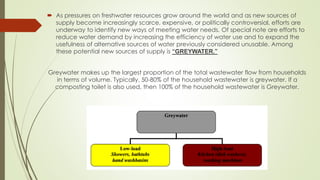
Greywater makes up the largest proportion of the total wastewater flow from households
in terms of volume. Typically, 50-80% of the household wastewater is greywater. If a
composting toilet is also used, then 100% of the household wastewater is Greywater.
HOW IS GREYWATER REUSED?
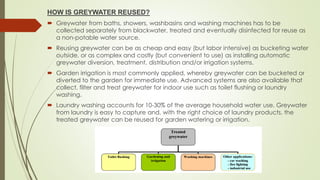
 Greywater from baths, showers, washbasins and washing machines has to be
collected separately from blackwater, treated and eventually disinfected for reuse as
a non-potable water source.
 Reusing greywater can be as cheap and easy (but labor intensive) as bucketing water
outside, or as complex and costly (but convenient to use) as installing automatic
greywater diversion, treatment, distribution and/or irrigation systems.
 Garden irrigation is most commonly applied, whereby greywater can be bucketed or
diverted to the garden for immediate use. Advanced systems are also available that
collect, filter and treat greywater for indoor use such as toilet flushing or laundry
washing.
 Laundry washing accounts for 10-30% of the average household water use. Greywater
from laundry is easy to capture and, with the right choice of laundry products, the
treated greywater can be reused for garden watering or irrigation.
WHY REUSE GREYWATER?
 GW recycling can save up to 35-40% of water consumption within a residential
building by reusing shower & basin water for the use of toilet flushing, irrigation, car
washing, cleaning etc.
 Conventional plumbing systems dispose of GW via septic tanks or sewers. The many
drawbacks of this system include overloading treatment systems, contaminating
natural waters with poorly treated effluent and high ecological/economic cost.
APPROACHES TO GREYWATER TREATMENT AND REUSE
The various systems of greywater reuse fall into two categories: diversion systems and
treatment systems.
(1)Diversions systems: direct greywater from the laundry or bathroom to the garden for
immediate use in restricted irrigation, without making changes to its quality. The water is not
stored for more than a few hours.
(2)Treatment systems: improves the quality of the greywater by filtering, treating and
disinfecting it. Treated greywater can be stored for longer periods without the risk of it going
septic and causing odour nuisances. Its higher quality and ability to be stored means that it
can be used for more purposes, including garden watering and irrigation, toilet flushing and
laundry washing.
ADVANTAGES OF REUSE
By using wastewater as a resource rather than a waste product you can:
 reduce water bills
 use fewer water resources
 irrigate the garden during drought or water restrictions
 cut down the amount of pollution going into waterways
 help save money on new infrastructure for water supplies and wastewater treatment
 decrease demand on infrastructure for sewage transport, treatment and disposal,
allowing it to work better and last longer.
DON’T STORE GREYWATER
• Use it within 24 hours before bacteria multiply. After 24 hours it is well on its way to
becoming blackwater
• Bacteria in it use up all the oxygen and the greywater becomes anaerobic and turns
septic.
• More like blackwater - stinky and a health hazard
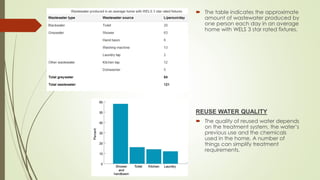
 The table indicates the approximate
amount of wastewater produced by
one person each day in an average
home with WELS 3 star rated fixtures.
REUSE WATER QUALITY
 The quality of reused water depends
on the treatment system, the water’s
previous use and the chemicals
used in the home. A number of
things can simplify treatment
requirements.
REUSING GREYWATER INDOORS
 In homes with access to a reliable rainwater supply, it is generally more economical just to
use grey water outdoors and rainwater indoors. However, if you are unable to collect
enough rainwater, treated grey water can reliably reduce indoor water use.
 Appropriately treated grey water can be reused for toilet flushing and clothes washing,
which are two of the biggest users of water in an average household.
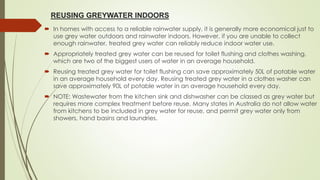
 Reusing treated grey water for toilet flushing can save approximately 50L of potable water
in an average household every day. Reusing treated grey water in a clothes washer can
save approximately 90L of potable water in an average household every day.
 NOTE: Wastewater from the kitchen sink and dishwasher can be classed as grey water but
requires more complex treatment before reuse. Many states in Australia do not allow water
from kitchens to be included in grey water for reuse, and permit grey water only from
showers, hand basins and laundries.
GREYWATER TREATMENT FOR OUTDOOR USE
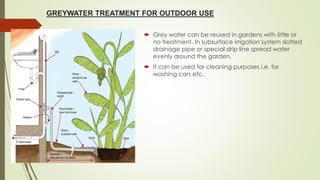
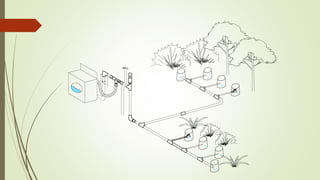
 Grey water can be reused in gardens with little or
no treatment. In subsurface irrigation system slotted
drainage pipe or special drip line spread water
evenly around the garden.
 It can be used for cleaning purposes i.e. for
washing cars etc.
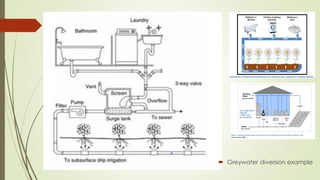
 Greywater diversion example
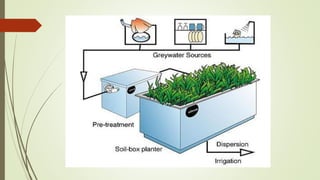
 USE OF GREYWATER FOR IRRIGATION:
o Greywater systems can work in several different ways.
o The two broad categories for greywater use include indoor reuse and
outdoor reuse.
o Outdoor greywater is usually filtered and then used for watering landscape.
o Indoor greywater, interior botanical cells, which are indoor planters.
o The easiest way to use greywater is to pipe it directly outside and use it to
water ornamental plants or fruit trees.
o Greywater can also be used to irrigate vegetable plants as long as it
doesn’t touch edible parts of the plants.
o In any greywater system, it is essential to use “plant friendly” products, those
without salts, boron, or chlorine bleach. The build-up of salts and boron in
the soil can damage plants.
Landscape design
Landscape design

Landscape design

  • 1.
  • 2.
     As pressureson freshwater resources grow around the world and as new sources of supply become increasingly scarce, expensive, or politically controversial, efforts are underway to identify new ways of meeting water needs. Of special note are efforts to reduce water demand by increasing the efficiency of water use and to expand the usefulness of alternative sources of water previously considered unusable. Among these potential new sources of supply is “GREYWATER.” Greywater makes up the largest proportion of the total wastewater flow from households in terms of volume. Typically, 50-80% of the household wastewater is greywater. If a composting toilet is also used, then 100% of the household wastewater is Greywater.
  • 3.
    HOW IS GREYWATERREUSED?  Greywater from baths, showers, washbasins and washing machines has to be collected separately from blackwater, treated and eventually disinfected for reuse as a non-potable water source.  Reusing greywater can be as cheap and easy (but labor intensive) as bucketing water outside, or as complex and costly (but convenient to use) as installing automatic greywater diversion, treatment, distribution and/or irrigation systems.  Garden irrigation is most commonly applied, whereby greywater can be bucketed or diverted to the garden for immediate use. Advanced systems are also available that collect, filter and treat greywater for indoor use such as toilet flushing or laundry washing.  Laundry washing accounts for 10-30% of the average household water use. Greywater from laundry is easy to capture and, with the right choice of laundry products, the treated greywater can be reused for garden watering or irrigation.
  • 4.
    WHY REUSE GREYWATER? GW recycling can save up to 35-40% of water consumption within a residential building by reusing shower & basin water for the use of toilet flushing, irrigation, car washing, cleaning etc.  Conventional plumbing systems dispose of GW via septic tanks or sewers. The many drawbacks of this system include overloading treatment systems, contaminating natural waters with poorly treated effluent and high ecological/economic cost. APPROACHES TO GREYWATER TREATMENT AND REUSE The various systems of greywater reuse fall into two categories: diversion systems and treatment systems. (1)Diversions systems: direct greywater from the laundry or bathroom to the garden for immediate use in restricted irrigation, without making changes to its quality. The water is not stored for more than a few hours. (2)Treatment systems: improves the quality of the greywater by filtering, treating and disinfecting it. Treated greywater can be stored for longer periods without the risk of it going septic and causing odour nuisances. Its higher quality and ability to be stored means that it can be used for more purposes, including garden watering and irrigation, toilet flushing and laundry washing.
  • 5.
    ADVANTAGES OF REUSE Byusing wastewater as a resource rather than a waste product you can:  reduce water bills  use fewer water resources  irrigate the garden during drought or water restrictions  cut down the amount of pollution going into waterways  help save money on new infrastructure for water supplies and wastewater treatment  decrease demand on infrastructure for sewage transport, treatment and disposal, allowing it to work better and last longer. DON’T STORE GREYWATER • Use it within 24 hours before bacteria multiply. After 24 hours it is well on its way to becoming blackwater • Bacteria in it use up all the oxygen and the greywater becomes anaerobic and turns septic. • More like blackwater - stinky and a health hazard
  • 6.
     The tableindicates the approximate amount of wastewater produced by one person each day in an average home with WELS 3 star rated fixtures. REUSE WATER QUALITY  The quality of reused water depends on the treatment system, the water’s previous use and the chemicals used in the home. A number of things can simplify treatment requirements.
  • 7.
    REUSING GREYWATER INDOORS In homes with access to a reliable rainwater supply, it is generally more economical just to use grey water outdoors and rainwater indoors. However, if you are unable to collect enough rainwater, treated grey water can reliably reduce indoor water use.  Appropriately treated grey water can be reused for toilet flushing and clothes washing, which are two of the biggest users of water in an average household.  Reusing treated grey water for toilet flushing can save approximately 50L of potable water in an average household every day. Reusing treated grey water in a clothes washer can save approximately 90L of potable water in an average household every day.  NOTE: Wastewater from the kitchen sink and dishwasher can be classed as grey water but requires more complex treatment before reuse. Many states in Australia do not allow water from kitchens to be included in grey water for reuse, and permit grey water only from showers, hand basins and laundries.
  • 8.
    GREYWATER TREATMENT FOROUTDOOR USE  Grey water can be reused in gardens with little or no treatment. In subsurface irrigation system slotted drainage pipe or special drip line spread water evenly around the garden.  It can be used for cleaning purposes i.e. for washing cars etc.
  • 9.
  • 10.
     USE OFGREYWATER FOR IRRIGATION: o Greywater systems can work in several different ways. o The two broad categories for greywater use include indoor reuse and outdoor reuse. o Outdoor greywater is usually filtered and then used for watering landscape. o Indoor greywater, interior botanical cells, which are indoor planters. o The easiest way to use greywater is to pipe it directly outside and use it to water ornamental plants or fruit trees. o Greywater can also be used to irrigate vegetable plants as long as it doesn’t touch edible parts of the plants. o In any greywater system, it is essential to use “plant friendly” products, those without salts, boron, or chlorine bleach. The build-up of salts and boron in the soil can damage plants.