
SUSTAINABLE ENERGY
PRINCIPLES & PRACTICE
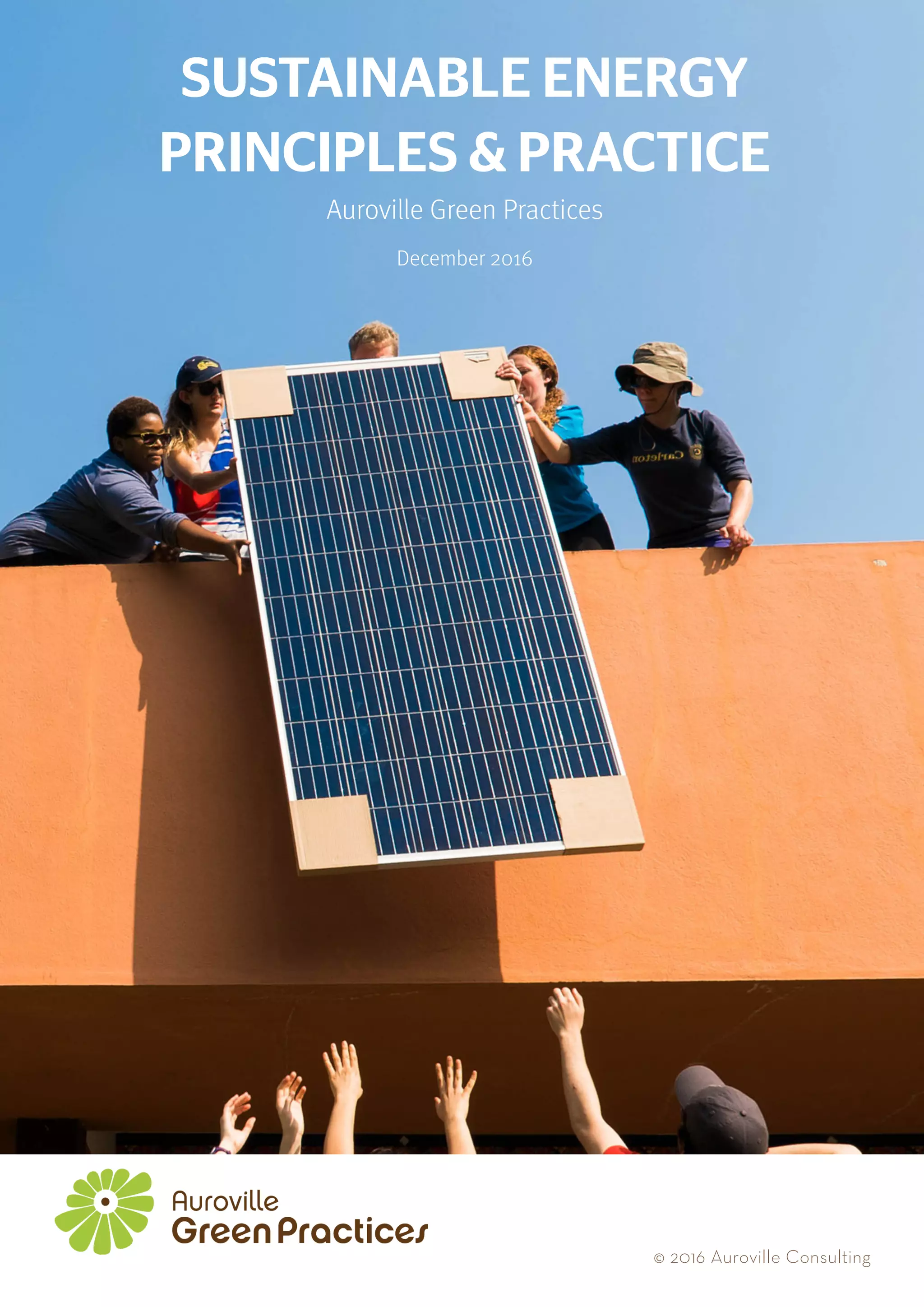
Auroville Green Practices
December 2016
© 2016 Auroville Consulting
Page 3 / 53
SUSTAINABLE ENERGY
PRINCIPLES & PRACTICE
© 2015 Auroville Consulting
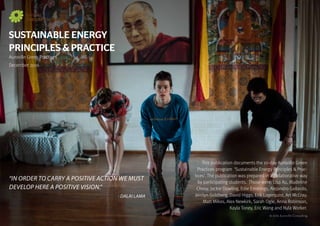
This publication documents the 10-day Auroville Green
Practices program ‘Sustainable Energy Principles & Prac-
tices’. The publication was prepared in a collaborative way
by participating students. Those were: Lisa Au, Madeline
Chosy, Jackie Dowling, Edie Emmings, Alejandro Gallardo,
Jerrilyn Goldberg, David Higgs, Erik Lagerquist, Art McCray,
Matt Mikos, Alex Newkirk, Sarah Ogle, Anna Robinson,
Kayla Toney, Eric Wang and Nyla Worker.
“IN ORDER TO CARRY A POSITIVE ACTION WE MUST
DEVELOP HERE A POSITIVE VISION.”
- DALAI LAMA
Auroville Green Practices
December 2016
Page 4 / 53 Page 5 / 53
FOREWORD
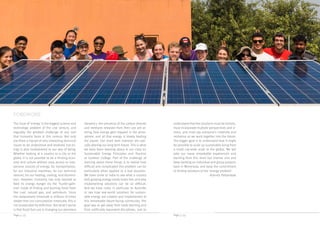
The issue of ‘energy’ is the biggest science and
technology problem of the 21st century, and
arguably the greatest challenge of any sort
that humanity faces in this century. Not only
are there a myriad of very interesting technical
issues to be understood and resolved, but en-
ergy is also fundamental to our way of being.
Whether looking at a country or a city or the
globe, it is not possible to be a thriving econ-
omy and culture without easy access to inex-
pensive sources of energy, for transportation,
for our industrial machines, for our technical
devices, for our heating, cooling, and illumina-
tion. However, humanity has only learned to
feed its energy hunger via the ‘hunter-gath-
erer’ mode of finding and burning fossil fuels
like coal, natural gas, and petroleum. Since
the replacement timescale is millions of times
slower than our consumption timescale, this is
not sustainable by definition. But what’s worse
is that fossil fuel use is changing our planetary
dynamics: the presence of the carbon-dioxide
and methane released from their use are al-
tering how energy gets trapped in the atmo-
sphere, and all that energy is slowly heating
the planet. Our short term interests are radi-
cally altering our long term future. This is what
we have been learning about in our class on
Sustainable Energy Principles and Practice
at Carleton College. Part of the challenge of
learning about these things is to realise how
difficult and complicated this problem can be
particularly when applied to a real situation.
We have come to India to see what a country
with growing energy needs looks like, and why
implementing solutions can be so difficult.
And we have come in particular to Auroville
to see how real-world solutions for sustain-
able energy are created and implemented at
this remarkable future-facing community. The
goal was to get away from book-learning and
from artificially separated disciplines, and to
understand that the solutions must be holistic,
must incorporate multiple perspectives and vi-
sions, and must tap everyone’s creativity and
resilience as we work together into the future.
The bigger goal is to understand how it might
be possible to scale up sustainable living from
a small city-wide scale to the global. We will
take our many remarkable experiences and
learning from this short but intense visit and
keep working on individual and group projects
back in Minnesota, and keep the commitment
to finding solutions to the ‘energy problem’.
- Arjendu Pattanayak
Page 6 / 53 Page 7 / 53
ACKNOWLEDGMENT
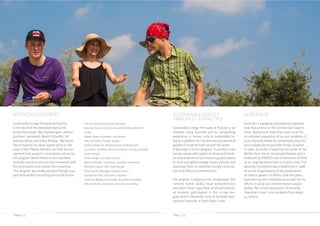
Sustainable Energy Principles & Practice
is the result of the dedicated work of Ar-
jendu Pattanayak, Balu Ramalingam, Helena
Kaufman, Jasnwanth, Martin Scherfler, De-
babrata Sahoo and Vimal Bhojraj. We would
like to express our deep appreciation to the
team of the Tibetan Pavilion, for their encour-
agement and support in providing a venue for
the program. Many thanks to the countless
Auroville resource persons that interacted with
the participants and shared their expertise.
This program was made possible through sup-
port of Auroville Consulting and Sunlit Future.
List of contributing resource persons:
Balu Sundaram, Director, Auroville Bamboo Research
Centre
Deepti Tiwari, Facilitator, Last School
Elke, Facilitator, Theater Games
Krishna McKenzie, Permaculturist, Solitude Farm
Lara Davis, Architect, Structural mason, Faculty, Auroville
Earth Institute
Lucas Dengel, Executive, EcoPro
Martin Scherfler, Consultant, Auroville Consulting
Mouhsine Serrar, COE, Prakti Design
Priya Vincent, Manager, Buddha Garden
Samuka da Índia, Facilitator, Capoeira
Toine van Megen, Co-Founder, Auroville Consulting
Vikram Devatha, Executive, Auroville Consulting
SUSTAINABLE ENERGY
PRINCIPLES & PRACTICE
Sustainable Energy Principles & Practice is an
initiative using Auroville and its outstanding
experience in human unity & sustainable liv-
ing as a platform for the learning and personal
growth of students from around the world.
A learning-in-action program, it connects core
human values with system thinking and hands-
on work experience by introducing participants
to local and global energy issues policies and
exposing them to potential energy conserva-
tion and efficiency interventions.
The program is based on the 3H approach that
nurtures hands (skills), head (competencies)
and heart (inner capacities) of all participants.
16 students participated in this 10-day pro-
gram held in December 2016 at Auroville Inter-
national Township in Tamil Nadu, India.
AUROVILLE
Auroville is a growing international township
near Puducherry on the Coromandel Coast in
India. Spread over more than 4000 acres for
an intended population of 50,000 residents, it
is an inspiring model for sustainable practices
and ecologically responsible living. Founded
in 1968, Auroville is based on the vision of The
Mother from the Sri Aurobindo Ashram and is
endorsed by UNESCO and Government of India
as an ongoing experiment in human unity. The
Auroville Foundation was established in 1988
by an act of parliament of the Government
of India to govern its affairs. Over the years,
Auroville has won international acclaim for its
efforts in social and environmental sustain-
ability. The current population of Auroville
Township is over 2200 residents from about
45 nations.
Page 8 / 53 Page 9 / 53
TABLE OF CONTENT
PARTICIPANTS PROFILES & LEARNING						 10 - 23
FROM CONCEPT TO MANIFESTATION						24 - 31
OUR FUTURE COMMITMENTS							32 - 49
Page 10 / 53 Page 11 / 53
PARTICIPANTS
PROFILES &
LEARNING
“THE ULTIMATE MEASURE OF A MAN IS NOT
WHERE HE STANDS IN MOMENTS OF COMFORT
AND CONVENIENCE, BUT WHERE HE STANDS AT
TIMES OF CHALLENGE AND CONTROVERSY.”
- MARTIN LUTHER KING, JR.
Page 12 / 53 Page 13 / 53
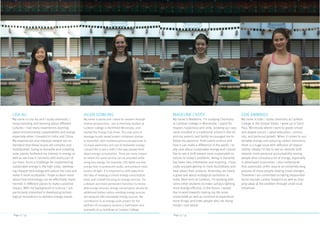
LISA AU
My name is Lisa Au and I study chemistry. I
enjoy traveling and learning about different
cultures. I had many experiences learning
about environmental sustainability and energy
especially when I traveled to India and China.
My experiences and interests helped me un-
derstand that these issues are complex and
multifaceted. Going to Auroville and installing
solar panels furthered my interest in energy as
well as see how it connects with every part of
our lives. Since a challenge for implementing
sustainable energy is the high costs, develop-
ing cheaper technology will reduce the cost and
make it more accessible. I hope to learn more
about how technology can be effectively imple-
mented in different places to make a positive
impact. With my background in science, I am
particularly interested in developing techno-
logical innovations to address energy issues.
JACKIE DOWLING
My name is Jackie and I stand for wisdom through
diverse perspectives. I am a chemistry student at
Carleton College in Northfield Minnesota, and I
started the Energy Club there. This club aims to
leverage locally based project initiatives (similar
to Auroville), with multidisciplinary perspectives to
increase awareness and use of renewable energy.
I would like to see a shift in the way people think
about energy consumption. There are many instanc-
es where the same service can be provided while
using less energy. For example, LED lights use less
energy than incandescent bulbs, and produce more
lumens of light. It is important to shift away from
the idea of meeting a certain energy consumption
level, and instead focusing on energy services. For
a deeper and more permanent transition to renew-
able energy sources, energy conservation should be
addressed before carbon emitting energy sources
are replaced with renewable energy sources. My
contribution is an energy audit project for the
addition of occupancy sensors in bathrooms and
stairwells of 40 buildings at Carleton College.
MADELINE CHOSY
My name is Madeline. I’m studying Chemistry
at Carleton College in Minnesota. I stand for
respect, happiness and unity. Growing up I was
never enrolled in a traditional school in the US
and my parents and family encouraged me to
follow my passions. Particularly science and
how it can make a difference in the world. I re-
ally care about sustainable energy and I would
like to see a shift toward more sustainable so-
lutions to today’s problems. Being in Auroville
has been very informative and inspiring. I have
really enjoyed getting to meet Aurovillians and
hear about their projects. Yesterday, we heard
a great talk about ecological sanitation in
India. Next term at Carleton, I’m working with
some other students to make campus lighting
more energy efficient. In the future, I would
like to work towards making my life more
sustainable as well as continue to experience
more things and meet people who are doing
things I care about.
EDIE EMMINGS
My name is Edie. I study chemistry at Carleton
College in the United States. I grew up in Saint
Paul, Minnesota where I went to grade school
and played soccer. I value education, commu-
nity, and personal growth. When it comes to sus-
tainable energy and reducing carbon emissions,
there is a huge issue with diffusion of respon-
sibility. Ideally I’d like to see an attitude shift
towards more personal accountability among
people who consume a lot of energy, especially
in developed economies. I also understand
that systematic shifts require an extremely long
process of many people making small changes.
Therefore I am committed to taking responsibil-
ity for my own carbon footprint as well as chip-
ping away at the problem through small local
initiatives.
Page 14 / 53 Page 15 / 53
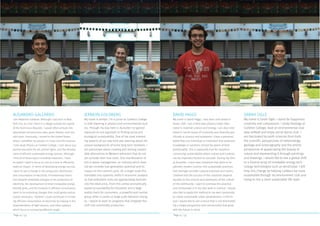
ALEJANDRO GALLARDO
I am Alejandro Gallardo. Although I was born in New
York City, as a kid I lived in a village outside the capital
of the Dominican Republic. I would often venture into
abandoned constructions sites, green forests, and into
odd rivers. Eventually, I moved to the United States,
where I solidified my passion in music and the sciences.
I now study Physics at Carleton College. I care about sup-
portive education for all, animal rights, and the develop-
ment of efficient sustainable energy sources. Although
I find all of these topics incredibly important, I have
accepted I need to focus on one at a time to efficiently
make an impact. In terms of developing energy sources,
I want to see a change in the production, distribution
and consumption of electricity. A fundamental transi-
tion towards renewable energies in the production of
electricity, the development of smart renewable energy
friendly grids, and the increase in efficient consumption
seem to be promising changes that could gently reduce
carbon emissions. I believe I could contribute in increas-
ing efficient consumption of electricity by helping in the
implementation of light sensors, and other systems,
which focus on increasing effective usage.
JERRILYN GOLDBERG
My name is Jerrilyn, I’m a junior at Carleton College
in USA majoring in physics and environmental stud-
ies. Through my stay here in Auroville I’ve gained
exposure to one approach to finding social and
ecological sustainability. One of the most interest-
ing aspects of our stay here was learning about the
unique backgrounds of some long-term residents. I
am passionate about creating and sharing sustain-
able alternatives to Western behaviors that do not
yet consider their true costs. One manifestation of
this is waste management, an industry which does
not yet consider fuel generation potential and its
impact on the nutrient cycle. On a larger scale this
translates into systemic shifts in economic analysis
so that embodied costs are appropriately factored
into the retail price. From this comes economically
based accountability for industries and a large
reality check for consumers, a powerful and inertial
group when it comes to large scale behavior chang-
es. I aspire to work on programs that integrate this
shift into commodity production.
DAVID HIGGS
My name is David Higgs. I was born and raised in
Texas, USA. I am a third year physics major inter-
ested in material science and energy. I am also inter-
ested in social issues of inclusivity and diversity spe-
cifically in science and academia. I have a personal
belief that any individual or institution that produces
knowledge or solutions should be aware of their
positionality. This is especially true for solutions
concerning sustainability where culture and customs
can be important factors to consider. During my time
at Auroville, I have seen initiatives that work to im-
plement modern science into sustainable practices
that strongly consider cultural practices and norms.
I believe that the success of this solutions depend
equally on the science and awareness of the culture
of the community. I want to continue this practice
and incorporate it in my own work in science. I would
also like to apply this method to my own community
to create sustainable urban development. In the fu-
ture I would like to see science that is not dominated
my a single perspective and communities that grow
with the future in mind.
SARAH OGLE
My name is Sarah Ogle. I stand for happiness
creativity and compassion. I study Geology at
Carleton College, lead an environmental club
play softball and enjoy social dance club. I
am fascinated by earth sciences from both
the scientific perspectives of meteorology,
geology and oceanography and the artistic
perspective of appreciating the beauty of
nature and representing it through paintings
and drawings. I would like to see a global shift
to a diverse array of renewable energy tech-
nology technologies such as wind/solar. I will
help this change by helping Carleton be more
sustainable through my environment club and
trying to live a more sustainable life style.
Page 16 / 53 Page 17 / 53
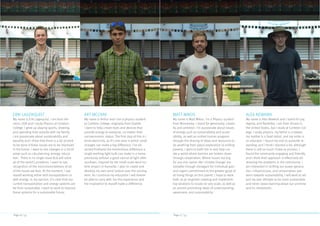
ERIK LAGERQUIST
My name is Erik Lagerquist. I am from Ver-
mont, USA and I study Physics at Carleton
College. I grew up playing sports, drawing,
and spending time outside with my family.
I am passionate about sustainability and
equality and I think that there is a lot of work
to be done if these issues are to be improved
in the future. I want to see changes in a lot of
areas such as city planning, energy, educa-
tion. There is no single issue that will solve
all of the world’s problems. I want to see
recognition of the interconnectedness of all
of the issues we face. At the moment, I see
myself working either with transportation or
with energy. In my opinion, it’s clear that our
current transportation and energy systems are
far from sustainable. I want to work to improve
these systems for a sustainable future.
ART MCCRAY
My name is Arthur and I am a physics student
at Carleton College, originally from Seattle.
I want to help create tools and devices that
provide energy to everyone, no matter their
socioeconomic status. The first step of this is I
think electricity, as it’s one area in which small
changes can make a big difference. I’ve ob-
served firsthand the tremendous difference a
single working light bulb can make in a home
previously without a good source of light after
sundown. Inspired by the small-scale wind tur-
bine project in Auroville, I plan to create and
develop my own wind turbine over the coming
term. As I continue my education I will forever
be able to carry with me this experience and
the inspiration to myself make a difference.
MATT MIKOS
My name is Matt Mikos. I’m a Physics student
from Minnesota. I stand for generosity, creativ-
ity and ambition. I’m passionate about issues
of energy such as sustainability and acces-
sibility, as well as unified human progress
through the sharing of ideas and resources to
do anything from space exploration to ending
poverty. I want to both live in and help cre-
ate a world where barriers are broken down
through cooperation. Where issues too big
for any one nation like ‘climate change’ are
solvable through disregard for individual gain
and urgent commitment to the greater good of
all living things on this planet. I hope to work
both as an engineer creating and implement-
ing solutions to issues on any scale, as well as
an activist promoting ideas of understanding,
awareness, and sustainability.
ALEX NEWKIRK
My name is Alex Newkirk and I stand for joy,
dignity, and flexibility. I am from Illinois in
the United States, but I study at Carleton Col-
lege. I study physics, my father is a lawyer,
my mother is a food stylist, and my sister is
an educator. I found my visit to auroville re-
warding, and I think I learned a lot, although
there is still so much I have to process. I
found the community engaging and friendly,
and I think their approach is effectively ad-
dressing the problems in the community. I
am interested in shifting our power genera-
tion, infrastructure, and consumption pat-
terns towards sustainability. I will work to ad-
just my own lifestyle to be more sustainable
and never cease learning about our universe
and its inhabitants.
Page 18 / 53 Page 19 / 53
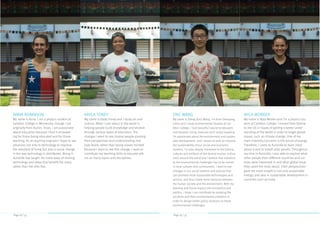
ANNA ROBINSON
My name is Anna. I am a physics student at
Carleton College in Minnesota, though I am
originally from Austin, Texas. I am passionate
about education because I find it empower-
ing for those being educated and for those
teaching. As an aspiring engineer I hope to see
advances not only in technology to improve
the standard of living but also a social change
in the way technology is distributed. Being in
Auroville has taught me some ways of sharing
technology and ideas that benefit the many
rather than the elite few.
KAYLA TONEY
My name is Kayla Toney and I study art and
science. What I care about in the world is
helping people build knowledge and wisdom
through various types of education. The
changes I want to see involve people pivoting
their perspectives and understanding mul-
tiple facets rather than being closed minded.
Because I want to see this change, I want to
contribute my teaching skills to educate oth-
ers on many topics and disciplines.
ERIC WANG
My name is Zifeng (Eric) Wang. I’m from Shenyang,
China and I study Environmental Studies at Car-
leton College. I love beautiful natural landscapes
and fantastic living creatures and I enjoy traveling.
I’m passionate about the environment and sustain-
able development, and I dream to work to improve
the sustainability of our social and economic
systems. I’m also deeply interested in the history,
cultures and artifacts of the diverse human civiliza-
tions around the world and I believe that solutions
to the environmental challenges has to be rooted
in local cultures and communities. I want to see
changes in our social systems and policies that
can promote more sustainable technologies and
actions, and thus create more harmony between
the human society and the environment. With my
learning and future inquiry into economics and
politics, I hope I can contribute by studying the
societies and their environmental problems in
order to design better policy solutions to those
environmental challenges.
NYLA WORKER
My name is Nyla Worker and I’m a physics stu-
dent at Carleton College. I moved from Bolivia
to the US in hopes of getting a better under-
standing of the world in order to target global
issues, such as climate change. One of my
main interests/concerns is the future of energy.
Therefore, I came to Auroville to learn more
about it and to install solar panels. Throughout
my time in Auroville, I was able to explore what
other people from different countries and cul-
tures were interested in and what global issue
they cared the most about. Their perspectives
gave me more insight in not only sustainable
energy, and also in sustainable development in
countries such as India.
Page 20 / 53 Page 21 / 53
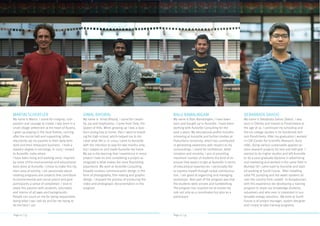
MARTIN SCHERFLER
My name is Martin. I stand for integrity, com-
passion and courage to create. I was born in a
small village settlement at the heart of Austria.
I grew up playing in the local forests, running
after the soccer ball and supporting (often
reluctantly so) my parents in their daily farm
work and their restaurant business. I hold a
masters degree in sociology. In 2005 I moved
to Auroville, India where
I have been living and working since. Inspired
by some of the environmental and educational
work done at Auroville, I chose to make this my
main area of activity. I am passionate about
creating programs and projects that contribute
to environmental and social justice and give
participants a sense of completion. I love to
share this passion with students, volunteers
and interns of all ages and backgrounds.
People can count on me for being responsible,
doing what I say I will do and for me trying to
do the best I can.
VIMAL BHOJRAJ
My name is Vimal Bhojraj. I stand for creativ-
ity, joy and helpfulness. I come from Ooty, the
Queen of Hills. When growing up I was a stub-
born young boy at home, then I went to board-
ing for high school, which helped me to dis-
cover what life is. In 2004 I came to Auroville
with the intention to stay for two months only,
but I stayed on and made Auroville my home.
My joy is the learning that I experience in every
project I take on and completing a project as
imagined is what makes the most flourishing
experience. My work at Auroville Consulting
broadly involves communication design in the
form of photography, film making and graphic
design. I enjoyed the process of producing the
video and photograpic documentation in this
program.
BALU RAMALINGAM
My name is Balu Ramalingam, I have been
born and bought up in Auroville. I have been
working with Auroville Consulting for the
past 3 years. My educational profile includes
schooling at Auroville and further studies at
Puducherry University, which has contributed
in generating awareness with respect to my
surroundings. I stand for confidence, deter-
mination and sincerity. I aim at providing
maximum number of students the kind of ex-
posure they expect to get at Auroville in terms
of educational experiences. I personally like
to express myself through verbal communica-
tion. I am good at organizing and managing
workshops. Best part of the program was that
the students were sincere and hardworking.
The program has inspired me to evolve my
role not only as a coordinator but also as a
participant.
DEBABRATA SAHOO
My name is Debabrata Sahoo (Debo). I was
born in Odisha and moved to Pondicheery at
the age of 10. I continued my schooling and
did my collage studies in Sri Aurobindo Ash-
ram Pondicherry. After my graduation I worked
in CSR (Center for Scientific Research, Auro-
ville), doing various sustainable applied sci-
ence research projects for one and half year. I
wanted to do higher studies and left Auroville
to do a post-graduate diploma in advertising
and marketing and worked in the same field in
Mumbai till I came back to Auroville and start-
ed working at Sunlit Future.  After installing
solar PV, pumping and hot water systems all
over the country from Ladakh  to Kanyakumari,
with this experience we developing a training
program to share our knowledge students,
volunteers and who ever is interested in sus-
tainable energy solutions.  My work at Sunlit
Future is of project manager, system designer
and I enjoy to take training programs.
Page 22 / 53 Page 23 / 53
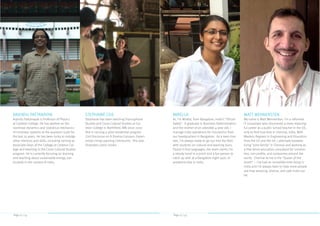
ARJENDU PATTANAYAK
Arjendu Pattanayak is Professor of Physics
at Carleton College. He has worked on the
nonlinear dynamics and statistical mechanics
of nonlinear systems at the quantum scale for
the last 25 years. He has been lucky to indulge
other interests and skills, including serving as
Associate Dean of the College at Carleton Col-
lege and teaching in the Cross-Cultural Studies
program. He is currently focusing on learning
and teaching about sustainable energy, par-
ticularly in the context of India.
STEPHANIE COX
Stephanie has been teaching Francophone
Studies and Cross-Cultural Studies at Car-
leton College in Northfield, MN since 2007.
She is running a pilot residential program
Civil Discourse on A Diverse Campus: Experi-
ential Living-Learning Community. She also
illustrates comic books.
MIRELLA
Hi, I’m Mirella, from Bangalore, India’s “Silicon
Valley”. A graduate in Business Administration
and the mother of an adorable 4-year old, I
manage India operations for ConnectInc from
our headquarters in Bangalore. As a keen trav-
eler, I’m always ready to go out into the field
with students on cultural and learning tours.
Fluent in five languages, the team claims I’m
a steady hand in a pinch and a fun person to
catch up with at a Bangalore night spot, or
anywhere else in India.
MATT WENNERSTEN
My name is Matt Wennersten. I’m a reformed
IT consultant who discovered a more meaning-
ful career as a public school teacher in the US,
only to find true love in Chennai, India. With
Masters Degrees in Engineering and Education
from the US and the UK, I alternate between
living “joint family” in Chennai and working as
a free-lance education consultant for universi-
ties, non-profits, and companies around the
world. Chennai to me is the “Queen of the
South” – I’ve had an incredible time living in
India and I’m always keen to help more people
see how amazing, diverse, and safe India can
be.
Page 24 / 53 Page 25 / 53
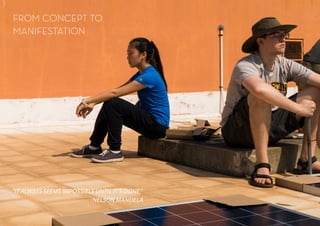
FROM CONCEPT TO
MANIFESTATION
“IT ALWAYS SEEMS IMPOSSIBLE UNTIL IT’S DONE.”
-NELSON MANDELA
Page 26 / 53 Page 27 / 53
TIBETAN PAVILION
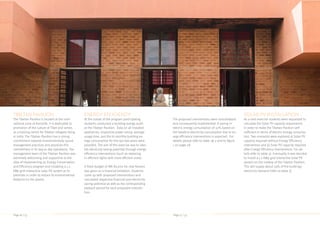
The Tibetan Pavilion is located at the inter-
national zone of Auroville. It is dedicated to
promotion of the culture of Tibet and serves
as a training centre for Tibetan refugees living
in India. The Tibetan Pavilion has a strong
commitment towards environmentally sound
management practices and practices this
commitment in its day to day operations. The
management team of the Tibetan Pavilion was
extremely welcoming and supportive to the
idea of implementing an Energy Conservation
and Efficiency program and installing a 1,2
kWp grid-interactive solar PV system at its
premises in order to reduce its environmental
footprint on the planet.
ENERGY EFFICIENCY
At the outset of the program participating
students conducted a building energy audit
at the Tibetan Pavilion. Data on all installed
appliances, respective power rating, average
usage time, and the bi-monthly building en-
ergy consumption for the last two years were
provided. The aim of this exercise was to iden-
tify electricity saving potential through energy
efficiency interventions (such as replacing
in-efficient lights with more efficient ones).
A fixed budget of INR 80,000 for new fixtures
was given as a financial limitation. Students
came up with proposed interventions and
calculated respective financial and electricity
saving potential as well as the corresponding
payback period for each proposed interven-
tion.
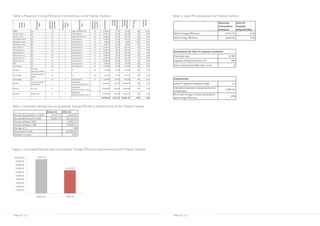
The proposed interventions were consolidated
and consequently implemented. A saving in
electric energy consumption of 32% based on
the baseline electricity consumption due to en-
ergy efficiency interventions is expected. For
details please refer to table 1& 2 and to figure
1 on page 28.
SOLAR PV INSTALLATION
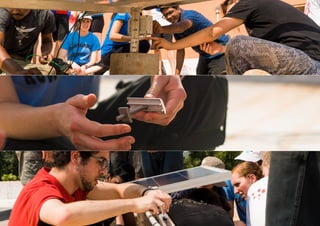
As a next exercise students were requested to
calculate the Solar PV capacity requirement
in order to make the Tibetan Pavilion self-
sufficient in terms of electric energy consump-
tion. Two scenarios were explored a) Solar PV
capacity required without Energy Efficiency
intervention and b) Solar PV capacity required
after Energy Efficiency interventions. For de-
tails refer to table 3). Eventually it was decided
to install a 1,2 kWp grid-interactive Solar PV
system on the rooftop of the Tibetan Pavilion.
This will supply about 29% of the buildings
electricity demand (refer to table 3)
Page 28 / 53 Page 29 / 53
	
  9,515.74	


  6,423.59	


  -­‐	


  1,000.00	


  2,000.00	


  3,000.00	


  4,000.00	


  5,000.00	


  6,000.00	


  7,000.00	


  8,000.00	


  9,000.00	


  10,000.00	
  	
  
Before	
  EE	
   A6er	
  EE	
  
Before	
  EE After	
  EE
Annual	
  Consumption	
  in	
  kWh 9,515.74	


   6,423.59	


Annual	
  Bill	
  Amount	
  in	
  INR 76,601.72	


   55,143.40	


Annual	
  saving	
  in	
  kWh 3,092.15	


Annual	
  savings	
  in	
  INR 21,458.31	


Savings	
  in	
  % 32%
Investment	
  in	
  INR 82,820.00	


Payback	
  in	
  years 3.86	


Table 1: Proposed Energy Efficiency Interventions at the Tibetan Pavilion
Figure 1: Estimated Results due to proposed Energy Efficiency Interventions at the Tibetan Pavilion
Room/	
  
facility	
  
name	
  
Old	
  Device	
  
Type	
  
Individual	
  
Electrical	
  
Load	
  (W)	
  
Number	
  of	
  
Device	
  
Type	
  
New	
  Device	
  
Type	
  
Individual	
  
Electrical	
  
Load	
  (W)	
  
Investment	
  
Energy	
  
Savings	
  
(kWh/year)	
  
Financial	
  
Savings	
  
(INR/Year)	
  
Savings	
  in	
  
%	
  
Payback	
  
(years)	
  
Office	
   Fan	
   75	
   1	
   Super	
  Efficient	
  Fan	
   35	
   	
  3,300.00	
  	
   	
  11.53	
  	
   	
  92.80	
  	
   0%	
   	
  35.56	
  	
  
Doctor	
  Room	
   CFL	
   15	
   3	
   LED	
  (Generic)	
   8	
   	
  1,920.00	
  	
   	
  48.72	
  	
   	
  392.20	
  	
   4%	
   	
  4.90	
  	
  
Doctor	
  Room	
   Fan	
   75	
   1	
   Super	
  Efficient	
  Fan	
   35	
   	
  3,300.00	
  	
   	
  92.22	
  	
   	
  742.37	
  	
   1%	
   	
  4.45	
  	
  
Caretaker	
  Room	
   CFL	
   15	
   2	
   LED	
  (Generic)	
   8	
   	
  1,280.00	
  	
   	
  24.36	
  	
   	
  196.10	
  	
   0%	
   	
  6.53	
  	
  
Caretaker	
  Room	
   CFL	
   15	
   1	
   LED	
  (Generic)	
   8	
   	
  640.00	
  	
   	
  12.18	
  	
   	
  98.05	
  	
   0%	
   	
  6.53	
  	
  
Caretaker	
  Room	
   CFL	
   15	
   1	
   LED	
  (Generic)	
   8	
   	
  640.00	
  	
   	
  12.18	
  	
   	
  98.05	
  	
   0%	
   	
  6.53	
  	
  
Guest	
  Room	
  1	
   CFL	
   15	
   3	
   LED	
  (Generic)	
   8	
   	
  1,920.00	
  	
   	
  48.72	
  	
   	
  392.20	
  	
   1%	
   	
  4.90	
  	
  
Guest	
  Room	
  2	
   CFL	
   15	
   3	
   LED	
  (Generic)	
   8	
   	
  1,920.00	
  	
   	
  48.72	
  	
   	
  392.20	
  	
   1%	
   	
  4.90	
  	
  
Guest	
  Room	
  2	
   CFL	
   15	
   3	
   LED	
  (Generic)	
   8	
   	
  1,920.00	
  	
   	
  48.72	
  	
   	
  392.20	
  	
   1%	
   	
  4.90	
  	
  
Guest	
  Room	
  3	
   CFL	
   15	
   3	
   LED	
  (Generic)	
   8	
   	
  1,920.00	
  	
   	
  48.72	
  	
   	
  392.20	
  	
   1%	
   	
  4.90	
  	
  
Guest	
  Room	
  4	
   CFL	
   15	
   3	
   LED	
  (Generic)	
   8	
   	
  1,920.00	
  	
   	
  48.72	
  	
   	
  392.20	
  	
   1%	
   	
  4.90	
  	
  
Guest	
  Room	
  5	
   CFL	
   15	
   4	
   LED	
  (Generic)	
   8	
   	
  2,560.00	
  	
   	
  40.60	
  	
   	
  326.83	
  	
   0%	
   	
  7.83	
  	
  
Hall	
   CFL	
   15	
   1	
   LED	
  (Generic)	
   8	
   	
  640.00	
  	
   	
  12.18	
  	
   	
  98.05	
  	
   0%	
   	
  6.53	
  	
  
Rest	
  Room	
   CFL	
   15	
   4	
   LED	
  (Generic)	
   8	
   	
  2,560.00	
  	
   	
  64.96	
  	
   	
  522.93	
  	
   1%	
   	
  4.90	
  	
  
entrance	
  
T12	
  with	
  
Electronic	
  Ballast	
  
48	
   1	
   T5	
   28	
   	
  550.00	
  	
   	
  29.00	
  	
   	
  233.45	
  	
   0%	
   	
  2.36	
  	
  
street	
  light	
  
T8	
  with	
  Electronic	
  
Ballast	
  
36	
   1	
   T5	
   28	
   	
  550.00	
  	
   	
  27.84	
  	
   	
  224.11	
  	
   0%	
   	
  2.45	
  	
  
street	
  light	
   CFL	
   15	
   2	
   LED	
  (Generic)	
   8	
   	
  1,280.00	
  	
   	
  48.72	
  	
   	
  392.20	
  	
   1%	
   	
  3.26	
  	
  
Kitchen	
  
Electrolux	
  ER200	
  
SHARP	
  190	
  l	
  
0	
   1	
  
SAMSUNG	
  
RR21K274ZDZ/NL	
  212	
  l	


  15,000.00	
  	
   	
  753.55	
  	
   	
  6,066.09	
  	
   8%	
   	
  2.47	
  	
  
Kitchen	
   LG	
  	
  250	
  l	
   0	
   1	
  
SAMSUNG	
  
RT28K3723UT/HL	
  253	
  l	


  24,000.00	
  	
   	
  852.28	
  	
   	
  6,860.88	
  	
   9%	
   	
  3.50	
  	
  
Corridor	
   Godrej	
  165	
  l	
   0	
   1	
  
SAMSUNG	
  
RR20K172ZS8/HL	
  192	
  l	


  15,000.00	
  	
   	
  818.22	
  	
   	
  6,586.70	
  	
   9%	
   	
  2.28	


  82,820.00	
  	
   	
  3,092.15	
  	
   	
  24,891.78	
  	
   32%	
   	
  3.86	
  	
  
Table 1: Estimated Results due to proposed Energy Efficiency Interventions at the Tibetan Pavilion
Electricity	
  
Consumption	
  
Kwh/year
Solar	
  PV	
  
Capacity	
  
Required	
  kWp
Before	
  Energy	
  Efficiency 9,515.74	


   6.03
After	
  Energy	
  Efficiency 6,423.50	


   4.07
Hours	
  per	
  year 8,760	


Capacity	
  Utilization	
  Factor	
  in	
  % 18%
Space	
  required	
  per	
  KWp	
  solar	
  In	
  m2 12
Solar	
  PV	
  capacity	
  installed	
  in	
  kWp 1.2
Exected	
  annual	
  solar	
  energy	
  production	
  
in	
  kWh/year
1,892.16	


%	
  of	
  solar	
  energy	
  on	
  total	
  consumption	
  
after	
  Energy	
  Efficiency
29%
Assumptions	
  for	
  Solar	
  PV	
  Capacity	
  Calculation
Implemented
Table 3: Solar PV calculations for Tibetan Pavilion
Page 30 / 53 Page 31 / 53
Page 32 / 53 Page 33 / 53
OUR FUTURE
COMMITMENTS
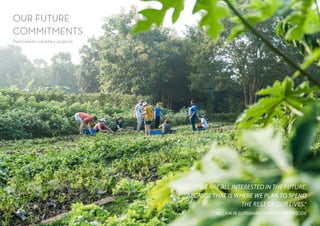
Participants voluntary projects
“WE ARE ALL INTERESTED IN THE FUTURE,
BECAUSE THAT IS WHERE WE PLAN TO SPEND
THE REST OF OUR LIVES.”
- VILLAIN IN SUPERMAN COMIC BOOK EPISODE
Page 34 / 53 Page 35 / 53
CLIMATE CHANGE & SUSTAINABILITY
My idea for a project is still very much in its
infancy. However, I hope to create a profile
of various social enterprises with a focus on
those, which address issues of ‘climate change’
and ‘sustainability’. I then hope to be able to
present this profile to the off campus stud-
ies office as a better alternative for carbon
offsets. Ideally, I would also like to work with
the divestment group on campus to offer a new
perspective on where the fossil fuel investment
funds could be allocated and spark a new con-
versation about the value of impact.
I hope my project will be able to increase the
awareness of how essential finance and think-
ing economically is when dealing with issues
of social and environmental justice. I believe
that this would help to increase the efficiency
and success rates of projects aimed at tackling
these kinds of issues.
The biggest thing I think I have learned about
sustainability and creating an impact from this
trip is how important the financial side is and
how it is so often neglected at great cost.
I hope my project can contribute to a shift in
the standard understanding of how we ap-
proach these issues and that the economic
approach is just as valid and important if not
more so then the technological and social.
The greatest challenge here, I believe, is the
gathering of information from various enter-
prises as well as finding a valuable metric to
show the strengths and weaknesses of each
enterprise.
- By Matt Mikos
SMALL SCALE WIND TURBINES
In the upcoming term, I plan to first develop
and build a small turbine that generates
electricity from wind power. This is a well-
studied idea and I intend to look at a variety
of designs, picking and choosing the parts
from each that I will incorporate. My interests
in small-scale wind were piqued when we saw
the wind turbines built by Jorgé in Auroville.
I was impressed by how little technical ma-
terials were required and how, as he put it,
the only necessities are patience, patience,
and more patience. My primary goals for this
project are to develop my own personal en-
gineering design skills and to prepare myself
for working in other, more experimental forms
of electricity generation like micro-hydro and
wind.
Small-scale wind turbines have many impor-
tant applications. Climate permitting, they
are one of the most environmentally practical
ways of bringing power to off grid communi-
ties. The effects of a single light bulb can be
tremendous when
introduced to a village or home without power,
and is an important first step in providing
equal access to technology to everyone.
My first step in this project is to make my own
working wind turbine. I realize that small scale
turbines are not where I’ll be able to make a
difference—there are lots of highly trained en-
gineers and scientists with years of experience
working on the major issues, namely making
them cheaper, more efficient, and resilient. My
hope is that my project will provide me with
much needed hands-on experience building
a turbine, letting me learn skills and design
techniques that I will next be able to apply to
less developed forms of generating electricity.
- By Arthur McCray
Page 36 / 53 Page 37 / 53
SUSTAINABLE ENERGY FUTURE
For a future where electricity generation relies on
sustainable fuels, communities need to diversify
their energy sources and decentralize electricity
generation. While solar energy is the first renewable
resource most people consider turning to, many op-
tions are available and the most effective combina-
tion is completely dependent on the region. Beyond
these variations, practical recommendations must
consider the socio-economic norms and class most
prevalent in the community. I would like to create
a platform for streamlining recommendations for
incorporating renewable energy into communities
based on socio-economic and natural climates.
This project will use a technical foundation to com-
municate qualitative results through geospatial
analysis and a smooth, user-friendly interface. The
program will aid consumers and consultors and
government officials to streamline their process
for approaching sustainable energy because it will
provide a background for further research. Identify-
ing enough reliable sources of data for economic
and climactic classifications will be challenging in
and of itself, but pushing for systemic shifts to
renewable energy will be a much more intensive
challenge because it relies on more than time and
careful methodological planning. For even meager
success in this project, I will need to prompt and
contribute to a series of cultural shifts from ignor-
ing the total cost of electricity and fuel use to
considering the full cost of fossil fuels such that a
variety of potent pollutants are taken into account
in an appropriate, factual manner. One approach
I will consider is showing the medical costs ac-
crued by miners and other people working within
or affected by the industries generating their
electricity. This is one mechanism for transparent,
relatable explanations of the true cost for each
Watt consumed. Overall, this project will generate
fact-based recommendations for integrating re-
newable fuels like solar, wind, and bio-gas so that
communities can achieve sustainability with the
least-cost solution.
- By Jerrilyn Goldbert
NO IMPACT CHALLENGE
My project is called the No Impact Challenge. During
two weeks of environmentally focused activities at
Carleton College, students from Carleton and St. Olaf
College will carry all of their plastic bags to increase
awareness of how much waste we produce. This will
be a competition and should motivate people to
produce less waste. People can form teams in each
college and will weigh their waste at the end of the
weeks. The team and college that has the lowest aver-
age weight of waste will win. I will need to be dedi-
cated, hard working, communicative, organized and
creative to make this project reach the most people
possible. I hope that we have lots of participation and
that people will decrease the amount of waste they
produce.
-By Sarah Ogle
Page 38 / 53 Page 39 / 53
ENVIRONMENTAL IMPACT APP
The project I will be working on the next semester is
to construct an app that scans products and gives
feedback on the environmental impact of the product.
This app is targeted to the American audience. I think
that it is not fair that countries such as the us are us-
ing so many resources and are not conscious of that
impact. Therefore, I want to give them easy access to
the environmental information of each product.
The challenges project faces are finding a metric to
measure the impact of each product. This metric has
to be reliable and provide an accurate description on
the products impact. The ideal metric is incredibly
complicated and would take into account all of the
small things involved in the product manufacture.
Given this challenges we would start by focusing on
some products on the local supermarket. Since the
metric cannot be perfect we will refrain ourselves to
choose products that are either very sustainable or
not at all. This will give us an idea of how feasible the
project is and see how to continue. I believe that if
each American had an idea of how much impact
each of the products they consume on a daily ba-
sis. At least some of them will be more thoughtful
on their purchases.
-By Nyla Worker
IMPROVING ELECTRICAL
DISTRIBUTION GRID
For my project I’d like to conduct a survey of
research and produce a report on potential improve-
ments to the electrical distribution grid. Our current
infrastructure is crumbling and there is significant
losses endemic to our centralized system of electri-
cal distribution. While there is almost universal
agreement that the system needs an overhaul, there
is persistent inaction. I’d seek to motivate action
through communication of costs and benefits to grid
improvements and employ this analysis to target im-
provements towards their most receptive audiences.
This infrastructure is not owned by clearly demar-
cated individuals or institutions, but instead by leaky
and piecemeal unaffiliated organizations. Thus any
improvement must come from cooperation across
many organizations and entities. I would seek to
analyze existing research into potential grid improve-
ments to determine their respective technological
feasibility, implementation costs, environmental
costs, and their economic, social and environmental
benefits. I could then identify the most promising
avenues to pursue, and could in turn communicate
these benefits to parties most likely to respond to
them. Inexpensive economically beneficial improve-
ments could be targeted towards corporate actors
while socially beneficial but never economically
profitable technologies could be targeted towards
institutional and governmental actors. I think this
targeting especially will be a crucial component
of this project, as any improvement to the grid is
messy. While a top down complete overhaul of
the grid would theoretically be optimal, it would
be logistically impossible, prohibitively expensive,
and would leave all consumers without power for
the duration of improvement. This is partially what
has prevented improvement for so long, and I think
determination of those improvements that could
be made to the existing infrastructure and develop-
ment could help alleviate this stagnation.
-				-By Alex Newkirk
Page 40 / 53 Page 41 / 53
SUSTAINABILITY RESOURCES &
ENERGY CONSERVATION
There needs to be a shift in the way people
think about energy. Current global energy
consumption is unsustainable and there are
many instances where the same service could
be provided while using less energy. Our project
involves installing occupancy sensors to reduce
energy consumption on Carleton’s campus by
ensuring that lights in the stairwells and bath-
rooms are only on when someone is using these
spaces.
This project will be funded through Carleton’s
Sustainable Revolving Fund (SRF), and part of
our project includes raising awareness of the
resources at Carleton available for pursuing
sustainability projects in the future. The Sustain-
able Revolving Fund was created for students to
pursue and implement project ideas centered
around sustainability. Our SRF project aims to
grow diverse student innovation by increasing
the fund’s accessibility. We want the hands on
lighting project to make students feel fulfilled
by facilitating Carleton’s transition to sustain-
able energy.
 
The Sustainable Revolving Fund is very large,
but not well known, and underutilized. We plan
on creating a pamphlet showcasing previous
projects and the history of the fund. Our pam-
phlet will also include details about our lighting
project as well as a guide for students on how
to put together a successful project based on
on-campus resources and past projects.
 
Our plan for the lighting project is to perform
energy audits of restrooms and stairwells of
forty buildings on campus. To do this, we will
determine the number and type of light in
bathrooms and stairwells in all campus build-
ings. This data will be used to calculate energy
consumption and determine how much energy
and money would be saved if sensors were
installed. If Carleton has sufficient improvement
capacity,  the SRF fund will grow after a payback
period.
 
We are excited to contribute to Carleton’s transi-
tion to sustainable energy. We were inspired by
the locally implemented, innovative solutions we
learned about in Auroville, India.
- By Lisa Au, Madeline Chosy and Jackie Dowling
Page 42 / 53 Page 43 / 53
MICRO OFF-GRID POWER GENERATION
Limited resources and unequal distribution of
power means that a large percentage of the
world population does not have access to elec-
tricity. This means that once it gets dark, their
day essentially ends. If energy-poor individuals
had access to light, they could use that time to
work and study, allowing them to increase their
earnings and livelihood. This would especially
empower young women by allowing them to
dedicate more time to their education and skills.
In order for this to change on a global scale,
there would have to be tremendous changes in
government policy, monetary distribution, infra-
structure, and general attitude of the energy-rich
population. This process would take a huge
amount of resources and time and is beyond the
scope of a local student initiative. We hope to
approach this problem by designing small off-
grid windmills from inexpensive or recycled ma-
terials. These could include rigid plastics, wood,
aluminum cans, or glass. Also, assembly should
not require power tools or special equipment.
Ideally, a screwdriver, hammer, and a sharp
object should be the only tools needed. These
kits could be sold internationally to be assem-
bled by the unskilled user for the purpose of
powering a light bulb. We hope to execute this
project through resources and funding from
Carleton. We will design and build a public
statement piece as an example for our com-
munity. It will utilize recycled unsustainable
materials that are commonly used by students
(e.g. plastic cups and aluminum cans). In ad-
dition to raising awareness about our project
and the greater issue of energy equality, this
installment will remind students of the impact
of their own behaviors. This windmill will be
constructed using the kit to demonstrate its
accessibility and functionality.
- By Edie Emmings and Anna Robinson
SUSTAINABLE TRANSPORTATION FOR
NORTHFIELD:
Being in Auroville and seeing the sustainable ini-
tiatives has given us a context to understand how
to create sustainable solutions for specific com-
munities and cultures. Looking at our own com-
munity we have identified an issue that needs to
be solved and that can benefit from being solved
in a sustainable way. The issue we want to work
on is transportation in our college town. Northfield
is small city with a population of 20,000 in rural
Minnesota. Transportation in Northfield is prob-
lematic because it only accommodates for motor-
ized vehicles running on fossil fuels. What little
public transportation that exists is inconsistent
and inaccessible to majority of the community. A
potential sustainable solution to this would be to
make space for bikes and add charging stations
for electric vehicles. Northfield is also only 45
minutes away from a major city but there isn’t a
convenient way to travel expect by car. A passen-
ger train using preexisting tracks could easily save
people money from the cost of traveling and
also greatly reduce the daily carbon emission
from commuters. These issues are not being
addressed because they are not an immediate
issue and there is no clear economic value.
Additionally, the car and truck culture is strong
within the community. However, we believe that
there is need to invest in a sustainable future.
Our first step in addressing this issue is to
research the current political policy in our town
more in depth and better understand the com-
munity’s cultural values. Next we would need
to do cost and benefit analysis on implantation
of potential projects like charging stations or
passenger trains. We can then inform policy
makers in our city and hopefully make change.
- By Erik Lagerquist and David Higgs
Page 44 / 53 Page 45 / 53
IMPROVING THE VISIBILITY OF EN-
ERGY COST ON CAMPUS THROUGH
ENERGY LABELLING
Food waste in dinning halls has always been a
huge problem on the campus of Carleton Col-
lege. Students dump a lot of their food wastes
into compost everyday, which generates a huge
burden in waste management and also leads to
enormous water use for dishwashing.
Early projects conducted by student activists
found that once the food dump is monitored by
people, the amount of food wasted would be
significantly reduced. However, once the moni-
tors are gone, food waste would bounce back.
Therefore, raising awareness through campaigns
does not seem like a good idea for generating
behavioral changes in the long run that can help
reduce the food waste on campus.
Economic incentives might be an alternative to
awareness-raising as a possible solution to the
food waste problem on campus. With their cur-
rent meal plans, students at Carleton pay a
fixed cost for each of their meal and the price
is actually quite high. There is no incentive at
all for the students to conserve their food,
and there is even an incentive for them to
take more food than they actually need since
they don’t pay for what they waste. Therefore,
a change in the dinning hall pricing scheme
that can make students pay for their food
waste can probably be an effective way to
reduce food waste and save students’ money
at the same time. If students pay for each dish
they consume they would not take more than
they need, and would also try to “clean their
plates” as much as possible since any waste
food dumped would also be a waste of their
own money.
My project would start by doing some re-
searches on the possible impacts of different
pricing schemes studied by previous scholars
to find some theories that can inform my
project. Then I would the related stakeholders
(students and Dinning Hall decision mak-
ers) and experts in the field (Environmental
Economics professors) about the feasibility
of the scheme. After that I can do a student
willingness-to-pay survey to see a possible
alternative pricing scheme, which can on one
hand help the Dinning Hall to design an ac-
ceptable way to price its products, and on the
other hand help the student realize how much
money they can possibly save if they are not
paying an “all-you-can-eat” price.
A change in the pricing scheme would be a
huge shock to the current dinning hall sys-
tem since in most of the dinning halls in the
United States as well as in other countries, a
buffet-style pricing scheme is used and simi-
lar problems with food wastes are there.
What can be learned from this project can
definitely inform decision makings in many
parts of the world and let people rethink
about the pricing system of the food we
eat at public dinning halls. It can possibly
lead to the changes in the pricing schemes
that can better take into account the energy
consumption and environmental impacts in
dealing with food wastes.
- By Eric Wang
Page 46 / 53 Page 47 / 53
AurovilleConsulting
COLLABORATORS
Auroville Green Practices aims to bring together various stakeholders
to envision future townships that offer a habitat that is ecologically,
socially and economically nurturing. Auroville Green Practices is
managed by Auroville Consulting a unit under the Auroville Founda-
tion.
Sunlit Future is an integrated service provider bringing high qual-
ity renewable energy solutions to both rural and urban India. Based
in Auroville, an international township in south India, we dedicate
ourselves to experimentation and research on solar photovoltaic and
thermal technologies and products. The key team members of Sunlit
Future have been actively involved in the field of solar energy over
the past 12 years building trust and credibility.
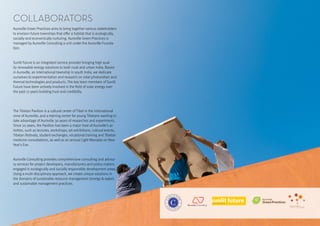
The Tibetan Pavilion is a cultural center of Tibet in the international
zone of Auroville, and a training center for young Tibetans wanting to
take advantage of Auroville 30 years of researches and experiments.
Since 20 years, the Pavilion has been a major host of Auroville’s ac-
tivities, such as lectures, workshops, art exhibitions, cultural events,
Tibetan festivals, student exchanges, vocational training and Tibetan
medicine consultations, as well as an annual Light Mandala on New
Year’s Eve.
Auroville Consulting provides comprehensive consulting and adviso-
ry services for project developers, manufacturers and policy makers
engaged in ecologically and socially responsible development areas.
Using a multi-disciplinary approach, we create unique solutions in
the domains of sustainable resource management (energy & water)
and sustainable management practices.
“THERE ARE TRIVIAL TRUTHS
AND THE GREAT TRUTHS. THE
OPPOSITE OF A TRIVIAL TRUTH
IS PLAINLY FALSE. THE
OPPOSITE OF A GREAT TRUTH IS
ALSO TRUE.”
					 - NIELS BOHR

Sustainable energy principles & practice

  • 1.
    SUSTAINABLE ENERGY PRINCIPLES &PRACTICE Auroville Green Practices December 2016 © 2016 Auroville Consulting
  • 2.
    Page 3 /53 SUSTAINABLE ENERGY PRINCIPLES & PRACTICE © 2015 Auroville Consulting This publication documents the 10-day Auroville Green Practices program ‘Sustainable Energy Principles & Prac- tices’. The publication was prepared in a collaborative way by participating students. Those were: Lisa Au, Madeline Chosy, Jackie Dowling, Edie Emmings, Alejandro Gallardo, Jerrilyn Goldberg, David Higgs, Erik Lagerquist, Art McCray, Matt Mikos, Alex Newkirk, Sarah Ogle, Anna Robinson, Kayla Toney, Eric Wang and Nyla Worker. “IN ORDER TO CARRY A POSITIVE ACTION WE MUST DEVELOP HERE A POSITIVE VISION.” - DALAI LAMA Auroville Green Practices December 2016
  • 3.
    Page 4 /53 Page 5 / 53 FOREWORD The issue of ‘energy’ is the biggest science and technology problem of the 21st century, and arguably the greatest challenge of any sort that humanity faces in this century. Not only are there a myriad of very interesting technical issues to be understood and resolved, but en- ergy is also fundamental to our way of being. Whether looking at a country or a city or the globe, it is not possible to be a thriving econ- omy and culture without easy access to inex- pensive sources of energy, for transportation, for our industrial machines, for our technical devices, for our heating, cooling, and illumina- tion. However, humanity has only learned to feed its energy hunger via the ‘hunter-gath- erer’ mode of finding and burning fossil fuels like coal, natural gas, and petroleum. Since the replacement timescale is millions of times slower than our consumption timescale, this is not sustainable by definition. But what’s worse is that fossil fuel use is changing our planetary dynamics: the presence of the carbon-dioxide and methane released from their use are al- tering how energy gets trapped in the atmo- sphere, and all that energy is slowly heating the planet. Our short term interests are radi- cally altering our long term future. This is what we have been learning about in our class on Sustainable Energy Principles and Practice at Carleton College. Part of the challenge of learning about these things is to realise how difficult and complicated this problem can be particularly when applied to a real situation. We have come to India to see what a country with growing energy needs looks like, and why implementing solutions can be so difficult. And we have come in particular to Auroville to see how real-world solutions for sustain- able energy are created and implemented at this remarkable future-facing community. The goal was to get away from book-learning and from artificially separated disciplines, and to understand that the solutions must be holistic, must incorporate multiple perspectives and vi- sions, and must tap everyone’s creativity and resilience as we work together into the future. The bigger goal is to understand how it might be possible to scale up sustainable living from a small city-wide scale to the global. We will take our many remarkable experiences and learning from this short but intense visit and keep working on individual and group projects back in Minnesota, and keep the commitment to finding solutions to the ‘energy problem’. - Arjendu Pattanayak
  • 4.
    Page 6 /53 Page 7 / 53 ACKNOWLEDGMENT Sustainable Energy Principles & Practice is the result of the dedicated work of Ar- jendu Pattanayak, Balu Ramalingam, Helena Kaufman, Jasnwanth, Martin Scherfler, De- babrata Sahoo and Vimal Bhojraj. We would like to express our deep appreciation to the team of the Tibetan Pavilion, for their encour- agement and support in providing a venue for the program. Many thanks to the countless Auroville resource persons that interacted with the participants and shared their expertise. This program was made possible through sup- port of Auroville Consulting and Sunlit Future. List of contributing resource persons: Balu Sundaram, Director, Auroville Bamboo Research Centre Deepti Tiwari, Facilitator, Last School Elke, Facilitator, Theater Games Krishna McKenzie, Permaculturist, Solitude Farm Lara Davis, Architect, Structural mason, Faculty, Auroville Earth Institute Lucas Dengel, Executive, EcoPro Martin Scherfler, Consultant, Auroville Consulting Mouhsine Serrar, COE, Prakti Design Priya Vincent, Manager, Buddha Garden Samuka da Índia, Facilitator, Capoeira Toine van Megen, Co-Founder, Auroville Consulting Vikram Devatha, Executive, Auroville Consulting SUSTAINABLE ENERGY PRINCIPLES & PRACTICE Sustainable Energy Principles & Practice is an initiative using Auroville and its outstanding experience in human unity & sustainable liv- ing as a platform for the learning and personal growth of students from around the world. A learning-in-action program, it connects core human values with system thinking and hands- on work experience by introducing participants to local and global energy issues policies and exposing them to potential energy conserva- tion and efficiency interventions. The program is based on the 3H approach that nurtures hands (skills), head (competencies) and heart (inner capacities) of all participants. 16 students participated in this 10-day pro- gram held in December 2016 at Auroville Inter- national Township in Tamil Nadu, India. AUROVILLE Auroville is a growing international township near Puducherry on the Coromandel Coast in India. Spread over more than 4000 acres for an intended population of 50,000 residents, it is an inspiring model for sustainable practices and ecologically responsible living. Founded in 1968, Auroville is based on the vision of The Mother from the Sri Aurobindo Ashram and is endorsed by UNESCO and Government of India as an ongoing experiment in human unity. The Auroville Foundation was established in 1988 by an act of parliament of the Government of India to govern its affairs. Over the years, Auroville has won international acclaim for its efforts in social and environmental sustain- ability. The current population of Auroville Township is over 2200 residents from about 45 nations.
  • 5.
    Page 8 /53 Page 9 / 53 TABLE OF CONTENT PARTICIPANTS PROFILES & LEARNING 10 - 23 FROM CONCEPT TO MANIFESTATION 24 - 31 OUR FUTURE COMMITMENTS 32 - 49
  • 6.
    Page 10 /53 Page 11 / 53 PARTICIPANTS PROFILES & LEARNING “THE ULTIMATE MEASURE OF A MAN IS NOT WHERE HE STANDS IN MOMENTS OF COMFORT AND CONVENIENCE, BUT WHERE HE STANDS AT TIMES OF CHALLENGE AND CONTROVERSY.” - MARTIN LUTHER KING, JR.
  • 7.
    Page 12 /53 Page 13 / 53 LISA AU My name is Lisa Au and I study chemistry. I enjoy traveling and learning about different cultures. I had many experiences learning about environmental sustainability and energy especially when I traveled to India and China. My experiences and interests helped me un- derstand that these issues are complex and multifaceted. Going to Auroville and installing solar panels furthered my interest in energy as well as see how it connects with every part of our lives. Since a challenge for implementing sustainable energy is the high costs, develop- ing cheaper technology will reduce the cost and make it more accessible. I hope to learn more about how technology can be effectively imple- mented in different places to make a positive impact. With my background in science, I am particularly interested in developing techno- logical innovations to address energy issues. JACKIE DOWLING My name is Jackie and I stand for wisdom through diverse perspectives. I am a chemistry student at Carleton College in Northfield Minnesota, and I started the Energy Club there. This club aims to leverage locally based project initiatives (similar to Auroville), with multidisciplinary perspectives to increase awareness and use of renewable energy. I would like to see a shift in the way people think about energy consumption. There are many instanc- es where the same service can be provided while using less energy. For example, LED lights use less energy than incandescent bulbs, and produce more lumens of light. It is important to shift away from the idea of meeting a certain energy consumption level, and instead focusing on energy services. For a deeper and more permanent transition to renew- able energy sources, energy conservation should be addressed before carbon emitting energy sources are replaced with renewable energy sources. My contribution is an energy audit project for the addition of occupancy sensors in bathrooms and stairwells of 40 buildings at Carleton College. MADELINE CHOSY My name is Madeline. I’m studying Chemistry at Carleton College in Minnesota. I stand for respect, happiness and unity. Growing up I was never enrolled in a traditional school in the US and my parents and family encouraged me to follow my passions. Particularly science and how it can make a difference in the world. I re- ally care about sustainable energy and I would like to see a shift toward more sustainable so- lutions to today’s problems. Being in Auroville has been very informative and inspiring. I have really enjoyed getting to meet Aurovillians and hear about their projects. Yesterday, we heard a great talk about ecological sanitation in India. Next term at Carleton, I’m working with some other students to make campus lighting more energy efficient. In the future, I would like to work towards making my life more sustainable as well as continue to experience more things and meet people who are doing things I care about. EDIE EMMINGS My name is Edie. I study chemistry at Carleton College in the United States. I grew up in Saint Paul, Minnesota where I went to grade school and played soccer. I value education, commu- nity, and personal growth. When it comes to sus- tainable energy and reducing carbon emissions, there is a huge issue with diffusion of respon- sibility. Ideally I’d like to see an attitude shift towards more personal accountability among people who consume a lot of energy, especially in developed economies. I also understand that systematic shifts require an extremely long process of many people making small changes. Therefore I am committed to taking responsibil- ity for my own carbon footprint as well as chip- ping away at the problem through small local initiatives.
  • 8.
    Page 14 /53 Page 15 / 53 ALEJANDRO GALLARDO I am Alejandro Gallardo. Although I was born in New York City, as a kid I lived in a village outside the capital of the Dominican Republic. I would often venture into abandoned constructions sites, green forests, and into odd rivers. Eventually, I moved to the United States, where I solidified my passion in music and the sciences. I now study Physics at Carleton College. I care about sup- portive education for all, animal rights, and the develop- ment of efficient sustainable energy sources. Although I find all of these topics incredibly important, I have accepted I need to focus on one at a time to efficiently make an impact. In terms of developing energy sources, I want to see a change in the production, distribution and consumption of electricity. A fundamental transi- tion towards renewable energies in the production of electricity, the development of smart renewable energy friendly grids, and the increase in efficient consumption seem to be promising changes that could gently reduce carbon emissions. I believe I could contribute in increas- ing efficient consumption of electricity by helping in the implementation of light sensors, and other systems, which focus on increasing effective usage. JERRILYN GOLDBERG My name is Jerrilyn, I’m a junior at Carleton College in USA majoring in physics and environmental stud- ies. Through my stay here in Auroville I’ve gained exposure to one approach to finding social and ecological sustainability. One of the most interest- ing aspects of our stay here was learning about the unique backgrounds of some long-term residents. I am passionate about creating and sharing sustain- able alternatives to Western behaviors that do not yet consider their true costs. One manifestation of this is waste management, an industry which does not yet consider fuel generation potential and its impact on the nutrient cycle. On a larger scale this translates into systemic shifts in economic analysis so that embodied costs are appropriately factored into the retail price. From this comes economically based accountability for industries and a large reality check for consumers, a powerful and inertial group when it comes to large scale behavior chang- es. I aspire to work on programs that integrate this shift into commodity production. DAVID HIGGS My name is David Higgs. I was born and raised in Texas, USA. I am a third year physics major inter- ested in material science and energy. I am also inter- ested in social issues of inclusivity and diversity spe- cifically in science and academia. I have a personal belief that any individual or institution that produces knowledge or solutions should be aware of their positionality. This is especially true for solutions concerning sustainability where culture and customs can be important factors to consider. During my time at Auroville, I have seen initiatives that work to im- plement modern science into sustainable practices that strongly consider cultural practices and norms. I believe that the success of this solutions depend equally on the science and awareness of the culture of the community. I want to continue this practice and incorporate it in my own work in science. I would also like to apply this method to my own community to create sustainable urban development. In the fu- ture I would like to see science that is not dominated my a single perspective and communities that grow with the future in mind. SARAH OGLE My name is Sarah Ogle. I stand for happiness creativity and compassion. I study Geology at Carleton College, lead an environmental club play softball and enjoy social dance club. I am fascinated by earth sciences from both the scientific perspectives of meteorology, geology and oceanography and the artistic perspective of appreciating the beauty of nature and representing it through paintings and drawings. I would like to see a global shift to a diverse array of renewable energy tech- nology technologies such as wind/solar. I will help this change by helping Carleton be more sustainable through my environment club and trying to live a more sustainable life style.
  • 9.
    Page 16 /53 Page 17 / 53 ERIK LAGERQUIST My name is Erik Lagerquist. I am from Ver- mont, USA and I study Physics at Carleton College. I grew up playing sports, drawing, and spending time outside with my family. I am passionate about sustainability and equality and I think that there is a lot of work to be done if these issues are to be improved in the future. I want to see changes in a lot of areas such as city planning, energy, educa- tion. There is no single issue that will solve all of the world’s problems. I want to see recognition of the interconnectedness of all of the issues we face. At the moment, I see myself working either with transportation or with energy. In my opinion, it’s clear that our current transportation and energy systems are far from sustainable. I want to work to improve these systems for a sustainable future. ART MCCRAY My name is Arthur and I am a physics student at Carleton College, originally from Seattle. I want to help create tools and devices that provide energy to everyone, no matter their socioeconomic status. The first step of this is I think electricity, as it’s one area in which small changes can make a big difference. I’ve ob- served firsthand the tremendous difference a single working light bulb can make in a home previously without a good source of light after sundown. Inspired by the small-scale wind tur- bine project in Auroville, I plan to create and develop my own wind turbine over the coming term. As I continue my education I will forever be able to carry with me this experience and the inspiration to myself make a difference. MATT MIKOS My name is Matt Mikos. I’m a Physics student from Minnesota. I stand for generosity, creativ- ity and ambition. I’m passionate about issues of energy such as sustainability and acces- sibility, as well as unified human progress through the sharing of ideas and resources to do anything from space exploration to ending poverty. I want to both live in and help cre- ate a world where barriers are broken down through cooperation. Where issues too big for any one nation like ‘climate change’ are solvable through disregard for individual gain and urgent commitment to the greater good of all living things on this planet. I hope to work both as an engineer creating and implement- ing solutions to issues on any scale, as well as an activist promoting ideas of understanding, awareness, and sustainability. ALEX NEWKIRK My name is Alex Newkirk and I stand for joy, dignity, and flexibility. I am from Illinois in the United States, but I study at Carleton Col- lege. I study physics, my father is a lawyer, my mother is a food stylist, and my sister is an educator. I found my visit to auroville re- warding, and I think I learned a lot, although there is still so much I have to process. I found the community engaging and friendly, and I think their approach is effectively ad- dressing the problems in the community. I am interested in shifting our power genera- tion, infrastructure, and consumption pat- terns towards sustainability. I will work to ad- just my own lifestyle to be more sustainable and never cease learning about our universe and its inhabitants.
  • 10.
    Page 18 /53 Page 19 / 53 ANNA ROBINSON My name is Anna. I am a physics student at Carleton College in Minnesota, though I am originally from Austin, Texas. I am passionate about education because I find it empower- ing for those being educated and for those teaching. As an aspiring engineer I hope to see advances not only in technology to improve the standard of living but also a social change in the way technology is distributed. Being in Auroville has taught me some ways of sharing technology and ideas that benefit the many rather than the elite few. KAYLA TONEY My name is Kayla Toney and I study art and science. What I care about in the world is helping people build knowledge and wisdom through various types of education. The changes I want to see involve people pivoting their perspectives and understanding mul- tiple facets rather than being closed minded. Because I want to see this change, I want to contribute my teaching skills to educate oth- ers on many topics and disciplines. ERIC WANG My name is Zifeng (Eric) Wang. I’m from Shenyang, China and I study Environmental Studies at Car- leton College. I love beautiful natural landscapes and fantastic living creatures and I enjoy traveling. I’m passionate about the environment and sustain- able development, and I dream to work to improve the sustainability of our social and economic systems. I’m also deeply interested in the history, cultures and artifacts of the diverse human civiliza- tions around the world and I believe that solutions to the environmental challenges has to be rooted in local cultures and communities. I want to see changes in our social systems and policies that can promote more sustainable technologies and actions, and thus create more harmony between the human society and the environment. With my learning and future inquiry into economics and politics, I hope I can contribute by studying the societies and their environmental problems in order to design better policy solutions to those environmental challenges. NYLA WORKER My name is Nyla Worker and I’m a physics stu- dent at Carleton College. I moved from Bolivia to the US in hopes of getting a better under- standing of the world in order to target global issues, such as climate change. One of my main interests/concerns is the future of energy. Therefore, I came to Auroville to learn more about it and to install solar panels. Throughout my time in Auroville, I was able to explore what other people from different countries and cul- tures were interested in and what global issue they cared the most about. Their perspectives gave me more insight in not only sustainable energy, and also in sustainable development in countries such as India.
  • 11.
    Page 20 /53 Page 21 / 53 MARTIN SCHERFLER My name is Martin. I stand for integrity, com- passion and courage to create. I was born in a small village settlement at the heart of Austria. I grew up playing in the local forests, running after the soccer ball and supporting (often reluctantly so) my parents in their daily farm work and their restaurant business. I hold a masters degree in sociology. In 2005 I moved to Auroville, India where I have been living and working since. Inspired by some of the environmental and educational work done at Auroville, I chose to make this my main area of activity. I am passionate about creating programs and projects that contribute to environmental and social justice and give participants a sense of completion. I love to share this passion with students, volunteers and interns of all ages and backgrounds. People can count on me for being responsible, doing what I say I will do and for me trying to do the best I can. VIMAL BHOJRAJ My name is Vimal Bhojraj. I stand for creativ- ity, joy and helpfulness. I come from Ooty, the Queen of Hills. When growing up I was a stub- born young boy at home, then I went to board- ing for high school, which helped me to dis- cover what life is. In 2004 I came to Auroville with the intention to stay for two months only, but I stayed on and made Auroville my home. My joy is the learning that I experience in every project I take on and completing a project as imagined is what makes the most flourishing experience. My work at Auroville Consulting broadly involves communication design in the form of photography, film making and graphic design. I enjoyed the process of producing the video and photograpic documentation in this program. BALU RAMALINGAM My name is Balu Ramalingam, I have been born and bought up in Auroville. I have been working with Auroville Consulting for the past 3 years. My educational profile includes schooling at Auroville and further studies at Puducherry University, which has contributed in generating awareness with respect to my surroundings. I stand for confidence, deter- mination and sincerity. I aim at providing maximum number of students the kind of ex- posure they expect to get at Auroville in terms of educational experiences. I personally like to express myself through verbal communica- tion. I am good at organizing and managing workshops. Best part of the program was that the students were sincere and hardworking. The program has inspired me to evolve my role not only as a coordinator but also as a participant. DEBABRATA SAHOO My name is Debabrata Sahoo (Debo). I was born in Odisha and moved to Pondicheery at the age of 10. I continued my schooling and did my collage studies in Sri Aurobindo Ash- ram Pondicherry. After my graduation I worked in CSR (Center for Scientific Research, Auro- ville), doing various sustainable applied sci- ence research projects for one and half year. I wanted to do higher studies and left Auroville to do a post-graduate diploma in advertising and marketing and worked in the same field in Mumbai till I came back to Auroville and start- ed working at Sunlit Future.  After installing solar PV, pumping and hot water systems all over the country from Ladakh  to Kanyakumari, with this experience we developing a training program to share our knowledge students, volunteers and who ever is interested in sus- tainable energy solutions.  My work at Sunlit Future is of project manager, system designer and I enjoy to take training programs.
  • 12.
    Page 22 /53 Page 23 / 53 ARJENDU PATTANAYAK Arjendu Pattanayak is Professor of Physics at Carleton College. He has worked on the nonlinear dynamics and statistical mechanics of nonlinear systems at the quantum scale for the last 25 years. He has been lucky to indulge other interests and skills, including serving as Associate Dean of the College at Carleton Col- lege and teaching in the Cross-Cultural Studies program. He is currently focusing on learning and teaching about sustainable energy, par- ticularly in the context of India. STEPHANIE COX Stephanie has been teaching Francophone Studies and Cross-Cultural Studies at Car- leton College in Northfield, MN since 2007. She is running a pilot residential program Civil Discourse on A Diverse Campus: Experi- ential Living-Learning Community. She also illustrates comic books. MIRELLA Hi, I’m Mirella, from Bangalore, India’s “Silicon Valley”. A graduate in Business Administration and the mother of an adorable 4-year old, I manage India operations for ConnectInc from our headquarters in Bangalore. As a keen trav- eler, I’m always ready to go out into the field with students on cultural and learning tours. Fluent in five languages, the team claims I’m a steady hand in a pinch and a fun person to catch up with at a Bangalore night spot, or anywhere else in India. MATT WENNERSTEN My name is Matt Wennersten. I’m a reformed IT consultant who discovered a more meaning- ful career as a public school teacher in the US, only to find true love in Chennai, India. With Masters Degrees in Engineering and Education from the US and the UK, I alternate between living “joint family” in Chennai and working as a free-lance education consultant for universi- ties, non-profits, and companies around the world. Chennai to me is the “Queen of the South” – I’ve had an incredible time living in India and I’m always keen to help more people see how amazing, diverse, and safe India can be.
  • 13.
    Page 24 /53 Page 25 / 53 FROM CONCEPT TO MANIFESTATION “IT ALWAYS SEEMS IMPOSSIBLE UNTIL IT’S DONE.” -NELSON MANDELA
  • 14.
    Page 26 /53 Page 27 / 53 TIBETAN PAVILION The Tibetan Pavilion is located at the inter- national zone of Auroville. It is dedicated to promotion of the culture of Tibet and serves as a training centre for Tibetan refugees living in India. The Tibetan Pavilion has a strong commitment towards environmentally sound management practices and practices this commitment in its day to day operations. The management team of the Tibetan Pavilion was extremely welcoming and supportive to the idea of implementing an Energy Conservation and Efficiency program and installing a 1,2 kWp grid-interactive solar PV system at its premises in order to reduce its environmental footprint on the planet. ENERGY EFFICIENCY At the outset of the program participating students conducted a building energy audit at the Tibetan Pavilion. Data on all installed appliances, respective power rating, average usage time, and the bi-monthly building en- ergy consumption for the last two years were provided. The aim of this exercise was to iden- tify electricity saving potential through energy efficiency interventions (such as replacing in-efficient lights with more efficient ones). A fixed budget of INR 80,000 for new fixtures was given as a financial limitation. Students came up with proposed interventions and calculated respective financial and electricity saving potential as well as the corresponding payback period for each proposed interven- tion. The proposed interventions were consolidated and consequently implemented. A saving in electric energy consumption of 32% based on the baseline electricity consumption due to en- ergy efficiency interventions is expected. For details please refer to table 1& 2 and to figure 1 on page 28. SOLAR PV INSTALLATION As a next exercise students were requested to calculate the Solar PV capacity requirement in order to make the Tibetan Pavilion self- sufficient in terms of electric energy consump- tion. Two scenarios were explored a) Solar PV capacity required without Energy Efficiency intervention and b) Solar PV capacity required after Energy Efficiency interventions. For de- tails refer to table 3). Eventually it was decided to install a 1,2 kWp grid-interactive Solar PV system on the rooftop of the Tibetan Pavilion. This will supply about 29% of the buildings electricity demand (refer to table 3)
  • 15.
    Page 28 /53 Page 29 / 53  9,515.74      6,423.59      -­‐          1,000.00      2,000.00      3,000.00      4,000.00      5,000.00      6,000.00      7,000.00      8,000.00      9,000.00      10,000.00     Before  EE   A6er  EE   Before  EE After  EE Annual  Consumption  in  kWh 9,515.74                 6,423.59                 Annual  Bill  Amount  in  INR 76,601.72             55,143.40             Annual  saving  in  kWh 3,092.15                 Annual  savings  in  INR 21,458.31             Savings  in  % 32% Investment  in  INR 82,820.00             Payback  in  years 3.86                                 Table 1: Proposed Energy Efficiency Interventions at the Tibetan Pavilion Figure 1: Estimated Results due to proposed Energy Efficiency Interventions at the Tibetan Pavilion Room/   facility   name   Old  Device   Type   Individual   Electrical   Load  (W)   Number  of   Device   Type   New  Device   Type   Individual   Electrical   Load  (W)   Investment   Energy   Savings   (kWh/year)   Financial   Savings   (INR/Year)   Savings  in   %   Payback   (years)   Office   Fan   75   1   Super  Efficient  Fan   35    3,300.00      11.53      92.80     0%    35.56     Doctor  Room   CFL   15   3   LED  (Generic)   8    1,920.00      48.72      392.20     4%    4.90     Doctor  Room   Fan   75   1   Super  Efficient  Fan   35    3,300.00      92.22      742.37     1%    4.45     Caretaker  Room   CFL   15   2   LED  (Generic)   8    1,280.00      24.36      196.10     0%    6.53     Caretaker  Room   CFL   15   1   LED  (Generic)   8    640.00      12.18      98.05     0%    6.53     Caretaker  Room   CFL   15   1   LED  (Generic)   8    640.00      12.18      98.05     0%    6.53     Guest  Room  1   CFL   15   3   LED  (Generic)   8    1,920.00      48.72      392.20     1%    4.90     Guest  Room  2   CFL   15   3   LED  (Generic)   8    1,920.00      48.72      392.20     1%    4.90     Guest  Room  2   CFL   15   3   LED  (Generic)   8    1,920.00      48.72      392.20     1%    4.90     Guest  Room  3   CFL   15   3   LED  (Generic)   8    1,920.00      48.72      392.20     1%    4.90     Guest  Room  4   CFL   15   3   LED  (Generic)   8    1,920.00      48.72      392.20     1%    4.90     Guest  Room  5   CFL   15   4   LED  (Generic)   8    2,560.00      40.60      326.83     0%    7.83     Hall   CFL   15   1   LED  (Generic)   8    640.00      12.18      98.05     0%    6.53     Rest  Room   CFL   15   4   LED  (Generic)   8    2,560.00      64.96      522.93     1%    4.90     entrance   T12  with   Electronic  Ballast   48   1   T5   28    550.00      29.00      233.45     0%    2.36     street  light   T8  with  Electronic   Ballast   36   1   T5   28    550.00      27.84      224.11     0%    2.45     street  light   CFL   15   2   LED  (Generic)   8    1,280.00      48.72      392.20     1%    3.26     Kitchen   Electrolux  ER200   SHARP  190  l   0   1   SAMSUNG   RR21K274ZDZ/NL  212  l        15,000.00      753.55      6,066.09     8%    2.47     Kitchen   LG    250  l   0   1   SAMSUNG   RT28K3723UT/HL  253  l        24,000.00      852.28      6,860.88     9%    3.50     Corridor   Godrej  165  l   0   1   SAMSUNG   RR20K172ZS8/HL  192  l        15,000.00      818.22      6,586.70     9%    2.28                              82,820.00      3,092.15      24,891.78     32%    3.86     Table 1: Estimated Results due to proposed Energy Efficiency Interventions at the Tibetan Pavilion Electricity   Consumption   Kwh/year Solar  PV   Capacity   Required  kWp Before  Energy  Efficiency 9,515.74                       6.03 After  Energy  Efficiency 6,423.50                       4.07 Hours  per  year 8,760                                   Capacity  Utilization  Factor  in  % 18% Space  required  per  KWp  solar  In  m2 12 Solar  PV  capacity  installed  in  kWp 1.2 Exected  annual  solar  energy  production   in  kWh/year 1,892.16                       %  of  solar  energy  on  total  consumption   after  Energy  Efficiency 29% Assumptions  for  Solar  PV  Capacity  Calculation Implemented Table 3: Solar PV calculations for Tibetan Pavilion
  • 16.
    Page 30 /53 Page 31 / 53
  • 17.
    Page 32 /53 Page 33 / 53 OUR FUTURE COMMITMENTS Participants voluntary projects “WE ARE ALL INTERESTED IN THE FUTURE, BECAUSE THAT IS WHERE WE PLAN TO SPEND THE REST OF OUR LIVES.” - VILLAIN IN SUPERMAN COMIC BOOK EPISODE
  • 18.
    Page 34 /53 Page 35 / 53 CLIMATE CHANGE & SUSTAINABILITY My idea for a project is still very much in its infancy. However, I hope to create a profile of various social enterprises with a focus on those, which address issues of ‘climate change’ and ‘sustainability’. I then hope to be able to present this profile to the off campus stud- ies office as a better alternative for carbon offsets. Ideally, I would also like to work with the divestment group on campus to offer a new perspective on where the fossil fuel investment funds could be allocated and spark a new con- versation about the value of impact. I hope my project will be able to increase the awareness of how essential finance and think- ing economically is when dealing with issues of social and environmental justice. I believe that this would help to increase the efficiency and success rates of projects aimed at tackling these kinds of issues. The biggest thing I think I have learned about sustainability and creating an impact from this trip is how important the financial side is and how it is so often neglected at great cost. I hope my project can contribute to a shift in the standard understanding of how we ap- proach these issues and that the economic approach is just as valid and important if not more so then the technological and social. The greatest challenge here, I believe, is the gathering of information from various enter- prises as well as finding a valuable metric to show the strengths and weaknesses of each enterprise. - By Matt Mikos SMALL SCALE WIND TURBINES In the upcoming term, I plan to first develop and build a small turbine that generates electricity from wind power. This is a well- studied idea and I intend to look at a variety of designs, picking and choosing the parts from each that I will incorporate. My interests in small-scale wind were piqued when we saw the wind turbines built by Jorgé in Auroville. I was impressed by how little technical ma- terials were required and how, as he put it, the only necessities are patience, patience, and more patience. My primary goals for this project are to develop my own personal en- gineering design skills and to prepare myself for working in other, more experimental forms of electricity generation like micro-hydro and wind. Small-scale wind turbines have many impor- tant applications. Climate permitting, they are one of the most environmentally practical ways of bringing power to off grid communi- ties. The effects of a single light bulb can be tremendous when introduced to a village or home without power, and is an important first step in providing equal access to technology to everyone. My first step in this project is to make my own working wind turbine. I realize that small scale turbines are not where I’ll be able to make a difference—there are lots of highly trained en- gineers and scientists with years of experience working on the major issues, namely making them cheaper, more efficient, and resilient. My hope is that my project will provide me with much needed hands-on experience building a turbine, letting me learn skills and design techniques that I will next be able to apply to less developed forms of generating electricity. - By Arthur McCray
  • 19.
    Page 36 /53 Page 37 / 53 SUSTAINABLE ENERGY FUTURE For a future where electricity generation relies on sustainable fuels, communities need to diversify their energy sources and decentralize electricity generation. While solar energy is the first renewable resource most people consider turning to, many op- tions are available and the most effective combina- tion is completely dependent on the region. Beyond these variations, practical recommendations must consider the socio-economic norms and class most prevalent in the community. I would like to create a platform for streamlining recommendations for incorporating renewable energy into communities based on socio-economic and natural climates. This project will use a technical foundation to com- municate qualitative results through geospatial analysis and a smooth, user-friendly interface. The program will aid consumers and consultors and government officials to streamline their process for approaching sustainable energy because it will provide a background for further research. Identify- ing enough reliable sources of data for economic and climactic classifications will be challenging in and of itself, but pushing for systemic shifts to renewable energy will be a much more intensive challenge because it relies on more than time and careful methodological planning. For even meager success in this project, I will need to prompt and contribute to a series of cultural shifts from ignor- ing the total cost of electricity and fuel use to considering the full cost of fossil fuels such that a variety of potent pollutants are taken into account in an appropriate, factual manner. One approach I will consider is showing the medical costs ac- crued by miners and other people working within or affected by the industries generating their electricity. This is one mechanism for transparent, relatable explanations of the true cost for each Watt consumed. Overall, this project will generate fact-based recommendations for integrating re- newable fuels like solar, wind, and bio-gas so that communities can achieve sustainability with the least-cost solution. - By Jerrilyn Goldbert NO IMPACT CHALLENGE My project is called the No Impact Challenge. During two weeks of environmentally focused activities at Carleton College, students from Carleton and St. Olaf College will carry all of their plastic bags to increase awareness of how much waste we produce. This will be a competition and should motivate people to produce less waste. People can form teams in each college and will weigh their waste at the end of the weeks. The team and college that has the lowest aver- age weight of waste will win. I will need to be dedi- cated, hard working, communicative, organized and creative to make this project reach the most people possible. I hope that we have lots of participation and that people will decrease the amount of waste they produce. -By Sarah Ogle
  • 20.
    Page 38 /53 Page 39 / 53 ENVIRONMENTAL IMPACT APP The project I will be working on the next semester is to construct an app that scans products and gives feedback on the environmental impact of the product. This app is targeted to the American audience. I think that it is not fair that countries such as the us are us- ing so many resources and are not conscious of that impact. Therefore, I want to give them easy access to the environmental information of each product. The challenges project faces are finding a metric to measure the impact of each product. This metric has to be reliable and provide an accurate description on the products impact. The ideal metric is incredibly complicated and would take into account all of the small things involved in the product manufacture. Given this challenges we would start by focusing on some products on the local supermarket. Since the metric cannot be perfect we will refrain ourselves to choose products that are either very sustainable or not at all. This will give us an idea of how feasible the project is and see how to continue. I believe that if each American had an idea of how much impact each of the products they consume on a daily ba- sis. At least some of them will be more thoughtful on their purchases. -By Nyla Worker IMPROVING ELECTRICAL DISTRIBUTION GRID For my project I’d like to conduct a survey of research and produce a report on potential improve- ments to the electrical distribution grid. Our current infrastructure is crumbling and there is significant losses endemic to our centralized system of electri- cal distribution. While there is almost universal agreement that the system needs an overhaul, there is persistent inaction. I’d seek to motivate action through communication of costs and benefits to grid improvements and employ this analysis to target im- provements towards their most receptive audiences. This infrastructure is not owned by clearly demar- cated individuals or institutions, but instead by leaky and piecemeal unaffiliated organizations. Thus any improvement must come from cooperation across many organizations and entities. I would seek to analyze existing research into potential grid improve- ments to determine their respective technological feasibility, implementation costs, environmental costs, and their economic, social and environmental benefits. I could then identify the most promising avenues to pursue, and could in turn communicate these benefits to parties most likely to respond to them. Inexpensive economically beneficial improve- ments could be targeted towards corporate actors while socially beneficial but never economically profitable technologies could be targeted towards institutional and governmental actors. I think this targeting especially will be a crucial component of this project, as any improvement to the grid is messy. While a top down complete overhaul of the grid would theoretically be optimal, it would be logistically impossible, prohibitively expensive, and would leave all consumers without power for the duration of improvement. This is partially what has prevented improvement for so long, and I think determination of those improvements that could be made to the existing infrastructure and develop- ment could help alleviate this stagnation. - -By Alex Newkirk
  • 21.
    Page 40 /53 Page 41 / 53 SUSTAINABILITY RESOURCES & ENERGY CONSERVATION There needs to be a shift in the way people think about energy. Current global energy consumption is unsustainable and there are many instances where the same service could be provided while using less energy. Our project involves installing occupancy sensors to reduce energy consumption on Carleton’s campus by ensuring that lights in the stairwells and bath- rooms are only on when someone is using these spaces. This project will be funded through Carleton’s Sustainable Revolving Fund (SRF), and part of our project includes raising awareness of the resources at Carleton available for pursuing sustainability projects in the future. The Sustain- able Revolving Fund was created for students to pursue and implement project ideas centered around sustainability. Our SRF project aims to grow diverse student innovation by increasing the fund’s accessibility. We want the hands on lighting project to make students feel fulfilled by facilitating Carleton’s transition to sustain- able energy.   The Sustainable Revolving Fund is very large, but not well known, and underutilized. We plan on creating a pamphlet showcasing previous projects and the history of the fund. Our pam- phlet will also include details about our lighting project as well as a guide for students on how to put together a successful project based on on-campus resources and past projects.   Our plan for the lighting project is to perform energy audits of restrooms and stairwells of forty buildings on campus. To do this, we will determine the number and type of light in bathrooms and stairwells in all campus build- ings. This data will be used to calculate energy consumption and determine how much energy and money would be saved if sensors were installed. If Carleton has sufficient improvement capacity,  the SRF fund will grow after a payback period.   We are excited to contribute to Carleton’s transi- tion to sustainable energy. We were inspired by the locally implemented, innovative solutions we learned about in Auroville, India. - By Lisa Au, Madeline Chosy and Jackie Dowling
  • 22.
    Page 42 /53 Page 43 / 53 MICRO OFF-GRID POWER GENERATION Limited resources and unequal distribution of power means that a large percentage of the world population does not have access to elec- tricity. This means that once it gets dark, their day essentially ends. If energy-poor individuals had access to light, they could use that time to work and study, allowing them to increase their earnings and livelihood. This would especially empower young women by allowing them to dedicate more time to their education and skills. In order for this to change on a global scale, there would have to be tremendous changes in government policy, monetary distribution, infra- structure, and general attitude of the energy-rich population. This process would take a huge amount of resources and time and is beyond the scope of a local student initiative. We hope to approach this problem by designing small off- grid windmills from inexpensive or recycled ma- terials. These could include rigid plastics, wood, aluminum cans, or glass. Also, assembly should not require power tools or special equipment. Ideally, a screwdriver, hammer, and a sharp object should be the only tools needed. These kits could be sold internationally to be assem- bled by the unskilled user for the purpose of powering a light bulb. We hope to execute this project through resources and funding from Carleton. We will design and build a public statement piece as an example for our com- munity. It will utilize recycled unsustainable materials that are commonly used by students (e.g. plastic cups and aluminum cans). In ad- dition to raising awareness about our project and the greater issue of energy equality, this installment will remind students of the impact of their own behaviors. This windmill will be constructed using the kit to demonstrate its accessibility and functionality. - By Edie Emmings and Anna Robinson SUSTAINABLE TRANSPORTATION FOR NORTHFIELD: Being in Auroville and seeing the sustainable ini- tiatives has given us a context to understand how to create sustainable solutions for specific com- munities and cultures. Looking at our own com- munity we have identified an issue that needs to be solved and that can benefit from being solved in a sustainable way. The issue we want to work on is transportation in our college town. Northfield is small city with a population of 20,000 in rural Minnesota. Transportation in Northfield is prob- lematic because it only accommodates for motor- ized vehicles running on fossil fuels. What little public transportation that exists is inconsistent and inaccessible to majority of the community. A potential sustainable solution to this would be to make space for bikes and add charging stations for electric vehicles. Northfield is also only 45 minutes away from a major city but there isn’t a convenient way to travel expect by car. A passen- ger train using preexisting tracks could easily save people money from the cost of traveling and also greatly reduce the daily carbon emission from commuters. These issues are not being addressed because they are not an immediate issue and there is no clear economic value. Additionally, the car and truck culture is strong within the community. However, we believe that there is need to invest in a sustainable future. Our first step in addressing this issue is to research the current political policy in our town more in depth and better understand the com- munity’s cultural values. Next we would need to do cost and benefit analysis on implantation of potential projects like charging stations or passenger trains. We can then inform policy makers in our city and hopefully make change. - By Erik Lagerquist and David Higgs
  • 23.
    Page 44 /53 Page 45 / 53 IMPROVING THE VISIBILITY OF EN- ERGY COST ON CAMPUS THROUGH ENERGY LABELLING Food waste in dinning halls has always been a huge problem on the campus of Carleton Col- lege. Students dump a lot of their food wastes into compost everyday, which generates a huge burden in waste management and also leads to enormous water use for dishwashing. Early projects conducted by student activists found that once the food dump is monitored by people, the amount of food wasted would be significantly reduced. However, once the moni- tors are gone, food waste would bounce back. Therefore, raising awareness through campaigns does not seem like a good idea for generating behavioral changes in the long run that can help reduce the food waste on campus. Economic incentives might be an alternative to awareness-raising as a possible solution to the food waste problem on campus. With their cur- rent meal plans, students at Carleton pay a fixed cost for each of their meal and the price is actually quite high. There is no incentive at all for the students to conserve their food, and there is even an incentive for them to take more food than they actually need since they don’t pay for what they waste. Therefore, a change in the dinning hall pricing scheme that can make students pay for their food waste can probably be an effective way to reduce food waste and save students’ money at the same time. If students pay for each dish they consume they would not take more than they need, and would also try to “clean their plates” as much as possible since any waste food dumped would also be a waste of their own money. My project would start by doing some re- searches on the possible impacts of different pricing schemes studied by previous scholars to find some theories that can inform my project. Then I would the related stakeholders (students and Dinning Hall decision mak- ers) and experts in the field (Environmental Economics professors) about the feasibility of the scheme. After that I can do a student willingness-to-pay survey to see a possible alternative pricing scheme, which can on one hand help the Dinning Hall to design an ac- ceptable way to price its products, and on the other hand help the student realize how much money they can possibly save if they are not paying an “all-you-can-eat” price. A change in the pricing scheme would be a huge shock to the current dinning hall sys- tem since in most of the dinning halls in the United States as well as in other countries, a buffet-style pricing scheme is used and simi- lar problems with food wastes are there. What can be learned from this project can definitely inform decision makings in many parts of the world and let people rethink about the pricing system of the food we eat at public dinning halls. It can possibly lead to the changes in the pricing schemes that can better take into account the energy consumption and environmental impacts in dealing with food wastes. - By Eric Wang
  • 24.
    Page 46 /53 Page 47 / 53 AurovilleConsulting COLLABORATORS Auroville Green Practices aims to bring together various stakeholders to envision future townships that offer a habitat that is ecologically, socially and economically nurturing. Auroville Green Practices is managed by Auroville Consulting a unit under the Auroville Founda- tion. Sunlit Future is an integrated service provider bringing high qual- ity renewable energy solutions to both rural and urban India. Based in Auroville, an international township in south India, we dedicate ourselves to experimentation and research on solar photovoltaic and thermal technologies and products. The key team members of Sunlit Future have been actively involved in the field of solar energy over the past 12 years building trust and credibility. The Tibetan Pavilion is a cultural center of Tibet in the international zone of Auroville, and a training center for young Tibetans wanting to take advantage of Auroville 30 years of researches and experiments. Since 20 years, the Pavilion has been a major host of Auroville’s ac- tivities, such as lectures, workshops, art exhibitions, cultural events, Tibetan festivals, student exchanges, vocational training and Tibetan medicine consultations, as well as an annual Light Mandala on New Year’s Eve. Auroville Consulting provides comprehensive consulting and adviso- ry services for project developers, manufacturers and policy makers engaged in ecologically and socially responsible development areas. Using a multi-disciplinary approach, we create unique solutions in the domains of sustainable resource management (energy & water) and sustainable management practices.
  • 25.
    “THERE ARE TRIVIALTRUTHS AND THE GREAT TRUTHS. THE OPPOSITE OF A TRIVIAL TRUTH IS PLAINLY FALSE. THE OPPOSITE OF A GREAT TRUTH IS ALSO TRUE.” - NIELS BOHR