Genevieve Bordogna, Graduate Assistant Enrollment Services 145 North Hall, Welcome Center
Education is a lifelong Journey who's destination expands as you travel- The Ultimate Gift website.
Having the ability to motivate  yourself to learn, grow, and work towards what  YOU  want. The challenge that you all are facing as you begin college is to identify and activate your own  personal motivators  —  these are the forces that move  YOU  forward.
Focus on your self-esteem: a belief in your value as a person How do you know that you have a healthy self-esteem? When can it be considered unhealthy? So it's not just about believing but it's about action as well and the effort that you put into yourself to feel that you have earned your self-esteem Can anyone think of an example of this in their own lives?
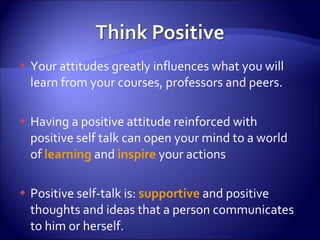
Your attitudes greatly influences what you will learn from your courses, professors and peers. Having a positive attitude reinforced with positive self talk can open your mind to a world of  learning  and  inspire  your actions Positive self-talk is:  supportive  and positive thoughts and ideas that a person communicates to him or herself.
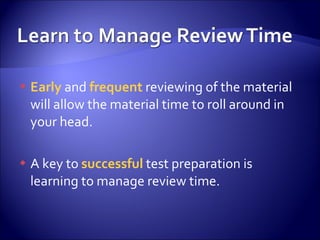
Early  and  frequent  reviewing of the material will allow the material time to roll around in your head. A key to  successful  test preparation is learning to manage review time.
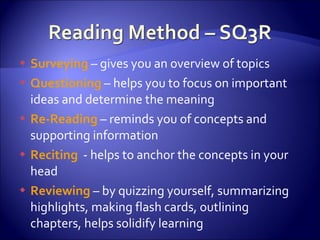
Surveying  – gives you an overview of topics Questioning  – helps you to focus on important ideas and determine the meaning Re-Reading  – reminds you of concepts and supporting information Reciting   - helps to anchor the concepts in your head Reviewing  – by quizzing yourself, summarizing highlights, making flash cards, outlining chapters, helps solidify learning
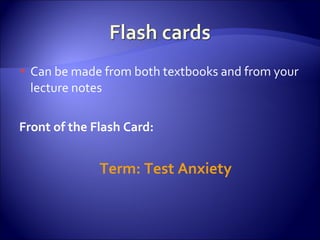
Can be made from both textbooks and from your lecture notes Front of the Flash Card: Term: Test Anxiety
EXPLANATION : A response to a perceived threatening environment, may be related to past negative experiences of feelings of inadequacy. EXAMPLE : Having done badly on a difficult test or have not prepared well
DAILY REVIEWS WEEKLY REVIEWS MAJOR REVIEWS
Daily - briefly look over your notes when you have spare time to keep it fresh in your head Weekly - look over your notes more thoroughly for about an hour to retain the information Major - These review periods are more lengthy , can be anywhere from 2-5 hours but no more than that
Midterms are the biggest review session you will have had thus far Compare them to your other reviews, but know you may have to devote more time because it’s more information
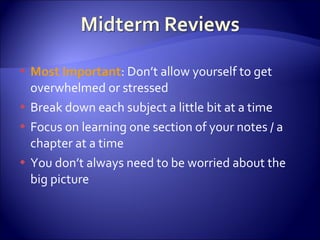
Most Important : Don’t allow yourself to get overwhelmed or stressed Break down each subject a little bit at a time Focus on learning one section of your notes / a chapter at a time You don’t always need to be worried about the big picture
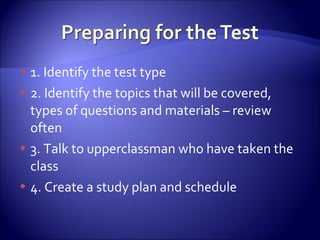
1. Identify the test type 2. Identify the topics that will be covered, types of questions and materials – review often 3. Talk to upperclassman who have taken the class 4. Create a study plan and schedule
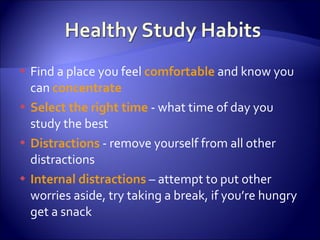
Find a place you feel  comfortable  and know you can  concentrate Select the right time  - what time of day you study the best Distractions  - remove yourself from all other distractions Internal distractions  – attempt to put other worries aside, try taking a break, if you’re hungry get a snack
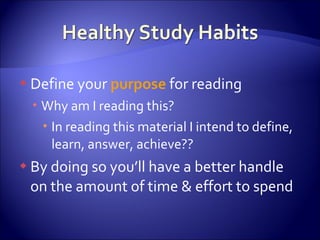
Define your  purpose  for reading  Why am I reading this? In reading this material I intend to define, learn, answer, achieve?? By doing so you’ll have a better handle on the amount of time & effort to spend
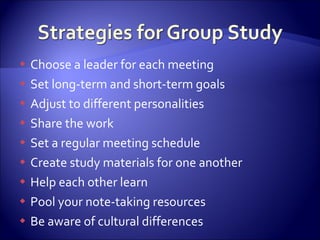
Choose a leader for each meeting Set long-term and short-term goals Adjust to different personalities Share the work Set a regular meeting schedule Create study materials for one another Help each other learn Pool your note-taking resources Be aware of cultural differences
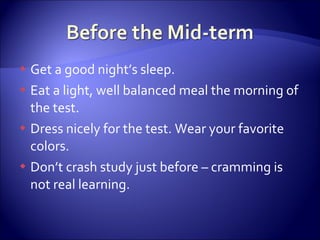
Get a good night’s sleep. Eat a light, well balanced meal the morning of the test. Dress nicely for the test. Wear your favorite colors. Don’t crash study just before – cramming is not real learning.
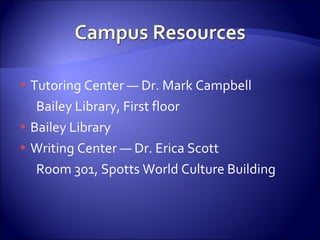
Tutoring Center — Dr. Mark Campbell Bailey Library, First floor Bailey Library Writing Center — Dr. Erica Scott Room 301, Spotts World Culture Building
Study Smart! & Be Yourself! You Can Do It!

Surviving Mid Term

  • 1.
    Genevieve Bordogna, GraduateAssistant Enrollment Services 145 North Hall, Welcome Center
  • 2.
    Education is alifelong Journey who's destination expands as you travel- The Ultimate Gift website.
  • 3.
    Having the abilityto motivate yourself to learn, grow, and work towards what YOU want. The challenge that you all are facing as you begin college is to identify and activate your own personal motivators — these are the forces that move YOU forward.
  • 4.
    Focus on yourself-esteem: a belief in your value as a person How do you know that you have a healthy self-esteem? When can it be considered unhealthy? So it's not just about believing but it's about action as well and the effort that you put into yourself to feel that you have earned your self-esteem Can anyone think of an example of this in their own lives?
  • 5.
    Your attitudes greatlyinfluences what you will learn from your courses, professors and peers. Having a positive attitude reinforced with positive self talk can open your mind to a world of learning and inspire your actions Positive self-talk is: supportive and positive thoughts and ideas that a person communicates to him or herself.
  • 6.
    Early and frequent reviewing of the material will allow the material time to roll around in your head. A key to successful test preparation is learning to manage review time.
  • 7.
    Surveying –gives you an overview of topics Questioning – helps you to focus on important ideas and determine the meaning Re-Reading – reminds you of concepts and supporting information Reciting - helps to anchor the concepts in your head Reviewing – by quizzing yourself, summarizing highlights, making flash cards, outlining chapters, helps solidify learning
  • 8.
    Can be madefrom both textbooks and from your lecture notes Front of the Flash Card: Term: Test Anxiety
  • 9.
    EXPLANATION : Aresponse to a perceived threatening environment, may be related to past negative experiences of feelings of inadequacy. EXAMPLE : Having done badly on a difficult test or have not prepared well
  • 10.
    DAILY REVIEWS WEEKLYREVIEWS MAJOR REVIEWS
  • 11.
    Daily - brieflylook over your notes when you have spare time to keep it fresh in your head Weekly - look over your notes more thoroughly for about an hour to retain the information Major - These review periods are more lengthy , can be anywhere from 2-5 hours but no more than that
  • 12.
    Midterms are thebiggest review session you will have had thus far Compare them to your other reviews, but know you may have to devote more time because it’s more information
  • 13.
    Most Important :Don’t allow yourself to get overwhelmed or stressed Break down each subject a little bit at a time Focus on learning one section of your notes / a chapter at a time You don’t always need to be worried about the big picture
  • 14.
    1. Identify thetest type 2. Identify the topics that will be covered, types of questions and materials – review often 3. Talk to upperclassman who have taken the class 4. Create a study plan and schedule
  • 15.
    Find a placeyou feel comfortable and know you can concentrate Select the right time - what time of day you study the best Distractions - remove yourself from all other distractions Internal distractions – attempt to put other worries aside, try taking a break, if you’re hungry get a snack
  • 16.
    Define your purpose for reading Why am I reading this? In reading this material I intend to define, learn, answer, achieve?? By doing so you’ll have a better handle on the amount of time & effort to spend
  • 17.
    Choose a leaderfor each meeting Set long-term and short-term goals Adjust to different personalities Share the work Set a regular meeting schedule Create study materials for one another Help each other learn Pool your note-taking resources Be aware of cultural differences
  • 18.
    Get a goodnight’s sleep. Eat a light, well balanced meal the morning of the test. Dress nicely for the test. Wear your favorite colors. Don’t crash study just before – cramming is not real learning.
  • 19.
    Tutoring Center —Dr. Mark Campbell Bailey Library, First floor Bailey Library Writing Center — Dr. Erica Scott Room 301, Spotts World Culture Building
  • 20.
    Study Smart! &Be Yourself! You Can Do It!