SURGICAL
SEIVE
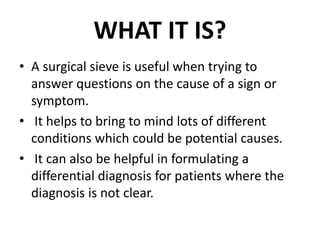
WHAT IT IS?
• A surgical sieve is useful when trying to
answer questions on the cause of a sign or
symptom.
• It helps to bring to mind lots of different
conditions which could be potential causes.
• It can also be helpful in formulating a
differential diagnosis for patients where the
diagnosis is not clear.
• A sieve allows you to gather your thoughts,
working from first principles, and come up
with at least some sensible statements. When
you answer a question, you should really talk
about the most common things first and the
rarities at the end.
• One disadvantage of using a sieve is that you
may not be able to rapidly reorganise your
thoughts in this way, but still it is useful when
all else fails and is invaluable in essay writing.
THE AETIOLOGICAL SIEVE
“ CAT IN CAN MED DIP”Congenital
Acquired
Traumatic
Inflammatory (physical, chemical, infective)
Neoplastic (benign or malignant, primary or secondary)
Circulatory
Autoimmune
Nutritional
Metabolic
Endocrine
Drugs
Degenerative
Iatrogenic
Psychosomatic
THE ANATOMICAL SIEVE
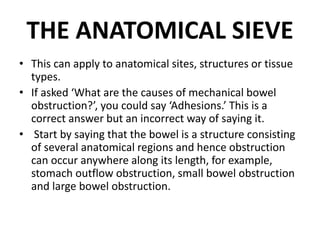
• This can apply to anatomical sites, structures or tissue
types.
• If asked ‘What are the causes of mechanical bowel
obstruction?’, you could say ‘Adhesions.’ This is a
correct answer but an incorrect way of saying it.
• Start by saying that the bowel is a structure consisting
of several anatomical regions and hence obstruction
can occur anywhere along its length, for example,
stomach outflow obstruction, small bowel obstruction
and large bowel obstruction.
• The examiner will then usually pick one route
and lead you along it.
• If writing an essay, you obviously need to
discuss all three.
• Then, add that the bowel is a hollow tube, and
like any hollow tube (cf. ureters) it can become
blocked at three sites: from outside the tube
pressing in (extramural), within the wall of the
tube (intramural) and within the lumen of the
tube (luminal). Where appropriate, answers
should be structured in this way.
Causes of Mechanical Bowel Obstruction
Extramural
Adhesions , Strangulated hernia, Volvulus,
Extrinsic compression
Intramural
Tumours, Infarction, , Strictures, Inflammation
(e.g. Crohn’s)
Luminal
Foreign body, Intussusception, Large polyps
Impacted faeces
GENERAL AND SPECIFIC
• Tell me about postoperative complications.
• Here, we can use two types of classification: one
applies to the type of complication, and the other
gives a time scale.
• Postoperative complications can be generalized,
i.e. applying to any operation (such as the effects
of anaesthesia), or specific, i.e. applying to a
particular operation (such as damage to the
recurrent laryngeal nerve in thyroidectomy).
• Once classified into general and specific the
complications can be broken down further into
time scales. These complications can be
immediate, early or late.
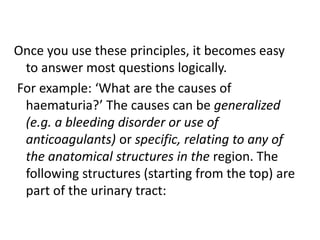
Once you use these principles, it becomes easy
to answer most questions logically.
For example: ‘What are the causes of
haematuria?’ The causes can be generalized
(e.g. a bleeding disorder or use of
anticoagulants) or specific, relating to any of
the anatomical structures in the region. The
following structures (starting from the top) are
part of the urinary tract:
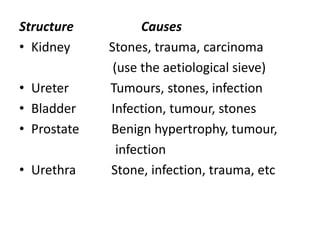
Structure Causes
• Kidney Stones, trauma, carcinoma
(use the aetiological sieve)
• Ureter Tumours, stones, infection
• Bladder Infection, tumour, stones
• Prostate Benign hypertrophy, tumour,
infection
• Urethra Stone, infection, trauma, etc
TISSUE TYPES
• Try to list the causes of a lump in the groin
A good method is to use tissue types, i.e. say that this lump
can arise from any of the tissue types in this region
Tissue type Example
Skin Sebaceous cyst
Adipose tissue Lipoma
Connective tissue Fibroma
Lymphatics Enlarged lymph node
Blood vessels Saphena varix, femoral artery aneurysm
Inguinal canal Inguinal hernia, hydrocoele of the cord
Femoral canal Femoral hernia
Testes Undescended testes
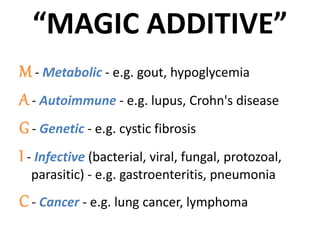
“MAGIC ADDITIVE”
M - Metabolic - e.g. gout, hypoglycemia
A- Autoimmune - e.g. lupus, Crohn's disease
G- Genetic - e.g. cystic fibrosis
I - Infective (bacterial, viral, fungal, protozoal,
parasitic) - e.g. gastroenteritis, pneumonia
C- Cancer - e.g. lung cancer, lymphoma
A- Acquired (environmental factors) - e.g. COPD,
asbestosis
D - Degenerative - e.g. osteoarthritis, dementia
D- Drugs - e.g. penicillin allergy, Clostridium
difficile infection after antibiotics
I - Insanity - psychiatric conditions e.g. depression,
factitious diarrhea
T- Trauma - gun shot wound, surgical trauma
I - Idiopathic - conditions with unknown cause e.g.
idiopathic intracranial hypertension
V- Vascular - e.g. stroke, angina
E- Endocrine - e.g. diabetes, acromegally
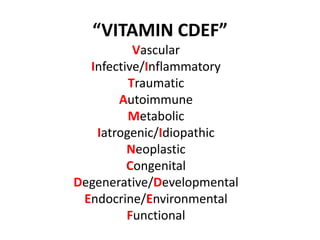
“VITAMIN CDEF”
Vascular
Infective/Inflammatory
Traumatic
Autoimmune
Metabolic
Iatrogenic/Idiopathic
Neoplastic
Congenital
Degenerative/Developmental
Endocrine/Environmental
Functional
“MIDNITE”
Metabolic,
Inflammation
Degenerative
Neoplastic
Infection
Trauma
Environmental.
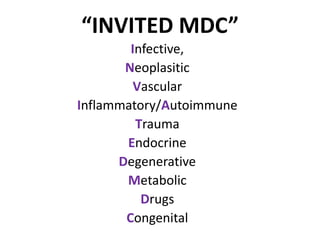
“INVITED MDC”
Infective,
Neoplasitic
Vascular
Inflammatory/Autoimmune
Trauma
Endocrine
Degenerative
Metabolic
Drugs
Congenital
“CA INVITED MD III”
Congenital
Acquired
Infective
Neoplastic
Vascular
Inflammatory
Trauma
Endocrine
Degenerative
Metabolic
Drugs
Idiopathic
Iatrogenic
Immunological
“MEDIC HAT PINE”
Metabolic - Fluid & Electrolyte
Imbalance, Hypoglycaemia, Gout
Endocrine - Diabetes, Adrenal disorders, Thyroid
Disorders
Degenerative - Osteoarthritis, Alzheimers Disease
Infective/Inflammatory - Bacterial, Viral, Fungal,
Parasitic,Pneumonia, Gastroenteritis, Meningitis
Congenital - Genetic Conditions, Down Syndrome
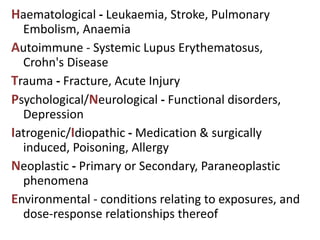
Haematological - Leukaemia, Stroke, Pulmonary
Embolism, Anaemia
Autoimmune - Systemic Lupus Erythematosus,
Crohn's Disease
Trauma - Fracture, Acute Injury
Psychological/Neurological - Functional disorders,
Depression
Iatrogenic/Idiopathic - Medication & surgically
induced, Poisoning, Allergy
Neoplastic - Primary or Secondary, Paraneoplastic
phenomena
Environmental - conditions relating to exposures, and
dose-response relationships thereof
What are the causes of an
acute confusional state in a patient?
Idiopathic/Iatrogenic: polypharmacy, sedatives,
analgesics, steroids, drug withdrawal
Vascular: stroke, TIA, vascular dementia
Inflammatory: infection, systemic inflammatory
response syndrome
Traumatic: head injury, Intracranial hemorrhage, shock
Autoimmune: thyroid disease
Metabolic: electrolyte
imbalance, DKA, hypoglycaemia, SIADH
Infective: sepsis, local infection
Neoplastic: brain tumour, carcinomatosis
Degenerative: Alzheimer's Disease, dementia
What are the causes of splenomegaly?
Idiopathic: Idiopathic thrombocytopenic purpura
Vascular: portal vein obstruction, Budd-Chiari
syndrome, haemoglobinopathies(Sickle-cell
disease, thalassemia)
Infective: AIDS, mononucleosis, septicaemia, tuberculosis,
brucellosis, malaria, infective endocarditis
Traumatic: haematoma, rupture
Autoimmune: rheumatoid arthritis, SLE
Metabolic: mucopolysaccharidoses, amyloidosis, Tangier
disease, Gaucher's disease
Inflammatory: sarcoidosis
Neoplastic: CML, metastases, myeloproliferative disorders
INVESTIGATIONS
Always break down investigations in the following
manner:
1. Simple urine and faecal tests (e.g. urine dipstix,
microscopy and culture, pregnancy tests, faecal
occult blood)
2. Haematological tests (routine, e.g. FBC, or
special, e.g. tumour markers)
3. Radiological tests (e.g. CXR, ultrasound or CT)
4. Special investigations (e.g. gastroscopy, V/Q
scans)
MANAGEMENT
• ‘Discuss the treatment of benign prostatic
hypertrophy’ is a different question from ‘Discuss
the management of benign prostatic
hypertrophy.’
• Management involves discussing all of the steps
that deal with a clinical problem, including the
history, examination, investigations, formation of
a diagnosis and treatment.
• When discussing treatment you can again break
down your answer into subheadings.
• For example: treatment can be conservative, medical
or surgical.
• For example, in this case:
 Conservative.
This usually means ruling out cancer. A prostate specific
antigen (PSA) 4 and a normal examination would help
the doctor reassure the patient and a policy of watchful
waiting may be adopted until the symptoms get worse.
 Medical. For example, drugs such as 1-adreno-
receptor blockers or 5--reductase inhibitors.
 Surgical. For example, trans-urethral resection of the
prostate (TURP).
Mind Bender
It is very important for medical students to be able
to “think outside the box”.
Learn to think outside the box with the help of a
Mind Bender Book.
Mind Bender books are designed to help you think.
Are you smart enough to solve a Mind Bender?
Get a Mind Bender Here: Mind Bender – Payhip
Link: payhip.com/mindbender
Good Luck
Good Luck With Your Studies
Surgical seive

Surgical seive

  • 1.
  • 2.
    WHAT IT IS? •A surgical sieve is useful when trying to answer questions on the cause of a sign or symptom. • It helps to bring to mind lots of different conditions which could be potential causes. • It can also be helpful in formulating a differential diagnosis for patients where the diagnosis is not clear.
  • 3.
    • A sieveallows you to gather your thoughts, working from first principles, and come up with at least some sensible statements. When you answer a question, you should really talk about the most common things first and the rarities at the end. • One disadvantage of using a sieve is that you may not be able to rapidly reorganise your thoughts in this way, but still it is useful when all else fails and is invaluable in essay writing.
  • 4.
    THE AETIOLOGICAL SIEVE “CAT IN CAN MED DIP”Congenital Acquired Traumatic Inflammatory (physical, chemical, infective) Neoplastic (benign or malignant, primary or secondary) Circulatory Autoimmune Nutritional Metabolic Endocrine Drugs Degenerative Iatrogenic Psychosomatic
  • 5.
    THE ANATOMICAL SIEVE •This can apply to anatomical sites, structures or tissue types. • If asked ‘What are the causes of mechanical bowel obstruction?’, you could say ‘Adhesions.’ This is a correct answer but an incorrect way of saying it. • Start by saying that the bowel is a structure consisting of several anatomical regions and hence obstruction can occur anywhere along its length, for example, stomach outflow obstruction, small bowel obstruction and large bowel obstruction.
  • 6.
    • The examinerwill then usually pick one route and lead you along it. • If writing an essay, you obviously need to discuss all three. • Then, add that the bowel is a hollow tube, and like any hollow tube (cf. ureters) it can become blocked at three sites: from outside the tube pressing in (extramural), within the wall of the tube (intramural) and within the lumen of the tube (luminal). Where appropriate, answers should be structured in this way.
  • 7.
    Causes of MechanicalBowel Obstruction Extramural Adhesions , Strangulated hernia, Volvulus, Extrinsic compression Intramural Tumours, Infarction, , Strictures, Inflammation (e.g. Crohn’s) Luminal Foreign body, Intussusception, Large polyps Impacted faeces
  • 8.
    GENERAL AND SPECIFIC •Tell me about postoperative complications. • Here, we can use two types of classification: one applies to the type of complication, and the other gives a time scale. • Postoperative complications can be generalized, i.e. applying to any operation (such as the effects of anaesthesia), or specific, i.e. applying to a particular operation (such as damage to the recurrent laryngeal nerve in thyroidectomy). • Once classified into general and specific the complications can be broken down further into time scales. These complications can be immediate, early or late.
  • 9.
    Once you usethese principles, it becomes easy to answer most questions logically. For example: ‘What are the causes of haematuria?’ The causes can be generalized (e.g. a bleeding disorder or use of anticoagulants) or specific, relating to any of the anatomical structures in the region. The following structures (starting from the top) are part of the urinary tract:
  • 10.
    Structure Causes • KidneyStones, trauma, carcinoma (use the aetiological sieve) • Ureter Tumours, stones, infection • Bladder Infection, tumour, stones • Prostate Benign hypertrophy, tumour, infection • Urethra Stone, infection, trauma, etc
  • 11.
    TISSUE TYPES • Tryto list the causes of a lump in the groin A good method is to use tissue types, i.e. say that this lump can arise from any of the tissue types in this region Tissue type Example Skin Sebaceous cyst Adipose tissue Lipoma Connective tissue Fibroma Lymphatics Enlarged lymph node Blood vessels Saphena varix, femoral artery aneurysm Inguinal canal Inguinal hernia, hydrocoele of the cord Femoral canal Femoral hernia Testes Undescended testes
  • 13.
    “MAGIC ADDITIVE” M -Metabolic - e.g. gout, hypoglycemia A- Autoimmune - e.g. lupus, Crohn's disease G- Genetic - e.g. cystic fibrosis I - Infective (bacterial, viral, fungal, protozoal, parasitic) - e.g. gastroenteritis, pneumonia C- Cancer - e.g. lung cancer, lymphoma
  • 14.
    A- Acquired (environmentalfactors) - e.g. COPD, asbestosis D - Degenerative - e.g. osteoarthritis, dementia D- Drugs - e.g. penicillin allergy, Clostridium difficile infection after antibiotics I - Insanity - psychiatric conditions e.g. depression, factitious diarrhea T- Trauma - gun shot wound, surgical trauma I - Idiopathic - conditions with unknown cause e.g. idiopathic intracranial hypertension V- Vascular - e.g. stroke, angina E- Endocrine - e.g. diabetes, acromegally
  • 16.
  • 17.
  • 18.
  • 19.
    “CA INVITED MDIII” Congenital Acquired Infective Neoplastic Vascular Inflammatory Trauma Endocrine Degenerative Metabolic Drugs Idiopathic Iatrogenic Immunological
  • 20.
    “MEDIC HAT PINE” Metabolic- Fluid & Electrolyte Imbalance, Hypoglycaemia, Gout Endocrine - Diabetes, Adrenal disorders, Thyroid Disorders Degenerative - Osteoarthritis, Alzheimers Disease Infective/Inflammatory - Bacterial, Viral, Fungal, Parasitic,Pneumonia, Gastroenteritis, Meningitis Congenital - Genetic Conditions, Down Syndrome
  • 21.
    Haematological - Leukaemia,Stroke, Pulmonary Embolism, Anaemia Autoimmune - Systemic Lupus Erythematosus, Crohn's Disease Trauma - Fracture, Acute Injury Psychological/Neurological - Functional disorders, Depression Iatrogenic/Idiopathic - Medication & surgically induced, Poisoning, Allergy Neoplastic - Primary or Secondary, Paraneoplastic phenomena Environmental - conditions relating to exposures, and dose-response relationships thereof
  • 23.
    What are thecauses of an acute confusional state in a patient? Idiopathic/Iatrogenic: polypharmacy, sedatives, analgesics, steroids, drug withdrawal Vascular: stroke, TIA, vascular dementia Inflammatory: infection, systemic inflammatory response syndrome Traumatic: head injury, Intracranial hemorrhage, shock Autoimmune: thyroid disease Metabolic: electrolyte imbalance, DKA, hypoglycaemia, SIADH Infective: sepsis, local infection Neoplastic: brain tumour, carcinomatosis Degenerative: Alzheimer's Disease, dementia
  • 24.
    What are thecauses of splenomegaly? Idiopathic: Idiopathic thrombocytopenic purpura Vascular: portal vein obstruction, Budd-Chiari syndrome, haemoglobinopathies(Sickle-cell disease, thalassemia) Infective: AIDS, mononucleosis, septicaemia, tuberculosis, brucellosis, malaria, infective endocarditis Traumatic: haematoma, rupture Autoimmune: rheumatoid arthritis, SLE Metabolic: mucopolysaccharidoses, amyloidosis, Tangier disease, Gaucher's disease Inflammatory: sarcoidosis Neoplastic: CML, metastases, myeloproliferative disorders
  • 25.
    INVESTIGATIONS Always break downinvestigations in the following manner: 1. Simple urine and faecal tests (e.g. urine dipstix, microscopy and culture, pregnancy tests, faecal occult blood) 2. Haematological tests (routine, e.g. FBC, or special, e.g. tumour markers) 3. Radiological tests (e.g. CXR, ultrasound or CT) 4. Special investigations (e.g. gastroscopy, V/Q scans)
  • 26.
    MANAGEMENT • ‘Discuss thetreatment of benign prostatic hypertrophy’ is a different question from ‘Discuss the management of benign prostatic hypertrophy.’ • Management involves discussing all of the steps that deal with a clinical problem, including the history, examination, investigations, formation of a diagnosis and treatment. • When discussing treatment you can again break down your answer into subheadings.
  • 27.
    • For example:treatment can be conservative, medical or surgical. • For example, in this case:  Conservative. This usually means ruling out cancer. A prostate specific antigen (PSA) 4 and a normal examination would help the doctor reassure the patient and a policy of watchful waiting may be adopted until the symptoms get worse.  Medical. For example, drugs such as 1-adreno- receptor blockers or 5--reductase inhibitors.  Surgical. For example, trans-urethral resection of the prostate (TURP).
  • 28.
    Mind Bender It isvery important for medical students to be able to “think outside the box”. Learn to think outside the box with the help of a Mind Bender Book. Mind Bender books are designed to help you think. Are you smart enough to solve a Mind Bender? Get a Mind Bender Here: Mind Bender – Payhip Link: payhip.com/mindbender
  • 29.
    Good Luck Good LuckWith Your Studies

Editor's Notes

  • #6  ADHESION- an abnormal union of membranous surfaces due to inflammation or injury
  • #7 Answering an Essay Essay questions nowadays are not common, but if they do feature tend to be quite generalized; for example, ‘Minimal access surgery — discuss.’ There will, however, always be the odd question based on a detailed knowledge of one condition The following is a guide for the headings you can use in writing such an essay; some surgeons refer to this as the pathological sieve. Definition Aetiology (incidence, age, sex, geography)/risk factors Histology (macro and micro) Clinical features (signs and symptoms) Diagnosis (and differential) Clinical staging (if appropriate) Investigations/treatment/management Complications Prognosis
  • #12 A saphena varix, or a saphenous varix is a dilation of the saphenous vein at its junction with the femoral vein in the groin. History of a Lump Surgery is full of lumps. No matter where the lump is, there are only five questions you need to remember when taking the history of a lump: When and how did you first notice the lump? How has the lump changed since you first not noticed it? What symptoms does it cause you? Have you got any more or have you had this before? What do you think it is?
  • #24 SIADH- SYNDROME OF INAPPROPRIATE ANTI-DIURETIC HORMONE PRODUCTION
  • #28 Management involves discussing all of the steps that deal with a clinical problem including the history, examination investigations, formation of a diagnosis and treatment Remember that management depends on diagnosis and that diagnosis depends on history, examination and special investigations. Therefore ‘management’ refers to all of the steps of clinical assessment and investigation as well as treatment. For example, if i asked how you would manage a case of acute cholecystitis, you need to say that you would give the patient adequate analgesia, arrange admission to a surgical bed, put up a drip, keep nil by mouth, etc., before talking about liver function tests or ultrasound scans (which would not normally be available immediately).
  • #29 It is very important for medical students to be able to “think outside the box”. Learn to think outside the box with the help of a Mind Bender Book. Mind Bender books are designed to help you think. Are you smart enough to solve a Mind Bender? Get a Mind Bender Here: Mind Bender – Payhip Alternative: payhip.com/mindbender