Definition
Aging is the progressive intrinsic universally prevalent
physiological process producing measurable changes in
the structure and function of tissues and organs.
The issue
The ratio of emergency to elective surgery increases with
age. Emergencies are 60-85% Lit
Mortality (30 days)is 5-10% in elective surgery and 20-
40%in emergency surgery
In the aged these figures rise dramatically to 20-25%
elective and 60-80% emergency surgery.
Cardiovascular system
Heart muscle :is gradually replaced with fibrosis
and senile amyloid
Valvular calcification(Aortic) and mucoid (Mitral)
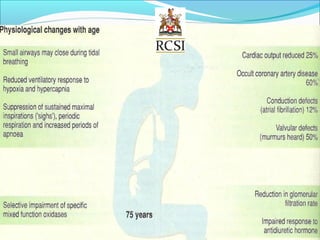
Overall there is a fall in COP of 1%/year from the
mid-fifties.thus in the 74-84 group the fall will be
80%.So there is little reserve to meet stresses.
Conduction defects are common.
There is an increased risk of sick sinus,BBB,AF.
Respiratory system
Increased fibrous tissue,
decreased elastin,
alveolar septal breakdown
Chest wall calcification
All the above will lead to:
Decreased compliance
Loss of elastic recoil
Increased ventilation/perfusion mismatch
Respiratory system
There is an increase in FAC at the expense of
expiratory reserve volume(ERV). Vital
capacity(VC) is therefore reduced
Small airways close even during tidal breathing.
Elderly show a marked reduction in ventilatory
response to hypoxia and hypercapnia.
THERE IS AN INCREASED RISK OF APNOIC
ATTACKS DURING SLEEP
HEPATIC FUNCTION
Reduction in hepatic mass is 40% by the age of 80 years.
Function is mainly preserved but some specific
microsomal mixed oxidase systems are notably affected
Renal function
GFR normally 120ml/min falls by 8 ml every decade after
the age of 20 .
Thus an 80 years old may have a GFR that is reduced by
45% ie 65ml/min .
This is a 50%reduction of the functioning nephrons
There is an impaired responsiveness to ADH and
decreased ability to concentrate urine
30% of patients over 75 years of age undergo surgery with
coexisting renal impairement
ARF is responsible for 20% of perioperative deaths in
elderly.
Metabolism
There is a decreased ability to handle glucose load
Type II NIDD is common 4%
Hypothyroidism 3%
Intra-operative and post-operative core temperature are
lower in elderly.
Body composition
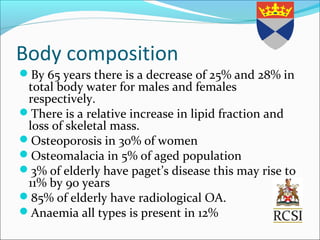
By 65 years there is a decrease of 25% and 28% in
total body water for males and females
respectively.
There is a relative increase in lipid fraction and
loss of skeletal mass.
Osteoporosis in 30% of women
Osteomalacia in 5% of aged population
3% of elderly have paget’s disease this may rise to
11% by 90 years
85% of elderly have radiological OA.
Anaemia all types is present in 12%
Pharmacokinetics
Regular medication is consumed by 75% of patients.
30% take 4 or more drugs/day.
Noncompliance is estimated at 60% and adverse drug
reaction increaese from 20% in middle age to 30% in the
aged .
Drug absorption is little affected by age
But because of the relative increase in the lipid fraction of
the body compositon the volume of distribution of fat
soluble drugs like diazepam ,lignocaine is increased,where
as the distribution of polar drugs digoxin is reduced
Pharmacokinetics
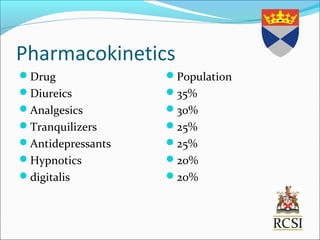
Drug
Diureics
Analgesics
Tranquilizers
Antidepressants
Hypnotics
digitalis
Population
35%
30%
25%
25%
20%
20%
Pharmacokinetics
Surgery in the elderly
Pharmacokinetics
Because of reduced GFR several drugs accumulate if given
in young adult dose.
The half-life of benzodiazepines may extend 5 folds.
Diuretics can produce
hypotension,hypovolaemia,decrease K,and potentiate the
digitalis toxicity
Oral hypoglycaemics should be stopped 48 hours before
surgery
Pharmacokinetics
Oral hypoglycaemics should be stopped 48 hours before
surgery
Drugs with anti cholinergic activity like tricyclic
antidepressants ,phenothiazines are more likely to
precipitate urine retention and constipation.
End receptor sensitivity may be increased with hypnotics
and may cause postoperative confusion
Per operative risk and outcome
In the over 65 years old the overall mortality is for major
surgery defined as death within 30 days is 10%
The risk of per operative mortality increases with age
Morbidity is related to age-related chronic medical
problems
Isolated diseases is unlikely in the over 75 years
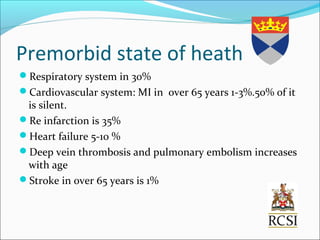
Premorbid state of heath
Respiratory system in 30%
Cardiovascular system: MI in over 65 years 1-3%.50% of it
is silent.
Re infarction is 35%
Heart failure 5-10 %
Deep vein thrombosis and pulmonary embolism increases
with age
Stroke in over 65 years is 1%
We can improve it
The problem will continue to rise as the projected increase
over the coming 10 years is more than 40% increase .
Aortic aneurysm repair, incarcerated hernia and biliary
calculus disease are three areas where marked differences
in outcome can be anticipated (elective versus emergency
surgery)
What to do?
The world demographic changes have produced a vast
majority of geriatric population .
A rigorous search for preoperative heart failure, renal
failure and hydration imbalance must be conducted
Close monitoring of all postoperative aged patients is
essential

Surgery in the elderly

  • 1.
    Definition Aging is theprogressive intrinsic universally prevalent physiological process producing measurable changes in the structure and function of tissues and organs.
  • 2.
    The issue The ratioof emergency to elective surgery increases with age. Emergencies are 60-85% Lit Mortality (30 days)is 5-10% in elective surgery and 20- 40%in emergency surgery In the aged these figures rise dramatically to 20-25% elective and 60-80% emergency surgery.
  • 3.
    Cardiovascular system Heart muscle:is gradually replaced with fibrosis and senile amyloid Valvular calcification(Aortic) and mucoid (Mitral) Overall there is a fall in COP of 1%/year from the mid-fifties.thus in the 74-84 group the fall will be 80%.So there is little reserve to meet stresses. Conduction defects are common. There is an increased risk of sick sinus,BBB,AF.
  • 4.
    Respiratory system Increased fibroustissue, decreased elastin, alveolar septal breakdown Chest wall calcification All the above will lead to: Decreased compliance Loss of elastic recoil Increased ventilation/perfusion mismatch
  • 5.
    Respiratory system There isan increase in FAC at the expense of expiratory reserve volume(ERV). Vital capacity(VC) is therefore reduced Small airways close even during tidal breathing. Elderly show a marked reduction in ventilatory response to hypoxia and hypercapnia. THERE IS AN INCREASED RISK OF APNOIC ATTACKS DURING SLEEP
  • 6.
    HEPATIC FUNCTION Reduction inhepatic mass is 40% by the age of 80 years. Function is mainly preserved but some specific microsomal mixed oxidase systems are notably affected
  • 7.
    Renal function GFR normally120ml/min falls by 8 ml every decade after the age of 20 . Thus an 80 years old may have a GFR that is reduced by 45% ie 65ml/min . This is a 50%reduction of the functioning nephrons There is an impaired responsiveness to ADH and decreased ability to concentrate urine 30% of patients over 75 years of age undergo surgery with coexisting renal impairement ARF is responsible for 20% of perioperative deaths in elderly.
  • 8.
    Metabolism There is adecreased ability to handle glucose load Type II NIDD is common 4% Hypothyroidism 3% Intra-operative and post-operative core temperature are lower in elderly.
  • 9.
    Body composition By 65years there is a decrease of 25% and 28% in total body water for males and females respectively. There is a relative increase in lipid fraction and loss of skeletal mass. Osteoporosis in 30% of women Osteomalacia in 5% of aged population 3% of elderly have paget’s disease this may rise to 11% by 90 years 85% of elderly have radiological OA. Anaemia all types is present in 12%
  • 10.
    Pharmacokinetics Regular medication isconsumed by 75% of patients. 30% take 4 or more drugs/day. Noncompliance is estimated at 60% and adverse drug reaction increaese from 20% in middle age to 30% in the aged . Drug absorption is little affected by age But because of the relative increase in the lipid fraction of the body compositon the volume of distribution of fat soluble drugs like diazepam ,lignocaine is increased,where as the distribution of polar drugs digoxin is reduced
  • 11.
  • 12.
  • 14.
  • 15.
    Pharmacokinetics Because of reducedGFR several drugs accumulate if given in young adult dose. The half-life of benzodiazepines may extend 5 folds. Diuretics can produce hypotension,hypovolaemia,decrease K,and potentiate the digitalis toxicity Oral hypoglycaemics should be stopped 48 hours before surgery
  • 16.
    Pharmacokinetics Oral hypoglycaemics shouldbe stopped 48 hours before surgery Drugs with anti cholinergic activity like tricyclic antidepressants ,phenothiazines are more likely to precipitate urine retention and constipation. End receptor sensitivity may be increased with hypnotics and may cause postoperative confusion
  • 17.
    Per operative riskand outcome In the over 65 years old the overall mortality is for major surgery defined as death within 30 days is 10% The risk of per operative mortality increases with age Morbidity is related to age-related chronic medical problems Isolated diseases is unlikely in the over 75 years
  • 18.
    Premorbid state ofheath Respiratory system in 30% Cardiovascular system: MI in over 65 years 1-3%.50% of it is silent. Re infarction is 35% Heart failure 5-10 % Deep vein thrombosis and pulmonary embolism increases with age Stroke in over 65 years is 1%
  • 19.
    We can improveit The problem will continue to rise as the projected increase over the coming 10 years is more than 40% increase . Aortic aneurysm repair, incarcerated hernia and biliary calculus disease are three areas where marked differences in outcome can be anticipated (elective versus emergency surgery)
  • 20.
    What to do? Theworld demographic changes have produced a vast majority of geriatric population . A rigorous search for preoperative heart failure, renal failure and hydration imbalance must be conducted Close monitoring of all postoperative aged patients is essential