A new software for the measurementA new software for the measurement
of the hip-knee condylar angleof the hip-knee condylar angle
Mr.Mubarak M.F.A. KerimMr.Mubarak M.F.A. Kerim
Associate ProfessorAssociate Professor
Consultant 0rthopaedic SurgeonConsultant 0rthopaedic Surgeon
Khartoum North Teaching HospitalKhartoum North Teaching Hospital
MBBS MCh Orth(UK) FRCSI FRCSEd FRSM(UK)MBBS MCh Orth(UK) FRCSI FRCSEd FRSM(UK)
IntroductionIntroduction
 Osteoarthritis of the knee is a majorOsteoarthritis of the knee is a major
problemproblem
 Total knee Arthroplasty is theTotal knee Arthroplasty is the
ultimate treatment.ultimate treatment.
 Success & longevity depends onSuccess & longevity depends on
many factorsmany factors
 Aims of TKA:Aims of TKA:
• Relief of painRelief of pain
• Restore alignmentRestore alignment
Technical AspectsTechnical Aspects
 Restoration of mechanical alignment.Restoration of mechanical alignment.
 Preservation of joint line.Preservation of joint line.
 Balanced ligaments.Balanced ligaments.
 Radiological evaluation is essentialRadiological evaluation is essential
for follow-upfor follow-up
The concept of ideal alignment inThe concept of ideal alignment in
total knee arthroplasty has beentotal knee arthroplasty has been
stressed by many authors.stressed by many authors.
 InsallInsall et al.et al. (1985) recommended to(1985) recommended to
err on the valgus angle.err on the valgus angle.
 Peterson & Engh (1988)Peterson & Engh (1988)
recommended a line passing throughrecommended a line passing through
the middle of the prosthesisthe middle of the prosthesis
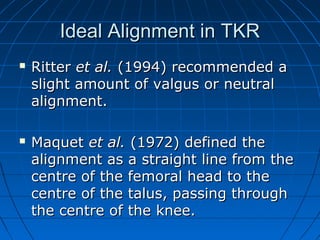
Ideal Alignment in TKRIdeal Alignment in TKR
 RitterRitter et al.et al. (1994) recommended a(1994) recommended a
slight amount of valgus or neutralslight amount of valgus or neutral
alignment.alignment.
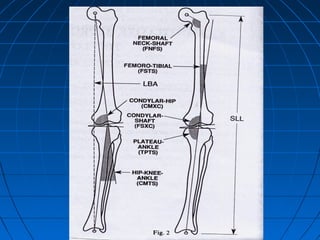
 MaquetMaquet et al.et al. (1972) defined the(1972) defined the
alignment as a straight line from thealignment as a straight line from the
centre of the femoral head to thecentre of the femoral head to the
centre of the talus, passing throughcentre of the talus, passing through
the centre of the knee.the centre of the knee.
Methods used to measure angles ofMethods used to measure angles of
alignmentalignment
 Two methodsTwo methods
• Conventional manual methodConventional manual method
• Computerized methodComputerized method
Conventional methodConventional method
 Too tediousToo tedious
 Time consumingTime consuming
 Limitations of goniometryLimitations of goniometry
 Inherited inaccuraciesInherited inaccuracies
• Positioning problemsPositioning problems
• DeformityDeformity
• Lack of standardizationLack of standardization
• ParallaxParallax
Computerized methodComputerized method
 Easy, inexpensiveEasy, inexpensive
 Converts radiological images intoConverts radiological images into
clinical dataclinical data
 Data can be stored & retrievedData can be stored & retrieved
 Ability to manipulate imageAbility to manipulate image
 ReproducibleReproducible
 Allows non-medically qualifiedAllows non-medically qualified
personnel to measure angles.personnel to measure angles.
MaterialsMaterials
 Sixty radiological films of the knees afterSixty radiological films of the knees after
TKR done by me as specialist registrarTKR done by me as specialist registrar
(short films) were selected randomly.(short films) were selected randomly.
 Personal ComputerPersonal Computer
 ScannerScanner
 X-ray analyser softwareX-ray analyser software
MethodMethod
 Films scanned, digitized & stored TIFFilms scanned, digitized & stored TIF
 Two sets of readings, two weeksTwo sets of readings, two weeks
interval – single observerinterval – single observer
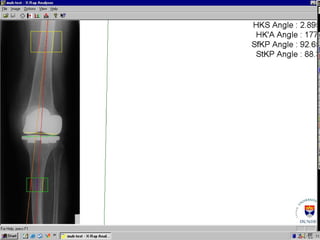
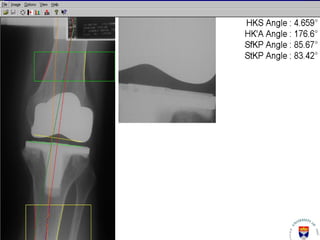
 Select 4 points on the imageSelect 4 points on the image
• Two on the lower edge of the femoralTwo on the lower edge of the femoral
componentcomponent
• Two on the upper edge of the tibialTwo on the upper edge of the tibial
componentcomponent
Method continuedMethod continued
 Draw a box on the femur as farDraw a box on the femur as far
proximally as the X-ray allowsproximally as the X-ray allows
 Click on the analyserClick on the analyser
Computerised routineComputerised routine
 The grey scale 0-256.The grey scale 0-256.
. Precision of measurements depends on degree of. Precision of measurements depends on degree of
resolutionresolution
 Digitised x-ray with the grey values over theDigitised x-ray with the grey values over the
image, anatomical features still identified on it.image, anatomical features still identified on it.
 Algorithm used for automatic identification ofAlgorithm used for automatic identification of
boundaries between bone and soft tissue.boundaries between bone and soft tissue.
 Within an area the computer detects bony edges.Within an area the computer detects bony edges.
ResultsResults
Results obtained were named readingResults obtained were named reading
1 and reading 21 and reading 2
The pairedThe paired tt-test and Pearson-test and Pearson’’ss
correlation were used to analyse thecorrelation were used to analyse the
results.results.
ResultsResults
 Readings were named reading 1 & 2Readings were named reading 1 & 2
 The paired t-test and PearsonThe paired t-test and Pearson’’ss
correlation were used to analysecorrelation were used to analyse
results.results.
Paired sample statisticsPaired sample statistics
 Mean of reading 1 is 9.789Mean of reading 1 is 9.789
 Mean of reading 2 is 10.112Mean of reading 2 is 10.112
 Mean of difference is 0.324Mean of difference is 0.324
 Minimum difference is 0.167Minimum difference is 0.167
 Maximum difference is 3.13Maximum difference is 3.13
 STD of mean difference is 1.214STD of mean difference is 1.214
 T-test is 0.937T-test is 0.937
 Pearson correlation 0.999Pearson correlation 0.999
 Confidence interval is 2.055Confidence interval is 2.055
Intra-observer variabilityIntra-observer variability
13%
28%
41%
12%
3% 3%
0 - .499
.5 - .999
1 - 1.499
1.5 - 1.99
2 - 2.499
> 2.5
0
5
10
15
20
25
30
35
40
0-4 4 to 6 6 to 9 >9
First reading in degrees
Second reading in degrees
DiscussionDiscussion
 Computer reduces errors arising fromComputer reduces errors arising from
subjective component of conventionalsubjective component of conventional
method.method.
 This method automatically determines theThis method automatically determines the
long axis of the bone.long axis of the bone.
 Cost is reduced by using personalCost is reduced by using personal
computer.computer.
 Image manipulation does not substituteImage manipulation does not substitute
for poor quality x-rays.for poor quality x-rays.
 Visual feedback is important in certainVisual feedback is important in certain
situations.situations.
Figure 1 : Intra Observer
13%
28%
41%
12%
3% 3%
0 - .499
.5 - .999
1 - 1.499
1.5 - 1.99
2 - 2.499
> 2.5
ConclusionConclusion
 Computerized method is preciseComputerized method is precise
 ReliableReliable
 In-expensiveIn-expensive
 Can enable non-medically qualified personnel toCan enable non-medically qualified personnel to
measure angles and distances in TKRmeasure angles and distances in TKR
 Matches all knee scoresMatches all knee scores
LimitationsLimitations
 Positioning of the limb.Positioning of the limb.
 Morphological factors.Morphological factors.
 Quality of radiographsQuality of radiographs
Thank You !Thank You !
Thank youThank you

Hip knee condylar angle

  • 3.
    A new softwarefor the measurementA new software for the measurement of the hip-knee condylar angleof the hip-knee condylar angle Mr.Mubarak M.F.A. KerimMr.Mubarak M.F.A. Kerim Associate ProfessorAssociate Professor Consultant 0rthopaedic SurgeonConsultant 0rthopaedic Surgeon Khartoum North Teaching HospitalKhartoum North Teaching Hospital MBBS MCh Orth(UK) FRCSI FRCSEd FRSM(UK)MBBS MCh Orth(UK) FRCSI FRCSEd FRSM(UK)
  • 4.
    IntroductionIntroduction  Osteoarthritis ofthe knee is a majorOsteoarthritis of the knee is a major problemproblem  Total knee Arthroplasty is theTotal knee Arthroplasty is the ultimate treatment.ultimate treatment.  Success & longevity depends onSuccess & longevity depends on many factorsmany factors  Aims of TKA:Aims of TKA: • Relief of painRelief of pain • Restore alignmentRestore alignment
  • 5.
    Technical AspectsTechnical Aspects Restoration of mechanical alignment.Restoration of mechanical alignment.  Preservation of joint line.Preservation of joint line.  Balanced ligaments.Balanced ligaments.  Radiological evaluation is essentialRadiological evaluation is essential for follow-upfor follow-up
  • 7.
    The concept ofideal alignment inThe concept of ideal alignment in total knee arthroplasty has beentotal knee arthroplasty has been stressed by many authors.stressed by many authors.  InsallInsall et al.et al. (1985) recommended to(1985) recommended to err on the valgus angle.err on the valgus angle.  Peterson & Engh (1988)Peterson & Engh (1988) recommended a line passing throughrecommended a line passing through the middle of the prosthesisthe middle of the prosthesis
  • 8.
    Ideal Alignment inTKRIdeal Alignment in TKR  RitterRitter et al.et al. (1994) recommended a(1994) recommended a slight amount of valgus or neutralslight amount of valgus or neutral alignment.alignment.  MaquetMaquet et al.et al. (1972) defined the(1972) defined the alignment as a straight line from thealignment as a straight line from the centre of the femoral head to thecentre of the femoral head to the centre of the talus, passing throughcentre of the talus, passing through the centre of the knee.the centre of the knee.
  • 9.
    Methods used tomeasure angles ofMethods used to measure angles of alignmentalignment  Two methodsTwo methods • Conventional manual methodConventional manual method • Computerized methodComputerized method
  • 10.
    Conventional methodConventional method Too tediousToo tedious  Time consumingTime consuming  Limitations of goniometryLimitations of goniometry  Inherited inaccuraciesInherited inaccuracies • Positioning problemsPositioning problems • DeformityDeformity • Lack of standardizationLack of standardization • ParallaxParallax
  • 11.
    Computerized methodComputerized method Easy, inexpensiveEasy, inexpensive  Converts radiological images intoConverts radiological images into clinical dataclinical data  Data can be stored & retrievedData can be stored & retrieved  Ability to manipulate imageAbility to manipulate image  ReproducibleReproducible  Allows non-medically qualifiedAllows non-medically qualified personnel to measure angles.personnel to measure angles.
  • 13.
    MaterialsMaterials  Sixty radiologicalfilms of the knees afterSixty radiological films of the knees after TKR done by me as specialist registrarTKR done by me as specialist registrar (short films) were selected randomly.(short films) were selected randomly.  Personal ComputerPersonal Computer  ScannerScanner  X-ray analyser softwareX-ray analyser software
  • 16.
    MethodMethod  Films scanned,digitized & stored TIFFilms scanned, digitized & stored TIF  Two sets of readings, two weeksTwo sets of readings, two weeks interval – single observerinterval – single observer  Select 4 points on the imageSelect 4 points on the image • Two on the lower edge of the femoralTwo on the lower edge of the femoral componentcomponent • Two on the upper edge of the tibialTwo on the upper edge of the tibial componentcomponent
  • 17.
    Method continuedMethod continued Draw a box on the femur as farDraw a box on the femur as far proximally as the X-ray allowsproximally as the X-ray allows  Click on the analyserClick on the analyser
  • 18.
    Computerised routineComputerised routine The grey scale 0-256.The grey scale 0-256. . Precision of measurements depends on degree of. Precision of measurements depends on degree of resolutionresolution  Digitised x-ray with the grey values over theDigitised x-ray with the grey values over the image, anatomical features still identified on it.image, anatomical features still identified on it.  Algorithm used for automatic identification ofAlgorithm used for automatic identification of boundaries between bone and soft tissue.boundaries between bone and soft tissue.  Within an area the computer detects bony edges.Within an area the computer detects bony edges.
  • 21.
    ResultsResults Results obtained werenamed readingResults obtained were named reading 1 and reading 21 and reading 2 The pairedThe paired tt-test and Pearson-test and Pearson’’ss correlation were used to analyse thecorrelation were used to analyse the results.results.
  • 22.
    ResultsResults  Readings werenamed reading 1 & 2Readings were named reading 1 & 2  The paired t-test and PearsonThe paired t-test and Pearson’’ss correlation were used to analysecorrelation were used to analyse results.results.
  • 23.
    Paired sample statisticsPairedsample statistics  Mean of reading 1 is 9.789Mean of reading 1 is 9.789  Mean of reading 2 is 10.112Mean of reading 2 is 10.112  Mean of difference is 0.324Mean of difference is 0.324  Minimum difference is 0.167Minimum difference is 0.167  Maximum difference is 3.13Maximum difference is 3.13  STD of mean difference is 1.214STD of mean difference is 1.214  T-test is 0.937T-test is 0.937  Pearson correlation 0.999Pearson correlation 0.999  Confidence interval is 2.055Confidence interval is 2.055
  • 24.
    Intra-observer variabilityIntra-observer variability 13% 28% 41% 12% 3%3% 0 - .499 .5 - .999 1 - 1.499 1.5 - 1.99 2 - 2.499 > 2.5
  • 26.
    0 5 10 15 20 25 30 35 40 0-4 4 to6 6 to 9 >9 First reading in degrees Second reading in degrees
  • 27.
    DiscussionDiscussion  Computer reduceserrors arising fromComputer reduces errors arising from subjective component of conventionalsubjective component of conventional method.method.  This method automatically determines theThis method automatically determines the long axis of the bone.long axis of the bone.  Cost is reduced by using personalCost is reduced by using personal computer.computer.  Image manipulation does not substituteImage manipulation does not substitute for poor quality x-rays.for poor quality x-rays.  Visual feedback is important in certainVisual feedback is important in certain situations.situations.
  • 29.
    Figure 1 :Intra Observer 13% 28% 41% 12% 3% 3% 0 - .499 .5 - .999 1 - 1.499 1.5 - 1.99 2 - 2.499 > 2.5
  • 30.
    ConclusionConclusion  Computerized methodis preciseComputerized method is precise  ReliableReliable  In-expensiveIn-expensive  Can enable non-medically qualified personnel toCan enable non-medically qualified personnel to measure angles and distances in TKRmeasure angles and distances in TKR  Matches all knee scoresMatches all knee scores
  • 31.
    LimitationsLimitations  Positioning ofthe limb.Positioning of the limb.  Morphological factors.Morphological factors.  Quality of radiographsQuality of radiographs
  • 32.
  • 33.