
CAESAREAN SECTION
Caesarean section may be an emergency procedure or an
elective and hence planned procedure.
Preparation for the surgery may be done in the labour room or
in the theatre itself. This includes putting a catheter into your
bladder to drain urine, and an intravenous line (needle) into a
vein in your hand or arm to give your body fluids and
medications as required.
CAESAREAN SECTION
Introduction
• Caesarean section (C-section) is the delivery of a baby through a cut in
the mother’s lower abdomen and the uterus.
It was an operation with many risks, less than a century ago. Today, it is
one of the most frequently performed surgeries in the world. Caesarean
births are more common than most surgeries (such as gallbladder
removal, hysterectomy or tonsillectomy) due to many factors. One factor,
of course, is that nearly 50% of the world population are women, and
pregnancy is still a very common condition! However, more important is
the fact that a Caesarean section may be life saving for the baby, or
mother (or both).
Caesarean birth is also much safer today than it was a few decades ago.
Thus ‘caesarean’ is not something that should scare you, as the ultimate
goal is a healthy mother and healthy baby, regardless of the method of
delivery.
It is important to know a few things about caesarean section in order to
be prepared for a caesarean birth if it does happen to you.
• You may be given an antacid orally, or injections like
Perinorm or Ranitidine to reduce the level of acid in your
stomach and prevent vomiting.
• Your abdomen and pubic hair will be shaved, and the area
washed with an antibacterial solution.
• Suitable anaesthesia is given to you so that you are pain-
free during the procedure.
• The doctor makes the skin incision first. This is either a
vertical incision in the middle from below the navel up to
the pubic bone. A transverse or ‘bikinicut’ incision (called
pfannesteil incision) from side to side just above your pubic
hairline
•
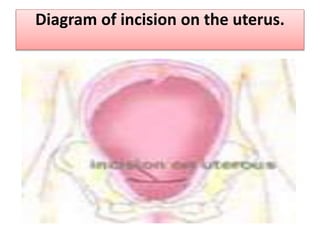
Diagram of incision on the uterus.
WWW.EASTZONEMEDICO.COM
• The amniotic sac (bag of water) is broken and your baby is delivered either by
hand or using forceps. At this point if you are under regional anaesthesia, you
may feel some tugging, pulling or some pressure on the upper abdomen.
• The umbilical cord is clamped and cut, and your baby is handed to the
neonatologist or nurse for evaluation.
• The placenta is detatched from the uterine wall and removed.
• The uterine incision is closed using sutures (usually) or staples, and bleeding is
controlled.
• The abdomen is now closed, and the skin sutured. Depending on the initial skin
incision, the skin may be closed with removable sutures, staples, or subcuticular
(under the skin surface) dissolvable sutures.
• You may be given your baby to hold if you are feeling upto it, After observing
your vital parameters (pulse, blood pressure, etc.) for some time you may be
shifted to your room.
• The complete procedure takes about 45 minutes to one hour in an
uncomplicated case. From the initial incision to delivery of the baby takes about
5 minutes, and the remaining time is taken for repairing your uterus and
abdominal wall.
Different measures may be used for pain relief before, during and after your
caesarean.
Before Operation:
If you had been in labour, you may have been taking medications for pain relief. If an
epidural is already in place, for example when you have been in labour for a while
before you needed a caesarean section, it is usually continued for the surgery.
During the surgery:
• Regional anaesthesia, that is one, which acts to block the pain only at the
operative area (and below), is usually preferred. This may be an epidural,
typically being continued from labour analgesia.
Another type of regional anaesthesia is spinal anaesthesia, which can be given
more quickly, provides better pain relief and is usually preferred if an anaesthetic
is not already given.
The advantages of regional anaesthesia include the fact that you are not
unconscious only the lower half of your body is numb. Hence, you are aware of
when your baby is delivered and may even see / hold the baby before he / she is
shifted out of the operating room. More than that, some risks of general
anaesthesia like aspiration, respiratory complications and delayed breastfeeding
are also avoided.
It may be possible that a regional anaesthetic cannot be given to you for medical
reasons. Another possibility is that, in an emergency caesarean . There may not
be enough time to give a regional block. In such cases general anaesthesia is
given, where you will be completely unconscious during the surgery. Some
women, who are apprehensive about the surgery may infact opt for general
anaesthesia as a personal choice. Your doctor, in conjunction with the
anaesthesiologist (doctor giving the pain relief) will be the right person to help
you decide what is best for you.
Emergency Caesarean Section
• Common indications for emergency caesarean sections are
• Foetal distress .
• Dystocia or non-progress of labour .
• Bleeding from your placenta.
• An emergency surgery is always more risky than a planned procedure.
This may be because you are not on empty stomach, or there are life
threatening problems like severe bleeding or rise in your blood pressure,
or complete facilities like experienced anaesthetist / neonatologist /
operative team / blood may not be immediately available.
This is one reason why your doctor may suggest a planned or elective
caesarean section to you. If there are certain pre-existing conditions,
which make it nearly certain that you will not be able to deliver safely
vaginally, it may be better to do a planned procedure. This could be for
reasons like
• Previous 2 or more caesareans .
• Placenta praevia.
• Mal-presentations of your baby etc .
Dystocia
• The causes of dystocia are many, but basically
the end result is that labour fails to progress,
is prolonged excessively, or gets arrested. .
• Your doctor may try measures like
augmenting contractions with oxytocin, or
rupturing the amniotic sac to improve the
labour pattern. If these fail, however
Caesarean section may be the only option.
• Your baby may not be tolerating the forces of
labour well, and may show problems like
irregularity or slowing of the heart rate, or
acid in the blood. Sometimes greenish
discolouration of the amniotic fluid (passage
of meconium or foetal stools in utero) may
be a sign of distress. If vaginal delivery
cannot be completed quickly, a caesarean
may be the best way to serve your baby.
Foetal distress
Mal-presentations
• Unfavorable positions of the foetus in utero can make vaginal delivery difficult,
dangerous or impossible.
These include:
• Transverse lie.
• Shoulder presentation.
• Oblique lie.
• Breech presentation (buttocks first).
• Posterior face presentation.
• Face presentation
• Brow presentation
• Some of these conditions may be corrected before the onset of pains by a
procedure called ‘external cephalic version’, by which your doctor attempts to
turn the baby to the correct position. This may not be feasible or safe in all cases.
Though, for breech, particularly if you have had a normal delivery earlier, it may
be possible in some cases to deliver the baby vaginally. However, even without
difficulties in delivery, breech babies have a less favorable outcome. Hence many
doctors opt for planned caesarean. This is a problem, which needs prior
discussion with your doctor.
Placental or cord problem
• The placenta is the main connection between the mother
and the foetus providing nutrition, oxygen and other
essentials to the baby via the umbilical cord.
Bleeding occurring from the placenta before delivery can
be risky. It may be due to an abnormal location of the
placenta, ‘placenta praevia’ . It may be due to early
separation of a normally located placenta called ‘abruption
placenta.’. These can endanger your life or your baby’s
health. Hence a Caesarean section may be done.
The umbilical cord may prolapse (come out) into the vagina
before the baby’s birth. This is more common with
malpresentations. Pressure on the prolapsed cord can lead
to baby’s death. Hence an emergency caesarean section is
usually required.
• Pre-eclampsia or Pregnancy Induced Hypertension (PIH) is
a leading cause of maternal and foetal problem, even
today. Due to uncontrolled blood pressure or impending
complication likes eclampsia, HELP syndrome it may be
necessary to opt for caesarean birth.
• Maternal diabetes in pregnancy is also associated with
problems, which may make caesarean birth a safer option.
• Other medical illness like severe asthma, certain types of
cardiac diseases, etc. may also preclude labour as mother,
baby or both may not be able to tolerate labour well.
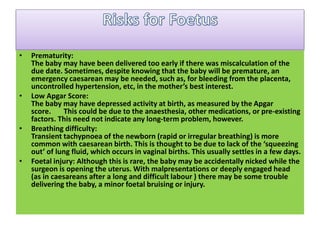
• Prematurity:
The baby may have been delivered too early if there was miscalculation of the
due date. Sometimes, despite knowing that the baby will be premature, an
emergency caesarean may be needed, such as, for bleeding from the placenta,
uncontrolled hypertension, etc, in the mother’s best interest.
• Low Apgar Score:
The baby may have depressed activity at birth, as measured by the Apgar
score. This could be due to the anaesthesia, other medications, or pre-existing
factors. This need not indicate any long-term problem, however.
• Breathing difficulty:
Transient tachypnoea of the newborn (rapid or irregular breathing) is more
common with caesarean birth. This is thought to be due to lack of the ‘squeezing
out’ of lung fluid, which occurs in vaginal births. This usually settles in a few days.
• Foetal injury: Although this is rare, the baby may be accidentally nicked while the
surgeon is opening the uterus. With malpresentations or deeply engaged head
(as in caesareans after a long and difficult labour ) there may be some trouble
delivering the baby, a minor foetal bruising or injury.
Caesarean section
Caesarean section
Caesarean section
Caesarean section

Caesarean section

  • 1.
    CAESAREAN SECTION Caesarean sectionmay be an emergency procedure or an elective and hence planned procedure. Preparation for the surgery may be done in the labour room or in the theatre itself. This includes putting a catheter into your bladder to drain urine, and an intravenous line (needle) into a vein in your hand or arm to give your body fluids and medications as required.
  • 2.
    CAESAREAN SECTION Introduction • Caesareansection (C-section) is the delivery of a baby through a cut in the mother’s lower abdomen and the uterus. It was an operation with many risks, less than a century ago. Today, it is one of the most frequently performed surgeries in the world. Caesarean births are more common than most surgeries (such as gallbladder removal, hysterectomy or tonsillectomy) due to many factors. One factor, of course, is that nearly 50% of the world population are women, and pregnancy is still a very common condition! However, more important is the fact that a Caesarean section may be life saving for the baby, or mother (or both). Caesarean birth is also much safer today than it was a few decades ago. Thus ‘caesarean’ is not something that should scare you, as the ultimate goal is a healthy mother and healthy baby, regardless of the method of delivery. It is important to know a few things about caesarean section in order to be prepared for a caesarean birth if it does happen to you.
  • 3.
    • You maybe given an antacid orally, or injections like Perinorm or Ranitidine to reduce the level of acid in your stomach and prevent vomiting. • Your abdomen and pubic hair will be shaved, and the area washed with an antibacterial solution. • Suitable anaesthesia is given to you so that you are pain- free during the procedure. • The doctor makes the skin incision first. This is either a vertical incision in the middle from below the navel up to the pubic bone. A transverse or ‘bikinicut’ incision (called pfannesteil incision) from side to side just above your pubic hairline •
  • 4.
    Diagram of incisionon the uterus.
  • 5.
    WWW.EASTZONEMEDICO.COM • The amnioticsac (bag of water) is broken and your baby is delivered either by hand or using forceps. At this point if you are under regional anaesthesia, you may feel some tugging, pulling or some pressure on the upper abdomen. • The umbilical cord is clamped and cut, and your baby is handed to the neonatologist or nurse for evaluation. • The placenta is detatched from the uterine wall and removed. • The uterine incision is closed using sutures (usually) or staples, and bleeding is controlled. • The abdomen is now closed, and the skin sutured. Depending on the initial skin incision, the skin may be closed with removable sutures, staples, or subcuticular (under the skin surface) dissolvable sutures. • You may be given your baby to hold if you are feeling upto it, After observing your vital parameters (pulse, blood pressure, etc.) for some time you may be shifted to your room. • The complete procedure takes about 45 minutes to one hour in an uncomplicated case. From the initial incision to delivery of the baby takes about 5 minutes, and the remaining time is taken for repairing your uterus and abdominal wall.
  • 6.
    Different measures maybe used for pain relief before, during and after your caesarean. Before Operation: If you had been in labour, you may have been taking medications for pain relief. If an epidural is already in place, for example when you have been in labour for a while before you needed a caesarean section, it is usually continued for the surgery.
  • 7.
    During the surgery: •Regional anaesthesia, that is one, which acts to block the pain only at the operative area (and below), is usually preferred. This may be an epidural, typically being continued from labour analgesia. Another type of regional anaesthesia is spinal anaesthesia, which can be given more quickly, provides better pain relief and is usually preferred if an anaesthetic is not already given. The advantages of regional anaesthesia include the fact that you are not unconscious only the lower half of your body is numb. Hence, you are aware of when your baby is delivered and may even see / hold the baby before he / she is shifted out of the operating room. More than that, some risks of general anaesthesia like aspiration, respiratory complications and delayed breastfeeding are also avoided. It may be possible that a regional anaesthetic cannot be given to you for medical reasons. Another possibility is that, in an emergency caesarean . There may not be enough time to give a regional block. In such cases general anaesthesia is given, where you will be completely unconscious during the surgery. Some women, who are apprehensive about the surgery may infact opt for general anaesthesia as a personal choice. Your doctor, in conjunction with the anaesthesiologist (doctor giving the pain relief) will be the right person to help you decide what is best for you.
  • 8.
    Emergency Caesarean Section •Common indications for emergency caesarean sections are • Foetal distress . • Dystocia or non-progress of labour . • Bleeding from your placenta. • An emergency surgery is always more risky than a planned procedure. This may be because you are not on empty stomach, or there are life threatening problems like severe bleeding or rise in your blood pressure, or complete facilities like experienced anaesthetist / neonatologist / operative team / blood may not be immediately available. This is one reason why your doctor may suggest a planned or elective caesarean section to you. If there are certain pre-existing conditions, which make it nearly certain that you will not be able to deliver safely vaginally, it may be better to do a planned procedure. This could be for reasons like • Previous 2 or more caesareans . • Placenta praevia. • Mal-presentations of your baby etc .
  • 9.
    Dystocia • The causesof dystocia are many, but basically the end result is that labour fails to progress, is prolonged excessively, or gets arrested. . • Your doctor may try measures like augmenting contractions with oxytocin, or rupturing the amniotic sac to improve the labour pattern. If these fail, however Caesarean section may be the only option.
  • 10.
    • Your babymay not be tolerating the forces of labour well, and may show problems like irregularity or slowing of the heart rate, or acid in the blood. Sometimes greenish discolouration of the amniotic fluid (passage of meconium or foetal stools in utero) may be a sign of distress. If vaginal delivery cannot be completed quickly, a caesarean may be the best way to serve your baby. Foetal distress
  • 11.
    Mal-presentations • Unfavorable positionsof the foetus in utero can make vaginal delivery difficult, dangerous or impossible. These include: • Transverse lie. • Shoulder presentation. • Oblique lie. • Breech presentation (buttocks first). • Posterior face presentation. • Face presentation • Brow presentation • Some of these conditions may be corrected before the onset of pains by a procedure called ‘external cephalic version’, by which your doctor attempts to turn the baby to the correct position. This may not be feasible or safe in all cases. Though, for breech, particularly if you have had a normal delivery earlier, it may be possible in some cases to deliver the baby vaginally. However, even without difficulties in delivery, breech babies have a less favorable outcome. Hence many doctors opt for planned caesarean. This is a problem, which needs prior discussion with your doctor.
  • 12.
    Placental or cordproblem • The placenta is the main connection between the mother and the foetus providing nutrition, oxygen and other essentials to the baby via the umbilical cord. Bleeding occurring from the placenta before delivery can be risky. It may be due to an abnormal location of the placenta, ‘placenta praevia’ . It may be due to early separation of a normally located placenta called ‘abruption placenta.’. These can endanger your life or your baby’s health. Hence a Caesarean section may be done. The umbilical cord may prolapse (come out) into the vagina before the baby’s birth. This is more common with malpresentations. Pressure on the prolapsed cord can lead to baby’s death. Hence an emergency caesarean section is usually required.
  • 15.
    • Pre-eclampsia orPregnancy Induced Hypertension (PIH) is a leading cause of maternal and foetal problem, even today. Due to uncontrolled blood pressure or impending complication likes eclampsia, HELP syndrome it may be necessary to opt for caesarean birth. • Maternal diabetes in pregnancy is also associated with problems, which may make caesarean birth a safer option. • Other medical illness like severe asthma, certain types of cardiac diseases, etc. may also preclude labour as mother, baby or both may not be able to tolerate labour well.
  • 18.
    • Prematurity: The babymay have been delivered too early if there was miscalculation of the due date. Sometimes, despite knowing that the baby will be premature, an emergency caesarean may be needed, such as, for bleeding from the placenta, uncontrolled hypertension, etc, in the mother’s best interest. • Low Apgar Score: The baby may have depressed activity at birth, as measured by the Apgar score. This could be due to the anaesthesia, other medications, or pre-existing factors. This need not indicate any long-term problem, however. • Breathing difficulty: Transient tachypnoea of the newborn (rapid or irregular breathing) is more common with caesarean birth. This is thought to be due to lack of the ‘squeezing out’ of lung fluid, which occurs in vaginal births. This usually settles in a few days. • Foetal injury: Although this is rare, the baby may be accidentally nicked while the surgeon is opening the uterus. With malpresentations or deeply engaged head (as in caesareans after a long and difficult labour ) there may be some trouble delivering the baby, a minor foetal bruising or injury.