Clasp retained partial denture 2
PHASES OF PARTIAL DENTURE SERVICE
DR LEENA TOMER
1. Education of Patient
• Mosby'sDental Dictionary
"the process of informing a patient about a
health matter to secure informed consent,
patient cooperation, and a high level of
patient compliance. "
The dentist and the patient share responsibility for
the ultimate success of a removable partial
denture.
It is folly to assume that a patient will have an
• understanding of the benefits of a removable
partial denture unless he or she is so informed.
• It is also unlikely that the patient will have the
knowledge to avoid misuse of the restoration
• or be able to provide the required oral care and
maintenance procedures
to ensure the success of the partial denture unless
he or she is adequately advised.
The finest biologically oriented removable
partial denture is often doomed to limited
success
• if the patient fails to exercise proper oral
hygiene habits or
• ignores recall appointments.
• Preservation of the oral structures, one of the
primary objectives of prosthodontic
treatment, will also be compromised
• Patient education should begin at the initial
contact with the patient and continue
throughout treatment.
• This educational procedure is especially
important when the treatment plan and
prognosis are discussed with the patient.
• The limitations imposed on the success of
treatment through failure of the patient to
accept responsibility must be explained before
definitive treatment is undertaken
• patient will not usually retain all the
information presented in the oral educational
instructions. For this reason, patients should
be given written suggestions to reinforce the
oral presentations.
• Posters charts in clinic
• Videos on clinic website
2. Diagnosis, Treatment Planning,
Design, Treatment Sequencing, and
Mouth Preparation
• Treatment planning and design begin with thorough
medical and dental histories.
• The complete oral examination must include both
clinical and radiographic
interpretation of
(1) caries,
(2) the condition of existing restorations,
(3) periodontal conditions,
(4) responses of teeth (especially abutment teeth) and
residual ridges to previous stress, and
(5) the vitality of remaining teeth.
Additionally, evaluation of the
• occlusal plane,
• the arch form, and
• the occlusal relations
of the remaining teeth must be meticulously
accomplished by clinical visual evaluation and
diagnostic mounting.
After a complete diagnostic examination has been
accomplished and a removable partial denture has
been selected as the treatment of choice,
• a treatment plan is sequenced and
• partial denture design is developed based on the
support
available.
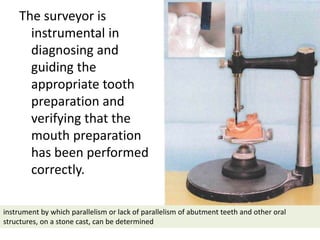
The surveyor is
instrumental in
diagnosing and
guiding the
appropriate tooth
preparation and
verifying that the
mouth preparation
has been performed
correctly.
instrument by which parallelism or lack of parallelism of abutment teeth and other oral
structures, on a stone cast, can be determined
After treatment planning, a predetermined
sequence of mouth preparations can be
performed with a definite goal in mind
• Treatment plan be reviewed to ensure the
mouth preparation necessary to
accommodate the removable partial denture
design has been properly sequenced
• ensure providing adequate support, stability,
retention, and a harmonious occlusion
Placing a crown or restoring a tooth out of sequence may result in the need to restore teeth that
were not planned for restoration, or it may necessitate remaking a restoration or even seriously
jeopardizing the success of the RPD.
3. Support for Distal Extension Denture
Bases
• Goal is to obtaining adequate support for
distal extension bases. Therefore it does not
apply to tooth-supported removable partial
dentures
Base made to fit the anatomic ridge form
• does not provide adequate support under
occlusal loading
• Neither does it provide for maximum border
extension nor accurate border detail
some type of corrected impression is necessary. This may be accomplished by several means,
any of which satisfy the requirements for support of any distal extension partial denture base
Foremost is the requirement that certain soft tissue
in the primary supporting area should be
recorded or related under some loading so that
the base may be made to fit the form of the ridge
when under function. This provides support and
ensures the maintenance of that support for the
longest possible time.
• A complete denture is entirely tissue supported,
and the entire denture can move toward the
tissue under function. In contrast, any movement
of a partial denture base is inevitably a rotational
movement that, if toward the tissue, may result
in undesirable torquing forces to the abutment
teeth and loss of planned occlusal contacts
4. Establishment and Verification of Occlusal
Relations and Tooth Arrangements
• Whether the partial denture is tooth
supported or has one or more distal extension
bases, the recording and verification of
occlusal relationships and tooth arrangement
are important steps in the construction
• For the distal extension base, however, jaw
relation records should be made only after
obtaining the best possible support for the
denture base
• final jaw relations should not be recorded until
after the denture framework has been returned
to the dentist, the fit of the framework to the
abutment teeth and opposing occlusion has been
verified and corrected, and
• a corrected impression has been made. Then
either a new resin base or a corrected base must
be used to record jaw relations.
• Occlusal records for a removable partial denture
may be made by the various methods
5. Initial Placement Procedures
• Patient is given possession of the removable
prosthesis
• Occlusal harmony be ensured before the patient
is given possession of the dentures, but also the
processed bases must be reasonably perfected to
fit the basal seats
• ascertained that the patient understands the
suggestions and recommendations
• understands about expectations in the
adjustment phases and use of the restorations
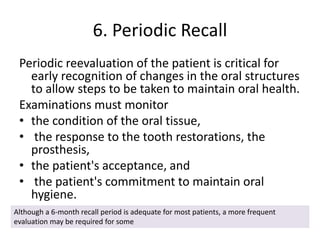
6. Periodic Recall
Periodic reevaluation of the patient is critical for
early recognition of changes in the oral structures
to allow steps to be taken to maintain oral health.
Examinations must monitor
• the condition of the oral tissue,
• the response to the tooth restorations, the
prosthesis,
• the patient's acceptance, and
• the patient's commitment to maintain oral
hygiene.
Although a 6-month recall period is adequate for most patients, a more frequent
evaluation may be required for some
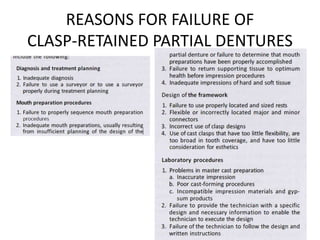
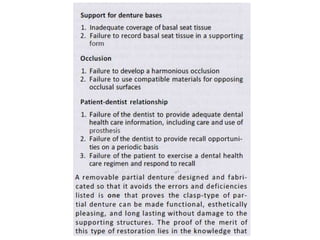
REASONS FOR FAILURE OF
CLASP-RETAINED PARTIAL DENTURES
Clasp retined partial denture 2

Clasp retined partial denture 2

  • 1.
    Clasp retained partialdenture 2 PHASES OF PARTIAL DENTURE SERVICE DR LEENA TOMER
  • 2.
    1. Education ofPatient • Mosby'sDental Dictionary "the process of informing a patient about a health matter to secure informed consent, patient cooperation, and a high level of patient compliance. "
  • 3.
    The dentist andthe patient share responsibility for the ultimate success of a removable partial denture. It is folly to assume that a patient will have an • understanding of the benefits of a removable partial denture unless he or she is so informed. • It is also unlikely that the patient will have the knowledge to avoid misuse of the restoration • or be able to provide the required oral care and maintenance procedures to ensure the success of the partial denture unless he or she is adequately advised.
  • 4.
    The finest biologicallyoriented removable partial denture is often doomed to limited success • if the patient fails to exercise proper oral hygiene habits or • ignores recall appointments. • Preservation of the oral structures, one of the primary objectives of prosthodontic treatment, will also be compromised
  • 5.
    • Patient educationshould begin at the initial contact with the patient and continue throughout treatment. • This educational procedure is especially important when the treatment plan and prognosis are discussed with the patient. • The limitations imposed on the success of treatment through failure of the patient to accept responsibility must be explained before definitive treatment is undertaken
  • 6.
    • patient willnot usually retain all the information presented in the oral educational instructions. For this reason, patients should be given written suggestions to reinforce the oral presentations. • Posters charts in clinic • Videos on clinic website
  • 7.
    2. Diagnosis, TreatmentPlanning, Design, Treatment Sequencing, and Mouth Preparation • Treatment planning and design begin with thorough medical and dental histories. • The complete oral examination must include both clinical and radiographic interpretation of (1) caries, (2) the condition of existing restorations, (3) periodontal conditions, (4) responses of teeth (especially abutment teeth) and residual ridges to previous stress, and (5) the vitality of remaining teeth.
  • 8.
    Additionally, evaluation ofthe • occlusal plane, • the arch form, and • the occlusal relations of the remaining teeth must be meticulously accomplished by clinical visual evaluation and diagnostic mounting. After a complete diagnostic examination has been accomplished and a removable partial denture has been selected as the treatment of choice, • a treatment plan is sequenced and • partial denture design is developed based on the support available.
  • 9.
    The surveyor is instrumentalin diagnosing and guiding the appropriate tooth preparation and verifying that the mouth preparation has been performed correctly. instrument by which parallelism or lack of parallelism of abutment teeth and other oral structures, on a stone cast, can be determined
  • 10.
    After treatment planning,a predetermined sequence of mouth preparations can be performed with a definite goal in mind • Treatment plan be reviewed to ensure the mouth preparation necessary to accommodate the removable partial denture design has been properly sequenced • ensure providing adequate support, stability, retention, and a harmonious occlusion Placing a crown or restoring a tooth out of sequence may result in the need to restore teeth that were not planned for restoration, or it may necessitate remaking a restoration or even seriously jeopardizing the success of the RPD.
  • 11.
    3. Support forDistal Extension Denture Bases • Goal is to obtaining adequate support for distal extension bases. Therefore it does not apply to tooth-supported removable partial dentures Base made to fit the anatomic ridge form • does not provide adequate support under occlusal loading • Neither does it provide for maximum border extension nor accurate border detail some type of corrected impression is necessary. This may be accomplished by several means, any of which satisfy the requirements for support of any distal extension partial denture base
  • 12.
    Foremost is therequirement that certain soft tissue in the primary supporting area should be recorded or related under some loading so that the base may be made to fit the form of the ridge when under function. This provides support and ensures the maintenance of that support for the longest possible time. • A complete denture is entirely tissue supported, and the entire denture can move toward the tissue under function. In contrast, any movement of a partial denture base is inevitably a rotational movement that, if toward the tissue, may result in undesirable torquing forces to the abutment teeth and loss of planned occlusal contacts
  • 13.
    4. Establishment andVerification of Occlusal Relations and Tooth Arrangements • Whether the partial denture is tooth supported or has one or more distal extension bases, the recording and verification of occlusal relationships and tooth arrangement are important steps in the construction • For the distal extension base, however, jaw relation records should be made only after obtaining the best possible support for the denture base
  • 14.
    • final jawrelations should not be recorded until after the denture framework has been returned to the dentist, the fit of the framework to the abutment teeth and opposing occlusion has been verified and corrected, and • a corrected impression has been made. Then either a new resin base or a corrected base must be used to record jaw relations. • Occlusal records for a removable partial denture may be made by the various methods
  • 15.
    5. Initial PlacementProcedures • Patient is given possession of the removable prosthesis • Occlusal harmony be ensured before the patient is given possession of the dentures, but also the processed bases must be reasonably perfected to fit the basal seats • ascertained that the patient understands the suggestions and recommendations • understands about expectations in the adjustment phases and use of the restorations
  • 16.
    6. Periodic Recall Periodicreevaluation of the patient is critical for early recognition of changes in the oral structures to allow steps to be taken to maintain oral health. Examinations must monitor • the condition of the oral tissue, • the response to the tooth restorations, the prosthesis, • the patient's acceptance, and • the patient's commitment to maintain oral hygiene. Although a 6-month recall period is adequate for most patients, a more frequent evaluation may be required for some
  • 17.
    REASONS FOR FAILUREOF CLASP-RETAINED PARTIAL DENTURES