Pharmaceutical Industry-The challenges
and the opportunities
Professor Luigi (Gino) Martini, FRPharmS, MBA
Chair in Pharmaceutical Innovation,
President of EIPG
King’s College London Email:
Luigi.Martini@kcl.ac.uk
Thank You For This Opportunity
Question: Can you think of 5
innovative countries?
Hold on to those ideas/thoughts
and we will compare with my list!
About me!
• Professor of Pharmaceutical Innovation at King’s College London
and Director of Rainbow Medical Engineering, this is Europe’s
largest centre of health education, with world renowned clinical
services and research in physical and mental health.
• I was a former GSK employee and occupied many roles in GSK from
Senior Director of Preclinical and Pharmaceutical Development for
Emerging Markets and Asia Pacific at GlaxoSmithKline to the
development of dosage forms to the design and successful
implementation of technological platforms.
• Professor Martini is a Pharmacist and received his PhD in Drug
Delivery from the University of Manchester. Professor Martini
obtained his MBA with Distinction from the University of Liverpool,
specialising in SME business failures and success
• President of the European Industrial Pharmacists Group visit
www.eipg.eu
Organisation
• First Industrial Pharmacist Teaching Practitioner in
the UK!
• My Chair is split between King’s College Campus in
Waterloo and at my company Rainbow Medical
Engineering Ltd based in Herts
• My university focus is forge links between Industry
and academia to help the development process
• My Rainbow focus is to help medical and
pharmaceutical companies manufacture products
using ultrasonic processing technology
• Effectively, I span 3 sectors –academia,
pharmaceutical and medical
Who I work with?
• Large Multinationals Companies both
Pharmaceutical and Medical
• Generic Companies
• SME’s and Spin-off organisations
• Regulatory Agencies
• Other Universities and Research Organisations
• Interesting trend is that I have been funded by
many organisations in Emerging Markets
• Interesting trend is that a large number of PhD
requests come from overseas (Emerging Markets)
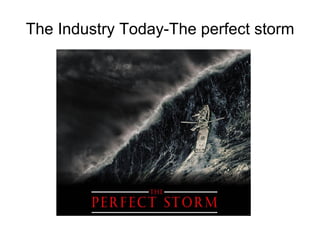
The Industry Today-The perfect storm
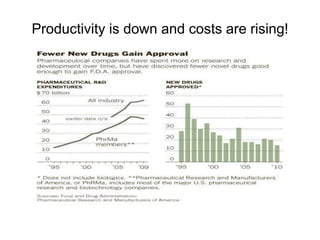
Productivity is down and costs are rising!
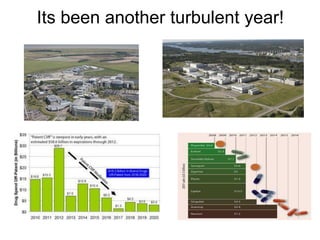
Its been another turbulent year!
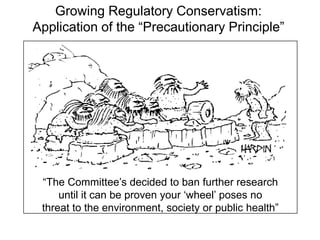
Growing Regulatory Conservatism:
Application of the “Precautionary Principle”
“The Committee’s decided to ban further research
until it can be proven your ‘wheel’ poses no
threat to the environment, society or public health”
How well do we innovate with
respect to Drug Development?
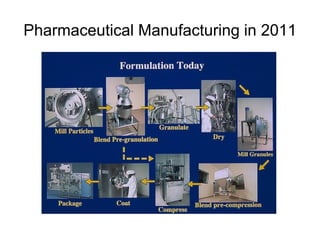
Pharmaceutical Manufacturing in 2011
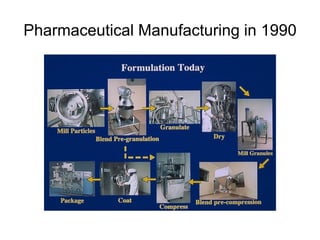
Pharmaceutical Manufacturing in 1990
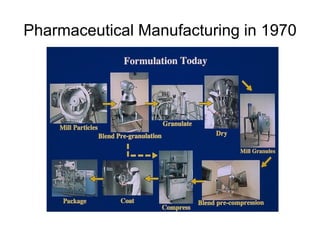
Pharmaceutical Manufacturing in 1970
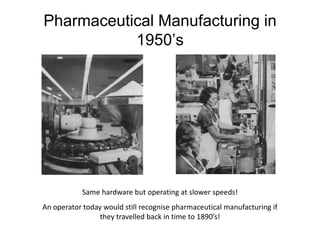
Pharmaceutical Manufacturing in
1950’s
Same hardware but operating at slower speeds!
An operator today would still recognise pharmaceutical manufacturing if
they travelled back in time to 1890’s!
9 May 2012
Pharmaceutical Product Manufacture
(an FDA View)
• Not state-of-art compared to other industries
• Reasonable product quality but at great effort &
cost
• For some products, waste as high as 50%
• Inability to predict effects of scale up on final
product
• Inability to analyze or understand reasons for
manufacturing failures
9 May 2012
Consequences
(FDA View)
• High cost due to
– inefficiencies (time, energy, materials)
– prolonged manufacturing cycle time due to testing.
– no improvements based on new technologies
• Drug shortages due to manufacturing problems
• Slows development of investigational drugs
Is this fair?
Consider the music industry and
Apple?
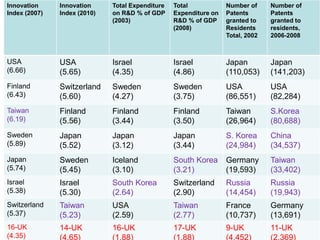
Now think of that list again!
Innovation
Index (2007)
Innovation
Index (2010)
Total Expenditure
on R&D % of GDP
(2003)
Total
Expenditure on
R&D % of GDP
(2008)
Number of
Patents
granted to
Residents
Total, 2002
Number of
Patents
granted to
residents,
2006-2008
USA
(6.66)
USA
(5.65)
Israel
(4.35)
Israel
(4.86)
Japan
(110,053)
Japan
(141,203)
Finland
(6.43)
Switzerland
(5.60)
Sweden
(4.27)
Sweden
(3.75)
USA
(86,551)
USA
(82,284)
Taiwan
(6.19)
Finland
(5.56)
Finland
(3.44)
Finland
(3.50)
Taiwan
(26,964)
S.Korea
(80,688)
Sweden
(5.89)
Japan
(5.52)
Japan
(3.12)
Japan
(3.44)
S. Korea
(24,984)
China
(34,537)
Japan
(5.74)
Sweden
(5.45)
Iceland
(3.10)
South Korea
(3.21)
Germany
(19,593)
Taiwan
(33,402)
Israel
(5.38)
Israel
(5.30)
South Korea
(2.64)
Switzerland
(2.90)
Russia
(14,454)
Russia
(19,943)
Switzerland
(5.37)
Taiwan
(5.23)
USA
(2.59)
Taiwan
(2.77)
France
(10,737)
Germany
(13,691)
16-UK
(4.35)
14-UK
(4.65)
16-UK
(1.88)
17-UK
(1.88)
9-UK
(4,452)
11-UK
(2,369)
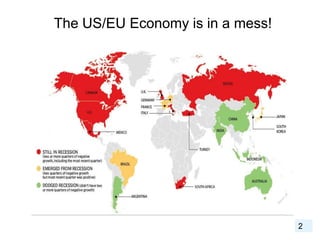
The US/EU Economy is in a mess!
2
Europe Not Paying for Pharma Innovation
• Hard-pressed healthcare systems can no longer pay
premium prices for new drugs. The consequence will be
less innovation in Europe says Andrew Witty, CEO of
GlaxoSmithKline.
• The consequence is not only that new products are
launched first elsewhere, delaying benefits for patients,
but also that GSK will do less clinical research in Europe.
“We have to take a view and face reality: it’s about the
U.S. and excitingly, about Japan in terms of where
innovation should be driven,” Witty said.
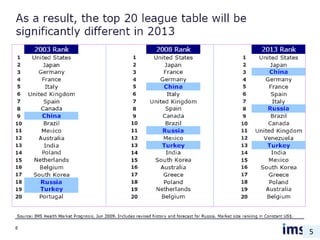
5
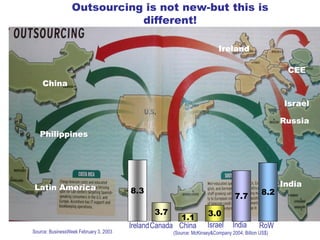
Outsourcing is not new-but this is
different!
Source: BusinessWeek February 3, 2003
China
Philippines
CEE
Russia
IndiaLatin America
Ireland
Israel
8.3
3.7
1.1
3.0
IrelandCanada China
7.7 8.2
Israel India RoW
(Source: McKinsey&Company 2004; Billion US$)
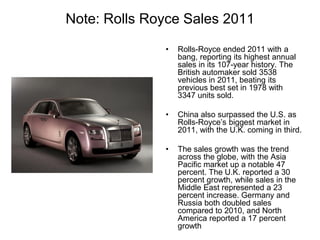
Note: Rolls Royce Sales 2011
• Rolls-Royce ended 2011 with a
bang, reporting its highest annual
sales in its 107-year history. The
British automaker sold 3538
vehicles in 2011, beating its
previous best set in 1978 with
3347 units sold.
• China also surpassed the U.S. as
Rolls-Royce’s biggest market in
2011, with the U.K. coming in third.
• The sales growth was the trend
across the globe, with the Asia
Pacific market up a notable 47
percent. The U.K. reported a 30
percent growth, while sales in the
Middle East represented a 23
percent increase. Germany and
Russia both doubled sales
compared to 2010, and North
America reported a 17 percent
growth
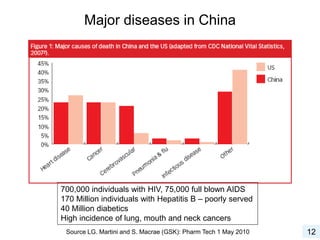
Major diseases in China
700,000 individuals with HIV, 75,000 full blown AIDS
170 Million individuals with Hepatitis B – poorly served
40 Million diabetics
High incidence of lung, mouth and neck cancers
12Source LG. Martini and S. Macrae (GSK): Pharm Tech 1 May 2010
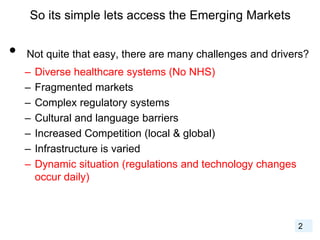
So its simple lets access the Emerging Markets
• Not quite that easy, there are many challenges and drivers?
– Diverse healthcare systems (No NHS)
– Fragmented markets
– Complex regulatory systems
– Cultural and language barriers
– Increased Competition (local & global)
– Infrastructure is varied
– Dynamic situation (regulations and technology changes
occur daily)
2
6
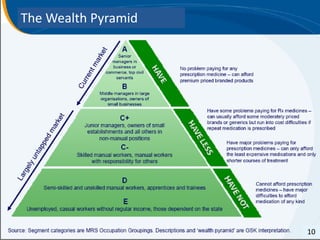
The Wealth Pyramid
10
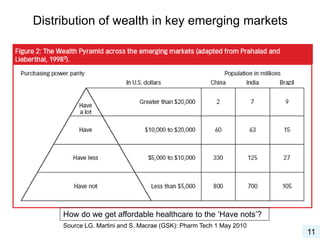
Distribution of wealth in key emerging markets
How do we get affordable healthcare to the ‘Have nots’?
11
Source LG. Martini and S. Macrae (GSK): Pharm Tech 1 May 2010
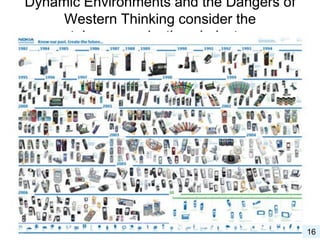
Dynamic Environments and the Dangers of
Western Thinking consider the
telecommunications industry
16
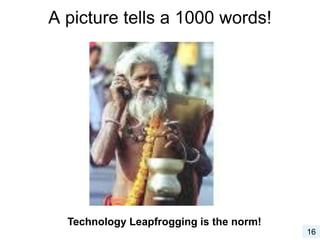
A picture tells a 1000 words!
16
Technology Leapfrogging is the norm!
What is the outcome from these drivers?
• Companies have to provide a ‘basket of offerings’ i.e. a mixed
portfolio of new medicines and cheaper (generic) medicines
– Many multinational companies do not have the experience of
playing in the ‘generic space’
– Many multinational companies have to acquire or form joint
ventures with local players
• Accessing existing dossiers and products
• Registering new dossiers locally or in selected markets
– Many multinational companies are forming dedicated emerging
markets teams and relocating senior people/resources to these
regions
– Local manufacturing is key for registration in many emerging
markets!
Supporting Headlines
• GSK announces a
strategic alliance with
Dr. Reddy’s to further
accelerate sales growth
in emerging markets
• Merck, Sun Pharma ink
JV to bring innovative
drugs to EMs
• Abbott to pay $3.7
billion for unit of India's
Piramal
• Novartis will transfer
production technology
for three commonly-
used vaccines to the
new facility under its
20-year agreement with
Arabio
What are the resulting issues?
• Many global companies struggle with different regulatory standards i.e.
Global (US/EU) vs Local Domestic
– Different registration requirements
• Many multinational companies work to higher standard then
FDA/EU requirements
• WHO often used as a default
– Clinical Data
• For some products ‘equivalence’ is not enough
• Clinical study designs being audited (DCGI in India)
• Requirements in India vs. China vs. Korea
• Pricing products– different systems exist and referencing pricing lists
change regularly
– Competing on price alone for Branded Generics is not enough-eventually
margins will be cut
• NICE like systems are being established in Emerging Markets
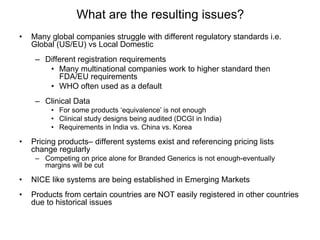
• Products from certain countries are NOT easily registered in other countries
due to historical issues
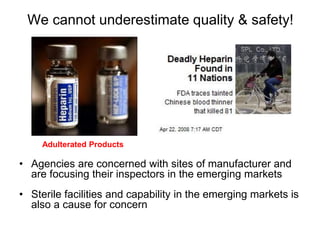
We cannot underestimate quality & safety!
• Agencies are concerned with sites of manufacturer and
are focusing their inspectors in the emerging markets
• Sterile facilities and capability in the emerging markets is
also a cause for concern
Adulterated Products
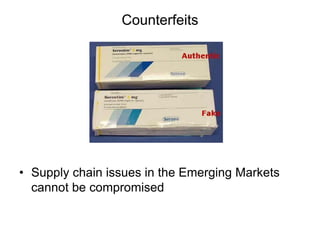
Counterfeits
• Supply chain issues in the Emerging Markets
cannot be compromised
Brand Power = Quality and Safety!
• Big Pharma will capitalise on its reputational
power and high quality standards
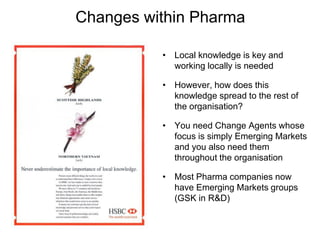
Changes within Pharma
• Local knowledge is key and
working locally is needed
• However, how does this
knowledge spread to the rest of
the organisation?
• You need Change Agents whose
focus is simply Emerging Markets
and you also need them
throughout the organisation
• Most Pharma companies now
have Emerging Markets groups
(GSK in R&D)
Evolving Workplace
• Key areas of change is that scientists will be dealing more with
projects that are being developed across national borders
– drug discovery in Europe with drug development conducted in
India and registration executed in Europe or North America or
– drug discovery occurring in China, developed in China,
commercialised in China and then registered and
commercialised in Europe or
– another scenario being drug discovery conducted in China,
development conducted in India and commercialised in Europe.
• Basic Formulation Development for small molecule will be
continually developed in a virtual way i.e. outsourced to low
cost countries whereas large molecules will be developed in
the EU and North America.
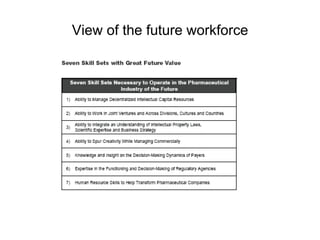
View of the future workforce
Required Skills for a Translator/Innovator
• Albani & Prakken, Nature Medicine, Sept 2009
– Knowledge of research and development
– Knowledge of Intellectual Property
– Knowledge of the various regulatory agencies
– Understanding Clinical Trials design and supplies
– Understanding legal and ethical requirements for good
business
– Good communication skills
– Fundamental skills of networking, team building and
strategic thinking
Working in the Pharmaceutical Industry allows you to gain
these valuable and transferrable skills—My time at GSK
afforded me the opportunity to acquire and develop
these skills
What is EIPG?
The E.I.P.G. is a European association representing the national,
professional organizations of pharmacists employed in the
pharmaceutical and allied industries of the Member States of the
European Union.
Its foundation dates back to 1966 and, over the years, it has
progressed in its activities in line with the evolution of the European
Union.
As a European association having its official seal with the French
Order of Pharmacists, EIPG is registered at the Prefecture of Police in
Paris.
Today EIPG represents about 10 000 pharmacists working in the
European industry.
Role of EIPG
Objectives
The main objective of EIPG is to promote and uphold the importance and role of
the industrial pharmacist within the pharmaceutical industry. In addition EIPG aims
to ensure that it:
• Will influence the evolution of EU regulations and guidelines concerning
standards of quality, safety and efficacy of medicinal products
• Works closely with member state industrial pharmacist groups, including
representation of their views within an EU context
• Maintains contact with other EU pharmaceutical groups representing community
and hospital pharmacy practices
• Consults with European Pharmaceutical Industry Associations
Next 8 years
• To promote the modern pharmaceutical
industry to observers and more importantly
to young Pharmacists
• To ensure that educational standards
meet the needs of the Industry of 2020
• To provide mentoring and coaching to
young Pharmacists who need career
advice
But the Industrial Pharmacist of the
future needs to think differently!
e.g. Funding will be tight and
therefore Lean Innovation is key
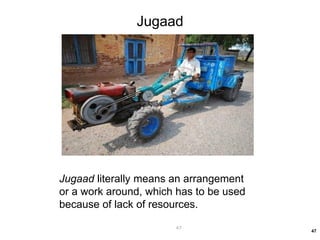
Jugaad literally means an arrangement
or a work around, which has to be used
because of lack of resources.
47
47
Jugaad
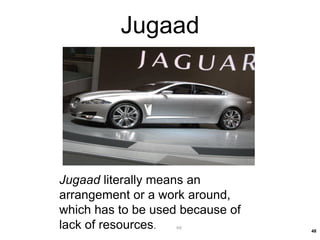
Jugaad literally means an
arrangement or a work around,
which has to be used because of
lack of resources. 48
48
Jugaad
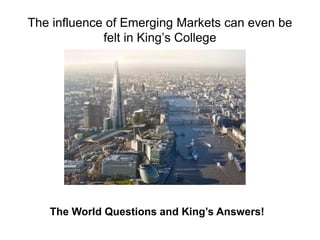
The influence of Emerging Markets can even be
felt in King’s College
The World Questions and King’s Answers!

Pharmaceutical Industry: The Challenges and the Opportunities

  • 1.
    Pharmaceutical Industry-The challenges andthe opportunities Professor Luigi (Gino) Martini, FRPharmS, MBA Chair in Pharmaceutical Innovation, President of EIPG King’s College London Email: Luigi.Martini@kcl.ac.uk
  • 2.
    Thank You ForThis Opportunity
  • 3.
    Question: Can youthink of 5 innovative countries? Hold on to those ideas/thoughts and we will compare with my list!
  • 4.
    About me! • Professorof Pharmaceutical Innovation at King’s College London and Director of Rainbow Medical Engineering, this is Europe’s largest centre of health education, with world renowned clinical services and research in physical and mental health. • I was a former GSK employee and occupied many roles in GSK from Senior Director of Preclinical and Pharmaceutical Development for Emerging Markets and Asia Pacific at GlaxoSmithKline to the development of dosage forms to the design and successful implementation of technological platforms. • Professor Martini is a Pharmacist and received his PhD in Drug Delivery from the University of Manchester. Professor Martini obtained his MBA with Distinction from the University of Liverpool, specialising in SME business failures and success • President of the European Industrial Pharmacists Group visit www.eipg.eu
  • 5.
    Organisation • First IndustrialPharmacist Teaching Practitioner in the UK! • My Chair is split between King’s College Campus in Waterloo and at my company Rainbow Medical Engineering Ltd based in Herts • My university focus is forge links between Industry and academia to help the development process • My Rainbow focus is to help medical and pharmaceutical companies manufacture products using ultrasonic processing technology • Effectively, I span 3 sectors –academia, pharmaceutical and medical
  • 6.
    Who I workwith? • Large Multinationals Companies both Pharmaceutical and Medical • Generic Companies • SME’s and Spin-off organisations • Regulatory Agencies • Other Universities and Research Organisations • Interesting trend is that I have been funded by many organisations in Emerging Markets • Interesting trend is that a large number of PhD requests come from overseas (Emerging Markets)
  • 7.
  • 8.
    Productivity is downand costs are rising!
  • 9.
    Its been anotherturbulent year!
  • 10.
    Growing Regulatory Conservatism: Applicationof the “Precautionary Principle” “The Committee’s decided to ban further research until it can be proven your ‘wheel’ poses no threat to the environment, society or public health”
  • 11.
    How well dowe innovate with respect to Drug Development?
  • 12.
  • 13.
  • 14.
  • 15.
    Pharmaceutical Manufacturing in 1950’s Samehardware but operating at slower speeds! An operator today would still recognise pharmaceutical manufacturing if they travelled back in time to 1890’s!
  • 16.
    9 May 2012 PharmaceuticalProduct Manufacture (an FDA View) • Not state-of-art compared to other industries • Reasonable product quality but at great effort & cost • For some products, waste as high as 50% • Inability to predict effects of scale up on final product • Inability to analyze or understand reasons for manufacturing failures
  • 17.
    9 May 2012 Consequences (FDAView) • High cost due to – inefficiencies (time, energy, materials) – prolonged manufacturing cycle time due to testing. – no improvements based on new technologies • Drug shortages due to manufacturing problems • Slows development of investigational drugs
  • 18.
    Is this fair? Considerthe music industry and Apple?
  • 19.
    Now think ofthat list again!
  • 20.
    Innovation Index (2007) Innovation Index (2010) TotalExpenditure on R&D % of GDP (2003) Total Expenditure on R&D % of GDP (2008) Number of Patents granted to Residents Total, 2002 Number of Patents granted to residents, 2006-2008 USA (6.66) USA (5.65) Israel (4.35) Israel (4.86) Japan (110,053) Japan (141,203) Finland (6.43) Switzerland (5.60) Sweden (4.27) Sweden (3.75) USA (86,551) USA (82,284) Taiwan (6.19) Finland (5.56) Finland (3.44) Finland (3.50) Taiwan (26,964) S.Korea (80,688) Sweden (5.89) Japan (5.52) Japan (3.12) Japan (3.44) S. Korea (24,984) China (34,537) Japan (5.74) Sweden (5.45) Iceland (3.10) South Korea (3.21) Germany (19,593) Taiwan (33,402) Israel (5.38) Israel (5.30) South Korea (2.64) Switzerland (2.90) Russia (14,454) Russia (19,943) Switzerland (5.37) Taiwan (5.23) USA (2.59) Taiwan (2.77) France (10,737) Germany (13,691) 16-UK (4.35) 14-UK (4.65) 16-UK (1.88) 17-UK (1.88) 9-UK (4,452) 11-UK (2,369)
  • 21.
    The US/EU Economyis in a mess! 2
  • 22.
    Europe Not Payingfor Pharma Innovation • Hard-pressed healthcare systems can no longer pay premium prices for new drugs. The consequence will be less innovation in Europe says Andrew Witty, CEO of GlaxoSmithKline. • The consequence is not only that new products are launched first elsewhere, delaying benefits for patients, but also that GSK will do less clinical research in Europe. “We have to take a view and face reality: it’s about the U.S. and excitingly, about Japan in terms of where innovation should be driven,” Witty said.
  • 23.
  • 24.
    Outsourcing is notnew-but this is different! Source: BusinessWeek February 3, 2003 China Philippines CEE Russia IndiaLatin America Ireland Israel 8.3 3.7 1.1 3.0 IrelandCanada China 7.7 8.2 Israel India RoW (Source: McKinsey&Company 2004; Billion US$)
  • 25.
    Note: Rolls RoyceSales 2011 • Rolls-Royce ended 2011 with a bang, reporting its highest annual sales in its 107-year history. The British automaker sold 3538 vehicles in 2011, beating its previous best set in 1978 with 3347 units sold. • China also surpassed the U.S. as Rolls-Royce’s biggest market in 2011, with the U.K. coming in third. • The sales growth was the trend across the globe, with the Asia Pacific market up a notable 47 percent. The U.K. reported a 30 percent growth, while sales in the Middle East represented a 23 percent increase. Germany and Russia both doubled sales compared to 2010, and North America reported a 17 percent growth
  • 26.
    Major diseases inChina 700,000 individuals with HIV, 75,000 full blown AIDS 170 Million individuals with Hepatitis B – poorly served 40 Million diabetics High incidence of lung, mouth and neck cancers 12Source LG. Martini and S. Macrae (GSK): Pharm Tech 1 May 2010
  • 27.
    So its simplelets access the Emerging Markets • Not quite that easy, there are many challenges and drivers? – Diverse healthcare systems (No NHS) – Fragmented markets – Complex regulatory systems – Cultural and language barriers – Increased Competition (local & global) – Infrastructure is varied – Dynamic situation (regulations and technology changes occur daily) 2
  • 28.
  • 29.
  • 30.
    Distribution of wealthin key emerging markets How do we get affordable healthcare to the ‘Have nots’? 11 Source LG. Martini and S. Macrae (GSK): Pharm Tech 1 May 2010
  • 31.
    Dynamic Environments andthe Dangers of Western Thinking consider the telecommunications industry 16
  • 32.
    A picture tellsa 1000 words! 16 Technology Leapfrogging is the norm!
  • 33.
    What is theoutcome from these drivers? • Companies have to provide a ‘basket of offerings’ i.e. a mixed portfolio of new medicines and cheaper (generic) medicines – Many multinational companies do not have the experience of playing in the ‘generic space’ – Many multinational companies have to acquire or form joint ventures with local players • Accessing existing dossiers and products • Registering new dossiers locally or in selected markets – Many multinational companies are forming dedicated emerging markets teams and relocating senior people/resources to these regions – Local manufacturing is key for registration in many emerging markets!
  • 34.
    Supporting Headlines • GSKannounces a strategic alliance with Dr. Reddy’s to further accelerate sales growth in emerging markets • Merck, Sun Pharma ink JV to bring innovative drugs to EMs • Abbott to pay $3.7 billion for unit of India's Piramal • Novartis will transfer production technology for three commonly- used vaccines to the new facility under its 20-year agreement with Arabio
  • 35.
    What are theresulting issues? • Many global companies struggle with different regulatory standards i.e. Global (US/EU) vs Local Domestic – Different registration requirements • Many multinational companies work to higher standard then FDA/EU requirements • WHO often used as a default – Clinical Data • For some products ‘equivalence’ is not enough • Clinical study designs being audited (DCGI in India) • Requirements in India vs. China vs. Korea • Pricing products– different systems exist and referencing pricing lists change regularly – Competing on price alone for Branded Generics is not enough-eventually margins will be cut • NICE like systems are being established in Emerging Markets • Products from certain countries are NOT easily registered in other countries due to historical issues
  • 36.
    We cannot underestimatequality & safety! • Agencies are concerned with sites of manufacturer and are focusing their inspectors in the emerging markets • Sterile facilities and capability in the emerging markets is also a cause for concern Adulterated Products
  • 37.
    Counterfeits • Supply chainissues in the Emerging Markets cannot be compromised
  • 38.
    Brand Power =Quality and Safety! • Big Pharma will capitalise on its reputational power and high quality standards
  • 39.
    Changes within Pharma •Local knowledge is key and working locally is needed • However, how does this knowledge spread to the rest of the organisation? • You need Change Agents whose focus is simply Emerging Markets and you also need them throughout the organisation • Most Pharma companies now have Emerging Markets groups (GSK in R&D)
  • 40.
    Evolving Workplace • Keyareas of change is that scientists will be dealing more with projects that are being developed across national borders – drug discovery in Europe with drug development conducted in India and registration executed in Europe or North America or – drug discovery occurring in China, developed in China, commercialised in China and then registered and commercialised in Europe or – another scenario being drug discovery conducted in China, development conducted in India and commercialised in Europe. • Basic Formulation Development for small molecule will be continually developed in a virtual way i.e. outsourced to low cost countries whereas large molecules will be developed in the EU and North America.
  • 41.
    View of thefuture workforce
  • 42.
    Required Skills fora Translator/Innovator • Albani & Prakken, Nature Medicine, Sept 2009 – Knowledge of research and development – Knowledge of Intellectual Property – Knowledge of the various regulatory agencies – Understanding Clinical Trials design and supplies – Understanding legal and ethical requirements for good business – Good communication skills – Fundamental skills of networking, team building and strategic thinking Working in the Pharmaceutical Industry allows you to gain these valuable and transferrable skills—My time at GSK afforded me the opportunity to acquire and develop these skills
  • 43.
    What is EIPG? TheE.I.P.G. is a European association representing the national, professional organizations of pharmacists employed in the pharmaceutical and allied industries of the Member States of the European Union. Its foundation dates back to 1966 and, over the years, it has progressed in its activities in line with the evolution of the European Union. As a European association having its official seal with the French Order of Pharmacists, EIPG is registered at the Prefecture of Police in Paris. Today EIPG represents about 10 000 pharmacists working in the European industry.
  • 44.
    Role of EIPG Objectives Themain objective of EIPG is to promote and uphold the importance and role of the industrial pharmacist within the pharmaceutical industry. In addition EIPG aims to ensure that it: • Will influence the evolution of EU regulations and guidelines concerning standards of quality, safety and efficacy of medicinal products • Works closely with member state industrial pharmacist groups, including representation of their views within an EU context • Maintains contact with other EU pharmaceutical groups representing community and hospital pharmacy practices • Consults with European Pharmaceutical Industry Associations
  • 45.
    Next 8 years •To promote the modern pharmaceutical industry to observers and more importantly to young Pharmacists • To ensure that educational standards meet the needs of the Industry of 2020 • To provide mentoring and coaching to young Pharmacists who need career advice
  • 46.
    But the IndustrialPharmacist of the future needs to think differently! e.g. Funding will be tight and therefore Lean Innovation is key
  • 47.
    Jugaad literally meansan arrangement or a work around, which has to be used because of lack of resources. 47 47 Jugaad
  • 48.
    Jugaad literally meansan arrangement or a work around, which has to be used because of lack of resources. 48 48 Jugaad
  • 49.
    The influence ofEmerging Markets can even be felt in King’s College The World Questions and King’s Answers!