Media Terminology
Andre
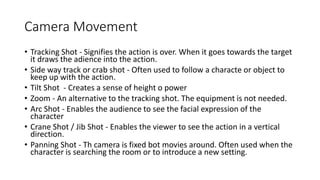
Camera Movement
• Tracking Shot - Signifies the action is over. When it goes towards the target
it draws the adience into the action.
• Side way track or crab shot - Often used to follow a characte or object to
keep up with the action.
• Tilt Shot - Creates a sense of height o power
• Zoom - An alternative to the tracking shot. The equipment is not needed.
• Arc Shot - Enables the audience to see the facial expression of the
character
• Crane Shot / Jib Shot - Enables the viewer to see the action in a vertical
direction.
• Panning Shot - Th camera is fixed bot movies around. Often used when the
character is searching the room or to introduce a new setting.
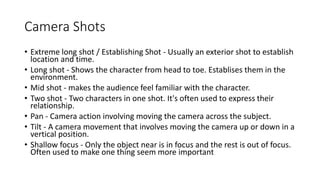
Camera Shots
• Extreme long shot / Establishing Shot - Usually an exterior shot to establish
location and time.
• Long shot - Shows the character from head to toe. Establises them in the
environment.
• Mid shot - makes the audience feel familiar with the character.
• Two shot - Two characters in one shot. It's often used to express their
relationship.
• Pan - Camera action involving moving the camera across the subject.
• Tilt - A camera movement that involves moving the camera up or down in a
vertical position.
• Shallow focus - Only the object near is in focus and the rest is out of focus.
Often used to make one thing seem more important
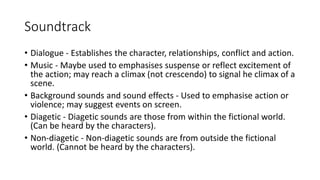
Soundtrack
• Dialogue - Establishes the character, relationships, conflict and action.
• Music - Maybe used to emphasises suspense or reflect excitement of
the action; may reach a climax (not crescendo) to signal he climax of a
scene.
• Background sounds and sound effects - Used to emphasise action or
violence; may suggest events on screen.
• Diagetic - Diagetic sounds are those from within the fictional world.
(Can be heard by the characters).
• Non-diagetic - Non-diagetic sounds are from outside the fictional
world. (Cannot be heard by the characters).
Editing terminology
• Fast paced editing - Suggests excitement, action, confrontation, etc.
• Slow paced editing - May be caused by complicated camera work,
such as long tracking shots, which follow the action without cutting.
• Change of editing pace - Usually signals an important change such as
the important change such as the start of an action.
• Cross cutting - Often adds to the excitement or suspense in a film.
• Jump cuts - Rarely used, a cut that causes the object the object to
appear to jump within the frame
Mise-en-scene
• Low key lighting - Dark shadows and lots of contrast may suggest
danger, suspense, horror
• Unusual lighing effects, such as flashing lights and blue lights - Often
used to suggest danger, especially in sci-fi films.
• Naturalistic lighting or high key lighting - Less easy to sport but
naturalistic lightubg nay be used to make events more 'real', which
can add a sense of suspense or sympathy.
• Set or location - These are important to the tone of action/adventure
films - they may create spectacle or a sense of being trapped in a
confined space or freedom in an open space.

Media terminology

  • 1.
  • 2.
    Camera Movement • TrackingShot - Signifies the action is over. When it goes towards the target it draws the adience into the action. • Side way track or crab shot - Often used to follow a characte or object to keep up with the action. • Tilt Shot - Creates a sense of height o power • Zoom - An alternative to the tracking shot. The equipment is not needed. • Arc Shot - Enables the audience to see the facial expression of the character • Crane Shot / Jib Shot - Enables the viewer to see the action in a vertical direction. • Panning Shot - Th camera is fixed bot movies around. Often used when the character is searching the room or to introduce a new setting.
  • 3.
    Camera Shots • Extremelong shot / Establishing Shot - Usually an exterior shot to establish location and time. • Long shot - Shows the character from head to toe. Establises them in the environment. • Mid shot - makes the audience feel familiar with the character. • Two shot - Two characters in one shot. It's often used to express their relationship. • Pan - Camera action involving moving the camera across the subject. • Tilt - A camera movement that involves moving the camera up or down in a vertical position. • Shallow focus - Only the object near is in focus and the rest is out of focus. Often used to make one thing seem more important
  • 4.
    Soundtrack • Dialogue -Establishes the character, relationships, conflict and action. • Music - Maybe used to emphasises suspense or reflect excitement of the action; may reach a climax (not crescendo) to signal he climax of a scene. • Background sounds and sound effects - Used to emphasise action or violence; may suggest events on screen. • Diagetic - Diagetic sounds are those from within the fictional world. (Can be heard by the characters). • Non-diagetic - Non-diagetic sounds are from outside the fictional world. (Cannot be heard by the characters).
  • 5.
    Editing terminology • Fastpaced editing - Suggests excitement, action, confrontation, etc. • Slow paced editing - May be caused by complicated camera work, such as long tracking shots, which follow the action without cutting. • Change of editing pace - Usually signals an important change such as the important change such as the start of an action. • Cross cutting - Often adds to the excitement or suspense in a film. • Jump cuts - Rarely used, a cut that causes the object the object to appear to jump within the frame
  • 6.
    Mise-en-scene • Low keylighting - Dark shadows and lots of contrast may suggest danger, suspense, horror • Unusual lighing effects, such as flashing lights and blue lights - Often used to suggest danger, especially in sci-fi films. • Naturalistic lighting or high key lighting - Less easy to sport but naturalistic lightubg nay be used to make events more 'real', which can add a sense of suspense or sympathy. • Set or location - These are important to the tone of action/adventure films - they may create spectacle or a sense of being trapped in a confined space or freedom in an open space.