MICRO FEATURES
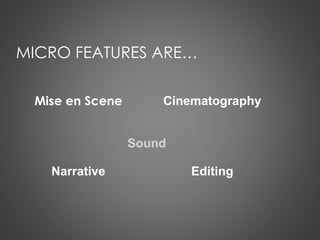
MICRO FEATURES ARE…
Cinematography
Editing
Mise en Scene
Narrative
Sound
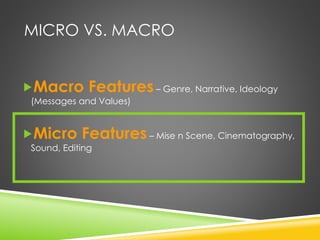
MICRO VS. MACRO
Macro Features– Genre, Narrative, Ideology
(Messages and Values)
Micro Features– Mise n Scene, Cinematography,
Sound, Editing
MISE EN SCENE
‘What is in the shot’
WHAT IT INCLUDES:
Setting
Décor
Props
Costume and make up
Figure expression and movement
SETTING
 The actual setting of a film will create a lot of meaning
for an audience. The setting conveys the world of the
film and can go a long way to setting the mood and
atmosphere of a film.
 Remember the setting can also be the interior of a
building not just the exterior world.
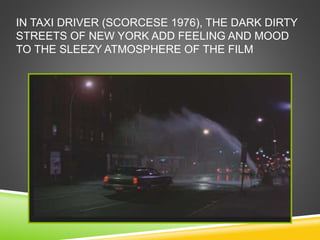
IN TAXI DRIVER (SCORCESE 1976), THE DARK DIRTY
STREETS OF NEW YORK ADD FEELING AND MOOD
TO THE SLEEZY ATMOSPHERE OF THE FILM
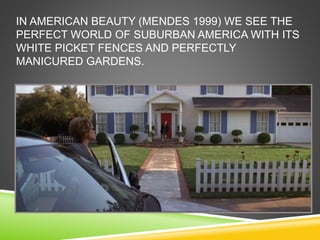
IN AMERICAN BEAUTY (MENDES 1999) WE SEE THE
PERFECT WORLD OF SUBURBAN AMERICA WITH ITS
WHITE PICKET FENCES AND PERFECTLY
MANICURED GARDENS.
DÉCOR
The décor is basically the objects contained in the
setting of the scene.
It can be used to amplify character emotion or the
dominant mood of the film
In a film, the décor of the set can also give us very
specific indicators about period, the world of the
characters, the lifestyle of the character and the
functionality of the setting.
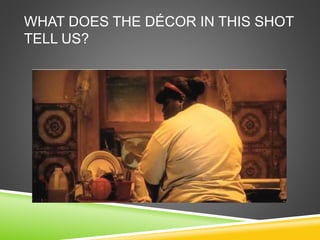
WHAT DOES THE DÉCOR IN THIS SHOT
TELL US?
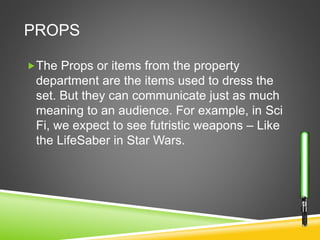
PROPS
The Props or items from the property
department are the items used to dress the
set. But they can communicate just as much
meaning to an audience. For example, in Sci
Fi, we expect to see futristic weapons – Like
the LifeSaber in Star Wars.
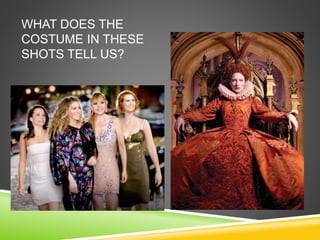
COSTUME
Costume simply refers to the clothes that
characters wear.
Costume in narrative cinema is used to signify
character, or advertise particular
fashions/periods in time, or to make clear
distinctions between characters.
WHAT DOES THE
COSTUME IN THESE
SHOTS TELL US?
FIGURE EXPRESSION AND MOVEMENT
Like everything else in the mise en scene
figure expression is used to support the
narrative
Figure expression refers to the facial
expressions and the posture of an actor,
whereas figure movement refers to all other
actions of the actor, including gestures.
CINEMATOGRAPHY
Photographic elements
WHAT THIS INCLUDES:
 Framing/composition
 Camera shots
 Camera angles
 Camera movement
 Depth of focus
 Lighting
 Colour
 Special effects
CAMERA SHOTS
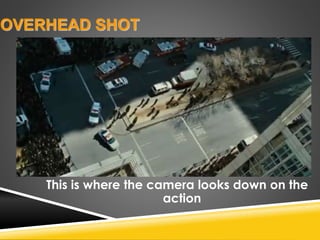
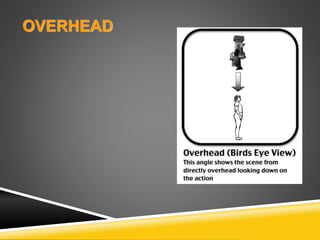
OVERHEAD SHOT
This is where the camera looks down on the
action
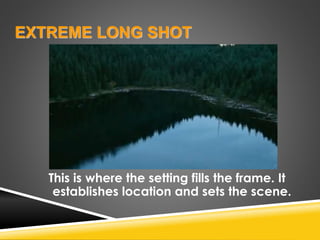
EXTREME LONG SHOT
This is where the setting fills the frame. It
establishes location and sets the scene.
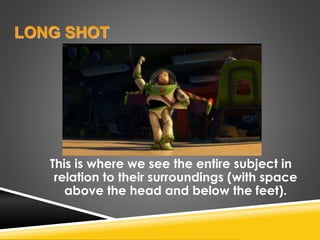
LONG SHOT
This is where we see the entire subject in
relation to their surroundings (with space
above the head and below the feet).
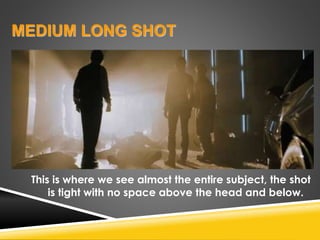
MEDIUM LONG SHOT
This is where we see almost the entire subject, the shot
is tight with no space above the head and below.
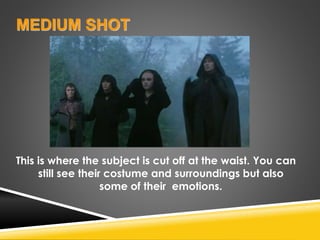
MEDIUM SHOT
This is where the subject is cut off at the waist. You can
still see their costume and surroundings but also
some of their emotions.
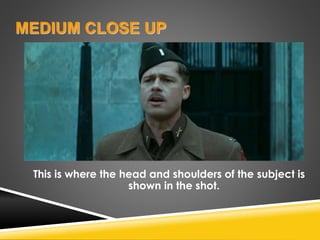
MEDIUM CLOSE UP
This is where the head and shoulders of the subject is
shown in the shot.
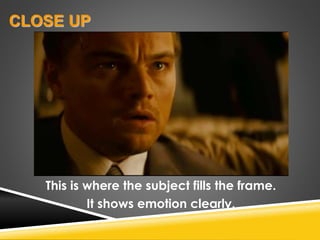
CLOSE UP
This is where the subject fills the frame.
It shows emotion clearly.
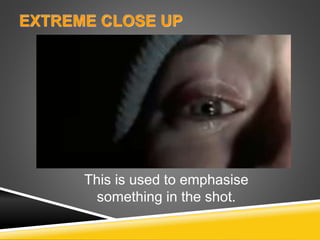
EXTREME CLOSE UP
This is used to emphasise
something in the shot.
CAMERA
MOVEMENTS
Movement
Name
Static
camera?
What movement does it make? Meaning Produced
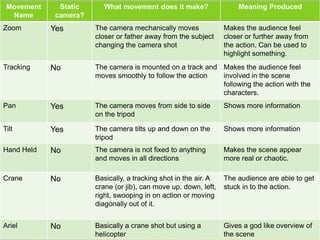
Zoom Yes The camera mechanically moves
closer or father away from the subject
changing the camera shot
Makes the audience feel
closer or further away from
the action. Can be used to
highlight something.
Tracking No The camera is mounted on a track and
moves smoothly to follow the action
Makes the audience feel
involved in the scene
following the action with the
characters.
Pan Yes The camera moves from side to side
on the tripod
Shows more information
Tilt Yes The camera tilts up and down on the
tripod
Shows more information
Hand Held No The camera is not fixed to anything
and moves in all directions
Makes the scene appear
more real or chaotic.
Crane No Basically, a tracking shot in the air. A
crane (or jib), can move up, down, left,
right, swooping in on action or moving
diagonally out of it.
The audience are able to get
stuck in to the action.
Ariel No Basically a crane shot but using a
helicopter
Gives a god like overview of
the scene
DEPTH OF FOCUS
The depth of focus can give us as the
spectator an insight into the
character/action on screen
Deep focus can make the film appear more
real
Shallow focus can tell us that the character
is disconnected from their surroundings or
only concerned with what they are doing,
everything else is irrelevant.
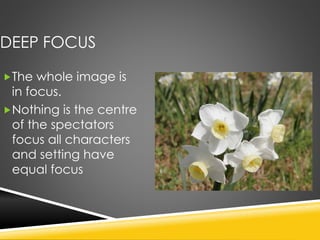
DEEP FOCUS
The whole image is
in focus.
Nothing is the centre
of the spectators
focus all characters
and setting have
equal focus
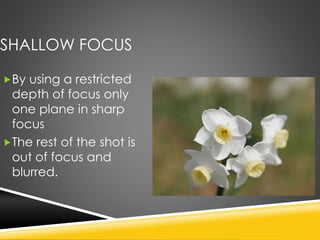
SHALLOW FOCUS
By using a restricted
depth of focus only
one plane in sharp
focus
The rest of the shot is
out of focus and
blurred.
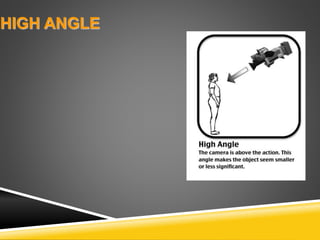
HIGH ANGLE
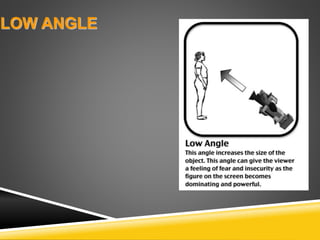
LOW ANGLE
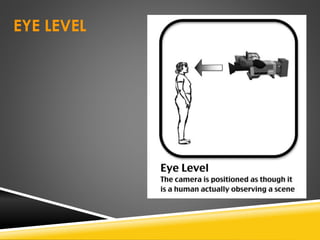
EYE LEVEL
OVERHEAD
CAMERA SHOTS, ANGLES AND
MOVEMENTS VIDEO
Video
LIGHTING
 The intensity, direction, and quality of lighting
can have a huge effect on the way an image is
perceived.
 It can focus attention on particular elements of
the composition or hide others.
 Most mainstream films use three-point lighting
 Other films, for example documentaries and
realist cinema, rely on natural light to create a
sense of authenticity.
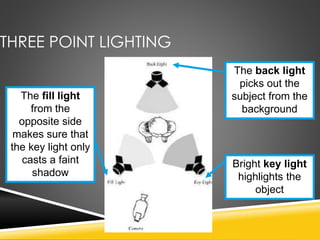
THREE POINT LIGHTING
The back light
picks out the
subject from the
background
Bright key light
highlights the
object
The fill light
from the
opposite side
makes sure that
the key light only
casts a faint
shadow
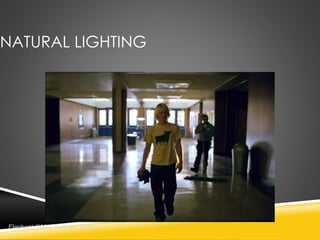
NATURAL LIGHTING
Elephant (2003, Gus Van Sant)
COLOUR
The greatest invention after sound in the
movie business? Regardless it is very
effective.
 A modern film like La Haine shot in B&W is very
powerful in communicating the bleakness of
life.
 Traffic, uses a grey/blue filter at times to
represent the different situations to us
 Collateral was shot in HD, illuminating the
colours of the night even more
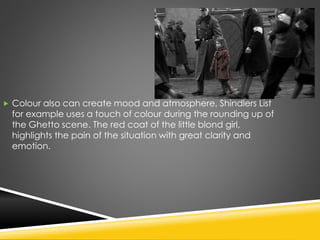
 Colour also can create mood and atmosphere, Shindlers List
for example uses a touch of colour during the rounding up of
the Ghetto scene. The red coat of the little blond girl,
highlights the pain of the situation with great clarity and
emotion.
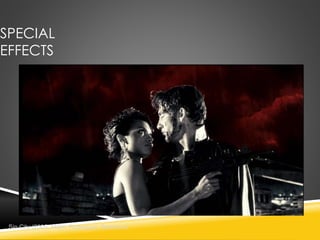
SPECIAL
EFFECTS
Sin City (2005, Miller, Rodriguez, Tarentino)
FRAMING/COMPOSITION
 This refers to the organisation of pictorial elements in a
frame.
 The purpose of the frame is to direct the spectators
attention to the focus of the narrative in the scene
PERFORMANCE
We have already looked at figure expression and
movement, we are now going to look at the
performance of an actor as a whole and what it
contributes the sensory impact of the film
SOUND
Diegesis
DIEGESIS
There are two main types of sound that
you can hear in films.
Sound can be broken down into diegetic
and non diegetic sound
DIEGETIC SOUND
Diegetic sound is sound that is recorded at
the time of filming the scene.
Sometimes sound is added post production
but we know the characters are supposed
to hear this sound. This is still classed as
diegetic sound, but you should note that
you understand that the sound had not
originated from the original recording.
DIEGETIC SOUND
The sound generated from
within the narrative of the text.
The characters and the
audience can hear the sound.
EXAMPLES OF DIEGETIC SOUND
Characters speech
Sounds made by objects in the narrative
e.g a creaking door
Music
 That is played by characters on screen in a band
 Radio that a character has turned on
Some sound effects – Dog barking, sirens,
car passing
THE EFFECT OF DIEGETIC SOUND
 Reinforces the narrative
 It helps to set the scene and make the scene
more believable. e.g. if you see two characters
talking in a café, you expect to hear other people
chatting, cups clinking, and people moving
around. If the scene was silent it would not be
believable.
NON DIEGETIC SOUND
 Non diegetic sound is the opposite to diegetic
sound. It is sound that the characters in the story
can not hear.
 Non diegetic sound is added post production
NON DIEGETIC SOUND
Sound that is generated outside the
narrative of the text.
Only the audience can hear the sound
EXAMPLES OF NON DIEGETIC SOUND
 Narration by an off screen character (Voice Of God
 Sound effects that are added for dramatic effect
 Mood music
 Film score (background Music)
 Theme tune
THE EFFECT OF NON DIEGETIC SOUND
 Non Diegetic sound helps to create the
atmosphere and mood of the film and scenes
within the film.
 The background music can completely change
the mood of the film and convey the emotion
that the director wants them to feel

Micro Features Lesson

  • 1.
  • 2.
  • 3.
    MICRO VS. MACRO MacroFeatures– Genre, Narrative, Ideology (Messages and Values) Micro Features– Mise n Scene, Cinematography, Sound, Editing
  • 4.
    MISE EN SCENE ‘Whatis in the shot’
  • 5.
    WHAT IT INCLUDES: Setting Décor Props Costumeand make up Figure expression and movement
  • 6.
    SETTING  The actualsetting of a film will create a lot of meaning for an audience. The setting conveys the world of the film and can go a long way to setting the mood and atmosphere of a film.  Remember the setting can also be the interior of a building not just the exterior world.
  • 7.
    IN TAXI DRIVER(SCORCESE 1976), THE DARK DIRTY STREETS OF NEW YORK ADD FEELING AND MOOD TO THE SLEEZY ATMOSPHERE OF THE FILM
  • 8.
    IN AMERICAN BEAUTY(MENDES 1999) WE SEE THE PERFECT WORLD OF SUBURBAN AMERICA WITH ITS WHITE PICKET FENCES AND PERFECTLY MANICURED GARDENS.
  • 9.
    DÉCOR The décor isbasically the objects contained in the setting of the scene. It can be used to amplify character emotion or the dominant mood of the film In a film, the décor of the set can also give us very specific indicators about period, the world of the characters, the lifestyle of the character and the functionality of the setting.
  • 10.
    WHAT DOES THEDÉCOR IN THIS SHOT TELL US?
  • 11.
    PROPS The Props oritems from the property department are the items used to dress the set. But they can communicate just as much meaning to an audience. For example, in Sci Fi, we expect to see futristic weapons – Like the LifeSaber in Star Wars.
  • 12.
    COSTUME Costume simply refersto the clothes that characters wear. Costume in narrative cinema is used to signify character, or advertise particular fashions/periods in time, or to make clear distinctions between characters.
  • 13.
    WHAT DOES THE COSTUMEIN THESE SHOTS TELL US?
  • 14.
    FIGURE EXPRESSION ANDMOVEMENT Like everything else in the mise en scene figure expression is used to support the narrative Figure expression refers to the facial expressions and the posture of an actor, whereas figure movement refers to all other actions of the actor, including gestures.
  • 15.
  • 16.
    WHAT THIS INCLUDES: Framing/composition  Camera shots  Camera angles  Camera movement  Depth of focus  Lighting  Colour  Special effects
  • 17.
  • 18.
    OVERHEAD SHOT This iswhere the camera looks down on the action
  • 19.
    EXTREME LONG SHOT Thisis where the setting fills the frame. It establishes location and sets the scene.
  • 20.
    LONG SHOT This iswhere we see the entire subject in relation to their surroundings (with space above the head and below the feet).
  • 21.
    MEDIUM LONG SHOT Thisis where we see almost the entire subject, the shot is tight with no space above the head and below.
  • 22.
    MEDIUM SHOT This iswhere the subject is cut off at the waist. You can still see their costume and surroundings but also some of their emotions.
  • 23.
    MEDIUM CLOSE UP Thisis where the head and shoulders of the subject is shown in the shot.
  • 24.
    CLOSE UP This iswhere the subject fills the frame. It shows emotion clearly.
  • 25.
    EXTREME CLOSE UP Thisis used to emphasise something in the shot.
  • 26.
  • 27.
    Movement Name Static camera? What movement doesit make? Meaning Produced Zoom Yes The camera mechanically moves closer or father away from the subject changing the camera shot Makes the audience feel closer or further away from the action. Can be used to highlight something. Tracking No The camera is mounted on a track and moves smoothly to follow the action Makes the audience feel involved in the scene following the action with the characters. Pan Yes The camera moves from side to side on the tripod Shows more information Tilt Yes The camera tilts up and down on the tripod Shows more information Hand Held No The camera is not fixed to anything and moves in all directions Makes the scene appear more real or chaotic. Crane No Basically, a tracking shot in the air. A crane (or jib), can move up, down, left, right, swooping in on action or moving diagonally out of it. The audience are able to get stuck in to the action. Ariel No Basically a crane shot but using a helicopter Gives a god like overview of the scene
  • 28.
    DEPTH OF FOCUS Thedepth of focus can give us as the spectator an insight into the character/action on screen Deep focus can make the film appear more real Shallow focus can tell us that the character is disconnected from their surroundings or only concerned with what they are doing, everything else is irrelevant.
  • 29.
    DEEP FOCUS The wholeimage is in focus. Nothing is the centre of the spectators focus all characters and setting have equal focus
  • 30.
    SHALLOW FOCUS By usinga restricted depth of focus only one plane in sharp focus The rest of the shot is out of focus and blurred.
  • 31.
  • 32.
  • 33.
  • 34.
  • 35.
    CAMERA SHOTS, ANGLESAND MOVEMENTS VIDEO Video
  • 36.
    LIGHTING  The intensity,direction, and quality of lighting can have a huge effect on the way an image is perceived.  It can focus attention on particular elements of the composition or hide others.  Most mainstream films use three-point lighting  Other films, for example documentaries and realist cinema, rely on natural light to create a sense of authenticity.
  • 37.
    THREE POINT LIGHTING Theback light picks out the subject from the background Bright key light highlights the object The fill light from the opposite side makes sure that the key light only casts a faint shadow
  • 38.
  • 39.
    COLOUR The greatest inventionafter sound in the movie business? Regardless it is very effective.  A modern film like La Haine shot in B&W is very powerful in communicating the bleakness of life.  Traffic, uses a grey/blue filter at times to represent the different situations to us  Collateral was shot in HD, illuminating the colours of the night even more
  • 40.
     Colour alsocan create mood and atmosphere, Shindlers List for example uses a touch of colour during the rounding up of the Ghetto scene. The red coat of the little blond girl, highlights the pain of the situation with great clarity and emotion.
  • 41.
    SPECIAL EFFECTS Sin City (2005,Miller, Rodriguez, Tarentino)
  • 42.
    FRAMING/COMPOSITION  This refersto the organisation of pictorial elements in a frame.  The purpose of the frame is to direct the spectators attention to the focus of the narrative in the scene
  • 43.
  • 44.
    We have alreadylooked at figure expression and movement, we are now going to look at the performance of an actor as a whole and what it contributes the sensory impact of the film
  • 45.
  • 46.
    DIEGESIS There are twomain types of sound that you can hear in films. Sound can be broken down into diegetic and non diegetic sound
  • 47.
    DIEGETIC SOUND Diegetic soundis sound that is recorded at the time of filming the scene. Sometimes sound is added post production but we know the characters are supposed to hear this sound. This is still classed as diegetic sound, but you should note that you understand that the sound had not originated from the original recording.
  • 48.
    DIEGETIC SOUND The soundgenerated from within the narrative of the text. The characters and the audience can hear the sound.
  • 49.
    EXAMPLES OF DIEGETICSOUND Characters speech Sounds made by objects in the narrative e.g a creaking door Music  That is played by characters on screen in a band  Radio that a character has turned on Some sound effects – Dog barking, sirens, car passing
  • 50.
    THE EFFECT OFDIEGETIC SOUND  Reinforces the narrative  It helps to set the scene and make the scene more believable. e.g. if you see two characters talking in a café, you expect to hear other people chatting, cups clinking, and people moving around. If the scene was silent it would not be believable.
  • 51.
    NON DIEGETIC SOUND Non diegetic sound is the opposite to diegetic sound. It is sound that the characters in the story can not hear.  Non diegetic sound is added post production
  • 52.
    NON DIEGETIC SOUND Soundthat is generated outside the narrative of the text. Only the audience can hear the sound
  • 53.
    EXAMPLES OF NONDIEGETIC SOUND  Narration by an off screen character (Voice Of God  Sound effects that are added for dramatic effect  Mood music  Film score (background Music)  Theme tune
  • 54.
    THE EFFECT OFNON DIEGETIC SOUND  Non Diegetic sound helps to create the atmosphere and mood of the film and scenes within the film.  The background music can completely change the mood of the film and convey the emotion that the director wants them to feel

Editor's Notes

  • #8 Tell me the elements of the mise en scene L Explain how these elements have been used to construct meaning M Argue a alternate reading of this mise en scene H
  • #9 Tell me the elements of the mise en scene L Explain how these elements have been used to construct meaning M Argue a alternate reading of this mise en scene H
  • #11 Tell me the elements of the mise en scene L Explain how these elements have been used to construct meaning M Argue a alternate reading of this mise en scene H