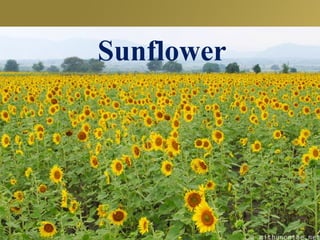
Sunflower
• English name :
Sunflower
• Scientific name :
helianthus annuus L.
• Family:
Asteraceae or
Compositae
The name Helianthus, being derived from
Helios (the sun) and Anthos (a flower).
Description of the
plant
Root:
a strong taproot and prolific lateral
spread of surface roots.
Root depth between (1.5 – 3) meter,
affected by:
1.Soil moisture.
2.Planting date.
3.Environmental factor.
Stem:
Sunflower is an annual, erect that grow to a height
of 50–400 centimeters. The stem has hairs
which make the stem feel extremely coarse.
Stem length is determined by the number of
internodes. The stems are typically unbranched.
Stem length affected by:
1.Vareity
2.Enviromental factor
3.Irrigation
4.Soil type
The stem has hairs which
make the stem feel
extremely coarse.
Leaves:
Sunflower (Helianthus annuus L.) is a broadleaf
plant.
The petiolate leaves are dentate and often sticky.
The first leaves are opposite but The upper
leaves are alternate. ovate or often heart-
shaped.
Number of leaves/ plant between (15 – 40) leaf.
Effect by:
1.Length of growth season.
2. Number of node/plant.
Flower (head)
• Sunflower has a typical head type
(capitulum) of the inflorescence.
• Sunflower has two different types of flower
are:
1.Ray flowers
Located around the margin of the head, are
sterile; without stamens or pistils. The
number of ray flower between (40 – 110)
flowers. The color can range from lemon-
yellow, orange to reddish.
2.Disk flower
The disk flowers, located in the central part of
the head, are fertile but incomplete. the ovary of
the disk flower develops into an achene.
Five yellow corolla leaf.
Five stamens.
The number of disk flower between ( 700 –
3000) flower.(in oil variety)
The number of disk flower between ( 4000–
8000) flower.(in Non-oil variety)
The head shape varies, being concave,
convex or flat.
 The flower heads are (7.5-15 cm) wide
and at the ends of branches.
01/06/18 15
Pollination
Pollen transfer is via insect pollinators, principally
bees. {Cross pollination ( 57 – 80) %} The pollen
is spiny and adapted to be transported by
insects. Little is pollinated by wind.
16
fruit and Seed
The achene or fruit of the sunflower consists
of a seed, often called the kernel, and
adhering pericarp, usually called the hull.
In the absence of fertilization, the achenes
will be empty, with no kernel. Achenes
vary from 7 to 25 mm in length and 4 to 13
mm in width. There were several varieties
of sunflowers; black, white, red, and
striped colors occurred in the seeds.
17
Oil
• Sunflower oil is considered a premium oil
because of its light color, high level of
unsaturated fatty acids, lack of trans fat,
bland flavor, high oxidative stability and
high smoke points.
18
Two primary types of sunflower are grown:
(1) oilseed for vegetable oil production and
(2) nonoil seed for human food and bird-
food markets.
1.Non oil seed:
a.Striped hulls
b.Larger
c.Lower oil content
d.Higher in protein
19
2. Oil varieties:
a.Black
b.Smaller
c.Up to 50% oil
d.Lower in protein
Composition of Sunflower Seed
01/06/18 21
Constituent Composition ( %)
Oil 30 - 50
Protein 22 - 27
Fiber 16-27
Ash 2-3
Agronomic PracticesAgronomic Practices
22
Seed Quality
• High quality, uniform seed with high
germination and freedom from weed
seeds and disease should be selected to
reduce production risks.
23
Seed Rate:
24
16 – 28 Kg /hectare.16 – 28 Kg /hectare.
Thinning:
• Remove unhealthy. Vigorous seedling in
each hole on 10th day of sowing Keep
healthy one.
25
Methods of sowing
There are two main methods of sowing:
broadcast and in drills.
a.Broadcast Sowing
b.Sowing in Drills
1.(Line)Row to Row : 45 – 80 cm
Plant to Plant: 20 - 40 cm
2.(Furrow)Row to Row: 60 – 70 cm
Plant to Plant: 20 - 40 cm
26
Fertilization:
The fertilizer required for raising a good
sunflower crop is 80 kg nitrogen, 40 kg
phosphorus and 40 kg potash per ha. At
the time of planting 50 kg nitrogen and the
full amounts of phosphorus and potash
should be applied as a basal dose and the
remaining 30 kg nitrogen after 40 to 45
days of crop growth.
27
Irrigation:
Critical at 20 days before flowering (bud
stage) to 20 days after flowering (petal
drop) High water use begins at bud stage.
Crop is not very responsive to irrigation
during vegetative stage.
28
Crop Rotation
2 or 3 seasons/year’s crop rotation with
traditional crops (cereals/legume) will
improve soil fertility. Legume or groundnut
crops are the best for rotation. Sunflower
should not be followed after mustard (as
they act as hosts for diseases) Crop
Rotation. Having a proper rotation
sequence with all crops, including
sunflower, is important.
29
Growers who do not rotate sunflower fields
likely will be confronted with one or more
of the following yield reducing problems:
1. Disease infested fields
2. Increased insect risk
3. Increasing populations of certain types of
weeds.
4. Soil moisture depletion.
List of sunflower diseases:
1. Rust (Puccinia helianthi)
2. Powdery Mildew( Erysiphe cichoracearum)
3. Alternaria leaf blight (Alternaria alternata)
4. Head Rot (Rhizopus sp.)
Disease
32
Rust Powdery Mildew Alternaria leaf blight Head Rot
Rust - Puccinia helianthi
33
Powdery mildew -Powdery mildew - ErysipheErysiphe
cichoracearumcichoracearum
34
Alternaria leaf blight
(Alternaria alternata)
36
Head rot - Rhizopus sp.
List of sunflower insects:
1. Sunflower Beetle (Zygogramma exclamationis)
2. Army cutworm: (Euxoa auxilaris)
3. Sunflower Bud Moth (Suleima helianthana)
4. Sunflower Moth (Homoeosoma electellum)
37
Sunflower Beetle
(Zygogramma exclamationis)
Army cutworm: (Euxoa
auxilaris)
Sunflower bud moth damage
Sunflower Moth (Homoeosoma
electellum)
Harvesting
43
Sunflower attain its physiological maturity in 100-120 Days
Harvesting should be done when the back of the head turns from green to
lemon yellow colour and the bottom leaves start drying and withering
At the physiological maturity, the seed attains maximum weight and oil
concentration and harvesting at this stage, results in highest seed and oil yield.
Delay in harvesting cause reduction in seed yield due more damage to birds,
rodents and termites attack.
Sunflower attain its physiological maturity in 100-120 Days
Harvesting should be done when the back of the head turns from green to
lemon yellow colour and the bottom leaves start drying and withering
At the physiological maturity, the seed attains maximum weight and oil
concentration and harvesting at this stage, results in highest seed and oil yield.
Delay in harvesting cause reduction in seed yield due more damage to birds,
rodents and termites attack.
Harvesting methods:
• Harvesting is done either manually or mechanically.
Manual harvesting is Practiced by cutting the crop
with a sickle or knife. Commercially available
Sunflower headers are useful in decreasing loss of
seed as the crop is direct combined. The combines
are used to perform several operations such as
cutting the crop, separating the grain from the straw,
cleaning the grain from chaff and transporting grains
to the storage tank.
The average yield ranges
from 1,2 to 1,8 t/ha under dry
land.
Storing
Like most grain crops, sunflower can
be stored safely if proper
management practices are followed.
The most critical aspects of storing
sunflower are to place dry, clean seed
into storage.
47
Store at safe moisture content
Sunflower should be stored at 8 percent or
less for oil seed and 10 percent or less for
non-oil seed.
48
01/06/18 Agrocel Industries Ltd( Agri Service
Division)
49
Thank
You

Sunflower

  • 1.
  • 2.
    • English name: Sunflower • Scientific name : helianthus annuus L. • Family: Asteraceae or Compositae
  • 3.
    The name Helianthus,being derived from Helios (the sun) and Anthos (a flower).
  • 4.
  • 5.
    Root: a strong taprootand prolific lateral spread of surface roots. Root depth between (1.5 – 3) meter, affected by: 1.Soil moisture. 2.Planting date. 3.Environmental factor.
  • 6.
    Stem: Sunflower is anannual, erect that grow to a height of 50–400 centimeters. The stem has hairs which make the stem feel extremely coarse. Stem length is determined by the number of internodes. The stems are typically unbranched. Stem length affected by: 1.Vareity 2.Enviromental factor 3.Irrigation 4.Soil type
  • 8.
    The stem hashairs which make the stem feel extremely coarse.
  • 9.
    Leaves: Sunflower (Helianthus annuusL.) is a broadleaf plant. The petiolate leaves are dentate and often sticky. The first leaves are opposite but The upper leaves are alternate. ovate or often heart- shaped. Number of leaves/ plant between (15 – 40) leaf. Effect by: 1.Length of growth season. 2. Number of node/plant.
  • 11.
    Flower (head) • Sunflowerhas a typical head type (capitulum) of the inflorescence. • Sunflower has two different types of flower are:
  • 12.
    1.Ray flowers Located aroundthe margin of the head, are sterile; without stamens or pistils. The number of ray flower between (40 – 110) flowers. The color can range from lemon- yellow, orange to reddish.
  • 13.
    2.Disk flower The diskflowers, located in the central part of the head, are fertile but incomplete. the ovary of the disk flower develops into an achene. Five yellow corolla leaf. Five stamens. The number of disk flower between ( 700 – 3000) flower.(in oil variety) The number of disk flower between ( 4000– 8000) flower.(in Non-oil variety)
  • 14.
    The head shapevaries, being concave, convex or flat.  The flower heads are (7.5-15 cm) wide and at the ends of branches.
  • 15.
  • 16.
    Pollination Pollen transfer isvia insect pollinators, principally bees. {Cross pollination ( 57 – 80) %} The pollen is spiny and adapted to be transported by insects. Little is pollinated by wind. 16
  • 17.
    fruit and Seed Theachene or fruit of the sunflower consists of a seed, often called the kernel, and adhering pericarp, usually called the hull. In the absence of fertilization, the achenes will be empty, with no kernel. Achenes vary from 7 to 25 mm in length and 4 to 13 mm in width. There were several varieties of sunflowers; black, white, red, and striped colors occurred in the seeds. 17
  • 18.
    Oil • Sunflower oilis considered a premium oil because of its light color, high level of unsaturated fatty acids, lack of trans fat, bland flavor, high oxidative stability and high smoke points. 18
  • 19.
    Two primary typesof sunflower are grown: (1) oilseed for vegetable oil production and (2) nonoil seed for human food and bird- food markets. 1.Non oil seed: a.Striped hulls b.Larger c.Lower oil content d.Higher in protein 19
  • 20.
    2. Oil varieties: a.Black b.Smaller c.Upto 50% oil d.Lower in protein
  • 21.
    Composition of SunflowerSeed 01/06/18 21 Constituent Composition ( %) Oil 30 - 50 Protein 22 - 27 Fiber 16-27 Ash 2-3
  • 22.
  • 23.
    Seed Quality • Highquality, uniform seed with high germination and freedom from weed seeds and disease should be selected to reduce production risks. 23
  • 24.
    Seed Rate: 24 16 –28 Kg /hectare.16 – 28 Kg /hectare.
  • 25.
    Thinning: • Remove unhealthy.Vigorous seedling in each hole on 10th day of sowing Keep healthy one. 25
  • 26.
    Methods of sowing Thereare two main methods of sowing: broadcast and in drills. a.Broadcast Sowing b.Sowing in Drills 1.(Line)Row to Row : 45 – 80 cm Plant to Plant: 20 - 40 cm 2.(Furrow)Row to Row: 60 – 70 cm Plant to Plant: 20 - 40 cm 26
  • 27.
    Fertilization: The fertilizer requiredfor raising a good sunflower crop is 80 kg nitrogen, 40 kg phosphorus and 40 kg potash per ha. At the time of planting 50 kg nitrogen and the full amounts of phosphorus and potash should be applied as a basal dose and the remaining 30 kg nitrogen after 40 to 45 days of crop growth. 27
  • 28.
    Irrigation: Critical at 20days before flowering (bud stage) to 20 days after flowering (petal drop) High water use begins at bud stage. Crop is not very responsive to irrigation during vegetative stage. 28
  • 29.
    Crop Rotation 2 or3 seasons/year’s crop rotation with traditional crops (cereals/legume) will improve soil fertility. Legume or groundnut crops are the best for rotation. Sunflower should not be followed after mustard (as they act as hosts for diseases) Crop Rotation. Having a proper rotation sequence with all crops, including sunflower, is important. 29
  • 30.
    Growers who donot rotate sunflower fields likely will be confronted with one or more of the following yield reducing problems: 1. Disease infested fields 2. Increased insect risk 3. Increasing populations of certain types of weeds. 4. Soil moisture depletion.
  • 31.
    List of sunflowerdiseases: 1. Rust (Puccinia helianthi) 2. Powdery Mildew( Erysiphe cichoracearum) 3. Alternaria leaf blight (Alternaria alternata) 4. Head Rot (Rhizopus sp.)
  • 32.
    Disease 32 Rust Powdery MildewAlternaria leaf blight Head Rot
  • 33.
    Rust - Pucciniahelianthi 33
  • 34.
    Powdery mildew -Powderymildew - ErysipheErysiphe cichoracearumcichoracearum 34
  • 35.
  • 36.
    36 Head rot -Rhizopus sp.
  • 37.
    List of sunflowerinsects: 1. Sunflower Beetle (Zygogramma exclamationis) 2. Army cutworm: (Euxoa auxilaris) 3. Sunflower Bud Moth (Suleima helianthana) 4. Sunflower Moth (Homoeosoma electellum) 37
  • 38.
  • 39.
  • 40.
  • 41.
  • 42.
  • 43.
    Harvesting 43 Sunflower attain itsphysiological maturity in 100-120 Days Harvesting should be done when the back of the head turns from green to lemon yellow colour and the bottom leaves start drying and withering At the physiological maturity, the seed attains maximum weight and oil concentration and harvesting at this stage, results in highest seed and oil yield. Delay in harvesting cause reduction in seed yield due more damage to birds, rodents and termites attack. Sunflower attain its physiological maturity in 100-120 Days Harvesting should be done when the back of the head turns from green to lemon yellow colour and the bottom leaves start drying and withering At the physiological maturity, the seed attains maximum weight and oil concentration and harvesting at this stage, results in highest seed and oil yield. Delay in harvesting cause reduction in seed yield due more damage to birds, rodents and termites attack.
  • 44.
    Harvesting methods: • Harvestingis done either manually or mechanically. Manual harvesting is Practiced by cutting the crop with a sickle or knife. Commercially available Sunflower headers are useful in decreasing loss of seed as the crop is direct combined. The combines are used to perform several operations such as cutting the crop, separating the grain from the straw, cleaning the grain from chaff and transporting grains to the storage tank.
  • 45.
    The average yieldranges from 1,2 to 1,8 t/ha under dry land.
  • 47.
    Storing Like most graincrops, sunflower can be stored safely if proper management practices are followed. The most critical aspects of storing sunflower are to place dry, clean seed into storage. 47
  • 48.
    Store at safemoisture content Sunflower should be stored at 8 percent or less for oil seed and 10 percent or less for non-oil seed. 48
  • 49.
    01/06/18 Agrocel IndustriesLtd( Agri Service Division) 49 Thank You