CULTIVATION OF SUNFLOWER
TOPIC
Assistant Professor
Mr. B.S Cheema
CONTENTS
ORGANIC
MATTER
INTRODUCTION
DECOMPOSITION
INVOLVEMENT
PROCESS
MINERALIZATION
FACTORS
INTRODUCTION
• Scientific Name : Helianthus annus Family: Asteraceae
• It is an important oilseed crop contributes 14% of the total oilseed
production from nine major oil seed crops.
• The genus Helianthus (Helio=Sun, anthus= flower).
• Sunflower is known as a “suryajmuki” as it is grown for ornamental
purpose.
• It is the third most important oilseed crop of world after Soybean and Rape
seed & Mustard in India .
AREAAND PRODUCTION
• Short duration (90-100 days) as it is fit well in multiple and
intercropping systems.
• Wide adaptability: it comes well up in any type of soils.
• Drought and saline tolerant: suitable for the best component crop
in dry land farming.
• High productivity per unit area per unit time with respect to yield
of oil.
• High seed multiplication ratio (1:80) with low seed rate requirement.
• It is the best substitute for groundnut crop in contingency crop
planning.
ECONOMIC IMPORTANCE
• The oil content varies from 48-53% and it is premium oil with pale
yellow in colour used for cooking and margarine.
• Sunflower is a rich source of linoliec acid (40-67%) which helps in
reducing the cholesterol deposition in the coronary arteries of the heart.
• Sunflower oil is used as industrial feed stock for manufacturing
cosmetics, soaps and pharmaceuticals. most of 90% fat is good for
human.
• Oil contains high level of alpha tocopherol, a form of vit. E.
• Oil cake contains 40-50% high quality protein and it is ideally suited
for poultry and livestock.
• The roasted kernels are used as food for human beings. Sunflower is
grown as green manure, fodder crop.
VARIETIES / HYBRIDS
Morden, TANUSAF 7, DRSF 108,
DRSF 113
Hybrids
MSFH 8, BSH 1, KBSH 1,
Jwalamukhi,
Sungene 85, PAC 36, PAC 1091, DSH
1, MSFH 8, MSFH 17, KBSH 44,
Sungene 85,
PAC 36, PAC 1091, Pro-Sun 09,
MLSFH 47
CLIMATIC REQUIREMENT
• Day neutral plant
• Optimum temperature requirement 20-250C
• Temperature beyond 38-400C may cause desiccation of
pollen and drying of stigma
• Rainfall 500-700 mm
SOIL REQUIREMENT
• Sunflower can be grown in a wide range of soils (Vertisols,
Alfisols, Inceptisols and Entisols) with texture varying sandy-
loam to deep clay.
• pH 6.5-8.0
• Moderately tolerant to alkalinity and salinity, but crop fails
below the pH 4.6 on sandy loam soil
AGRONOMIC PRACTICES
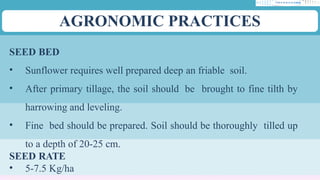
SEED BED
• Sunflower requires well prepared deep an friable soil.
• After primary tillage, the soil should be brought to fine tilth by
harrowing and leveling.
• Fine bed should be prepared. Soil should be thoroughly tilled up
to a depth of 20-25 cm.
SEED RATE
• 5-7.5 Kg/ha
AGRONOMIC PRACTICES
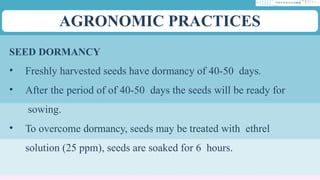
SEED DORMANCY
• Freshly harvested seeds have dormancy of 40-50 days.
• After the period of of 40-50 days the seeds will be ready for
sowing.
• To overcome dormancy, seeds may be treated with ethrel
solution (25 ppm), seeds are soaked for 6 hours.
AGRONOMIC PRACTICES
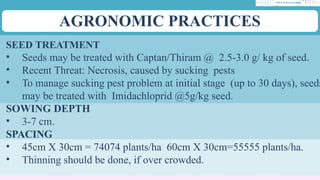
SEED TREATMENT
• Seeds may be treated with Captan/Thiram @ 2.5-3.0 g/ kg of seed.
• Recent Threat: Necrosis, caused by sucking pests
• To manage sucking pest problem at initial stage (up to 30 days), seeds
may be treated with Imidachloprid @5g/kg seed.
SOWING DEPTH
• 3-7 cm.
SPACING
• 45cm X 30cm = 74074 plants/ha 60cm X 30cm=55555 plants/ha.
• Thinning should be done, if over crowded.
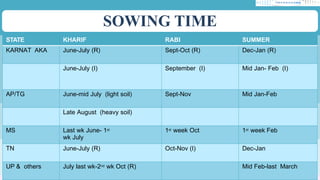
SOWING TIME
STATE KHARIF RABI SUMMER
KARNAT AKA June-July (R) Sept-Oct (R) Dec-Jan (R)
June-July (I) September (I) Mid Jan- Feb (I)
AP/TG June-mid July (light soil) Sept-Nov Mid Jan-Feb
Late August (heavy soil)
MS Last wk June- 1st
wk July
1st week Oct 1st week Feb
TN June-July (R) Oct-Nov (I) Dec-Jan
UP & others July last wk-2nd wk Oct (R) Mid Feb-last March
NUTRIENT MANAGEMENT
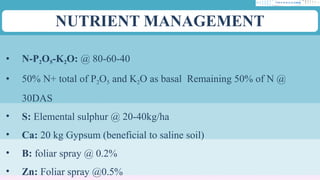
• N-P2O5-K2O: @ 80-60-40
• 50% N+ total of P2O5 and K2O as basal Remaining 50% of N @
30DAS
• S: Elemental sulphur @ 20-40kg/ha
• Ca: 20 kg Gypsum (beneficial to saline soil)
• B: foliar spray @ 0.2%
• Zn: Foliar spray @0.5%
WATER MANAGEMENT
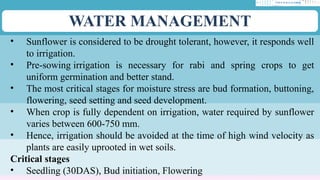
• Sunflower is considered to be drought tolerant, however, it responds well
to irrigation.
• Pre-sowing irrigation is necessary for rabi and spring crops to get
uniform germination and better stand.
• The most critical stages for moisture stress are bud formation, buttoning,
flowering, seed setting and seed development.
• When crop is fully dependent on irrigation, water required by sunflower
varies between 600-750 mm.
• Hence, irrigation should be avoided at the time of high wind velocity as
plants are easily uprooted in wet soils.
Critical stages
• Seedling (30DAS), Bud initiation, Flowering
HARVESTING AND YIELD
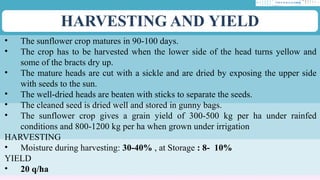
• The sunflower crop matures in 90-100 days.
• The crop has to be harvested when the lower side of the head turns yellow and
some of the bracts dry up.
• The mature heads are cut with a sickle and are dried by exposing the upper side
with seeds to the sun.
• The well-dried heads are beaten with sticks to separate the seeds.
• The cleaned seed is dried well and stored in gunny bags.
• The sunflower crop gives a grain yield of 300-500 kg per ha under rainfed
conditions and 800-1200 kg per ha when grown under irrigation
HARVESTING
• Moisture during harvesting: 30-40% , at Storage : 8- 10%
YIELD
• 20 q/ha
THANK YOU
FOR
WATCHING

Cultivation Practices on Sunflower.pptx

  • 1.
  • 2.
  • 3.
    INTRODUCTION • Scientific Name: Helianthus annus Family: Asteraceae • It is an important oilseed crop contributes 14% of the total oilseed production from nine major oil seed crops. • The genus Helianthus (Helio=Sun, anthus= flower). • Sunflower is known as a “suryajmuki” as it is grown for ornamental purpose. • It is the third most important oilseed crop of world after Soybean and Rape seed & Mustard in India .
  • 4.
    AREAAND PRODUCTION • Shortduration (90-100 days) as it is fit well in multiple and intercropping systems. • Wide adaptability: it comes well up in any type of soils. • Drought and saline tolerant: suitable for the best component crop in dry land farming. • High productivity per unit area per unit time with respect to yield of oil. • High seed multiplication ratio (1:80) with low seed rate requirement. • It is the best substitute for groundnut crop in contingency crop planning.
  • 5.
    ECONOMIC IMPORTANCE • Theoil content varies from 48-53% and it is premium oil with pale yellow in colour used for cooking and margarine. • Sunflower is a rich source of linoliec acid (40-67%) which helps in reducing the cholesterol deposition in the coronary arteries of the heart. • Sunflower oil is used as industrial feed stock for manufacturing cosmetics, soaps and pharmaceuticals. most of 90% fat is good for human. • Oil contains high level of alpha tocopherol, a form of vit. E. • Oil cake contains 40-50% high quality protein and it is ideally suited for poultry and livestock. • The roasted kernels are used as food for human beings. Sunflower is grown as green manure, fodder crop.
  • 6.
    VARIETIES / HYBRIDS Morden,TANUSAF 7, DRSF 108, DRSF 113 Hybrids MSFH 8, BSH 1, KBSH 1, Jwalamukhi, Sungene 85, PAC 36, PAC 1091, DSH 1, MSFH 8, MSFH 17, KBSH 44, Sungene 85, PAC 36, PAC 1091, Pro-Sun 09, MLSFH 47
  • 7.
    CLIMATIC REQUIREMENT CLIMATIC REQUIREMENT •Day neutral plant • Optimum temperature requirement 20-250C • Temperature beyond 38-400C may cause desiccation of pollen and drying of stigma • Rainfall 500-700 mm
  • 8.
    SOIL REQUIREMENT • Sunflowercan be grown in a wide range of soils (Vertisols, Alfisols, Inceptisols and Entisols) with texture varying sandy- loam to deep clay. • pH 6.5-8.0 • Moderately tolerant to alkalinity and salinity, but crop fails below the pH 4.6 on sandy loam soil
  • 9.
    AGRONOMIC PRACTICES SEED BED •Sunflower requires well prepared deep an friable soil. • After primary tillage, the soil should be brought to fine tilth by harrowing and leveling. • Fine bed should be prepared. Soil should be thoroughly tilled up to a depth of 20-25 cm. SEED RATE • 5-7.5 Kg/ha
  • 10.
    AGRONOMIC PRACTICES SEED DORMANCY •Freshly harvested seeds have dormancy of 40-50 days. • After the period of of 40-50 days the seeds will be ready for sowing. • To overcome dormancy, seeds may be treated with ethrel solution (25 ppm), seeds are soaked for 6 hours.
  • 11.
    AGRONOMIC PRACTICES SEED TREATMENT •Seeds may be treated with Captan/Thiram @ 2.5-3.0 g/ kg of seed. • Recent Threat: Necrosis, caused by sucking pests • To manage sucking pest problem at initial stage (up to 30 days), seeds may be treated with Imidachloprid @5g/kg seed. SOWING DEPTH • 3-7 cm. SPACING • 45cm X 30cm = 74074 plants/ha 60cm X 30cm=55555 plants/ha. • Thinning should be done, if over crowded.
  • 12.
    SOWING TIME STATE KHARIFRABI SUMMER KARNAT AKA June-July (R) Sept-Oct (R) Dec-Jan (R) June-July (I) September (I) Mid Jan- Feb (I) AP/TG June-mid July (light soil) Sept-Nov Mid Jan-Feb Late August (heavy soil) MS Last wk June- 1st wk July 1st week Oct 1st week Feb TN June-July (R) Oct-Nov (I) Dec-Jan UP & others July last wk-2nd wk Oct (R) Mid Feb-last March
  • 13.
    NUTRIENT MANAGEMENT • N-P2O5-K2O:@ 80-60-40 • 50% N+ total of P2O5 and K2O as basal Remaining 50% of N @ 30DAS • S: Elemental sulphur @ 20-40kg/ha • Ca: 20 kg Gypsum (beneficial to saline soil) • B: foliar spray @ 0.2% • Zn: Foliar spray @0.5%
  • 14.
    WATER MANAGEMENT • Sunfloweris considered to be drought tolerant, however, it responds well to irrigation. • Pre-sowing irrigation is necessary for rabi and spring crops to get uniform germination and better stand. • The most critical stages for moisture stress are bud formation, buttoning, flowering, seed setting and seed development. • When crop is fully dependent on irrigation, water required by sunflower varies between 600-750 mm. • Hence, irrigation should be avoided at the time of high wind velocity as plants are easily uprooted in wet soils. Critical stages • Seedling (30DAS), Bud initiation, Flowering
  • 15.
    HARVESTING AND YIELD •The sunflower crop matures in 90-100 days. • The crop has to be harvested when the lower side of the head turns yellow and some of the bracts dry up. • The mature heads are cut with a sickle and are dried by exposing the upper side with seeds to the sun. • The well-dried heads are beaten with sticks to separate the seeds. • The cleaned seed is dried well and stored in gunny bags. • The sunflower crop gives a grain yield of 300-500 kg per ha under rainfed conditions and 800-1200 kg per ha when grown under irrigation HARVESTING • Moisture during harvesting: 30-40% , at Storage : 8- 10% YIELD • 20 q/ha
  • 16.