MARKET OVERVIEW
May 2006 was a terrible month for equities: Inflation spiked, the Federal Reserve hiked interest
rates and Wall Street’s bears gnawed 6.1% off the technology-heavy Nasdaq Composite. One
year later, conditions are markedly better. Stocks rallied last month, with the Dow Jones
Industrial Average completing its longest bull-run since 1927. The Dow, which has ranged in and
out of record territory since October, was joined on May 30 by the S&P 500, which closed the
day at 1,530, a hair above its March 2000 high. Surging optimism wasn’t bounded by borders.
Country and regional benchmarks from Asia and Europe to Latin America also reached peaks.
Mergers and acquisitions are a major theme underpinning stocks. According to Bloomberg, $1.1
trillion in deals were announced year-to-date through May 31. That is 61% more than the
record-setting pace established in 2006. While Wall Street’s recent milestones dredge up mem-
ories of dot-com exuberance, today’s markets still look relatively fairly priced. At the end of last
month, the S&P 500 was valued at 18 times earnings. At the height of the technology bubble
in March 2000, the index was valued at 33 times earnings.
From an economic perspective, news was mostly good. The Federal Open Market Committee
met on May 9 and held interest rates steady at 5.25%. Minutes from the meeting showed infla-
tion remains the “predominant concern”,
while risks to the economy have “dimin-
ished slightly.” Core consumer price gains
slipped to a twelve-month low of 2.3% in
April. However, May gasoline prices crested
at $3.23/gallon, according to AAA. The
previous inflation-adjusted high of $3.20/
gallon had stood since March 1981.
Business spending continues to recover,
with April orders for non-defense capital
goods ex-aircraft up 1.2%.
According to Thomson Financial, with 474
companies reporting, 1Q07 corporate earn-
ings for the S&P 500 grew 8.1%. This ends
fourteen straight quarters of double-digit
expansion, the longest such stretch in fifty-
seven years. Telecommunications and
health care companies are seeing the
strongest results, while consumer discre-
tionary companies are lagging due to
weakness among auto and housing-related
firms.
S U M M E R 2 0 0 7
at the margin
G L O B A L E Q U I T Y M A R K E T O V E R V I E W
IN THIS ISSUE
Perspective . . . . . . . . . . . . .2
Equity Update . . . . . . . . . . .2
Firm Update . . . . . . . . . . . .3
Portfolio Manager Insights:
Adding Depth, Flexibility and
Enhanced Returns with SMID
Cap Growth . . . . . . . . . . .4
Feature:
Emerging Markets
Small Cap . . . . . . . . . . . . .6
Focus:
The Case for Europe . . . . .8
Chartbook . . . . . . . . . . . . .12
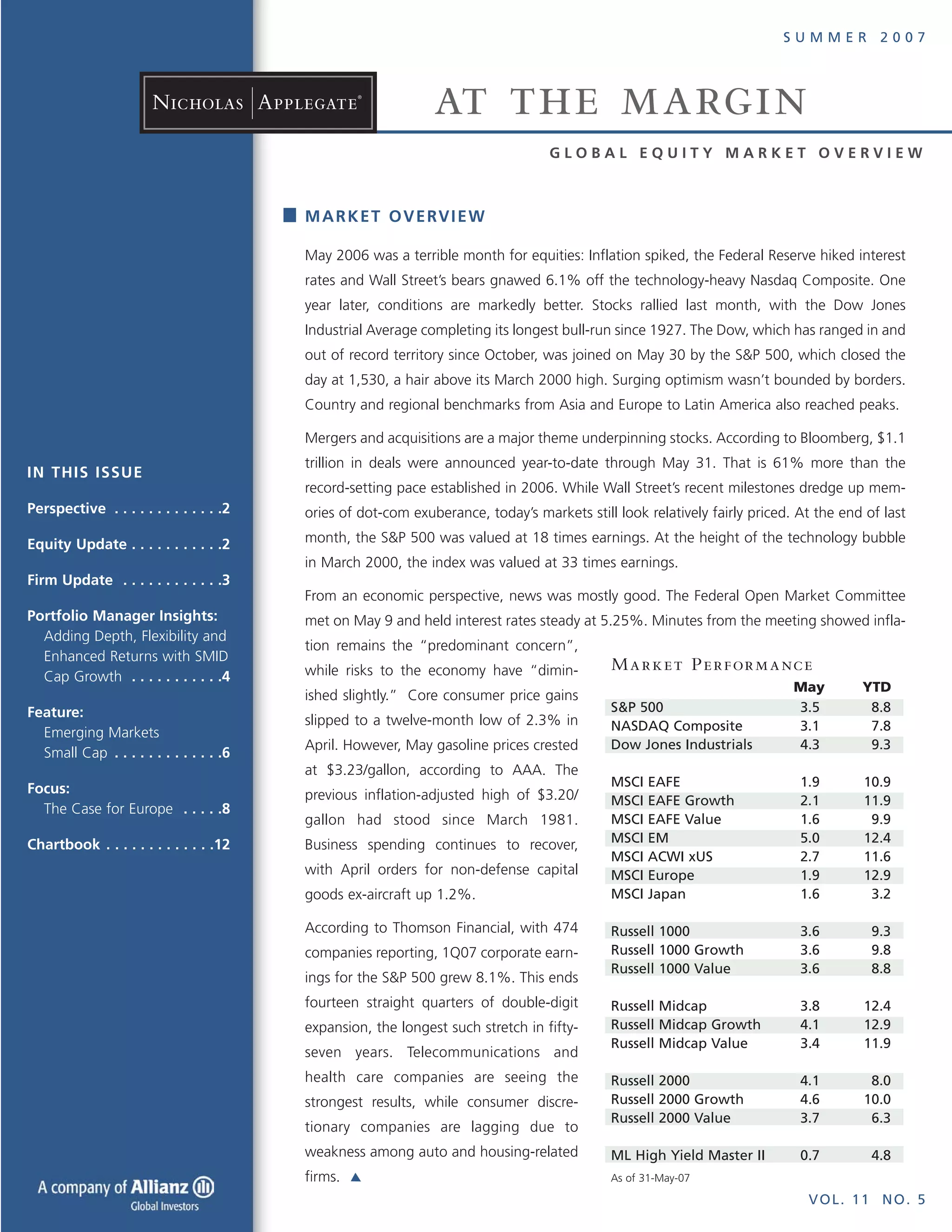
May YTD
S&P 500 3.5 8.8
NASDAQ Composite 3.1 7.8
Dow Jones Industrials 4.3 9.3
MSCI EAFE 1.9 10.9
MSCI EAFE Growth 2.1 11.9
MSCI EAFE Value 1.6 9.9
MSCI EM 5.0 12.4
MSCI ACWI xUS 2.7 11.6
MSCI Europe 1.9 12.9
MSCI Japan 1.6 3.2
Russell 1000 3.6 9.3
Russell 1000 Growth 3.6 9.8
Russell 1000 Value 3.6 8.8
Russell Midcap 3.8 12.4
Russell Midcap Growth 4.1 12.9
Russell Midcap Value 3.4 11.9
Russell 2000 4.1 8.0
Russell 2000 Growth 4.6 10.0
Russell 2000 Value 3.7 6.3
ML High Yield Master II 0.7 4.8
As of 31-May-07
Market Performance
VOL. 11 NO. 5
PERSPECTIVE
Katherine Rich
Managing Director,
Director of Client
Service
EQUITY UPDATE
GROWTH/VALUE EQUITY
Improved economic conditions led to growth’s out-
performance in May, at least among small- and
mid-cap companies. Investment style had little dis-
cernible impact on performance in the large-cap
space. Consumer-related shares saw some of the
weakest results, as the public grappled with
record-high gasoline prices. According to the
Government Accountability Office, rising pump
prices have already cost consumers $20 billion this
year, the equivalent of nearly $150 for each car on
the road. Perhaps unsurprisingly, energy company
stocks were among the month’s top gainers.
LARGE/MID/SMALL EQUITY
Sentiment shifted in favor of small caps over mid
and large caps in May, as improving economic
conditions prompted investors to load up on
riskier assets. The Russell 2000 Index, a broad
measure of the small-cap universe, with an aver-
age market capitalization of $1.3 billion, hit a
stride, notching four record-high closes. In spite of
the results, on average, small caps still trail on a
year-to-date basis.
INTERNATIONAL EQUITY
International equities managed a twelfth consecu-
tive month of gains in May, matching the longest
such stretch since early 2004. Indexes in several
countries from Australia and China to Mexico and
Brazil reached all-time highs. In aggregate, growth
outperformed value, while emerging markets out-
performed developed markets. Regionally, North
American shares saw the best results, followed by
European shares and shares in Asia. Performance
in local terms was higher than performance in U.S.
terms, due to a stronger dollar and diminished
expectations for a Federal Reserve interest rate cut
by year-end.
2
 Copyright 2007
....Nicholas-Applegate
....Capital Management
At Nicholas-Applegate, clients are at the heart
of everything we do. We appreciate your trust
in us to manage your assets and never lose
sight of that privilege.
Over the past several years, we have made
“client centricity” the focus of our activities.
This has included many initiatives around our
processes and practices, including: new port-
folio accounting systems, significantly
reduced trading costs, implementation of a
highly-automated compliance engine, and
post Reg-FD research enhancement, among
others. Each of these activities is part of our
constant objective to provide world-class exe-
cution in all areas of our business.
In addition, we have been working to
enhance specific aspects of our client service
delivery, including:
Working with Greenwich Associates to
obtain detailed feedback on our client
service delivery;
Streamlining the new client funding
process;
Implementing a Client Relationship
Management (CRM) system to better doc-
ument and track client interactions; and
Retaining an external consultant to solicit
objective feedback following our prospect
presentations.
A critical element of enhancing our client
experience is to improve our employee experi-
ence — how we develop, evaluate and moti-
vate our people as well as how we work
together. Closer alignment of our employees’
individual career goals with the vision and val-
ues of the firm will result in a tighter bond
with our clients.
Clients are why we’re in business.
Continuous enhancement of your experience
is why we remain excited to be in this
business.
FIRM UPDATE
At The Margin is a
monthly publication of:
Nicholas-Applegate
Capital Management
600 West Broadway
San Diego, CA 92101
PHONE (800) 656-6226
(619) 687-8000
FAX (619) 744-5545
3
Nicholas-Applegate invests in intellectual capital by hiring top-notch talent. This quarter, the
following professional joined our investment team:
Stephan Maikkula, CFA, CMT – Associate, Analyst – Stephan Maikkula has research responsi-
bilities on our international teams. Prior to joining Nicholas-Applegate, he was a portfolio
manager and an international equity analyst for the Employees Retirement System of Texas.
Stephan also managed portfolios for MBA Investment Fund, LLC, interned at the Teacher
Retirement System of Texas, and worked at Cargill, Inc., providing fundamental and technical
analysis of commodity futures markets. He earned his B.A. with dual majors in management with
an international concentration and in German from Saint John’s University, graduating summa
cum laude, and his M.B.A. at the University of Texas at Austin, McCombs School of Business.
Stephan is fluent in German and has ten years of investment industry experience.
CONFERENCE PRESENTATION
Kunal Ghosh, Senior Vice President, Portfolio Manager, Systematic, recently spoke at the
Investors Capital Corp. conference, a forum for variable annuity distributors, on the outlook for
investment opportunities in non-U.S. markets. Please contact your client service officer for a copy
of Mr. Ghosh’s presentation, “Expanding Opportunities Abroad”.
by Cathleen Bramlage
Celebrating a Champion — Thanks to support for
Children’s Hospital’s pediatric cancer care center, eight-
year-old Les Fountain is triumphing over cancer today.
Les and his parents are shown in the picture with our
Celebration of Champion runners, Mel Horvath and
son Noah, and Brandon Michael. Nicholas-Applegate
was a Bronze Sponsor of the event, May 12 at the
Embarcadero, San Diego.
4
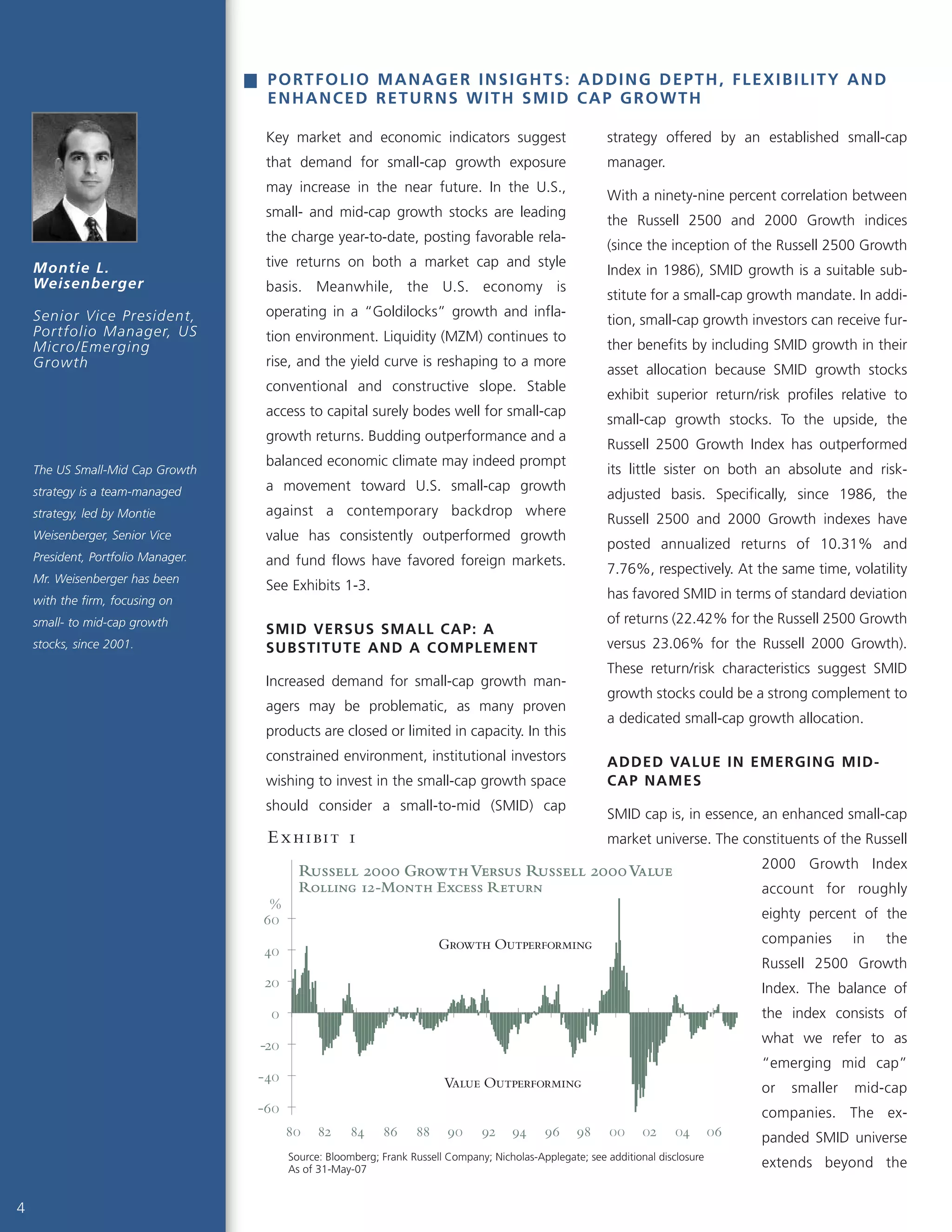
Key market and economic indicators suggest
that demand for small-cap growth exposure
may increase in the near future. In the U.S.,
small- and mid-cap growth stocks are leading
the charge year-to-date, posting favorable rela-
tive returns on both a market cap and style
basis. Meanwhile, the U.S. economy is
operating in a “Goldilocks” growth and infla-
tion environment. Liquidity (MZM) continues to
rise, and the yield curve is reshaping to a more
conventional and constructive slope. Stable
access to capital surely bodes well for small-cap
growth returns. Budding outperformance and a
balanced economic climate may indeed prompt
a movement toward U.S. small-cap growth
against a contemporary backdrop where
value has consistently outperformed growth
and fund flows have favored foreign markets.
See Exhibits 1-3.
SMID VERSUS SMALL CAP: A
SUBSTITUTE AND A COMPLEMENT
Increased demand for small-cap growth man-
agers may be problematic, as many proven
products are closed or limited in capacity. In this
constrained environment, institutional investors
wishing to invest in the small-cap growth space
should consider a small-to-mid (SMID) cap
strategy offered by an established small-cap
manager.
With a ninety-nine percent correlation between
the Russell 2500 and 2000 Growth indices
(since the inception of the Russell 2500 Growth
Index in 1986), SMID growth is a suitable sub-
stitute for a small-cap growth mandate. In addi-
tion, small-cap growth investors can receive fur-
ther benefits by including SMID growth in their
asset allocation because SMID growth stocks
exhibit superior return/risk profiles relative to
small-cap growth stocks. To the upside, the
Russell 2500 Growth Index has outperformed
its little sister on both an absolute and risk-
adjusted basis. Specifically, since 1986, the
Russell 2500 and 2000 Growth indexes have
posted annualized returns of 10.31% and
7.76%, respectively. At the same time, volatility
has favored SMID in terms of standard deviation
of returns (22.42% for the Russell 2500 Growth
versus 23.06% for the Russell 2000 Growth).
These return/risk characteristics suggest SMID
growth stocks could be a strong complement to
a dedicated small-cap growth allocation.
ADDED VALUE IN EMERGING MID-
CAP NAMES
SMID cap is, in essence, an enhanced small-cap
market universe. The constituents of the Russell
2000 Growth Index
account for roughly
eighty percent of the
companies in the
Russell 2500 Growth
Index. The balance of
the index consists of
what we refer to as
“emerging mid cap”
or smaller mid-cap
companies. The ex-
panded SMID universe
extends beyond the
Montie L.
Weisenberger
Senior Vice President,
Portfolio Manager, US
Micro/Emerging
Growth
PORTFOLIO MANAGER INSIGHTS: ADDING DEPTH, FLEXIBILITY AND
ENHANCED RETURNS WITH SMID CAP GROWTH
The US Small-Mid Cap Growth
strategy is a team-managed
strategy, led by Montie
Weisenberger, Senior Vice
President, Portfolio Manager.
Mr. Weisenberger has been
with the firm, focusing on
small- to mid-cap growth
stocks, since 2001.
Russell 2000 GrowthVersus Russell 2000Value
Rolling 12-Month Excess Return
-60
-40
-20
0
20
40
60
80 82 84 86 88 90 92 94 96 98 00 02 04 06
%
Value Outperforming
Growth Outperforming
Source: Bloomberg; Frank Russell Company; Nicholas-Applegate; see additional disclosure
As of 31-May-07
Exhibit 1
indexes and, as of 1Q07, included roughly 3,500 companies
trading on major U.S. exchanges with market caps
ranging from one hundred million to ten billion dollars. This
ceiling will reset when the index rebalances this summer.
What makes SMID cap attractive versus small cap is the added
depth and flexibility. Depth refers to the addition of hundreds
of emerging mid-cap names to the small-cap base.
Specifically, during 1Q07, the Russell 2500 Index included 476
emerging mid-cap companies on top of the 1,918 small caps
included in the Russell 2000 Index.
Importantly, the emerging mid-cap space is populated each
summer with “graduates” from the Russell 2000 Index via
Russell’s reconstitution process. Historically, these emerging
mid-cap graduates have performed well versus the Russell
2000 Index. Collectively, emerging mid alumni of the Russell
2000 Index graduating classes of 1990 through 2006 have on
average outperformed the index by 4.3%, 6.4%, and 6.7%
over the following three, six, and twelve months, respectively.
Moreover, during the same period, the alumni had a better
than fifty percent chance of outperforming the index they left
behind. Thus, the opportunity to “let your winners run”
rather than selling them based on market-cap constraints
associated with small-cap mandates makes SMID an attractive
alternative to small. Changes to Russell’s reconstitution
methodology will alter the scope and timing of new
entrants to the SMID cap universe, while preserving the
differentiation between emerging mid- and small-cap
investment opportunities.
Added flexibility comes from the ability to source investment
candidates from a broad universe of robust small caps as well
as market-leading emerging mid caps. Such flexibility provides
for alpha generation opportunity when a certain segment of
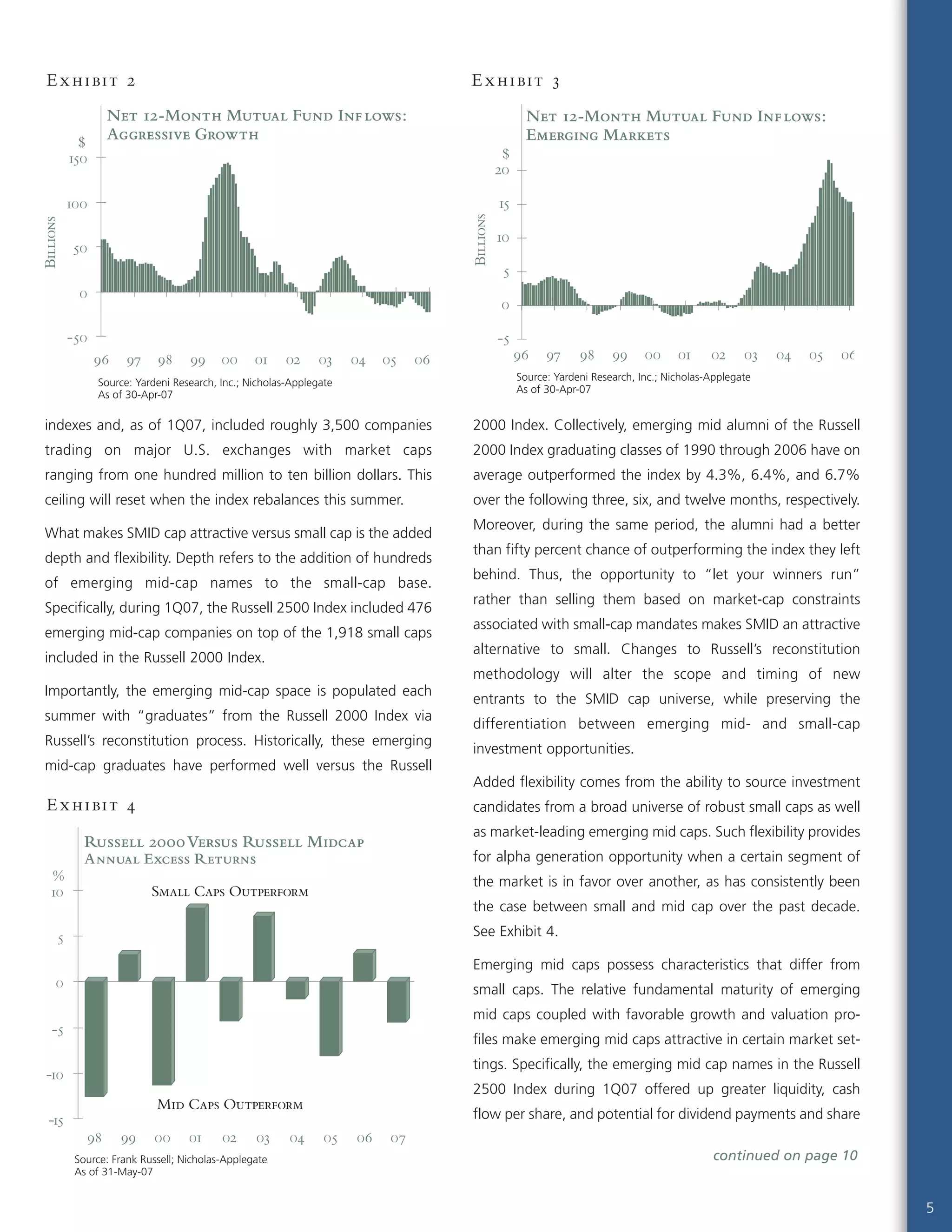
the market is in favor over another, as has consistently been
the case between small and mid cap over the past decade.
See Exhibit 4.
Emerging mid caps possess characteristics that differ from
small caps. The relative fundamental maturity of emerging
mid caps coupled with favorable growth and valuation pro-
files make emerging mid caps attractive in certain market set-
tings. Specifically, the emerging mid cap names in the Russell
2500 Index during 1Q07 offered up greater liquidity, cash
flow per share, and potential for dividend payments and share
5
continued on page 10Source: Frank Russell; Nicholas-Applegate
As of 31-May-07
Russell 2000Versus Russell Midcap
Annual Excess Returns
-15
-10
-5
0
5
10
98 99 00 01 02 03 04 05 06 07
Small Caps Outperform
Mid Caps Outperform
%
Exhibit 4
Source: Yardeni Research, Inc.; Nicholas-Applegate
As of 30-Apr-07
Net 12-Month Mutual Fund Inflows:
Emerging Markets
-5
0
5
10
15
20
96 97 98 99 00 01 02 03 04 05 06
Billions
$
Exhibit 2
Source: Yardeni Research, Inc.; Nicholas-Applegate
As of 30-Apr-07
Net 12-Month Mutual Fund Inflows:
Aggressive Growth
-50
0
50
100
150
96 97 98 99 00 01 02 03 04 05 06
Billions
$
Exhibit 3
6
FEATURE: EMERGING MARKETS SMALL CAP
organ Stanley Capital International
(MSCI) recently announced
enhancements to their standard
international indices. These changes are
designed to allow for greater comparability
among emerging market investment managers
and in the case of emerging markets small cap,
will help establish its place on the global invest-
ment map.
In order to dissect emerging markets small
caps, we first need to revisit emerging markets
as a whole. Emerging markets investing has
long been classified as a boom-or-bust propo-
sition, with countries often lumped into one
broad category. However, with increasingly
sophisticated financial markets, access to capi-
tal and higher legal and regulatory standards, a
new environment for emerging markets has
been created. The lines between emerging
and developed economies have been blurring
for some time now.
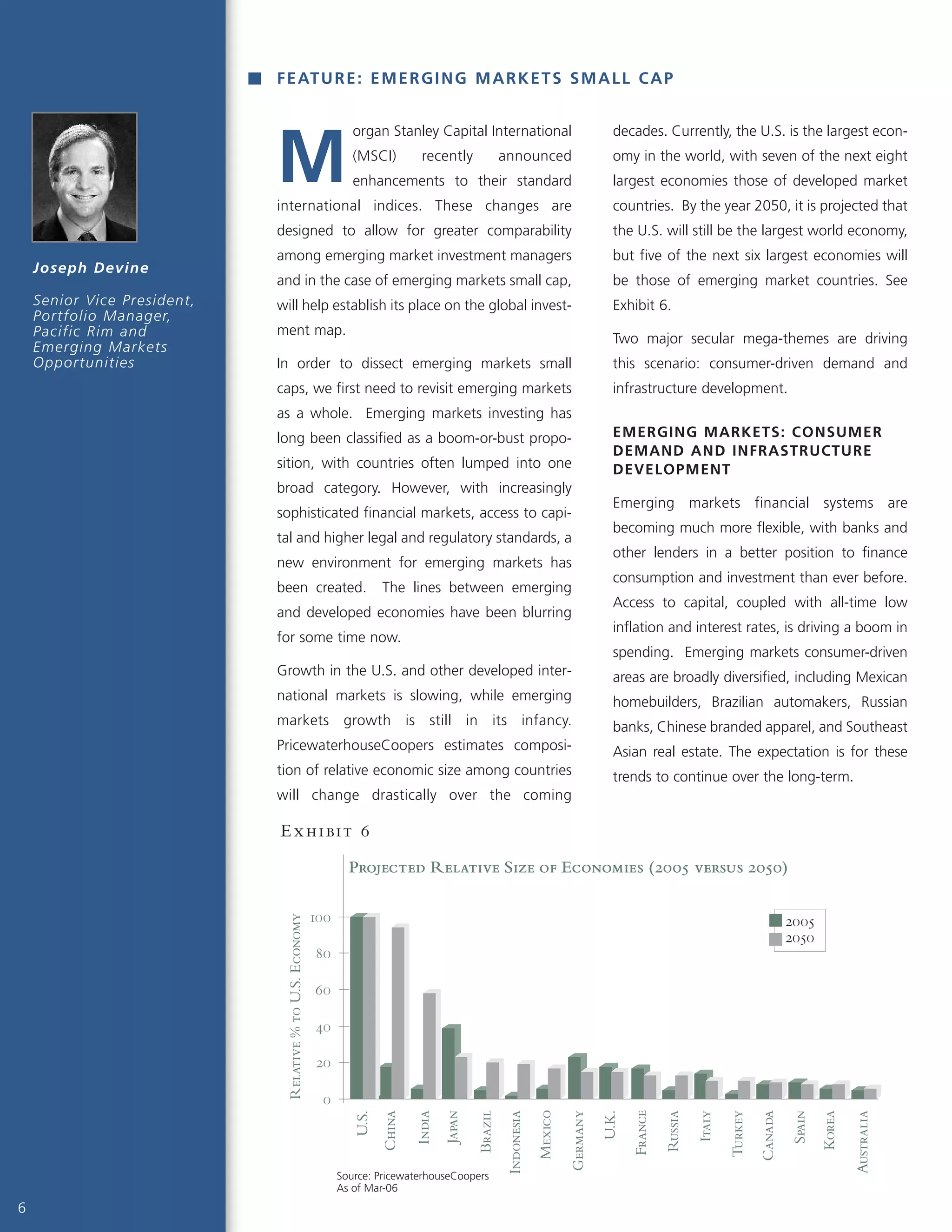
Growth in the U.S. and other developed inter-
national markets is slowing, while emerging
markets growth is still in its infancy.
PricewaterhouseCoopers estimates composi-
tion of relative economic size among countries
will change drastically over the coming
decades. Currently, the U.S. is the largest econ-
omy in the world, with seven of the next eight
largest economies those of developed market
countries. By the year 2050, it is projected that
the U.S. will still be the largest world economy,
but five of the next six largest economies will
be those of emerging market countries. See
Exhibit 6.
Two major secular mega-themes are driving
this scenario: consumer-driven demand and
infrastructure development.
EMERGING MARKETS: CONSUMER
DEMAND AND INFRASTRUCTURE
DEVELOPMENT
Emerging markets financial systems are
becoming much more flexible, with banks and
other lenders in a better position to finance
consumption and investment than ever before.
Access to capital, coupled with all-time low
inflation and interest rates, is driving a boom in
spending. Emerging markets consumer-driven
areas are broadly diversified, including Mexican
homebuilders, Brazilian automakers, Russian
banks, Chinese branded apparel, and Southeast
Asian real estate. The expectation is for these
trends to continue over the long-term.
M
Joseph Devine
Senior Vice President,
Portfolio Manager,
Pacific Rim and
Emerging Markets
Opportunities
Projected Relative Size of Economies (2005 versus 2050)
0
20
40
60
80
100 2005
2050
Source: PricewaterhouseCoopers
As of Mar-06
Relative%toU.S.Economy
U.S.
China
India
Brazil
Japan
Indonesia
Mexico
Germany
U.K.
France
Russia
Italy
Turkey
Canada
Spain
Korea
Australia
Exhibit 6
7
Along with increased consumer spending, infrastructure
demand in emerging markets economies is also exploding.
Demand for roads, bridges, rail, electrical supply and housing
projects is at record levels across emerging markets countries.
General Electric predicts that developing market infrastructure
spending could be $3 trillion over the next ten years. This ends
up being windfall demand for many countries such as South
Africa, Brazil, and Russia who supply a majority of the world’s
energy and materials. This infrastructure development boom
is also expected to continue for the foreseeable future.
EMERGING MARKETS INDICES
So, if growth in emerging markets should continue for some
time, namely from consumer and infrastructure themes, then
all investors need to do is to invest in a strategy that is similar
to the MSCI Emerging Markets Index (EM) and hold it for a
long time, right? Not exactly. While the current MSCI EM
Index is the industry standard to gauge emerging markets per-
formance, it does have its flaws, namely concentration in a
handful of names and lack of broad sector coverage.
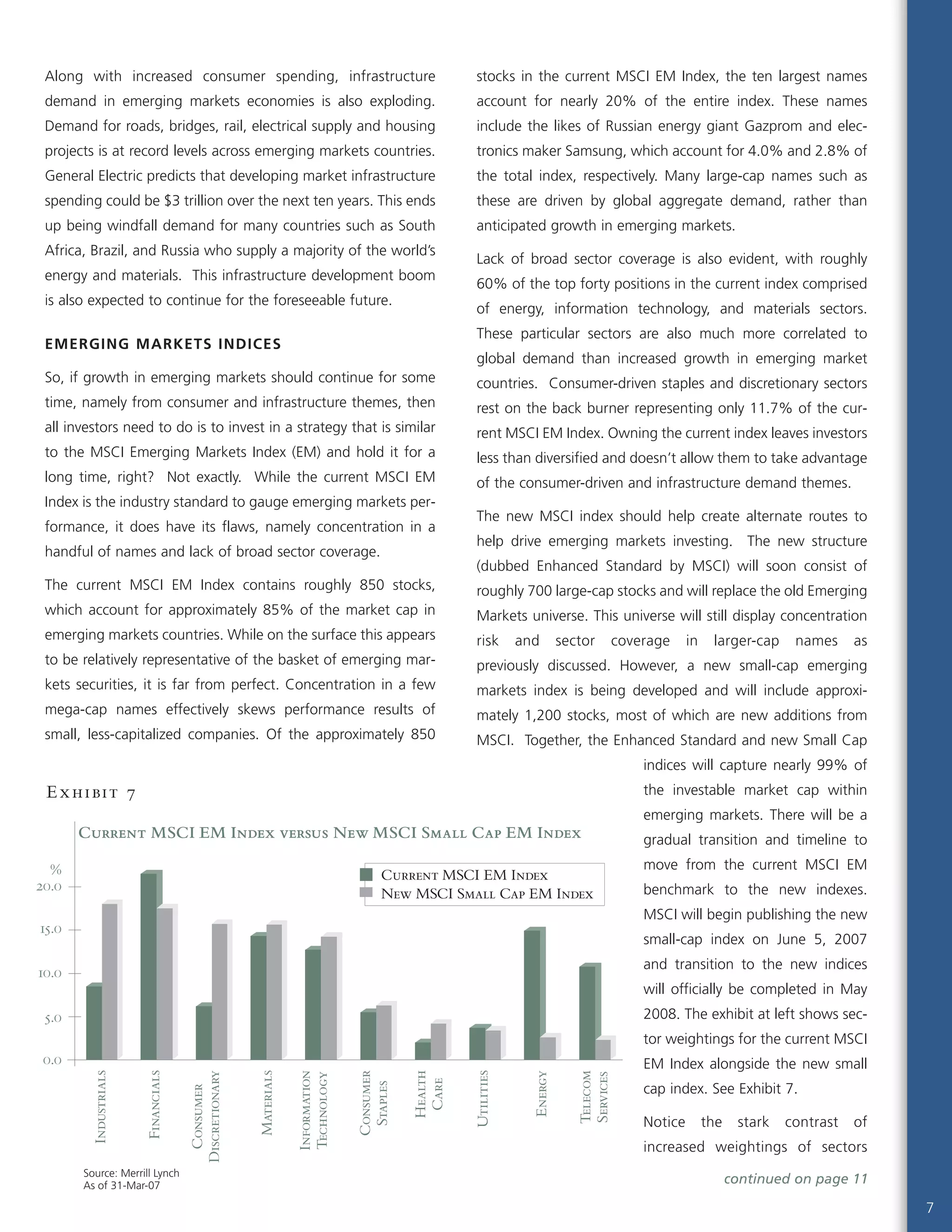
The current MSCI EM Index contains roughly 850 stocks,
which account for approximately 85% of the market cap in
emerging markets countries. While on the surface this appears
to be relatively representative of the basket of emerging mar-
kets securities, it is far from perfect. Concentration in a few
mega-cap names effectively skews performance results of
small, less-capitalized companies. Of the approximately 850
stocks in the current MSCI EM Index, the ten largest names
account for nearly 20% of the entire index. These names
include the likes of Russian energy giant Gazprom and elec-
tronics maker Samsung, which account for 4.0% and 2.8% of
the total index, respectively. Many large-cap names such as
these are driven by global aggregate demand, rather than
anticipated growth in emerging markets.
Lack of broad sector coverage is also evident, with roughly
60% of the top forty positions in the current index comprised
of energy, information technology, and materials sectors.
These particular sectors are also much more correlated to
global demand than increased growth in emerging market
countries. Consumer-driven staples and discretionary sectors
rest on the back burner representing only 11.7% of the cur-
rent MSCI EM Index. Owning the current index leaves investors
less than diversified and doesn’t allow them to take advantage
of the consumer-driven and infrastructure demand themes.
The new MSCI index should help create alternate routes to
help drive emerging markets investing. The new structure
(dubbed Enhanced Standard by MSCI) will soon consist of
roughly 700 large-cap stocks and will replace the old Emerging
Markets universe. This universe will still display concentration
risk and sector coverage in larger-cap names as
previously discussed. However, a new small-cap emerging
markets index is being developed and will include approxi-
mately 1,200 stocks, most of which are new additions from
MSCI. Together, the Enhanced Standard and new Small Cap
indices will capture nearly 99% of
the investable market cap within
emerging markets. There will be a
gradual transition and timeline to
move from the current MSCI EM
benchmark to the new indexes.
MSCI will begin publishing the new
small-cap index on June 5, 2007
and transition to the new indices
will officially be completed in May
2008. The exhibit at left shows sec-
tor weightings for the current MSCI
EM Index alongside the new small
cap index. See Exhibit 7.
Notice the stark contrast of
increased weightings of sectors
Current MSCI EM Index versus New MSCI Small Cap EM Index
Source: Merrill Lynch
As of 31-Mar-07
0.0
5.0
10.0
15.0
20.0
Current MSCI EM Index
New MSCI Small Cap EM Index
Industrials
Financials
Consumer
Discretionary
Materials
Information
Technology
Consumer
Staples
Health
Care
Utilities
Energy
Telecom
Services
%
Exhibit 7
continued on page 11
8
FOCUS: THE CASE FOR EUROPE
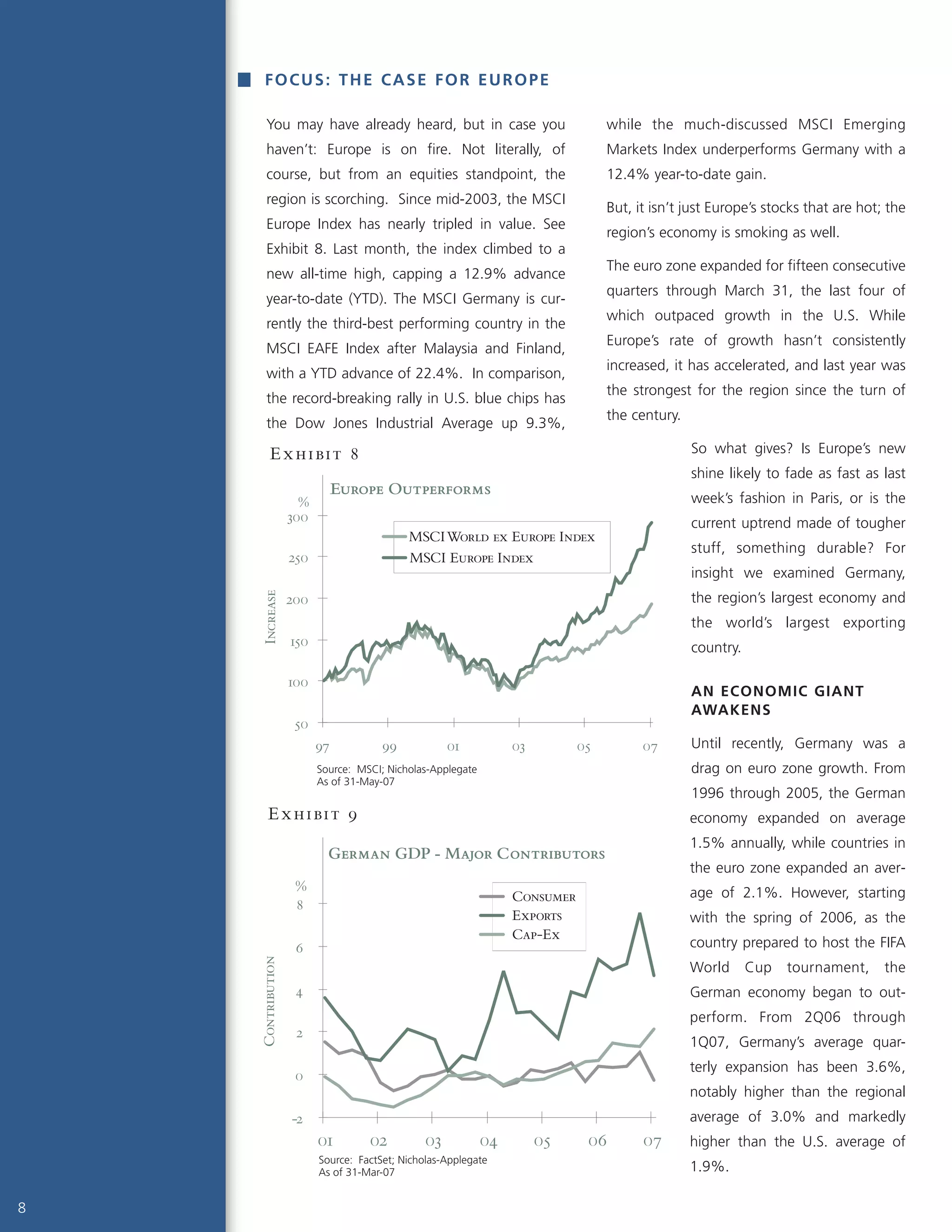
You may have already heard, but in case you
haven’t: Europe is on fire. Not literally, of
course, but from an equities standpoint, the
region is scorching. Since mid-2003, the MSCI
Europe Index has nearly tripled in value. See
Exhibit 8. Last month, the index climbed to a
new all-time high, capping a 12.9% advance
year-to-date (YTD). The MSCI Germany is cur-
rently the third-best performing country in the
MSCI EAFE Index after Malaysia and Finland,
with a YTD advance of 22.4%. In comparison,
the record-breaking rally in U.S. blue chips has
the Dow Jones Industrial Average up 9.3%,
while the much-discussed MSCI Emerging
Markets Index underperforms Germany with a
12.4% year-to-date gain.
But, it isn’t just Europe’s stocks that are hot; the
region’s economy is smoking as well.
The euro zone expanded for fifteen consecutive
quarters through March 31, the last four of
which outpaced growth in the U.S. While
Europe’s rate of growth hasn’t consistently
increased, it has accelerated, and last year was
the strongest for the region since the turn of
the century.
So what gives? Is Europe’s new
shine likely to fade as fast as last
week’s fashion in Paris, or is the
current uptrend made of tougher
stuff, something durable? For
insight we examined Germany,
the region’s largest economy and
the world’s largest exporting
country.
AN ECONOMIC GIANT
AWAKENS
Until recently, Germany was a
drag on euro zone growth. From
1996 through 2005, the German
economy expanded on average
1.5% annually, while countries in
the euro zone expanded an aver-
age of 2.1%. However, starting
with the spring of 2006, as the
country prepared to host the FIFA
World Cup tournament, the
German economy began to out-
perform. From 2Q06 through
1Q07, Germany’s average quar-
terly expansion has been 3.6%,
notably higher than the regional
average of 3.0% and markedly
higher than the U.S. average of
1.9%.
Europe Outperforms
50
100
150
200
250
300
97 99 01 03 05 07
MSCIWorld ex Europe Index
MSCI Europe Index
Increase
%
Source: MSCI; Nicholas-Applegate
As of 31-May-07
Exhibit 8
German GDP - Major Contributors
-2
0
2
4
6
8
01 02 03 04 05 06 07
Consumer
Exports
Cap-Ex
Contribution
Source: FactSet; Nicholas-Applegate
As of 31-Mar-07
%
Exhibit 9
9
Germany’s economic reawakening can be boiled down to
three interrelated factors: a nearly 50% spike in exports since
2003, a steadily growing wave of capital expenditures since
mid-2004 and the resurgence of the consumer as a positive
contributor to economic growth in late 2004. See Exhibit 9. In
theory, the rapid rise in exports prompted businesses to
improve their production capabilities and hire more em-
ployees. This led to a drop in unemployment, an increase in
salaries and rising consumer spending. In practice, German
capital expenditures as a percent of GDP reached a five-year
peak in May, while joblessness was at a six-year low and con-
sumer confidence was at an all-time high.
Assuming capital expenditures reasonably indicate future
business activity, and high consumer confidence amid a tight
job market reasonably indicates future consumer spending,
the economic outlook for Germany would appear fairly good.
While this is interesting, it is even more so given that the
themes surrounding German growth are common to some
degree throughout the region. Euro zone exports jumped
35% in the five years through March 31, while euro zone
business spending was up 7.2% from a year earlier. In May,
regional business and consumer confidence was at a six-year
high, while unemployment, at 7.1% in April, was the lowest
since records started in 1993.
VALUATIONS AND EARNINGS
Economics are a good starting point for stock picking, but
valuations and earnings are an investor's bread and butter.
Despite the recent run-up in share prices, European
equities still look cheap compared to the rest of the
world. Furthermore, current valuations are a far cry
from the froth seen at the peak of the technology
bubble.
One reason Europe continues to price well is because
corporate earnings growth has been solid. According
to Citigroup figures, profits in the MSCI Europe Index
have grown for four consecutive years, including a
17% jump in 2006 and a 13% rise in 2005. So far in
2007, about three companies are beating 1Q07 ana-
lyst estimates for each company missing estimates.
The biggest positive surprises have been in the con-
struction, health care and household goods industries.
While FactSet Research suggests profits in Europe will
grow approximately 6.4% in 2007, Nicholas-
Applegate Portfolio Manager, Senior Vice President,
Pedro Marcal thinks “something in the mid to high single-digit
range seems reasonable.”
INFLATION, INTEREST RATES AND THE EURO
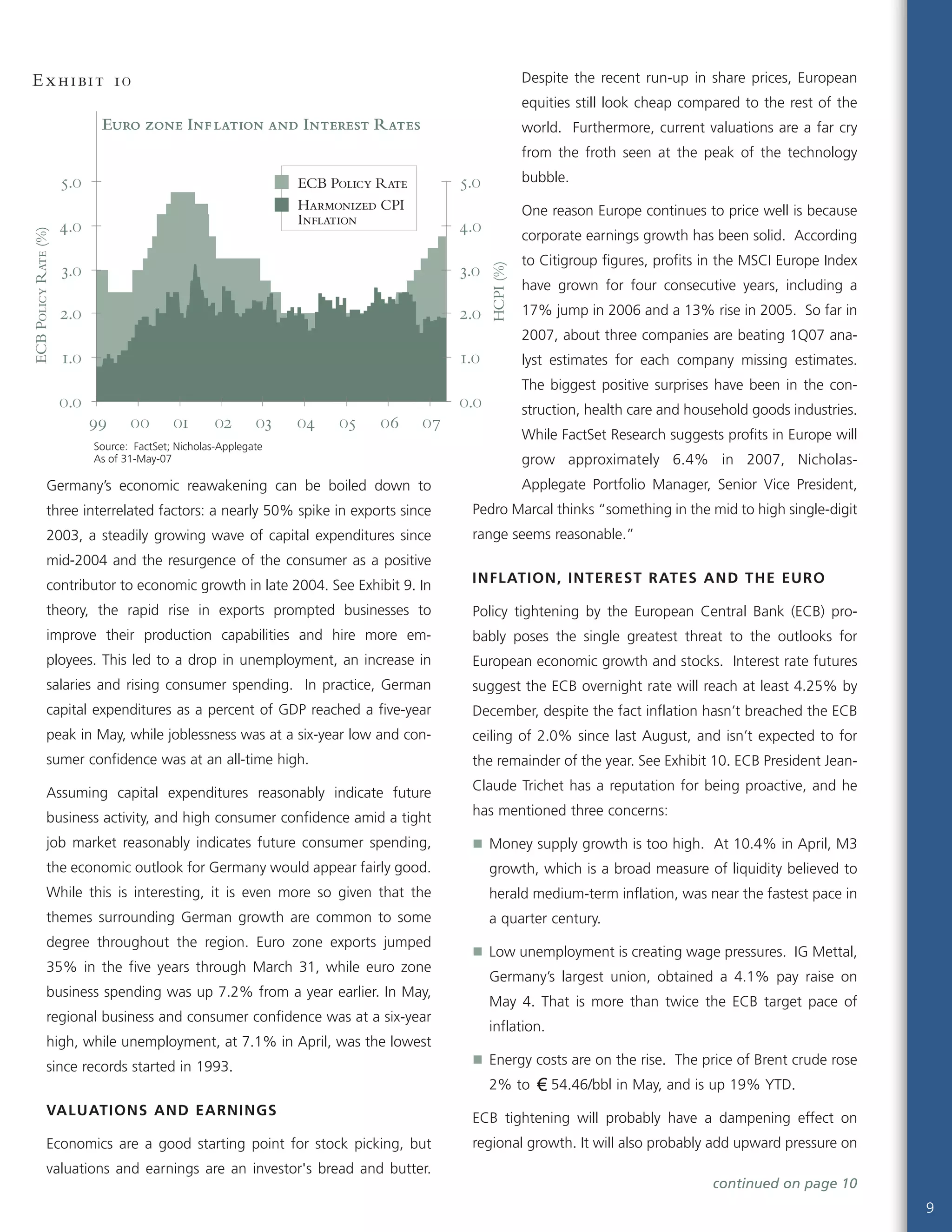
Policy tightening by the European Central Bank (ECB) pro-
bably poses the single greatest threat to the outlooks for
European economic growth and stocks. Interest rate futures
suggest the ECB overnight rate will reach at least 4.25% by
December, despite the fact inflation hasn’t breached the ECB
ceiling of 2.0% since last August, and isn’t expected to for
the remainder of the year. See Exhibit 10. ECB President Jean-
Claude Trichet has a reputation for being proactive, and he
has mentioned three concerns:
Money supply growth is too high. At 10.4% in April, M3
growth, which is a broad measure of liquidity believed to
herald medium-term inflation, was near the fastest pace in
a quarter century.
Low unemployment is creating wage pressures. IG Mettal,
Germany’s largest union, obtained a 4.1% pay raise on
May 4. That is more than twice the ECB target pace of
inflation.
Energy costs are on the rise. The price of Brent crude rose
2% to 54.46/bbl in May, and is up 19% YTD.
ECB tightening will probably have a dampening effect on
regional growth. It will also probably add upward pressure on
continued on page 10
Euro zone Inflation and Interest Rates
0.0
1.0
2.0
3.0
4.0
5.0
99 00 01 02 03 04 05 06 07
0.0
1.0
2.0
3.0
4.0
5.0ECB Policy Rate
Harmonized CPI
Inflation
ECBPolicyRate(%)
HCPI(%)
Source: FactSet; Nicholas-Applegate
As of 31-May-07
Exhibit 10
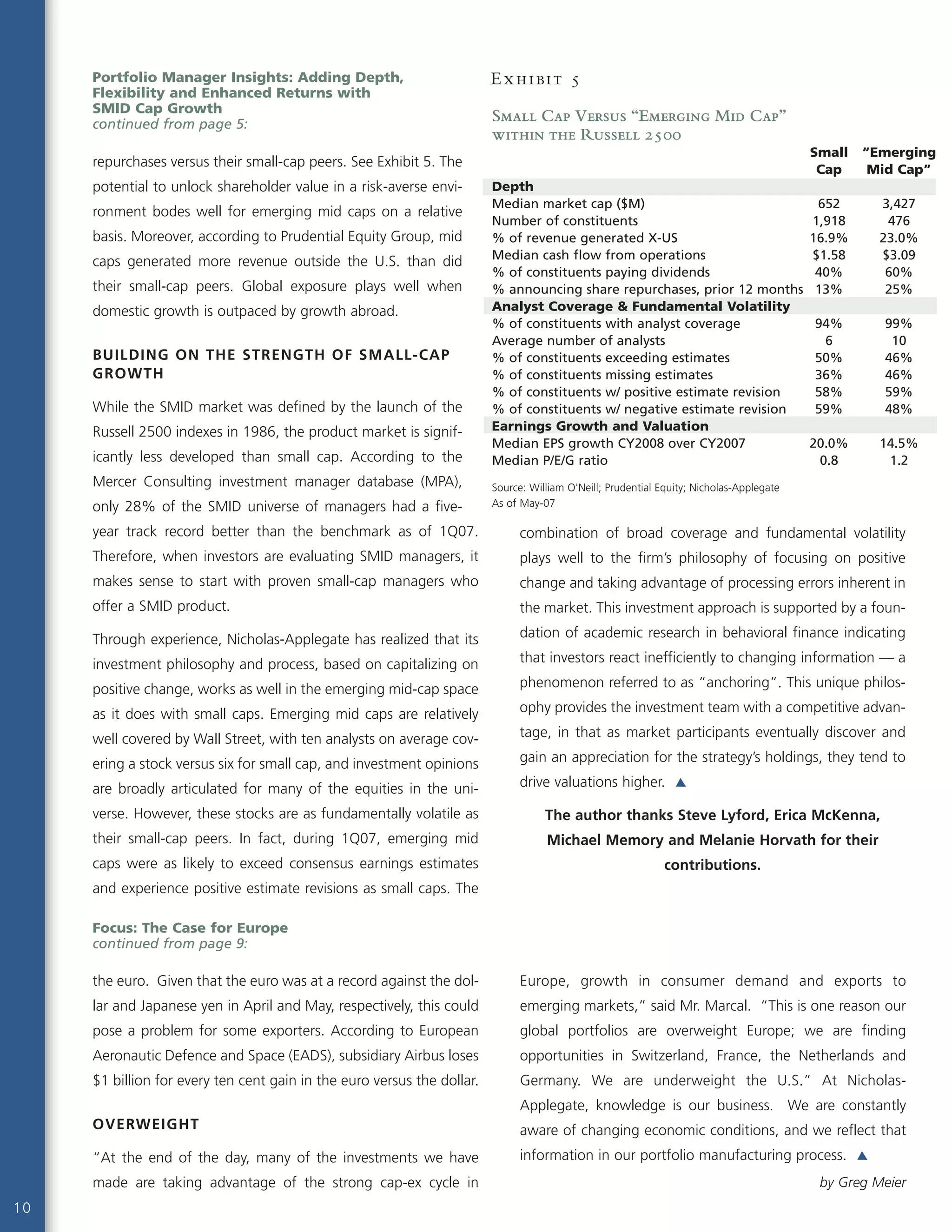
repurchases versus their small-cap peers. See Exhibit 5. The
potential to unlock shareholder value in a risk-averse envi-
ronment bodes well for emerging mid caps on a relative
basis. Moreover, according to Prudential Equity Group, mid
caps generated more revenue outside the U.S. than did
their small-cap peers. Global exposure plays well when
domestic growth is outpaced by growth abroad.
BUILDING ON THE STRENGTH OF SMALL-CAP
GROWTH
While the SMID market was defined by the launch of the
Russell 2500 indexes in 1986, the product market is signif-
icantly less developed than small cap. According to the
Mercer Consulting investment manager database (MPA),
only 28% of the SMID universe of managers had a five-
year track record better than the benchmark as of 1Q07.
Therefore, when investors are evaluating SMID managers, it
makes sense to start with proven small-cap managers who
offer a SMID product.
Through experience, Nicholas-Applegate has realized that its
investment philosophy and process, based on capitalizing on
positive change, works as well in the emerging mid-cap space
as it does with small caps. Emerging mid caps are relatively
well covered by Wall Street, with ten analysts on average cov-
ering a stock versus six for small cap, and investment opinions
are broadly articulated for many of the equities in the uni-
verse. However, these stocks are as fundamentally volatile as
their small-cap peers. In fact, during 1Q07, emerging mid
caps were as likely to exceed consensus earnings estimates
and experience positive estimate revisions as small caps. The
combination of broad coverage and fundamental volatility
plays well to the firm’s philosophy of focusing on positive
change and taking advantage of processing errors inherent in
the market. This investment approach is supported by a foun-
dation of academic research in behavioral finance indicating
that investors react inefficiently to changing information — a
phenomenon referred to as “anchoring”. This unique philos-
ophy provides the investment team with a competitive advan-
tage, in that as market participants eventually discover and
gain an appreciation for the strategy’s holdings, they tend to
drive valuations higher.
The author thanks Steve Lyford, Erica McKenna,
Michael Memory and Melanie Horvath for their
contributions.
10
Portfolio Manager Insights: Adding Depth,
Flexibility and Enhanced Returns with
SMID Cap Growth
continued from page 5:
Small Cap Versus “Emerging Mid Cap”
within the Russell 2500
Small “Emerging
Cap Mid Cap”
Depth
Median market cap ($M) 652 3,427
Number of constituents 1,918 476
% of revenue generated X-US 16.9% 23.0%
Median cash flow from operations $1.58 $3.09
% of constituents paying dividends 40% 60%
% announcing share repurchases, prior 12 months 13% 25%
Analyst Coverage & Fundamental Volatility
% of constituents with analyst coverage 94% 99%
Average number of analysts 6 10
% of constituents exceeding estimates 50% 46%
% of constituents missing estimates 36% 46%
% of constituents w/ positive estimate revision 58% 59%
% of constituents w/ negative estimate revision 59% 48%
Earnings Growth and Valuation
Median EPS growth CY2008 over CY2007 20.0% 14.5%
Median P/E/G ratio 0.8 1.2
Source: William O'Neill; Prudential Equity; Nicholas-Applegate
As of May-07
Exhibit 5
Focus: The Case for Europe
continued from page 9:
the euro. Given that the euro was at a record against the dol-
lar and Japanese yen in April and May, respectively, this could
pose a problem for some exporters. According to European
Aeronautic Defence and Space (EADS), subsidiary Airbus loses
$1 billion for every ten cent gain in the euro versus the dollar.
OVERWEIGHT
“At the end of the day, many of the investments we have
made are taking advantage of the strong cap-ex cycle in
Europe, growth in consumer demand and exports to
emerging markets,” said Mr. Marcal. “This is one reason our
global portfolios are overweight Europe; we are finding
opportunities in Switzerland, France, the Netherlands and
Germany. We are underweight the U.S.” At Nicholas-
Applegate, knowledge is our business. We are constantly
aware of changing economic conditions, and we reflect that
information in our portfolio manufacturing process.
by Greg Meier
Nicholas-Applegate Capital Management (NACM) is a registered investment
advisor with the Securities and Exchange Commission. The Firm is defined as all
actual, institutional and mutual fund accounts (including sub-advisory
relationships) managed by NACM. The managed (wrap) account business of
NACM is held out separately as Nicholas-Applegate Managed Accounts (NAMA).
The effective date of NACM’s firm-wide compliance with the AIMR-PPS standards
is January 1, 1993. NACM claims compliance with the AIMR Performance
Presentation Standards (AIMR-PPS), the U.S. and Canadian version of GIPS. AIMR
has not been involved with or reviewed NACM’s claim of compliance. To receive
a complete list and description of NACM’s composites and/or a presentation that
adheres to the AIMR-PPS standards, contact our Performance Measurement
Group at (619) 687-2800, or write Nicholas-Applegate Capital Management, 600
W. Broadway, 29th Floor, San Diego, CA 92101, Attn: Performance
Measurement Group.
Under no circumstances does the information contained within represent a
recommendation to buy or sell securities.
Investments in overseas markets pose special risks, including currency
fluctuation and political risks, and the portfolio is expected to be more volatile
than that of a U.S. only portfolio. These risks are generally intensified for
investments in emerging markets.
Small-cap stocks may be subject to a higher degree of risk than more estab-
lished companies’ securities. The illiquidity of the small-cap market may adversely
affect the value of these investments.
Unless otherwise noted, equity index returns reflect the reinvestment of all
income dividends and capital gains, if any, and bond index returns include all
payments to bondholders, if any. Index return calculations do not reflect fees,
brokerage commissions or other expenses of investing. Investors may not make
direct investments into any index.
Securities, sectors, countries and representative buys and sells herein illustrate
companies, sectors and countries in which portfolios may invest. Portfolio holdings
are subject to change daily. Unless otherwise noted, Nicholas-Applegate is the
source of all performance data, characteristics, charts and illustrations. Past
performance is not an indication of future performance.
Index characteristics and partial lists of past specific recommendations do not
reflect composite performance. For a list of all representative buys and sells for a
given time period, please contact Nicholas-Applegate.
11
DISCLOSURE:
Feature: Emerging Markets Small Cap
continued from page 7:
such as industrials, along with consumer staples and discre-
tionary, while energy, for example, has shrunk dramatically.
If projections for increased long-term growth for emerging
markets economies are on track, these smaller-cap names
should benefit over the longer-term.
There are still risks to investing in smaller-cap emerging
markets stocks. First, smaller-cap stocks are generally not as
liquid and have less analyst coverage than their larger-cap
counterparts. Also, the possibilities for unstable govern-
ments, currency devaluation and general economic uncer-
tainty are still higher than in developed countries. This, how-
ever, creates opportunity for the bottom-up investor who
can decipher information and identify best-of-breed compa-
nies who will capitalize on long-term themes.
The advent of the new MSCI Emerging Markets Small Cap
Index will help create a more investable asset class with
increased trading volumes, which will drive analyst cover-
age, and should ultimately lead to higher multiples and price
appreciation. These upcoming changes, coupled with con-
sumer-driven and infrastructure demand themes, should
offer long-term alpha opportunities in small-cap emerging
markets stocks.
by Brandon Michael
12
Source: FactSet; Bloomberg; Nicholas-Applegate
As of 31-May-07
48.0
49.0
50.0
51.0
52.0
53.0
54.0
55.0
6/06 7/06 8/06 9/06 10/06 11/06 12/06 1/07 2/07 3/07 4/07 5/07
ISM Manufacturing Survey PMI
Source: Thomson Financial; Nicholas-Applegate
As of 14-May-07
Worldwide Mergers and Acquisitions (M&A)
0
2,000
4,000
6,000
8,000
10,000
12,000
14,000
16,000
Announcement Date
$0
$500,000
$1,000,000
$1,500,000
$2,000,000
$2,500,000
98 99 00 01 02 03 04 05 06 07
Number of Deals (lhs)
$ Million (rhs)
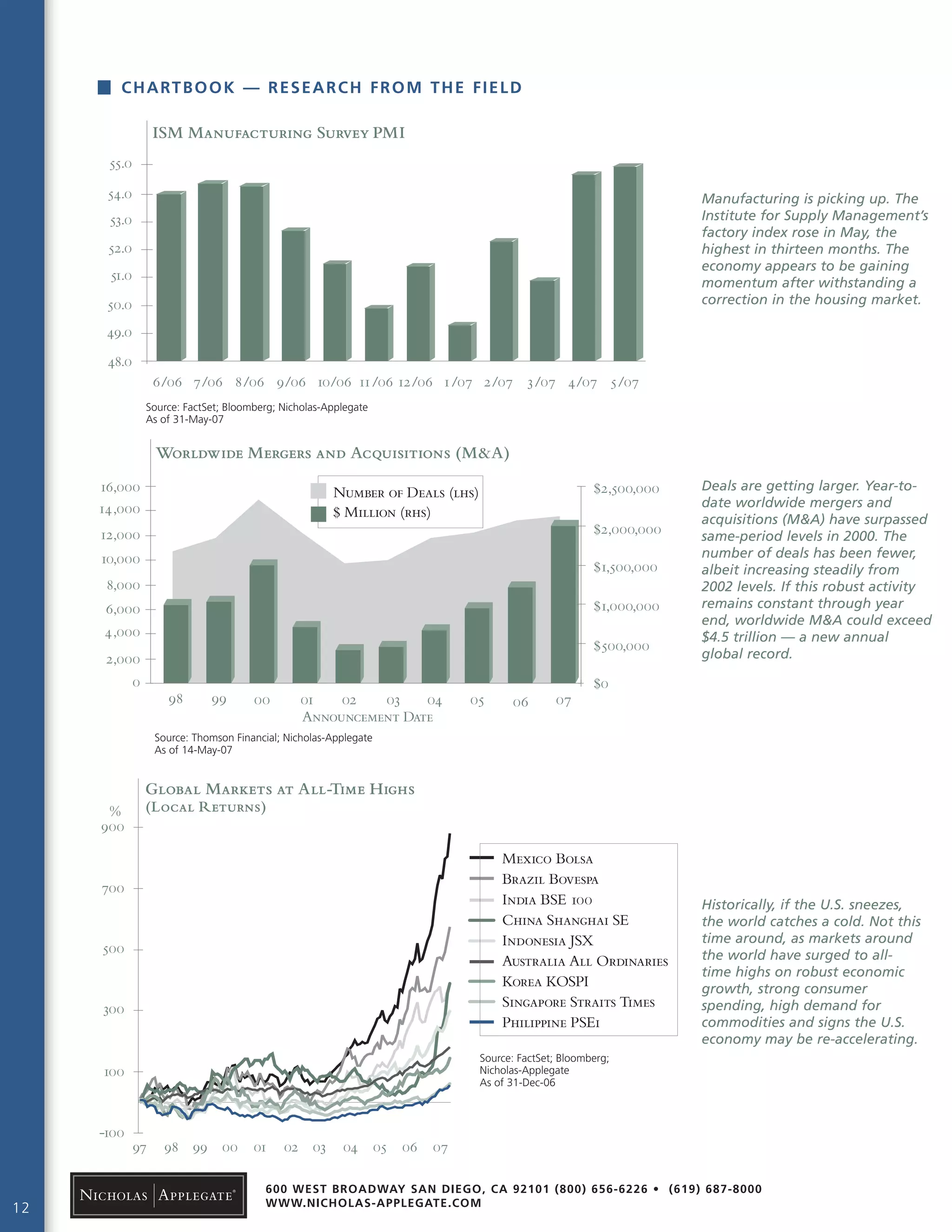
Deals are getting larger. Year-to-
date worldwide mergers and
acquisitions (M&A) have surpassed
same-period levels in 2000. The
number of deals has been fewer,
albeit increasing steadily from
2002 levels. If this robust activity
remains constant through year
end, worldwide M&A could exceed
$4.5 trillion — a new annual
global record.
Source:
As of 31-Dec-06
FactSet; Bloomberg;
Nicholas-Applegate
Global Markets at All-Time Highs
(Local Returns)
-100
100
300
500
700
900
97 98 99 00 01 02 03 04 05 06 07
Mexico Bolsa
Brazil Bovespa
India BSE 100
China Shanghai SE
Indonesia JSX
Australia All Ordinaries
Korea KOSPI
Singapore Straits Times
Philippine PSEi
%
Historically, if the U.S. sneezes,
the world catches a cold. Not this
time around, as markets around
the world have surged to all-
time highs on robust economic
growth, strong consumer
spending, high demand for
commodities and signs the U.S.
economy may be re-accelerating.
CHARTBOOK — RESEARCH FROM THE FIELD
Manufacturing is picking up. The
Institute for Supply Management’s
factory index rose in May, the
highest in thirteen months. The
economy appears to be gaining
momentum after withstanding a
correction in the housing market.
600 WEST BROADWAY SAN DIEGO, CA 92101 (800) 656-6226 • (619) 687-8000
WWW.NICHOLAS-APPLEGATE.COM

summer2007

  • 1.
    MARKET OVERVIEW May 2006was a terrible month for equities: Inflation spiked, the Federal Reserve hiked interest rates and Wall Street’s bears gnawed 6.1% off the technology-heavy Nasdaq Composite. One year later, conditions are markedly better. Stocks rallied last month, with the Dow Jones Industrial Average completing its longest bull-run since 1927. The Dow, which has ranged in and out of record territory since October, was joined on May 30 by the S&P 500, which closed the day at 1,530, a hair above its March 2000 high. Surging optimism wasn’t bounded by borders. Country and regional benchmarks from Asia and Europe to Latin America also reached peaks. Mergers and acquisitions are a major theme underpinning stocks. According to Bloomberg, $1.1 trillion in deals were announced year-to-date through May 31. That is 61% more than the record-setting pace established in 2006. While Wall Street’s recent milestones dredge up mem- ories of dot-com exuberance, today’s markets still look relatively fairly priced. At the end of last month, the S&P 500 was valued at 18 times earnings. At the height of the technology bubble in March 2000, the index was valued at 33 times earnings. From an economic perspective, news was mostly good. The Federal Open Market Committee met on May 9 and held interest rates steady at 5.25%. Minutes from the meeting showed infla- tion remains the “predominant concern”, while risks to the economy have “dimin- ished slightly.” Core consumer price gains slipped to a twelve-month low of 2.3% in April. However, May gasoline prices crested at $3.23/gallon, according to AAA. The previous inflation-adjusted high of $3.20/ gallon had stood since March 1981. Business spending continues to recover, with April orders for non-defense capital goods ex-aircraft up 1.2%. According to Thomson Financial, with 474 companies reporting, 1Q07 corporate earn- ings for the S&P 500 grew 8.1%. This ends fourteen straight quarters of double-digit expansion, the longest such stretch in fifty- seven years. Telecommunications and health care companies are seeing the strongest results, while consumer discre- tionary companies are lagging due to weakness among auto and housing-related firms. S U M M E R 2 0 0 7 at the margin G L O B A L E Q U I T Y M A R K E T O V E R V I E W IN THIS ISSUE Perspective . . . . . . . . . . . . .2 Equity Update . . . . . . . . . . .2 Firm Update . . . . . . . . . . . .3 Portfolio Manager Insights: Adding Depth, Flexibility and Enhanced Returns with SMID Cap Growth . . . . . . . . . . .4 Feature: Emerging Markets Small Cap . . . . . . . . . . . . .6 Focus: The Case for Europe . . . . .8 Chartbook . . . . . . . . . . . . .12 May YTD S&P 500 3.5 8.8 NASDAQ Composite 3.1 7.8 Dow Jones Industrials 4.3 9.3 MSCI EAFE 1.9 10.9 MSCI EAFE Growth 2.1 11.9 MSCI EAFE Value 1.6 9.9 MSCI EM 5.0 12.4 MSCI ACWI xUS 2.7 11.6 MSCI Europe 1.9 12.9 MSCI Japan 1.6 3.2 Russell 1000 3.6 9.3 Russell 1000 Growth 3.6 9.8 Russell 1000 Value 3.6 8.8 Russell Midcap 3.8 12.4 Russell Midcap Growth 4.1 12.9 Russell Midcap Value 3.4 11.9 Russell 2000 4.1 8.0 Russell 2000 Growth 4.6 10.0 Russell 2000 Value 3.7 6.3 ML High Yield Master II 0.7 4.8 As of 31-May-07 Market Performance VOL. 11 NO. 5
  • 2.
    PERSPECTIVE Katherine Rich Managing Director, Directorof Client Service EQUITY UPDATE GROWTH/VALUE EQUITY Improved economic conditions led to growth’s out- performance in May, at least among small- and mid-cap companies. Investment style had little dis- cernible impact on performance in the large-cap space. Consumer-related shares saw some of the weakest results, as the public grappled with record-high gasoline prices. According to the Government Accountability Office, rising pump prices have already cost consumers $20 billion this year, the equivalent of nearly $150 for each car on the road. Perhaps unsurprisingly, energy company stocks were among the month’s top gainers. LARGE/MID/SMALL EQUITY Sentiment shifted in favor of small caps over mid and large caps in May, as improving economic conditions prompted investors to load up on riskier assets. The Russell 2000 Index, a broad measure of the small-cap universe, with an aver- age market capitalization of $1.3 billion, hit a stride, notching four record-high closes. In spite of the results, on average, small caps still trail on a year-to-date basis. INTERNATIONAL EQUITY International equities managed a twelfth consecu- tive month of gains in May, matching the longest such stretch since early 2004. Indexes in several countries from Australia and China to Mexico and Brazil reached all-time highs. In aggregate, growth outperformed value, while emerging markets out- performed developed markets. Regionally, North American shares saw the best results, followed by European shares and shares in Asia. Performance in local terms was higher than performance in U.S. terms, due to a stronger dollar and diminished expectations for a Federal Reserve interest rate cut by year-end. 2  Copyright 2007 ....Nicholas-Applegate ....Capital Management At Nicholas-Applegate, clients are at the heart of everything we do. We appreciate your trust in us to manage your assets and never lose sight of that privilege. Over the past several years, we have made “client centricity” the focus of our activities. This has included many initiatives around our processes and practices, including: new port- folio accounting systems, significantly reduced trading costs, implementation of a highly-automated compliance engine, and post Reg-FD research enhancement, among others. Each of these activities is part of our constant objective to provide world-class exe- cution in all areas of our business. In addition, we have been working to enhance specific aspects of our client service delivery, including: Working with Greenwich Associates to obtain detailed feedback on our client service delivery; Streamlining the new client funding process; Implementing a Client Relationship Management (CRM) system to better doc- ument and track client interactions; and Retaining an external consultant to solicit objective feedback following our prospect presentations. A critical element of enhancing our client experience is to improve our employee experi- ence — how we develop, evaluate and moti- vate our people as well as how we work together. Closer alignment of our employees’ individual career goals with the vision and val- ues of the firm will result in a tighter bond with our clients. Clients are why we’re in business. Continuous enhancement of your experience is why we remain excited to be in this business.
  • 3.
    FIRM UPDATE At TheMargin is a monthly publication of: Nicholas-Applegate Capital Management 600 West Broadway San Diego, CA 92101 PHONE (800) 656-6226 (619) 687-8000 FAX (619) 744-5545 3 Nicholas-Applegate invests in intellectual capital by hiring top-notch talent. This quarter, the following professional joined our investment team: Stephan Maikkula, CFA, CMT – Associate, Analyst – Stephan Maikkula has research responsi- bilities on our international teams. Prior to joining Nicholas-Applegate, he was a portfolio manager and an international equity analyst for the Employees Retirement System of Texas. Stephan also managed portfolios for MBA Investment Fund, LLC, interned at the Teacher Retirement System of Texas, and worked at Cargill, Inc., providing fundamental and technical analysis of commodity futures markets. He earned his B.A. with dual majors in management with an international concentration and in German from Saint John’s University, graduating summa cum laude, and his M.B.A. at the University of Texas at Austin, McCombs School of Business. Stephan is fluent in German and has ten years of investment industry experience. CONFERENCE PRESENTATION Kunal Ghosh, Senior Vice President, Portfolio Manager, Systematic, recently spoke at the Investors Capital Corp. conference, a forum for variable annuity distributors, on the outlook for investment opportunities in non-U.S. markets. Please contact your client service officer for a copy of Mr. Ghosh’s presentation, “Expanding Opportunities Abroad”. by Cathleen Bramlage Celebrating a Champion — Thanks to support for Children’s Hospital’s pediatric cancer care center, eight- year-old Les Fountain is triumphing over cancer today. Les and his parents are shown in the picture with our Celebration of Champion runners, Mel Horvath and son Noah, and Brandon Michael. Nicholas-Applegate was a Bronze Sponsor of the event, May 12 at the Embarcadero, San Diego.
  • 4.
    4 Key market andeconomic indicators suggest that demand for small-cap growth exposure may increase in the near future. In the U.S., small- and mid-cap growth stocks are leading the charge year-to-date, posting favorable rela- tive returns on both a market cap and style basis. Meanwhile, the U.S. economy is operating in a “Goldilocks” growth and infla- tion environment. Liquidity (MZM) continues to rise, and the yield curve is reshaping to a more conventional and constructive slope. Stable access to capital surely bodes well for small-cap growth returns. Budding outperformance and a balanced economic climate may indeed prompt a movement toward U.S. small-cap growth against a contemporary backdrop where value has consistently outperformed growth and fund flows have favored foreign markets. See Exhibits 1-3. SMID VERSUS SMALL CAP: A SUBSTITUTE AND A COMPLEMENT Increased demand for small-cap growth man- agers may be problematic, as many proven products are closed or limited in capacity. In this constrained environment, institutional investors wishing to invest in the small-cap growth space should consider a small-to-mid (SMID) cap strategy offered by an established small-cap manager. With a ninety-nine percent correlation between the Russell 2500 and 2000 Growth indices (since the inception of the Russell 2500 Growth Index in 1986), SMID growth is a suitable sub- stitute for a small-cap growth mandate. In addi- tion, small-cap growth investors can receive fur- ther benefits by including SMID growth in their asset allocation because SMID growth stocks exhibit superior return/risk profiles relative to small-cap growth stocks. To the upside, the Russell 2500 Growth Index has outperformed its little sister on both an absolute and risk- adjusted basis. Specifically, since 1986, the Russell 2500 and 2000 Growth indexes have posted annualized returns of 10.31% and 7.76%, respectively. At the same time, volatility has favored SMID in terms of standard deviation of returns (22.42% for the Russell 2500 Growth versus 23.06% for the Russell 2000 Growth). These return/risk characteristics suggest SMID growth stocks could be a strong complement to a dedicated small-cap growth allocation. ADDED VALUE IN EMERGING MID- CAP NAMES SMID cap is, in essence, an enhanced small-cap market universe. The constituents of the Russell 2000 Growth Index account for roughly eighty percent of the companies in the Russell 2500 Growth Index. The balance of the index consists of what we refer to as “emerging mid cap” or smaller mid-cap companies. The ex- panded SMID universe extends beyond the Montie L. Weisenberger Senior Vice President, Portfolio Manager, US Micro/Emerging Growth PORTFOLIO MANAGER INSIGHTS: ADDING DEPTH, FLEXIBILITY AND ENHANCED RETURNS WITH SMID CAP GROWTH The US Small-Mid Cap Growth strategy is a team-managed strategy, led by Montie Weisenberger, Senior Vice President, Portfolio Manager. Mr. Weisenberger has been with the firm, focusing on small- to mid-cap growth stocks, since 2001. Russell 2000 GrowthVersus Russell 2000Value Rolling 12-Month Excess Return -60 -40 -20 0 20 40 60 80 82 84 86 88 90 92 94 96 98 00 02 04 06 % Value Outperforming Growth Outperforming Source: Bloomberg; Frank Russell Company; Nicholas-Applegate; see additional disclosure As of 31-May-07 Exhibit 1
  • 5.
    indexes and, asof 1Q07, included roughly 3,500 companies trading on major U.S. exchanges with market caps ranging from one hundred million to ten billion dollars. This ceiling will reset when the index rebalances this summer. What makes SMID cap attractive versus small cap is the added depth and flexibility. Depth refers to the addition of hundreds of emerging mid-cap names to the small-cap base. Specifically, during 1Q07, the Russell 2500 Index included 476 emerging mid-cap companies on top of the 1,918 small caps included in the Russell 2000 Index. Importantly, the emerging mid-cap space is populated each summer with “graduates” from the Russell 2000 Index via Russell’s reconstitution process. Historically, these emerging mid-cap graduates have performed well versus the Russell 2000 Index. Collectively, emerging mid alumni of the Russell 2000 Index graduating classes of 1990 through 2006 have on average outperformed the index by 4.3%, 6.4%, and 6.7% over the following three, six, and twelve months, respectively. Moreover, during the same period, the alumni had a better than fifty percent chance of outperforming the index they left behind. Thus, the opportunity to “let your winners run” rather than selling them based on market-cap constraints associated with small-cap mandates makes SMID an attractive alternative to small. Changes to Russell’s reconstitution methodology will alter the scope and timing of new entrants to the SMID cap universe, while preserving the differentiation between emerging mid- and small-cap investment opportunities. Added flexibility comes from the ability to source investment candidates from a broad universe of robust small caps as well as market-leading emerging mid caps. Such flexibility provides for alpha generation opportunity when a certain segment of the market is in favor over another, as has consistently been the case between small and mid cap over the past decade. See Exhibit 4. Emerging mid caps possess characteristics that differ from small caps. The relative fundamental maturity of emerging mid caps coupled with favorable growth and valuation pro- files make emerging mid caps attractive in certain market set- tings. Specifically, the emerging mid cap names in the Russell 2500 Index during 1Q07 offered up greater liquidity, cash flow per share, and potential for dividend payments and share 5 continued on page 10Source: Frank Russell; Nicholas-Applegate As of 31-May-07 Russell 2000Versus Russell Midcap Annual Excess Returns -15 -10 -5 0 5 10 98 99 00 01 02 03 04 05 06 07 Small Caps Outperform Mid Caps Outperform % Exhibit 4 Source: Yardeni Research, Inc.; Nicholas-Applegate As of 30-Apr-07 Net 12-Month Mutual Fund Inflows: Emerging Markets -5 0 5 10 15 20 96 97 98 99 00 01 02 03 04 05 06 Billions $ Exhibit 2 Source: Yardeni Research, Inc.; Nicholas-Applegate As of 30-Apr-07 Net 12-Month Mutual Fund Inflows: Aggressive Growth -50 0 50 100 150 96 97 98 99 00 01 02 03 04 05 06 Billions $ Exhibit 3
  • 6.
    6 FEATURE: EMERGING MARKETSSMALL CAP organ Stanley Capital International (MSCI) recently announced enhancements to their standard international indices. These changes are designed to allow for greater comparability among emerging market investment managers and in the case of emerging markets small cap, will help establish its place on the global invest- ment map. In order to dissect emerging markets small caps, we first need to revisit emerging markets as a whole. Emerging markets investing has long been classified as a boom-or-bust propo- sition, with countries often lumped into one broad category. However, with increasingly sophisticated financial markets, access to capi- tal and higher legal and regulatory standards, a new environment for emerging markets has been created. The lines between emerging and developed economies have been blurring for some time now. Growth in the U.S. and other developed inter- national markets is slowing, while emerging markets growth is still in its infancy. PricewaterhouseCoopers estimates composi- tion of relative economic size among countries will change drastically over the coming decades. Currently, the U.S. is the largest econ- omy in the world, with seven of the next eight largest economies those of developed market countries. By the year 2050, it is projected that the U.S. will still be the largest world economy, but five of the next six largest economies will be those of emerging market countries. See Exhibit 6. Two major secular mega-themes are driving this scenario: consumer-driven demand and infrastructure development. EMERGING MARKETS: CONSUMER DEMAND AND INFRASTRUCTURE DEVELOPMENT Emerging markets financial systems are becoming much more flexible, with banks and other lenders in a better position to finance consumption and investment than ever before. Access to capital, coupled with all-time low inflation and interest rates, is driving a boom in spending. Emerging markets consumer-driven areas are broadly diversified, including Mexican homebuilders, Brazilian automakers, Russian banks, Chinese branded apparel, and Southeast Asian real estate. The expectation is for these trends to continue over the long-term. M Joseph Devine Senior Vice President, Portfolio Manager, Pacific Rim and Emerging Markets Opportunities Projected Relative Size of Economies (2005 versus 2050) 0 20 40 60 80 100 2005 2050 Source: PricewaterhouseCoopers As of Mar-06 Relative%toU.S.Economy U.S. China India Brazil Japan Indonesia Mexico Germany U.K. France Russia Italy Turkey Canada Spain Korea Australia Exhibit 6
  • 7.
    7 Along with increasedconsumer spending, infrastructure demand in emerging markets economies is also exploding. Demand for roads, bridges, rail, electrical supply and housing projects is at record levels across emerging markets countries. General Electric predicts that developing market infrastructure spending could be $3 trillion over the next ten years. This ends up being windfall demand for many countries such as South Africa, Brazil, and Russia who supply a majority of the world’s energy and materials. This infrastructure development boom is also expected to continue for the foreseeable future. EMERGING MARKETS INDICES So, if growth in emerging markets should continue for some time, namely from consumer and infrastructure themes, then all investors need to do is to invest in a strategy that is similar to the MSCI Emerging Markets Index (EM) and hold it for a long time, right? Not exactly. While the current MSCI EM Index is the industry standard to gauge emerging markets per- formance, it does have its flaws, namely concentration in a handful of names and lack of broad sector coverage. The current MSCI EM Index contains roughly 850 stocks, which account for approximately 85% of the market cap in emerging markets countries. While on the surface this appears to be relatively representative of the basket of emerging mar- kets securities, it is far from perfect. Concentration in a few mega-cap names effectively skews performance results of small, less-capitalized companies. Of the approximately 850 stocks in the current MSCI EM Index, the ten largest names account for nearly 20% of the entire index. These names include the likes of Russian energy giant Gazprom and elec- tronics maker Samsung, which account for 4.0% and 2.8% of the total index, respectively. Many large-cap names such as these are driven by global aggregate demand, rather than anticipated growth in emerging markets. Lack of broad sector coverage is also evident, with roughly 60% of the top forty positions in the current index comprised of energy, information technology, and materials sectors. These particular sectors are also much more correlated to global demand than increased growth in emerging market countries. Consumer-driven staples and discretionary sectors rest on the back burner representing only 11.7% of the cur- rent MSCI EM Index. Owning the current index leaves investors less than diversified and doesn’t allow them to take advantage of the consumer-driven and infrastructure demand themes. The new MSCI index should help create alternate routes to help drive emerging markets investing. The new structure (dubbed Enhanced Standard by MSCI) will soon consist of roughly 700 large-cap stocks and will replace the old Emerging Markets universe. This universe will still display concentration risk and sector coverage in larger-cap names as previously discussed. However, a new small-cap emerging markets index is being developed and will include approxi- mately 1,200 stocks, most of which are new additions from MSCI. Together, the Enhanced Standard and new Small Cap indices will capture nearly 99% of the investable market cap within emerging markets. There will be a gradual transition and timeline to move from the current MSCI EM benchmark to the new indexes. MSCI will begin publishing the new small-cap index on June 5, 2007 and transition to the new indices will officially be completed in May 2008. The exhibit at left shows sec- tor weightings for the current MSCI EM Index alongside the new small cap index. See Exhibit 7. Notice the stark contrast of increased weightings of sectors Current MSCI EM Index versus New MSCI Small Cap EM Index Source: Merrill Lynch As of 31-Mar-07 0.0 5.0 10.0 15.0 20.0 Current MSCI EM Index New MSCI Small Cap EM Index Industrials Financials Consumer Discretionary Materials Information Technology Consumer Staples Health Care Utilities Energy Telecom Services % Exhibit 7 continued on page 11
  • 8.
    8 FOCUS: THE CASEFOR EUROPE You may have already heard, but in case you haven’t: Europe is on fire. Not literally, of course, but from an equities standpoint, the region is scorching. Since mid-2003, the MSCI Europe Index has nearly tripled in value. See Exhibit 8. Last month, the index climbed to a new all-time high, capping a 12.9% advance year-to-date (YTD). The MSCI Germany is cur- rently the third-best performing country in the MSCI EAFE Index after Malaysia and Finland, with a YTD advance of 22.4%. In comparison, the record-breaking rally in U.S. blue chips has the Dow Jones Industrial Average up 9.3%, while the much-discussed MSCI Emerging Markets Index underperforms Germany with a 12.4% year-to-date gain. But, it isn’t just Europe’s stocks that are hot; the region’s economy is smoking as well. The euro zone expanded for fifteen consecutive quarters through March 31, the last four of which outpaced growth in the U.S. While Europe’s rate of growth hasn’t consistently increased, it has accelerated, and last year was the strongest for the region since the turn of the century. So what gives? Is Europe’s new shine likely to fade as fast as last week’s fashion in Paris, or is the current uptrend made of tougher stuff, something durable? For insight we examined Germany, the region’s largest economy and the world’s largest exporting country. AN ECONOMIC GIANT AWAKENS Until recently, Germany was a drag on euro zone growth. From 1996 through 2005, the German economy expanded on average 1.5% annually, while countries in the euro zone expanded an aver- age of 2.1%. However, starting with the spring of 2006, as the country prepared to host the FIFA World Cup tournament, the German economy began to out- perform. From 2Q06 through 1Q07, Germany’s average quar- terly expansion has been 3.6%, notably higher than the regional average of 3.0% and markedly higher than the U.S. average of 1.9%. Europe Outperforms 50 100 150 200 250 300 97 99 01 03 05 07 MSCIWorld ex Europe Index MSCI Europe Index Increase % Source: MSCI; Nicholas-Applegate As of 31-May-07 Exhibit 8 German GDP - Major Contributors -2 0 2 4 6 8 01 02 03 04 05 06 07 Consumer Exports Cap-Ex Contribution Source: FactSet; Nicholas-Applegate As of 31-Mar-07 % Exhibit 9
  • 9.
    9 Germany’s economic reawakeningcan be boiled down to three interrelated factors: a nearly 50% spike in exports since 2003, a steadily growing wave of capital expenditures since mid-2004 and the resurgence of the consumer as a positive contributor to economic growth in late 2004. See Exhibit 9. In theory, the rapid rise in exports prompted businesses to improve their production capabilities and hire more em- ployees. This led to a drop in unemployment, an increase in salaries and rising consumer spending. In practice, German capital expenditures as a percent of GDP reached a five-year peak in May, while joblessness was at a six-year low and con- sumer confidence was at an all-time high. Assuming capital expenditures reasonably indicate future business activity, and high consumer confidence amid a tight job market reasonably indicates future consumer spending, the economic outlook for Germany would appear fairly good. While this is interesting, it is even more so given that the themes surrounding German growth are common to some degree throughout the region. Euro zone exports jumped 35% in the five years through March 31, while euro zone business spending was up 7.2% from a year earlier. In May, regional business and consumer confidence was at a six-year high, while unemployment, at 7.1% in April, was the lowest since records started in 1993. VALUATIONS AND EARNINGS Economics are a good starting point for stock picking, but valuations and earnings are an investor's bread and butter. Despite the recent run-up in share prices, European equities still look cheap compared to the rest of the world. Furthermore, current valuations are a far cry from the froth seen at the peak of the technology bubble. One reason Europe continues to price well is because corporate earnings growth has been solid. According to Citigroup figures, profits in the MSCI Europe Index have grown for four consecutive years, including a 17% jump in 2006 and a 13% rise in 2005. So far in 2007, about three companies are beating 1Q07 ana- lyst estimates for each company missing estimates. The biggest positive surprises have been in the con- struction, health care and household goods industries. While FactSet Research suggests profits in Europe will grow approximately 6.4% in 2007, Nicholas- Applegate Portfolio Manager, Senior Vice President, Pedro Marcal thinks “something in the mid to high single-digit range seems reasonable.” INFLATION, INTEREST RATES AND THE EURO Policy tightening by the European Central Bank (ECB) pro- bably poses the single greatest threat to the outlooks for European economic growth and stocks. Interest rate futures suggest the ECB overnight rate will reach at least 4.25% by December, despite the fact inflation hasn’t breached the ECB ceiling of 2.0% since last August, and isn’t expected to for the remainder of the year. See Exhibit 10. ECB President Jean- Claude Trichet has a reputation for being proactive, and he has mentioned three concerns: Money supply growth is too high. At 10.4% in April, M3 growth, which is a broad measure of liquidity believed to herald medium-term inflation, was near the fastest pace in a quarter century. Low unemployment is creating wage pressures. IG Mettal, Germany’s largest union, obtained a 4.1% pay raise on May 4. That is more than twice the ECB target pace of inflation. Energy costs are on the rise. The price of Brent crude rose 2% to 54.46/bbl in May, and is up 19% YTD. ECB tightening will probably have a dampening effect on regional growth. It will also probably add upward pressure on continued on page 10 Euro zone Inflation and Interest Rates 0.0 1.0 2.0 3.0 4.0 5.0 99 00 01 02 03 04 05 06 07 0.0 1.0 2.0 3.0 4.0 5.0ECB Policy Rate Harmonized CPI Inflation ECBPolicyRate(%) HCPI(%) Source: FactSet; Nicholas-Applegate As of 31-May-07 Exhibit 10
  • 10.
    repurchases versus theirsmall-cap peers. See Exhibit 5. The potential to unlock shareholder value in a risk-averse envi- ronment bodes well for emerging mid caps on a relative basis. Moreover, according to Prudential Equity Group, mid caps generated more revenue outside the U.S. than did their small-cap peers. Global exposure plays well when domestic growth is outpaced by growth abroad. BUILDING ON THE STRENGTH OF SMALL-CAP GROWTH While the SMID market was defined by the launch of the Russell 2500 indexes in 1986, the product market is signif- icantly less developed than small cap. According to the Mercer Consulting investment manager database (MPA), only 28% of the SMID universe of managers had a five- year track record better than the benchmark as of 1Q07. Therefore, when investors are evaluating SMID managers, it makes sense to start with proven small-cap managers who offer a SMID product. Through experience, Nicholas-Applegate has realized that its investment philosophy and process, based on capitalizing on positive change, works as well in the emerging mid-cap space as it does with small caps. Emerging mid caps are relatively well covered by Wall Street, with ten analysts on average cov- ering a stock versus six for small cap, and investment opinions are broadly articulated for many of the equities in the uni- verse. However, these stocks are as fundamentally volatile as their small-cap peers. In fact, during 1Q07, emerging mid caps were as likely to exceed consensus earnings estimates and experience positive estimate revisions as small caps. The combination of broad coverage and fundamental volatility plays well to the firm’s philosophy of focusing on positive change and taking advantage of processing errors inherent in the market. This investment approach is supported by a foun- dation of academic research in behavioral finance indicating that investors react inefficiently to changing information — a phenomenon referred to as “anchoring”. This unique philos- ophy provides the investment team with a competitive advan- tage, in that as market participants eventually discover and gain an appreciation for the strategy’s holdings, they tend to drive valuations higher. The author thanks Steve Lyford, Erica McKenna, Michael Memory and Melanie Horvath for their contributions. 10 Portfolio Manager Insights: Adding Depth, Flexibility and Enhanced Returns with SMID Cap Growth continued from page 5: Small Cap Versus “Emerging Mid Cap” within the Russell 2500 Small “Emerging Cap Mid Cap” Depth Median market cap ($M) 652 3,427 Number of constituents 1,918 476 % of revenue generated X-US 16.9% 23.0% Median cash flow from operations $1.58 $3.09 % of constituents paying dividends 40% 60% % announcing share repurchases, prior 12 months 13% 25% Analyst Coverage & Fundamental Volatility % of constituents with analyst coverage 94% 99% Average number of analysts 6 10 % of constituents exceeding estimates 50% 46% % of constituents missing estimates 36% 46% % of constituents w/ positive estimate revision 58% 59% % of constituents w/ negative estimate revision 59% 48% Earnings Growth and Valuation Median EPS growth CY2008 over CY2007 20.0% 14.5% Median P/E/G ratio 0.8 1.2 Source: William O'Neill; Prudential Equity; Nicholas-Applegate As of May-07 Exhibit 5 Focus: The Case for Europe continued from page 9: the euro. Given that the euro was at a record against the dol- lar and Japanese yen in April and May, respectively, this could pose a problem for some exporters. According to European Aeronautic Defence and Space (EADS), subsidiary Airbus loses $1 billion for every ten cent gain in the euro versus the dollar. OVERWEIGHT “At the end of the day, many of the investments we have made are taking advantage of the strong cap-ex cycle in Europe, growth in consumer demand and exports to emerging markets,” said Mr. Marcal. “This is one reason our global portfolios are overweight Europe; we are finding opportunities in Switzerland, France, the Netherlands and Germany. We are underweight the U.S.” At Nicholas- Applegate, knowledge is our business. We are constantly aware of changing economic conditions, and we reflect that information in our portfolio manufacturing process. by Greg Meier
  • 11.
    Nicholas-Applegate Capital Management(NACM) is a registered investment advisor with the Securities and Exchange Commission. The Firm is defined as all actual, institutional and mutual fund accounts (including sub-advisory relationships) managed by NACM. The managed (wrap) account business of NACM is held out separately as Nicholas-Applegate Managed Accounts (NAMA). The effective date of NACM’s firm-wide compliance with the AIMR-PPS standards is January 1, 1993. NACM claims compliance with the AIMR Performance Presentation Standards (AIMR-PPS), the U.S. and Canadian version of GIPS. AIMR has not been involved with or reviewed NACM’s claim of compliance. To receive a complete list and description of NACM’s composites and/or a presentation that adheres to the AIMR-PPS standards, contact our Performance Measurement Group at (619) 687-2800, or write Nicholas-Applegate Capital Management, 600 W. Broadway, 29th Floor, San Diego, CA 92101, Attn: Performance Measurement Group. Under no circumstances does the information contained within represent a recommendation to buy or sell securities. Investments in overseas markets pose special risks, including currency fluctuation and political risks, and the portfolio is expected to be more volatile than that of a U.S. only portfolio. These risks are generally intensified for investments in emerging markets. Small-cap stocks may be subject to a higher degree of risk than more estab- lished companies’ securities. The illiquidity of the small-cap market may adversely affect the value of these investments. Unless otherwise noted, equity index returns reflect the reinvestment of all income dividends and capital gains, if any, and bond index returns include all payments to bondholders, if any. Index return calculations do not reflect fees, brokerage commissions or other expenses of investing. Investors may not make direct investments into any index. Securities, sectors, countries and representative buys and sells herein illustrate companies, sectors and countries in which portfolios may invest. Portfolio holdings are subject to change daily. Unless otherwise noted, Nicholas-Applegate is the source of all performance data, characteristics, charts and illustrations. Past performance is not an indication of future performance. Index characteristics and partial lists of past specific recommendations do not reflect composite performance. For a list of all representative buys and sells for a given time period, please contact Nicholas-Applegate. 11 DISCLOSURE: Feature: Emerging Markets Small Cap continued from page 7: such as industrials, along with consumer staples and discre- tionary, while energy, for example, has shrunk dramatically. If projections for increased long-term growth for emerging markets economies are on track, these smaller-cap names should benefit over the longer-term. There are still risks to investing in smaller-cap emerging markets stocks. First, smaller-cap stocks are generally not as liquid and have less analyst coverage than their larger-cap counterparts. Also, the possibilities for unstable govern- ments, currency devaluation and general economic uncer- tainty are still higher than in developed countries. This, how- ever, creates opportunity for the bottom-up investor who can decipher information and identify best-of-breed compa- nies who will capitalize on long-term themes. The advent of the new MSCI Emerging Markets Small Cap Index will help create a more investable asset class with increased trading volumes, which will drive analyst cover- age, and should ultimately lead to higher multiples and price appreciation. These upcoming changes, coupled with con- sumer-driven and infrastructure demand themes, should offer long-term alpha opportunities in small-cap emerging markets stocks. by Brandon Michael
  • 12.
    12 Source: FactSet; Bloomberg;Nicholas-Applegate As of 31-May-07 48.0 49.0 50.0 51.0 52.0 53.0 54.0 55.0 6/06 7/06 8/06 9/06 10/06 11/06 12/06 1/07 2/07 3/07 4/07 5/07 ISM Manufacturing Survey PMI Source: Thomson Financial; Nicholas-Applegate As of 14-May-07 Worldwide Mergers and Acquisitions (M&A) 0 2,000 4,000 6,000 8,000 10,000 12,000 14,000 16,000 Announcement Date $0 $500,000 $1,000,000 $1,500,000 $2,000,000 $2,500,000 98 99 00 01 02 03 04 05 06 07 Number of Deals (lhs) $ Million (rhs) Deals are getting larger. Year-to- date worldwide mergers and acquisitions (M&A) have surpassed same-period levels in 2000. The number of deals has been fewer, albeit increasing steadily from 2002 levels. If this robust activity remains constant through year end, worldwide M&A could exceed $4.5 trillion — a new annual global record. Source: As of 31-Dec-06 FactSet; Bloomberg; Nicholas-Applegate Global Markets at All-Time Highs (Local Returns) -100 100 300 500 700 900 97 98 99 00 01 02 03 04 05 06 07 Mexico Bolsa Brazil Bovespa India BSE 100 China Shanghai SE Indonesia JSX Australia All Ordinaries Korea KOSPI Singapore Straits Times Philippine PSEi % Historically, if the U.S. sneezes, the world catches a cold. Not this time around, as markets around the world have surged to all- time highs on robust economic growth, strong consumer spending, high demand for commodities and signs the U.S. economy may be re-accelerating. CHARTBOOK — RESEARCH FROM THE FIELD Manufacturing is picking up. The Institute for Supply Management’s factory index rose in May, the highest in thirteen months. The economy appears to be gaining momentum after withstanding a correction in the housing market. 600 WEST BROADWAY SAN DIEGO, CA 92101 (800) 656-6226 • (619) 687-8000 WWW.NICHOLAS-APPLEGATE.COM