Another solid quarter for stocks
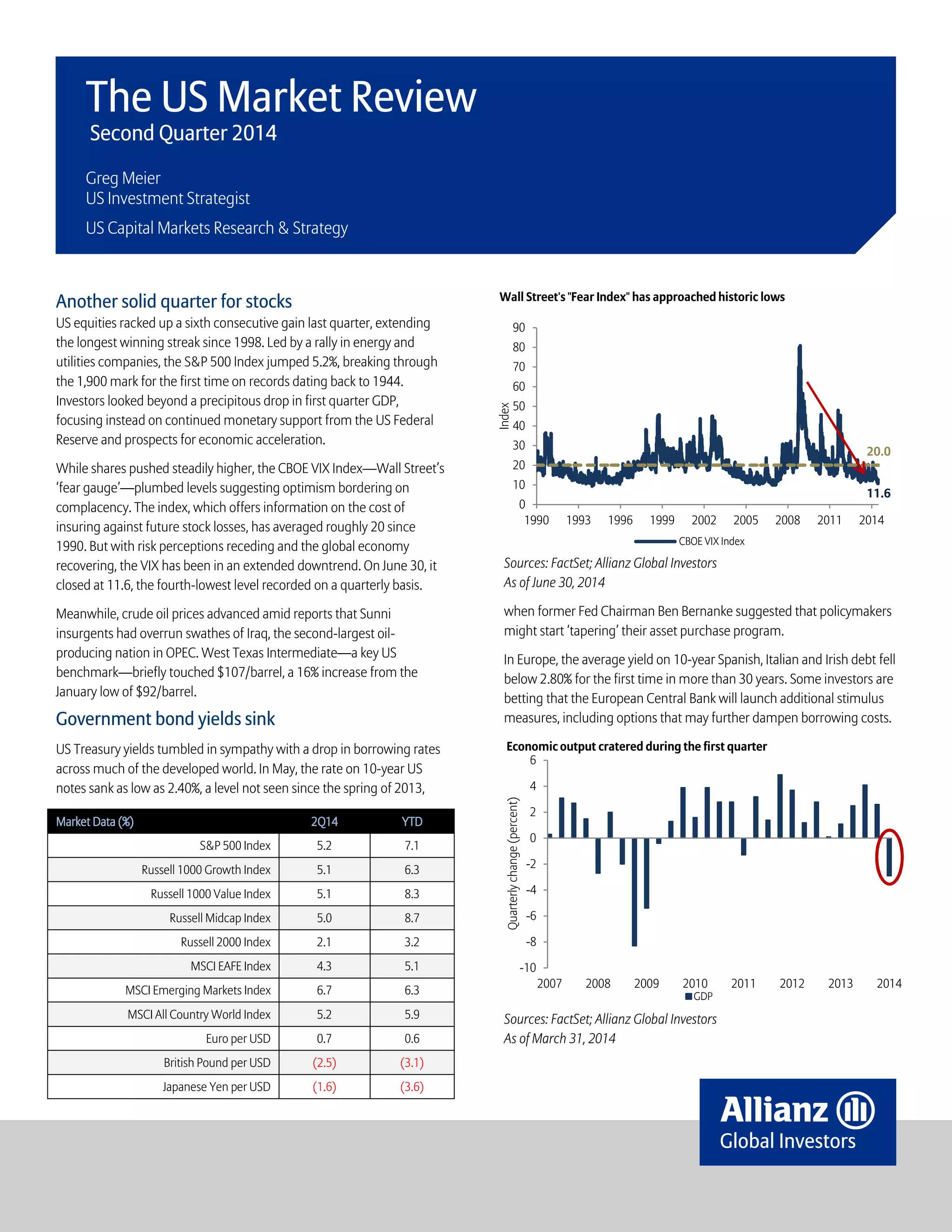
US equities racked up a sixth consecutive gain last quarter, extending
the longest winning streak since 1998. Led by a rally in energy and
utilities companies, the S&P 500 Index jumped 5.2%, breaking through
the 1,900 mark for the first time on records dating back to 1944.
Investors looked beyond a precipitous drop in first quarter GDP,
focusing instead on continued monetary support from the US Federal
Reserve and prospects for economic acceleration.
While shares pushed steadily higher, the CBOE VIX Index—Wall Street’s
‘fear gauge’—plumbed levels suggesting optimism bordering on
complacency. The index, which offers information on the cost of
insuring against future stock losses, has averaged roughly 20 since
1990. But with risk perceptions receding and the global economy
recovering, the VIX has been in an extended downtrend. On June 30, it
closed at 11.6, the fourth-lowest level recorded on a quarterly basis.
Meanwhile, crude oil prices advanced amid reports that Sunni
insurgents had overrun swathes of Iraq, the second-largest oil-
producing nation in OPEC. West Texas Intermediate—a key US
benchmark—briefly touched $107/barrel, a 16% increase from the
January low of $92/barrel.
Government bond yields sink
US Treasury yields tumbled in sympathy with a drop in borrowing rates
across much of the developed world. In May, the rate on 10-year US
notes sank as low as 2.40%, a level not seen since the spring of 2013,
Sources: FactSet; Allianz Global Investors
As of June 30, 2014
when former Fed Chairman Ben Bernanke suggested that policymakers
might start ‘tapering’ their asset purchase program.
In Europe, the average yield on 10-year Spanish, Italian and Irish debt fell
below 2.80% for the first time in more than 30 years. Some investors are
betting that the European Central Bank will launch additional stimulus
measures, including options that may further dampen borrowing costs.
Sources: FactSet; Allianz Global Investors
As of March 31, 2014
Market Data (%)Market Data (%)Market Data (%)Market Data (%) 2Q142Q142Q142Q14 YTDYTDYTDYTD
S&P 500 Index 5.2 7.1
Russell 1000 Growth Index 5.1 6.3
Russell 1000 Value Index 5.1 8.3
Russell Midcap Index 5.0 8.7
Russell 2000 Index 2.1 3.2
MSCI EAFE Index 4.3 5.1
MSCI Emerging Markets Index 6.7 6.3
MSCI All Country World Index 5.2 5.9
Euro per USD 0.7 0.6
British Pound per USD (2.5) (3.1)
Japanese Yen per USD (1.6) (3.6)
The US Market Review
Second Quarter 2014
Greg Meier
US Investment Strategist
US Capital Markets Research & Strategy
11.6
20.0
0
10
20
30
40
50
60
70
80
90
1990 1993 1996 1999 2002 2005 2008 2011 2014
Index
Wall Street's "Fear Index" has approached historic lows
CBOE VIX Index
-10
-8
-6
-4
-2
0
2
4
6
2007 2008 2009 2010 2011 2012 2013 2014
Quarterlychange(percent)
Economic output cratered during the first quarter
GDP
The US Market Review: Second Quarter 2014
2
-1000
-700
-400
-100
200
500
800
-0.3
-0.2
-0.1
0.0
0.1
0.2
0.3
2001 2003 2005 2007 2009 2011 2013
Nonfarmpayrolls(thousands)
Jobopenings(millions)
Record April job openings could signal stronger hiring
Job Openings (3-month average) Nonfarm Payrolls
Growth disappoints
Reports on the US economy exposed a much softer start to 2014 than
initially thought. The Commerce Department last month downgraded
its estimate on first quarter GDP from -1.0% to -2.9%, the steepest
contraction in output since the 2007-9 recession.
Three of the four main engines of the economy—government
spending, net trade and private investment—subtracted from growth.
The only major sector that was additive was consumer spending, which
expanded at the slowest pace in more than four years.
Workers wanted
While first quarter economic performance was unabashedly poor, more
recent data suggest positive momentum. One area of improvement is
the labor market, where employers hired nearly half a million workers
over April and May. A sharp upturn in April job openings could translate
into a further pick-up in payroll growth and, potentially, wages this
summer. The unemployment rate—currently at 6.3%—will likely see
additional downward pressure.
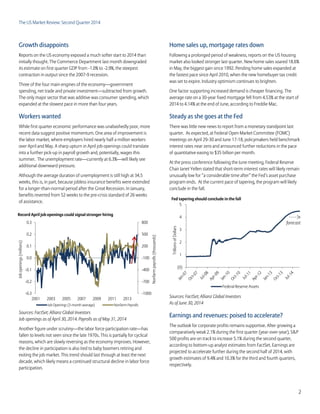
Although the average duration of unemployment is still high at 34.5
weeks, this is, in part, because jobless insurance benefits were extended
for a longer-than-normal period after the Great Recession. In January,
benefits reverted from 52 weeks to the pre-crisis standard of 26 weeks
of assistance.
Sources: FactSet; Allianz Global Investors
Job openings as of April 30, 2014. Payrolls as of May 31, 2014
Another figure under scrutiny—the labor force participation rate—has
fallen to levels not seen since the late 1970s. This is partially for cyclical
reasons, which are slowly reversing as the economy improves. However,
the decline in participation is also tied to baby boomers retiring and
exiting the job market. This trend should last through at least the next
decade, which likely means a continued structural decline in labor force
participation.
Home sales up, mortgage rates down
Following a prolonged period of weakness, reports on the US housing
market also looked stronger last quarter. New home sales soared 18.6%
in May, the biggest gain since 1992. Pending home sales expanded at
the fastest pace since April 2010, when the new homebuyer tax credit
was set to expire. Industry optimism continues to brighten.
One factor supporting increased demand is cheaper financing. The
average rate on a 30-year fixed mortgage fell from 4.53% at the start of
2014 to 4.14% at the end of June, according to Freddie Mac.
Steady as she goes at the Fed
There was little new news to report from a monetary standpoint last
quarter. As expected, at Federal Open Market Committee (FOMC)
meetings on April 29-30 and June 17-18, policymakers held benchmark
interest rates near zero and announced further reductions in the pace
of quantitative easing to $35 billion per month.
At the press conference following the June meeting, Federal Reserve
Chair Janet Yellen stated that short-term interest rates will likely remain
unusually low for “a considerable time after” the Fed’s asset purchase
program ends. At the current pace of tapering, the program will likely
conclude in the fall.
Sources: FactSet; Allianz Global Investors
As of June 30, 2014
Earnings and revenues: poised to accelerate?
The outlook for corporate profits remains supportive. After growing a
comparatively weak 2.1% during the first quarter (year-over-year), S&P
500 profits are on track to increase 5.1% during the second quarter,
according to bottom-up analyst estimates from FactSet. Earnings are
projected to accelerate further during the second half of 2014, with
growth estimates of 9.4% and 10.3% for the third and fourth quarters,
respectively.
(0)
1
2
3
4
5
TrillionsofDollars
Fed tapering should conclude in the fall
Federal Reserve Assets
forecast
The US Market Review: Second Quarter 2014
3
20
24
28
32
36
3Q11 1Q12 3Q12 1Q13 3Q13 1Q14 3Q14 1Q15
Earningspershare($)
Earnings are forecasted to rise after a weak start to 2014
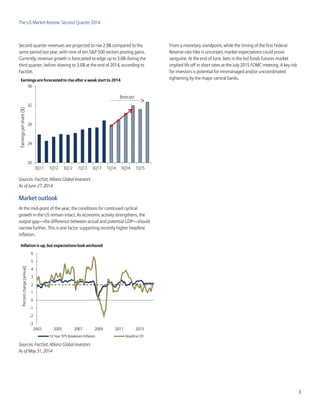
Second quarter revenues are projected to rise 2.9% compared to the
same period last year, with nine of ten S&P 500 sectors posting gains.
Currently, revenue growth is forecasted to edge up to 3.6% during the
third quarter, before slowing to 3.0% at the end of 2014, according to
FactSet.
Sources: FactSet; Allianz Global Investors
As of June 27, 2014
Market outlook
At the mid-point of the year, the conditions for continued cyclical
growth in the US remain intact. As economic activity strengthens, the
output gap—the difference between actual and potential GDP—should
narrow further. This is one factor supporting recently higher headline
inflation.
Sources: FactSet; Allianz Global Investors
As of May 31, 2014
From a monetary standpoint, while the timing of the first Federal
Reserve rate hike is uncertain, market expectations could prove
sanguine. At the end of June, bets in the fed funds futures market
implied lift-off in short rates at the July 2015 FOMC meeting. A key risk
for investors is potential for mismanaged and/or uncoordinated
tightening by the major central banks.
-3
-2
-1
0
1
2
3
4
5
6
2003 2005 2007 2009 2011 2013
Percentchange(annual)
Inflation is up, but expectations look anchored
10 Year TIPS Breakeven Inflation Headline CPI
forecast
The US Market Review: Second Quarter 2014
4
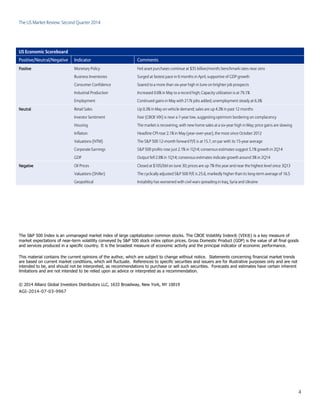
US Economic Scoreboard
Positive/Neutral/Negative Indicator Comments
PositivePositivePositivePositive Monetary Policy Fed asset purchases continue at $35 billion/month; benchmark rates near zero
Business Inventories Surged at fastest pace in 6 months in April, supportive of GDP growth
Consumer Confidence Soared to a more than six-year high in June on brighter job prospects
Industrial Production Increased 0.6% in May to a record high; Capacity utilization is at 79.1%
Employment Continued gains in May with 217k jobs added; unemployment steady at 6.3%
NeutralNeutralNeutralNeutral Retail Sales Up 0.3% in May on vehicle demand; sales are up 4.3% in past 12 months
Investor Sentiment Fear (CBOE VIX) is near a 7-year low, suggesting optimism bordering on complacency
Housing The market is recovering, with new home sales at a six-year high in May; price gains are slowing
Inflation Headline CPI rose 2.1% in May (year-over-year), the most since October 2012
Valuations (NTM) The S&P 500 12-month forward P/E is at 15.7, on par with its 15-year average
Corporate Earnings S&P 500 profits rose just 2.1% in 1Q14; consensus estimates suggest 5.1% growth in 2Q14
GDP Output fell 2.9% in 1Q14; consensus estimates indicate growth around 3% in 2Q14
NegativeNegativeNegativeNegative Oil Prices Closed at $105/bbl on June 30; prices are up 7% this year and near the highest level since 3Q13
Valuations (Shiller) The cyclically adjusted S&P 500 P/E is 25.6, markedly higher than its long-term average of 16.5
Geopolitical Instability has worsened with civil wars spreading in Iraq, Syria and Ukraine
The S&P 500 Index is an unmanaged market index of large capitalization common stocks. The CBOE Volatility Index® (VIX®) is a key measure of
market expectations of near-term volatility conveyed by S&P 500 stock index option prices. Gross Domestic Product (GDP) is the value of all final goods
and services produced in a specific country. It is the broadest measure of economic activity and the principal indicator of economic performance.
This material contains the current opinions of the author, which are subject to change without notice. Statements concerning financial market trends
are based on current market conditions, which will fluctuate. References to specific securities and issuers are for illustrative purposes only and are not
intended to be, and should not be interpreted, as recommendations to purchase or sell such securities. Forecasts and estimates have certain inherent
limitations and are not intended to be relied upon as advice or interpreted as a recommendation.
© 2014 Allianz Global Investors Distributors LLC, 1633 Broadway, New York, NY 10019
AGI-2014-07-03-9967

The US Market Overview - 2Q14 (FINAL)

  • 1.
    Another solid quarterfor stocks US equities racked up a sixth consecutive gain last quarter, extending the longest winning streak since 1998. Led by a rally in energy and utilities companies, the S&P 500 Index jumped 5.2%, breaking through the 1,900 mark for the first time on records dating back to 1944. Investors looked beyond a precipitous drop in first quarter GDP, focusing instead on continued monetary support from the US Federal Reserve and prospects for economic acceleration. While shares pushed steadily higher, the CBOE VIX Index—Wall Street’s ‘fear gauge’—plumbed levels suggesting optimism bordering on complacency. The index, which offers information on the cost of insuring against future stock losses, has averaged roughly 20 since 1990. But with risk perceptions receding and the global economy recovering, the VIX has been in an extended downtrend. On June 30, it closed at 11.6, the fourth-lowest level recorded on a quarterly basis. Meanwhile, crude oil prices advanced amid reports that Sunni insurgents had overrun swathes of Iraq, the second-largest oil- producing nation in OPEC. West Texas Intermediate—a key US benchmark—briefly touched $107/barrel, a 16% increase from the January low of $92/barrel. Government bond yields sink US Treasury yields tumbled in sympathy with a drop in borrowing rates across much of the developed world. In May, the rate on 10-year US notes sank as low as 2.40%, a level not seen since the spring of 2013, Sources: FactSet; Allianz Global Investors As of June 30, 2014 when former Fed Chairman Ben Bernanke suggested that policymakers might start ‘tapering’ their asset purchase program. In Europe, the average yield on 10-year Spanish, Italian and Irish debt fell below 2.80% for the first time in more than 30 years. Some investors are betting that the European Central Bank will launch additional stimulus measures, including options that may further dampen borrowing costs. Sources: FactSet; Allianz Global Investors As of March 31, 2014 Market Data (%)Market Data (%)Market Data (%)Market Data (%) 2Q142Q142Q142Q14 YTDYTDYTDYTD S&P 500 Index 5.2 7.1 Russell 1000 Growth Index 5.1 6.3 Russell 1000 Value Index 5.1 8.3 Russell Midcap Index 5.0 8.7 Russell 2000 Index 2.1 3.2 MSCI EAFE Index 4.3 5.1 MSCI Emerging Markets Index 6.7 6.3 MSCI All Country World Index 5.2 5.9 Euro per USD 0.7 0.6 British Pound per USD (2.5) (3.1) Japanese Yen per USD (1.6) (3.6) The US Market Review Second Quarter 2014 Greg Meier US Investment Strategist US Capital Markets Research & Strategy 11.6 20.0 0 10 20 30 40 50 60 70 80 90 1990 1993 1996 1999 2002 2005 2008 2011 2014 Index Wall Street's "Fear Index" has approached historic lows CBOE VIX Index -10 -8 -6 -4 -2 0 2 4 6 2007 2008 2009 2010 2011 2012 2013 2014 Quarterlychange(percent) Economic output cratered during the first quarter GDP
  • 2.
    The US MarketReview: Second Quarter 2014 2 -1000 -700 -400 -100 200 500 800 -0.3 -0.2 -0.1 0.0 0.1 0.2 0.3 2001 2003 2005 2007 2009 2011 2013 Nonfarmpayrolls(thousands) Jobopenings(millions) Record April job openings could signal stronger hiring Job Openings (3-month average) Nonfarm Payrolls Growth disappoints Reports on the US economy exposed a much softer start to 2014 than initially thought. The Commerce Department last month downgraded its estimate on first quarter GDP from -1.0% to -2.9%, the steepest contraction in output since the 2007-9 recession. Three of the four main engines of the economy—government spending, net trade and private investment—subtracted from growth. The only major sector that was additive was consumer spending, which expanded at the slowest pace in more than four years. Workers wanted While first quarter economic performance was unabashedly poor, more recent data suggest positive momentum. One area of improvement is the labor market, where employers hired nearly half a million workers over April and May. A sharp upturn in April job openings could translate into a further pick-up in payroll growth and, potentially, wages this summer. The unemployment rate—currently at 6.3%—will likely see additional downward pressure. Although the average duration of unemployment is still high at 34.5 weeks, this is, in part, because jobless insurance benefits were extended for a longer-than-normal period after the Great Recession. In January, benefits reverted from 52 weeks to the pre-crisis standard of 26 weeks of assistance. Sources: FactSet; Allianz Global Investors Job openings as of April 30, 2014. Payrolls as of May 31, 2014 Another figure under scrutiny—the labor force participation rate—has fallen to levels not seen since the late 1970s. This is partially for cyclical reasons, which are slowly reversing as the economy improves. However, the decline in participation is also tied to baby boomers retiring and exiting the job market. This trend should last through at least the next decade, which likely means a continued structural decline in labor force participation. Home sales up, mortgage rates down Following a prolonged period of weakness, reports on the US housing market also looked stronger last quarter. New home sales soared 18.6% in May, the biggest gain since 1992. Pending home sales expanded at the fastest pace since April 2010, when the new homebuyer tax credit was set to expire. Industry optimism continues to brighten. One factor supporting increased demand is cheaper financing. The average rate on a 30-year fixed mortgage fell from 4.53% at the start of 2014 to 4.14% at the end of June, according to Freddie Mac. Steady as she goes at the Fed There was little new news to report from a monetary standpoint last quarter. As expected, at Federal Open Market Committee (FOMC) meetings on April 29-30 and June 17-18, policymakers held benchmark interest rates near zero and announced further reductions in the pace of quantitative easing to $35 billion per month. At the press conference following the June meeting, Federal Reserve Chair Janet Yellen stated that short-term interest rates will likely remain unusually low for “a considerable time after” the Fed’s asset purchase program ends. At the current pace of tapering, the program will likely conclude in the fall. Sources: FactSet; Allianz Global Investors As of June 30, 2014 Earnings and revenues: poised to accelerate? The outlook for corporate profits remains supportive. After growing a comparatively weak 2.1% during the first quarter (year-over-year), S&P 500 profits are on track to increase 5.1% during the second quarter, according to bottom-up analyst estimates from FactSet. Earnings are projected to accelerate further during the second half of 2014, with growth estimates of 9.4% and 10.3% for the third and fourth quarters, respectively. (0) 1 2 3 4 5 TrillionsofDollars Fed tapering should conclude in the fall Federal Reserve Assets forecast
  • 3.
    The US MarketReview: Second Quarter 2014 3 20 24 28 32 36 3Q11 1Q12 3Q12 1Q13 3Q13 1Q14 3Q14 1Q15 Earningspershare($) Earnings are forecasted to rise after a weak start to 2014 Second quarter revenues are projected to rise 2.9% compared to the same period last year, with nine of ten S&P 500 sectors posting gains. Currently, revenue growth is forecasted to edge up to 3.6% during the third quarter, before slowing to 3.0% at the end of 2014, according to FactSet. Sources: FactSet; Allianz Global Investors As of June 27, 2014 Market outlook At the mid-point of the year, the conditions for continued cyclical growth in the US remain intact. As economic activity strengthens, the output gap—the difference between actual and potential GDP—should narrow further. This is one factor supporting recently higher headline inflation. Sources: FactSet; Allianz Global Investors As of May 31, 2014 From a monetary standpoint, while the timing of the first Federal Reserve rate hike is uncertain, market expectations could prove sanguine. At the end of June, bets in the fed funds futures market implied lift-off in short rates at the July 2015 FOMC meeting. A key risk for investors is potential for mismanaged and/or uncoordinated tightening by the major central banks. -3 -2 -1 0 1 2 3 4 5 6 2003 2005 2007 2009 2011 2013 Percentchange(annual) Inflation is up, but expectations look anchored 10 Year TIPS Breakeven Inflation Headline CPI forecast
  • 4.
    The US MarketReview: Second Quarter 2014 4 US Economic Scoreboard Positive/Neutral/Negative Indicator Comments PositivePositivePositivePositive Monetary Policy Fed asset purchases continue at $35 billion/month; benchmark rates near zero Business Inventories Surged at fastest pace in 6 months in April, supportive of GDP growth Consumer Confidence Soared to a more than six-year high in June on brighter job prospects Industrial Production Increased 0.6% in May to a record high; Capacity utilization is at 79.1% Employment Continued gains in May with 217k jobs added; unemployment steady at 6.3% NeutralNeutralNeutralNeutral Retail Sales Up 0.3% in May on vehicle demand; sales are up 4.3% in past 12 months Investor Sentiment Fear (CBOE VIX) is near a 7-year low, suggesting optimism bordering on complacency Housing The market is recovering, with new home sales at a six-year high in May; price gains are slowing Inflation Headline CPI rose 2.1% in May (year-over-year), the most since October 2012 Valuations (NTM) The S&P 500 12-month forward P/E is at 15.7, on par with its 15-year average Corporate Earnings S&P 500 profits rose just 2.1% in 1Q14; consensus estimates suggest 5.1% growth in 2Q14 GDP Output fell 2.9% in 1Q14; consensus estimates indicate growth around 3% in 2Q14 NegativeNegativeNegativeNegative Oil Prices Closed at $105/bbl on June 30; prices are up 7% this year and near the highest level since 3Q13 Valuations (Shiller) The cyclically adjusted S&P 500 P/E is 25.6, markedly higher than its long-term average of 16.5 Geopolitical Instability has worsened with civil wars spreading in Iraq, Syria and Ukraine The S&P 500 Index is an unmanaged market index of large capitalization common stocks. The CBOE Volatility Index® (VIX®) is a key measure of market expectations of near-term volatility conveyed by S&P 500 stock index option prices. Gross Domestic Product (GDP) is the value of all final goods and services produced in a specific country. It is the broadest measure of economic activity and the principal indicator of economic performance. This material contains the current opinions of the author, which are subject to change without notice. Statements concerning financial market trends are based on current market conditions, which will fluctuate. References to specific securities and issuers are for illustrative purposes only and are not intended to be, and should not be interpreted, as recommendations to purchase or sell such securities. Forecasts and estimates have certain inherent limitations and are not intended to be relied upon as advice or interpreted as a recommendation. © 2014 Allianz Global Investors Distributors LLC, 1633 Broadway, New York, NY 10019 AGI-2014-07-03-9967