ONLINE TRADING  AND  STOCK RESEARCH TECHNIQUES
RESEARCH OBJECTIVE To qualitatively view the prevalent analysis techniques used for selecting a Company’s stock for investment purpose.   To identify the factors to be considered while selecting a particular stock.
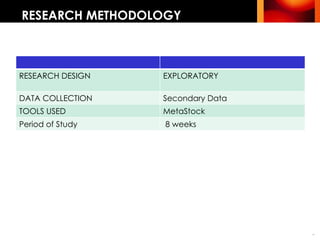
RESEARCH METHODOLOGY RESEARCH DESIGN EXPLORATORY DATA COLLECTION Secondary Data TOOLS USED MetaStock Period of Study 8 weeks
A Stock Exchange is an organized market for purchase and sale of existing or second hand securities. STOCK EXCHANGE
SIGNIFICANCE  OF STOCK MARKETS Stock markets are true indicators of the economy of a country wherein they take into consideration factors such as  GDP growth, Industrial growth, Global cues, Government policies, Budget, Inflation(WPI) and Demand & Supply to reflect the growth of the economy by  showcasing the variations as fluctuations in the Index; NSE and the BSE.
Surplus capital. Speculative instincts. High risk appetite.  Stock Market provides them with a platform wherein the variations in its Index levels amounts to huge gains/losses in a short span of time (minutes to several days).  The quick and high returns from Stock Market lures Traders and Investors to invest. A variable RoR. Why Invest in Stock Market?
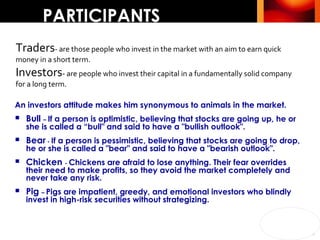
PARTICIPANTS An investors attitude makes him synonymous to animals in the market. Bull  –  If a person is optimistic, believing that stocks are going up, he or she is called a “bull" and said to have a "bullish outlook".  Bear  -  If a person is pessimistic, believing that stocks are going to drop, he or she is called a "bear" and said to have a "bearish outlook".  Chicken  -  Chickens are afraid to lose anything. Their fear overrides their need to make profits, so they avoid the market completely and never take any risk. Pig  –  Pigs are impatient, greedy, and emotional investors who blindly invest in high-risk securities without strategizing. Traders - are those people who invest in the market with an aim to earn quick money in a short term. Investors - are people who invest their capital in a fundamentally solid company for a long term.
DOW THEORY ELLIOTT WAVE THEORY THEORIES OF RESEARCH
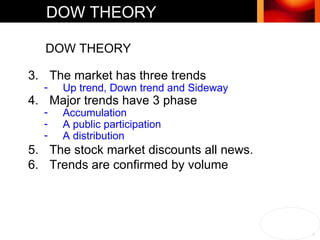
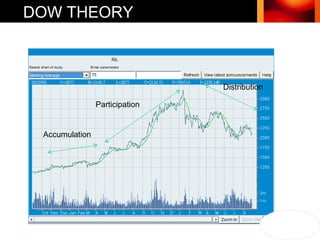
DOW THEORY DOW THEORY The market has three trends Up trend, Down trend and Sideway Major trends have 3 phase  Accumulation  A public participation A distribution The stock market discounts all news.  Trends are confirmed by volume
Accumulation Participation Distribution Reliance Industries 1/9/06- 29/8/08 DOW THEORY
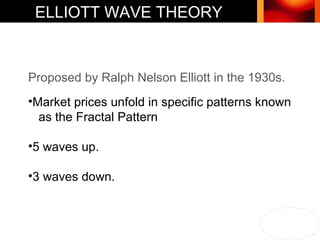
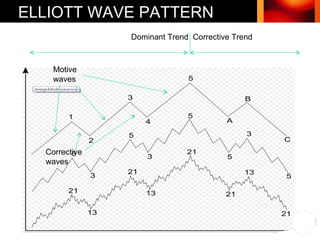
ELLIOTT WAVE THEORY Proposed by Ralph Nelson Elliott  in the 1930s. Market prices unfold in specific patterns known  as the Fractal Pattern 5 waves up.  3 waves down.
Dominant Trend  Corrective Trend   Motive waves Corrective waves ELLIOTT WAVE PATTERN
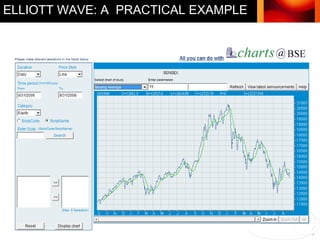
ELLIOTT WAVE: A  PRACTICAL EXAMPLE
Technical Analysis Philosophy or Rationale Market action discounts everything Prices move in trends History repeats itself
Candlestick charts are the oldest type of charts use for price prediction Date back to the 1700’s,when they were  used for predicting rice price Sokuta Honma is said to have executed over 100 consecutive winning trades!! Sakata’s method is the first verifiable beginning of pattern recognition CANDLESTICK
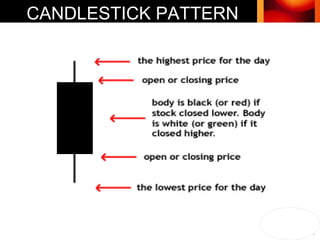
CANDLESTICK PATTERN
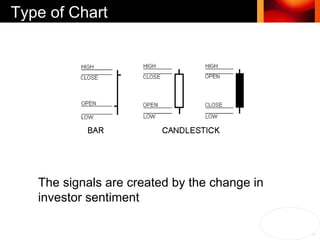
The signals are created by the change in investor sentiment Type of Chart
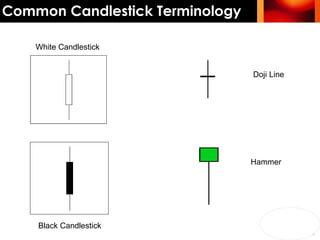
White Candlestick Black Candlestick Hammer Doji Line Common Candlestick Terminology
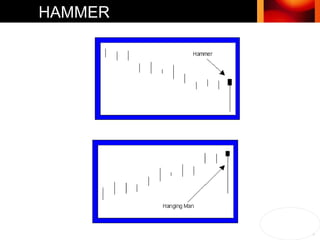
HAMMER
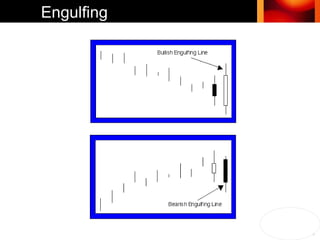
Engulfing
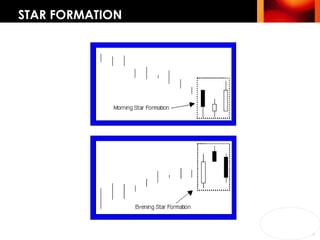
STAR FORMATION
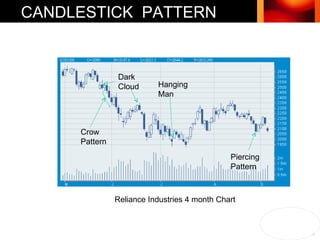
CANDLESTICK  PATTERN Reliance Industries 4 month Chart Hanging Man Piercing Pattern Dark Cloud Crow Pattern
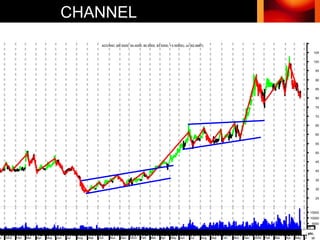
Support and Resistance Trendlines Trading Range (Channel) Price patterns RSI TOOLS FOR TECHNICAL ANALYSIS
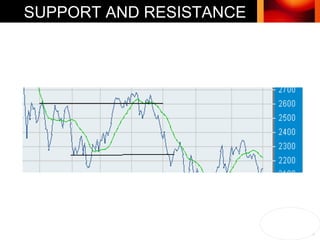
SUPPORT AND RESISTANCE
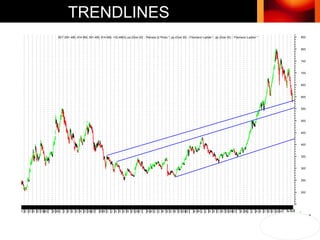
Draw a trendline through the edges of congestion areas The most important feature of a trendline is its angle Trendlines show the action of bulls and bears TREND LINES
TRENDLINES
CHANNEL
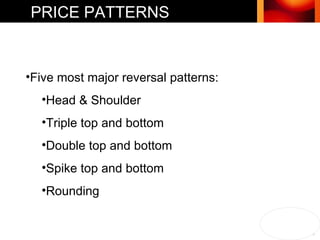
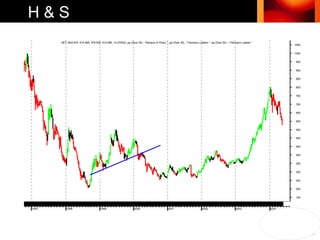
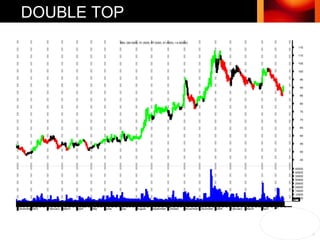
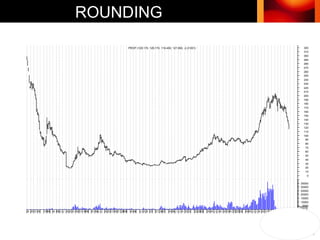
Five most major reversal patterns: Head & Shoulder Triple top and bottom Double top and bottom Spike top and bottom Rounding  PRICE PATTERNS
H & S
DOUBLE TOP
ROUNDING
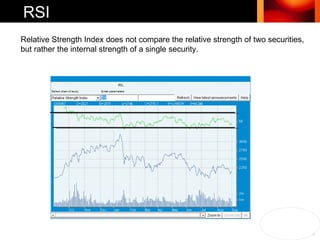
RSI Relative Strength Index does not compare the relative strength of two securities, but rather the internal strength of a single security.
FUNDAMENTAL ANALYSIS Data collected from Company’s Balance Sheet. Factors considered: Dividend PAT Reserves and Surplus EPS PE ratio
FURTHER RESEARCH Fiscal Policy of Government Varied tax slabs for different sectors RBI’s Monetary Policy Repo Rate CRR SLR FOREX policy Tracking Global Cues Inflation – 5p.m every Thursday Imported inflation  Domestic Inflation Speculative Instincts
Contd. Sector specific announcements Windfall tax Corporate Tax on IT companies Subsidy to Agri sector Ban on Iron Ore to control inflation Increased export duty on metals Re-Dollar equation FII Turnover Domestic turnover Keeping a check on Commodity driven stocks Keeping a check on Demand-Supply of Crude oil
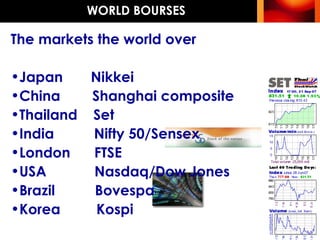
WORLD BOURSES The markets the world over Japan  Nikkei China  Shanghai composite Thailand  Set India  Nifty 50/Sensex London  FTSE USA  Nasdaq/Dow Jones Brazil  Bovespa Korea  Kospi
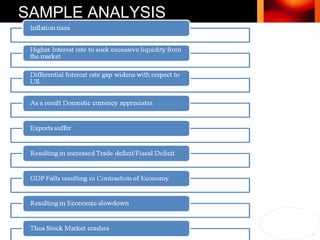
SAMPLE ANALYSIS
Inflation is receding as threat. New problem :Liquidity and Growth What can the banks do: Cut interest rates Increase liquidity India caught in a ripple of financial crisis. High counter party risk and thus no lenders  resulting in reduced liquidity Current Market Scenario
Bull markets are born in despair, rise in skepticism and die in mania. By- John Templeton Famous Quote
ONLINE TRADING MECHANISM Open a DEMAT Account  for Equity Trading with their Depository Participant (DP) who is their Stock Broker or the Online Trading Company registered with the Stock Exchange.  Negotiate Brokerage  Requirements for opening a Demat a/c are as follows: Fill the DEMAT Form provided by the Stock Broker.  Provide the PAN number with it.  Provide residence proof. Draw a cheque in favour of NSCCL as the a/c opening fee. After the DEMAT a/c has been opened and  mapped to a Stock Broker’s VSAT  terminal, one can commence trading.
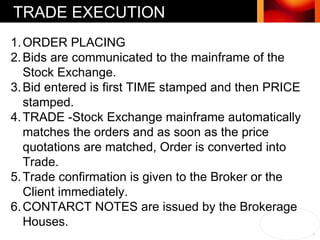
TRADE EXECUTION ORDER PLACING Bids are communicated to the mainframe of the Stock Exchange. Bid entered is first TIME stamped and then PRICE stamped. TRADE - Stock Exchange mainframe automatically matches the orders and as soon as the price quotations are matched, Order is converted into Trade. Trade confirmation is given to the Broker or the Client immediately. CONTARCT NOTES are issued by the Brokerage Houses.
QUESTION AND ANSWERS

Summer Project

  • 1.
    ONLINE TRADING AND STOCK RESEARCH TECHNIQUES
  • 2.
    RESEARCH OBJECTIVE Toqualitatively view the prevalent analysis techniques used for selecting a Company’s stock for investment purpose.   To identify the factors to be considered while selecting a particular stock.
  • 3.
    RESEARCH METHODOLOGY RESEARCHDESIGN EXPLORATORY DATA COLLECTION Secondary Data TOOLS USED MetaStock Period of Study 8 weeks
  • 4.
    A Stock Exchangeis an organized market for purchase and sale of existing or second hand securities. STOCK EXCHANGE
  • 5.
    SIGNIFICANCE OFSTOCK MARKETS Stock markets are true indicators of the economy of a country wherein they take into consideration factors such as GDP growth, Industrial growth, Global cues, Government policies, Budget, Inflation(WPI) and Demand & Supply to reflect the growth of the economy by showcasing the variations as fluctuations in the Index; NSE and the BSE.
  • 6.
    Surplus capital. Speculativeinstincts. High risk appetite. Stock Market provides them with a platform wherein the variations in its Index levels amounts to huge gains/losses in a short span of time (minutes to several days). The quick and high returns from Stock Market lures Traders and Investors to invest. A variable RoR. Why Invest in Stock Market?
  • 7.
    PARTICIPANTS An investorsattitude makes him synonymous to animals in the market. Bull – If a person is optimistic, believing that stocks are going up, he or she is called a “bull" and said to have a "bullish outlook". Bear - If a person is pessimistic, believing that stocks are going to drop, he or she is called a "bear" and said to have a "bearish outlook". Chicken - Chickens are afraid to lose anything. Their fear overrides their need to make profits, so they avoid the market completely and never take any risk. Pig – Pigs are impatient, greedy, and emotional investors who blindly invest in high-risk securities without strategizing. Traders - are those people who invest in the market with an aim to earn quick money in a short term. Investors - are people who invest their capital in a fundamentally solid company for a long term.
  • 8.
    DOW THEORY ELLIOTTWAVE THEORY THEORIES OF RESEARCH
  • 9.
    DOW THEORY DOWTHEORY The market has three trends Up trend, Down trend and Sideway Major trends have 3 phase Accumulation A public participation A distribution The stock market discounts all news. Trends are confirmed by volume
  • 10.
    Accumulation Participation DistributionReliance Industries 1/9/06- 29/8/08 DOW THEORY
  • 11.
    ELLIOTT WAVE THEORYProposed by Ralph Nelson Elliott in the 1930s. Market prices unfold in specific patterns known as the Fractal Pattern 5 waves up. 3 waves down.
  • 12.
    Dominant Trend Corrective Trend   Motive waves Corrective waves ELLIOTT WAVE PATTERN
  • 13.
    ELLIOTT WAVE: A PRACTICAL EXAMPLE
  • 14.
    Technical Analysis Philosophyor Rationale Market action discounts everything Prices move in trends History repeats itself
  • 15.
    Candlestick charts arethe oldest type of charts use for price prediction Date back to the 1700’s,when they were used for predicting rice price Sokuta Honma is said to have executed over 100 consecutive winning trades!! Sakata’s method is the first verifiable beginning of pattern recognition CANDLESTICK
  • 16.
  • 17.
    The signals arecreated by the change in investor sentiment Type of Chart
  • 18.
    White Candlestick BlackCandlestick Hammer Doji Line Common Candlestick Terminology
  • 19.
  • 20.
  • 21.
  • 22.
    CANDLESTICK PATTERNReliance Industries 4 month Chart Hanging Man Piercing Pattern Dark Cloud Crow Pattern
  • 23.
    Support and ResistanceTrendlines Trading Range (Channel) Price patterns RSI TOOLS FOR TECHNICAL ANALYSIS
  • 24.
  • 25.
    Draw a trendlinethrough the edges of congestion areas The most important feature of a trendline is its angle Trendlines show the action of bulls and bears TREND LINES
  • 26.
  • 27.
  • 28.
    Five most majorreversal patterns: Head & Shoulder Triple top and bottom Double top and bottom Spike top and bottom Rounding PRICE PATTERNS
  • 29.
  • 30.
  • 31.
  • 32.
    RSI Relative StrengthIndex does not compare the relative strength of two securities, but rather the internal strength of a single security.
  • 33.
    FUNDAMENTAL ANALYSIS Datacollected from Company’s Balance Sheet. Factors considered: Dividend PAT Reserves and Surplus EPS PE ratio
  • 34.
    FURTHER RESEARCH FiscalPolicy of Government Varied tax slabs for different sectors RBI’s Monetary Policy Repo Rate CRR SLR FOREX policy Tracking Global Cues Inflation – 5p.m every Thursday Imported inflation Domestic Inflation Speculative Instincts
  • 35.
    Contd. Sector specificannouncements Windfall tax Corporate Tax on IT companies Subsidy to Agri sector Ban on Iron Ore to control inflation Increased export duty on metals Re-Dollar equation FII Turnover Domestic turnover Keeping a check on Commodity driven stocks Keeping a check on Demand-Supply of Crude oil
  • 36.
    WORLD BOURSES Themarkets the world over Japan Nikkei China Shanghai composite Thailand Set India Nifty 50/Sensex London FTSE USA Nasdaq/Dow Jones Brazil Bovespa Korea Kospi
  • 37.
  • 38.
    Inflation is recedingas threat. New problem :Liquidity and Growth What can the banks do: Cut interest rates Increase liquidity India caught in a ripple of financial crisis. High counter party risk and thus no lenders resulting in reduced liquidity Current Market Scenario
  • 39.
    Bull markets areborn in despair, rise in skepticism and die in mania. By- John Templeton Famous Quote
  • 40.
    ONLINE TRADING MECHANISMOpen a DEMAT Account for Equity Trading with their Depository Participant (DP) who is their Stock Broker or the Online Trading Company registered with the Stock Exchange. Negotiate Brokerage Requirements for opening a Demat a/c are as follows: Fill the DEMAT Form provided by the Stock Broker. Provide the PAN number with it. Provide residence proof. Draw a cheque in favour of NSCCL as the a/c opening fee. After the DEMAT a/c has been opened and mapped to a Stock Broker’s VSAT terminal, one can commence trading.
  • 41.
    TRADE EXECUTION ORDERPLACING Bids are communicated to the mainframe of the Stock Exchange. Bid entered is first TIME stamped and then PRICE stamped. TRADE - Stock Exchange mainframe automatically matches the orders and as soon as the price quotations are matched, Order is converted into Trade. Trade confirmation is given to the Broker or the Client immediately. CONTARCT NOTES are issued by the Brokerage Houses.
  • 42.