Summarizing: what is it?
 A condensed version of what you’ve read
 Written in your own words; little to no quoted material
 Includes the author’s main points along with a sentence
that provides the title, author, text type, and focus (overall
main idea).
Summarizing: Not an EasyTask
 Imagine it:You’ve just written your first summary and turned it in.You
think you did okay, but then you get back your paper with comments.
Your teacher has written one or more of the following in the margins:
 You wrote down everything!
 You wrote down nothing!
 You wrote way too much!
 You didn’t write select the right information to include!
 You copied word for word and used too many quotes!
 You wrote too much detail!
 You didn’t write the author’s main focus/idea!
ARRRGHHHHHHH!!!!!!YOU CAN’TWIN!!!!!!
Now what?
 Try, try again.
 Summarizing takes time and practice. A lot of practice.
Give yourself at least an hour to complete the assignment
after you’ve finished reading.
 By following the 6 summary steps in this presentation, you
should be able to arrive at an overall idea/gist of whatever
the author is trying to say.
 To get to the overall idea, you are going to work
backwards at achieving that.You will start with a lot of
sentences and then reduce it down to main one.
Summary Objective
 When writing a summary you want to accomplish 2 things:
1. The author’s main purpose or focus, which is ultimately
written as a topic sentence at the beginning of the
summary.
2. About 5-7 supporting sentences, which are a collection of
main points that follow the topic sentence.
Step 1
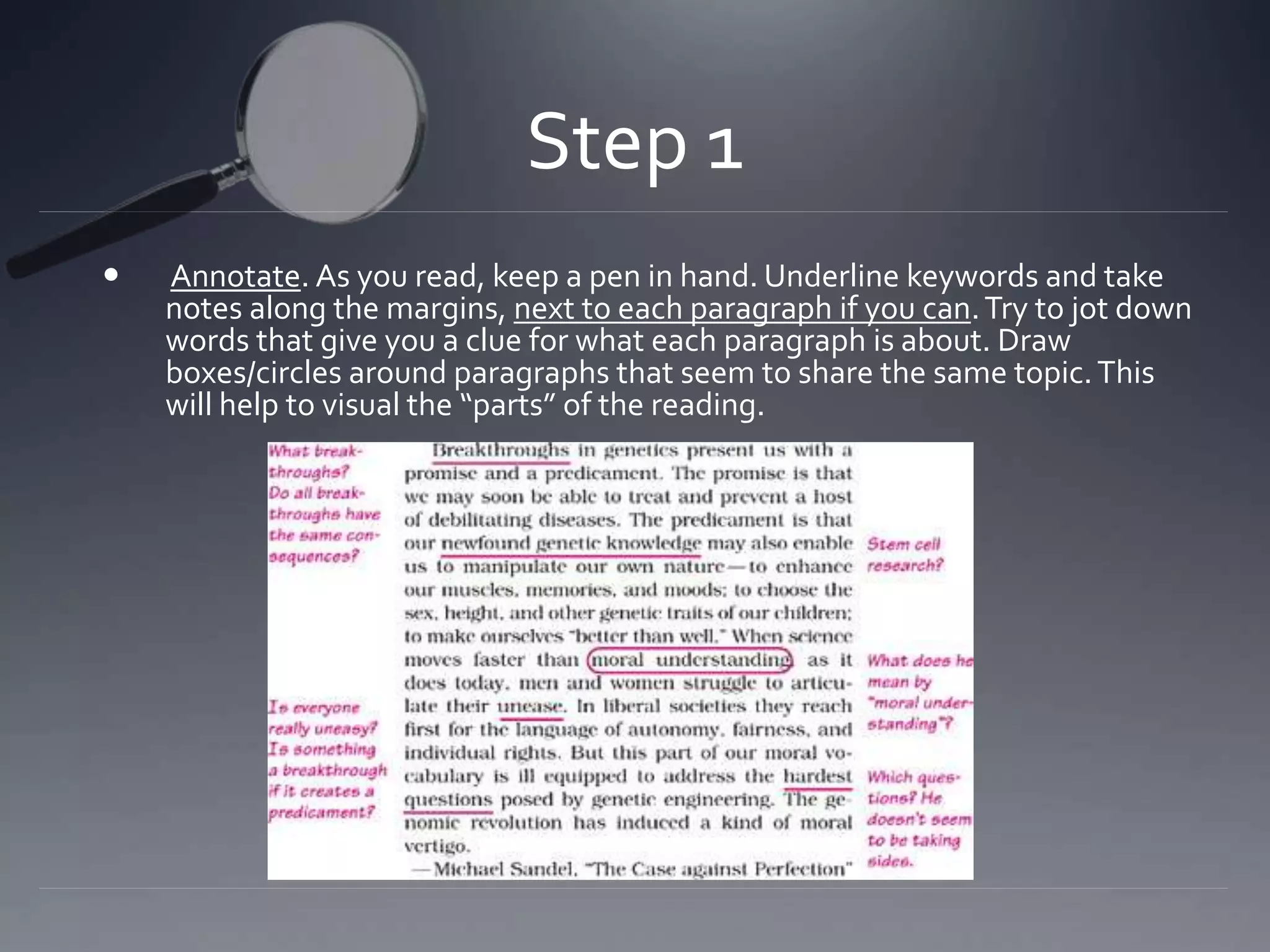
 Annotate. As you read, keep a pen in hand. Underline keywords and take
notes along the margins, next to each paragraph if you can.Try to jot down
words that give you a clue for what each paragraph is about. Draw
boxes/circles around paragraphs that seem to share the same topic.This
will help to visual the “parts” of the reading.
Step 2
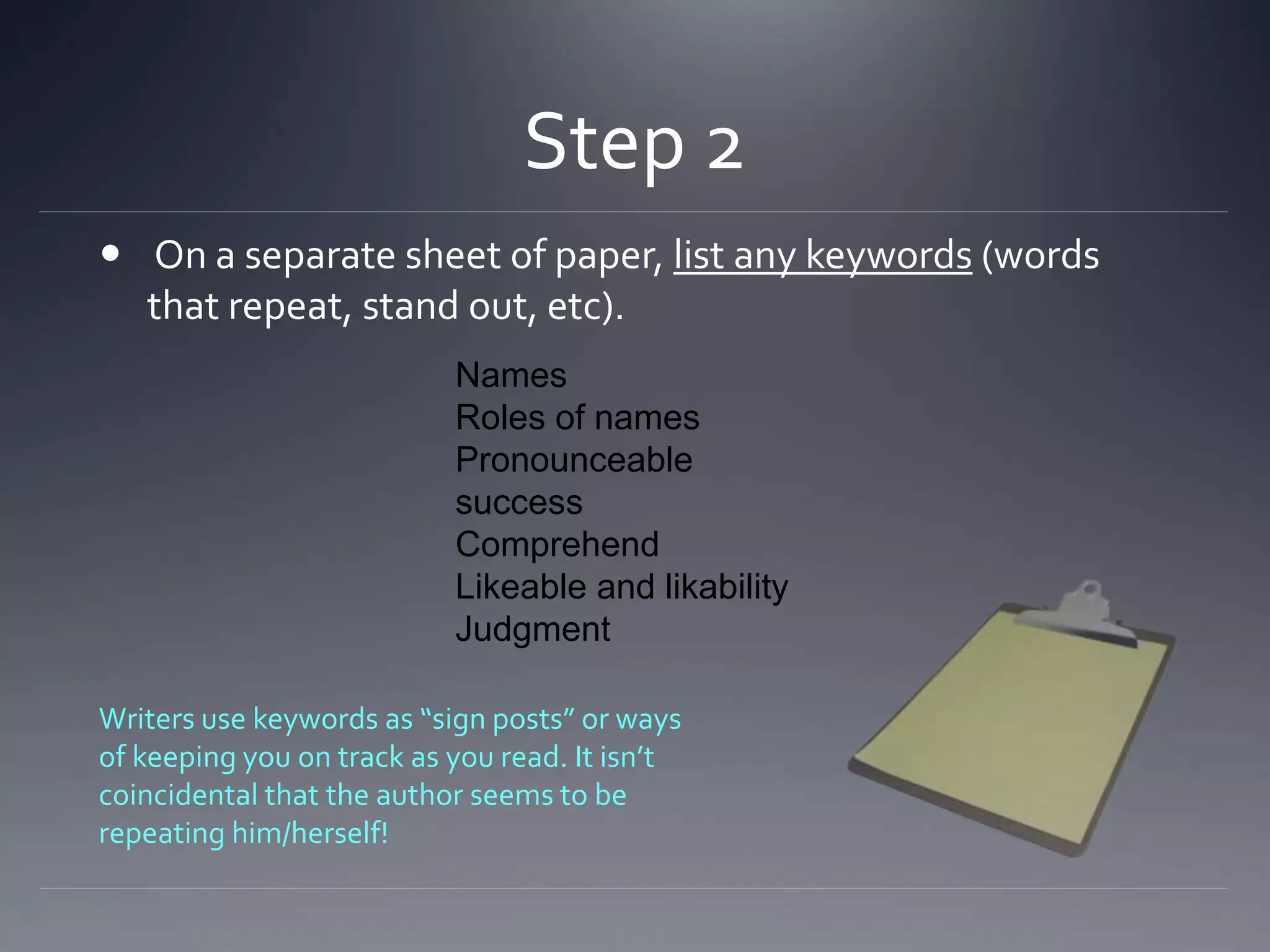
 On a separate sheet of paper, list any keywords (words
that repeat, stand out, etc).
Names
Roles of names
Pronounceable
success
Comprehend
Likeable and likability
Judgment
Writers use keywords as “sign posts” or ways
of keeping you on track as you read. It isn’t
coincidental that the author seems to be
repeating him/herself!
Step 3
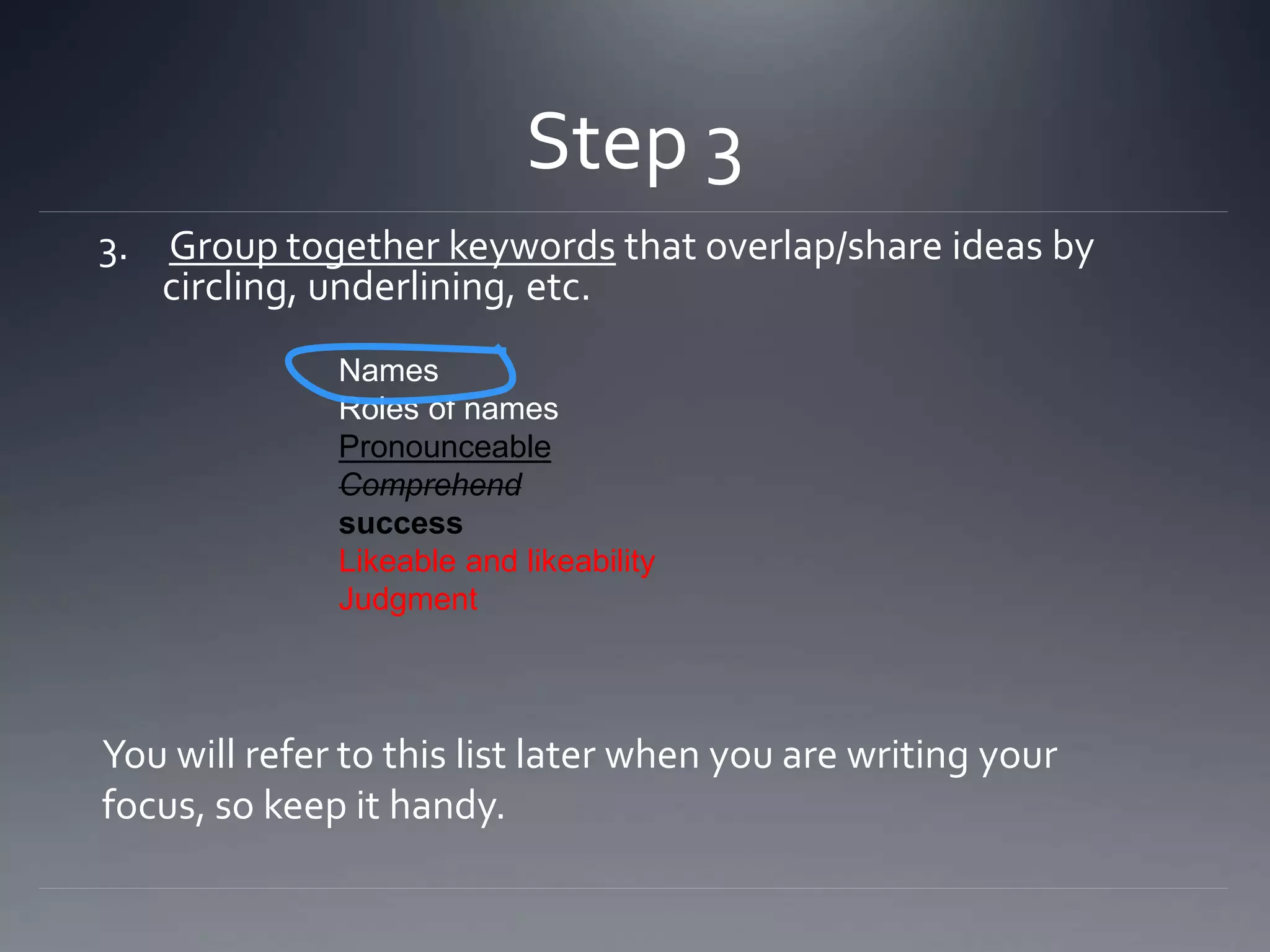
3. Group together keywords that overlap/share ideas by
circling, underlining, etc.
Names
Roles of names
Pronounceable
Comprehend
success
Likeable and likeability
Judgment
You will refer to this list later when you are writing your
focus, so keep it handy.
Step 4
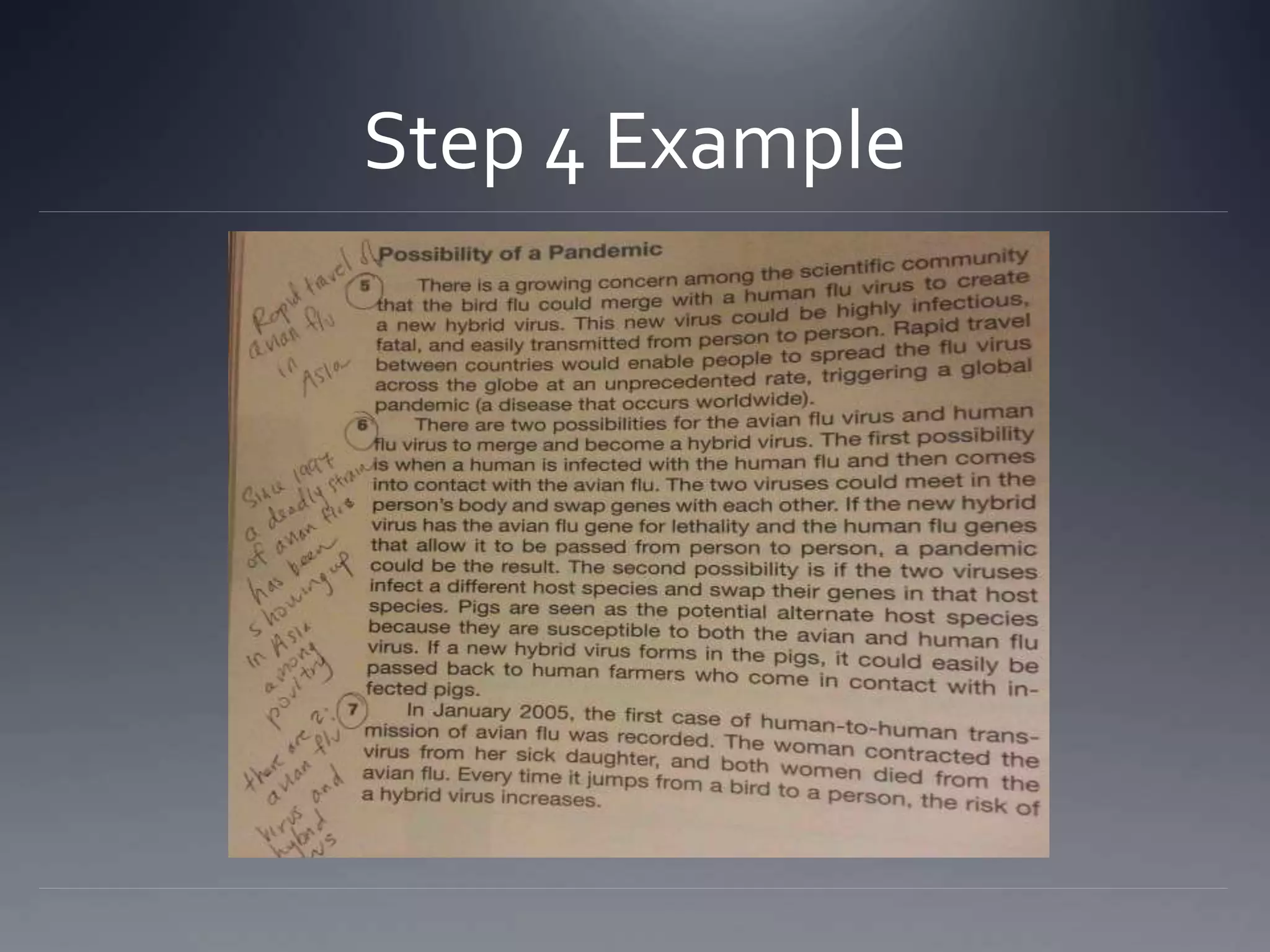
 Return to the original text where you jotted down notes along the
margins.
 Going chronologically through the reading, write a sentence for each
paragraph on a separate sheet of paper. Each sentence should be the
main idea of that particular paragraph.
 Revisit the keywords you have grouped together to help you.
 You will have a paper that is made up of many sentences.
 P1: ______(main idea)_________
 P2:______(main idea)_________
 P3:______(main idea)_________
 P4:______(main idea)_________
Step 4 Example
Step 5
Refine and Reduce: Go through your main points and
erase any ideas that repeat or do not matter i.e. do not
help one to better understand the text. Replace jumbled
words/phrases with stronger, more precise words.Think
less is more. Try to get your main points down to 5
sentences.
Step 6
Focus:After rereading your 5-7 main points, determine
the author’s overall purpose or focus for writing the text.
What is he/she trying to tell us with these main points?
Write this as one statement.You might start with one of
these templates:
 The author wants readers to understand…
 Overall, the author argues that…
 The author’s main purpose is…
Example:The author’s main purpose is to suggest that a
person with a name that is common and easy to pronounce
is more likely to be successful in life.
PAUSE
 Your homework assignment ends here.
 Your final product should be:
1. Your topic sentence, which includes a template from step 6
and the author’s focus
2. 5-7 additional supporting sentences (main ideas from the
reading) that follow
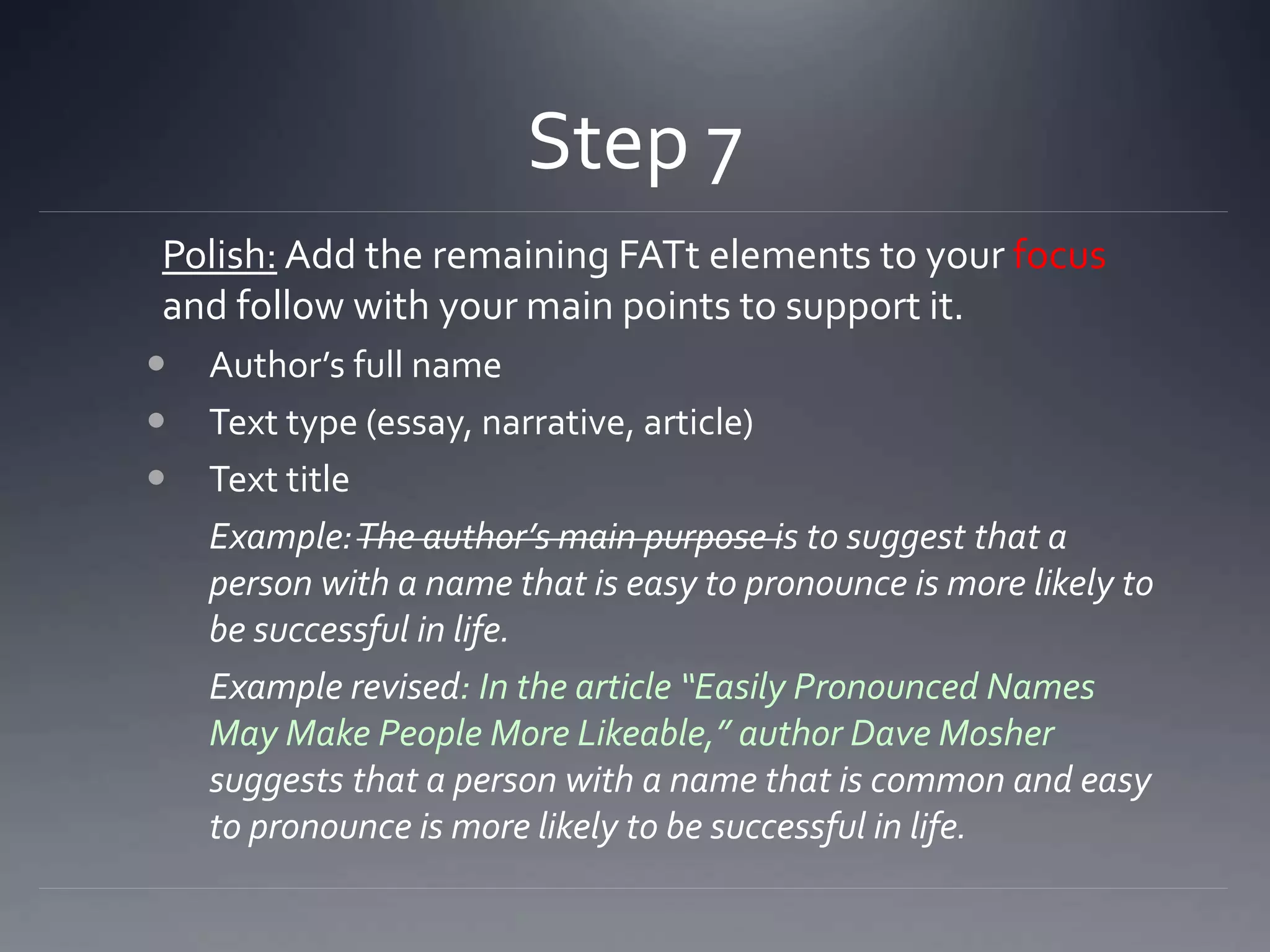
Step 7
Polish: Add the remaining FATt elements to your focus
and follow with your main points to support it.
 Author’s full name
 Text type (essay, narrative, article)
 Text title
Example:The author’s main purpose is to suggest that a
person with a name that is easy to pronounce is more likely to
be successful in life.
Example revised: In the article “Easily Pronounced Names
May Make People More Likeable,” author Dave Mosher
suggests that a person with a name that is common and easy
to pronounce is more likely to be successful in life.
Format
 Use standard paragraph form for your summary:
 Begin with your FATt Statement (topic sentence/thesis.) It
captures in one sentence the author’s main purpose or focus.
 Follow with 5-7 main points (supporting sentences)
 If possible, follow the same order as the reading to list these
points.

Summarizing

  • 2.
    Summarizing: what isit?  A condensed version of what you’ve read  Written in your own words; little to no quoted material  Includes the author’s main points along with a sentence that provides the title, author, text type, and focus (overall main idea).
  • 3.
    Summarizing: Not anEasyTask  Imagine it:You’ve just written your first summary and turned it in.You think you did okay, but then you get back your paper with comments. Your teacher has written one or more of the following in the margins:  You wrote down everything!  You wrote down nothing!  You wrote way too much!  You didn’t write select the right information to include!  You copied word for word and used too many quotes!  You wrote too much detail!  You didn’t write the author’s main focus/idea! ARRRGHHHHHHH!!!!!!YOU CAN’TWIN!!!!!!
  • 4.
    Now what?  Try,try again.  Summarizing takes time and practice. A lot of practice. Give yourself at least an hour to complete the assignment after you’ve finished reading.  By following the 6 summary steps in this presentation, you should be able to arrive at an overall idea/gist of whatever the author is trying to say.  To get to the overall idea, you are going to work backwards at achieving that.You will start with a lot of sentences and then reduce it down to main one.
  • 5.
    Summary Objective  Whenwriting a summary you want to accomplish 2 things: 1. The author’s main purpose or focus, which is ultimately written as a topic sentence at the beginning of the summary. 2. About 5-7 supporting sentences, which are a collection of main points that follow the topic sentence.
  • 6.
    Step 1  Annotate.As you read, keep a pen in hand. Underline keywords and take notes along the margins, next to each paragraph if you can.Try to jot down words that give you a clue for what each paragraph is about. Draw boxes/circles around paragraphs that seem to share the same topic.This will help to visual the “parts” of the reading.
  • 7.
    Step 2  Ona separate sheet of paper, list any keywords (words that repeat, stand out, etc). Names Roles of names Pronounceable success Comprehend Likeable and likability Judgment Writers use keywords as “sign posts” or ways of keeping you on track as you read. It isn’t coincidental that the author seems to be repeating him/herself!
  • 8.
    Step 3 3. Grouptogether keywords that overlap/share ideas by circling, underlining, etc. Names Roles of names Pronounceable Comprehend success Likeable and likeability Judgment You will refer to this list later when you are writing your focus, so keep it handy.
  • 9.
    Step 4  Returnto the original text where you jotted down notes along the margins.  Going chronologically through the reading, write a sentence for each paragraph on a separate sheet of paper. Each sentence should be the main idea of that particular paragraph.  Revisit the keywords you have grouped together to help you.  You will have a paper that is made up of many sentences.  P1: ______(main idea)_________  P2:______(main idea)_________  P3:______(main idea)_________  P4:______(main idea)_________
  • 10.
  • 11.
    Step 5 Refine andReduce: Go through your main points and erase any ideas that repeat or do not matter i.e. do not help one to better understand the text. Replace jumbled words/phrases with stronger, more precise words.Think less is more. Try to get your main points down to 5 sentences.
  • 12.
    Step 6 Focus:After rereadingyour 5-7 main points, determine the author’s overall purpose or focus for writing the text. What is he/she trying to tell us with these main points? Write this as one statement.You might start with one of these templates:  The author wants readers to understand…  Overall, the author argues that…  The author’s main purpose is… Example:The author’s main purpose is to suggest that a person with a name that is common and easy to pronounce is more likely to be successful in life.
  • 13.
    PAUSE  Your homeworkassignment ends here.  Your final product should be: 1. Your topic sentence, which includes a template from step 6 and the author’s focus 2. 5-7 additional supporting sentences (main ideas from the reading) that follow
  • 14.
    Step 7 Polish: Addthe remaining FATt elements to your focus and follow with your main points to support it.  Author’s full name  Text type (essay, narrative, article)  Text title Example:The author’s main purpose is to suggest that a person with a name that is easy to pronounce is more likely to be successful in life. Example revised: In the article “Easily Pronounced Names May Make People More Likeable,” author Dave Mosher suggests that a person with a name that is common and easy to pronounce is more likely to be successful in life.
  • 15.
    Format  Use standardparagraph form for your summary:  Begin with your FATt Statement (topic sentence/thesis.) It captures in one sentence the author’s main purpose or focus.  Follow with 5-7 main points (supporting sentences)  If possible, follow the same order as the reading to list these points.