Mathematical                 N
  Modeling
                        I O
                  A T
            I C
      P L          Applied


A P               Problems
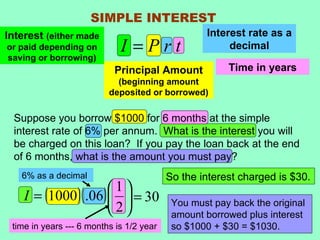
SIMPLE INTEREST
Interest (either made                              Interest rate as a
or paid depending on
saving or borrowing)
                             I =Prt                     decimal

                           Principal Amount            Time in years
                            (beginning amount
                          deposited or borrowed)

  Suppose you borrow $1000 for 6 months at the simple
  interest rate of 6% per annum. What is the interest you will
  be charged on this loan? If you pay the loan back at the end
  of 6 months, what is the amount you must pay?
   6% as a decimal                        So the interest charged is $30.
                       1
    I = (1000 )( .06 )   = 30            You must pay back the original
                       2                 amount borrowed plus interest
 time in years --- 6 months is 1/2 year    so $1000 + $30 = $1030.
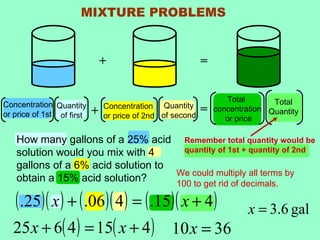
MIXTURE PROBLEMS


                               +                           =

                                                                  Total       Total
Concentration Quantity         Concentration Quantity
or price of 1st of first   +   or price of 2nd of second
                                                           =   concentration Quantity
                                                                  or price

   How many gallons of a 25% acid Remember total quantity would be
   solution would you mix with 4      quantity of 1st + quantity of 2nd

   gallons of a 6% acid solution to
                                    We could multiply all terms by
   obtain a 15% acid solution?      100 to get rid of decimals.

  ( .25)( x ) + ( .06)( 4) = ( .15)( x + 4)                             x = 3.6 gal
  25 x + 6( 4 ) = 15( x + 4 ) 10 x = 36
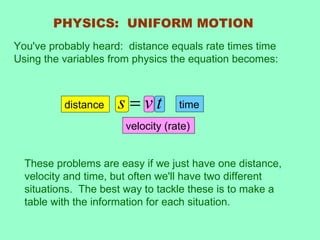
PHYSICS: UNIFORM MOTION
You've probably heard: distance equals rate times time
Using the variables from physics the equation becomes:


          distance   s=vt         time

                      velocity (rate)


  These problems are easy if we just have one distance,
  velocity and time, but often we'll have two different
  situations. The best way to tackle these is to make a
  table with the information for each situation.
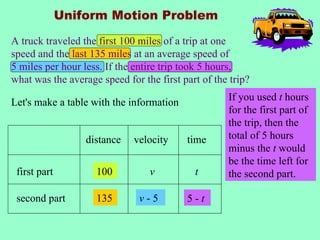
Uniform Motion Problem

A truck traveled the first 100 miles of a trip at one
speed and the last 135 miles at an average speed of
5 miles per hour less. If the entire trip took 5 hours,
what was the average speed for the first part of the trip?

Let's make a table with the information             If you used t hours
                                                    for the first part of
                                                    the trip, then the
                  distance   velocity     time      total of 5 hours
                                                    minus the t would
                                                    be the time left for
 first part         100          v          t       the second part.

 second part        135        v-5        5-t
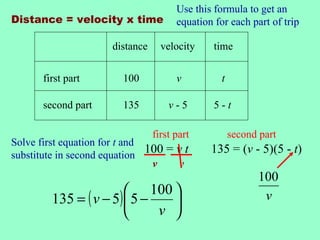
Use this formula to get an
Distance = velocity x time             equation for each part of trip

                      distance     velocity     time


       first part        100           v          t

       second part       135         v-5        5-t

                                 first part           second part
Solve first equation for t and
substitute in second equation
                               100 = v t       135 = (v - 5)(5 - t)
                                v    v
                                                            100
                         100 
         135 = ( v − 5)  5 −                               v
                             v 
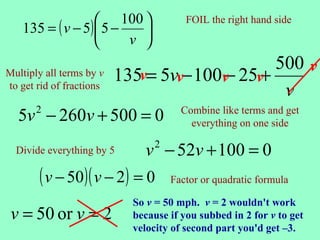
 100 
   135 = ( v − 5)  5 −
                                        FOIL the right hand side
                          
                       v 
                                               500 v
Multiply all terms by v   135v= 5vv− 100v 25v+
                                        −
to get rid of fractions
                                                v
  5v − 260v + 500 = 0
       2                               Combine like terms and get
                                         everything on one side

  Divide everything by 5      v − 52v + 100 = 0
                                 2


       ( v − 50)( v − 2) = 0         Factor or quadratic formula

                            So v = 50 mph. v = 2 wouldn't work
 v = 50 or v = 2            because if you subbed in 2 for v to get
                            velocity of second part you'd get –3.
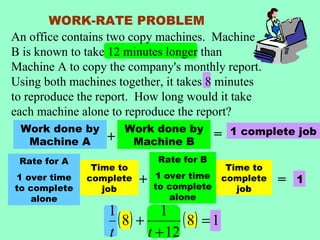
WORK-RATE PROBLEM
An office contains two copy machines. Machine
B is known to take 12 minutes longer than
Machine A to copy the company's monthly report.
Using both machines together, it takes 8 minutes
to reproduce the report. How long would it take
each machine alone to reproduce the report?
 Work done by         Work done by             1 complete job
  Machine A       +    Machine B
                                           =
 Rate for A                  Rate for B
               Time to                        Time to
1 over time                  1 over time
              complete   +   to complete
                                             complete   =   1
to complete      job                            job
    alone                       alone
                  1           1
                    ( 8) +        ( 8) = 1
                  t        t + 12
1           1
   ( 8) +        ( 8) = 1
 t        t + 12
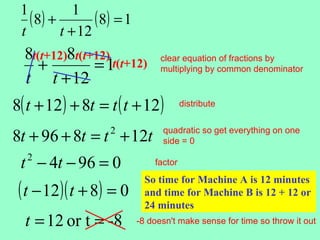
  8t(t+12)8t(t+12) t(t+12)
     +         =1
                                  clear equation of fractions by
                                  multiplying by common denominator
  t t + 12
8( t + 12 ) + 8t = t ( t + 12 )          distribute


8t + 96 + 8t = t + 12t
                    2             quadratic so get everything on one
                                  side = 0

 t − 4t − 96 = 0
   2                            factor


 ( t − 12)( t + 8) = 0
                              So time for Machine A is 12 minutes
                              and time for Machine B is 12 + 12 or
                              24 minutes
  t = 12 or t = -8          -8 doesn't make sense for time so throw it out

Sulalgtrig7e Isg 1 7

  • 1.
    Mathematical N Modeling I O A T I C P L Applied A P Problems
  • 2.
    SIMPLE INTEREST Interest (eithermade Interest rate as a or paid depending on saving or borrowing) I =Prt decimal Principal Amount Time in years (beginning amount deposited or borrowed) Suppose you borrow $1000 for 6 months at the simple interest rate of 6% per annum. What is the interest you will be charged on this loan? If you pay the loan back at the end of 6 months, what is the amount you must pay? 6% as a decimal So the interest charged is $30. 1 I = (1000 )( .06 )   = 30 You must pay back the original 2 amount borrowed plus interest time in years --- 6 months is 1/2 year so $1000 + $30 = $1030.
  • 3.
    MIXTURE PROBLEMS + = Total Total Concentration Quantity Concentration Quantity or price of 1st of first + or price of 2nd of second = concentration Quantity or price How many gallons of a 25% acid Remember total quantity would be solution would you mix with 4 quantity of 1st + quantity of 2nd gallons of a 6% acid solution to We could multiply all terms by obtain a 15% acid solution? 100 to get rid of decimals. ( .25)( x ) + ( .06)( 4) = ( .15)( x + 4) x = 3.6 gal 25 x + 6( 4 ) = 15( x + 4 ) 10 x = 36
  • 4.
    PHYSICS: UNIFORM MOTION You'veprobably heard: distance equals rate times time Using the variables from physics the equation becomes: distance s=vt time velocity (rate) These problems are easy if we just have one distance, velocity and time, but often we'll have two different situations. The best way to tackle these is to make a table with the information for each situation.
  • 5.
    Uniform Motion Problem Atruck traveled the first 100 miles of a trip at one speed and the last 135 miles at an average speed of 5 miles per hour less. If the entire trip took 5 hours, what was the average speed for the first part of the trip? Let's make a table with the information If you used t hours for the first part of the trip, then the distance velocity time total of 5 hours minus the t would be the time left for first part 100 v t the second part. second part 135 v-5 5-t
  • 6.
    Use this formulato get an Distance = velocity x time equation for each part of trip distance velocity time first part 100 v t second part 135 v-5 5-t first part second part Solve first equation for t and substitute in second equation 100 = v t 135 = (v - 5)(5 - t) v v 100  100  135 = ( v − 5)  5 −  v  v 
  • 7.
     100  135 = ( v − 5)  5 − FOIL the right hand side   v  500 v Multiply all terms by v 135v= 5vv− 100v 25v+ − to get rid of fractions v 5v − 260v + 500 = 0 2 Combine like terms and get everything on one side Divide everything by 5 v − 52v + 100 = 0 2 ( v − 50)( v − 2) = 0 Factor or quadratic formula So v = 50 mph. v = 2 wouldn't work v = 50 or v = 2 because if you subbed in 2 for v to get velocity of second part you'd get –3.
  • 8.
    WORK-RATE PROBLEM An officecontains two copy machines. Machine B is known to take 12 minutes longer than Machine A to copy the company's monthly report. Using both machines together, it takes 8 minutes to reproduce the report. How long would it take each machine alone to reproduce the report? Work done by Work done by 1 complete job Machine A + Machine B = Rate for A Rate for B Time to Time to 1 over time 1 over time complete + to complete complete = 1 to complete job job alone alone 1 1 ( 8) + ( 8) = 1 t t + 12
  • 9.
    1 1 ( 8) + ( 8) = 1 t t + 12 8t(t+12)8t(t+12) t(t+12) + =1 clear equation of fractions by multiplying by common denominator t t + 12 8( t + 12 ) + 8t = t ( t + 12 ) distribute 8t + 96 + 8t = t + 12t 2 quadratic so get everything on one side = 0 t − 4t − 96 = 0 2 factor ( t − 12)( t + 8) = 0 So time for Machine A is 12 minutes and time for Machine B is 12 + 12 or 24 minutes t = 12 or t = -8 -8 doesn't make sense for time so throw it out